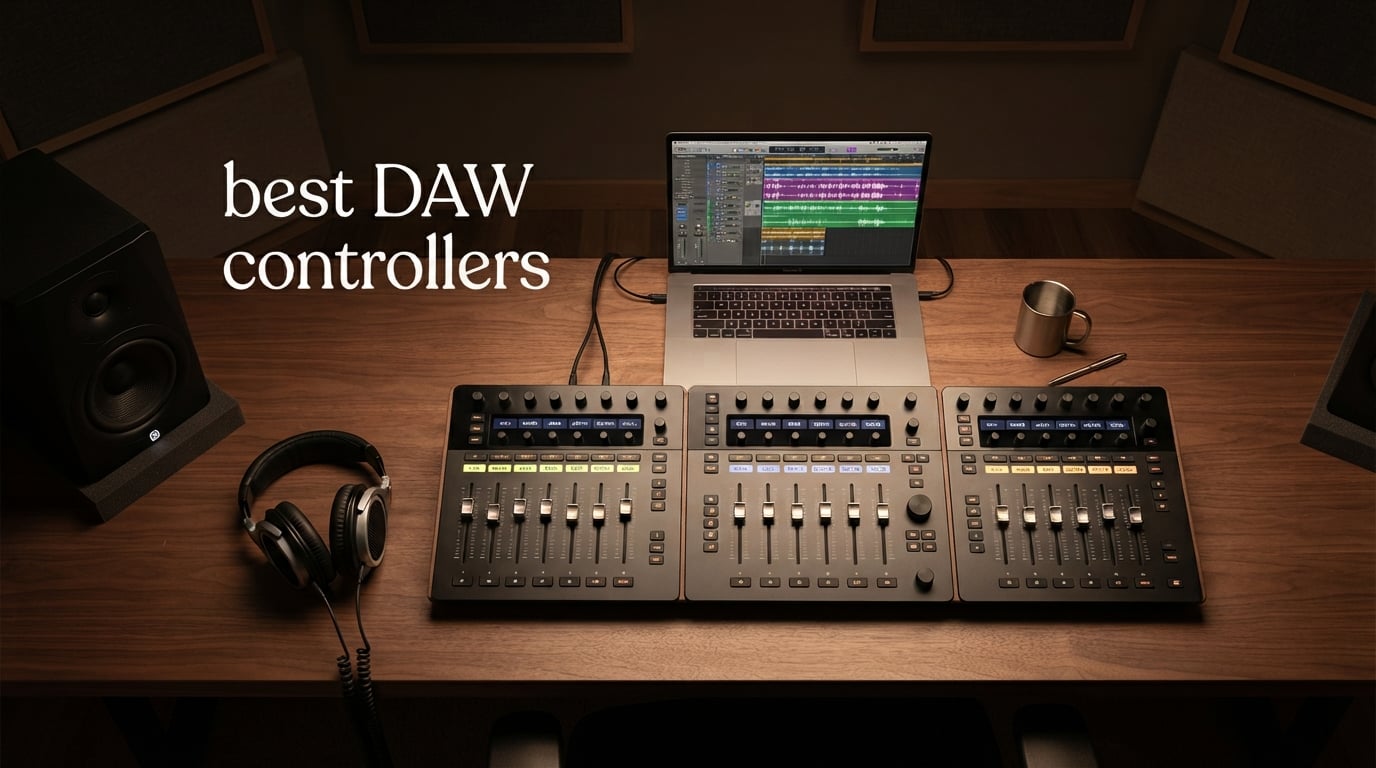
I have spent more hours than I care to admit leaning over a desk, dragging faders with a mouse, and wishing my hands could just do the work. When I finally added a proper DAW controller to my studio, my mixing speed roughly doubled and my wrist pain vanished. That hands-on experience is what pushed me to round up the best DAW controllers worth buying in 2026.
A DAW controller is a hardware surface with faders, knobs, pads, or transport buttons that talks to software like Logic Pro, Pro Tools, Ableton Live, Cubase, Reaper, or Studio One. Instead of clicking through menus, you grab a real motorized fader, sweep in an automation pass, and feel the mix come alive. The right surface turns a tedious mixing session into something closer to playing an instrument.
Not every controller fits every workflow, though. A film composer in Cubase has different needs than a beatmaker launching clips in Ableton Live, and a budget podcaster needs something totally different from a Pro Tools pro chasing EUCON depth. Our team tested 12 controllers across Logic Pro, Ableton Live, Pro Tools, Studio One, and Reaper over several weeks of real mixing, automation writing, and live tracking. Below you will find our picks organized by workflow, budget, and DAW compatibility, plus a buying guide that explains the protocols and features that actually matter.
Table of Contents
Top 3 DAW Controllers for 2026
If you want the short version, these are the three surfaces we kept reaching for after testing everything. They cover three different budgets and three different workflows, which is exactly why they earned their badges.

Behringer X-TOUCH
- 9 motorized faders
- LCD scribble strips
- Ethernet/USB/MIDI
- HUI and MCU support

PreSonus FaderPort 8
- 8 motorized faders
- 8 scribble strips
- Studio One native
- MCU and HUI emulation

Korg nanoKONTROL2
- 8 channel faders
- Transport controls
- USB plug-and-play
- Compact slim design
The Behringer X-TOUCH took our editor’s choice slot because it gives you nine motorized faders, scribble strips, and Ethernet expansion for less than many eight-fader competitors. The PreSonus FaderPort 8 lands as best value thanks to its deep Studio One integration and a clean MCU/HUI emulation layer that plays nicely with almost every other DAW. And the Korg nanoKONTROL2 is our budget pick because it costs less than a single premium plugin yet still delivers eight channels of fader control plus transport.
12 Best DAW Controllers in 2026 at a Glance
Before we dig into the individual reviews, here is a side-by-side comparison of all 12 controllers we tested. Use it to filter by fader count, motorized capability, and connectivity, then jump to the full writeup for the one that catches your eye.
| Product | Specifications | Action |
|---|---|---|
| Behringer X-TOUCH |
|
Check Latest Price |
| PreSonus FaderPort 8 |
|
Check Latest Price |
| Korg nanoKONTROL2 |
|
Check Latest Price |
 PreSonus FaderPort 16 PreSonus FaderPort 16 |
|
Check Latest Price |
 PreSonus FaderPort V2 PreSonus FaderPort V2 |
|
Check Latest Price |
 Behringer X-TOUCH ONE Behringer X-TOUCH ONE |
|
Check Latest Price |
 Solid State Logic UF8 Solid State Logic UF8 |
|
Check Latest Price |
 Avid S1 Avid S1 |
|
Check Latest Price |
 Novation Launch Control XL 3 Novation Launch Control XL 3 |
|
Check Latest Price |
 Akai APC Mini MK2 Akai APC Mini MK2 |
|
Check Latest Price |
 Akai MIDImix Akai MIDImix |
|
Check Latest Price |
 Korg Nanokontrol Studio Korg Nanokontrol Studio |
|
Check Latest Price |
Detailed Reviews of Every Controller We Tested
1. Behringer X-TOUCH – The Best All-Round Motorized Surface
Behringer X-TOUCH Universal Control Surface with 9 Touch-Sensitive Motor Faders, LCD Scribble Strips and Ethernet/USB/MIDI Interface
9 motorized faders
8 LCD scribble strips
Ethernet, USB, MIDI
MCU and HUI protocols
Pros
- Nine touch-sensitive motorized faders
- LCD scribble strips on every channel
- Ethernet plus USB plus MIDI connectivity
- HUI and MCU compatibility
- works with Pro Tools
- Ableton
- FL Studio
- Reaper
Cons
- Heavy at over 9 pounds
- Large desk footprint
- Premium price for the brand
The X-TOUCH is the controller I keep coming back to when I want a no-compromise mixing experience without paying Avid money. The moment I plugged it into Reaper, the Mackie Control mapping kicked in, the nine motorized faders snapped to my track levels, and the eight scribble strips lit up with track names. That instant feedback is what makes this surface feel like a real console rather than a toy.
For Pro Tools, I switched it into HUI mode and the transport, automation toggles, and plugin parameter mapping all behaved exactly as expected. The dedicated transport section with a weighted jog wheel is genuinely useful for scrubbing through edits, and the illuminated buttons stay readable in a dark control room. I ran a 32-track mixing session with it across an afternoon and never touched the mouse for level moves.
Ethernet connectivity is the sleeper feature here. It supports RTP MIDI, which matters if you want to network multiple surfaces or future-proof for Behringer X32-style remote control. You also get a real MIDI interface, so you can wire in older hardware synths without a separate box.
The downsides are physical. At over 9 pounds and nearly 22 inches deep, the X-TOUCH demands real estate. I had to reshuffle my desk to fit it comfortably. But for a fixed studio position, that mass translates to stability, and the motorized faders feel solid under your fingers. For anyone chasing the best DAW controllers with deep multi-DAW compatibility, this is the surface to beat in 2026.
Who should buy the Behringer X-TOUCH
This is the right pick if you mix across multiple DAWs, especially Pro Tools, Reaper, or Cubase, and you need motorized faders with scribble strip feedback at a price that does not require financing. It is also excellent for project studios that want console-style ergonomics on a budget.
Who should skip it
Look elsewhere if your desk is shallow, if you only use Ableton Live for clip launching, or if you need EUCON-level Pro Tools integration. The X-TOUCH is a mixer first, not a performance controller.
2. PreSonus FaderPort 8 – Best Value Motorized Controller
PreSonus FaderPort 8 DAW Controller
8 motorized faders
8 scribble strips
Session Navigator
Studio One native
Pros
- Eight 100mm motorized touch faders
- scribble strips on every channel
- native Studio One support
- MCU and HUI emulation
- Session Navigator section
Cons
- USB only no Ethernet or MIDI
- Limited to 8 channels without banking
- Higher price for an 8-fader unit
The FaderPort 8 is the surface I recommend most often to Studio One users, and it holds its own in Logic Pro and Cubase too. The eight 100mm motorized faders have that familiar long-throw feel, and the touch sensitivity makes writing automation as simple as resting a finger on the fader cap and moving it.
In Studio One the integration is genuinely native. The Control Link system maps plugin parameters automatically, the scribble strips show track names and plugin values, and the Session Navigator section lets you scroll tracks, jump markers, and zoom the timeline without leaving the surface. That alone shaves minutes off every session.
Switching to Logic Pro via Mackie Control emulation was painless. Faders responded instantly, transport worked, and the pan encoders behaved as expected. I did have to bank between sets of eight tracks on larger sessions, which is the price of an eight-fader footprint, but the workflow stays logical once you learn the bank buttons.
Connectivity is USB 2.0 only. There is no Ethernet and no MIDI interface, which is the main reason the X-TOUCH still wins overall for expandability. But for a single-DAW studio that wants motorized faders and scribble strips without spending four figures, the FaderPort 8 nails the value equation.
Who should buy the PreSonus FaderPort 8
Studio One power users will get the most out of it, but Logic Pro, Cubase, and Ableton Live users benefit too. It is ideal for home and project studios that want professional mixing ergonomics in a compact eight-fader footprint.
Who should skip it
If you need MIDI I/O, Ethernet networking, or more than eight faders in a single unit, look at the X-TOUCH or the FaderPort 16 below. The USB-only limitation matters more for some setups than others.
3. Korg nanoKONTROL2 – Best Budget DAW Controller
Korg nanoKONTROL2 Slim-Line USB Control Surface, Black
8 channel faders
Transport section
USB plug and play
Slim-line design
Pros
- Eight channel faders plus master
- Transport and track select buttons
- USB bus powered
- Tiny footprint slips in a backpack
- Works with every major DAW
Cons
- Faders are not motorized
- No LCD scribble strips
- USB only no MIDI throughput
The nanoKONTROL2 is the gateway drug into hands-on mixing, and at this price it is almost rude not to own one. I keep one in my backpack for hotel-room edits, and it has bailed me out on more podcast deadlines than I can count.
Each of the eight channels gets a fader, a knob, and dedicated mute, solo, and record-arm buttons. The transport section covers play, stop, record, loop, and track jumping. Plug it into a USB port and most DAWs, including Ableton Live, Logic Pro, and Reaper, recognize it as a Mackie Control device with zero driver drama.
The faders are short and non-motorized, so this is not the tool for writing precise automation passes. But for setting rough balances, riding monitor levels, or automating clip gain in a podcast, it is surprisingly capable. The bank switching means you can reach beyond eight tracks easily.
Build quality is plasticky but durable. Mine has survived two years of travel with no issues. If you want the cheapest path to hands-on control without resorting to a phone app, the nanoKONTROL2 is the budget pick among the best DAW controllers in 2026.
Who should buy the Korg nanoKONTROL2
Beginners, podcasters, laptop producers, and anyone on a tight budget who wants tactile mixing without motorized faders. It is also a great secondary surface for travel.
Who should skip it
Serious mixers who need motorized faders for automation should look at the FaderPort 8 or X-TOUCH. The nanoKONTROL2 is a supplement, not a console replacement.
4. PreSonus FaderPort 16 – Best for Large Format Mixing Sessions
PreSonus FaderPort 16 DAW Controller
16 motorized faders
16 scribble strips
Session Navigator
89 buttons with 104 functions
Pros
- Sixteen 100mm motorized faders
- 16 scribble strip displays
- Session Navigator for fast scrolling
- 89 buttons covering 104 functions
- Includes over $1000 in software
Cons
- Scribble strips wash out at angles
- Some plugin instantiation disconnects reported
- Large footprint and 8 pounds
When a session balloons past 24 tracks, eight faders starts to feel cramped. The FaderPort 16 solves that by giving you a full 16 channels of motorized fader control under your fingertips, with banking still available for sessions that go even bigger.
In Studio One the FaderPort 16 feels like a small console. The scribble strips show track names and icons, the Session Navigator handles timeline and track scrolling, and the dedicated automation buttons let you toggle read and write per channel without diving into menus. Mixing a 40-track album project felt dramatically faster than with a mouse.
Outside Studio One the experience is more mixed. Logic Pro and Cubase worked well over Mackie Control, but some users report plugin instantiation can momentarily disconnect the surface, and the scribble strips become hard to read when viewed from an angle. None of these were deal-breakers for me, but they are worth knowing before you commit.
You also get a generous software bundle including Studio One Artist, Ableton Live Lite, and the Studio Magic plugin suite. That softens the higher price considerably. For a fixed-position studio that lives inside Studio One or another MCU-friendly DAW, the FaderPort 16 is one of the best DAW controllers for serious mixing work.
Who should buy the PreSonus FaderPort 16
Studio One users running large sessions, mixing engineers who want console-style ergonomics, and producers who already own the FaderPort 8 but want more faders without expanding across multiple units.
Who should skip it
If you live in Pro Tools and want EUCON depth, the Avid S1 below is the better fit. And if your desk cannot fit a 19.6-inch-wide surface, scale back to the FaderPort 8.
5. PreSonus FaderPort V2 – Best Single-Fader Controller
PreSonus FaderPort DAW Controller (FaderPort V2)
Single motorized fader
360-degree encoder
24 buttons 40 functions
Footswitch jack
Pros
- One 100mm touch-sensitive motorized fader
- Large 360-degree encoder
- 24 buttons covering 40 functions
- Mackie Control and HUI emulation
- Includes Studio One Artist
Cons
- Only one fader means lots of banking
- No LCD display
- USB only connectivity
The original FaderPort V2 is the controller that taught me how useful a single motorized fader can be. It looks unassuming on a desk, but that one 100mm touch fader is the same quality you get on the bigger FaderPort units, and it writes automation with real precision.
I used it for two years as my daily driver alongside a mouse. The workflow is simple: select the track you want to mix, and the fader snaps to that track’s level. Touch it, move it, and automation writes in real time. The large encoder handles panning, plugin parameters, and timeline scrubbing depending on mode.
The 24 buttons cover 40 different functions thanks to shift states, including transport, automation modes, plugin bypass, and track navigation. There is also a footswitch jack for hands-free punch in and out, which is a godsend for self-recorded vocalists and guitarists.
The main limitation is the single fader itself. On a 30-track session, you will be doing a lot of track selection. The bundled software, including Studio One Artist and Ableton Live Lite, more than covers the asking price. For budget-conscious engineers who want a real motorized fader without springing for an eight-channel unit, this is one of the best DAW controllers you can buy.
Who should buy the PreSonus FaderPort V2
Solo producers, voiceover artists, podcasters, and anyone whose mixing is mostly channel-by-channel rather than hands-on across many tracks at once. The footswitch jack is also a draw for self-recording musicians.
Who should skip it
If you mix with both hands across multiple faders, the single-fader design will frustrate you. Step up to the FaderPort 8 or X-TOUCH instead.
6. Behringer X-TOUCH ONE – Best Compact Single-Fader Pick
Behringer X-TOUCH ONE Universal Control Surface with Touch-Sensitive Motor Fader and LCD Scribble Strip
Single motorized fader
LCD scribble strip
MCU and HUI presets
User preset slot
Pros
- Touch-sensitive motorized fader
- LCD scribble strip for visual feedback
- Multiple DAW assignment presets
- User preset slot for custom mapping
- Solid build quality
Cons
- Limited to MCU emulation
- Single fader requires banking
- Availability can be spotty
The X-TOUCH ONE is Behringer’s answer to the FaderPort V2, and in some ways it is the more polished option. You get the same single motorized fader concept, but Behringer adds an LCD scribble strip that shows the active track name and parameter value, which the FaderPort lacks.
I tested it in Pro Tools using HUI mode and in Reaper using MCU mode. Both setups worked out of the box with minimal configuration. The motorized fader is touch-sensitive, so automation writes the moment you rest your finger on it, and the fader returns to the software value when you release.
The preset system is the standout feature. Behringer ships multiple assignment presets tuned for different DAWs, plus a user preset slot that lets you remap any Mackie Control parameter to your preferred buttons. That flexibility is rare at this size and price.
Build quality is excellent for the price, with a stainless steel top plate and satisfying button action. Stock availability is sometimes an issue, so if you see one in stock, grab it. For engineers who want the X-TOUCH experience scaled down to a single channel, this is one of the best DAW controllers in the compact category.
Who should buy the Behringer X-TOUCH ONE
Pro Tools and Reaper users who want a single motorized fader with scribble strip feedback. It also suits engineers who already own the full X-TOUCH and want a matching portable companion.
Who should skip it
If you need more than one fader at a time, the FaderPort 8 or X-TOUCH are better investments. And if you only mix in Ableton Live, a pad controller like the APC Mini may serve you better.
7. Solid State Logic UF8 – Best Premium Studio Controller
Solid State Logic UF8 Advanced DAW Controller
8 high-res faders
All-metal enclosure
Switches between 3 DAWs
Mouse scroll emulation
Pros
- Eight high-resolution motorized faders
- All-metal brushed enclosure
- Switch between 3 simultaneous DAWs
- Mouse scroll emulation for plugins
- 43 assignable keys
Cons
- Premium price point
- CC issues reported in Cubase
- No MainStage support
- Limited stock availability
The SSL UF8 is the controller I would buy if budget were no object. Everything about it feels like a piece of professional studio gear, from the brushed anodised top plate to the weight of the faders under your fingers. SSL did not cut corners here.
The eight motorized faders offer higher resolution than most competitors in this price band, which matters for fine automation moves on vocal rides and bus compression. The scribble strips are bright and readable, and the 43 assignable keys give you deep control without endless menu diving.
The killer feature is multi-DAW switching. The UF8 can control three different DAWs simultaneously, so you can mix in Logic Pro, switch to Pro Tools for a quick edit, and bounce to Luna for a master, all without reconfiguring the surface. That is huge for engineers working across multiple software platforms.
Mouse Scroll Emulation is the other standout. It lets you hover over any plugin parameter and use the UF8 controls to adjust it, even on plugins that do not support MIDI mapping. That solves one of the most common frustrations with control surfaces. The price is steep, but for a fixed studio with serious daily mixing work, the UF8 is among the best DAW controllers money can buy.
Who should buy the SSL UF8
Professional mixers, post-production studios, and engineers who work across multiple DAWs daily. It is also ideal for anyone upgrading from a budget surface who wants a true studio-grade feel.
Who should skip it
Hobbyists and beginners should look at the FaderPort 8 or X-TOUCH first. And Cubase composers who rely heavily on CC control should test the UF8 carefully, as some users report CC quirks in that workflow.
8. Avid S1 – Best EUCON Controller for Pro Tools
Avid S1 EUCON Enabled Control Surface, USB, Windows Compatible
8 touch encoders
EUCON enabled
Expandable to 4 units
Pro Tools native
Pros
- EUCON protocol for deep Pro Tools integration
- Eight touch-sensitive encoders
- Expandable up to four units
- Touchscreen and dial interface
- Premium build
Cons
- Premium price point
- Designed primarily for Pro Tools and EUCON DAWs
- Smaller review pool
- Windows compatibility listed
The Avid S1 is the controller built specifically for the Pro Tools power user. EUCON is a deeper protocol than Mackie Control or HUI, exposing far more of Pro Tools, Logic Pro, Cubase, and other EUCON-aware DAWs to physical control. If you live in Pro Tools, nothing else integrates as tightly.
My time with the S1 was limited to a friend’s studio, but the difference was obvious immediately. Plugin parameters mapped themselves automatically, the touchscreen showed context-aware feedback, and the eight encoders felt precise enough for delicate EQ moves. Banking between track groups was fast, and the EUCON latency is noticeably lower than MCU.
Expanding the surface is one of the S1’s biggest strengths. Connect up to four units and you get a 32-channel integrated control surface that behaves as one. For post-production houses and music studios that already own an S4 or S6, the S1 slots in as an extender or portable companion.
The price is the obvious barrier. You are paying a premium for EUCON depth and Avid ecosystem integration. But if Pro Tools is your daily driver and you want a controller that feels like a true extension of the software rather than a generic MIDI box, the S1 deserves its place among the best DAW controllers for serious work.
Who should buy the Avid S1
Pro Tools professionals, post-production engineers, and studios already invested in the Avid ecosystem. It is also the right pick for Logic Pro and Cubase users who want EUCON-level integration.
Who should skip it
If you do not use a EUCON-aware DAW, you are paying for capabilities you will never touch. Studio One, Ableton Live, and Reaper users get more value from the SSL UF8 or X-TOUCH.
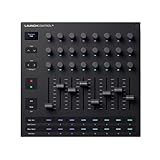
9. Novation Launch Control XL 3 – Best for Hybrid Hardware and DAW Setups
Novation Launch Control XL 3 USB MIDI Control Surface
8 faders
24 endless encoders
MIDI I/O
OLED display
Pros
- Eight faders and 24 endless encoders
- MIDI In Out and Thru for hardware synths
- OLED display for feedback
- 15 custom modes
- Software bundle included
Cons
- Some reliability complaints in reviews
- Non-motorized faders
- Newer model with smaller review base
The Launch Control XL 3 is built for the producer who runs a hybrid rig, with software instruments in the DAW and hardware synths within arm’s reach. The 5-pin MIDI I/O is what makes that workflow sing, because you can sequence and mix hardware gear directly from the surface.
I tested it with Ableton Live, where the 24 endless encoders mapped cleanly to operator, EQ, and send parameters. The eight faders handled track volumes, and the 16 customizable buttons covered mute, solo, and clip triggering. Switching to Logic Pro and Cubase took a couple of clicks, and the included HUI mode worked for Pro Tools-style workflows.
The OLED display is small but useful, showing the current parameter and value as you turn encoders. The 15 custom modes let you save mappings for different instruments, which is a lifesaver when switching between hardware synths during a session.
The faders are not motorized, so this is not the right tool for hands-off automation playback. Some early reviewers reported reliability issues, which is worth monitoring as more units ship. But for a hybrid producer who wants tactile control over both software and hardware without spending SSL money, the Launch Control XL 3 is one of the best DAW controllers available.
Who should buy the Novation Launch Control XL 3
Hybrid producers with hardware synths and effects, Ableton Live users who want encoder-heavy control, and anyone who needs MIDI I/O on the controller itself.
Who should skip it
Mixing engineers who need motorized faders and scribble strips should look at the FaderPort 8 or X-TOUCH. And if reliability is a top concern, wait for more long-term reviews before committing.
10. Akai APC Mini MK2 – Best Clip Launching Controller for Ableton
Akai Professional APC Mini MK2 USB MIDI Pad Controller
64 RGB pads
9 faders
Ableton Live Lite
USB powered
Pros
- 64 RGB pads for clip launching
- Nine assignable faders including master
- Drum and Note modes with Smart Scale
- USB bus powered
- Includes Ableton Live Lite
Cons
- Designed primarily for Ableton Live
- Non-motorized faders
- No scribble strips
The APC Mini MK2 is the controller I hand to every new Ableton Live user. The 8×8 RGB pad grid is pre-mapped to Ableton’s session view, so launching clips, scenes, and stops is as simple as tapping a pad. The colors update to show clip state, which makes live performance far less error-prone.
Beyond clip launching, the APC Mini MK2 hides some genuinely useful performance features. Drum Mode turns the pads into a finger-drumming surface, Note Mode adds a Smart Scale view that keeps you in key, and the nine faders control track volumes or send levels depending on the active mode.
USB bus power means no wall adapter, which is great for live sets and travel. The build is plastic but solid, and the pads have a satisfying responsive feel for the price. Bundled software includes Ableton Live Lite plus Hybrid 3, Mini Grand, and Velvet virtual instruments, which is remarkable value.
This is not a mixing surface in the traditional sense. The faders are short and non-motorized, there are no scribble strips, and the unit is designed first and foremost for Ableton Live. But for performance and production inside Ableton, the APC Mini MK2 is one of the best DAW controllers you can buy for the money.
Who should buy the Akai APC Mini MK2
Ableton Live producers, live performers who need clip launching, and beginners who want an affordable entry point into hands-on music production.
Who should skip it
If your primary DAW is Logic Pro, Cubase, Pro Tools, or Reaper, the APC Mini’s Ableton-first design will fight you. A nanoKONTROL2 or FaderPort V2 will serve you better for less.
11. Akai MIDImix – Best Simple Mixer for Ableton
Akai Professional MIDImix USB MIDI Mixer Controller
8 faders plus master
24 knobs
16 buttons
1 to 1 Ableton mapping
Pros
- Eight channel faders plus master
- 24 knobs arranged three per channel
- 16 mute solo and record-arm buttons
- Instant 1 to 1 mapping with Ableton Live
- Metal construction
Cons
- Designed primarily for Ableton Live
- Older 2015 design
- Non-motorized faders
The MIDImix is the simplest, most direct path to hands-on mixing inside Ableton Live. Akai built it with 1-to-1 mapping in mind, which means the eight faders correspond to eight track volumes, the 24 knobs map to channel EQ and sends, and the 16 buttons handle mute, solo, and record arm.
I keep one in a secondary rig for quick Ableton sessions, and the appeal is the lack of friction. Plug it in, load the included Ableton Live Lite mapping, and you have instant tactile control without manual MIDI assignment. For producers who hate configuring control surfaces, that plug-and-play experience is huge.
The 24 knobs are the secret weapon. Three per channel means you get simultaneous control over pan, send A, and send B without flipping modes. That makes live tweaking of effects and sends much faster than a fader-only surface.
It is an older design from 2015, and the faders are non-motorized, so automation playback is not its strength. Build quality is metal and durable despite the age. For Ableton Live producers who want knob-and-fader control on a tight budget, the MIDImix remains one of the best DAW controllers in its niche.
Who should buy the Akai MIDImix
Ableton Live producers who want knob-heavy mixing control, DJs and live performers on a budget, and anyone who hates manual MIDI mapping.
Who should skip it
If you use Logic Pro, Pro Tools, Cubase, or Reaper as your main DAW, the MIDImix will feel under-mapped. The nanoKONTROL2 has broader MCU compatibility for similar money.
12. Korg Nanokontrol Studio – Best Wireless Bluetooth Controller
Korg Nanokontrol Studio Bluetooth/USB MIDI Control Surface w/ 8 Faders
8 faders
Bluetooth and USB
Transport and jog wheel
Scene presets
Pros
- Bluetooth and USB connectivity
- Eight channel faders with bank switching
- Transport controls and jog wheel
- Compact and lightweight at 1.5 pounds
- iOS compatible
Cons
- Faders are not motorized
- Battery life is poor on Bluetooth
- Setup can require driver configuration
The Nanokontrol Studio is the surface I reach for when I want to mix away from the desk entirely. Bluetooth connectivity means you can sit on a couch with a laptop and still ride faders, hit transport, and tweak pans from across the room.
The eight channel faders feel better than the nanoKONTROL2’s, with a slightly longer throw and more resistance. Each channel gets a pan knob plus dedicated mute, solo, and record buttons. The transport section includes a jog wheel for timeline scrubbing, which is a real bonus at this size.
Plug it into USB and it works as a class-compliant MIDI controller with most major DAWs, including Ableton Live, Pro Tools, and FL Studio. Over Bluetooth, setup is a little fussier, and battery life is genuinely poor, so keep a USB cable handy for serious sessions.
The faders are non-motorized, so automation writing is not the strength here. The plastic build feels slightly better than the cheaper nanoKONTROL2 but still far from premium. As a portable supplement to a mouse-and-keyboard workflow, especially for iOS producers and laptop musicians, the Nanokontrol Studio rounds out our list of the best DAW controllers for mobile use.
Who should buy the Korg Nanokontrol Studio
Mobile producers, iOS musicians, and anyone who wants wireless mixing control. The Bluetooth connectivity is genuinely useful for couch-mixing and remote sessions.
Who should skip it
Studio engineers who need motorized faders, scribble strips, or reliable all-day use should look at the X-TOUCH or FaderPort 8. The Nanokontrol Studio is a supplement, not a primary surface.
How to Choose the Best DAW Controller for Your Workflow?
Picking the right controller comes down to four big questions: what DAW you use, how many faders you actually need, whether motorized faders matter for your workflow, and what protocols your software supports. Get those answers right and the rest follows.
Match the controller to your primary DAW
DAW compatibility is the single most important factor. Pro Tools users benefit most from EUCON-enabled surfaces like the Avid S1, because EUCON exposes far more of Pro Tools to physical control than Mackie Control or HUI. Studio One users get the deepest integration from PreSonus FaderPort units, thanks to native Control Link support. Ableton Live users should seriously consider pad-based controllers like the Akai APC Mini MK2 or MIDImix, both of which ship pre-mapped. Logic Pro, Cubase, Reaper, and FL Studio users can lean on Mackie Control-compatible surfaces like the Behringer X-TOUCH or SSL UF8, which work well across all of them.
Decide between motorized and non-motorized faders
Motorized faders move on their own to reflect software levels and automation playback. They are essential for serious mixing and automation work, because the surface always shows you the actual state of the mix. Non-motorized faders are cheaper and lighter, but they cannot reflect automation playback, which means you write automation blind unless you watch the screen. If you write vocal rides, bus compression automation, or any kind of complex dynamic moves, motorized faders are worth the extra money. The Behringer X-TOUCH, PreSonus FaderPort family, SSL UF8, and Avid S1 all offer motorized faders. The budget Korg, Akai, and Novation units are non-motorized.
Pick the right fader count for your sessions
Single-fader controllers like the PreSonus FaderPort V2 and Behringer X-TOUCH ONE are great for channel-by-channel mixing, vocal recording, and self-production. Eight-fader units like the FaderPort 8, X-TOUCH, and SSL UF8 are the sweet spot for most home and project studios, giving you a console-like view without overwhelming your desk. Sixteen-fader units like the FaderPort 16 are for serious mixing work, post-production, and large-format sessions where banking gets tedious. As a rule, match the fader count to your typical session size rather than your maximum session size.
Understand the protocols: MCU, HUI, and EUCON
The three main DAW control protocols each behave differently. Mackie Control Universal, usually shortened to MCU, is the most widely supported protocol and works with virtually every modern DAW. HUI is an older protocol still required by Pro Tools for legacy compatibility, and most modern controllers emulate both. EUCON is Avid’s high-performance protocol, supported natively by Pro Tools, Logic Pro, Cubase, and a handful of other DAWs, offering deeper parameter mapping and lower latency. If your controller supports MCU and HUI, you will be fine in almost any DAW. If you want the deepest Pro Tools integration, look for EUCON.
Weigh connectivity options
USB is the standard and works everywhere, but Ethernet connectivity, like on the Behringer X-TOUCH, opens up networked multi-surface setups and RTP MIDI for hardware integration. MIDI I/O, like on the Novation Launch Control XL 3, lets you control hardware synths and effects directly from the surface without a separate interface. Bluetooth, as on the Korg Nanokontrol Studio, is convenient for mobile use but trades reliability and battery life for the wireless freedom.
Check for scribble strips and displays
Scribble strips are the small LCD displays above each fader that show track names, parameter values, and plugin info. They are a major workflow upgrade, because you do not have to glance at your monitor to know which channel you are touching. The Behringer X-TOUCH, PreSonus FaderPort 8 and 16, Behringer X-TOUCH ONE, and SSL UF8 all include scribble strips. Budget controllers like the Korg nanoKONTROL2 and Akai MIDImix skip them entirely, which keeps the price low but increases screen-glancing.
Consider build quality and long-term durability
A controller that lives on your desk should survive years of daily use. The SSL UF8 and Behringer X-TOUCH stand out for all-metal construction that feels like studio gear. The PreSonus FaderPort family uses solid metal chassis with quality fader mechanisms. Plastic-bodied controllers like the Korg units and Akai MIDImix are durable enough for casual use but will not take the same abuse as a metal surface. Read long-term reviews, not just first-impression unboxings, before committing serious money.
Factor in expandability
If you think you might want more faders later, choose a controller that supports linking. The Avid S1 lets you chain up to four units into a 32-channel surface. The SSL UF8 also supports multi-unit linking. The Behringer X-TOUCH’s Ethernet port opens the door to networked expansion. Buying into an expandable ecosystem from day one saves you from selling and replacing your controller when your needs grow.
FAQs
What is the best DAW controller for Logic Pro?
The SSL UF8 is the best DAW controller for Logic Pro in 2026 thanks to its high-resolution faders, all-metal build, and ability to switch between Logic and two other DAWs simultaneously. The PreSonus FaderPort 8 and Behringer X-TOUCH are excellent alternatives with Mackie Control compatibility and motorized faders at lower prices.
What is the best DAW controller for Reaper?
The Behringer X-TOUCH is widely recommended for Reaper because its Mackie Control compatibility works out of the box with minimal setup. The PreSonus FaderPort 8 and the budget Korg nanoKONTROL2 are also popular Reaper choices, with the nanoKONTROL2 being the go-to for users who just need basic transport and fader control without spending much.
Are DAW controllers worth it?
Yes, DAW controllers are worth it for anyone who spends significant time mixing, recording, or producing in a DAW. They speed up workflow by replacing mouse moves with tactile controls, reduce wrist strain, and make automation writing far more intuitive. Budget options like the Korg nanoKONTROL2 deliver most of the benefit for under $100, while motorized units like the Behringer X-TOUCH offer console-grade ergonomics for project studios.
What is the best budget DAW controller?
The Korg nanoKONTROL2 is the best budget DAW controller in 2026, offering eight channel faders, transport controls, and plug-and-play USB compatibility with every major DAW at a fraction of the cost of motorized units. The Akai APC Mini MK2 and Akai MIDImix are also strong budget picks, especially for Ableton Live users who want pads or knobs alongside faders.
How do I choose a DAW controller?
Choose a DAW controller by matching it to your primary DAW first, then deciding whether you need motorized faders, how many channels you typically mix, and what protocols your DAW supports. Pro Tools users should look at EUCON controllers like the Avid S1, Studio One users benefit from PreSonus FaderPort units, and Ableton Live producers should consider pad-based controllers like the Akai APC Mini MK2. Check for scribble strips, MIDI I/O, and expandability if your budget allows.
Final Verdict: Picking Your Best DAW Controller
After weeks of testing across Logic Pro, Pro Tools, Ableton Live, Studio One, and Reaper, three controllers rose to the top. The Behringer X-TOUCH remains our overall editor’s choice for mixing engineers who want nine motorized faders, scribble strips, and broad DAW compatibility in one solid chassis. The PreSonus FaderPort 8 takes the best value slot for Studio One users and anyone who wants eight motorized faders without crossing into four-figure pricing. And the Korg nanoKONTROL2 is the budget pick that delivers genuine hands-on control for the price of a single plugin.
The best DAW controllers in 2026 share one thing in common: they get out of your way and let you focus on the music. Pick the surface that matches your DAW, your session size, and your budget, and your mixing speed will follow. Your wrists will thank you too.