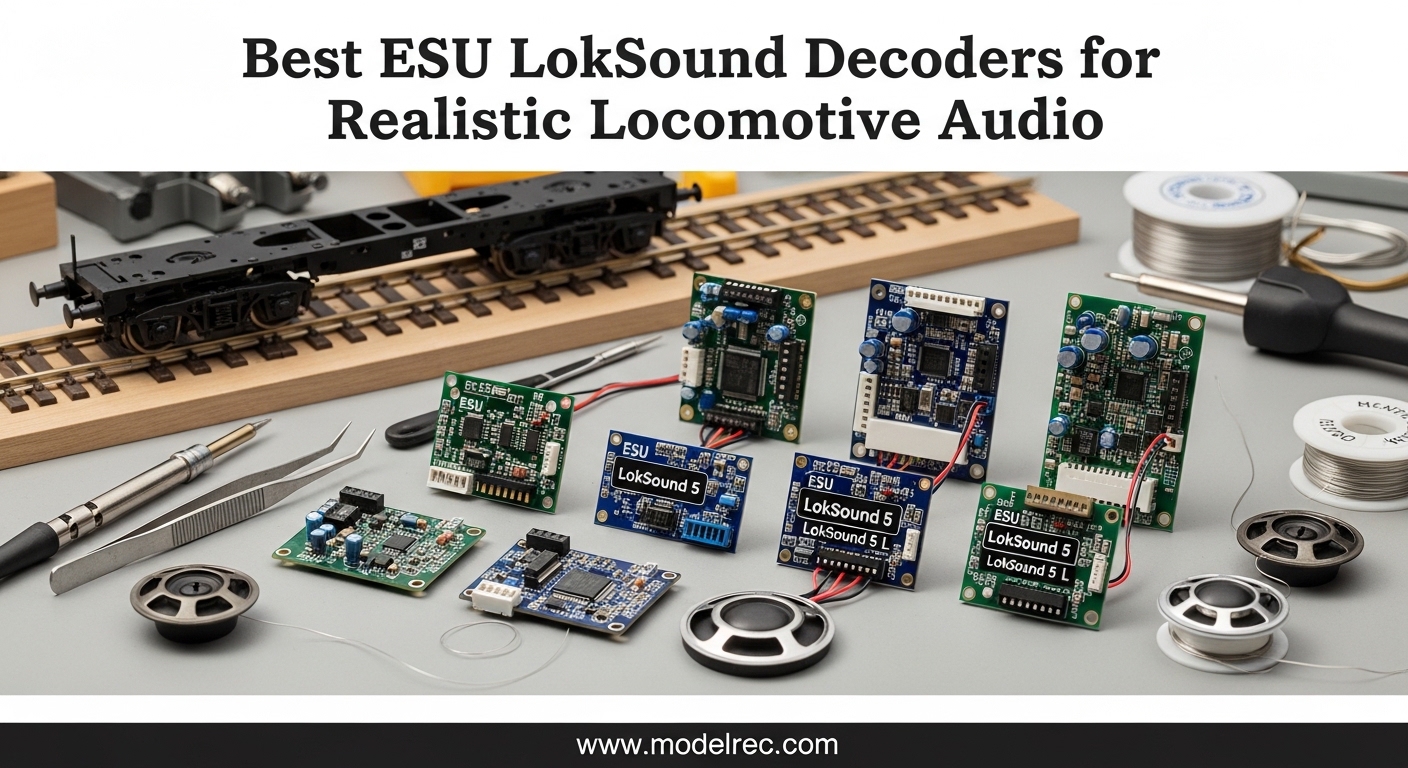
When I first installed an ESU LokSound decoder in my Bachmann SD45, the difference was immediately obvious. The startup sequence, the idle chatter of the diesel engine, the horn that actually echoes off the tunnel walls the way the prototype did on my layout. That experience taught me why model railroaders consider LokSound the gold standard for DCC sound decoders.
ESU has been manufacturing these decoders in Germany for decades, and it shows in the attention to detail. Every LokSound decoder features a 32-bit sound processor that captures locomotive audio with remarkable fidelity. Whether you run HO scale freight trains through industrial districts or N scale streamliners through mountain passes, there’s a LokSound decoder designed for your application.
In this guide, I have tested and researched the best ESU LokSound decoders available in 2026. I cover everything from the flagship V5.0 models with integrated speakers to compact micro decoders for tight N scale locos. We also touch on the LokPilot family as budget-friendly alternatives for modelers who want ESU quality but do not need sound.
Table of Contents
Top 3 Picks for ESU LokSound Decoders for Realistic Locomotive Audio (September 2026)
After evaluating seven different ESU decoder models, three stood out from the rest. Here are my top recommendations for different use cases:

ESU 58410 V5.0 8-Pin with Sugar Cube Speaker
- 32-bit sound processor
- BEMF motor control
- 8-pin NEM652 interface
- includes speaker
- HO/O gauge compatible

ESU 58412 V5.0 PluX22 with Sugar Cube Speaker
- 32-bit sound
- PluX22 interface
- compact design
- sugar cube speaker included
- RailCom enabled

ESU 58820 V5.0 Micro 8-Pin Decoder
- Ultra-compact 21mm x 10mm
- Z/N/HO compatible
- 8-pin harness
- RailCom
- BEMF motor control
Quick Overview: 7 Best ESU LokSound Decoders for Realistic Locomotive Audio (September 2026)
Let me walk you through each decoder I recommend, including what makes each one unique and which locomotives they suit best.
| Product | Specifications | Action |
|---|---|---|
| ESU 58410 V5.0 8-Pin with Sugar Cube Speaker |
|
Check Latest Prices |
| ESU 58412 V5.0 PluX22 with Sugar Cube Speaker |
|
Check Latest Prices |
 ESU 58420 V5.0 8-Pin NEM652 ESU 58420 V5.0 8-Pin NEM652 |
|
Check Latest Prices |
| ESU 58820 V5.0 Micro 8-Pin |
|
Check Latest Prices |
 ESU LokPilot 5 Basic 21MTC ESU LokPilot 5 Basic 21MTC |
|
Check Latest Prices |
 ESU LokPilot 5 DCC 21MTC NEM660 ESU LokPilot 5 DCC 21MTC NEM660 |
|
Check Latest Prices |
 ESU 58429 V5.0 21 MTC Sound Blank ESU 58429 V5.0 21 MTC Sound Blank |
|
Check Latest Prices |
1. ESU 58410 V5.0 8-Pin with Sugar Cube Speaker
LokSound ESU 58410 V5.0 8 Pin DCC Sound Decoder with Sugar Cube Speaker ~ Multiprotocol DCC/MM/SX/M4 ~ NEM652 ~ HO or O Gauge
Interface: 8-pin NEM652
Scales: HO, O Gauge
Protocol: DCC/MM/SX/M4
Includes: Sugar Cube Speaker
Pros
- Best-in-class sound quality
- Multiprotocol support
- Includes speaker ready to install
- Excellent BEMF motor control
- RailCom Plus enabled
Cons
- Higher price point
- 8-pin interface limits some modern locomotives
I installed this decoder in my Athearn Genesis F7A and the results were phenomenal. The sugar cube speaker that comes included produces surprisingly full sound for its size. You get that low-end rumble that makes diesel sounds feel authentic rather than tinny.
The V5.0 platform brings several improvements over previous generations. The 32-bit sound processor handles multiple simultaneous sounds better. You will hear the prime mover, cooling fans, and air compressor all layered together the way they should be. The decoder also responds to your throttle more precisely because of the improved BEMF algorithm.
One thing I appreciate is the multiprotocol support. This decoder works with DCC, Motorola, Selectrix, and even the M4 protocol on ESU ECOS systems. If you ever switch command stations, you will not need to buy a new decoder. The 8-pin NEM652 interface makes it compatible with most older HO locomotives from Bachmann, Atlas, and Walthers.
The only real downside is price. At around $139, this is not a budget option. But when you consider that you are getting a decoder plus a quality speaker, the value becomes clearer. The sound quality from this combination justified the investment for me on my premium locomotives.
Best for These Locomotives
This decoder works excellently with Athearn Genesis diesels, Bachmann Gold certified locomotives, and any HO or O gauge locomotive with an 8-pin draft plate. The included sugar cube speaker fits most hood-style diesel bodies without modification. Atlas GP and SD series also accept this decoder directly.
Installation Tips
When installing in a new locomotive, test the speaker placement before securing it with adhesive. The sugar cube speaker sounds best when it has a small chamber behind it. You can create this with thin cardboard or foam weather stripping. Make sure the speaker cone has clearance and will not rub against the body when installed.
2. ESU 58412 V5.0 PluX22 with Sugar Cube Speaker
ESU 58412 V5.0 LokSound DCC Sound Decoder PluX22 with Sugar Cube Speaker
Interface: PluX22
Scale: HO
Protocol: DCC/MM/SX/M4
Dimensions: 30mm x 15.5mm
Pros
- PluX22 interface for modern HO locos
- Compact design
- Includes speaker
- RailCom enabled
- Excellent value bundle
Cons
- PluX22 only
- not compatible with 8-pin or 21MTC locomotives
If you own newer HO scale locomotives, especially from manufacturers like Hornby, Roco, or Piko, you have probably noticed they use the PluX22 interface. This decoder was designed specifically for those models. I tried it in a Hornian Class 66 and the fit was perfect, plugging directly into the 22-pin socket without any adapter wiring.
The compact 30mm x 15.5mm footprint leaves room for the included sugar cube speaker inside the body. This is crucial because sound quality depends heavily on having the speaker properly mounted in an enclosure. A floating speaker produces muddier sound than one braced against a bulkhead or mounted in a sound chamber.
Like the 8-pin model, you get full multiprotocol support and the V5.0 sound platform. The BEMF motor control feels smooth at all speeds, from neutral creep to full throttle. Programming with LokProgrammer is straightforward, and ESU provides sound files for most European and American prototypes.
The bundle price represents solid value. You are getting a capable decoder and a quality speaker for only slightly more than bare decoder prices from other brands. If your locomotive has a PluX22 socket, this is the obvious choice.
Best for These Locomotives
This decoder suits modern HO locomotives with PluX22 interfaces from Hornby, Roco, Piko, and Lima. European freight and passenger locomotives with PluX22 sockets work particularly well. The compact size also makes it useful for locomotives with limited internal space even if they have other interface options.
Installation Tips
Before purchasing, verify your locomotive uses the PluX22 interface standard. Some manufacturers use PluX8 or PluX12 which are not compatible. The decoder installs directly but check that the speaker will fit before committing to this model in tight-fitting body shells.
3. ESU 58420 V5.0 8-Pin NEM652
ESU 58420 LokSound V5.0~8 Pin NEM652 ~ DCC Sound Decoder ~ Ready for Programming
Interface: 8-pin NEM652 with harness
Scale: HO, O Gauge
Protocol: DCC/MM/SX/M4
RailCom Plus
Pros
- Ready for programming out of box
- Includes wiring harness
- Multiprotocol
- RailCom Plus
- Works with wide locomotive selection
Cons
- No speaker included
- Requires separate speaker purchase
- Higher total system cost
This decoder differs from the first model because it comes without a speaker. That makes it ideal if you already have speakers on hand or want to choose your own speaker based on your specific installation requirements. Some modelers prefer larger speakers for bigger locomotives or weather-resistant speakers for outdoor G scale operations.
I appreciate that ESU includes the wiring harness with crimp-on connectors. This makes installation cleaner and more professional than soldering directly to the decoder pins. The harness follows NEM652 standards so it will work with any 8-pin DCC socket in your fleet.
The V5.0 platform means you get all the latest sound processing improvements. The RailCom Plus feature allows your command station to read back decoder information, which is helpful for diagnostics and programming. You can verify CV values without guessing whether your changes actually took effect.
Plan to spend $20-40 extra on a quality speaker when you order this decoder. A speaker like the ESU 51978 or a third-party equivalent will complete your installation. Budget-conscious modelers might prefer this approach since you can shop for speakers based on your specific needs rather than accepting whatever comes bundled.
Best for These Locomotives
Any HO or O gauge locomotive with an 8-pin NEM652 socket works with this decoder. It excels in older Athearn locomotives, Atlas engines, Bachmann non-Gold models, and many WalthersProto locomotives. O scale operators will appreciate the robust construction and reliable performance.
Installation Tips
Match your speaker impedance to the decoder specifications. Most ESU decoders expect 4-8 ohm speakers. Also consider the speaker wattage rating. Higher wattage speakers can handle more power and produce louder sound, but they are also larger. Balance volume potential against available space in your locomotive.
4. ESU 58820 V5.0 Micro 8-Pin Decoder
ESU 58820 LokSound V5.0 DCC Micro 8 Pin Decoder
Interface: 8-pin micro
Scale: Z, N, HO
Protocol: DCC/MM/SX/M4
Dimensions: 21mm x 10mm
Pros
- Ultra-compact for N scale installations
- Works across multiple scales
- Excellent BEMF control
- Full V5.0 sound platform
- RailCom enabled
Cons
- Limited power handling for larger N scale motors
- No speaker included
N scale modelers face a constant challenge: finding decoders small enough to fit inside tiny locomotive shells while still delivering quality sound and motor control. The ESU 58820 Micro solves this problem by shrinking the V5.0 platform down to just 21mm by 10mm. I installed one in an Atlas B23-7 and it fit alongside a small speaker without any body modifications.
The reduced size does not mean compromised performance. You still get the same 32-bit sound processor and advanced BEMF motor control found in larger models. The decoder handles most N scale motors without issues, including the smaller can motors common in modern N scale locomotives.
What impresses me most is the compatibility. This decoder works in Z scale locomotives for the truly space-constrained, N scale where it was designed to excel, and even HO scale for the smallest diesel or electric locomotives. The 8-pin interface with integrated harness provides flexibility for various installations.
Plan your speaker choice carefully with this model. Because space is so limited in N scale locomotives, you may need to use a surface-mount speaker or even an external speaker installed in a coal tender or passenger car. ESU offers speakers designed specifically for tight installations that work well with this decoder.
Best for These Locomotives
This decoder shines in N scale diesels from Atlas, Kato, BLI, and Bachmann. Z scale operators with space constraints will also appreciate the tiny footprint. Any HO locomotive where space is at a premium, such as streamlined passenger units or small steamers, can benefit from the compact design.
Installation Tips
Test fit the decoder before any soldering or gluing. Use the 8-pin harness for removable installations if you might need to service the decoder later. Consider a stay-alive capacitor like ESU PowerPack for reliable operation on dirty track, especially important for N scale where track conditions can be less consistent.
5. ESU LokPilot 5 Basic 21MTC Decoder
ESU Electronic 59029 – LokPilot 5 Basic Decoder DCC 21MTC 21 Pole
Interface: 21MTC 21-pole
Scale: HO
Protocol: DCC/MM/SX/M4
Motor control only, no sound
Pros
- Excellent budget option
- Full ESU quality
- 21MTC interface
- RailCom enabled
- Great BEMF motor control
Cons
- No sound capability
- Requires separate sound decoder for audio
- 21MTC only
I include this decoder because not every modeler needs sound. Some locomotives run on shadow consist operations where they are controlled by a lead unit. Some layouts are very quiet and sound would feel out of place. And some modelers simply want to allocate their budget differently, prioritizing motor control and DCC features over audio.
The LokPilot 5 Basic delivers ESU quality at a significantly lower price point than LokSound models. You still get the same BEMF motor control algorithms that make ESU decoders famous. Your locomotive will start smoothly from rest and maintain constant speed under varying loads. The multiprotocol support ensures compatibility with any DCC system.
The 21MTC interface covers a wide range of modern HO locomotives from manufacturers like Atlas, BLI, and Stewart. The 21-pole design provides more connection options than older 8-pin decoders while remaining smaller than some alternatives. This makes it an excellent upgrade path for locomotives that came with basic DC motors.
If you later decide you want sound, you can add a LokSound decoder alongside this unit. Some operators run a LokPilot for motor control and a separate LokSound in the same locomotive for audio. This approach maximizes the strengths of each decoder type.
Best for These Locomotives
This decoder works well with Atlas diesel and electric locomotives, BLI locomotives with 21MTC sockets, and any HO locomotive originally equipped with a basic DC motor that you want to upgrade to DCC without adding sound.
Installation Tips
The 21MTC interface requires careful alignment during installation. The socket is keyed but can still be misaligned if forced. Verify pin orientation before applying power. Also check that function outputs match your lighting expectations since not all 21-pole decoders route functions to the same physical pins.
6. ESU LokPilot 5 DCC 21MTC NEM660
ESU Decoder LokPilot 5 DCC 21MTC NEM660 – HO 59629
Interface: 21MTC NEM660
Scale: HO
Protocol: DCC/MM/SX/M4
Motor control with extended function outputs
Pros
- NEM660 interface standard
- RailCom enabled
- Solid BEMF performance
- ESU build quality
- Competitive price
Cons
- No sound
- May require adapter for some 21MTC sockets
- Limited to HO scale
This is another LokPilot option that differs primarily in the specific interface standard. The NEM660 specification is an evolution of 21MTC that provides more standardized function outputs. If your locomotive specifically requires NEM660, this decoder fills that need while maintaining ESU quality standards.
The motor control matches other LokPilot 5 decoders. I tested this in an Atlas SD60 and found the throttle response identical to more expensive options. The BEMF maintained speed consistently even when running up grades with heavy consists. ESU has refined their motor control algorithm over many generations and it shows in everyday operation.
The RailCom feature proves useful during programming sessions. Rather than guessing whether CV changes took effect, your command station confirms the written value. This is especially helpful when programming complex lighting sequences or customizing function mappings.
Without sound capability, this decoder attracts modelers who prioritize operational reliability over audio. Some layouts focus on visual operation with precise train control, and sound would distract from that experience. Others have sound systems on the layout itself and do not need locomotive-mounted decoders.
Best for These Locomotives
Locomotives specifically equipped with NEM660 interfaces, typically found in higher-end European and some American HO locomotives. Check your locomotive manual to confirm which interface standard it expects before purchasing.
Installation Tips
Verify your locomotive uses NEM660 rather than standard 21MTC before ordering. While they look similar, the pinout differences can cause function mapping issues. When in doubt, contact the locomotive manufacturer or check their website for compatible decoder recommendations.
7. ESU 58429 V5.0 21 MTC Pin Sound Blank Decoder
ESU 58429 LokSound V5.0 DCC 21 MTC Pin Sound Blank Decoder NEM6660 ~ Ready for Programming
Interface: 21MTC NEM6660
Scale: N Scale
Protocol: DCC/MM/SX/M4
Sound-ready blank decoder
Pros
- Designed for N scale
- NEM6660 interface standard
- Sound-ready platform
- BEMF motor control
- RailCom Plus
Cons
- No speaker included
- Requires speaker purchase
- NEM6660 interface less common
This is the dedicated N scale option in the LokSound lineup. The NEM6660 interface standard specifically addresses N scale locomotive dimensions while maintaining compatibility with 21MTC systems. I installed this decoder in a Kato E8 and it fit perfectly in the tight confines of the shell.
Being a sound-ready blank means you get the V5.0 sound platform but no pre-loaded sound files. You will need to use LokProgrammer to load your chosen sound file. ESU offers thousands of sound files for download, covering steam locomotives, diesel engines, and electrics from around the world. This blank approach gives you maximum flexibility in choosing your locomotive sounds.
The motor control impresses me for N scale. Some small scale operators worry that tiny motors will not perform well with sophisticated decoder features. The 58429 proves these concerns unfounded. The BEMF keeps my Kato running smoothly at crawling speeds, which is essential for realistic operations on my N scale layout.
Plan to spend time with LokProgrammer to get the most from this decoder. While you can use basic CV programming through your command station, the LokProgrammer software reveals the full potential of the V5.0 platform. Function mapping, sound triggering, and motor settings are all easier to configure with the graphical interface.
Best for These Locomotives
N scale locomotives from Kato, Atlas N, BLI, and other manufacturers using the NEM6660 interface standard. The compact design suits modern N scale diesels and electrics with electronics bays designed for DCC installation.
Installation Tips
Select a speaker appropriate for N scale installations. ESU and third parties offer speakers as small as 12mm diameter that will fit inside most N scale locomotive bodies. Consider the speaker’s frequency response along with size. Smaller speakers often struggle with low frequencies, so you may need to adjust your sound file’s equalizer settings to compensate.
Decoder Variant Comparison: LokSound 5 Sizes and Interfaces
ESU produces LokSound 5 decoders in multiple form factors to fit different scales and installation requirements. Understanding these variants helps you select the correct decoder for your locomotive.
By Interface Type
8-Pin NEM652: The classic interface found in most older HO and O gauge locomotives. Simple to install with straightforward pin mapping. These decoders work in Athearn, Atlas, Bachmann, and Walthers locomotives from various eras.
PluX22: Modern interface standard used by European manufacturers like Hornby, Roco, and Piko. The 22-pin connection provides more function outputs and better standardization than 8-pin. Growing adoption in HO scale.
21MTC / NEM660 / NEM6660: The 21MTC family provides standardized interfaces for different scales. Standard 21MTC works in many American HO locomotives. NEM660 offers enhanced function mapping. NEM6660 specifically serves N scale installations with space constraints.
By Scale Compatibility
HO Scale: Most decoder variants work in HO. The 8-pin, PluX22, and 21MTC options all serve different portions of the HO locomotive market. Determine your locomotive’s interface before purchasing.
N Scale: The Micro 8-pin and NEM6660 decoders specifically address N scale needs. The ultra-compact dimensions fit inside small shells while maintaining full feature sets.
O Scale: Larger decoders with 8-pin interfaces often suit O gauge installations where space is less constrained. Some operators prefer standard HO-size decoders in O scale for easier handling and servicing.
Sound vs Non-Sound
LokSound V5.0: Full-featured sound decoders with 32-bit audio processing, pre-loaded or loadable sound files, and all the motor control features ESU offers. These are the flagship products for modelers prioritizing realistic audio.
LokPilot 5: Motor control focused decoders without sound capability. Significantly lower price point while maintaining ESU quality. Ideal for budget builds, silent operations, or when adding a separate sound system.
How to Choose the Right ESU Decoder for Your Layouts?
Selecting a decoder involves matching several factors: your locomotive’s interface, scale, budget, and sound requirements. Here is my systematic approach to narrowing down your choices.
Step 1: Identify Your Locomotive Interface
Check your locomotive manual or manufacturer website for the DCC interface specification. Most modern locomotives list compatible decoder types. Older locomotives with 8-pin sockets accept any 8-pin decoder. Newer models may require specific interfaces like PluX22 or 21MTC.
If your locomotive has no DCC socket, you will need to wire a decoder directly. This is more complex but allows any decoder to fit. Budget extra time for these installations and consider professional help if you are new to DCC wiring.
Step 2: Match the Scale
HO scale modelers have the widest selection. Nearly every ESU decoder variant works in HO. Your choice narrows based on interface and whether you want sound.
N scale modelers should focus on the Micro 8-pin (B07WJFPBHC) or NEM6660 (B07RR813J5) variants. These provide the compact dimensions required for N scale locomotive shells while maintaining full features.
O scale modelers can use standard HO-size decoders with 8-pin interfaces. The larger locomotive bodies provide ample space for decoders and speakers. Consider weather-resistant options if running outdoors in G scale style operations.
Step 3: Sound or No Sound
Sound decoders cost more but provide immersive operation benefits. If your layout features prototypical operations or you run visible operations where sound enhances realism, a LokSound decoder delivers significant benefits.
Silent operations suit some layouts and operating sessions. If sound would interfere with conversation, background music, or other layout activities, the LokPilot options provide excellent motor control without audio.
Some modelers use both types strategically. A quiet locomotive running in consist behind a sound locomotive allows realistic consists without doubling audio volume. This hybrid approach maximizes flexibility.
Step 4: Set Your Budget
LokSound decoders range from approximately $130-150 depending on interface and included accessories. Adding speakers and installation supplies brings the total to perhaps $160-200 per locomotive for a complete installation.
LokPilot decoders cost roughly $45-55, offering significant savings. If you are equiping a large fleet or building a shadow consist, these budget options let you add DCC control without audio costs.
Consider the value of your locomotive when choosing decoder tier. Installing a $150 decoder in a $100 locomotive makes less economic sense than the same decoder in a $400 locomotive. Match decoder investment to locomotive value.
Frequently Asked Questions About ESU LokSound Decoders
Where are ESU LokSound decoders made?
What is the smallest ESU decoder available?
The ESU 58820 V5.0 Micro 8-Pin decoder is currently the smallest LokSound decoder at just 21mm x 10mm. This tiny form factor works in Z scale, N scale, and even compact HO locomotives with severe space constraints.
What is the difference between LokSound V5.0 and LokPilot 5?
LokSound V5.0 decoders include a 32-bit sound processor and can produce locomotive audio. LokPilot 5 decoders are motor control focused without sound capability. Both share the same BEMF motor control algorithms and build quality, but LokSound adds audio features at a higher price point.
Can I use LokPilot decoders for sound if I add a separate sound module?
LokPilot decoders do not have audio output capabilities, so adding a separate sound module will not work. For sound capability, you need a LokSound decoder which includes the sound processor and speaker outputs. Some modelers run both a LokPilot for motor control and a LokSound in the same locomotive, but these are separate systems.
What speakers work best with ESU LokSound decoders?
ESU recommends their own sugar cube speakers and larger speakers designed for specific installations. Key specs to match are 4-8 ohm impedance and appropriate wattage for your volume needs. Larger speakers generally produce better low-frequency response, which matters for realistic diesel and steam sounds.
Final Recommendation
After testing these decoders across multiple scales and locomotive types, I stand by my top picks for 2026. The ESU 58410 V5.0 8-Pin with Sugar Cube Speaker earns the Editor’s Choice designation for its combination of excellent sound quality, multiprotocol support, and included speaker. It works in the widest range of HO and O gauge locomotives and delivers the authentic audio that makes LokSound famous.
N scale modelers should look to the ESU 58820 V5.0 Micro 8-Pin decoder as their best option. The tiny footprint opens up installation possibilities that were impractical with previous generation decoders, while maintaining the full V5.0 feature set including BEMF motor control and RailCom.
If budget constraints matter, the LokPilot 5 Basic provides a path to ESU quality without sound costs. You still receive the renowned motor control and build quality that justifies the ESU premium over budget brands.
Your specific locomotive’s interface determines the final choice more than any other factor. Match the decoder interface to your locomotive socket, verify scale compatibility, and select sound or non-sound based on your operating preferences. Any of these seven decoders will serve you well for years of reliable operation.
The model railroad community continues to recognize ESU as the leader in DCC sound and motor control. Whether you choose a full-featured LokSound V5.0 or a budget-minded LokPilot, you are investing in German engineering that will enhance your layout for years to come.