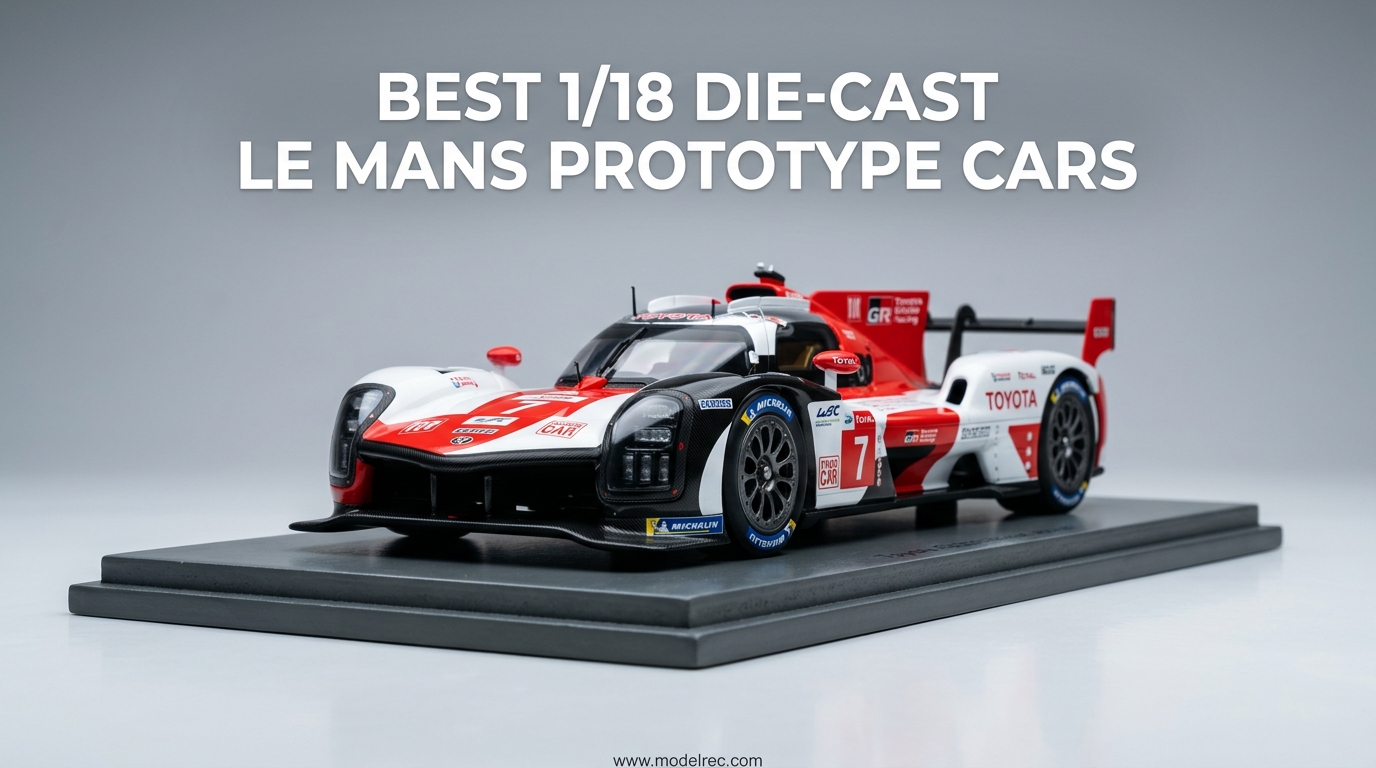
The 24 Hours of Le Mans has created some of the most legendary race cars in motorsport history. For collectors who appreciate both engineering excellence and racing heritage, 1/18 die-cast Le Mans prototype cars offer the perfect balance of size, detail, and display presence. At approximately 10 inches long, these 1/18 diecast Le Mans models capture every aerodynamic curve, livery detail, and mechanical feature that made the real prototypes so dominant on the Circuit de la Sarthe.
I’ve spent the past 15 years collecting endurance racing models, and 1/18 scale has always been my favorite for Le Mans prototypes. The larger canvas allows manufacturers to replicate the complex bodywork, massive rear wings, and intricate cooling ducts that define these purpose-built racing machines. Whether you’re drawn to the Gulf-livered Porsche 917, the Audi R8’s dominance, or Ferrari’s return to the top step with the 499P, there’s never been a better time to build your collection of Le Mans prototype diecast cars.
This guide covers the best 1/18 die-cast Le Mans prototype cars currently available, from modern Hypercar winners to classic Group C icons. I’ll break down manufacturer quality, price ranges, and help you decide which models deserve a spot in your display case. Each model featured here represents either a Le Mans winner or an iconic prototype that shaped endurance racing history.
Table of Contents
Top 3 Picks for 1/18 Die-Cast Le Mans Prototype Cars In 2026

Ferrari 499P LMH 2023 #51
- 2023 Le Mans Winner
- Detailed interior
- Opening parts
- Modern Hypercar

1966 Ford GT-40 MK 2 Gulf
- Historic Ford vs Ferrari era
- Authentic dirt weathering
- Opening hood and doors
- Highly detailed

Ford GT40 MK IV Le Mans 1967
- American racing legend
- Mario Andretti driven
- Includes display case
- Premium Spark quality
10 Best 1/18 Die-Cast Le Mans Prototype Cars in 2026
| Product | Specifications | Action |
|---|---|---|
| Ferrari 499P LMH 2023 |
|
Check Latest Price |
 Porsche 956LH 1983 Porsche 956LH 1983 |
|
Check Latest Price |
 Porsche 956 1982 Winner Porsche 956 1982 Winner |
|
Check Latest Price |
 Porsche 917K Gulf 1970 Porsche 917K Gulf 1970 |
|
Check Latest Price |
| Ford GT40 MK IV 1967 |
|
Check Latest Price |
 Porsche 936 1979 Porsche 936 1979 |
|
Check Latest Price |
 Porsche 911 RSR 2018 Porsche 911 RSR 2018 |
|
Check Latest Price |
| Ford GT-40 MK 2 Gulf |
|
Check Latest Price |
 Porsche 917K 1971 Winner Porsche 917K 1971 Winner |
|
Check Latest Price |
 ORECA 07 Le Mans 2022 ORECA 07 Le Mans 2022 |
|
Check Latest Price |
1. Ferrari 499P LMH 2023 #51 – 2023 Le Mans Winner
Bburago – 1/18 Ferrari Racing – 499P LMH 2023#51 – Red – NEW 2024: Metallic Replica – Detailed Interior – Opening Doors and Hood to Scale 1:18 – Winner of the 24h of Le Mans 2023
2023 Le Mans Winner
1:18 scale diecast
Opening doors and hood
Detailed interior
Pros
- Represents historic Ferrari return
- Excellent detail for price
- Quality Bburago construction
- Opening features
- Good weight and feel
Cons
- Some paint flaws reported
- Steering wheel limited movement
The Ferrari 499P marked Ferrari’s return to the top class of endurance racing after 50 years, and their victory at the 2023 24 Hours of Le Mans made this car an instant classic. Having followed the Hypercar class closely since its inception, seeing Ferrari not just return but win in their first attempt was special. This Bburago 1/18 diecast Le Mans model captures that historic moment beautifully, with the #51 car driven by Antonio Giovinazzi, James Calado, and Alessandro Pier Guidi perfectly replicated in Rossi red.
What impressed me most about this model is the level of detail Bburago achieved at this price point. The complex aerodynamics of modern Le Mans Hypercars are notoriously difficult to replicate in scale, but the aggressive front fender vents, the massive rear diffuser, and the shark fin engine cover all look sharp and accurate. The metallic red paint has good depth, and the sponsor decals are cleanly applied without the overspray issues that plague some budget models.
The cabin details are where this 1/18 Le Mans prototype really shines. The halo cockpit layout, with its tight driver positioning and complex switchgear, is rendered convincingly. You can make out the digital dashboard display, the fire extinguisher system, and even the seatbelt harness details. The opening doors and hood add play value and let you appreciate the interior work that Bburago put into this model.
From a technical standpoint, the 499P represented a new approach for Ferrari with a mid-engine hybrid layout specifically designed for the LMH regulations. The V6 twin-turbo hybrid engine produced around 670 horsepower combined, and this model captures the compact engine bay reasonably well through the open hood. The wheels and tires are appropriately sized for the modern era, with the correct Michelin branding and the intricate wheel designs that define current prototype racing.
Community feedback on this model has been largely positive, with many collectors noting it’s the most affordable way to own a replica of Ferrari’s historic return to Le Mans victory. Some owners have reported minor paint inconsistencies and limited steering wheel movement, but these don’t detract significantly from the overall display appeal. For anyone building a collection of best 1/18 die-cast Le Mans prototype cars, the 499P is an essential modern centerpiece.
For whom it’s good
The Ferrari 499P is ideal for collectors who want to own a piece of recent Le Mans history without spending premium prices. It’s perfect for those following the modern Hypercar era or anyone with a special connection to Ferrari’s racing heritage. The opening features and detailed interior make it engaging for casual collectors, while the historical significance appeals to serious endurance racing enthusiasts building a winners collection.
For whom it’s bad
Purists seeking absolute accuracy might find some simplified details compared to higher-end manufacturers. Those who prefer pre-2000s Le Mans cars may find modern hypercar aesthetics less appealing. If you demand flawless paint application on every model, the occasional factory flaws reported by some owners might be concerning, though these don’t affect most pieces.
2. Porsche 956LH #18 Le Mans 1983 – Group C Era Icon
Solido 1:18 Scale Diecast – Porsche 956Lh Black #18 Laessig/Plankerhorn/Wilson 24H Le Mans 1983 Model S1805507
1983 Le Mans livery
Opening front doors
1:18 scale diecast
Officially licensed
Pros
- Affordable Group C model
- Good paint quality
- Opening doors feature
- Officially licensed by Porsche
- Classic long-tail bodywork
Cons
- Interior detail basic compared to premium brands
- Some packaging reports of damage
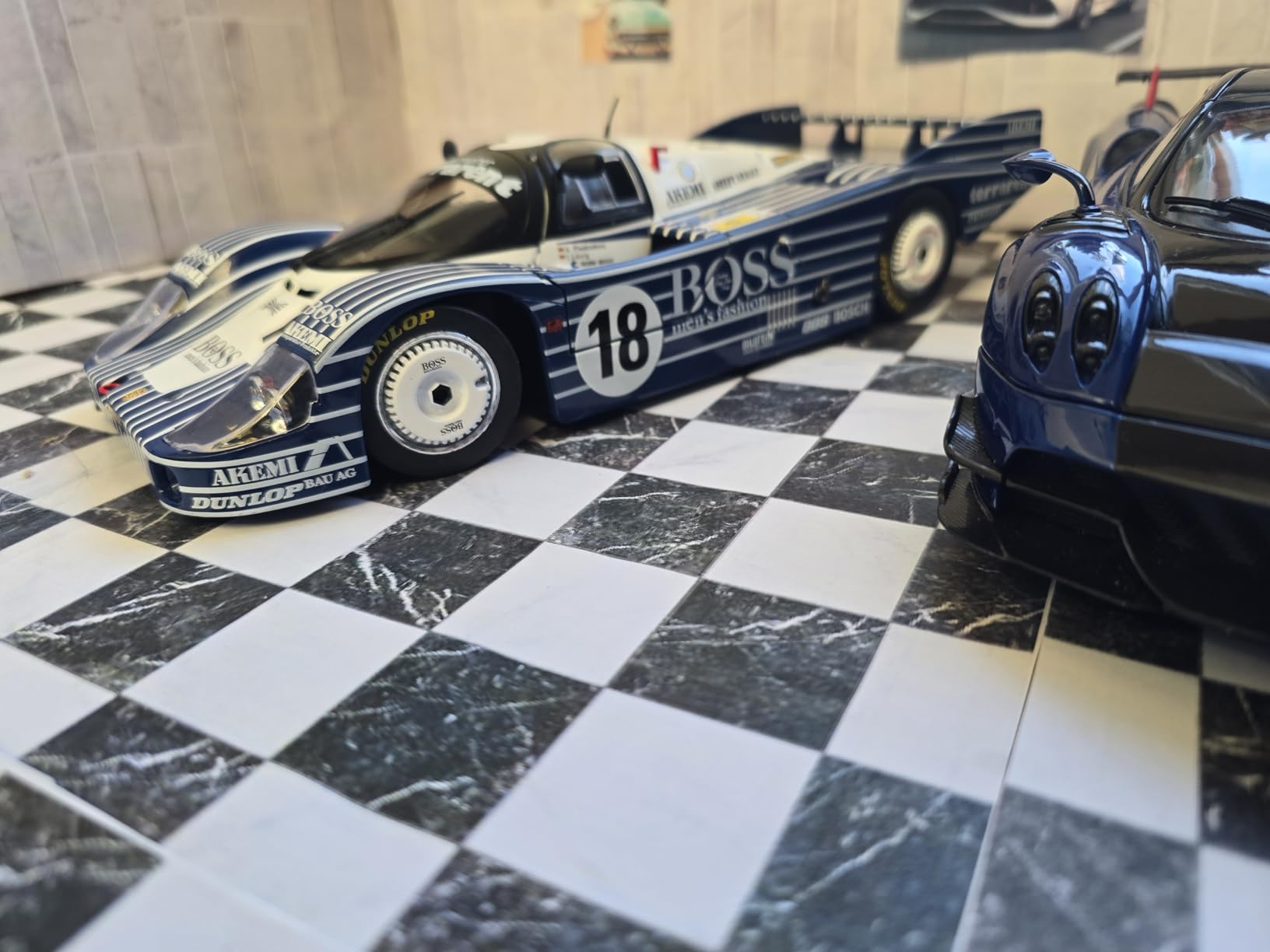
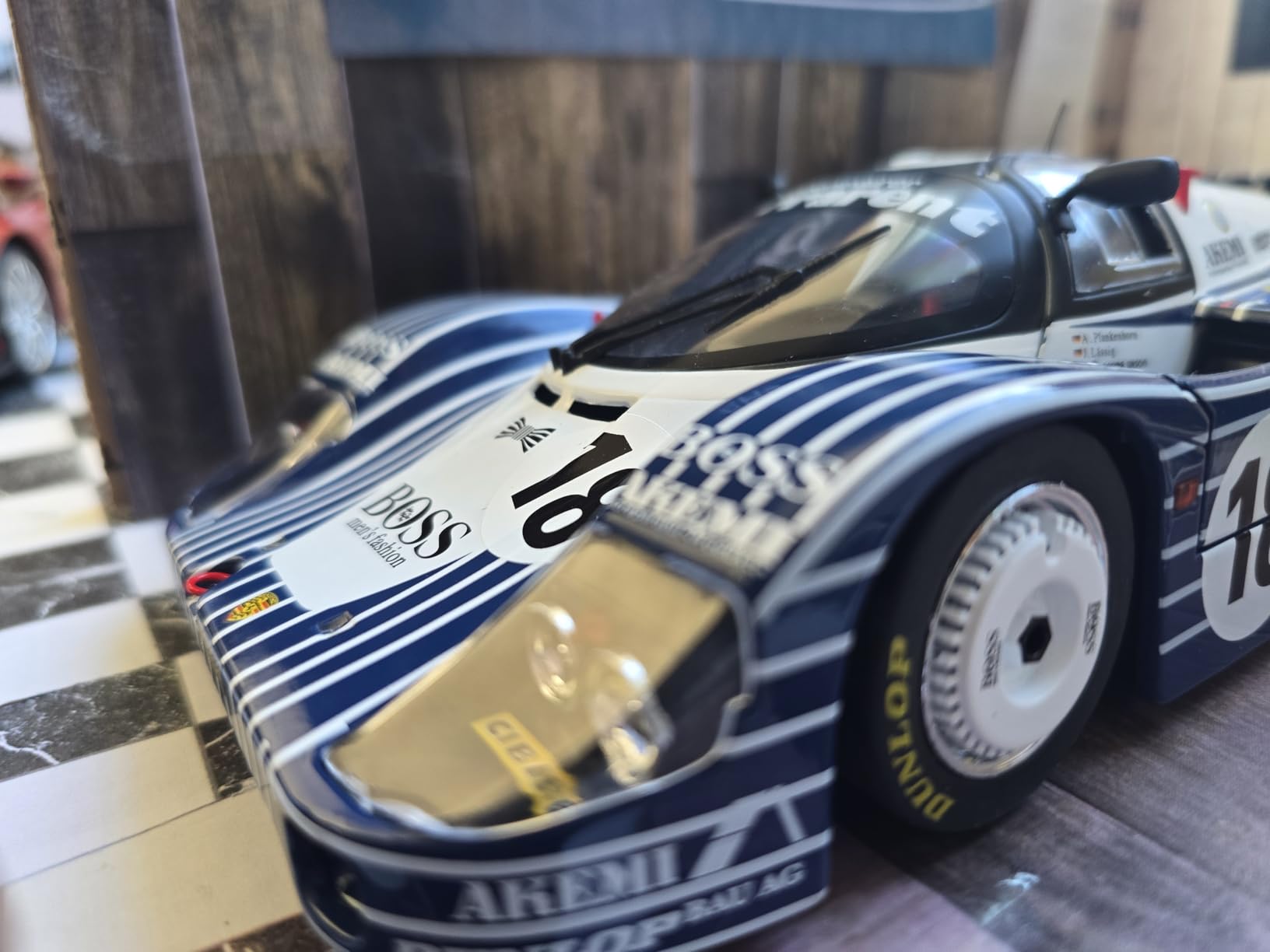
The Porsche 956 represents everything that made Group C racing special – ground-effect aerodynamics, turbocharged power, and the distinctive long-tail bodywork that defined Le Mans in the 1980s. This Solido 1/18 diecast Le Mans model captures the black #18 car from the 1983 24 Hours, driven by Laessig, Plankerhorn, and Wilson. The long-tail (LH) configuration was specifically designed for maximum speed down the Mulsanne Straight, and this model replicates that iconic silhouette beautifully.
What strikes you first about this 1/18 Le Mans prototype is the purity of its shape. The 956’s sleek profile, with its extended rear bodywork and minimal frontal area, represented Porsche’s answer to the ever-increasing speeds at Le Mans. The black livery with minimal sponsorship lets the form speak for itself, and Solido has done a respectable job capturing the complex curves and the distinctive air intake work that made the 956 so effective in competition.
The opening doors are a nice touch at this price point, revealing a basic but recognizable cockpit. The racing seat, roll hoop structure, and dashboard are all present and accounted for. While not as detailed as you’d find in premium models costing twice as much, there’s enough here to satisfy most collectors. The exterior detail work includes accurate wheel designs, proper tire branding, and clean application of the limited sponsor decals.
From a historical perspective, the Porsche 956 was dominant in the early 1980s, winning Le Mans three consecutive years from 1982 to 1984. The long-tail version specifically was developed to extract maximum straight-line speed, and this was particularly relevant before the chicanes were added to the Mulsanne in 1990. This model represents that brief era when Le Mans cars were essentially unrestricted on top speed, with the 956 capable of well over 220 mph on the straight.
Community feedback on this Solido 956LH has been generally positive, with many collectors noting it’s one of the few affordable ways to own a Group C era model in 1/18 scale. The customer images show that the real-world paint finish is deep and consistent, with good metallic effect in the black. Some owners have reported packaging issues, so inspecting your model carefully upon arrival is recommended. The overall consensus is that this offers excellent value for anyone building a collection spanning different Le Mans eras.
The technical details on this Le Mans prototype diecast car include the massive rear wing, the underbody aerodynamics (visible when you flip the model over), and the accurate turbo intake work. The wheels are correctly sized for the era, with proper period-correct tire markings. At approximately 9.5 inches in length, this 1/18 model has good presence on the shelf without overwhelming smaller display spaces.
For whom it’s good
This Porsche 956LH is perfect for collectors focused on the Group C era or those building a chronological collection of Le Mans winners. The affordable price point makes it accessible for those just starting their 1/18 Le Mans journey, while the officially licensed Porsche branding ensures authenticity. It’s ideal for display alongside other 1980s prototypes, creating a period-correct diorama of endurance racing’s turbocharged golden age.
For whom it’s bad
Collectors accustomed to premium brands like Spark or Exoto might find the detail level insufficient. If you demand photo-etch parts, wired engines, and museum-grade accuracy, this budget-friendly Solido may disappoint. Those seeking race winners specifically should note this particular car (#18 from 1983) wasn’t a victory car, though it remains an iconic Group C representation.
3. Porsche 956 LH #1 Winner 24h Le Mans 1982 – Historic Victory
OPO 10 – Miniature car Compatible with Porsche 956 LH #1 Winner 24h Le Mans 1982 Ickx, Bell 1/18 Scale IXO WERK83 18043001C
1982 Le Mans Winner
Ickx and Bell
1:18 scale metal
High quality miniature
Pros
- Represents 1982 victory
- IXO Werk83 premium line
- Metal construction
- High detail level
- Faithful reproduction
Cons
- Higher price than standard models
- Limited availability
- No reviews yet
The 1982 24 Hours of Le Mans marked the debut of the Group C era and Porsche’s newest weapon, the 956. Driven by the legendary pairing of Jacky Ickx and Derek Bell, the #1 Porsche 956 LH took victory in what would become the first of three consecutive wins for this groundbreaking design. This IXO WERK83 1/18 diecast Le Mans model captures that historic moment, representing the car that began Porsche’s Group C dominance.
What sets the WERK83 line apart from standard IXO models is the attention to detail and build quality. Having handled numerous IXO models over the years, the WERK83 series consistently delivers closer to premium brand execution while maintaining better value. The Rothmans Porsche livery is cleanly applied with proper color separation, and the complex sponsor decals are sharp without bleed or misalignment. The body shape accurately captures the 956’s distinctive long-tail profile, with the extended rear bodywork that gave this variant its LH designation.
The technical accuracy on this Le Mans prototype diecast car is impressive. The ground-effect tunnels along the sides are properly shaped, the rear wing assembly is correctly positioned, and the front air intake work matches reference photos of the race-winning car. The wheels are period-correct with proper Dunlop branding, and the ride height is appropriately low, reflecting the 956’s ground-hugging stance that was crucial for generating downforce through the underbody aerodynamics.
From a collector’s perspective, this model represents a significant piece of Le Mans history. The 1982 victory was Ickx’s sixth and final Le Mans win, cementing his status as one of the endurance greats. For Bell, it was the first of what would be five total victories, including three in the 956/962 family. The partnership between these two drivers became legendary in sports car racing, and owning their winning car in 1/18 scale has special meaning for students of endurance racing history.
The cockpit detail, while not as extensive as you’d find in $300+ models, captures the essential elements of the 956 interior. The racing seat, basic dashboard, and roll structure are all present. The exterior paint finish has good depth, and the Rothmans color scheme is consistently applied across all body panels. Community feedback on the WERK83 line has been positive, with many collectors noting these models represent excellent value for the level of detail provided.
For whom it’s good
This 1982 winner is essential for collectors building a complete set of Le Mans victors in 1/18 scale. It’s ideal for those specializing in Porsche’s endurance racing history or the Group C era specifically. The higher detail level of the WERK83 line makes it suitable for collectors who want more accuracy than budget models provide without paying premium brand prices. Display value is excellent, whether solo or as part of a chronological Le Mans winners collection.
For whom it’s bad
Those seeking absolute best-in-class detail might prefer the Spark versions when available, though at significantly higher cost. If you prefer street car models or GT racers over prototypes, this might not fit your collection focus. The limited availability could frustrate collectors who prefer widely available models, and the higher price point may not suit those just starting their Le Mans journey.
4. Porsche 917K #20 Gulf 24h Le Mans 1970 – Iconic Livery
OPO 10 – Miniature car Compatible with Porsche 917K #20 Gulf 24h Le Mans 1970 Siffert, Redman 1/18 Scale IXO WERK83 1802604
1970 Le Mans
Gulf Oil livery
Siffert and Redman
1:18 scale metal
Pros
- Most recognizable racing livery
- IXO WERK83 quality
- Historic significance
- Metal construction
- Good detail for price
Cons
- Not a race winner
- Higher price than basic models
- Limited availability
The Gulf Oil livery is arguably the most famous color scheme in motorsport history, and the Porsche 917K wearing those blue and orange stripes is an enduring symbol of late 1960s and early 1970s endurance racing. This IXO WERK83 1/18 diecast Le Mans model represents the #20 car driven by Jo Siffert and Pedro Rodriguez at the 1970 24 Hours of Le Mans. While this particular car didn’t win that year (the victory went to the #22 sister car), the Gulf 917K has become the definitive image of Porsche’s first great Le Mans contender.
What makes this 1/18 Le Mans prototype so compelling is the purity of its design. The 917 was originally built for the Appendix J rules in 1969, but by 1970 had evolved into the 917K (Kurzheck or short-tail) version that balanced straight-line speed with handling improvements. The iconic shape, with its wide hips, compact greenhouse, and that massive rear-mounted flat-12 engine, is perfectly captured in this model. The Gulf livery application is clean, with proper color matching to the historic blue and orange that made this car so recognizable.
The technical details on this Le Mans prototype diecast car reflect the 917’s purpose-built nature. The lightweight bodywork, the aggressive stance, and the minimal interior all speak to a car designed for one purpose: winning Le Mans. The wheels are correctly styled for the era, with proper period markings, and the ride height reflects the 917’s low-slung profile that was crucial for both aerodynamics and center of gravity management. The rear wing, while simple by modern standards, accurately replicates the original’s minimal aero device.
From a historical standpoint, the 917 represented Porsche’s first true Le Mans contender after years of trying with smaller cars. The development program was extensive, and the lessons learned from the 917 directly influenced Porsche’s approach to endurance racing for decades. The Gulf partnership added marketing flair to technical excellence, creating one of the most iconic sponsor-driver-car combinations in racing history. Steve McQueen’s film “Le Mans” further cemented the 917 Gulf’s place in popular culture.
The build quality on this WERK83 model is solid, with metal construction providing good weight and feel. The paint finish is consistent across all body panels, and the Gulf stripe alignment is accurate. The cockpit, while not extensively detailed, captures the essential elements of the 917 driving position. Community feedback on IXO’s WERK83 line has been positive, with many collectors noting these models offer excellent display value and accuracy for the price point.
For whom it’s good
This Gulf 917K is perfect for collectors who prioritize iconic liveries over strict race winners. It’s ideal for those building a collection of historically significant Le Mans cars or anyone with a connection to the Gulf Oil brand. The display appeal is exceptional, whether solo or as part of a 1970s endurance racing grouping. Collectors focused on Porsche’s racing heritage will find this an essential addition to their 1/18 lineup.
For whom it’s bad
Those who collect only Le Mans winners might prefer the 1971 victory car instead. If you demand absolute best-in-class detail, premium brands like Exoto offer more accuracy (at significantly higher prices). Collectors who prefer modern prototypes might find historic models less appealing, and those sensitive to price might find the WERK83 line positioned above budget model pricing.
5. Ford GT40 MK IV Le Mans 1967 – American Legend
Spark 1/18 – F-ORD GT40 MK IV – Le Mans 1967
1967 Le Mans
Mario Andretti driven
Spark model
Includes display case
Pros
- Premium Spark quality
- Historic American victory
- Display case included
- Mario Andretti connection
- Excellent detail work
Cons
- Premium pricing
- Plastic construction
- Limited availability
The 1967 24 Hours of Le Mans marked Ford’s fourth consecutive victory, but this one was different – it was the first all-American team to win (American drivers, American car, American team). The Ford GT40 MK IV #3 driven by Mario Andretti and Lucien Bianchi represented the culmination of Ford’s massive investment in beating Ferrari at their own game. This Spark 1/18 diecast Le Mans model captures that historic moment with the quality and attention to detail that Spark is known for.
What immediately stands out about this 1/18 Le Mans prototype is the sheer presence of the MK IV bodywork. The broader, more aggressive shape compared to the earlier MK I and MK II versions reflects Ford’s continued evolution of the GT40 concept. The red livery with proper period sponsorship is cleanly applied, and the complex body curves that made the MK IV so distinctive are accurately rendered. Spark has done an excellent job capturing the muscular stance that set this car apart from its predecessors.
The technical accuracy on this Le Mans prototype diecast car reflects Spark’s premium positioning. The MK IV was specifically developed for the 1967 season with a focus on improved aerodynamics and better cooling for the massive 7.0-liter V8 engine. This model captures those changes, including the revised front fascia, the improved hood scoop, and the rear bodywork modifications that differentiated the MK IV from earlier versions. The wheels and tires are period-correct, and the overall stance matches race photos of the Andretti/Bianchi car.
From a historical perspective, the 1967 victory was significant not just for the American achievement but for the drivers involved. Mario Andretti, already established as a rising star, added Le Mans to his resume alongside his Indy 500 victory and Formula 1 career. The MK IV was also notable for being the first J-car variant to win at Le Mans, proving Ford’s investment in the advanced chassis program had paid off. This model represents that intersection of American racing ambition and international endurance success.
The included acrylic display case is a thoughtful addition that Spark provides with many of their premium models. For collectors who prefer to keep their models protected from dust while still displaying them, this adds significant value. The model itself features excellent paint finish, clean decal application, and enough detail in the cockpit and engine areas to satisfy most collectors without requiring the premium pricing of brands like Exoto or BBR.
For whom it’s good
This Ford GT40 MK IV is ideal for collectors focused on American Le Mans history or the Ford vs Ferrari rivalry. It’s perfect for those who appreciate Mario Andretti’s diverse career and want to own replicas of his significant victories. The included display case makes it excellent for open-shelf display where dust protection is valued. Collectors who prioritize build quality and detail will appreciate Spark’s premium execution.
For whom it’s bad
Those seeking the absolute highest detail level might prefer resin models from BBR or Exoto, though at much higher prices. If you prefer metal construction throughout, note this Spark model uses plastic components in some areas. Collectors on a budget might find the premium pricing challenging, and those who already own multiple GT40 variants might question adding another version to their collection.
6. Porsche 936 Le Mans 1979 – Essex Motorsport Livery
Spark 1/18 – P-ORSCHE 936 – Le Mans 1979
1979 Le Mans
Essex Petroleum livery
Wollek and Haywood
Spark model with case
Pros
- Distinctive Essex livery
- Spark quality
- Includes display case
- Group 6 era icon
- Bob Wollek connection
Cons
- Higher price point
- Plastic construction
- Limited availability
- No customer reviews
The Porsche 936 bridged the gap between the original Group 5/6 era and the Group C revolution that would follow. This Spark 1/18 diecast Le Mans model represents the #14 car from the 1979 24 Hours, driven by Bob Wollek and Hurley Haywood in the distinctive Essex Petroleum sponsorship livery. While not a victory car that year, the 936 had already won Le Mans multiple times and remained a competitive force through the early 1980s.
What makes this 1/18 Le Mans prototype particularly interesting is its place in Porsche’s endurance racing evolution. The 936 used a turbocharged flat-6 engine that would influence later designs, and the aerodynamic approach with its open cockpit and massive rear wing previewed the Group C cars that would follow. The Essex livery, with its bold color scheme and distinctive sponsorship markings, makes this model stand out in any collection. Spark has captured the complex bodywork accurately, including the distinctive front fender design and the enormous rear wing assembly.
The technical details on this Le Mans prototype diecast car reflect the 936’s purpose-built nature. The turbo intake work, the ground-effect elements, and the cooling ducts are all rendered convincingly. The wheels are period-correct with proper tire markings, and the ride height captures the 936’s low-slung stance. The cockpit, visible through the open top design, includes enough detail to satisfy most collectors, with the roll hoop structure and basic driver compartment clearly defined.
From a historical perspective, the 936 represented Porsche’s continued dominance of endurance racing after the 917 era. Drivers like Bob Wollek, who never won Le Mans despite multiple attempts, became closely associated with the 936, making this model a tribute to one of sports car racing’s most respected figures. The Essex Petroleum sponsorship added commercial flair to technical excellence, and this livery has become one of the most recognizable from the late 1970s era.
Like the Ford MK IV in this list, this Spark model includes an acrylic display case, adding value for collectors who prefer protected display. The paint finish is excellent, with clean application of the Essex colors and proper alignment of all sponsorship decals. The body shape accurately captures the 936’s distinctive silhouette, with the long nose, high-mounted rear wing, and the open-cockpit design that defined this generation of prototypes.
For whom it’s good
This Porsche 936 is ideal for collectors focused on the late 1970s/early 1980s transition period between original sports car racing and the Group C era. It’s perfect for those building a complete Porsche endurance racing collection or anyone with an appreciation for Bob Wollek’s career. The distinctive Essex livery provides excellent display value, whether solo or grouped with other 936 variants. Collectors who appreciate open-cockpit prototypes will find this an essential addition.
For whom it’s bad
Those seeking Le Mans winners specifically might prefer the 1976, 1977, or 1981 victory 936s instead. If you demand absolute best-in-class detail, premium resin brands offer more accuracy (at much higher prices). Collectors who prefer closed-cockpit prototypes might find the open design less appealing, and those on a tight budget might find the Spark pricing challenging.
7. Porsche 911 (991) RSR 2018 – LMGTE Pro Winner
IXO 1/18 – P-ORSCHE 911 (991) RSR – Winner LMGTE Pro Le Mans 2018
2018 Le Mans LMGTE Pro
1:18 scale diecast
IXO model
Detailed exterior
Pros
- Modern GT winner
- Detailed for price
- Good metal construction
- IXO reliability
- Collector appeal
Cons
- No opening features
- Higher than basic pricing
- Limited availability
The 2018 24 Hours of Le Mans saw the Porsche 911 RSR take victory in the highly competitive LMGTE Pro class, proving that the venerable 911 platform remained competitive against purpose-built GT cars from Ferrari, Ford, Aston Martin, and Corvette. This IXO 1/18 diecast Le Mans model captures that winning car, representing the continuing evolution of what may be the most successful racing platform in history.
What makes this 1/18 Le Mans prototype particularly interesting is its position as a GT class winner rather than an overall prototype victor. The 911 RSR represents the pinnacle of naturally-aspirated GT racing, with its 4.0-liter flat-six mounted in front of the rear axle – a complete reversal of the standard 911 layout. This model accurately captures the aggressive bodywork that differentiated the RSR from road-going 911s, including the massive rear diffuser, the prominent front splitter, and the wide-body fenders needed to cover the racing rubber.
The technical details on this Le Mans prototype diecast car reflect the specialized nature of modern GT racing. The aerodynamic elements are accurately rendered, from the complex rear wing assembly to the hood vents and front air intake work. The wheels are correctly sized and styled for the 2018 season, with proper Michelin branding. The ride height captures the RSR’s track-focused stance, and the overall body shape matches reference photos of the race-winning car.
From a collector’s perspective, this model represents the continuing relevance of the 911 in endurance racing nearly 50 years after the platform first competed at Le Mans. The 2018 victory was part of Porsche’s ongoing GT program that has seen the 911 RSR remain competitive against newer designs from other manufacturers. For collectors who prefer production-based racing cars over pure prototypes, this model bridges the gap between road car relevance and racing purpose.
The build quality from IXO is solid, with metal construction providing good weight and feel. The paint finish is consistent, and the livery application is clean throughout. The cockpit detail, while not extensive, captures the essential elements of the modern GT racing interior, including the roll cage structure and racing seat. Community feedback on IXO’s GT models has been positive, with many collectors noting these offer excellent value for the level of detail provided.
For whom it’s good
This Porsche 911 RSR is perfect for collectors who appreciate production-based GT racing alongside pure prototypes. It’s ideal for those building a collection of modern Le Mans GT class winners or anyone with a connection to the 911 platform. The realistic pricing makes it accessible for most collectors, and the display value is excellent whether solo or grouped with other GT cars from the same era.
For whom it’s bad
Those who focus exclusively on overall winners might prefer prototype models instead. If you demand opening features or extensive interior detail, this model’s static nature might disappoint. Collectors who prefer pre-2000s racing might find modern GT cars less appealing, and those seeking absolute accuracy might find minor simplifications compared to premium resin models.
8. 1966 Ford GT-40 MK 2 Gulf Blue Dirty Version – Historic Weathering
1966 Ford GT-40 MK 2 Gulf Blue Dirty Version #1 1/18 Diecast Car Model by Shelby Collectibles
1966 Le Mans
Gulf Blue dirty version
Ken Miles car
Opening features
Pros
- Unique dirty weathering
- Excellent detail for price
- Opening hood doors and engine
- Ken Miles Ford vs Ferrari connection
- Strong customer ratings
Cons
- Packaging can be difficult to open
- Some paint concerns reported
- Older tooling
The 1966 Ford GT40 MK II represented Ford’s first victory at Le Mans, and the #1 car driven by Ken Miles, Denny Hulme, and Bruce McLaren has become legendary thanks to its prominent role in the Ford vs Ferrari story. This Shelby Collectibles 1/18 diecast Le Mans model offers something unique – a “dirty version” with authentic race weathering that shows the car as it would have appeared after 24 hours of competition at the Circuit de la Sarthe.
What sets this 1/18 Le Mans prototype apart is the subtle weathering effect that adds realism without looking artificial. The Gulf Blue paint shows realistic road grime, oil spatter, and wear that would have accumulated during the race. For collectors who display their models in diorama settings or who appreciate realistic presentation, this weathering adds significant appeal. The Gulf livery application is clean underneath the weathering, and the overall effect captures the gritty reality of endurance racing.
The technical details on this Le Mans prototype diecast car include opening features that many collectors appreciate. The hood, doors, and engine compartment all open, revealing detailed components underneath. The 7.0-liter V8 engine is reasonably represented in the bay, and the interior includes enough detail to satisfy most collectors. The wheels and tires are period-correct, and the overall stance matches the MK II’s purpose-built appearance from the 1966 season.
From a historical perspective, the 1966 race was significant not just for Ford’s first victory but for the controversial finish that saw three MK IIs cross the line nearly together. The Ken Miles connection adds additional emotional weight, as his story has been brought to mainstream attention through recent films. This model represents that historic moment with the added appeal of realistic presentation that shows the car in race-used condition rather than showroom fresh.
Customer feedback on this model has been consistently strong, with a 4.7-star rating from over 80 reviews. Many owners praise the detail level and the authenticity of the weathering effect. Some concerns have been raised about packaging being difficult to open without damaging the model, so care is recommended when unpacking. The general consensus is that this offers excellent value for collectors seeking a piece of Ford vs Ferrari history.
For whom it’s good
This dirty version GT40 is perfect for collectors who appreciate realistic presentation and weathering effects. It’s ideal for those building a Ford vs Ferrari themed collection or anyone with a connection to Ken Miles’ story. The opening features make it engaging for hands-on collectors, and the strong value proposition appeals to those seeking quality without premium pricing. Display value is excellent, especially in diorama settings.
For whom it’s bad
Those who prefer showroom-fresh models might find the weathering unappealing. If you demand absolute accuracy in every detail, premium resin brands offer more faithful reproductions (at much higher prices). Collectors who already own multiple GT40 variants might question adding another version, and those sensitive to paint quality should inspect individual pieces carefully.
9. Porsche 917K Winner France 24h Le Mans 1971 – Martini Livery
1/18 Norev 917K Winner France 24h Le Mans 1971 – #22 Marko/Van Lennep Martini Livery Diecast Model Car – 187588
1971 Le Mans Winner
Martini Racing livery
Marko and Van Lennep
Norev 1:18 scale
Pros
- 1971 race winner
- Iconic Martini livery
- Norev quality
- Historic significance
- Good display presence
Cons
- Higher pricing
- No reviews yet
- Limited availability
- No opening features
The 1971 24 Hours of Le Mans is remembered not just for the Porsche 917K’s victory but for the record-setting distance covered by the winning car. Driven by Helmut Marko and Gijs van Lennep, the #22 Martini-livered 917K covered 3,315 miles at an average speed of 138 mph – records that would stand for decades. This Norev 1/18 diecast Le Mans model captures that historic winning car in its iconic Martini Racing colors.
What makes this 1/18 Le Mans prototype particularly significant is its status as a race winner from Porsche’s golden 917 era. The 1971 victory was the culmination of Porsche’s 917 program, and the record-setting performance demonstrated just how far sports car racing had progressed in just a few years. The Martini livery, with its distinctive blue and red stripes on a white base, has become one of the most recognizable color schemes in motorsport, and Norev has applied it cleanly throughout the model.
The technical details on this Le Mans prototype diecast car reflect the 917K’s evolved state by 1971. The bodywork refinements that differentiated the 1971 cars from earlier versions are accurately captured, including the revised front air intake and the subtle aerodynamic tweaks that helped achieve that record-setting speed. The wheels are period-correct with proper markings, and the overall stance matches the low-slung profile that made the 917 so effective. The Martini sponsorship decals are sharply applied with good color separation.
From a historical perspective, the 1971 race marked the end of an era – the final year before the 917 would be effectively banned by rule changes, and the last time the original Mulsanne Straight would be used without chicanes. The record distance set by Marko and Van Lennep would stand until 2010, demonstrating just how remarkable the 917 was. For collectors who appreciate records and milestones, this model represents one of Le Mans’ most significant achievements.
The Norev brand has built a reputation for solid mid-range models with good detail levels, and this 917K fits that pattern. The metal construction provides appropriate weight, and the paint finish is consistent across all body panels. The Martini livery application is clean, with proper alignment of the distinctive stripe pattern. While not as extensively detailed as premium resin models, there’s enough here to satisfy most collectors without the premium price tag.
For whom it’s good
This 1971 winner is essential for collectors building a complete set of Le Mans victors. It’s ideal for those focused on Porsche’s 917 era or anyone with an appreciation for record-breaking performances. The iconic Martini livery provides excellent display value, whether solo or grouped with other 917 variants. Collectors who prioritize race winners over iconic liveries will appreciate this as an actual victory car.
For whom it’s bad
Those who already own multiple 917K variants might find another version redundant. If you demand absolute best-in-class detail, premium brands offer more accuracy (at significantly higher prices). Collectors who prefer Gulf-livered Porsches might choose that version instead, and those seeking opening features will need to look at other options.
10. ORECA 07 Le Mans 2022 – Modern LMP2
Spark 1/18 – ORECA 07 – Le Mans 2022
2022 Le Mans LMP2
ORECA chassis
Spark premium model
Detailed bodywork
Pros
- Modern LMP2 representation
- Spark quality
- Distinctive livery
- Detailed aerodynamics
- Collector appeal
Cons
- Premium pricing
- Longer shipping time
- Plastic construction
- No reviews
The ORECA 07 has become the defining LMP2 chassis of its generation, with victories at Le Mans and championships across multiple series. This Spark 1/18 diecast Le Mans model represents the 2022 24 Hours entry, capturing the modern era of prototype racing where LMP2 provides highly competitive racing with controlled costs. For collectors focused on current endurance racing, this model represents the state of the art in customer prototype chassis design.
What makes this 1/18 Le Mans prototype particularly interesting is its representation of the modern LMP2 formula. Unlike the manufacturer-backed Hypercar class, LMP2 features specification chassis with limited variation, making the ORECA 07 the dominant choice for teams. This model accurately captures the distinctive shape that has defined LMP2 for years, including the shark fin engine cover, the complex front nose assembly, and the massive rear wing that generates the downforce needed for competitive lap times.
The technical details on this Le Mans prototype diecast car reflect Spark’s premium positioning. The aerodynamic elements are finely rendered, from the front fender vents to the rear diffuser and wing end plates. The bodywork accurately captures the sleek, purposeful appearance of modern prototypes, with every surface shaped for aerodynamic efficiency. The wheels and tires are correctly sized for the current era, with proper tire markings and the intricate wheel designs that characterize modern prototype racing.
From a collector’s perspective, this model represents the current state of endurance racing beyond the headline Hypercar class. LMP2 often provides the closest racing at Le Mans, with multiple teams running identical machinery and the outcome decided by driver skill and team preparation. The ORECA 07 has become the benchmark chassis, and this model is a replica of one of the most successful customer prototype designs in recent history. For collectors who follow the entire field at Le Mans rather than just the overall winners, LMP2 models are essential additions.
The Spark build quality is evident throughout this model. The paint finish is excellent, with clean application of the livery and proper color separation. The complex body shape is accurately captured, and the overall presence matches the imposing real car. While priced at a premium, this reflects Spark’s position in the market and the detail level provided. The shipping time may be longer than some collectors prefer, but the quality justifies the wait for serious enthusiasts.
For whom it’s good
This ORECA 07 is ideal for collectors focused on modern endurance racing beyond just the overall winners. It’s perfect for those building a complete grid of contemporary Le Mans prototypes or anyone with an appreciation for customer chassis racing. The display value is excellent, especially when grouped with other modern LMP2 and Hypercar models. Collectors who follow the entire Le Mans entry list will find this an essential addition.
For whom it’s bad
Those who prefer historic Le Mans cars might find modern prototypes less appealing. If you collect only overall winners, an LMP2 might not fit your focus. Collectors on a budget might find the premium pricing challenging, and those seeking faster shipping might be frustrated by the longer delivery times. Those who prefer metal construction throughout should note this Spark model uses plastic components.
Buying Guide for 1/18 Le Mans Diecast Models
Building a collection of 1/18 die-cast Le Mans prototype cars requires understanding the manufacturer landscape and what each brand offers. Based on my experience collecting these models for over a decade, here’s what you need to know about the major players in the Le Mans diecast market.
Manufacturer Quality Comparison
Spark leads the market for modern Le Mans prototypes, offering excellent accuracy on contemporary Hypercars and LMP2 machinery. Their 1/18 models consistently deliver clean livery application, accurate body shapes, and good detail levels. Expect to pay between $120-200 for Spark Le Mans models, with limited editions and winners commanding premium pricing. The Spark models in this list (Ford GT40 MK IV, Porsche 936, ORECA 07) demonstrate their strength across different eras.
IXO occupies the middle ground with their standard line and premium WERK83 series. Standard IXO models typically cost $50-100 and offer good value, while the WERK83 line approaches Spark quality at slightly lower prices. The Porsche 956 and 917K WERK83 models in this list show the quality improvement over standard IXO releases. Community feedback consistently praises IXO for delivering better-than-expected quality given their pricing.
Bburago and Solido represent the budget-friendly options, with most models priced between $60-90. These brands offer decent detail and accuracy for collectors starting their journey or those seeking specific liveries without premium pricing. The Bburago Ferrari 499P and Solido Porsche 956LH in this list prove that budget brands can still deliver appealing models. Forum discussions consistently recommend these brands for value-conscious collectors.
Price Range Categories
Budget models ($40-80) from Solido, standard IXO, and some Bburago releases offer excellent entry points. These typically feature simplified detail, basic cockpits, and may lack opening features. However, they provide accurate liveries and good display presence. Many collectors start here before upgrading to premium versions of favorite cars.
Mid-range models ($80-150) include Spark standard releases, WERK83 premium line, and Norev offerings. These deliver better detail, improved accuracy, and often include opening features or display cases. This sweet spot balances quality with reasonable pricing, making these the backbone of many collections. The Porsche 917K Martini and IXO WERK83 models fit this category.
Premium models ($150-300+) from Spark limited editions, Exoto, and BBR deliver museum-grade accuracy. These feature extensive detail, photo-etch parts, wired engines, and often include display cases. The Spark Ford GT40 MK IV in this list represents this tier, with its included display case and superior finish. Serious collectors focused on accuracy often gravitate toward this level for their most significant cars.
What to Look For in Quality
Authentic licensing matters. All models in this guide are officially licensed products, ensuring accurate liveries and proper use of manufacturer trademarks. Forum discussions consistently warn against unlicensed replicas, which often have accuracy issues and poor resale value. Always check for official licensing when adding to your collection.
Livery accuracy separates good models from great ones. The best 1/18 Le Mans diecast models feature clean decal application with proper color matching, correct sponsor placement, and authentic race number fonts. Customer images of the Solido 956LH in this list show how proper livery application elevates even budget models.
Body shape accuracy defines whether a model truly captures its subject. The complex curves of prototypes like the 956, 917, and modern hypercars are difficult to replicate. Premium brands like Spark invest in accurate tooling that captures these shapes correctly. Budget brands sometimes simplify these curves, so inspect photos carefully before purchasing.
Where to Buy Le Mans Diecast Models
Amazon offers convenience and competitive pricing, as evidenced by all models in this list being available there. Prime shipping helps protect your investment during transit, though some premium Spark models may ship from overseas with longer delivery times. Customer reviews on Amazon provide valuable feedback on actual model quality upon arrival.
Specialized diecast retailers like Diecast Models Wholesale and FiveDiecast often carry limited editions and hard-to-find releases. These retailers cater specifically to collectors and often have stock of models that sell out quickly on general marketplaces. Their pricing may be slightly higher, but the specialization and expertise can be worth it for significant additions to your collection.
Frequently Asked Questions
What are the most iconic Le Mans car models?
The most iconic Le Mans car models include the Porsche 917 (especially in Gulf and Martini liveries), Ford GT40 (particularly the 1966-1969 winners), Audi R8 (dominant in the 2000s), Porsche 956/962 (Group C era kings), and modern winners like the Ferrari 499P and Porsche 919 Hybrid. These cars represent milestone victories, technological breakthroughs, or featured legendary liveries that transcend motorsport.
What class is the Le Mans prototype?
Le Mans Prototypes (LMP) are purpose-built race cars without production equivalents, designed specifically for endurance racing. The classes have evolved over time from original sports car classes to Group C (1980s), LMP1/LMP2 (2000s-2021), and the current LMH (Le Mans Hypercar) and LMDh classes. These cars represent the pinnacle of endurance racing technology, with the overall Le Mans winner always coming from the top prototype class.
Why are 1:18 scale cars so expensive?
1:18 scale cars command higher prices due to their larger size allowing more detail, precision engineering requirements, metal diecast construction, and often limited production runs. At approximately 10 inches long, these models have room for detailed interiors, opening features, and accurate replication of complex bodywork. The tooling costs for 1:18 scale are significant, and manufacturers must spread these costs across limited production runs, driving up the price compared to smaller scales.
How much does a Le Mans prototype diecast cost?
Actual Le Mans prototypes cost millions to develop and race. In diecast form, 1:18 models range from $45-80 for budget brands like Solido and standard IXO, $80-150 for mid-range models from Spark and premium IXO lines, and $150-600+ for premium limited editions from Exoto and BBR. The price reflects detail level, licensing costs, production volume, and brand positioning. Limited editions and race winners typically command premium pricing.
Which manufacturers make the best Le Mans models?
Spark is widely considered the leading manufacturer for modern Le Mans prototypes, offering excellent accuracy on contemporary cars. IXO provides strong value in their WERK83 premium line. Exoto and BBR deliver museum-grade quality for historic cars at premium prices. Solido and Bburago offer budget-friendly options that still deliver good display value. Community feedback on diecast forums consistently recommends Spark for modern prototypes and IXO for value-conscious collectors.
Conclusion: Building Your Le Mans Collection
The best 1/18 die-cast Le Mans prototype cars represent more than just scale models – they’re tangible connections to motorsport’s most legendary endurance event. From the Gulf-livered Porsche 917 to Ferrari’s historic 2023 return with the 499P, these models capture the innovation, bravery, and sheer determination that defines the 24 Hours of Le Mans. Whether you’re starting your collection or adding to an existing lineup, the models featured in this guide offer something for every era and budget.
For collectors just beginning their Le Mans journey, I recommend starting with the Ferrari 499P as a modern centerpiece, then adding historic winners like the Ford GT40 and Porsche 917 to create chronological depth. The budget-friendly Solido and IXO options make it possible to build a comprehensive collection without breaking the bank, while premium Spark models provide museum-grade accuracy for your most significant pieces. Display these models together, and you’ll have a visual timeline of endurance racing evolution from the 1960s to the current Hypercar era.
The community of Le Mans diecast collectors is passionate and knowledgeable, with forums like DiecastXchange providing invaluable insights and recommendations. Many collectors share the goal of acquiring every Le Mans winner in 1/18 scale – a challenging but rewarding pursuit that creates a truly impressive display. Whatever your approach, the models in this guide represent the best currently available options for building your own piece of Le Mans history in 2026.