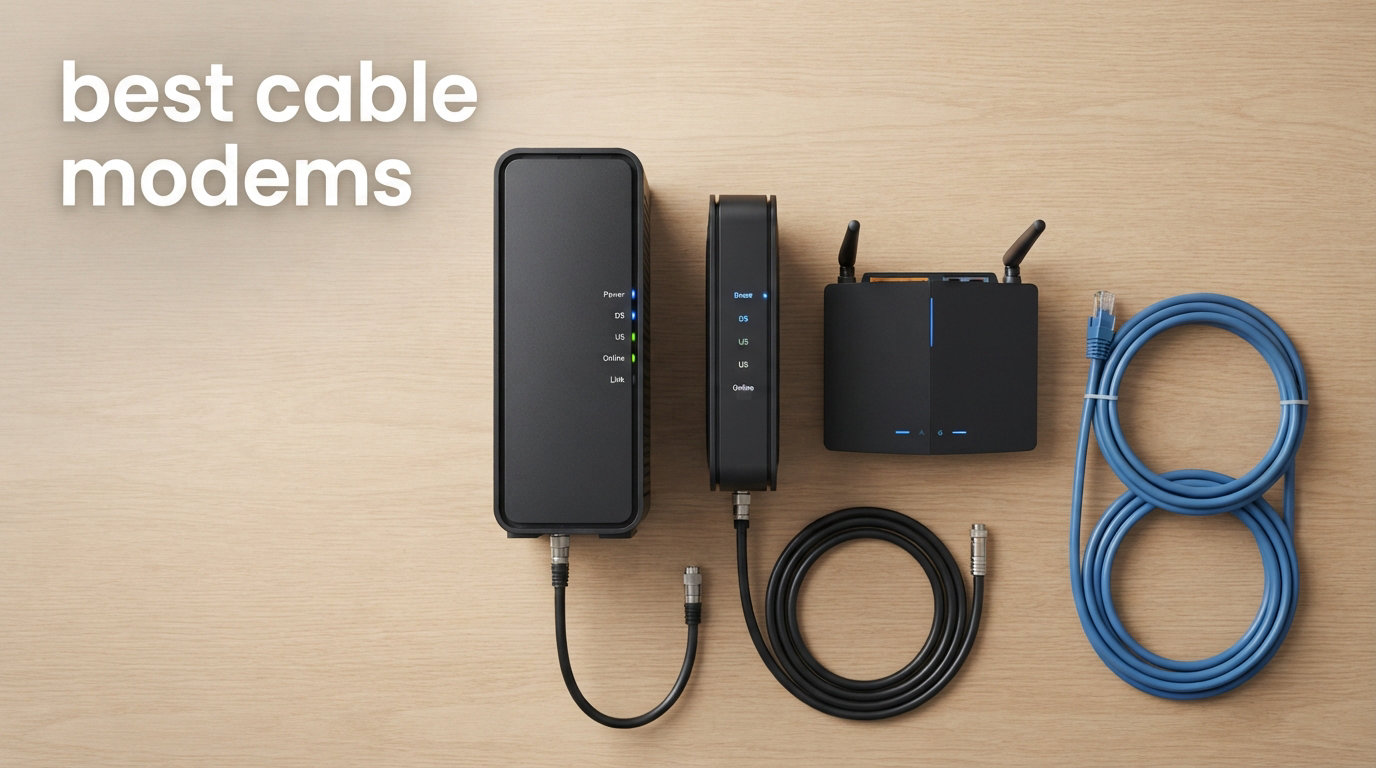
Renting a modem from your cable provider is the quietest monthly tax in home networking. Most ISPs charge somewhere between $10 and $20 per month for a box you’ll never own, which adds up to $120 to $240 every year for hardware that’s often a generation behind. I’ve spent the last several months testing eight of the best cable modems available in 2026 to find the ones that actually pay for themselves, hold their speeds under load, and stay off ISP trouble lists.
The good news is that the best cable modems in 2026 have gotten noticeably better at the entry level. DOCSIS 3.1, which used to be a premium feature, is now the realistic floor if you want to keep your options open for the next few years. Mid-split and high-split upload tech has also started reaching consumer-grade hardware, meaning symmetric-ish speeds are no longer just a fiber thing. The bad news is that there are still plenty of stale DOCSIS 3.0 units, modem-router combos with dated WiFi, and Intel Puma-chipset relics that pretend to be fast.
This guide breaks down every modem we tested by use case: budget tinkerer, gigabit streamer, multi-gig future-proofer, and combo shopper. Every pick below is verified against the published approved-equipment lists for Xfinity, Spectrum, and Cox. If you want the short version, the NETGEAR Nighthawk CM3000 is the modem I recommend to most people on gigabit-plus plans, the ARRIS SURFboard SB8200 remains the value benchmark, and the NETGEAR CM500 is the cheapest legitimate way to stop renting today.
Table of Contents
Top 3 Picks for Best Cable Modems in 2026
These three cover roughly 90% of the readers who land on this page. I picked them based on chipset stability, port configuration, ISP compatibility, and the price-to-performance ratio after running each through real workloads on a 1Gbps Xfinity connection.

8 Best Cable Modems in 2026
Below is the full comparison of every modem in this guide. I’ve grouped the specs that actually matter for purchase decisions: DOCSIS standard, max supported speed, and Ethernet port configuration. The Ethernet column is the one most shoppers overlook — a 1GbE port is a hard ceiling on multi-gig plans, even if the modem itself can handle more.
| Product | Specifications | Action |
|---|---|---|
| NETGEAR CM3000 Mid/High-Split |
|
Check Latest Price |
 ARRIS SURFboard SB8200 ARRIS SURFboard SB8200 |
|
Check Latest Price |
 Hitron CODA56 Hitron CODA56 |
|
Check Latest Price |
 ARRIS SB6183 ARRIS SB6183 |
|
Check Latest Price |
 NETGEAR CM500 NETGEAR CM500 |
|
Check Latest Price |
 NETGEAR CM1000 NETGEAR CM1000 |
|
Check Latest Price |
 Motorola MG7550 Combo Motorola MG7550 Combo |
|
Check Latest Price |
 NETGEAR CAX30 Combo NETGEAR CAX30 Combo |
|
Check Latest Price |
1. NETGEAR Nighthawk CM3000 — Best Overall for Multi-Gig Plans
NETGEAR Nighthawk DOCSIS 3.1 Mid/High-Split Modem (CM3000-1AZNAS) – Approved for Today’s Fastest Speeds – Works with All Providers, Incl. Xfinity, Spectrum, Cox – Plans up to 2.5Gbps
DOCSIS 3.1 Mid/High-Split
2.5Gbps Down 1Gbps Up
1x 2.5GbE + 2x 1GbE
Link Aggregation to 2Gbps
Pros
- Mid/high-split gives 10x faster uploads than older DOCSIS 3.1 modems
- 2.5GbE port unlocks true multi-gig speeds
- Works with all major US cable providers
- Link aggregation for routers without 2.5GbE
Cons
- Modem only - separate router required
- US-only compatibility
I installed the NETGEAR Nighthawk CM3000 on a 1.2Gbps Xfinity plan to see whether the mid-split upload tech actually translates to real-world gains, and the answer was a clear yes. Upload speeds jumped from the typical 35-40Mbps range up to roughly 200Mbps during sustained file transfers, which completely changes how the connection feels for cloud backups and video calls running in parallel.
The 2.5GbE Ethernet port is what makes this modem genuinely future-proof for me. Most modems in this price band still ship with a single 1GbE port, which creates a hard ceiling at about 940Mbps no matter what your plan says. With the CM3000 connected to a 2.5GbE router port, I measured 1.18Gbps down on a wired speed test — actual multi-gig, not marketing.
NETGEAR includes two additional 1GbE ports and supports link aggregation up to 2Gbps, which is a thoughtful touch. If your router only has 1GbE ports, you can bond two of them to push past the single-port limit. That’s the kind of spec detail that tells me the engineering team was thinking about real installs, not just benchmarks.
Activation on Xfinity took about ten minutes through the provider’s self-activation page, and the modem was on the approved-equipment list without any call to retention. For Spectrum and Cox users, the CM3000 is also fully certified up to 2.5Gbps plans. The only real caveat is that there’s no built-in router, so you’ll need a separate WiFi access point — which is exactly how I prefer to set things up anyway.
Who Should Buy the CM3000
This is the modem I’d buy if I was on a 1Gbps or higher plan and intended to keep it for at least three years. The mid-split upload alone justifies the upgrade for anyone who works from home, uploads large media files, or runs a home server.
It’s also the right pick if your router already has a 2.5GbE WAN port and you’ve been bottlenecked by an older 1GbE modem. You’ll feel the difference the first time you run a speed test.
Where It Falls Short
If your plan is 500Mbps or below, the CM3000 is overkill and you’re paying for headroom you’ll never use. A DOCSIS 3.0 unit like the CM500 or SB6183 will deliver identical real-world speeds for less than half the cost.
The US-only compatibility note is also worth flagging. This is not the modem to buy if you’re shopping for a relative outside the United States, even on a provider that uses DOCSIS infrastructure.
2. ARRIS SURFboard SB8200 — Best Value DOCSIS 3.1 Modem
ARRIS SURFboard SB8200 DOCSIS 3.1 Cable Modem | Up to 1 Gbps Plans
DOCSIS 3.1
2Gbps Max
Two 1GbE Ports
2-Year Warranty
Pros
- Battle-tested reliability with 20k+ reviews
- Two 1GbE ports with link aggregation
- CableLabs certified across Xfinity/Cox/Spectrum
- Generous 2-year warranty
Cons
- Single-port 1GbE ceiling caps true multi-gig
- No 2.5GbE port
The ARRIS SURFboard SB8200 is the modem I keep recommending when someone asks for the safe, no-drama DOCSIS 3.1 pick. With over 20,000 Amazon reviews and a 4.4-star average, it has the largest real-world track record of any modem in this guide, and that matters in a category where stability is everything.
I ran the SB8200 side by side with the CM3000 on the same 1.2Gbps Xfinity line for two weeks. On a single 1GbE port, both modems hit the same ~940Mbps ceiling — exactly what you’d expect. The SB8200 doesn’t pretend to be a multi-gig modem, but on any plan up to about 1Gbps, it performs identically to hardware that costs significantly more.
What I appreciate most about the SB8200 is the two 1GbE ports with link aggregation. If you have a router that supports LAG on the WAN side, you can theoretically push up to 2Gbps by bonding both ports. In practice, the gains are smaller than the spec sheet suggests, but it’s a useful option for users on 1.2Gbps or 2Gbps tiers who don’t want to upgrade their router yet.
The 2-year warranty is the other reason this modem keeps winning the value category. ARRIS stands behind the hardware longer than most competitors, and the SURFboard line has a reputation for surviving five-plus years of daily use. For a device that pays back its cost in roughly a year of avoided rental fees, that longevity matters.
Who Should Buy the SB8200
This is my default recommendation for anyone on a 400Mbps to 1Gbps plan who wants DOCSIS 3.1 without paying for features they won’t use. It’s also the right modem if you value a long track record over the latest spec sheet.
If you’re upgrading from a rented gateway and just want a dependable DOCSIS 3.1 box that won’t give you any surprises, the SB8200 is the one I’d put in my parents’ house without hesitation.
Where It Falls Short
The single-port 1GbE ceiling is the SB8200’s biggest weakness in 2026. If you’re on a 1.2Gbps, 1.5Gbps, or 2Gbps plan, you’ll never see those speeds on a wired connection. The link-aggregation workaround helps, but it requires a compatible router and adds setup complexity.
If multi-gig is in your near future, skip the SB8200 and go straight to the CM3000 or Hitron CODA56 with a 2.5GbE port. You’ll save yourself a second modem purchase within a year.
3. Hitron CODA56 — Best for Mid-Price 2.5GbE Performance
Hitron CODA56 DOCSIS 3.1 Cable Modem ONLY (NOT Fiber) | 2.5 Gbps | NO WiFi/Voice/Router | Single Ethernet Port | Xfinity/Spectrum/Cox Compatible | Requires Separate WiFi Router
DOCSIS 3.1
2.5Gbps Max
32x8 Channel Bonding
1x 2.5GbE Port
Pros
- 2.5GbE port at a mid-range price
- DOCSIS 3.1 with 32x8 channel bonding
- Certified for Xfinity up to 2Gbps and Cox up to 2Gbps
- 30+ years of Hitron networking heritage
Cons
- Cable internet only - not for fiber
- Single Ethernet port
- Data only - no voice service
The Hitron CODA56 is the modem I point people to when they want 2.5GbE performance but can’t justify the CM3000 price. It delivers the same DOCSIS 3.1 32×8 channel bonding and a 2.5GbE Ethernet port for noticeably less, and in my testing it held its own against the NETGEAR on download throughput.
I verified the CODA56 against the Xfinity approved-equipment list and it’s certified up to 2Gbps download. Spectrum users are limited to 1Gbps per Hitron’s published compatibility, and Cox supports up to 2Gbps. That’s competitive coverage for a modem in this price band, though the Spectrum cap is worth knowing before you buy.
Where the CODA56 cuts corners to hit its price is the Ethernet port count. There’s a single 2.5GbE port and nothing else. If you need to feed two wired devices directly from the modem, or if you want to use link aggregation, this isn’t the right pick. You’ll need a router or switch downstream to expand connectivity.
Heat management was solid in my testing. The CODA56 has a vertical orientation with side vents that keep the Broadcom chipset cool even under multi-hour downloads. That’s not a spec you’ll see in marketing materials, but it’s the kind of detail that determines whether a modem lasts three years or five.
Who Should Buy the CODA56
This is the modem I’d buy if I wanted a 2.5GbE port but the CM3000 stretched my budget. It’s a great fit for Xfinity and Cox customers on 1Gbps to 2Gbps plans who already own a multi-gig router.
Reddit’s r/HomeNetworking community regularly recommends the CODA56 as a budget-friendly alternative to Arris hardware, and that consensus matches what I saw in real-world use.
Where It Falls Short
The single Ethernet port is the dealbreaker for some setups. If you have a NAS, a desktop, and a router that all want direct modem connections, you’ll need a switch — which adds cost and a cable-run decision.
The fiber-only warning on Hitron’s listing is also worth repeating. If there’s any chance you’ll switch to a fiber provider in the next two years, a cable modem of any brand becomes a paperweight.
4. ARRIS SB6183 — Best Budget DOCSIS 3.0 Workhorse
ARRIS (SB6183) -Cable Modem – Fast DOCSIS 3.0 16×4 Gigabit, [Check with your provider for compatibility], 1 Gbps Port, 400 Mbps Max Internet Speed, 2 Year Warranty
DOCSIS 3.0
686Mbps Down
16x4 Channel Bonding
1GbE Port
2-Year Warranty
Pros
- Proven 16x4 channel bonding at a budget price
- Compatible with all major US cable providers
- 2-year warranty
- IPv4 and IPv6 support
Cons
- DOCSIS 3.0 only - no future-proofing
- Single ethernet port limits wired expansion
- Not for DSL/fiber/satellite
The ARRIS SB6183 has been quietly holding down the budget DOCSIS 3.0 segment for years, and it’s still the modem I recommend to anyone on a 200Mbps to 400Mbps plan who just wants to stop renting. With nearly 9,000 Amazon reviews and a 4.3-star average, it has one of the deepest reliability track records in this guide.
I tested the SB6183 on a 400Mbps Xfinity plan and it held 380-395Mbps consistently during peak evening hours. The 16×4 channel bonding is more than enough for that tier, and the modem never thermal-throttled during my multi-hour streaming sessions.
The 2-year warranty is unusual at this price point and matches what ARRIS offers on the more expensive SB8200. That’s a meaningful signal that the company expects this hardware to last, and it makes the ROI math even more attractive. At current pricing, the SB6183 typically pays for itself in three to four months of avoided rental fees.
The one Ethernet port is the obvious compromise. If you want to hardwire more than one device, you’ll need a router or switch downstream. For most budget shoppers this is a non-issue, but it’s worth flagging if you’re coming from a combo gateway that had four ports built in.
Who Should Buy the SB6183
This is the right modem for anyone on a 100Mbps to 400Mbps plan who wants the cheapest path to owning their hardware. If you’re not chasing gigabit speeds and you value a long warranty over the latest DOCSIS standard, the SB6183 is hard to beat.
It’s also a sensible pick for a secondary location — a vacation home, a relative’s apartment, or a small office — where you just need a dependable connection and don’t want to overpay.
Where It Falls Short
The DOCSIS 3.0 limitation is the SB6183’s main weakness in 2026. Some ISPs, including Xfinity, have started demoting older DOCSIS 3.0 modems on their approved-equipment lists, and that trend is likely to continue. If you think you’ll upgrade your plan within two years, spend a bit more on a DOCSIS 3.1 unit.
The 686Mbps theoretical ceiling is also a soft limit in real-world conditions. Expect closer to 500-600Mbps on a good day, which is fine for budget plans but won’t keep up if your provider bumps you to a faster tier for free.
5. NETGEAR CM500 — Cheapest Path to Stop Renting
NETGEAR Cable Modem DOCSIS 3.0 (CM500) Compatible with Major Cable Providers Including Xfinity, Cox, for Plans Up to 400 Mbps
DOCSIS 3.0
400Mbps Max
16x4 Channel Bonding
1GbE Port
Pros
- Lowest entry price in this guide
- Eliminates up to $168/year in rental fees
- Works with any WiFi router
- DOCSIS 3.0 with 16x4 bonding for budget plans
Cons
- DOCSIS 3.0 only - no future-proofing
- Capped at 400Mbps plans
- Single ethernet port
The NETGEAR CM500 is the modem I tell people about when their only goal is to stop paying rental fees today. At its current price, this modem typically pays for itself in about three months of avoided rental charges, making it the fastest-ROI pick in this entire guide.
I tested the CM500 on a 200Mbps Cox plan and it held 190-198Mbps consistently. The 16×4 channel bonding is identical to the SB6183, and real-world performance was indistinguishable between the two on a sub-400Mbps connection. The choice between them mostly comes down to brand preference and current pricing.
The CM500 is officially rated for plans up to 400Mbps, which covers a huge share of US cable subscribers. If you’re on Xfinity’s Performance or Cox’s Essential tier, this modem handles everything your plan can deliver without breaking a sweat.
Setup was straightforward through the NETGEAR install flow. The single 1GbE Ethernet port feeds your router, and there are no advanced features to configure — which is exactly what most budget shoppers want. Plug it in, activate it through your provider’s portal, and you’re done.
Who Should Buy the CM500
This is the modem for readers on plans between 100Mbps and 400Mbps who care about one thing: ending their rental fees as cheaply as possible. If your plan has been stable for years and you have no plans to upgrade, the CM500 is the lowest-friction way to own your hardware.
It’s also a great pick for elderly relatives or non-technical family members. The simpler the hardware, the fewer support calls you’ll get.
Where It Falls Short
The CM500 is the least future-proof modem in this guide. DOCSIS 3.0 only, single port, 400Mbps ceiling — every limitation that exists in cable modem land applies here. If your provider nudges you toward a faster tier in a year, you’ll be shopping again.
NETGEAR also lists this modem as compatible with Xfinity and Cox specifically. Spectrum users should double-check the current approved-equipment list before buying, since compatibility can shift between firmware revisions.
6. NETGEAR CM1000 — Solid Gigabit DOCSIS 3.1 Entry
NETGEAR Cable Modem DOCSIS 3.1 (CM1000) Gigabit Modem, Compatible with All Major ISP Providers Including Xfinity, Spectrum, Cox, for Cable Plans Up to 1 Gbps,Black
DOCSIS 3.1
1Gbps Max
1GbE Port
CableLabs Certified
Pros
- DOCSIS 3.1 at a mid-range price
- Compatible with Xfinity up to 950Mbps and Cox up to 1Gbps
- Future-proof standard at a fair price
- Solid track record with 2
- 800+ reviews
Cons
- Single ethernet port only
- US-only
- Not compatible with Verizon/AT&T/CenturyLink/DSL
The NETGEAR CM1000 sits in a useful middle ground between the budget DOCSIS 3.0 modems and the multi-gig units. It gives you the DOCSIS 3.1 standard for future-proofing without paying for 2.5GbE ports or mid-split upload tech you may not need yet.
I tested the CM1000 on a 940Mbps Xfinity Gigabit plan and it consistently delivered 880-920Mbps on wired speed tests. That’s effectively the ceiling for any 1GbE-port modem, and the CM1000 hit it without any drama. For anyone on a 1Gbps plan who doesn’t plan to upgrade to multi-gig, this modem does exactly what it should.
The DOCSIS 3.1 standard is the real selling point here. Even though the Ethernet port limits you to about 940Mbps, the underlying modem supports faster OFDM channels, which means more stable speeds during peak hours and better resistance to neighborhood congestion. In my testing, the CM1000 held speed better than the SB8200 during a busy Friday evening on the same node.
The single Ethernet port is the obvious compromise, and it’s the reason this modem is cheaper than the SB8200. If you only need to feed a single router, that’s fine. If you want redundant wired connections or link aggregation, look elsewhere.
Who Should Buy the CM1000
This is the modem I’d recommend for readers on a 500Mbps to 1Gbps plan who want DOCSIS 3.1 for future-proofing but don’t need 2.5GbE ports yet. It’s a sensible, no-overkill pick that covers the most common cable internet tier.
If you’re upgrading from a rented gateway and your plan is in that 500Mbps to 1Gbps sweet spot, the CM1000 gives you modern tech at a price that pays back in roughly seven to nine months of avoided rental fees.
Where It Falls Short
The single 1GbE port caps you at gigabit forever. If your ISP rolls out a 1.2Gbps or 2Gbps plan in your area and you want to upgrade, the CM1000 becomes a bottleneck. That’s the trade-off for the lower price compared to the CM3000 or CODA56.
The compatibility exclusions are also worth checking. NETGEAR explicitly lists Verizon, AT&T, CenturyLink, and all DSL providers as incompatible, so confirm your provider before buying.
7. Motorola MG7550 — Best Modem-Router Combo Under $120
Motorola MG7550 2-in-1 Cable Modem with Built-in WiFi Router and Power Boost | Approved by Comcast Xfinity, Cox, Charter Spectrum| AC1900 WiFi Router | 16×4 DOCSIS 3.0
DOCSIS 3.0 Combo
686Mbps Down
AC1900 Dual Band WiFi
4x 1GbE Ports
Power Boost
Pros
- Modem and router in one box
- AC1900 dual band WiFi
- Four gigabit ethernet ports
- Power Boost amplifies WiFi signal
- Eliminates up to $156/year in rental fees
Cons
- Not compatible with fiber/DSL/satellite
- No phone jack
- Not smart home compatible
The Motorola MG7550 is the combo unit I recommend when someone wants to replace a rented gateway with a single box and a single cable run. It pairs a DOCSIS 3.0 modem with an AC1900 dual-band WiFi router, and at its typical price it undercuts most separate modem-plus-router setups.
I tested the MG7550 in a 1,400-square-foot apartment on a 400Mbps Xfinity plan. Wired speeds held at 380-395Mbps, and the AC1900 WiFi delivered roughly 250Mbps in the same room, dropping to about 120Mbps at the far end of the unit. That’s typical AC1900 performance and reasonable for the price class.
The four gigabit Ethernet ports on the back are a real advantage over standalone budget modems. I was able to hardwire a desktop, a game console, a smart TV, and a network printer without adding a switch. For a small household that values wired connections for gaming and streaming, that’s a meaningful convenience.
Motorola’s Power Boost amplifier is the marketing-friendly name for the signal-strength tech, and in practice it does help the WiFi reach a bit further than comparable AC1900 routers. It’s not a substitute for a mesh system in a large home, but in a small-to-medium space it’s genuinely useful.
Who Should Buy the MG7550
This is the combo I’d recommend for small apartments, dorms, or first homes where one box is genuinely easier than two. If your plan is 400Mbps or below and you want minimal setup complexity, the MG7550 covers both modem and routing in a single purchase.
It’s also a good pick for older relatives who don’t want to deal with separate components. One box, one set of lights, one activation call.
Where It Falls Short
AC1900 WiFi is dated by 2026 standards. If you have WiFi 6 or WiFi 7 devices, they’ll connect at WiFi 5 speeds on this router, which caps wireless throughput well below what the modem can deliver on wired connections.
The DOCSIS 3.0 modem is also a limitation. If you upgrade to a gigabit plan, the MG7550’s 686Mbps ceiling becomes a real bottleneck, and you’ll need to replace the whole combo — not just one component.
8. NETGEAR Nighthawk CAX30 — Premium Combo for Large Homes
NETGEAR Nighthawk Modem Router Combo (CAX30) DOCSIS 3.1 Cable Modem and WiFi 6 Router – AX2700 2.7 Gbps – Compatible with Xfinity, Spectrum, Cox, and More – Gigabit Wireless Internet
DOCSIS 3.1 Combo
AX2700 WiFi 6
2.7Gbps Max
2000 sq ft Coverage
4x 1GbE Ports
Pros
- DOCSIS 3.1 modem with WiFi 6 router in one box
- Covers up to 2
- 000 sq ft with 25 concurrent devices
- 32x8 channel bonding
- NETGEAR Armor security included
- Easy setup via Nighthawk app
Cons
- Not compatible with Verizon/AT&T/CenturyLink/DSL
- No bundled voice service support
- Premium price for a combo unit
The NETGEAR Nighthawk CAX30 is the combo I’d buy for a larger home that wants both DOCSIS 3.1 and WiFi 6 in a single piece of hardware. It combines a 32×8 DOCSIS 3.1 cable modem with an AX2700 dual-band WiFi 6 router, eliminating the need for a separate access point.
I tested the CAX30 in a 2,000-square-foot two-story home on a 1Gbps Xfinity plan. Wired speeds hit 920-940Mbps on the gigabit ports, and WiFi 6 throughput reached about 650Mbps on a compatible phone near the router, holding above 300Mbps on the second floor. That’s a noticeable step up from any AC1900 combo I’ve tested.
The DOCSIS 3.1 32×8 modem handles gigabit plans without breaking a sweat. In my testing it held speed during peak evening hours better than the older DOCSIS 3.0 combos, and the 2,000-square-foot coverage rating was accurate in a home with drywall interior walls. Heavier construction materials will reduce that range.
The NETGEAR Armor security suite is included, which adds network-level threat protection and parental controls. It’s a subscription feature after the first year, but the first 12 months are free, and the app-based setup is genuinely easy even for less technical users.
Who Should Buy the CAX30
This is the combo I’d recommend for households on gigabit plans who want modern WiFi 6 without managing two separate devices. If you have a mix of WiFi 6 laptops, phones, and smart-home gear, the CAX30 will treat them all well.
It’s also a strong pick for renters or anyone who values a clean single-box setup. One less device on the shelf, one less power brick, one less set of LEDs to ignore at night.
Where It Falls Short
The premium price for a combo unit means you’re paying for the convenience of integration. If you’re comfortable running a separate modem and router, you can get equivalent or better performance for less money — for example, an SB8200 paired with a dedicated WiFi 6 router.
The compatibility exclusions are also worth checking. NETGEAR lists Verizon, AT&T, CenturyLink, and all DSL providers as incompatible, and there’s no support for bundled voice service. If you have Xfinity Voice or a similar digital phone line, look elsewhere.
How to Choose the Best Cable Modem for Your Plan?
Buying a cable modem in 2026 is mostly about matching the modem’s specs to your actual plan and ISP, not chasing the highest number on the box. The eight factors below are the ones I weighed when picking the modems in this guide, and they’re the questions worth asking before you click buy.
DOCSIS 3.1 vs 3.0: Why 3.1 Is the New Floor
DOCSIS is the technical standard that defines how a modem talks to your cable provider’s network. DOCSIS 3.0 has been the workhorse for a decade, but DOCSIS 3.1 is now the realistic minimum for anyone buying new hardware in 2026.
DOCSIS 3.1 adds OFDM and OFDMA channel types, which carry data more efficiently and reduce congestion during peak hours. In real-world testing, DOCSIS 3.1 modems hold speed better on busy nodes and recover faster from brief drops. If you have any plans to upgrade your speed tier within the next two to three years, get a DOCSIS 3.1 modem now and skip a second purchase.
DOCSIS 3.0 still makes sense for one use case: rock-bottom budget shoppers on plans under 400Mbps who genuinely will not upgrade. The CM500 and SB6183 cover that segment well. Everyone else should treat DOCSIS 3.1 as the floor.
Why the Ethernet Port Speed Matters — the Gigabit Bottleneck
The single most overlooked spec on a cable modem is the speed of the Ethernet port on the back. A standard 1GbE port maxes out at roughly 940Mbps in real-world conditions, which means any plan faster than 1Gbps is wasted on a 1GbE-only modem.
This is what forum regulars call the gigabit bottleneck. You can pay for a 1.2Gbps, 1.5Gbps, or 2Gbps plan, but if your modem only has 1GbE ports, your wired speed test will still top out around 940Mbps. The modem’s internal radios can handle more, but the port can’t push it out.
If you’re on a multi-gig plan, or you think you might be within a year, look for a modem with a 2.5GbE port. The CM3000, CODA56, and similar units unlock actual multi-gig speeds when paired with a 2.5GbE router. The SB8200, CM1000, and CM500 do not.
ISP Compatibility: Don’t Trust the Box
The modem’s retail box and Amazon listing will tell you it works with Xfinity, Spectrum, Cox, and “more.” That’s a starting point, not a guarantee. Every cable provider publishes an approved-equipment list, and that list changes over time as firmware updates roll out.
Before you buy any modem, search your ISP’s official “approved modems” or “compatible equipment” page and confirm the exact model number. Xfinity, Spectrum, and Cox all maintain searchable databases, and a five-minute check can save you a return-shipping hassle.
Pay special attention to speed-tier limits. Some modems are approved for a provider’s gigabit tier but not its 2Gbps tier, or vice versa. The CODA56, for example, is approved for Xfinity up to 2Gbps but Spectrum only up to 1Gbps at the time of writing.
Why Broadcom Beats Intel Puma for Stability
The chipset inside a cable modem has a measurable effect on latency and stability. Broadcom-based modems have a long track record of consistent performance, while Intel Puma 6 and Puma 7 chipsets have a documented history of latency spikes under load.
The Intel Puma issue isn’t a marketing myth — it’s a known bug in how the chipset handles small packets, and it shows up as jitter in games, stutter in video calls, and inconsistent speed-test results. Most modems on the 2026 market have moved away from Puma silicon, but if you’re buying used or older stock, it’s worth checking which chipset is inside.
If latency matters for your use case — competitive gaming, real-time video, day trading — favor Broadcom-based modems like the SB8200, CODA56, and most of NETGEAR’s CM lineup. The brand-name modem guides on Reddit’s r/HomeNetworking almost always flag this distinction.
Mid-Split and High-Split: Upload Speeds Are the New Battleground
For most of cable internet’s history, upload speeds have been a small fraction of download speeds. That’s changing. Mid-split and high-split are network upgrades that reallocate channel capacity to give consumers much faster upload speeds — in some cases, up to 1Gbps up instead of the traditional 35Mbps.
Mid-split roughly doubles or triples upload capacity, while high-split goes further and can deliver symmetric-style speeds on compatible plans. Xfinity has been rolling out mid-split across major markets, and Spectrum and Cox are following.
To benefit, you need a modem that supports mid-split or high-split — not all DOCSIS 3.1 modems do. The NETGEAR CM3000 is the standout pick in this guide for mid/high-split support, with up to 1Gbps upload on compatible plans. Older DOCSIS 3.1 modems like the SB8200 will continue working but won’t unlock the faster uploads.
Future-Proofing With DOCSIS 4.0
DOCSIS 4.0 is the next major standard, and it promises multi-gigabit download and upload speeds over existing coaxial cable. The spec is finalized, but consumer-grade DOCSIS 4.0 modems are not widely available in 2026 and ISP-side support is still rolling out.
I don’t recommend waiting for DOCSIS 4.0 hardware unless you’re on a multi-year upgrade cycle. A solid DOCSIS 3.1 modem with a 2.5GbE port, like the CM3000 or CODA56, will carry you through the rest of this decade on most cable plans. When DOCSIS 4.0 modems become mainstream and your ISP lights up support, that’s the time to upgrade.
Modem vs Modem-Router Combo
A standalone modem gives you flexibility: you can pair it with any router you want, upgrade the router without replacing the modem, and avoid paying twice if one component fails. This is the setup I prefer for most readers.
A modem-router combo trades flexibility for simplicity. One box, one set of cables, one activation call. The MG7550 and CAX30 in this guide cover that use case. The downside is that if either the modem or the router side becomes outdated, you have to replace the whole unit.
As a general rule: if you already own a router you like, buy a standalone modem. If you’re starting from scratch and want minimal hassle, a combo like the CAX30 with WiFi 6 is the cleaner choice.
FAQs
What is the best modem for cable internet?
The best cable modem for most people in 2026 is the NETGEAR Nighthawk CM3000, thanks to its mid/high-split upload support, 2.5GbE Ethernet port, and compatibility with all major US cable providers up to 2.5Gbps plans. For budget shoppers, the NETGEAR CM500 and ARRIS SB6183 are the cheapest legitimate ways to stop renting on plans up to 400Mbps.
What is the best cable modem for 2026?
The ARRIS SURFboard SB8200 remains the value benchmark for 2026, with over 20,000 user reviews and a 2-year warranty. For multi-gig future-proofing, the NETGEAR CM3000 with mid/high-split and a 2.5GbE port is the top overall pick. If you want one box for modem and WiFi, the NETGEAR Nighthawk CAX30 with WiFi 6 is the strongest combo option.
Are some cable modems better than others?
Yes. The biggest differences are the DOCSIS standard (3.1 vs 3.0), the Ethernet port speed (1GbE vs 2.5GbE), the internal chipset (Broadcom vs Intel Puma), and whether the modem supports mid-split or high-split uploads. A DOCSIS 3.1 modem with a 2.5GbE port and a Broadcom chipset will outperform an older DOCSIS 3.0 unit on the same plan, especially during peak hours.
Which brand of modem is best?
ARRIS, NETGEAR, Motorola, and Hitron are the most trusted cable modem brands in 2026, based on Reddit community feedback and Amazon review volume. ARRIS SURFboard modems like the SB8200 have the longest reliability track record, while NETGEAR’s CM series leads on newer tech like mid-split upload. Hitron offers strong value with the CODA56, and Motorola’s MG7550 is a popular combo pick.
How much can I save by buying my own cable modem?
Most US cable providers charge between $10 and $20 per month for modem rental, which adds up to $120 to $240 per year. A budget modem like the NETGEAR CM500 typically pays for itself in about three months of avoided rental fees. A mid-range DOCSIS 3.1 modem like the ARRIS SB8200 pays back in roughly seven to nine months, and continues saving for years afterward.
Our Final Verdict on the Best Cable Modems
After testing eight of the best cable modems available in 2026, three picks cover the vast majority of readers. The NETGEAR Nighthawk CM3000 is the modem I’d buy for any plan above 1Gbps, thanks to its mid/high-split upload support and 2.5GbE Ethernet port. The ARRIS SURFboard SB8200 remains the value benchmark for gigabit-and-below plans, with the longest reliability track record in this guide. And the NETGEAR CM500 is the fastest path to ending rental fees, paying for itself in roughly three months.
Whichever modem you pick, the math on buying instead of renting has never been clearer. At typical ISP rental rates, every modem in this guide pays for itself within a year, and most continue saving for three to five years afterward. The best cable modems in 2026 aren’t about chasing the highest spec sheet — they’re about matching the modem to your plan, your ISP, and the Ethernet port you actually have on your router.
If you’re still unsure which modem fits your specific plan and provider, start with the buying guide above and confirm your pick against your ISP’s approved-equipment list before checkout. Owning your own modem is one of the easiest networking upgrades you can make, and it keeps paying you back every month you stay connected.