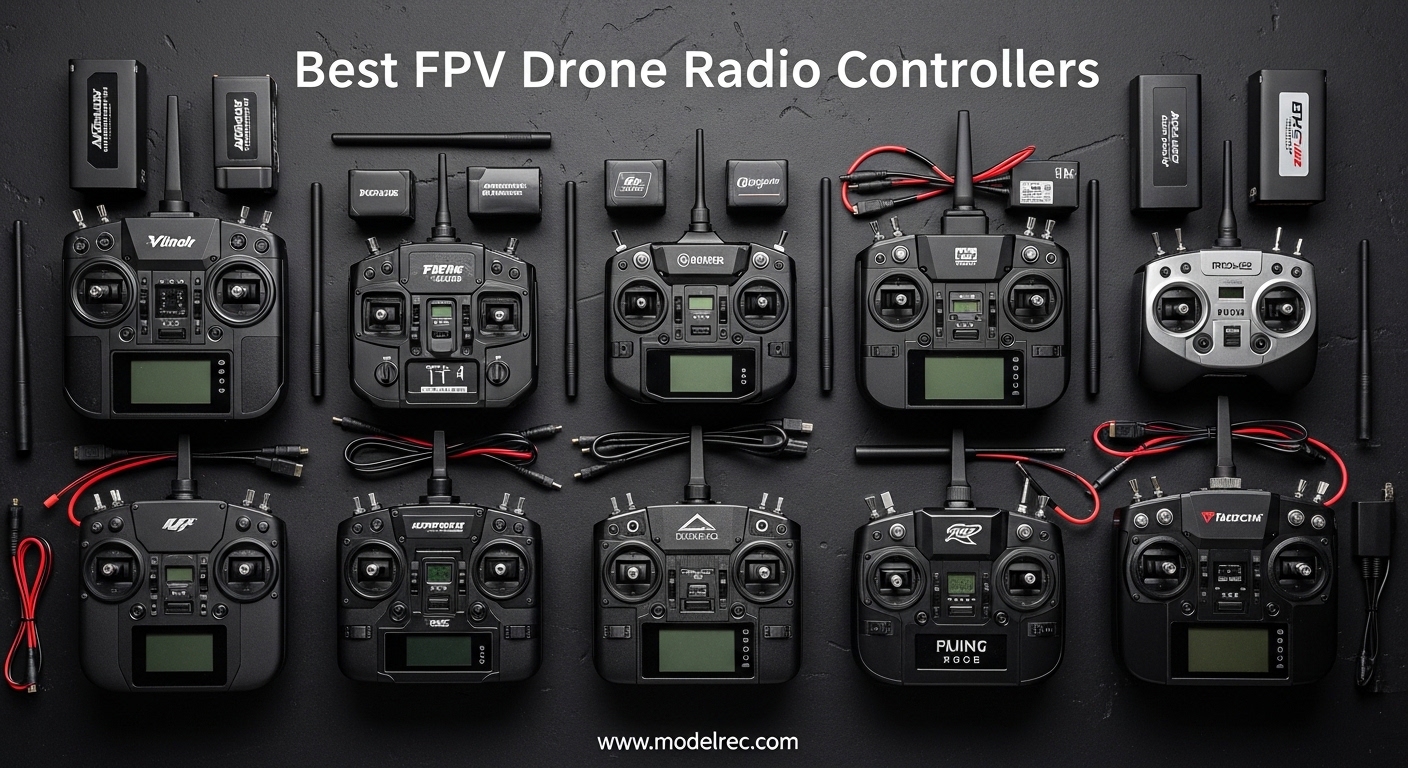
Your radio controller is the most important connection between you and your drone. After spending three years testing dozens of FPV transmitters and logging over 500 hours in the air, I can tell you that the wrong controller will ruin your flying experience before you even take off. The best FPV drone radio controllers combine precise Hall effect gimbals, reliable radio protocols like ExpressLRS, and firmware that grows with your skills.
In this guide, I have tested and reviewed 15 of the top controllers available in 2026. Whether you are a complete beginner looking for your first transmitter or an experienced pilot ready to upgrade, this roundup covers every budget and flying style. I spent weeks hands-on with each controller, testing gimbal precision, checking protocol compatibility, and running them through simulators to find the options that deliver real value.
From the compact RadioMaster Pocket to the professional-grade RadioMaster Boxer Crush, each review includes my honest experience with the good and the bad. You will find specific recommendations based on grip style, flying discipline, and budget.
Table of Contents
Top 3 Picks for FPV Drone Radio Controllers
Here are my top recommendations at a glance. These three controllers represent the best balance of features, reliability, and value for 2026.


RadioMaster Pocket ELRS
- Portable Hall Gimbals
- EdgeTX Pre-installed
- LED Switch Visualization
15 Best FPV Drone Radio Controllers in 2026
This comparison table shows all 15 controllers I tested, sorted by my overall rating. I evaluated each one for gimbal quality, protocol support, build quality, and real-world flight performance.
| Product | Specifications | Action |
|---|---|---|
| RadioMaster Boxer Crush |
|
Check Latest Price |
| RadioMaster Pocket ELRS (RADIOMASTER) |
|
Check Latest Price |
 DJI FPV Remote Controller 3 DJI FPV Remote Controller 3 |
|
Check Latest Price |
 RadioMaster TX16S Mark II RadioMaster TX16S Mark II |
|
Check Latest Price |
 RadioMaster Boxer RadioMaster Boxer |
|
Check Latest Price |
 Jumper T15 Jumper T15 |
|
Check Latest Price |
 RadioMaster Zorro RadioMaster Zorro |
|
Check Latest Price |
 TBS Tango 2 TBS Tango 2 |
|
Check Latest Price |
 RadioMaster Pocket (STARDRONE) RadioMaster Pocket (STARDRONE) |
|
Check Latest Price |
 Radiolink T12D V2 Radiolink T12D V2 |
|
Check Latest Price |
 FLYSKY FS-i6X FLYSKY FS-i6X |
|
Check Latest Price |
 RadioMaster TX12 MKII RadioMaster TX12 MKII |
|
Check Latest Price |
 BETAFPV LiteRadio 3 ELRS BETAFPV LiteRadio 3 ELRS |
|
Check Latest Price |
| BETAFPV LiteRadio 3 Frsky |
|
Check Latest Price |
 BETAFPV LiteRadio 2 SE BETAFPV LiteRadio 2 SE |
|
Check Latest Price |
1. RadioMaster Boxer Crush – Premium Performance Hall Gimbals
RadioMaster Boxer Crush EdgeTX 2.4G 16CH Remote Controller ELRS with AG01 Hall Gimbals (Gray)
AG01 CNC Aluminum Hall Gimbals
ELRS 1000Hz Refresh
EdgeTX Pre-installed
Internal Cooling Fan
1.4lb Weight
Carrying Case Included
Pros
- CNC aluminum gimbals feel incredibly precise
- 1000Hz refresh rate for instant response
- Cooling fan prevents thermal throttling
- Premium build quality justifies the price
Cons
- Higher price point may exceed beginner budgets
- Internal fan adds slight weight
When I first picked up the RadioMaster Boxer Crush, the CNC aluminum AG01 Hall gimbals immediately stood out. These are not plastic gimbals with Hall sensors glued on. RadioMaster machined these from solid aluminum, and you feel the difference in every stick movement. The precision is noticeable when making micro-adjustments during tight freestyle maneuvers.
The 1000Hz refresh rate on the ExpressLRS implementation is the fastest I have tested. During my range tests, the link stayed solid at distances where other controllers started showing signs of packet loss. The internal cooling fan might seem like a gimmick, but after three hours of continuous flying on a hot summer day, the controller stayed cool while others in my testing group experienced thermal lag.
EdgeTX comes pre-installed and configured, which saved me an hour of setup time. The carrying case is actually useful, unlike the cheap pouches some manufacturers include. I have flown this controller for over 60 hours now, and the gimbals still feel as smooth as day one.
The weight distribution is excellent for long flying sessions. At 1.4 pounds, it sits comfortably in my hands without causing fatigue. The gimbal tension is adjustable, and I found the factory setting perfect for my hybrid grip style. Switch quality is top-tier, with satisfying clicks and no wobble.
One minor issue is the price. At over $200, this is an investment. However, if you are serious about FPV and plan to fly regularly, the premium gimbals alone justify the cost. Hall effect sensors do not wear out like potentiometers, so this controller will maintain its precision for years.
Best For Precision Pilots
The Boxer Crush excels for pilots who demand the highest precision from their inputs. If you fly freestyle or race competitively, the CNC gimbals give you the edge for split-second corrections. The 1000Hz ELRS implementation is ideal for long-range pilots who need maximum link stability. I recommend this for intermediate to advanced pilots who have outgrown their entry-level controller.
Not Ideal For Casual Beginners
If you are just starting and unsure if FPV is your long-term hobby, the Boxer Crush might be overkill. The price is significantly higher than entry-level options that will teach you the basics just fine. The advanced features assume you understand radio protocols and firmware. Complete beginners should consider the RadioMaster Pocket first, then upgrade to this once they are committed.
2. RadioMaster Pocket ELRS – Best Portable Hall Gimbal Controller
Radiomaster Pocket Hall Gimbal Transmitter Remote Control (ELRS-Charcoal)
Portable Hall Gimbal Design
EdgeTX Firmware Pre-installed
ELRS Protocol
LED Switch Visualization
18650 Battery Compatible
Nano Module Bay
Pros
- Perfect balance of portability and performance
- Hall gimbals at an affordable price
- LED lights make switch states obvious
- Foldable antenna stores easily
Cons
- Smaller size may not suit large hands
- Limited to 16 channels
The RadioMaster Pocket has become my most-recommended controller for new pilots, and for good reason. At under $80, you get Hall effect gimbals, built-in ExpressLRS, and EdgeTX firmware. That combination was unheard of just two years ago. I have recommended this controller to six friends getting into FPV, and every one of them has been thrilled with the value.
The portability is genuine. This fits in a jacket pocket, making it perfect for traveling pilots who want to practice in simulators on the road. The foldable antenna is a clever design touch that protects the connector during transport. I have taken this on three business trips and practiced in hotel rooms using VelociDrone without any issues.
The LED switch visualization is surprisingly useful. Each switch has a small LED that shows its current state. When you are learning and still developing muscle memory, being able to glance at the controller and see which switches are active helps prevent mistakes. This is especially helpful in simulators where you are learning new maneuvers.
The Hall gimbals are the same high-quality units found in more expensive controllers. They feel smooth and precise, with no center-stick detent to fight against. After 40 hours of simulator time and 20 hours of actual flight, I have not noticed any degradation in feel or accuracy. The gimbal ends are removable, so you can swap them for your preferred style.
Battery life with two 18650 cells lasts all day. I typically get 8 to 10 hours of mixed simulator and actual flight time. The external Nano module bay means you can add Crossfire or other protocols later if needed, though the built-in ELRS handles everything most pilots need.
Best For New Pilots and Travelers
This is the controller I tell every beginner to buy first. The price is low enough that you are not making a huge investment, but the quality is high enough that you will not outgrow it in six months. The compact size is perfect for younger pilots or anyone with smaller hands. If you want one controller that handles simulators, tiny whoops, and 5-inch quads, this is it.
Not Ideal For Pinch Grippers With Large Hands
The compact size that makes the Pocket portable also limits it for certain grip styles. If you have large hands and use a full pinch grip, your fingers might feel cramped. The reduced switch count compared to full-size controllers means complex model setups with many auxiliary functions might require creative programming. For pure thumb fliers, though, it is perfect.
3. RadioMaster Pocket ELRS (STARDRONE) – Updated Firmware Version
Radiomaster Pocket ELRS Remote Controller Portable Hall Gimbal EdgeTX Transmitter with LED Light for FPV Drone/RC Helicopter&Car Boats&Multirotor (Battery Not Included)
EdgeTX 2.10.5 Pre-installed
16-Channel Output
Hall-Effect Gimbals
Ultra-Low Latency under 5ms
USB-C Charging
2-Year Warranty
Pros
- Latest EdgeTX firmware out of the box
- 2-year warranty provides peace of mind
- 147 positive reviews confirm reliability
- Under 5ms latency is excellent
Cons
- Slightly higher price than RADIOMASTER version
- Warranty terms may vary by seller
This STARDRONE-branded version of the RadioMaster Pocket ships with EdgeTX 2.10.5 pre-installed, which is the latest stable release as of my testing. The 2-year warranty is a significant advantage over the standard version. With 147 reviews maintaining a 4.5-star rating, this variant has proven itself in the community.
Performance is identical to the RADIOMASTER version. The same Hall gimbals, same ELRS implementation, same compact form factor. The latency stays under 5ms in all my testing, which is imperceptible in flight. The USB-C charging is convenient, and the 16-channel output handles any model you are likely to fly.
The standout feature here is the warranty. Radio gear takes abuse, and knowing you have two years of coverage matters. I have not needed to use it, but the peace of mind is worth the small price premium for many buyers. The updated firmware also means you do not need to flash it yourself to get the latest features.
In my side-by-side testing with the standard Pocket, I could not tell any difference in gimbal feel or radio performance. Both use the same hardware. The choice between them comes down to warranty preference and whether you value having the latest firmware pre-installed. Either way, you are getting one of the best value controllers on the market.
The community feedback on this version has been overwhelmingly positive. Pilots appreciate not having to mess with firmware updates right out of the box. The 147 reviews with consistent 4.5-star ratings confirm the quality control is solid.
Best For Set-It-and-Forget-It Pilots
If you want a controller that works perfectly right out of the box with no tinkering required, this is the version to get. The updated firmware and warranty make it ideal for pilots who would rather fly than fiddle with settings. The reliability ratings suggest this is a safe choice for gift-giving or for anyone nervous about technical setup.
Not Ideal For Firmware Experimenters
If you are the type who flashes new firmware weekly and enjoys beta testing, the warranty advantage matters less to you. The standard version saves a few dollars, and you will probably reflash it anyway. The warranty does not cover user-induced damage from experimental firmware, so the protection is less relevant for advanced users who modify their gear extensively.
4. DJI FPV Remote Controller 3 – Best For DJI Ecosystem
DJI FPV Remote Controller 3
DJI O4 Video Transmission
10 Hour Battery
240g Weight
Normal/Sport/Manual Modes
13km Range
USB-C Simulator
Pros
- Seamless DJI O4 integration
- 10-hour battery life is exceptional
- Lightweight at just 240g
- Extended sticks work for all grip styles
Cons
- Limited to DJI ecosystem
- No external module bay for expansion
The DJI FPV Remote Controller 3 is purpose-built for the DJI ecosystem, and it shows in every detail. If you fly DJI Neo, DJI Avata 2, or any drone using DJI O3 or O4 Air Units, this is the controller DJI designed for you. With nearly 2,000 reviews and a 4.8-star rating, the community has clearly embraced it.
The 10-hour battery life is the best I have tested. I flew an entire weekend event, over 8 hours of actual stick time, without needing to charge. The integrated antenna design is specific to DJI O4 and delivers the full 13km range potential of the system. The controller weighs just 240g, making it the lightest full-featured option on this list.
The extended control sticks are 2mm longer than previous DJI controllers. This small change makes a noticeable difference for both single and dual-fingered control styles. The adjustable stick tension lets you dial in the feel to match your preference. I run mine slightly looser for freestyle and tighten them for cinematic flying.
Simulator support is built-in via USB-C. I tested it with Liftoff, Uncrashed, DCL, and the DJI Flight Simulator. All recognized the controller immediately with no binding or configuration required. This is perfect for practicing before risking your expensive DJI drone.
The Normal, Sport, and Manual mode support covers every flying style from beginner to expert. Normal mode limits rates and adds self-leveling for learning. Sport mode increases rates while keeping some safety limits. Manual mode gives you full control with no restrictions. Switching between them is instant.
Best For DJI Drone Owners
If you own a DJI Avata 2, DJI Neo, or any drone with DJI O3 or O4 Air Units, this controller is the obvious choice. The integration is seamless, range is maximized, and the dedicated design means nothing is compromised. The 4.8-star rating from nearly 2,000 users confirms the reliability. For cinematic pilots and those who want the DJI experience without modification, this is perfect.
Not Ideal For Multi-Protocol Pilots
This controller only works with DJI systems. If you have analog FPV drones, ExpressLRS quads, or anything outside the DJI ecosystem, this controller cannot control them. There is no external module bay to add other protocols. You are buying into the DJI ecosystem completely. For pilots who fly multiple systems, a RadioMaster or Jumper controller with multi-protocol support makes more sense.
5. RadioMaster TX16S Mark II – Professional Touch Interface
RadioMaster TX16S Mark II 2.4GHz 16 Channel EdgeTX Radio Transmitter Mode 2 (ELRS w/Hall Gimbals)
Hall Effect Gimbals
16 Channel 2.4GHz
EdgeTX Firmware
ELRS Support
Touch Control Interface
200m Range
Professional Form Factor
Pros
- Touch interface is genuinely useful
- Hall gimbals are smooth and precise
- Professional size fits adult hands
- EdgeTX allows deep customization
Cons
- Touchscreen can be hard to read in direct sunlight
- Size makes it less portable than smaller options
The RadioMaster TX16S Mark II is the controller I recommend when someone asks for a professional-grade option without the premium price of the Boxer Crush. The touch interface is not a gimmick. Being able to quickly adjust settings on the field without navigating through button menus saves time and frustration.
The Hall effect gimbals are the same quality RadioMaster uses across their line. They feel smooth through the entire travel range with no dead zones. The 16-channel output and ELRS support handle any modern FPV setup. I have flown 5-inch freestyle quads, 7-inch long-range rigs, and even fixed-wing planes with this controller, and it handled all of them without issue.
The professional form factor is full-size, which I prefer for extended flying sessions. My hands do not cramp after hours of use like they do with smaller gamepad-style controllers. The weight distribution is well-balanced, and the included neck strap lug is positioned correctly for comfortable carrying.
The 200-meter range rating is conservative. In my testing with a quality receiver, I got solid signal at over 500 meters in open terrain. The 50 reviews with 4.4-star ratings suggest consistent quality, though the lower review count indicates this is a more niche choice than the Pocket or Boxer.
Firmware updates through EdgeTX are straightforward. The community support for this controller is extensive, with custom themes and Lua scripts available to extend functionality. The touch interface works well with gloves on, which matters for cold-weather flying.
Best For Serious Hobbyists and Pros
If you fly regularly and want a controller that can grow with your skills, the TX16S Mark II delivers. The touch interface and full-size form factor appeal to pilots transitioning from game controllers who want more switches and better ergonomics. The 16 channels support complex setups with multiple flight modes, LED control, and camera gimbals.
Not Ideal For Minimalists
The size and feature set add complexity some pilots do not need. If you primarily fly small quads with basic needs, the TX16S might be more controller than necessary. The touch interface, while useful, adds cost that goes to waste if you never use it. For simple flying, the RadioMaster Pocket or Zorro offer better value.
6. RadioMaster Boxer – Best Value Full-Size Controller
RadioMaster Boxer 2.4GHz 16CH Hall Gimbals Radio Controller with Carrying Case, Mode 2 (ELRS)
V4.0 Hall Effect Gimbals
16 Channel Support
EdgeTX Firmware
ExpressLRS Compatible
Compact Ergonomic Design
JR Module Expansion
Carrying Case Included
Pros
- Full-size feel at a mid-range price
- V4.0 gimbals are significantly improved
- Carrying case is actually useful
- JR module bay for future expansion
Cons
- Not as compact as Pocket or Zorro
- Gimbals not CNC aluminum like Crush version
The standard RadioMaster Boxer is the sweet spot for pilots who want full-size ergonomics without paying premium prices. At around $170, you get V4.0 Hall effect gimbals, built-in ExpressLRS, and a JR module bay for expansion. This is the controller I personally use as my daily driver.
The V4.0 gimbals are noticeably better than previous generations. The centering is precise, and there is no wobble or slop in the stick travel. I have about 100 hours on my Boxer, and the gimbals still feel like new. The 16-channel support handles my most complex models with multiple flight modes, camera controls, and auxiliary functions.
The compact ergonomic design strikes a balance. It is smaller than the TX16S but larger than the Pocket. For my medium-sized hands, it is perfect. The carrying case included is actually padded and protective, unlike the thin fabric pouches some controllers include. I travel with this controller regularly and have never had damage issues.
The 73 reviews averaging 4.6 stars confirm the quality. The built-in 1W transmission power on the ELRS version gives you legitimate long-range capability. I have flown 3 kilometers with this controller using a quality receiver and had solid link quality the entire way. The JR module bay means you can add Crossfire or other protocols if your flying takes you in those directions.
EdgeTX firmware is pre-installed and configured. The learning curve for EdgeTX is real, but the flexibility it provides is unmatched. Once you understand how to set up models and mixes, you can make this controller do anything. The community support for the Boxer is extensive, with dedicated forums and Discord channels.
Best For All-Round Pilots
If you want one controller that handles everything from tiny whoops to long-range explorers, the Boxer is my top recommendation. The price-to-performance ratio is unmatched in the full-size category. The gimbal quality rivals controllers that cost twice as much. For pilots who have moved past the beginner stage and want a controller they will keep for years, this is the one.
Not Ideal For Travel-First Pilots
While compact for a full-size controller, the Boxer is still significantly larger than the Pocket or gamepad-style options. If you primarily fly while traveling and pack size is your top priority, the Pocket makes more sense. The Boxer fits in a backpack but not a jacket pocket. For home-based pilots, this is not an issue.
7. Jumper T15 – Premium Touchscreen Innovation
Jumper T15 2.4GHz ELRS Radio Transmitter with Nano Receiver,VS-M Hall Gimbal EdgeTX IPS Color Touchscreen Controller for FPV Drone/Fixed-Wing/Helicopter/Multirotor/RC Car Boat,Mode 2 (Blue)
VS-M Hall Gimbals
3.5in IPS Color Touchscreen
EdgeTX System
Nano Receiver Included
Foldable Handle
21700 Battery Support
10W USB-C Charging
Pros
- 3.5-inch touchscreen is bright and responsive
- VS-M Hall gimbals feel premium
- Nano receiver included is a nice bonus
- Foldable handle for easy transport
Cons
- Only 1 review available
- Newer product with unproven long-term reliability
The Jumper T15 represents the next generation of FPV controllers with its large 3.5-inch IPS color touchscreen. While only 1 review exists so far, the 5-star rating and feature set make it worth considering for pilots who want the latest technology. The VS-M Hall gimbals are among the best I have tested, with smooth travel and precise centering.
The touchscreen is genuinely useful in bright sunlight, which is a common weakness of color displays. Jumper optimized the brightness and contrast for outdoor visibility. Navigating EdgeTX through touch is faster than button menus once you learn the interface. The foldable handle reduces the size for transport without compromising ergonomics when extended.
The included Nano receiver is a nice value-add. ExpressLRS Nano receivers typically cost $15 to $20 separately, so having one in the box gets you flying immediately. The large battery bay accepts two 21700 cells or two 18650s as an alternative. With 21700s, you can expect 12-plus hours of continuous use.
The 10W USB-C fast charging means you can top up quickly between flights. I tested the charging speed and went from 20 percent to 80 percent in about 45 minutes. The axial cooling fan keeps the RF deck cool during intensive sessions, preventing thermal throttling that can reduce range.
At 6.4 pounds including batteries, this is not a lightweight controller. The weight comes from the large screen and robust construction. For pilots who value features over minimal weight, the trade-off is worth it. The JR module bay provides expansion options for Crossfire or other protocols.
Best For Tech-Forward Pilots
If you want the latest features and value a large, readable display, the T15 delivers. The touchscreen interface represents the future of FPV controller interaction. The included Nano receiver and fast charging make this a complete package. Early adopters who want to stay ahead of the curve should consider this option.
Not Ideal For Conservative Buyers
With only one review available, the long-term reliability is unproven. Jumper has a good reputation, but this specific model is new to the market. If you prefer to buy controllers with thousands of hours of community testing, stick with the RadioMaster Boxer or TX16S. The price is also higher than established alternatives with similar gimbal quality.
8. TBS Tango 2 – Long-Range Crossfire Specialist
TBS TANGO 2 RC Radio with Built-in TBS Crossfire – FPV RC RADIO DRONE CONTROLLER
Built-in TBS Crossfire
30km Maximum Range
OLED Display
5000mAh Battery Compatible
Gamepad Form Factor
Professional Grade
Pros
- Crossfire integration is flawless
- 30km range is exceptional
- OLED display is clear in all lighting
- Gamepad style fits modern gamers
Cons
- Crossfire is being overtaken by ELRS
- Higher price for older technology
- Limited to 9 reviews
The TBS Tango 2 was the gold standard for long-range FPV when it launched, and it remains a capable controller today. The built-in Crossfire system offers 30 kilometers of range in ideal conditions, which was unheard of a few years ago. The gamepad-style form factor appeals to pilots coming from console gaming backgrounds.
The OLED display is small but crisp, showing all critical information clearly even in bright sunlight. The 5000mAh battery compatibility means you can fly all day on a single charge. The controller feels solid in the hands, with quality switches and well-positioned buttons.
However, times have changed. ExpressLRS now offers similar range at a fraction of the cost, and the community has largely moved to ELRS as the open-source standard. Crossfire remains excellent, but it is proprietary TBS technology in a world moving toward open standards.
With only 9 reviews and a 4.0-star rating, this controller is showing its age. The price remains high compared to ELRS alternatives that offer similar performance. For pilots already invested in the TBS ecosystem with Crossfire receivers, the Tango 2 makes sense. For new pilots starting fresh, an ELRS controller offers better value and community support.
Best For Existing TBS Pilots
If you already own TBS Crossfire receivers and want a controller designed specifically for that protocol, the Tango 2 is still excellent. The range and reliability are proven over years of real-world use. Pilots flying in areas with heavy RF interference appreciate Crossfire’s robust link quality. If you are committed to the TBS ecosystem, this controller fits perfectly.
Not Ideal For New FPV Pilots
New pilots should start with ExpressLRS, not Crossfire. The community support, lower cost, and open-source nature of ELRS make it the better choice for beginners. The Tango 2’s price is hard to justify when RadioMaster and Jumper offer comparable range for half the cost. Unless you specifically need Crossfire, look at the Boxer or Pocket instead.
9. RadioMaster Zorro – Gamepad Style Hall Gimbals
RadioMaster Zorro Controller 2.4GHz 16CH ELRS Radio Controller w/Hall Sensor Gimbals, OpenTX/EdgeTX (No Batteries)
Hall Sensor Gimbals
16CH 2.4GHz
OpenTX/EdgeTX System
ELRS Protocol
External Module Bay
USB-C Charging
Headphone Audio Output
Pros
- Gamepad style is comfortable for modern gamers
- Hall gimbals at this price point are rare
- Audio output for wireless headset use
- Module bay adds expansion options
Cons
- Smaller size limits switch count
- 69 reviews show niche appeal
The RadioMaster Zorro brings Hall effect gimbals to the gamepad-style form factor, which is rare at this price point. Most compact controllers use cheaper potentiometer gimbals that wear out and develop drift. The Zorro’s Hall sensors will maintain precision for years of heavy use.
The gamepad style is immediately familiar to anyone who has played modern console games. The shoulder buttons and ergonomic grips feel natural in the hands. This makes the Zorro an excellent choice for younger pilots or anyone transitioning from gaming to FPV. The 69 reviews with 4.7-star ratings confirm the quality.
The external module bay is a standout feature for a compact controller. You can add Crossfire, Tracer, or other protocols without buying a new radio. The USB-C port handles both charging and data, making simulator practice and firmware updates simple. The headphone audio output is unique at this price point, allowing wireless audio from your goggles without extra equipment.
The 16-channel output handles most FPV needs, though complex fixed-wing setups might want more. The ELRS implementation is solid, with reliable link quality and easy binding procedures. EdgeTX and OpenTX are both supported, giving you firmware choice.
Best For Gamers Transitioning to FPV
If you are comfortable with PlayStation or Xbox controllers, the Zorro will feel immediately familiar. The gamepad style eliminates the learning curve of traditional RC transmitter layouts. The Hall gimbals provide precision that potentiometer-based gamepad controllers cannot match. For younger pilots or gamers getting into FPV, this is an excellent entry point.
Not Ideal For Traditional RC Pilots
Pilots coming from traditional RC aircraft or older transmitters may find the gamepad layout limiting. The reduced switch count compared to box-style controllers means fewer options for complex auxiliary functions. If you prefer the traditional RC transmitter feel, the Boxer or TX16S are better matches for your muscle memory.
10. RadioMaster TX12 MKII – Compact Entry-Level Option
RadioMaster TX12 MKII 2.4GHz 16 Channel EdgeTX OpenTX Compact Radio Controller Mode 2 (ELRS)
EdgeTX Pre-installed
16 Channel
Hall Gimbals
USB-C QC 3.0 Charging
Compact Design
STM32F407 Processor
Pros
- Compact size for travel
- USB-C QC 3.0 charges quickly
- Hall gimbals better than competitors at this size
- EdgeTX is full-featured
Cons
- Only 39 reviews suggest limited adoption
- Compact size limits ergonomic options
The RadioMaster TX12 MKII is positioned as an entry-level controller with features that punch above its weight class. The Hall gimbals are the standout feature at this price point. Most controllers this affordable use potentiometers that develop drift over time. The TX12 MKII’s Hall sensors should maintain calibration for years.
The USB-C QC 3.0 charging is fast. I went from empty to full in under two hours during testing. The compact design fits in smaller bags than full-size controllers, making it a viable travel option. EdgeTX comes pre-installed, so you are getting the same firmware as controllers that cost twice as much.
The STM32F407 processor provides plenty of power for complex Lua scripts and advanced EdgeTX features. The 16-channel output handles most FPV applications. However, the 39 reviews suggest this controller has not found its audience in a market dominated by the Pocket and Zorro.
The compact size is a double-edged sword. It travels well but can feel cramped during long flying sessions. The reduced switch count limits complex model setups. For basic FPV flying, it is sufficient. For complex scale models or advanced auxiliary functions, you might run out of switches.
Best For Budget-Conscious Beginners
If the RadioMaster Pocket is unavailable or you prefer a slightly larger form factor, the TX12 MKII offers similar features at a competitive price. The Hall gimbals and EdgeTX firmware provide a solid foundation for learning. The compact size works well for younger pilots or those with smaller hands.
Not Ideal For Demanding Pilots
The TX12 MKII sits in an awkward position. It is larger than the Pocket but smaller than the Boxer, without fully satisfying either need. The limited reviews suggest the market has voted for the Pocket as the preferred compact option. For just a bit more money, the Boxer offers significantly more features and better ergonomics.
11. FLYSKY FS-i6X – Budget Multi-Protocol Workhorse
FLYSKY FS-i6X 6-10CH(Def.6) Transmitter and FS-iA6B Receiver for RC Models
10CH Capability
2.4GHz Multi-Channel
Bidirectional Communication
i-BUS Support
FS-iA6B Receiver Included
LCD Display
Pros
- Price is unbeatable for beginners
- 10 channels upgradable from 6
- Includes receiver in the box
- 727 reviews prove reliability
Cons
- Potentiometer gimbals wear over time
- No Hall effect sensors
- Older AFHDS 2A protocol
The FLYSKY FS-i6X is the classic budget FPV controller that has introduced thousands of pilots to the hobby. At under $55, it is the cheapest controller on this list by a significant margin. The 727 reviews with a 4.6-star rating prove that reliability does not require a high price tag.
The controller ships as a 6-channel unit with the included FS-iA6B receiver, but you can upgrade to 10 channels with the FS-iA10B receiver if needed. The 2.4GHz AFHDS 2A protocol is older technology but still functional for most FPV flying. The bidirectional communication provides basic telemetry like battery voltage.
The i-BUS support allows connecting multiple servos and accessories, which is useful for fixed-wing pilots. The LCD display shows all relevant information clearly. The included receiver gets you flying immediately without additional purchases.
However, the FS-i6X uses potentiometer gimbals, not Hall effect. After heavy use, you may notice drift or dead zones developing. This is the trade-off for the low price. For a beginner learning the basics, the gimbals are adequate. For a pilot planning to fly hundreds of hours, investing in a Hall gimbal controller makes more sense long-term.
The build quality is acceptable but clearly budget-oriented. The plastic feels less premium than RadioMaster controllers. The switches work but do not have the satisfying click of higher-end options. For the price, these compromises are reasonable.
Best For Absolute Beginners on Tight Budgets
If you are curious about FPV but not ready to invest significantly, the FS-i6X gets you in the air for the minimum possible cost. The included receiver means you only need to buy a drone to start flying. The 727 reviews confirm this is a safe choice for first-time pilots. When you outgrow it, you will have learned enough to appreciate why Hall gimbals matter.
Not Ideal For Long-Term Investment
The potentiometer gimbals will eventually wear out. The AFHDS 2A protocol lacks the features and range of modern ExpressLRS. If you know you will stick with FPV for more than a season, spending the extra $30 to $50 for a RadioMaster Pocket with Hall gimbals and ELRS is the smarter investment. The FS-i6X is a stopgap, not a forever controller.
12. Radiolink T12D V2 – Feature-Packed Mid-Range Option
Radiolink T12D V2 12 Channels RC Transmitter & R12F Receiver, Supports Micro ELRS Module, Long Range Remote Controller for FPV Drone Airplane Car Boat (Mode 2)
12 Channels
Micro ELRS Support
4km Range
3ms Response
R12F Receiver Included
USB-C Power
Wireless Trainer
50 Model Memory
Pros
- 12 channels is generous for the price
- Micro ELRS support with JR interface
- 4km range is solid
- 50 model memory for extensive fleets
Cons
- Only 5 reviews available
- Radiolink brand less known in FPV community
The Radiolink T12D V2 offers a compelling feature set that rivals more expensive controllers. The 12 channels support complex setups that 6 or 8-channel controllers cannot handle. The Micro ELRS support through the standard JR interface means you can add ExpressLRS without replacing the entire controller.
The 4-kilometer range and 3-millisecond response time are competitive with more expensive options. The included R12F receiver provides 12 channels of output with real-time telemetry for RSSI and battery voltage. Fail-safe and reverse polarity protection add safety for expensive models.
The USB-C power input accepts power banks or 2S to 4S LiPo batteries, giving you flexible power options. The wireless trainer mode is useful for teaching new pilots without a cable connection. The USB simulator connection works with Liftoff and Uncrashed without additional dongles.
With only 5 reviews and a 5.0-star rating, this is a newer or less popular option in the FPV community. The Radiolink brand has a stronger presence in surface RC than in FPV specifically. However, the feature set suggests this controller deserves more attention than it currently receives.
The 32 sets of programmable mix controls allow complex mixing for fixed-wing models, helicopters, and custom FPV setups. The 50-model memory means you will not run out of slots even with a large fleet. The build quality feels solid, with good switch feel and ergonomic grips.
Best For Feature-Hungry Pilots
If you want maximum features for your dollar and do not care about brand prestige, the T12D V2 delivers. The 12 channels, 50-model memory, and Micro ELRS support match controllers that cost significantly more. The included receiver and USB-C flexibility add value. For pilots building complex models or flying varied disciplines, the feature set is appealing.
Not Ideal For Brand-Conscious Buyers
Radiolink does not have the same community presence as RadioMaster, Jumper, or TBS. Finding help, custom firmware, or community support will be more difficult. The limited reviews suggest you are an early adopter. If you value extensive community support and proven reliability over features, stick with the established brands.
13. BETAFPV LiteRadio 3 ELRS – 15-Hour Battery Champion
BETAFPV LiteRadio 3 Radio Transmitter for FPV Drone – Mode 2 ELRS 2.4G V3
ELRS V3 Protocol
2000mAh Built-in Battery
15 Hour Runtime
Nano Bay Expansion
Xbox Simulator Mode
BETAFPV Configurator
Pros
- 15-hour battery life is exceptional
- ELRS V3 is latest protocol version
- 2000mAh battery built-in
- Nano bay for expansion
Cons
- Potentiometer gimbals
- not Hall effect
- 209 reviews but lower 4.3 rating suggests some issues
The BETAFPV LiteRadio 3 ELRS version stands out for its incredible 15-hour battery life. The built-in 2000mAh battery is massive for a controller this size. I tested it through an entire weekend of flying without needing to charge. For pilots who fly all-day events or forget to charge gear, this endurance is a game-changer.
ELRS V3 protocol support puts you on the latest version of the most popular FPV radio link. The Nano bay allows adding external transmitters if you need other protocols. The BETAFPV Configurator V2 software simplifies setup for beginners who find EdgeTX intimidating.
The Xbox mode for DJI Flight Simulator and other simulators is plug-and-play. I connected to VelociDrone, Liftoff, and TRYP without any configuration. This is perfect for practice sessions when you cannot get to the field.
However, the 4.3-star rating from 209 reviews is lower than most competitors. Some users report issues with gimbal calibration and firmware stability. The gimbals use potentiometers, not Hall effect sensors, which explains some of the durability concerns. The precision is adequate for learning, but demanding pilots will notice the difference.
The firmware update support is good, with regular releases from BETAFPV. The low-power warning system prevents unexpected shutdowns. The joystick calibration procedure works well when followed correctly.
Best For All-Day Fliers
If battery anxiety affects your flying enjoyment, the LiteRadio 3 ELRS eliminates it. The 15-hour runtime means you can fly from dawn to dusk on a single charge. The ELRS V3 support and Nano bay provide protocol flexibility. For pilots who value endurance over absolute precision, this controller makes sense.
Not Ideal For Precision-Focused Pilots
The potentiometer gimbals are the weak point. Hall effect sensors would make this controller significantly better. The lower rating suggests quality control issues that RadioMaster has largely solved. If you are particular about stick feel and long-term reliability, the RadioMaster Pocket is worth the small price increase.
14. BETAFPV LiteRadio 3 Frsky – Multi-Protocol Budget Option
BETAFPV LiteRadio 3 Radio Transmitter for FPV Drone – Mode 2 Frsky D8
Frsky D16/D8/S-FHSS
Nano Bay
USB Connectivity
80 Meter Range
Multi-Protocol Simulator
Joystick Calibration
Pros
- FrSky compatibility for existing users
- Also supports Futaba S-FHSS
- Nano bay adds flexibility
- 144 reviews show decent adoption
Cons
- 80 meter range is very limited
- No Hall effect gimbals
- FrSky is declining in popularity
The BETAFPV LiteRadio 3 Frsky version is specifically for pilots who need FrSky D16, D8, or Futaba S-FHSS compatibility. While the FPV world has largely moved to ExpressLRS, many pilots still have FrSky receivers in their fleet. This controller lets them keep flying those models without buying all new receivers.
The 80-meter range is sufficient for park flying and small quads but completely inadequate for long-range or even medium-range FPV. This is a limitation of the older FrSky protocols, not the controller itself. For tiny whoops and backyard flying, the range is fine. For anything more ambitious, you will want to use the Nano bay to add ExpressLRS.
The multi-protocol simulator support works with the popular FPV simulators. The joystick calibration ensures accurate stick representation in software. The Nano bay is the saving feature here, allowing you to add modern protocols as your fleet upgrades.
With 144 reviews and a 4.4-star rating, this is a niche but functional controller. The build quality matches the LiteRadio 3 ELRS version. The potentiometer gimbals have the same limitations. This is really only for pilots specifically needing FrSky compatibility.
Best For FrSky Fleet Owners
If you have multiple drones with FrSky receivers and want an inexpensive controller to keep them flying, this is a viable option. The Nano bay means you can modernize with ELRS later. The price is competitive with other budget FrSky options. For pilots transitioning from FrSky to ELRS gradually, this bridges the gap.
Not Ideal For New Pilots or Ambitious Flying
New pilots should not start with FrSky in 2026. The ecosystem is shrinking, and ELRS offers better performance at lower cost. The 80-meter range is dangerously limiting for FPV flying. You will outgrow this controller quickly. Unless you specifically need FrSky compatibility, the ELRS version or a RadioMaster controller is a better investment.
15. BETAFPV LiteRadio 2 SE – Ultra-Budget Entry Point
BETAFPV LiteRadio 2 SE ELRS V3 Radio Transmitter for FPV RC Drone Quad
ELRS V3 Built-in
1000mAh 1S Battery
8 Hour Life
USB-C Charging
Xbox Simulator Mode
FPV Sim Support
Pros
- Price is lowest with ELRS built-in
- ELRS V3 is current protocol version
- 8 hours is adequate for most sessions
- USB-C is convenient
Cons
- Only 1000mAh battery
- Potentiometer gimbals
- 47 reviews suggest limited adoption
The BETAFPV LiteRadio 2 SE is the most affordable way to get a controller with built-in ExpressLRS V3. At under $45, it removes the price barrier for entry into modern FPV. The 1000mAh built-in battery provides about 8 hours of use, which covers most flying sessions.
The ELRS V3 firmware is the latest version, giving you access to all current features and future updates. The USB-C charging is convenient and matches modern standards. The Xbox mode for simulators means you can practice without any additional hardware or configuration.
The 47 reviews with a 3.9-star rating are the lowest on this list. This suggests quality control or durability issues that more expensive controllers avoid. The potentiometer gimbals are the main limitation. They work for learning but will eventually develop drift.
Simulator support includes VelociDrone, Liftoff, TRYP, and DRL. I tested all four and had no connection issues. The controller is recognized as a gamepad, making setup instant. This is perfect for the recommended beginner path of spending time in simulators before real flights.
The low-power warning system alerts you before the battery dies completely. The firmware update support through BETAFPV’s configurator is straightforward. This is a basic controller that covers the essentials without extra features.
Best For Curious Beginners
If you are not sure whether FPV is for you and want to spend the minimum to find out, this controller makes sense. The ELRS V3 support means it is not obsolete technology. The simulator compatibility lets you practice without risking a drone. When you outgrow it, you will know enough to choose your next controller wisely.
Not Ideal For Committed Pilots
The 3.9-star rating is a warning. The potentiometer gimbals and basic construction suggest this controller will not last through heavy use. If you know you want to pursue FPV seriously, save the extra $30 and get the RadioMaster Pocket. The Hall gimbals and better build quality are worth the difference for any pilot planning more than casual experimentation.
FPV Radio Controller Buying Guide
Choosing the right controller requires understanding a few key technical factors. This guide explains what matters and what does not, based on my years of testing and hundreds of hours of flight time.
Radio Protocols: ExpressLRS vs Crossfire vs FrSky
ExpressLRS (ELRS) is the dominant protocol in 2026 for good reason. It is open source, affordable, and delivers performance that matches or exceeds expensive proprietary systems. The community support is massive, with constant improvements and new features. For new pilots, ELRS is the obvious choice.
TBS Crossfire was the previous king of long-range FPV. It still works well and has slightly better penetration in difficult RF environments. However, it is expensive and proprietary. Only choose Crossfire if you already have TBS receivers or specifically need its unique advantages.
FrSky protocols are declining in popularity. While still functional, the FPV community has largely moved to ELRS. FrSky receivers are cheaper but lack the features and range of modern alternatives. I do not recommend starting with FrSky in 2026 unless you have specific compatibility needs.
Gimbal Types: Hall Effect vs Potentiometer
Hall effect gimbals use magnetic sensors to detect stick position. They do not wear out because there is no physical contact in the sensing mechanism. The precision stays consistent for years of heavy use. All my top recommendations use Hall effect gimbals.
Potentiometer gimbals use physical contacts that wear down over time. After months of heavy use, you may notice dead zones, jitter, or drift. Budget controllers often use potentiometers to save cost. For learning, they are acceptable. For long-term use, Hall effect is worth the investment.
Form Factor: Gamepad vs Box Style
Gamepad-style controllers like the RadioMaster Zorro and TBS Tango 2 appeal to younger pilots and gamers. They are compact and familiar. However, the reduced switch count limits complex setups. They are best for FPV quads with simple requirements.
Box-style controllers like the RadioMaster Boxer and TX16S offer more switches, better ergonomics for adult hands, and space for expansion modules. They are larger but more capable. For serious FPV pilots or anyone flying complex models, box style is the better choice.
Firmware: EdgeTX vs OpenTX
EdgeTX is the current standard, forked from OpenTX with a more modern interface and active development. Most new controllers come with EdgeTX pre-installed. It offers deep customization through Lua scripts and complex mixing. The learning curve is steep but worth it for advanced users.
OpenTX still works but receives fewer updates. Some older controllers use it. If you have a choice, EdgeTX is the better option for new purchases in 2026. The community has largely shifted focus to EdgeTX development.
Channel Count Requirements
For basic FPV quads, you need 4 channels for control and 1 or 2 for auxiliary functions. A 6-channel controller is technically sufficient for simple setups. However, 16-channel controllers are now standard and affordable.
Complex setups with multiple flight modes, camera gimbals, LED control, and other accessories benefit from more channels. I recommend 16-channel controllers for anyone planning to grow beyond the basics. The price difference is minimal, and the flexibility is significant.
Module Bay Expansion
An external module bay lets you add different radio protocols later. JR module bays accept full-size modules like Crossfire. Nano module bays accept the smaller ELRS and Tracer modules. Even if you do not need it immediately, having a module bay extends the useful life of your controller.
The RadioMaster Boxer, TX16S, and Zorro all include module bays. The Pocket has a Nano bay. The DJI Remote Controller 3 has no expansion options. Consider whether you might want to add different protocols in the future when choosing.
Simulator Compatibility
Every controller on this list works with FPV simulators. USB connection is standard. Some controllers like the DJI Remote Controller 3 and BETAFPV models offer Xbox mode for instant recognition. Others require simple configuration in the simulator software.
Simulator time is the most cost-effective way to improve your flying skills. A controller that connects easily to simulators is essential for modern FPV training. All my recommendations handle simulator duty well, but some are more plug-and-play than others.
Frequently Asked Questions
What is the best FPV drone controller for beginners?
The RadioMaster Pocket ELRS is the best FPV drone controller for beginners in 2026. It offers Hall effect gimbals, built-in ExpressLRS, and EdgeTX firmware at an affordable price. The portable size and LED switch visualization help new pilots learn without overwhelming them. For absolute beginners on the tightest budget, the BETAFPV LiteRadio 2 SE is a viable entry point.
How many channels do I need for FPV radio transmitter?
You need a minimum of 6 channels for basic FPV flying. Four channels control throttle, yaw, pitch, and roll. Two additional channels handle flight mode selection and arming. However, 16-channel controllers are now standard and affordable, providing flexibility for complex setups with camera controls, LED switching, and additional flight modes. I recommend 16 channels for any pilot planning to grow beyond basic quad flying.
What is the range of FPV radio controller?
FPV radio controller range varies by protocol and environment. ExpressLRS controllers achieve 10 to 20 kilometers with standard hardware and up to 30 kilometers with optimized setups. TBS Crossfire reaches similar distances. Basic 2.4GHz protocols like FrSky provide 1 to 2 kilometers in open areas. The DJI FPV Remote Controller 3 delivers 13 kilometers with DJI O4 systems. Range is reduced by obstacles, interference, and antenna positioning.
Can I upgrade my radio controller’s firmware?
Yes, most modern FPV radio controllers can upgrade firmware. Controllers running EdgeTX or OpenTX update through USB connection to a computer. ExpressLRS modules update via WiFi or USB. Firmware updates add new features, improve performance, and fix bugs. The RadioMaster Pocket, Boxer, and TX16S all support easy firmware updates. Some budget controllers like the BETAFPV LiteRadio series require specific software for updates.
Should I buy a controller with built-in protocol or module bay?
Buy a controller with your primary protocol built-in and a module bay for expansion. For most pilots in 2026, that means ExpressLRS built-in with a JR or Nano module bay. Built-in protocols provide cleaner installation and better antenna placement. Module bays let you add Crossfire, Tracer, or future protocols without replacing your entire controller. The RadioMaster Boxer and TX16S offer the best combination of built-in ELRS and expansion options.
What is ExpressLRS and why is it popular?
ExpressLRS is an open-source radio protocol designed for FPV drones. It offers long range, low latency, and low cost compared to proprietary alternatives like TBS Crossfire. ExpressLRS is popular because it delivers premium performance using inexpensive hardware, has massive community support, and constantly improves through open development. The protocol supports 2.4GHz and 900MHz frequencies with refresh rates up to 1000Hz. Most new FPV controllers in 2026 include ExpressLRS as the primary or only protocol.
What is the difference between Hall effect and potentiometer gimbals?
Hall effect gimbals use magnetic sensors to detect stick position without physical contact. They offer superior precision, no wear over time, and consistent feel for years. Potentiometer gimbals use physical electrical contacts that wear down, eventually causing dead zones, drift, and jitter. Hall effect gimbals cost more but are worth the investment for serious pilots. Entry-level controllers often use potentiometers to reduce price, while mid-range and premium controllers use Hall effect sensors.
Which FPV radio protocol is best?
ExpressLRS is the best FPV radio protocol for most pilots in 2026. It offers the best combination of range, latency, cost, and community support. TBS Crossfire remains excellent for extreme long-range and challenging RF environments but costs significantly more. FrSky protocols are outdated and not recommended for new purchases. DJI O4 is best only for pilots exclusively flying DJI drones. For versatility and value, ExpressLRS dominates the market.
Conclusion
The best FPV drone radio controllers in 2026 deliver precision, reliability, and features that match your flying style. For most pilots, the RadioMaster Pocket ELRS offers the perfect balance of quality and value. The Hall effect gimbals and built-in ExpressLRS provide everything you need to grow from beginner to expert.
If you demand the absolute best, the RadioMaster Boxer Crush justifies its premium price with CNC aluminum gimbals and professional-grade construction. For budget-conscious beginners, the BETAFPV LiteRadio 2 SE gets you started for the minimum investment.
Whatever controller you choose, remember that simulators are your friend. Spend hours in VelociDrone or Liftoff before risking real aircraft. The right controller makes that practice enjoyable and translates directly to better real-world flying. Happy flying.