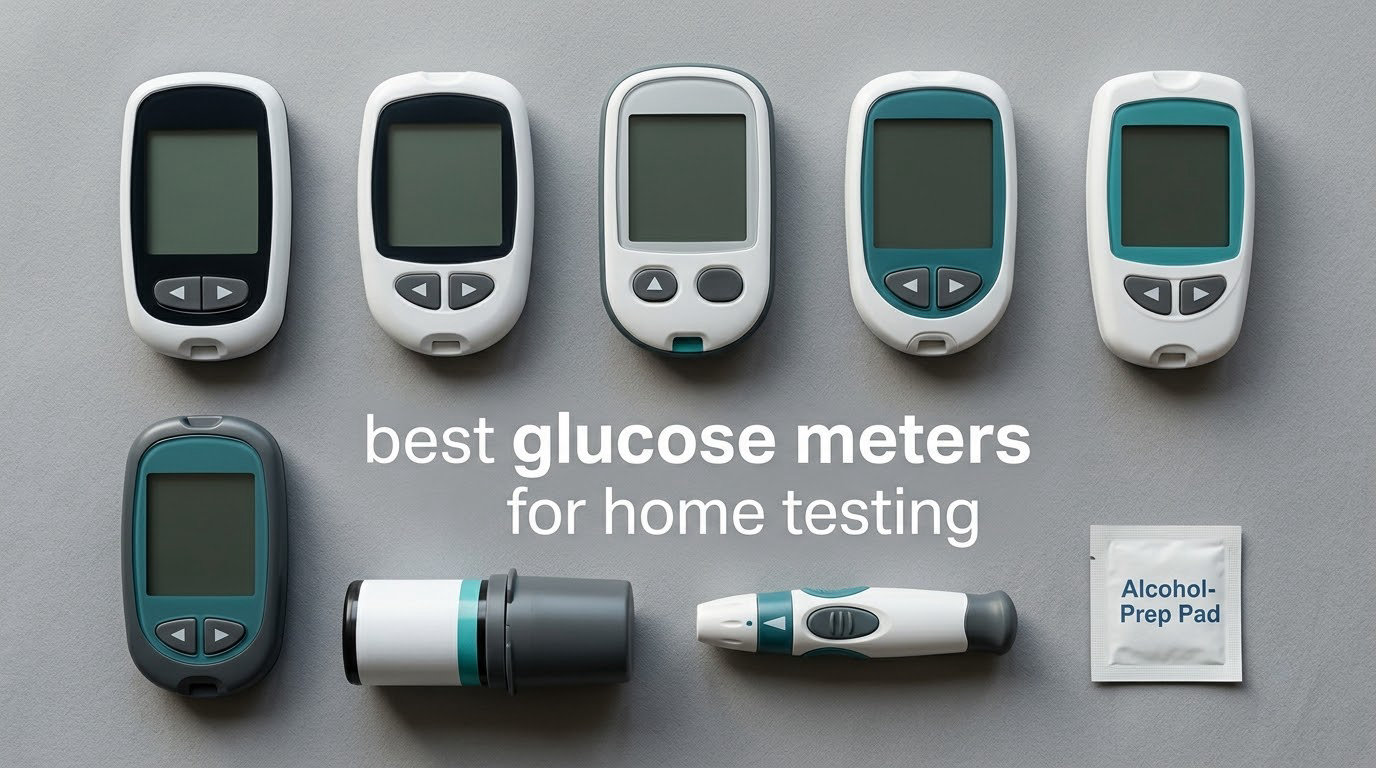
If you are shopping for the best glucose meters for home testing, the short version is this: the CareSens N is the one we would put in front of most people. It draws a 0.5 microliter blood sample, returns a result in five seconds, comes with 100 strips, 100 lancets, a control solution and a travel case, and it holds a 4.5 average across more than 9000 reviews. If your priority is a phone app and a cleaner daily routine, the Contour Next One is the stronger pick. If the budget is the deciding factor, the On Call Express gets a result in four seconds from a 0.4 microliter sample and carries a five-year warranty.
That is the shortlist. The rest of this guide explains the ten meters we looked at in detail, what each one is actually good at, who should avoid it, and how to check a meter’s accuracy yourself before you trust a single number it prints. We spent several weeks reading customer review patterns across the whole set, comparing sample sizes, result times, memory, connectivity and what is actually in the box.
One thing to clear up first: almost nobody in the forums asks for the cheapest meter. What you pay for the meter matters far less than what its replacement strips cost every year, and strips are locked to the model you bought. A low-cost meter paired with expensive proprietary strips can work out more expensive over three years than a mid-range meter with cheap refills, which is why running cost gets its own section below.
Everything here is a purchasing guide, not medical advice. Target ranges, testing frequency and insulin decisions belong with your doctor or diabetes care team, and this article is not a substitute for that conversation.
Table of Contents
Top 3 Picks Best Glucose Meters for Home Testing in October
These three cover the most common situations. The CareSens N wins on the combination of a small sample, fast results, a generous kit and strong review volume. The AUVON is the pick for anyone who wants the most proven kit in the group and the highest volume of customer feedback we could find. The Metene is the pick for older users and anyone who wants a large display with reminder alarms built in.


All 10 Meters at a Glance in 2026
The table below is the fastest way to compare the set. Sample size, result time, connectivity and what arrives in the box are the four things that change day to day, and they are listed first. Strip costs and coverage change by seller and by pharmacy benefit, so check the current listing for any meter you are serious about.
| Product | Specifications | Action |
|---|---|---|
| CareSens N Glucose Monitor Kit |
|
Check Latest Price |
| AUVON Blood Glucose Monitor Kit |
|
Check Latest Price |
 Metene TD-4116 Monitor Kit Metene TD-4116 Monitor Kit |
|
Check Latest Price |
 Contour Next One All-in-One Kit Contour Next One All-in-One Kit |
|
Check Latest Price |
 Keto-Mojo GK+ Glucose and Ketone Meter Keto-Mojo GK+ Glucose and Ketone Meter |
|
Check Latest Price |
 On Call Express Diabetes Meter Kit On Call Express Diabetes Meter Kit |
|
Check Latest Price |
 iHealth Gluco+ Wireless Smart Monitor iHealth Gluco+ Wireless Smart Monitor |
|
Check Latest Price |
 OneTouch Verio Reflect Test Kit OneTouch Verio Reflect Test Kit |
|
Check Latest Price |
 Glucoracy G-425-2 Monitor Kit Glucoracy G-425-2 Monitor Kit |
|
Check Latest Price |
 CareLiving BGM101 Monitor Kit CareLiving BGM101 Monitor Kit |
|
Check Latest Price |
1. CareSens N Blood Glucose Monitor Kit: The Best All-Round Choice
CareSens N Blood Glucose Monitor Kit with 100 Blood Sugar Test Strips, 100 Lancets, 1 Blood Glucose Meter, 1 Lancing Device, 1 Control Solution, Travel Case for Diabetes Testing for Personal Use
0.5 microliter sample
5-second results
Auto-coded strips
100 strips,100 lancets,control solution and travel case
Pros
- 0.5 microliter sample and 5-second results keep frequent testing painless
- Auto-coded strips remove manual coding
- Complete kit with 100 strips 100 lancets and control solution
- 77 percent of reviews are five star
- Highest-rated product in the roundup
Cons
- Finger-stick instructions take practice to get a clean sample
- Lancet depth settings need trial and error
- A small number of users report a wide margin of error
The CareSens N is the meter we kept coming back to while working through this list. It holds a 4.5 average across more than 9000 reviews, which puts it among the best-rated devices in the roundup, the rating breakdown is unusually clean with 77 percent five-star reviews. That consistency matters for a medical-adjacent tool, because a device people abandon after a bad month does not help anyone track a trend.
The day to day numbers are good. It needs 0.5 microliter of blood, which is the smallest sample among the kit meters we reviewed, and the result arrives in five seconds. Some owners have mentioned that they returned to this brand after a cheaper competitor produced readings that varied too much, which is the clearest signal we found that people judge accuracy by comparison rather than by specification.
What arrives in the box matters more than most buyers expect at first. You get the meter, 100 test strips, 100 lancets, a lancing device, a control solution and a travel case, so nothing needs buying on day one beyond batteries. The whole kit weighs 10.5 ounces and the meter is 5 by 2.75 by 6.5 inches, small enough to live in a pocket or a handbag without thinking about it.
The strips are auto-coded, which means the meter reads the batch code off the strip itself and you never have to match a code chip to a vial. That removes one of the classic beginner errors, and it is the same no-friction approach the AUVON and Glucoracy kits take. CareSens makes the strips with i-SENS, a manufacturer that has been in the glucose sensing business for a long time, which is reassuring for a device that has to keep working years later.
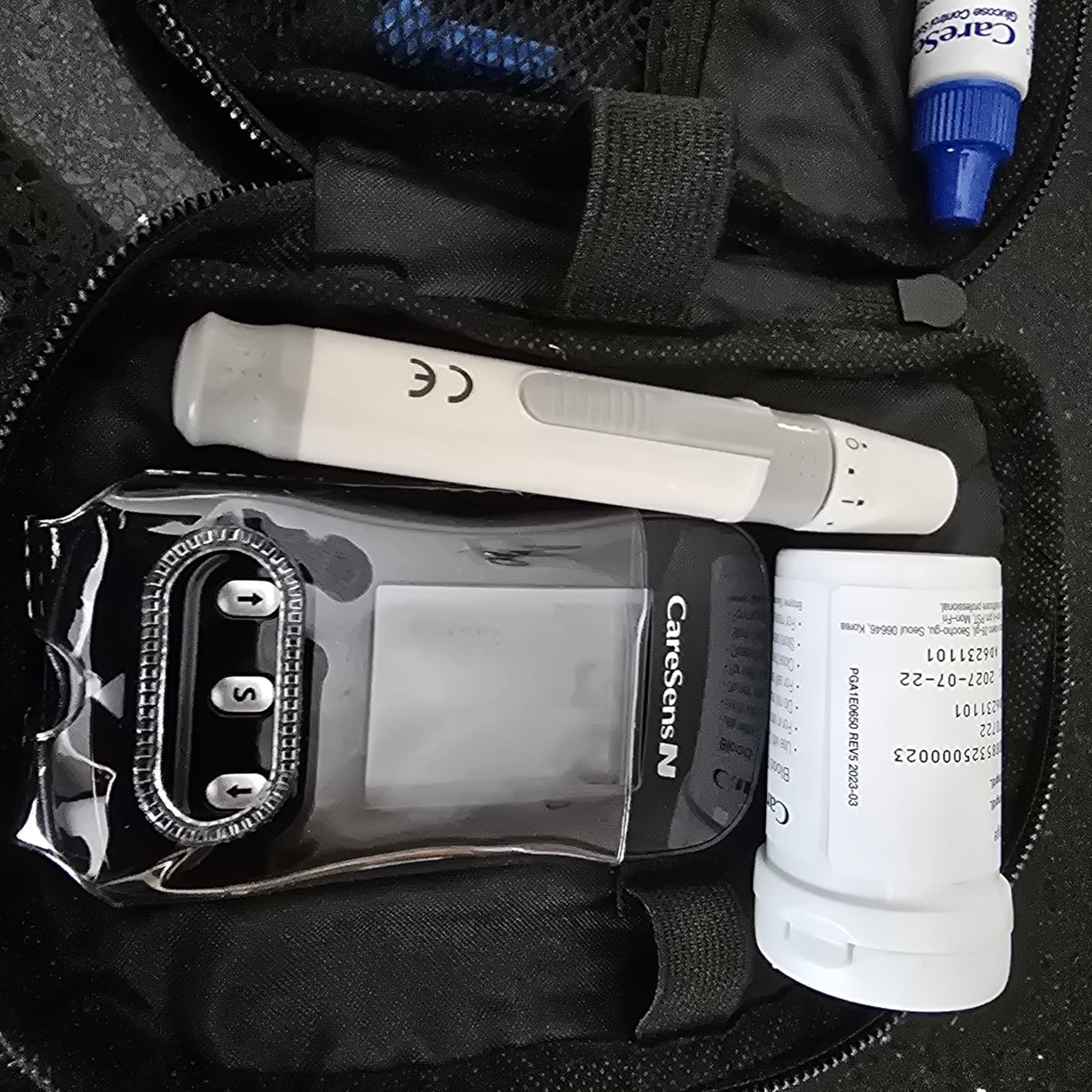
The honest complaints are about technique rather than hardware. The finger-stick instructions can be hard to follow, and several owners describe needing a few attempts before the sample reads properly. The lancing device has adjustable depth, but finding the right setting takes trial and error. Neither of these is a defect, they are the ordinary learning curve of any finger-stick meter, and they resolve with a little practice.
Who the CareSens N suits
This is the meter for someone who tests several times a day, because the small sample and the five second turnaround keep the friction low. It suits a first-time tester as much as it suits someone who has had diabetes for decades, since the auto-coded strips and the complete kit remove almost every setup decision. It is also a sensible choice for anyone who has been put off by meters that feel fiddly.
Who should look elsewhere
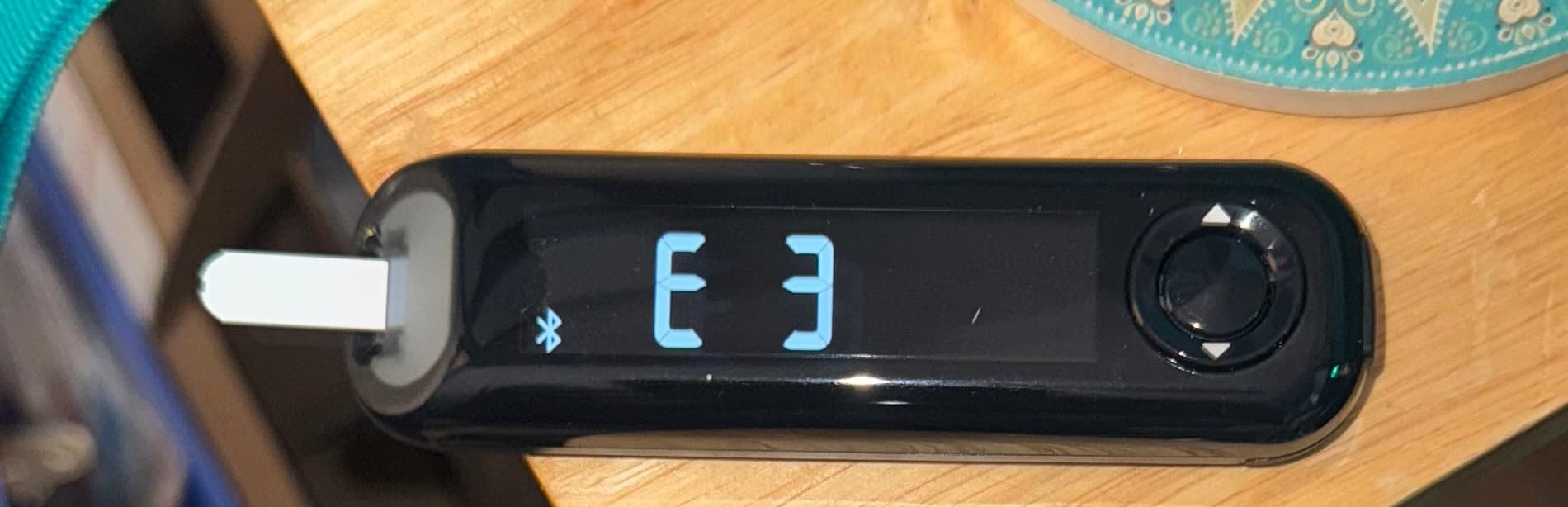
Skip it if you need a meter that logs automatically to a phone, since this one has no Bluetooth. If you are working toward insulin dosing decisions, talk to your care team about a prescription meter with independent verification, since a small number of owners here report a wide margin of error and moved on to one. It is also not the right choice for ketogenic tracking, because it reads glucose only.
2. AUVON Blood Glucose Monitor Kit: Best Value With the Most Owner Feedback
AUVON Blood Glucose Monitor Kit for Accurate Test, 100 Strips, No Coding
100 strips and 100 lancets
No coding
7/14/30-day averages
Manufacturer states accuracy within 10 percent of lab values
Pros
- Most reviewed kit in the roundup
- No coding with a complete 100-strip and 100-lancet bundle
- Stated accuracy within 10 percent of lab values over 95 percent of readings
- Stores time and date stamped results with 7/14/30-day averages
- Lifetime warranty with US-based technical support and instructional videos
Cons
- Test strips are proprietary and must be repurchased
- Some users need several attempts to get an adequate blood sample
The AUVON kit is the most proven device in this roundup by volume of use, with more than 21000 reviews and a 4.4 average. That kind of sample size tells you more about long-term reliability than any specification, because people keep a meter for years and they keep reviewing it.
The accuracy claim is the one that matters here. The manufacturer states the meter functions within 10 percent or 10 mg/dL of laboratory values over 95 percent of readings, and it is approved under CE, GMP, ISO 13485:2016 and ISO 15197:2013. The ISO 15197 standard is the international accuracy benchmark for self-testing meters, and passing it is the baseline for a device anyone should trust at home.
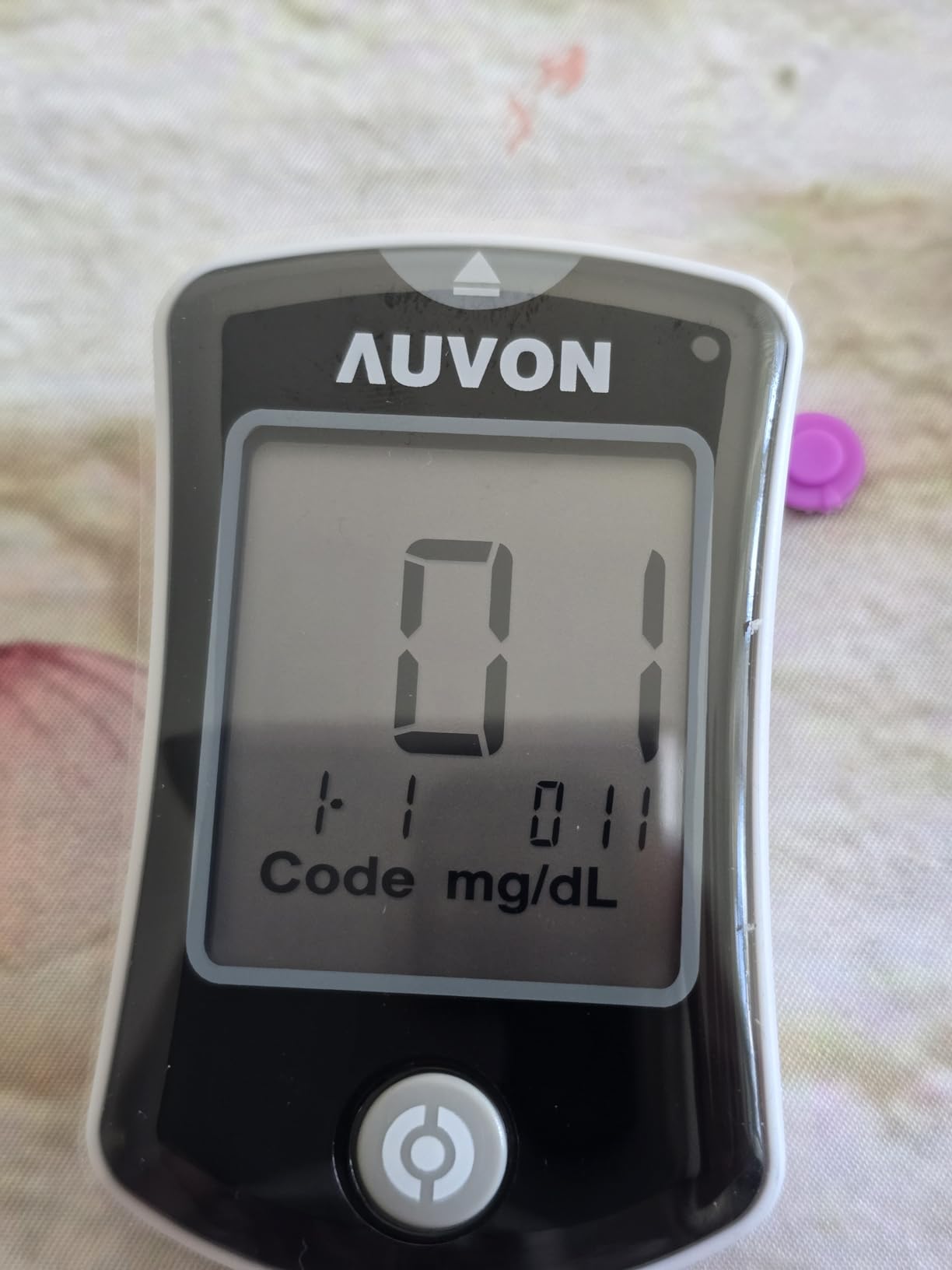
The strips are made with an automatic carbon printing technique aimed at batch consistency, which addresses one of the real weak points of cheaper strips, where a bad batch produces readings that drift. The meter stores time and date stamped results and can show 7, 14 and 30 day averages, which is the simplest useful way to see whether a change in routine is working.
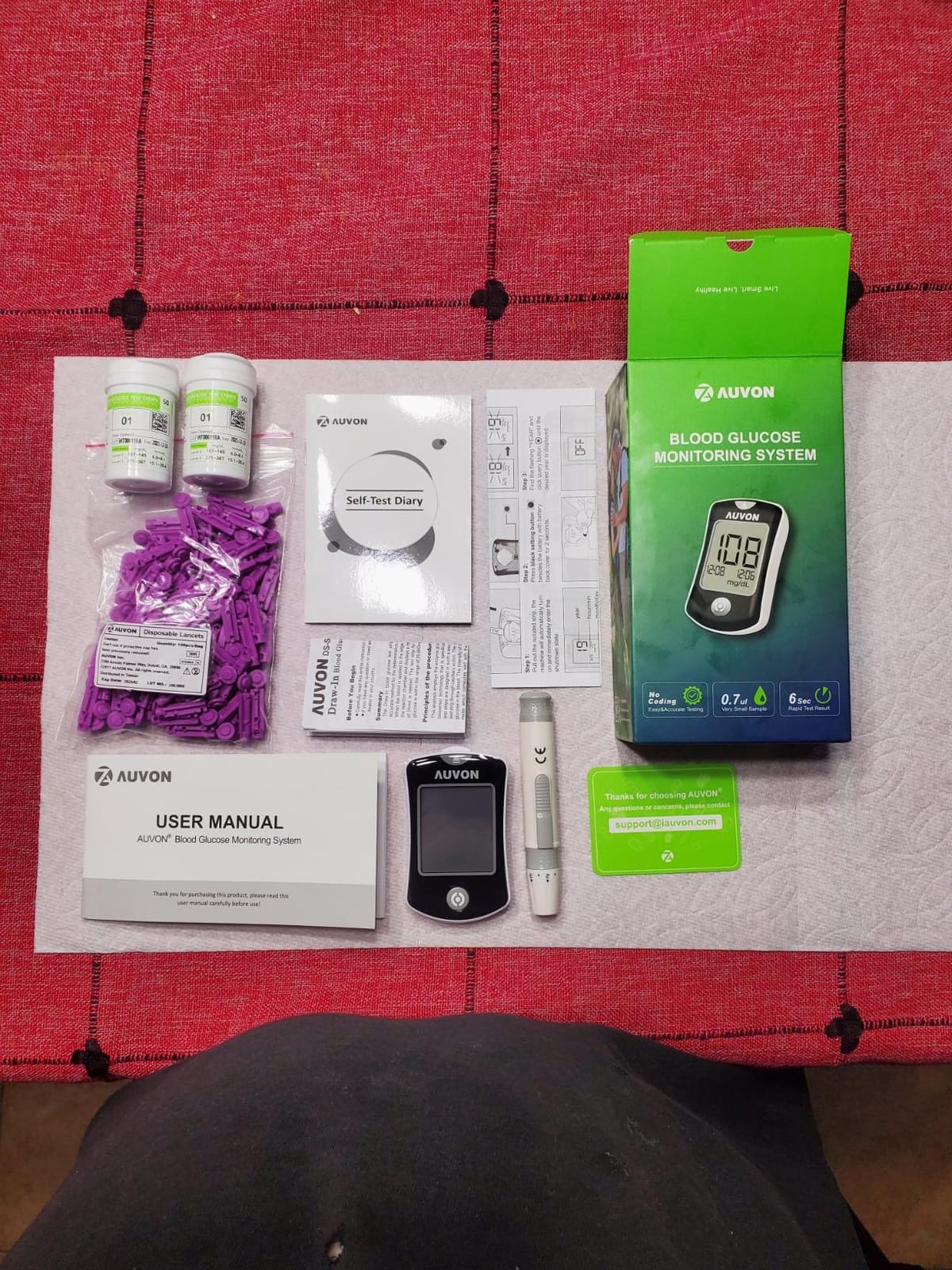
Everything you need to start is in the box: meter, 100 strips, 100 30-gauge lancets, lancing device, storage bag, battery, log book and two guides. A coin cell lasts about six months, the meter powers itself off to conserve it, and both 100-piece and 50-piece kit versions exist if you want fewer strips to start.
There is a lifetime warranty with US-based technical support, and AUVON publishes instructional videos, which sounds minor until you realise most of the frustration in the reviews is about how much blood to put where. The recurring complaint is exactly that, plus the fact that the strips are proprietary and have to be repurchased from the brand.
Who the AUVON suits
This is the safest pick for someone who wants a known quantity and does not want to research. The volume of reviews means the failure modes are well documented, so you already know what you are dealing with. It also works well for anyone who prefers a paper-friendly log book alongside the digital averages, since both are included.
Who should look elsewhere
Pass if you need app syncing or a display that tells you at a glance whether a number is high or low, because this meter gives you a number and nothing else. Those who struggle to get a clean sample from the fingertip will find that frustrating too, and should look at a meter with a guided fill feature instead.
3. Metene TD-4116: Best for Older Users and Low-Vision Buyers
Metene TD-4116 Blood Glucose Monitor Kits, Blood Sugar Testing Kit, HSA/FSA
Large display
0.7 microliter sample
7-second results
4 daily reminder alarms
Pros
- Large easy-to-read display and simple no-code operation
- Only 0.7 microliter of blood needed with a 7-second result
- Complete kit with 100 strips 100 lancets lancing device and control solution
- 450-value memory plus 14/21/28/60/90-day averages
- Reminder alarms help you keep a testing routine
Cons
- Some users get errors by smearing blood on top of the strip instead of the tip
- Not lab-grade accuracy so treat results as a ballpark
The Metene TD-4116 is designed around a simple idea, which is that the most common problems for older or low-vision users are not accuracy, they are reading the display and remembering to test. It answers both, with a large display and four daily reminder alarms, and it holds a 4.4 average across more than 10900 reviews.
Some owners use it for baseline tracking rather than for active diabetes management, which tells you how the community reads it. They want a number that is consistent week to week, not a device that makes insulin decisions. For that purpose it is a good fit, and the reviewer sentiment reflects that, with a large share of comments focused on the display size and how fast the reading arrives.
Memory is generous for a budget kit. The meter stores 450 results and calculates 14, 21, 28, 60 and 90 day averages, and there are four recording modes so you can separate readings by time of day. In practice that is more than enough to see whether breakfast readings have moved, which is the sort of detail that gets lost in a paper log.
The kit includes 100 strips, 100 lancets, a lancing device and control solution, which matters because a control solution is what lets you confirm the meter and the strips are working before you rely on a result. The meter is code free, ready to test as soon as a strip is seated correctly, and needs 0.7 microliter for a seven second answer.
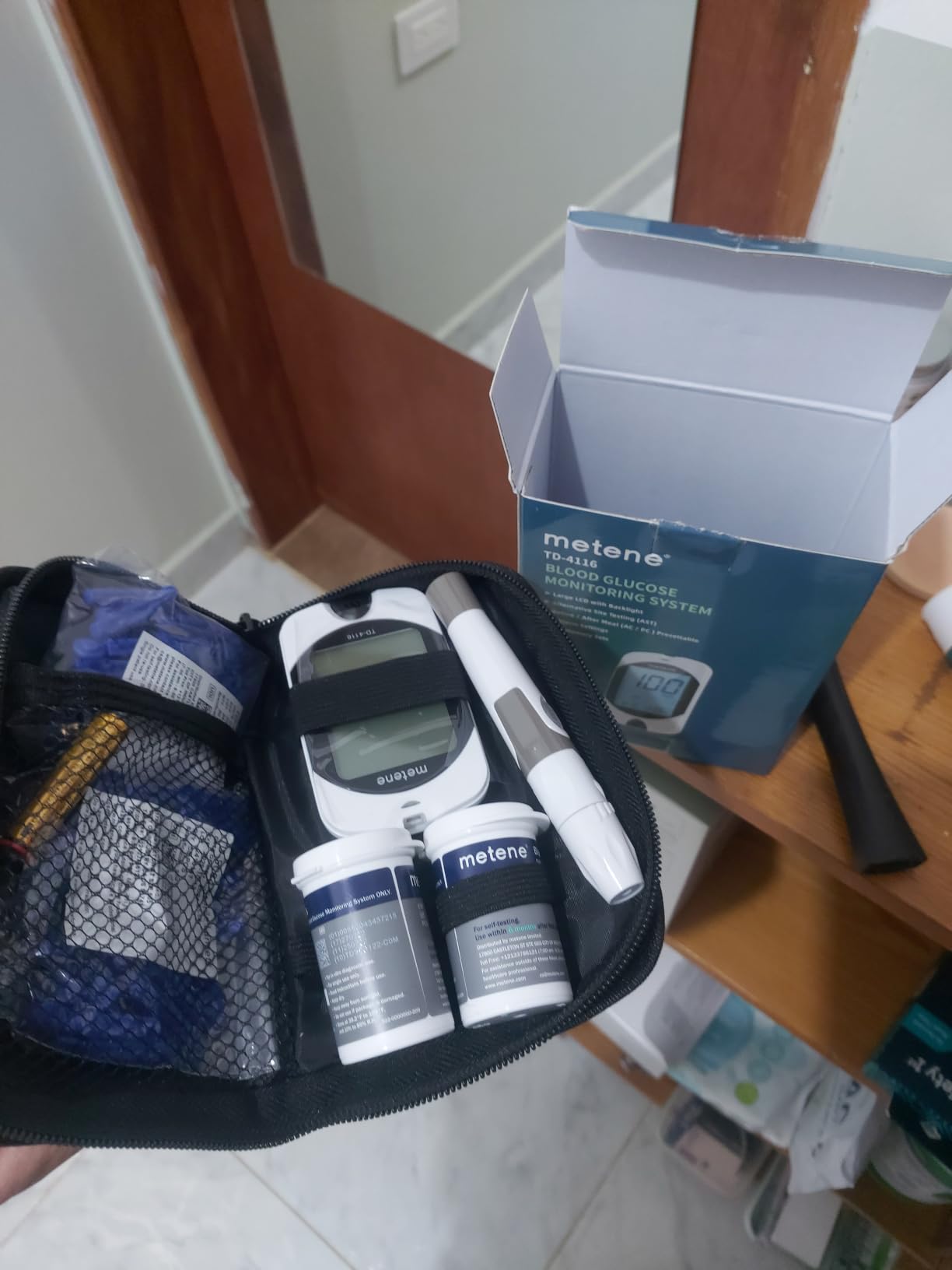
The main learning curve is where the blood goes. Some first-time users smeared blood across the top of the strip instead of drawing it into the tip and got errors until they got the technique right. Once that clicks, the complaints disappear, which is why the ratings recover as owners gain experience.
Who the Metene suits
It suits anyone who will struggle with a small screen, and anyone who needs a prompt to remember to test. Caregivers setting up testing for a relative will also appreciate the alarms, since they reduce the need for someone else to keep track. The long averaging windows are useful when you want to see a monthly direction rather than a daily spike.
Who should look elsewhere
It is not the right choice for anyone who needs a connected meter, since there is no Bluetooth here, and reviewers are candid that accuracy is not lab grade. If your readings will inform insulin dosing, pair it with a prescription meter or discuss a different approach with your care team rather than relying on it alone.
4. Contour Next One: Best for a Bluetooth App and Guided Feedback
CONTOUR NEXT ONE Blood Glucose Monitoring System All-in-One Kit for Diabetes
Smartlight range indicator
Second-Chance Sampling
Bluetooth companion app
Accuracy stated within 8.4 percent of lab values
Pros
- Highest average rating in the roundup with 79 percent five-star reviews
- Smartlight indicator gives instant in-range feedback
- Second-Chance Sampling can reduce wasted strips
- Bluetooth connectivity to a free companion app for record keeping
Cons
- Kit includes only 20 test strips and 10 lancets
- Smallest consumable bundle in the roundup
The Contour Next One has the highest raw rating in the group at 4.6, with 79 percent of reviews at five stars, and it comes from a brand that people in the diabetes community already recognise. On Reddit, Contour meters come up constantly as a logging choice, and the Contour Next family is the one most often recommended for people who want their history somewhere other than a paper notebook.
Two features make it stand out. Smartlight puts a coloured indicator on the meter so you know whether the number is above, below or inside your range without interpreting the digits first, and Second-Chance Sampling gives you a 60 second window to add more blood if the first sample was too small instead of throwing the strip away. When strips are the running cost, not wasting them matters.
The accuracy claim is the tightest in the roundup, with the manufacturer stating the meter reads within 8.4 percent of laboratory values. That is a claim about the device rather than about a person, and no home meter is a laboratory instrument, but it is the number we would want to see quoted for anyone comparing options on accuracy alone.
Bluetooth syncing to a free companion app is the reason this meter appears in most app discussions. The app keeps the history on your phone and shares reports, which is exactly what a clinic visit needs, because a month of readings on a screen beats a bag of used strips and handwritten notes.
The catch is what arrives in the box. The kit holds the meter, 20 test strips, 10 Microlet colored lancets, the Microlet lancing device, a logbook, a carrying case and the guides, and 20 strips is the smallest bundle in this roundup. It is also worth grabbing one of our glucose meter carrying cases, since the case included here is basic and the meter travels well in something with a strap.
Who the Contour Next One suits
It suits anyone who wants the history off the meter and onto a phone, and anyone who benefits from being told whether a reading is in range rather than having to work it out. Second-Chance Sampling is a quiet advantage for people on frequent testing schedules, because one thin sample no longer means a wasted strip.
Who should look elsewhere
Skip it if you are starting from zero and want enough strips and lancets to cover the first couple of months, because 20 strips disappears quickly. It is also the wrong pick for anyone without a compatible phone or a preference for app-based logging, since the meter’s own memory is modest compared with the kits that store hundreds of results.
5. Keto-Mojo GK+: The Only Meter Here That Reads Ketones Too
KETO-MOJO GK+ Glucose & Ketone Meter, Keto Diabetes Fasting
Glucose and ketone testing
GKI calculation in the app
Bluetooth sync to MyMojoHealth
Pros
- Measures glucose and ketones in one device for GKI tracking
- App syncs automatically and calculates the Glucose Ketone Index
- Reviewers report readings matching other meters within a few mg/dL
- Auto-detects strip type which reduces user error
- Lifetime warranty with US-based support
Cons
- App pairing and setup instructions can be confusing
- Foil strip pouches are hard to tear open
- Replacement glucose and ketone strips cost more than single-function strips
If you are following a low-carb or ketogenic diet, the Keto-Mojo GK+ is the reason it is in this roundup. It measures blood glucose and blood ketones in the same device, and it is the only meter here that does. Members of the r/FelineDiabetes community, which has a large keto following, regularly point to it as the practical option because one meter covers both numbers.
The app is the other reason to buy it. Readings sync over Bluetooth to the free MyMojoHealth app, which graphs your history and calculates the Glucose Ketone Index, a ratio of glucose to ketones that people use to describe nutritional ketosis. It also integrates with Apple Health, Cronometer and Carb Manager, so your data can live inside the tracking tools you already use.
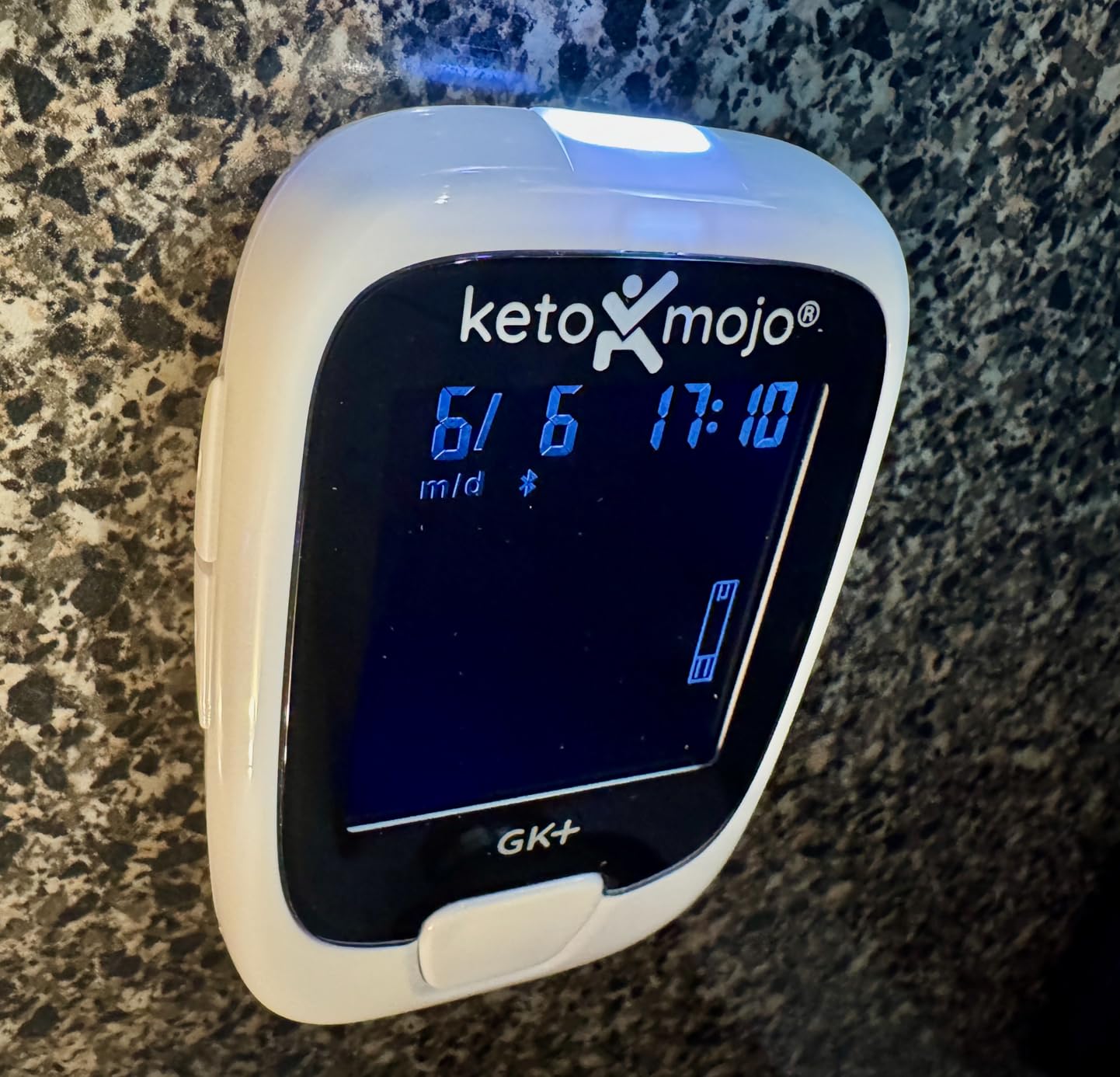
On credibility, the meter is FDA cleared for home use and the manufacturer states it has been used in more than 100 clinical trials, and the type has been used in veterinary settings too. Reviewers report readings that landed within a few mg/dL of other meters they compared against, which is the closest thing to a home cross-check we found in the review data.
The kit is a proper starter pack: the meter, 10 ketone strips, 10 glucose strips, 20 lancets, a lancing device, both control solutions, two AAA batteries, a travel case and a manual. Strips come individually foil wrapped and the meter detects which type is inserted, so you cannot accidentally run a ketone strip as a glucose test.
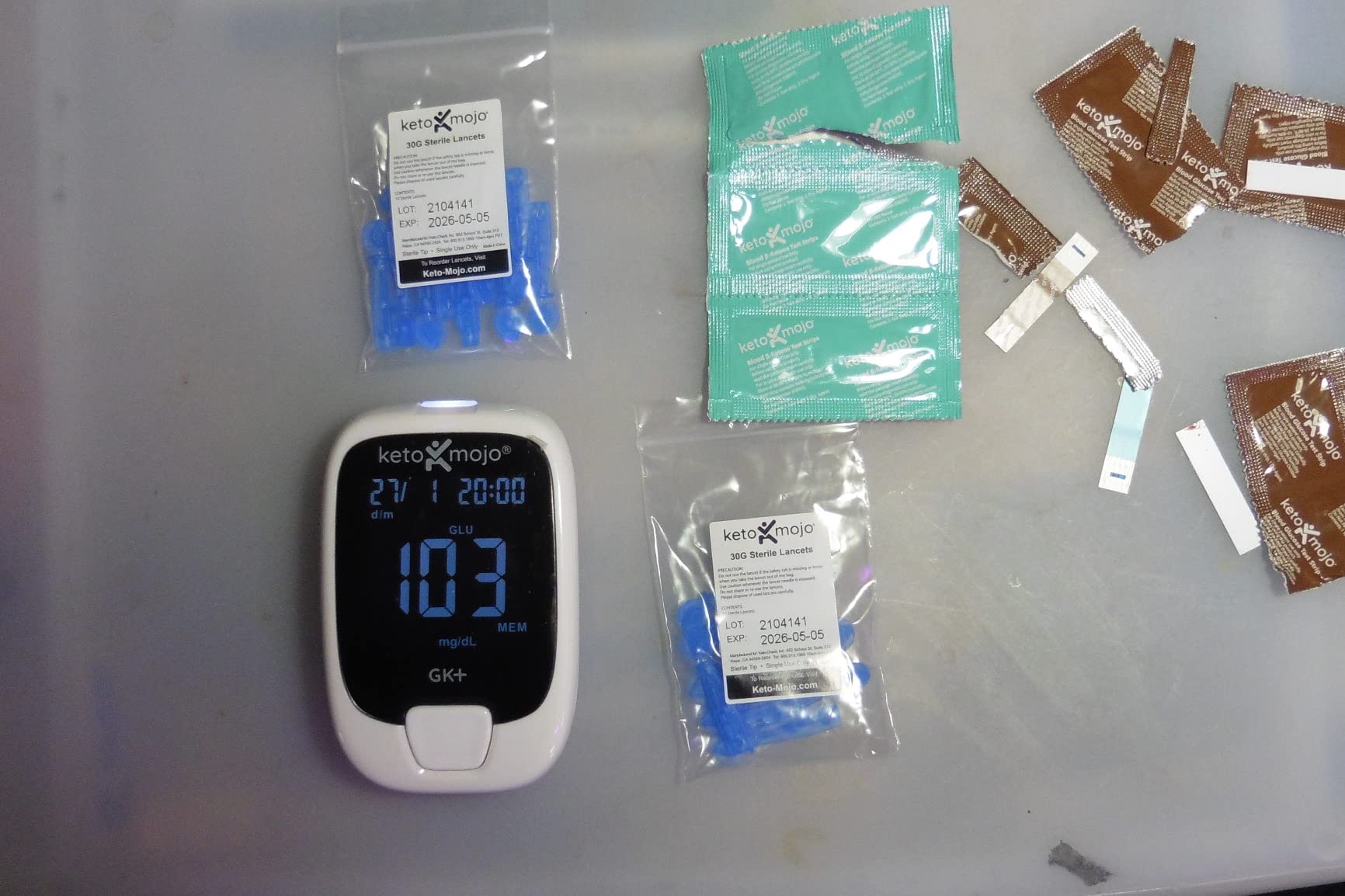
Sentiment on this one is split by user type, and that is fair. Keto and fasting users love the dual reading and the index calculation, while a smaller group reports wider reading variance and setup friction. The most repeated practical gripes are the difficulty pairing the app, foil pouches that fight back when you tear them, and the fact that replacement strips cost more than single-function strips.
Who the Keto-Mojo suits
It suits anyone tracking ketosis alongside glucose, whether that is a low-carb diet, a fasting protocol or simply a curiosity about how food changes your numbers. It also suits people who like their history in an app, since the GKI figure gives you a single number to watch instead of two separate logs.
Who should look elsewhere
Pass if you only need glucose, because you would be paying for a ketone function and the more expensive strip supply that goes with it. Anyone who does not want to deal with app setup and pairing should look at a plain meter with a large display, and anyone who tests many times a day will find the running strip cost adds up quickly.
6. On Call Express: Budget Pick With a Five-Year Warranty
On Call Express Diabetes Blood Glucose Meter Kit
4-second results
0.4 microliter sample
300 stored tests with meal markers
5-year warranty
Pros
- Fastest result time in the roundup at 4 seconds from a 0.4 microliter sample
- Smallest blood volume requirement of any meter here
- Audible fill detection and a strip ejector reduce errors and handling
- Meal markers plus hypo and hyperglycemia alarms and 5 daily reminders
- Five-year product warranty with 24/7 support
Cons
- No Bluetooth or app connectivity
- Kit includes only 10 test strips and lancets
The On Call Express is the budget answer in this roundup, and it is a better one than the price suggests. It holds a 4.5 average across more than 3000 reviews, carries a five-year product warranty, and is FDA cleared with clinically proven accuracy. A device that stays in service for years is worth more than a cheaper one that ends up in a drawer.
The speed is the standout number. It returns a result in four seconds, the fastest in this group, from a 0.4 microliter sample, which is the smallest blood volume here. For anyone testing frequently, the combination of a tiny sample and a four second wait makes the routine less of an interruption to the day.
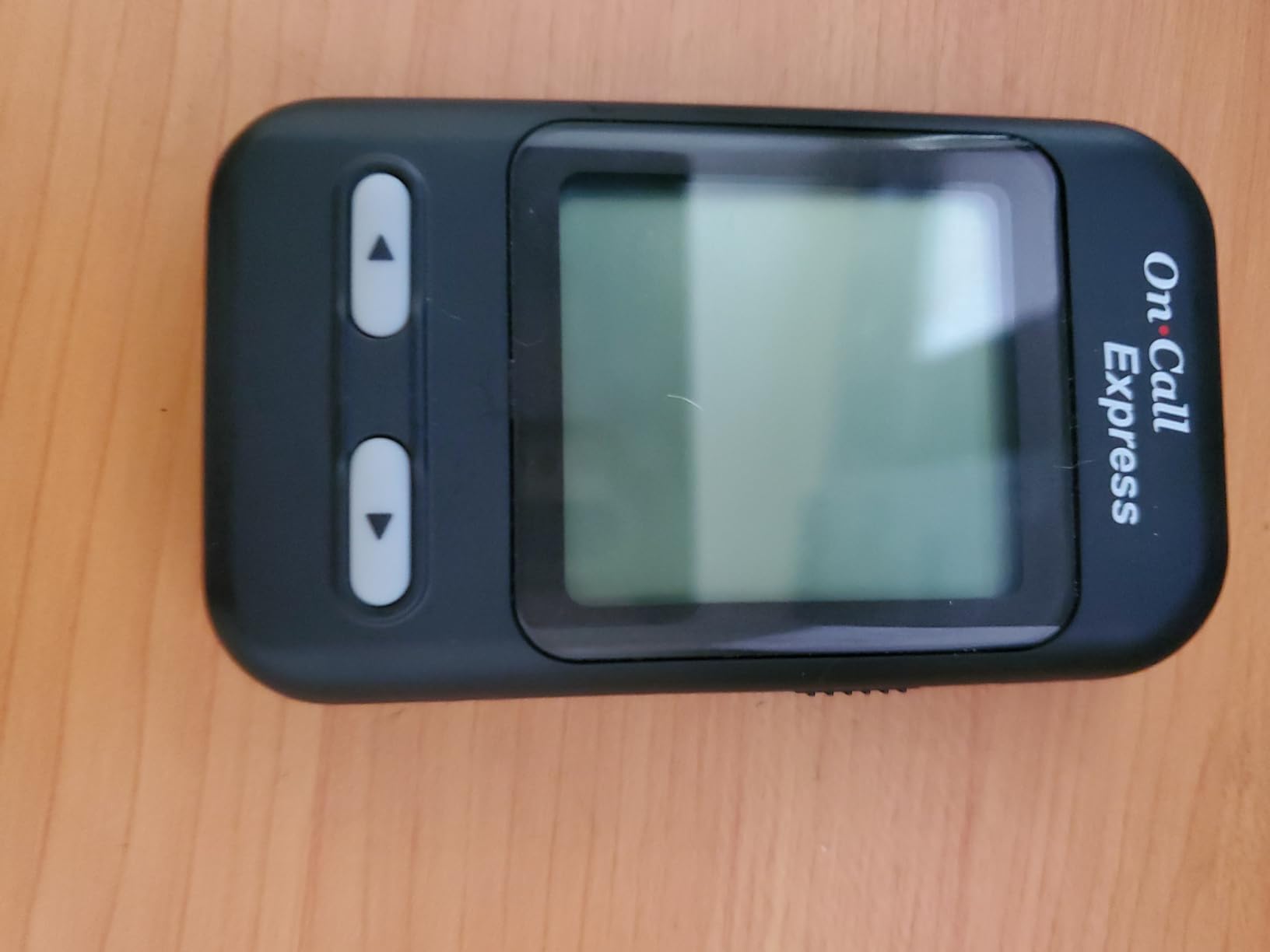
It also does two thoughtful things for older or hurried users. Audible fill detection beeps when it has enough blood, so you do not pull the strip out early, and a test strip release ejector pushes used strips out without touching them. The meter stores 300 tests with meal markers, has hypo and hyperglycemia alarms with a ketone test alert, and offers five daily reminders.
The kit contains the meter, 10 test strips, lancets, control solution and a carrying case, with a CR2 battery included and an operating range of 5 to 45 degrees Celsius. It is the smallest consumable bundle in the roundup, so plan a refill order well before you run out.
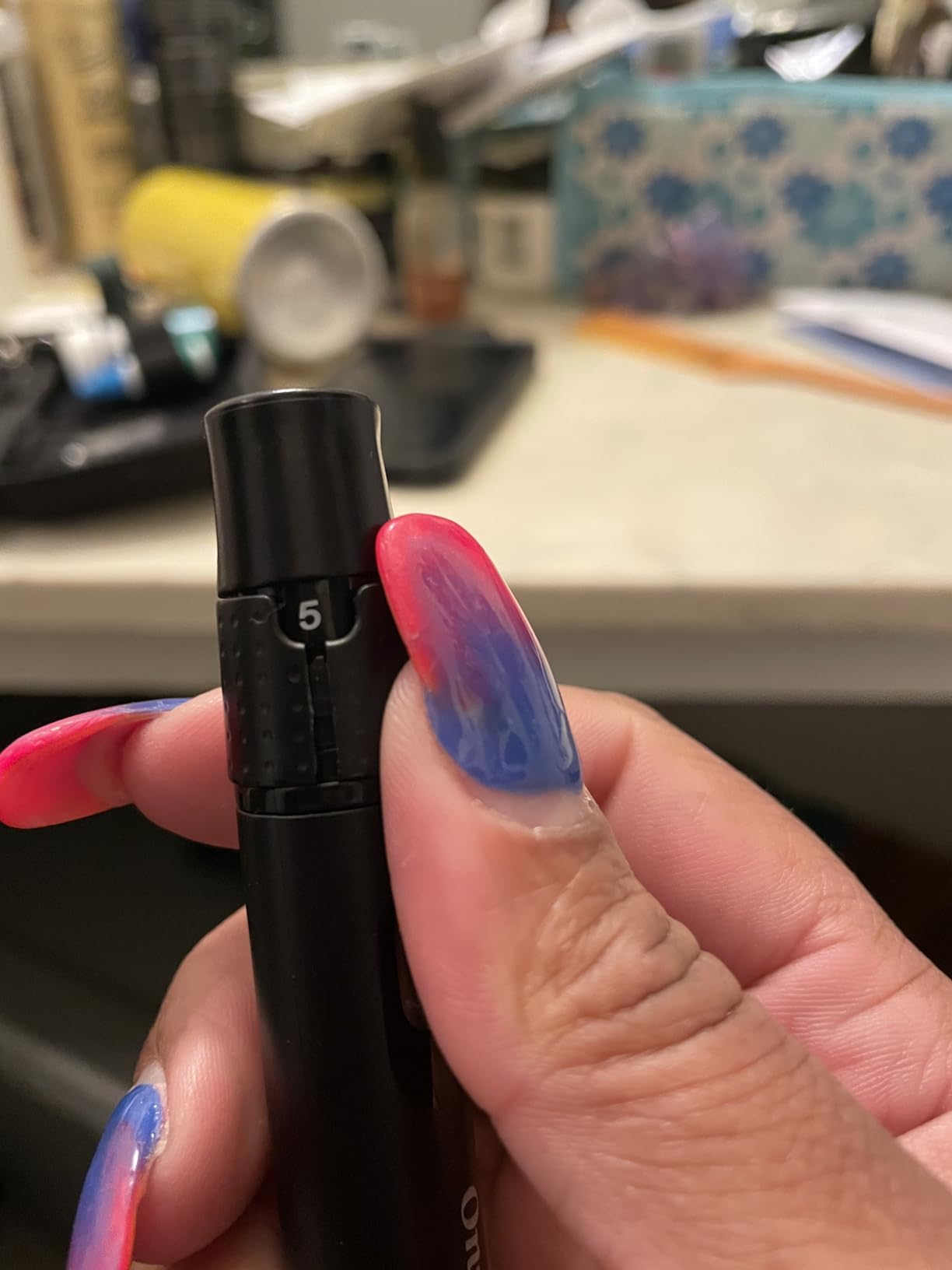
What you give up is connectivity. There is no Bluetooth and no app, so the history lives on the meter or in a paper logbook, and 300 stored tests covers a reasonable stretch of daily checking for most people. If your care team wants a report you can share, that is the trade-off you are making.
Who the On Call Express suits
It suits first-time buyers, anyone on a tight budget, and anyone who wants a meter that simply works without an app, an account or a phone. The alarms and reminders suit people managing an older relative, and the fill detection helps if you have tremor or reduced dexterity.
Who should look elsewhere
Skip it if you want automatic logging, because there is no way to get readings off the meter except manually. It is also a poor fit for keto tracking since it reads glucose only, and anyone who travels across hot climates should note the stated operating range.
7. iHealth Gluco+: Best Rechargeable Design With Bluetooth Tracking
iHealth Gluco+ Wireless Smart Glucose Monitor Kit, 100 Strips & 100 Lancets
Rechargeable battery
Bluetooth Gluco-Smart app
500 on-device readings
5-second results from 0.7 microliter
Pros
- Rechargeable battery avoids disposable cells and runs for weeks per charge
- Works phone free and stores 500 readings on the meter
- Clear directions make setup easy for newly diagnosed users
- 5-second results from a 0.7 microliter sample
- Kit includes 100 strips 100 lancets and a USB cable
Cons
- Lowest average rating in the roundup at 4.2
- Some users report readings inconsistent with repeat tests
- App pairing can be troublesome and typed notes are not always visible
The iHealth Gluco+ is the one rechargeable meter in this roundup, and that single design decision changes the running experience. The battery delivers up to 200 tests per charge and recharges over USB, so you are not hunting for a coin cell or a battery pack. It is a 510(k)-cleared device that meets ISO 15197:2015 accuracy requirements, with high and low glucose alerts.
It is also built to work with or without a phone. Readings store on the meter itself, up to 500 of them, and Bluetooth sync to the free Gluco-Smart app gives you unlimited storage and tagged readings plus report sharing. The fact that the device functions fully on its own is a genuine advantage, since the app is an addition rather than a requirement.
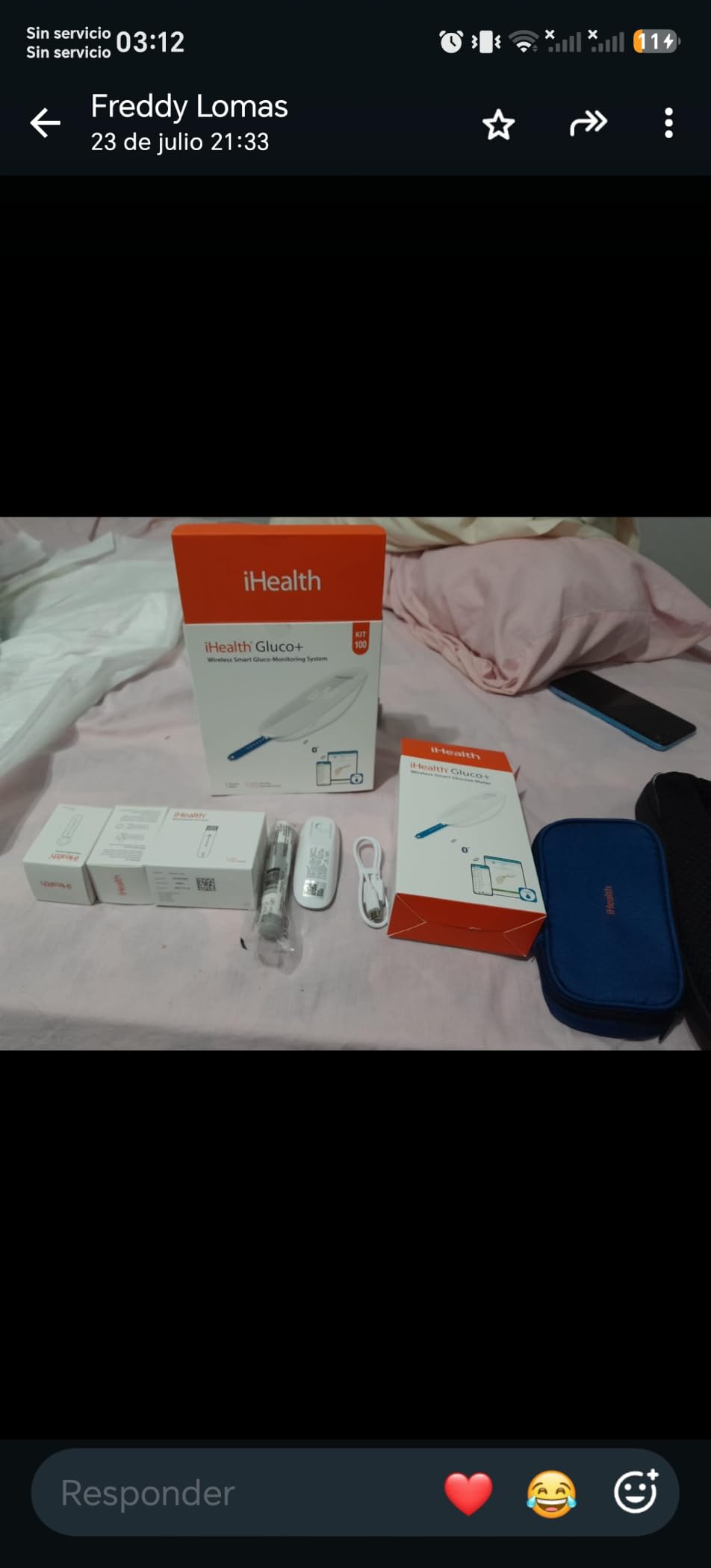
Performance on paper is solid, with a 5-second result from a 0.7 microliter sample on an LED display, and the meter is small at 1.35 by 0.75 by 3.8 inches. The kit includes 100 strips, 100 lancets, a lancing device, a USB charging cable, a travel case and a 12-month warranty, which is a fuller package than several higher-rated rivals.
What holds it back is consistency rather than design. It has the lowest average rating in the set at 4.2, and the largest share of one-star reviews, with the recurring theme being readings that did not match repeat tests or other meters. App pairing frustrates some owners on the first attempt, and notes typed in the app do not always appear when you go back to look.
Two smaller details are worth knowing. The included carrying case is a tight fit with no place to store spare lancets, so you will likely want one of our glucose meter carrying cases instead. And the battery does not hold a deep charge, so a short top-up before a test sometimes helps.
Who the iHealth Gluco+ suits
It suits anyone tired of carrying spare batteries, and anyone who wants app logging without depending on the app. The clear directions make it a decent first meter, and the rechargeable design suits frequent testing where battery anxiety is real.
Who should look elsewhere
Pass if reading consistency matters most, since that is the specific complaint in the reviews. Anyone whose readings feed into insulin dosing should treat this as a lifestyle tracker rather than a dosing device, and anyone who will not troubleshoot an app pairing problem will be better served by a meter with no connectivity at all.
8. OneTouch Verio Reflect: Best Known-Brand Pick With a Reliable App
OneTouch Verio Test Kit with Meter, Lancets, Lancing Device and Test Strips
Color-coded range indicators
5-second results
OneTouch Reveal app
30 strips and 30 lancets
Pros
- Established name brand with decades of experience in glucose management
- Display indicates whether a reading is high or low at a glance
- Bright screen and 5-second results with easy setup
- Bluetooth pairing to the OneTouch Reveal app works well for most users
- Comfortable OneTouch Delica Plus lancing device
Cons
- Strips are error prone for some users producing frequent Error 4 codes
- Kit includes only 30 test strips and 30 lancets
- Advertised carrying pouch is not always included
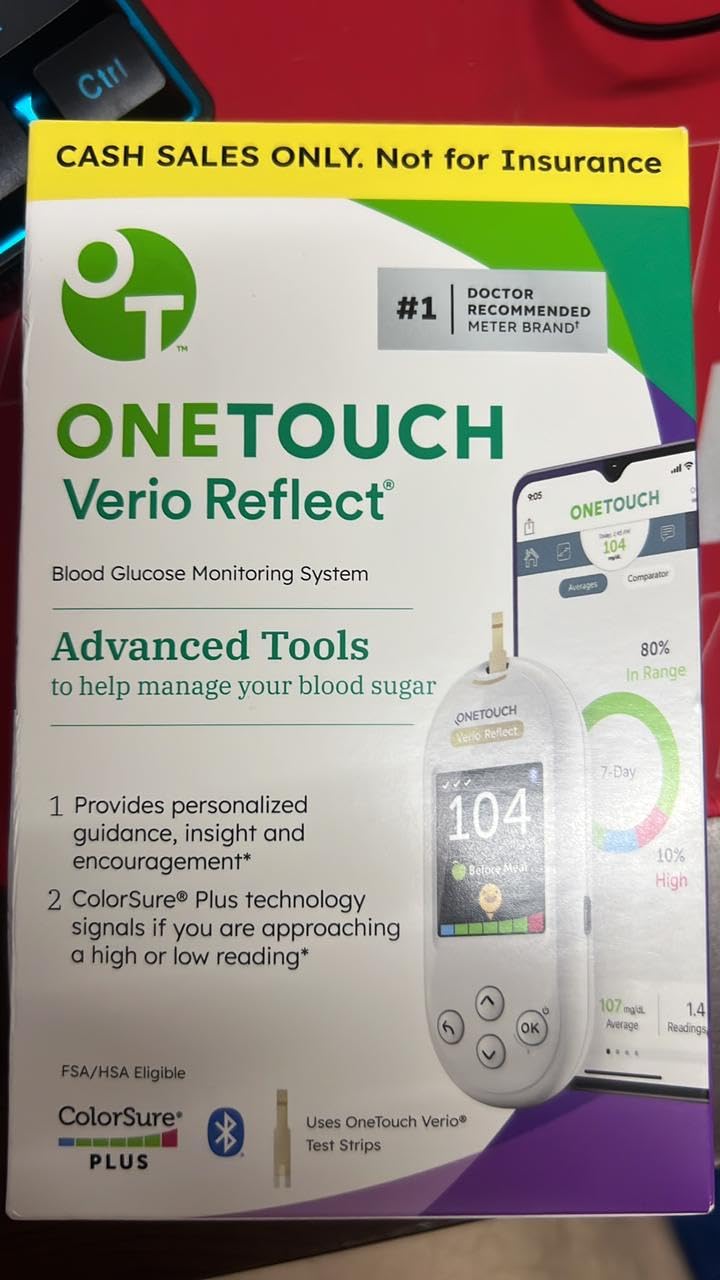
The OneTouch Verio Reflect is the pick if you want a long-established name behind the meter. LifeScan has been in glucose management for more than forty years, and that matters for a device that people expect to keep using for a decade. It holds a 4.4 average across more than 2300 reviews, and in the forums OneTouch and Contour are the two names people mention most often when they ask which meter to trust.
The design is aimed at readability. The display shows a simple colour-coded indicator telling you whether the reading is high or low, which removes the need to remember a number range, and results arrive in about five seconds. Setup is straightforward, and the bright screen is easy to read in poor light, which older users consistently single out.
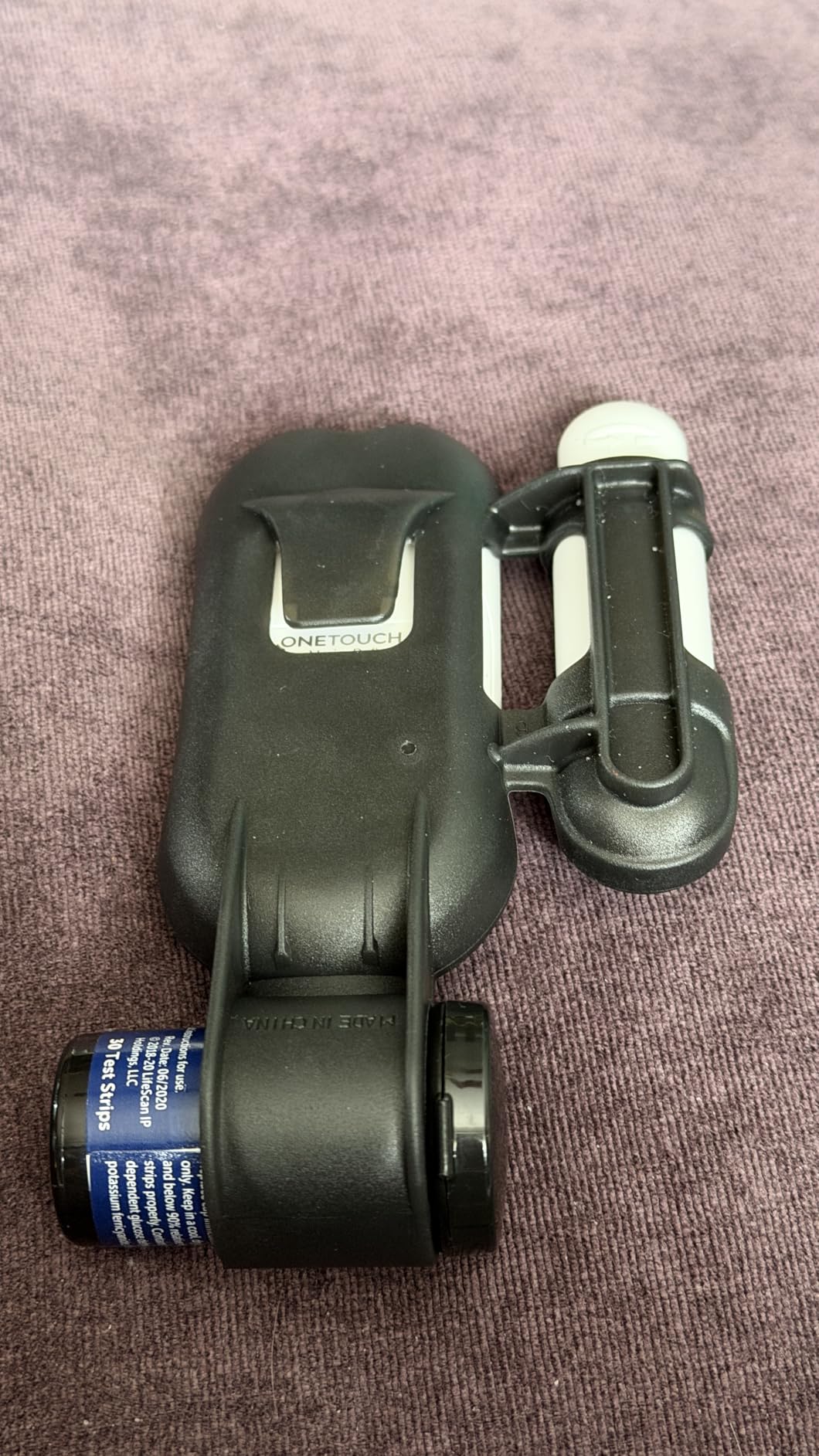
The Bluetooth connection to the OneTouch Reveal app is the connected option people in the diabetes community mention most often, and reviewers here describe pairing as quick and reliable. The Delica Plus lancing device is comfortable for regular testing, which matters more than any spec sheet when you are doing this several times a day.
The kit holds the meter, a lancing device, 30 lancets and 30 test strips. That is a moderate starting supply, more than the Contour Next One and less than the 100-strip kits elsewhere in this roundup, so plan your first refill order in advance rather than reacting to a failed test.
The main problem is the strips. Error number 4 codes appear repeatedly in the reviews, meaning the meter failed to read the sample, and some owners report the meter repeatedly prompting them to reapply blood. Strip-related issues are the single most common frustration with this kit, and OneTouch customer service did replace a bad batch for several reviewers, which is worth knowing when you contact them.
Who the OneTouch Verio suits
It suits anyone who wants a name they recognise, and anyone who already uses a OneTouch meter and wants to keep the same strips and lancing system. The app is a good reason to choose it if you want logging, since Reveal pairing is one of the smoother experiences in this group.
Who should look elsewhere
Look elsewhere if you are sensitive to a test that fails to read and have to repeat, because wasted strips add up over a year. Anyone buying purely on the cheapest kit contents should also note the 30-strip bundle, and a separate carrying pouch may be needed since some buyers report it missing from the box.
9. Glucoracy G-425-2: Large-Screen Logging With 500 Stored Results
Glucoracy Blood Glucose Monitor Kit, 100 Blood Sugar Test Strips, No Coding
2.7-inch display
0.5 microliter sample
5-second results
500 stored results
Pros
- Low entry cost with 100 strips 100 lancets and a storage case
- No coding operation and a 2.7-inch large display
- Stores up to 500 results for long-term tracking
- Compact and discreet
- Several accuracy complaints were resolved by the seller with a refund and replacement
Cons
- Batteries are not included in the kit
- Strips are proprietary and will not work with other brands
- Setting the time and date is poorly explained in the manual
The Glucoracy G-425-2 is built around one clear advantage over most of the budget kits here: a 2.7-inch display. Combined with 500 stored results, it is a good pick for anyone who wants a long history on the device itself rather than a small screen with a handful of readings. It holds a 4.3 average across more than 3500 reviews.
It is no-coding, meaning the meter powers on when a Glucoracy strip is inserted, needs 0.5 microliter of blood, and returns a result in five seconds. The lancing device offers five strength levels and the meter ejects used strips with a single button, which keeps handling to a minimum and is genuinely useful if you test while out.
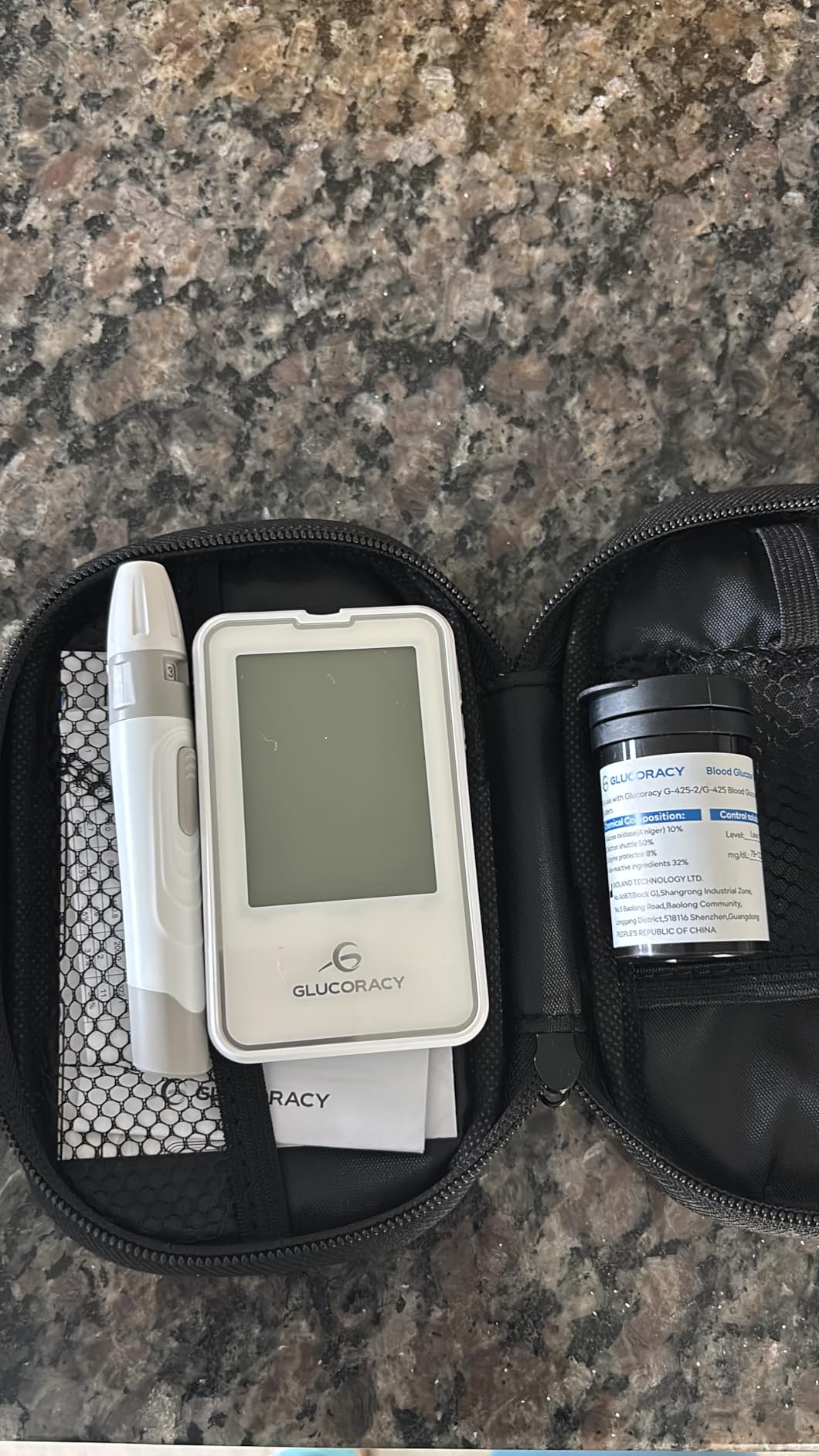
The kit includes the meter, a lancing device, 100 test strips, 100 lancets, a travel bag and a user manual, in 50-strip and 100-strip versions. What it does not include is batteries, which is the detail most likely to catch someone out on day one. The meter runs on two AAA cells, so pick some up before the first test.
Customer service comes through when there is a problem. Several owners who reported accuracy complaints had them resolved with a full refund and a replacement, which suggests that when a strip batch misbehaves, support does act on it. That is worth more than a spec sheet when you are deciding whether a brand will stand behind a device for years.
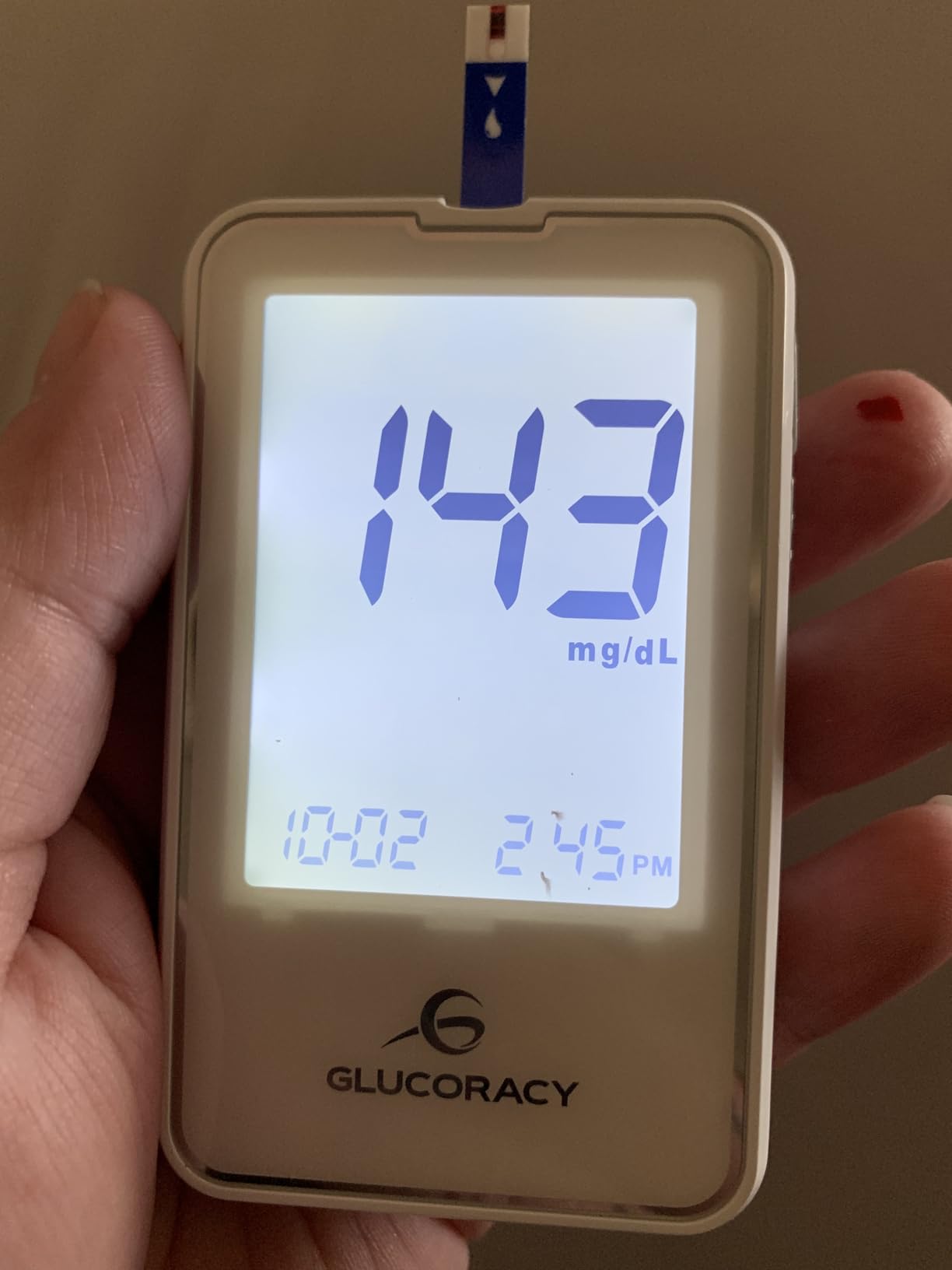
The weak spots are documentation and strip locking. Strips are proprietary and the meter will not accept other brands, so check strip pricing and refill availability before you commit. Setting the time and date is not clearly explained, and the printed manual with its small diagrams is hard to read, especially for older users, which partly undercuts the appeal of the large screen.
Who the Glucoracy suits
It suits anyone who wants a big readable screen and a long on-device history without a monthly app subscription or a connected meter. It works for people who test occasionally and want data they can review later without an app, and the single-button strip ejection is a small nicety that pays off when you are out and about.
Who should look elsewhere
Pass if you are not comfortable setting a device up from a thin manual, since the time and date step is confusingly documented. Anyone who needs accuracy verified against a lab result on a routine basis will get more reassurance from a brand with published clearance and validation, and strip availability in your area is worth checking first.
10. CareLiving BGM101: Best for First-Time Testers
CareLiving BGM101 Blood Glucose Monitor Kit, 100 Test Strips, 100 Lancets, 1 Blood Glucose Meter, 1 Lancing Device, Diabetes Testing Kit, Portable Blood Sugar Test Kit, Glucometer Kit for Home
Simple 6-step operation
1 microliter sample
Results in under 5 seconds
350 stored results
Pros
- Affordable full kit with 100 strips 100 lancets control solution and a carrying bag
- Large screen and a simple 6-step operation that is easy to learn
- Stores 350 results with 14-day and 30-day averages
- 12 lancing depth settings let you tune the prick to your comfort
- Support service handles problems within 24 hours
Cons
- Lancet device is fiddly to load and the depth settings are poorly documented
- Included carrying case is too small for all the supplies
- Some reviewers report accuracy complaints and difficulty reaching support
The CareLiving BGM101 is the most beginner-shaped meter in the roundup. The whole routine is six steps, the screen is large, and the meter auto-starts when a strip goes in correctly, which removes the decision-making that makes first tests stressful. It holds a 4.4 average across more than 2500 reviews.
It needs 1 microliter of blood, which is the largest sample in this group, and returns results in under five seconds. That sample size is the trade-off for the simpler hardware, and it is worth weighing if pricking is the thing you are most worried about, since a larger drop is harder to produce from a cold or shaky hand.
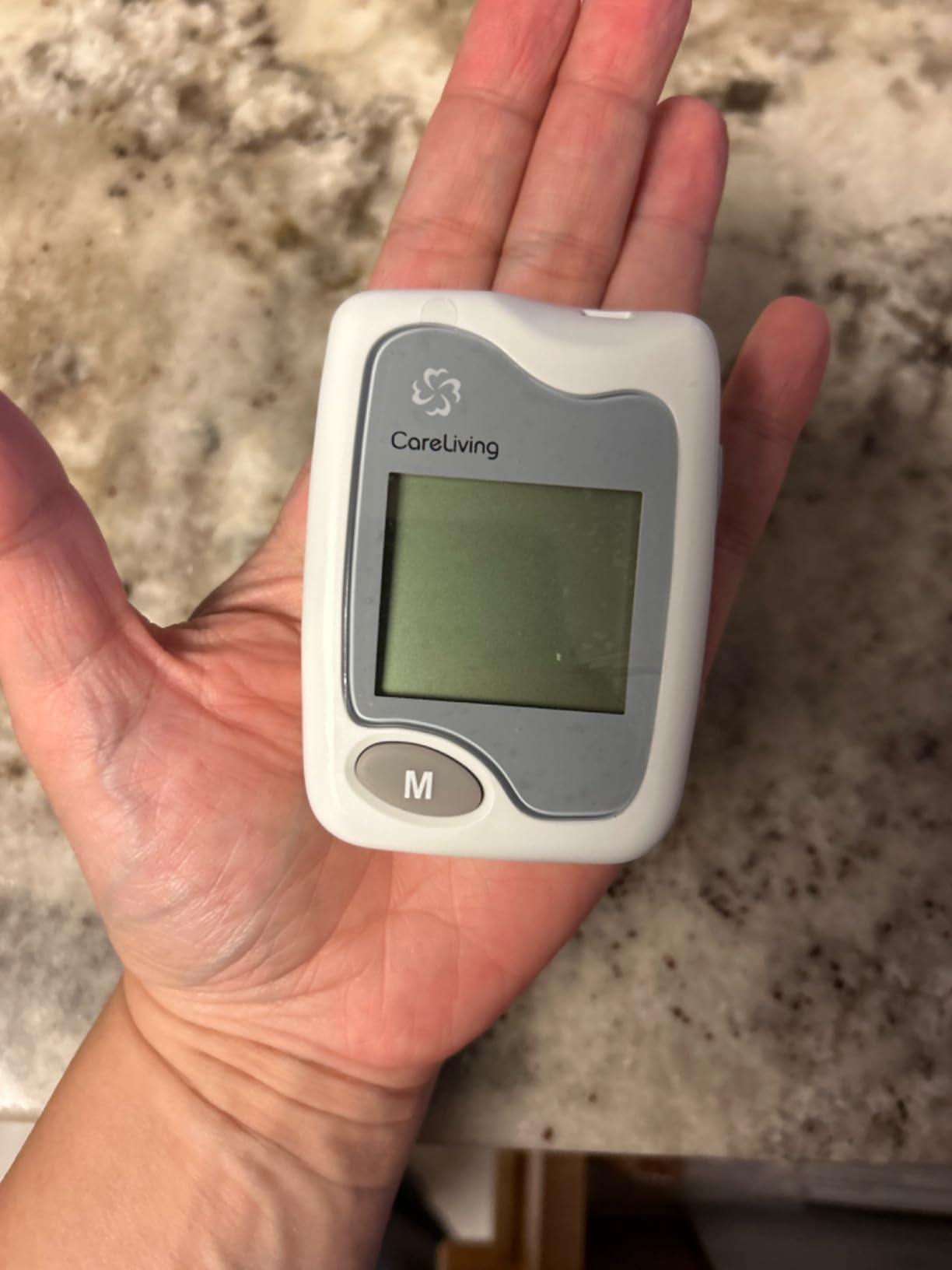
Tracking is decent for the price. The meter stores up to 350 results and calculates 14-day and 30-day averages, which is enough to see whether a month of changes moved your numbers. The lancing device has 12 depth settings, the most granular here, and once you find your setting the comfort improves a lot.
The kit is a full one, with the meter, 100 test strips, 100 lancets, a lancing device, a control solution, an instruction manual, a quick start guide and a carrying bag. A coin cell powers it, and the support service is advertised as responding within 24 hours, which is a better commitment than most of the budget brands make.
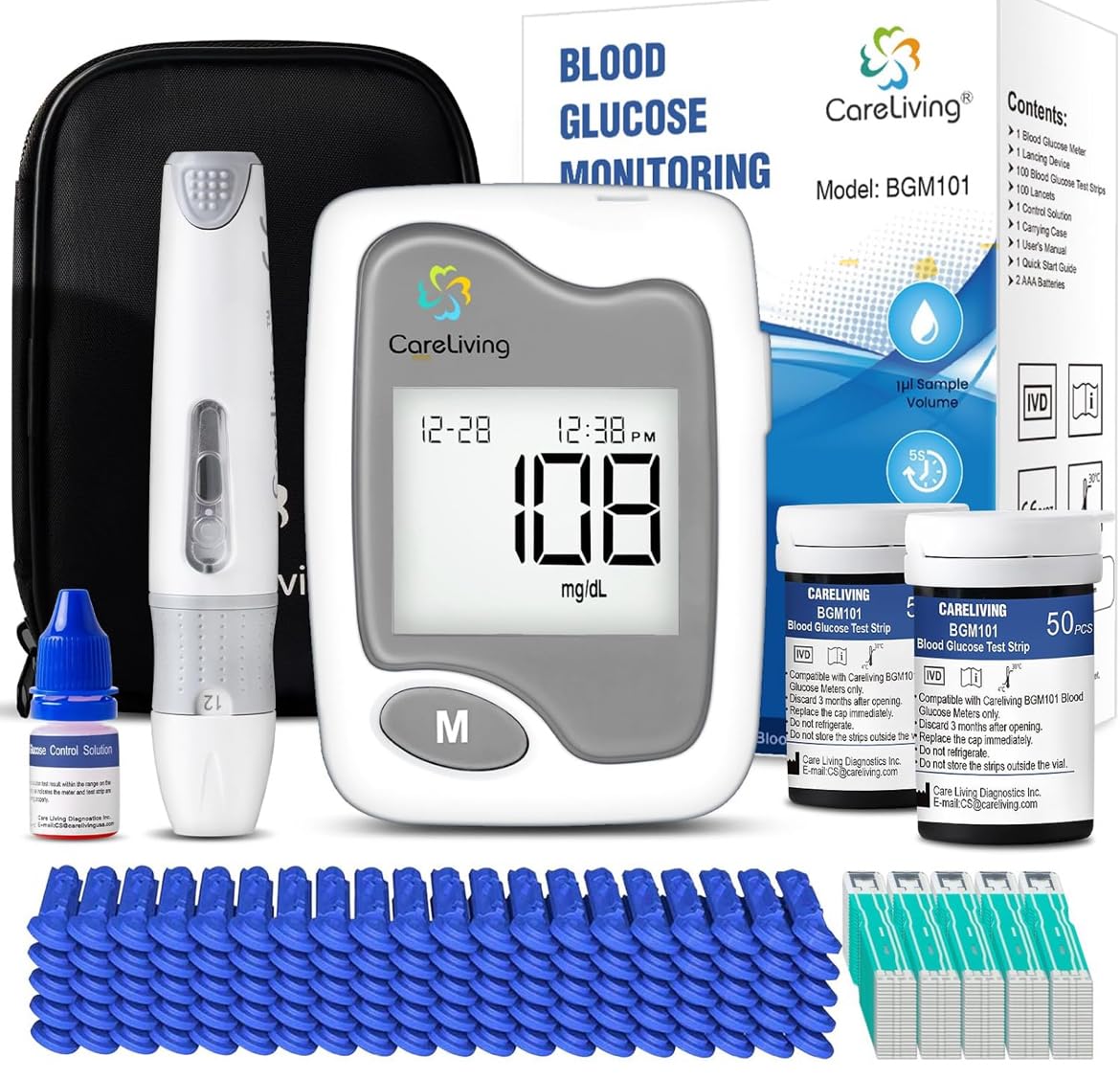
The lancet device is the part owners complain about most. It is fiddly to load and takes dexterity to insert a lancet correctly, and the documentation for the depth settings is not clear. The included carrying bag is also too small for all the supplies, so plan to use your own case. A few reviewers reported accuracy complaints and difficulty reaching support, so if accuracy is your priority, check the latest reviews before settling.
Who the CareLiving BGM101 suits
It suits someone who has never tested before and wants the gentlest possible introduction to the routine. The large screen and six-step process reduce the chance of a confusing first session, and the 12 depth settings mean you can find a comfortable setting fairly quickly once you get past loading the lancet.
Who should look elsewhere
Look elsewhere if a small blood sample is important, since 1 microliter is the largest requirement here. Anyone with limited hand strength or tremor will find the lancet loading frustrating, and buyers who care most about accuracy will be better served by a meter that publishes a tighter stated accuracy figure.
How to Choose a Blood Glucose Meter for Home Testing
Most buyers start with price, and it is the least useful criterion. Every meter in this roundup does the same core job, and the differences that matter show up over months: whether the strip supply is easy to get, whether the reading is consistent, and whether you can live with the routine. Here are the factors that decide the outcome, in the order we would think about them.
Accuracy first, and know what accuracy actually means. The international benchmark is ISO 15197, which requires a meter to be within 15 percent or 15 mg/dL of a lab reference 95 percent of the time. Several meters here claim tighter figures than that. No home meter is a laboratory instrument, so treat the claim as a starting point and verify the specific unit you receive, because batches vary.
Strip cost over three years, not sticker price. This is the factor that forum users complain about most, and they are right. Strips are brand-locked, which means a cheap meter with expensive refills is an expensive meter. Before you buy, check the current strip price, check that refills are sold by the same brand through more than one seller, and check whether your pharmacy benefit covers the brand. If you switch meters later, the unused strips from the old meter usually stop working, so decide before you buy rather than after.
Sample size and result time. Smaller samples are easier to get, particularly from cold fingers, sore fingers or hands that are not steady, and shorter result times make frequent testing less intrusive. In this roundup the range runs from 0.4 microliter on the On Call Express to 1 microliter on the CareLiving BGM101, and four seconds to seven seconds from test to number.
Whether you need an app at all. Three meters here connect to a phone: the Contour Next One, the iHealth Gluco+ and the OneTouch Verio Reflect, with the Keto-Mojo GK+ doing the same for glucose and ketones. An app gives you a shareable history, which is genuinely useful at a clinic appointment, and forum posts about app-connected meters often mention the same pain point, which is a phone that no longer supports the app. If you do not want that risk, a plain meter with on-device memory works fine.
Reading it easily, especially for older users. The Metene TD-4116, Glucoracy and CareLiving all use a large display, and the Contour Next One and OneTouch Verio add colour indicators that tell you whether a number is high or low without remembering a range. Reminder alarms, audible fill detection and adjustable lancing depth matter more than most people expect once testing becomes routine.
Refill logistics and what happens when you travel. Check that your strips are sold by a retailer that will still carry the brand in three years, since a discontinued strip ends a meter’s usefulness. For travel, a meter that stores hundreds of results and runs on a coin cell is simpler to pack than one that needs a cable, and any protective case is worth a look if you are prone to dropping things.
Prescription status and insurance. In the US, most meters of this type are sold over the counter without a prescription, but strips are frequently covered only with a prescription and only for a specific brand, which is why checking your pharmacy benefit before you buy saves a lot of money. Talking about calibration discipline and reading tools is similar to how we approach our guides on pH meters, where matching the tool to the job and verifying it with a known standard is the whole game.
Which Glucose Meter Is the Most Accurate?
Here is the short answer: for a typical home buyer the CareSens N is our pick for the most accurate glucose meter you can use at home, because it combines a 0.5 microliter sample, five second results, auto-coded strips and a 4.5 average across more than 9000 reviews. The Contour Next One publishes the tightest stated figure, within 8.4 percent of lab values, and the AUVON states 10 percent or 10 mg/dL over 95 percent of readings. Individual units still vary, so verify yours.
Here is how to check a meter’s accuracy at home, using a control solution and then a matched lab draw.
Buy the control solution made for your meter’s brand. It is a solution with a known glucose value, and testing it tells you whether the meter and the strips are working.
Check the expiration date on the control solution and on the strip vial. Heat and expired strips are the most common cause of a meter that seems to drift.
Insert a fresh strip as if you were testing, then apply control solution to the strip tip instead of blood.
Compare the result with the range printed on the control solution bottle. Inside the range means the meter and strips are performing as expected.
If the reading is outside the range, try a new strip before blaming the meter, since a single bad strip is more common than a broken device.
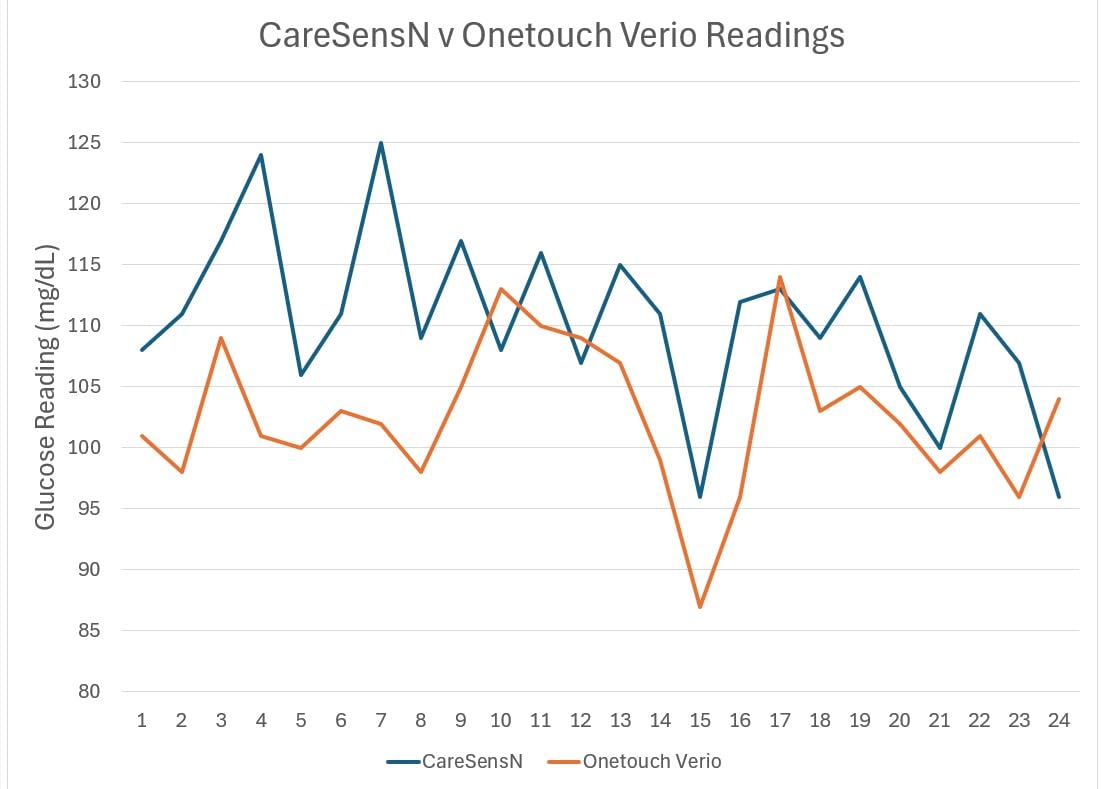
For an independent check, test within a few minutes of a lab draw and compare the two numbers. A gap of roughly 15 percent or 15 mg/dL is within the tolerance allowed for home meters, and a consistent gap is worth raising with your care team.
Two things cause most mismatches with lab results, and neither is a broken meter. The first is technique, because washing and fully drying your hands, using the side of the fingertip and confirming the strip has filled all the way can move a number by a surprising amount. The second is timing, because home meters read capillary blood while lab assays read plasma, and the two differ slightly at the extremes.
Glucose Meter vs CGM: Who Still Needs a Finger-Stick Meter
Continuous glucose monitors have taken a lot of attention, and for good reason. They read interstitial fluid through a small sensor worn on your body, they give you a reading every few minutes, and they show patterns over a day that a finger-stick meter simply cannot see. If your plan covers a CGM and you tolerate the sensor, that is a genuine change in how you manage your condition.
A meter still earns its place for several reasons. Confirming a CGM reading with a finger stick is standard practice when a sensor reading and how you feel do not agree, and a meter is what most people use to confirm an insulin dose. A meter costs almost nothing to start with and needs no sensor warm-up, no app pairing and no charging. It works as a backup when a sensor session ends, when a sensor falls off, or when you fly through airport security with electronics you would rather leave behind.
It also suits people the CGM model does not reach. If you do not use insulin, you may not qualify for a CGM under your plan, and many CGM programs require a prescription and periodic review. If you test occasionally rather than continuously, a meter is a fraction of the ongoing cost. And for someone tracking a low-carb diet, a ketone-capable meter gives you a number a standard CGM does not produce.
The practical answer is that these are not competitors so much as a pair. If you are on insulin, keep a meter as a confirmation and backup device even if you wear a CGM. If you are tracking a diagnosis or a diet rather than titrating medication, a meter does the job at a fraction of the cost.
What the Number Means: A Reading Guide
Most people pick up a meter without being told what to do with the number, so a short reading guide helps. Glucose is reported in mg/dL in the US, which is milligrams of glucose per deciliter of blood. Common adult targets used in diabetes care sit roughly between 70 and 180 mg/dL, with a typical fasting goal below 130 and a post-meal goal under 180, though individual targets are set by your care team.
A reading below 70 is generally treated as low, and a reading persistently above 180 suggests glucose is running high after meals. The distinction that matters at home is between fasting readings, taken after several hours without food, and post-meal readings taken one to two hours after eating. The two answer different questions, and mixing them makes a log much harder to interpret.
Home readings also connect to A1C, the HbA1c test that estimates your average glucose over roughly three months. An A1C of 7 percent corresponds to an average glucose near 154 mg/dL, so a pattern of home readings sitting in the 150s over a few months is consistent with a result in that range. Home meters cannot tell you an A1C, but a month or two of readings gives you something concrete to bring to the appointment where it does get measured.
Bring the meter to the appointment if you can. Two weeks of readings with time-of-day markers, including any that felt wrong, give your care team something far more useful than a memory of how things went. We are not clinicians and this section is general information rather than guidance for your situation, so confirm any target or frequency change with your doctor before adjusting your routine.
Frequently Asked Questions
Which brand of glucose meter is the most accurate?
There is no single most accurate brand, because accuracy varies by unit, by strip batch and by technique. Among the meters we reviewed, the CareSens N offers the strongest overall combination with a 0.5 microliter sample, five second results and a 4.5 average across more than 9000 reviews. The Contour Next One publishes the tightest stated figure at within 8.4 percent of lab values, and the AUVON states 10 percent or 10 mg/dL over 95 percent of readings. Verify any meter with control solution and a matched lab draw before relying on it.
Can I monitor my blood sugar without pricking my finger?
Yes, through a continuous glucose monitor, which reads glucose from interstitial fluid through a small sensor worn on your body instead of a finger prick. A CGM gives readings every few minutes and shows patterns a meter cannot. Many require a prescription and periodic review for coverage, and most plans cover them for people who use insulin. Even with a CGM, many people keep a finger-stick meter for confirming readings and as a backup when a sensor session ends.
Do I need a prescription to buy a glucose meter and strips?
In the US, meters of this type are generally available over the counter without a prescription. Test strips are different, because insurers and pharmacy benefits frequently cover only specific brands and only with a valid prescription. Before you buy, check which strip brands your plan covers so you are not stuck with an expensive supply your insurance will not reimburse. Outside the US, availability and prescription rules vary by market.
How often should I test my blood sugar at home?
It depends on what you are managing and on your treatment. People using insulin usually test more often because they need numbers to make dosing decisions, while people on oral medication or diet alone may test less frequently. Your care team should set the frequency, since it depends on your targets, your medications and your day-to-day pattern. The practical starting point is to test enough to learn how food, activity and medication affect your numbers, then adjust with your clinician.
Why do my home glucose readings differ from my lab results?
A small difference is normal, because home meters read capillary blood while lab assays read plasma, and the two methods are not identical. Most meters are allowed to differ from a lab reference by 15 percent or 15 mg/dL, and a home reading can also be shifted by technique, by unwashed hands or by a strip that has expired or been stored in heat. Run a control solution test to rule out the meter, then compare a home reading taken close to a lab draw before drawing any conclusion.
Is a glucometer or a continuous glucose monitor better for me?
For someone titrating insulin or at high risk of lows, a CGM offers more insight and most plans cover it. For occasional testing, tracking a diagnosis, or following a low-carb diet, a meter is simpler, costs far less over time and needs no prescription. Many people use both, keeping a meter for confirming CGM readings and as a backup when a sensor session ends or a sensor is not working.
Final Verdict: The Best Glucose Meters for Home Testing in 2026
After working through ten kits, the best glucose meters for home testing come down to a small number of clear winners. The CareSens N is the one to buy first, with the smallest sample, a five second result, a 100-strip kit and the strongest combination of rating and review volume in the group. The AUVON is the pick if you want the most proven option and the most owner feedback available, and the On Call Express is the pick if running cost is what matters most.
For a phone app, the Contour Next One is the strongest, with Smartlight range feedback, second-chance sampling and smooth Bluetooth logging. The Metene TD-4116 suits older users, the OneTouch Verio Reflect suits anyone who wants a familiar name brand, the iHealth Gluco+ suits anyone tired of batteries, and the Keto-Mojo GK+ is the only one here that reads ketones as well as glucose.
Whatever you choose, check the strip price and refill availability before you order the meter, and run a control solution test the day it arrives. Those two steps prevent most of the disappointment we saw in the customer reviews, and they take about ten minutes.