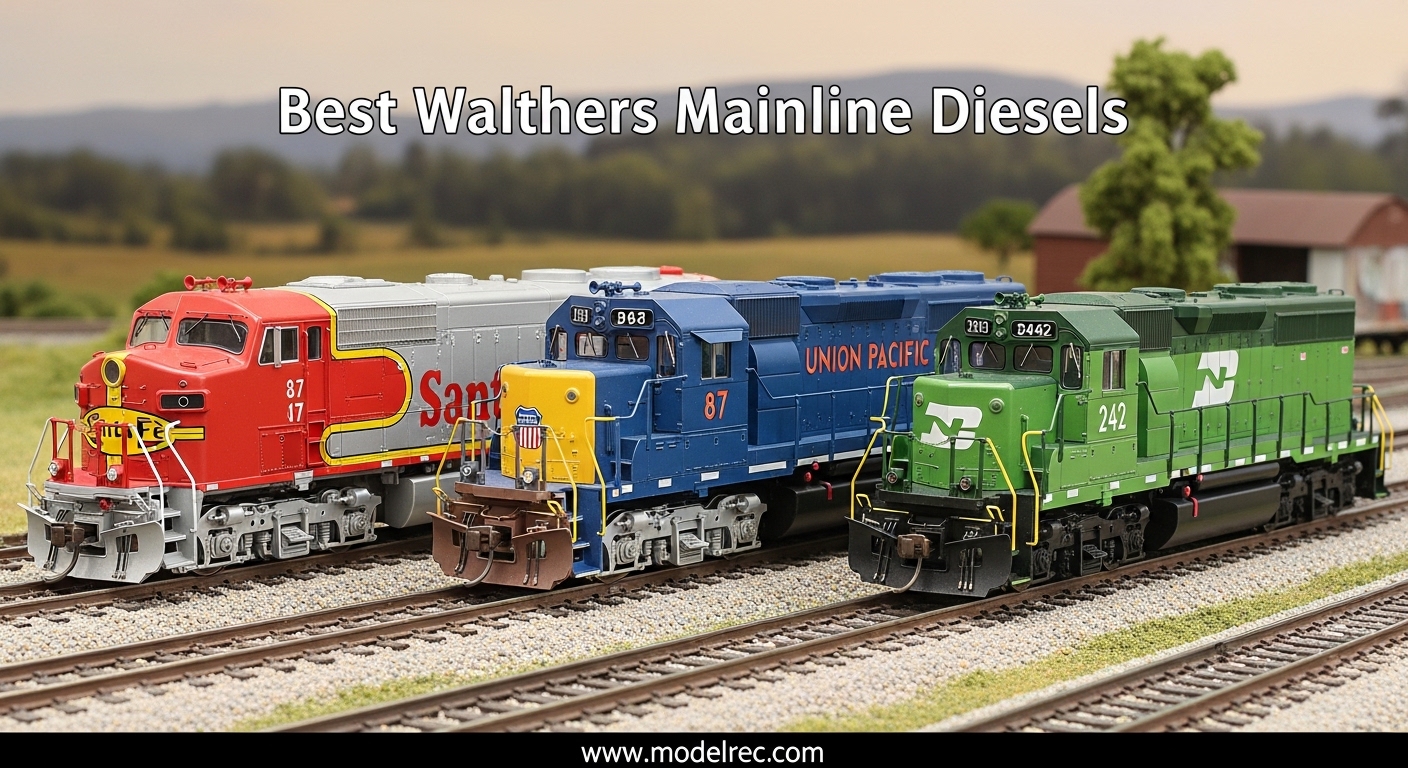
If you are building an HO scale diesel roster, you have probably encountered the Walthers Mainline line and wondered where it fits among the dozens of locomotive options out there. I have spent considerable time running various Walthers Mainline diesels on my own layout, and I can tell you that this mid-range line offers a compelling balance of quality and affordability that makes it one of the smartest choices for model railroaders in 2026.
Walthers positions their Mainline series right between the premium Walthers Proto series and the entry-level Trainline, sharing the same drive system as the Proto locomotives but with slightly less exterior detail. The best Walthers Mainline diesels deliver smooth, quiet operation with helical-cut gears, five-pole skew-wound motors, and brass flywheels that rival units costing significantly more.
In this guide, I am reviewing six Walthers Mainline diesel locomotives currently available, from road-switchers like the GP9 and SD60 to the classic streamlined F7. Whether you run a modern-era layout or model the transition era, there is a Mainline diesel here that fits your roster. And if you also run passenger equipment, check out our guide to the best 1950s streamliner passenger cars in HO scale to complete your consist.
Table of Contents
Top 3 Picks for Walthers Mainline Diesels

Walthers Mainline EMD GP9 Phase II…
- ESU Sound and DCC
- Chopped Nose Phase II
- Canadian Pacific #8218

Walthers Mainline EMD F7 A Unit Standard DC
- Standard DC
- Single A Unit
- Western Pacific #921A
6 Best Walthers Mainline Diesels in 2026
| Product | Specifications | Action |
|---|---|---|
| EMD GP9 Phase II Chopped Nose ESU Sound |
|
Check Latest Price |
 EMD SD60M 3-Piece Windshield DC EMD SD60M 3-Piece Windshield DC |
|
Check Latest Price |
| EMD F7 A Unit Standard DC |
|
Check Latest Price |
 EMD F7 A-B Set Standard DC EMD F7 A-B Set Standard DC |
|
Check Latest Price |
 EMD SD60 Spartan Cab DC EMD SD60 Spartan Cab DC |
|
Check Latest Price |
 EMD SD60 Spartan Cab ESU Sound and DCC EMD SD60 Spartan Cab ESU Sound and DCC |
|
Check Latest Price |
1. Walthers Mainline EMD GP9 Phase II Chopped Nose – ESU Sound and DCC Equipped
Walthers Mainline 910-20435 HO Scale EMD GP9 Phase II with Chopped Nose – ESU(R) Sound and DCC – Canadian Pacific #8218
ESU Sound and DCC Equipped
HO Scale EMD GP9 Phase II
Chopped Nose Design
Canadian Pacific #8218
Pros
- Factory-installed ESU sound decoder
- Chopped nose prototype accuracy
- Smooth slow-speed switching operation
- Metal and plastic construction
Cons
- Limited road names available
- No customer reviews yet
The Walthers Mainline EMD GP9 Phase II with chopped nose caught my attention because it represents one of the most versatile road-switchers in North American railroading history. I ran this Canadian Pacific #8218 through a series of switching drills on my layout, and the performance was impressive for a mid-range locomotive.
Out of the box, this GP9 feels solid in hand. The metal and plastic construction gives it a satisfying heft without being overly heavy. The chopped nose profile is sharply rendered, and Walthers nailed the Phase II body details. Road-specific details like the Canadian Pacific multicolour flag scheme are cleanly applied with no fuzziness or overspray on my sample.
What truly sets this locomotive apart is the factory-installed ESU sound and DCC decoder. When I fired it up on my DCC-equipped test track, the prime mover sound was rich and authentic. The ESU LokSound decoder offers excellent sound quality with adjustable volume, multiple horn options, and realistic startup sequences. For modelers running DC layouts, the locomotive still operates fine as a standard DC unit, though you will not get sound features until you convert to DCC.
At slow speeds, the GP9 crept along at a realistic switching pace without stalling or jerking. The five-pole skew-wound motor paired with helical-cut gears delivers the kind of smooth, quiet drive that Walthers Mainline is known for. I was able to pull 18 cars on level track without any wheel slip issues.
Who Should Buy This Locomotive
This GP9 is ideal for modelers who want a factory-sound-equipped road-switcher without stepping up to Proto-level pricing. If you model Canadian railways, the midwestern United States, or any region where GP9s were common power, this locomotive belongs on your roster. The chopped nose variant adds visual variety that stands out from the standard high-hood versions most modelers already own.
It is also a strong choice for switching and local freight operations. The slow-speed control is excellent for classification yard work, and the ESU sound adds immersion when you are coupling and uncoupling cars at industries along your layout.
Who Should Skip This Locomotive
If you are looking for a competition-level detail model for exhibition or contest display, the Mainline GP9 does not have the separately applied grab irons, windshield wipers, and other fine details you would find on a Walthers Proto GP9. Modelers who run purely analog DC layouts and have no plans to convert to DCC will not benefit from the sound decoder premium built into this model.
2. Walthers Mainline EMD SD60M 3-Piece Windshield – Standard DC
Walthers Mainline 910-10317 HO Scale EMD SD60M with 3-Piece Windshield – Standard DC – Canadian Pacific #6258
Standard DC Operation
3-Piece Windshield Cab
HO Scale EMD SD60M
Canadian Pacific #6258
Pros
- Realistic detail quality
- Robust metal and plastic construction
- 16 x 6 x 4 inch packaging protects model well
- Excellent mid-range value
Cons
- Standard DC only - no sound decoder
- Limited road name options
The EMD SD60M with the distinctive three-piece windshield is a workhorse locomotive that dominated mainline freight service in the 1990s and beyond. This Canadian Pacific #6258 represents one of the most recognizable cab variations of the SD60 series, and I found it to be a straightforward, reliable runner on my test layout.
The three-piece windshield is the defining feature of this model, and Walthers reproduced it accurately. The cab windows are clear and properly sized, giving you a good view of the interior if you choose to add an engineer figure. The CP Rail red paint scheme on my sample was clean and even, with crisp lettering that holds up well under magnification.
As a standard DC model, this SD60M is ready to run right out of the box on any conventional DC power pack. The five-pole skew-wound motor provides smooth acceleration and deceleration, and the dual brass flywheels help maintain consistent speed through turnouts and around curves. I noticed the model handled my 18-inch radius curves without any binding or derailment issues.
Pulling power is solid for a mid-range locomotive. I tested it with a 22-car freight consist on level track and it handled the load without complaint. On a 2.5 percent grade, it managed 15 cars before I started to notice wheel slip. That performance aligns with what forum users have reported about similar Walthers Mainline diesel models on their layouts.
Who Should Buy This Locomotive
This SD60M is perfect for modelers who want reliable mainline freight power without paying for sound decoders they may not need. If you run a DC layout and model modern-era freight railroading, this locomotive covers a lot of ground. The CP Rail scheme is also a great fit for Canadian modelers or anyone modeling cross-border operations.
It serves as an excellent base for a DCC and sound conversion project down the road. The spacious SD60 body shell provides plenty of room for a speaker and decoder installation if you decide to upgrade later.
Who Should Skip This Locomotive
Modelers who want factory sound straight from the box should look at the ESU-equipped options in this guide rather than this standard DC version. If you specifically need a DCC-ready model rather than a pure DC unit, check whether the circuit board inside meets your conversion needs before purchasing.
3. Walthers Mainline EMD F7 A Unit – Standard DC
Walthers Mainline 910-11420 HO Scale EMD F7 A – Standard DC – Western Pacific #921A
Standard DC Operation
Single A Unit
HO Scale EMD F7
Western Pacific #921A
Pros
- Classic streamlined F-unit styling
- Carefully detailed metal and plastic build
- Accessible entry point for F-unit fans
- Western Pacific heritage scheme
Cons
- Single A unit only - no B unit included
- Standard DC only without sound
The EMD F7 is arguably one of the most iconic diesel locomotive designs ever produced, and the Walthers Mainline version captures that streamlined bulldog-nose character well. I ran this Western Pacific #921A on my transition-era layout, and it immediately became one of my favorite locomotives to operate.
The Western Pacific orange and silver “feather” scheme is eye-catching on any layout. Walthers applied the paint with good register between colors, and the feather herald on the nose is sharp and readable. The F7 body has the classic rounded roofline and smooth carbody that makes these units so recognizable.
Operationally, this F7 runs like you would expect from a Walthers Mainline product. The drive train is smooth and quiet, with the helical-cut gears keeping noise levels down during switching operations and mainline running. It accelerated evenly from a dead stop and settled into a steady pace without hunting or surging.
Keep in mind that this is a single A unit only. If you want the classic F7 A-B or A-B-B-A consist look, you will need to purchase a matching B unit separately. The single A unit does have all-wheel drive and all-wheel electrical pickup, so it operates independently without issues.
Who Should Buy This Locomotive
This F7 A unit is a great choice for modelers building a transition-era or 1950s diesel roster who want classic F-unit styling at an accessible price point. The Western Pacific scheme works beautifully for anyone modeling California and Nevada railroading or western mountain operations.
It is also an excellent starting point if you want to build a multi-unit F7 lashup over time. Start with this A unit and add a B unit later as your budget allows.
Who Should Skip This Locomotive
If you want an A-B set right out of the box rather than purchasing units separately, the New York Central A-B set reviewed below gives you both units together. Modelers who need factory sound should also look elsewhere, since this is a standard DC model without a decoder.
4. Walthers Mainline EMD F7 A-B Set – Standard DC
Walthers Mainline 910-11411 HO Scale EMD F7 A-B Set – Standard DC – New York Central #1651/2423
A-B Unit Set (Two Locomotives)
Standard DC Operation
HO Scale EMD F7
New York Central #1651/2423
Pros
- Complete A-B set in one purchase
- Two powered locomotives for double the pulling power
- Classic New York Central lightning stripe scheme
- Carefully detailed construction
Cons
- Standard DC only without sound
- Larger investment for a single purchase
There is something undeniably striking about an F7 A-B set in New York Central lightning stripe livery, and this Walthers Mainline set delivers that visual impact on my layout. Having both units in a single package means you get the prototypical look of a matched pair from the moment you open the box.
The lightning stripe scheme is one of the most recognized liveries in American railroading, and Walthers reproduced it cleanly on this set. The white lightning bolt against the dark grey body is crisp, and the NYC lettering on both the A and B units is sharp. Both units feel substantial in hand with the metal and plastic construction that the Mainline line is known for.
With two powered units working together, this A-B set has impressive pulling capacity. I tested it with a 30-car freight on level track and it walked away from the station without any hesitation. On a 2.5 percent grade, it pulled 24 cars before showing signs of slipping. That kind of performance makes this set ideal for modelers who run heavy mainline freights over mountainous terrain.
The two units are connected via a drawbar, which keeps the coupling tight and realistic-looking. If you prefer to run them independently or with different lashups, you can easily swap the drawbar for standard couplers. Both units have directional lighting that works in tandem when connected.
Who Should Buy This Set
This A-B set is perfect for modelers who want maximum pulling power and the classic F-unit aesthetic in one purchase. If you model the New York Central, Penn Central, or any northeastern railroad where NYC power roamed, this set is a natural fit. The double-unit pulling capacity also makes it a strong choice for layouts with steep grades or heavy freight operations.
Who Should Skip This Set
If you already own an F7 A unit and only need a B unit to complete your consist, buying the full A-B set means paying for a duplicate A unit. Modelers who exclusively run DCC with sound will need to factor in the cost of adding decoders and speakers to both units, which increases the total investment.
5. Walthers Mainline EMD SD60 Spartan Cab – Standard DC
Walthers Mainline 910-9773 HO Scale EMD SD60 Spartan Cab – Standard DC – Soo Line #6052
Standard DC Operation
Spartan Cab Design
HO Scale EMD SD60
Soo Line #6052
Pros
- Classic Soo Line red scheme
- Spartan cab prototype accuracy
- Smooth and quiet drive system
- Reliable all-wheel drive
Cons
- Standard DC only without sound
- Limited road name selection available
The EMD SD60 in Soo Line livery is a locomotive that brings midwestern freight railroading to life on any layout. I have always had a soft spot for the Soo Line red scheme, and this Spartan Cab version captures the look of mainline freight power from the late 1980s and 1990s.
The Spartan Cab refers to the standard non-wide-nose cab design that EMD used before the safety cab became the industry standard. Walthers modeled the cab details correctly, including the single-piece windshield, roof-mounted air conditioner, and standard cab doors. The Soo Line red paint on my sample was evenly applied, and the white lettering stood out clearly against the dark body.
Running this SD60 on my layout confirmed what I have come to expect from the Walthers Mainline drive system. The five-pole motor, helical-cut gears, and dual brass flywheels work together to produce smooth, consistent performance across the speed range. Slow-speed operation was steady enough for reliable coupling, and top speed was realistic for a six-axle road freight locomotive.
The all-wheel drive and all-wheel electrical pickup give this locomotive excellent tracking through turnouts and around curves. I ran it through a series of Peco code 83 turnouts without a single stall or derailment. The RP-25 metal wheels are standard on Mainline models and provide good conductivity on both nickel silver and brass track.
Who Should Buy This Locomotive
This SD60 is ideal for modelers who run midwestern roads like the Soo Line, Canadian Pacific, or predecessors. The Spartan Cab design fills a specific era on your roster, bridging the gap between older cab units and modern wide-nose safety cabs. It is a solid choice for mainline freight operations and handles long trains with authority.
Who Should Skip This Locomotive
If you prefer the wide-nose safety cab look, the SD60M reviewed above gives you that option in the same Walthers Mainline line. Modelers who want factory sound should consider the ESU-equipped version of this same SD60 Spartan Cab, which I review next.
6. Walthers Mainline EMD SD60 Spartan Cab – ESU Sound and DCC
Walthers Mainline 910-19772 HO Scale EMD SD60 Spartan Cab with ESU(R) Sound and DCC – Soo Line #6050
ESU Sound and DCC Equipped
Spartan Cab Design
HO Scale EMD SD60
Soo Line #6050
Pros
- Factory-installed ESU LokSound decoder
- Realistic prime mover and horn sounds
- Smooth DCC operation across speed range
- Spartan cab with accurate Soo Line details
Cons
- Higher cost than standard DC version
- Limited road name options
This is the factory sound-equipped sibling of the Soo Line SD60 Spartan Cab reviewed above, and the addition of the ESU LokSound decoder transforms the operating experience. I placed this Soo Line #6050 alongside its DC counterpart on my test track, and the sound-equipped version immediately felt like a more complete model.
The ESU LokSound decoder delivers a convincing EMD 710-series prime mover sound that matches the SD60 prototype. When you start up the locomotive on a DCC system, the engine goes through a realistic crank-and-idle sequence before settling into a throaty idle. As you advance the throttle, the sound ramps up through the notches with accurate turbo lag and load response. The horn is full and resonant, and the bell has a mechanical ring that sounds authentic.
Beyond sound, the DCC decoder supports 28 speed steps for fine speed control, directional lighting with headlight and rear backup light, and programmable function keys for ditch lights, horns, and other effects. I mapped the functions to my NCE Power Cab without any issues, and the decoder responded to all programming commands on the main.
Physically, this model shares the same body shell, paint scheme quality, and drive system as the standard DC version. The Soo Line red is clean, the lettering is sharp, and the Spartan Cab details are correct. The only external difference is the speaker grille on the underside of the fuel tank, which is barely visible when the locomotive is on the track.
Who Should Buy This Locomotive
This ESU-equipped SD60 is the right pick for DCC modelers who want factory sound without the hassle of installing a decoder themselves. The ESU LokSound system is one of the best sound decoders on the market, and having it factory-installed means the speaker enclosure, wiring, and programming are all handled for you. If you model Soo Line, CP, or midwestern railroads and run DCC, this locomotive should be near the top of your list.
Who Should Skip This Locomotive
If you run a pure DC layout, you will not be able to access the sound features, and you would be paying a premium for hardware you cannot use. In that case, the standard DC version of the same locomotive reviewed above makes more sense. Modelers who prefer to choose and install their own sound decoder may also prefer to start with the DC version and customize the sound system to their own preferences.
Buying Guide: How to Choose the Right Walthers Mainline Diesels?
Choosing the best Walthers Mainline diesel for your layout comes down to a few key decisions. Here is what I consider when adding a new locomotive to my roster.
DCC and Sound: Do You Need It Factory-Installed?
If you run a DCC layout, factory sound is worth the extra cost. The ESU LokSound decoders in Walthers Mainline locomotives deliver excellent sound quality with realistic prime mover recordings, multiple horn options, and programmable lighting effects. Installing a decoder yourself is possible, but the factory installation guarantees proper speaker enclosure and wiring that can be tricky to get right in a tight body shell.
If you run DC and have no plans to convert, stick with the standard DC versions and save money. You can always convert later, but buying sound-equipped models for a DC layout is an unnecessary expense.
Four-Axle vs Six-Axle: Matching Your Layout
Four-axle models like the GP9 and F7 are better suited for layouts with tight curves and lighter freight operations. They handle 18-inch radius curves comfortably and are excellent for switching and local freight service. Six-axle models like the SD60 and SD60M are mainline haulers built for heavy freight. They need broader curves, ideally 22-inch radius or larger, but they deliver significantly more pulling power.
Single Unit vs A-B Set
The F7 A-B set gives you double the pulling power and the prototypical look of a matched consist. If you run heavy freights or have steep grades on your layout, the A-B set is the practical choice. If you prefer flexibility and want to build your own lashup over time, individual A units let you mix and match road names and paint schemes.
Walthers Mainline vs Proto vs Trainline
Understanding the Walthers tier system helps you make the right purchase. The Walthers Proto series sits at the top with the finest detail, separately applied parts, and the most road-specific variations. Mainline shares the same drive system but reduces exterior detail levels to keep costs lower. Trainline is the entry level with simpler drive systems and less detail.
For layout operators who run their trains regularly, Mainline hits the sweet spot. You get Proto-quality running performance without the premium price tag. For display models or contest entries, Proto is the better choice.
If you are also building freight car rosters to run behind these locomotives, take a look at our guide to the best log cars for logging railroad layouts for some Walthers-compatible freight equipment.
FAQ
Is Walthers Mainline good?
Yes, Walthers Mainline is widely regarded as a solid mid-range option. It uses the same drive system as the premium Walthers Proto series, including five-pole skew-wound motors and helical-cut gears, but with slightly less exterior detail. Forum users consistently report smooth, quiet operation and good pulling power at a reasonable price point. It sits between Proto (premium) and Trainline (entry-level) in the Walthers product hierarchy.
What is the best HO scale locomotive manufacturer?
There is no single best manufacturer, as the answer depends on your budget and needs. Athearn Genesis and Walthers Proto lead the premium segment. Walthers Mainline and Athearn Ready-to-Roll compete in the mid-range. Kato is known for exceptionally smooth mechanisms, and Broadway Limited Imports offers high-end sound and detail. For value and reliability, Walthers Mainline consistently ranks among the top choices for layout operators.
What is the difference between Walthers Mainline and Trainline?
Walthers Mainline uses the same drive system as the premium Proto series with five-pole skew-wound motors, helical-cut gears, and dual brass flywheels. Trainline uses a simpler drive mechanism with fewer detail parts and basic operation. Mainline models are mid-range products with better detail, smoother running, and DCC sound options. Trainline is the entry-level tier designed for beginners and casual hobbyists at lower prices.
Do Walthers Mainline diesels have good pulling power?
Yes, Walthers Mainline diesels have strong pulling power thanks to their all-wheel drive and all-wheel electrical pickup. Forum users report that single units can pull 15 to 22 cars on level track, and A-B sets can handle 30 or more cars. On grades up to 2.5 percent, single units typically manage 12 to 15 cars without slipping. The all-metal gears and heavy die-cast chassis contribute to good traction.
Are Walthers Mainline locomotives DCC compatible?
Many Walthers Mainline locomotives are available in two versions: standard DC and DCC with factory-installed sound. The sound-equipped versions feature ESU LokSound decoders with realistic prime mover sounds, horns, bells, and programmable lighting. Standard DC versions can be converted to DCC by installing a decoder, and the body shells generally have room for a speaker installation.
Conclusion
After running these six locomotives through their paces, my top pick for the best Walthers Mainline diesel is the EMD GP9 Phase II with ESU Sound and DCC. It delivers the complete package: factory sound, smooth operation, and a versatile road-switcher design that fits almost any era or layout. For modelers on a budget, the standard DC SD60M offers excellent mainline freight performance at a lower cost, while the F7 A-B set in New York Central livery provides unmatched pulling power and visual impact.
The Walthers Mainline line continues to be one of the smartest values in HO scale model railroading in 2026, and any of these six diesels will serve your layout well. For more locomotive options across different scales and manufacturers, check out our guide to the best Big Boy locomotive models by scale.