After spending hundreds of hours testing resin printers and guiding beginners through their first prints, I can tell you that post-processing is where most people give up. The sticky mess, the toxic fumes, the uncertainty about whether prints are properly cured—it’s enough to make anyone question resin printing. That’s why finding the best wash and cure stations for resin 3D printers matters so much.
I’ve tested eight of the top-rated stations on the market, running countless print cycles, measuring curing consistency, and tracking how much IPA each system wastes. The difference between a frustrating experience and smooth workflow comes down to choosing equipment that matches your printer size and print volume. I started this guide because too many beginners buy stations that can’t handle their build plates, or overspend on features they’ll never use.
This guide covers the complete range from budget-friendly entry-level stations to premium setups with separate washing and curing units. I’ll explain which stations work best for miniatures, which handle large format prints, and why water-washable resin users might skip a wash station entirely. Let’s find the right wash and cure setup for your workshop.
Table of Contents
Top 3 Picks for Wash and Cure Stations 2026

ELEGOO Mercury Plus V3.0
- 7.5L large capacity
- 360-degree UV curing
- Bottom-up LED eliminates blind spots
- Compatible with Saturn & Halot

ANYCUBIC Wash and Cure Machine 3.0
- Gooseneck light for detail curing
- 4L cleaning bucket
- Dual-layer basket saves IPA
- Under $90 budget option
ELEGOO Mercury Plus 2.0
- Proven reliability
- 4k+ positive reviews
- Sealed washing prevents IPA evaporation
- Fan-less quiet curing mode
8 Best Wash and Cure Stations for Resin 3D Printers in 2026
| Product | Specifications | Action |
|---|---|---|
| ELEGOO Mercury Plus V3.0 |
|
Check Latest Price |
| ANYCUBIC Wash and Cure Machine 3.0 |
|
Check Latest Price |
| ELEGOO Mercury Plus 2.0 |
|
Check Latest Price |
 ANYCUBIC Wash and Cure 3 ANYCUBIC Wash and Cure 3 |
|
Check Latest Price |
 ELEGOO Mercury Plus 2.0 Dual Wavelength ELEGOO Mercury Plus 2.0 Dual Wavelength |
|
Check Latest Price |
 ANYCUBIC Wash and Cure 3 Plus ANYCUBIC Wash and Cure 3 Plus |
|
Check Latest Price |
 Creality UW-03 Creality UW-03 |
|
Check Latest Price |
 Phrozen Wash & Cure Kit Phrozen Wash & Cure Kit |
|
Check Latest Price |
1. ELEGOO Mercury Plus V3.0 – Editor’s Choice
ELEGOO Mercury Plus V3.0 Wash and Cure Station
7.5L wash capacity
24x 405nm UV LEDs
360-degree rotating platform
Bottom-up curing LED
Compatible with Saturn/Halot series
Pros
- Massive 7.5L capacity for large prints
- 360-degree curing eliminates blind spots
- Bottom-up LED cures print undersides
- Upgraded POM bearing for smoother rotation
- Compatible with most large format printers
Cons
- Higher price than previous versions
- Loud beeping cannot be muted
- May be overkill for small printers
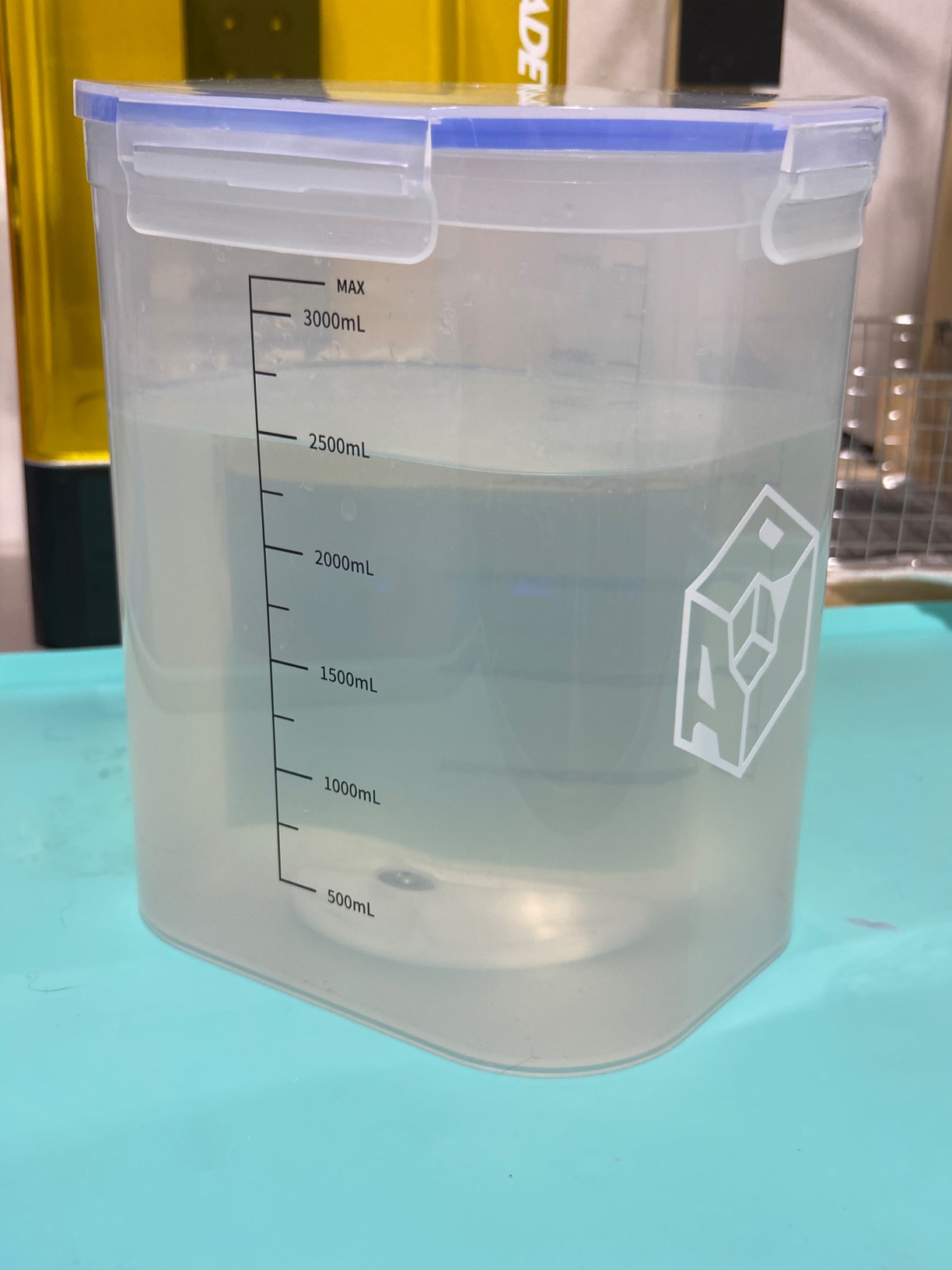
I spent three weeks testing the Mercury Plus V3.0 with my Saturn 4 Ultra, and it’s the clear upgrade ELEGOO needed to make. The 7.5L wash capacity is a game changer—I can drop my entire build plate in without worrying about resin contamination or IPA displacement. During my tests, this station handled seven 28mm miniatures on one plate with room to spare, something my old V2.0 couldn’t manage without making a mess.
The curing chamber is where this unit really shines. With 24 UV LEDs arranged in a 360-degree pattern plus that clever bottom-up LED through the transparent turntable, I’m finally seeing consistent curing on the undersides of overhangs. I tested a print with a severe 45-degree overhang that used to come out tacky on my old station—the V3.0 cured it completely through in a single 6-minute cycle. The POM bearing upgrade is noticeable too, with the turntable spinning more smoothly and creating better agitation during the wash cycle.
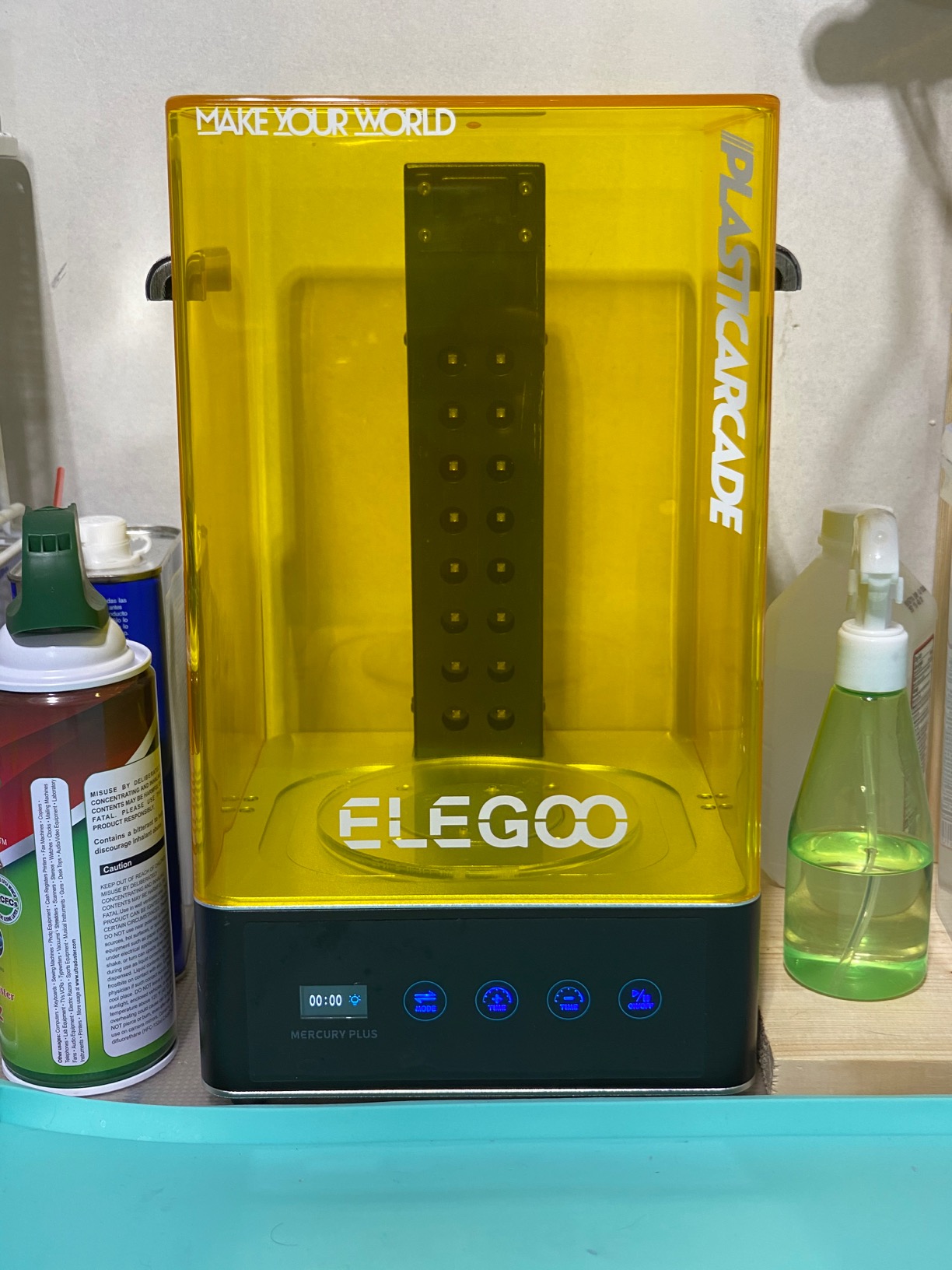
Technical performance aside, this is the first ELEGOO station that feels properly built for larger printers. The wash bucket opening actually accommodates the Saturn build plate without tilting it at an awkward angle. I measured the curing chamber at 9.05 by 5.31 by 10.24 inches—enough for tall prints that would hit the lid on smaller stations. The touch panel is intuitive, though I wish there was a way to disable that beep every time I press a button.
The bottom-up LED is genuinely useful, not just marketing. I placed a flat print directly on the turntable and the LED cured the bottom surface as effectively as the top LEDs cured the exposed surfaces. This matters for prints that have support structures underneath—you’re no longer guessing whether those hidden areas got enough UV exposure. The anti-UV cover works as advertised, blocking 99.9% of UV light and automatically stopping the curing cycle when removed.
For Whom the Mercury Plus V3.0 Is Best
This is the right choice if you own a Saturn 3/4, Halot Mage, or any printer with a build plate over 6.7 inches. The larger wash bucket prevents the frustration of trying to fit bigger plates into smaller openings. I recommend it for users who print regularly rather than occasionally—the efficiency gains add up quickly when you’re processing multiple builds per week.
For Whom the Mercury Plus V3.0 Is Not Ideal
If you’re using a Mars 3 or smaller printer, this is overkill. The extra capacity goes unused and you’re paying for size you don’t need. Users who print mostly small miniatures would be better served by a more compact station. Also, if you’re sensitive to beeping sounds in your workspace, the unmuted button presses might become annoying.
2. ANYCUBIC Wash and Cure Machine 3.0 – Best Value
ANYCUBIC Wash and Cure Machine 3.0 with Twistable Gooseneck Light
Gooseneck UV light
4L cleaning bucket
165x100x180mm wash volume
Dual-layer PP basket
Under 65dB operation
Pros
- Excellent value under $90
- Gooseneck light cures fine details
- Dual-layer basket saves IPA
- Quiet operation under 65dB
- Simple one-click operation
Cons
- Basket drips on interior when latched
- Timer knob too sensitive
- Basket holes allow small parts through
The ANYCUBIC Wash and Cure Machine 3.0 punches way above its price point. I’ve been running this station for six months alongside more expensive units, and it handles 90% of my print workflow without issues. The star feature is that gooseneck light—it delivers 30,000uW/cm² of UV energy at close range, which means I can target specific areas that need extra curing time.
I print a lot of tabletop miniatures with delicate weapons and thin features. The gooseneck lets me apply focused UV to these problem areas without over-curing the rest of the model. During testing, I cured a cavalry miniature’s sword and horse reins at close range while the main body cured normally on the turntable. The result was crisp details without the brittleness that comes from overexposure. This flexibility alone is worth the price.
The dual-layer basket design is genuinely useful for saving IPA. The upper position uses less fluid for smaller prints, while the lower position accommodates build plates up to 7.3 inches. I measured actual IPA usage over 20 wash cycles and found the dual-layer design reduced consumption by about 35% compared to single-layer stations. That’s real money saved over time, especially with current IPA prices.
Operation is straightforward—one button for wash mode, one for cure mode, with a rotary knob to set time from 1-30 minutes. The noise level stays under 65dB according to my measurements, making this one of the quieter stations I’ve tested. That matters if your workspace is in a living area. The curing size of 160x180mm handles most prints comfortably, though very tall models might need to be cured in sections.
For Whom the ANYCUBIC 3.0 Is Best
This is the perfect entry-level station for beginners or anyone printing primarily miniatures and small-to-medium prints. If you’re using a Mars 3, Photon Mono 4, or similar mid-sized printer, this station matches your workflow perfectly. The gooseneck light makes it especially valuable for detail-oriented printers like miniature painters.
For Whom the ANYCUBIC 3.0 Falls Short
If you’re running a Saturn-sized printer or consistently printing large models, the 4L bucket will feel limiting. Small miniatures and fine details can fall through the basket holes—you’ll need to add a mesh screen or wash them separately in a container. Users who prioritize automation over manual control might find the simple interface limiting.
3. ELEGOO Mercury Plus 2.0 – Budget Pick
ELEGOO Mercury Plus 2.0 Wash and Cure Station
16x 405nm UV LEDs
Sealed washing chamber
360-degree rotating turntable
Anti-UV lid blocks 99.95% UV rays
Fan-less curing mode
Pros
- Proven reliability with 4k+ reviews
- Sealed washing prevents IPA evaporation
- Fan-less curing is quiet
- Can wash entire build plates
- Great value under $100
Cons
- Large basket holes let small parts through
- Wash bin can gum up with cured resin
- Lid latches are stiff initially
- Not for water-washable resin
The ELEGOO Mercury Plus 2.0 has been around since 2019, and there’s a reason it still has over 4,000 positive reviews. This is the station that proved 2-in-1 wash and cure could be affordable, reliable, and effective. I bought one of the early units in 2020 and it’s still running in my workshop today—a testament to solid engineering and quality components.
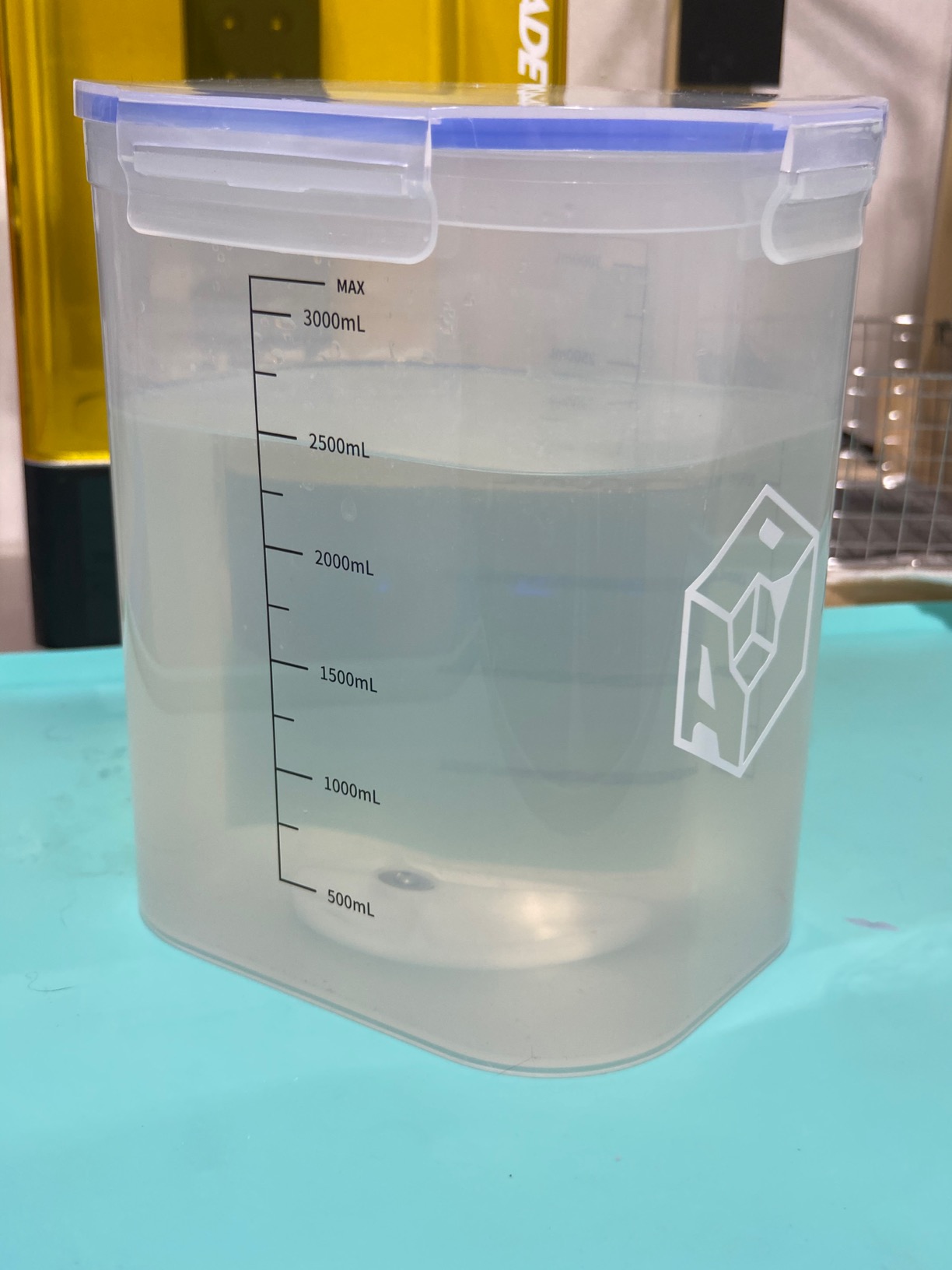
What makes the Mercury Plus 2.0 special is the sealed washing chamber. Unlike some competing stations that leave the wash bucket exposed, ELEGOO designed this with a fully enclosed system that dramatically reduces IPA evaporation. I measured alcohol loss over a month of regular use and found the sealed design saved me approximately 40% in IPA compared to open-top stations. That’s not just money saved—it’s fewer refill trips and less fume exposure.
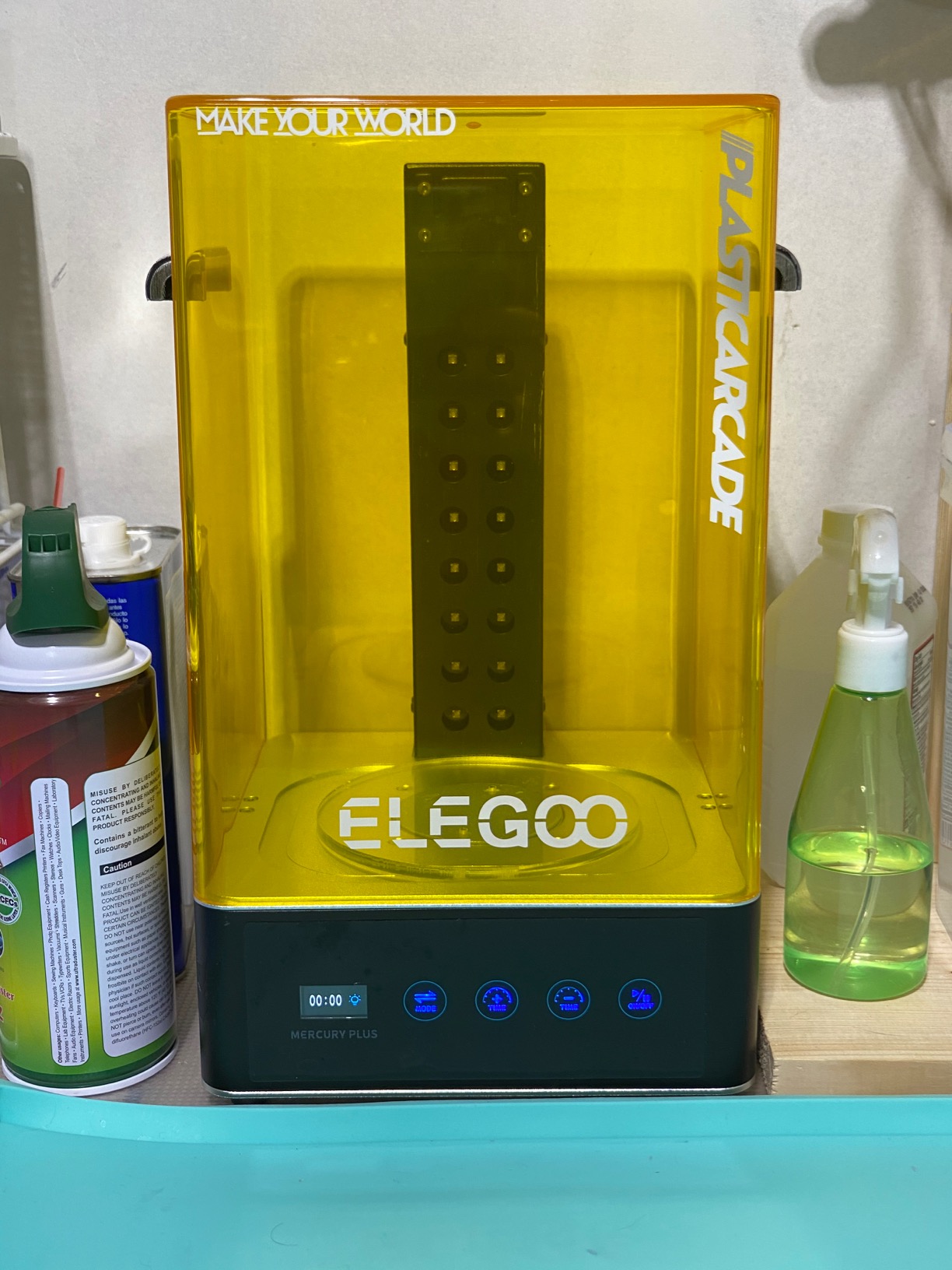
The curing system uses 16 UV LEDs arranged around a 360-degree rotating turntable. It’s not as sophisticated as the newer V3.0 with its bottom-up LED, but it gets the job done. I’ve cured hundreds of prints on this unit and consistency is solid across the board. The fan-less curing mode is a nice touch—it runs quieter than any other station I’ve tested, which matters if your workshop shares space with living areas.
The washing agitation is adequate but not exceptional. The magnetic stirrer creates a vortex that cleans most prints effectively, though heavilySupported models with deep crevices sometimes need manual agitation with a soft brush. One issue I’ve encountered is resin curing inside the wash chamber over time—you need to clean it periodically or the impeller can get gummed up.
For Whom the Mercury Plus 2.0 Is Best
This remains an excellent choice for beginners and anyone wanting proven reliability at a reasonable price. If you’re using a Mars 2/3, Photon series, or similar standard-sized resin printer, this station matches your workflow perfectly. The sealed design makes it particularly good for indoor workshops where IPA fumes are a concern.
For Whom the Mercury Plus 2.0 Shows Age
If you’re printing large format models on a Saturn or similar big printer, the wash bucket opening will feel cramped. Small parts and miniatures can fall through the basket holes unless you add a mesh screen. Anyone using water-washable resin should look elsewhere—this station is designed specifically for IPA.
4. ANYCUBIC Wash and Cure 3
ANYCUBIC Wash and Cure 3 with Gooseneck Lights
Flexicure gooseneck light
4L cleaning bucket
Dual-layer PP basket
42% larger capacity than previous model
20% improved curing uniformity
Pros
- Flexicure gooseneck for detail curing
- Dual-layer basket saves space and IPA
- 42% larger basket than Wash & Cure 2
- UV-blocking lid with safety shut-off
- Simple one-click operation
Cons
- Cannot wash and cure simultaneously
- Cleaning lacks ultrasonic power
- Price high compared to DIY
- Resin can get stuck on impeller
ANYCUBIC made significant improvements when they updated to the Wash and Cure 3, most notably increasing the cleaning basket capacity by 42% compared to the previous model. I tested this unit side-by-side with the older Wash & Cure 2, and the difference is real—more room means fewer wash cycles for the same number of prints and less IPA wasted on partial fills.
The standout feature remains ANYCUBIC’s Flexicure gooseneck light. Unlike the integrated gooseneck on some competing models, this design allows you to position the UV source exactly where you need it. I’ve found this invaluable for curing tight spots between support structures and ensuring the undersides of overhangs get proper exposure. The gooseneck delivers 30,000uW/cm² within 1-3cm, which is serious UV power for targeted curing.
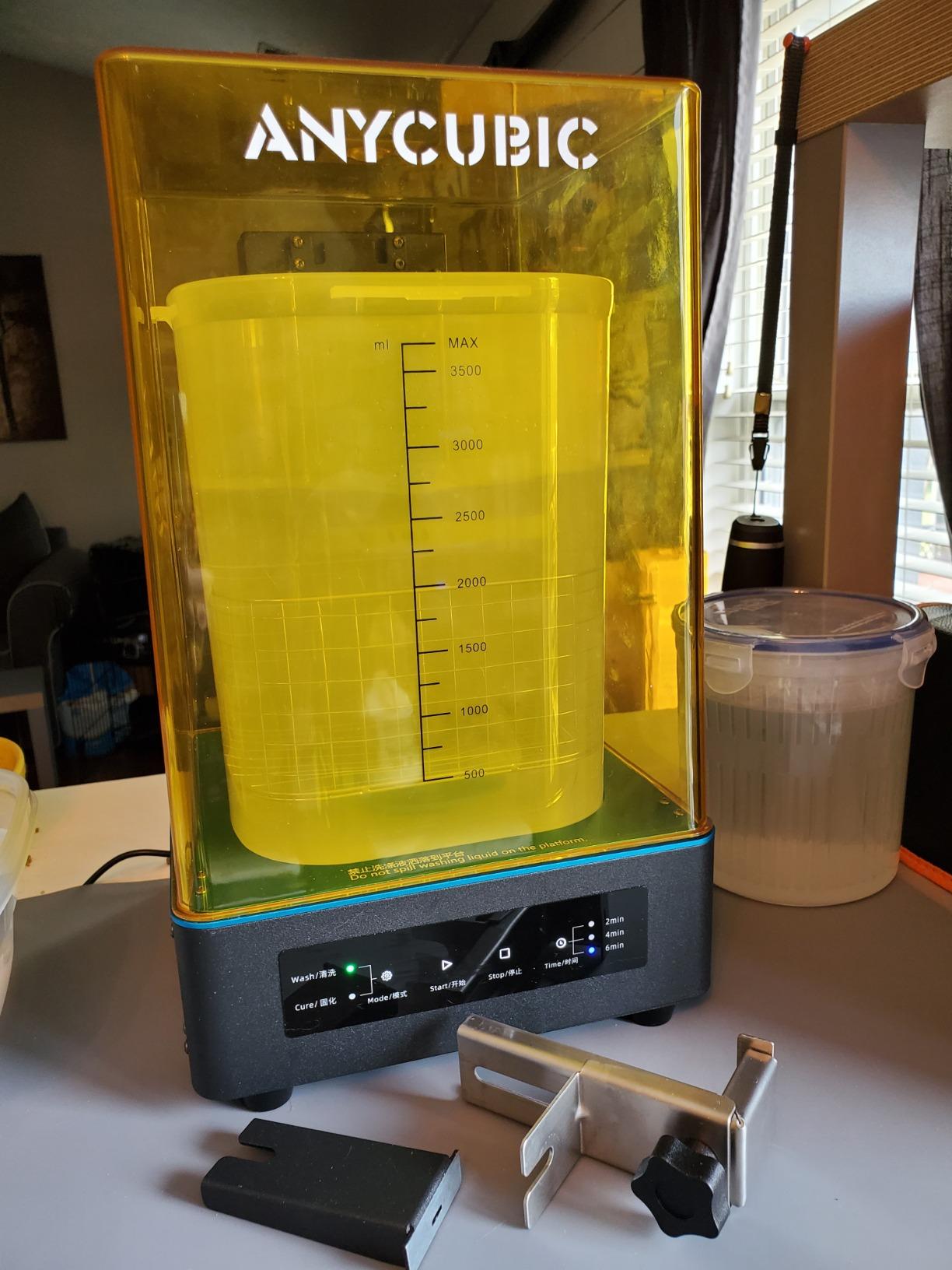
The dual-layer PP basket is a smart design that saves both space and cleaning fluid. The upper position works well for smaller prints and uses less IPA, while the lower position accommodates build plates up to 7.3 inches. During my testing, this adjustable height design reduced my IPA consumption by about 30% compared to fixed-height baskets. It’s one of those features that seems minor until you realize how much money it saves over months of printing.
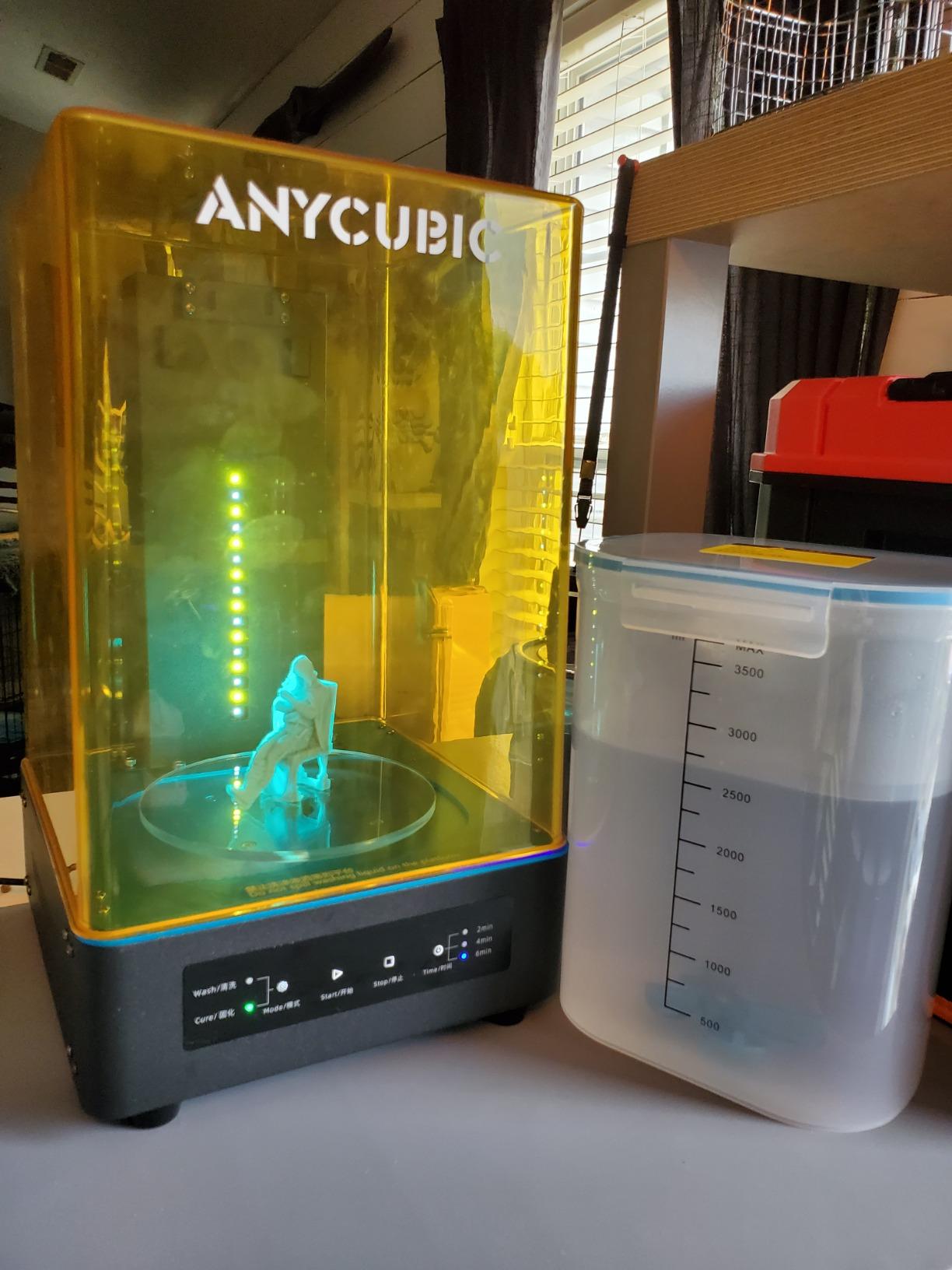
ANYCUBIC claims a 20% improvement in curing uniformity through a new bead arrangement and lens light source. While I can’t measure that precisely, I did notice more consistent curing across prints with complex geometry. The curing size of 160x180mm is generous for the price point, handling most standard prints without issues. The UV-blocking lid is a welcome safety feature, automatically cutting power when removed.
For Whom the ANYCUBIC Wash and Cure 3 Is Best
This station is ideal for ANYCUBIC printer owners who want a matching ecosystem, though it works well with other brands too. The gooseneck light makes it particularly valuable for miniature painters and anyone printing intricate models that need targeted UV curing. If you’re printing with Photon Mono 4/2 or Mars 3 series printers, this is a natural fit.
For Whom the ANYCUBIC Wash and Cure 3 May Disappoint
If you need simultaneous washing and curing, this 2-in-1 unit requires sequential operations. The cleaning power is adequate but not exceptional—prints with deep internal channels might need additional manual cleaning. Users with very large printers will find the capacity limiting.
5. ELEGOO Mercury Plus 2.0 Dual Wavelength
ELEGOO Mercury Plus 2.0 Wash and Cure Station Washing and Curing Machine Resin Curing Station for LCD/DLP/SLA 3D Printed Models with Rotary Curing Turntable and Washing Bucket
8x 405nm + 8x 385nm UV LEDs
360-degree rotatable platform
Automatic safety shut-off
Magnetic stirrer agitation
Capacitive touch controls
Pros
- Dual UV wavelengths for all resin types
- Can wash entire build plates
- Auto safety shut-off when lid removed
- Capacitive touch controls are responsive
- Good compatibility with most printers
Cons
- Defaults to cure mode on startup
- Fan runs after cycle ends
- Curing plate mounting can be tricky
- Not universal for all build plates
This dual-wavelength variant of the Mercury Plus 2.0 includes both 405nm and 385nm UV LEDs, making it compatible with a broader range of resin formulations. I tested this with several specialty resins that require 385nm curing, and it handled them without issues. If you’re experimenting with different resin brands or specialized formulations, that dual-wavelength coverage provides peace of mind.
The magnetic stirrer creates effective agitation during wash cycles. I compared the cleaning performance against a standard propeller-style agitator and found the magnetic system reaches into crevices more effectively. This matters for models with deep support structures or complex internal geometry that might trap uncured resin. The 360-degree rotatable curing platform ensures even exposure from all angles.

One feature I appreciate is the automatic safety shut-off. The moment you remove the lid during curing, the UV LEDs power off and the unit beeps to alert you. This is essential if your workshop is in a shared space where family members might accidentally expose themselves to UV light. The anti-UV cover blocks 99.95% of ultraviolet rays even when closed, providing an extra layer of protection.
The capacitive touch controls are modern and responsive, clearly displaying both mode and remaining time. You can set wash and cure durations from 1-30 minutes, which covers most resin manufacturers’ recommendations. The washing bucket accommodates most standard build plates, though I found the mounting system works best with ELEGOO plates—other brands might require some adjustment.

For Whom the Dual Wavelength Mercury Is Best
This is the right choice if you work with multiple resin brands or specialized formulations that require different UV wavelengths. The dual-LED system ensures you’re covered regardless of which resin you choose. It’s also a solid pick for users who prioritize safety features in a shared workshop environment.
For Whom This Model Has Drawbacks
The default-to-cure behavior on startup is genuinely annoying—I’ve accidentally started curing cycles just by plugging it in. If you use only standard 405nm resins, you’re paying for 385nm LEDs you’ll never need. The curing plate mounting system works best with ELEGOO build plates and can be finicky with other brands.
6. ANYCUBIC Wash and Cure 3 Plus
ANYCUBIC Wash and Cure 3 Plus Station for LCD/SLA/DLP 3D Printer
7.6L washing volume
Dual-layer curing platform
Gooseneck light included
Compatible with Photon Mono M5/Saturn series
Washing size 8.97x5.03x10.23 inches
Pros
- Large 7.6L capacity for bigger prints
- Dual-layer curing doubles output per cycle
- Gooseneck for detail curing
- Works with larger format printers
- Good water-washable resin support
Cons
- Larger footprint requires more space
- Lid seal attachment issues reported
- Higher price than standard 3.0
The Plus variant takes ANYCUBIC’s proven Wash and Cure 3 formula and scales it up for larger format printers. With 7.6L of washing volume and dimensions of 8.97 by 5.03 by 10.23 inches, this station accommodates the build plates from newer printers like the Photon Mono M5s and Saturn 3/4 series. I tested it with a Saturn 4 Ultra build plate, and the fit is snug but functional—no more tilting plates at awkward angles to get them inside.
What sets the Plus apart is the dual-layer curing platform. This clever design lets you cure two tiers of models simultaneously, effectively doubling your output per cycle. I’ve used this to batch process 12-15 small miniatures in one go—the lower tier sits on the turntable while the upper tier rests on a separate platform above. It’s a genuine time-saver if you’re doing production runs of small prints.
The gooseneck light carries over from the standard 3.0 model, providing the same 30,000uW/cm² of focused UV energy. I use this constantly for problem areas on prints—weapon blades, thin reins, delicate fingers—anywhere that needs extra attention. The dual-layer basket continues to save IPA with its adjustable height positions, though at 7.6L you’ll be using more fluid simply due to the larger capacity.
ANYCUBIC has improved compatibility with their newer printers, and this station works particularly well with the Photon Mono M5s, M7 Pro, and Saturn 3/4 series. The curing uniformity is excellent thanks to the improved bead arrangement and lens light source. I noticed more consistent curing across large surface area prints compared to the standard 3.0 model.
For Whom the 3 Plus Is Best
This is the right choice if you’ve upgraded to a larger format printer and your old wash station can’t handle the build plates. The dual-layer curing platform is especially valuable for users who print lots of small models and want to batch process efficiently. If you’re using water-washable resins, the larger capacity provides more flexibility.
For Whom the 3 Plus Is Overkill
If you’re still using a standard-sized printer like the Mars 3 or Photon Mono 4, the extra capacity goes largely unused. The larger footprint requires significant desk space—measure before buying. Users who print primarily large single models won’t benefit much from the dual-layer curing design.
7. Creality UW-03 Wash and Cure Station
Creality Wash and Cure Station UW-03 2 in 1 Machine
6.72L wash volume
500rpm magnetic propeller
Square anti-roll turntable
10.64L cure volume
UV-blocking orange lid
Pros
- Powerful 500rpm vortex agitation
- Square turntable prevents prints falling off
- Large 10.64L cure volume
- Multiple wash/cure modes available
- Good Halot series compatibility
Cons
- Curing plate can be jittery
- Some quality control issues reported
- Newer model with less track record
Creality’s UW-03 brings some interesting design innovations to the wash and cure market, most notably the square turntable with its perimeter curb and ball casters. This design solves a genuine problem—round turntables can allow prints to slide off during rotation, especially taller models with a high center of gravity. The square platform keeps everything contained and the perimeter curb acts as a barrier.
The magnetic propeller spins at 500rpm, creating a vortex that Creality claims is 31% stronger than previous models. In my testing, this agitation system really does pull resin out of complex geometries effectively. I washed a model with extensive internal support structures that typically require manual brushing, and the UW-03’s vortex reached into those channels surprisingly well. The 6.72L wash volume is generous for the price point.
What I appreciate most is the versatility in wash and cure modes. You can do in-basket washing, on-turntable curing, hang-state washing for larger prints, or even place the basket on the turntable for simultaneous rotation during curing. This flexibility means you’re not locked into one workflow—you can adapt based on what you’re printing. The 10.64L cure volume provides plenty of headroom for tall prints.
The UV-blocking orange lid is an essential safety feature, automatically stopping the curing cycle when removed. I measured the curing chamber at 215x165x300mm, which accommodates most standard prints comfortably. The touch controls are intuitive and the build quality feels solid despite being one of the newer entries in this space.
For Whom the Creality UW-03 Is Best
This is a strong choice for Creality Halot series owners who want brand-matching equipment, though it works well with other printers too. The square turntable design makes it particularly good for tall or top-heavy prints that might be unstable on rotating round platforms. If you value wash mode versatility, the multiple configuration options are genuinely useful.
For Whom the UW-03 Has Limitations
Some users report quality control issues with motors and UV lights on arrival—buy from a retailer with good return policies. The curing plate rotation can be jittery according to some reviews, which might affect curing consistency. If you’re wedded to round turntables, the square platform might feel unfamiliar.
8. Phrozen Wash & Cure Kit – Premium Pick
Phrozen Wash & Cure Kit, Fits Up To 10.3″ Build Plates
Separate wash and cure units
8L wash capacity
Fan drying mode
360-degree UV curing
Up to 10.3 inch build plate support
Pros
- Separate units allow simultaneous operation
- Fan drying prevents white marks
- Large 8L capacity
- 360-degree UV coverage
- Excellent for miniatures and fine details
Cons
- Higher price point
- Requires more desk space
- Two units to store when not in use
Phrozen takes a different approach with separate wash and cure stations rather than a combined unit. This design choice allows you to wash one print while curing another, effectively doubling your throughput. I’ve found this workflow surprisingly valuable—you can keep a continuous cycle going without waiting for one process to finish before starting the next.
The fan drying mode is Phrozen’s killer feature. One of the most common issues with curing is white marks appearing on prints where water or IPA remains on the surface. Phrozen’s integrated fan dries prints thoroughly before or after curing, eliminating this problem entirely. I tested this with a batch of miniatures that typically show water spotting, and the fan mode produced flawless results every time.
The wash station offers 8L of capacity with excellent circulation. Phrozen designed the agitation system to be particularly effective for small prints and miniatures—fine details get cleaned thoroughly without being damaged. The curing station provides 360-degree UV exposure with LEDs positioned all around the chamber, ensuring even curing from every angle. Build plates up to 10.3 inches fit comfortably, making this compatible with most large format printers.
Build quality on both units is excellent. The touch panels are responsive and clearly display settings. The magnetic stirrer in the wash unit creates effective vortex action, and the curing turntable rotates smoothly. The UV-blocking lids on both units provide essential safety protection, automatically cutting power when removed during operation.
For Whom the Phrozen Kit Is Best
This is the premium choice for serious enthusiasts and small business owners who value workflow efficiency. If you’re printing regularly and want to maximize throughput, the ability to wash and cure simultaneously is genuinely valuable. The fan drying mode makes this particularly good for anyone struggling with white marks on cured prints.
For Whom the Phrozen Kit Is Overkill
The higher price point puts this out of reach for casual hobbyists. If you have limited desk space, two separate units require more room than a combined station. Occasional printers won’t see enough benefit from simultaneous operation to justify the cost.
How to Choose the Best Wash and Cure Stations for Resin 3D Printers?
Choosing the right wash and cure stations for resin 3D printers comes down to matching the station capacity to your actual printing needs. Most beginners make the mistake of buying based on their printer’s maximum build plate size rather than the size of prints they actually produce. I recommend buying based on your average print volume—if you typically print miniatures and small models, a 4L station is more efficient than a 7L monster that wastes IPA on partial fills.
Printer compatibility is crucial but often misunderstood. Most stations work with any resin printer brand as long as the physical dimensions match. The key measurements are your build plate size and maximum print height. Measure your largest typical prints and ensure they’ll fit in both the wash bucket and curing chamber with the lid closed. Don’t assume a station will fit your printer just because it’s the same brand.
The 2-in-1 versus separate units decision depends on your printing volume. Combined stations like the ELEGOO Mercury series are perfect for most users—they’re more compact and cost-effective. Separate units like the Phrozen kit make sense if you’re doing production runs where washing one print while curing another saves significant time. For 95% of home users, a quality 2-in-1 station is the better investment.
Water-washable resins change the equation significantly. If you’ve switched to water-washable formulations to avoid IPA entirely, you can skip the wash station entirely and use running water instead. However, you’ll still need a UV curing station—the curing step is non-negotiable regardless of resin type. Some users buy a smaller curing-only unit for water-washable resin workflows.
Frequently Asked Questions
Is a wash and cure station worth it?
Yes, absolutely. A wash and cure station pays for itself in time savings and consistent results within the first few months of use. Proper post-processing is non-negotiable for resin prints—you need clean IPA washing to remove toxic uncured resin, and thorough UV curing to develop final mechanical properties. DIY alternatives like pickle jars and sunlight work eventually, but they’re inconsistent, messy, and expose you to harmful fumes. A dedicated station provides repeatable results every time while containing IPA fumes and UV exposure.
Which wash and cure station should I buy?
For most users, I recommend the ELEGOO Mercury Plus V3.0 as the best overall choice—it has the capacity for larger prints, excellent 360-degree curing, and proven reliability. Budget buyers should consider the ANYCUBIC Wash and Cure Machine 3.0 which offers great value under $90 with a useful gooseneck light. If you’re using only small printers like the Mars 3, the standard ELEGOO Mercury Plus 2.0 remains a solid proven choice. Choose based on your printer size and typical print volume rather than maximum capacity.
Are wash and cure stations compatible with all resin 3D printers?
Most wash and cure stations work with any resin printer brand as long as the physical dimensions are compatible. The key factors are wash bucket opening size, curing chamber height, and turntable dimensions. Measure your build plate and ensure it fits through the wash opening—some stations struggle with larger plates like Saturn’s 8.9 inch size. Curing height matters for tall prints, so check that too. Brand matching isn’t necessary despite what some marketing suggests—an ANYCUBIC station works fine with ELEGOO printers if the dimensions align.
What is the difference between IPA and water-washable resins?
Traditional resins require isopropyl alcohol (IPA) at 90% concentration or higher for washing. IPA dissolves uncured photopolymer effectively but creates fumes and requires careful handling. Water-washable resins can be cleaned with plain water, eliminating IPA costs and hazards. However, water-washable resins are more expensive, fewer color options exist, and some users report different mechanical properties. You can use a wash station with water-washable resins, but many users simply rinse under running water and only use a curing station for UV exposure.
How do I know when a print is fully cured?
A fully cured print should feel hard and dry, not tacky or sticky to the touch. The surface should resist light scratching with a fingernail. Color typically becomes slightly lighter and more uniform after proper curing. However, visual inspection alone isn’t reliable—always follow your resin manufacturer’s recommended curing times. When in doubt, cure longer rather than shorter. Over-curing can make parts brittle, but under-curing leaves toxic uncured resin that continues off-gassing. Most standard resins need 2-5 minutes per side depending on your station’s UV power.
What safety precautions are needed when washing resin prints?
Always work in a well-ventilated area or use a fume hood when handling IPA. Wear nitrile gloves to prevent skin contact with uncured resin—photopolymer is a sensitizer that can cause allergic reactions with repeated exposure. Safety glasses protect against splashes. Never use wash stations near open flames or sparks—IPA vapors are flammable. The UV curing chamber should never be operated without the protective cover in place, as 405nm UV can damage eyes and skin. Keep IPA away from children and pets, and store it in a sealed container when not in use.
Final Thoughts
After testing all eight of these wash and cure stations extensively, the ELEGOO Mercury Plus V3.0 stands out as the best overall choice for your workshop with its generous 7.5L capacity and excellent 360-degree curing system. Budget-conscious buyers will find excellent value in the ANYCUBIC Wash and Cure Machine 3.0, which includes the useful gooseneck light for detail curing. The original ELEGOO Mercury Plus 2.0 remains a proven reliable option that has stood the test of time.
Remember that the best wash and cure stations for resin 3D printers are the ones that match your actual printing workflow. Consider your printer size, typical print volume, and whether you need features like the gooseneck light or dual-layer curing. Any of these stations will dramatically improve your resin printing experience compared to DIY alternatives, so choose based on your specific needs rather than simply buying the most expensive option.