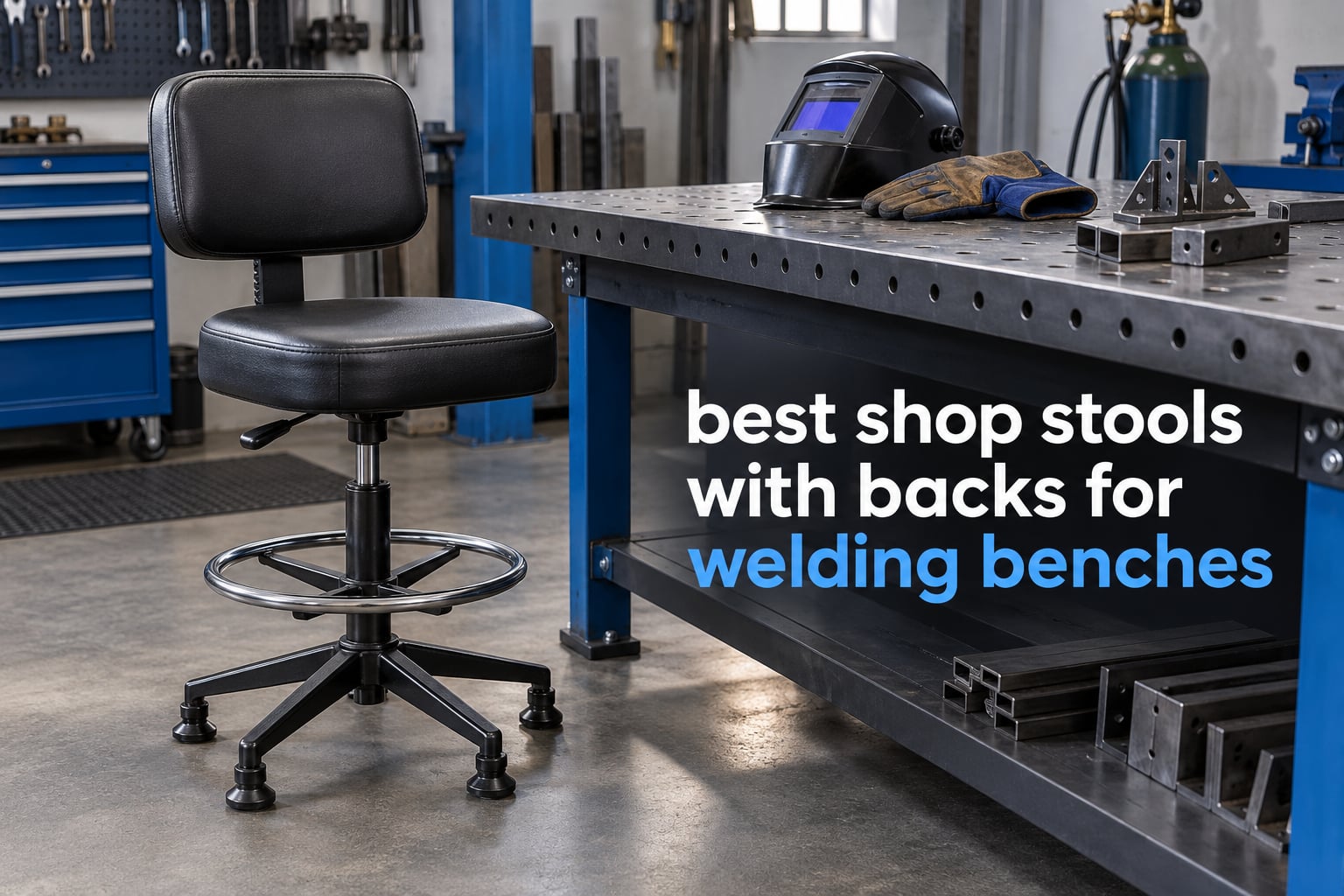
A shop stool with a back for welding is a height-adjustable industrial rolling seat with a lumbar backrest, a wide anti-tip base and a wipe-clean seat, chosen so the seat height puts your elbows near 90 degrees at a raised welding bench. Most benches top out between 34 and 40 inches, so look for a 24 to 32 inch seat range. Our top pick reaches 24.49 to 30 inches on a 300 lb steel frame with a 360 degree swivel and a footrest.
Getting this wrong is the single most common complaint we found among welders. Ask anyone who has spent a shift on a backless shop stool and they will tell you the same thing: comfortable, but the wrong height for the bench. A welding bench sits far higher than a normal workbench, so a standard 20 to 22 inch stool leaves you hunching with your shoulders up and your neck bent forward.
We went through twelve shop stools with backs and picked the ones that genuinely fit a raised bench. The short version of the list below: the FreekyFit adjustable stool for most people, the Sunex hydraulic stool for the tallest benches, and the Performance Tool W85011 if you would rather skip tools entirely. If you want the broader picture of backless and low stools, our general shop stool roundup covers those too.
Table of Contents
Top 3 Best Shop Stools With Backs for Welding Benches in October

FreekyFit Adjustable Backrest Shop Stool
- 24.49-30 inch pneumatic range
- 300 lbs capacity
- 14.96 inch PVC seat with footrest
Sunex 8516 Hydraulic Shop Stool
- 29-34 inch hydraulic range
- Vinyl seat and backrest
- Slip resistant sled base

Performance Tool W85011 Pneumatic Stool
- 26-32 inch pneumatic range
- 330 lbs alloy steel frame
- Tool-free assembly
All 12 Shop Stools With Backs Side by Side in 2026
Height range is the first column worth reading, because it decides whether the stool works at your bench at all. Capacity, adjustment type and backrest style follow from there.
| Product | Specifications | Action |
|---|---|---|
| FreekyFit Backrest Shop Stool |
|
Check Latest Price |
| Performance Tool W85011 |
|
Check Latest Price |
| Sunex 8516 Hydraulic Stool |
|
Check Latest Price |
 FreekyFit Rolling Stool with Tool Tray FreekyFit Rolling Stool with Tool Tray |
|
Check Latest Price |
 FREEKYROCK D17 Star Base Stool FREEKYROCK D17 Star Base Stool |
|
Check Latest Price |
 FREEKYROCK D15-B Red Shop Stool FREEKYROCK D15-B Red Shop Stool |
|
Check Latest Price |
 CoVibrant Counter-Height Shop Stool CoVibrant Counter-Height Shop Stool |
|
Check Latest Price |
 Powerbuilt 240299 Detailers Roller Seat Powerbuilt 240299 Detailers Roller Seat |
|
Check Latest Price |
 FreekyFit D03-B Backrest Stool FreekyFit D03-B Backrest Stool |
|
Check Latest Price |
 BestGlory Shop Stool TC001 BestGlory Shop Stool TC001 |
|
Check Latest Price |
 WUDOYO DZ1 Locking Wheel Stool WUDOYO DZ1 Locking Wheel Stool |
|
Check Latest Price |
 Type S Chrome Shop Stool Type S Chrome Shop Stool |
|
Check Latest Price |
How We Picked Stools That Actually Fit a Welding Bench
Most roundups rank shop stools on comfort, which is the wrong first filter for welding. Comfort at 20 inches is useless if your bench top is at 38 inches. So we scored these on fit first and comfort second.
Seat height range against your bench top. A raised welding bench needs a stool that tops out around 28 to 32 inches. Anything that stops at 23 inches is a bench stool for engine work, not for a welding bench.
Real backrest size. A 4.5 inch rest is a lumbar nudge. A back that reaches your shoulder blades is what holds you up over a four hour bead.
Base spread and support polygon. Wide bases resist tipping when you lean toward the bench with a torch in hand. Narrow five-leg bases need more care on uneven concrete.
Adjustment mechanism. Pneumatic and hydraulic lifts give smooth, continuous travel. A threaded rod is fine but is slower to work with while wearing gloves.
Seat material around hot work. Spark and spatter resistance matters more than most listings admit. A wipe-clean PVC or vinyl surface has no fabric weave to catch a hot droplet.
Weight capacity with margin. Static ratings are laboratory numbers. We prefer 300 lb or more so a 220 lb welder in gear is not at the limit.
Caster behaviour on a weld cell floor. Spatter and ground slag are obstacles. Small hard wheels catch and stop the stool dead, which is a real annoyance at a fixed work position.
Welders in r/Welding ask for the same narrow spec sheet over and over: a small backrest, adjustable height and padding. That request is the reason the height range sits at the top of our list, and it is why we treat the taller stools in this group as the serious contenders.
1. FreekyFit Adjustable Shop Stool with Backrest and Footrest
FreekyFit Shop Stool with Backrest, Mechanic Garage Stool for Workshop, Adjustable Shop Stools Chair, Padded Workbench Stools for Men Women, 300 LBS Capacity, 360° Swivel PVC Seat, Heavy Duty, Black
24.49-30 inch pneumatic range
300 lbs capacity
14.96 inch PVC seat
360 degree swivel with footrest
Pros
- 24.49-30 inch range lands on a raised welding bench
- Large memory foam seat with waterproof PVC cover
- Integrated footrest for high work positions
- 360 degree swivel makes repositioning along the bench easy
Cons
- Needs a Phillips screwdriver and some hole alignment during assembly
- Backrest height is modest rather than a full lumbar back
This is the stool we kept coming back to. The 24.49 to 30 inch pneumatic range is the sweet spot for a welding bench, because the top of the range puts you at elbow height on a bench that sits in the upper 30s. Owners describe the 14.96 inch memory foam seat as the most comfortable part of the package, and we agree that cushion depth is what separates a stool you can sit on for a shift from one you tolerate for twenty minutes.
The footrest matters more than it looks on paper. At 30 inches your legs have nowhere to go without something to push against, and a welded foot ring is the difference between stable and constantly shifting your weight. The 360 degree swivel then lets you rotate to the bench edge rather than standing up to reposition.
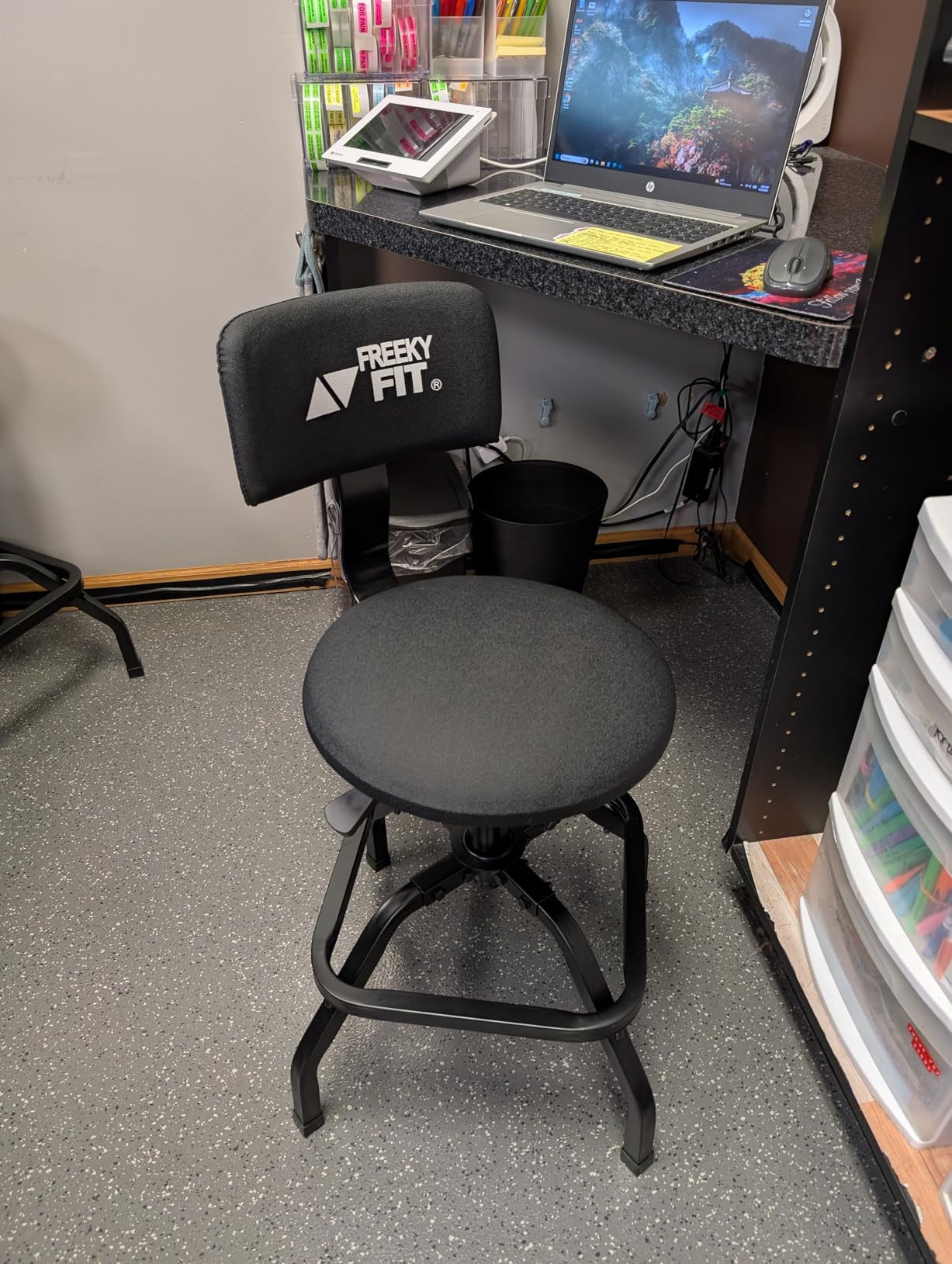
Two details tell you where this sits in the market. The seat surface is PVC over thickened memory foam, which wipes down after a spatter event instead of absorbing it, and the frame is thick angle steel rated to 300 lbs. For a welder in a t-shirt and apron that is plenty of headroom.
Assembly is the weak point. Reviewers report needing a Phillips screwdriver and a little patience lining up holes, and the backrest is short enough that taller users may want to add a cushion. Neither issue is serious, but neither is invisible either.
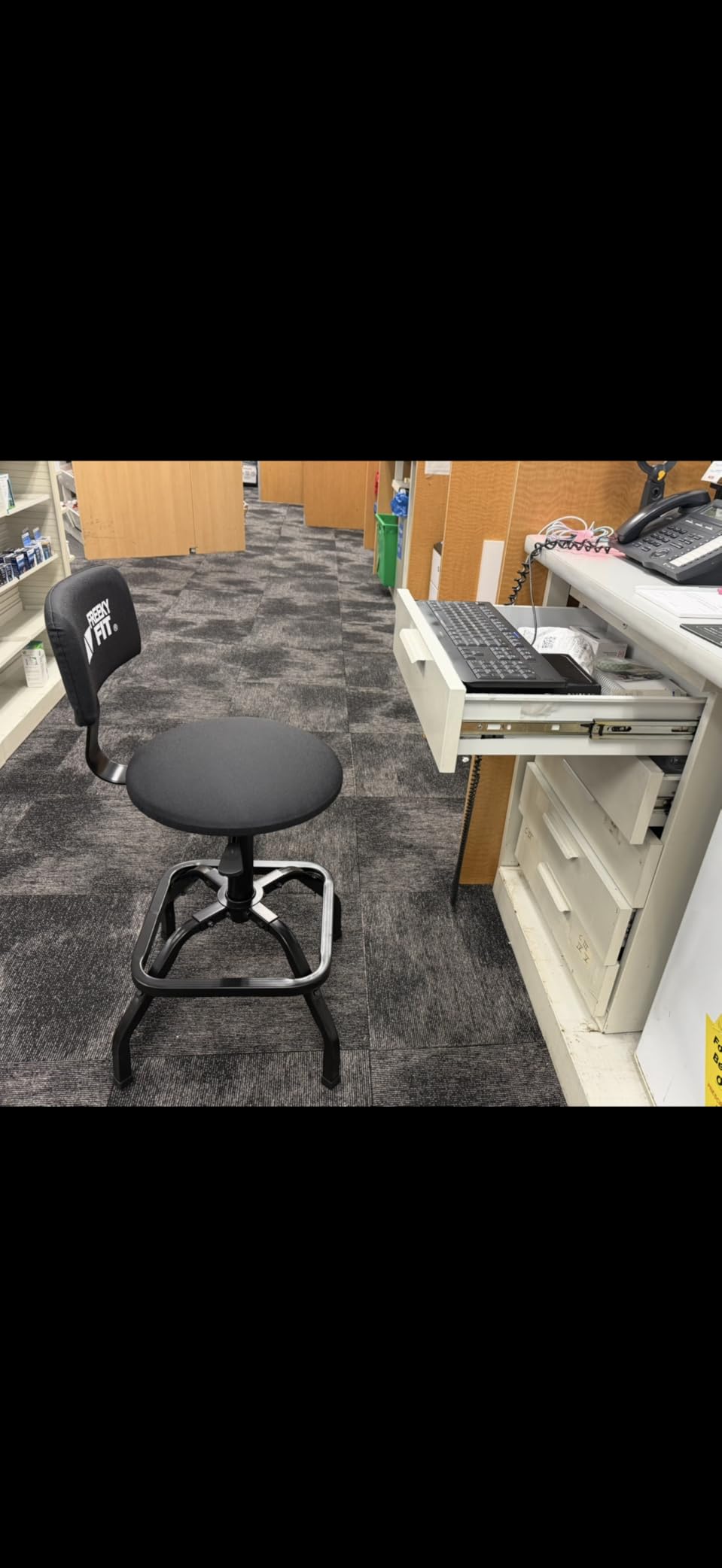
Who will like this stool most
A welder who works at a 36 to 40 inch bench and wants to roll along the workpiece rather than walk around it. It also works well as a second stool in a mixed shop because the swivel and footrest translate to assembly and layout work.
If you sit here for a full shift, the memory foam cushion is the reason you will not want to move. Bring a welding jacket rather than a hoodie and the PVC wipe-down takes care of the rest.
Where it falls short
If you are six foot two or taller, the backrest is not tall enough to fill the gap between your shoulder blades and the seat edge. Pair it with a lumbar cushion or accept that you will lean forward on long beads.
The 300 lb rating is the lower end of the heavy-duty group, so anyone significantly over that should look at a 400 lb frame instead. It is also a rolling stool, which means spatter and ground slag on the floor will catch the casters.
2. Performance Tool W85011 Pneumatic Swivel Bar Stool
Performance Tool W85011 Pneumatic Swivel Bar Stool with Back Support, 360-Degree Swivel, Heavy Duty Steel Frame, Black
26-32 inch pneumatic range
330 lbs alloy steel frame
12.5 inch foam seat
Tool-free assembly
Pros
- 26-32 inch range covers raised bench and counter heights
- Alloy steel five-point frame feels firm at full extension
- Assembles in seconds with no tools
- Foot rail attaches to all four legs
Cons
- Pneumatic cylinder can eventually stick at the lowest position
- Back support is a low 4.5 inch rest
- Square foot rail can press on bare feet
This is the fastest stool to set up in the group. You press the stem into the base and the seat on top, with no hardware and no instructions you need to reread. In a shop where stools get moved and rebuilt constantly, that is a real advantage over the hex-key models.
The height story is strong for welding. Pneumatic adjustment runs from 26 to 32 inches, which covers a raised bench, and the five-point alloy steel frame with a wide powder-coated foot rail stays firm at full extension. Reviewers consistently describe it as solid at any height.
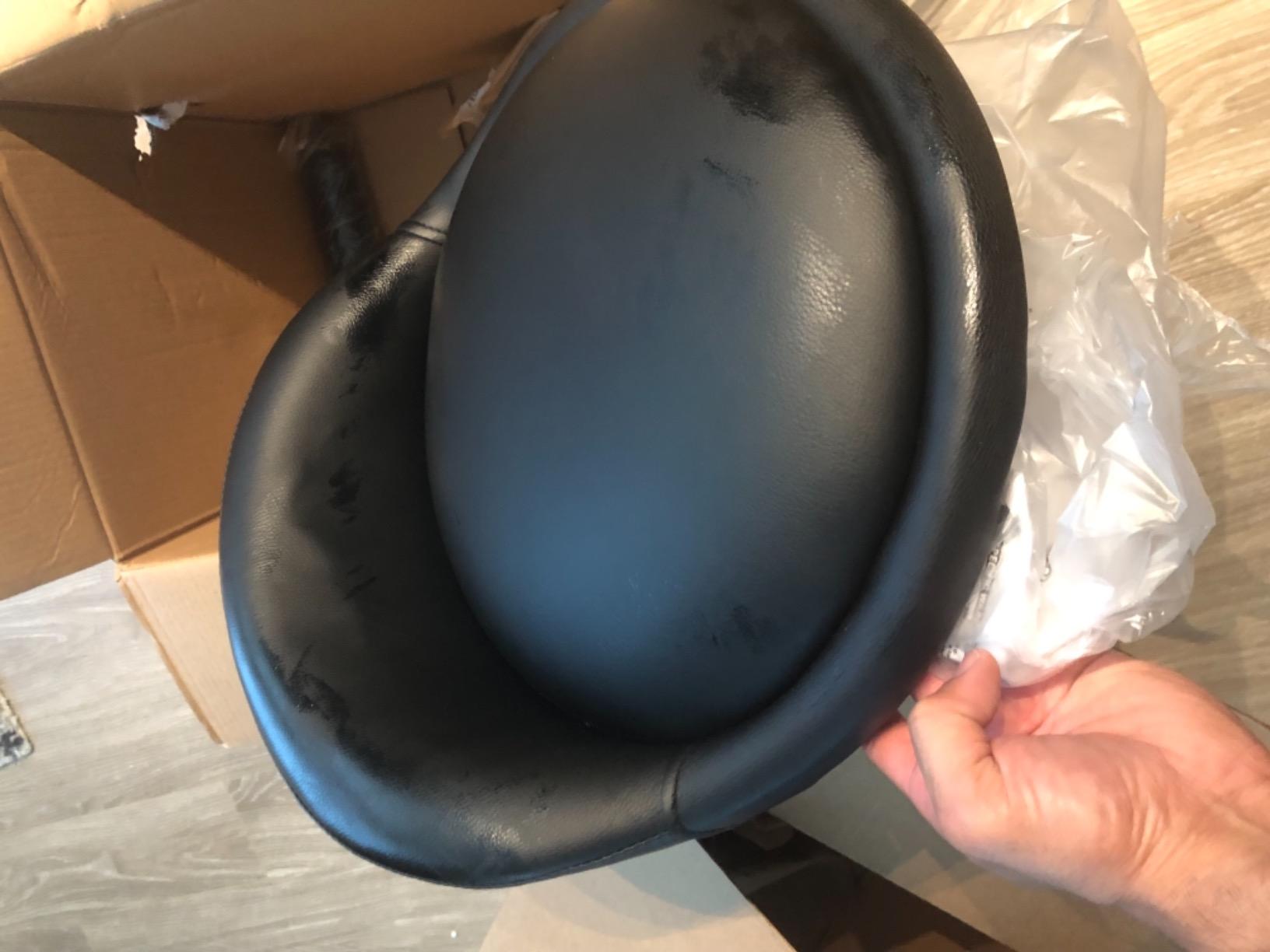
With 1642 ratings behind it, this is one of the most owner-tested stools in the category, and the feedback is consistent. People use it at workbenches, drafting tables and long seated jobs, and they like the matte black powder coat because there is no chrome to scratch.
The recurring complaint is the pneumatic cylinder. Some owners report it eventually stops holding height and drops to the bottom of its travel, which on a bench stool means you are suddenly too low to work. That is a wear item rather than a defect, but plan for it.
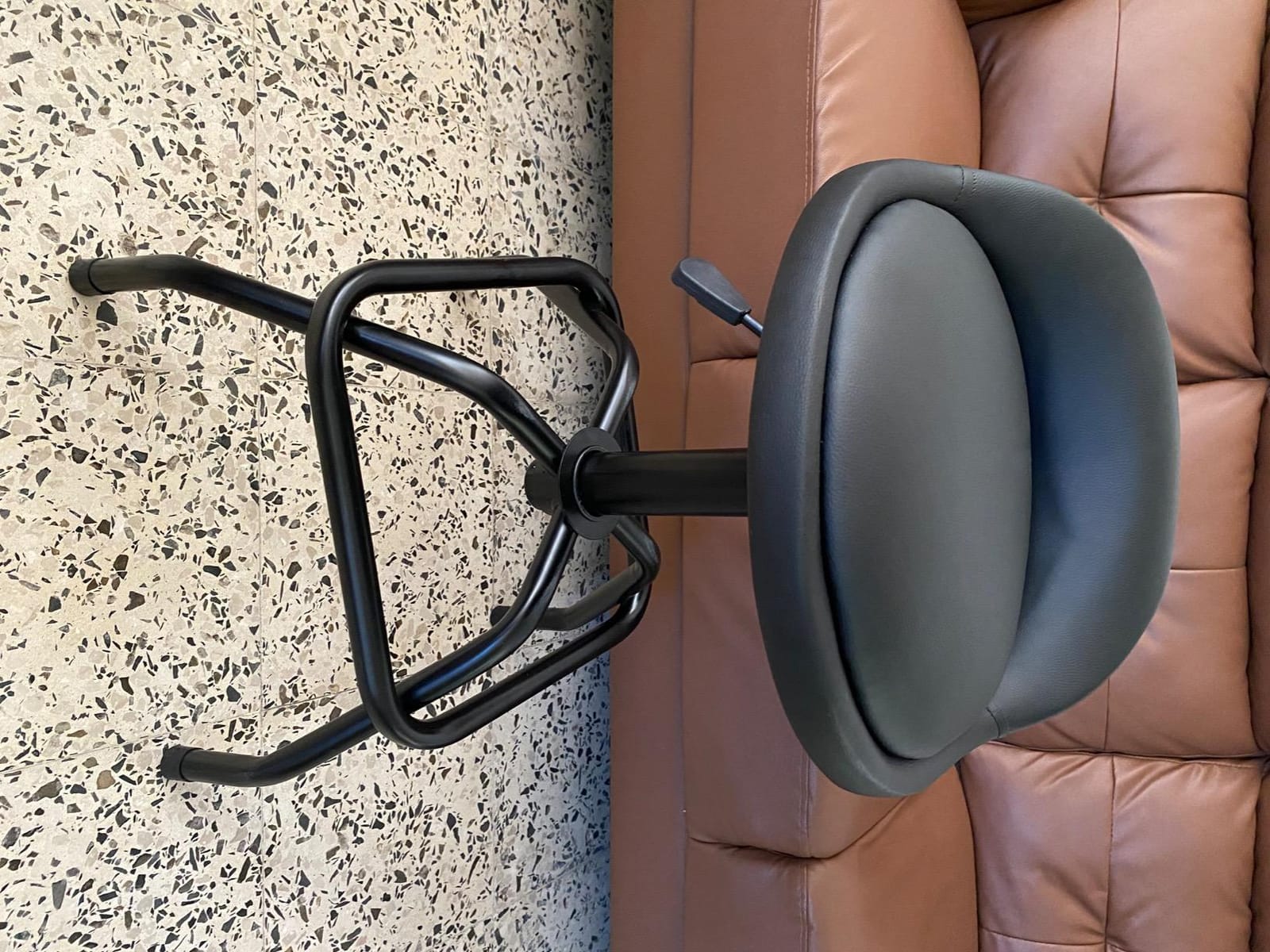
Where it earns its place
Choose this if assembly time matters, if more than one person uses the stool, or if you want a simple mechanism with few failure points. It is also a sensible pick for a mixed garage where the same seat handles welding bench height and a workbench.
The 330 lb rating gives a comfortable margin over a typical welder. The foot rail wraps all four legs, so you can find a position for your feet from any angle.
What to watch out for
The back is a low 4.5 inch rest. That gives you something to lean against when you scoot back, but it will not support your lumbar region over a long session. Anyone with back trouble should look at a taller back.
Shorter users may find even the lowest setting leaves their heels off the floor, so a fixed base or a taller-stool alternative can be a better fit. The square foot rail is also hard on bare feet when you are wearing welding boots all day.
3. Sunex 8516 Hydraulic Shop Stool with Vinyl Backrest
SUNEX TOOLS 8516 Hydraulic Shop Stool, High-Polished Chrome Finish, Hydraulic Seat Adjustment, Vinyl Padded Adjustable Seat and Backrest, Slip Resistant Feet, 250-Pound Capacity, Silver
29-34 inch hydraulic range
250 lbs capacity
Vinyl padded seat and backrest
Slip resistant sled feet
Pros
- 29-34 inch range is the tallest in this group
- Vinyl seat and backrest wipe clean after spatter
- Slip resistant feet stay level on uneven shop floors
- Chrome finish resists corrosion
Cons
- 250 lb capacity is the lowest rating here
- Fixed sled base with no casters so it must be lifted
- Hydraulic travel is narrower than pneumatic models
If your welding bench is genuinely tall, this is the one to look at. The hydraulic range runs from 29 to 34 inches of seat height, and nothing else in this group goes that high. At a 40 inch bench top, a stool that stops at 30 inches leaves you reaching, and a stool that stops at 23 inches leaves you folded in half.
The seat and backrest are vinyl padded, which is the right material family for a weld cell. Vinyl has no weave for a hot droplet to catch in, and it wipes down. The high-polished chrome finish also resists surface corrosion in a damp shop.
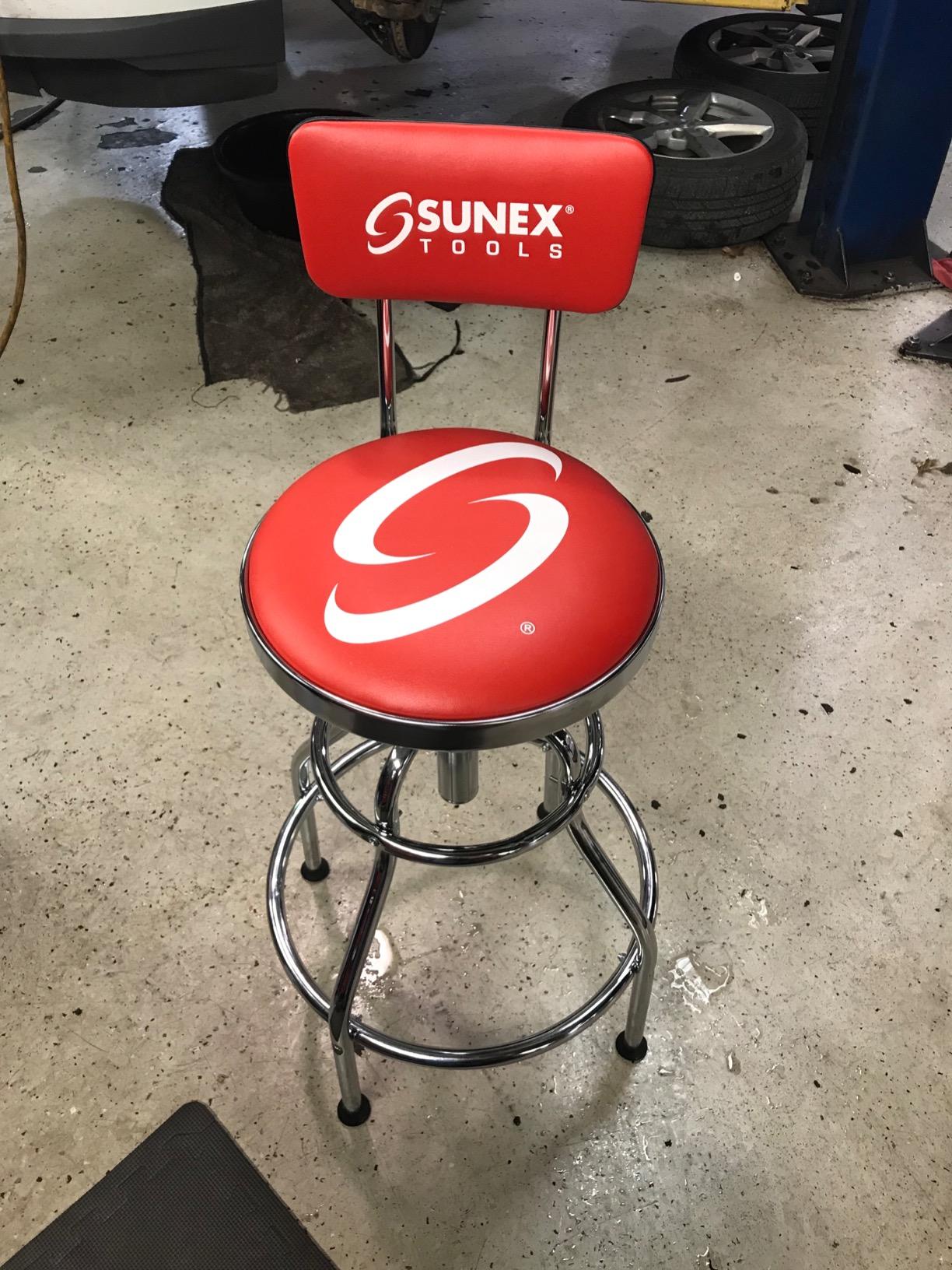
At 1661 ratings this stool has more owner history than anything else on the list, and the reviews read like a settled product. Buyers return to it because it is dependable, looks good and hits a height band that cheaper adjustable stools miss.
There is one design decision worth weighing before you buy. The sled base has no casters, which means the stool stays put on uneven floors thanks to slip resistant feet, but it also means you lift it to move it. Some welders see that as a feature in a cell full of spatter and slag.
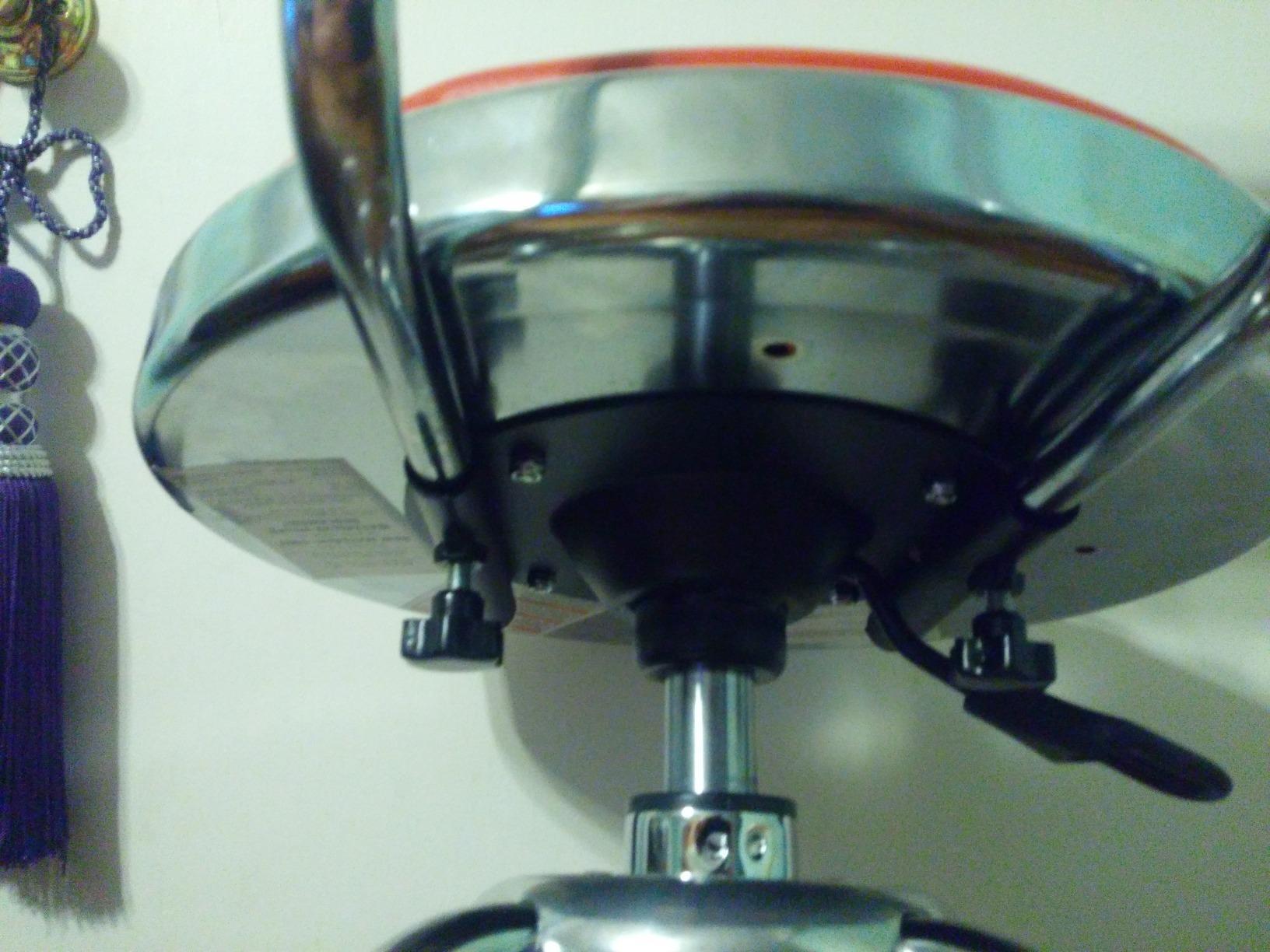
Why welders pick it
The 29 to 34 inch band is the reason. A shop that built a tall bench to work standing for part of the day needs a seat that can follow the welder up to that height, and this is the only pick here that fully does it.
It is also a fixed seat, so there is no caster to snag on ground slag or a floor seam, and no rolling to drag it toward a hot bench edge. For a dedicated cell that is a sensible trade.
Where it runs out
The 250 lb rating is the lowest in this group. That is fine for most welders but leaves little margin if you weigh much over 200 pounds, and none at all with a heavy jacket and tool belt.
Hydraulic adjustment also gives a narrower and slower travel than a pneumatic cylinder, and the fixed base means this is not a stool you will use under a car. If you need one seat for the whole garage, the rolling picks below suit that better.
4. FreekyFit Rolling Shop Stool with Tool Trays and Locking Brakes
FreekyFit Rolling Shop Stool with Wheels, Garage Work Mechanic Stool with Backrest, Roller Mechanic Chair, Adjustable Height, 360° Swivel, Tool Tray Storage, 330 LBS Capacity, Heavy Duty, Black
18.11-23.62 inch pneumatic range
330 lbs capacity
Two under-seat trays
4 casters with 2 lockable brakes
Pros
- Two under-seat trays plus a tool rack keep parts within reach
- Locking brakes hold a fixed working position
- Textured memory foam seat resists sliding
- Quick assembly on a mostly pre-assembled frame
Cons
- Height range stops at 23.6 inches which is low for a standing bench
- Caster quality is the most common complaint
- Brake levers are hard under bare feet
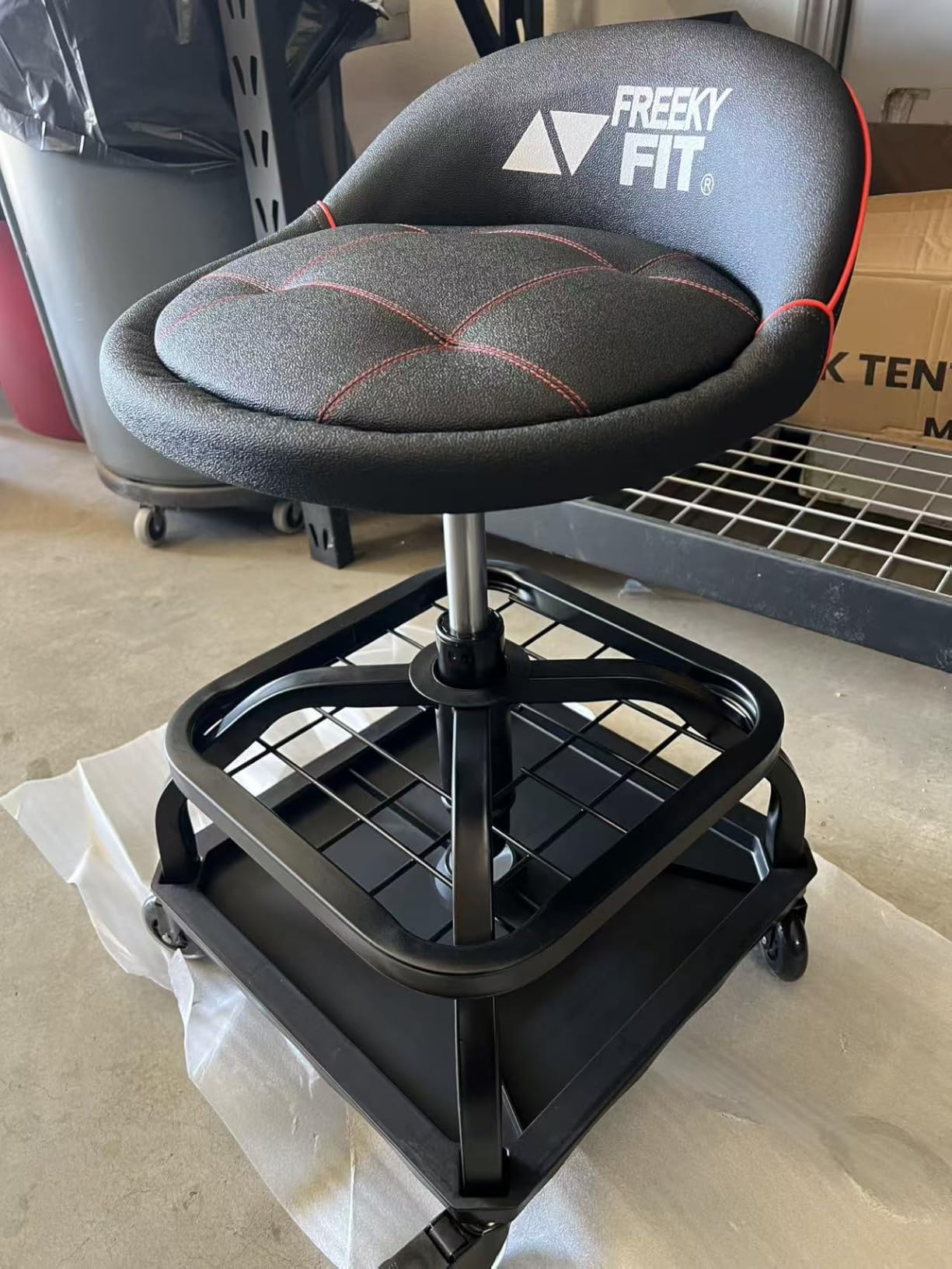
Storage is what separates this one. Under the seat sit two trays, a metal mesh tray and a solid plastic tray, plus a utility tool rack. For a welder running a bead on a bracket that needs two hands free, having the wire brush, pliers and hardware within reach without standing up is worth more than a slightly larger seat.
The locking brakes are the second detail that matters at a bench. Two of the four casters lock, so you can set a position, lean in over the work and stay there instead of drifting every time you move your weight. Reviewers like how the casters glide over concrete and rubber mats.
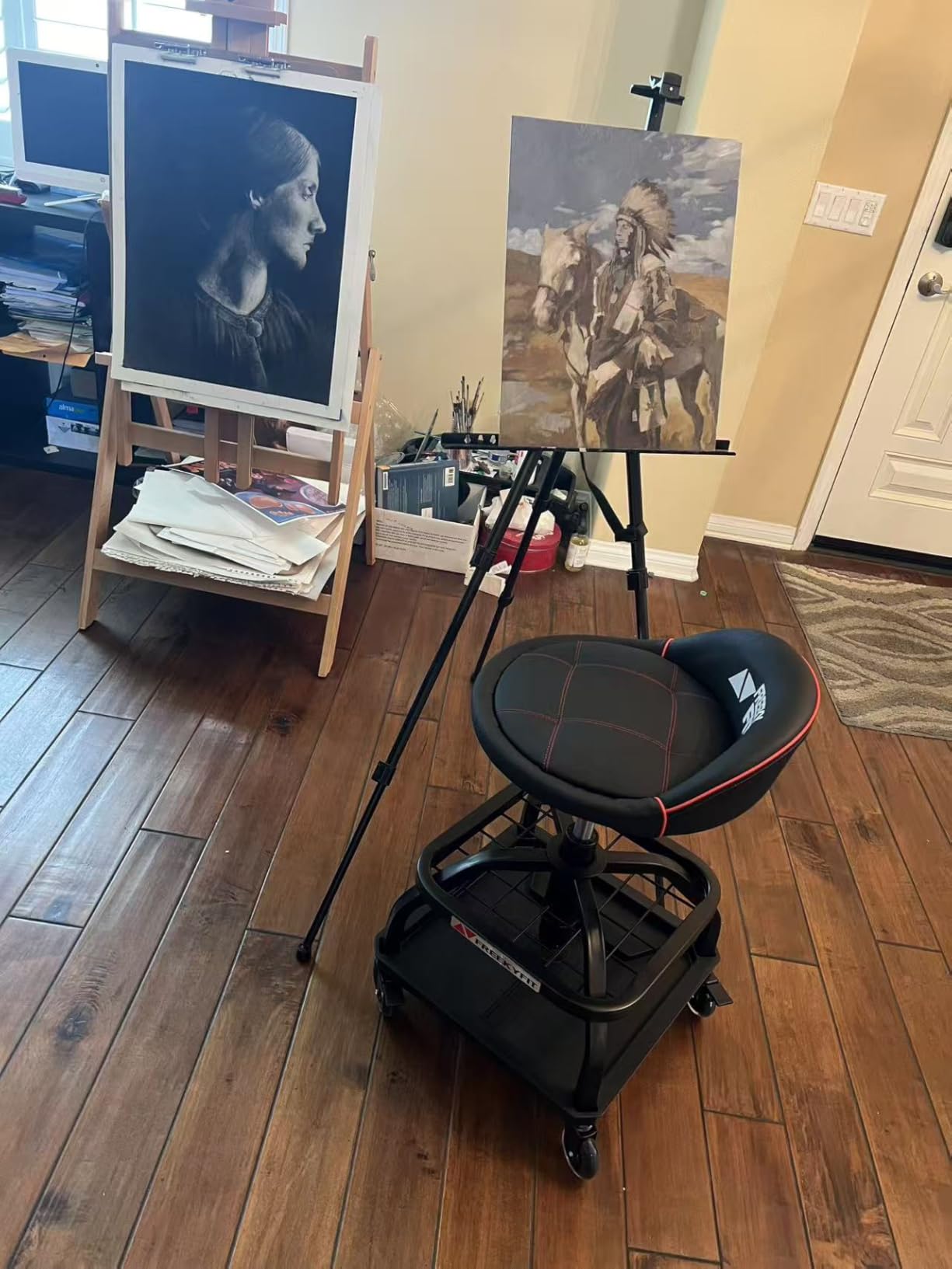
The seat is memory foam with a textured leather-like grip surface, and that texture does something useful: it stops you sliding sideways when you lean toward the bench with a torch in your hand. The lumbar backrest takes the load off during long projects.
Caster quality is the honest weakness. A number of owners report wheels that will not spin or bearings that fall out, and some have swapped in office-chair casters to solve it. Inspect the wheels as soon as it arrives rather than discovering it mid-project.
Best fit for a seated welder
This suits anyone doing fine bench work where a small part goes missing mid-tick and rolling under a low bench is impossible. The two trays and side rack cover that better than a plain seat.
Assembly is quick because most of the frame arrives together, and the 330 lb rating sits comfortably above a typical welder’s weight.
Why it will not fit a tall welding bench
The range tops out at 23.62 inches. That is a comfortable fit for a standard 34 inch workbench and completely wrong for a bench in the high 30s. Buying this for a tall bench is the most common sizing mistake we see.
It is also a lighter-duty build for commercial daily use, with a stated manufacturer warranty of three months. For a dedicated production cell, a heavier frame from the list below is the safer bet.
5. FREEKYROCK D17 Stool with 22.4 Inch Star Base and Trays
Rolling Shop Stool with Wheels, Garage Mechanic Stool Chair with Backrest, Height Adjustable Heavy Duty Swivel Task Chair, Adjustable Footrest with Storage Tray for Garage Kitchen Salon Tattoo (Black)
18.7-25.59 inch pneumatic range
330 lbs capacity
22.4 inch star base
Height-adjustable footring
Pros
- 22.4 inch star base is wider than typical five-leg shop stools
- Height-adjustable footring gives real leg support
- Three removable trays including a magnetic liner
- Five quiet casters with two brakes
Cons
- Leg tubing is thin walled and some owners added their own bracing
- Small casters catch in tile grout
- Chrome foot ring is decorative and too high to use as a footrest
Base width is the story here. At 22.4 inches across, the star base is noticeably wider than the standard five-leg shop stool base, and that geometry is what stops a stool tipping when you lean out over a bench with a torch in hand. If your concern is stability rather than cushion comfort, this is the pick.
The height-adjustable footring deserves credit as well. It moves through a 0 to 5.5 inch range, so you can set it for your frame rather than stretching to a fixed ring. The magnetic liner on one of the three removable trays is a nice touch for holding small steel parts.
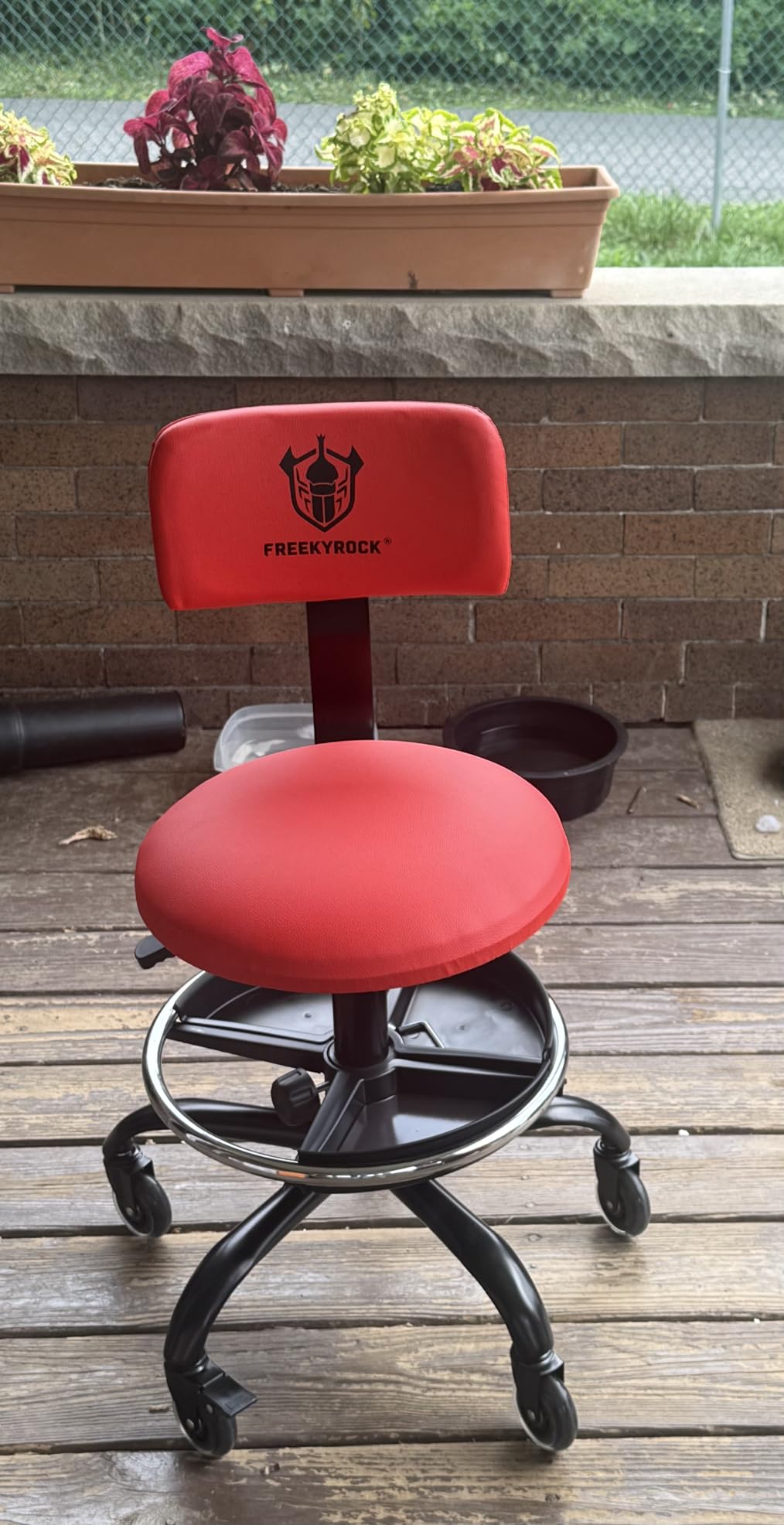
Casters roll quietly and two of the five lock for precise positioning. Several owners use this stool at welding table height and for detailing work, which tells you the range of 18.7 to 25.59 inches is flexible, though it still stops short of a true standing bench.
Build quality is the mixed part. Reviewers point to thin-walled leg tubing, and some added their own cross bracing. Others report a backrest that feels flimsy and a seat diameter that runs small for a larger frame.
Where the wide base pays off
Any time you work with a helmet on and reach out over a work surface, a wider base means you can lean without the stool walking. On uneven concrete or a floor with a drain channel running through the cell, that geometry is worth more than extra cushion thickness.
The removable tray system also suits anyone who does layout and prep at the same station as the welding.
Where you should look elsewhere
Thin-walled tubing is a fair criticism for a bench that sees daily commercial use. If your shop is shared and rough, spend up on a heavier frame.
The decorative chrome foot ring flops and sits too high to serve as an actual footrest, so do not count it twice. And the 25.59 inch ceiling means this is a workbench stool, not a standing-height welding bench stool.
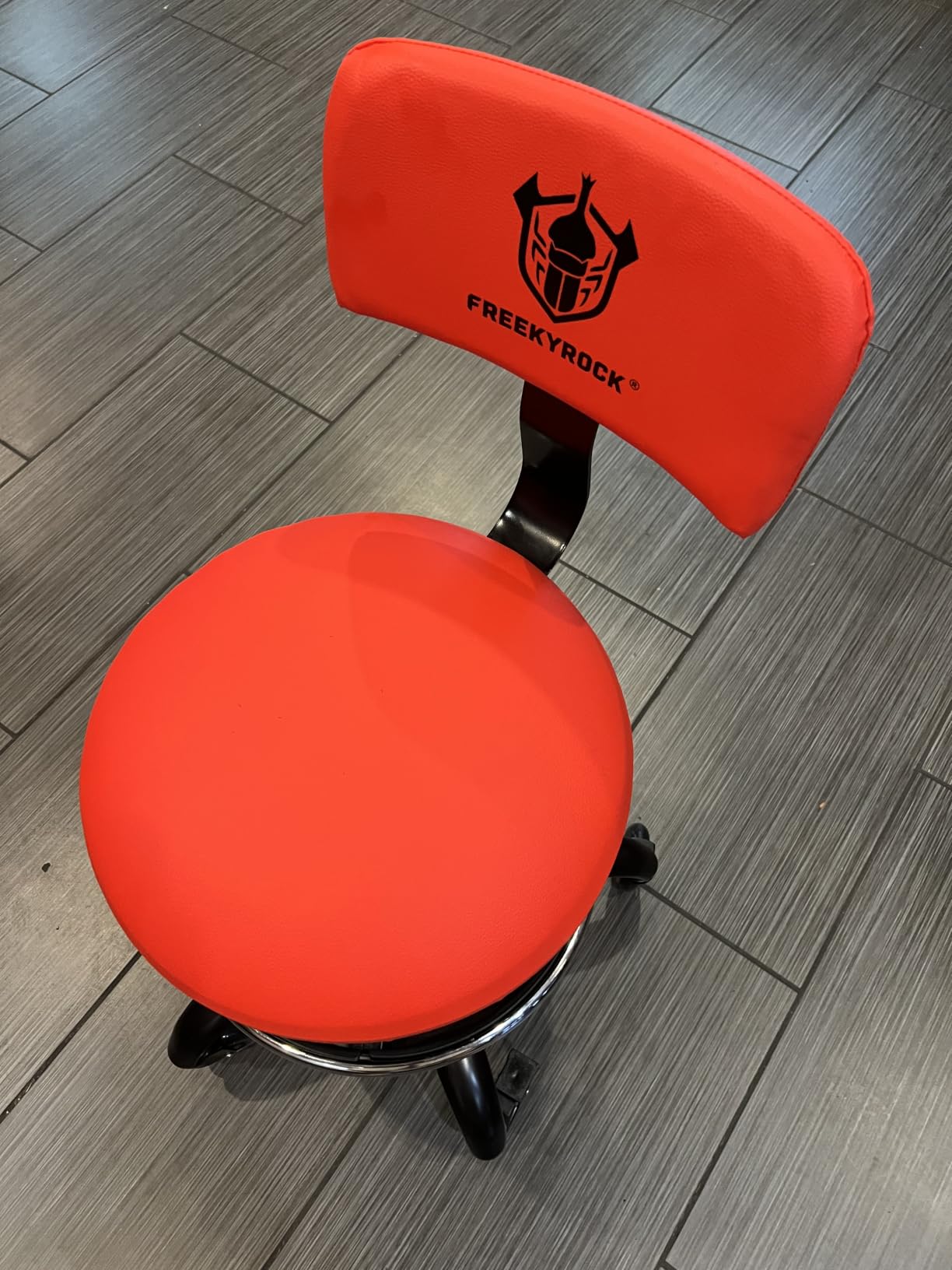
6. FREEKYROCK D15-B Shop Stool with 400 lb Frame and Low Reach
FREEKYROCK Rolling Stool with Wheels, Adjustable Height Pneumatic Garage Work Mechanic Stool Seat with Backrest, 400 LBS Capacity 360° Swivel Mechanic Crepper Chair with Tool Tray Storage, Red
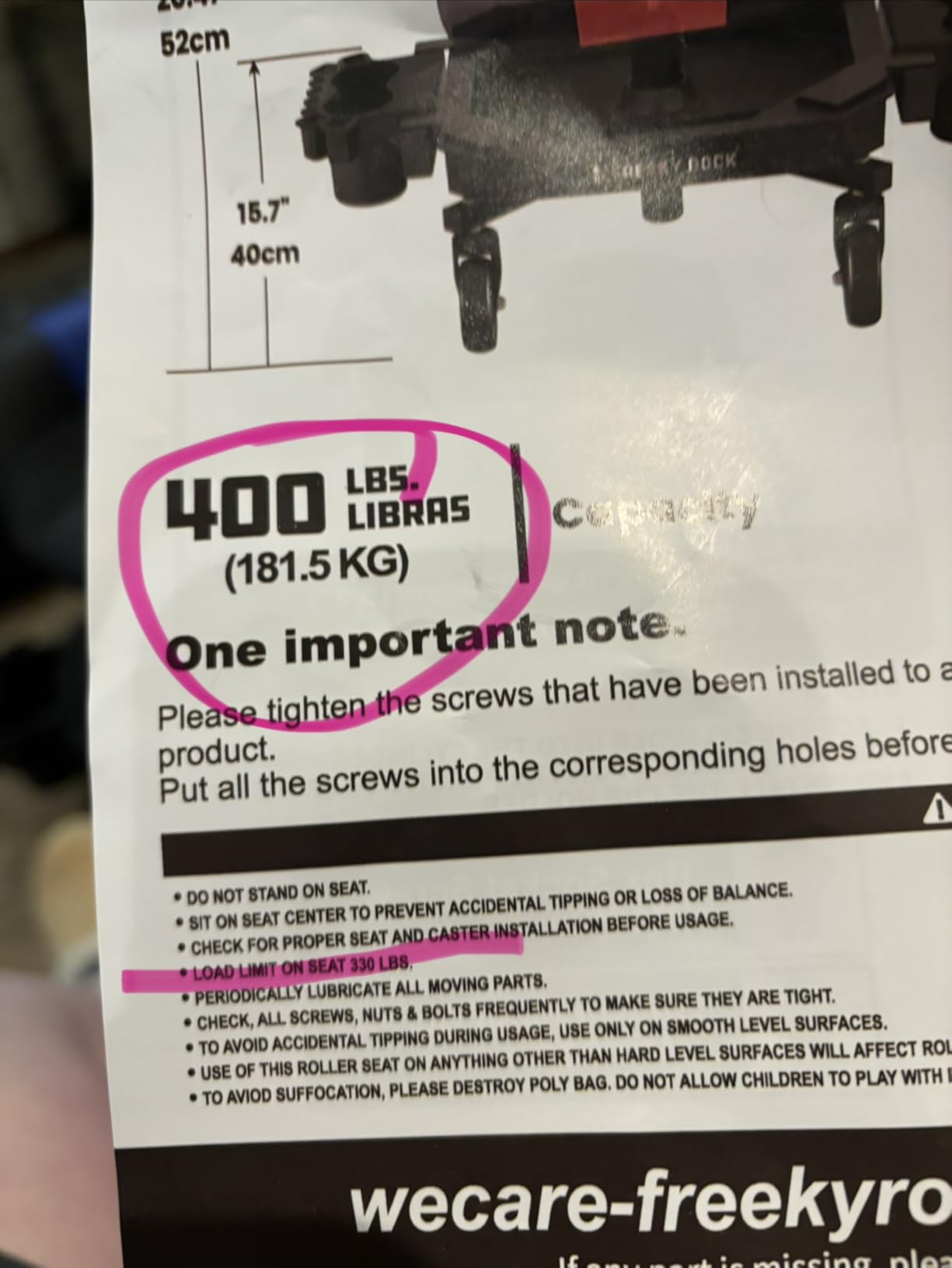
15.7-20.47 inch pneumatic range
400 lbs capacity
Under-seat tray and cup holders
4 swivel casters
Pros
- Very low 15.7 inch minimum for tires and undercarriage work
- Rolls quietly with no squeaking
- 400 lb rating on a stout angle steel frame
- Side cup and tool holders keep supplies on the stool
Cons
- Under-seat tray is awkward to reach while seated
- Low back offers limited lumbar support
- One owner received a mismatched hydraulic cylinder
This is a low stool, and we want to be clear about that rather than pretend otherwise. The range runs from 15.7 to 20.47 inches, which puts it at the bottom of this group. It is not a welding bench stool for a raised bench. It is the seat you want when you are rolling under a chassis, working on brakes or reaching into a wheel well.
That said, it is one of the best-built rolling frames here. The 400 lb rating on stout angle steel is a genuine margin, and owners describe the rolling as exceptionally smooth and quiet with no squeaking, which matters when you are manoeuvring on a coated shop floor.
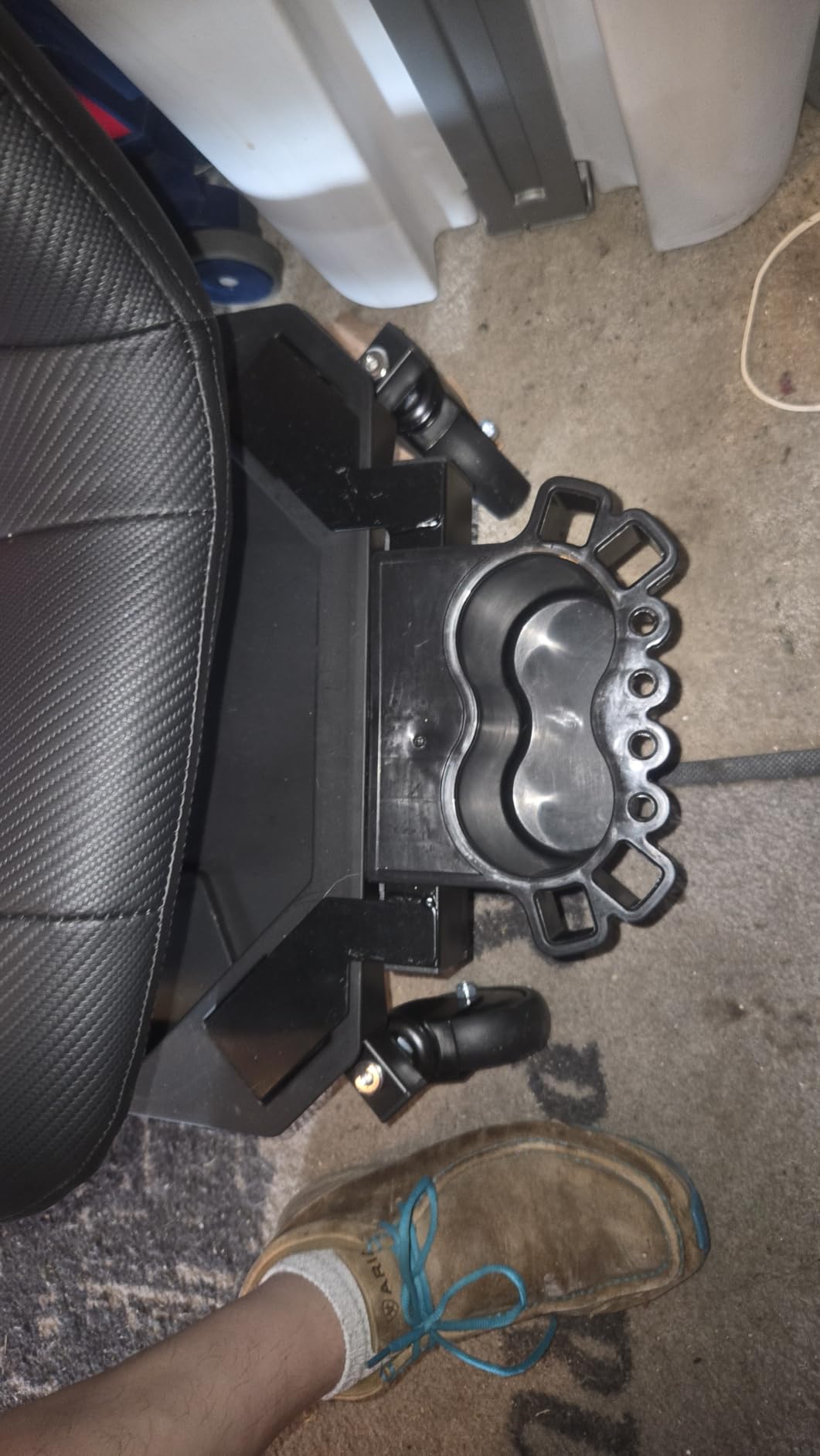
The storage layout is generous for its size: one under-seat tray plus two cup and tool side holders with small-part placement areas. The carbon fibre patterned faux leather upholstery is soft and durable, and the wraparound back is enough to rest against briefly.
The design complaint owners raise most is reach. The under-seat tray is hard to access from a seated position, so you bend forward to grab tools rather than swinging round. A few buyers also reported arrival damage or a mismatched cylinder, so check the unit before you rely on it.
Who this is actually for
A mechanic or fabricator who works at both ends of the height scale and wants one stool that can drop to 15.7 inches for low work and carry 400 lbs. In that context the low reach is the whole point.
The padded seat and low back stay comfortable over long sessions, and the 400 lb frame is the second-heaviest rating in this roundup.
Why it is not a welding bench pick
At a 20 inch maximum you would be welding hunched over a 36 inch bench, which is the exact posture problem that makes a welding stool different from a garage stool. Choose one of the taller picks instead.
The back is also low, so it does little for lumbar support on long seated work, and the tray reach issue comes up every time you need a part mid-job.
7. CoVibrant Counter-Height Shop Stool with Locking Rubber Casters
CoVibrant Heavy Duty Shop Stool with Ergonomic Backrest – Lockable Rubber Wheels & Adjustable Height, 360° Swivel, High Footrest for Garage Workshop Workbench, 350lbs Capacity (Black, 26″-31″‘)
26-31.5 inch height adjustment
350 lbs capacity
Dual locking rubber casters
8.3 inch elevated footrest
Pros
- 26-31.5 inch counter-height range suits 31-41 inch work surfaces
- Locking rubber casters do not mark the floor
- Assembles in under 10 minutes with the included hex key
- Thick 3.75 inch cushion holds its shape
Cons
- Caster bearings can stop swivelling under load
- Small wheel diameter struggles on coated garage floors
- Seat is narrow and some owners removed the backrest
This is the budget route into a tall welding bench stool, and the numbers back that up. Height adjustment runs from 26 to 31.5 inches, which pairs with work surfaces between 31 and 41 inches, and the 350 lb rating gives more margin than most of the entry-level options.
The footrest is genuinely elevated at 8.3 inches rather than sitting low near the base. On a tall stool that is the difference between pushing against something and dangling your legs, and owners single it out as a real foot support.
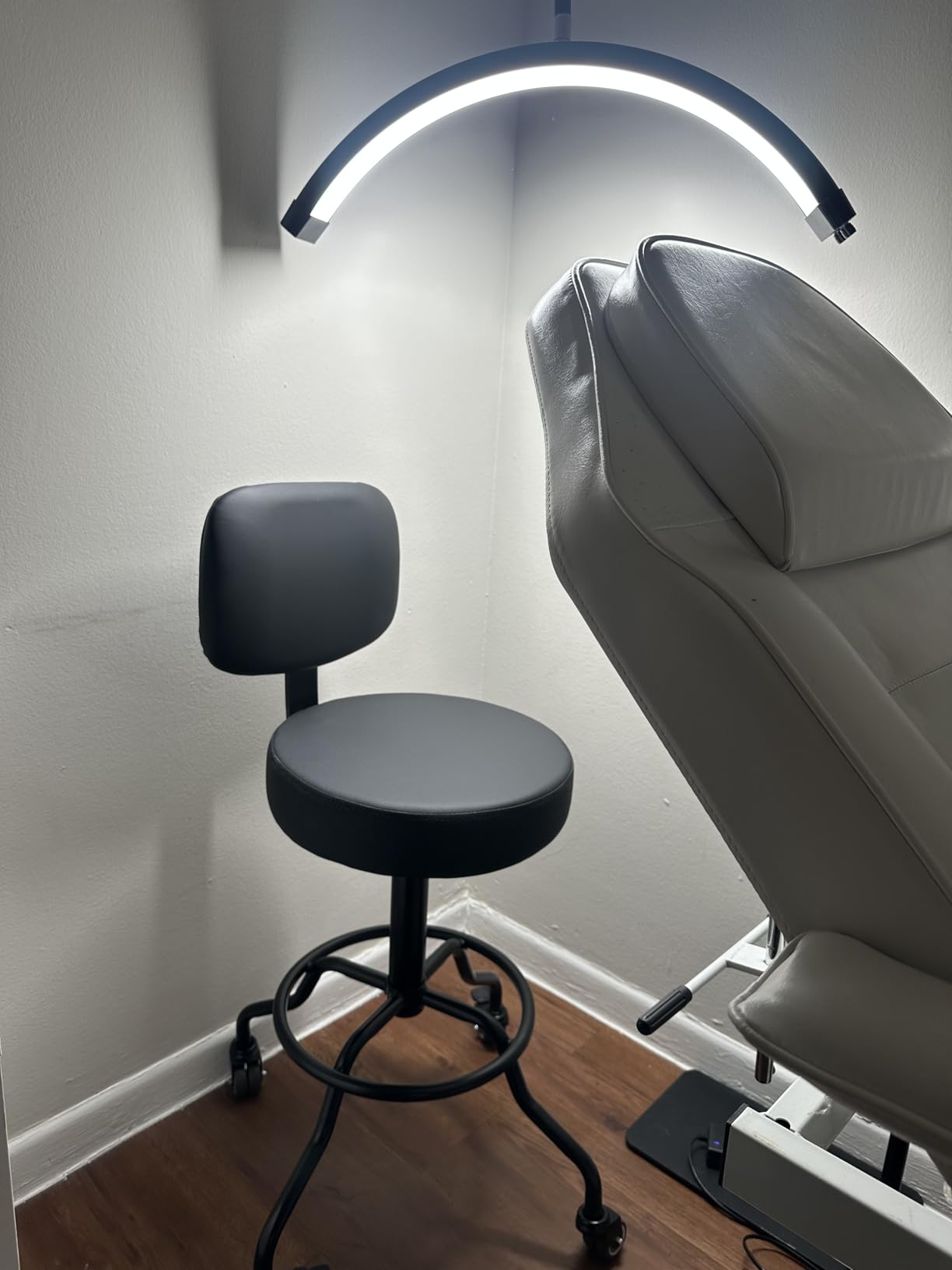
Locking rubber casters are a good call in a welding shop. Rubber does not mark a sealed concrete floor the way hard plastic wheels can, and the brake pedal switches between rolling and stationary without tools. The 3.75 inch thick cushion resists deformation over long shifts and wipes clean.
Reviewers report mixed results on the casters despite that. Bearings can stop swivelling under load so the stool only rolls in one direction, and the small wheel diameter performs poorly on polyaspartic or epoxy-coated floors, which most garages have.
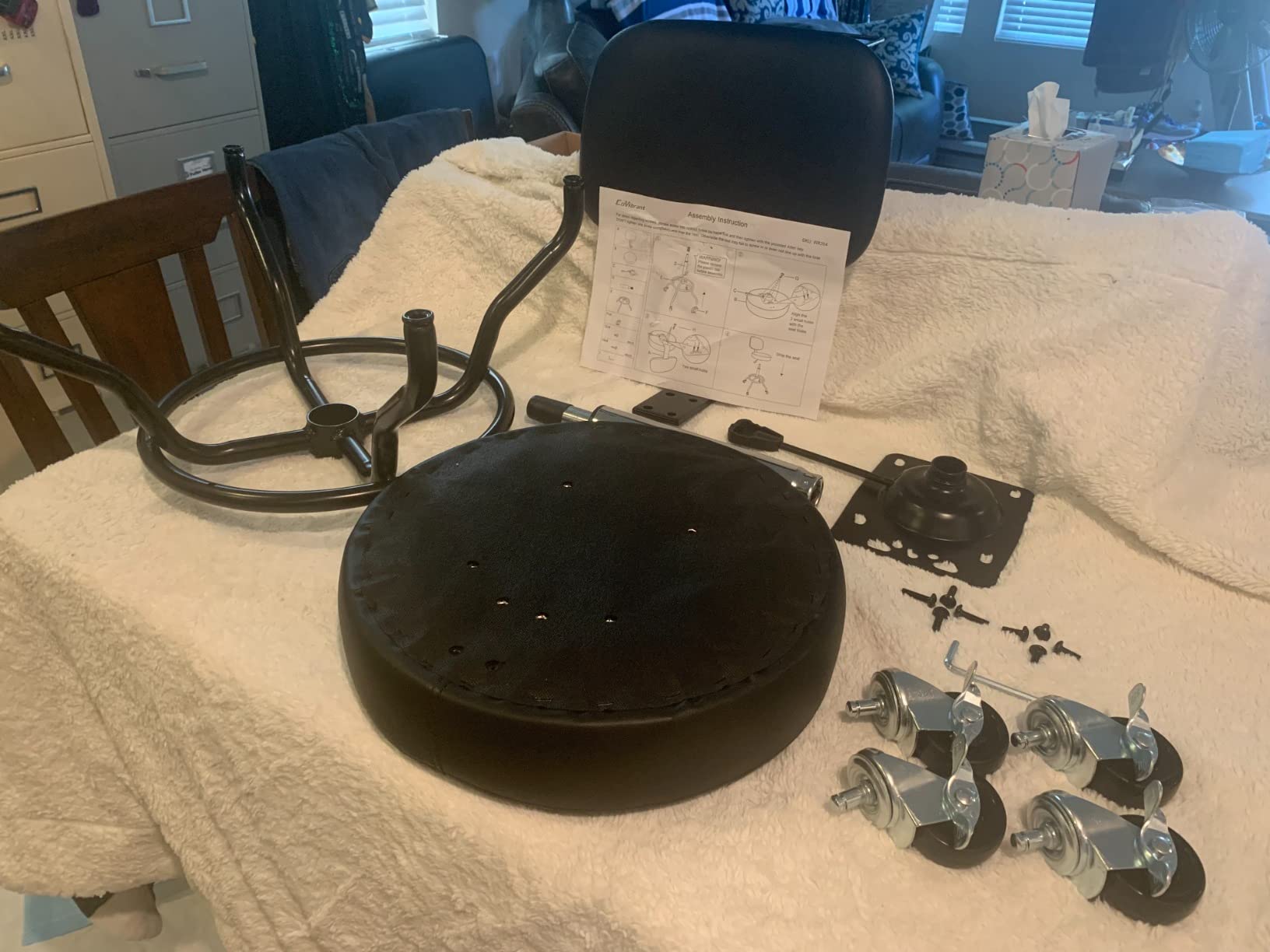
Where it makes sense
A home shop or apprentice welding setup with a tall bench and a moderate budget. One owner at 250 lbs reports full stability, and the counter-height range covers a lot of home bench builds.
Assembly takes under ten minutes with the included hex key, which is more than several stools in this group can claim.
Where it frustrates people
The seat is narrow and the distance from seat to back is short, so some owners removed the backrest entirely. If you already have lower back sensitivity, read our back support guide for what real lumbar support looks like.
Several units also failed after a couple of months of daily commercial use, and the 4.1 rating is the lowest in this roundup. For a home shop it is a reasonable trade; for a production cell, look at a heavier frame.
8. Powerbuilt 240299 Detailers Roller Seat with Storage Drawers
Powerbuilt Professional Car Detailers Mechanics Roller Seat, Heavy Duty Garage Stool with Thick Padded Seat and Backrest, 2 Sliding Storage Drawers, Tool Tray, Can Holders, 3in. Swivel Casters–240299
500 lbs capacity
1-inch steel frame members
16 inch foam-filled vinyl seat
Two sliding steel drawers
Pros
- 500 lb capacity on 1-inch steel frame is the heaviest duty here
- Two sliding steel drawers plus a front tray and can caddy
- Hardware is bagged and labelled and screw holes align
- 3-inch ball-bearing casters with two locking casters
Cons
- Weighs 37.4 pounds so it is awkward to move once loaded
- Drawers are shallow and close with some noise
- Stock casters drag for very heavy users
The frame is the reason to buy this one. It uses 1-inch steel frame members rated to 500 lbs, and that is a different class of construction from the tube and angle steel on most shop stools. If you are heavier, or if the stool takes abuse, this is the one that will not be the weak link.
Storage is unusually serious. Two sliding steel drawers for rags, wax, tools and cords, plus a front tool tray and a 2-can can caddy, all carried on the stool as it rolls. Owners who work on vehicles love having consumables move with them.
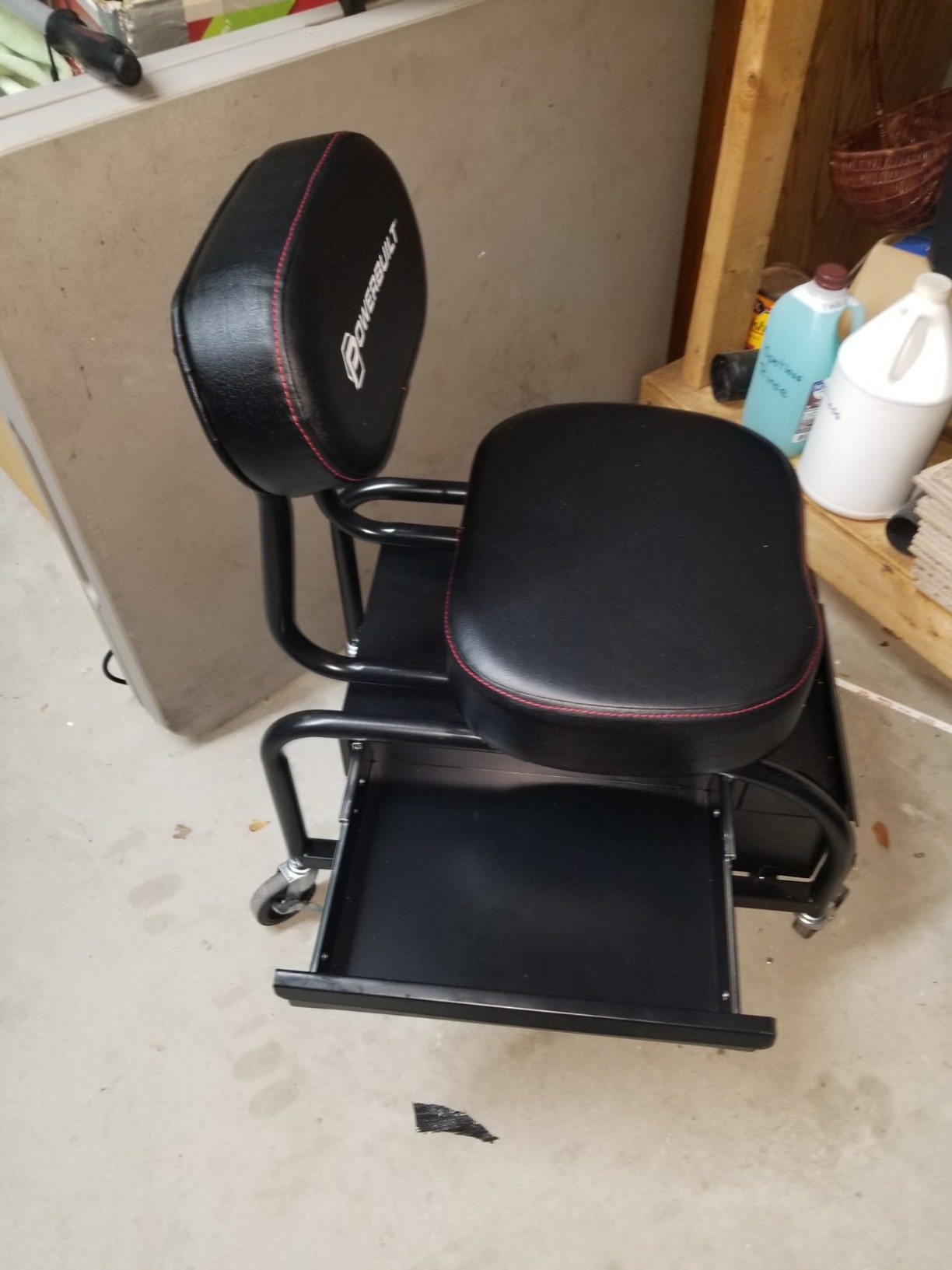
Build quality shows in the details. Hardware arrives individually bagged and labelled, screw holes align, and the welds are smooth. The 3-inch ball-bearing swivel casters roll properly over a shop floor, and two of them lock for stability on a sloped surface.
The seat is a 16 inch wide foam-filled vinyl pad with a solid back, and this is the most comfortable seat in the group by owner account. Vinyl is also the right upholstery family next to a live arc.
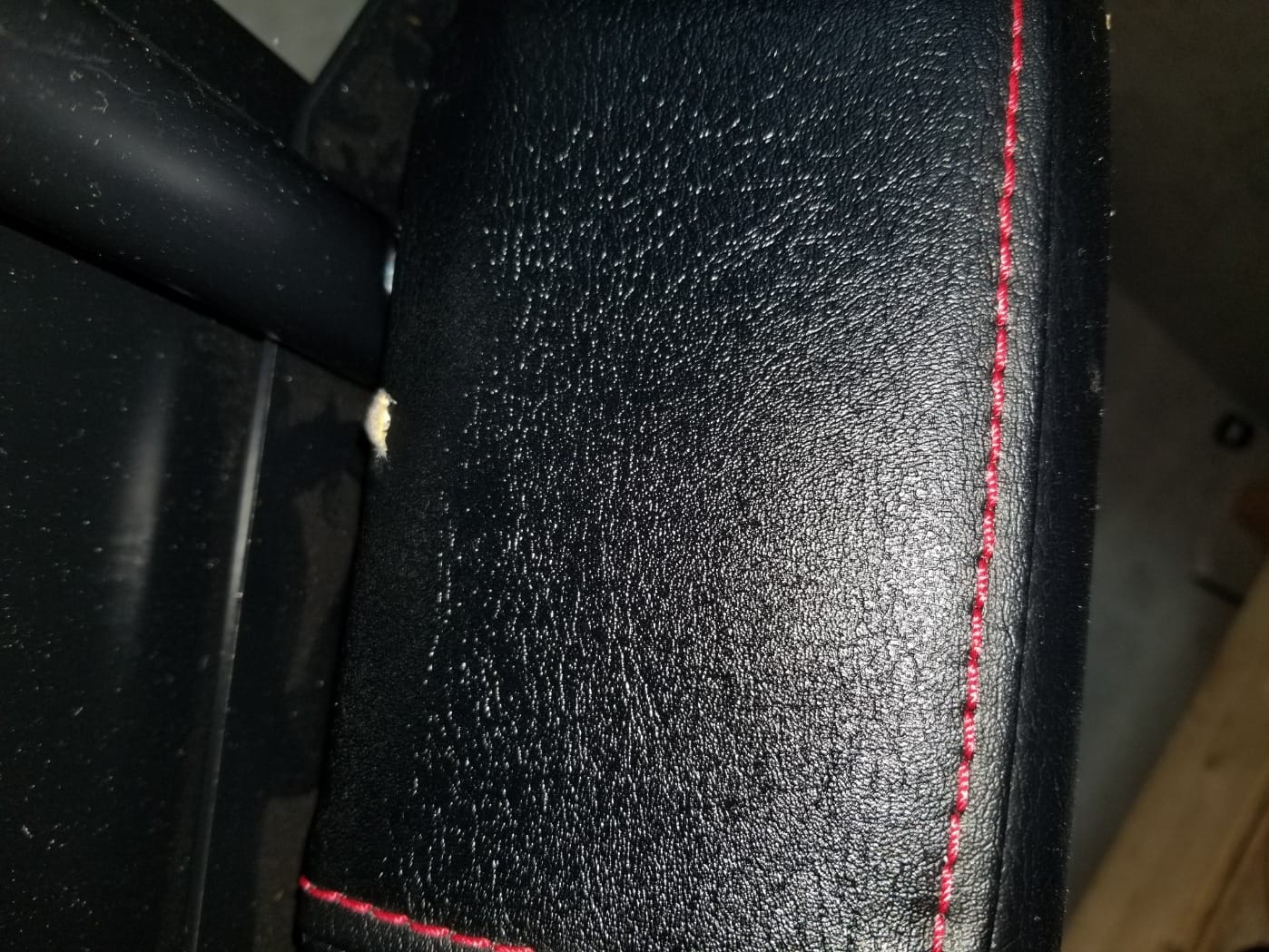
Best for a heavy or shared shop
Anyone over 250 lbs gets real margin here rather than an optimistic rating, and the solid back lets you lean back without worrying about the frame. The one-year factory warranty is short compared with some picks, but the steel is what matters.
Those who detail vehicles will get more out of the can caddy and drawers than welders will, so consider whether the storage matters more to your workflow.
Where it works against you
At 37.4 pounds it is the heaviest stool here, and moving it between stations once it is loaded with tools is awkward. Plan a permanent position rather than a mobile one.
The seat height listed is around 18 inches with no stated pneumatic travel in the specifications, so this is not a tall-bench welding stool. The drawers are also shallow and close with a bit of noise, and very heavy users report the stock casters dragging.
9. FreekyFit D03-B Lightweight Stool with Handle Backrest
FreekyFit Garage Stool, Adjustable Height Swivel Work Mechanic Shop Stool with Backrest, Pneumatic Shop Chair for Home, Workshop, 300 LBS Capacity, 360° Rotation, Heavy Duty, Black
24.49-30 inch pneumatic range
300 lbs capacity
12.9 pounds total
Handle doubles as backrest
Pros
- 24.49-30 inch range suits standing-height benches
- Only 12.9 pounds so it is easy to move around the shop
- Sits solidly on an unlevel floor without rocking
- Thick 14.96 inch memory foam PVC seat
Cons
- Included tools are nearly useless so bring your own
- Some screw holes do not align and the supplied backrest screws are too short
- Pneumatic lift can let the seat detach from the post
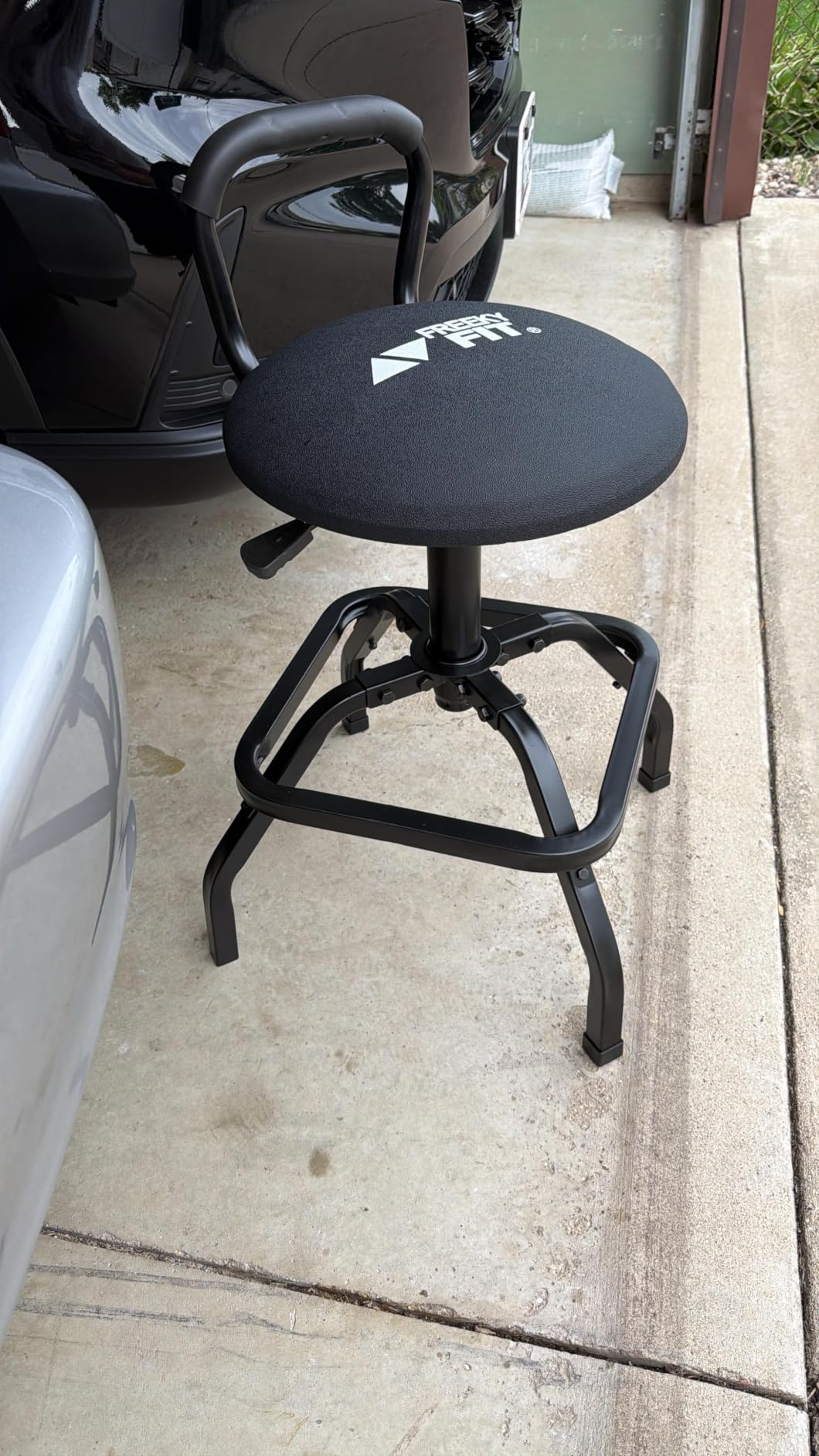
At 12.9 pounds this is the lightest stool in the group, and that turns out to matter more than expected in a welding shop. When your work position changes every few minutes, being able to lift a stool one-handed beats a heavier frame you never move.
Height is right for the job. The pneumatic range of 24.49 to 30 inches matches our top pick, so this works at a raised bench, and owners confirm it sits solidly on an unlevel shop floor without rocking.
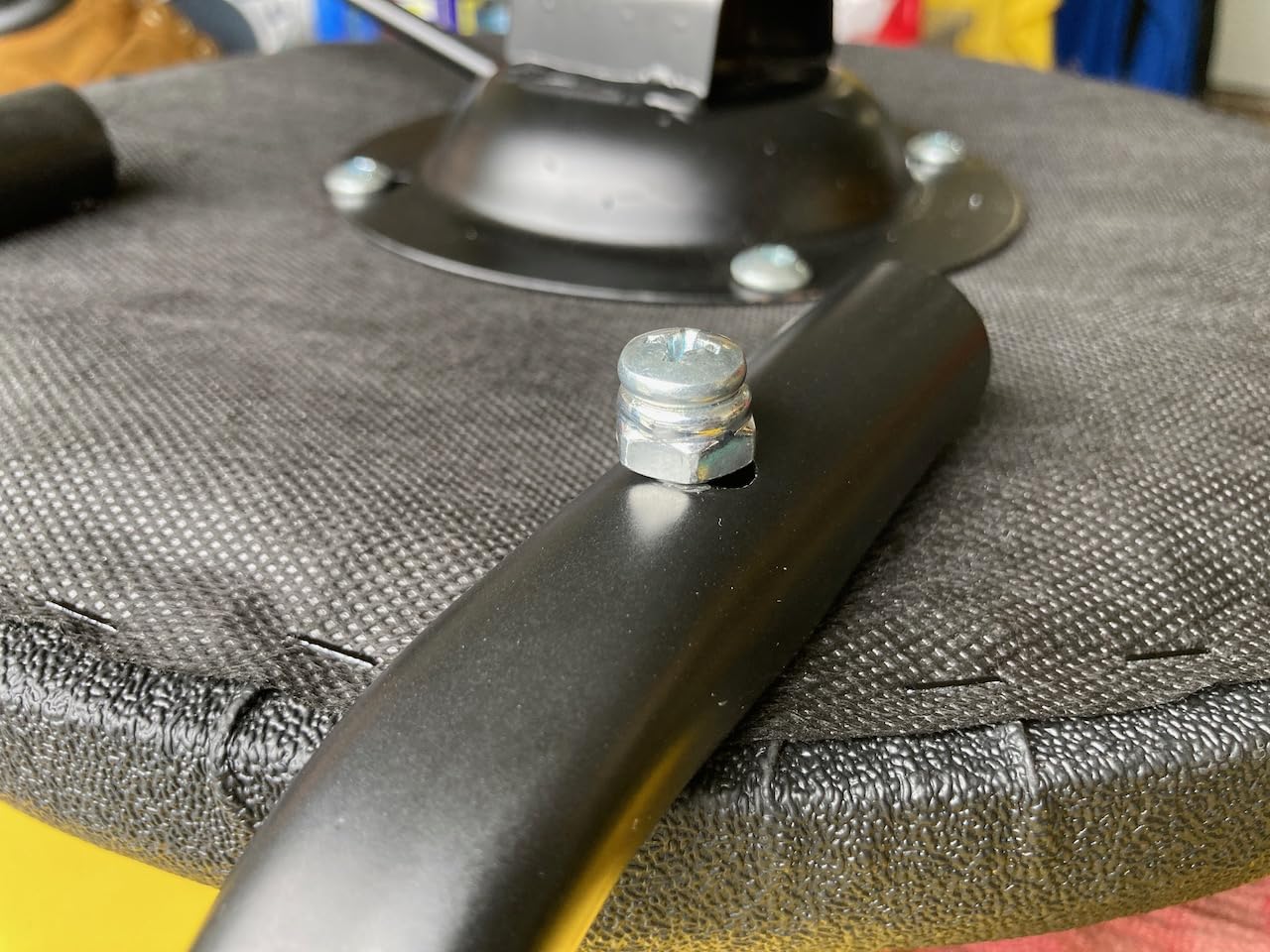
The backrest is an NBR-coated handle that doubles as a lumbar support. It is not a tall back, but it gives you something to push against and it is the design that keeps the whole frame light. The seat is the same generous 14.96 inch memory foam PVC cushion as the larger model.
Assembly is the problem here. Reviewers report that the included tools are nearly useless, that some screw holes do not line up, and that the supplied backrest screws are too short to hold. Budget ten extra minutes and a proper hex key.
Who should buy it
A welder who moves between positions, works in a small shop, or wants one stool that is easy to relocate. The 24.5 to 30 inch range and stable stance on uneven floors are genuine advantages at a bench.
The 360 degree rotating seat and quick assembly round out a package that suits an apprentice or hobbyist building out a first shop.
Where to be careful
One quality control report described the seat detaching from the pneumatic lift post, which is a safety issue on a stool this light. If you buy it, check the seat-to-post connection before you sit down the first time and re-check it periodically.
The backrest is minimal, so this is not the stool for anyone with lower back problems doing long seated work. And the 300 lb rating is modest for a large welder.
10. BestGlory Shop Stool TC001 with Adjustable Footrest
BestGlory Shop Stool with Wheels for Garage, Mechanics Rolling Chair with Backrest, Adjustable Height Heavy Duty Garage Stool with Footrest and Storage Tray, Swivel Task Chair for Workshop Salon
17.32-23.5 inch pneumatic range
340 lbs capacity
Adjustable-height footrest
5 year manufacturer warranty
Pros
- Backrest makes a noticeable comfort difference versus a backless stool
- Very quick assembly with no complicated steps
- Sturdy wide base that feels stable when leaning
- 5 year manufacturer warranty is the longest here
Cons
- Wheels do not roll especially well
- Seat height tops out at 23.5 inches which is low for a standing bench
- Faux leather may not wipe as cleanly as vinyl or PVC
Owners describe the backrest as the reason this stool feels different from a backless perch, and several say it removes the fear of tipping backwards when you scoot or stretch for a part. The seat is plush high-density foam over a contoured back, and the 4.6 rating reflects genuinely enthusiastic feedback.
Two adjustable features make it flexible. The footrest moves in height rather than being fixed near the base, and one of the three storage trays adjusts from 0 to 4.75 inches, so you can set tray height to match your reach.
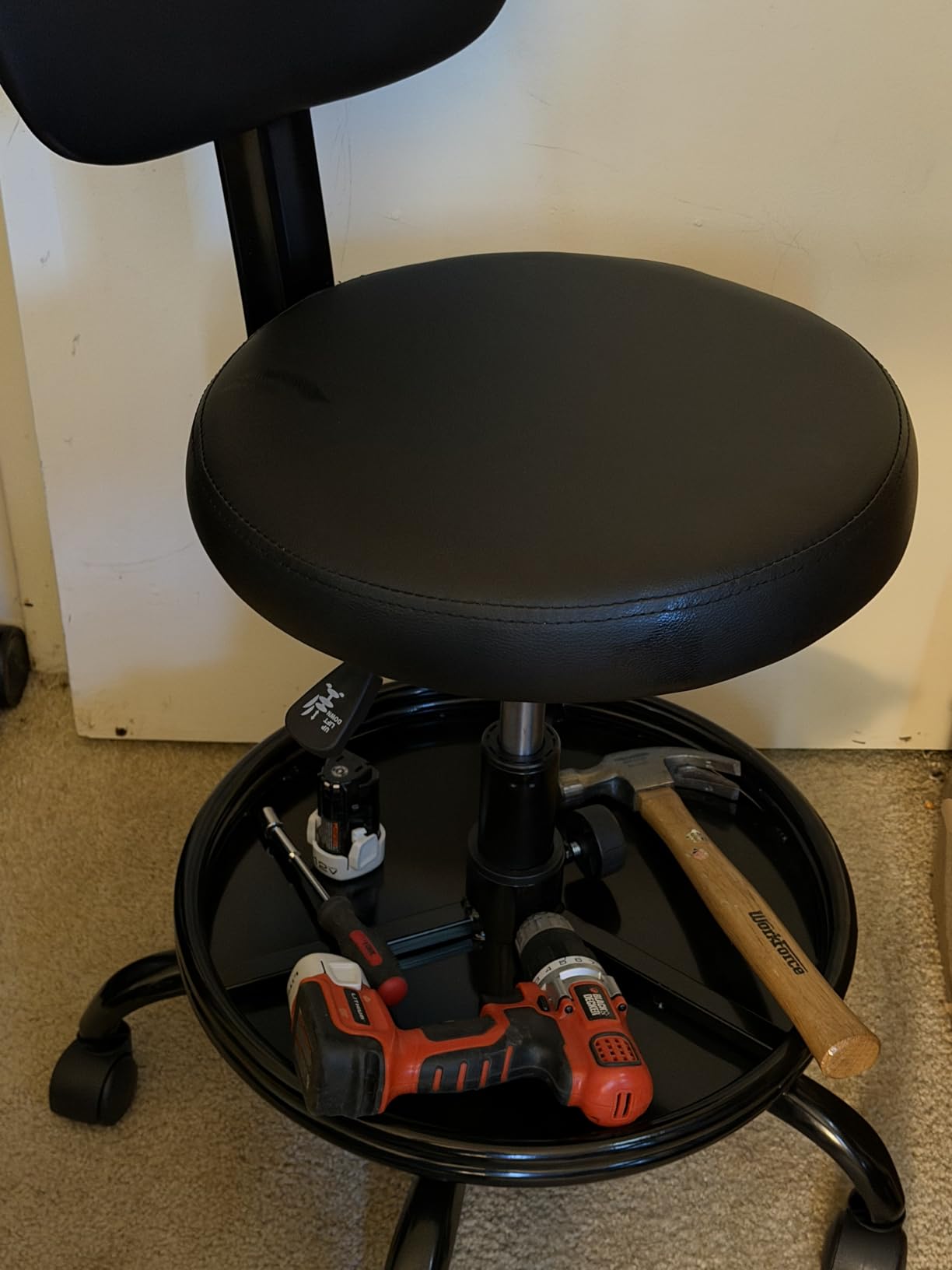
The warranty is worth noting on its own. A 5 year manufacturer warranty is longer than anything else in this roundup, which is meaningful if you are buying for a shop that will keep it for years. The 340 lb rating sits comfortably above most welders.
Rolling quality is the standout weakness. Mediocre wheel performance is the single most common complaint in reviews, and the 23.5 inch ceiling makes this a workbench-height stool rather than a standing welding bench stool.
Where it works well
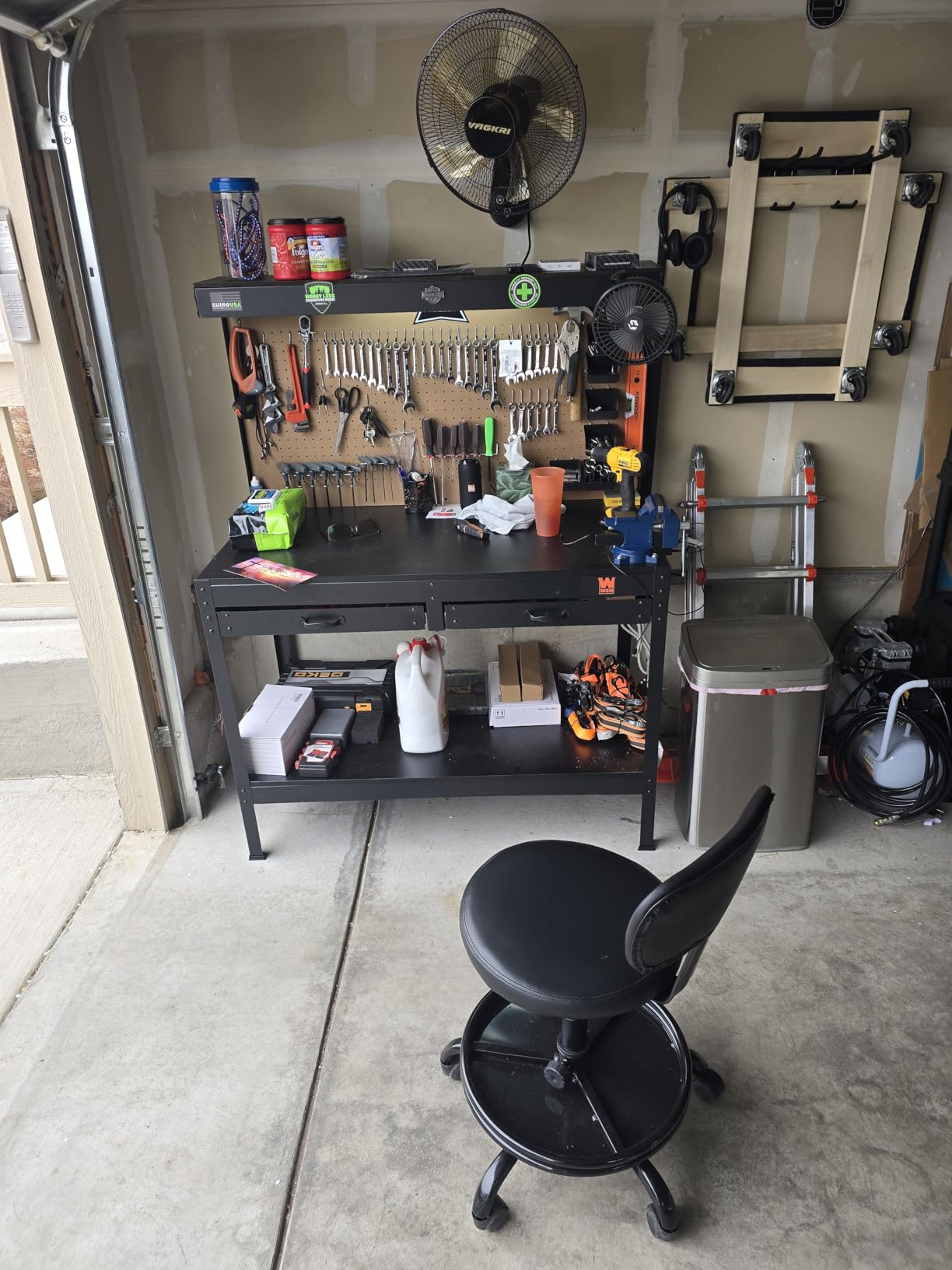
A standard-height workbench, a drafting table or any seated bench job where you want back support and quick adjustment. Assembly takes minutes with no complicated steps, which suits a shop where anyone may grab the stool.
Owners like the wide base and describe it as stable when leaning or reaching, and the three trays keep consumables close.
Where it does not fit
It is too low for a raised welding bench. At 23.5 inches you would be working with raised shoulders at a 36 inch bench top, which is the posture problem this whole category exists to solve.
Faux leather also wipes less cleanly than PVC or vinyl, and in a weld cell you will drop spatter on it. The poor wheel roll is the other reason to choose a different model if you plan to reposition frequently.
11. WUDOYO DZ1 Stool with Removable Backrest and Convertible Wheels
WUDOYO Shop Stool with Lockable Rubber Wheels Adjustable Backrest Tool Tray Storage 400 lb Capacity Rolling Garage Stool (Black)
24-28 inch adjustable seat height
400 lbs capacity
Backrest adjusts to two heights
3-inch rubber casters with double brakes
Pros
- Backrest adjusts to two heights or removes completely
- Wheels swap for rubber foot caps to make a fixed stool
- 3-inch rubber tires roll quietly and leave no floor marks
- Large 17 by 17 inch iron tray gives real storage
Cons
- 24-28 inch range is short against taller competitors
- Molded foam cushion is durable rather than plush
- Converting to fixed feet means swapping parts
Two convertibility features make this the most flexible stool here. The backrest adjusts to two heights and can be removed entirely, and the wheels can be swapped for rubber foot caps to turn the stool into a traditional fixed shop stool. One chair can cover rolling work and a fixed bench position.
The 3-inch rubber tires are the right choice in a weld cell. They roll quietly, leave no marks on sealed concrete, and the double brakes hold the stool steady when you step up onto it, which is a genuine plus when you are climbing onto a raised bench.
Storage is a 17 by 17 inch iron tray with a 3.5 inch wall, which is real capacity rather than a token shelf, and there is a 2-layer footrest. The 400 lb rating on a metal frame gives good margin for a heavier welder.
The seat height range of 24 to 28 inches suits workbenches between 29 and 43 inches, so it covers most welding benches but stops short of the very tallest. The molded foam cushion is described as more durable than sponge or EPE pads, though not especially plush.
Who it is for
A welder who alternates between rolling along a bench and locking into one position for a long fit-up. Removing the backrest for grinding or deburring and converting the base to fixed feet makes it a two-tool stool.
Anyone over 250 lbs will like the 400 lb frame, and the iron tray is more durable than the plastic trays on lighter stools.
Where it stops short
The 24 to 28 inch range is short against the taller adjustable picks, so on a 40 inch bench you would be working at the very top of its travel. Choose the Sunex or Performance Tool for more headroom.
Only 102 ratings exist for this model, so there is less long-term owner history behind it than the models above, and converting the base means swapping parts rather than flipping a lever.
12. Type S Chrome Shop Stool with Lumbar Support
Type S Shop Stool with Backrest – Adjustable Garage & Workshop Stool, 360° Swivel with Footrest, Padded Seat & Lumbar Support, Heavy-Duty Steel Frame, 22–28” Height
22-28 inch height adjustment
250 lbs capacity
360 degree swivel with square footrest
Chrome tubular steel frame
Pros
- Chrome finish suits a shop or barbershop interior
- Heavy tubular steel frame feels sturdy
- 360 degree swivel with a square footrest works from any angle
- Seller replaced a failed hydraulic lift under warranty support
Cons
- Lumbar support is short and thinly padded
- 22 inch minimum height suits taller users only
- Loose decorative base plate rattles when kicked
This is the one to pick if the stool is going to sit in a visible part of the shop. The chrome finish suits a clean workshop or a grooming space, and the tubular steel frame gives it a classic shop stool look that hides shop grime better than black powder coat.
Height runs from 22 to 28 inches, which reaches most standard welding benches but not the tallest. The 360 degree swivel and square footrest are well designed, and the footrest works from any angle because it is square rather than a narrow ring.
Service is a genuine positive. The seller replaced a failed hydraulic lift under warranty support, which is worth something when a lift is the mechanism that sets your working height.
The lumbar support is the weak point. It is described as short and thinly padded, offering not much real support, and some users find the seat uncomfortable after 20 to 30 minutes. The 250 lb rating is also on the low side for a larger welder.
Where it makes sense
A shop where the stool is visible, a grooming or detailing studio, or a user who wants a simple mechanical stool with no caster problems at all. Non-slip floor caps mean it will not mark a floor and will not roll away mid-task.
If you are under 250 pounds and change position often, the lift and swivel combination is simple and dependable.
Why it is last in our ranking
Only 33 ratings means very little long-term owner history, and the complaints cluster around the parts that matter most: a thin lumbar back and a 22 inch minimum height that leaves shorter users with heels dangling.
Assembly is also laborious without an electric screwdriver and a good spanner, and a loose decorative base plate rattles loudly when kicked. For a welding bench specifically, one of the taller picks will serve you better.
Welding Bench Stool Buying Guide: Height, Sparks and Base Clearance
Match the stool to your bench top height
Measure your bench top from the floor before you buy anything, then pick a stool whose maximum seat height sits roughly 6 to 8 inches below it. That puts your forearms near level with the plate and your elbows at about 90 degrees, which is the position that lets you hold a torch steady.
Bench top at 34 inches: a stool topping out at 26 to 28 inches works. The Sunex 8516 and the Type S stool both reach this band.
Bench top at 36 to 38 inches: you want 28 to 32 inches of travel. The FreekyFit D03-B, Performance Tool W85011 and CoVibrant counter-height stool all reach here.
Bench top at 40 inches and above: you need a 29 to 34 inch range. The Sunex 8516 is the only pick here that fully covers this, and the Performance Tool reaches 32 inches.
Bench top under 34 inches: almost any rolling shop stool works, and the lower picks with trays become sensible again.
Stools that top out at 23 to 25 inches belong in a different category. They are excellent engine and bench stools, and several buyers in r/garageporn describe exactly the 18 to 30 inch range they want, but that request assumes a bench low enough to reach it.
Wheels or fixed feet in a weld cell
Wheels win when your work moves along the bench. Fixed feet win when the cell floor is covered in ground slag, when you climb on and off the stool, or when you want zero risk of the stool drifting toward a hot bench edge.
Counterintuitively, a rolling stool is not obviously better in a weld cell. Spatter and slag are obstacles, and small hard wheels catch on them and stop the stool dead. Bigger rubber-tired casters such as the 3-inch type on the WUDOYO and Powerbuilt stools roll over debris far better. If your floor is coated with epoxy or polyaspartic, add that to the list of things that stop small wheels dead.
Whatever you choose, make sure at least two casters lock. A stool that rolls while you are leaning over a plate with a hot workpiece nearby is a nuisance and a hazard.
Seat material and what sparks do to it
Seat material is the least discussed spec in this category and the one that matters most next to an arc. Vinyl and PVC are the safe choices: both are non-porous, both wipe clean, and neither has a weave for a hot droplet to catch in and burn.
Faux leather sits in between. It looks better and is often more comfortable, but it is a coated surface with seams, and in a heavy spatter area those seams are where material degrades. Padded sponge seats are the worst case near hot work, because foam insulates and a hot particle stays hot against it.
One more hazard nobody mentions: a wooden or hardboard seat has no business within reach of a live arc. Hot slag sticks to it and burns into the surface permanently. If you are tempted by a DIY stool, weld the frame and buy a vinyl or PVC seat rather than building one with a wood top.
Backrest size, lumbar support and tall welders
Backrest height is where budget stools fail first. A 4.5 inch rest, like the one on the Performance Tool W85011, is a lumbar nudge that lets you scoot back briefly. It will not hold your spine neutral over a four hour session.
For a welder who is six foot two or taller, look for a back that reaches at least to the bottom of the shoulder blades and sits close enough to the seat to support you. Owners in r/woodworking raise this exact complaint about premium steel shop chairs, and the same geometry problem applies at lower price points. A short back on a tall frame leaves a gap you cannot bridge by leaning.
Adjustable backrest height is worth paying for when you can get it. Two positions or a removable back covers both tall and shorter users in the same shop.
Weight capacity beyond the printed number
Rated capacity is a static laboratory figure measured at the seat centre with a slow load. Real use is different: you shift your weight forward to reach a weld, you lean back to rest between passes, and you are wearing a jacket, helmet and tool belt.
Use these bands as a guide. 250 lb suits a welder under about 190 lb. 300 to 350 lb is the sweet spot for most people and is where the best-built stools in this roundup sit. 400 lb and above is for heavier users or anyone who treats the stool as a step. The 500 lb Powerbuilt frame is the outlier and the only one here built from 1-inch steel members.
Clearance under the bench and the foot ring question
Welding benches are often wall-mounted or post-mounted, which means the area under the top is tighter than under a free-standing workbench. Check that the base footprint fits your leg space before you commit.
A cantilever or sled base with feet at the corners leaves the centre open, which is the best clearance you can get. A five-leg star base with casters takes up less floor area overall but puts a leg and casters in the space where your knees go. A fixed sled base like the Sunex model is the least mobile but the most stable.
The foot ring is where most of these stools win or lose. A ring close to the base is decorative. A ring high enough to push against at your working seat height, and adjustable to your frame, is what stops you swaying. The WUDOYO and CoVibrant stools both get this right; the FREEKYROCK D17 has a second decorative ring that does not function as a footrest at all.
One more thought on the wider shop. If you also need head and face protection, our welding helmet roundup covers the other half of the seated welding setup.
Frequently Asked Questions
What is the best heavy-duty shop stool with backrest?
The best heavy-duty shop stool with a backrest for a welding bench is the FreekyFit adjustable stool, which reaches 24.49 to 30 inches on a 300 lb steel frame with a footrest. For heavier welders, the Powerbuilt 240299 has a 500 lb rating on 1-inch steel frame members, and the FREEKYROCK D15-B carries 400 lbs.
What is the best chair for welding?
The best chair for welding is a height-adjustable industrial stool with a lumbar backrest and a seat that reaches 28 to 32 inches, matched to a bench top that measures 34 to 40 inches. That puts your elbows near 90 degrees and keeps your spine neutral. A fixed hydraulic stool works too, and it will not roll across spatter.
How much weight can a garage stool hold?
Shop stools in this group are rated from 250 lb to 500 lb. The Sunex 8516 and Type S stool are rated 250 lb, most mid-range models sit at 300 to 350 lb, and the Powerbuilt 240299 reaches 500 lb on 1-inch steel frame members. Pick a rating well above your own weight plus a loaded tool belt.
What height stool should I use for a welding bench?
Aim for a seat height about 6 to 8 inches below your bench top. A 34 inch bench needs a stool reaching 26 to 28 inches, a 36 to 38 inch bench needs 28 to 32 inches, and a 40 inch bench needs a 29 to 34 inch range. The Sunex 8516 is the only pick here with a range that high.
Do welding shop stools have wheels or should they be fixed?
Rolling stools suit work that moves along a bench, but spatter and ground slag catch small casters and stop them dead. Larger rubber-tired wheels such as 3-inch casters roll over debris far better, and coated garage floors stop small wheels. Fixed sled bases stay level on uneven floors and never drift toward a hot bench edge.
Are padded shop stools safe near a welding spark?
Vinyl and PVC are the safest seat materials near a live arc because both are non-porous and wipe clean with no weave for a hot droplet to catch in. Faux leather is workable but has seams where spatter degrades the surface. Avoid foam seats and any wooden or hardboard top, since hot slag sticks to them permanently.
The Verdict for Welding Benches in 2026
The best shop stools with backs for welding benches all share one trait: they reach 28 inches or more. Our pick, the FreekyFit adjustable stool with backrest, covers 24.49 to 30 inches on a 300 lb angle steel frame with a memory foam PVC seat, a 360 degree swivel and a footrest, and it holds a 4.5 rating across more than 600 reviews.
If your bench is genuinely tall, go with the Sunex 8516. Its 29 to 34 inch hydraulic range is the only one here that fully covers a 40 inch bench top, and with more than 1600 ratings behind it you are buying the most owner-tested stool in the group. For a stool you can put together without tools, the Performance Tool W85011 reaches 32 inches on a 330 lb alloy steel frame.
Measure your bench top first. Height is the one spec that cannot be adjusted later, and it is what decides whether you spend a shift comfortable or hunched. For the rest of your welding gear, start with our welding helmet roundup and the broader shop stool roundup for the rest of the garage.