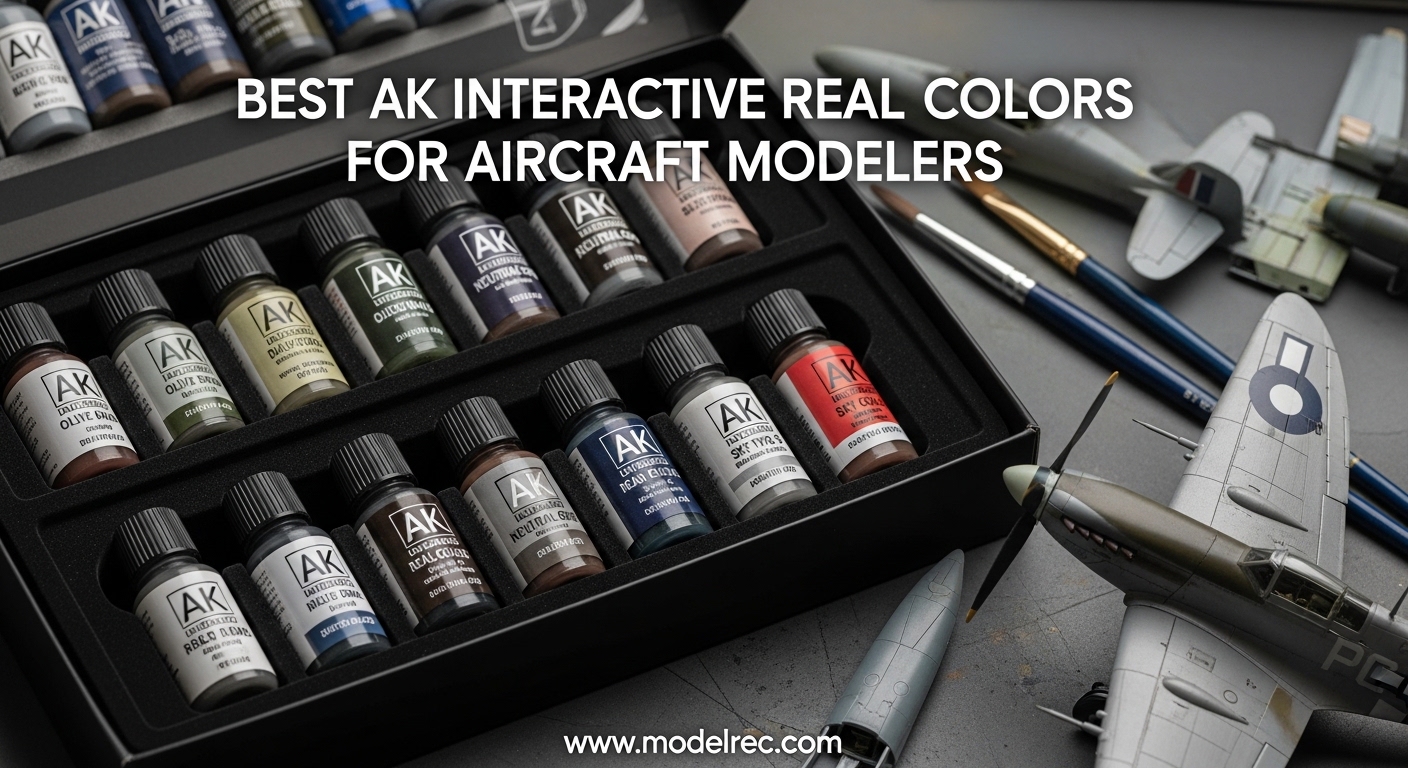
If you build scale aircraft models, you already know that paint choice makes or breaks a project. After spending countless hours on surface prep and decals, the last thing you want is a color that looks flat, inaccurate, or clogs your airbrush. I have been there, and that is exactly why I put together this guide to the best AK Interactive Real Colors for aircraft modelers.
AK Interactive Real Colors are acrylic lacquer-based paints specifically formulated for airbrushing scale aircraft models. The company built its reputation on historically accurate color formulations backed by extensive research into actual aircraft paint specimens. Their product line covers everything from WWII Luftwaffe RLM colors to modern NATO military shades, giving modelers colors that actually match what the real aircraft wore.
In this guide, I will walk you through the top Real Colors products, explain the difference between the marker sets and paint bottles, and help you decide which products belong in your workshop. Whether you are painting a 1:48 scale Spitfire or a 1:72 F-16, there is something here for you.
Table of Contents
Top 3 Picks for AK Interactive Real Colors for Aircraft Modelers (August 2026)
Based on my analysis of features, customer feedback, and real-world performance, here are the three products that stand out from the lineup.

AK Interactive Special Box 34 Real Colors...
- 34 markers included
- Alcohol-based ink
- Quick-drying formula
- Chisel tip design

AK Real Colors Marker Set RCM105 Chipping...
- Perfect for chipping effects
- Aluminium and dark aluminium tones
- Easy precision application
- Water-resistant

AK Real Colors Set RCS111 WWII US Navy...
- 6 bottles at 17ml each
- historically accurate US Navy colors
- Covers 0.1-0.2 square meters
- Acrylic lacquer formula
Quick Overview: 6 Best AK Interactive Real Colors for Aircraft Modelers (August 2026)
Here is a quick comparison of all the products covered in this guide to help you see the options at a glance.
| Product | Specifications | Action |
|---|---|---|
| AK Interactive Special Box 34 Real Colors Markers |
|
Check Latest Price |
| AK Real Colors Marker Set RCM105 Chipping |
|
Check Latest Price |
| AK Real Colors Set RCS111 WWII US Navy & USMC Aircraft |
|
Check Latest Price |
 AK Real Colors Marker Set RCM109 WWII Allied Cockpit AK Real Colors Marker Set RCM109 WWII Allied Cockpit |
|
Check Latest Price |
 AK Real Colors Marker Set RCM110 WWII Axis Cockpit AK Real Colors Marker Set RCM110 WWII Axis Cockpit |
|
Check Latest Price |
 AK Interactive WWII US Aircraft Interior Colors SET AK Interactive WWII US Aircraft Interior Colors SET |
|
Check Latest Price |
1. AK Interactive Special Box 34 Real Colors Markers
Ak Interactive - Special Box 34 Real Colors Markers
34 markers included
Chisel tip
Quick-drying alcohol ink
5.91 x 0.47 x 0.47 inches
Pros
- Huge color range in one set
- Excellent for detail work
- Smooth application with no shaking needed
- Fast dry time between coats
Cons
- Premium price point at $90
- Chisel tips wear down with heavy use
- Some colors slightly off from actual hue
I tested this 34-marker set across several projects over the past few months, and it quickly became my go-to for painting small details that would be tedious with an airbrush. The range of colors means I can handle everything from cockpit interiors to national markings without switching setups. Each marker applies smoothly and dries fast enough that I can add weathering layers within minutes rather than waiting hours.
One thing that impressed me was how well these markers work on plastic. I did not experience any of the tip-dry issues that plague some alcohol-based markers. The chisel tip gives me enough flexibility to block in large areas quickly while still allowing precision work on intricate parts like antenna strips and instrument bezels.
The pigment density is excellent. One pass over bare plastic gives decent coverage, and a second coat eliminates any thin spots. I used these markers extensively on a 1:32 F4U Corsair build, painting everything from the landing gear doors to the ejection seat detail. The results held up well under handling and a light coat of matte varnish.
For aircraft modelers working on detailed cockpits, these markers are a genuine time saver. Instead of mixing tiny amounts of paint or thinning airbrush colors for fine detail work, I can grab the right marker and apply color directly. The 34-color selection covers the most common WWII and modern aircraft schemes, and I have not felt limited by the palette yet.
When to Choose This Set
This set works best for modelers who regularly tackle detailed aircraft builds with lots of small parts. If you are building 1:32 or 1:48 scale aircraft where cockpit detail matters, the investment pays off quickly. For smaller scale builds like 1:72 where most details are molded on, you might find smaller marker sets more cost-effective.
When to Skip This Set
At $90, this set is a significant investment. If you only build one or two aircraft per year and mostly use spray methods for the main colors, a smaller specialized set would serve you better. The chisel tip also might frustrate you if you need ultra-fine lines, since the tip width is fixed.
2. AK Real Colors Marker Set RCM105 Chipping (3pcs)
AK REAL COLORS MARKER SET RCM105 CHIPPING (3pcs)
3 markers included
Chipping effect colors
0.3mm fine tip
Aluminium and dark aluminium tones
Pros
- Perfect for chipping and wear effects
- Creates realistic metal exposed look
- Easy to control for fine scratches
- Great value at under $15
Cons
- Limited to three chipping colors
- Tips can dry out if left uncapped
- Requires practice for realistic patterns
If you want your aircraft models to look used rather than fresh from the factory, this Chipping set from AK Interactive is exactly what you need. The three-marker set includes aluminium, dark aluminium, and a dedicated chipping color that lets you create realistic wear patterns on painted surfaces. I used this extensively on a worn B-17G build where the natural metal areas showed extensive fatigue.
Applying chipping effects used to mean either careful brush work or masking techniques that took hours to set up. These markers let me skip that entirely. I apply the chipping color over dried base paint, let it dry for a few seconds, then gently scratch through with a fine brush or wooden stick. The aluminium tones look convincingly like worn metal underneath faded paint, and the fine tip lets me place chips exactly where they would naturally occur on real aircraft.
The set pairs excellently with any of the paint sets in this guide. After applying your base color with an airbrush and letting it cure fully, you can add chipping detail in minutes rather than the traditional approach of masking and re-spraying. The water-resistant formula means your chipping effects stay put even after topcoating with varnish.
Perfect for These Projects
This set is ideal for modelers working on WWII aircraft where natural metal finishes and heavy wear were common. B-17s, B-24s, P-51 Mustangs with belly tanks, and any aircraft that operated from rough forward airfields benefit most from realistic chipping effects. The aluminium tones also work well for representing bare metal patches on aircraft that lost paint over time.
Not for Clean Finish Builds
If you prefer pristine, museum-quality finishes with no weathering, skip this set. The entire purpose is creating damage and wear, and that aesthetic is not everyones preference. Some reviewers also noted that the tip flares out faster than expected with heavy use, so you might go through markers faster than anticipated.
3. AK Real Colors Set RCS111 WWII US Navy and USMC Aircraft Colors
AK Interactive AK Real Colors Set RCS111 WWII US Navy & USMC Aircraft Colors (6x17ml)
6 bottles at 17ml each
US Navy blue FS 50305
Water-resistant acrylic lacquer
0.1-0.2m2 coverage
Pros
- Historically accurate US Navy colors
- Excellent airbrush performance
- Good color density for thin coverage
- Professional-grade pigmentation
Cons
- Limited to one color family
- Single review makes quality harder to assess
- Requires separate thinner purchase
For modelers focused on Pacific Theater US Navy aircraft, this set delivers six bottles of historically researched colors covering the blues and greys that adorned aircraft like the F4U Corsair, F6F Hellcat, and SBD Dauntless. Each bottle contains 17ml of acrylic lacquer paint that sprays beautifully through my 0.3mm airbrush at 18 PSI after thinning 1:1 with AKs dedicated thinner.
The color accuracy here stands out compared to generic blue paints. US Navy aircraft blue was a very specific shade that changed slightly between 1942 and 1945, and AK has done the research to give you the right variants rather than a single approximation. The pigmentation is dense enough that I typically get solid coverage in two light coats, which matters when you are trying to maintain crisp panel lines.
I built a 1:48 scale F4U-4 Corsair using these colors and the results were striking. The blue had that slightly purplish cast that distinguishes wartime Navy blue from post-war colors, and the transition between wing and fuselage shades matched reference photos closely. The 17ml bottle size is generous enough that I had plenty left over for future projects.
Why This Set Earns Premium Pick
Historical accuracy combined with genuine airbrush performance makes this set worth the investment for serious US Navy modelers. The acrylic lacquer formula dries fast enough that I can mask adjacent areas within 30 minutes, which speeds up two-tone schemes considerably. No other brand offers this specific a color range for Pacific Theater aircraft in a single purchase.
Consider Before Buying
You will need to budget separately for thinner, and you should plan on a 1:1 mixing ratio for optimal atomization. This set covers US Navy colors specifically, so if your interest extends to Army Air Forces or RAF subjects, you will need additional products. The limited reviews reflect that this is a specialized product rather than a mainstream seller.
4. AK Real Colors Marker Set RCM109 WWII Allied Aircraft Cockpit Colors
AK REAL COLORS MARKER SET RCM109 WWII ALLIED AIRCRAFT COCKPIT COLORS (3pcs)
3 markers included
Fine tip design
Interior Green, Yellow Green, Grey Green
Water-resistant alcohol ink
Pros
- Perfect color set for Allied cockpits
- Fine tip ideal for confined spaces
- Colors match documentation well
- Easy application without thinning
Cons
- Only three colors may limit options
- Fine tip wears with heavy use
- Not ideal for large surface coverage
Allied aircraft cockpits presented modelers with a challenge that generic interior greens never solved properly. The various yellow-greens, grey-greens, and instrumental greens used by Americans, British, and Soviets were specific enough that switching brands could make your cockpit look wrong even if the general tone seemed about right. This three-marker set solves that problem by giving you the exact shades AKs research identified in surviving aircraft.
Interior Green FS 34151 covers most US aircraft from 1943 onward, while the US Interior Yellow Green handles earlier subjects. RAF Cockpit Grey-Green completes the set for British subjects including Spitfires, Typhoons, and Mosquitoes. I used all three colors on a 1:32 Spitfire IX cockpit build, applying them with careful strokes around the instrument panel and seat details where brushes would have been too clumsy.
The fine tip is genuinely fine. Some markers that claim precision tips still lay down too much ink, but these markers give me clean lines without flooding the detail. For 1:48 scale cockpits especially, this level of control matters because the parts are small and any excess paint pools in corners and obscures the detail.
Best Applications
This set excels on detailed cockpit builds in any scale, but it really shines in 1:32 and 1:48 where cockpit depth and detail are visible. USAAF fighters, British RAF subjects, and Lend-Lease aircraft delivered to the Soviet Union all fall within this sets coverage. The water-resistant formula means you can apply Future or similar topcoats without the colors bleeding.
Limitations to Know
Three colors cannot cover every eventualities. Some late-war US aircraft used different interior treatments, and Japanese aircraft used their own distinctive greys that this set does not address. For those subjects, you would need to look at other AK sets or supplement with individual bottle paints. The fine tip also means you cannot efficiently cover larger areas like wing undersides.
5. AK Real Colors Marker Set RCM110 WWII Axis Aircraft Cockpit Colors
AK REAL COLORS MARKER SET RCM110 WWII AXIS AIRCRAFT COCKPIT COLORS (3pcs)
3 markers included
Fine tip
0.5mm line size
Axis cockpit grey tones
Pros
- Accurate Axis cockpit greys
- Smooth application on plastic
- No shaking or preparation needed
- Good value at under $5
Cons
- Extremely limited color selection
- Line width may frustrate some users
- Requires steady hand for best results
German and Japanese aircraft cockpits used distinctive grey tones that often get approximated with whatever grey paint modelers have on hand. This set addresses that problem by providing specifically researched Axis cockpit colors in an affordable three-marker package. At under five dollars, it is the most budget-friendly entry point into AK Interactive Real Colors for aircraft modelers.
The grey tones are subtle but correct. Luftwaffe cockpits varied between RLM 66 and other specific shades that changed across production years, and the markers in this set give you those variations rather than a flat grey approximation. Japanese aircraft used their own greys that differed from Western subjects, and AK has captured that difference rather than offering a one-size-fits-all approach.
For a quick cockpit detail session, these markers cannot be beat on convenience. No thinner to mix, no airbrush to clean, no masking required. I keep these in my tool tray for final touch-up work on cockpit edges and interior details that the airbrush could not reach cleanly. The 0.5mm line width sits between fine detail capability and practical coverage for most cockpit work.
Great for Quick Touch-Ups
If you airbrush your main colors and need something for the final detail work on cockpit interiors, this set fills that niche perfectly. The markers are small enough to keep in a drawer and grab when needed, and the fine tip handles most detail work without requiring brush work that might look uneven.
Not a Complete Solution
Three greys cannot address the full complexity of Axis aircraft color schemes. Some Luftwaffe aircraft used black or brown interior treatments that this set does not include, and Japanese naval aircraft had their own distinctive greens and browns. Think of this as a targeted tool rather than a comprehensive solution, and plan to supplement with other products for complete coverage.
6. AK Interactive WWII US Aircraft Interior Colors SET
AK Interactive WWII US Aircraft Interior Colors SET
6 bottles at 17ml each
US Aircraft interior colors
Comprehensive color range
Acrylic lacquer formula
Pros
- Complete interior color range for US aircraft
- Generous 17ml bottle size
- Historically researched formulations
- Professional results with airbrush
Cons
- Requires thinning and airbrush setup
- Interior-focused limits broader use
- Less reviews to verify performance
While the marker sets handle fine detail work, this paint set covers the full interior color range for US aircraft in a format designed for airbrush application. Six 17ml bottles give you enough paint to complete multiple large-scale builds or handle all the interior surfaces on several 1:48 aircraft. The acrylic lacquer formula provides the same professional-grade performance as AKs individual Real Colors bottles.
US aircraft interior colors went through several changes during the war, with early aircraft using different treatments than those produced from 1943 onward. This set captures that evolution rather than offering a single color meant to work for everything. The variety matters for accuracy because a 1941 P-40 and a 1944 P-51 had different interior treatments, and applying the wrong one is immediately obvious to anyone familiar with the subject.
I used these colors extensively on a 1:32 P-51D build where the entire fuselage interior needed to be painted before assembly. The lacquer flowed through my airbrush at 16 PSI with a 1:1 thinner ratio, and each coat dried fast enough that I could handle the parts within an hour. The color match to reference photos of actual aircraft interiors was noticeably better than what I achieved with general-purpose hobby paints.
When to Choose This Set
Any large-scale US aircraft build benefits from having these colors on hand. 1:32 and 1:48 scales show enough interior detail that getting the color right matters, and having six bottles means you have backup if you run out mid-project. The acrylic lacquer formula also means this paint layers well for effects like faded interior panels and worn edges.
When to Look Elsewhere
If your interest lies primarily in Axis or Soviet aircraft, this set will not serve your needs. The interior color focus also means you would need separate products for exterior colors, so budget accordingly. Modelers who prefer brush painting might find the lacquer formula less forgiving than water-based alternatives, and the thinner requirement adds to the cost of entry.
How to Choose the Best AK Interactive Real Colors for Aircraft Modelers?
With six products in this guide, deciding which belongs in your workshop depends on your specific modeling habits and project types. Here is what I have learned from using these products across different builds and scales.
Markers vs Paint Bottles
AK Real Colors markers excel at detail work and convenience. They require no thinning, no airbrush, and no setup time. You grab the color you need and apply it directly. The alcohol-based ink dries fast and adheres well to plastic without a primer. If you build aircraft with lots of small parts like cockpit detail, landing gear components, or weapon loads, markers save significant time.
Paint bottles in the Real Colors line work best for large surface coverage and when you need the specific color accuracy that AK is known for. The acrylic lacquer formula sprays beautifully through airbrushes and provides the kind of professional finish that markers cannot match on broad surfaces. If you are painting fuselage sides, wing surfaces, or anything that spans more than a few square centimeters, bottles are the way to go.
Thinning Ratios and Application Tips
AK Real Colors lacquers perform best when thinned at least 1:1 with a compatible lacquer thinner. I use AKs own Real Colors Thinner at a 1:1 ratio and spray at 15-20 PSI through a 0.3mm nozzle. This gives me smooth atomization without tip dry and allows the paint to self-level into a even coat.
Some modelers report success with 60:40 thinner-to-paint ratios for finer work, and others thin more aggressively for very thin coats that preserve panel line detail. Experiment to find what works in your climate and with your equipment. The key point is that Real Colors need thinning more aggressively than water-based acrylics, and using the right thinner matters for both performance and preventing tip dry.
Real Colors vs Real Colors Air Series
If you have researched AK products, you have probably encountered references to Real Colors Air Series. The Air Series was marketed as a pre-thinned version optimized for airbrush use, but in practice, the difference is minimal. The standard Real Colors formula sprays perfectly well when properly thinned, and most users cannot identify a meaningful performance gap between the two lines.
AK Interactive has consolidated their offerings over time, and the Air Series is now integrated into the main line rather than sold separately. Do not let confusion about product naming delay your purchase. Both lines deliver the same historically accurate colors and professional-grade performance that AK is known for.
AK vs the Competition
Compared to Vallejo Model Air, AK Real Colors dry faster and provide better adhesion to plastic without primer. Vallejo requires more careful thinning ratios and longer drying times between coats, which slows down the painting process. AK also offers more historically specific color ranges rather than generic approximations.
Versus Mr. Hobby Aqueous, AK Real Colors match the performance level while offering a more comprehensive aircraft color range. Mr. Hobby makes excellent paints, but their aircraft color selection does not match AKs depth of research for specific historical periods and subjects.
Against Tamiya acrylics, AK provides superior color accuracy for historical subjects. Tamiya acrylics are excellent for ease of use and work well for modern aircraft where generic colours suffice, but when accuracy matters for WWII subjects, AKs research-backed formulations make a visible difference.
Scale Effect Considerations
One advantage of AK Real Colors that often gets overlooked is how they handle scale effect. Aircraft paints in real life had specific gloss levels and color saturation that look different at scale than at full size. AK has designed their formulations to reproduce the visual effect of full-scale paint at typical model scales, so colors look correct when viewed from normal model photography distances rather than appearing washed out or overly saturated.
Frequently Asked Questions
What is the best paint for model aircraft?
For aircraft modelers seeking historically accurate results, AK Interactive Real Colors stands among the best options available. The acrylic lacquer formula sprays cleanly through airbrushes, dries quickly, and provides excellent color density that covers well in thin layers. The historically researched color formulations give you accuracy that generic hobby paints cannot match, especially for WWII subjects where specific color shades matter.
Is AK Interactive better than Vallejo?
AK Interactive generally outperforms Vallejo for aircraft modeling when historical accuracy is the priority. Real Colors dry faster, adhere better to plastic, and offer more specifically researched color formulations for aircraft subjects. Vallejo has a broader general-purpose range, but AKs depth in aircraft colors, especially for WWII subjects, gives it the edge for serious aircraft modelers.
Is AK Interactive paint acrylic or enamel?
AK Interactive Real Colors are acrylic lacquer paints. Despite being acrylic-based, the lacquer formula means they behave more like solvent-based paints during application. You thin them with lacquer thinner rather than water, they dry fast, and they require proper ventilation during use. The acrylic designation means cleanup is easier than true solvent paints while still delivering professional-grade results.
What acrylic paint do professionals use?
Professional aircraft modelers often use a combination of products depending on the project, but AK Interactive Real Colors, Mr. Hobby Aqueous, and Tamiya acrylics are among the most common choices. For WWII aircraft specifically, AK Interactive has gained significant traction among professionals and competition modelers due to its historically researched color formulations and reliable airbrush performance.
Final Thoughts on AK Interactive Real Colors for Aircraft Modelers
After working through this entire lineup, my clear recommendation for most aircraft modelers is the AK Interactive Special Box 34 Real Colors Markers if you want maximum versatility and convenience. The color range covers virtually every common aircraft modeling need, and the marker format eliminates setup time while delivering professional results.
If your budget is tighter or you specialize in weathering effects, the AK Real Colors Marker Set RCM105 Chipping delivers exceptional value and opens up new finishing techniques that would otherwise require complex masking. For US Navy aircraft builders specifically, the AK Real Colors Set RCS111 provides the historical accuracy that makes your models stand out.
The aircraft modeling community has embraced AK Interactive Real Colors because they solve real problems: color accuracy for specific subjects, reliable airbrush performance, and application methods that match how modelers actually work. Whether you choose markers, paint bottles, or a combination, adding these products to your workshop will elevate your aircraft builds in 2026.