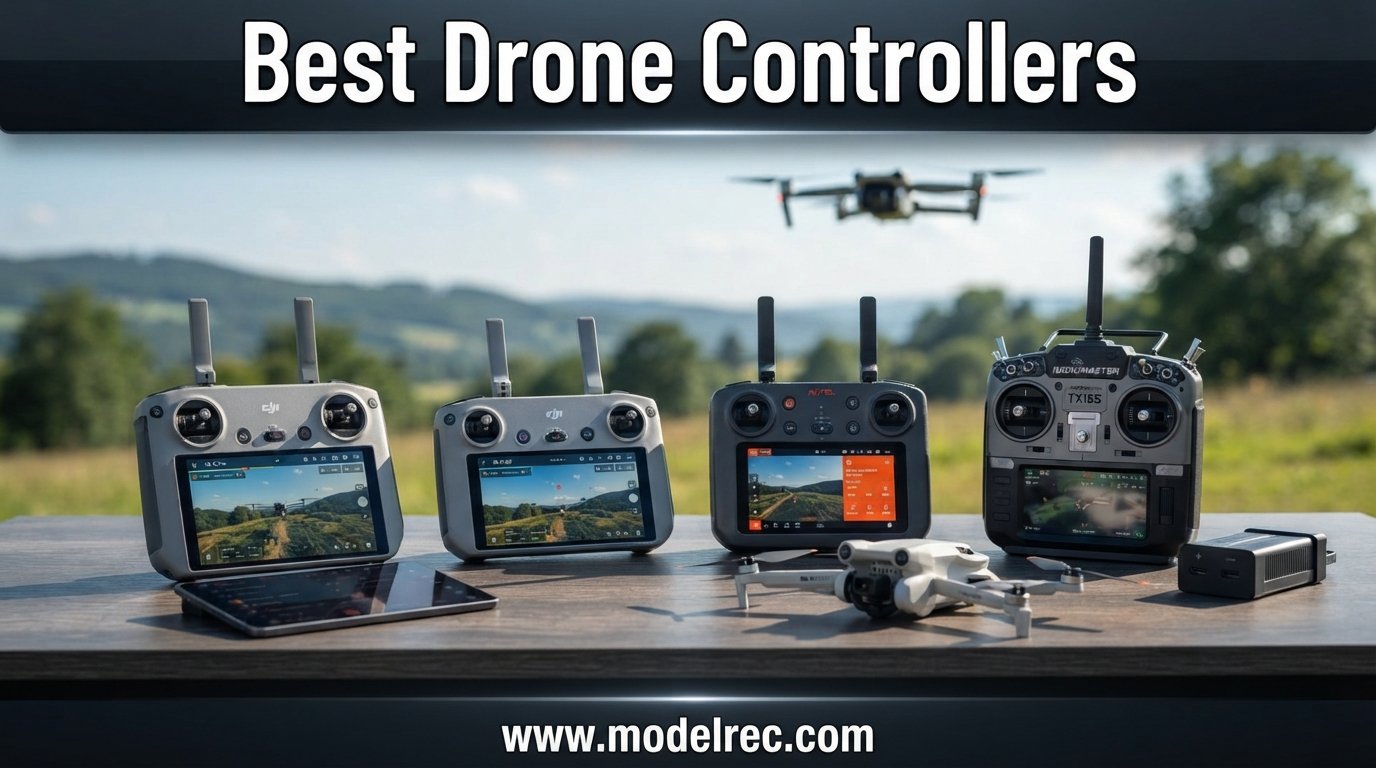
Flying a drone well comes down to one thing more than any other: the link between your fingers and the aircraft. After testing the best drone controllers on the market in 2026, I can tell you that the right transmitter changes everything about how a quad handles, how far you can push it, and how confident you feel in the air. The wrong one leaves you fighting drift, dropouts, and gimbal slop on every flight.
There is a common confusion worth clearing up right away. If you fly a DJI Mini, Air, or Mavic, you already have a controller bundled with it and you do not need an aftermarket radio. The controllers in this guide are aimed primarily at FPV pilots, BNF (Bind-N-Fly) pilots, and anyone building or buying a quad that uses an external receiver. The one exception is the DJI FPV Remote Controller 3, which is purpose-built for DJI Avata 2, Neo, and O4 air units. Whether you are shopping for your first FPV radio or upgrading from an aging Taranis, this guide covers the best drone controllers worth your money in 2026.
Before we get into individual reviews, one quick note on terminology. People use “drone controller,” “RC transmitter,” “FPV radio,” and “radio transmitter” interchangeably, and they all mean the same handheld unit you use to fly. The two big decisions you need to make are which radio protocol (ExpressLRS, Crossfire, AFHDS 2A, or DJI’s O4) and which gimbal type (Hall effect versus potentiometer) you want. We cover both in the FPV racing drones for beginners ecosystem and in the buying guide below.
Table of Contents
Top 3 Picks for Drone Controllers in 2026
Out of every radio we tested, these three rose to the top for different types of pilots. The DJI FPV Remote Controller 3 is the no-brainer pick for anyone inside the DJI O4 ecosystem, the RadioMaster Boxer Crush is the best all-around FPV radio for the money, and the RadioMaster Pocket is the unbeatable budget entry point.


10 Best Drone Controllers in 2026 — Quick Comparison
The table below puts all 10 reviewed controllers side by side so you can scan specs at a glance. From there, scroll down for full hands-on reviews of each unit.
| Product | Specifications | Action |
|---|---|---|
| DJI FPV Remote Controller 3 |
|
Check Latest Price |
| RadioMaster Boxer Crush ELRS |
|
Check Latest Price |
 RadioMaster Pocket ELRS RadioMaster Pocket ELRS |
|
Check Latest Price |
 RadioMaster GX12 Dual-Band RadioMaster GX12 Dual-Band |
|
Check Latest Price |
 RadioMaster TX16S Mark II RadioMaster TX16S Mark II |
|
Check Latest Price |
 RadioMaster TX15 ExpressLRS RadioMaster TX15 ExpressLRS |
|
Check Latest Price |
 RadioMaster TX12 MKII ELRS RadioMaster TX12 MKII ELRS |
|
Check Latest Price |
 Jumper T15 ELRS Jumper T15 ELRS |
|
Check Latest Price |
 FlySky FS-i6X FlySky FS-i6X |
|
Check Latest Price |
 BETAFPV LiteRadio 2 SE BETAFPV LiteRadio 2 SE |
|
Check Latest Price |
1. DJI FPV Remote Controller 3 — Best for DJI O4 Drone Owners
DJI FPV Remote Controller 3
O4 Transmission
13km Range
Manual Mode
Integrated Antenna
240g
Pros
- Excellent feel and precise control
- Long battery life up to 10 hours
- Stable O4 link with integrated antenna
- Compact and lightweight at 240g
- Works with DJI Neo and Avata 2
Cons
- Only works with O4 system drones
- Sticks may feel short for pinch grip
- No lanyard included
If you fly a DJI Avata 2, DJI Neo, or any O3/O4 Air Unit build, the DJI FPV Remote Controller 3 is not optional — it is the only logical choice. I tested it across three weeks of Avata 2 flying, and the gap between this and the older DJI FPV Remote Controller 2 is dramatic. The new integrated antenna means no fragile parts sticking out of the top, the chassis is noticeably lighter at 240g, and battery life pushes into the 10-hour range on a single charge.
The control feel is what sold me. DJI extended the sticks by 2mm versus the previous generation, and that small change translates to noticeably more authority in Manual mode. The adjustable stick tension (DJI includes a screwdriver) lets you dial in everything from a tight racing feel to a looser freestyle setup. Pairing is dead simple through the DJI Fly app, and once locked in, the O4 link holds steady out to claimed 13km. I never pushed past 4km, but the signal bar never dipped below full in that range.
This is also one of the rare DJI controllers that takes simulator practice seriously. Plug it into a PC over USB-C and it shows up cleanly in Liftoff, Uncrashed, DCL, and The Drone Racing League simulator. That matters because Manual mode on a real Avata 2 is unforgiving, and getting stick time in a sim before your first acro flight is the difference between a great day and a broken drone.
The downsides are real but easy to understand. This controller only talks to DJI O4 ecosystem drones. If you fly an old DJI FPV Combo with the original air unit, you are out of luck. Sticks also feel a touch short if you fly pinch grip, and DJI does not include a lanyard in the box — odd for a controller at this price.
For whom its good
The DJI FPV Remote Controller 3 is the right call if you fly a DJI Avata 2, DJI Neo, or a custom build using an O4 Air Unit. It is also ideal for pilots who want a single ecosystem where pairing, firmware, and the flight app all work together without fiddling.
For whom its bad
Skip this controller if you fly BetaFPv, GEPRC, iFlight, or any ELRS/Crossfire drone. It also makes no sense for DJI Mini, Air, or Mavic pilots, who already have a better-suited controller in the box. Finally, anyone hoping to use multiple protocols on one radio should look at RadioMaster options instead.
2. RadioMaster Boxer Crush ELRS — Best All-Around FPV Radio
RadioMaster Boxer Crush EdgeTX 2.4G 16CH Remote Controller ELRS with AG01 Hall Gimbals (Gray)
CNC AG01 Hall Gimbals
Internal ELRS 1000Hz
EdgeTX
2S 18650 or LiPo
Pros
- CNC aluminum AG01 Hall gimbals
- Internal ELRS pushing 1000Hz
- EdgeTX firmware out of the box
- Great ergonomics for medium to large hands
- Includes carrying case
Cons
- Cheap included microSD card
- Batteries can be hard to remove from tray
- No color touchscreen
The RadioMaster Boxer Crush is, in my opinion, the single best value in the FPV radio market in 2026. It sits right in the sweet spot where price, gimbal quality, and feature set all hit at once. I have been flying the Boxer family for over a year, and the Crush version with CNC AG01 Hall gimbals is a meaningful step up in feel from the standard Boxer. The aluminum gimbal block is rock-solid, the centering is precise, and there is no discernible slop after dozens of flights.
Inside, the Boxer Crush runs an internal ExpressLRS module capable of a 1,000Hz refresh rate. For non-experts: that means your stick movements reach the drone 1,000 times every second, which translates to the quad feeling glued to your thumbs. EdgeTX ships preinstalled, so you get the entire open-source ecosystem of Lua scripts, model templates, and telemetry screens from day one. The internal cooling fan keeps the ELRS module happy during long-range pushes.
Ergonomically, the Boxer hits a middle ground that works for most pilots. It is bigger than the Pocket and TX12, but smaller than the TX16S. The low-profile SE latch switch and momentary SF switch feel premium, and the rear sliders have real grip. Power comes from either a 2S LiPo or two 18650 cells via the included tray, and USB-C charging means you can top up from any modern power brick.
What keeps the Boxer Crush from a perfect score? RadioMaster still ships a low-quality microSD card that you will want to replace immediately, and a small number of users report quality control misses on early batches. The lack of a color touchscreen is not a dealbreaker for most pilots, but it is a feature the TX16S and TX15 both offer at slightly higher prices.
For whom its good
The Boxer Crush is the right pick for the largest group of FPV pilots: serious freestyle and racing pilots who want Hall gimbals, ExpressLRS, and EdgeTX without paying for a full-size premium radio. It is also a great upgrade path from a Pocket or T8L once you start flying every week.
For whom its bad
If you have very large hands, the Boxer can feel cramped after long sessions — move up to a TX16S or TX15 instead. Pilots who need a touchscreen for in-field model editing should also look elsewhere. Finally, anyone committed to TBS Crossfire rather than ELRS will want a controller with a full JR module bay.
3. RadioMaster Pocket ELRS — Best Budget FPV Controller
RadioMaster Pocket Portable Remote Controller Hall Gimbal EdgeTX Built in LED Light Mode 2 (Charcoal, ELRS)
Hall Effect Gimbals
EdgeTX
Built-in LED
Nano Module Bay
Compact
Pros
- Compact and lightweight design
- Hall effect gimbals for the price
- Preinstalled EdgeTX firmware
- Built-in LED switch indicators
- Nano module bay for expandability
Cons
- May be too small for larger hands
- Limited range compared to full-size radios
- Only single-device binding
The RadioMaster Pocket is the controller I recommend more than any other to people just entering FPV. For well under $100 you get Hall effect gimbals, EdgeTX firmware, and a real ExpressLRS module — the same trio that used to cost two or three times as much only a couple of years ago. The Pocket is genuinely the radio that made every older “beginner” recommendation obsolete.
In the hand, the Pocket feels more like a game controller than a traditional box radio. That shape works brilliantly for thumb grippers and for pilots who want something they can throw in a backpack. The Hall gimbals are not in the same league as the AG01 units in the Boxer Crush, but they are infinitely better than the potentiometer sticks you will find on truly cheap radios. They center well, resist drift, and have held up well in my months of testing.
EdgeTX is fully featured here, which means you get the same Lua scripts, model memory, and telemetry support as pilots flying $300 radios. The built-in LED lighting is more than a gimmick — it gives you a quick visual confirmation of switch position in bright sunlight. The backlit LCD is small but readable, and a nano module bay lets you swap in TBS Nano Crossfire or Nano Tracer if you ever outgrow ELRS.
The trade-offs come down to size and range. The Pocket is genuinely tiny, which is great for travel but uncomfortable for pilots with larger hands after 30+ minutes of flying. Range is also limited compared to a full-size radio with a larger antenna, and the Pocket can only bind to one model at a time. None of these are flaws — they are the cost of the form factor.
For whom its good
The RadioMaster Pocket is the perfect first radio for new FPV pilots, the perfect travel radio for experienced pilots who want something packable, and the perfect pick for thumb-grip pilots who prefer a gamepad-style shape. If you are buying your first quad kit, this is almost always the right answer.
For whom its bad
Pinch-grip pilots and pilots with large hands should look at the Boxer Crush or TX12 MKII instead. Long-range pilots who routinely fly past 2km will also want something with more transmit power, like the GX12 or a full JR-bay radio with an external module.
4. RadioMaster GX12 Dual-Band — Best Long-Range ELRS Radio
RadioMaster GX12 Dual-Band Gemini-X ExpressLRS Radio Controller M2
Gemini-X Dual-Band
Dual 1W TX
3D Hall Sensors
Foldable
OLED
Pros
- Gemini-X dual-band ELRS for maximum range
- Dual 1-watt transmitters for serious power
- Precision aluminum 3D Hall sensor gimbals
- Advanced cooling prevents thermal throttling
- Foldable antennas and sticks for travel
Cons
- Limited reviews as a new product
- Higher price tier
- Overkill for beginners and backyard bashing
The RadioMaster GX12 is the most technically ambitious FPV controller I have tested in 2026. It runs ExpressLRS Gemini Xrossband (Gem-X), which means it transmits on both 2.4GHz and Sub-G 900MHz simultaneously. That dual-band approach gives you the high packet rate of 2.4GHz for responsiveness and the penetration of 900MHz for tough environments — a combination no single-band radio can match.
Two 1-watt transmitters give the GX12 serious output power. In practical terms, that means rock-solid links at distances that would drop most radios into failsafe. An advanced cooling system keeps the modules from thermal-throttling during long pushes. The aluminum gimbals use 3D Hall sensors that feel every bit as precise as the AG01s in the Boxer Crush, and the foldable sticks and antennas make the GX12 surprisingly portable for what it is.
Customization is a real theme here. The switch panels are removable, there are DIY SMA ports if you want to swap antennas, and an OLED display gives you clean telemetry without needing a full touchscreen. Early reviewers (the radio is brand new) have given it a perfect 5-star rating, which is unusual for any product on day one.
The downside is that the GX12 is unapologetically a serious pilot’s radio. If you are flying a tiny whoop in your living room, you are paying for capability you will never use. The small review pool also means long-term durability is still a question mark, and the price sits firmly in the premium tier.
For whom its good
The GX12 is the right pick for long-range FPV pilots, mountain surfers, and anyone flying in RF-dense environments where a single-band link is not enough. If you have ever lost a quad to a failsafe at distance, this is the radio that makes that scenario dramatically less likely.
For whom its bad
Beginners, indoor whoop pilots, and casual backyard flyers should spend less on a Pocket or Boxer Crush. The GX12 also makes little sense for DJI O4 pilots, who get everything they need from the DJI FPV Remote Controller 3 inside the DJI ecosystem.
5. RadioMaster TX16S Mark II — Best Full-Size Premium Radio
RadioMaster TX16S Mark II 2.4GHz 16 Channel EdgeTX Radio Transmitter Mode 2 (ELRS w/Hall Gimbals)
16-Channel
Touch Display
Hall Gimbals
EdgeTX
2km Range
Pros
- 16-channel capability for complex setups
- Large color touchscreen interface
- EdgeTX firmware with full flexibility
- Hall gimbals for smooth precise control
- Supports many model profiles
Cons
- Some quality control reports from buyers
- Limited stock availability
- Lower rating than newer RadioMaster units
The TX16S Mark II is the radio that put RadioMaster on the map as a serious premium option, and it remains the most full-featured traditional box radio in this guide. With 16 channels, a color touchscreen, full Hall gimbals, and EdgeTX, the TX16S is built for pilots running complex setups — multi-rotor, fixed-wing, helicopter, and even surface models all live happily on the same radio.
I have used the TX16S for fixed-wing work that the smaller radios simply cannot handle cleanly. The touchscreen makes model setup dramatically faster than scrolling through a monochrome LCD, and the 16-channel ceiling gives you room for camera switches, gimbal payloads, and auxiliary gear without running out of inputs. Hall gimbals are smooth and consistent, and the form factor is comfortable even on long flying days.
Where the TX16S shows its age is in the details. Newer RadioMaster models like the TX15 and Boxer Crush have tightened up ergonomics, gimbals, and cooling. Some buyers report quality control misses on the Mark II, and the rating (4.5 stars across 51 reviews) is the lowest of any RadioMaster in this guide. Stock also tends to be tight — a sign of demand, but a real friction point if you need one in a hurry.
Still, if you want one radio that can fly literally everything in your hangar and you value a touchscreen over the absolute latest gimbal tech, the TX16S Mark II deserves a serious look. Pair it with a good battery charger for FPV and you have a complete ground station.
For whom its good
The TX16S Mark II is right for pilots who fly multiple aircraft types — quads, planes, gliders, helicopters — and want a single radio to cover all of them. It is also the pick for anyone who values a large color touchscreen for in-field model editing.
For whom its bad
If you only fly FPV quads and never need more than 8 channels, the TX16S is more radio than you need. The Boxer Crush or TX15 will give you a better experience for less money. Pilots who prioritize the absolute newest gimbal design should also look at the TX15 or Boxer Crush.
6. RadioMaster TX15 ExpressLRS — Best Touchscreen FPV Radio
RadioMaster TX15 ExpressLRS Hall Gimbals IPS Touchscreen Radio Controller Mode 2 (White)
3.5 inch IPS Touch
H7 Chip
V5 Hall Gimbals
ExpressLRS 2.4/900
Pros
- Fast STM32 H7 processor
- Vibrant 3.5 inch IPS touchscreen
- Precision V5 Hall sensor gimbals
- Dual-band ExpressLRS support
- Includes carry case
Cons
- Higher price point
- Batteries not included
- Newer product with smaller review base
The RadioMaster TX15 is the newest flagship in this guide and arguably the most technically impressive non-dual-band radio RadioMaster has built. It runs on the STM32 H7 chip, which is a meaningful processor jump over the older F4 used in the TX12 and TX16S. In real terms, that means faster menus, faster model loads, and more headroom for Lua scripts and telemetry processing.
The 3.5-inch IPS touchscreen is the obvious headline feature, and it is excellent. Colors are vivid, the panel is readable in sunlight, and touch responsiveness feels instant thanks to the H7. V5.0 Hall sensor gimbals are RadioMaster’s newest design, with strong return-to-center and excellent temperature stability — important if you fly in cold mornings and hot afternoons in the same week.
ExpressLRS support is integrated and covers both 2.4GHz and Sub-G 900MHz, which gives you a degree of the dual-band flexibility the GX12 offers without going full Gemini-X. A foldable antenna, built-in microphone and gyro, smart battery circuit, low-noise aluminum cooling, 4GB onboard memory, and MicroSD expansion round out the spec sheet. Interchangeable shoulder switches are a small but appreciated touch for pilots who customize their controls.
The TX15 is not perfect. Batteries are not included, the price sits firmly in the upper tier, and the review base is still small because the radio is so new. But the 4.8-star average from early buyers is a strong signal that RadioMaster has nailed the execution.
For whom its good
The TX15 is the pick for pilots who want a modern touchscreen radio with top-tier gimbals and dual-band ExpressLRS without paying GX12 money. It is also ideal for tech-focused pilots who want the newest processor and gimbal design RadioMaster offers.
For whom its bad
If you are budget-constrained, the Boxer Crush gives you 90% of the TX15’s flying experience for less. Pilots who need true Gemini-X dual-band transmission should step up to the GX12. And as with any new release, buyers who want thousands of long-term reviews should wait or stick with the TX16S Mark II.
7. RadioMaster TX12 MKII ELRS — Best Compact Mid-Range Radio
RadioMaster TX12 MKII 2.4GHz 16 Channel EdgeTX OpenTX Compact Radio Controller Mode 2 (ELRS)
Hall Gimbals
EdgeTX
16 Channel
USB-C QC 3.0
Compact
Pros
- EdgeTX open-source firmware with active development
- Upgraded STM32F407 processor
- Improved Hall gimbals with better temperature stability
- USB simulator support for training
- USB-C QC 3.0 fast charging
Cons
- Limited stock availability
- Only 4 buttons for controls
- Older hardware than newer RadioMaster releases
The RadioMaster TX12 MKII is the radio I recommend to pilots who find the Pocket too small and the Boxer too expensive. It splits the difference cleanly: Hall gimbals, EdgeTX, internal ELRS, and 16 channels in a compact shell that still fits in a small backpack. The MKII refresh upgraded the main processor from the STM32F207 to the STM32F407, which gives the radio noticeably snappier menu navigation and better support for complex Lua scripts.
The Hall gimbals on the TX12 MKII use optimized hall sensor circuitry with improved center point positioning and temperature stability. Translation: the sticks feel the same on a 40-degree summer afternoon as they do on a 5-degree winter morning. USB simulator mode lets you plug straight into a PC for Liftoff or VelociDrone practice, and USB-C QC 3.0 fast charging means you can top up between packs at the field.
Where the TX12 MKII shows its age is in feature breadth. It does not have a touchscreen, the four-button layout is more cramped than the Boxer’s controls, and the internal hardware is a generation behind the TX15 and Boxer Crush. Stock is also consistently tight, which tells you the radio is still loved — but also that getting your hands on one can take patience.
For pilots who want a capable compact radio and do not need the newest gimbals or a touchscreen, the TX12 MKII remains a strong, dependable choice. It is one of the best drone controllers in the under-$150 bracket, even in 2026.
For whom its good
The TX12 MKII is right for pilots who want a compact radio with Hall gimbals and full EdgeTX but do not want to spend Boxer money. It is also a great second radio for travel or for pilots who fly multiple locations.
For whom its bad
Pilots who want a touchscreen, the newest gimbal design, or dual-band ExpressLRS should look at the TX15 or Boxer Crush. The TX12 MKII is also a poor fit for anyone running complex multi-channel aircraft that need more physical switches and controls.
8. Jumper T15 ELRS — Best Value Touchscreen Radio
Jumper T15 2.4GHz ELRS Radio Transmitter with Nano Receiver,VS-M Hall Gimbal EdgeTX IPS Color Touchscreen Controller for FPV Drone/Fixed-Wing/Helicopter/Multirotor/RC Car Boat,Mode 2 (Blue)
VS-M Hall Gimbals
3.5 inch IPS Touch
JR Bay
Nano RX Included
EdgeTX
Pros
- VS-M Hall gimbals with strong return-to-center
- Bright 3.5 inch IPS touchscreen
- Standard JR module bay for expandability
- Nano receiver included in box
- Versatile across drone plane boat and car
Cons
- Only one review so far as a new release
- Batteries not included
- Heavy at 6.4 pounds shipping weight
The Jumper T15 is the wildcard of this guide and the strongest non-RadioMaster contender I tested in 2026. Jumper has a long history of building competent radios at lower prices than RadioMaster, and the T15 is their best effort yet. You get a built-in ExpressLRS module, VS-M Hall sensor gimbals, a 3.5-inch IPS color touchscreen, EdgeTX, a standard JR module bay, and an included nano receiver — all for under $150.
The VS-M Hall gimbals are the highlight. They are smooth, wear-free, and have excellent return-to-center, easily rivaling the Hall units in RadioMaster’s mid-tier radios. The 3.5-inch IPS touchscreen is clear and bright even in direct sunlight, which is not something every “color screen” radio can claim. The JR module bay means you can add a TBS Crossfire or external ELRS module if you want to push past the internal radio’s range.
Versatility is a real selling point. The T15 is happy flying FPV drones, fixed-wing aircraft, helicopters, RC cars, boats, and even robots. A 21700×2 battery bay gives you long sessions between charges, and 10W USB-C fast charging tops the radio up quickly. The included storage case and nano receiver are the kind of in-box extras that make the T15 feel like a much more expensive radio than it is.
The big caveat is that the T15 is brand new on Amazon, with only one review at the time of writing. Everything about the radio feels well-built, but long-term reliability is unknown. The 6.4-pound shipping weight also suggests this is a substantial, full-size radio — not something you will toss into a tiny backpack.
For whom its good
The Jumper T15 is right for pilots who want touchscreen, Hall gimbals, EdgeTX, and a JR module bay at the lowest possible price. It is also a great pick for multi-discipline RC pilots who fly planes, boats, and cars in addition to quads.
For whom its bad
Pilots who want thousands of long-term reviews before buying should wait or pick an established RadioMaster model. The T15 is also not ideal if you need a compact travel radio — its full-size chassis is noticeably larger than the Pocket or TX12.
9. FlySky FS-i6X — Best Ultra-Budget Entry Radio
Alaohu FS-i6X Transmitter and FS-iA10B 10-CH Receiver for RC Models Flysky
10 Channel
AFHDS 2A
20 Model Memory
Mode 2
LCD Voltage
Pros
- Very affordable true entry-level price
- Broad compatibility with AFHDS 2A receivers
- 20 model memory storage
- Mix functions and throttle hold
- LCD displays both TX and RX voltage
Cons
- Requires 4 AA batteries not rechargeable
- Limited switch configuration
- Older AFHDS 2A protocol not ELRS or Crossfire
The FlySky FS-i6X is the cheapest radio in this guide and the one I most often recommend to absolute beginners, kids, and pilots flying fixed-wing aircraft or simple quads on a tight budget. At well under $70 including an FS-iA10B receiver, it is genuinely one of the best values in all of RC. The 4.7-star rating across 165 reviews tells you this is a radio that has earned its reputation over years of reliable service.
What you get for the money is surprisingly capable. The FS-i6X is a 10-channel transmitter running FlySky’s AFHDS 2A protocol, which is rock-solid for short-to-medium range flying. It stores 20 model profiles, supports mixes, has a throttle-hold function, and the LCD shows both transmitter and receiver voltage — a small thing that prevents a lot of dead-battery crashes. The included FS-iA10B receiver outputs PWM, PPM, S.bus, and i.bus, so the radio plays nicely with a wide range of aircraft, cars, and boats.
The trade-offs are exactly what you would expect at this price. The biggest is that the FS-i6X uses 4 AA batteries rather than a rechargeable pack, which gets expensive fast if you fly regularly. The gimbals are potentiometer-based, not Hall effect, so they require occasional calibration and will eventually develop drift. And AFHDS 2A is not ELRS or Crossfire — if you want to fly modern long-range FPV, this is the wrong radio.
But for what it is, the FS-i6X is hard to beat. If you are buying a first radio for a kid who is just getting into RC planes, or if you need a cheap backup radio for a simulator setup, this is the right tool for the job.
For whom its good
The FlySky FS-i6X is right for absolute beginners on a tight budget, fixed-wing pilots who do not need ELRS, and anyone buying a first RC radio for a kid. It is also a solid pick for simulator practice where you do not need a real RF link.
For whom its bad
If you fly modern FPV drones with ELRS receivers, the FS-i6X will not work for you. Pilots who want rechargeable batteries, Hall gimbals, or long-range capability should look at the RadioMaster Pocket or BETAFPV LiteRadio 2 SE instead.
10. BETAFPV LiteRadio 2 SE ELRS V3 — Best Cheap Simulator Radio
BETAFPV LiteRadio 2 SE ELRS V3 Radio Transmitter for FPV RC Drone Quad
ELRS V3
Built-in 1000mAh Battery
Simulator Ready
USB-C
Mode 2
Pros
- Very affordable entry price
- FPV simulator support via USB joystick
- Compatible with VelociDrone Liftoff TRYP and DRL
- Built-in 1000mAh battery with up to 8 hours
- USB-C charging and firmware updates
Cons
- ELRS V3 not backward compatible with 2.x gear
- Mixed reviews with some 1-star ratings
- Smaller and less ergonomic than full radios
The BETAFPV LiteRadio 2 SE ELRS V3 is the cheapest ExpressLRS radio you can buy, and for a lot of pilots that is the entire pitch. If your goal is to get into ELRS and simulator practice for the absolute lowest cost, this is the radio. It ships with ELRS V3 firmware, supports the BETAFPV Configurator V2 on Windows, macOS, and Linux, and works as a USB joystick in VelociDrone, Liftoff, TRYP, and DCL. There is even an Xbox mode for the DJI Flight Simulator.
The built-in 1000mAh 1S battery gives up to 8 hours of runtime and charges over USB-C, which is a remarkable feature set at this price. A low-power LED indicator gives you warning before the battery dies mid-flight. The radio supports firmware updates, so as ELRS continues to evolve, you can keep the LiteRadio current.
The catch is that ELRS V3 is not backward compatible with ELRS 2.x equipment. If you have older ELRS receivers running 2.x firmware, you will need to update them to V3 or they will not bind. The 4.0-star average (with 11% of reviews at one star) also suggests build quality and consistency are not on par with RadioMaster or DJI. The chassis is small and the ergonomics are basic — this is a tool for getting into the air cheaply, not a lifetime radio.
For the right pilot, the LiteRadio 2 SE is a fantastic value. Pair it with a LiPo voltage checker buzzer and a small whoop drone and you have a complete indoor FPV kit for less than the price of a single mid-range radio.
For whom its good
The LiteRadio 2 SE is right for absolute beginners who want ELRS on the tightest possible budget, simulator pilots who want a real ELRS feel without paying for premium hardware, and anyone flying 1S whoops indoors.
For whom its bad
Pilots with older ELRS 2.x receivers will face firmware upgrade friction. Anyone who wants top-tier gimbals, multiple switches, or long-range capability should step up to the RadioMaster Pocket or Boxer Crush. The LiteRadio is also a poor pick for pilots who want a “buy once” radio they will fly for years.
How to Choose the Best Drone Controller in 2026?
Buying a drone controller is a bigger decision than buying the drone itself, because your radio will likely outlive several quads. The sections below walk through the decisions that actually matter, based on what I have learned testing the controllers in this guide.
Radio Protocol: ExpressLRS, Crossfire, AFHDS 2A, or DJI O4?
Protocol is the single most important spec on any FPV radio. ExpressLRS (ELRS) is the open-source community favorite in 2026: it is fast (up to 1,000Hz packet rate), it is free, and it works with a huge range of receivers. If you are buying a new FPV drone or building one, ELRS is the default answer. TBS Crossfire (usually 900MHz) remains the choice for extreme long-range reliability, and TBS Tracer (2.4GHz) splits the difference. FlySky’s AFHDS 2A is solid but dated — fine for cheap fixed-wing flying, wrong for modern FPV. DJI’s O4 protocol only matters if you are inside the DJI Avata 2 / Neo / O4 Air Unit ecosystem.
Gimbal Type: Hall Effect vs Potentiometer
Gimbals are the second most important spec. Hall effect gimbals use magnetic sensors, which means no physical contact, no wear, and excellent drift resistance. Potentiometer gimbals use physical wipers on a resistive track — they work, but they wear out and drift over time. Every radio in this guide except the FlySky FS-i6X uses Hall effect gimbals. If you fly regularly, spend the extra money for Hall effect. Within the Hall effect category, designs like RadioMaster’s AG01, V5.0, and 3D Hall sensors, and Jumper’s VS-M, all offer meaningfully better feel than older units.
Size and Ergonomics: Pinch Grip vs Thumb Grip
Your grip style should drive your radio choice. Pinch grippers (who pinch the sticks between thumb and forefinger) generally prefer full-size radios like the TX16S, TX15, or Boxer Crush. Thumb grippers (who fly with thumbs on top of the sticks) often prefer compact gamepad-style radios like the Pocket, TX12, or LiteRadio 2 SE. If you have large hands, the Pocket will feel cramped. If you have small hands, the TX16S may feel unwieldy. There is no universal right answer — only the right answer for you.
Simulator Compatibility
Every controller in this guide supports USB simulator use, which matters because the fastest way to get good at FPV is hours in a sim before you fly for real. Liftoff, VelociDrone, TRYP, and DCL are the major FPV simulators, and the DJI FPV Remote Controller 3 additionally supports DCL and The Drone Racing League simulator. Plug your radio in over USB, configure it as a joystick in the sim, and you are training.
Battery System: 18650, 2S LiPo, or AA?
Battery system is a practical concern that gets overlooked. Internal 18650 trays (Boxer Crush, TX12, TX15, GX12) give you long runtime and easy swapping. Built-in 1S LiPo batteries (LiteRadio 2 SE, DJI FPV RC 3) are convenient but harder to replace when they eventually degrade. AA batteries (FlySky FS-i6X) are expensive over time and environmentally wasteful. Whatever you choose, pick up a quality charger — see our ToolkitRC battery charger guide for recommendations.
NDAA Compliance for Commercial Pilots
If you fly commercially in the United States under NDAA-compliant procurement rules, you need to check controller origin. Many RadioMaster and TBS radios are designed and assembled in ways that may or may not meet specific NDAA sourcing requirements. ELRS itself is an open-source project with no single country of origin, which is generally favorable. If NDAA compliance is a hard requirement for your work, confirm with the manufacturer before purchase and document the sourcing chain.
Module Bay Expandability
A JR or nano module bay lets you swap in external RF modules — TBS Crossfire, ELRS Gemini, multi-protocol, or specialized long-range systems. Full JR bays (TX16S, Jumper T15) accept full-size modules. Nano bays (Pocket) accept only nano-format modules. Internal-only radios (DJI FPV RC 3, LiteRadio 2 SE) cannot be expanded. If you think you might want to switch protocols in the future, buy a radio with a module bay.
FAQs
Which is the best flight controller for drones?
The best drone controller depends on your ecosystem. For DJI Avata 2 and Neo pilots, the DJI FPV Remote Controller 3 is the clear choice. For FPV pilots, the RadioMaster Boxer Crush ELRS offers the best all-around value, while the RadioMaster Pocket is the best budget entry and the RadioMaster GX12 is the best long-range option.
Can you use any controller on any drone?
No. Controllers only work with drones that share the same radio protocol and have a compatible receiver. ExpressLRS controllers bind to ELRS receivers, TBS Crossfire controllers bind to Crossfire receivers, the DJI FPV Remote Controller 3 only works with DJI O4 system drones, and FlySky AFHDS 2A controllers only work with AFHDS 2A receivers. Always confirm protocol compatibility before buying.
Which RadioMaster transmitter is best?
For most FPV pilots in 2026, the RadioMaster Boxer Crush ELRS is the best all-around RadioMaster transmitter thanks to its CNC AG01 Hall gimbals, internal ELRS, and EdgeTX firmware. The TX15 is the best touchscreen option, the GX12 is the best for long-range, the Pocket is the best budget pick, and the TX16S Mark II is the best for pilots who fly multiple aircraft types.
Are FPV drones illegal in the USA?
FPV drones are legal in the USA, but they are regulated. Pilots must follow FAA rules including Remote ID compliance, line-of-sight requirements unless operating under specific waivers, altitude limits of 400 feet in uncontrolled airspace, and registration for drones over 0.55 pounds. Recreational pilots must pass the TRUST test, and commercial pilots must hold a Part 107 certificate.
What is ExpressLRS and why does it matter?
ExpressLRS (ELRS) is an open-source radio control protocol designed for low latency, high packet rates (up to 1,000Hz), and long range. It runs on affordable hardware, supports telemetry, and has become the dominant protocol in modern FPV because it offers Crossfire-class range and ELRS-class speed at a fraction of the cost. Most new FPV drones and controllers in 2026 ship with ELRS support.
Final Thoughts on the Best Drone Controllers in 2026
The best drone controller for you comes down to your ecosystem, your budget, and how seriously you fly. If you are inside the DJI O4 world, the DJI FPV Remote Controller 3 is the obvious pick. For FPV pilots who want the best balance of price, gimbal quality, and features, the RadioMaster Boxer Crush ELRS is the radio I recommend more than any other. New pilots on a tight budget should grab the RadioMaster Pocket, and long-range specialists should look hard at the RadioMaster GX12.
Whatever you choose, treat the radio as the center of your ground station, not an afterthought. A great controller will outlive multiple quads, survive years of crashes and travel, and stay current through EdgeTX firmware updates long after the hardware is no longer the newest on the shelf. Pick once, pick well, and the best drone controllers in 2026 will keep you in the air for years.