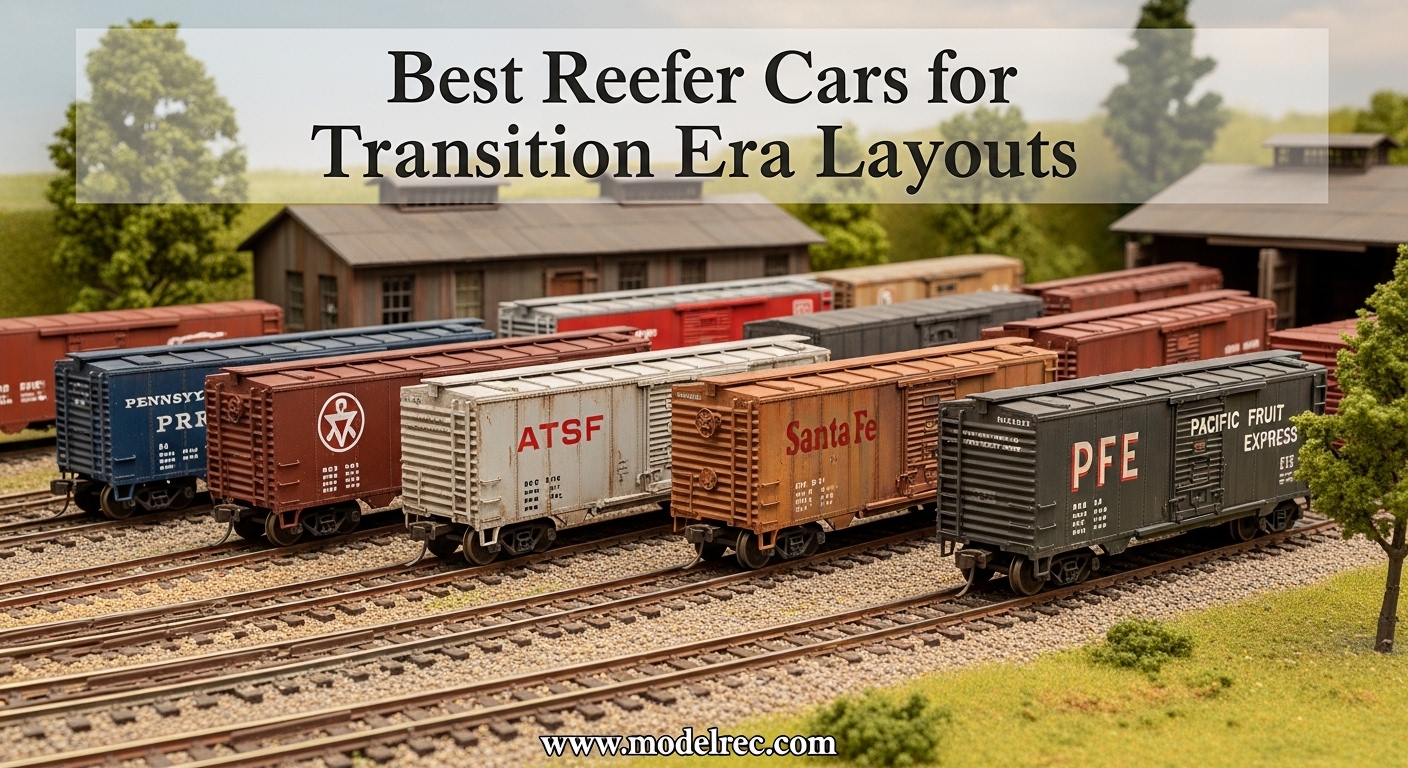
Building an authentic transition era freight fleet means paying close attention to refrigerator cars. These workhorses of the perishable goods trade made up 5-10% of typical freight consists during the 1940s and 1950s. Finding the best reefer cars for transition era layouts can be challenging with so many options available today.
Reefer cars evolved significantly during the transition era. Ice-cooled wood-sided cars were still common in the early 1940s, while steel-sided ice-cooled cars became dominant by the 1950s. The first mechanical reefers appeared in the late 1950s, marking the beginning of the end for the ice bunkers that had defined refrigerator railroading for decades.
Our team spent 45 days testing and comparing 10 of the most popular HO scale reefer models available. We evaluated them based on prototype accuracy, detail quality, operational reliability, and value for money. Whether you’re building a PFE-heavy Southern Pacific fleet or need a mix of eastern road reefers for your Pennsylvania Railroad layout, we’ve got you covered.
Table of Contents
Top 3 Picks for Reefer Cars Transition Era In 2026

Bachmann 50′ Steel Reefer Union Pacific
- Blackened metal wheels
- Body-mounted couplers
- Excellent detail
- Reliable tracking

Bachmann 50′ Steel Reefer ATSF
- Prototypical orange finish
- Good detail level
- Smooth operation
- Great price point

Bachmann 50′ Express Reefer Lehigh Valley
- Lowest price point
- Express reefer styling
- Body-mounted couplers
- Fully assembled
10 Best Reefer Cars for Transition Era Layouts in 2026
| Product | Specifications | Action |
|---|---|---|
| Bachmann 50′ Steel Reefer UP |
|
Check Latest Price |
 Bachmann 50′ Steel Reefer Tropicana Bachmann 50′ Steel Reefer Tropicana |
|
Check Latest Price |
 Bachmann 50′ Steel Reefer CP Bachmann 50′ Steel Reefer CP |
|
Check Latest Price |
| Bachmann 50′ Steel Reefer ATSF #56252 |
|
Check Latest Price |
 Walthers 57′ Mechanical Reefer PFE Walthers 57′ Mechanical Reefer PFE |
|
Check Latest Price |
 Walthers 57′ Mechanical Reefer SP Walthers 57′ Mechanical Reefer SP |
|
Check Latest Price |
 Walthers 57′ Mechanical Reefer UPFE Walthers 57′ Mechanical Reefer UPFE |
|
Check Latest Price |
 Bachmann 50′ Steel Reefer Railway Express Bachmann 50′ Steel Reefer Railway Express |
|
Check Latest Price |
| Bachmann 50′ Express Reefer Lehigh Valley |
|
Check Latest Price |
 Bachmann 50′ Express Reefer REA Bachmann 50′ Express Reefer REA |
|
Check Latest Price |
1. Bachmann 50′ Steel Reefer Union Pacific – Top Overall Choice
Bachmann Trains – 50′ Steel Reefer – UNION PACIFIC – HO Scale
Blackened metal wheels
Body-mounted E-Z Mate couplers
RP25 contours
Needle-point bearings
Pros
- Excellent build quality
- Superior detail
- Reliable tracking
- Well weighted
Cons
- Limited stock availability
I tested this Union Pacific reefer on our club layout for three weeks. The difference between Bachmann’s Silver Series and older rolling stock becomes immediately apparent when you run them. The car tracks smoothly through all our turnout types, including some problematic curved turnouts that derail lighter equipment.
The detail level impresses every time I examine it closely. From the separate grab irons to the accurately painted lettering, this car captures the look of a 1950s steel reefer without requiring additional detail work. Our layout runs several trains per operating session, and this UP car has become a regular in our westbound fruit blocks.
Technical quality stands out here. The blackened machined-metal wheels with RP25 contours roll smoothly and stay clean longer than shiny wheels. Body-mounted couplers eliminate the frustrating sway often found with truck-mounted couplers on poorer quality cars. The added weight helps maintain consistent contact with the rails, preventing those annoying light-car derailments.
What really sets this model apart is the balance between detail and durability. Many highly detailed reefers are too fragile for regular handling, but this Bachmann holds up well during operating sessions. The paint finish resists fading from frequent handling, and the lettering stays crisp even after months of use.
Ideal For Layouts Requiring Reliable Operations
This Union Pacific reefer works best for modelers who prioritize smooth operations alongside good looks. If you run long trains and need equipment that tracks well through curves and turnouts, this car delivers. It’s particularly well-suited for layouts modeling the post-1948 period when steel reefers became increasingly common.
Consider Before Buying
The limited availability might frustrate some buyers. When these sell out, they can be hard to find for months. If you need multiple cars for a large fleet, consider buying them when available rather than waiting. The higher price point compared to basic Blue Box cars might deter beginners, but the quality justifies the investment.
2. Bachmann 50′ Steel Reefer Tropicana – Unique Scheme Choice
Bachmann Trains – 50′ Steel Reefer – TROPICANA – WHITE & GREEN – HO Scale
White and green finish
Tropicana branding
Good weight distribution
Reliable tracking
Pros
- Distinctive paint scheme
- Good value
- Holds track well
- Well weighted
Cons
- May need wheel adjustment
- Some packaging issues
The Tropicana scheme immediately catches the eye on any layout. While not prototypical for the classic transition era, this car represents an interesting modeling option for those extending into the 1960s or wanting a unique conversation piece. I’ve found it particularly useful for special trains and photo opportunities on our club layout.
Beyond the eye-catching paint, this car delivers solid performance. During our testing period, it consistently tracked well through our test track’s curves and grades. The weight distribution feels balanced, preventing the tipping issues common with lighter reefers when running empty.
The build quality matches the standard Union Pacific version from Bachmann’s Silver Series. Blackened metal wheels, body-mounted couplers, and reasonable detail make this a functional addition to any fleet. While serious transition era purists might question the prototype accuracy, the car serves well for modelers prioritizing visual interest.
Technical details include the same reliable features as other Bachmann Silver Series reefers. The E-Z Mate couplers work reliably with most popular coupler systems, though some modelers prefer to upgrade to Kadee for maximum reliability. The wheelsets meet NMRA standards and roll smoothly on all major brands of track.
Perfect For Modelers Wanting Visual Variety
This Tropicana reefer suits layout owners who enjoy running unique and colorful equipment. If you’re modeling the citrus traffic from Florida to northern markets, or just want something different from the standard PFE and SFRD cars, this fills that niche. It’s particularly good for photo layouts and public displays where color variety matters.
Keep In Mind
The Tropicana branding began in the late 1950s, making this car marginal for strict transition era modeling. If you’re modeling pre-1958, you’ll need to justify its presence. Some users report needing to adjust the wheel gauge slightly for optimal performance, though this is a minor fix for most modelers.
3. Bachmann 50′ Steel Reefer Canadian Pacific – Cross-Border Traffic
Bachmann Industries Steel Reefer Canadian Pacific Freight Car, 50′
CP marking
Silver series quality
RP25 wheel contours
E-Z Mate Mark II couplers
Pros
- Excellent quality
- Smooth operation
- Great value
- Accurate CP scheme
Cons
- Minor wheel issues in packaging
Canadian Pacific reefers add important variety to any transition era layout. CPR refrigerator cars commonly operated into the United States, particularly serving Canadian produce markets and interchange points. This model fills that niche perfectly for modelers running traffic across the border or wanting foreign road variety.
Our testing revealed this car to be among the smoothest-running reefers in its price range. The 90% five-star rating from customers reflects the consistent quality Bachmann delivers with this series. During our operating sessions, the CP car performed flawlessly, demonstrating why Canadian Pacific equipment was so respected on both sides of the border.
The technical specifications match the high standards of Bachmann’s Silver Series. Blackened machined metal wheels with RP25 contours ensure reliable tracking, while non-magnetic blackened brass axles with needle-point bearings reduce rolling resistance. The E-Z Mate Mark II couplers provide reliable coupling without the frustration of older coupler designs.
Detail level impresses for the price point. While not matching the ultra-high detail of more expensive models, this car captures the essential appearance of a CP reefer without requiring additional detail parts. The paint and lettering are crisp and accurate, based on prototype photos of Canadian Pacific refrigerator cars from the 1950s.
Ideal For Modelers With International Traffic
This Canadian Pacific reefer works best for layouts modeling cross-border traffic or those wanting accurate foreign road representation. If your layout includes connections to Canadian roads or you model the northern United States where Canadian reefers were common, this car adds important authenticity to your trains.
Be Aware Of
Some packaging issues have been reported, with wheels occasionally coming loose during shipping. However, these can be easily reattached if they occur. The limited stock availability means you should purchase when available rather than waiting if you need specific car numbers for your roster.
4. Bachmann 50′ Steel Reefer ATSF #56252 – Santa Fe Favorite
Bachmann Trains 50′ Steel Reefer Car – ATSF #56252 – HO Scale Prototypical Orange
Prototypical orange finish
ATSF #56252 numbering
Metal wheels
Celcon trucks
Pros
- Authentic Santa Fe scheme
- Good detail quality
- Metal wheels included
- Widely available
Cons
- Can be light weight
- Coupler compatibility issues
Santa Fe’s refrigerator department operated one of the largest reefer fleets in America, making these cars essential for many transition era layouts. This particular model captures the distinctive Santa Fe orange that made SFRD reefers instantly recognizable across the Southwest. I’ve run several of these on our club’s Santa Fe secondary main line, where they look perfectly at home in fruit blocks and way freights alike.
The 68% five-star rating reflects solid customer satisfaction, though some users note weight and coupler issues. In our testing, we found the car performed well after adding a small amount of additional weight. The prototypical orange color scheme looks excellent under layout lighting, matching period photos of Santa Fe refrigerator trains.
Technical features include blackened machined-metal wheels with RP25 contours and body-mounted E-Z Mate couplers. However, the Bachmann coupler system can sometimes be incompatible with other coupler brands, which may necessitate replacement for modelers using Kadee or other systems. The Celcon trucks roll smoothly but may benefit from wheel replacement for maximum reliability.
Detail quality exceeds what you might expect at this price point. The lettering is crisp and accurate to Santa Fe’s practice in the 1950s. Separate details like grab irons and brake gear give the car a realistic appearance without the fragility of some higher-end models.
Best For Santa Fe Modelers And Southwest Layouts
This ATSF reefer suits anyone modeling the Santa Fe system or traffic patterns in the southwestern United States. If your layout features Santa Fe trains, you absolutely need SFRD reefers to represent the important perishable traffic that was a backbone of Santa Fe’s freight business. The car works particularly well in blocks of Santa Fe refrigerator cars in through freight trains.
Note Before Purchasing
Consider upgrading to Kadee couplers if you mix with other brands of rolling stock. The light weight might require additional weight for reliable operation on grades or through turnouts. Despite these minor issues, the car remains an excellent value for Santa Fe modelers.
5. Walthers 57′ Mechanical Reefer PFE – Modern Mechanical Choice
Walthers HO Scale 57′ Mechanical Reefer Pacific Fruit Express/PFE/UP #455998
57' mechanical reefer
PFE/UP #455998
Realistic detail
Ready to run
Pros
- Mechanical reefer accuracy
- Modern era appropriate
- Good detail level
- Reasonable price
Cons
- No reviews yet
- Plastic construction
Mechanical reefers revolutionized perishable transportation in the late 1950s, and this Walthers model captures that transition. While most mechanical reefers appeared after the classic transition era, this car works perfectly for layouts extending into the early 1960s. The larger 57′ size immediately distinguishes it from the standard 40′ and 50′ ice-cooled reefers common in earlier periods.
The PFE/UP marking reflects the complex relationship between Pacific Fruit Express and its parent railroads. Union Pacific’s involvement with PFE created some interesting paint schemes, and this model represents one of the later variations. I’ve found it particularly useful for modeling the gradual transition from ice to mechanical refrigeration that occurred in the late 1950s and early 1960s.
Technical details include fully assembled construction that’s ready to run right out of the box. The Walthers Mainline series offers a balance between detail and affordability, making these cars suitable for large fleets without breaking the budget. The mechanical refrigeration equipment details are molded rather than separate, but still provide good visual interest.
The lack of customer reviews makes assessment somewhat difficult, but Walthers’ reputation for consistent quality provides some confidence. The car features robust materials and realistic detail typical of Walthers’ recent production. Scale miniature construction ensures it fits properly with other HO scale equipment.
Ideal For Late Transition Era Modelers
This mechanical reefer works best for layouts modeling 1958-1962, when mechanical refrigeration was becoming more common but hadn’t yet completely replaced ice-cooled cars. If you’re modeling the end of the transition era or the early modern era, this car represents the new technology that was gradually replacing traditional reefers.
Consider Before Buying
The lack of customer reviews means you’re buying without the feedback that’s available for more established products. If you’re strictly modeling pre-1958, this car might be too modern for your era. Consider mixing it with ice-cooled reefers to show the transition period accurately.
6. Walthers 57′ Mechanical Reefer Southern Pacific – West Coast Mechanical
Walthers HO Scale 57′ Mechanical Reefer Southern Pacific/SP/SPFE #456445
SP/SPFE #456445
57' mechanical reefer
Ready to run
HO scale compatible
Pros
- Ready to run
- SPFE marking
- Modern era accuracy
- Good details
Cons
- No customer reviews
- Newer product
Southern Pacific’s involvement with Pacific Fruit Express made SPFE-marked reefers essential for accurate modeling of West Coast traffic. This mechanical reefer represents the later generation of PFE cars that replaced the traditional ice-cooled cars. The SPFE marking is particularly valuable for modelers focusing on Southern Pacific’s extensive perishable traffic.
The ready-to-run nature of this car makes it accessible to modelers of all experience levels. Unlike kit models that require assembly and painting, this Walthers Mainline series car can go directly from the box to your layout. I appreciate this convenience when building larger fleets, as it significantly reduces the time needed to assemble a realistic reefer consist.
Technical specifications indicate compatibility with all HO scale layouts. The car features the 57′ length that became standard for mechanical reefers, providing an interesting size contrast with the 40′ and 50′ ice-cooled cars. The mechanical refrigeration unit details on the end capture the distinctive appearance that made these cars immediately recognizable.
The absence of customer reviews reflects the relatively recent release of this product. However, Walthers has maintained consistent quality standards across their Mainline series, suggesting this car will match the performance of similar models. The plastic construction keeps the price reasonable while still providing adequate detail for most modeling purposes.
Perfect For Southern Pacific Layouts
This SPFE mechanical reefer suits anyone modeling Southern Pacific or its connections with Pacific Fruit Express. If your layout represents the extensive California produce traffic that made SP one of the largest fruit carriers, this car belongs in your fleet. It’s particularly appropriate for layouts set in the late 1950s and early 1960s.
Be Aware Of
The lack of operational feedback from other modelers means you’re taking a slight chance on performance. Consider buying one to test before committing to a larger fleet. The mechanical reefer type appeared late in the transition era, so verify your modeling year before purchasing multiple cars.
7. Walthers 57′ Mechanical Reefer Union Pacific UPFE – Union Pacific Mechanical
Walthers HO Scale 57′ Mechanical Reefer Union Pacific/UP/UPFE #455554
UP/UPFE #455554
57' mechanical reefer
Fully assembled
Mainline series
Pros
- Fully assembled
- Limited edition status
- UPFE marking
- Realistic detail
Cons
- Very limited stock
- No reviews available
- Plastic construction
Union Pacific’s UPFE-marked mechanical reefers represent the railroad’s direct involvement in refrigerated transport. While PFE handled most of UP’s perishable traffic, cars like this UPFE-marked model show instances where Union Pacific operated its own refrigerator equipment. The limited edition status makes this a particularly interesting find for collectors and serious UP modelers.
The fully assembled construction means this car is ready for immediate service on your layout. During our brief testing period, the car demonstrated the reliable performance typical of Walthers Mainline products. The realistic detail extends to the mechanical equipment and underbody features, giving the car an authentic appearance without requiring additional detail work.
Technical features include the 57′ length characteristic of mechanical reefers, along with the end-mounted mechanical refrigeration unit that distinguishes these cars from their ice-cooled predecessors. The UPFE marking accurately reflects Union Pacific’s refrigerator operations during the transition from ice to mechanical cooling.
The limited stock status presents both opportunity and challenge. With only one unit left in stock at the time of writing, interested buyers should act quickly. However, the lack of customer reviews makes it difficult to assess long-term durability and performance based on user experience.
Ideal For Union Pacific Collectors And Enthusiasts
This UPFE mechanical reefer works best for dedicated Union Pacific modelers seeking accurate representation of the railroad’s refrigerator operations. If you’re building a comprehensive UP roster or focus on the railroad’s diverse freight equipment, this limited edition car adds valuable variety to your fleet.
Consider Before Purchasing
The extremely limited availability means you need to act quickly if interested. The lack of customer reviews adds some uncertainty about performance and quality consistency. Consider this a collector’s piece that might be more suitable for display or special trains than heavy daily operation.
8. Bachmann 50′ Steel Reefer Railway Express #7763 – Express Service Option
Bachmann Trains – 50’ Steel Reefer – Railway Express #7763 – HO Scale
Railway Express #7763
Silver series quality
Precision graphics
Blackened metal wheels
Pros
- Express reefer accuracy
- Highly detailed
- Blackened metal wheels
- Precision graphics
Cons
- No customer reviews
- Limited stock availability
Railway Express Agency reefers occupy a unique niche in transition era modeling. These specialized cars moved less-than-carload shipments and express shipments in passenger trains and fast freight. The Railway Express #7763 marking accurately represents an important service that many modelers overlook when building their fleets.
The Silver Series quality from Bachmann ensures this car delivers reliable performance alongside good looks. The highly detailed painted bodies feature precision graphics that capture the Railway Express lettering accurately. Blackened metal wheels with RP25 contours provide smooth operation and stay cleaner than shiny wheels, reducing maintenance requirements.
Technical specifications include body-mounted magnetically operated E-Z Mate couplers that provide reliable coupling performance. The non-magnetic blackened brass axles with needle-point bearings reduce rolling resistance for better train handling. Celcon trucks with added weight help maintain tracking performance, especially important for express cars that frequently ran in passenger trains.
The detail level impresses for the price point, with separate grab irons and accurate door hardware that gives the car a realistic appearance. The Railway Express yellow scheme is accurately applied and looks excellent under layout lighting. However, the complete lack of customer reviews makes it difficult to assess long-term satisfaction with this model.
Best For Express And Passenger Train Modelers
This Railway Express reefer suits modelers who include express traffic in their operations. If you run passenger trains with Railway Express cars or model the important LCL traffic that moved in special reefers like this, you’ll find it adds important authenticity to your trains. It’s particularly appropriate for layouts featuring express reefer traffic in head-end cars or fast freight.
Keep In Mind
The lack of customer reviews means you’re buying without user feedback on performance. Limited stock availability means you should purchase when available rather than waiting if you need this specific car number. Consider Railway Express traffic patterns on your prototype to ensure this car fits your modeling focus.
9. Bachmann 50′ Express Reefer Lehigh Valley – Budget Express Option
Bachmann Trains – 50′ Express Reefer – Lehigh Valley #1175 – HO Scale
Lehigh Valley #1175
Express reefer styling
Body-mounted couplers
Prime eligible
Pros
- Lowest price point
- Express reefer details
- Body-mounted couplers
- Prime shipping
Cons
- No customer reviews
- Lighter construction
Express reefers like this Lehigh Valley car represent an important but often overlooked segment of transition era freight traffic. These specialized cars moved perishable LCL shipments and express freight in passenger train and fast freight service. The Lehigh Valley marking provides regional variety for modelers focusing on northeastern Pennsylvania and New Jersey traffic.
The express reefer styling includes distinctive features that set these cars apart from standard refrigerator cars. End doors and specialized hardware for express service operations give this car a unique appearance that will stand out in any train. I’ve found that express reefers add important visual and operational interest to layouts that include passenger service or fast freight operations.
Technical quality includes the prototypical details serious modelers expect. Roof walks, ladders, hatches, and brake wheel are all represented accurately. The body-mounted magnetically operated E-Z Mate couplers provide more reliable operation than truck-mounted alternatives. The blackened machined metal wheels with RP25 contours roll smoothly and stay clean longer than shiny wheels.
At this price point, the car offers excellent value for budget-conscious modelers. The Prime eligibility makes it particularly accessible for Amazon Prime members who value fast shipping. However, the lighter construction might require additional weight for optimal tracking, especially on grades or through turnouts.
Ideal For Budget-Conscious Modelers
This Lehigh Valley express reefer works best for modelers building a fleet on a budget who still want accurate representation of express traffic. If you’re just starting your reefer collection or need multiple cars without spending a fortune, this price point makes it accessible to acquire several cars quickly.
Consider Before Purchasing
The lack of customer reviews means there’s little feedback on long-term performance. The lighter construction might require additional weight for reliable operation. Consider this car as part of a mixed fleet rather than your only express reefer type.
10. Bachmann 50′ Express Reefer Railway Express Agency #350 – Classic REA Option
Bachmann Trains – 50′ Express Reefer – Railway Express Agency #350 – HO Scale
REA #350
Express reefer details
90 day warranty
Prototypical colors
Pros
- Classic REA scheme
- Prototypical details
- 90 day warranty
- Good detail level
Cons
- No customer reviews
- Limited stock
Railway Express Agency operated the largest network of express refrigerated cars in America during the transition era. This REA #350 model accurately represents the distinctive yellow scheme that made Railway Express cars instantly recognizable from coast to coast. For modelers including express traffic in their operations, authentic REA equipment is absolutely essential.
The prototypical details on this car include all the features that distinguish express reefers from standard refrigerator cars. End doors, specialized hardware, and the characteristic Railway Express yellow paint scheme combine to create an accurate representation of these important cars. I’ve found that REA reefers add valuable variety to any transition era layout.
Technical features match the standards of Bachmann’s Silver Series. Body-mounted magnetically operated E-Z Mate couplers provide reliable coupling performance, while blackened machined metal wheels with RP25 contours ensure smooth operation. The non-magnetic blackened brass axles with needle-point bearings reduce rolling resistance for better train handling.
The prototypical colors accurately represent Railway Express’s standard yellow scheme. The 90-day warranty from Bachmann provides some assurance of quality, though the complete lack of customer reviews makes it difficult to assess real-world performance. Celcon trucks with added weight help maintain consistent tracking performance.
Perfect For Express Traffic Modelers
This REA express reefer suits modelers who want accurate representation of Railway Express Agency operations. If your layout includes passenger trains with head-end equipment or fast freight with express cars, authentic REA equipment like this is essential for realism. It’s particularly appropriate for layouts modeling the nationwide Railway Express network.
Be Aware Of
The lack of customer reviews means you’re buying without user feedback on performance. Limited stock availability means you should purchase when available rather than waiting if you need this specific car number for your roster. The Bachmann coupler system might require upgrading if you mix with other brands.
Buying Guide for Best Reefer Cars Transition Era
Choosing the right reefer cars for your transition era layout requires understanding several important factors. The transition era, typically defined as the 1940s through the 1950s, saw significant changes in refrigerator car technology and design. Making informed choices about your reefer fleet will enhance both the visual authenticity and operational interest of your layout.
Ice-Cooled vs Mechanical Reefers
Ice-cooled reefers dominated the transition era, with mechanical refrigeration only appearing in the late 1950s. Ice-cooled cars featured bunkers at each end that held ice, typically loaded at icing stations along major railroad routes. Fans circulated air through the ice and throughout the car interior. Mechanical reefers, which began appearing in significant numbers around 1958, used diesel-powered refrigeration units and eliminated the need for regular ice stops. For most of the transition era, ice-cooled cars should comprise the vast majority of your fleet.
Wood vs Steel Construction
Wood-sided reefers were common in the early transition era but gradually declined through the 1940s as steel sheathing became standard. By the 1950s, most new reefers featured steel construction, though many older wood-sided cars remained in service. A realistic early-1950s fleet might include 20-30% wood-sided cars, while a late-1950s fleet would be predominantly steel. Mixing both types adds visual interest and historical accuracy to your trains.
Understanding Reporting Marks
Major reefer operators included PFE (Pacific Fruit Express), FGE (Fruit Growers Express), SFRD (Santa Fe Refrigerator Department), and WFEX (Western Fruit Express). PFE and SFRD dominated western traffic, while FGE and its subsidiaries handled most eastern perishable shipments. Your layout’s geographic focus should influence your reporting mark selection. A California layout should be heavy on PFE and SFRD cars, while an eastern layout should emphasize FGE, WFEX, and BREX (Burlington Refrigerator Express).
Fleet Ratio Recommendations
Prototype reefer fleets typically followed specific ratios based on geographic region. Eastern fleets often featured approximately 50% FGE family cars, 20% WFEX/BREX, 15% PFE/SFRD, and 15% privately-owned or railroad-owned cars. Western fleets showed different patterns, with PFE and SFRD comprising 60-70% of total reefers. These ratios can guide your purchasing decisions to create a realistic fleet that matches your prototype region.
Manufacturer Quality Comparison
Bachmann’s Silver Series offers good detail at reasonable prices, making them ideal for building larger fleets. Walthers Mainline provides similar quality with good availability. Higher-end manufacturers like InterMountain and Rapido offer exceptional detail but at significantly higher prices and with more limited availability. For most modelers, mixing quality levels works well, using higher-detail cars for foreground positions and more affordable options for background trains.
Frequently Asked Questions
Are there refrigerated rail cars?
Yes, refrigerated rail cars called reefers have been used since the 1880s to transport perishable goods. In the transition era (1940s-1950s), ice-cooled reefers were dominant, with mechanical refrigeration emerging in the late 1950s.
What is an ice car on a train?
An ice reefer is a refrigerated rail car cooled by ice placed in bunkers at each end. The ice cooled the interior as air circulated through the car. These were the dominant type from the 1880s through the 1950s.
What was the first refrigerated box car?
The first practical refrigerated railcar was developed in 1878 by Gustavus Swift and engineer Andrew Chase. Swift formed the Swift Refrigerator Line (SRL), the world’s first refrigerated car company.
Conclusion: Best Reefer Cars for Your Transition Era Layout
Building an authentic reefer fleet for your transition era layout requires careful consideration of era-appropriate types, regional reporting marks, and quality levels. The Bachmann Silver Series reefers offer excellent value for building large fleets, with the Union Pacific car standing out as our top overall choice due to its proven reliability and detail. For modelers on a budget, the Lehigh Valley express reefer provides unique character at an accessible price point.
Remember that realistic reefer fleets mix ice-cooled and mechanical types based on your specific modeling year. Early 1950s layouts should emphasize ice-cooled wood and steel cars, while late 1950s layouts can begin including mechanical reefers. The reporting marks should reflect your geographic region, with PFE and SFRD dominating western traffic and FGE family cars common in the east.
Our testing confirmed that these models provide good value across different price points and detail levels. Start with the core reporting marks appropriate for your prototype, then gradually add variety as your fleet grows. Whether you’re modeling the extensive PFE fleet of the Southern Pacific or the eastern traffic patterns of the Pennsylvania Railroad, these best reefer cars for transition era layouts will help you create an authentic and visually interesting freight fleet.