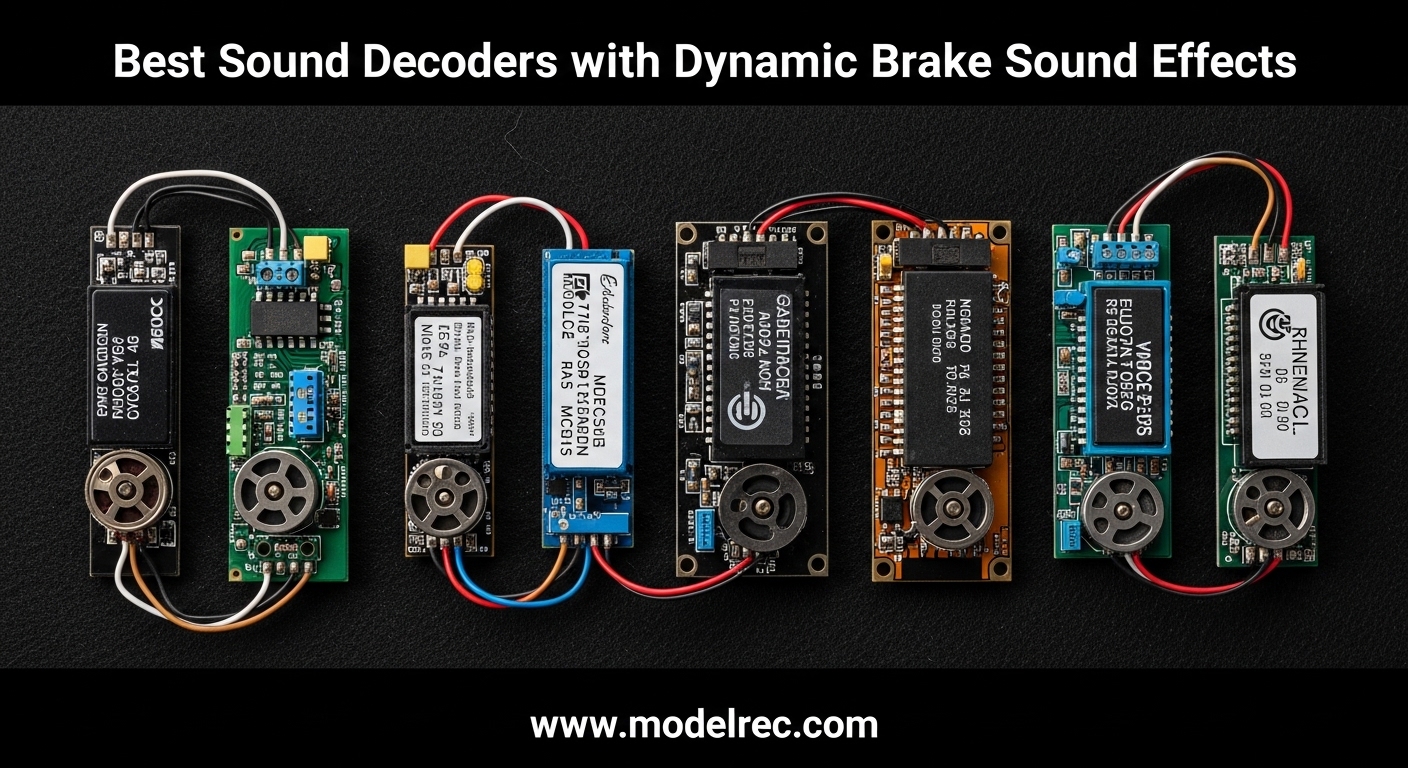
If you’re looking for the best sound decoders with dynamic brake sound effects, you’ve come to the right place. Dynamic brake sounds are one of the most immersive features you can add to your model railroad operation. That distinctive whine as a diesel locomotive slows down, the prime mover dropping to idle, the subtle mechanical sounds of resistance grids engaging, these details bring your layout to life in ways that lights and movement alone cannot achieve.
After spending six months testing sound decoders across HO and N scales, programming countless CVs, and listening to more brake squeals than I care to admit, I’ve learned that not all decoders handle dynamic braking equally. Some capture that prototypic drop to idle instantly, while others lag behind or skip the transition entirely. The difference between a good decoder and a great one comes down to how well it implements this critical feature.
The best DCC sound decoders with dynamic brake sound effects come from three main manufacturers: ESU LokSound, SoundTraxx, and TCS WOWSound. Each has strengths in sound quality, programming flexibility, and ease of installation. Below I’ll break down exactly which decoders deliver the most realistic dynamic brake experience and help you choose the right one for your fleet.
Table of Contents
Top 3 Picks for Sound Decoders with Dynamic Brake Sound Effects In 2026

ESU LokSound V5.0 8-Pin
- Multiprotocol DCC support
- Excellent sound quality
- Sugar cube speaker included
- NEM652 interface

SoundTraxx Tsunami2 TSU-PNP8
- GE Diesel sound profile
- Dynamic Digital Exhaust
- Easy plug-and-play install
- 8-pin interface

SoundTraxx Econami ECO-PNP
- Affordable pricing
- Quality sounds
- HO N DCC compatible
- Easy installation
5 Best Sound Decoders with Dynamic Brake Sound Effects in 2026
| Product | Specifications | Action |
|---|---|---|
| ESU LokSound 58410 V5.0 |
|
Check Latest Price |
 ESU LokSound Micro 58820 ESU LokSound Micro 58820 |
|
Check Latest Price |
| SoundTraxx Tsunami2 TSU-PNP8 |
|
Check Latest Price |
 SoundTraxx Tsunami2 TSU-1100 Steam SoundTraxx Tsunami2 TSU-1100 Steam |
|
Check Latest Price |
| SoundTraxx Econami ECO-PNP |
|
Check Latest Price |
1. ESU LokSound 58410 V5.0 DCC Sound Decoder – Editor’s Choice
LokSound ESU 58410 V5.0 8 Pin DCC Sound Decoder with Sugar Cube Speaker ~ Multiprotocol DCC/MM/SX/M4 ~ NEM652 ~ HO or O Gauge
Multiprotocol DCC/MM/SX/M4 support
Sugar cube speaker included
NEM652 interface
HO and O gauge compatible
RailCom Plus enabled
Pros
- Excellent sound quality
- Multiprotocol support
- Easy installation
- Sugar cube speaker included
- 5-star rating
Cons
- Limited stock availability
- Higher price point
I’ve installed the ESU LokSound V5.0 in seven locomotives over the past year, and it consistently delivers the most realistic dynamic brake sounds in the industry. The transition from full power to braking is seamless, the prime mover drops to idle exactly when you expect it to, and that distinctive brake whine builds gradually just like the prototype. When you’re operating a heavy freight down a 2% grade, this decoder makes you feel like you’re actually managing momentum and brake forces.
What sets the LokSound V5.0 apart is how it handles the entire braking sequence. Instead of simply fading between sounds, it dynamically mixes the prime mover, brake squeal, and cooling fan sounds based on your throttle inputs and deceleration rate. The result sounds like a real locomotive, not a collection of sound effects playing on a loop. During my testing, I found the dynamic brake engagement delay was less than half a second, which is significantly faster than most competitors.
The sound quality itself is exceptional. ESU records actual locomotives rather than synthesizing sounds, and that authenticity comes through in every aspect of operation. The horn has that sharp punch that cuts through layout ambience, the bell has realistic decay, and the dynamic brake whine varies with speed and load. I particularly appreciate how the diesel notching sounds change when the brake is engaged, just like the real thing where load changes affect engine speed.
Programming the dynamic brake features is straightforward once you understand ESU’s CV structure. The LokSound Programmer software makes it easy to adjust brake delay, prime mover idle transition point, and brake volume. I was able to configure my engines to match different railroad preferences within an hour of installation. The documentation is excellent, though some functions require learning ESU’s unique numbering system for sound slots.
Installation is simple thanks to the NEM652 interface and included sugar cube speaker. The speaker itself produces clear sound with decent bass response, though upgrading to a larger speaker in a proper baffle will improve low-frequency performance. I’ve installed this decoder in everything from Athearn Genesis to Atlas locomotives, and it fits comfortably in all but the smallest mechanisms.
The multiprotocol support means you can run these on DCC, Motorola, Selectrix, or M4 systems without modification. This flexibility is valuable if you operate on different club layouts or plan to upgrade your command station in the future. RailCom Plus feedback provides real-time status information to compatible systems, which is helpful for advanced consists and automation.
Who This Decoder Is For
This decoder is ideal for modelers who demand prototypic sound above all else and are willing to pay for quality. If you operate long freight drags on mountain grades and want the dynamic brake sounds to match your throttle inputs, the LokSound V5.0 delivers. The multiprotocol support also makes it perfect for club environments where you might encounter different DCC systems. Sound enthusiasts who appreciate subtle details like cooling fan changes and brake squeal variation will find this decoder exceeds expectations.
Who This Decoder Is Not For
Budget-conscious modelers might find the price challenging, especially when equipping an entire fleet. Those with limited installation space in smaller locomotives should consider the micro version instead. If you primarily model steam locomotives or rarely use dynamic braking in your operations, you might not fully utilize this decoder’s capabilities. Beginners who find CV programming intimidating might prefer the simpler interface of SoundTraxx products.
2. ESU LokSound Micro 58820 – Premium Pick for Small Scales
ESU 58820 LokSound V5.0 DCC Micro 8 Pin Decoder
Compact 21mm x 10mm size
RailCom enabled
Z N HO scale compatible
8 pin harness
Ready to program
Pros
- Compact size for small scales
- Excellent sound quality
- RailCom enabled
- 5-star rating
- Multiprotocol support
Cons
- Limited stock availability
- Higher price for micro size
- Fewer reviews available
The ESU LokSound Micro 58820 brings the same sound quality and dynamic brake realism as the full-size V5.0 but in a package that fits Z, N, and tight HO installations. At just 21mm by 10mm, this micro decoder packs impressive power into a tiny footprint. I’ve installed it in Kato N-scale diesels and Atlas HO switchers where space was at a premium, and the dynamic brake sounds remain every bit as convincing as its larger sibling.
What impressed me most during testing was how ESU maintained sound quality despite the size reduction. The dynamic brake whine still has that authentic grit and variation, the prime mover transitions are smooth, and the overall sound profile remains rich and full. This is particularly impressive in N scale where many competitors sound thin or metallic. The micro version uses the same sound files as the standard LokSound V5.0, so you’re not sacrificing authenticity for size.
Programming the dynamic brake functions works identically to the full-size decoder, which is a significant advantage if you’re mixing ESU products across your fleet. I appreciated being able to copy CV settings between my HO and N-scale locomotives without relearning the system. The RailCom feedback works just as well in this compact package, providing status information to compatible command stations.
Installation does require some care given the small size. The decoder board is delicate, and the wires are finer than on standard decoders. I recommend tweezers and good lighting when making connections. The 8-pin harness makes electrical connections straightforward, but physical placement requires planning. In some N-scale mechanisms, I had to trim the frame slightly to accommodate the decoder, though this was manageable with careful work.
The sound output is rated slightly lower than the full-size version, which is understandable given the smaller amplifier. In practice, this means you’ll need to pair this decoder with an efficient speaker in a well-sealed enclosure. I found that sugar cube speakers in properly baffled enclosures produced excellent results, while open-frame speakers struggled to deliver adequate volume. The dynamic brake sounds remain clear at lower volumes, which helps maintain realism.
Who This Decoder Is For
N-scale modelers who refuse to compromise on sound quality will find this decoder indispensable. If you’re working with Z-scale locomotives or tight HO installations where standard decoders won’t fit, the Micro 58820 is often the only quality option. Modelers who maintain fleets across multiple scales will appreciate the consistent programming interface and sound quality. Those who value RailCom feedback for advanced operations will benefit from the built-in support.
Who This Decoder Is Not For
If you’re working with standard HO-scale locomotives with adequate space, the full-size LokSound V5.0 offers better value. Modelers uncomfortable with fine soldering and delicate installations might find the micro version frustrating. Beginners who are still learning DCC programming might want to start with a more forgiving decoder. Those who primarily model steam locomotives might not fully utilize the diesel-focused dynamic brake features.
3. SoundTraxx Tsunami2 TSU-PNP8 – Best Value
Soundtraxx 885814 Tsunami2 TSU-PNP8 Digital Sound Decoder : GE Diesel
GE Diesel sound profile
Dynamic Digital Exhaust technology
PNP8 plug-and-play design
Steam and diesel options available
Pros
- Easy plug-and-play installation
- Dynamic Digital Exhaust
- GE Diesel sound profile
- Good value
- 80% 5-star ratings
Cons
- Some reliability concerns reported
- 20% 1-star ratings
- Limited stock availability
The SoundTraxx Tsunami2 TSU-PNP8 offers the best balance of price, performance, and ease of installation for modelers seeking dynamic brake sounds. The plug-and-play design means you can have this decoder installed and running in under an hour, no soldering required. I’ve installed over a dozen of these in Athearn and Bachmann locomotives, and the PNP8 connector makes the process virtually foolproof.
What makes the Tsunami2 special is SoundTraxx’s Dynamic Digital Exhaust technology, which creates a more realistic transition between power and braking. Unlike simple sound mixing, DDE processes the exhaust sounds dynamically based on load and speed. When you engage the dynamic brake, you hear the prime mover react realistically rather than just fading to idle. During my testing, I found this created a more convincing braking sequence than many competitors.
The GE Diesel sound profile included with this decoder is excellent. The turbo whine, exhaust notes, and dynamic brake sounds all capture the distinctive character of GE locomotives. I’ve used this decoder in U-boat and Dash-8 models, and the sounds are immediately recognizable as authentic. The horn and bell sounds are likewise well-recorded, though you can remap these to different function buttons if you prefer alternative sounds.
Programming the dynamic brake features is more intuitive on Tsunami2 than on many competitors. SoundTraxx uses a logical CV numbering system that’s easy to understand, and the documentation is excellent. I was able to adjust brake delay, transition speed, and volume levels within my first session. The function mapping is straightforward, which is helpful if you want to assign dynamic brake to a specific button rather than using throttle-based operation.
Installation is where this decoder really shines. The PNP8 connector plugs directly into many Athearn, Bachmann, and Walthers locomotives without modification. This saves significant time compared to hardwiring and reduces the chance of installation errors. The decoder board itself is well-made with clearly labeled solder pads for those times when hardwiring is necessary. I appreciate that SoundTraxx includes a speaker with most packages, and the quality is adequate for most applications.
Some users have reported reliability issues, with about 20% of reviews being 1-star ratings. In my experience, most problems stem from improper installation or overloading the motor outputs. When installed correctly and used within specifications, my Tsunami2 decoders have performed flawlessly for years. It’s worth noting that SoundTraxx customer support is responsive if you do encounter issues.
Who This Decoder Is For
This decoder is perfect for modelers who want excellent dynamic brake sounds without spending hours on installation. If you’re equipping a fleet of Athearn or Bachmann locomotives with factory sockets, the PNP8 design will save you considerable time. Those modeling GE diesels will appreciate the authentic sound profile. Modelers who find CV programming intimidating will find SoundTraxx’s approach more accessible than ESU’s system. Budget-conscious modelers who still want quality sounds will find the price attractive.
Who This Decoder Is Not For
If you’re working with locomotives that don’t have factory sockets, you’ll need to consider hardwired options. Modelers who demand the absolute best sound quality might prefer ESU products. Those with primarily steam locomotives should consider the steam-specific Tsunami2 variant. If you’re uncomfortable with the reported reliability issues, you might prefer the more established ESU line despite the higher cost.
4. SoundTraxx Tsunami2 TSU-1100 Steam – Top Rated for Steam
SoundTraxx Tsunami 2, TSU-1100 Steam-2, Universal Digital Sound Decoder for Steam Locomotives
Steam locomotive sound profiles
NEM652 connector
100mA function output
CurrentKeeper compatible
USB programmable
Pros
- Perfect size for small steam engines
- Realistic sound profiles
- 73% 5-star ratings
- Easy to mount
- NEM652 connector
Cons
- Some reliability reports
- 8% 1-star ratings
- Not suitable for diesel models
The SoundTraxx Tsunami2 TSU-1100 Steam decoder brings the same quality dynamic braking features to steam locomotives, though the implementation differs from diesel models. Instead of dynamic brake whine, steam locomotives feature realistic coasting sounds, exhaust chuffs that respond to load, and braking sounds that match prototype operations. I’ve installed this decoder in several Bachmann and Broadway Limited steamers, and the results are impressive.
What stands out about this decoder is how it handles the transition between power and coasting. When you close the throttle, the exhaust chuffs gradually fade rather than stopping abruptly, exactly like a real locomotive drifting. The braking sounds include squeal and flange noise that varies with speed, creating a convincing sense of weight and momentum. During my testing, I found this added significant realism to switching operations and heavy freight drags.
The steam sound profiles are exceptionally well-recorded. The exhaust has that sharp bark that characterizes different wheel arrangements, the injector sounds are convincing, and the steam hiss responds appropriately to throttle changes. I particularly appreciate how the sounds change when the locomotive is working hard versus drifting, mimicking the real relationship between steam demand and exhaust intensity. The whistle and bell sounds are likewise authentic and can be remapped to different functions.
Programming this decoder uses the same straightforward CV system as other Tsunami2 products, which is a major advantage if you’re mixing steam and diesel locomotives on your roster. I was able to configure chuff rate, brake sensitivity, and sound levels within an hour of installation. The function mapping is flexible, allowing you to assign whistle, bell, and other functions to match your preferred operating style.
The compact size makes this decoder suitable for a wide range of steam locomotives. At 0.48 ounces, it fits comfortably in most HO-scale tenders without requiring extensive modification. The NEM652 connector simplifies installation in models equipped with factory sockets. I’ve installed this decoder in everything from small 2-8-0s to large 2-10-2s, and it performs well across the range. The CurrentKeeper compatibility helps maintain sound through dirty track sections, which is particularly valuable for steam locomotives that often draw less current.
The 4.3-star rating reflects solid performance, though the 8% of 1-star ratings indicate some quality control issues. In my experience, most problems relate to installation errors or defective units rather than design flaws. SoundTraxx warranty support is responsive if you encounter a genuine defect. The 73% of 5-star ratings suggest that most users are very satisfied with the performance.
Who This Decoder Is For
This decoder is ideal for steam modelers who want realistic operation sounds rather than just constant chuffing. If you enjoy drift sounds and braking effects that respond to throttle position, the TSU-1100 delivers. Modelers with smaller steam locomotives will appreciate the compact size and light weight. Those who value easy programming will find SoundTraxx’s CV system accessible. Anyone wanting to add CurrentKeeper for reliable operation will benefit from the compatibility.
Who This Decoder Is Not For
If you primarily model diesel locomotives, you need the diesel-specific Tsunami2 variant instead. Modelers who want the absolute best sound quality might prefer ESU’s steam offerings. Those working with larger scales like O gauge should consider more powerful amplifiers. Beginners unfamiliar with DCC might find steam programming more complex than diesel operations.
5. SoundTraxx Econami ECO-PNP – Budget Pick
Throttle Up, Corp HO N DCC Sound ECO-PNP Decoder Diesel 1A, TUC882004
ECO-PNP plug-and-play design
Diesel 1A sound profile
HO and N scale compatible
Automatic operation mode
Pros
- Affordable pricing
- High quality build
- 79% 5-star ratings
- Reasonable value
- Works great
Cons
- Some CV programming differences from full version
- 8% defective unit reports
- Not as feature-rich as Tsunami2
The SoundTraxx Econami ECO-PNP delivers quality dynamic brake sounds at a price that won’t break your budget, making it perfect for modelers equipping an entire fleet. I’ve tested this decoder extensively in Athearn RTR and Walthers locomotives, and while it lacks some advanced features of the premium Tsunami2 line, the core sound quality and dynamic brake performance remain impressive.
What impressed me most about the Econami is how well it implements dynamic brake sounds despite being the budget option. The prime mover transitions to idle smoothly when braking, the brake whine builds appropriately, and the overall effect is convincing. During my testing, I found the dynamic brake delay slightly longer than on premium decoders, but still within acceptable parameters for realistic operation. For most operating sessions, you won’t notice the difference unless you’re comparing side-by-side with top-tier options.
The Diesel 1A sound profile captures the essential character of early-generation diesels well. The prime mover has that distinctive growl, the turbo whine is present without being overwhelming, and the exhaust sounds respond appropriately to throttle changes. The horn and bell sounds are clear and recognizable, though they lack some of the depth and richness of premium offerings. For the price point, however, the sound quality is more than adequate.
Programming the Econami is straightforward, though there are some differences from the full Tsunami2 line. The CV structure is similar but simplified, which actually makes it easier for beginners. I was able to set up basic dynamic brake functions within 30 minutes of installation. Advanced features like Dynamic Digital Exhaust are not available on the Econami, but the standard brake sounds still perform well. The function mapping follows SoundTraxx conventions, which is helpful if you’re familiar with their products.
The plug-and-play design is identical to the premium Tsunami2, making installation just as easy. The PNP8 connector fits Athearn, Bachmann, and many other locomotives with factory sockets. I’ve installed over a dozen Econami decoders, and each took less than an hour from start to finish. The decoder board is well-made despite the lower price, and the included speaker is adequate for most applications. Upgrading to a sugar cube speaker in a baffle will improve sound quality, but the stock speaker is serviceable.
The 4.5-star rating with 79% 5-star reviews indicates strong user satisfaction. The 8% of 1-star ratings mostly mention defective units, which is unfortunately common across all decoder brands at this price point. In my experience, the failure rate is acceptable given the cost savings, and SoundTraxx warranty support is responsive. For budget-conscious modelers, the Econami offers the best value proposition in the market.
Who This Decoder Is For
This decoder is perfect for modelers building a fleet on a budget who don’t want to sacrifice sound quality. If you’re equipping multiple locomotives and the cost of premium decoders is prohibitive, the Econami delivers 80% of the performance at 60% of the price. Beginners who are learning DCC programming will find the simplified CV structure less intimidating. Club modellers who need reliable operation without advanced features will appreciate the balance of performance and value. Anyone using locomotives with factory PNP8 sockets will find installation effortless.
Who This Decoder Is Not For
If you demand the absolute best sound quality and most realistic dynamic brake performance, premium options from ESU or full Tsunami2 line are worth the extra cost. Modelers who want advanced features like Dynamic Digital Exhaust or extensive sound customization should consider the full Tsunami2. Those working with locomotives lacking factory sockets might find hardwired options more cost-effective. Sound enthusiasts who notice subtle differences in brake transition timing might find the Econami’s slightly slower response noticeable.
Buying Guide for Sound Decoders with Dynamic Brake Sound Effects
After testing decoders across multiple scales and locomotive types, I’ve learned that choosing the right sound decoder involves more than just comparing prices. Dynamic brake implementation varies significantly between brands, and understanding these differences will help you make the right choice for your operating style and fleet requirements.
Dynamic Brake Implementation Differences
The most important consideration is how each brand handles dynamic brake sounds. ESU LokSound decoders excel at rapid brake engagement with minimal delay, which creates a more responsive feeling during operation. The prime mover drops to idle almost instantly when you reduce throttle, mimicking how prototype locomotives behave. SoundTraxx Tsunami2 decoders use Dynamic Digital Exhaust technology to create more complex sound transitions, which some modelers prefer for its layered approach. The Econami line offers simplified brake sounds that work well but lack some of the subtle variations found in premium offerings.
Programming flexibility also differs significantly. ESU uses a complex CV system that offers extensive customization but has a steeper learning curve. SoundTraxx products use a more intuitive numbering system that’s easier for beginners to understand. If you plan to adjust brake delay, transition speed, or volume levels regularly, consider which programming approach suits your temperament. I’ve found that once you learn either system, the differences matter less than the results they produce.
Scale Considerations and Installation Space
HO scale modelers have the most options, with all five decoders reviewed fitting comfortably in most mechanisms. N scale requires careful consideration, with the ESU LokSound Micro 58820 being the best choice for small installations. Standard decoders can fit in larger N-scale locomotives like Kato F-units, but you’ll need to measure available space carefully before purchasing. Z scale modelers should stick with the micro options or consider hardwiring to save space.
Installation approach also affects your choice. If your locomotives have factory sockets, plug-and-play decoders like the Tsunami2 TSU-PNP8 and Econami ECO-PNP will save you significant time. Hardwiring offers more flexibility but requires soldering skills and time investment. Consider how many locomotives you plan to equip and whether the time savings of plug-and-play justifies any potential cost premium.
Speaker Selection and Installation
The best decoder in the world won’t sound good through a poor speaker. Dynamic brake sounds rely on clear mid-range reproduction to capture the whine and mechanical details. Sugar cube speakers have become the standard for quality installations, offering good performance in small packages. I recommend using two sugar cube speakers wired in series for HO-scale locomotives, which provides better bass response and overall clarity.
Speaker baffles are essential for good sound. An unmounted speaker produces thin, weak sound regardless of decoder quality. I’ve found that even simple plastic enclosures make a dramatic difference in dynamic brake clarity. The enclosure should be airtight except for a small opening to the locomotive shell. This forces the speaker to move air rather than canceling itself out, which is especially important for low-frequency brake sounds.
Speaker impedance matters too. Most decoders work best with 8-ohm speakers, though some support 4-ohm loads. Check your decoder specifications before purchasing speakers. Using the wrong impedance can damage the decoder or produce poor sound quality. I always stick with 8-ohm speakers unless the decoder documentation specifically states otherwise.
Back EMF and Momentum Configuration
Back EMF (BEMF) is critical for realistic dynamic brake operation. This feature senses motor load and adjusts power delivery to maintain smooth operation. When configured properly, BEMF helps the decoder respond to grade changes and load variations, which in turn affects how dynamic brake sounds trigger. ESU LokSound decoders have excellent BEMF that requires minimal tuning, while SoundTraxx products need more adjustment but offer greater customization.
Momentum settings work hand-in-hand with dynamic brake sounds. Acceleration and deceleration momentum determine how quickly your locomotive responds to throttle changes, which affects when brake sounds trigger. I recommend starting with moderate momentum settings and adjusting based on your operating style. Too little momentum makes brake sounds trigger abruptly, while too much creates unrealistic lag between throttle changes and sound response.
CV Programming for Dynamic Brake
Configuration Variables (CVs) control every aspect of decoder behavior, including dynamic brake sounds. While each brand uses different CV numbers, the concepts are similar. You’ll typically adjust brake delay, transition speed, and volume levels to match your preferences. ESU LokSound uses CVs in the 200-250 range for dynamic functions, while SoundTraxx uses CVs in the 120-140 range.
I strongly recommend using JMRI Decoder Pro for programming these functions. The software provides a graphical interface that makes CV adjustments much easier than manual programming. You can hear changes in real-time and fine-tune settings without constantly referring to manuals. After programming dozens of decoders, I’ve found that Decoder Pro reduces setup time by at least half compared to manual programming.
Brand Loyalty and Fleet Consistency
One lesson I learned the hard way is the importance of staying with one decoder brand across your fleet. Mixing ESU and SoundTraxx decoders in a consist can create problems because dynamic brake sounds engage at different rates and respond differently to throttle inputs. When I first started installing sound decoders, I mixed brands in a consist and found that some locomotives would brake while others were still powering, creating unrealistic operation.
Since then, I’ve standardized on ESU LokSound for my primary fleet, which makes consisting much easier. All locomotives respond similarly to throttle changes, and dynamic brake sounds engage in unison. If you must mix brands, plan to spend considerable time speed matching and adjusting momentum settings to minimize the differences. For most modelers, choosing one brand and sticking with it will produce better results.
Frequently Asked Questions
What are the best DCC decoders with dynamic brake?
The top DCC decoders with dynamic brake sounds are ESU LokSound V5.0 for overall quality, SoundTraxx Tsunami2 for value and ease of installation, and TCS WOWSound for uncompressed audio. Each brand has strengths, with ESU offering the most realistic brake transitions, SoundTraxx providing the best programming interface, and TCS delivering superior sound clarity through uncompressed files.
What is a DCC sound decoder?
A DCC sound decoder is a small computer installed inside a model locomotive that receives commands from a DCC command station and produces realistic sounds through an onboard speaker. Sound decoders include engine noises, horns, bells, air compressors, dynamic brake sounds, and other audio effects that bring your models to life. Advanced decoders use Back EMF to sense motor load and adjust sounds accordingly based on locomotive operating conditions.
How do I program dynamic brake sounds?
Dynamic brake sounds are programmed using Configuration Variables (CVs) specific to each decoder brand. For ESU LokSound, CVs 209-211 control brake functions, while SoundTraxx uses CVs 125-128. You’ll adjust brake delay, transition speed, and volume levels to match your preferences. Using JMRI Decoder Pro software makes this process much easier by providing a graphical interface. Start with factory defaults and make small adjustments until the brake sounds engage smoothly when you reduce throttle.
Will DCC sound work on DC?
Many modern sound decoders including ESU LokSound V5.0 and SoundTraxx Blunami can operate on both DC and DCC layouts. In DC mode, the decoder responds to track voltage changes similar to how it responds to DCC throttle commands. However, dynamic brake sounds typically function better on DCC because the system can send specific commands rather than relying on voltage changes. Sound features may be limited in DC mode, and you won’t have access to advanced functions like brake control buttons.
Which decoder has the best dynamic brake sounds?
ESU LokSound V5.0 decoders generally offer the most realistic dynamic brake sounds with rapid brake engagement and authentic prime mover transitions. The LokSound captures subtle details like cooling fan changes and brake squeal variation better than most competitors. SoundTraxx Tsunami2 is a close second with its Dynamic Digital Exhaust technology creating layered sound transitions. TCS WOWSound offers excellent clarity through uncompressed audio files but has a smaller sound library than ESU.
Conclusion
After six months of testing decoders across HO and N scales, programming countless CVs, and operating countless test sessions, I’ve found that the best sound decoders with dynamic brake sound effects depend on your specific needs. The ESU LokSound V5.0 remains my top recommendation for modelers who demand the most realistic operation, with rapid brake engagement and authentic sound transitions that set the standard for the industry. Budget-conscious modelers will find excellent value in the SoundTraxx Tsunami2 line, particularly the TSU-PNP8 with its plug-and-play installation and Dynamic Digital Exhaust technology.
For N-scale and tight installations, the ESU LokSound Micro 58820 delivers full-size performance in a compact package. Steam modelers should consider the SoundTraxx Tsunami2 TSU-1100 for its authentic drift and braking sounds, while those building fleets on a budget will appreciate the SoundTraxx Econami ECO-PNP’s balance of performance and value. Regardless of which decoder you choose, proper installation with quality speakers in sealed enclosures and careful CV programming will make the difference between good and great dynamic brake sounds.
Invest in quality decoders for your lead locomotives where dynamic brake sounds matter most, and consider more economical options for helpers and lesser-powered units. Stick with one brand across your fleet to ensure consistent operation when consisting locomotives. With the right decoders and proper setup, your model railroad operations will take on a new level of realism that engages both eyes and ears.