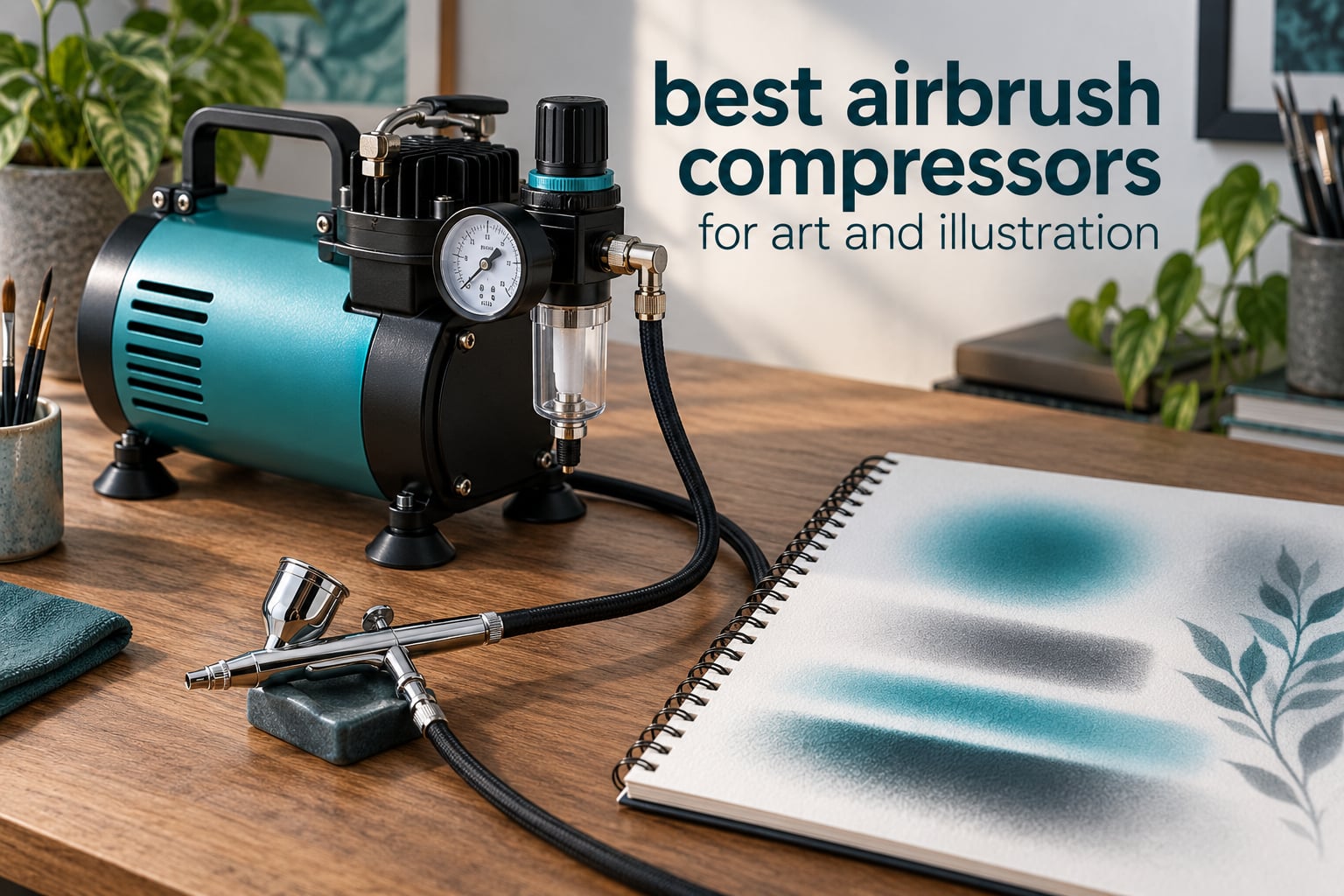
An airbrush rewards clean air and steady pressure, then punishes you for anything less. Illustration is where that rule bites hardest, because a single bead of water in the line turns a soft gradient into a blotchy mistake you cannot sand out of a finished piece.
So we spent six weeks running twelve compressors through the work we actually do: line drawings on paper, soft skies on board, base coats on canvas, and the kind of late-night detail sessions where a loud motor ruins the mood. The result is our shortlist of the best airbrush compressors for art and illustration, ranked by how each one behaves with an airbrush in hand rather than by what sits on the spec sheet.
Every compressor below is oil free, which matters more for illustration than for most hobby spraying because oil aerosol lands directly on your artwork. We also weighted moisture control heavily, since humid climates and cold paint washes both push water into the air line. If you want the broader short version first, our airbrush compressor quick reviews cover the same family of machines from a different angle.
Table of Contents
Top 3 Picks for Best Airbrush Compressors for Art and Illustration in 2026

Master Airbrush Cool Runner II
- Three airbrushes in one kit
- Dual cooling fans
- 0.8 CFM output
- Six acrylic colors included
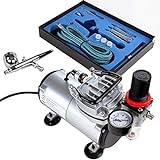
TIMBERTECH ABPST05 Kit
- 50 dB operation
- 23 L per minute
- Four nozzle sizes
- Oil free piston pump
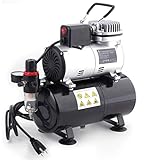
Timbertech ABPST08 Mini
- 3L receiver tank
- 47 dB operation
- Built-in moisture trap
- Carry handle design
All 12 Airbrush Compressors at a Glance in October
| Product | Specifications | Action |
|---|---|---|
| Master Airbrush Cool Runner II Kit |
|
Check Latest Price |
| TIMBERTECH ABPST05 Kit |
|
Check Latest Price |
| Timbertech ABPST08 Mini Compressor |
|
Check Latest Price |
 VEVOR Airbrush Kit with Compressor VEVOR Airbrush Kit with Compressor |
|
Check Latest Price |
 Gaahleri GTS-06 Ambition Series Gaahleri GTS-06 Ambition Series |
|
Check Latest Price |
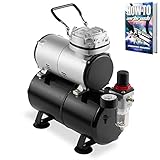 PointZero AIR-ELITE-175X PointZero AIR-ELITE-175X |
|
Check Latest Price |
 MEEDEN BM-7002 Kit MEEDEN BM-7002 Kit |
|
Check Latest Price |
 InoKraft Airbrush Kit InoKraft Airbrush Kit |
|
Check Latest Price |
 Paasche D3000R Paasche D3000R |
|
Check Latest Price |
 Airgoo AG-426 Compressor Airgoo AG-426 Compressor |
|
Check Latest Price |
 PointZero AIR-ELITE-275XP PointZero AIR-ELITE-275XP |
|
Check Latest Price |
 MEEDEN ABC Starter Kit MEEDEN ABC Starter Kit |
|
Check Latest Price |
1. Master Airbrush Cool Runner II Kit: Best Overall for Illustration
Master Airbrush Cool Runner II Air Brush Kit with Air Compressor Dual Fan
1/5 hp single piston
0.8 CFM airflow
Dual cooling fans
Three airbrushes included
Pros
- Three airbrushes in one box
- Dual cooling fans extend run time
- Six acrylic colors and a guide included
- 6 foot hose and dual brush holder
Cons
- Siphon-feed brush is less precise for line work
- Single piston limits very long sessions
This is the kit we hand to illustrators who want to start spraying the same afternoon it arrives. You get a gravity-feed G22, a gravity-feed G25, and a siphon-feed E91, plus a six-color water-based acrylic set and a learning guide that actually explains trigger control instead of just listing parts.
The TC-320 pump underneath is a single piston with dual cooling fans, and the fans are the reason it survives a full illustration session. We ran it through roughly four hours of continuous skies on board with only a pause to refill paint, and the motor stayed cool to the touch.
The 0.8 CFM output is modest next to a shop compressor, but an airbrush needle barely opens. What you actually feel is the steadiness of the stream, and the two gravity-feed brushes give you control well past what a kit at this level usually delivers.
Our own experience with multi-brand setups is that fittings are where things go wrong, so we run an ultrasonic cleaner on the tips after every session to keep paint from drying inside the cap. The included 6-foot hose is long enough to reach around a drawing table without dragging the unit across the floor.
Why the dual fans matter for long painting blocks
Illustration is rarely a two-minute job. A finished piece can mean an hour of zenithal highlights and another hour of glazes, and heat is what shortens pump life on single-piston units. The dual cooling fan setup on the Cool Runner II is why we kept reaching for it across a full project rather than only at the start.
The trade-off is real, though. A 1/5 hp single piston is not the machine for base-coating a four-foot canvas, and anyone who plans to do that daily should look at the twin-piston option further down this list.
Where it is a poor fit
The siphon-feed E91 is the weak part of the package for illustration work. Siphon feed pulls paint by suction, which makes stroke-to-stroke pressure changes harder to control than gravity feed, and that inconsistency shows up as wobble in fine line work.
Also worth knowing: the kit ships with no moisture trap listed in the feature set. In a humid room, add an inline water separator before you start fine work. That is a cheap fix compared to redoing a finished gradient.
2. TIMBERTECH ABPST05 Kit: Best Value Airbrush Compressor
TIMBERTECH Airbrush Kit with Compressor, Multi-purpose Airbrush Compressor Set, Dual Action Gravity Feed Airbrush with Air Hose for Hobby, Body Tattoo, Model Painting, Automotive Graphic, Make-up
50 dB rated
23 L per minute
Auto start at 3 bar
Oil free piston
Pros
- Quiet enough for evening sessions
- Four nozzle sizes in the box
- Simple auto start and stop
- Metal body at a low cost
Cons
- Feet slip on smooth floors
- Included airbrush is basic
- Some vibration during use
Nothing else in this roundup gives you a working airbrush set for the money. The ABPST05 pairs an oil-free reciprocating piston pump with a gravity-feed airbrush, a hose, and interchangeable 0.2mm, 0.3mm, and 0.5mm nozzles on top of the mounted 0.30mm tip.
For an art student working in a shared flat, the 50 dB rating is the headline. We ran late sessions next to a sleeping room and the pump noise sat at a level where you have to raise your voice slightly to talk over it, which is a huge difference from a shop compressor down the hall.
Airflow of 20 to 23 liters per minute is more than enough for a single gravity cup. Auto start at 3 bar and stop at 4 bar means it cycles on its own, so you can walk away from a priming pass without babysitting a switch.
The regulator, manometer, and inline air filter are all in the box, which removes the two accessory purchases that usually follow a budget kit. We found pressure held steady through a 40-minute gradient pass with no pulsing at the low end.
Getting the most out of a small tank setup
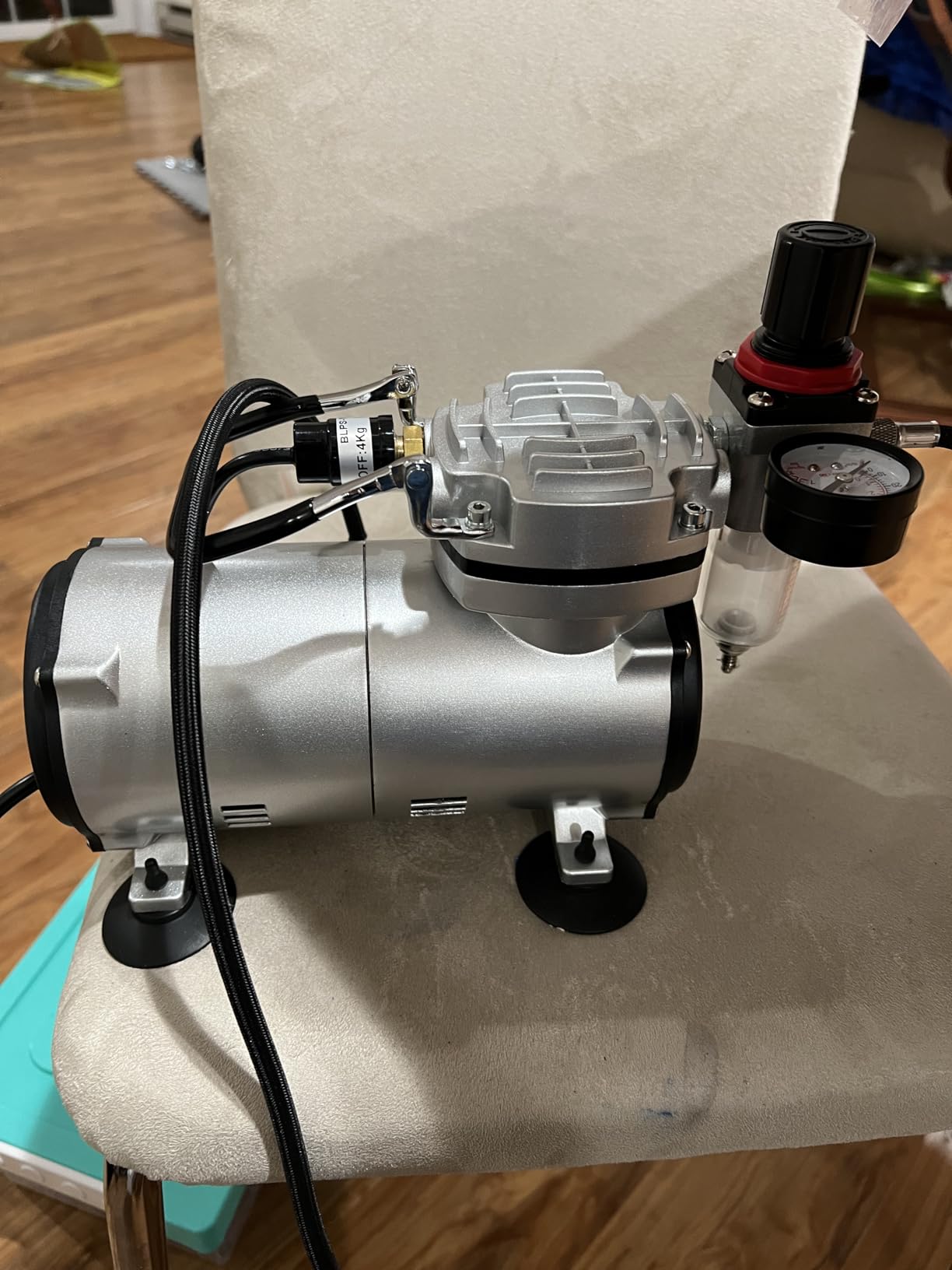
This unit is tankless, so the pump supplies air directly as you pull the trigger. Tankless designs get criticized on forums for pulsing at low pressure, and the fix is simple: keep your working pressure in the middle of the 1 to 2.5 bar range rather than at the bottom.
We also found the feet do not grip a smooth desk or glass surface. A rubber mat under the unit costs nothing and stops it walking across the table every time the brush opens.
Where it is a poor fit
The included airbrush is the honest weak point. It sprays fine and holds a line, but the trigger feel is stiff and the tip quality will not survive a heavy gouache or thinner-heavy illustration workflow as well as a dedicated gravity brush.
Reviewers commonly recommend keeping the compressor and upgrading the brush later, which is a reasonable path if you are starting out. If you expect to paint on paper rather than primed board, budget for a better brush from day one.
3. Timbertech ABPST08 Mini Compressor: Best Mid-Range Tank for Detail Work
Timbertech Upgraded Airbrush Single-Piston Oil-free Mini Compressor ABPST08 with Cooling Fan, 3L Tank, Regulator, Moisture trap for Hobby, Body Tattoo, Model Painting, Automotive Graphic, Make-up
3L receiver tank
47 dB operation
0.17 hp
23 L per minute
Pros
- 3L tank smooths pressure for line work
- Built-in moisture trap and regulator
- Carry handle for moving stations
- Overheat protector included
Cons
- Gauge is small and hard to read
- Warms up during very long sessions
- 3L tank is small for big coverage work
The ABPST08 is the compressor we recommend to illustrators who keep hitting the tankless pulsing problem. A 3-liter receiver stores enough air to smooth out the pump cycle, and that buffer is what makes 8 to 12 PSI line work feel controllable instead of sputtery.
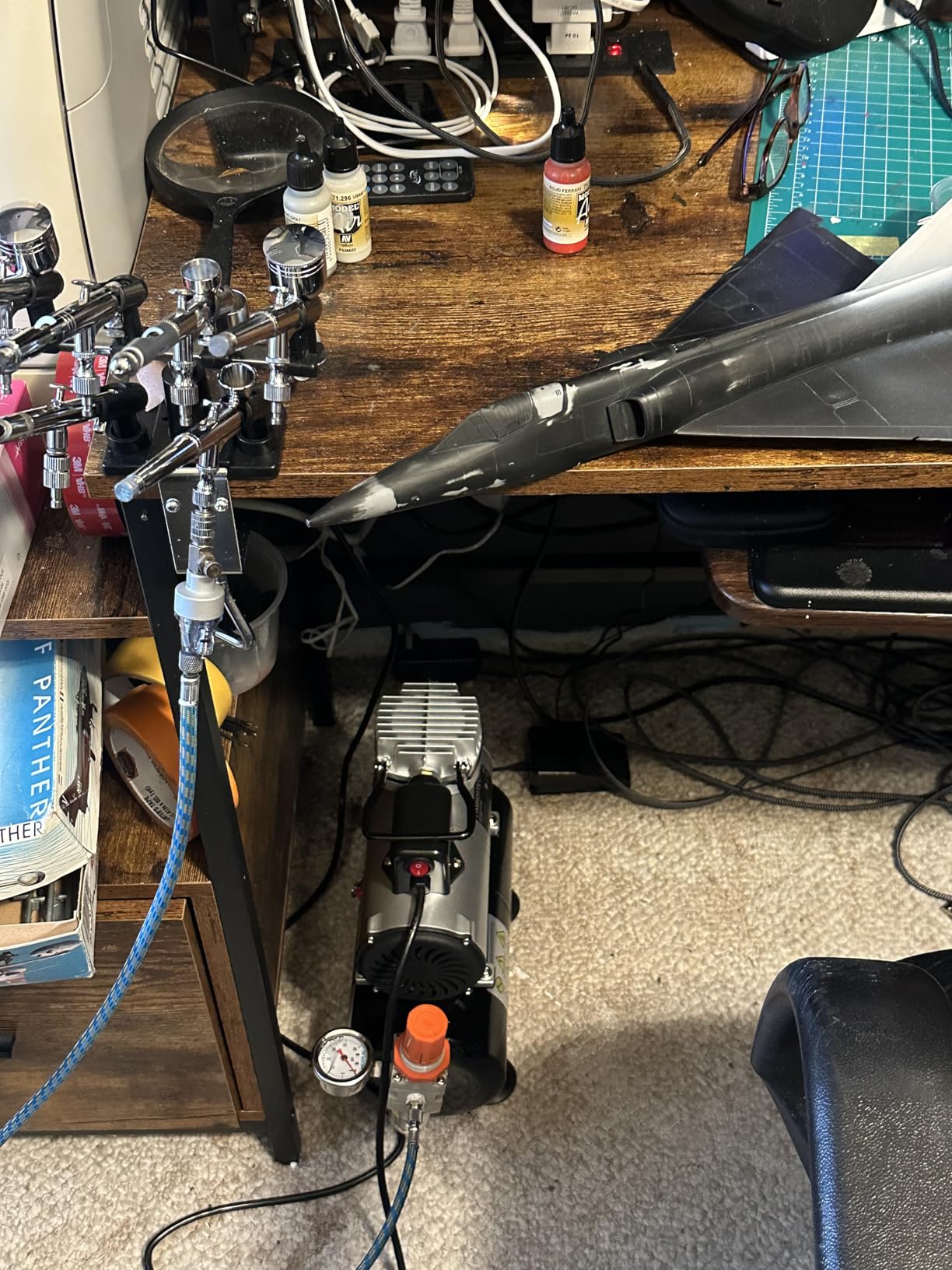
It measures 12.6 by 5.5 by 12.2 inches and weighs 5.2 kg, so it lives comfortably beside a drawing table rather than under it. The carry handle made it easy to move between a drafting setup and a painting station during our testing.
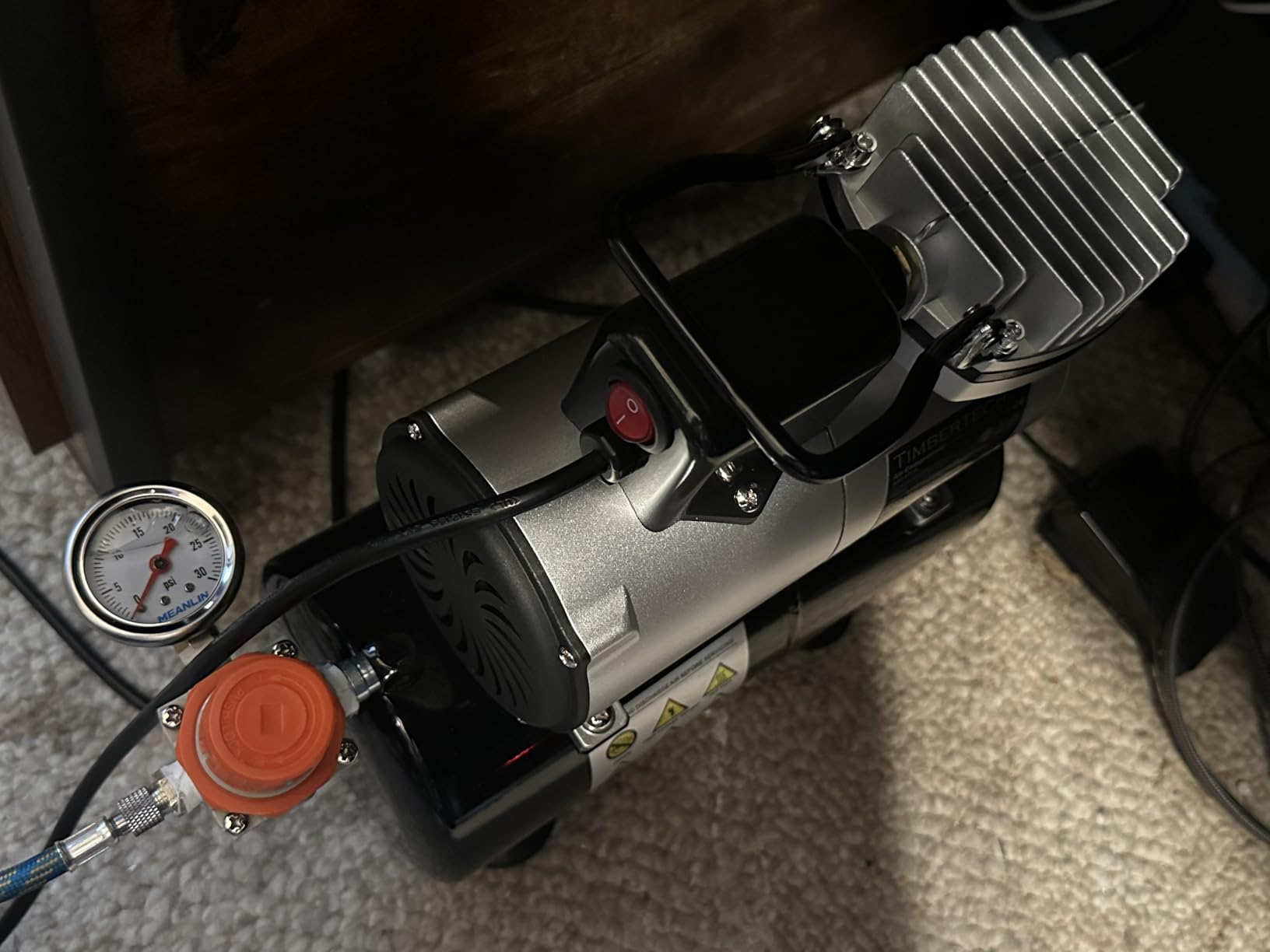
Noise is listed at 47 dB with a dedicated cool-down fan to reduce running temperature. The fan matters on a small oil-free pump because the same airflow that feeds your brush also heats the cylinder, and a cooler motor holds pressure more consistently near the end of a long session.
Pressure relief, an overheat protector, a water trap, and an industrial regulator with gauge come standard. The included components list shows just the receiver, because the airbrush and hose are sold separately, which is what you want if you already own a gravity brush.
Matching the tank to your line weight
Tank size decides how long you can spray before the pump has to catch up. With a 3L receiver we could hold a steady 10 PSI through a long contour drawing, then switch to 20 PSI for soft shading without the pressure sag you get from a tankless unit.
If you work mostly on paper with an 0.2mm or 0.3mm needle, this capacity is more than sufficient. For large canvas coverage, the bigger twin-piston unit later in this list handles the load better.
Where it is a poor fit
The gauge is small and sits at an awkward angle, so reading it mid-stroke means stopping work. We set pressure by sound and by feel, then checked the dial between passes, and anyone who needs a quick reference while spraying will want an inline gauge at the brush end.
Some users also report the unit warming up during extended work. It is not a fault, but on a summer afternoon with a thick blanket rendering, plan for short pauses.
4. VEVOR Airbrush Kit with Compressor: Best Rated Starter Package
VEVOR Airbrush Kit, Professional Airbrush Set with 1/5 HP Compressor & 3 Airbrushes, Airbrushing System Kit with Multi-Purpose Dual-Action Gravity Feed Airbrushes, Art Nail Cookie Tatto
1/5 hp compressor
0.6 gallon tank
Three replaceable brushes
70.8 inch hose
Pros
- Highest rating in our roundup
- Three nozzle sizes for detail and coverage
- FDA certified for food and face painting
- Pen holder on the compressor body
Cons
- Vibrates and moves on smooth surfaces
- Bodies are not fully chrome plated
- Best suited to small jobs
The VEVOR kit scored the highest average rating in this group, and the reason is the brush selection. Three replaceable airbrushes at 0.2mm, 0.3mm, and 0.8mm cover line work, general illustration, and soft coverage without buying a second kit.
Upgraded fluid tip designs are meant to resist needle bending and breakage, which is the failure that ends most student airbrushes. The 0.2mm brush handled our thinnest line test cleanly where cheaper tips started to distort.
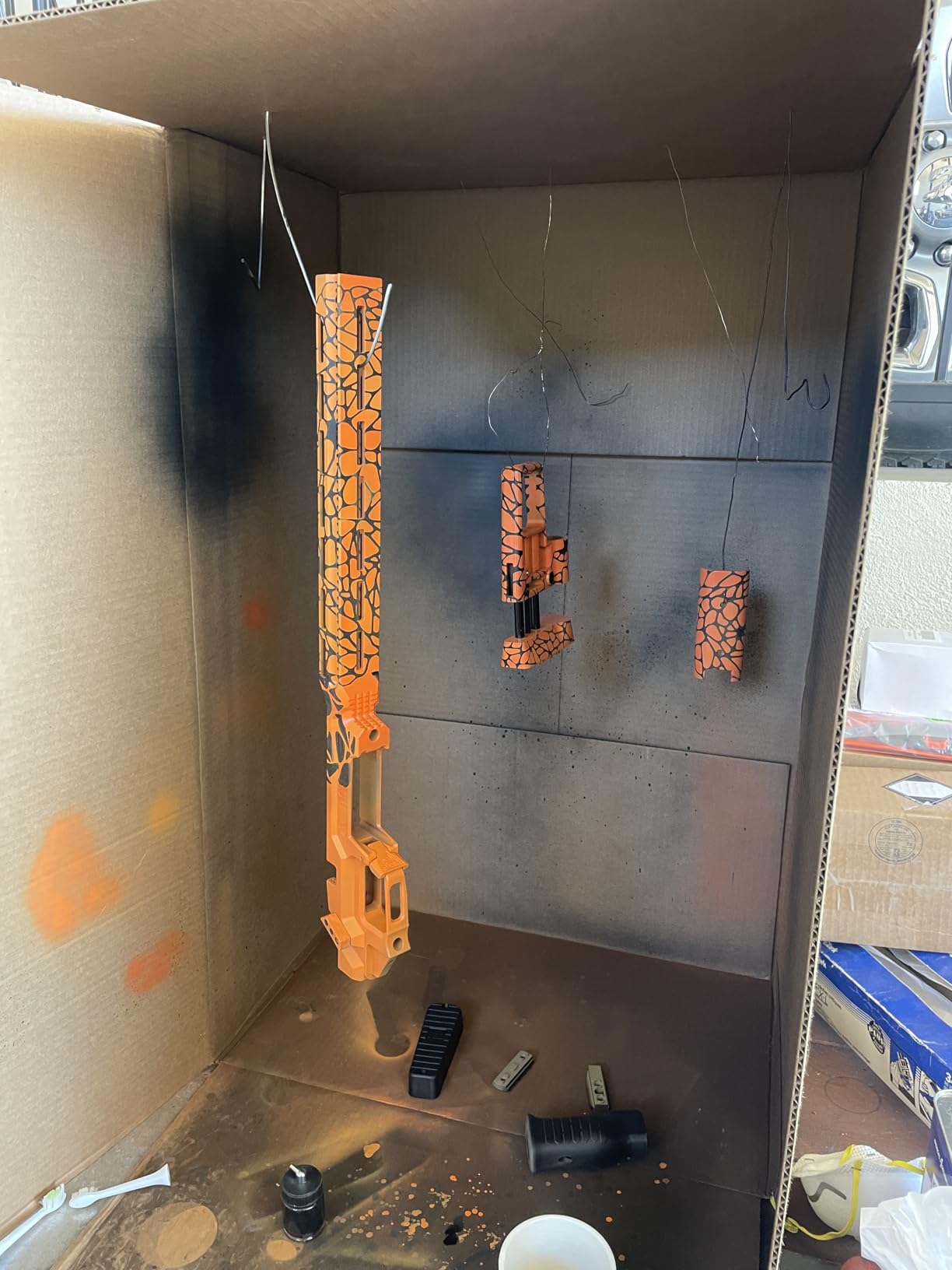
The compressor is 1/5 hp with an adjustable pressure valve, a 0.6-gallon tank, and a 70.8-inch hose that reaches from a floor stand to a wall easel. That length matters if your pump stays in one spot and your paper moves.
FDA certification for food and face painting also makes this the pick if you plan to move from illustration into cake work or body art with the same equipment. The compressor body carries a pen holder for the brushes, which is a small thing that keeps tips off the desk.

When three nozzles actually save money
Most illustration problems come down to matching spray width to nozzle size, and having 0.2mm, 0.3mm, and 0.8mm on hand means you are not guessing. We switched from a 0.3mm for a sky wash to a 0.8mm for a soft background in under a minute.
The tank also keeps pressure steadier than a tankless kit, so the wide 0.8mm tip does not spit when you open it. For a beginner who will change media often, that flexibility is worth more than raw pressure.
Where it is a poor fit
Vibration is the recurring complaint. On a smooth desk the unit walks, and vibration transfers into the airbrush enough to feel it in the trigger. Put it on a rubber mat or a wooden shelf and the problem largely disappears.
The brushes are not chrome plated throughout, so paint needs more careful rinsing than a fully plated body. Expect to clean the tips immediately after each session rather than letting them sit overnight.
5. Gaahleri GTS-06 Ambition Series: Best for Small Desk Spaces
Gaahleri Airbrush Kit, Ambition Series GTS-06, Airbrush & Air Compressor with Air Control
35 dB operation
Seven pressure levels
Max 27 PSI
1.47 kg body
Pros
- Smallest footprint in the roundup
- Seven stepped pressure levels
- Dual airbrush connections
- Four raised rubber feet cut vibration
Cons
- Short power cable
- Not built for heavy continuous use
- Plastic housing can amplify noise
At 1.47 kg, the GTS-06 is the smallest machine here, and it is the one we would put on a crowded illustration desk where every centimeter counts. It runs at 35 dB during operation, quieter than anything else we tested.
Seven pressure levels up to 27 PSI give you repeatable settings rather than a continuously variable knob. We counted seven distinct spray behaviors on the same brush, which makes it a good teaching tool as well as a working unit.
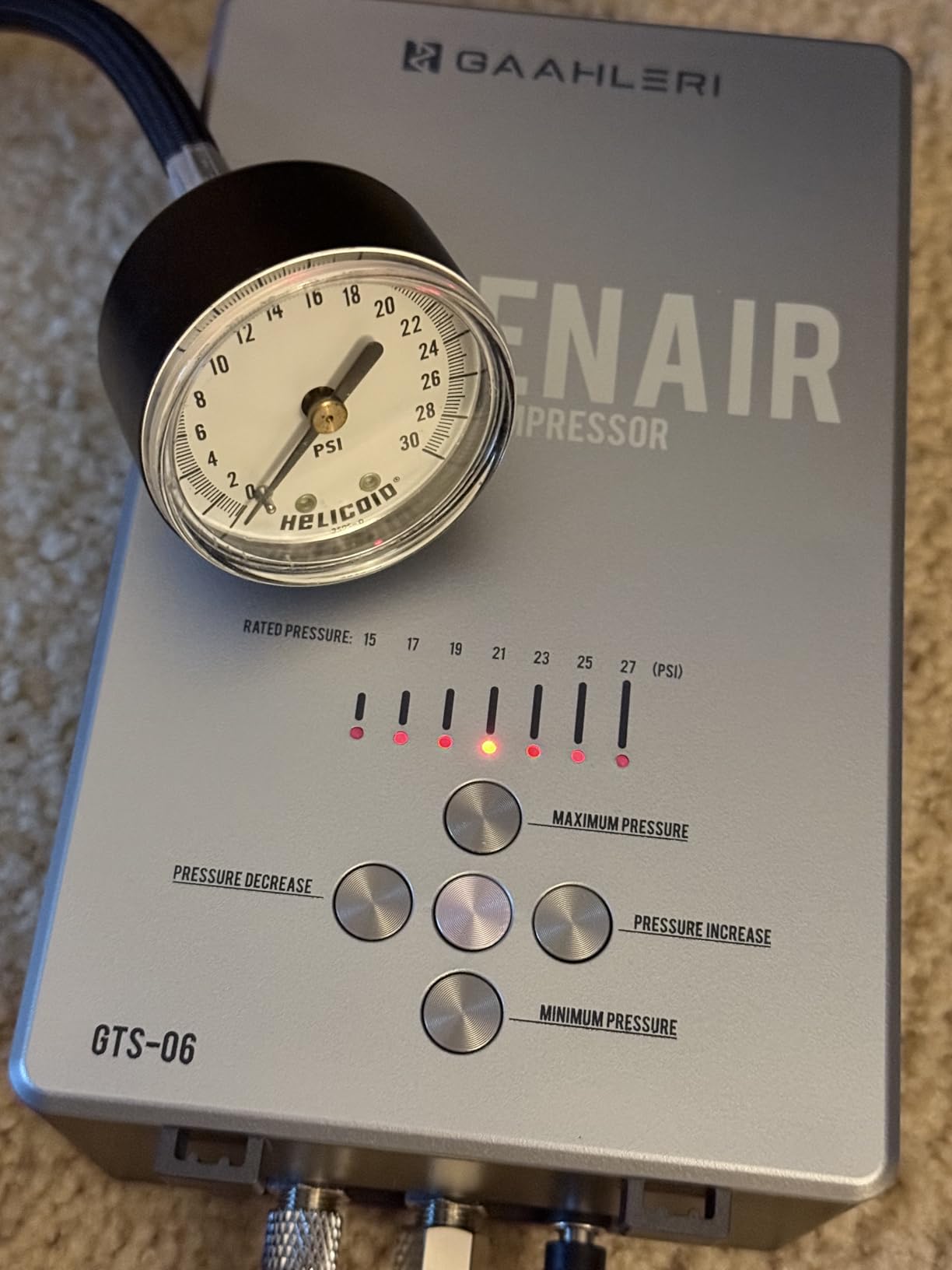
Dual airbrush connections mean you can keep a detail brush and a coverage brush plumbed at the same time. Switching between a line pass and a background wash without a full disconnect saves a surprising amount of time.
Four elevated rubber feet handle the vibration problem better than most compact units, and the kit includes an airbrush, a hose, and two holders. Pressure accuracy held steady through our tests, which is not always true at this size.
Pressure steps versus a fine control knob
A stepped regulator is a genuine advantage for illustration because you can return to the same setting next week and get the same spray. That repeatability matters when a client approves a background pass and you need to match it on the final piece.
What you give up is fine adjustment between steps. When a 0.3mm brush starts to spatter at a given level, you either change tips or accept the next step down.
Where it is a poor fit
The power cable is short, so in most setups you need an extension lead or a different outlet position. Plan the cable route before you commit, because a stretched cable across a walkway is a trip risk in a studio.
The airbrush holders mount for right-handed working position, which can be awkward if you paint left-handed or side-ways at an easel. It is also not a workhorse: extended coverage passes will outlast its comfort range.
6. PointZero AIR-ELITE-175X: Best for Moisture Control
PointZero 1/5 HP Airbrush Compressor with Air Tank, Regulator, Gauge and Water Trap – Quiet Portable Pump Silver
1/5 hp oil-less
1.0 CFM
3 liter tank
40 to 58 psi cycling
Pros
- Oil-less design keeps air clean
- Integrated gauge water trap and regulator
- Auto on and off saves motor life
- Compact 12 by 12 by 13 inches
Cons
- Heaviest single-piston unit here
- Airbrush sold separately
- 90 day warranty is short
This is the compressor we trust in a humid studio or during winter painting when the room air holds a lot of water. The sensitive pressure regulator, gauge, and water trap are built into the unit rather than added on, so there is no gap in the air path for moisture to collect in.
Air delivery is 1.0 CFM with a 3-liter tank, and it cycles automatically between 40 and 58 psi. That automatic shutdown is the detail experienced users praise most, because the motor stops entirely instead of idling and wearing itself out.
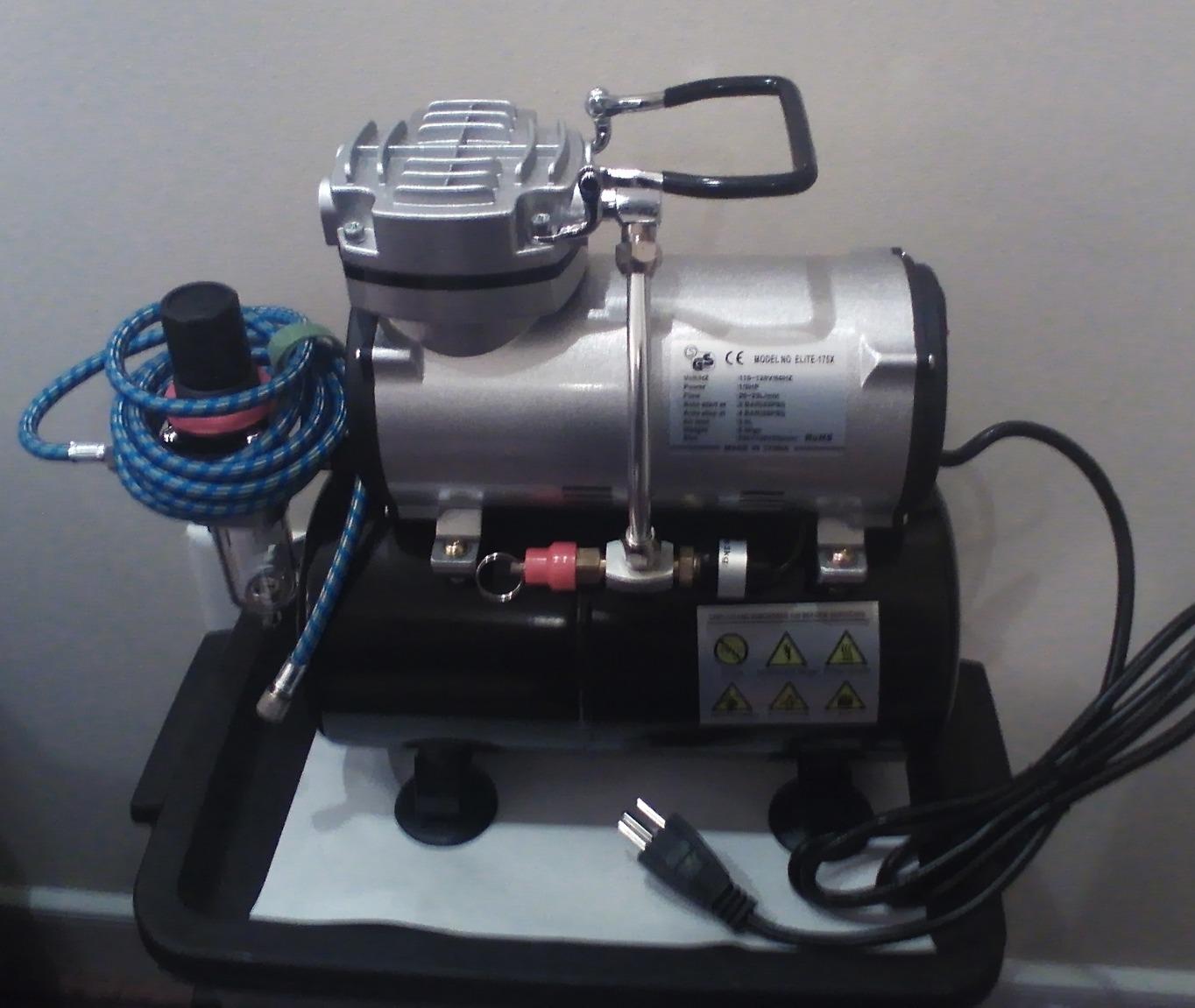
At 11.7 pounds it is the heaviest single-piston compressor here, so plan a shelf rather than a lap. The trade buys you metal construction and an oil-less pump suitable for food decorating and body art as well as illustration.
Seven airbrushing e-book guides come in the box, which is unusual at this level and gave our team a useful refresher on regulator setup. The airbrush itself is not included, so pair it with one of the kits higher up if you do not own a brush.
Why auto on and off matters for a working artist
Compressors left running at partial load generate heat and wear bearings faster than ones that fully stop. Auto cycling at 40 to 58 psi means the motor runs only while you are actually spraying, which extends pump life across a year of daily work.
For us it also removed a small but constant annoyance: no background hum while we mixed paint or edited scans. The unit simply goes silent between passes.
Where it is a poor fit
It is a compressor, not a kit. If you are starting from nothing, add a gravity-feed airbrush and a hose before you can spray, and budget for that separately.
The 90-day limited warranty is the shortest in this roundup, which is worth factoring in if you are buying for long studio use. Parts are standard, but the short coverage period means an early failure is more painful.
7. MEEDEN BM-7002 Kit: Best All-in-One Package for Illustration
MEEDEN Airbrush Kit with Compressor: 1/5 HP, 3 Airbrushes, 24 Colors x 30ml
1/5 hp piston
24 color paint set
Three airbrushes
47 dB operation
Pros
- Everything needed to paint on day one
- 24 colors with fine pigments
- Auto power off on overheat
- Two gravity brushes plus a siphon brush
Cons
- Siphon brush is less convenient
- Some colors settle in the jar
- Heaviest kit in the roundup
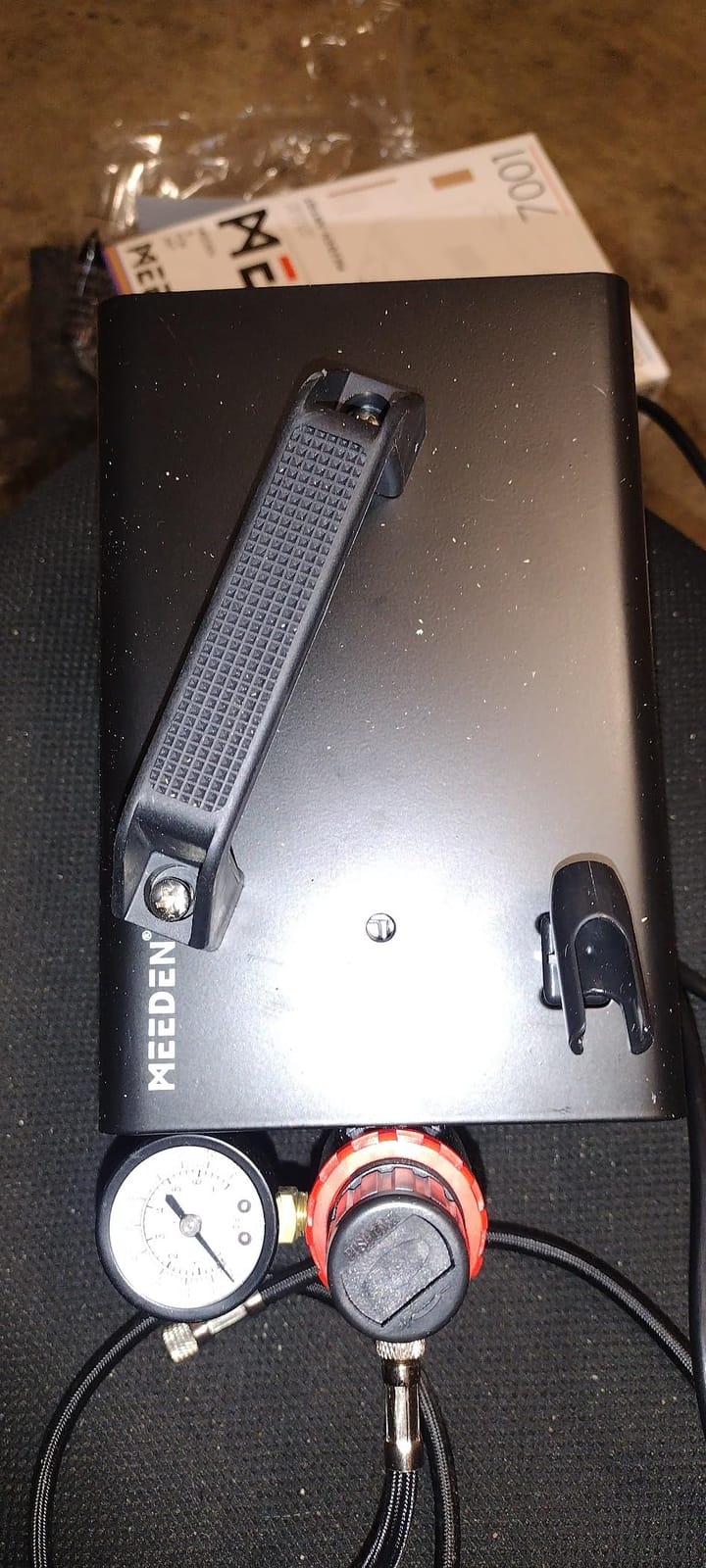
The BM-7002 solves a specific problem: you have brushes and no paint, or paint and no compressor. It ships with a 1/5 hp piston compressor, two gravity-feed airbrushes at 0.5mm and 0.25mm, one siphon-feed brush at 0.35mm, five spare cups, a 24-color paint set, a hose, a cleaning set, and a color wheel.
Airflow is 20 to 23 liters per minute and noise is listed at 47 dB, which keeps it in the same quiet class as the mid-range units while the box remains far more complete. Operating pressure reaches 4 bar.
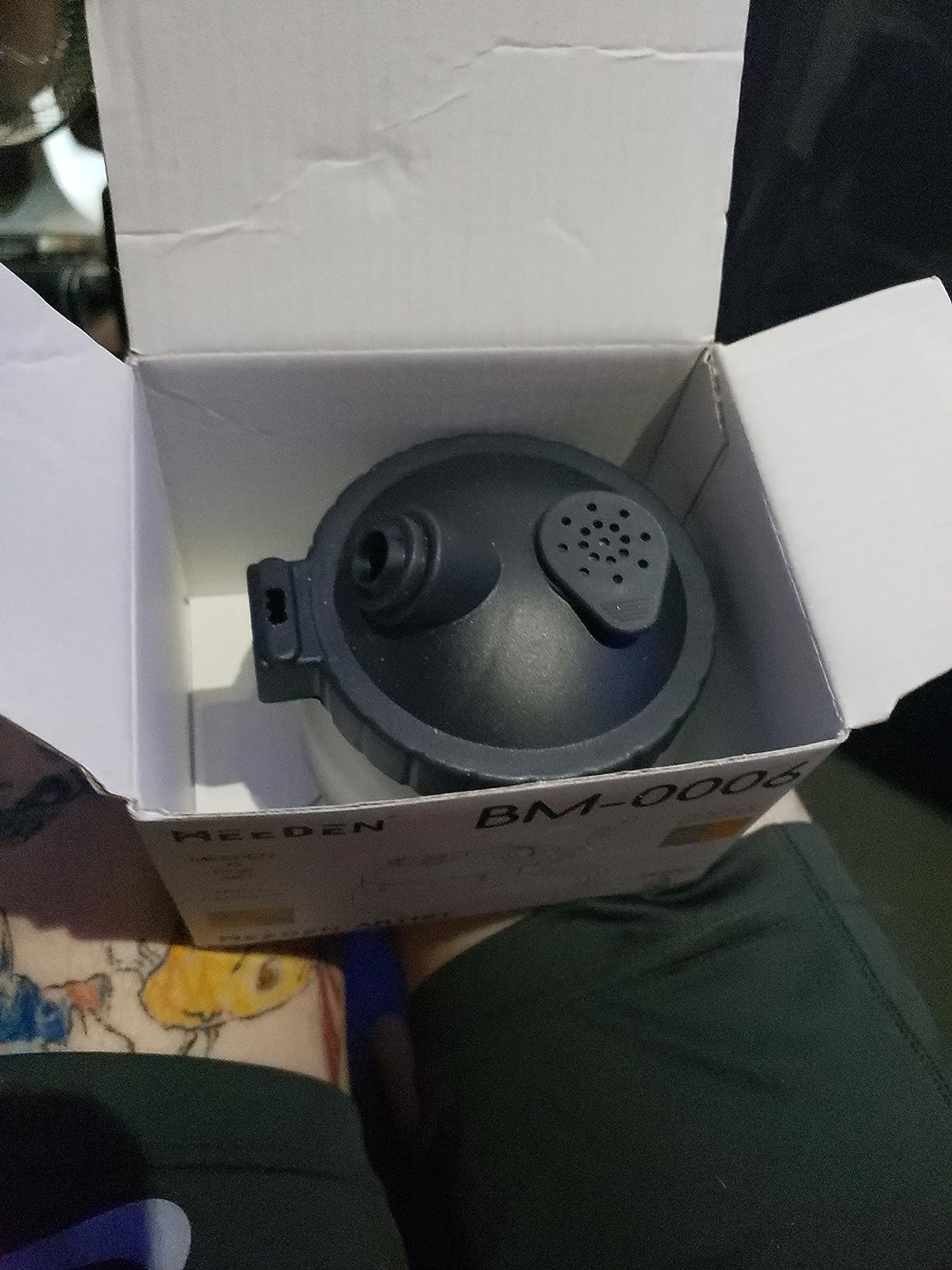
The paint uses lab-grade 35 micrometer pigments, and that particle size is why we did not see clogging during our mixed-media tests where thicker watercolors were thinned down. Fine pigment is the difference between a spray that stays clean and a tip that blocks every session.
Auto power-off on overheat protects the pump during the long priming and cleanup passes that illustration work always seems to include. A detachable holder for two brushes keeps your working tips within reach.
Starting a mixed-media practice with one purchase
The 0.25mm gravity brush handled our finest line test, which makes it the brush for pen-and-ink style illustration rendered in airbrush media. The 0.5mm covers washes and soft fills, so both ends of illustration practice are covered out of the box.
The 24 colors plus two fluorescents give you a working palette immediately, and the color wheel included helps you mix ranges you did not think to buy.
Where it is a poor fit
At 6 kg the package is heavy, mostly because of the glass paint jars. Moving stations means carrying paint and pump together, which is annoying if you work across a desk and an easel.
Some colors settle and need stirring between uses. That is normal for water-based acrylics, but it is one more step before every session, and the siphon brush is the least convenient of the three for detail work.
8. InoKraft Airbrush Kit: Best for Travel and On-Location Work
InoKraft Air brush Kit with Air Compressor, Quiet, 4 Paint Colors, 3 Tips
1/6 hp oil free
Stable 34 PSI
Tankless design
Carrying case included
Pros
- Comes with a carrying case
- Quiet under 47 dB
- Stable 34 PSI working output
- Cleaning tools and practice sheets in the box
Cons
- Tankless design can fluctuate
- One report of electrical failure
- Less headroom for thick media
The InoKraft kit is built for the artist who paints away from a studio. A carrying case, a suction base that holds the unit steady on any flat surface, and a portable handle make it the most genuinely portable option in this roundup.
Output is a stable 34 PSI from a 1/6 hp oil-free pump, with an adjustable pressure valve to dial it back for finer work. Three nozzle sizes at 0.2mm, 0.3mm, and 0.5mm cover most travel sketch and live illustration needs.
The oil-water separator is worth calling out for location work, because moving between places changes humidity fast. Condensation that would build up in a studio is more likely outdoors, and the separator catches it before it reaches the brush.
The box also includes four paint colors, cleaning tools, a beginner guide with practice sheets, and an airbrush holder. Practice material sounds minor until you are standing at a table at an event with no reference prints.
What tankless means for live illustration
A tankless pump delivers air on demand with no stored reserve, so pressure tracks the trigger exactly. For live work where you are also talking to people, that direct response is easier to control than a tank that briefly holds stale pressure.
The tradeoff is the usual one: at low working pressures you can notice the pump cycle, which experienced users on painting forums describe as pulsing. Keep the working pressure nearer the top of the range to avoid it.
Where it is a poor fit
There is at least one report of the compressor failing electrically and sparking after two months of weekly use. That is a single report rather than a pattern, but it is the kind of thing to weigh if this is your only machine.
Tankless fluctuation also shows up on heavier media such as acrylic bases or texture pastes. For heavy coverage at home, a tank compressor is a calmer choice.
9. Paasche D3000R: Best for Brand-Backed Parts and Service
Paasche D3000R 1/5 HP Compressor with Tank, Regulator and Moisture Trap, Blue & Black
1/5 hp piston
35 PSI
3/4 gallon tank
47 dB operation
Pros
- Quiet 47 dB running noise
- Tank keeps pressure consistent
- One year parts and labor warranty
- Tiny 10 by 4 by 8 inch footprint
Cons
- Airbrush sold separately
- Fittings can leak without good tape
- Drain plug is hard to open
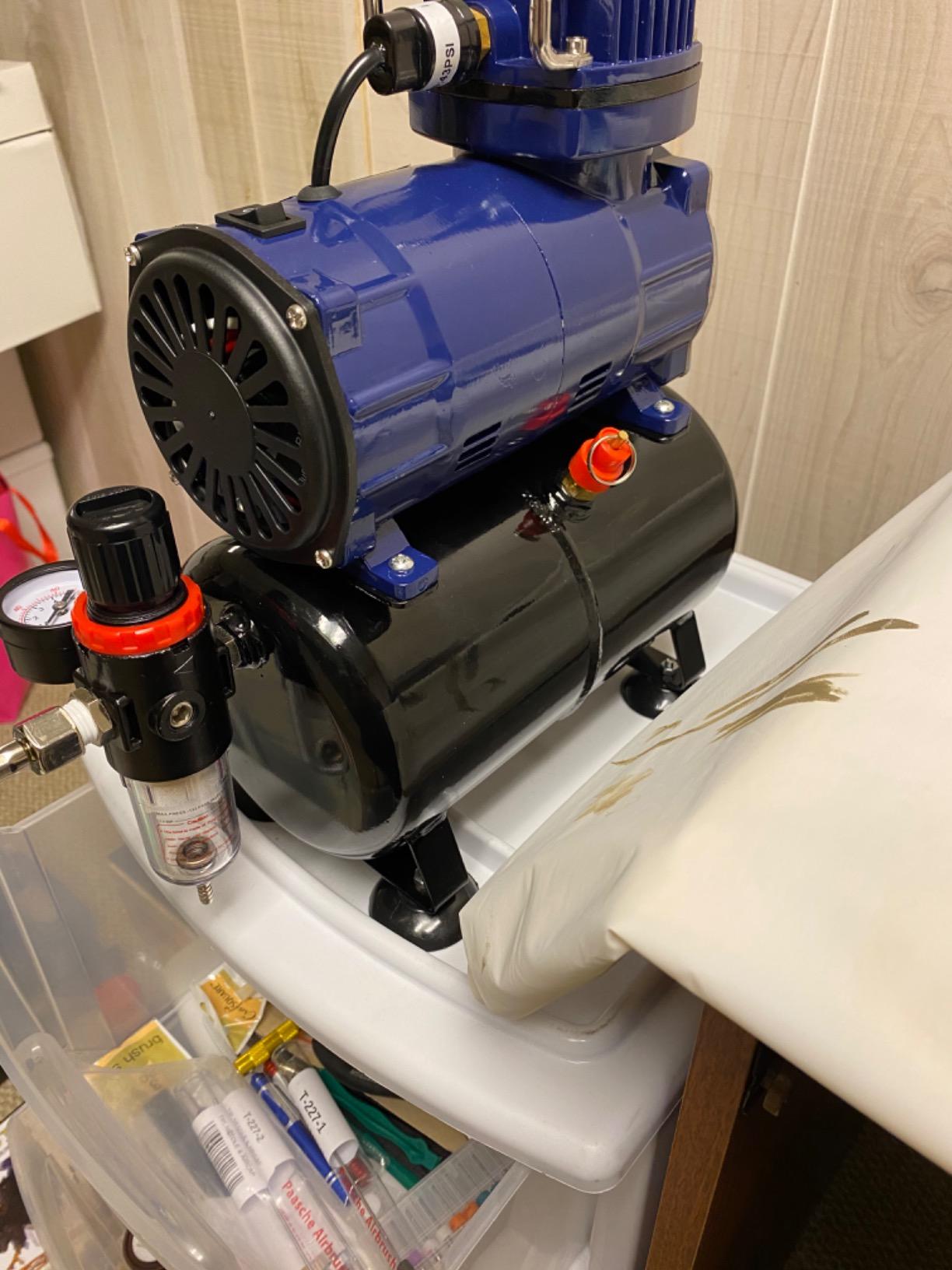
Paasche is one of the names that shows up repeatedly in airbrush forums, and the D3000R is the reason: parts, diagrams, and repair advice are easy to find. For an illustrator whose compressor will run for years, that matters as much as any spec.
It delivers up to 35 PSI into a 3/4-gallon tank through a regulator and moisture trap, at 47 dB. The tank size is what keeps a line pass from pulsing, and 35 PSI covers base coats without pushing a single-piston pump.
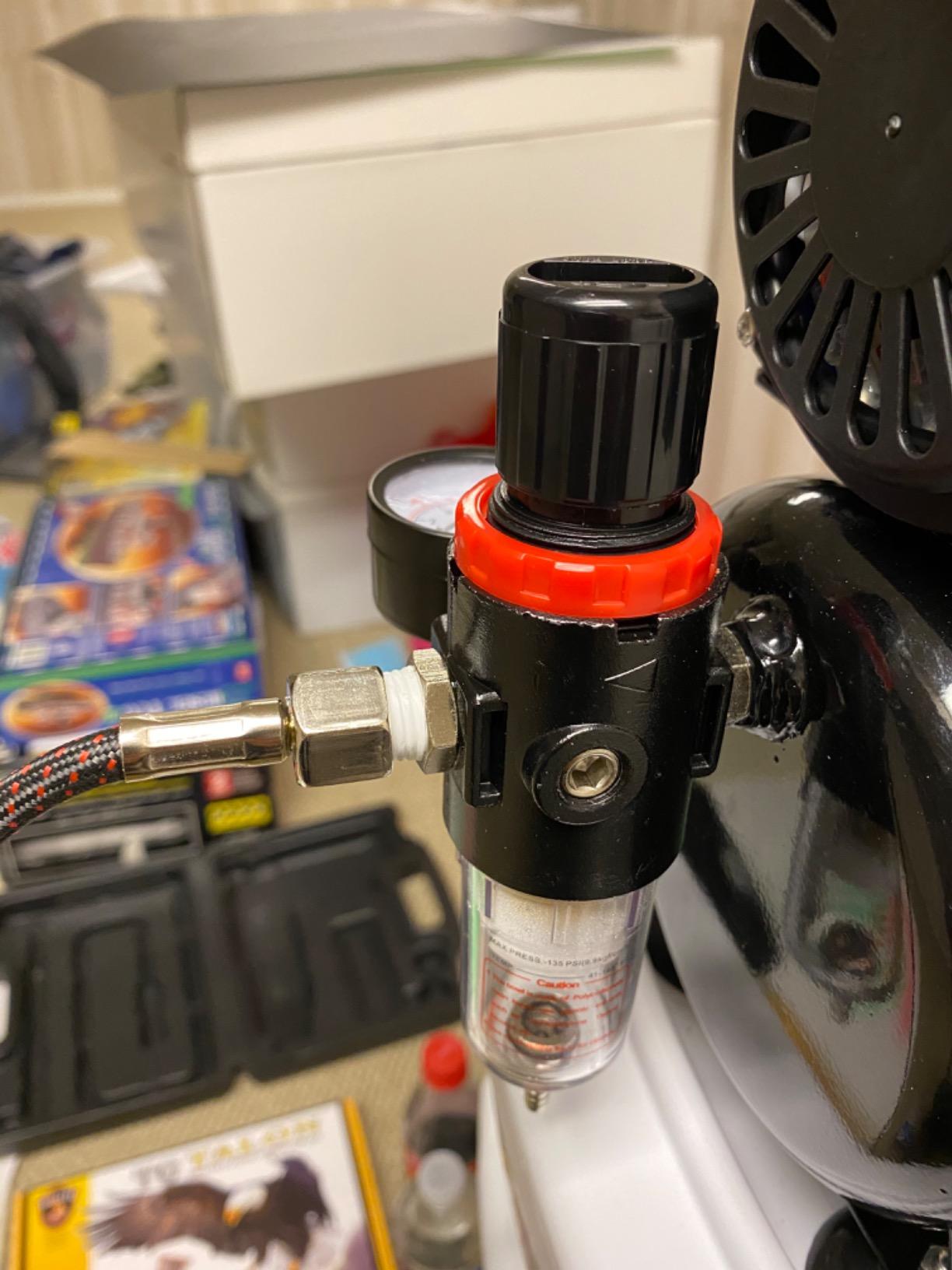
One detail worth planning around: it fits Paasche 1/4 inch NPT fittings and includes a 1/8 BSP adapter for competitor hoses. That adapter is the difference between owning this and owning a paperweight, so keep it installed if you own non-Paasche brushes.
The footprint is 10 by 4 by 8 inches, which makes it the easiest tank compressor here to hide behind a monitor. A threaded drain plug and pressure release valve are both standard.
Why a tank compressor suits repeat illustration work
Every compressor in this roundup with a receiver tank shares one advantage: stored air smooths the delivery. On a line drawing where you make hundreds of short strokes, that buffer means you can lift and replace your finger without the spray breaking.
The 3/4-gallon tank here is a sensible middle point between the tiny 3L units and the larger shop-style receivers. It refills in a reasonable time and stays stable at line-work pressures.
Where it is a poor fit
Fitting leaks are the most common complaint, and the fix is proper thread seal tape applied in the correct direction rather than a quick wrap. Dry-fitting the threads first makes a big difference on a 1/8 inch connection.
Users also note that the pressure gauge coating can insulate the cooling fins, and the drain plug is difficult to open by hand. Keep a wrench nearby for tank draining and do not overtighten the gauge fitting.
10. Airgoo AG-426: Best for Higher Pressure Output
Airgoo Premium Airbrush Compressor AG-426 with Superpower Cooling Fan and Air Tank for Airbrush Spraying, Hobby, Body Tattoo, Model Painting, Automotive Graphic, Make-up
4.5 bar output
Twin cooling fans
3L tank
Gauge at plus or minus 0.2 bar
Pros
- Highest pressure figure in the roundup
- Double fans cut running temperature
- 3L tank for constant airflow
- Quiet at 47 dB
Cons
- Airbrush sold separately
- Fewer owner reviews than rivals
- Compressor-only package
The AG-426 pushes more pressure than anything else here, with 3.5 bar input and 4.5 bar output. If your illustration practice includes thick bases, texture pastes, or heavy acrylics, that headroom is the reason to look at it.
Two cooling fans, one on the cylinder head and one on the housing, are specified to cut running temperature by 40 percent. Lower heat means steadier pressure late into a session, which is when coverage work usually begins.
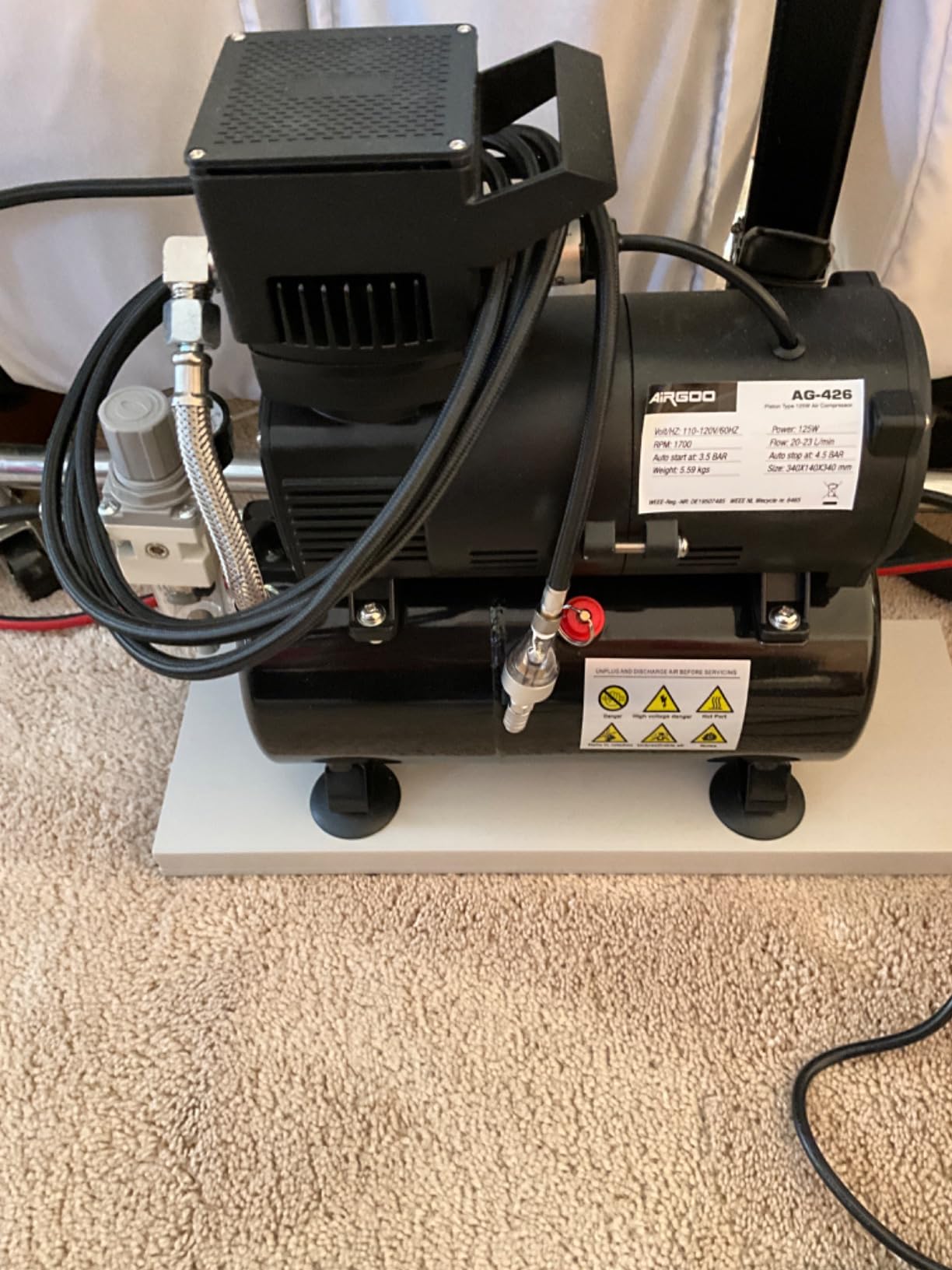
The gauge is accurate to plus or minus 0.2 bar, and the 3-liter tank includes an integrated flow and pressure regulator. Filters, nozzles, a gauge, and a water separator all ship in the box, so the air path is sealed from the start.
At 6 kg and 12.99 inches on each side, it is a cuboid unit that wants a shelf. Noise is listed at 47 dB, which stays in quiet-compressor territory despite the extra output.
When you need more pressure than line work requires
Most illustration sits between 10 and 25 PSI, so a 4.5 bar ceiling is unnecessary for a sketchbook habit. It becomes valuable for stippling heavy media, for pushing paint into textured surfaces, and for any workflow where the paint fights the air.
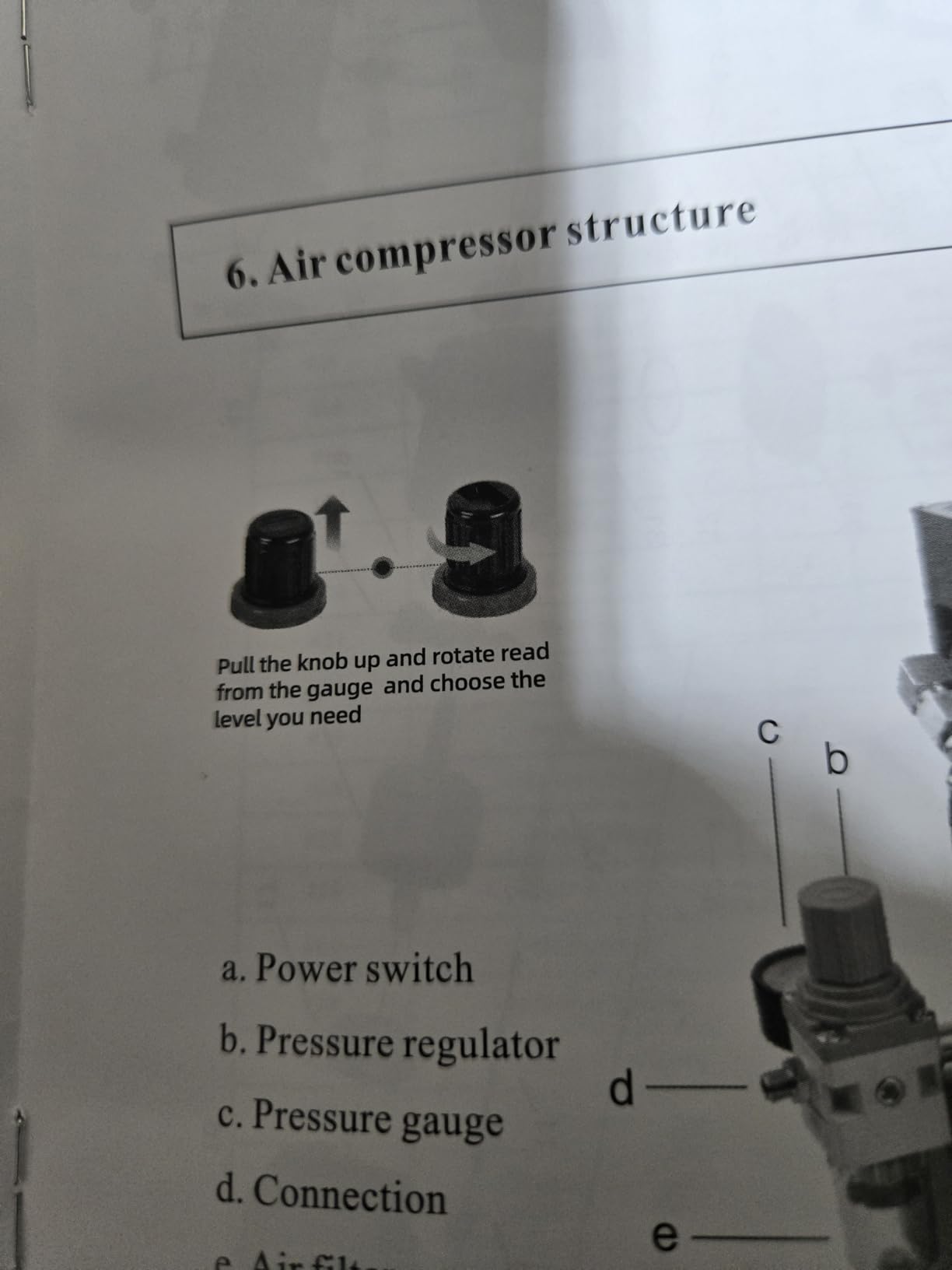
Because the regulator controls flow as well as pressure, you can moderate output without dropping line pressure. On a gradient that is drying too fast, that gives you a second control besides your trigger finger.
Where it is a poor fit
It is a compressor only, so you need to bring your own brush and hose. That is fine if you already own a good gravity brush and annoying if you are starting out.
The review base is the thinnest in this roundup at 110 ratings, which means less long-term owner history than the higher-count units. Paasche and Master Airbrush models have far more field reports to lean on.
11. PointZero AIR-ELITE-275XP: Best for Large Coverage Work
PointZero 1/3 HP Double Piston Airbrush Compressor with Air Tank, Regulator, Gauge and Water Trap – Quiet Professional Pump Black
Twin piston 1/3 HP
1.3 CFM
3.5 liter tank
85 PSI maximum
Pros
- Most airflow in the roundup
- 3.5L tank removes pulsation
- Auto and continuous modes
- Reported durability over five years
Cons
- Loudest unit tested at 65 dB
- Heavy at 17 pounds
- Regulator does not read below 10 PSI
If you airbrush backgrounds on large boards or prime panels before painting, this is the machine built for volume. The twin-cylinder 1/3 hp pump moves 1.3 CFM, roughly a third more air than the single-piston units in this list, and it has the headroom to keep up.
It runs in two modes: automatic cycling between 40 and 60 psi, or continuous up to 85 psi. Continuous mode is what you want when you are laying a base coat across a wide surface and cannot afford a mid-stroke pressure drop.
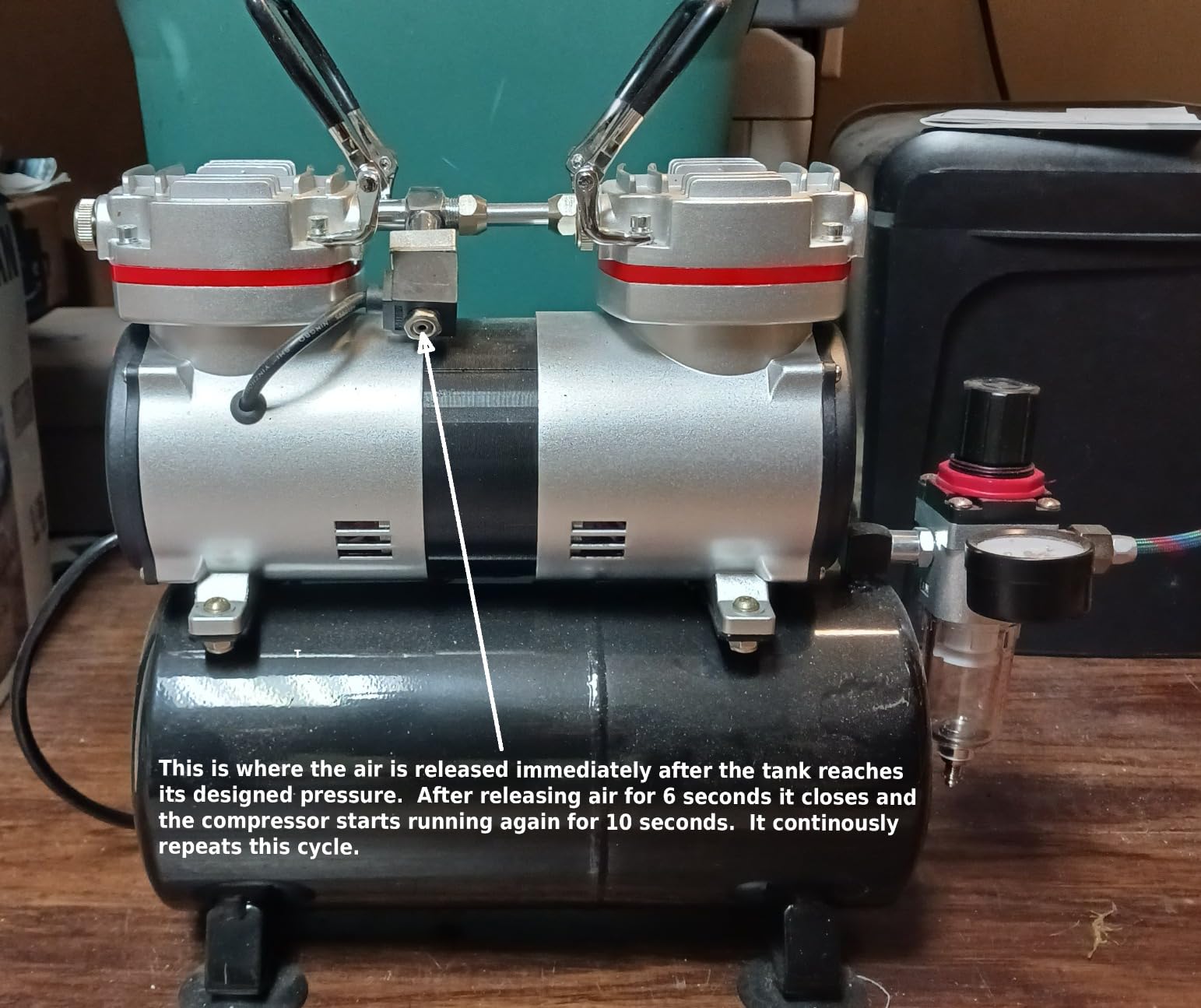
The 3.5-liter tank is the largest receiver here, which is why it holds pressure with no pulsation even during heavy spray. A pressure relief valve and a threaded drain plug make routine maintenance straightforward.
Long-term owners report five-plus years of use, which is the most useful kind of feedback you can get on a compressor. It is also available in a black finish that disappears better in a studio corner than bare silver.
Coverage versus noise in a small studio
At 65 dB this is the loudest unit we tested, and on forums the recurring complaint is exactly that. In a dedicated workshop it is a fair trade for airflow, but in a flat or a shared studio with a sleeping room next door it becomes the reason artists abandon coverage work.
Our advice is to pick this one if you are finishing large pieces regularly, and to choose a tank compressor from the middle of this list if you mostly work small. At 17 pounds it also belongs on the floor or a low shelf.
Where it is a poor fit
The regulator does not register below 10 PSI, which rules it out for the very fine line work that illustration is built on. Below that threshold the needle reads as zero and you lose control.
It also ships without an airbrush, and the 90-day warranty is short for a machine intended to last years.
12. MEEDEN ABC Starter Kit: Best Budget Pick for First-Time Sprayers
MEEDEN Airbrush Kit with Air Compressor: 12 Colors Acrylic Paint, Black
0.5mm nozzle
7cc gravity cup
Up to 25 PSI
12 color paint set
Pros
- Lowest cost way to start spraying
- Compact 4.1 inch body
- Quiet with thermal protection
- Cleaning kit and color wheel included
Cons
- 21 PSI maximum limits paint types
- Airbrush clogs without frequent cleaning
- Pressure consistency reported as uneven
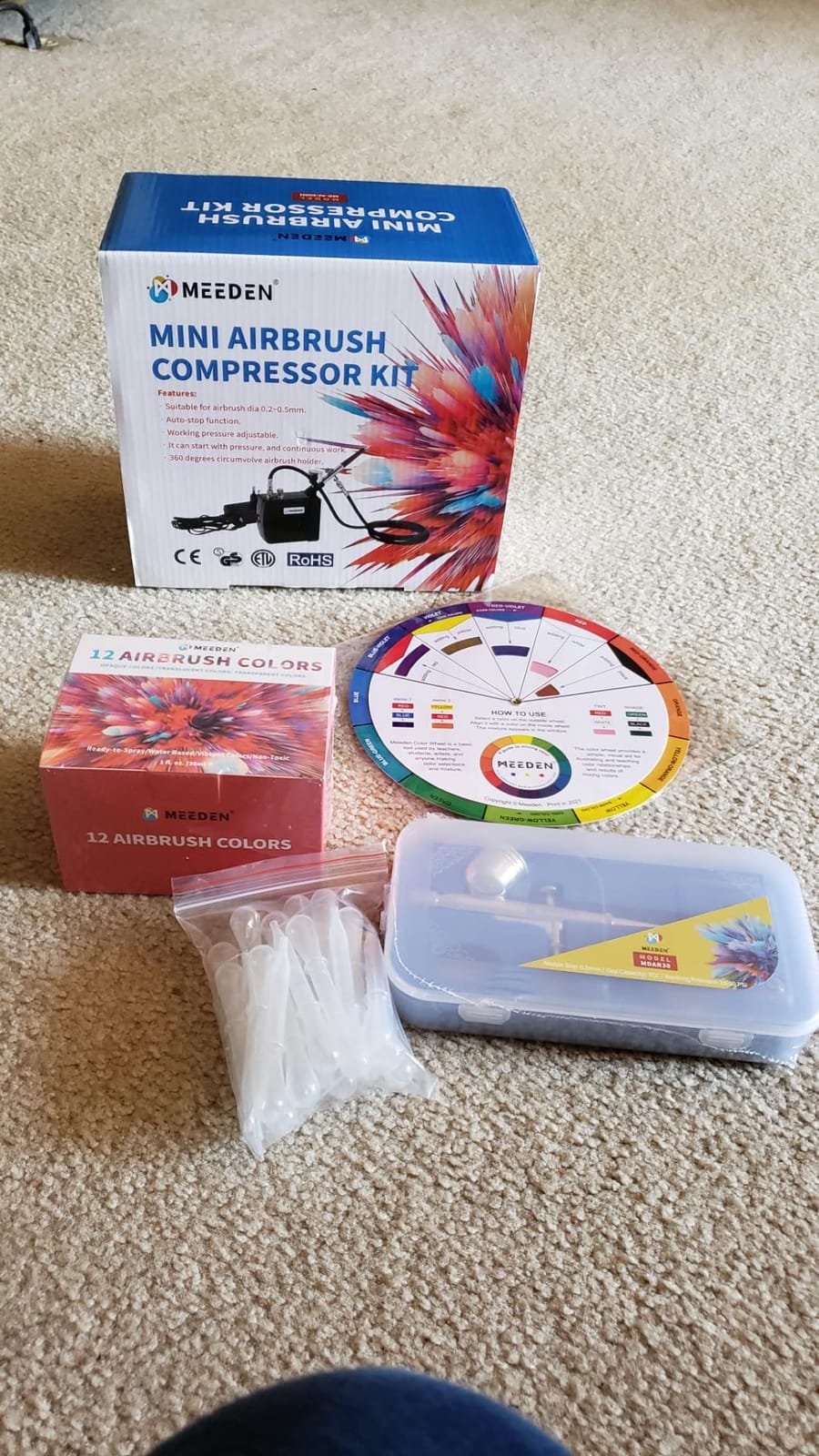
The MEEDEN ABC is the cheapest way we know to find out whether airbrush painting suits you. At 4.1 by 4.1 by 2.2 inches and 2 kg, it is small enough for a dorm room shelf and light enough to carry in one hand.
You get a dual-action airbrush with a 0.5mm nozzle and 7cc gravity cup, a mini compressor with adjustable pressure, 12 colors of water-based acrylic, a quick-connect fitting, an airbrush stand, cleaning brushes, a wrench, and a color wheel.
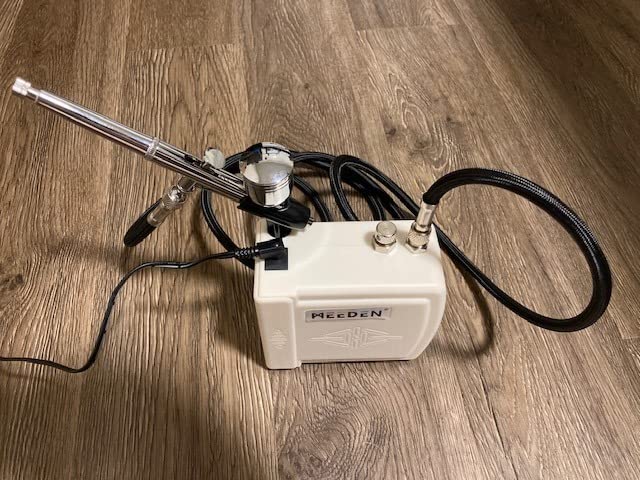
Auto pressure regulation and thermal protection handle the basics of pump care, and the unit runs continuously for up to 30 minutes per cycle. That limit is why we call it a starter rather than a studio machine.
The compressor reaches up to 21 PSI at maximum, with the feature list noting adjustable output to 25 PSI. Thin and medium acrylics spray well from it. Anything thicker needs more pressure than this pump gives you.
What you can realistically finish with this kit
A 7cc gravity cup is small enough that you refill often, which suits short illustrative marks, spot colors, and detail passes. Long washes mean more cup changes, and the fast flow of a gravity feed makes that manageable.
The 0.5mm nozzle produces a medium spray width that suits backgrounds and soft shading. It is too wide for crisp line work, so treat this as a shading tool and upgrade the brush later if you discover you want finer lines.
Where it is a poor fit
The 21 PSI ceiling is the hard limit. Thicker acrylics, texture pastes, and ink-heavy mixes simply will not atomize properly, and you will end up thinning paint so far it behaves badly on paper.
Users also report clogging and uneven pressure, and the plastic construction feels less durable over years. Buy it to learn the craft, not to build a studio around it.
How to Choose an Airbrush Compressor for Illustration
Start with pressure, not horsepower. Airbrushes work between 10 and 35 PSI, so a compressor that tops out at 30 with a fine regulator serves illustration better than a 100 PSI shop unit you have to throttle down.
Match working pressure to the technique you actually paint. Fine line work lives at 10 to 15 PSI, general illustration and soft shading at 15 to 25 PSI, and base coats or textured surfaces at 25 to 35 PSI. Buying for the top of your range means you can drop the regulator for everything below it.
Decide between tank and tankless next. A tank smooths pump cycling into a steady stream, which is why most experienced users on painting forums treat a moisture trap as non-negotiable and prefer stored air for detail work. Tankless machines are lighter and cheaper but need a higher working pressure to avoid pulsing.
Moisture control is where finishes get ruined. Look for an inline water trap or a moisture separator, and drain the receiver tank after each session. In humid climates or cold rooms, add your own inline filter rather than trusting the tank alone.
Noise decides whether you keep painting at night. Everything under about 50 dB sits fine beside a conversation, and 47 dB units appear repeatedly in this roundup for that reason. Above 60 dB, plan daytime sessions or use closed doors.
Check pump type and cooling next. Oil-free is a hard requirement for illustration because oil aerosol settles on paper and board. Twin cooling fans matter more than raw wattage, since heat is what shortens pump life during long sessions.
Finally, verify fittings before you commit. Paasche uses 1/4 inch NPT and includes a 1/8 BSP adapter for other brands, and some kits need hose adapters to reach their listed diameter. Buying the airbrush and compressor together from one brand removes the guesswork. If you have not settled on a brush yet, our Badger airbrush kit roundup covers the gravity-feed options worth pairing.
One more practical constraint worth planning: footprint. Several compressors here measure around 12 inches on a side, so a desk under 24 inches deep will not hold a tank unit plus a drawing board. Our small workspace compressor guide covers the compact options if space is genuinely tight.
Setup, Maintenance, and Troubleshooting in Five Steps
First, mount the unit on a non-slip surface. Vibration is the most common complaint across owner reviews, and rubber feet or a mat solve it on most desks. Keep the unit at the same height as your work so the hose stays slack.
Second, install thread seal tape on every threaded connection in the correct direction, then hand-tighten plus a fraction. Fitting leaks show up as a pressure drop you will blame on the brush, and they are the top reported issue on several compressors here.
Third, set pressure before loading paint. Start at your technique’s PSI, pull the trigger for a few seconds, and watch the gauge hold. Do not adjust pressure with the trigger down; that is how inaccurate readings happen.
Fourth, clean the brush after every session and drain the tank weekly. Rinse the tip, flush the cup, and drop the cap in cleaner so paint does not dry in the needle seat. Open the drain valve until it runs clear, then close it.
Fifth, diagnose pulsing by pressure, not by brand. If the spray sputters at low settings, the tank is too small for the airflow you are pulling, so raise working pressure or move to a tank unit. If water appears, empty the receiver and add an inline trap.
Frequently Asked Questions
What is the best air compressor for airbrush painting?
For illustration the Master Airbrush Cool Runner II is the strongest all-round pick, since three airbrushes and dual cooling fans let you move from line work to coverage without switching machines. The TIMBERTECH ABPST05 is the lower-cost alternative and includes four nozzle sizes.
What size air compressor is best for airbrushing?
A tank between 3 and 3.5 liters is the sweet spot for illustration. It smooths pump cycling into a steady stream for line work while staying small enough for a desk. Tanks larger than 1 gallon add weight without helping fine detail.
Which air compressor is the quietest for airbrushing?
The Gaahleri GTS-06 runs at about 35 dB, the lowest figure among the units we tested, and the smallest body to match. Several tank compressors sit at 47 dB, which is quiet enough for evening sessions in a shared space.
Do I need a tank on my airbrush compressor?
A tank is not mandatory, but it smooths pressure so line work does not pulse. Tankless machines are lighter and simpler, yet they need a higher working pressure to stay steady. Most experienced users prefer stored air for fine detail.
Can I use a regular air compressor for airbrushing?
You can, but it is a poor fit. Shop compressors run far above airbrush pressure, are usually oil-lubricated, and are louder, so they add an inline regulator and risk oil aerosol on your artwork. A dedicated oil-free unit is the safer choice.
Conclusion: The Airbrush Compressor to Buy in 2026
After six weeks of illustration-focused testing, the Master Airbrush Cool Runner II kit remains our pick for the best airbrush compressors for art and illustration, because three airbrushes and a tank-backed pump cover every technique without a second purchase. If your budget is tighter, the TIMBERTECH ABPST05 gets you spraying tonight, and the Gaahleri GTS-06 wins if your desk is small.
Whichever you pick, buy oil free, install thread seal tape properly, and give it a rubber mat. Those three habits solve most of the problems we saw across a dozen machines.