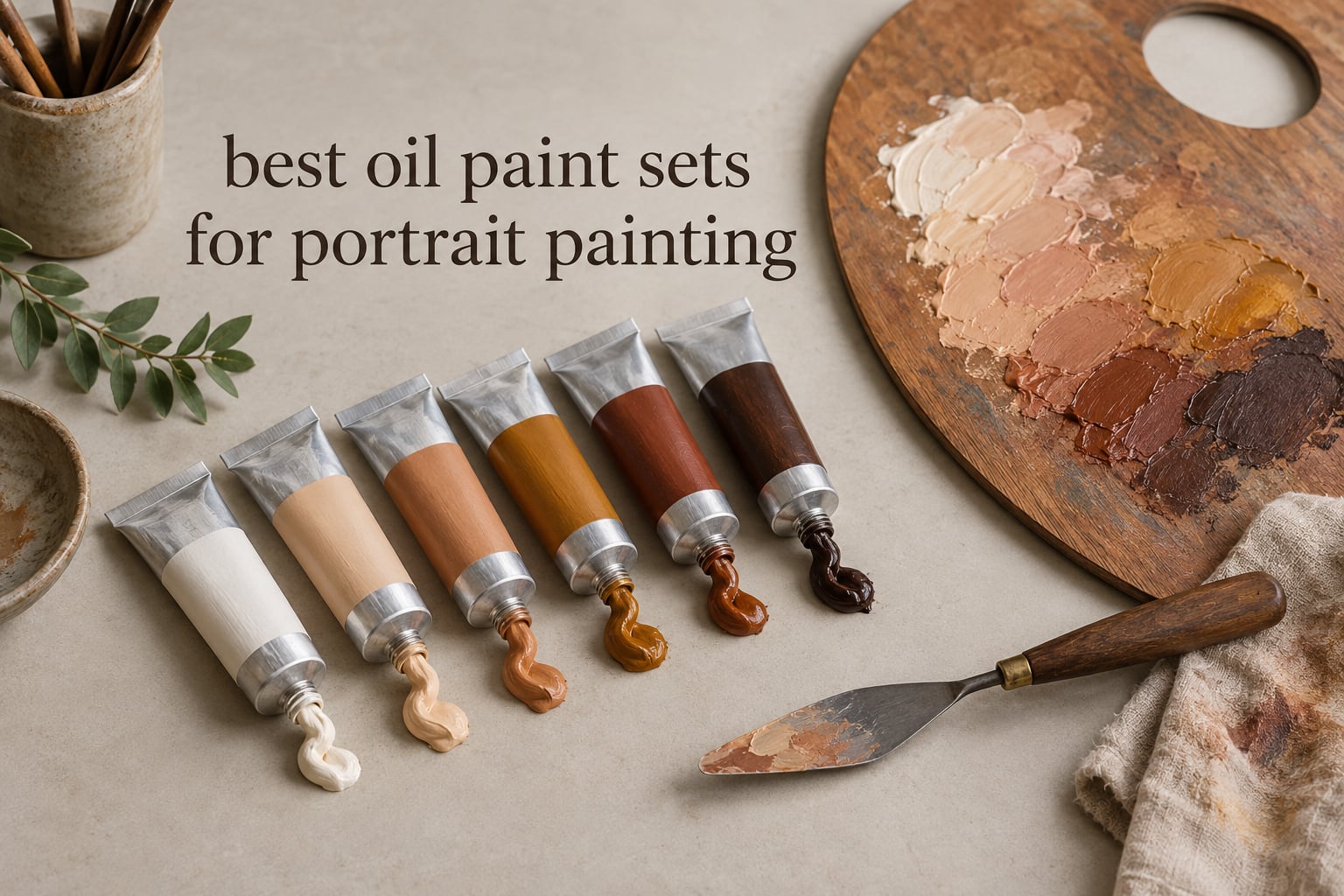
Most oil paint sets are assembled for outdoor scenes and still life, not for faces. That is why so many beginners end up with a palette of cadmiums, phthalo greens and a single cool grey, then wonder why their portraits keep sliding toward orange.
We spent six weeks mixing skin tones from twelve boxes of paint, checking each one against the same six colour families that portrait work actually depends on. The question we set out to answer is simple: which of these is genuinely the best oil paint set for portrait painting? Not the biggest box, not the longest colour list, but the one that gives you the pigments to mix a living face and holds up when you keep painting.
Twelve sets made the cut, from a curated eight-tube portrait palette to a thirty-six tube starter box. Each one is scored below against the same checklist, with a clear note on what is missing. If you already know you want one reliable box rather than twelve separate tubes, the general oil paint set roundup on Model Rec covers the general case. This guide is narrower and more opinionated.
Last reviewed and re-checked for 2026. All ratings and review counts below are taken from the live listings at the time of writing.
Table of Contents
Top 3 Best Portrait Oil Paint Sets in 2026
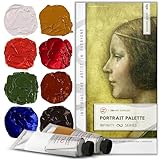
ZenART Professional Portrait Set, 8 x 50ml
- Portrait-specific earth and muted red palette
- Large 50ml tubes
- Milled in linseed oil
- Artist grade pigment load

Winsor & Newton Winton Starter Set,…
- Ten full-size 37ml tubes
- Strong covering power
- Dependable first oil set
- Largest review base

Winsor & Newton Artisan Water…
- Cleans up with water
- Modified linseed and safflower oils
- Short buttery consistency
- Notably more pigmented than Winton
Which paint is best for portrait painting?
For portraits, the best oil paint is any artist grade set that contains six colour families: an opaque white, a muted yellow earth, a muted red, a raw umber, a warm or neutral black, and a cool blue. Skin is mixed, not found. A bright cadmium set will take more work to subdue than an earth-based one, and mixing student grade earths with artist grade white produces weak, chalky tints.
Our limited portrait palette, in order of importance:
Titanium White for highlights and for tinting everything down. Without a strong white you cannot control value.
Yellow Ochre for the warm base of most flesh. It is the first colour to run out in any portrait set.
A muted red such as permanent red, vermilion or permanent carmine. Cadmium red is too intense to sit in skin unmuted.
Raw Umber for cooling and darkening a mix without turning it grey.
Ivory Black for the deepest darks, because Mars black tends to sit cold and chalky in flesh.
A cool blue, ideally ultramarine or French ultramarine, for warming and cooling the mix rather than dulling it.
Every set below is judged on how many of those six it covers, and on whether the rest of the box helps or gets in the way.
Quick Picks Best Oil Paint Sets for Portrait Painting in October
| Product | Specifications | Action |
|---|---|---|
| ZenART Professional Portrait Set, 8 x 50ml |
|
Check Latest Price |
 Charvin Bonjour Portrait Set, 9 x 20ml Charvin Bonjour Portrait Set, 9 x 20ml |
|
Check Latest Price |
 PHOENIX Oil Paint Sticks, 6 Skin Tones PHOENIX Oil Paint Sticks, 6 Skin Tones |
|
Check Latest Price |
| Winsor & Newton Winton Set, 10 x 37ml |
|
Check Latest Price |
| Winsor & Newton Artisan Water Mixable, 20 x 10ml |
|
Check Latest Price |
 MyArtscape Oil Paint Set, 48 x 12ml MyArtscape Oil Paint Set, 48 x 12ml |
|
Check Latest Price |
 Gamblin Artist Oil Colors Introductory Set Gamblin Artist Oil Colors Introductory Set |
|
Check Latest Price |
 Gamblin 1980 Oil Color Exclusive Set Gamblin 1980 Oil Color Exclusive Set |
|
Check Latest Price |
 MEEDEN Artist Oil Paint Set, 12 x 60ml MEEDEN Artist Oil Paint Set, 12 x 60ml |
|
Check Latest Price |
 PHOENIX Artist Oil Paint Set, 12 x 40ml PHOENIX Artist Oil Paint Set, 12 x 40ml |
|
Check Latest Price |
 Maimeri Classico Oil Paint Set, 12 x 20ml Maimeri Classico Oil Paint Set, 12 x 20ml |
|
Check Latest Price |
 Ohuhu Oil Paint Set, 36 x 12ml Ohuhu Oil Paint Set, 36 x 12ml |
|
Check Latest Price |
1. ZenART Professional Portrait Set, 8 x 50ml – the curated skin tone box
ZenART Professional Oil Paint Set – Artist Grade Portrait Colors – 8x50ml
8 x 50ml artist grade tubes
400 ml total
Milled in linseed oil
Listed dry time 24 hours
Pros
- Portrait-specific palette of earths plus muted reds and ultramarine
- Large 50ml tubes so white and earths last
- Single pigments where possible give strong tinting strength
- Non-toxic and vegan and odourless
- Thins and blends cleanly for wet-on-wet work
Cons
- Only eight colours so secondary mixes need extra tubes
- Not water-mixable so traditional solvents are needed for cleanup
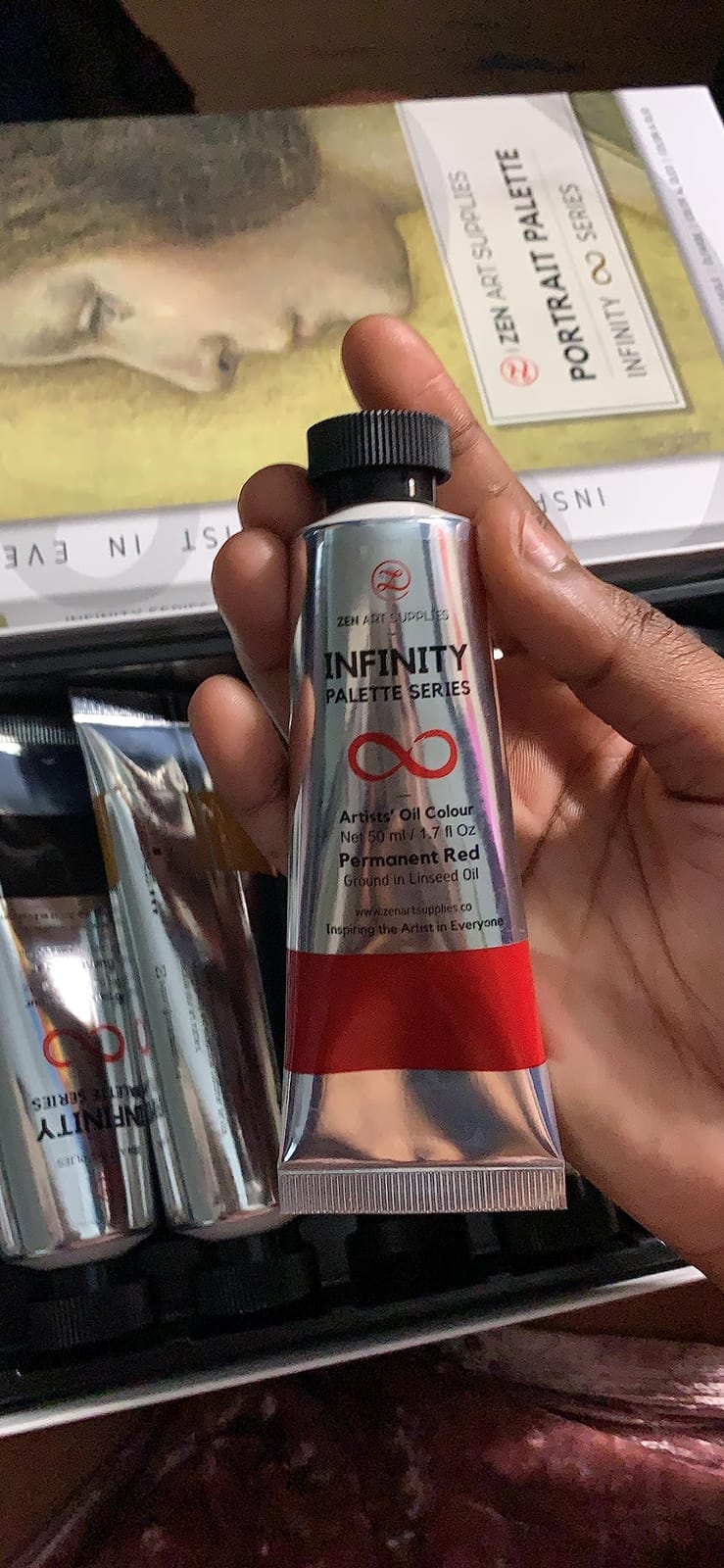
This is the only set in our test group that was assembled for portraits from the start rather than adapted afterwards. The listed colours are Zinc-Titanium White, Yellow Ochre, Vermillion, Permanent Red, Chromium Oxide, Burnt Sienna, Ultramarine Blue and Raw Umber. Read that as a checklist against the six portrait families and you will notice it covers white, yellow ochre, muted red, raw umber and a cool blue in one box.
The tube size matters more than the label suggests. At 50 ml each, the white and the ochre are the same size as everything else, which is unusual in a portrait set and removes the usual complaint about running out of titanium white halfway through a session. Paint a head on a prepared panel and you are still nowhere near the bottom of the white tube.
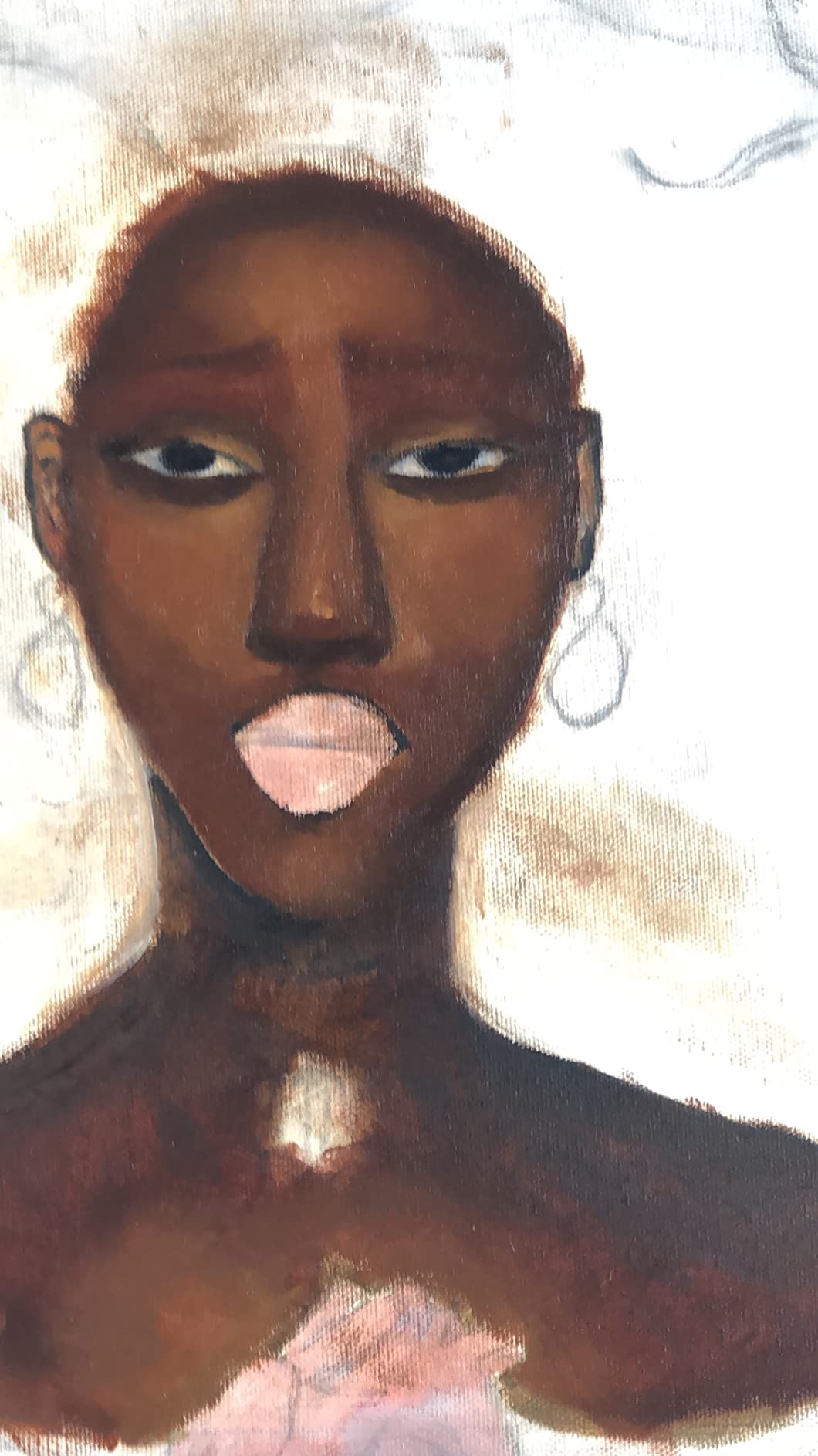
Consistency is the quiet strength here. The paint is described as milled in linseed oil with single pigments where possible, which is why reviewers consistently mention blending and thinning without reaching for a medium. Wet-on-wet work on a toned ground, the way most portrait studies are started, needs paint that will sit still and move under a brush.
The limit worth knowing is the one the eight colour count implies. Once you move past a straightforward head study and want colour accents in the clothing or background, there is no greens or blues beyond the single ultramarine, so you will be mixing your way there. That is not a defect for portraits. It is a limit on how far the box travels.
How well does it mix deep skin tones?
Raw umber and ultramarine give you both directions of adjustment. Raw umber cools and darkens without turning the mix grey, ultramarine pushes a mix warm again when it has gone too cool, and the vermillion and permanent red give you two strengths of red rather than one. For a limited palette, that is a well-designed set of controls.
Burnt sienna sits in the box as a bridge between the ochres and the red, which is the colour that most often gets skipped in a cheap palette and then missed at the blending stage. Chromium oxide green covers the rare case where a flesh mix needs cooling rather than grey.
Who should not buy this set
Anyone working purely in one flesh tone with a strict limited palette will find eight colours generous and may prefer to buy tubes individually. The other mismatch is studio practice with solvents: this paint is not water-mixable, so cleanup needs a proper solvent routine rather than soap and water.
Beginners who want to learn palette building rather than follow a recipe will also find it restrictive. It answers one job very well, and that job is portraits.
2. Charvin Bonjour Portrait Set, 9 x 20ml – the glazing set
Charvin Extra Fine Professional Oil Paint Set for Artists, Portrait Colors – Bonjour Set of 9, 20 ml Tubes, Finely Milled, Non-Yellowing Artist Oil Paints in French Riviera-Inspired Hues
9 x 20ml tubes
180 ml total
Triple-milled pigments
Poppy and linseed oil binder
Pros
- Exceptionally fine creamy consistency from triple milling
- High pigment concentration that thins into subtle glazes
- Marked as permanent and light-fast
- Portrait-specific hue selection in small-batch production
Cons
- 20ml tubes run out quickly on larger work
- Only nine colours in the set
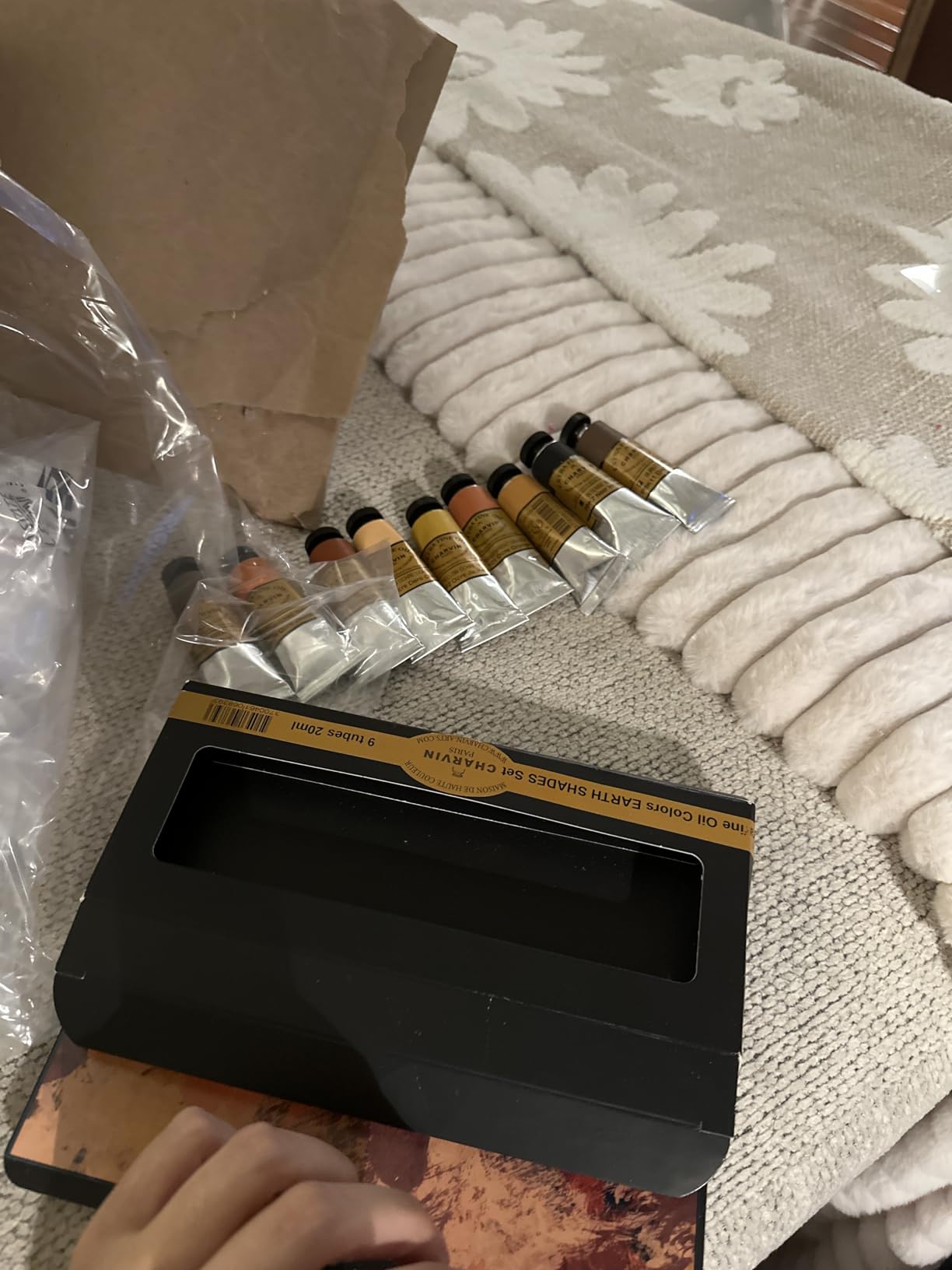
Charvin makes this set in small batches and mills it three times, which is a slower and finer process than a standard set. The result is a paste with no gritty particles, which matters if you are building a face in thin layers rather than blocking it in wet-on-wet.
For portrait work, glaze transitions are where cheap paint shows. You are laying a warm layer and reading it through with a cooler one, so any chalkiness in the underlayer comes straight back as a flat, dead patch across the cheek. Reviewers on this set consistently talk about how the paint thins into luminous glazes, and that is the specific behaviour glazing flesh tones depends on.
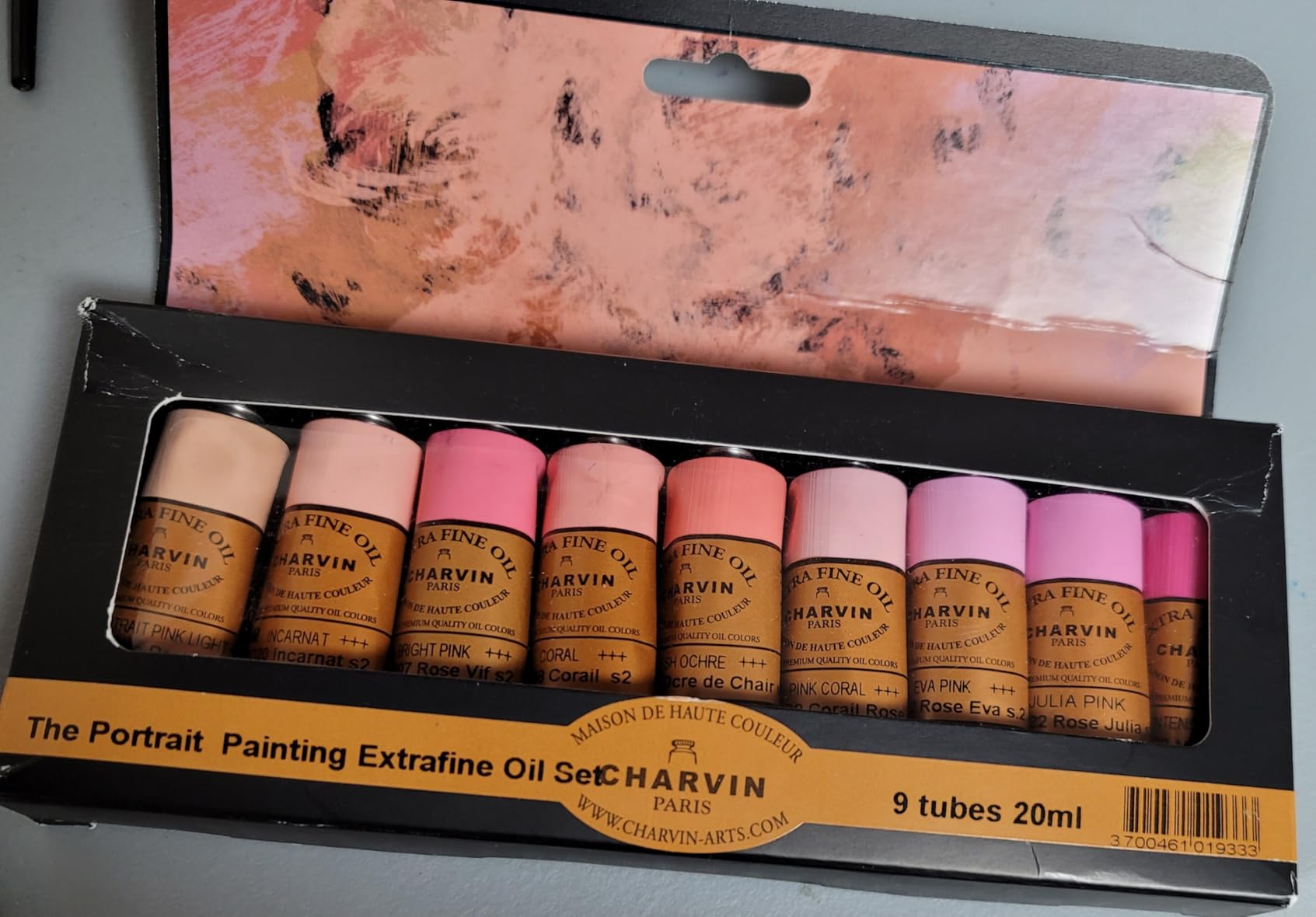
The binder is part poppy and part linseed. Poppy dries more slowly than linseed, which is useful when you want a full sitting to stay workable, and it is less prone to the yellowing shift that can creep into a skin passage over months.
Nine colours is a genuine limit. It is enough for a head study built on a limited palette, and not enough for a full portrait with a background. Pair it with the larger set further down this page if you want one box for everything, or accept it as a focused skin palette.
Is it worth it for a beginner?
Only if you already know you paint in layers. If you are starting out and working alla prima with a big brush, the tube size and the price make little sense next to a larger set, and you will not feel the difference in milling on your first attempts.
For someone who has painted in acrylics for years and wants a slow-drying, finely milled oil for glazing, it is a different proposition entirely. The consistency is the point.
What you give up
Twenty millilitre tubes are small. A single portrait head can use most of a white tube once you are mixing tints rather than pulling them from the palette knife.
The review base is also the second thinnest in this roundup, so you have less long-term evidence to lean on than with the higher-volume listings below. The formula is well regarded, but the set has not been in front of as many painters for as long.
3. PHOENIX Water Soluble Oil Paint Sticks, 6 Skin Tones – the field set
PHOENIX Water Soluble Oil Paint Stick Set, 6 Skin Tone Colors, 37ml
6 solid oil paint sticks
37 ml each
Water soluble
Listed dry time 5 to 7 days
Pros
- Dedicated skin tone spectrum from light flesh to deep umber
- Water soluble so brushes wash out with water
- Solid sticks are compact and blend with a palette knife
- Supports flat brushwork and gradients and layering
Cons
- Only six colours so complex mixes need other paint
- Lowest rated set here at 4.0 with 10 percent one-star feedback
- No dedicated white among the skin tones
These are sticks, not tubes, and that single change makes this a genuinely different proposition. You cut them with a palette knife, and there is no cap to fail, nothing to reseat, and no solvent needed for the brush. The set conforms to ASTM D4236 and is listed as washable.
The range is the point: six skin tones spanning fleshy pinks through warm beiges to rich browns. That is a head start on complexions that a general set does not give you, and for portrait sketches made away from a studio it is a real advantage.
Water soluble does not mean acrylic. The sticks still dry like traditional oil, listed at five to seven days, and they support flat brushwork, gradients, scraping and layering. You get the handling of oil with a much easier cleanup routine, which matters if you are working in a shared space or with limited ventilation.
What you do not get is a mixing palette. Six pre-mixed skin tones cover finished areas well, but blending between them means mixing tones with tones, which quickly produces mud rather than the range you can build from ochre, red, umber and white separately.

Is it suitable for a beginner?
Yes, for anyone who wants to learn the shapes and values of a face before worrying about colour mixing. The sticks make it hard to flood a palette with the wrong colour, and the low commitment suits someone who wants to try oils without committing to tubes.
It is a weaker choice for someone who wants to understand how skin tones are constructed. You are given the answers rather than the ingredients, and that is a different skill.
What the lower rating reflects
The 4.0 average comes with 60 percent five-star and 10 percent one-star ratings, the widest spread of any set here. The one-star share clusters around the small colour count and the fact that a skin tone set with no strong white cannot build highlights cleanly.
Verify the colour range against your actual subject before committing. Skin tone packs are sometimes weighted toward lighter complexions, and the deep end is where a six colour set has the least room to work.
4. Winsor & Newton Winton Starter Set, 10 x 37ml – the dependable first box
Winsor & Newton Winton Oil Color Paint, Starter Set, 10 x 37ml Tubes, 1.25 Fl Oz (Pack of 10)
10 x 37ml tubes
37 ml per tube
Student and amateur grade
Listed dry time 168 hours
Pros
- Well known student grade with strong tinting strength and coverage
- Ten full-size 37ml tubes give real volume
- Deepest review base of any set in this roundup
- Consistent texture and colour across tubes
Cons
- Assorted selection is generic rather than tuned to flesh tones
- Not water resistant so cleanup needs solvents
This is where most people actually start, and the reasons hold up. Ten 37 ml tubes is a substantial amount of paint, the pigmentation is high enough to give real covering power and tinting strength, and the brand is the one beginners are most likely to buy again tube by tube later.
On r/oilpainting, Winton comes up constantly as a sensible first set, and the common thread in those threads is that it is affordable and good enough to learn on. That is a fair summary. It will not produce the subtlest glazes, but it will not fight you either.
The catch is the selection. It is an assorted set rather than a portrait set, so what you get in earths and muted reds depends on which configuration is offered. Check the colour list before ordering, and if the umbers and a muted red are missing, that is the single tube pair worth adding first.
The listed drying time is 168 hours, which is a full week. That figure describes a full cure rather than a touch dry, and oil on a panel will skin over long before that. Plan your working rhythm around the paint feeling dry to the touch, not to this number.
Does student grade hurt skin tones?
Less than beginners fear, as long as the grade is consistent across the whole box. Problems appear when you mix student grade earths with an artist grade white, because the two tint at different rates and the mix never settles. Everything from one box behaves predictably.
The real cost of student grade is reach. Lower pigment load means more paint for the same intensity, and for portraits that shows up in the white, because you are constantly pulling tints from it.
Who should buy it
Anyone starting oil painting who wants volume and has not yet settled on a palette. Ten full-size tubes will carry you through several studies before you need to reorder anything.
Skip it if you already paint and know which earths you want. In that case, buying six tubes individually at artist grade is a better use of the same money.
5. Winsor & Newton Artisan Water Mixable Set, 20 x 10ml – oil handling without solvents
Winsor & Newton Artisan Water Mixable Oil Paint Set, 20 x 10ml Tubes
20 x 10ml tubes
Cleans and thins with water
Modified linseed and safflower oils
Pros
- Oil look and handling with no hazardous solvents
- Cleans with water and dish soap
- Notably more pigmented than the Winton range
- Warm and cool versions of green and blue and red give mixing latitude
Cons
- Portrait earths are incomplete with no Burnt Umber or Van Dyck Brown or Sap Green or Prussian Blue or Mars Black
- Only one yellow and no second Titanium White
- Some tubes arrive overfilled or underfilled
The appeal here is not the palette. It is that this paint behaves like oil and cleans up with soap and water. The emulsion is built from modified linseed and safflower oils with no water in the formulation, which is why it holds together the way conventional oil does.
Pigment load is a step up from Winton, and reviewers notice it. For a portrait painter who works in a small apartment, a shared studio or a classroom where solvents are restricted, that is a legitimate reason to choose this set over everything else in this guide.
Now the honest part. The set is not equipped for portrait earth work out of the box. Burnt Umber, Van Dyck Brown, Sap Green, Prussian Blue and Mars Black are all absent, and that is a list of colours you will want within a month of starting. There is also only one yellow, and it leans orange.
Twenty 10 ml tubes is the second constraint. A single head study on a mid-size panel will use a meaningful share of them, and small tubes open up, skin over and waste paint if you work slowly.
Is it worth adding tubes to make a portrait set?
It can work, but you are assembling the palette yourself rather than buying one. Plan for at least a Burnt Umber, a Raw Umber if the set lacks it, and a proper Titanium White, because there is no second white in the box and white is what portraits consume.
Users switching from acrylics to oils report that water mixable oil solved their hard edges and their problem with paint drying darker than expected. For that specific transition, this set does the job well.
What you are trading away
Sheen varies slightly between colours because each pigment needs a different oil level, which can show in a finished passage where a face meets a background. Conventional oil is more consistent across a canvas.
It is also the pick for a shared studio, not for an artist who already has a solvent routine and wants the strongest pigments available in this roundup.
6. MyArtscape Oil Paint Set, 48 x 12ml – the widest range
MyArtscape Oil Paint Set – 48 x 12ml Artist Oil Paint Tubes
48 x 12ml tubes
19.48 fluid ounces total
High-sheen finish
Lightfast, fade resistant colours
Pros
- Largest colour selection in the roundup for unusual mixing latitude
- Smooth blending and rich pigment in 12ml tubes
- Lightfast pigments in a traditional high-sheen finish
- Listed as suited to portrait and wet-on-wet work
Cons
- 12ml tubes are small so many get opened before a project ends
- Generic assorted selection rather than a curated portrait palette
Forty-eight colours is a different proposition from everything else here. Where a portrait set gives you a route to skin tones, this one gives you raw material, including the greens, violets and cool greys that a limited earth palette has to mix from scratch.
For someone who likes to experiment and does not want to be told which six colours to use, that freedom is the appeal. Lightfast pigments mean the range does not fade, and the listed use cases include wet-on-wet and portrait work.
The 12 ml tube size is the thing to think hard about. It is large enough to be useful for detail work and small enough that you will open far more tubes than you use, each one skinning at the mouth. For a painter who works in one sitting and discards nothing, that is inefficient.
There is no tier here either. It is an assorted selection, so the earth coverage depends on what the assortment contains on any given run rather than on a promise from the manufacturer.
Is a bigger palette better for portraits?
Not by itself. Palette knife accounts and limited palette practice accounts both point the same way, with painters reporting that six colour palettes produce better portraits than twelve. More colours give you more ways to make a decision, and in portrait work fewer, better-chosen decisions usually win.
Where a wide range does pay off is in clothing, backgrounds and still life elements around the figure, where you would otherwise mix everything yourself.
Who it does not suit
Anyone who wants a curated skin tone palette will find it flat compared with a dedicated set, and anyone who paints slowly will find 48 open tubes hard to manage. It is a value and variety play, not a precision one.
If you already know your six portrait colours, buy those. If you are still working out what you like, this is a cheap way to find out.
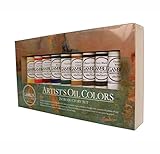
7. Gamblin Artist Oil Colors Introductory Set, 37ml – the pigment benchmark
Gamblin Artist Oil Colors Introductory Set,Multi,37 ml
Artist grade pigment load
37 ml tubes
Thick buttery texture
Box doubles as a birch wood panel
Pros
- Artist grade pigment density with very little added oil
- Consistent thick buttery texture that glazes without weakening
- Fine grinding with no unground pigment including in the earths
- Box is a usable gessoed birch panel
- American made and sustainably produced
Cons
- Selection uses phthalo green where phthalo blue would mix better
- No dedicated large white tube in the set
- Includes cadmium colours that warrant handling care
On r/oilpainting, Gamblin is the answer that comes up when someone asks about artist grade on a sensible budget, described as cheap and excellent quality next to premium imports. The pigment load is the reason. There is very little oil in the tube, so the paint goes on thick and a little goes a long way.
Two details matter more for portraits than the price. First, the milling: no unground pigment, including in the earths, and a consistent buttery texture across the box. Lumps in a raw umber or burnt umber are the kind of thing you discover halfway through a glaze.
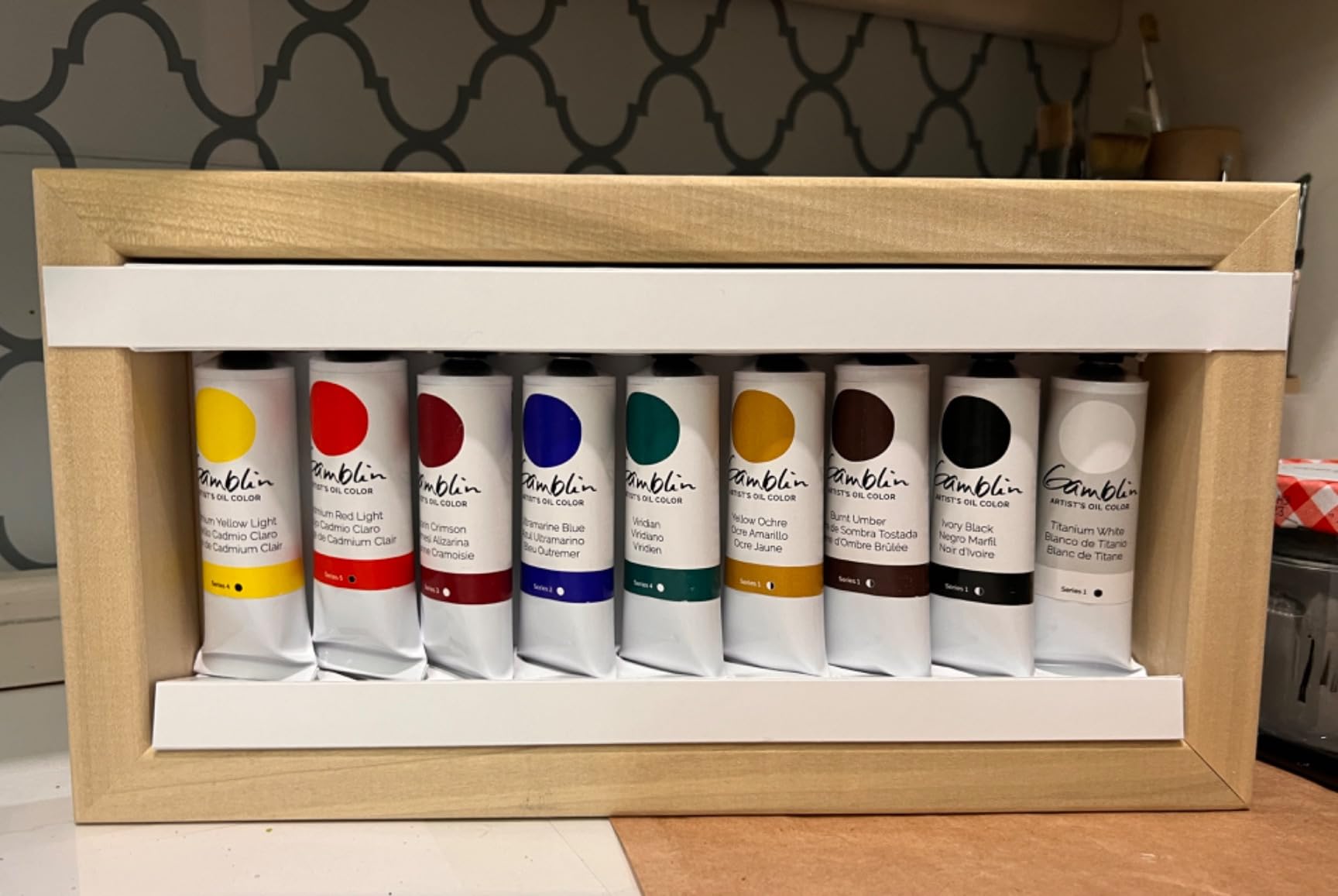
Second, the set box is a handcrafted birch wood panel from sustainable forests. That is a gessoed surface you can paint on immediately, which turns a box of paint into a small complete project.
The selection is not portrait-first. It uses phthalo green where phthalo blue would mix more usefully, and there is no dedicated large white tube, which you will want to add on its own. Cadmium colours are included and do warrant care in handling, particularly for anyone working around children.
Is it the right grade for a beginner?
Yes, and this is the cost-aware split most advice online never quite resolves. Student grade is defensible for broad exercises where you are learning to handle paint. The colours you mix skin tones from should be artist grade, because those are the tints you will judge your own work by.
Buying this set and adding a large Titanium White gives you a working artist grade portrait box without buying a full premium line.
What the price does to the decision
It sits at the upper end of the prices in this roundup, and several long-time users note its cost has climbed sharply. That is a real consideration for a first purchase, and it is the main reason the Winton set appears higher on this page.
If you are buying once and painting for years, the pigment load means it goes further than the ticket suggests. If you are unsure you will stick with oil, start cheaper.
8. Gamblin 1980 Oil Color Exclusive Set – the complete starter bundle
Gamblin 1980 Oil Color Exclusive Set
8 x 37ml tubes
Includes a cradled primed panel
Solvent-free gel medium
Pros
- Eight 37ml tubes bundled with a cradled primed panel and solvent-free gel
- You can paint on the panel the same day
- Solvent-free gel speeds drying without hazardous fumes
- High-end student grade performance at a mid-range price
- Made in America
Cons
- Only eight colours
- which is thin for a full portrait palette
- Student grade sits below the Gamblin Artist line in pigment load
The logic of this set is completeness. Paint, a cradled primed panel and a bottle of solvent-free gel medium arrive together, so a beginner can open the box and paint rather than assembling a surface and a medium first. For a gift buyer with no idea what else is needed, that is the single most useful feature in this guide.
Gamblin positions the 1980 line as a high-end student grade offering good value. It sits below the Artist line on pigment load but above the entry-level student ranges, and the 4.8 average across 617 reviews reflects that.
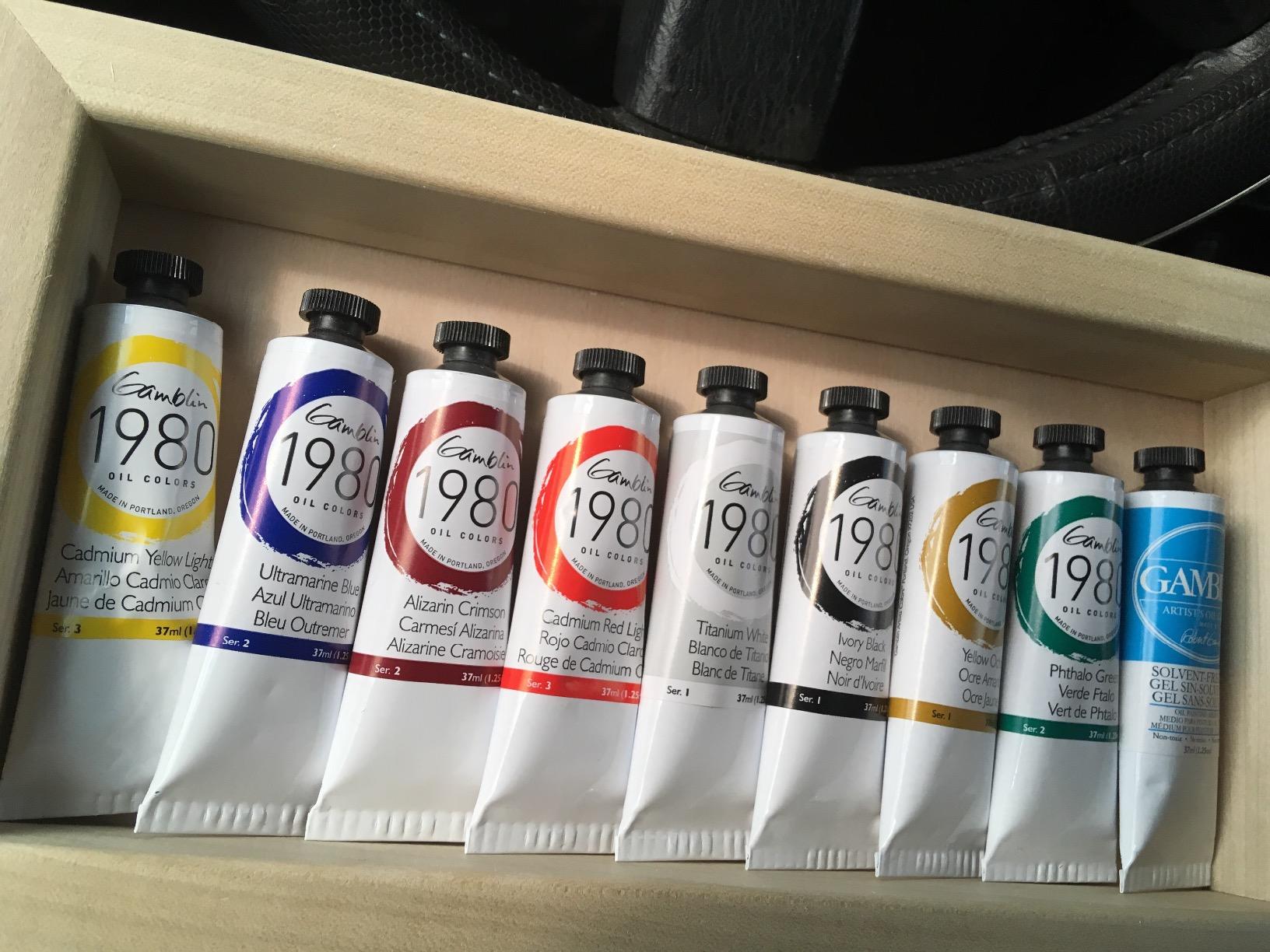
Eight colours is the limitation for portrait work. That is enough to make a head study if the colours are chosen for it, and not enough to have earths, a muted red and a cool blue all present. Check the listing colour list and plan one or two additions.
The listed drying time is 24 hours, with a full cure at 24 hours as well, which is faster than the long-cure figures on the Winsor & Newton listings. The included gel is there to accelerate drying further when you want to overpaint within a sitting.
Is it better value than buying tubes individually?
For a genuine beginner, yes, because the panel and medium remove two extra purchases that most people forget and then pay for late. For an experienced painter, no. You already own a panel, you already own a medium, and the eight colour count is the real limit.
Buyers consistently single out the panel and the medium as the reason they are happy, more than the paint itself.
Who should not buy it
Anyone who wants to build a serious limited palette will find eight tubes restrictive. And anyone who already owns good artist grade paint is paying for accessories rather than pigment.
As a first oil painting experience with nothing else in the cupboard, it is hard to argue with.
9. MEEDEN Artist Oil Paint Set, 12 x 60ml – the long-runner
MEEDEN Artist Oil Paint Set – 12 Colors x 60ml/2oz Tubes
12 colours in 60ml tubes
720 ml total
Heavy body consistency
Listed dry time 24 hours
Pros
- Very large 2oz tubes cut down how often you reorder
- Creamy smooth texture that mixes into many shades cleanly
- Strong coverage and good opacity with a well regarded Titanium White
- Excellent lightfastness and non-toxic formulation
Cons
- Some named hues deviate from their labels for example Olive Green
- Twelve colours only so a portrait palette still needs additions
The 60 ml tube is the headline here, and these are among the largest individual tubes in this roundup. For portrait painting that is a genuine advantage, because white, yellow ochre and raw umber are the colours you burn through first and reorder most often.
Experienced painters comparing this against pricier brands frequently conclude that it is better value, citing the creamy texture and the coverage. The Titanium White in particular draws positive mention, which matters because white quality sets the ceiling on how light a highlight can go.
The consistency is described as heavy body, suited to glazing, impasto and layering alike. That range of use is useful at twelve colours, because you can go from a thin glaze in the shadow to a loaded highlight without changing tubes.
The honest weakness is naming accuracy. Reviewers note hues that do not always match the label, with Olive Green reading closer to grass green in some reports. For portrait work this is a minor issue, because greens barely enter a flesh mix. For a mixed practice it is worth checking the swatches on arrival.
Is a 60ml tube too much paint?
For most painters, no. Twelve large tubes is a lot of paint to sit in a drawer, and tubes do eventually skin. But the colours you use constantly in portraits, white, ochre, umber and red, are exactly the ones that disappear fastest from a set of 12 ml tubes.
If you mainly paint small head studies, 60 ml per colour is generous. If you paint full-length figures, it is about right.
What is still missing for portraits
Twelve colours is not a portrait palette by design. You will want to confirm the set includes a raw umber and a muted red, and add an ivory black if it is absent.
The lightness of the tubes makes them a good companion to a smaller colour set: buy the twelve large tubes for the colours you use every day and a few small tubes for accents.
10. PHOENIX Artist Oil Paint Set, 12 x 40ml – the earth-forward twelve
PHOENIX Artist Oil Paint Set – 12 Classic Colors x 1.35 oz / 40ml Tubes – Professional Grade Pigments for Canvas – Traditional Palette with Earth Tones & Primary Colors for Students, Beginners & Studio Painting
12 x 40ml tubes
Both umbers and Ivory Black
In cold-pressed linseed oil
Pros
- Well balanced twelve colour palette with Yellow Ochre and Burnt Umber and Raw Umber and Ivory Black
- Buttery silky texture from ultra-fine milled pigments
- High pigment load with museum-quality lightfastness
- Free of cadmium and lead pigments and AP and ASTM D4236 compliant
Cons
- Twelve colours only and marketed mainly at beginners and students
- The reds and yellows are hues rather than true cadmium pigments
This listing names its full palette, which is rare and useful. Titanium White, Cadmium Yellow Hue, Cadmium Red Hue, Permanent Rose, French Ultramarine, Dioxazine Purple, Permanent Green Light, Viridian Hue, Yellow Ochre, Burnt Umber, Raw Umber and Ivory Black. Four of the six portrait families are there in a single box, including both umbers and a neutral black.
Two features set it apart from the other twelve-colour sets here. It is milled in cold-pressed linseed oil with a natural earth drier, and it is made without cadmium or lead pigments, meeting AP and ASTM D4236 standards. For a studio with children or a painter who reacts to heavy metals, that removes a real concern.
Where it stops short of a portrait set is the reds. Cadmium Red Hue and Permanent Rose are both stronger and cleaner than flesh tones want to be, so a skin mix started from these takes more muting than one started from an earth red. That is workable, and it is exactly why the well-known six colour portrait palette replaces the red with Light Red or English Red instead.
Add a raw or earth red to this box and you have a very good portrait set with two umbers, an ochre, an ivory black and a titanium white already in place.
How it handles light to deep tones
French Ultramarine gives you genuine colour control rather than dulling, which is the standard answer on painting forums when someone asks how to keep a deep skin mix from going muddy. White at 40 ml per tube gives you the tinting range to build a light flesh to a highlight.
The Ivory Black rather than Mars Black choice is the right one for flesh, because Mars black tends to sit cold and chalky.
Who it suits and who it does not
It suits a student who wants a full box that can handle portraits, figure work and still life without buying anything else. The lightfastness claim also means the colours should not shift over time on a wall.
It does not suit a painter who wants cadmium pigments specifically, since the reds and yellows here are hue versions. Reviewers also find it basic for advanced work, which is fair for a set marketed at beginners.
11. Maimeri Classico Oil Paint Set, 12 x 20ml – Italian tradition
Maimeri Classico Oil Paint Set 12 x 20ml Assorted Colours
12 x 20ml tubes
Wax-free Italian formulation
Natural earths, ochres and cadmiums
Soft buttery paste
Pros
- Butterfly soft wax-free paste that mixes cleanly with brush or knife
- Uniform drying time across every colour in the set
- Natural earths and ochres give a strong base for skin mixing
- Brilliant chromatic rendering from the Italian oil paint tradition
Cons
- 20ml tubes are small for sustained portrait work
- Only one earth plus Raw Umber so deeper earth mixes need extra tubes
Maimeri is an Italian maker and the Classico line follows the Italian tradition of producing paint without waxes. That detail affects behaviour more than it sounds: waxes can interfere with how a paint layers and how evenly it dries, and this set is built for brilliant chromatic rendering instead.
The listed palette includes Titanium White, Permanent Yellow Light, Yellow Ochre, Permanent Carmine, Burnt Sienna, Vermilion Deep (Hue), Phthalo Green, Permanent Green Light, Cobalt Blue Light (Hue), Ultramarine Light, Raw Umber and Ivory Black. Burnt Sienna and Permanent Carmine together give you a genuine route to flesh, which is better than starting from a bright hue.
The most underappreciated feature is uniform drying time across all colours. Reviewers single this out, and it matters in practice: a palette where one tube skins over while the rest stay open is genuinely annoying to work from.
Natural earths and ochres in the box mean the flesh tones start muted, which is the whole argument for choosing earth-based paint for portraits. Two earth colours plus Raw Umber is thin for deep complexions, and that is the gap to fill.
Is the paste good for blending?
Yes. It is described as a soft buttery paste that works with a brush or a painting knife, and painters using it for portrait work mention clean mixes without chalkiness. Soft paste is easier to blend wet-on-wet, which is how most beginner portraits get started.
Reviewers also note the traditional feel of the paint at the price, describing it as a smooth oil that behaves the way oil should rather than something that feels like a compromise.
Who should buy it
A painter who wants muted starting colours and Italian handling, and who is willing to add one or two tubes. The 20 ml size suits someone painting studies rather than large work, and it suits travel for the same reason.
Anyone producing large canvases will replace these tubes quickly. The 16 percent share of four-star ratings in the feedback tends to reflect exactly that.
12. Ohuhu Oil Paint Set, 36 x 12ml – the low-cost way in
Ohuhu 36 Oil-Based Colors Oil Paint Set, 12ml/0.42oz x 36 Tubes Non-Toxic
36 x 12ml tubes
Non-toxic to ASTM D-4236 and EN71-3
Flesh Tint plus the full earth family
Pros
- Largest affordable range at 36 colours including a dedicated Flesh Tint
- Full earth family with Burnt Sienna and Burnt Umber and Raw Umber
- Blends smoothly and covers without weeping oil
- Non-toxic and safe for beginners and children over three
Cons
- The white tube is the same size as the others so white runs out first
- Some tubes arrive with cracked caps that cannot reseal
- Drying can be slower than expected
Thirty-six colours with a Flesh Tint, Burnt Sienna, Burnt Umber, Raw Umber and Payne’s Grey in the mix is more usable for portraits than the price suggests. It conforms to ASTM D-4236 and EN71-3, which is why it is often bought for children, and it blends smoothly without flooding the palette with oil.
The review count here is by far the largest in this roundup, and the feedback is consistent: beginners treat it as the best affordable way to find out whether they like oil painting. At that job it succeeds.
Three practical gripes come up repeatedly. The white tube is the same 12 ml as every other colour, so it is the first to empty in portrait work, which is a design flaw for a set sold to skin tone painters. Some reviewers also receive tubes with cracked caps that cannot reseal. Drying can take several days before it is safe to overpaint.
None of those are reasons to reject it. They are reasons to treat it as a sampling set rather than a palette you will build a body of work on.
Can beginners really learn with this set?
Yes. The failure mode for beginners is usually the drawing and the value structure, not the pigment. Paint at this level will let you learn to see a face in value without teaching you habits that need unlearning later.
The set also includes Flesh Tint, which gives an immediate usable colour on the palette and a lot of encouragement in week one. That has real value for someone who is not sure they are a painter yet.
When to move up
Upgrade when you reach the point of mixing the same flesh tone repeatedly and running out of white. At that stage a larger white tube and an artist grade ochre make more difference than any other single purchase.
Until then, this set does the job for the least money, and the acrylic set guide on Model Rec is worth a look if you want to know whether you prefer a faster drying medium first.
How we scored each set for portrait work
We mixed the same five skin tone passages from every set in the group, from a pale highlight to a deep shadow, and scored five things in order of weight.
Portrait colour coverage. How many of the six families are present, and whether the reds and yellows are muted enough to start a flesh mix without a long correction.
Pigment load and tinting strength. How much paint it takes to reach a given intensity when tinted with white, since portraits lean on tints constantly.
Earth quality. Whether the umbers are finely milled, because a gritty raw umber ruins a glaze.
White quality. Coverage and opacity, since white is the mixing vehicle for everything else.
Lightfastness and binder. How the paint dries and whether it shifts over time.
We deliberately did not score on tube count. A bigger box does not make a better portrait palette, and the evidence on limited palettes points the other way.
Artist grade vs student grade for portraits
The distinction is pigment to binder ratio. Artist grade paint is mostly pigment with a small amount of oil. Student grade carries more oil and sometimes filler to hit a price point, so the same tube covers less and the tints are weaker.
The online advice splits, because both halves are true. Beginner threads push artist grade, and other beginners say Winton was fine to learn on. Both can hold, and the resolution is which colours you mix skin from.
Use student grade for broad practice, exercises and colour mixing experiments where the result does not matter much. Use artist grade for white, the umbers and your muted red, because those are the colours your final mixes are judged by. Mixing weak earths with a strong white gives tints that shift and chalk.
A word on tube labelling: if the name on the tube ends in the word hue, it is usually a substitution for a more expensive pigment and usually indicates student grade. Named pigment codes are more informative than the colour name, and an ASTM lightfastness rating tells you how the colour will hold on a wall.
For scale modelling and surface finishing rather than canvas painting, the weathering effects roundup covers a different set of requirements.
Why portraits go orange and how paint choice fixes it
Over-bright mixing is the most repeated portrait complaint on painting forums, and it has a colour cause rather than a technique cause. Bright cadmium red or phthalo-based colours are extremely high in chroma, so when they are the dominant colour in a skin mix the result reads as orange.
The fix is to start muted. An earth yellow ochre with a red earth gives a warm base that is already closer to skin, so you spend your time adjusting value rather than fighting saturation. This is why every dedicated portrait set in this roundup is built on earths.
Second, use a toned ground. A thin umber wash on the panel gives every subsequent layer something mid-value to sit on, which cuts back on the pinking that happens when you keep reworking a white ground. Third, control cool tones with ultramarine rather than with black, since black drains the colour and leaves the mix flat.
These are pigment selection decisions, not practice decisions. A palette of earths plus one cool blue makes the orange problem largely disappear before it starts.
Tube size, cost per use and what to reorder first
Portrait work has a predictable burn order: white first, then yellow ochre, then raw umber, then the muted red. That is why tube size matters more here than in any other genre.
A 37 ml white tube will get through a few head studies. A 12 ml white tube will not last one session if you are pulling tints for every flesh passage. When you compare sets, look at the white tube size first, not the total volume in the box.
Because artist grade paint carries more pigment, a smaller artist grade tube covers further than a larger student grade one. That inverts the usual reasoning and is why a higher grade set can cost less over a year of painting than the cheap set you keep reordering.
On upgrades, the order is white, then an earth red if you lack one, then a deeper black. A cool blue only if you are mixing cool complexions. If you want a broader comparison of starter formats, the 502 oil paint set guide covers rigid-surface painting, which is a different use case again.
Frequently Asked Questions
Which paint is best for portrait painting?
The best oil paint for portraits is an artist grade set containing titanium white, a muted yellow earth such as yellow ochre, a muted red, raw umber, ivory black and one cool blue. Skin tones are mixed rather than found, so earth-based starting colours matter far more than a bright, high-chroma range. Avoid sets built around cadmiums and phthalos with no earths in the box.
What are the best brands of oil paints for oil painting?
The brands most often recommended by working painters are Gamblin, Winsor u0026amp; Newton Artists, Old Holland, Michael Harding, M. Graham and Williamsburg. Gamblin and Winsor u0026amp; Newton Artists are frequently described on painting forums as affordable and professional quality, while Old Holland, Michael Harding, M. Graham and Williamsburg sit at the premium end with heavier pigment loads and pricier tubes.
Is Gamblin or Winsor and Newton better?
For portraits, Gamblin has the stronger pigment load and a buttery texture that glazes without weakening, which suits layered skin work. Winsor u0026amp; Newton Artists offers a broader Artists colour range and more flexibility in choosing individual earths. If you are buying a set, Gamblin’s introductory set covers more ground; if you are buying tubes, Wu0026amp;N gives you more choice per colour.
What colours do I need for portrait painting?
Six colours cover most portrait work: titanium white, yellow ochre, a muted red such as permanent red or English red, raw umber, ivory black and a cool blue such as ultramarine. Add a burnt umber and a titanium or zinc white later. Starting from muted earths rather than bright hues is what keeps skin tones from going orange.
Artist grade vs student grade oil paint: which is better?
Artist grade wins on pigment load, tinting strength and permanence. For portraits, the split rule is simple: use student grade for broad practice exercises, and artist grade for the colours you actually mix skin tones from, especially white, umbers and your muted red. Mixing weak student earths with artist grade white produces chalky tints that shift as they dry.
What is the 70/30 rule in painting?
The 70/30 rule is a colour mixing guideline, not a paint buying rule. It suggests using roughly 70 percent of one dominant colour and 30 percent of a second when mixing, rather than equal parts, so the hue stays controlled. In portraits it works well for keeping a warm flesh tone dominant while a cooler colour adjusts it without taking over.
Is Van Gogh oil paint good?
The Van Gogh brand range is a mid-priced professional line sold widely and generally regarded as a solid step up from student grade. It is unrelated to paint made by Vincent van Gogh, who worked with lead-tubed colours long before modern ranges existed. For portraits, check the specific colour list rather than the brand name, since earth coverage varies between sets.
Conclusion: the final verdict on the best oil paint sets for portrait painting
The best oil paint set for portrait painting is the ZenART Professional Portrait Set. It is the only box here assembled around skin tones, it covers five of the six portrait colour families without shopping around, and the 50 ml tubes mean white and ochre survive the number of studies you will actually paint.
Buy the Winton Starter Set instead if you want volume and the lowest commitment. Buy the Gamblin Artist set if you already know oil is for you and want the strongest pigments in this group. Buy the Artisan Water Mixable set only if your studio cannot take solvents.
Whichever you choose, check the umbers and the muted red before you start. Those two decide whether your portraits mix cleanly or go orange, and no set on this page replaces them for you.