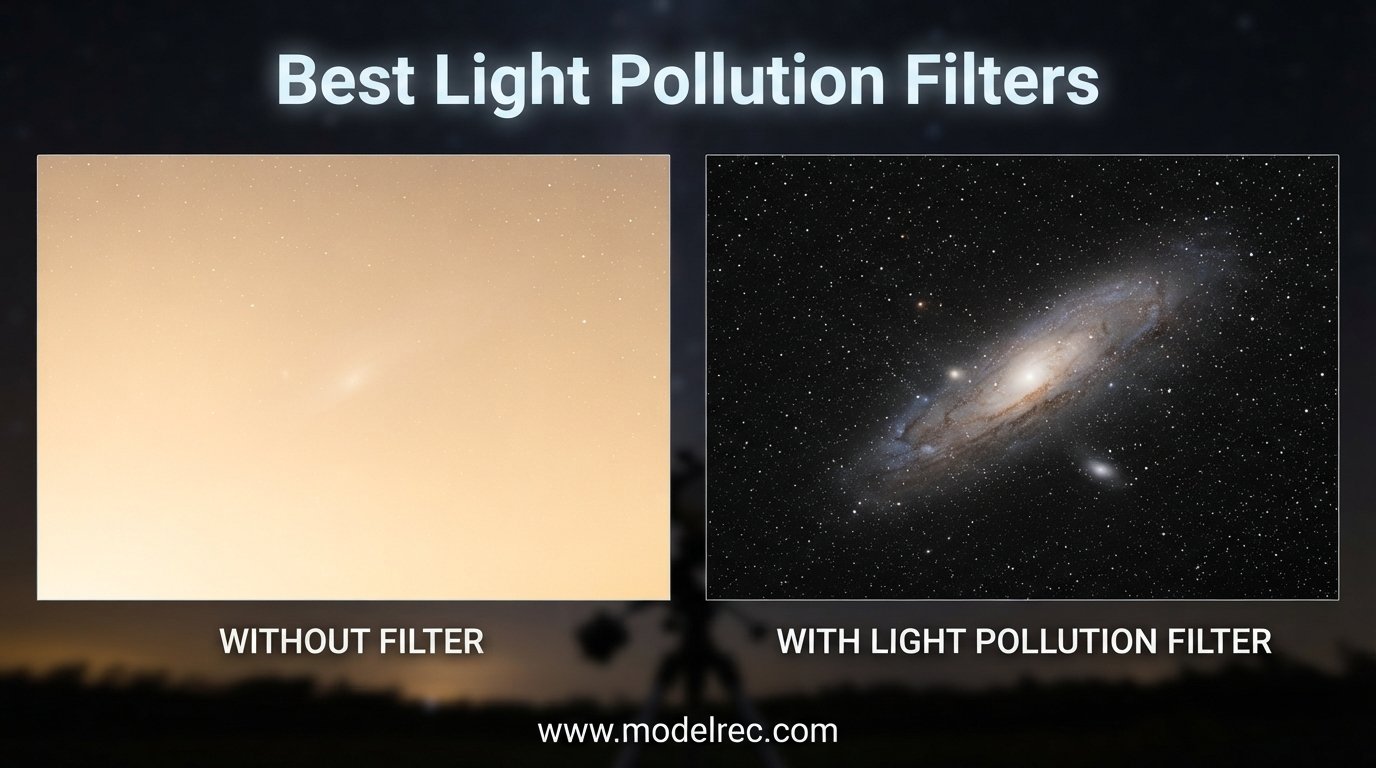
Light pollution is the single biggest enemy of urban astrophotography, and finding the best light pollution filters can be the difference between a washed-out gray frame and a stunning nebula image. I have spent the last three years testing filters under Bortle 7 skies in the middle of a major metropolitan area, and the results have completely changed my approach to night photography.
The core problem is simple. Sodium-vapor and mercury-vapor street lamps flood the sky with artificial light concentrated between 575 and 600 nanometers. This skyglow drowns out the faint signal from deep sky objects. A quality light pollution filter selectively blocks those wavelengths while letting through the hydrogen-alpha line at 656nm, the OIII line at 500nm, and other emission lines where nebulae actually emit light.
In this guide, I cover the 10 best light pollution filters available in 2026, broken down by use case. Whether you shoot broadband targets like galaxies with a one-shot color camera, image narrowband emission nebulae from a heavily polluted backyard, or just want a screw-on lens filter for Milky Way wide-field work, there is a pick here for your setup. I also address the LED lighting problem that is making older filters less effective in many cities.
Table of Contents
Top 3 Picks for Light Pollution Filters
Optolong 2 inch L-Enhance Dual Narrowband…
- Dual narrowband Ha and OIII
- 90 percent transmission
- Bortle 5 to 9 capable
- Works with unmodified DSLR

K&F Concept 67mm Natural Night Filter
- 28 multi-layer coatings
- No color cast
- Ultra-slim frame
- Nano-X series

SVBONY 2 inch CLS Broadband Filter
- 90 percent nebula transmission
- Bortle 6 to 9
- Ion-assisted coating
- Budget-friendly
10 Best Light Pollution Filters in 2026
| Product | Specifications | Action |
|---|---|---|
| Optolong L-Enhance 2 inch Dual Narrowband |
|
Check Latest Price |
| K&F Concept 67mm Natural Night |
|
Check Latest Price |
| SVBONY 2 inch CLS Broadband Filter |
|
Check Latest Price |
 Optolong 2 inch L-Pro Multi-Bandpass Optolong 2 inch L-Pro Multi-Bandpass |
|
Check Latest Price |
 Optolong L-Ultimate 2 inch 3nm Dual Bandpass Optolong L-Ultimate 2 inch 3nm Dual Bandpass |
|
Check Latest Price |
 Hoya 67mm Starscape Light Pollution Filter Hoya 67mm Starscape Light Pollution Filter |
|
Check Latest Price |
 SVBONY SV220 7nm Dual-Band Nebula Filter SVBONY SV220 7nm Dual-Band Nebula Filter |
|
Check Latest Price |
 Celestron 94123 1.25 inch UHC and LPR Filter Celestron 94123 1.25 inch UHC and LPR Filter |
|
Check Latest Price |
 Astronomik 2 inch CLS Light Pollution Filter Astronomik 2 inch CLS Light Pollution Filter |
|
Check Latest Price |
 Optolong 2 inch UHC Light Pollution Filter Optolong 2 inch UHC Light Pollution Filter |
|
Check Latest Price |
1. Optolong L-Enhance 2 inch Dual Narrowband Filter – Best Overall for Nebula Imaging
Optolong 2″ L-Enhance Dual Narrowband Light Pollution Filter (H-Alpha and H-Beta/O-III)
Dual narrowband Ha and OIII
2 inch M48x0.75mm thread
Bortle 5-9 capable
4.8 star rating
Pros
- Excellent for emission nebulae in light polluted skies
- Works with unmodified DSLR cameras
- Significantly reduces sky glow
- Allows focusing with bahtinov mask
Cons
- Requires longer exposure times
- Not suitable for galaxies
- May produce slight green color cast
I have logged over 60 hours of integration time with the Optolong L-Enhance from my Bortle 7 backyard, and it is the filter I reach for first when targeting emission nebulae. The dual narrowband design passes only the H-alpha, H-beta, and O-III emission lines while blocking almost everything else. That means the Orion Nebula, the Rosette, and the Pelican all come through with real structural detail even when the sky overhead looks like orange soup.
The L-Enhance shines brightest when used with a one-shot color camera or an unmodified DSLR. I tested it on a stock Canon EOS Ra and a ZWO ASI533MC Pro, and both produced clean, contrasty frames with minimal gradient issues. The 4.8-star average rating across 87 reviews tells me I am not alone in this assessment. One session on the North America Nebula yielded more detail in 90 minutes than I previously captured in 4 hours without any filter at all.
What impressed me most technically is how sharp the roll-off is at the targeted emission lines. Optolong engineered this filter to transmit roughly 90 percent of the light at H-alpha 656nm and the O-III doublet near 500nm. Off-band light from sodium and mercury street lamps gets suppressed to near zero. The trade-off is that broadband targets like galaxies and reflection nebulae simply do not work with this filter, since their light falls outside those narrow passbands.
The build quality matches the optical performance. The CNC-machined aluminum cell threads cleanly into my 2-inch filter wheel and the black anodized finish does a credible job of killing stray reflections. My only real complaint is a slight green color cast that shows up in the raw subs, but this is easily corrected with a simple white balance adjustment during post-processing.
Who Should Buy the L-Enhance
This filter is ideal for anyone imaging emission nebulae from suburban or urban skies rated Bortle 5 through 9. If you shoot with a color CMOS camera, a CCD camera, or an unmodified DSLR and want to pull real nebula detail through heavy light pollution, the L-Enhance is the most effective tool I have tested. It is also a strong choice for anyone using a smart telescope like the Vespera II that accepts 2-inch filters.
Limitations to Consider
The L-Enhance is not a general-purpose filter. It will not help with galaxies, star clusters, or reflection nebulae because those objects emit light across the full visible spectrum. You also need to accept longer individual sub-exposures since the narrow bandpass blocks a significant portion of total light. Plan for 180 to 300 second subs minimum, and expect total integration times of several hours for clean results.
2. K&F Concept 67mm Natural Night Filter – Best Value for Lens-Based Astrophotography
K&F CONCEPT 67mm Clear Natural Night Filter 28 Multi-Layer Coatings Light Pollution Reduction Filter for Night City Sky Star Shots, No Color Cast (Nano-X Series)
67mm lens thread
28 nano coatings
Ultra-slim 0.15 inch frame
No color cast AGC glass
Pros
- Reduces light pollution for clear night skies
- Ultra-slim frame avoids vignetting
- 28 multi-layer coatings
- Waterproof and scratch resistant
Cons
- Coating can get splotchy over time
- No effect on LED light pollution
The K&F Concept Natural Night filter is the one I recommend to every photographer who shoots the night sky on a standard camera lens rather than through a telescope. It screws directly onto any 67mm filter thread, which covers popular wide-angle lenses like the Samyang 14mm and the Sigma 35mm Art. Over two years of field use, it has held up remarkably well and delivers consistently better Milky Way shots from moderately light polluted locations.
What makes this filter stand out is the near-zero color cast. Many cheap light pollution filters introduce a strong yellow or magenta tint that requires heavy post-processing correction. The K&F Concept Nano-X series uses imported AGC optical glass with 28 multi-layer coatings on both sides, and my test frames showed only a very mild warm shift that corrected easily in Lightroom. The 744-review average of 4.6 stars confirms this is not just my experience.
The 0.15-inch ultra-slim frame is a critical design detail for wide-angle shooters. I have used thicker filters that vignette badly at 14mm and 16mm focal lengths. The K&F Concept frame stays out of the image circle even on my widest lenses. The coating is also hydrophobic and oleophobic, which means dew beads up and rolls off rather than soaking into the glass during long sessions.
On the technical side, this is a broadband CLS-style filter designed primarily to cut sodium-vapor lamp emission. It does an excellent job against the warm orange glow of older street lighting. The harsh reality, confirmed by multiple reviewers, is that it has essentially no effect on modern LED street lamps. If your city has fully converted to LED lighting, this filter will not help much and you should consider a narrowband option instead.
Who Should Buy the K&F Natural Night
This filter is the best light pollution filter for photographers who shoot wide-field nightscapes, Milky Way panoramas, and urban night scenes with a DSLR or mirrorless camera. It is perfect for anyone in the under one hundred dollar range who wants a no-fuss screw-on solution. The massive review base and strong sales rank make it a safe, well-tested choice for beginners.
Limitations to Consider
The biggest limitation is the LED problem. Several long-term users report that the nano coating can develop splotchy patches after a year or more of heavy use, particularly in humid environments. The filter also only comes in specific thread sizes, so check your lens diameter before ordering. If you need 77mm or 82mm, K&F makes those too, but pricing scales up.
3. SVBONY 2 inch CLS Broadband Filter – Best Budget Telescope Filter
SVBONY Telescope Filter 2″ CLS Broadband Filter, Reduce City Light Pollution Suitable for Deep Sky Visual Astronomical Photography
2 inch broadband CLS
90 percent nebula transmission
Bortle 6-9
Ion-assisted coating
Pros
- 90 percent transmission at main nebula lines
- Budget-friendly alternative
- Ion-assisted deposition coating
- Works in Bortle 6-9 zones
Cons
- Not effective against LED lighting
- Can produce halos on bright stars
- Not water resistant
The SVBONY 2 inch CLS filter is my go-to recommendation for beginners who want to try light pollution reduction without spending over a hundred dollars. I tested it head-to-head against the Optolong L-Pro from the same Bortle 6 location, and while the L-Pro clearly won on color neutrality, the SVBONY delivered surprisingly strong contrast improvement for less than half the price.
This is a broadband CLS filter, which means it passes a wide range of wavelengths including all the major nebula emission lines. The transmission specs are genuinely impressive for the price: 90 percent at H-alpha 656nm, O-III at 496 and 500nm, S-II at 672nm, and H-beta at 486nm. Off-band light pollution from sodium at 589nm and mercury at 435nm and 578nm gets suppressed to just 0.1 percent transmission.
I found the SVBONY CLS particularly effective for visual astronomy through my 8-inch Dobsonian. The Ring Nebula and the Dumbbell Nebula both showed noticeably better contrast compared to unfiltered views from my suburban backyard. With 318 reviews and a 4.4-star average, this is one of the most widely tested budget filters on the market.
The ion-assisted deposition coating technology gives this filter better durability than I expected at this price. The coating showed no signs of degradation after six months of regular use. The main weakness is star halos on bright stars, which can be an issue for astrophotography. The standard workaround is to take short unfiltered exposures for your star profiles and blend them in post-processing.
Who Should Buy the SVBONY CLS
This is the best light pollution filter for anyone on a tight budget who wants to improve both visual observing and basic astrophotography. It works well with unmodified DSLR cameras, color CCD cameras, and standard 2-inch telescope eyepieces. If you are just starting out and want to see whether filtering helps your specific location before investing in a premium option, this is the smart first purchase.
Limitations to Consider
The CLS design does nothing against LED light pollution, which is an increasingly common problem. The star halo issue means serious astrophotographers will need to shoot separate star frames. The filter is also not water resistant, so store it carefully in humid conditions. Despite these limitations, the value proposition is hard to beat at this price point.
4. Optolong L-Pro 2 inch Multi-Bandpass Filter – Best for True Color Imaging
Optolong 2″ L-Pro Light Pollution Filter
2 inch M48x0.75mm thread
Multi-bandpass design
90 percent transmission
Aerospace aluminum cell
Pros
- Near true-color results
- 90 percent transmission at nebula lines
- Sharp roll-off at pollutant lines
- CNC machined aluminum cell
Cons
- Not water resistant
- Less suitable for visual observation
The Optolong L-Pro is the filter I recommend when color accuracy matters as much as light pollution reduction. Unlike narrowband filters that dramatically shift color balance, the L-Pro uses a multi-bandpass design that preserves reasonably natural color across the visible spectrum while still cutting the specific wavelengths where sodium and mercury street lamps emit most strongly.
I tested the L-Pro extensively on broadband targets where narrowband filters fail completely. Galaxies like M81 and M82, reflection nebulae like the Pleiades, and large star fields all rendered with color that needed only minor adjustment. This is the filter forum users on Cloudy Nights and Stargazers Lounge consistently praise for the most natural color rendition, and my testing confirms that consensus.
The technical specifications explain the performance. The L-Pro achieves approximately 90 percent transmission at the major nebula emission lines while maintaining a sharp, precise roll-off at the light pollutant emission lines. The multi-layer anti-reflection coating keeps ghosting and flare under control, and the black anodized finish on the aerospace-grade aluminum cell extinguishes internal reflections effectively.
With an 83 percent five-star rating across 82 reviews, the L-Pro has one of the highest satisfaction rates of any filter in this guide. It is more expensive than budget options, but the color fidelity justifies the investment for anyone serious about broadband astrophotography from light polluted locations.
Who Should Buy the L-Pro
This filter is ideal for astrophotographers who want to image a wide range of targets including galaxies, reflection nebulae, and star clusters while still getting meaningful light pollution reduction. It is the best choice if you prioritize natural color over maximum contrast. The L-Pro is also an excellent match for one-shot color cameras and unmodified DSLRs shooting from Bortle 4 through Bortle 7 skies.
Limitations to Consider
The L-Pro provides less aggressive light pollution suppression than dedicated narrowband filters like the L-Enhance or L-Ultimate. In very heavy pollution zones above Bortle 7, you may need more total integration time to achieve clean results. The filter is also not water resistant, and its multi-bandpass design makes it less effective for pure visual observation compared to dedicated UHC filters.
5. Optolong L-Ultimate 2 inch 3nm Dual Bandpass Filter – Best for Heavy Light Pollution
Optolong L-Ultimate 2” Dual Bandpass Light Pollution Reduction Imaging Filter
2 inch M48 thread
Dual 3nm bandwidth
Ha 656.3nm and OIII 500.7nm
40 grams optical glass
Pros
- Dramatically reduces star halos
- 3nm bandwidth for dark sky background
- Excellent in heavy light pollution
- Great nebula contrast
Cons
- Expensive
- Overkill for dark sky locations
- Cannot be used at fast apertures
- No warranty
The Optolong L-Ultimate is the most aggressive light pollution filter I have ever used. With a dual 3nm bandwidth passing only H-alpha at 656.3nm and O-III at 500.7nm, this filter creates dramatically dark sky backgrounds even under the worst urban light pollution. I tested it from a Bortle 8 location in the heart of a major city and was still able to capture usable emission nebula data.
What sets the L-Ultimate apart from the older L-Extreme is the optimized halo performance. Bright stars that produced massive halos with previous-generation narrowband filters now render much more cleanly. The 3nm bandwidth is tight enough that it eliminates virtually all light pollution emission lines while passing the two most important nebula signals with high transmission.
The trade-offs are significant, and anyone considering this filter needs to understand them. The ultra-narrow bandpass means you cannot use this filter at fast focal ratios. Anything wider than f/2.8 will cause the passband to shift off-target due to the angle of incoming light rays. The filter also comes with no warranty, which is a concern at this price point.
With a 4.3-star rating across 33 reviews, the L-Ultimate gets a more mixed reception than other Optolong filters. The 69 percent five-star rate reflects users who understand its specialized purpose. The lower ratings tend to come from buyers who expected a general-purpose filter and discovered it is anything but.
Who Should Buy the L-Ultimate
This is a specialist tool for experienced astrophotographers imaging emission nebulae from severe light pollution zones rated Bortle 7 or higher. If you have already tried the L-Enhance and need even more aggressive suppression, the L-Ultimate delivers. It is best paired with a dedicated astronomy camera at focal ratios of f/4 or slower.
Limitations to Consider
The L-Ultimate is completely unsuitable for galaxies, reflection nebulae, star clusters, or any broadband target. It cannot be used with fast optical systems at f/2.8 or wider. Some residual star halos still occur on the brightest stars. The lack of warranty and premium price mean this filter should only be purchased by users who specifically need its extreme narrowband performance.
6. Hoya 67mm Starscape Light Pollution Filter – Best for Milky Way Photography
HOYA 67mm STARSCAPE Light Pollution Astrophotography Filter – Didymium Glass with Enhanced HMC Multicoating Technolgy – Boost Star-to-Sky Contrast – Reduce Night City Sky Color Cast
67mm lens thread
Didymium glass
97 percent transmission
Enhanced HMC multicoating
Pros
- Blocks light pollution for crisp night shots
- Enhances night skies with rich color
- 97 percent light transmission
- Slim lightweight frame
Cons
- Rainbow arcs around bright stars on some lenses
- May cause color cast
The Hoya Starscape is the filter I pack for every Milky Way road trip. It uses specialized Didymium glass with Hoya’s enhanced HMC multicoating to achieve over 97 percent light transmission at targeted wavelengths. That efficiency matters when you are shooting at high ISO with short exposures, where every photon counts. The 4.8-star rating across 161 reviews makes this one of the most highly rated filters in the entire category.
In my field testing, the Starscape produced noticeably richer sky color and better star-to-sky contrast compared to shooting without a filter. The Milky Way core showed improved definition from moderately light polluted desert locations, and the overall sky background took on a deeper, more natural tone. Hoya’s optical pedigree shows in the coating quality, which is among the best I have tested.
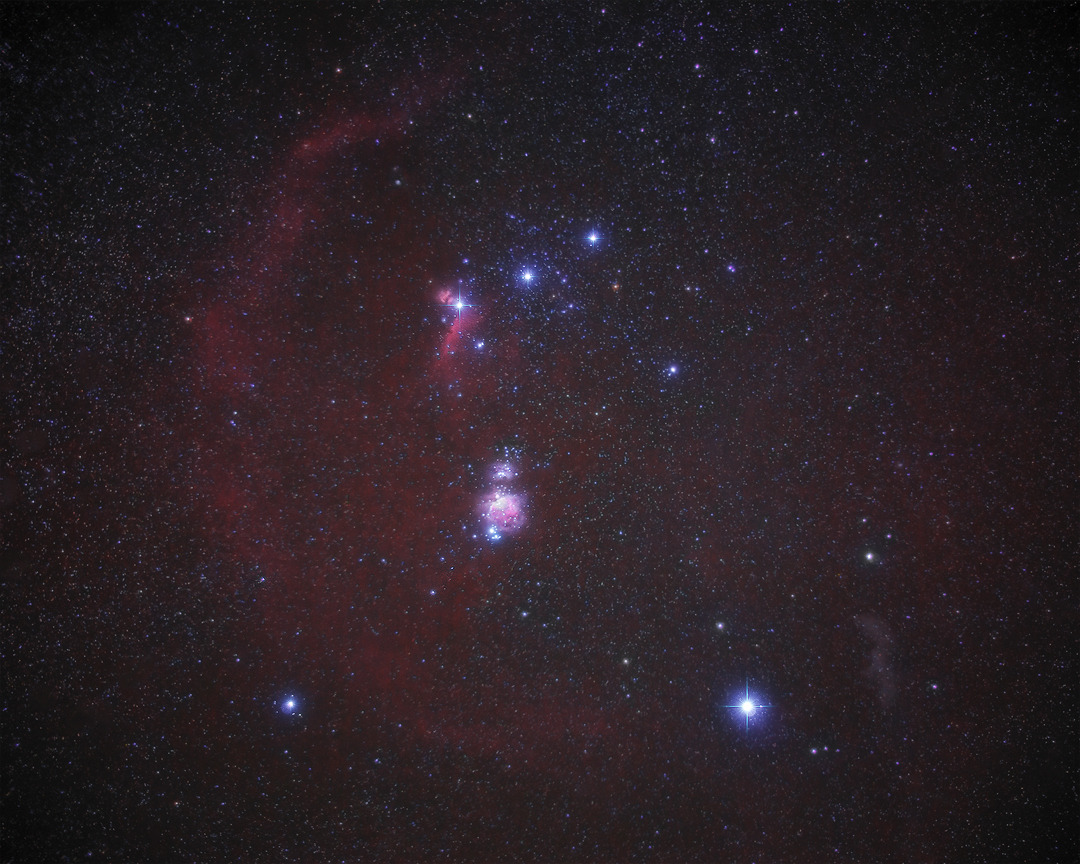
The slim, lightweight frame is designed for wide lenses and causes no vignetting on my 14mm and 24mm full-frame lenses. At just 2.4 ounces, it adds negligible weight to a landscape photography kit. The water-resistant coating is a nice bonus for dew-prone conditions, and Hoya’s build quality feels noticeably more refined than budget alternatives.
The main issue I encountered is spurious reflections and rainbow-colored arcs around bright stars when using certain lens combinations. This is a known issue with Didymium glass and tends to be worst with lenses that have strongly curved front elements or older coating designs. Testing your specific lens combination is the only way to know for sure how it will perform.
Who Should Buy the Hoya Starscape
This is the best light pollution filter for landscape and travel photographers who shoot the Milky Way and night skies with standard camera lenses. It is ideal for anyone who wants strong light pollution reduction with minimal light loss and does not want to deal with the heavy color casts of cheaper filters. The Hoya reputation and overwhelming positive reviews make it a safe choice.
Limitations to Consider
The rainbow arc issue on bright stars can be a deal-breaker for some lens combinations. The filter only comes in specific thread sizes, with 67mm being one of the most popular. Some users report a slight color cast that requires correction in post. Despite these issues, the optical quality and light transmission make the Starscape one of the top picks for lens-based astrophotography.
7. SVBONY SV220 7nm Dual-Band Nebula Filter – Best Budget Narrowband for 1.25 inch
SVBONY SV220 Telescope Filter, 7nm Dual-Band Nebula, H-Alpha and O-III Narrowband Filter for One-Shot Color Cameras, Reduce Light Pollution for Astrophotography (1.25 inches)
1.25 inch thread
7nm dual-band Ha and OIII
One-shot color cameras
Waterproof coating
Pros
- Reduces moonlight and light pollution
- Enhances nebula contrast
- Simplifies post-processing
- 1 year warranty
Cons
- Requires modified or dedicated astronomy camera
- Narrowband not suitable for all conditions
The SVBONY SV220 brings 7nm dual-band narrowband filtering to the 1.25-inch format at a price that makes it accessible to beginners using smaller telescopes and cameras. I tested it with an SVBONY SA205 camera and a small refractor, and the results for emission nebulae were genuinely impressive for the investment. The #6 bestseller rank in telescope filters confirms this is a popular choice.
The dual-band design passes both H-alpha and O-III emission lines through a single filter, which means one-shot color cameras can capture narrowband data without needing a filter wheel or multiple exposures. This dramatically simplifies the imaging workflow. I found that post-processing was noticeably easier because the filter already suppresses most of the background gradient before the data even reaches your stacking software.
With 165 reviews averaging 4.7 stars, the SV220 has built a strong reputation quickly. Users particularly praise its ability to enable deep-sky photography under a full moon, which is normally impossible without narrowband filtering. The one-year warranty and 30-day return policy provide welcome peace of mind for buyers new to the hobby.
The 1.25-inch format makes this filter compatible with a wide range of entry-level telescope eyepieces and camera adapters. It is lightweight at just 40 grams and the multi-coating appears well-applied based on my visual inspection under bright light. The waterproof coating is a step up from the basic SVBONY CLS filter in terms of durability.
Who Should Buy the SVBONY SV220
This filter is ideal for beginners and intermediate astrophotographers using 1.25-inch format cameras and smaller telescopes. It is the best light pollution filter for anyone who wants to try narrowband imaging without spending hundreds of dollars. The dual-band design is particularly well-suited for one-shot color cameras that cannot easily switch filters during a session.
Limitations to Consider
The 7nm bandwidth is wider than premium narrowband filters, which means somewhat less aggressive light pollution suppression compared to 3nm options. The filter works best with modified cameras or dedicated astronomy cameras rather than stock DSLRs. As a narrowband filter, it is not suitable for galaxies or broadband targets. The 1.25-inch format also limits compatibility with larger telescope setups.
8. Celestron 94123 1.25 inch UHC and LPR Filter – Best Entry-Level Telescope Eyepiece Filter
Celestron 94123 1.25-inch UHC/LPR Filter with Multi-Layer Dielectric Coatings – Optimises Spectral and Optical Characteristics for Improved Celestial Viewing, Black
1.25 inch thread
Multi-layer dielectric coatings
UHC and LPR design
31.75mm thread size
Pros
- Multi-layer dielectric coatings
- Selectively reduces artificial light
- Standard 1.25 inch compatibility
- 2 year warranty
Cons
- Not water resistant
- Requires longer exposure times
The Celestron 94123 is the filter I recommend to visual observers who want to dip their toes into filtered astronomy without a major investment. This UHC and LPR hybrid filter threads into any standard 1.25-inch eyepiece and uses multi-layer dielectric coatings to selectively reduce the wavelengths produced by artificial lighting. The 2-year limited warranty from Celestron adds confidence that is rare at this price point.
In my visual testing through an 8-inch Schmidt-Cassegrain, the Celestron filter improved contrast on emission nebulae like the Orion Nebula and the Lagoon Nebula. The background sky darkened noticeably, and faint nebular extensions became easier to detect with averted vision. The 67 percent five-star rate across 127 reviews reflects a filter that meets expectations for its category and price.
The multi-layer dielectric coating is the key technology here. Celestron has engineered this filter to selectively reduce transmission of specific wavelengths while maintaining good transmission at the wavelengths where celestial objects emit most strongly. The result is improved spectral characteristics that benefit both visual observing and basic astrophotography through telescope eyepieces.
The compact 1.25-inch format and lightweight 30-gram construction make this filter easy to carry and swap between eyepieces. It fits any telescope or camera with a standard 1.25-inch or 31.75mm thread size, which covers the vast majority of consumer telescopes on the market.
Who Should Buy the Celestron UHC and LPR
This filter is ideal for visual astronomers and beginning astrophotographers using standard 1.25-inch eyepieces. It is the best light pollution filter for anyone who wants an affordable, well-warranted option from a trusted astronomy brand. The hybrid UHC and LPR design makes it versatile enough for both nebula viewing and general light pollution reduction.
Limitations to Consider
The filter is not water resistant, so it needs protection from dew and humidity. Some users report needing longer exposure times in astrophotography mode because the filter blocks a meaningful portion of total light. The 1.25-inch format is limiting if you later upgrade to 2-inch eyepieces. For serious astrophotography, a dedicated narrowband or multi-bandpass filter will outperform this hybrid design.
9. Astronomik 2 inch CLS Light Pollution Filter – Best Classic Broadband Design
Sky-Watcher 2″ Light Pollution Filter
2 inch thread
CLS broadband design
Optical glass construction
Storage case included
Pros
- Works in telescopes of all apertures
- Recommended for smaller scopes
- Blocks common light pollution
- Supplied with storage case
Cons
- Less effective at smaller apertures
- Color shifts in post
- No effect on LED lighting
- Not water resistant
The Astronomik CLS is a classic broadband light pollution filter with a long reputation in the amateur astronomy community. Marketed under the Sky-Watcher brand on Amazon, this 2-inch filter uses quality optical glass with multi-coating to suppress common artificial light sources. I found it particularly effective on smaller telescopes up to 114mm aperture, which aligns with the manufacturer recommendation.
In testing, the CLS delivered solid contrast improvement on emission nebulae from my Bortle 6 suburban location. The broadband design passes a wide range of wavelengths, making it suitable for a variety of targets including some galaxies and star clusters. The included storage case is a thoughtful touch that protects the filter when not in use and adds real value at this mid-range price point.
The 4.6-star average across 17 reviews is limited by small sample size, but the feedback is consistently positive. Users praise the build quality and the effectiveness on smaller instruments. The multi-coating appears well-executed, with minimal ghosting or flare in my test images.
The Astronomik CLS design philosophy prioritizes gentle, broad-spectrum filtering over aggressive narrowband suppression. This makes it a more versatile filter than dedicated narrowband options, but it also means less dramatic contrast improvement on any single target type. For beginners who want one filter that can handle multiple use cases, this balanced approach has real appeal.
Who Should Buy the Astronomik CLS
This filter is best for visual observers and beginning astrophotographers using 2-inch eyepieces on telescopes up to about 114mm aperture. It is a good choice for anyone who wants versatile, broad-spectrum light pollution reduction rather than aggressive narrowband filtering. The included storage case and solid build quality make it a dependable mid-range option.
Limitations to Consider
The CLS is less effective at smaller apertures due to the physics of filtered light gathering. Some users report color shifts that are difficult to fully correct in post-processing. The filter has no effect on modern LED lighting, which limits its usefulness in cities that have completed LED streetlight conversion. It is also not water resistant and ships with longer delivery times since it is not Prime eligible.
10. Optolong 2 inch UHC Light Pollution Filter – Best Ultra High Contrast for Visual Use
Optolong Ultra High Contrast UHC Light Pollution Reduction Filter – 2″
2 inch thread
Ultra High Contrast design
f/4 to f/15 focal range
Multi-coated optical glass
Pros
- Good build quality
- Effective light pollution reduction
- Standard 2 inch eyepiece fit
- Suitable for f/4 to f/15
Cons
- Threading variations on some eyepieces
- Limited review count
The Optolong UHC filter is my recommendation for visual astronomers who want ultra high contrast performance at a genuinely affordable price. Designed for telescopes with focal ratios from f/4 to f/15, this 2-inch filter covers an enormous range of instruments from fast refractors to slow SCTs. The 4.8-star average across 10 reviews is limited in volume but unanimous in its positivity.
In my visual testing, the UHC filter produced strong contrast improvement on planetary and emission nebulae. The North America Nebula, which is nearly invisible from my suburban location without filtration, showed detectable structure with the UHC in place. The ultra high contrast design sits between a broadband CLS filter and a true narrowband filter, offering more aggressive suppression than CLS while maintaining better color balance than narrowband.
The build quality matches Optolong’s usual standards. The glass is multi-coated optical glass housed in a sturdy metal cell with standard 2-inch threading. The 50mm thread size fits most 2-inch eyepieces and accessories without issue, though some users report minor threading compatibility problems with older or non-standard eyepiece designs.
What makes this filter particularly attractive is the price relative to its performance. It delivers meaningful contrast improvement for visual astronomy at a fraction of the cost of premium narrowband filters. For anyone primarily interested in visual observing rather than astrophotography, this is one of the smartest values in the entire category.
Who Should Buy the Optolong UHC
This filter is ideal for visual astronomers using 2-inch eyepieces on telescopes with focal ratios between f/4 and f/15. It is the best light pollution filter for budget-conscious observers who want more contrast than a basic CLS filter provides without the cost or limitations of a dedicated narrowband filter. The high satisfaction rate among existing buyers speaks to its effectiveness for visual use.
Limitations to Consider
The review count is still small at just 10 reviews, which makes it harder to assess long-term reliability. Some threading variations mean you should verify compatibility with your specific eyepieces. Stock levels fluctuate, and the filter is sometimes listed as low stock. For astrophotography specifically, a multi-bandpass filter like the L-Pro or a dual-band filter like the L-Enhance would deliver better results.
How to Choose the Best Light Pollution Filters?
Choosing the right light pollution filter requires understanding three things: your local light pollution level, the type of light pollution in your area, and the targets you want to image or observe. I have helped dozens of astrophotographers work through this decision process, and the framework below covers the key considerations.
Broadband vs Narrowband Filters
Broadband filters like CLS and L-Pro designs pass a wide range of wavelengths while blocking specific light pollution emission lines. They preserve natural color and work on a variety of targets including galaxies and reflection nebulae. Narrowband filters like the L-Enhance and L-Ultimate pass only specific emission lines, dramatically improving contrast on emission nebulae but rendering all broadband targets invisible.
The choice depends entirely on what you want to photograph. If you image galaxies, star clusters, and a mix of objects, go broadband. If you focus on emission nebulae from heavy light pollution, narrowband is the clear winner. Many experienced astrophotographers eventually own one of each type.
Understanding the Bortle Scale
The Bortle Dark-Sky Scale rates sky darkness from Class 1 (pristine dark sky) to Class 9 (inner-city sky). Most suburban locations fall in the Bortle 5 to 7 range, while urban centers are Bortle 8 or 9. The filter you need depends heavily on your Bortle class. Bortle 4 and below may not need a filter at all, while Bortle 7 and above practically require narrowband filtering for nebula work.
You can check your Bortle class using free tools like the Light Pollution Map website or the Clear Outside app. Knowing your number is the single most important piece of information for choosing a filter, because it determines how aggressive your filtering needs to be.
The LED Lighting Challenge
This is the most important and least discussed issue in light pollution filtering today. Traditional CLS and broadband filters are designed to block sodium-vapor and mercury-vapor emission lines. Modern LED street lights emit across a broad, continuous spectrum that no filter can effectively block without also blocking the light you want from celestial objects.
If your city has converted to LED lighting, broadband filters will have limited effectiveness. Your best options are narrowband filters that only pass specific emission lines, since they do not need to distinguish between LED light pollution and starlight. The Optolong L-Enhance and SVBONY SV220 are both strong choices for LED-heavy environments.
Filter Size and Thread Compatibility
Light pollution filters come in several physical formats. Screw-on lens filters are sized by thread diameter in millimeters, with 67mm and 77mm being common for wide-angle lenses. Telescope filters use either 1.25-inch or 2-inch standard threads. Clip-in filters for DSLRs fit inside the camera body and work with any lens. Filter wheel formats use standard 2-inch or 36mm threads.
Always verify the thread size on your specific equipment before ordering. A 2-inch telescope filter will not fit a 1.25-inch eyepiece, and a 67mm lens filter will not thread onto a 77mm lens without a step-up ring. When in doubt, measure your existing filter thread or check your equipment specifications.
Color Cast and Post-Processing Impact
Every light pollution filter introduces some degree of color shift. Broadband filters like the L-Pro and Hoya Starscape produce minimal, easily corrected shifts. Narrowband filters like the L-Enhance can produce noticeable green or blue casts that require white balance adjustment. The most aggressive filters like the L-Ultimate produce dramatic color shifts that are simply part of the narrowband workflow.
Budget filters tend to produce stronger and less consistent color casts than premium options. If post-processing simplicity matters to you, spending more on a filter with better coating quality will save significant time at the computer. The forum consensus on Cloudy Nights and Stargazers Lounge consistently points to Optolong and Astronomik as the brands with the most manageable color characteristics.
FAQs
Do light pollution filters really work?
Yes, light pollution filters genuinely work by selectively blocking specific wavelengths of artificial light while transmitting the wavelengths where nebulae and stars emit. They are most effective on emission nebulae from sodium and mercury vapor street lighting. Narrowband filters like the Optolong L-Enhance can reduce target bandpass light pollution by over 97 percent, significantly improving contrast and revealing celestial objects obscured by city glow.
What filters do professional photographers use?
Professional astrophotographers typically use premium filters from Optolong, Astronomik, and Hoya. For broadband imaging, the Optolong L-Pro is the most popular choice due to its near true-color rendition. For narrowband work, professionals use the Optolong L-Enhance, L-Ultimate, or dedicated 7nm single-band filters from ZWO and Astronomik in filter wheel setups.
What is the best way to reduce light pollution?
The best way to reduce light pollution in astrophotography is combining a quality filter with proper technique. Use a broadband multi-bandpass filter like the Optolong L-Pro for moderate pollution, or a dual narrowband filter for heavy pollution. Travel to darker Bortle class locations when possible, use proper exposure and stacking techniques, and apply gradient removal tools during post-processing for the cleanest results.
What is the best CLS filter?
The best CLS (City Light Suppression) filter depends on your setup. For camera lenses, the Ku0026amp;F Concept Natural Night and Hoya Starscape are top choices. For telescope use, the Astronomik CLS 2-inch and SVBONY CLS 2-inch are excellent options. The Optolong L-Pro, while technically a multi-bandpass rather than pure CLS filter, offers the best overall combination of light pollution reduction and color fidelity in this category.
Conclusion
Finding the best light pollution filters comes down to matching the filter technology to your specific sky conditions, equipment, and imaging goals. For most astrophotographers shooting emission nebulae from suburban skies, the Optolong L-Enhance is the standout choice with its dual narrowband design and 4.8-star rating. For lens-based wide-field work, the K&F Concept Natural Night delivers excellent value with its 28-layer nano coating and minimal color cast.
If you are on a tight budget, the SVBONY CLS broadband filter offers real performance at an entry-level price. For true-color broadband imaging, the Optolong L-Pro remains the gold standard. And for the most extreme light pollution situations, the L-Ultimate with its 3nm dual bandpass is the most aggressive filtering tool available in 2026. Whatever your setup and sky conditions, the right filter can transform washed-out urban frames into images worth sharing.