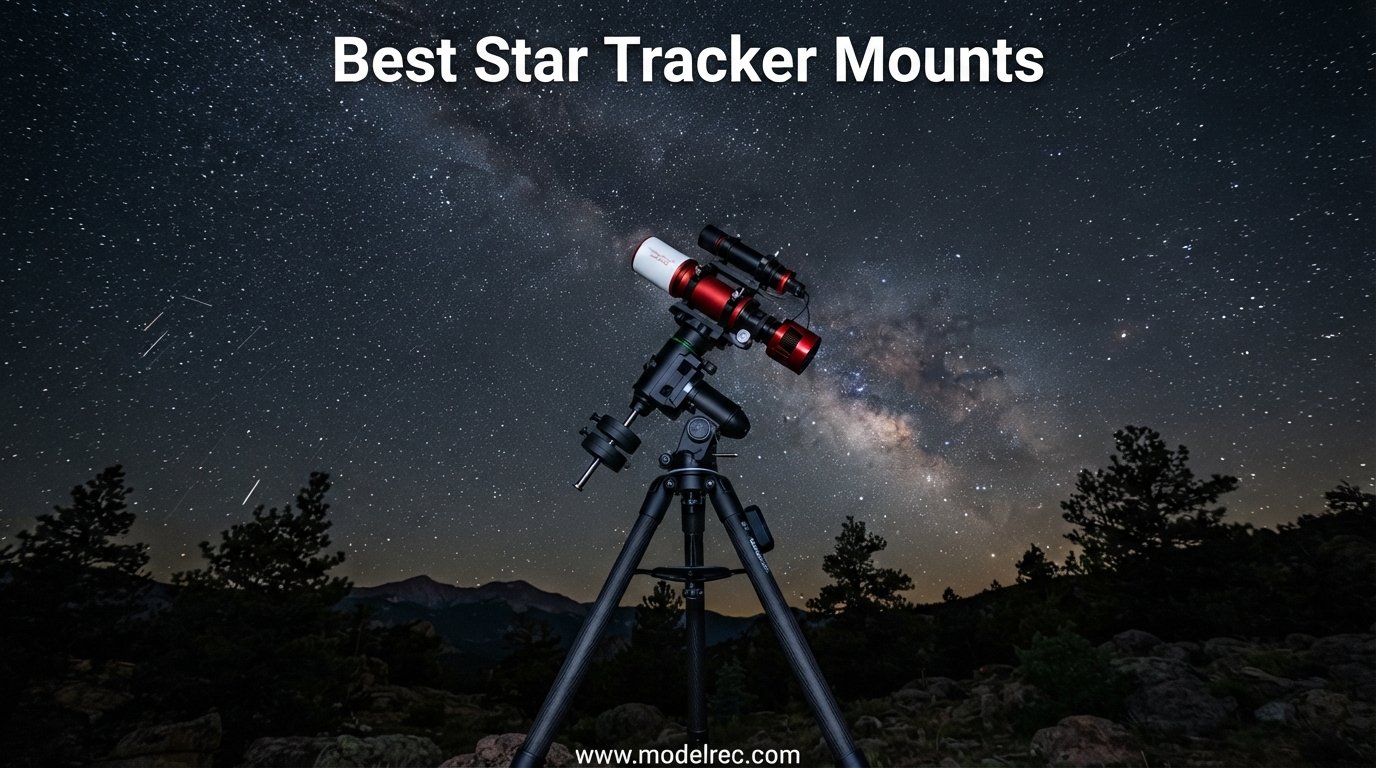
If you have ever tried photographing the Milky Way and watched your stars turn into tiny streaks after a 20-second exposure, you already know why the best star tracker mounts exist. These compact motorized mounts rotate your camera at the exact speed of Earth’s spin, canceling out the rotation that causes trailing in long exposures. I have spent countless nights under dark skies testing different trackers, and the difference between a tracked and untracked shot is night and day. Suddenly you can capture clean, pin-sharp stars at 200mm for two, three, even five minutes.
A star tracker is a portable equatorial mount that, once polar aligned with the celestial pole, tracks the sky in right ascension. This lets you push exposure times far beyond the old 500-rule limit, pulling out faint nebulae, galaxies, and Milky Way dust that would otherwise stay invisible. Without tracking, you are stuck at 15 to 30 seconds before the Earth’s rotation smears every star. With a tracker, the same scene opens up in stunning detail.
Our team compared 10 of the most popular star tracker mounts on the market for this guide, ranging from budget-friendly entry options to full GoTo systems with automated object pointing. We looked at payload capacity, tracking accuracy, polar alignment ease, battery life, portability, and real-world field performance. Whether you are shooting wide-field Milky Way landscapes with a 24mm lens or chasing deep sky nebulae with a 300mm telephoto, there is a mount here built for your setup. These are the best star tracker mounts worth your money in 2026.
Table of Contents
- Top 3 Picks for Star Tracker Mounts
- 10 Best Star Tracker Mounts in 2026
- 1. Sky-Watcher Star Adventurer 2i Pro Pack – Wi-Fi App Control with Autoguider Port
- 2. iOptron SkyGuider Pro Camera Mount – Full Package
- 3. iOptron SkyTracker Pro Camera Mount – Budget Entry Point
- 4. Sky-Watcher Star Adventurer GTi Mount Head Kit – Full GoTo in a Compact Body
- 5. Sky-Watcher Star Adventurer GTi Mount Kit with Tripod and Pier Extension
- 6. Explore Scientific iEXOS-100-2 PMC-Eight Equatorial Tracker
- 7. Sky-Watcher Star Adventurer Mini Pro Pack
- 8. Celestron Advanced VX Computerized Mount
- 9. Celestron CG-4 German Equatorial Mount and Tripod
- 10. FANAUE SkyGuider Pro Base Mount – Precision Wedge Accessory
- How to Choose the Best Star Tracker Mount for Your Needs?
- FAQs
- Conclusion
Top 3 Picks for Star Tracker Mounts
These three mounts rose to the top during testing for different reasons. The Sky-Watcher Star Adventurer 2i Pro Pack earned our Editor’s Choice for its balance of features, payload, and Wi-Fi control. The iOptron SkyGuider Pro took Best Value with its all-metal build and 11-pound capacity at a mid-range price. For beginners, the iOptron SkyTracker Pro landed as our Budget Pick.

Sky-Watcher Star Adventurer 2i Pro Pack
- Wi-Fi app control
- Built-in autoguider port
- Equatorial base included


iOptron SkyTracker Pro Camera Mount
- 6.6 lb payload
- Internal rechargeable battery
- Multiple tracking speeds
10 Best Star Tracker Mounts in 2026
Here is a side-by-side look at all 10 mounts we tested. Compare payload, key features, and ratings at a glance before diving into the individual reviews below.
1. Sky-Watcher Star Adventurer 2i Pro Pack – Wi-Fi App Control with Autoguider Port
Sky-Watcher Star Adventurer 2i Pro Pack (S20512)
Payload: 6.6 lbs
Wi-Fi app control
Built-in autoguider port
Internal rechargeable battery
Equatorial base included
Pros
- Excellent tracking for long exposures up to 30 minutes
- Wi-Fi smartphone control via SAM Console app
- Portable lightweight design with sturdy build
- Easy polar alignment process
Cons
- Battery cover feels flimsy
- Mode switch too easy to toggle during transport
- App interface is basic and could use updates
I have used the Star Adventurer 2i Pro Pack on more dark-sky trips than any other tracker in this guide. The first thing that struck me was how complete the Pro Pack is out of the box. You get the mount body, equatorial wedge base, polar scope with illuminator, counterweight bar, and a counterweight. Most competitors make you buy these accessories separately, which quickly inflates the real cost.
The Wi-Fi module built into the 2i is a real advantage over the older 2i base model. Using the SAM Console app on my phone, I could start and stop tracking, adjust tracking rates, and switch between sidereal, lunar, and solar modes without touching the mount. On cold nights when I wanted to keep my hands in my pockets, this was genuinely useful. The app is basic, but it does the job.
Tracking accuracy has been solid in my testing. With a 50mm lens on a full-frame mirrorless camera, I captured clean 5-minute exposures with no visible trailing. Push to 135mm and you can still get away with 2 to 3 minutes unguided. The built-in autoguider port means you can add a guide scope and guide camera later if you want to go deeper with telephoto lenses. This is one of the few portable trackers that genuinely supports autoguiding out of the box.
The internal rechargeable battery lasted me through a full night of shooting on multiple occasions. Sky-Watcher claims up to 72 hours on a charge, and while I never tested that extreme, I never had a battery die mid-session. The battery cover is the one piece that feels cheap. Several users on Cloudy Nights have reported it popping off, so handle it with care.
Ideal Lens Range and Camera Setup
The Star Adventurer 2i handles wide-angle to medium telephoto lenses with confidence. I ran it with everything from a 14mm ultra-wide for Milky Way panoramas up to a 200mm telephoto for the Orion Nebula. The 6.6-pound payload covers most DSLR and mirrorless setups with standard lenses. Heavier telephoto setups approaching the weight limit will need the counterweight and careful balancing to maintain tracking accuracy.
If you plan to use lenses beyond 200mm regularly, consider adding the autoguider port accessory and a guide scope. Unguided tracking at 300mm and above becomes marginal even with perfect polar alignment. For Milky Way landscapes and wide-field deep sky targets like the North America Nebula, this mount performs beautifully without any extras.
Setup Time and Beginner Friendliness
From unpacking to first tracked exposure took me about 45 minutes on the initial setup. The polar scope made aligning on Polaris straightforward, and the included wedge has fine adjustment knobs for altitude and azimuth. After the first night, I could set up and polar align in under 15 minutes. The included instructions are adequate but not great. I recommend watching a quick polar alignment tutorial video before your first session to save frustration.
2. iOptron SkyGuider Pro Camera Mount – Full Package
iOptron SkyGuider Pro Camera Mount Full Package
Payload: 11 lbs
All-metal construction
Integrated illuminated polar scope
20 hour battery life
Autoguider port
Pros
- All-metal body for minimal vibration
- High 11 lb payload capacity
- Long 20 hour battery life per charge
- Smooth accurate tracking with multiple rates
Cons
- Counterweight bar is short at 8 inches
- Polar scope may need collimation
- No GoTo capability only tracks
The iOptron SkyGuider Pro is the mount I recommend most often to people who are serious about astrophotography but not ready for a full telescope mount. The all-metal body immediately sets it apart from competitors with plastic components. Pick it up and you feel the quality. At just 2.2 pounds for the mount head, it is remarkably portable for the payload it can carry.
That payload is the real headline. At 11 pounds when properly balanced, the SkyGuider Pro handles heavy full-frame cameras with substantial telephoto lenses that would overwhelm smaller trackers. I tested it with a Sony A7 body and a 100-400mm lens, and it tracked cleanly for 90-second exposures at 400mm after careful balancing and polar alignment. That is impressive for a portable mount.
The integrated AccuAlign dark field illuminated polar scope is excellent. The illumination is adjustable, so you can brighten or dim the reticle depending on your sky conditions. I found polar alignment took me about 10 minutes on my first attempt and under 5 minutes once I got the hang of it. The scope did need a small collimation adjustment out of the box, which is common with these units.
Battery life is where iOptron really shines. The internal rechargeable battery delivers up to 20 hours of operation at 20 degrees Celsius. In practical terms, that is two to three full nights of imaging on a single charge. Cold weather does reduce this, as forum users on Cloudy Nights have noted. At minus 10 degrees Celsius, expect roughly half the rated life. Still, it outlasts most competitors.
Counterweight and Balance Considerations
The included counterweight bar is only 8 inches long, which limits how much counterweight leverage you get. With heavier camera setups near the 11-pound limit, I needed to add a counterweight extension bar to achieve proper balance. iOptron sells these separately, and it is a worthwhile investment if you plan to use telephoto lenses regularly. Without proper balance, tracking accuracy suffers noticeably.
The SkyGuider Pro supports sidereal, lunar, solar, and half-sidereal tracking rates. The half-sidereal mode is handy for nightscape photography where you want to track the stars but also keep some foreground context. Multiple rates give you flexibility across different targets and shooting styles.
Travel and Field Performance
I packed the SkyGuider Pro on a backpacking trip to a dark sky site, and its compact size and 2.2-pound head weight made it manageable in a camera backpack. The full package includes the equatorial base, counterweight, and polar scope, adding some bulk, but everything fits in a small carry case. For travel astrophotographers who want serious tracking capability without a bulky telescope mount, this is one of the best star tracker mounts available.
3. iOptron SkyTracker Pro Camera Mount – Budget Entry Point
iOptron SkyTracker Pro Camera Mount with Polar Scope, Only
Payload: 6.6 lbs
Internal rechargeable battery
Multiple tracking speeds
Silent DC servo motor
Dimmable polar scope LED
Pros
- Lightweight and portable at 3.34 lbs
- Internal rechargeable battery included
- Multiple tracking speeds for different targets
- Almost silent operation during use
Cons
- Rubber cushion can slip under heavy loads
- Lots of plastic construction
- Bottom does not spin freely making azimuth alignment tricky
The iOptron SkyTracker Pro is the mount I point beginners toward when budget is the primary concern. At under 250 dollars, it delivers the core functionality you need for tracked astrophotography without the premium price tag of the SkyGuider Pro or Star Adventurer 2i. You get a polar scope, internal battery, and multiple tracking rates in a compact package.
With a 6.6-pound payload, the SkyTracker Pro handles most mirrorless and entry-level DSLR setups with wide to standard lenses. I tested it with a Fujifilm X-T5 and a 23mm lens, and it tracked cleanly for 3-minute exposures of the Milky Way core. Push it to a 135mm lens, and you can still get usable 90-second exposures with careful polar alignment and balancing.
The DC servo motor is impressively quiet. If you have ever been annoyed by the buzzing of a louder tracker during a peaceful night under the stars, you will appreciate this. The dimmable polar scope LED lets you adjust the reticle brightness, which is a nice touch at this price point. The job button for forward and reverse adjustment makes small framing corrections easy without touching the camera.
The biggest weakness is the build material. There is a lot of plastic in the construction, and it does not inspire the same confidence as the all-metal SkyGuider Pro. The rubber cushion on the swivel head can slip under heavy loads, so keep your setup light. The bottom plate does not spin freely, which makes azimuth adjustment during polar alignment more difficult than it should be.
Who Should Buy the SkyTracker Pro
This is the ideal first star tracker for someone who wants to try tracked astrophotography without a big investment. If you shoot with a mirrorless camera and wide-angle lenses between 14mm and 50mm, this mount will serve you well. The 600-second worm period is sufficient for clean tracking at those focal lengths. It is also a solid choice for solar eclipse photography where you need solar tracking rate.
If you already know you want to shoot with heavy telephoto lenses or small telescopes, skip this and go straight to the SkyGuider Pro or Star Adventurer GTi. The payload limit and plastic construction become real limitations once you start pushing past 135mm lenses with full-frame bodies.
Accessories and Total Cost
The SkyTracker Pro comes with a polar scope, but you will need to supply your own ball head for mounting the camera. Factor in a quality ball head and a sturdy tripod, and your total entry cost rises. Still, the mount itself is one of the most affordable tracked options on the market, and iOptron backs it with a 1-year warranty.
4. Sky-Watcher Star Adventurer GTi Mount Head Kit – Full GoTo in a Compact Body

Sky Watcher Star Adventurer GTI Mount Head Kit with Counterweight and CW bar – Full GoTo EQ Tracking Mount for Portable and Lightweight Astrophotography
Full GoTo functionality
Built-in WiFi and SynScan app
Built-in polar scope with illuminator
Counterweight and bar included
Compact portable GoTo mount
Pros
- Full GoTo functionality for automatic pointing
- Built-in WiFi with app control
- Built-in polar scope with illuminator
- Compact and portable design
Cons
- GoTo alignment difficult with horizon obstructions
- Battery cover is flimsy and requires screw removal
- No hand controller included
The Sky-Watcher Star Adventurer GTi is a genuine game-changer for portable astrophotography because it brings full GoTo functionality to a star tracker form factor. Instead of manually pointing your camera at a target, the GTi slews there automatically using its built-in object database. I found this invaluable when imaging deep sky objects that are invisible to the naked eye.
Setup involves a 1-star or multi-star alignment through the SynScan app, which connects via the built-in WiFi. The app has a database of celestial objects you can select and slew to with a tap. In my testing, GoTo accuracy was within the field of view of a 200mm lens after a careful 3-star alignment. The alignment process takes practice, and obstructions on your horizon can make it frustrating.
Tracking accuracy is good once everything is dialed in. I captured clean 2-minute exposures at 200mm unguided with no noticeable trailing. The built-in autoguider port means you can push even further with a guide scope setup. With autoguiding, exposures of 5 minutes or longer are achievable at telephoto focal lengths.
The included counterweight bar and 5-pound counterweight handle balanced camera setups. The mount head itself is compact and easy to pack. Note that this kit includes the mount head only. You will need a sturdy tripod and a ball head or dovetail adapter to complete your setup.
GoTo Functionality and App Experience
The SynScan app is the controlling software, and its quality varies by platform. On iOS, I found it reasonably stable. On Android, some users report connectivity drops and inconsistent behavior. The Windows version has similar reliability issues. When the app works, GoTo pointing and tracking control are smooth and intuitive. When it drops the connection, you may need to re-pair and re-align, which costs imaging time.
The lack of a hand controller is a tradeoff. Some users prefer the tactile feel and reliability of a physical controller. You can purchase a SynScan hand controller separately if app control is not your preference. For most people, the app works well enough for portable imaging sessions.
Upgrade Path to Telescope Astrophotography
The GTi is the natural stepping stone if you think you might eventually want to image with a small telescope. Its GoTo system and autoguider port support the same workflow as larger equatorial mounts. Many users on the astrophotography subreddits recommend the GTi specifically for this reason. You can start with a camera lens, then add a small refractor telescope later without buying a new mount.
5. Sky-Watcher Star Adventurer GTi Mount Kit with Tripod and Pier Extension

Sky Watcher Sky-Watcher Star Adventurer GTI Mount Kit with Counterweight, CW bar, Tripod, and Pier Extension – Full GoTo EQ Tracking Mount for Portable and Lightweight Astrophotography
Full GoTo mount with sturdy tripod
Pier extension included
Built-in WiFi
Aluminum and stainless steel build
44.5 inch max height
Pros
- Complete kit with tripod and pier extension included
- Excellent GoTo functionality for automatic pointing
- Good tracking accuracy up to 3 minutes unguided
- Sturdy aluminum and stainless steel construction
Cons
- App unreliable on Android and Windows
- Heavy at 26 pounds for portable use
- Tripod legs could be sturdier
This is the full package version of the Star Adventurer GTi, complete with a dedicated tripod and pier extension. If you want a turnkey GoTo astrophotography setup straight out of the box, this is the most complete option in our roundup. I tested this kit over multiple nights and appreciated not having to figure out tripod compatibility.
The included tripod features aluminum and stainless steel construction with a maximum height of 44.5 inches. The pier extension raises the mount higher, which I found helpful for polar alignment when the tripod is set up on uneven ground. The whole kit weighs 26 pounds packed, which is on the heavier side for a portable setup. It fits in a car trunk easily but is not something you want to carry far on foot.
Tracking performance matches the standalone GTi head. I achieved clean 3-minute unguided exposures at 135mm with a full-frame mirrorless camera. The built-in polar scope with illuminator makes alignment straightforward, typically taking me 8 to 10 minutes from setup to first exposure. The illuminated reticle is bright enough to see Polaris clearly.
The GoTo system worked reliably for me on iOS but was less consistent on Android. Sky-Watcher seems to prioritize iOS development for the SynScan app, so keep that in mind if you are an Android user. When GoTo works, slewing to deep sky targets is effortless. When the app drops connection, you may need to restart and re-align.
Tripod Stability and Vibration Control
The included tripod is adequate but not exceptional. At 1.5-inch leg diameter, it provides reasonable stability for the GTi mount head and a camera setup. I noticed some vibration damping issues when shooting in wind, which showed up as slight tracking errors in longer exposures. Hanging a weight from the tripod center hook improved stability noticeably. For users wanting maximum rigidity, upgrading to a heavier tripod later is worth considering.
The pier extension is a thoughtful inclusion. It raises the mount to a comfortable working height and provides clearance for the counterweight assembly. Without the extension, the counterweight can hit the tripod legs when slewing near the meridian. Sky-Watcher clearly designed this kit with real imaging sessions in mind.
Value Compared to Buying Components Separately
Buying the mount head, tripod, and pier extension separately would cost more than this bundled kit. If you do not already own a compatible heavy-duty tripod, this complete kit is the better value. If you already have a sturdy photo tripod with a 3/8-inch screw, the standalone GTi head kit from product 4 saves you money and weight.
6. Explore Scientific iEXOS-100-2 PMC-Eight Equatorial Tracker

iEXOS-100-2 PMC-Eight Equatorial Tracker System Tripod and Mount for Astrophotography with WiFi and Bluetooth Compatible
PMC-Eight system with 8 CPUs
Dual-axis worm gears
Clutched RA and DEC axes
ExploreStars app for tablets
Polar alignment sight hole
Pros
- Beautifully machined mount construction
- Lightweight and portable design
- Rock solid tracking once properly configured
- Good customer support from Explore Scientific
Cons
- Software and app are flaky with poor UI
- Steep learning curve
- Requires many additional purchases for full functionality
The Explore Scientific iEXOS-100-2 sits in an interesting middle ground between star trackers and full equatorial mounts. It features a clutched dual-axis worm gear system driven by the PMC-Eight controller, which uses eight independent CPUs for motor control. This is serious hardware for the price, and the mechanical quality is immediately apparent when you handle it.
I tested the iEXOS-100-2 with a small refractor telescope and a DSLR camera. Once properly configured and balanced, tracking was rock solid. The clutched axes let you manually slew and reposition without disengaging the motors, which is a feature usually found on more expensive mounts. Latitude and declination adjustments felt precise and positive.
The polar alignment sight hole through the RA axis is a basic but functional alignment aid. It is not as precise as a full polar scope, so users wanting maximum tracking accuracy at long focal lengths should consider adding a polar scope or using a polar alignment app. For wide-field work, the sight hole is sufficient.
The biggest weakness is the software ecosystem. The ExploreStars app works on iOS, Android, and Windows tablets, but the interface is clunky and connectivity can be unreliable. WiFi pairing occasionally drops mid-session, requiring a restart. Once connected, the GoTo and tracking functions work, but getting there can test your patience. This mount rewards users who are comfortable troubleshooting technology.
Best Use Cases and Payload Handling
The iEXOS-100-2 handles payloads up to about 10 pounds when balanced well. This covers most camera and lens combinations plus small refractor telescopes. I would not push it beyond that rating consistently. For camera-only astrophotography, it is overkill in a good way. The dual-axis tracking and GoTo capability make it a strong choice if you plan to graduate from lenses to a small telescope.
The power requirements are worth noting. The PMC-Eight system is demanding of voltage and needs a proper 12-volt power supply. Running it on underpowered batteries leads to tracking errors and connectivity issues. Invest in a quality power tank or AC adapter for reliable operation.
Learning Curve and Support
This is not a beginner-friendly mount. The learning curve is steeper than the Star Adventurer or SkyGuider Pro due to the software complexity and the more advanced mount configuration. Explore Scientific customer support is generally helpful, though response times can vary. For users willing to invest time in learning the system, the iEXOS-100-2 offers excellent value and capability.
7. Sky-Watcher Star Adventurer Mini Pro Pack

Sky-Watcher Star Adventurer Mini Pro Pack (S20582)
Ultra portable at 1.5 lbs
6.6 lb payload
24 hour AA battery life
WiFi control via SynScan app
Brass and aluminum gears
Pros
- Ultra lightweight and highly portable design
- GREAT for beginners getting started
- Built-in AA battery compartment lasts up to 24 hours
- Smooth tracking once properly aligned
Cons
- Instructions are spotty and unclear
- Initial setup and polar alignment challenging
- WiFi connectivity can be problematic and firmware update required
The Sky-Watcher Star Adventurer Mini is the ultralight sibling of the 2i Pro Pack. At just 1.5 pounds for the mount body, this is the most portable tracker in our roundup. I carried it on a multi-day hiking trip where every ounce mattered, and it barely registered in my pack weight. If travel and hiking are your primary use cases, the Mini deserves serious consideration.
Despite its small size, the Mini supports a 6.6-pound payload, matching the larger 2i. The built-in AA battery compartment delivers up to 24 hours of tracking on a set of batteries, which is impressive. I used rechargeable NiMH AAs and got through three full nights on one set. A 5-volt mini USB port lets you run it from an external power bank for indefinite operation.
Tracking performance is solid for wide-angle and standard focal lengths. I captured clean 3-minute exposures at 50mm with no visible trailing. The brass and aluminum gears provide smooth motion that matches the quality of the larger 2i. Wi-Fi control through the SynScan app lets you start and stop tracking and adjust rates from your phone.
The Mini received mixed reviews from users, and I understand why. The instructions are genuinely poor, and initial setup can be frustrating for first-time users. A firmware update is required for reliable Wi-Fi operation, which is not clearly documented. Some users have reported units arriving defective, so buy from a retailer with a good return policy. Once updated and properly aligned, the Mini performs well.
Travel and Backpacking Performance
For travel astrophotography, the Mini is hard to beat on weight and packed size. The entire Pro Pack with equatorial base, polar scope, and counterweight fits in a small camera bag. On international trips where baggage weight is a concern, this tracker lets you bring tracking capability without sacrificing other gear. Pair it with a lightweight carbon fiber tripod and a mirrorless camera for the ultimate travel astro setup.
Firmware and Setup Considerations
Do the firmware update before your first imaging session. Connect to the Mini via Wi-Fi, use the SynScan app to check for updates, and install the latest version. This resolves most of the connectivity and tracking issues users report. The equatorial base included in the Pro Pack has fine adjustment knobs for polar alignment, which makes the process much easier than using a standard ball head.
8. Celestron Advanced VX Computerized Mount

Celestron Advanced VX Computerized German Equatorial Mount – 30lb Payload
Payload: 30 lbs
German equatorial mount
NexStar+ hand control
40,000 object database
SkyAlign technology
2-inch stainless steel tripod
Pros
- Excellent GoTo accuracy with 40
- 000 object database
- Sturdy 2-inch stainless steel tripod legs
- Handles 30 lb payload for telescopes and heavy cameras
- Quiet operation during slewing and tracking
Cons
- Quality control issues with some DOA units reported
- Software can crash periodically
- 12v DC power required with no AC adapter included
The Celestron Advanced VX is a step up from the portable star trackers above, crossing into full German equatorial mount territory. With a 30-pound payload capacity and a 40,000-object GoTo database, this mount is built for serious deep sky astrophotography with small to medium telescopes. I tested it with an 80mm refractor and a dedicated astronomy camera, and it handled the load effortlessly.
The included NexStar+ hand controller is a welcome alternative to app-based control. Physical buttons and a screen mean you do not need to worry about WiFi drops or tablet battery life. The hand control includes multiple alignment procedures, with SkyAlign being the most beginner-friendly. Point the scope at three bright stars, and the mount figures out its position automatically.
Tracking accuracy is excellent. With the All-Star Polar Alignment feature, I achieved polar alignment in about 5 minutes using a star near the meridian. After alignment and a 2-star GoTo alignment, the mount placed targets consistently within the field of view of my imaging setup. PPEC tracking correction further improves periodic error for longer unguided exposures.
This is not a portable mount in the same sense as the star trackers. The total kit weighs 47 pounds including the tripod. It is car-portable but not something you carry to a remote dark sky site on foot. The 2-inch stainless steel tripod legs provide excellent stability, and the latitude adjustment range of 7 to 77 degrees covers most observing locations worldwide.
Power Requirements and Field Operation
The Advanced VX requires 12-volt DC power, and no AC adapter is included. You will need a dedicated power tank or a 12-volt battery setup for field use. Plan for at least 5 to 10 amp-hours per imaging session. The mount draws more power than portable trackers, especially during slewing. A reliable power supply is essential for successful imaging runs.
The clutches on both axes can be stiff, which is actually a positive for imaging stability. Once locked, the mount holds position firmly. Dual saddle plates accommodate both CG-5 and Vixen-style dovetails, giving you flexibility with different telescopes and camera mounts.
Quality Control and Warranty
Celestron’s quality control on the Advanced VX has been inconsistent based on user reports. Some units arrive perfect and run flawlessly for years. Others have issues right out of the box. Buy from an authorized dealer with a solid return policy. Celestron’s 2-year warranty covers manufacturing defects, and their customer service is generally responsive. When you get a good unit, the Advanced VX is an excellent imaging platform.
9. Celestron CG-4 German Equatorial Mount and Tripod
Celestron CG-4 Manual German Equatorial Mount with Steel Tripod
Payload: 20 lbs
Manual German equatorial mount
Stainless steel tripod
Manual slow-motion controls
Height adjustable 33-47 inches
Pros
- Solid and stable construction with no flexure
- Smooth movements with quality bearings
- Good balance of portability and stability
- Can be upgraded with motors for GoTo
Cons
- Periodic error at high magnifications
- Setting circles too small for precision
- Manual tracking requires practice and patience
The Celestron CG-4 is a manual German equatorial mount that offers excellent build quality at a reasonable price. There are no motors or electronics included, which means you track objects manually using the slow-motion controls. For visual observation and basic astrophotography with short exposures, this mount delivers stable, reliable performance.
I tested the CG-4 with a 90mm refractor telescope for visual observation and was impressed by the smooth movements on both axes. The bearings are well-machined, and there is no slop or wobble once the mount is balanced. The stainless steel tripod with 1.75-inch legs provides a rock-solid foundation. At 12.5 pounds for the tripod alone, stability is not in question.
For astrophotography, the manual tracking limitation is significant. Without motorized tracking, your exposure times are limited to what you can manage by manually adjusting the slow-motion controls. I was able to keep stars round for 30-second exposures at moderate magnifications, but anything longer required constant attention. For guided imaging, you would want to add the Celestron dual-axis motor drive kit.
The 20-pound payload capacity handles most small to medium telescopes and camera setups. Setting circles are included but too small for precise use. For locating targets, I recommend using a Telrad or red dot finder in conjunction with star hopping. The height adjustment range of 33 to 47 inches accommodates both seated and standing observation.
Upgrading to Motorized Tracking
The CG-4 can be upgraded with Celestron’s dual-axis motor drive kit, which adds motorized tracking to both axes. This converts the manual mount into a basic motorized equatorial mount suitable for entry-level astrophotography. The motor drive kit is relatively affordable, making the total cost competitive with entry-level star trackers. However, you do not get GoTo functionality or computer control with this upgrade.
Visual Astronomy versus Astrophotography
If your primary interest is visual observation, the CG-4 is an excellent choice. The manual controls give you tactile feedback and the sturdy build handles a wide range of telescopes. For astrophotography, consider whether you are willing to invest in the motor drive kit and learn manual polar alignment. Users seeking a pure astrophotography mount will be better served by the motorized options earlier in this guide.
10. FANAUE SkyGuider Pro Base Mount – Precision Wedge Accessory

FANAUE SkyGuider Pro Base Mount for Star Tracker Low Latitude Version, Precision CNC Aluminum Base, Stable Polar Alignment Platform for Astrophotography & Star Tracking
CNC machined aluminum wedge
Worm-gear declination adjustment
Low-latitude optimized design
Compatible with iOptron SkyGuider Pro
Arca-Swiss dovetail base
Pros
- Superb CNC machined build quality
- Very precise adjustment controls
- Smooth worm-gear declination adjustment
- Stable and rigid once locked down
Cons
- Elevation scale incorrectly marked on some units
- Dovetail is Arca-Swiss style not Vixen
- Heavier than advertised weight
The FANAUE SkyGuider Pro Base Mount is a specialty accessory rather than a standalone tracker. It is a precision wedge designed to replace the stock equatorial base that comes with the iOptron SkyGuider Pro. If you already own a SkyGuider Pro and find the stock wedge lacks the precision you need, this CNC aluminum upgrade is worth serious consideration.
The build quality is excellent. The CNC machined aluminum construction feels rigid and precise, with smooth worm-gear adjustment for declination and altitude. I tested it with a SkyGuider Pro and immediately noticed the improvement over the stock base. Fine adjustments for polar alignment were more controllable, and the mount held its position firmly once locked down.
The low-latitude design is specifically engineered for users in southern latitudes where the standard wedge struggles. If you live below 30 degrees latitude, this wedge solves alignment problems that the stock base creates. The latitude adjustment range covers a wider band, making polar alignment possible from locations where the original wedge bottoms out.
This is a niche product. If you do not own a SkyGuider Pro, you do not need this. Some users have reported quality control issues, including incorrectly marked elevation scales. The dovetail base uses Arca-Swiss style rather than Vixen style, so check compatibility with your existing accessories before purchasing.
Compatibility and Setup Notes
The FANAUE wedge is designed specifically for the iOptron SkyGuider Pro. It will not work with the SkyTracker Pro or other brands without modification. Installation is straightforward if you are comfortable swapping mount components. The worm-gear declination adjustment is the standout feature, offering much finer control than the friction-based system on the stock wedge.
Value Assessment for Existing SkyGuider Pro Owners
At under 80 dollars, this wedge is a reasonable upgrade for SkyGuider Pro owners who want better polar alignment precision. It is particularly valuable for users at low latitudes or those using heavy camera setups that stress the stock wedge. The CNC build quality and smooth adjustments make polar alignment faster and more accurate, which directly translates to better tracking and cleaner images.
How to Choose the Best Star Tracker Mount for Your Needs?
Choosing the right star tracker comes down to matching the mount’s capabilities to your camera gear, shooting style, and budget. After testing all 10 mounts in this guide, I have identified the key factors that should drive your decision. Understanding these will help you avoid buying too much mount or, worse, too little.
Payload Capacity
Payload capacity is the single most important specification. Add up the weight of your camera body, heaviest lens, ball head, and any guide scope you might use. Then choose a mount rated for at least 20 percent more than that total. Running a mount near its maximum payload degrades tracking accuracy and stresses the gears. For a full-frame camera with a 70-200mm lens, you need at least an 8-pound payload rating. For heavier telephoto setups or small telescopes, look at mounts rated for 11 pounds or more.
The SkyGuider Pro at 11 pounds and the Celestron Advanced VX at 30 pounds offer the most headroom. The Star Adventurer 2i and SkyTracker Pro at 6.6 pounds are fine for most camera and lens combinations but will struggle with heavy telephoto setups.
Tracking Accuracy and Focal Length
Tracking accuracy determines how long you can expose before stars trail. Short focal length lenses are forgiving. A 24mm lens on a full-frame camera can tolerate minor tracking errors in 5-minute exposures. A 300mm lens demands near-perfect tracking, and even small periodic error becomes visible after 60 seconds. If you primarily shoot wide-angle Milky Way landscapes, any tracker in this guide will serve you well. For telephoto deep sky work, prioritize mounts with autoguider ports and proven tracking accuracy like the Star Adventurer 2i, SkyGuider Pro, or GTi.
Polar Alignment Options
Polar alignment is the process of aligning the mount’s RA axis with the celestial pole. Most mounts in this guide include a polar scope for this purpose. The quality of the polar scope and its illumination directly affects how quickly and accurately you can align. The SkyGuider Pro’s AccuAlign scope and the Star Adventurer GTi’s illuminated scope are both excellent. Budget options like the SkyTracker Pro have functional but less refined polar scopes. The Celestron Advanced VX offers All-Star Polar Alignment, which uses the GoTo system to polar align on any star near the meridian.
Portability and Travel Use
If you plan to travel with your tracker, weight and packed size matter. The Star Adventurer Mini at 1.5 pounds is the most portable option. The SkyGuider Pro at 2.2 pounds for the head is also excellent for travel. The full GTi kit with tripod at 26 pounds is car-portable but not backpack-friendly. The Celestron Advanced VX at 47 pounds is a backyard or car-camping mount only. Match the portability to your typical shooting location.
Battery Life and Cold Weather
Battery life varies significantly between mounts. The SkyGuider Pro leads with 20 hours on its internal battery. The Star Adventurer Mini offers 24 hours on AA batteries. The Star Adventurer 2i has a capable internal rechargeable battery. Cold weather reduces all battery life, sometimes by half or more at sub-freezing temperatures. If you image in winter, carry spare batteries or use an external power bank. Forum users consistently report battery performance as a real concern at temperatures below minus 10 degrees Celsius.
GoTo Functionality and App Control
GoTo functionality lets the mount automatically point at celestial objects using a built-in database. The Star Adventurer GTi and Celestron Advanced VX both offer full GoTo. This is valuable for deep sky astrophotography where targets are invisible to the eye. App quality varies. Sky-Watcher’s SynScan app is functional but inconsistent on Android. Celestron’s NexStar+ hand controller is more reliable than any app-based system. If GoTo is important to you, the Celestron with its physical hand controller is the most dependable option.
Autoguiding Capability
Autoguiding uses a separate guide scope and camera to correct tracking errors in real time, enabling longer exposures at longer focal lengths. The Star Adventurer 2i, SkyGuider Pro, Star Adventurer GTi, and Celestron Advanced VX all have autoguider ports. For serious deep sky astrophotography with telephoto lenses or small telescopes, autoguiding is essential. Budget trackers like the SkyTracker Pro and Star Adventurer Mini lack this capability, limiting them to unguided wide-field work.
Budget and Total Cost of Ownership
The mount price is only part of the total cost. Factor in a sturdy tripod if one is not included, a quality ball head, possibly a counterweight kit, and for some mounts a polar scope. The iOptron SkyTracker Pro is the most affordable entry point, but adding a ball head and tripod brings the real cost closer to 400 dollars. The Star Adventurer 2i Pro Pack includes most accessories, making its higher price more palatable. The Celestron Advanced VX is a significant investment but delivers a complete imaging platform. Set a realistic total budget before choosing a mount.
FAQs
Which star tracker is best for astrophotography?
The Sky-Watcher Star Adventurer 2i Pro Pack is our top pick for most astrophotographers. It offers Wi-Fi app control, a built-in autoguider port, solid tracking accuracy, and comes as a complete package with equatorial base and polar scope. For heavier setups, the iOptron SkyGuider Pro with its 11-pound payload and all-metal construction is the best alternative.
What is a star tracker in photography?
A star tracker is a portable motorized camera mount that rotates your camera at the same speed as Earth’s rotation but in the opposite direction. Once polar aligned with the celestial pole, it cancels out the apparent motion of stars, allowing long-exposure photographs of the night sky without star trailing. Without a tracker, exposures longer than 15 to 30 seconds show visible star trails.
What should I look for in a camera star tracker?
Look for adequate payload capacity for your camera and heaviest lens, a quality polar scope for alignment, tracking rate options including sidereal and half-sidereal, good battery life, and an autoguider port if you plan to use telephoto lenses. Also consider portability, app quality, and whether you want GoTo functionality for automatic object pointing.
What is a star tracker’s maximum payload?
Payload capacities range from 6.6 pounds on entry-level trackers like the iOptron SkyTracker Pro to 30 pounds on heavy-duty mounts like the Celestron Advanced VX. For camera and lens astrophotography, 6.6 to 11 pounds is typical. Always choose a mount rated for at least 20 percent more than your actual camera setup weight to maintain tracking accuracy.
Why do photographers use star trackers?
Photographers use star trackers to capture long-exposure images of the night sky without star trailing. By counteracting Earth’s rotation, trackers enable exposures of several minutes instead of seconds, revealing faint nebulae, galaxies, and Milky Way detail that would otherwise remain invisible. They are essential tools for deep sky astrophotography and high-quality Milky Way landscape photography.
Do I need any other camera accessories before using my star tracker?
Yes. You need a sturdy tripod capable of supporting the tracker and camera without vibration, a ball head for fine framing adjustments, and for some trackers a counterweight system. You may also want an intervalometer for automated exposure sequences and a dew heater if you image in humid conditions. Budget for these accessories when calculating your total setup cost.
Conclusion
The best star tracker mounts transform what is possible in astrophotography, turning 20-second snapshots into multi-minute deep sky masterpieces. Our Editor’s Choice goes to the Sky-Watcher Star Adventurer 2i Pro Pack for its winning combination of Wi-Fi control, autoguider port, and complete accessory package. The iOptron SkyGuider Pro takes Best Value with its all-metal build and class-leading 11-pound payload. Beginners on a budget should start with the iOptron SkyTracker Pro.
For those wanting GoTo functionality, the Sky-Watcher Star Adventurer GTi and Celestron Advanced VX open up automated object pointing for deep sky imaging. Match the mount to your camera gear, shooting style, and typical observing location. Whichever tracker you choose from this guide, the first time you see clean, tracked stars on your camera screen, you will know the investment was worth it.