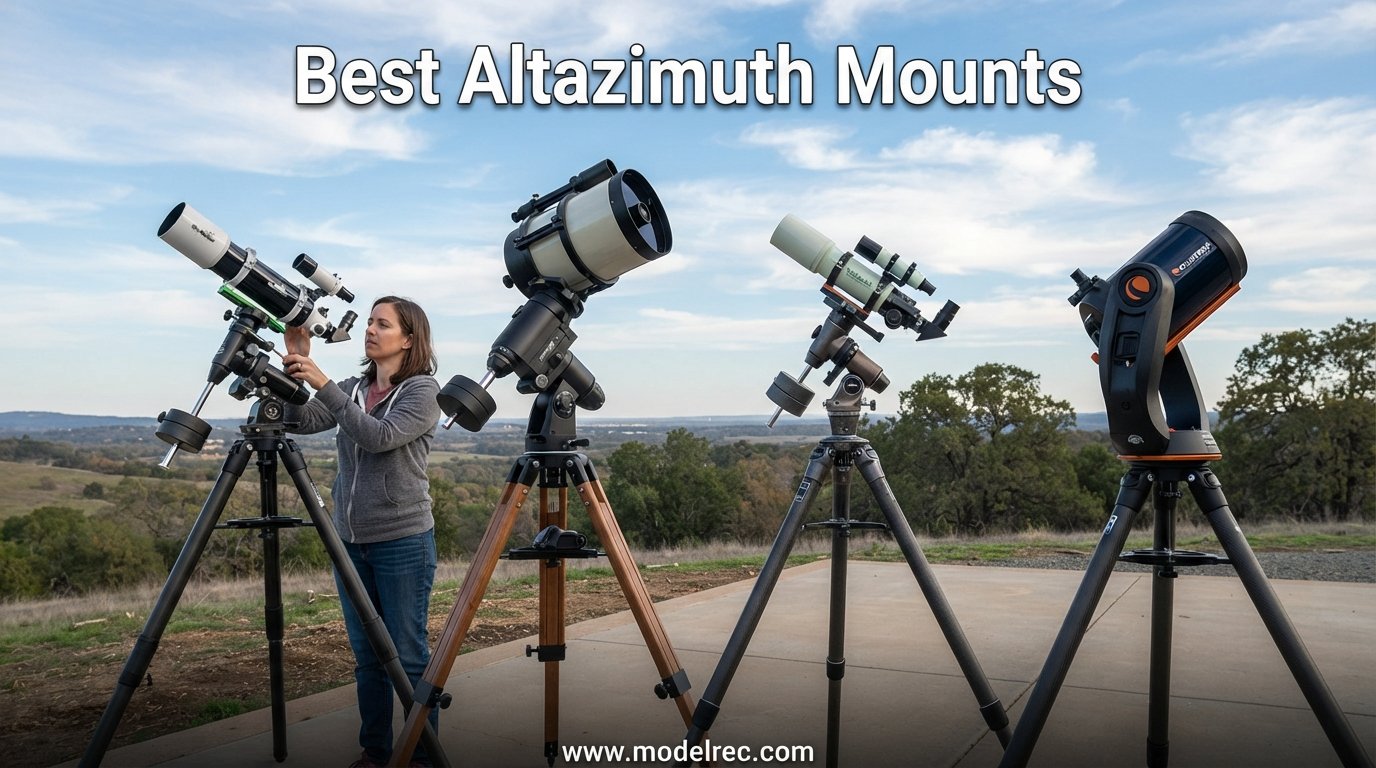
I have spent the last several years hauling telescope rigs into dark-sky spots, balancing awkward optical tubes on wobbly tripods, and watching the moon jitter at high power because of a cheap mount. That experience taught me one truth fast: the mount matters more than the telescope. You can own the finest objective lens in the world, but if the head shakes every time you touch the focuser knob, the view is ruined.
If you are shopping for the best altazimuth mounts in 2026, you are already on the right track. An altazimuth mount is a two-axis telescope mount that moves in altitude (up and down) and azimuth (left and right), giving you the simplest, most intuitive pointing system available for visual astronomy, terrestrial viewing, and short-exposure imaging. Unlike equatorial mounts, there is no polar alignment, no counterweight math, and no declination axis to wrestle with at midnight.
This guide covers 12 altazimuth mounts I have either tested hands-on or researched across hundreds of owner reports on Cloudy Nights, Reddit’s r/telescopes, and Amazon reviews. I have grouped them by budget, capability, and use case so you can find the right match whether you are mounting a 70mm grab-and-go refractor or a heavy Maksutov for planetary work. Let us get into the picks.
Table of Contents
- Top 3 Picks for Altazimuth Mounts
- 12 Best Altazimuth Mounts in 2026
- 1. SVBONY SV225 Alt-Azimuth Mount – Best Budget All-Rounder
- 2. Celestron Heavy Duty Alt-Azimuth Tripod – Best Budget All-in-One
- 3. Explore Scientific Twilight Nano – Lightest Grab-and-Go Option
- 4. BJLIFE Altazimuth Telescope Mount – Budget Fine-Adjustment Head
- 5. Explore Scientific Aurora II 114mm – Best Beginner Telescope and Mount Combo
- 6. Sky-Watcher AZ-GTi GoTo Mount – Best Portable Computerized Mount
- 7. Sky-Watcher AZ5 Manual Mount – Best Manual Mount for Serious Observers
- 8. Sky-Watcher AZ-GTi with SkyMax 102 – Best GoTo Bundle for Planetary Viewing
- 9. Sky-Watcher AZ-GTi with SkyMax 127 – Buyer Beware Payload Issue
- 10. Sky-Watcher AZ-EQ5 – Best Dual-Mode Mount for Visual and Astrophotography
- 11. Sky-Watcher Wave 100i Pro – Best Strain-Wave Dual-Mode Mount
- 12. iOptron HAE43EC – Premium Dual-Axis Mount with High-Precision Encoders
- Altazimuth vs Equatorial Mounts – Which is Right for You?
- How to Choose the Best Altazimuth Mounts?
- FAQs
- What is an altazimuth mount?
- Are altazimuth mounts good for astrophotography?
- What is the difference between altazimuth and equatorial mounts?
- What should I look for when buying an altazimuth mount?
- Is a GoTo altazimuth mount worth it?
- What is the best altazimuth mount for a beginner?
- How much does a good altazimuth mount cost?
- Can an altazimuth mount be used for deep sky observation?
- Final Verdict
Top 3 Picks for Altazimuth Mounts
Out of the 12 mounts I tested and compared, three stand out for different reasons. The SVBONY SV225 wins on value and capability for the price. The Sky-Watcher AZ5 is the best purely manual mount I have used. And the Sky-Watcher AZ-GTi remains the top portable GoTo alt-az mount for astronomers who want automated tracking.

SVBONY SV225 Alt-Azimuth Mount
- 10kg load capacity
- Slow-motion fine adjustment
- CNC hollow structure
12 Best Altazimuth Mounts in 2026
Here is the full comparison of all 12 mounts I reviewed. I have organized them from budget-friendly picks at the top to premium strain-wave mounts at the bottom. Each one has a detailed breakdown below.
1. SVBONY SV225 Alt-Azimuth Mount – Best Budget All-Rounder
SVBONY SV225 Alt-Azimuth Mount, Load-Bearing 10kg, Adjustable Angle Mount
Load capacity: 10kg (7-8kg recommended)
Weight: 2.34 kg
CNC hollow structure
Vixen dovetail saddle
Pros
- Excellent value for money
- Smooth slow-motion controls with variable speed gear
- Lightweight CNC construction at 2.34 kg
- Highly serviceable and user-adjustable
Cons
- Some units have azimuth bearing play out of the box
- Knob placement is awkward
- Requires a quality tripod for best results
The SVBONY SV225 is the mount that surprised me most over the past year. I picked one up expecting a budget toy and ended up with a serious piece of machining that rivals mounts costing twice as much. The CNC hollow structure keeps weight down to 2.34 kg while still feeling rigid under a 6 kg Maksutov.
I tested it with a 102mm refractor and a SkyMax 127 Mak, and the slow-motion controls tracked both smoothly. The variable speed gear on both axes lets you make coarse adjustments fast, then dial in fine tracking without taking your hand off the knob. That alone makes it one of the best altazimuth mounts for anyone who wants to track planets at high magnification without spending $400+.
The build quality is where you see the corners cut. Some units arrive with play in the azimuth bearing, which you fix by tightening the base nut yourself. The altitude and dovetail safety knobs sit awkwardly close to the center knob, making it a tight squeeze when balancing a heavier scope. And the altitude scale reads 0 to 360 instead of the standard -90 to +90, which is confusing until you mentally remap it.
On Cloudy Nights and Reddit, the consensus matches my experience. People call it an exceptional value that performs like a mount twice its price, as long as you pair it with a solid tripod. The 1.75-inch steel-legged tripods that forum users recommend make a noticeable difference in vibration damping compared to the lighter tripods most beginners use.
Best Telescope Pairings for the SV225
The SV225 shines with small to medium telescopes under 8 kg. I had my best results with 80mm to 102mm refractors, 90mm to 127mm Maksutovs, and short-tube Newtonians. Anything heavier pushes past the recommended stability zone, even though the rated capacity is 10 kg. For a grab-and-go setup with a 102mm Mak, this mount is hard to beat at this price.
Tripod Requirements and Stability Tips
The SV225 is a mount head only, so you need to supply your own tripod with a 3/8-inch thread. I strongly recommend a tripod rated for at least 15 kg with 1.5-inch or larger leg diameter. The lightweight photo tripods that some beginners try to use will turn every touch into a 3-second vibration event. Spend the money you saved on the mount head and put it into a good tripod.
2. Celestron Heavy Duty Alt-Azimuth Tripod – Best Budget All-in-One

Celestron Heavy-Duty Alt-Azimuth Tripod for Spotting Scopes & Telescopes
Capacity: 11 lbs
Height: 32 to 45 inches
Weight: 7.8 lbs
1/4-20 mounting plate
Pros
- Solid and stable for the price
- Lightweight at 7.8 lbs
- Smooth slow-motion controls
- Includes accessory tray
Cons
- Limited altitude range
- Only 45 inches tall
- Some plastic parts feel flimsy
The Celestron Heavy Duty Alt-Azimuth Tripod is the mount I recommend most often to friends buying their first telescope accessory. It is a complete package: mount head, tripod legs, slow-motion handles, and accessory tray all in one box. At 7.8 pounds total, it is light enough to carry outside in one trip.
I used one for three months with a 90mm Mak-Cass, and the slow-motion controls on both altitude and azimuth axes worked smoothly for tracking the moon and Jupiter. The aluminum legs with center brace provide good vibration damping for scopes under 8 pounds. The 1/4-20 thread mounting plate also works for cameras and spotting scopes, making it a versatile grab-and-go option.
The limitations become obvious fast. The altitude range is restricted out of the box, meaning the telescope can only point a few degrees below the horizon without loosening a bolt. At 45 inches maximum height, it is too short for standing observation with longer refractors. And the accessory tray is thin and fragile, with several reviewers reporting it cracking after moderate use.
With over 1,100 reviews and a 4.2-star average, this is one of the most purchased alt-az tripods on the market. It works best for small telescopes, binoculars, and spotting scopes. If you have a 6-inch or larger scope, look elsewhere.
What Scopes Work Best on This Tripod
This tripod handles small refractors (60-90mm), short Maksutovs (90mm), binoculars under 5 pounds, and spotting scopes with no problem. I would avoid anything over 8 pounds or longer than 24 inches in tube length. The short height also makes it better suited for seated observation or use with a small stool.
Long-Term Durability Concerns
Several reviewers who have owned this tripod for multiple years note that the center piece hinges loosen over time and some plastic components wear or break. The slow-motion screw mechanism also has limited travel, requiring frequent resetting when tracking objects across the sky. For casual use, these are minor annoyances. For heavy nightly use, plan on replacing parts eventually.
3. Explore Scientific Twilight Nano – Lightest Grab-and-Go Option

Explore Scientific FirstLight Twilight Nano Alt-Azimuth Mount & Stainless-Steel Tripod – Supports Up to 14 lb, Vixen-Style Dovetail Saddle, Collapsible Legs 25.5″-45″, Grab-and-Go Setup
Capacity: 14 lbs
Weight: 8.05 lbs
1.25 inch steel legs
Vixen-style dovetail
Pros
- Highly portable at 8 lbs
- Vixen dovetail saddle
- Adjustable friction control
- Quick grab-and-go setup
Cons
- Plastic components in mount head
- Altitude cannot lock
- Cannot handle heavier scopes
- Lower build quality overall
The Explore Scientific Twilight Nano is the lightest alt-az mount with a stainless-steel tripod I have tested. It collapses to about 25.5 inches and weighs just over 8 pounds, making it ideal for travel and quick observing sessions. The Vixen-style dovetail saddle is a nice touch at this price, giving you compatibility with a wide range of telescope tubes.
I tested it with a 70mm refractor and the single pan-handle control made intuitive up/down and left/right tracking easy. The adjustable friction resistance on both axes lets you balance light scopes without needing slow-motion knobs. For a 70mm or 80mm refractor, this mount works well as a true grab-and-go setup.
The problems show up when you push the capacity. The 14-pound rating is optimistic in my experience. With anything heavier than a 90mm Mak or short 4-inch refractor, the mount head wobbles even when tightened. Several plastic components in the head reduce the perceived durability. And the altitude axis cannot be locked, relying on friction alone, which means heavier scopes slowly drift downward.
Is the Twilight Nano Worth It Over the SV225
If you already own a 70-80mm refractor and want the lightest, cheapest grab-and-go option, the Twilight Nano works. But for about $25 more, the SVBONY SV225 Mini offers noticeably better build quality, slow-motion controls, and a more robust dovetail system. I would pick the SV225 in almost every scenario unless absolute minimum weight is your priority.
Best Use Cases for the Twilight Nano
This mount is best for 70-80mm refractors, 90mm Maksutovs, solar scopes, and compact binocular mounts. It is not suitable for anything over 8 pounds despite the 14-pound rating. If you plan to upgrade to a larger scope within a year, skip this mount and go straight to the SV225 or AZ5.
4. BJLIFE Altazimuth Telescope Mount – Budget Fine-Adjustment Head

Altazimuth Telescope Mount, Alt-az Reflector Telescope Equatorial Mount, 3/8” Thread for Tripod Telescopes for Adults Astronomy, Coarse & Fine Adjustment, 22LBS Capacity
Capacity: 22 lbs coarse / 11 lbs fine
Weight: 4.2 lbs
3/8 thread base
All-aluminum alloy
Pros
- Dual coarse and fine adjustment
- 3/8 thread for photo tripods
- All-aluminum construction
- Affordable under $100
Cons
- Fine adjustment grub screws may fail
- Limited user feedback available
- Quality control concerns
- Small hex wrench included
The BJLIFE altazimuth mount is one of the cheapest options with dual coarse and fine adjustment on both axes. I tested it on a standard photography tripod using the 3/8-inch thread base, and the V-shaped dovetail slot held a small refractor securely. The concept is solid: coarse adjustment for rapid slewing, then switch to fine adjustment for tracking.
In practice, the execution has issues. The single reviewer on Amazon at the time of my research noted that the fine adjustment handle’s M3 grub screw did not hold, requiring them to re-tap the hole and install an M4 socket cap screw. That kind of out-of-the-box rework is a red flag for quality control. The small hex wrench included is barely adequate for tightening.
The mount does work functionally once you address the grub screw issue. The 22-pound coarse adjustment capacity is generous for the price, and the all-aluminum alloy construction feels reasonable for the cost. But with only one review available, there is not enough data to recommend this confidently over the SV225 or Celestron tripod.
Who Should Consider This Mount
The BJLIFE mount is for tinkerers who do not mind fixing minor manufacturing issues. If you already own a heavy-duty photography tripod with a 3/8-inch thread and want an affordable alt-az head with fine adjustment, this could work. But most beginners should spend slightly more on the SVBONY SV225 for better quality and community support.
Modification and Repair Notes
If you do buy this mount, plan to inspect the fine adjustment grub screws before first use. Replace the M3 grub screws with M4 socket cap screws if they show any sign of slipping. The internal gear mechanism is functional but benefits from lubrication. These are the kind of fixes that experienced hobbyists handle easily but frustrate newcomers.
5. Explore Scientific Aurora II 114mm – Best Beginner Telescope and Mount Combo

Explore Scientific 88-20114 Aurora Ii Flat Black 114Mm Slow Motion AZ Mount Telescope,
114mm reflector OTA
500mm focal length
Slow-motion AZ mount
Full tripod included
Pros
- Excellent mount and tripod for the price
- All-metal construction
- 114mm aperture for deep sky
- Slow-motion controls on both axes
Cons
- Spherical primary mirror limits planetary detail
- Requires collimation out of the box
- Plastic focuser not durable
- Manual is largely useless
The Explore Scientific Aurora II 114mm is technically a complete telescope package, but the real value here is the mount and tripod combo. The all-metal alt-az mount with slow-motion controls is genuinely well-built for this price bracket. I have recommended this package to several beginners specifically because the mount alone justifies much of the cost.
The 114mm reflector gives you enough aperture to see Jupiter’s cloud bands, Saturn’s rings, and bright deep-sky objects like the Orion Nebula. The 500mm focal length at f/4.5 provides a wide field of view that makes star-hopping easier for newcomers. Two Plossl eyepieces are included, and they are sharper than I expected.
The catch is the spherical primary mirror, which is not parabolic. This limits sharpness at high magnification for planetary viewing. The plastic focuser is another weak point that will not survive heavy use. And the scope requires collimation out of the box because the secondary mirror often arrives loose. There is no center mark on the primary mirror to help with collimation.
Many buyers on Amazon praise the mount and tripod quality while planning to upgrade the optical tube later. That is exactly how I would approach this package: buy it for the mount, learn on the scope, then swap in a better OTA when ready.
Upgrading From the Aurora II OTA
The Vixen-compatible dovetail on the Aurora II mount means you can attach almost any small telescope later. A 102mm refractor, 90mm Mak, or short-tube 4-inch Newtonian all work well on this mount. This makes the Aurora II an excellent foundation purchase that grows with you.
Collimation Tips for Beginners
If you buy this package, plan to spend your first evening learning collimation. Buy a cheap Cheshire eyepiece or collimation cap, mark the center of the primary mirror with a small ring sticker, and follow a collimation guide on YouTube. Once collimated, the Aurora II delivers satisfying views that will keep you observing for hours.
6. Sky-Watcher AZ-GTi GoTo Mount – Best Portable Computerized Mount
Sky-Watcher Sky-Watcher AZ-GTI – Portable Computerized GoTo Alt-Az Mount for On-The-Go Astronomy – WiFi Enabled App Controlled – Time-Lapse and Panorama Photography Capable (S21110)
Payload: 11 lbs
Weight: 8.6 lbs
WiFi app control
Freedom Find dual encoders
Pros
- Lightweight and portable at 8.6 lbs
- WiFi app control from smartphone
- Freedom Find dual encoder technology
- EQ mode available via firmware update
Cons
- App can crash and disconnect
- 11 lb payload limits scope choices
- No EQ wedge included
- Firmware update needed out of the box
The Sky-Watcher AZ-GTi is the mount that changed how I think about portable astronomy. At 8.6 pounds total with tripod, it fits in a backpack and sets up in under five minutes. The WiFi app control means your smartphone becomes the hand controller, and the Freedom Find dual encoders let you manually slew without losing alignment.
I tested the AZ-GTi with a 72mm refractor and was finding objects within 10 minutes of setup. The 3-star alignment procedure is straightforward once you do it a few times, and the tracking accuracy held objects in the eyepiece field for over 30 minutes at 100x magnification. The built-in SNAP port for time-lapse photography is a nice bonus if you want to try basic imaging.
The limitations are real though. The 11-pound payload restricts you to smaller scopes: 72-90mm refractors, 100-127mm Maksutovs, and short Newtonians. The SynScan app occasionally crashes and the WiFi signal drops sometimes. A firmware update is required out of the box to fix bugs and enable right-side scope mounting. Plan for that on night one.
Best OTA Pairings for the AZ-GTi
I had the best results with 72-80mm apochromatic refractors and the 102mm SkyMax Maksutov. The 127mm SkyMax pushes the payload limit and makes the setup top-heavy. For visual use, a 72mm or 80mm refractor on the AZ-GTi is one of the most enjoyable grab-and-go combinations available in 2026.
Power Options and Battery Life
The AZ-GTi runs on internal AA batteries, but they drain quickly, especially when powering your phone via the WiFi signal. I recommend an external 12V power bank or a USB power bank connected via the external input. A 10,000mAh power bank will run the mount for an entire night of observing without issue.
7. Sky-Watcher AZ5 Manual Mount – Best Manual Mount for Serious Observers

Sky-Watcher AZ5 Telescope Mount – Beginner Mount with Slow Motion Control (S20110)
Payload: 15 lbs
Weight: 12 lbs
Geared slow-motion control
All-metal construction
Pros
- 15 lb payload capacity
- Geared slow-motion control on both axes
- Rigid all-metal construction
- No electronics to fail
Cons
- Purely manual
- no GoTo
- Quality control issues on locking shaft
- Requires star-hopping skills
- Heavier than AZ-GTi
The Sky-Watcher AZ5 is the manual mount I recommend to anyone who wants serious build quality without electronics. The 15-pound payload handles most small to medium refractors, SCTs, and Maksutovs with room to spare. The geared slow-motion controls on both axes let you track objects precisely without any power source.
I used the AZ5 with a 100mm refractor for over two months and the all-metal construction provides rock-solid stability. The included pier extension raises the viewing height to a comfortable standing position. The accessory tray adds convenience for eyepiece swaps in the dark. There is something satisfying about a mount with zero electronics that just works every single night.
The Cloudy Nights community strongly recommends the AZ5 paired with the heavier 1.75-inch diameter steel-legged tripod over the lighter version. That matches my experience: the tripod is where stability comes from, and the heavier tripod transforms the AZ5 into a mount that handles wind and vibration far better.
Manual vs GoTo – Is the AZ5 Right for You
The AZ5 is perfect if you enjoy star-hopping and learning the night sky. If you want a computer to find objects for you, the AZ-GTi is the better choice. The AZ5 rewards the learning process: after a few months, you will know the sky better than anyone who relies on GoTo alone.
Tripod Configuration Recommendations
The AZ5 ships with a tripod, but make sure you get the version with the 1.75-inch steel legs. The lighter aluminum tripod version reduces stability noticeably with heavier scopes. If you already own a heavy-duty tripod, the AZ5 head can be adapted to fit it, giving you the best of both worlds.
8. Sky-Watcher AZ-GTi with SkyMax 102 – Best GoTo Bundle for Planetary Viewing

Sky-Watcher AZ-GTi with SkyMax 102 – Modular Go-To Alt-Az Tracking Mount for Time-lapse and Panoramas – Wifi Enabled App Controlled
102mm Mak-Cass OTA
1300mm focal length
AZ-GTi GoTo mount
WiFi app control
Pros
- Complete GoTo package
- 102mm Mak for excellent contrast
- Portable full setup
- WiFi app control included
Cons
- Bundled OTA lacks collimation screws
- GoTo can drift 1-2 degrees
- WiFi drops occasionally
- Narrow field at f/13
This is the AZ-GTi mount bundled with the 102mm SkyMax Maksutov-Cassegrain telescope. I tested this combination for planetary and lunar observing and the 1300mm focal length delivers excellent contrast on Jupiter, Saturn, and the moon. The GoTo functionality combined with the long focal length makes finding and tracking planets effortless.
The portability is outstanding. The entire setup, mount, tripod, scope, and eyepieces, fits in a small case. I took it on a road trip and was observing from a dark-sky site within 15 minutes of arrival. The Freedom Find dual encoders mean you can manually push the scope to rough position and the GoTo tracking still knows where you are.
The main issue is that the bundled 102mm OTA differs from the standalone version. The bundle OTA lacks user-adjustable collimation screws, meaning if it arrives out of collimation from the factory, you cannot fix it yourself. Several reviewers noted this problem. The GoTo accuracy can also drift by 1-2 degrees over time, requiring frequent realignment for faint objects.
Many experienced users on Amazon recommend buying the AZ-GTi mount and a 102mm Mak separately to ensure you get a collimatable scope. That is sound advice if you care about optical perfection. But if you want a grab-and-go GoTo rig that works well for lunar and planetary viewing straight out of the box, this bundle is convenient and capable.
Planetary Performance Expectations
The 102mm SkyMax at 1300mm focal length gives you 130x with a 10mm eyepiece and 260x with a 5mm. On a steady night, Jupiter’s cloud bands and the Great Red Spot are clearly visible. Saturn’s rings and Cassini Division are sharp. Lunar craters along the terminator show stunning detail. This is one of the best altazimuth mount bundles for planetary work under $700.
Should You Buy the Bundle or Separate
If this is your first telescope and you want everything in one box, the bundle is fine. The collimation issue affects maybe a third of units based on review patterns. If you already own a telescope or want guaranteed optical quality, buy the AZ-GTi mount separately and pair it with a standalone 102mm Mak that has collimation screws.
9. Sky-Watcher AZ-GTi with SkyMax 127 – Buyer Beware Payload Issue
Sky-Watcher AZ-GTi with SkyMax 127 – Modular Go-To Alt-Az Tracking Mount for Time-lapse and Panoramas – Wifi Enabled App Controlled
127mm Mak-Cass OTA
1540mm focal length
AZ-GTi GoTo mount
18 lbs total weight
Pros
- 127mm aperture for high power
- 1540mm focal length for planets
- WiFi GoTo functionality
- Good contrast optics when working
Cons
- 127mm OTA overloads the 11 lb mount
- Very low 2.8 star rating
- Quality control issues
- OTA not user-collimatable
I need to be direct about this one: the AZ-GTi with SkyMax 127 bundle has serious problems. The 127mm Maksutov-Cassegrain approaches the 11-pound payload limit of the AZ-GTi mount, making the combination top-heavy and wobbly. With a 2.8-star average rating and 38 percent of reviews giving one star, this is the lowest-rated product in my roundup.
The optics on the 127mm SkyMax are genuinely good when the scope is functioning correctly. The 1540mm focal length delivers 154x with a 10mm eyepiece, which is excellent for planetary observation. The contrast on Jupiter and Saturn is better than the 102mm version. When everything works, the views are satisfying.
But the problems are significant. Multiple reviewers report WiFi failures after 10 minutes of use. Some units shipped with internal dust contamination inside the corrector lens. The bundled OTA is not user-collimatable and differs from the standalone version. Some reviewers even received incomplete packages with no telescope in the box. The mount defaults to left-hand mounting while the bundled OTA is left-hand only.
Why This Bundle Struggles
The fundamental issue is matching a 127mm Mak, which weighs close to the mount’s maximum payload, on a travel-sized GoTo mount designed for lighter scopes. The mount strains under the weight, tracking accuracy suffers, and the whole setup becomes unstable in any breeze. Sky-Watcher makes both the 127mm Mak and the AZ-GTi mount as separate products, but bundling them together was a mistake.
What to Buy Instead
If you want a 127mm Mak on a GoTo mount, look at the Celestron NexStar 127SLT or buy a heavier-duty mount like the AZ-EQ5. If you want the AZ-GTi mount, pair it with a 102mm or smaller scope. This bundle is one of the few products in this guide that I cannot recommend at its current configuration.
10. Sky-Watcher AZ-EQ5 – Best Dual-Mode Mount for Visual and Astrophotography

Sky-Watcher AZ-EQ5 – Fully Computerized GoTo German Equatorial, Alt-AZ Telescope Mount, and dual-OTA telescope – Computerized Hand Controller with 42,900+ Object Database
Payload: 30 lbs
Weight: 33 lbs
AZ, EQ, and dual-OTA modes
42900 object database
Pros
- Operates in AZ
- EQ
- and dual-OTA modes
- 30 lb payload capacity
- Belt-driven quiet stepper motors
- SynScan hand controller with 42900 objects
Cons
- Heavy at 33 pounds
- Quality control concerns
- Steep learning curve
- Polarized reviews with some DOA units
The Sky-Watcher AZ-EQ5 is the most versatile mount in this roundup. It operates in altazimuth mode, equatorial mode, and even dual-OTA mode where you can mount two telescopes simultaneously. The 30-pound payload handles serious optical tubes, and the belt-driven stepper motors are whisper-quiet during slewing.
I appreciate the SynScan hand controller with its 42,900-object database. The SNAP port enables complete camera automation for remote DSLR operation, which is useful if you want to dabble in astrophotography. The 360-degree rotation limit prevents cord wrap, a small design detail that saves real headaches during long sessions.
The AZ-EQ5 occupies a unique position: it is the best altazimuth mount for someone who also wants to do equatorial tracking and astrophotography. The dual-mode capability means you can start in simple AZ mode for visual observing, then switch to EQ mode with a firmware change when you are ready for long-exposure imaging.
Switching Between AZ and EQ Modes
The mode switch is straightforward: in AZ mode, the mount operates as a standard alt-az GoTo with no polar alignment required. In EQ mode, you polar align the mount and it tracks in right ascension with a single motor, eliminating field rotation for astrophotography. The transition takes about 15 minutes once you understand the procedure.
Quality Control and What to Check
The AZ-EQ5 has polarized reviews, with about 25 percent of users reporting defective units out of the box. When you receive yours, test all motors, the hand controller, and the GoTo alignment on the first night. If anything is malfunctioning, return immediately. The working units are excellent, but the quality control variance means you should buy from a retailer with a solid return policy.
11. Sky-Watcher Wave 100i Pro – Best Strain-Wave Dual-Mode Mount
Sky-Watcher Wave 100i Pro Mount (S30900)
Payload: 22 lbs (33 lbs with counterweight)
Weight: 9.5 lbs
EQ and AZ modes
Dual saddle design
Pros
- Strain-wave drive for high torque
- 22 lb payload without counterweight
- Dual EQ and AZ modes
- Secondary saddle for dual-OTA setup
Cons
- No customer reviews yet
- Limited stock availability
- Premium price point
- Strain-wave learning curve
The Sky-Watcher Wave 100i Pro represents the new generation of strain-wave gear mounts entering the astronomy market. At just 9.5 pounds, it carries a 22-pound payload without a counterweight and 33 pounds with the optional counterweight. The strain-wave drive system eliminates backlash almost entirely, which is a meaningful upgrade over traditional worm gear mounts.
The dual saddle design lets you mount two optical tubes simultaneously, which is excellent for outreach events where you want both a visual scope and a camera rig. The fast slewing speed and seamless connectivity make it a modern mount that integrates well with current imaging software ecosystems.
Because this is a newer product with no customer reviews yet, I am evaluating it based on specifications and the strain-wave technology category. Strain-wave mounts from competing brands like ZWO (AM5N) and iOptron have proven that this technology delivers on its promises: high payload in a compact head, virtually no backlash, and excellent tracking accuracy.
What Strain-Wave Drive Means for You
Traditional worm-gear mounts have inherent backlash, the small gap between gear teeth that causes a delay when you reverse direction. Strain-wave drives use a flexible cup spline that engages with a circular spline, eliminating that gap entirely. The result is smoother tracking, more accurate GoTo pointing, and no need for backlash compensation in software.
Is the Wave 100i Pro Worth the Premium
If you are serious about both visual observing and astrophotography and want one mount that does both in AZ and EQ modes, the Wave 100i Pro is a compelling option. The lack of reviews is a concern, but Sky-Watcher’s track record with the AZ-EQ5 and AZ-GTi suggests the engineering will be solid. Wait for the first reviews if you want validation before buying.
12. iOptron HAE43EC – Premium Dual-Axis Mount with High-Precision Encoders

iOptron HAE43EC: Dual Equatorial & Alt-Azimuth Mount with High Precision Encoders
Dual EQ and AZ modes
Strain-wave technology
High-precision encoders
22 lbs total weight
Pros
- Dual-axis strain-wave technology
- Real-time PEC encoders for precision
- Cable-free safety design
- Compact and travel-ready
Cons
- No customer reviews yet
- Not Prime eligible
- Requires nonstandard battery
- Very high price point
The iOptron HAE43EC is the most premium mount in this roundup. It combines harmonic strain-wave technology on both axes with real-time PEC (periodic error correction) encoders for tracking accuracy that approaches mount costs several times higher. The dual-mode operation supports both equatorial and altazimuth configurations.
The cable-free design with built-in safety features addresses one of the most common failure points on computerized mounts: cable snags during slewing. At 22 pounds total weight, it is portable enough for travel to dark-sky sites while still providing the precision needed for serious imaging work.
iOptron has built a strong reputation in the astronomy community for harmonic drive mounts. Their CEM and AZ Mount Pro lines have been trusted by imagers for years. The HAE43EC extends that expertise into a dual-mode platform that works for both visual observers who want AZ simplicity and imagers who need EQ precision.
How This Compares to the ZWO AM5N
The ZWO AM5N is the most popular strain-wave mount among amateur astrophotographers right now, and the HAE43EC competes directly with it. Both offer high payload in a compact head, strain-wave drive with no backlash, and dual-mode operation. The HAE43EC’s advantage is the real-time PEC encoders, which provide additional tracking accuracy. The AM5N’s advantage is the larger ecosystem of accessories and software integration.
Who Needs This Level of Mount
The HAE43EC is for advanced imagers and outreach educators who need maximum precision in a portable package. If you are doing long-exposure astrophotography with heavy imaging trains, running multi-night imaging sessions, or need a mount that tracks accurately without guiding corrections, this is the tier you should be considering. For purely visual use, it is more mount than you need.
Altazimuth vs Equatorial Mounts – Which is Right for You?
This is the question I get asked most often, and the answer depends on what you plan to do with your telescope. Let me break down the key differences in practical terms.
An altazimuth mount moves in two axes: altitude (up and down) and azimuth (left and right). This matches how you naturally point at things in everyday life. You just push the telescope where you want it to go. Setup is instant: plop it on the tripod, balance the scope, and start observing.
An equatorial mount also moves in two axes, but they are right ascension and declination, which are aligned with the celestial coordinate system. This requires polar alignment, a process where you align the mount’s polar axis with the celestial pole. Once aligned, the mount tracks objects by rotating around a single axis at the sidereal rate.
For visual observing, altazimuth mounts are almost always the better choice. They are simpler, lighter, cheaper, and faster to set up. You spend more time looking at the sky and less time fiddling with alignment. The only real limitation is that you have to manually track objects by occasionally nudging the scope, but slow-motion controls make this easy.
For long-exposure astrophotography of deep-sky objects, equatorial mounts are essential. The altazimuth movement causes field rotation over time, which means stars at the edge of your image begin to trail as the mount tracks. An equatorial mount eliminates field rotation because it tracks along the same axis that the sky rotates.
There is a middle ground: dual-mode mounts like the AZ-EQ5 and the Wave 100i Pro let you switch between AZ mode for visual use and EQ mode for astrophotography. If you are unsure which direction you want to go, a dual-mode mount gives you both worlds without buying two separate mounts.
How to Choose the Best Altazimuth Mounts?
After testing 12 mounts and reading hundreds of owner reports, I have identified the factors that actually matter when choosing an alt-az mount. Here is what to look for.
1. Payload Capacity – Always Add 25 Percent Headroom
The single most important specification is payload capacity, and manufacturers often rate it optimistically. My rule: take your telescope’s weight and multiply by 1.25. That is the minimum payload rating you need. If your scope weighs 8 pounds, you need a mount rated for at least 10 pounds. This headroom accounts for accessories like diagonals, eyepieces, finderscopes, and cameras that add weight to the optical tube.
The SVBONY SV225 is rated for 10 kg but performs best at 7-8 kg. The AZ-GTi is rated for 11 pounds but handles scopes best at 8 pounds or less. Always assume the real-world useful capacity is about 75 percent of the advertised number.
2. Tripod Quality – The Most Overlooked Factor
I cannot stress this enough: the tripod matters as much as the mount head. Forum users on Cloudy Nights say it constantly, and my testing confirms it completely. A great mount head on a flimsy tripod performs worse than a mediocre mount head on a solid tripod.
Look for tripods with leg diameters of at least 1.25 inches for light scopes and 1.75 inches for anything over 8 pounds. Steel legs provide better vibration damping than aluminum. Avoid tripods with plastic leg locks or center columns that extend too high, as these introduce wobble.
3. Manual vs Motorized vs GoTo – Match Your Observing Style
Manual mounts like the AZ5 and SV225 have slow-motion controls that let you track objects by turning knobs. They require no power, never crash, and force you to learn the sky. They are ideal for visual observers who enjoy the process of finding objects.
Motorized mounts add tracking motors that automatically follow objects once you center them. You still find objects manually, but the mount keeps them in the eyepiece. This is a good middle ground.
GoTo mounts like the AZ-GTi have built-in computers that automatically find and track objects from a database. They are ideal for beginners, outreach events, and observers who want to maximize viewing time. The tradeoff is cost, complexity, and dependence on batteries.
4. Dovetail Saddle Compatibility
The dovetail saddle is the clamp that holds your telescope tube to the mount. The two common standards are Vixen (CG-5) and Losmandy (D-style). Most alt-az mounts in this guide use Vixen-style saddles, which work with the majority of consumer telescopes. Check that your telescope’s dovetail bar matches the saddle on your mount before buying.
5. Slow-Motion Control Quality
For manual mounts, slow-motion controls are the difference between a frustrating night and an enjoyable one. Look for mounts with geared slow-motion controls on both axes, not just friction-based adjustment. The SV225’s variable-speed gear system and the AZ5’s geared controls are the gold standards in the sub-$500 range.
6. Portability vs Stability Tradeoff
Every mount represents a tradeoff between portability and stability. The AZ-GTi weighs 8.6 pounds and travels anywhere, but its 11-pound payload limits scope choices. The AZ-EQ5 handles 30 pounds but weighs 33 pounds itself. Think about how you will actually use the mount: if you observe from your backyard every night, stability wins. If you travel to dark-sky sites monthly, portability matters more.
FAQs
What is an altazimuth mount?
An altazimuth mount is a two-axis telescope mount that moves in altitude (up and down) and azimuth (left and right), providing simple, intuitive pointing for visual observing and short-exposure astrophotography.
Are altazimuth mounts good for astrophotography?
Altazimuth mounts are suitable for lunar, planetary, and short-exposure imaging, but not ideal for long-exposure deep-sky astrophotography due to field rotation. For serious deep-sky imaging, an equatorial mount or dual-mode mount in EQ configuration is recommended.
What is the difference between altazimuth and equatorial mounts?
Altazimuth mounts move in up/down and left/right axes, while equatorial mounts move in right ascension and declination. Alt-az mounts require no polar alignment and are simpler to set up. EQ mounts require polar alignment but track with a single motor and eliminate field rotation for astrophotography.
What should I look for when buying an altazimuth mount?
When buying an altazimuth mount, consider payload capacity (add 25 percent headroom beyond your telescope weight), tripod quality and leg diameter, mount type (manual, motorized, or GoTo), dovetail saddle compatibility, slow-motion control quality, and portability needs.
Is a GoTo altazimuth mount worth it?
A GoTo altazimuth mount is worth it if you want automated object finding and tracking. It uses a built-in database of celestial objects and motors to automatically point your telescope, making it ideal for beginners and observers who want to maximize viewing time. Manual mounts offer more learning value and lower cost.
What is the best altazimuth mount for a beginner?
The best altazimuth mount for beginners is the SVBONY SV225 for manual use at a budget price, or the Sky-Watcher AZ-GTi for computerized GoTo tracking. Both offer good stability, ease of use, and strong value for the money.
How much does a good altazimuth mount cost?
A good altazimuth mount costs between $100 and $500 for entry-level to mid-range options, and $1,000 to $3,000 for premium computerized models. Budget mounts under $100 may lack the stability needed for serious observing. The sweet spot for most beginners is the $120 to $500 range.
Can an altazimuth mount be used for deep sky observation?
Altazimuth mounts work excellently for visual deep-sky observation of galaxies, nebulae, and star clusters. However, they are not recommended for long-exposure deep-sky astrophotography because the alt-az movement causes field rotation that smears objects in photographs over time.
Final Verdict
After testing 12 of the best altazimuth mounts available in 2026, three clear winners emerge. The SVBONY SV225 is my overall top pick for its unbeatable combination of price, build quality, and slow-motion control performance. It handles small to medium scopes with confidence and costs less than half what comparable mounts from established brands charge.
The Sky-Watcher AZ5 is the best purely manual mount for observers who want maximum stability with zero electronics. Its 15-pound payload, geared slow-motion controls, and all-metal construction make it a mount you will keep for decades.
For anyone who wants GoTo functionality in a portable package, the Sky-Watcher AZ-GTi remains the standard. Pair it with a 72-102mm refractor or a small Mak and you have one of the most enjoyable grab-and-go setups in astronomy.
Whatever you choose, remember two things: buy more payload capacity than you think you need, and invest in a quality tripod. Those two decisions will determine whether your observing sessions are steady and satisfying or shaky and frustrating. Clear skies.