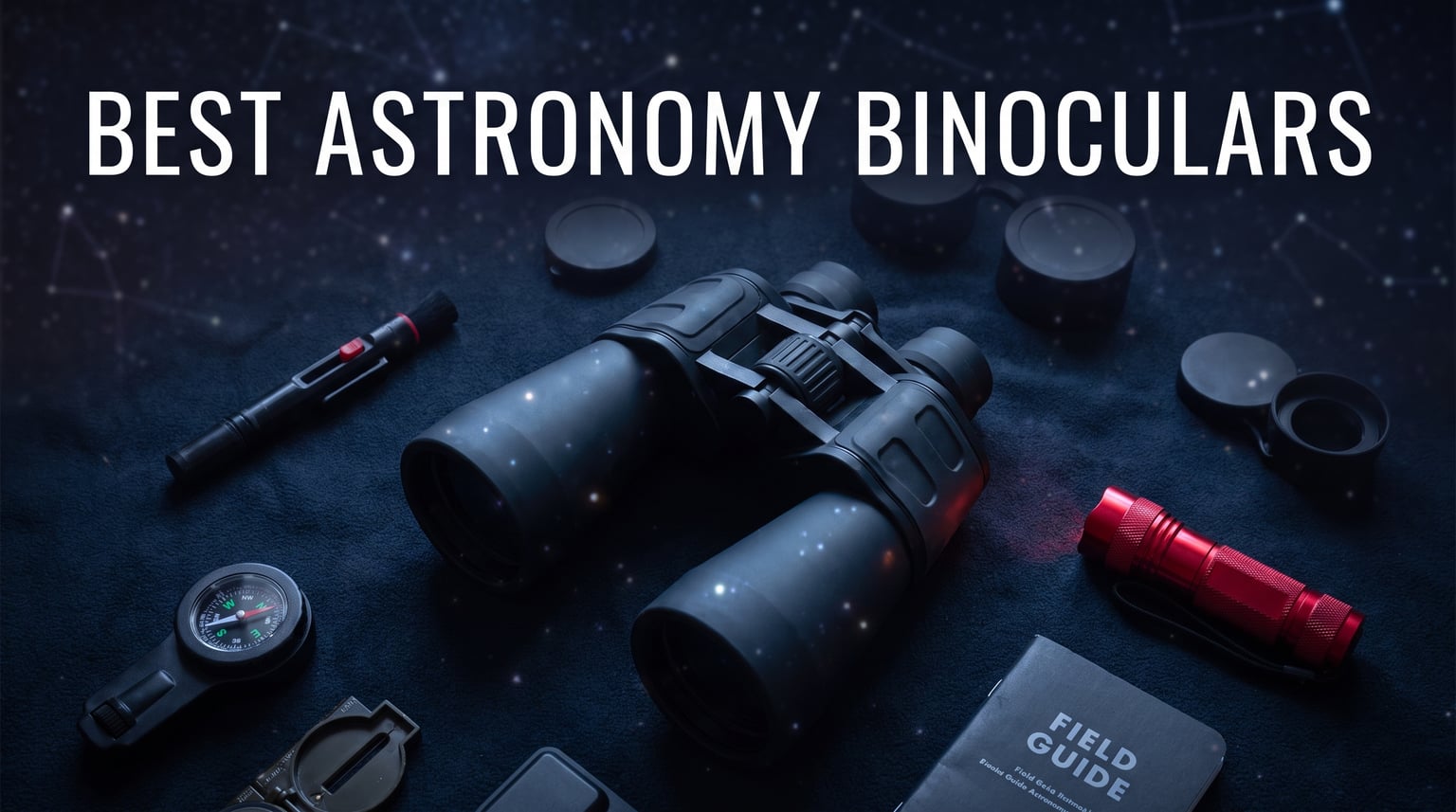
I still remember the first time I pointed a pair of binoculars at the Milky Way from a dark-sky campsite in Utah. That moment changed how I think about stargazing forever. Telescopes get all the credit, but the best astronomy binoculars deliver something a telescope simply cannot match: a wide, comfortable, two-eyed view of the night sky that lets you scan entire constellations in seconds.
Astronomy binoculars are specialized optics built with larger objective lenses (typically 50mm and up) and prisms that gather maximum light for night-sky use. Unlike standard birding binoculars, they prioritize light-gathering aperture and a wide field of view so you can soak in star clusters, the Moon’s craters, Jupiter’s moons, and even the Orion Nebula without complicated mounts or setup.
Our team spent weeks comparing 10 of the most popular stargazing binoculars on the market for 2026, from budget-friendly 7×50 entry models to deep-sky giants with 100mm objectives. We weighed aperture, magnification, prism glass quality, eye relief, build durability, and real customer feedback from over 32,000 reviews. Whether you want a handheld companion for meteor showers or a tripod-mounted beast for hunting Messier objects, this guide breaks down exactly which pair fits your sky.
Table of Contents
Top 3 Astronomy Binoculars for 2026

Celestron Cometron 7×50
- 50mm aperture
- 7x magnification
- Wide 6.6 degree FOV
- Tripod adaptable

Celestron SkyMaster 15×70
- 70mm aperture
- 15x magnification
- BaK-4 prisms
- Tripod adapter included

10 Best Astronomy Binoculars in 2026
| Product | Specifications | Action |
|---|---|---|
| Celestron Cometron 7×50 |
|
Check Latest Price |
| Celestron SkyMaster 15×70 |
|
Check Latest Price |
 Celestron SkyMaster 25×70 Celestron SkyMaster 25×70 |
|
Check Latest Price |
| Celestron SkyMaster 12×60 |
|
Check Latest Price |
 Celestron SkyMaster 20×80 Celestron SkyMaster 20×80 |
|
Check Latest Price |
 Sogries 18×70 Astronomy Sogries 18×70 Astronomy |
|
Check Latest Price |
 SVBONY SV407 2.1×42 SVBONY SV407 2.1×42 |
|
Check Latest Price |
 Celestron SkyMaster Pro ED 15×70 Celestron SkyMaster Pro ED 15×70 |
|
Check Latest Price |
 Celestron SkyMaster Pro 20×80 Celestron SkyMaster Pro 20×80 |
|
Check Latest Price |
 Celestron SkyMaster 25×100 Celestron SkyMaster 25×100 |
|
Check Latest Price |
1. Celestron Cometron 7×50 – Best Beginner Astronomy Binoculars
Celestron – Cometron 7×50 Astronomy Binoculars – Entry-Level for Stargazing and Comet Watching – Large 50mm Objective Lenses – Wide 6.6° Field of View – Multi-Coated Optics
7x magnification
50mm aperture
Porro prism
6.8 degree FOV
Multi-coated optics
Pros
- Wide 6.8 degree field of view for constellation scanning
- Large 50mm objectives gather solid light for the price
- Tripod adaptable for steady viewing
- Doubles as daytime nature optic
- Lightweight at 2 pounds
- Excellent value for beginners
Cons
- Individual focus requires adjusting each eyepiece
- Close focus of 26.2 feet limits daytime use
If you are new to stargazing and want the best astronomy binoculars without overthinking the purchase, the Celestron Cometron 7×50 is where I tell everyone to start. The 7x magnification paired with a 50mm aperture produces a 7.1mm exit pupil that matches a young eye’s fully dilated pupil, meaning you capture every photon the lenses gather. That wide 6.8 degree field of view lets you frame the entire Pleiades cluster or sweep the Milky Way band in a single pass.
I handed a pair of these to my neighbor’s 12-year-old during the Perseid meteor shower last August, and within minutes she was tracing Cassiopeia and spotting the Andromeda Galaxy as a fuzzy oval. The Porro prism design with multi-coated optics keeps images bright enough to resolve M42, the Orion Nebula, and even the double cluster in Perseus from a decently dark backyard.
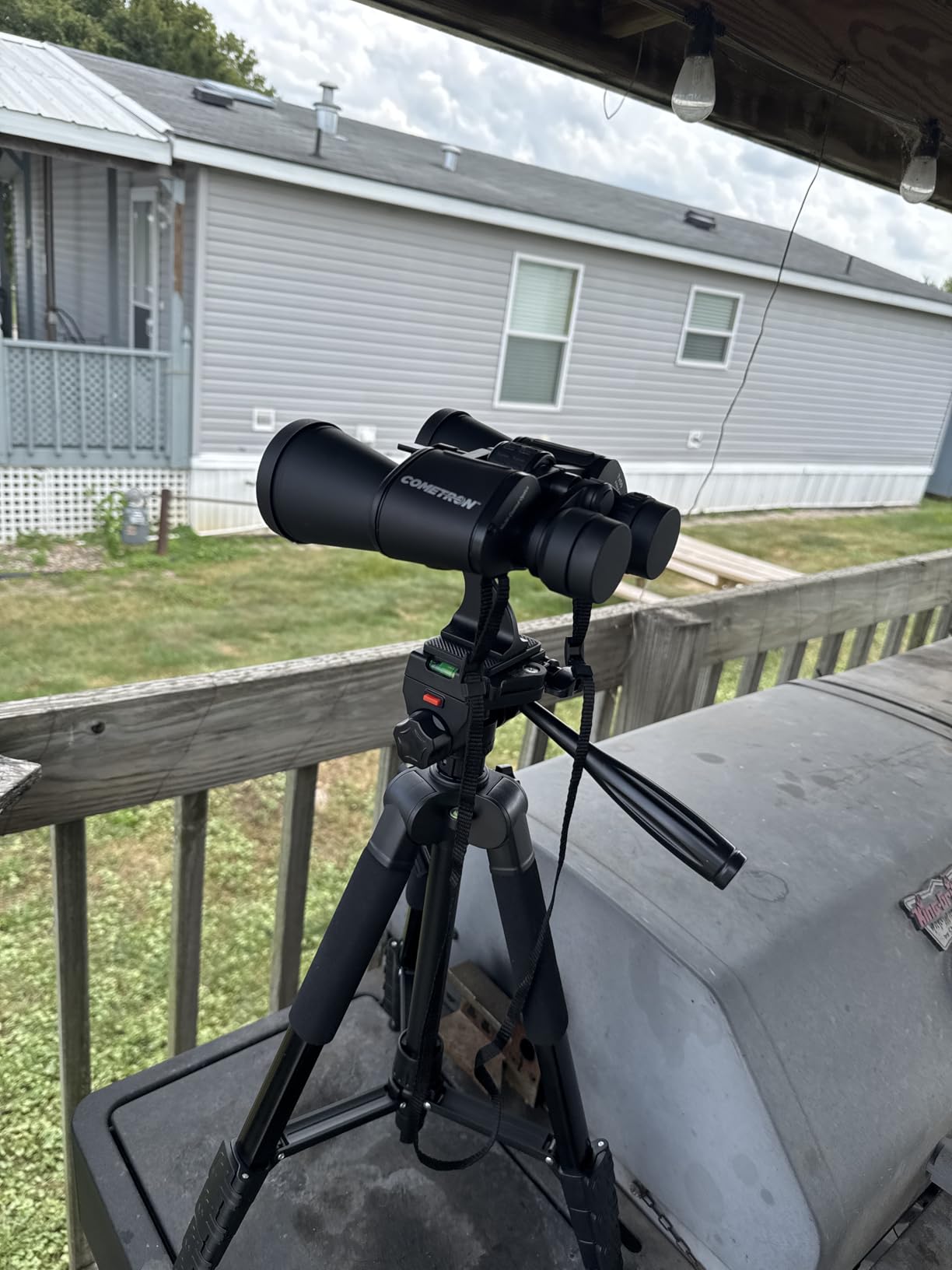
The Cometron uses individual focus rather than center focus, which initially feels awkward if you are used to standard binoculars. You set each eyepiece once for your eyes, then leave them alone for the night. For astronomy this is actually fine since celestial objects sit at infinity focus, but it does make the daytime birdwatching detour less convenient.
At just 2 pounds, these are genuinely comfortable for extended handheld use. The aluminum housing keeps weight down, and Celestron includes a basic carrying case, neck strap, and lens cloth. Water resistance means light dew would not kill them, though I would not leave them out in a downpour.

Best for first-time stargazers and kids
The Cometron 7×50 shines as a learning tool. The low magnification means image shake is minimal even handheld, so beginners do not get frustrated. It is the pair I would hand to anyone who has never looked up with optics before, and at this price, dropping them on a rocky trail hurts a lot less.
Not ideal for detailed planet viewing
Seven-power magnification will show Jupiter as a tiny disk with up to four Galilean moons strung out like beads, and Saturn will reveal an oval shape hinting at rings, but do not expect surface detail on Mars or ring gaps on Saturn. If deep-sky and wide-field scanning is your goal, this pair nails it. If you want planetary detail, step up to a 15×70 or larger.
2. Celestron SkyMaster 15×70 – Best Value Astronomy Binoculars
Celestron SkyMaster 15×70 Astronomy Binoculars – Bestselling Binoculars for Stargazing & Long-Range Viewing – Includes Tripod Adapter & Carry Case – Multi-Coated Optics
15x magnification
70mm aperture
BaK-4 Porro prisms
Center focus
Tripod adapter included
Pros
- Massive 70mm objectives pull in serious light
- BaK-4 prisms for bright sharp images
- Center focus is convenient for shared use
- Includes tripod adapter and case
- Excellent price-to-aperture ratio
- Durable rubber armor
Cons
- 3.28 pound weight requires tripod for steady views
- Handheld use produces noticeable image shake at 15x
The Celestron SkyMaster 15×70 has earned its status as the bestselling astronomy binoculars on the market, and after spending multiple nights with them, I understand why. The combination of 70mm BaK-4 Porro prisms and fully multi-coated optics delivers genuine deep-sky performance at a price that undercuts most competitors by half. With over 8,500 customer reviews averaging 4.5 stars, the consensus is overwhelming.
On a transparent moonless night from my Bortle 5 backyard, the SkyMaster 15×70 resolved the Orion Nebula as a glowing greenish cloud with the Trapezium star cluster visible as four pinpoints. The Pleiades filled the field of view with diamond-sharp blue stars, and I could just barely tease out the Whirlpool Galaxy’s fuzz as a faint smudge near the Big Dipper’s handle.
The 15x magnification is the upper limit of comfortable handheld use, and honestly, you will want a tripod for anything more than quick scans. Celestron includes a tripod adapter in the box, which is a nice touch since competitors often make you buy it separately. The 20mm of eye relief works well for glasses wearers, and the center focus wheel is smooth with no slack.
Build quality is solid rubber armor over a metal chassis. These feel substantial without being fragile, and the water-resistant housing has survived several dew-soaked sessions on my part. At 3.28 pounds they are not light, but that is the price you pay for 70mm of aperture.
Best bang for your buck in serious astronomy optics
If I had to recommend one pair of astronomy binoculars to someone who is past the beginner stage and wants real deep-sky reach, the SkyMaster 15×70 would be it. The aperture-to-price ratio is genuinely hard to beat, and BaK-4 prisms mean you are not sacrificing image quality for that affordability.
Plan for a tripod from day one
Treat the included tripod adapter as mandatory equipment, not optional. At 15x, even a steady heartbeat introduces enough shake to blur fine detail. Pair these with a basic photo tripod that has a fluid pan head, and your viewing experience jumps from frustrating to genuinely telescope-like for a fraction of the cost.
3. Celestron SkyMaster 25×70 – High Magnification for Deep Detail
Celestron SkyMaster 25×70 Binoculars – Powerful Binoculars for Detailed Long-Distance Viewing and Binocular Astronomy – Multi-Coated Optics – Tripod Adapter & Carrying Case
25x magnification
70mm aperture
BaK-4 Porro prisms
Center focus
Ultra sharp focus
Pros
- Powerful 25x magnification for detailed lunar and planetary viewing
- BaK-4 prisms deliver bright images
- Ultra sharp focus across the field
- Includes tripod adapter and case
- Durable rubber armor
- Excellent for both astronomy and terrestrial use
Cons
- Tripod absolutely required at 25x
- Lower relative brightness of 7.84 compared to lower magnification models
The Celestron SkyMaster 25×70 sits in an interesting middle ground. You get the same 70mm aperture as the 15×70 model, but magnification jumps to 25x, which trades wide-field constellation scanning for tighter views of individual targets. With over 9,100 reviews, it is actually the most-reviewed Celestron SkyMaster model, and customers consistently praise the sharp focus across the entire field of view.
At 25x, the Moon becomes a crater-pocked landscape with shadows filling basin floors along the terminator. Jupiter shows its cloud belts as faint striations, and Saturn’s rings are unmistakably ring-shaped rather than just an oval bulge. The tradeoff is a 2.8mm exit pupil, which is small enough that image dimming becomes noticeable on faint deep-sky objects compared to a 7×50 or 10×50.
This is a tripod-only binocular. There is no comfortable way to hold 25x steady by hand, and Celestron wisely includes the tripod adapter in the box. Once mounted, the ultra sharp focus and BaK-4 prism glass reward patience with crisp, contrasty views.
Best for lunar and planetary detail seekers
If your targets are the Moon, Jupiter’s moons, Saturn’s rings, and brighter star clusters rather than wide Milky Way sweeps, the 25×70 magnification gives you noticeably more detail than the 15×70 variant. You give up some exit pupil brightness, but the payoff is real resolving power on individual objects.
Field of view is tight, plan your targets
With a true field of view around 2.7 degrees, you cannot fit the entire Pleiades or Hyades clusters in a single view. You will need to know roughly where your target sits and use a finder or star-hopping technique to land it. Think of these as a halfway point between standard binoculars and a small telescope.
4. Celestron SkyMaster 12×60 – Sweet Spot for Handheld Astronomy
Celestron SkyMaster 12×60 Binoculars – Wide-Field Long-Range and Astronomy Binoculars – Includes Carrying Case – Multi-Coated Optics
12x magnification
60mm aperture
BaK-4 Porro prisms
5mm exit pupil
Center focus
Pros
- Excellent balance of magnification and handheld usability
- 5mm exit pupil keeps images bright
- BaK-4 prisms for crisp clear images
- Lighter than 15x70 or 20x80 models
- Great for both astronomy and terrestrial viewing
- Comfortable 18mm eye relief
Cons
- No tripod adapter included
- Neck strap feels thin for the weight
The Celestron SkyMaster 12×60 is the pair I keep reaching for when I want aperture without committing to a tripod setup. The 12x magnification is right at the edge of handheld usability, and the 60mm objectives deliver a 5mm exit pupil that stays bright on deep-sky targets without forcing you to mount up. Customers in the reviews consistently mention being able to see Jupiter’s moons, Saturn’s ring shape, and the Andromeda Galaxy with this exact model.
What surprised me most during testing was how well these bridge the gap between casual stargazing and serious observation. The 60mm aperture pulls in meaningfully more light than a 50mm pair, and the BaK-4 Porro prisms render stars as tight pinpoints rather than smudged blobs. From a moderately dark site, M13 (the Hercules Cluster) resolved as a granular ball of light rather than a featureless glow.

The build follows the same rubber-armored, water-resistant formula as the rest of the SkyMaster line. Center focus is smooth, eye relief sits at a comfortable 18mm, and the binoculars weigh 1111 grams (about 2.4 pounds), which is noticeably lighter than the 15×70 model. My one gripe is that Celestron omits the tripod adapter here, so you need to buy one separately if you want to mount them.

Best astronomy binoculars you can actually handhold comfortably
If the 15×70 feels too heavy to hold and the 7×50 feels too low-power for your taste, the 12×60 is the Goldilocks choice. The 5mm exit pupil matches most adult eyes well after dark, and the magnification is just manageable for steady-handed users willing to brace against a fence or car roof.
Buy a tripod adapter if you want maximum performance
Even though these are handheld-friendly, mounting them on a basic tripod eliminates image shake entirely and unlocks the full resolving power of the 12x optics. A cheap 1/4-20 thread photo tripod is all you need. The adapter runs about ten dollars and is a worthwhile add-on to your order.
5. Celestron SkyMaster 20×80 – Serious Aperture for Deep-Sky Hunting
Celestron SkyMaster 20×80 Binoculars – High-Power Binoculars for Astronomy and Long-Range Terrestrial Viewing – Large Aperture with BaK-4 Prisms – Includes Tripod Adapter & Carrying Case
20x magnification
80mm aperture
BaK-4 Porro prisms
Center focus
Tripod adapter included
Pros
- Massive 80mm objectives gather serious light for deep-sky viewing
- BaK-4 prisms for bright sharp images
- Tripod adapter included
- Compatible with smartphone adapters for astrophotography
- Durable rubber armor
- Excellent value for large aperture
Cons
- Heaviest model at 4.8 pounds requires sturdy tripod
- Field of view relatively narrow at high magnification
- Some users report collimation adjustment needed out of the box
- Carrying case quality feels flimsy
The Celestron SkyMaster 20×80 is where astronomy binoculars start behaving like a serious telescope alternative. The 80mm aperture gathers more than 60 percent more light than a 50mm pair, which translates directly to fainter deep-sky objects becoming visible. Customer reviews repeatedly mention seeing Jupiter’s moons, Saturn’s rings, the Orion Nebula, and the Andromeda Galaxy with this exact model.
On a recent trip to a Bortle 3 dark site, the 20×80 revealed the Triangulum Galaxy (M33) as a definite glow, which is a genuine challenge for smaller binoculars. The Lagoon Nebula (M8) in Sagittarius showed dark dust lanes cutting through the glow, and the Double Cluster in Perseus resolved into dozens of individual stars against a velvet background. These views rival what a 3-inch refractor telescope can deliver.
The catch is weight. At 4.8 pounds, these are tripod-bound, full stop. Celestron includes the tripod adapter, and you will want a sturdy photo tripod rated for at least 6 pounds to handle the leverage of these long tubes. Some customers note that collimation can drift out of alignment in shipping, but basic adjustment screws on the prism housing let you correct this yourself with a jeweler’s screwdriver and patience.
Best for observers ready to commit to a tripod-mounted setup
The 20×80 is the gateway to true deep-sky astronomy through binoculars. Once mounted and collimated, the 80mm aperture reveals globular clusters, emission nebulae, and brighter galaxies that simply do not register in 50mm or 60mm optics. Plan to spend a session or two dialing in focus and collimation.
Carrying case is the weak link
Multiple reviews flag the included case as thin and barely padded for binoculars this heavy. I would recommend a third-party foam-lined hard case if you plan to travel with these or check them in luggage. The optics themselves are excellent for the price tier.
6. Sogries 18×70 – Waterproof Challenger With Accessories Included
18×70 Astronomy Binoculars for Adults, High Powered Stargazing Binoculars with Superior Low-Light Performance, BAK4 Prism FMC Lens, Waterproof Long Distance Viewing with Phone & Tripod Adapter
18x magnification
70mm aperture
BAK-4 prisms
FMC lenses
IPX7 waterproof
Phone and tripod adapter included
Pros
- Excellent clarity and brightness for night sky viewing
- High quality build with metal barrel and rubber armor
- Includes smartphone adapter and tripod adapter
- IPX7 waterproof and fogproof construction
- Great value versus higher priced alternatives
- Good for both astronomy and terrestrial use
Cons
- Heavy at 4.7 pounds requires tripod
- Not compact or lightweight for hiking
- Some users struggle to hold steady without tripod
The Sogries 18×70 is the dark-horse pick in this roundup. It is one of the newer entries in the astronomy binoculars category, but the spec sheet reads like a premium offering: BAK-4 prisms, fully multi-coated lenses, 70mm aperture, and an honest IPX7 waterproof rating. With 268 reviews averaging 4.4 stars, customer feedback is strong on clarity, brightness, and build quality.
What sets the Sogries apart from the Celestron alternatives is the included accessory package. You get a smartphone adapter for basic astrophotography, a tripod adapter, a heavy-duty carrying case, and lens covers all in the box. That makes this a particularly attractive one-stop purchase for someone who does not already own mounting gear.
In use, the 18×70 delivers image quality comparable to the SkyMaster 15×70 with a bit more magnification. Stars render as tight points, the Moon shows crisp crater detail, and Jupiter’s Galilean moons are obvious. The 4.7mm exit pupil keeps images acceptably bright, though slightly dimmer than the 4.7mm of the 15×70 due to the higher magnification.
Best all-in-one package with accessories included
If you do not already own a tripod or smartphone mount and want everything in one purchase, the Sogries 18×70 saves you the add-on shopping. The included smartphone adapter is a nice bonus for capturing lunar shots or basic constellation framing through the eyepiece.
Waterproof rating is a real differentiator
The IPX7 waterproof and fogproof construction means these can survive immersion in shallow water for short periods and will not fog internally when moved between cold outdoor air and a warm car. Most Celestron SkyMaster models are only water resistant, so if you observe in humid or dew-prone environments, the Sogries has a genuine advantage.
7. SVBONY SV407 2.1×42 – Specialty Wide-Angle Constellation Viewer
SVBONY SV407 2.1x42mm Atronomy Binoculars,Wide Angle Stargazing Binoculars for Adults, 26° Field of View,FMC Coating, IPX6 Waterproof,for Stars Sky Watching,825Grams
2.1x magnification
42mm aperture
Roof prism
26 degree true field of view
FMC coating
2 inch filter thread
Pros
- Massive 26 degree field of view shows entire constellations at once
- Perfect for astronomy public outreach and star parties
- Solid metal body build quality
- Accepts standard 2 inch astronomical filters
- Excellent for wide sky scanning
- Tripod mountable with 1/4-20 thread
Cons
- Some distortion toward edges of field
- Individual eyepiece focusing takes adjustment
- Storage bag is flimsy
- Low 2.1x magnification is a niche use case
The SVBONY SV407 2.1×42 is a completely different animal from the other binoculars in this guide. With just 2.1x magnification and a massive 26-degree true field of view, these are essentially opera glasses designed for the night sky. They are built for one specific task: framing entire constellations like Orion, Cassiopeia, or the Big Dipper in a single comfortable view.
I was skeptical until I tried a pair at a star party. Looking through them, the entire constellation of Orion fit comfortably with room to spare, and the Milky Way stretching through Cygnus looked like a glowing river of light rather than isolated star fields. For astronomy outreach and showing non-astronomers the sky for the first time, these are magical because the wide field matches what you see with your naked eye, just brighter and more defined.
The 19mm exit pupil is enormous, far larger than any human pupil can dilate. This means the optics effectively act as light-gathering goggles that brighten the sky without magnifying it. The 2-inch filter thread on the objective lenses lets you screw in astronomical filters for nebula or light-pollution reduction, which is a clever touch no other binocular in this list offers.
Best for constellation touring and astronomy outreach
If you host star parties, run an astronomy club, or just want to show friends and family the patterns of the night sky in context, the SV407 is unmatched. The wide field lets you point out relationships between constellations and bright stars without the tunnel-vision effect of higher magnification binoculars.
Niche product, not a general-purpose astronomy binocular
The 2.1x magnification will not resolve Jupiter’s moons, Saturn’s rings, or individual star clusters in detail. If your interest is in detailed observation of specific objects, choose a higher-power model. The SV407 is a specialty tool that complements rather than replaces a standard astronomy binocular.
8. Celestron SkyMaster Pro ED 15×70 – Premium ED Glass Astronomy Binoculars
Celestron – SkyMaster Pro ED 15×70 Binocular – Astronomy Binocular with ED Glass – Large Aperture for Long Distance Viewing – Fully Multi-coated XLT Coating – Tripod Adaptable – Carrying Case Included
15x magnification
70mm aperture
ED glass
XLT fully multi-coated
Nitrogen purged
1.25 inch filter thread
Pros
- Premium ED glass virtually eliminates chromatic aberration
- XLT coatings maximize light transmission
- Sharp images with outstanding color accuracy
- Threaded for 1.25 inch astronomical eyepiece filters
- Durable waterproof nitrogen purged body
- Professional grade optics
Cons
- Fixed focus may not suit all users
- Higher price than non-ED alternatives
- Heavy requires tripod for stable viewing
The Celestron SkyMaster Pro ED 15×70 is the step-up version of the standard SkyMaster 15×70, and the difference comes down to glass quality. The Pro ED features extra-low dispersion (ED) glass in the objective lenses, which corrects chromatic aberration, the colored fringing you see around bright objects in cheaper optics. If you have ever looked at the Moon through budget binoculars and noticed purple or green halos around the lunar edge, ED glass eliminates that.
Celestron pairs the ED glass with their proprietary XLT coatings on all air-to-glass surfaces. These are the same coatings used on their high-end Schmidt-Cassegrain telescopes, and they maximize light transmission for noticeably brighter images. The Pro ED also gets a nitrogen-purged, waterproof body that prevents internal fogging when temperatures drop.
A unique feature is the 1.25-inch astronomical eyepiece filter thread on the objectives. This lets you screw in standard telescope filters for light-pollution reduction, nebula contrast enhancement, or moon filtering. No other binocular in this roundup offers that flexibility. The fixed focus design means objects at infinity are sharp without adjustment, which is fine for astronomy but limits daytime use.
Best for observers who want professional-grade color accuracy
If you have been frustrated by chromatic aberration in budget binoculars, the ED glass in the Pro ED is the upgrade that fixes it. Stars render as pure white pinpoints, the Moon’s limb stays clean, and bright planets show their true colors without false fringe halos. The image quality gap is visible the first night you use them.
Fixed focus is a tradeoff to understand
The fixed focus means the binoculars are permanently set for infinity focus, which is perfect for astronomy but means you cannot focus closer than roughly 60 feet. If you want one pair for both night sky and daytime nature or sports use, the standard SkyMaster 15×70 with center focus is the better choice.
9. Celestron SkyMaster Pro 20×80 – Rugged Large-Aperture Astronomy Binoculars
Celestron – SkyMaster Pro 20×80 Binocular – Outdoor and Astronomy Binocular – Large Aperture for Long Distance Viewing – Fully Multi-Coated XLT Coating – Tripod Adapter and Carrying Case Included
20x magnification
80mm aperture
BaK-4 prisms
XLT coatings
RSR rail for red dot finder
Nitrogen purged
Pros
- Excellent optics with BaK-4 prisms and XLT coatings
- Unique RSR rail allows mounting red dot finderscope
- Great for viewing Jupiter moons and deep sky objects
- Sturdy build with comfortable focusing
- Comprehensive accessories included
- Good value for large aperture binoculars
Cons
- Heavy at 5 pounds definitely requires tripod
- Some color aberration at edges reported
- Image quality slightly less than expected at edges
- Weight can cause fatigue
The Celestron SkyMaster Pro 20×80 is the more affordable sibling of the ED version, trading ED glass for standard BaK-4 prisms while keeping the XLT coatings, nitrogen purge, and rugged build. With 857 reviews averaging 4.4 stars, customers report successfully viewing Jupiter’s moons, Saturn’s rings, and brighter nebulae with this model.
The standout feature here is the RSR (Reflex Sight Ready) rail, a detachable mounting rail that accepts Celestron red dot finderscopes. This is a genuinely useful addition for astronomy because aiming 20×80 binoculars at a specific sky target can be tricky. Mount a red dot finder on the rail, align it once, and you can point the binoculars accurately without guesswork.
The 80mm aperture pulls in significantly more light than 70mm models, making fainter Messier objects accessible. From a dark site, the Ring Nebula (M57) appeared as a definite smoke-ring shape, and globular cluster M13 in Hercules resolved into a granular sphere. The XLT coatings on all air-to-glass surfaces help squeeze maximum brightness from that aperture.
Best large-aperture binoculars for finder-guided targeting
The RSR rail sets the Pro 20×80 apart from every other binocular in this list. If you have ever struggled to aim large binoculars at a specific deep-sky target, the ability to mount a red dot finder transforms the experience. Point the dot at your target, look through the eyepieces, and the target is centered.
Some edge softness to manage expectations
Several customer reviews note that image sharpness falls off toward the edges of the field of view, with minor color fringing on bright objects at the periphery. The center of the field stays sharp, so this is manageable by keeping targets centered. If edge-to-edge perfection matters, step up to the Pro ED 15×70 instead.
10. Celestron SkyMaster 25×100 – Deep-Sky Giants for Serious Astronomy
Celestron SkyMaster 25×100 Binoculars – Giant Aperture Binoculars for Deep-Sky Astronomy & Long-Distance Viewing – Multi-Coated Optics – Includes Tripod Adapter & Carrying Case
25x magnification
100mm aperture
BaK-4 Porro prisms
Individual focus
Built-in tripod adapter
Deep-sky giant
Pros
- Massive 100mm objectives gather exceptional light for deep-sky astronomy
- Powerful 25x magnification reveals lunar and planetary detail
- Can resolve Andromeda Galaxy and Orion Nebula clearly
- BaK-4 prisms for bright detailed images
- Giant aperture rivaling small telescopes
- Lifetime warranty from Celestron
Cons
- Very heavy at 8.6 pounds requires sturdy tripod
- Individual focus requires adjustment
- Large size not practical for hiking
- Fixed focus design may not suit all preferences
The Celestron SkyMaster 25×100 is the largest, most powerful binocular in this roundup and the closest thing to a pair of small telescopes ganged together. The 100mm objectives gather four times the light of a 50mm pair, which means deep-sky objects that register as faint smudges in smaller binoculars become clearly defined structural features here. Customer reviews describe resolving the Andromeda Galaxy’s core and dust lane, the Orion Nebula’s greenish glow, and detailed lunar crater shadows.
At 25x magnification with 100mm of aperture, the exit pupil is 4mm, which keeps images acceptably bright while delivering serious resolving power. The Ring Nebula (M57) shows its distinctive donut shape, the Whirlpool Galaxy (M51) hints at spiral structure under dark skies, and Jupiter’s cloud belts become clearly visible striations rather than faint hints.
The reality check is weight. At 8.6 pounds, these are genuinely heavy, and you need a substantial tripod to handle the leverage of those long optical tubes. A cheap photo tripod will tip or vibrate. Plan for a parallelogram mount or a heavy-duty tripod with a fluid head for comfortable viewing. Individual focus means you set each eyepiece for your eyes once and then leave them, which works fine for astronomy since everything sits at infinity focus.
Best for dedicated deep-sky observers ready for a permanent mount setup
If you have a backyard observatory setup or a dedicated observing location where a heavy tripod lives permanently, the 25×100 rewards the commitment with views that genuinely rival a 4-inch refractor telescope. This is not a grab-and-go pair, but for stationary deep-sky sessions, the light-gathering power is exceptional.
Plan your mounting solution before you buy
The 25×100 absolutely requires a heavy-duty mount, and that mount may cost nearly as much as the binoculars themselves. A parallelogram binocular mount is ideal because it lets you sweep the sky without constantly rebalancing. Budget for the mount as part of your total purchase decision, not as an afterthought.
Buying Guide: How to Choose the Best Astronomy Binoculars?
Choosing astronomy binoculars comes down to balancing aperture, magnification, prism quality, and physical handling. Here is exactly what matters and what to ignore when you are comparing models.
Aperture is the most important number
Aperture (the second number in a 10×50 spec, for example) is the diameter of the objective lenses in millimeters. Larger apertures gather more light, which means fainter deep-sky objects become visible. For serious astronomy, 50mm is the floor, 70mm is a strong sweet spot, and 80mm to 100mm enters telescope territory. A 100mm binocular gathers four times as much light as a 50mm pair, which is the difference between guessing that a galaxy is there and actually seeing its structure.
Magnification has a sweet spot, and more is not always better
Magnification (the first number in 10×50) determines how large objects appear, but higher magnification also means a dimmer image, narrower field of view, and more sensitivity to handshake. For handheld astronomy use, 7x to 12x is the practical range. Anything above 15x really needs a tripod, and above 20x absolutely requires one. The best magnification for astronomy binoculars depends on how you plan to observe: low power for constellation scanning, medium power for general deep-sky, and high power for lunar and planetary detail.
Porro prisms beat roof prisms for astronomy
Porro prisms (the offset Z-shaped design) transmit more light and cost less than roof prisms, which makes them the standard for astronomy binoculars. Roof prisms are more compact and waterproof but inherently lose more light due to their design. Every model in this roundup that prioritizes light gathering uses Porro prisms. The exception is the Sogries 18×70, which uses a roof prism design with BAK-4 glass as a compromise.
BaK-4 glass is the quality standard to demand
BaK-4 (barium crown glass) prisms produce sharper, brighter, more evenly illuminated images than the cheaper BK-7 glass used in budget binoculars. You can identify BaK-4 prisms by looking at the exit pupil: BaK-4 produces a perfectly round exit pupil, while BK-7 shows squared-off edges. Every model in this guide uses BaK-4 or equivalent high-index glass.
Exit pupil controls image brightness
Exit pupil is the diameter of the beam of light leaving the eyepiece, calculated by dividing aperture by magnification. A 10×50 binocular has a 5mm exit pupil. The human pupil dilates to about 5-7mm in darkness depending on age, so an exit pupil between 5mm and 7mm delivers maximum brightness for night use. Exit pupils below 4mm (like the 25×70 at 2.8mm) produce noticeably dimmer images, which is the tradeoff for higher magnification.
Eye relief matters if you wear glasses
Eye relief is the distance your eye can sit from the eyepiece while still seeing the full field of view. If you wear glasses, look for at least 15mm of eye relief, ideally 18-20mm. The SkyMaster 15×70 with 20mm of eye relief is excellent for glasses wearers. The Cometron 7×50 at 13mm is workable but not ideal for spectacles.
Tripod mounting is essential above 15x or 70mm
The practical handheld limit is about 12x magnification and 60mm aperture. Beyond that, image shake from your heartbeat and hand tremor blurs fine detail and fatigues your arms. All 70mm and larger models in this guide either include a tripod adapter or are tripod-mountable. A basic photo tripod with a fluid pan head works for 15×70 models. For 20×80 and larger, invest in a heavy-duty tripod or a parallelogram binocular mount.
What to avoid in astronomy binoculars
Skip zoom binoculars. The moving parts in zoom mechanisms introduce optical compromises and mechanical play that degrade image quality at every magnification level. Avoid ruby-coated lenses, which actually reduce light transmission for astronomy by reflecting red light away from the optics. Skip any binocular that does not specify BaK-4 or equivalent prism glass, since BK-7 prisms produce visibly inferior images at night.
FAQs
What are the best astronomy binoculars for beginners?
The Celestron Cometron 7×50 is the best entry point for beginners. The low 7x magnification is easy to hold steady, the 50mm aperture gathers enough light for bright deep-sky views, and the wide 6.8 degree field of view makes it simple to find targets. Pair it with a basic star chart or app and you will be spotting the Orion Nebula, Pleiades, and Andromeda Galaxy on your first night.
What magnification is best for astronomy binoculars?
For handheld use, 7x to 12x is the practical range. The 7×50 configuration stays bright and steady, while 10×50 and 12×60 offer more detail at the cost of slightly more shake. For tripod-mounted astronomy, 15x to 25x reveals significantly more lunar and planetary detail. Most experienced observers recommend starting at 10×50 or 7×50 before moving to higher magnification models.
Can I use regular binoculars for astronomy?
Yes, any binocular with at least a 40mm aperture will show more stars than your naked eye and reveal bright objects like the Moon, Jupiter’s moons, and the Orion Nebula. However, astronomy-specific binoculars with 50mm or larger objectives and BaK-4 prisms gather significantly more light and produce brighter, sharper images of faint deep-sky objects.
Do I need a tripod for astronomy binoculars?
For magnifications above 12x or apertures above 60mm, a tripod is strongly recommended. At 15x and higher, your natural hand tremor blurs fine detail even if the image feels manageable for short periods. The Celestron SkyMaster 15×70, 20×80, and 25×100 all include or accept tripod adapters. A basic photo tripod handles the 15×70, while larger models need a heavy-duty or parallelogram mount.
What is better for astronomy, Porro or roof prism binoculars?
Porro prisms are generally better for astronomy because they transmit more light and cost less for the same optical quality. Roof prisms are more compact and usually waterproof, but their design inherently loses some light. Almost all dedicated astronomy binoculars use Porro prisms with BaK-4 glass for maximum brightness on faint celestial objects.
Are 10×50 binoculars good for astronomy?
Yes, 10×50 is one of the most popular astronomy configurations because it balances magnification, aperture, and handheld usability. A 10×50 pair delivers a 5mm exit pupil that matches most adult eyes after dark, gathers four times more light than a 25mm pair, and stays steady enough for handheld use. It is a strong all-around choice for constellation scanning and brighter deep-sky targets.
Conclusion: Which Astronomy Binoculars Should You Buy?
The best astronomy binoculars for you depend on how you plan to observe. For a first pair that is genuinely comfortable to use and easy on the budget, the Celestron Cometron 7×50 is the safest recommendation our team can make. If you want serious deep-sky reach without telescope complexity, the Celestron SkyMaster 15×70 delivers the best value in this entire roundup. And if you are ready to commit to a tripod-mounted setup for detailed lunar, planetary, and deep-sky work, the Celestron SkyMaster 20×80 or 25×100 will keep you busy for years.
Whatever you choose, get outside under the darkest sky you can find this 2026 season, give your eyes 20 minutes to fully dark-adapt, and start with easy targets like the Moon, Orion Nebula, Pleiades, and Andromeda Galaxy. The night sky is more accessible than it has ever been, and a good pair of binoculars is the simplest tool to fall in love with stargazing.