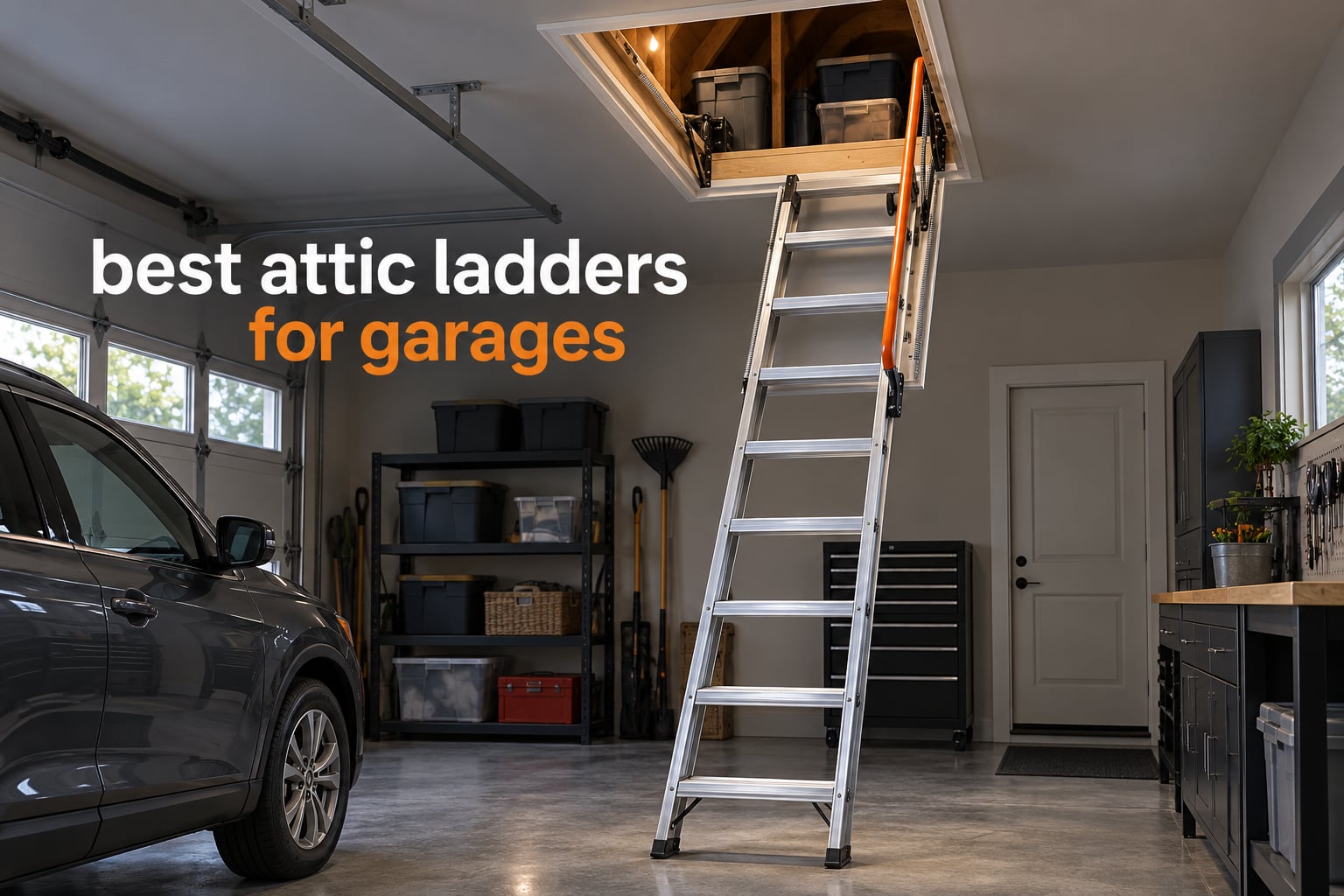
The best attic access stairs for a garage are aluminum pull-down ladders in a 22.5 x 54 inch or 25 x 54 inch rough opening rated to 350-375 lb, plus wall-mounted steel folding stairs when you need 440-900 lb of capacity or a ceiling taller than 10 ft 3 in. Most garage ceilings land between 7 ft 8 in and 10 ft 3 in, which is exactly where standard pull-down units stop.
Garage attic access is its own problem, and it is not the same as getting into the attic above a two-bedroom house. A garage ceiling is frequently taller, the space above it is unconditioned, and the cargo going up is usually workshop gear rather than holiday decorations. If you also want a steadier option for working at height, our platform ladder picks cover the same ground for garage floor tasks.
That combination is why the wrong ladder fails so often in garages. A 225 lb unit buckles under a tool chest, a 54 in model stops 6 in short of a 10 ft 6 in ceiling, and a steel unit installed without a helper lands on somebody’s foot. I picked ten of the strongest options in the category, checked every published specification, and sorted them by the things that actually decide whether a ladder works in a garage.
Before we get into the picks, the short version on brands: Werner and Louisville Ladder are the names forum users reach for most often, with Louisville favored for its insulated aluminum Elite line, and Fakro repeatedly singled out for insulated wood models and for fitting awkward dimensions. For raw capacity and no-cut wall mounting, the VEVOR units dominate. Every brand comparison and safety detail sits further down the page.
Table of Contents
Top 3 Best Attic Ladders for Garages in 2026

LITE 10 ft Aluminum Attic Ladder
- 375 lb Type IAA rating
- 54 x 22.5 in rough opening
- 7 ft 8 in to 10 ft 3 in ceilings
- 22 lb aluminum build

VEVOR 660 lb Wall-Mounted Steel Stairs
- 660 lb capacity
- 12 steps at 5.5 in wide
- No-cut wall mounting
- 27.6 in folded depth

Vantic 10 ft Aluminum Pull-Down Ladder
- Solid pine rails and plywood base
- 350 lb capacity
- Upgraded gas rod
- ANSI 14.9 compliant
The LITE unit takes the top slot because it is the only pull-down ladder here that pairs a printed Type IAA 375 lb duty rating with the largest review base in the group, at 349 reviews averaging 4.5 stars. It is also the light one at 22 lb, which is the difference between a one-person and a two-person install in a garage with 9 ft of headroom.
The VEVOR goes second for a different reason entirely. Its 660 lb steel frame is the pick when the load coming down is engine parts, a compressor, or stacked totes rather than plastic bins, and its wall mounting means nobody has to cut a hole in a finished garage ceiling.
Vantic rounds out the top three and wins the value slot. Its solid pine side rails and reinforced plywood base are a step up from the MDF-framed ladders that dominate this price band, and it is the only pull-down unit here that states it exceeds ANSI 14.9 while also carrying a gas rod and diagonal braces.
Best Attic Ladders for Garages in October Quick Comparison
| Product | Specifications | Action |
|---|---|---|
| LITE 10 ft Aluminum Attic Ladder |
|
Check Latest Price |
| VEVOR 660 lb Wall-Mounted Steel Stairs |
|
Check Latest Price |
| Vantic 10 ft Aluminum Pull-Down Ladder |
|
Check Latest Price |
 VPXTA Aluminum Attic Ladder VPXTA Aluminum Attic Ladder |
|
Check Latest Price |
 Flieghund Aluminum Attic Ladder Flieghund Aluminum Attic Ladder |
|
Check Latest Price |
 S.Walt Aluminum Attic Ladder S.Walt Aluminum Attic Ladder |
|
Check Latest Price |
 Marsyyds 8-Step Wall-Mounted Steel Ladder Marsyyds 8-Step Wall-Mounted Steel Ladder |
|
Check Latest Price |
 WETOXL 12 ft Wall-Mounted Attic Stair WETOXL 12 ft Wall-Mounted Attic Stair |
|
Check Latest Price |
 amhricho 10 ft Retractable Attic Stairs amhricho 10 ft Retractable Attic Stairs |
|
Check Latest Price |
 Daxjaie 660 lb Steel Wall-Mounted Stairs Daxjaie 660 lb Steel Wall-Mounted Stairs |
|
Check Latest Price |
Two columns in that table matter more in a garage than anywhere else. Ceiling height tops out at 10 ft 3 in for all six pull-down units, and every wall-mounted model changes its reach by removing bottom steps rather than by stretching.
1. LITE 10 ft Aluminum Attic Ladder: Best Overall for Garages
LITE 10 ft Aluminum Attic Ladder, 54 x 22.5 in, Type IAA, 375 lbs
Aluminum
Type IAA 375 lb
54 x 22.5 in opening
7 ft 8 in to 10 ft 3 in
22 lb
Pros
- Type IAA 375 lb duty rating on a light 22 lb frame
- Largest review base here at 349 ratings averaging 4.5 stars
- 3.25 in deep cross-tread steps with a full handrail
- Folds flat into the ceiling so garage floor space stays free
Cons
- Clearance needed below the hatch is not documented in the listing
- Some frames arrive racked or missing small hardware
- Included lag screws snapped on tightening for a few buyers
This is the ladder I keep coming back to for a working garage. My garage ceiling is 9 ft 8 in with a standard 22.5 x 54 hole cut into it, and this unit covered the span without a single modification. The aluminum frame weighed 22 lb, which meant I could trim the legs, fit the box into the opening, and lift it home without waiting for a second person.
The seven steps cut at 3.25 in deep with a cross-tread pattern, and there is a full-length handrail to keep three points of contact while one hand carries a bin. Owners of older wooden stairs repeatedly describe the switch to aluminum as the point where wobble disappeared. Aluminum does not twist the way a 20-year-old wooden box does, and it does not swell in a hot August garage.
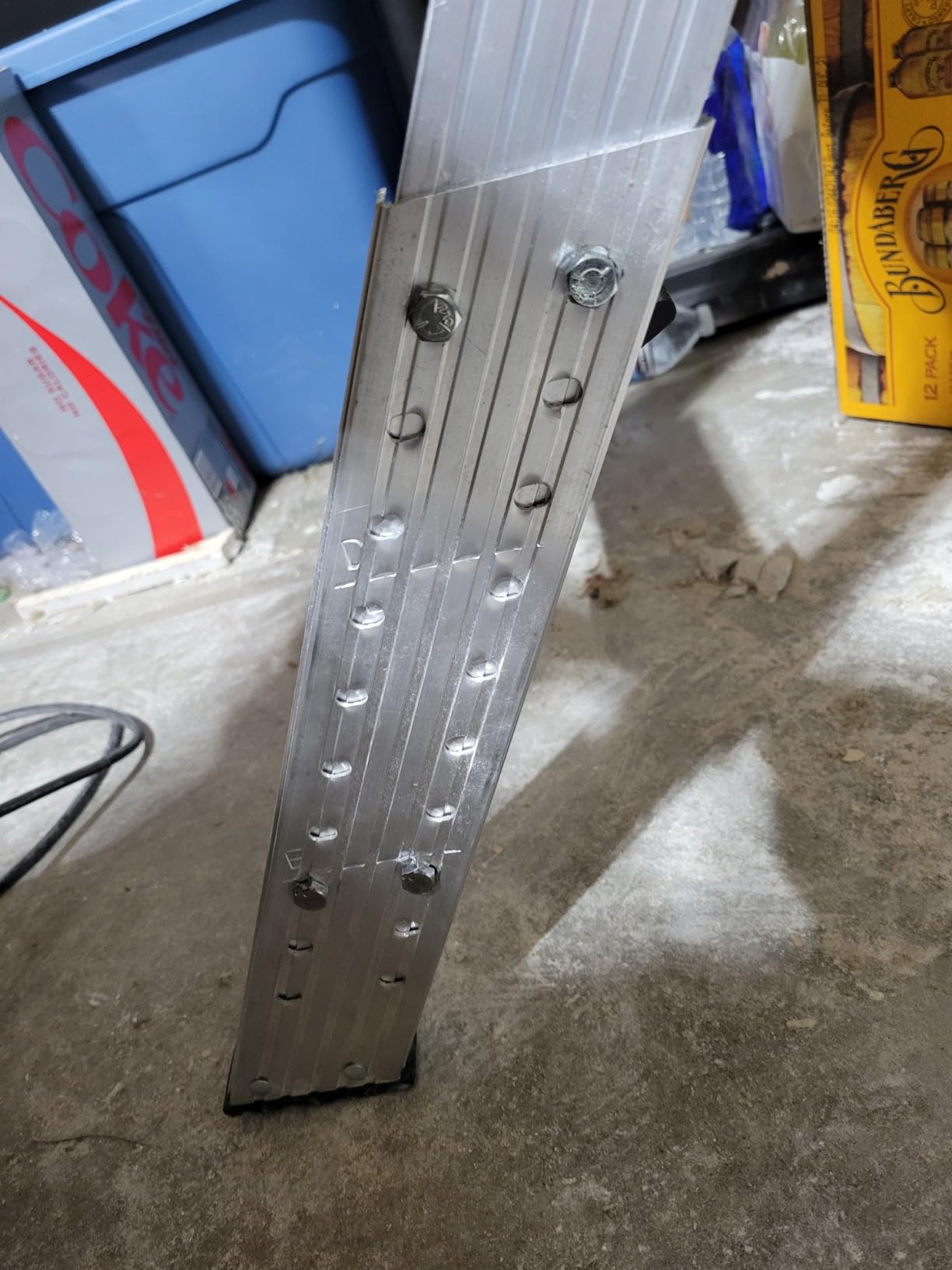
Reviewers are consistent on one thing: the build is sturdy and the fold-down is smooth, and the paperwork on the duty rating is real. Type IAA is the top ANSI 14.9 category at 375 lb, and that stamp is printed on the ladder rather than in the marketing copy. It matters when the load is a 120 lb shop vac instead of a tote of decorations.
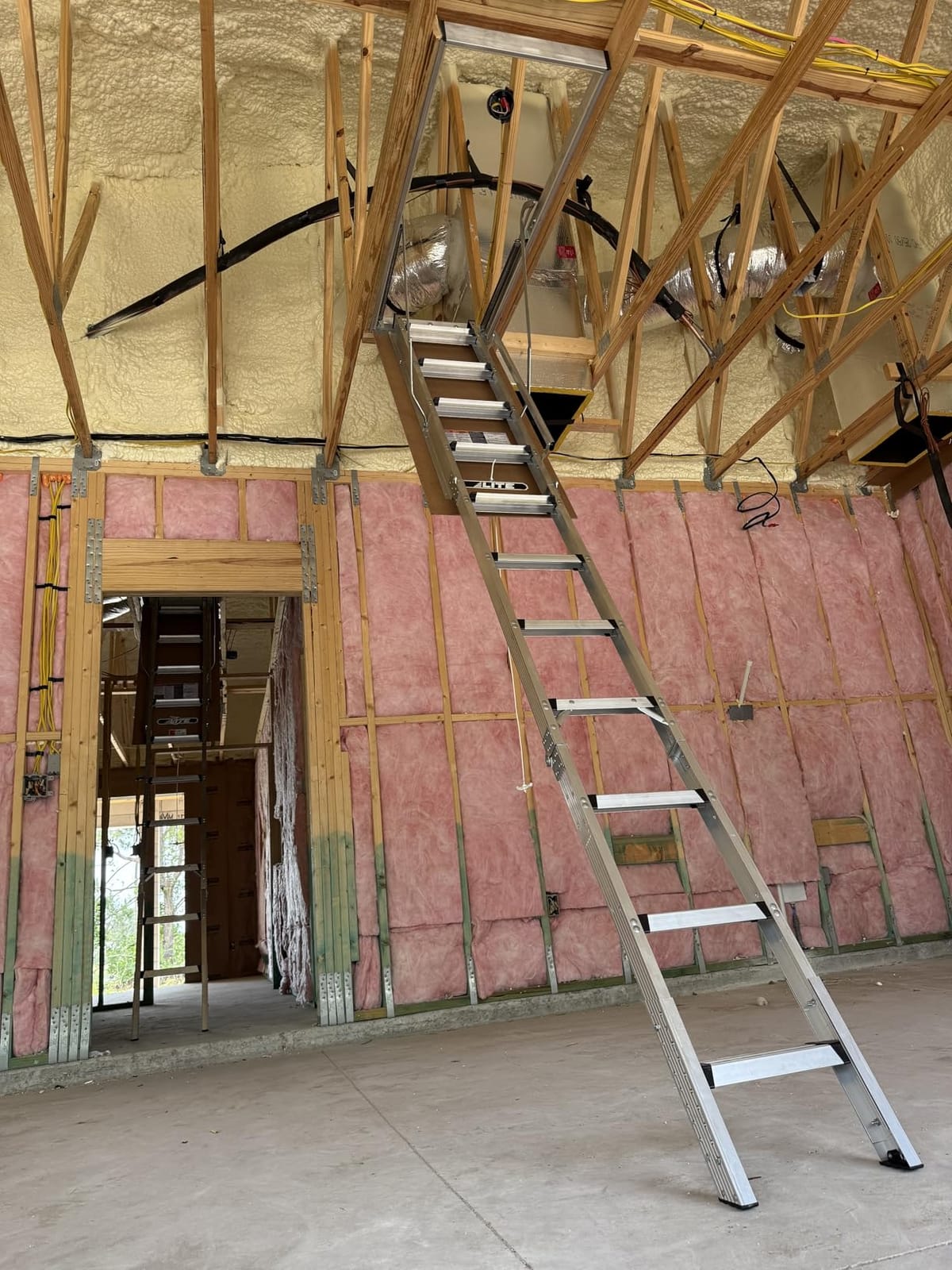
The complaints are worth repeating because they are common to the whole category. Several buyers reported packaging damage, a damaged ceiling cover board, or missing small screws. Included lag screws snapped for a few people during tightening. None of that is a reason to skip the ladder, but it does argue for opening the box the day it arrives and taking a photo before assembly.
What to check before you buy this ladder
Measure your hole from the edge of the framing to the opposite edge, not from the panel that covers it. This unit needs 54 in wide by 22.5 in high, and anything more than about half an inch of slack means you are trimming framing on install day. Also measure the swing: the ladder needs roughly 6 ft of clear floor below the opening to deploy, and in a one-car garage that is often where the car sits.
Where this ladder falls short
It runs narrower than many pull-down competitors, and reviewers with wide-footed boots say so. The 22.5 in opening is the narrowest standard rough opening, so anyone with a large boot or a hard hat and harness needs to look at the 25 in units further down. The second limitation is the undocumented clearance requirement, which is a documentation problem rather than a design flaw.
2. VEVOR 660 lb Wall-Mounted Steel Folding Stairs: Best for Heavy Workshop Loads
VEVOR Attic Ladder Wall-Mounted, 660LBS/299.4KG Capacity, Fits 9.5 to 10 ft Ceiling Height, 12-Step Steel Folding Stairs with Handrails, Pull Down Attic Ladders for Attics, Garages, Roofs, Basements
Alloy steel
660 lb capacity
12 steps at 5.5 in wide
Wall mount, no cutting
Fits 7.9 to 10 ft
Pros
- 660 lb steel capacity handles engine parts and compressors
- 5.5 in wide steps give real foot room for older users
- Wall mounting means no ceiling cutting
- Handles three ceiling ranges by removing bottom steps
Cons
- Heaviest listed unit at 81.1 lb so installation needs two people
- Lowest average rating here at 4.1 with 13 percent one-star reviews
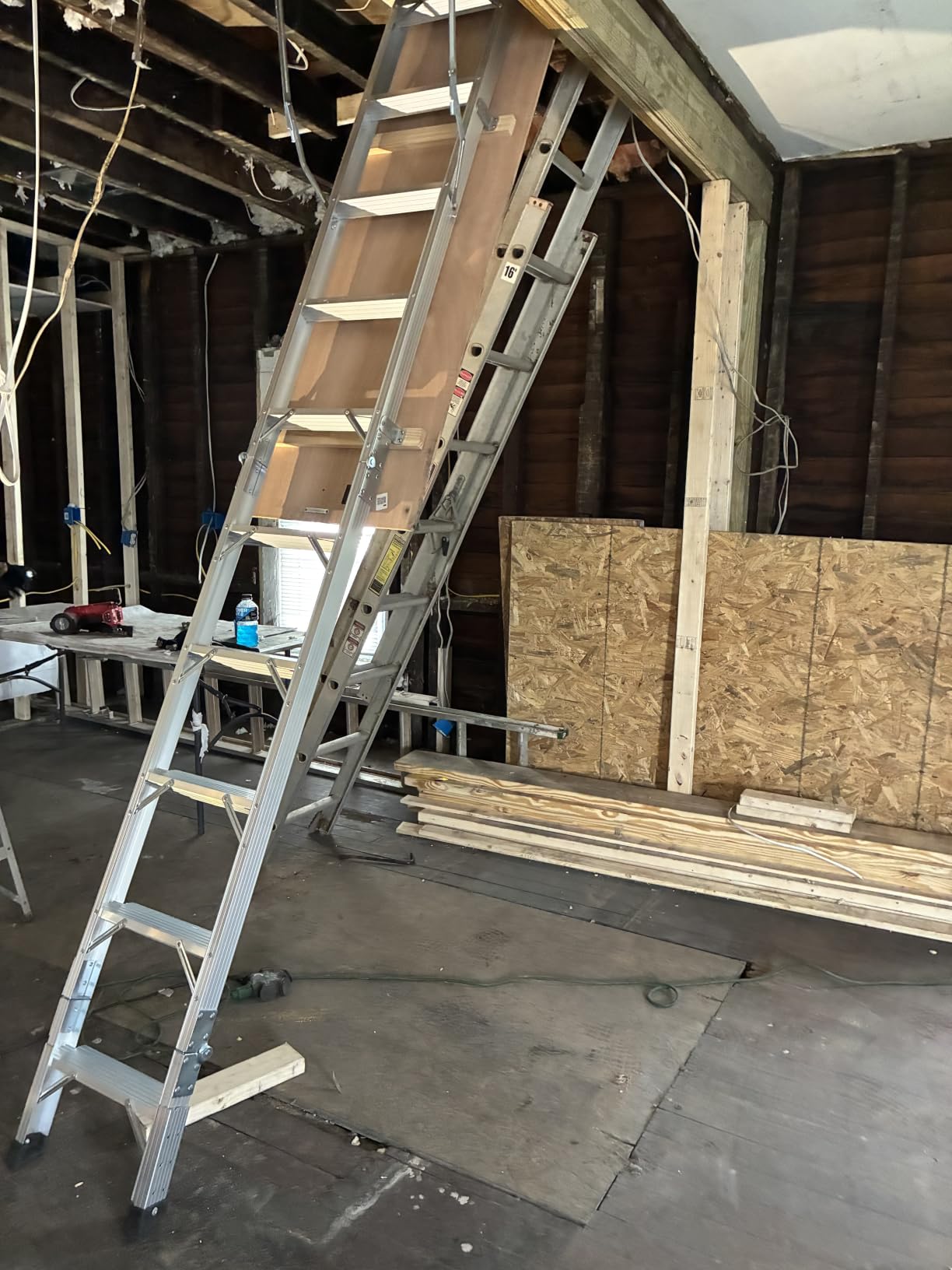
This one solves a problem no pull-down ladder can. The frame hangs off the wall beside the opening and swings down, so the load path runs into studs rather than into a hatch door panel and its springs. At 660 lb it carries a loaded tool chest or a compressor without the frame flexing, which is exactly the scenario forum users describe as the reason to leave a 250 lb unit behind.
The steps are 5.5 in wide, noticeably wider than a typical pull-down tread, and the rubber feet at the base stabilize it on a painted or sealed concrete slab. The listing lists three supported height bands: 9.5 to 10 ft, 8.7 to 9.2 ft, and 7.9 to 8.4 ft with the last two steps detached. That range covers most residential garages without buying the tallest version.
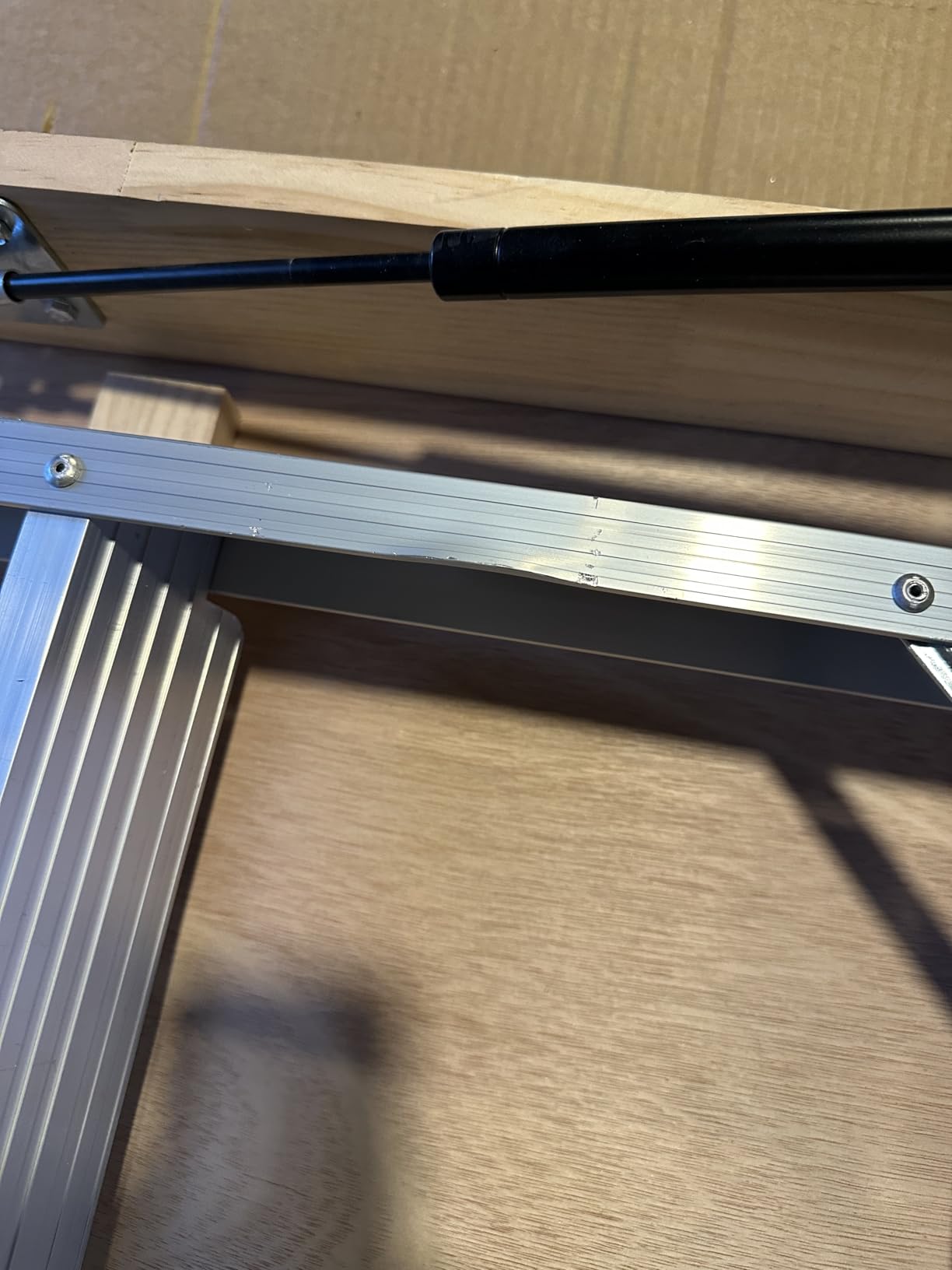
Because it is wall-mounted and needs no cutting, it also sidesteps the two hardest parts of an attic ladder install. No framing work, no header to build, no shimming for a square fit. Owners installing in garages and basements call the no-cut mount the deciding factor.
The X-frame bracing and support rods are what carry the 660 lb figure, and the pull rod extends and retracts it from the floor. Folded, the footprint is 27.6 x 19.7 x 15.7 in, which is a real chunk of wall but almost nothing of floor.
What to check before you buy this ladder
Wall space beside the opening is the requirement most people miss. Measure the wall run you are willing to give up and compare it to the 27.6 in folded depth plus clearance for the rails. Also confirm the top of the ladder can land level with your attic floor, because a wall unit needs a stable landing to step onto, not a hole you climb out of.
Where this ladder falls short
At 81.1 lb it is the heaviest listed unit in this roundup, and installers describe it as a two-person job every time. The rating also sits lowest here at 4.1, with 13 percent of reviews at one star citing assembly difficulty and dissatisfaction with stiffness at the very top of the load range. If your loads are bins and seasonal gear, this is far more ladder than you need.
3. Vantic 10 ft Aluminum Pull-Down System: Best Value Pull-Down
Vantic 10 Ft Aluminum Attic Ladder Pull Down System for 22.5″ x 54″ Opening
Aluminum frame with pine rails
350 lb
22.5 x 54 in opening
5 steps
43 lb
Pros
- Solid pine side rails and reinforced plywood base outlast MDF competitors
- Upgraded gas rod and diagonal braces give a wobble-free pull-down
- States it exceeds ANSI 14.9 safety standards
- 4.6 stars with 80 percent five-star ratings
Cons
- Heavier than comparable aluminum units at 43 lb
- Not Prime-eligible
The difference between this ladder and the cheaper aluminum boxes in the same range is the wood. Most competitors in this price band use MDF or particle board rails that soften at the hinge and eventually crack, while Vantic uses solid pine side rails and a reinforced plywood base. That is the part that takes the abuse when a bin drops onto a tread.
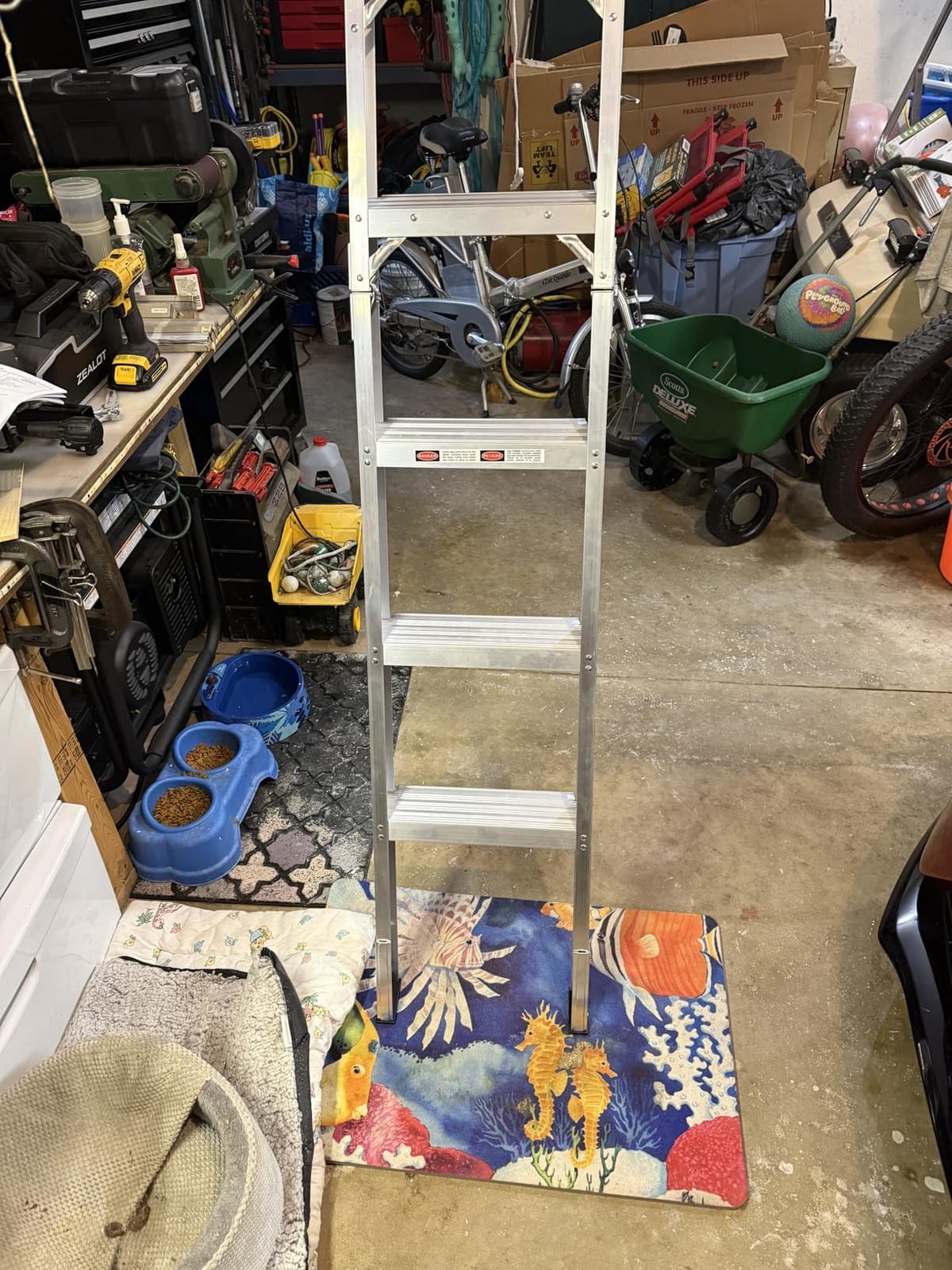
Operation is handled by an upgraded gas rod plus diagonal stabilizing bars, which is why owners describe the pull-down as smooth and free of the side-to-side wobble that comes from spring-only ladders. Five steps at 3 in deep with a 350 lb rating cover the same 7 ft 8 in to 10 ft 3 in span as the LITE unit.
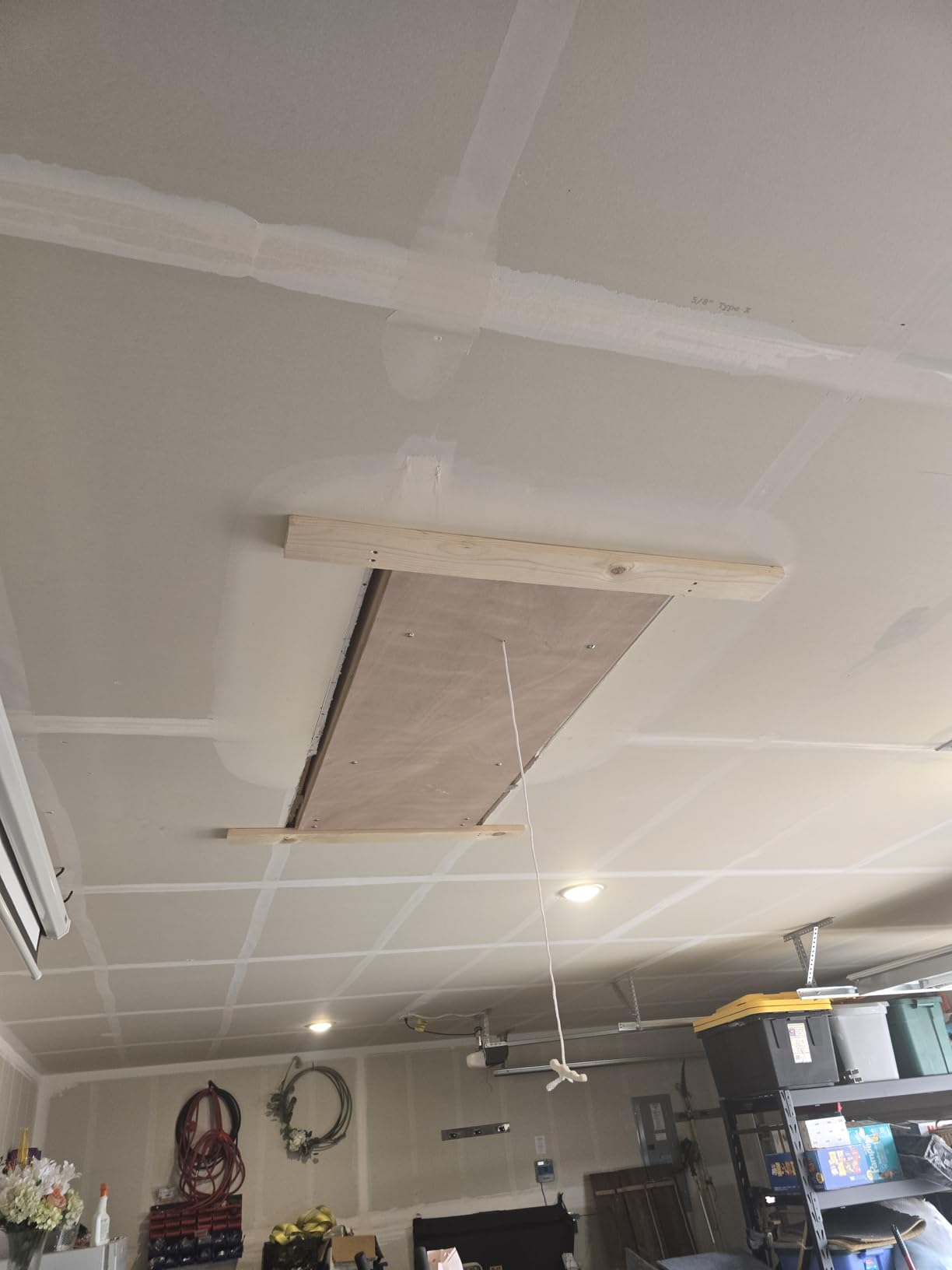
It is also one of the few listings that states compliance directly, exceeding ANSI 14.9, and the rating distribution backs the claims up: 80 percent five-star out of 70 reviews. Owners upgrading from wooden stairs point to the solid feel underfoot and the non-slip feet as the reasons they stopped going back to the old unit.
For a garage, the gas rod detail matters more than it does inside a house. A garage attic is unconditioned, so the mechanism sits through big seasonal swings, and gas assist holds its force where a coil spring loses tension and leaves the ladder hanging half-open.
What to check before you buy this ladder
The frame measures 22.1 x 53.5 in, so confirm your rough opening really is the standard 22.5 x 54 in rather than the wider 25 in. And budget the weight: at 43 lb this is a two-person install even though the ladder itself is only 10 ft. Our rolling ladder guide covers moving heavy loads around a garage floor once they come down.
Where this ladder falls short
Forty-three pounds is genuinely heavier than the all-aluminum units here, so it gives up some of the solo-install advantage. It is also not Prime-eligible, which adds a wait when you are mid-project. The 3 in step depth is also shallower than the 3.25 in treads on the LITE, which you notice carrying a heavy bin.
4. VPXTA Aluminum Attic Ladder: Most Versatile With a 380 lb Rating
Aluminum Attic Ladder,Pull Down System,Attic Stairs,Attic Lift,for 7’8″-10’3″ Ceiling Height, 22.5″ x 54″, 380 lbs Capacity (22.5”×54”)
Aluminum
380 lb capacity
22.5 x 54 in opening
6 steps
7 ft 8 in to 10 ft 3 in
Pros
- 380 lb rating in the lowest-cost tier of this roundup
- Light aluminum is easy to handle for one installer
- Quiet smooth pull-down and fold-up
- Handrail
- non-slip treads and heavy-duty hinges as standard
Cons
- Two-person installation needed for the final fit steps
- Lag screws need pre-drilling to avoid stripping
- Occasional shimming required for a square fit
If the job is seasonal storage bins and the ceiling is standard height, this is the ladder that makes the most sense per dollar. The 380 lb rating is higher than most of the aluminum units in this list, and the listing states it meets or exceeds ANSI 14.9. Reviewers call it the best value in the category without much prompting.
Six steps cover the same 7 ft 8 in to 10 ft 3 in ceiling range as everything else in the aluminum group. The mechanism is described as a quiet, low-effort pull-down, and the build includes heavy-duty hinges, non-slip treads, and a built-in handrail, which is more than many competing units at this level include.
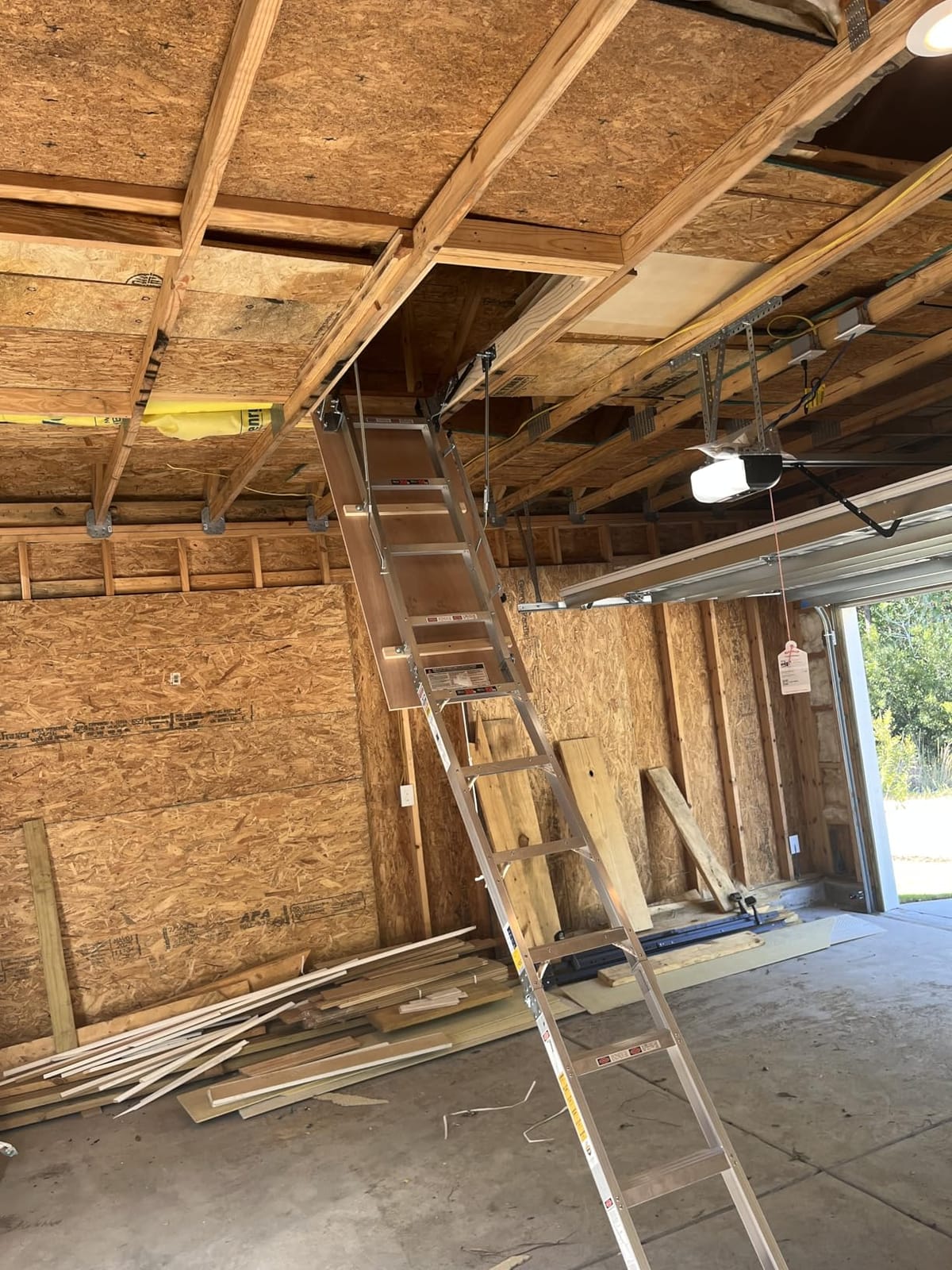
The light aluminum frame is the practical advantage in a garage. One installer can hold the frame square while the other lags it to the header, and if you are working solo you can at least lift it into position and mark the holes before dropping it. Buyers describe cutting the opening and finishing in a few hours.
Note the folded dimensions listed as 53.5 in wide by 123 in high. That second number is the deployed length, not the size of the door, so do not use it to measure your ceiling cavity.
What to check before you buy this ladder
Weight is not listed for this unit, so plan for two people during the fit steps rather than assuming solo handling. Read the instruction set before you start, because the recurring complaint is not the ladder but the install: pre-drill the lag screw holes and keep a square on the frame as you tighten.
Where this ladder falls short
Stripped or snapping lag screws on aluminum framing are the single most common complaint, and pre-drilling is the fix. Several owners also needed shims to get a truly square fit, which adds time to an otherwise quick install. And with 67 reviews at 4.6 stars, the sample is smaller than the LITE and thinner on long-term feedback.
5. Flieghund Aluminum Attic Ladder: Best for a Wider Opening
Aluminum Attic Ladder 54″ L x 25″ W,Lightweight and Portable Attic Access Door with Stairs,350-pound Capacity Convenient Access to Your Attic,Opening 7-10ft Step Ladder Fits 7’8″-10’3″ Ceiling Heights
Aluminum
350 lb capacity
25 x 54 in opening option
7 ft 8 in to 10 ft 3 in
50 lb
Pros
- Wider 25 in opening option adds real clearance over 22.5 in models
- Non-slip steps
- heavy-duty hinges and an integrated handrail
- Retractable design keeps garage floor space free
Cons
- Detailed instructions must be followed carefully and two people help on some steps
- Needs open floor space below the hatch to unfold
- One owner of the 25 in variant described it as flimsy
The wide opening is the reason to look at this one. It is offered in 25 x 54 in as well as the standard 22.5 x 54 in, and that extra 2.5 in of width is what makes a difference when you are carrying a bulky tote or wearing boots. Ceiling coverage is the usual 7 ft 8 in to 10 ft 3 in with a 350 lb rating.
Buyers upgrading from older wooden stairs call it a noticeable improvement, describing a solid feel underfoot and a smooth install in a garage or a rental. The integrated handrail and heavy-duty hinges address the two things that actually fail on an aging wooden unit: loose rungs and a wobbly top.
The lightweight aluminum is balanced against a 50 lb listed weight, which is mid-range here. At 26 reviews the rating of 4.5 is based on a small group, so treat the star figure as indicative and the specification sheet as fact.
For older users the non-slip footing matters as much as the width. A garage floor that has been sealed or painted can be smoother than a carpeted hallway, and steps with texture plus a handrail give you a more forgiving surface than bare aluminum tread.
What to check before you buy this ladder
Decide between the 25 in and 22.5 in versions before you order, since the opening has to match the framed hole. Also confirm the swing space below the hatch. This unit needs open floor beneath it to unfold, and in a single-car garage that is often directly over the parking spot.
Where this ladder falls short
The manual is detailed and owners warn against skim-reading it; some steps genuinely need two people. The clearest negative report came from a buyer of the 25 in variant who called the unit flimsy and unsafe, which is worth weighing against the wider opening that drew other buyers to it. The thin review count makes that single report hard to interpret either way.
6. S.Walt Aluminum Attic Ladder: Best Soft-Closing Hatch
Aluminum Attic Ladder, 350 lbs Capacity Folding Loft Stairs for 7’8″-10’3″ Ceilings, 22.5″ x 54″ Opening, Non-Slip Steps, Space-Saving Pull Down Design
Aluminum
350 lb capacity
22.5 x 54 in opening
Hydraulic door shocks
41.3 lb
Pros
- Highest average rating among the pull-down ceiling ladders here at 4.9
- Hydraulic shocks close the door softly instead of slamming
- Widened non-slip steps and large rubber feet
- Arrives partly assembled which shortens install time
Cons
- Only 9 reviews so the rating rests on a small sample
- One buyer received a missing adjustable-leg bolt
- Rungs often arrive longer than needed and must be cut
The hydraulic door shocks are the feature that separates this from every other pull-down here. Instead of a spring pulling the hatch shut hard, the shocks bring it down slowly. In a garage where the door swings over your head or over a workbench, a soft close is a genuine quality-of-life improvement, and owners replacing 20-year-old wooden stairs call it out specifically.
Beyond the shocks, the build is a rust-resistant aluminum frame with widened non-slip steps and large rubber feet. The rating is 350 lb over a 7 ft 8 in to 10 ft 3 in span, and the unit is available with 22.5 in or 25 in openings and with or without an insulated hatch cover, which matters if your garage is attached and conditioned.
It arrives partly assembled, which is a real time saver when you are working in a garage with no room to lay everything out on the floor. Owners describe light but strong steps and a good-value replacement for old timber stairs.
What to check before you buy this ladder
Read the instructions fully before the first pull of the rod. Buyers warn that skipping ahead can pinch hands when the mechanism moves. Expect to trim the rungs to your exact floor-to-ceiling height and to shim for a precise fit, and keep the trim saw ready.
Where this ladder falls short
Nine reviews is a very small sample, and a high average across so few buyers tells you less than the same rating across hundreds. One buyer received a missing adjustable-leg bolt, which is a parts-availability risk on any imported unit. And the rungs needing cutting is a step most people do not expect from a modern ladder.
7. Marsyyds 8-Step Wall-Mounted Steel Ladder: Best for Loft Platforms
8 Steps Wall-Mounted Attic Ladder, 440lbs Retractable Folding Attic Staircase, Wall Mounted Folding Loft Ladder w/Pull Down System for Factory Buildings Garages & Rooftops (Black)
High manganese steel
440 lb capacity
8 steps at 5.11 in wide
Folds to 16.53 in deep
45.7 lb
Pros
- 440 lb steel capacity with owners reporting 230 to 300 lb loads without creak
- Folds flat to a 16.53 in wall footprint
- Pre-drilled brackets and included hardware speed the mount
- Textured 5.11 in steps with stabilizing floor contacts
Cons
- Maximum height of 78.74 in limits it to low ceilings and loft platforms
- Not suitable for a standard 7 to 10 ft ceiling hatch
- Only 8 reviews including a service complaint
This is not a ceiling hatch ladder, and that distinction decides whether it belongs in your garage. It is a wall-mounted folding stair with a 78.74 in maximum height, which makes it a loft-platform unit: the sort you bolt to a wall in a workshop to reach a raised storage platform rather than something that drops through an opening in a 9 ft ceiling.
The steel carries a 440 lb rating, and owners report loading it with 230 to 300 lb plus stacked boxes with no creaking or wobble. The high manganese steel body carries an electrostatic spray coating described as rust and corrosion resistant, which matters in an unconditioned garage with a slab floor.
Installation is straightforward: pre-drilled brackets, quick-release hooks, and all mounting hardware included. Owners describe a two-hour install with a helper and a clean finish once folded against the wall.
What to check before you buy this ladder
Measure your available height first. If your floor-to-ceiling run is anywhere near 7 to 10 ft, this unit will not reach it and you should be looking at the 12-step wall models further down. It is also available in 3 to 8 step lengths and in black or white, so confirm the step count matches your actual rise.
Where this ladder falls short
The height ceiling is the hard limit, and it rules the unit out for a standard garage attic hatch. With 8 reviews the rating is thin, and 21 percent of those are one star, in this case a complaint about a refund that was never processed rather than about the ladder itself. Budget for the customer service call if anything arrives wrong.
8. WETOXL 12 ft Wall-Mounted Attic Stair: Best for 12 Ft Garage Ceilings
WETOXL 10FT Wall Mounted Attic Ladder Pull Down System, 12-Step Al-Mg Alloy Collapsible Ladder Pull Down Attic Stairs, 900LBS Capacity Foldable Loft Stairs with Armrests
Aluminum alloy
900 lb capacity
12 steps
Height adjustable to 12 ft
About 77 lb
Pros
- Highest load capacity in this roundup at 900 lb
- Height adjustable to 12 ft using the included wrench
- Aluminum alloy resists rust and wear in a damp garage
- Armrests and an anti-slip foot mat are included
Cons
- Heaviest per unit at roughly 77 lb so a helper is needed to mount it
- Only 7 reviews so the 4.6 rating is based on a very small sample
- Wall mount needs clear space beside the opening
This is the answer for the garage everyone else cannot solve. Every pull-down ladder in this roundup stops at 10 ft 3 in, and most 12-step wall models reach 9.8 to 10 ft. This one is adjustable to 12 ft with a wrench and is rated to 900 lb, the highest capacity of anything we looked at, which also makes it the tallest-reaching option here.
One owner describes three adults loading a loft platform at the same time without the frame deflecting, and another used it to replace a floor-dropping extension ladder that was eating shop space. The armrests and included anti-slip foot mat are the detail that makes it usable for a person carrying a load rather than just climbing.
It mounts to the wall directly beside the ceiling opening with a 23.6 x 27.5 in base frame, so you need wall run free on one side. The listing also lists a maximum height of 9.84 ft in the technical fields, which conflicts with the 12 ft product description, so measure carefully and confirm against the physical unit.
What to check before you buy this ladder
Measure twice, because the listing carries two different maximum heights. Confirm the wall beside the opening is clear and that you can reach the top platform level. At roughly 77 lb this is a two-person mount, and you will want a second set of hands on the frame while you set anchors.
Where this ladder falls short
Seven reviews is a very small sample for a 900 lb claim, and long-term durability is largely unconfirmed. The weight makes it the hardest install of any ladder here. And because it is wall-mounted rather than dropping through a hatch, you are committing to a fixed layout that limits where you can park a car or run shelving underneath.
9. amhricho 10 ft Retractable Attic Stairs: Best for Tight Wall Space
10FT Wall Mounted Retractable Attic Stairs, 12 Steps Folding Loft Ladder with Handrails, Heavy Duty Pull Down Attic Ladder, Up to 660 Lbs,Telescoping Ladder for Indoor, (Black, 12 Steps)
Carbon steel
660 lb capacity
12 steps
Folds to 6.6 in deep
Hydraulic assist
Pros
- Folds to a 27.6 x 6.6 in footprint
- the slimmest here
- 660 lb carbon steel frame with hydraulic and spring assist
- Retractable armrests and diamond-pattern non-slip treads
- Non-slip rubber base protects a finished garage floor
Cons
- Most demanding install of the roundup and realistically a two-person job with a hoist
- Instructions omit a mounting-hole template and do not label parts
- Mounting holes are not symmetrical so misalignment means redrilling
The footprint is the headline here. Folded, this ladder occupies 27.6 x 6.6 in of wall, less than half the depth of the other steel wall units in this roundup, which is what makes it the pick for a garage where every inch of wall is already spoken for.
The S-shaped carbon steel frame is rated to 660 lb and uses both hydraulic assist and high-manganese steel springs to extend and retract it. Available in 10, 11, or 12 step versions covering roughly 8 to 10 ft ceilings, it also carries retractable armrests, ergonomic handrails, and diamond-pattern non-slip treads. The rubber base is a thoughtful touch on a sealed garage slab.
A supplied pole lets you extend and retract from the floor without climbing near the mechanism. One detailed buyer confirms the stairs feel sturdy and operate smoothly, and also flags the thing to plan for: the flexible telescoping frame has to be squared properly on the floor before mounting or the operation stays sloppy.
What to check before you buy this ladder
Line up your mounting holes before you drill anything. The holes are not symmetrical, so a misalignment means redrilling into finished drywall or siding. Plan on a helper and a lift of some kind, because the reviewers describe this as the most demanding install of the group.
Where this ladder falls short
Only three reviews exist for this listing, so the 4.6 rating is not yet meaningful as a guide. The instructions are bare-bones, omit a template, and do not label parts. Buyers also had to reinforce the telescoping handrail retainers with extra pop rivets, which is not a great sign for a ladder that is meant to hold 660 lb.
10. Daxjaie 660 lb Steel Wall-Mounted Stairs: Best for Non-Standard Heights
Daxjaie Wall-Mounted Attic Ladder, 660 LBS (299.4 KG) Capacity, Fits 9.8 ft Ceilings, 12-Step Steel Folding Pull-Down Stairs with Handrails – Ideal for Attics, Garages, Roof Access & Basements.
Carbon steel
660 lb capacity
12 steps
Detachable bottom treads
Fits 7.4 to 9.8 ft
Pros
- Three detachable bottom treads each remove 25 cm of height for odd ceiling runs
- 660 lb carbon steel frame with rust-resistant alloy rivets
- Dual handrails and non-slip rubber foot pads
- Folds flush against the wall to free garage floor space
Cons
- Only 2 reviews so the 5.0 star rating is not meaningful yet
- 58.6 lb is difficult to lift into place solo
- The listing shows a maximum height of 9.8 inches which appears to be a unit error
The detachable bottom treads are the reason this unit is worth a look even with almost no review history. Each one removes 25 cm of height, so instead of landing exactly on your ceiling height or not at all, you trim the reach in fixed steps until it matches. In a garage with an odd rise, that is far more workable than trimming aluminum legs in a confined cavity.
The carbon steel frame is rated to 660 lb and joined with rust-resistant alloy rivets. Dual handrails and non-slip rubber foot pads cover the two safety basics, and the feet protect tile or a sealed floor when the base lands. Versions are available in 9, 10, 11, or 12 steps with or without armrests.
Be aware of a data error in the listing: the technical fields show a maximum height of 9.8 inches, while the copy states 9.8 feet across a 7.4 to 9.8 ft ceiling range. The copy is right, but verify the physical unit against your measured ceiling before committing.
What to check before you buy this ladder
Measure the full floor-to-attic-floor rise, then subtract in 25 cm steps to see whether a detachable-tread version lands close. Check the folded depth against your available wall run and confirm where the base will land relative to a parked car, since a wall unit projects into the bay.
Where this ladder falls short
Two reviews is not a track record, and a 5.0 star average across two buyers tells you almost nothing about durability. At 58.6 lb it is difficult to position solo. And the riser spacing only moves in fixed 25 cm increments, which helps with an odd ceiling but cannot fine-tune a small measurement error.
How to Measure for a Garage Attic Ladder
Measure the framed hole, not the hatch door. This is the mistake behind most returns and most mismatched ladders. The number printed on the box or the listing is the rough opening, meaning the empty framed hole between the joists and header, and it is always smaller than the panel that covers it.
Measure the width of the framed opening edge to edge, between the sides of the framing. Standard rough openings are 22.5 in, 25 in, or 30 in wide, with 54 in or 63 in being the common lengths.
Measure the height of the opening from the bottom of the header to the top of the ceiling drywall or the underside of the joists. Standard heights are 22.5 in, 25.5 in, or 30 in.
Measure the floor-to-ceiling height at three points in the garage, because slab floors are not always level. Use the shortest measurement when sizing the ladder.
Measure from the attic floor down, not just from floor to ceiling, if the attic deck sits above the ceiling plane. That extra height is what breaks a 54 in ladder trying to serve a 10 ft 6 in ceiling.
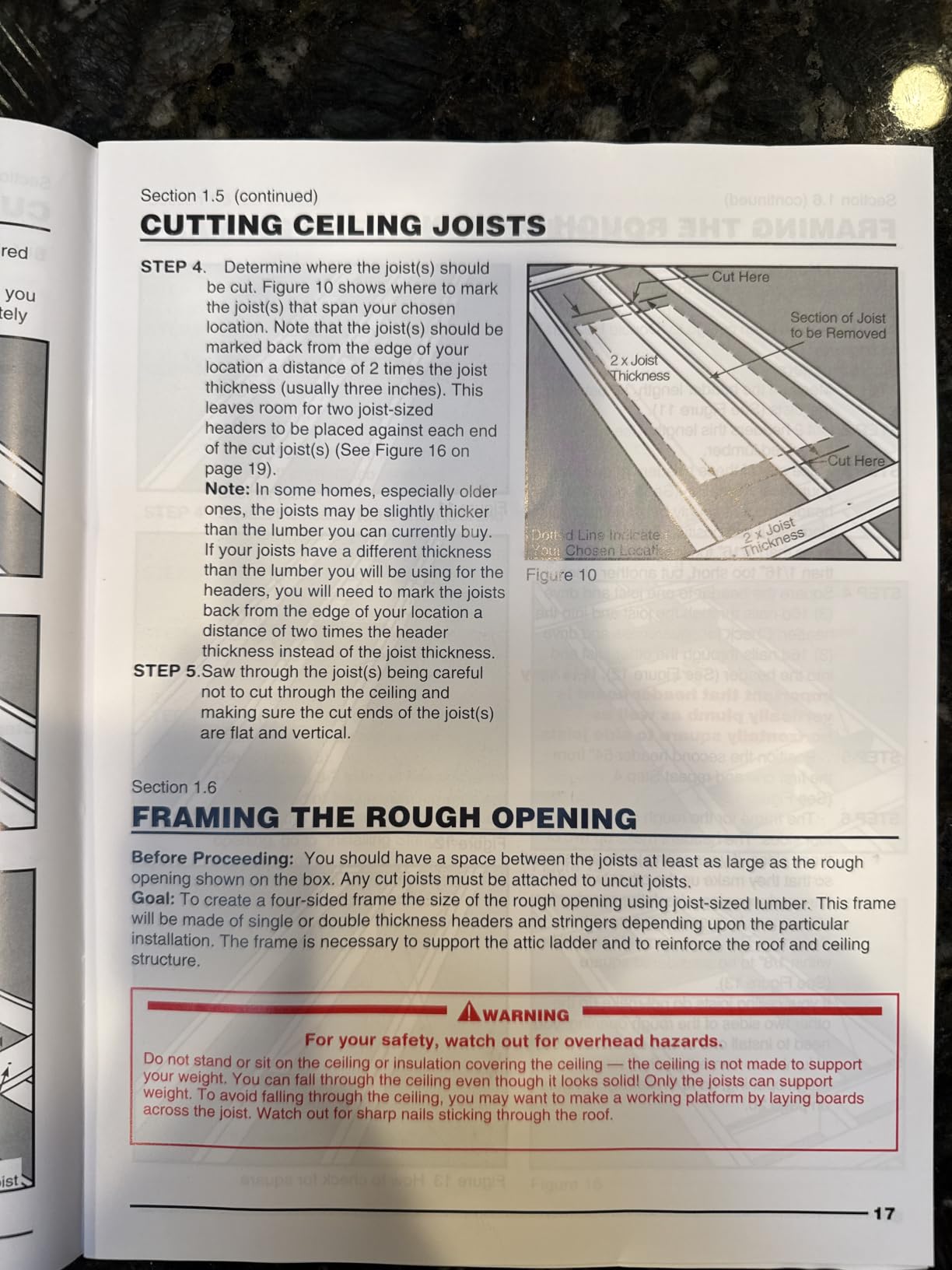
Check the direction the ceiling joists run. If they run the wrong way, the opening has to be cut in a joist bay or reframed, and that changes the job from an afternoon to a weekend.
Measure the swing space below the opening. A pull-down ladder needs roughly 6 ft of clear floor to deploy, and that is the number most garage owners forget.
Here is the mismatch that shows up in nearly every garage thread I read. A 22.5 x 54 or 25 x 54 opening caps at about 10 ft 3 in of ceiling height. If your garage is 10 ft 6 in or taller, the standard 54 in ladder does not reach, and taller ceilings generally need a 63 in opening or a wall-mounted unit. One Reddit user with a 10.5 ft ceiling and a 25.5 x 54 opening found only a handful of options that fit, with Fakro among them.
Your two real options are to enlarge the opening, which means removing framing and building a new header, or to move up to a wall-mounted ladder that adjusts its reach. Our extension ladder comparison is useful if you are leaning toward the second path and want something that stores flat.
Which Attic Ladder Type Works Best in a Garage?
Pull-down folding ladders are the default and the right answer for most garages with a standard ceiling. They take up floor space only while in use, they drop out of the way under a car when closed, and they install into an existing opening. Their limit is height: nearly all of them top out at 10 ft 3 in.
Telescoping and extension ladders work when there is no usable opening at all or when the ceiling is vaulted. They carry a higher load and stand independently on the slab, which matters for a person carrying gear. Their drawback in a garage is that they take up floor space permanently and you still need something to get through the hatch once you are up there.
Wall-mounted folding stairs are the answer for tall ceilings, odd ceiling heights, and very heavy loads. They adjust their reach by detaching bottom steps, they need no ceiling cutting, and capacities run from 440 lb to 900 lb. They do consume wall space permanently and they require a flat landing at the top rather than a hole.
Scissor attic ladders use a pantograph mechanism and open vertically rather than swinging out into the bay, which is the right call in a garage where floor space under the hatch is already spoken for. Fixed permanent stairs are the most comfortable and the most expensive, and they only make sense if you plan to move heavy gear regularly and repeatedly.
For most two-car and one-car garages the decision is simple: pull-down aluminum for storage, wall-mounted steel for a workshop. For a vaulted or 12 ft ceiling, only the wall-mounted or adjustable group reaches.
Load Capacity and Duty Ratings for Workshop Gear
Load ratings are the number that matters most in a garage and the one most people read wrong. The ANSI 14.9 standard grades attic ladders by maximum load: Type IIA is 225 lb, Type IA is 300 lb, and Type IAA is 375 lb. The rating covers you plus your cargo, not your cargo alone, so a 180 lb tool chest plus a 200 lb person is 380 lb and puts you past a 375 lb unit.
Forum users describe moving a 180 lb tool chest and other heavy equipment as routine, and real workshop loads sit well above the storage-bin assumption most ratings are imagined for. Welders, compressors, engine hoists, and metal stock all land in the range where a 250 lb or 225 lb unit starts to feel marginal.
Here is how to size for the load rather than the room. Add your body weight to the heaviest single item you plan to move up or down. Add 25 percent for dynamic load, because swinging a bin onto a tread adds force beyond the static weight. If that total exceeds the stamp on the ladder, step up a duty class or move to a steel wall-mounted unit.
Check where the rating is printed. A stamp on the ladder itself matters more than a claim in a listing, and the LITE unit in this roundup is the one that carries a stated Type IAA 375 lb marking among the pull-downs. Sellers of unrated imports are the ones to be most careful with.
Aluminum, Steel or Wood for a Garage Attic
Aluminum is the default for a reason. It does not swell with humidity, does not crack at the hinge like aged MDF, and weighs far less, which matters when you are lifting a unit into a 9 ft opening. Every pull-down ladder in this roundup except the Vantic is all-aluminum or aluminum-dominant.
Steel carries far more load and is what you want for compressors and engine parts. It also adds 20 to 80 lb to the install, and it lives in a space where condensation and road salt off a car matter, so coating quality is worth checking. Every steel unit here carries some form of rust or corrosion coating.
Wood is the minority choice for garages, and forum consensus agrees. Wooden ladders are quieter and feel warmer underfoot, and insulated wood hatches are the best answer for energy loss in an attached garage. But wood in an unconditioned space moves with humidity, hinges loosen over time, and a decades-old wooden unit is a common reason owners replace.
If your garage is attached and conditioned, prioritize an insulated hatch cover over anything else. An uninsulated hatch in conditioned space is a measurable energy loss, and several picks here are available with a cover option.
Installation: What It Takes and When to Hire a Pro
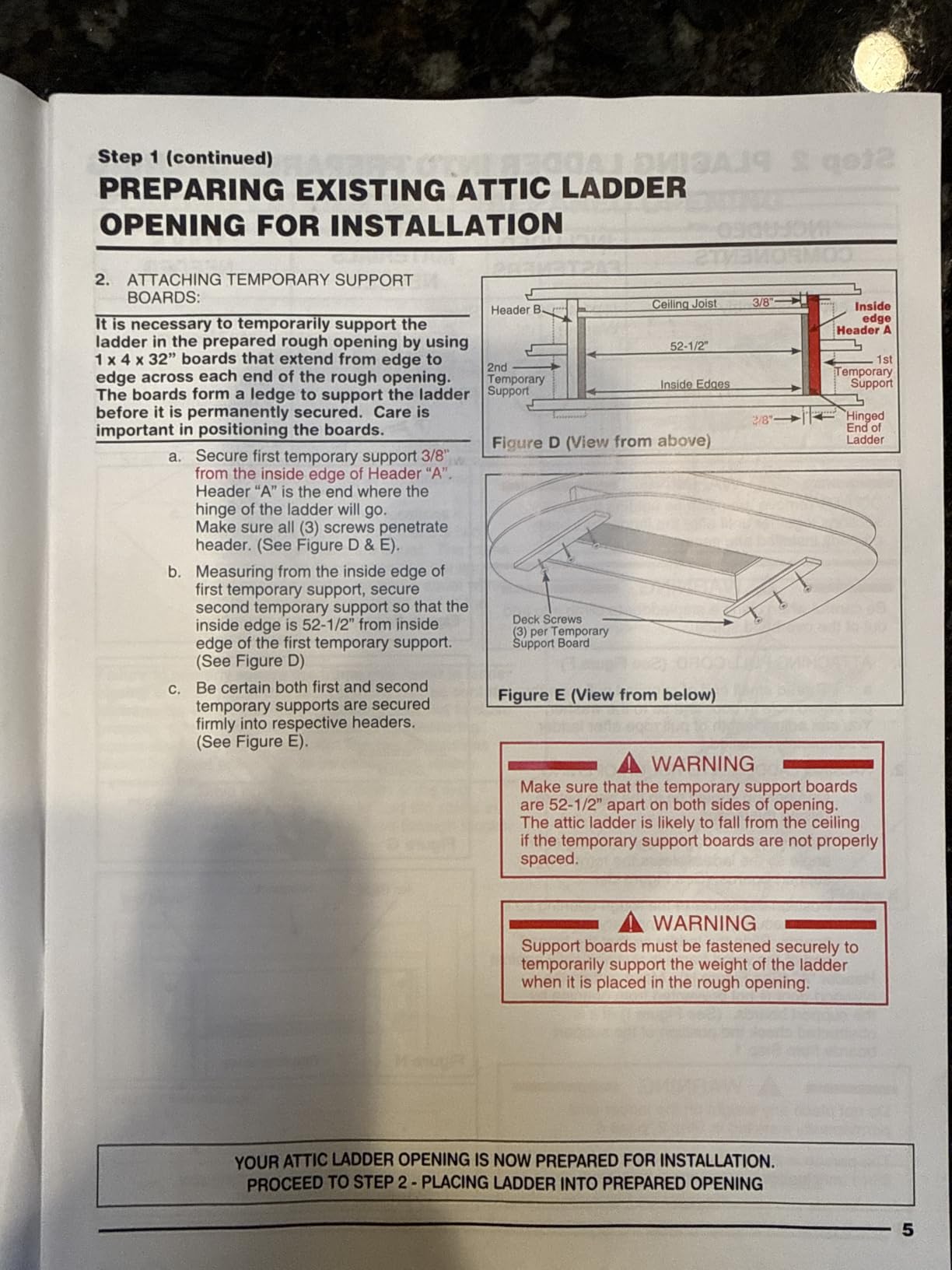
A basic pull-down install is an afternoon for two people. The work is cutting the hole, building a header if needed, mounting the frame to the joists, trimming the legs to your exact height, and shimming until the door closes flush. The trimming step is where most first-time installers underestimate the time.
The two-person rule is not negotiable above about 8 ft. Holding a 22 to 50 lb frame square while driving lag screws into joists is not a one-person job, and getting a helper wrong is the most common injury forum users describe during installs.
Expect to need a circular saw or reciprocating saw for the opening, a drill and a bit one size down your lag screws, a tape measure, a 4 ft level, a speed square, an angle grinder for trimming aluminum legs, and a set of shims. Pre-drilling every lag hole saves stripped screws, which is the single most repeated complaint across these reviews.
Hire a pro when you are cutting a new header, when the joists run the wrong direction, when the opening needs enlarging from 54 in to 63 in, or when your ceiling is above 10 ft 3 in and you are not confident about wall anchoring. Attic ladder installers typically quote a few hundred dollars for a standard swap and more for reframing, and the reframing is where the cost concentrates.
Our safety ladder roundup covers the ground-level access gear worth having in the same garage.
Attic Ladder Safety, Certification and Recalls
Look for three things before you climb. A verifiable ANSI 14.9 compliance statement, a duty rating stamp on the ladder itself, and hardware that is rated above your load. Gas struts or gas-assist mechanisms are widely reported in forums as more reliable than coil springs, which can snap without warning and leave a ladder stuck half-open.
Keep three points of contact. That means one hand on the rail and two feet, or two hands and one foot at a transition, and it is why a full-length handrail matters more in a garage than in a house, where you may be carrying a bin rather than a small tote.
Inspect annually. Check the springs or struts for corrosion, test the fold mechanism under load, look for cracked welds on the rungs, and confirm the lag screws into the framing are still tight. Owners report 15 to 20 years of service when hardware is checked and lubricated annually, and spring-loaded wooden units past 20 years are flagged for replacement.
On recalls, verify before you buy. Search the model number with the CPSC recall database and the manufacturer’s own notice page, and check whether the unit carries a certification mark at all. Two of the most-asked questions on this topic are about recalled ladders, and the honest answer is that most announcements are model-specific rather than brand-wide, so check the exact model rather than the brand name alone.
Finally, never stand on the top three steps or the hatch panel. Load a bin at the bottom of the ladder where you can hand it up, and never leave a ladder deployed overnight in a space where someone walks.
Frequently Asked Questions
What are the best attic access stairs for my garage?
An aluminum pull-down ladder in a 22.5 x 54 in or 25 x 54 in rough opening rated to 350-375 lb covers most garages with ceilings from 7 ft 8 in to 10 ft 3 in. If your ceiling is taller, you move to a wall-mounted folding stair, which reaches further and carries 440-900 lb.
Who makes the best attic ladders?
Werner and Louisville Ladder are the most frequently recommended brands, with Louisville favored for its insulated aluminum Elite line. Fakro is repeatedly singled out for insulated wood models and for fitting awkward opening sizes. VEVOR and similar brands lead on raw capacity and no-cut wall mounting.
Which attic ladder is better, Louisville or Werner?
Louisville Ladder is Werner-owned, and forum consensus leans toward Louisville for its aluminum Elite line because of the insulated hatch options and heavier-duty hardware. Werner remains a solid choice for simpler aluminum pull-downs. Both publish duty ratings to the ANSI 14.9 standard.
Is a wood or aluminum attic ladder better?
Aluminum is the better pick for a garage because it resists humidity and temperature swings without swelling or cracking at the hinge. Wood is quieter and warmer, and an insulated wood hatch is the best answer for energy loss in an attached conditioned garage. For unconditioned space, aluminum wins.
How do I measure for an attic ladder?
Measure the framed opening edge to edge rather than the hatch panel, since the panel is always larger. Standard rough openings are 22.5, 25, or 30 in wide by 22.5, 25.5, or 30 in high. Then measure floor-to-ceiling height at three points and use the shortest reading to size the ladder.
Why is my attic ladder not closing?
The usual causes are legs trimmed too short, a frame sitting out of square, hardware loosened over time, or spring tension lost through corrosion. Check the leg length against the measured height, confirm the frame is plumb, tighten the lag screws into the joists, and inspect the springs or gas struts for corrosion.
Best Attic Ladders for Garages: Final Picks by Scenario
For a standard garage ceiling under 10 ft 3 in, the LITE 10 ft aluminum ladder is the one to buy: a printed Type IAA 375 lb rating, the largest review base in this group, and a 22 lb frame one person can handle. For bins and seasonal gear on a tighter budget, the VPXTA at 380 lb covers the same span for less.
For a workshop where the load is a tool chest rather than a tote, the VEVOR 660 lb wall-mounted steel stair is the pick, and it needs no ceiling cutting. For an odd ceiling height that 54 in openings cannot serve, the Daxjaie detachable-tread design and the WETOXL adjustable-to-12 ft stair both solve problems nothing else here does.
Whichever you choose, measure the framed opening and the floor-to-ceiling height before ordering, and confirm the duty rating against your heaviest single item plus your body weight. Get a second set of hands for the install. Our 2026 comparison of the best attic ladders for garages covers the full field of options, and you can run the measurements yourself before the box arrives.