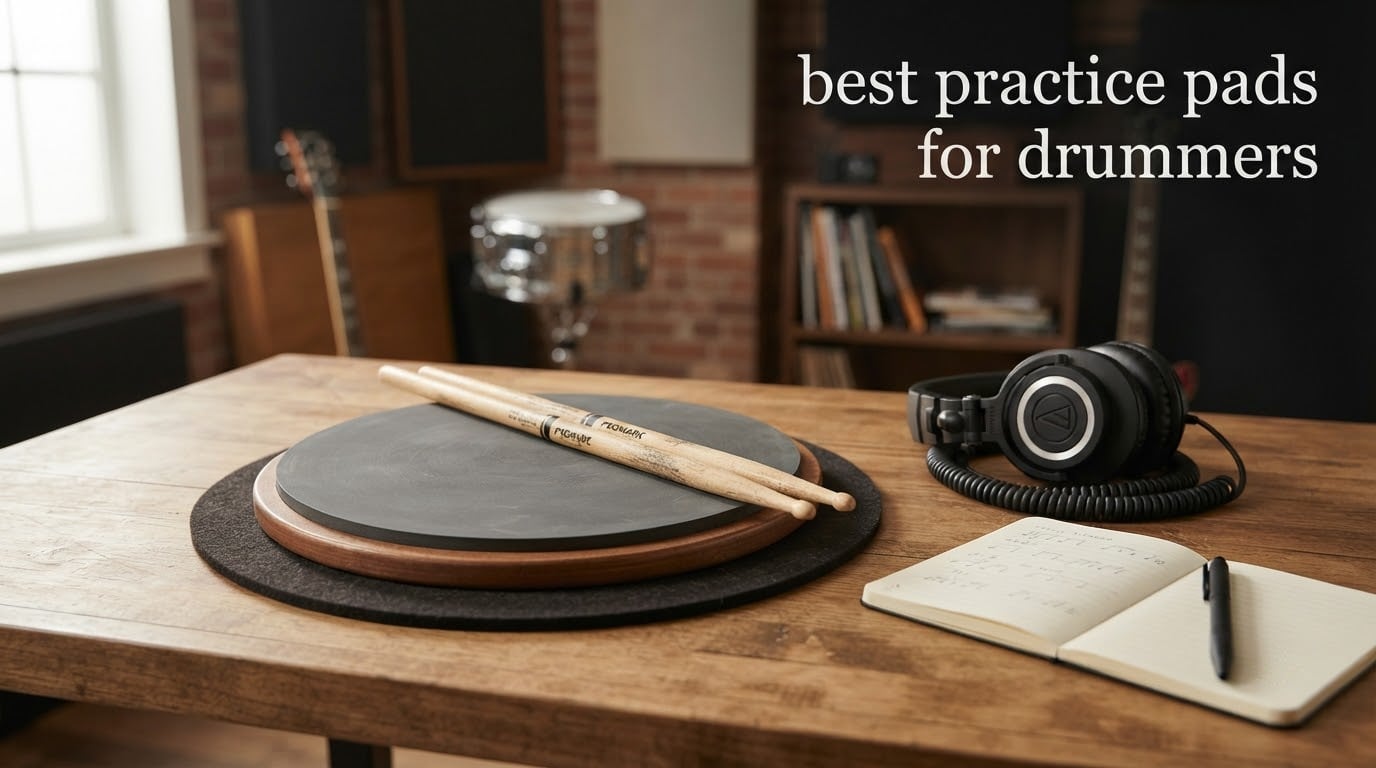
Short answer: the Evans RealFeel Attacktile 12-inch two-sided pad is the best practice pad for drummers we could find, because it is the only pad in this roundup that gives you a realistic gum-rubber rebound on one side and a harder conditioning face on the other, and it holds still while you play. Twelve pads later, nothing else covered both needs at this weight and at a sensible cost.
A drum practice pad is a compact playing surface that behaves like a drumhead without resonating like one. You strike it with the same sticks, from the same sitting or standing position, and the rubber, coated head or polymer surface absorbs the acoustic resonance and hands back a controlled amount of rebound. That is the whole trick, and it is why a pad lets you put in two hours of rudiment work in a flat where a drum kit would earn you a complaint.
We compared 12 pads for feel, rebound consistency, how much noise they leak into a room, whether they fit a snare basket, and how they hold up over years of daily use. Three come with a stand in the box, several include sticks, and a couple are simple slabs you put on a lap. If you are still working out what to do with a pad rather than which one to buy, start with our broader practice pad overview.
Table of Contents
Top 3 Best Practice Pads for Drummers in 2026

Remo 10 Inch Tunable Pad
- Replaceable coated head
- Real bounce for rolls
- Fits a snare basket
Those three cover the three most common situations. The Evans is the reference standard for anyone who wants a pad that behaves like an acoustic drum. The Remo is the one to buy if you play rolls and want a head you can tune and eventually replace. The Donner 8-inch is the pad you hand to a student or buy for every practice room in a school.
Best Practice Pads for Drummers in October
| Product | Specifications | Action |
|---|---|---|
| Evans RealFeel 2-Sided Pad |
|
Check Latest Price |
| Remo 10 Inch Tunable Pad |
|
Check Latest Price |
 Evans RealFeel Single-Sided Evans RealFeel Single-Sided |
|
Check Latest Price |
 Donner 8 Inch 2-Sided Pad Donner 8 Inch 2-Sided Pad |
|
Check Latest Price |
 Evans RealFeel Apprentice 7 Inch Evans RealFeel Apprentice 7 Inch |
|
Check Latest Price |
 GrowDaily 12 Inch Pad GrowDaily 12 Inch Pad |
|
Check Latest Price |
 Donner 12 Inch Stand Set Donner 12 Inch Stand Set |
|
Check Latest Price |
 GrowDaily Pad And Stand Set GrowDaily Pad And Stand Set |
|
Check Latest Price |
 HAIRIESIS 12 Inch Double Sided HAIRIESIS 12 Inch Double Sided |
|
Check Latest Price |
 Offworld Invader V3 Offworld Invader V3 |
|
Check Latest Price |
 Donner Snare Simulation Pad Donner Snare Simulation Pad |
|
Check Latest Price |
 Horse Pad And Stand Set Horse Pad And Stand Set |
|
Check Latest Price |
How we picked: every pad here was judged on the same five criteria. Rebound consistency at moderate tempo, how the surface responds to rim and stroke-height changes, how much sound reaches the room, whether it mounts in a snare basket or takes a stand, and the build quality of the frame and base. Ratings and review counts come straight from the product listings, so you can see how much history each one has behind it.
1. Evans RealFeel Attacktile 12 Inch Two-Sided – Best Overall
Evans RealFeel – Drum Practice Pad – Drum Pad – Drummer Practice Pad – Gum Rubber & Neoprene, 2 Sided, 12 Inch
12 inch double-sided
Gum rubber plus hard rubber
1.65 kg
Made in USA
Pros
- Two surfaces for different rebound levels
- Sits still on lap table and carpet
- Realistic gum rubber stick return
- Resists visible stick marking
Cons
- Heavier than portable pads
- Will not sit on a standard snare stand
- Hard side is louder than the gum side
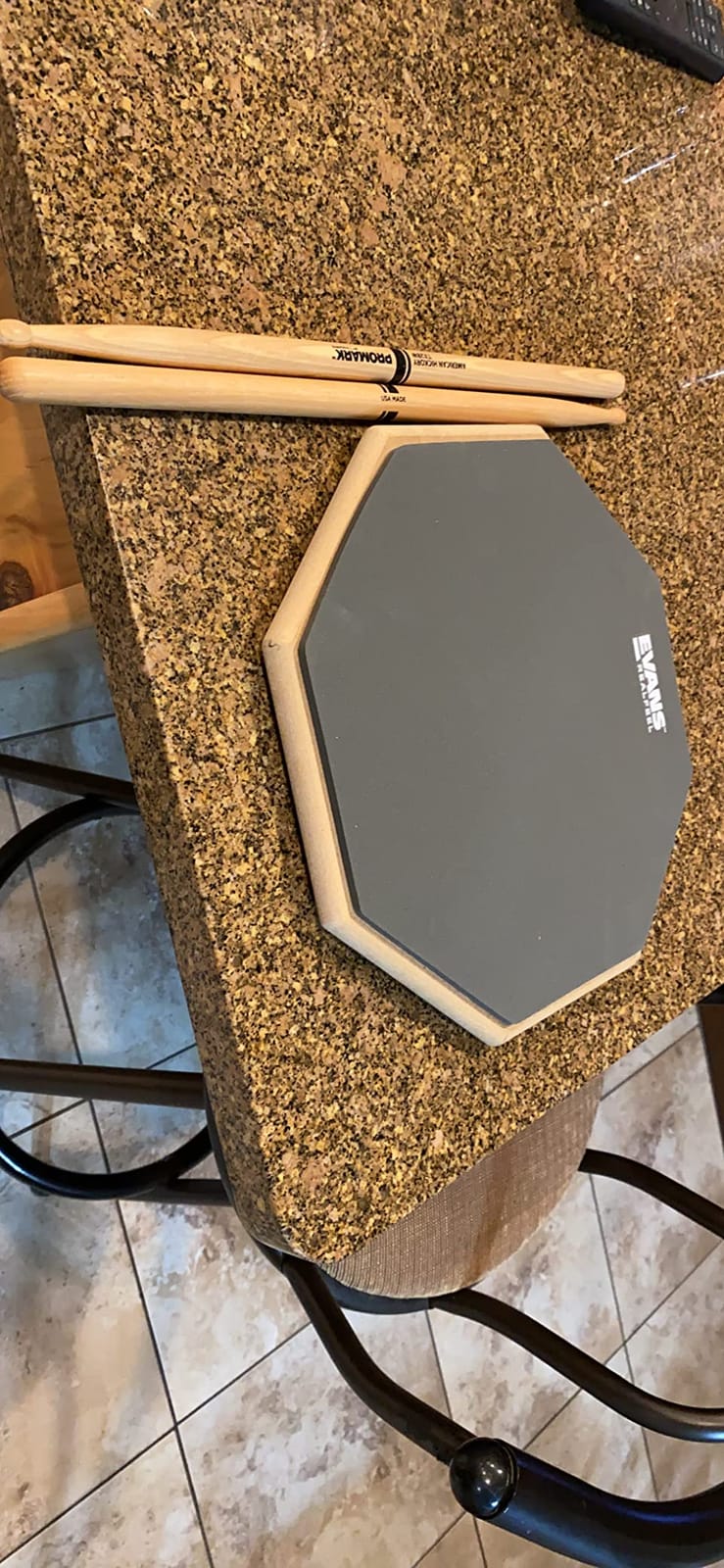
This is the pad most drummers mean when they say the word. One side is a lightly textured natural gum rubber, and the return you get off it is the closest to a coated acoustic head of anything we played. The stick comes back at a height you can actually work with, which is what makes it useful for control drills rather than just arm waving.
The flip side is a harder recycled rubber with noticeably less rebound. That is the side for endurance work, where you do not want the pad to give energy back to you for twenty minutes at a time. Having both faces in one slab is the reason it beats every single-surface competitor here, and it is also why teachers hand these to students instead of making them choose a playing side and commit to it.
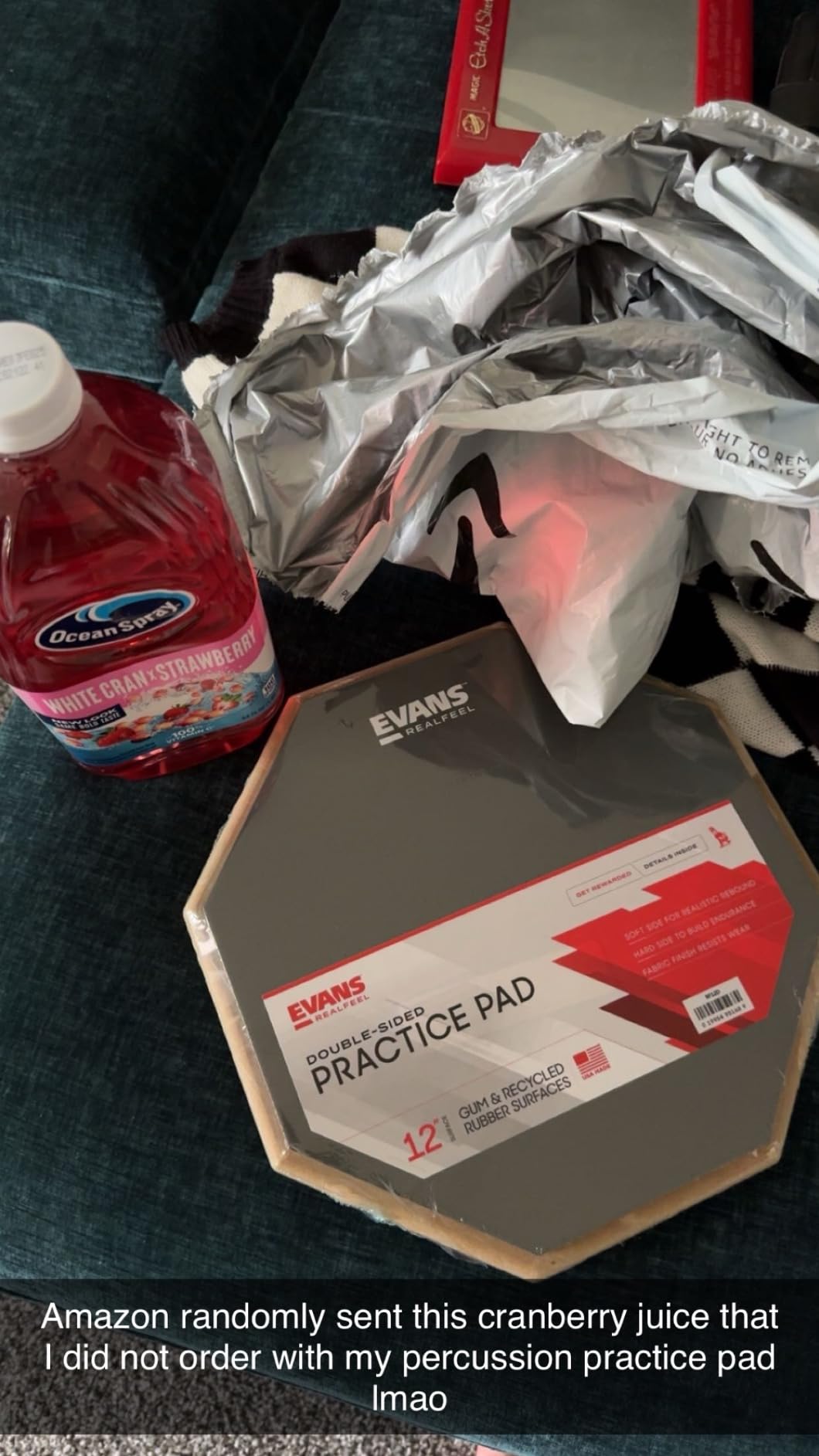
At 1.65 kg it is a genuinely heavy object. That gets treated as a downside in listings, and we understand the complaint about carrying it up three flights of stairs, but in use the weight is the feature. The pad does not skate across a table when you play accents, and it does not slide off a lap mid roll. It goes down and stays down, which lets you concentrate on the stick instead of on the furniture.
The 13.39 by 13.39 by 1.57 inch footprint is a genuine limitation. It drops happily into a snare basket, but at 12 inches it will not sit on a standard snare stand, so if your routine is built around a stand at a fixed height you need a cradle or a table edge instead. Owners also note that heavy full-power strokes still carry, though control rather than force keeps it genuinely quiet in an ordinary flat.
Who the two-sided RealFeel suits
Anyone practising at home without a kit, and anyone with a kit who wants a pad for hotel rooms, backstage and flat sessions. Students who need to build rebound control before they move to an acoustic head will find the gum side does most of the teaching. It is equally good for a player switching to lighter sticks, because the surface makes underplaying feel and sound like underplaying.
Musicians who warm up before a show, a lesson or an audition will recognise it immediately. Warm-up strokes are exactly the strokes that need a responsive surface. A pad that absorbs everything makes you play harder than you should, and then the first real stroke on stage feels like a surprise.
Where the two-sided RealFeel falls short
If your practice space is small enough that you carry the pad between rooms daily, 1.65 kg gets old fast. The 7-inch apprentice model and the 8-inch Donner cut that weight by more than half and still teach decent rebound control, at the cost of surface area.
It also does not fit a snare stand at 12 inches, which rules it out for anyone whose warm-up routine is built around a stand at a set height. Two surfaces is a lot of design, and you only get to use one of them on a given day.
2. Remo RT-0010-58 Ten Inch Red Tunable Pad – Best for Real Snare Feel
Remo RT-0010-58 10″ Red Tunable Practice Pad with Ambassador Ebony Drumhead
10 inch tunable pad
Replaceable coated Ambassador head
Rubber shell
Rubber base
Pros
- Replaceable coated head restores a real drum feel
- Bounce supports genuine rolls
- Rubber base protects tabletops
- Seats in a 10 inch snare basket
Cons
- Louder than a rubber practice pad
- 10 inch head is smaller than most pads
- Coated head wears under heavy stick attack
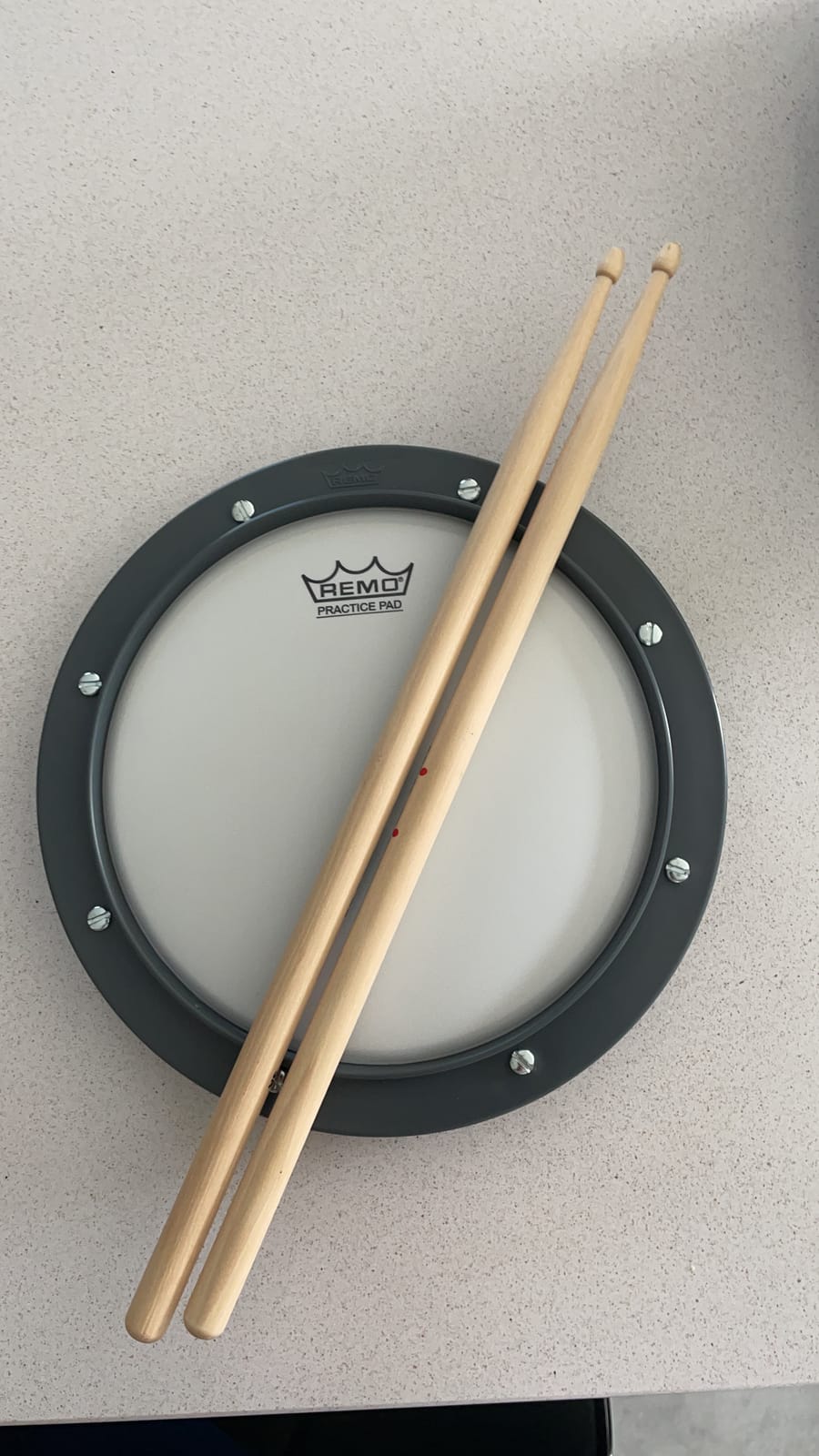
This is the only pad here with a real drumhead stretched across it. The coated Ambassador head bounces the way a snare bounces, which means your rolls sound like rolls and your hand volume reads correctly. If your sticking has been quietly falling apart on rubber, this is the pad that will show you, because the failure is audible as well as visible.
Being the only tunable option also changes the longevity story. When the coating wears through, you replace a head rather than replace a pad. That matters more than it sounds if you are the type who plays hard and would otherwise be shopping for a new slab every couple of years. Red anodised hoop, black coated head, and it looks the part on a stand.
The honest drawback is volume. A coated head is a head, so it rings, and the gritty stick noise is the loudest thing in this roundup. Reviewers describe it as quieter than a real drum and definitely not quiet, which makes it a poor fit for a late-night session in a thin-walled flat. It is excellent on a stand, in a garage, or in a house where nobody is trying to sleep.
At 8 ounces it is also the lightest full-size option here, so it moves between rooms without ceremony. The protective rubber bottom means you can put it straight on a table or a lap without worrying about scratches, and it still holds position once you start playing.
Who the Remo tunable pad suits
Drummers whose main problem is roll control, sticking accuracy, or rebuilding a weak hand. It rewards controlled playing in a way rubber cannot, because the head gives you audible feedback on every stroke. Students moving from a rubber pad to a real snare will notice the difference immediately and it shortens that transition.
It is also the pick for anyone whose practice pad has to double as a snare substitute at a lesson, a rehearsal, or a small venue where a full kit cannot travel. Sits in a 10 inch basket, plays like a small drum, and weighs almost nothing to carry.
Where the Remo tunable pad falls short
Noise. If neighbours, housemates or a partner are the reason you are looking at a pad in the first place, this is the wrong one. A coated head defeats the entire purpose of practising quietly, and the louder you play to hear yourself, the louder the room gets.
Ten inches is also smaller than the twelve-inch pads that dominate this list. Full-size snare technique work and long stretches of single strokes feel slightly cramped, and the 12 inch models simply do not have that problem.
3. Evans RealFeel Single-Sided 12 Inch – Best for Quiet Practice
Evans RealFeel Single-Sided Drum Practice Pad, 12 Inch
12 inch single-sided
Natural gum rubber surface
1.4 lb
12.01 inch square
Pros
- Most realistic rebound in this roundup
- Snare sized for unrestricted placement
- Solid and does not move while playing
- Quiet when stroke height is controlled
Cons
- Only one playing surface
- Higher cost than generic rubber pads
- Thinner and lighter than the two-sided model
If the whole reason you are here is the noise, this is the pad to buy. The single natural gum rubber face returns a genuinely realistic stick response and, because there is no head to ring, produces almost nothing beyond the stick contact itself. Owners consistently point out that the single gum side is the quietest surface in this roundup, and at 4.8 stars across more than 3200 reviews it is also the best reviewed quiet option in the set.
It is the cleanest expression of the RealFeel idea. No second face, no extra layers, no beading system. Just a 12-inch gum rubber playing surface in a dark grey shell that resists wear, sized so your normal stick placement does not feel restricted and your rimshots read the way they would on a snare.
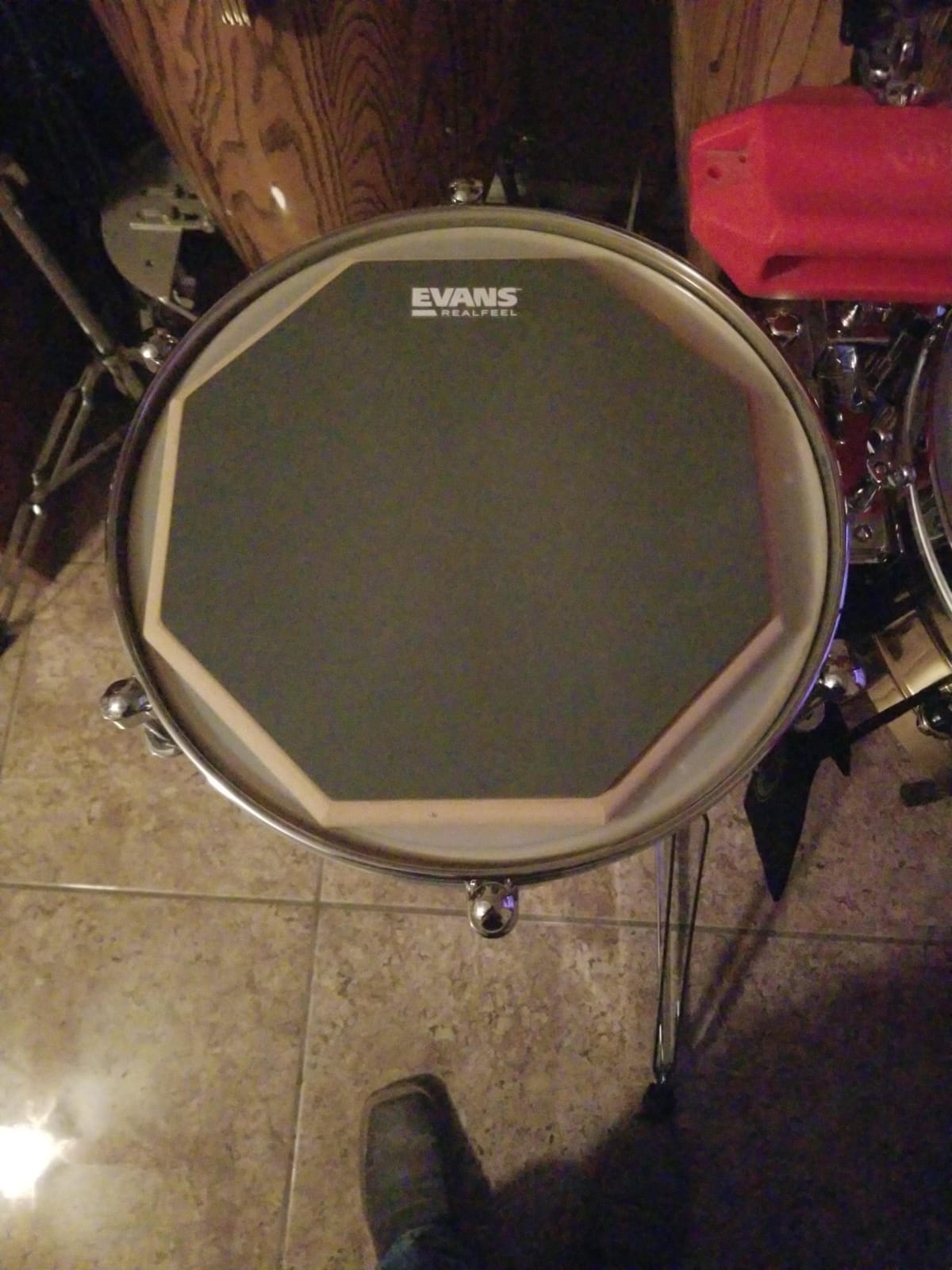
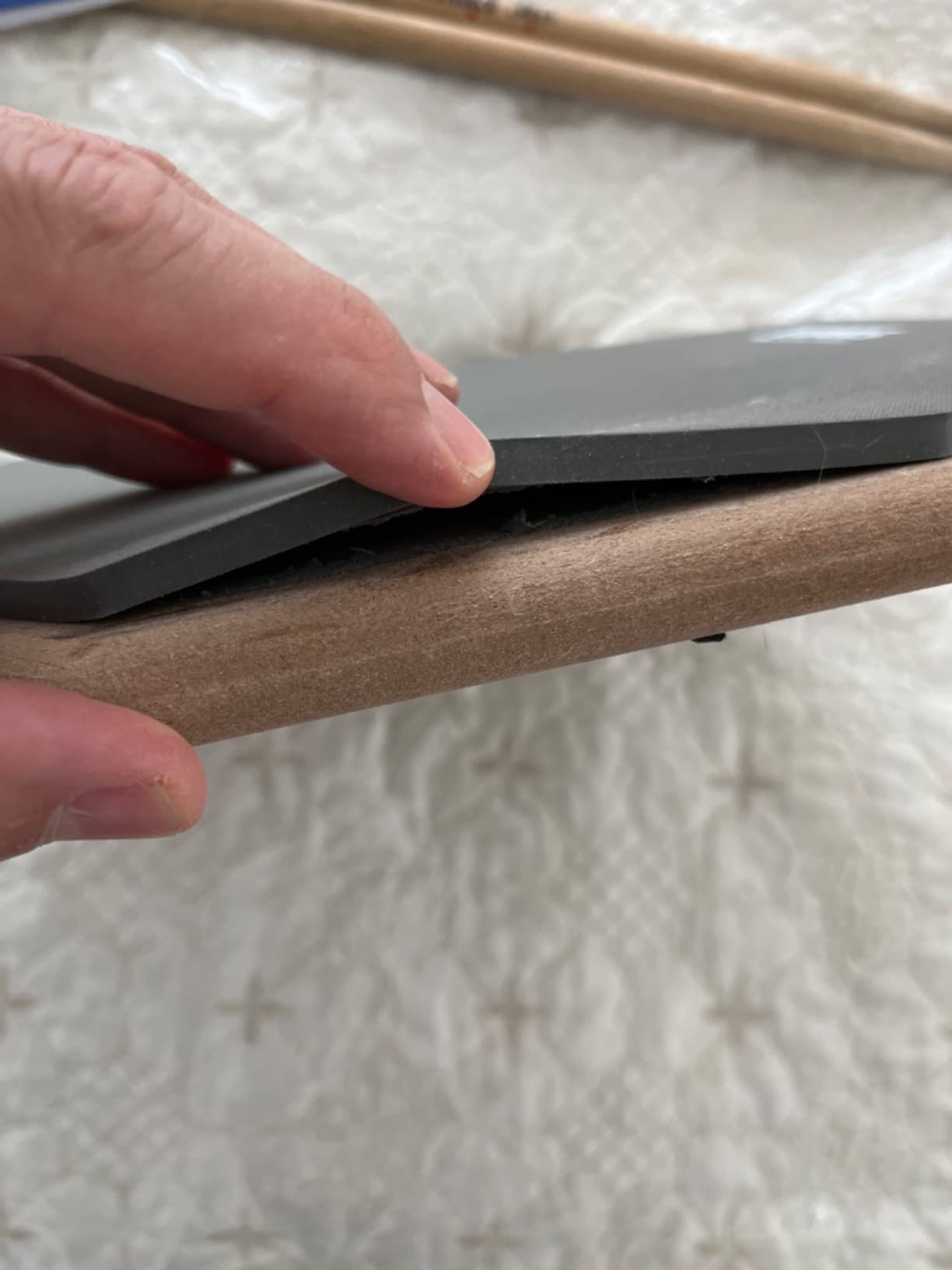
At 1.4 pounds and just under an inch thick it is lighter and thinner than the two-sided Attacktile, and that shows up in two ways. It is easier to move around, and it is a little more flexible under a heavy stroke, which some players prefer for a more drum-like response and others find a bit soft for conditioning work.
Reviewers are near unanimous that stroke height, not the pad, decides how loud you are. Play the way you would play in a room with people in it, and this thing is close to silent. Play flat-out rock strokes and you will hear the stick more than you would like, because there is a volume floor that no rubber pad removes.
Who the single-sided RealFeel suits
Flat dwellers, students in shared houses, and anyone practising after nine at night. It also works well for the drummer who owns a kit and wants one dedicated pad for rudiments, where a quiet surface that does not slide is worth more than versatility.
Anyone who plays on a snare basket or a small stand will like the full 12-inch footprint. Unlike the two-sided model, reviewers note it sits well with drum stands, so you can set it at snare height and work on a single dedicated surface rather than switching faces every session.
Where the single-sided RealFeel falls short
One surface. If you want a firm conditioning face for forearm endurance work, you need a second pad, and that is real money for something you could have covered with the two-sided model. Drummers who do both kinds of work buy both.
It also costs more than generic rubber pads for the same basic job of absorbing sound, which is a fair criticism at a given budget. The gum rubber is what you are paying for, and reviewers who compare it to cheaper pads generally conclude the difference is real once you have played both.
4. Donner 8 Inch Two-Sided Silent Pad – Best Value
Donner Drum Practice Pad 8 Inches, Silent Practice Drum Pad 2-Sided
8 inch double-sided
Rubber over EVA polymer base
1.76 lb
Maple sticks included
Pros
- Low cost per student in a music room
- Elastic rubber gives believable rebound
- Includes a pair of maple sticks
- Small enough for a lap or a closet
Cons
- Bundled sticks are light and flimsy
- Back face feels lower quality
- 8 inch surface crowds full-size technique
This is the pad you buy when the number of people who need one matters more than the specification. A high density elastic rubber surface sits over an EVA polymer mat and a compressed wood board, and that stack is what does the sound insulation. The result is quiet enough for a practice room full of students and modest enough each that you can buy a class of them.
Two faces, a wooden frame with a cavity for a stand, and a pair of maple sticks in the box. For a beginner who has never held sticks properly, having sticks that fit the pad in the first ten minutes removes a genuine barrier. You do not have to work out which tips to order or whether the pad takes a 5A.
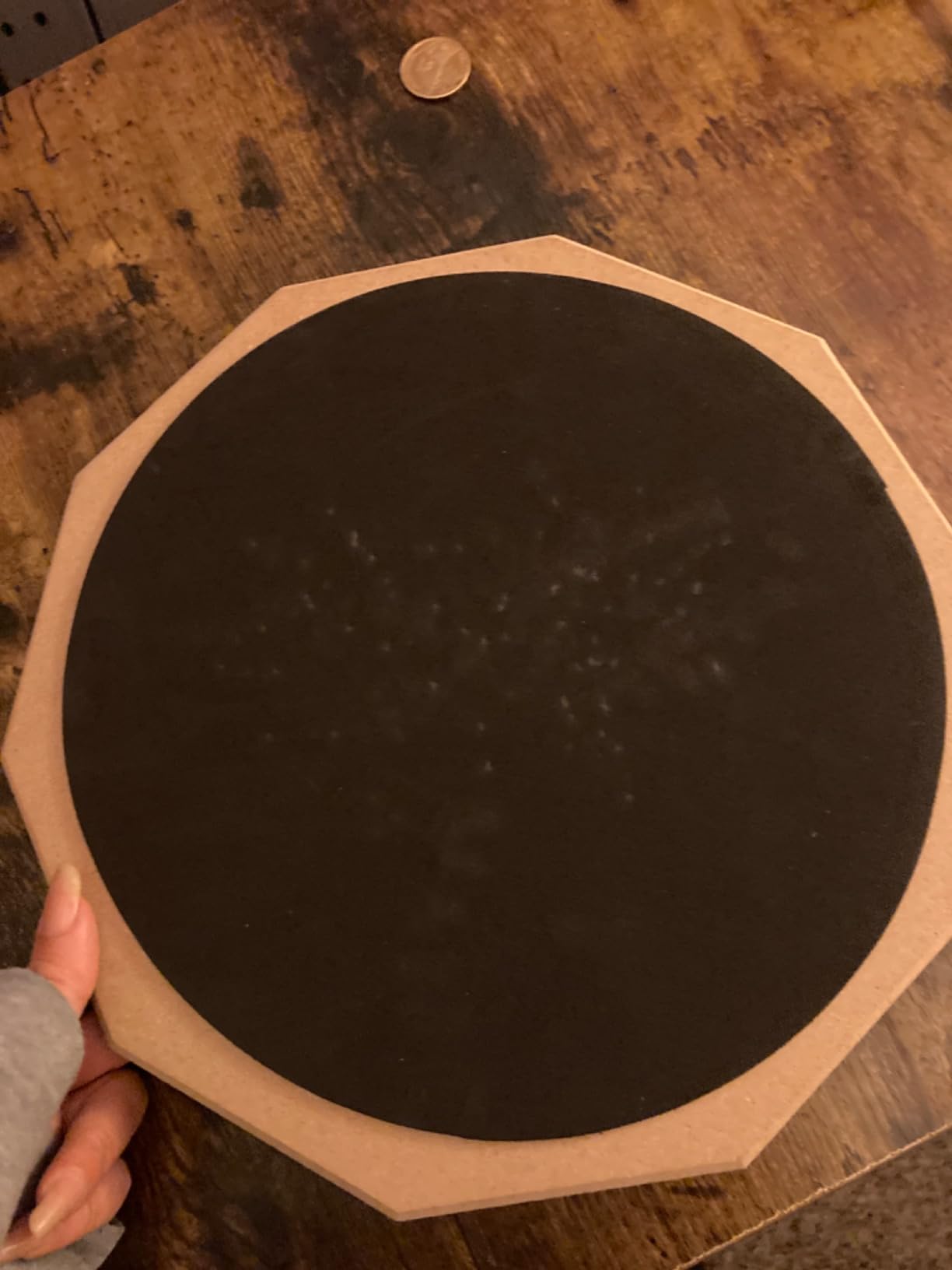
At 1.76 pounds and 8 inches across, it is a genuinely portable object. It lives in a rucksack, it works on carpet, table or lap, and it drops into a snare basket. Reviewers who compared it to more expensive pads usually concede the surface is thinner and livelier in feel but the practical package is hard to argue with.
The back face is the weak point. Most owners play the top surface and ignore the other one, and the consensus is that the reverse side is a step down in quality. The same reviews warn that the included sticks are light and not built for serious playing, so treat them as a starter pair rather than an upgrade.
Who the Donner 8 inch suits
Beginners, children learning on a lap, and anyone who needs a pad in three rooms of a house rather than one. It is a strong first purchase because it teaches rebound control at a cost that does not require thinking about it, and it tolerates being stored in a car or a school bag.
Band directors and teachers buying in bulk will find the value hard to beat. A single purchase covers the pad and the sticks, which is the difference between a student starting this month and starting next term.
Where the Donner 8 inch falls short
Eight inches is a small target for long sessions. Drummers report that the hitting area feels limiting during extended single stroke and roll practice, and for adults working on full-size technique a 10 or 12 inch surface makes the work far more transferable to a real kit.
Long-term buyers also flag consistency of finish. Reports of a chemical smell on arrival, visible glue marks and rubber edges curling show up in the small-budget category more than they do with the American-made pads. Check it the day it arrives rather than after a month of use.
5. Evans RealFeel Apprentice 7 Inch – Best for Beginners and Younger Players
Evans RealFeel Apprentice Drum Practice Pad, 7 Inch
7 inch single-sided
Natural gum rubber surface
1.22 lb
Made in USA
Pros
- Realistic gum rubber at a smaller size
- Light enough for a child to carry
- Works on a lap table or carpet
- Resists visible wear over years
Cons
- 7 inch head is cramped for adults
- Single surface with no firmer side
- Less stable than the 12 inch models
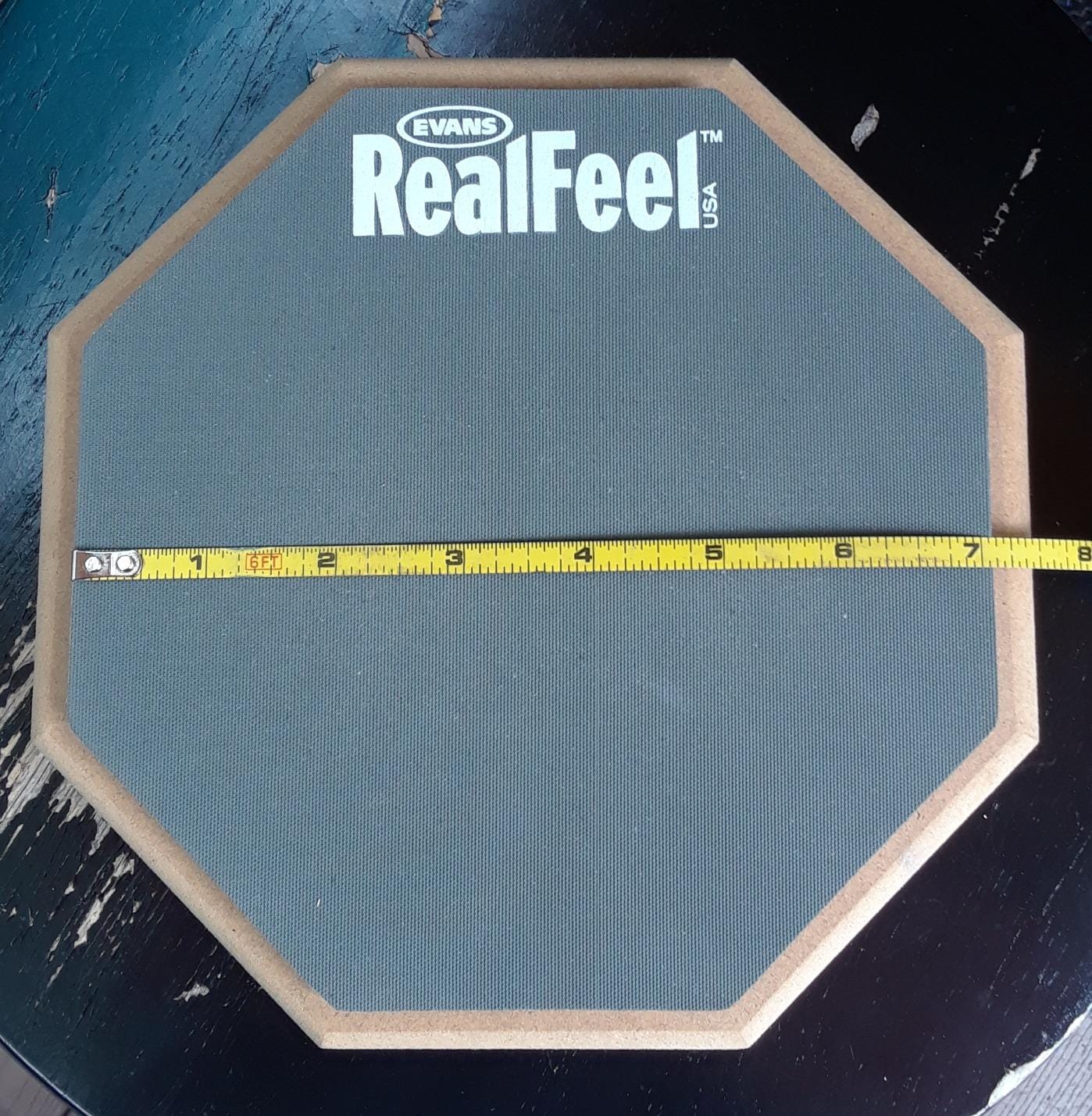
The apprentice pad is the one we would put in the hands of a nine year old, and the one we would hand an adult who needs something in a hotel room. It is the same natural gum rubber as the full-size RealFeel models, so the stick response is not a compromise version of the real thing. It is the real surface, scaled down.
At 1.22 pounds it is light enough for a child to carry to a lesson by themselves and thin enough to slide into a laptop bag. It works on a lap, a table or a carpet, and the dark grey fabric finish resists wear in a way that matters when a beginner is striking the same spot hundreds of times a day.
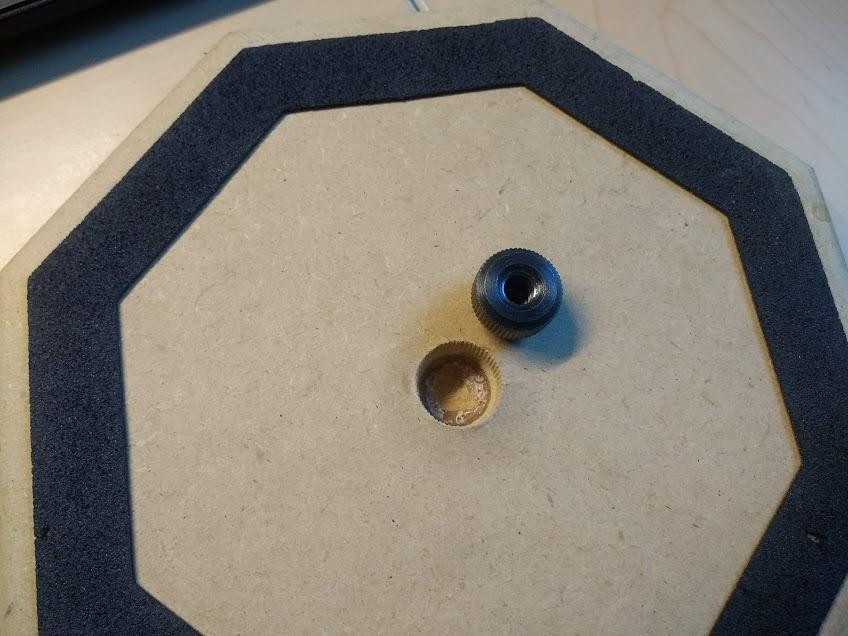
The honest limitation is the 7.87 inch frame around a 7 inch head. That is a real target for a young player’s hand, and it is tight for an adult who wants to practise rudiments with normal stick spacing. Owners who start on the apprentice pad and move up tend to describe the jump to 12 inches as a step change in what they can work on rather than a gradual one.
It is also less stable than the heavier 12-inch models, so on a slippery table or a lap you will want a cloth underneath. Because the surface is quiet and the weight is low, it is a genuinely good late-night practice tool for someone who lives in a small flat.
Who the apprentice pad suits
Children in lessons, and adult beginners who want to build stick grip and rebound control before committing to a larger surface. Portable players who practise in hotel rooms, on balconies and backstage will find 1.22 pounds easy to forget they are carrying.
Anyone who already owns a 12-inch pad and wants a second, smaller surface for edge work and targeted drills. Students who travel to lessons with their kit in the car benefit from having a pad that lives in the bag rather than in the stand.
Where the apprentice pad falls short
Adults doing serious technique work will outgrow it quickly. The small hitting area restricts the same strokes that matter most for transferring to an acoustic kit, and a 7 inch head forces you to place strokes closer together than a real snare would.
With a single surface you also give up the conditioning option entirely. If your plan involves long daily sessions on a firmer face, the two-sided 12-inch model covers more ground for the same shelf space.
6. GrowDaily 12 Inch Pad With Sticks And Bag – Best for Shared Walls
Drum Practice Pad for drumming drum pad and sticks 12 In
12 inch single-sided
Rubber on poplar with cotton base
3.52 lb pad
Four sticks and bag
Pros
- Shock absorbing cotton layer cuts noise
- Weight keeps the pad from sliding
- Four maple sticks and a storage bag
- Low noise transfer suits shared rooms
Cons
- Surface is firmer than gum rubber
- Generic brand with little heritage
- Heavier than comparable budget pads
Most of the noise a practice pad gives off comes from the stick striking something hard, and the fix is a base that absorbs impact rather than passing it into the table. This one uses a high density shock absorbing cotton layer between the rubber head and the poplar base, and it makes a real difference in a thin-walled room. Owners practising in apartments single that layer out as the feature that solved their problem.
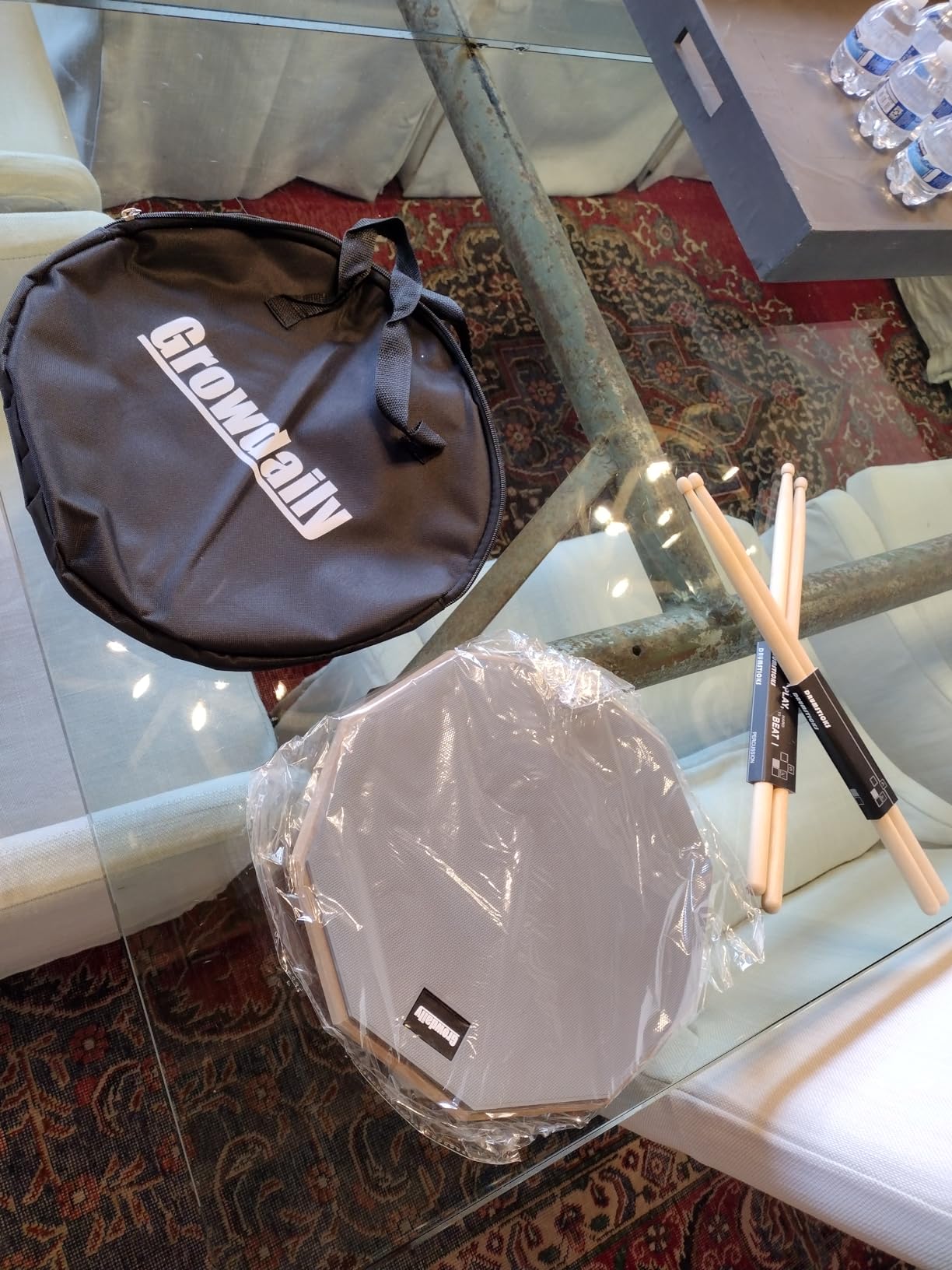
It is also a bundle. A 12-inch pad, two pairs of maple sticks, and a storage bag with dedicated pockets for each. For someone starting out who does not already own sticks, that removes the single most common reason a new drummer puts a pad in a cupboard and never opens it again.
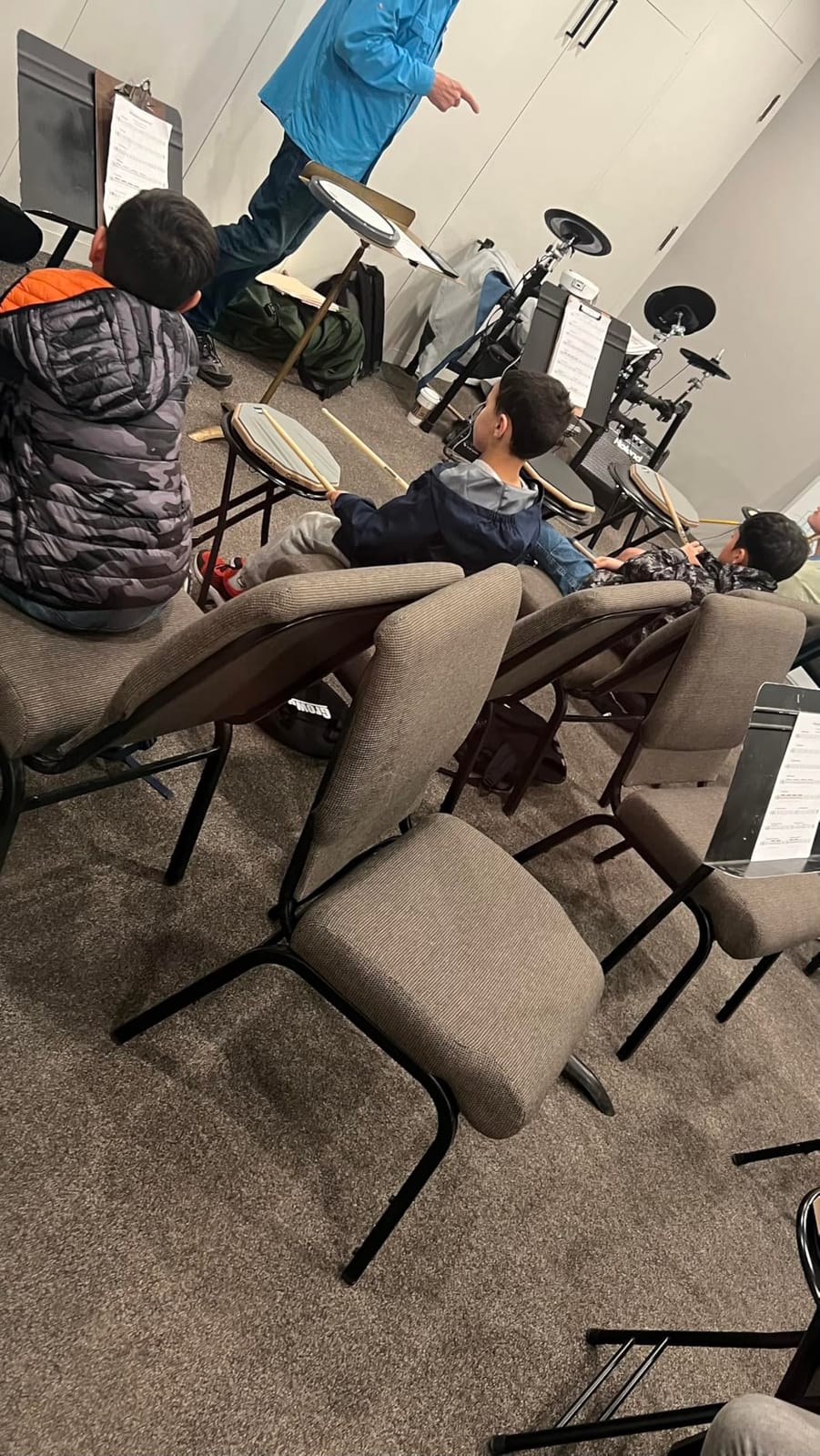
At 3.52 pounds for the pad itself, this is a serious object. That weight is why it stays put under accents and rolls, and it is also why it is a poor choice for a child who has to carry it to school. It works on carpet, table or inside a snare basket, so the placement options are wide.
The rebound is described as believable rather than exceptional. The rubber is high resilience but firmer than the natural gum rubber on the Evans models, so your stroke height changes the feel more than it would on a gum surface. If you are coming from an acoustic kit, that difference is worth knowing in advance.
Who the GrowDaily 12 inch suits
Anyone in a shared flat, a house with thin walls, or a rehearsal space where the neighbours matter. The shock absorbing base is the reason to pick it over a cheaper pad of the same diameter, and owners converting from a louder practice surface report the volume drop as obvious.
Starters who want everything in one box, and anyone who wants a full-size 12-inch surface without buying a stand separately. The bag means it survives being moved between a home, a lesson and a rehearsal room without the pad getting scuffed.
Where the GrowDaily 12 inch falls short
Brand support and long-term parts are thin compared with the established drumhead makers. There is no replaceable head, so once the rubber wears you are buying a new pad, and a product with a shorter track record is a little harder to plan around than one that has been making drumheads for decades.
Weight is the other issue. At 3.52 pounds for a single-sided slab, it is a poor trade if your practice spot is upstairs from someone who is trying to sleep, and the stands in this roundup are the better answer for that layout.
7. Donner 12 Inch Stand Set With Pad Sticks And Backpack – Best All-In-One Kit
Donner Snare Drum Stand Set with Drum Practice Pad, 12” Double-sided Silent Drum Pad set, Drumsticks, Backpack Adjustable Stand Fits 10”-14” Dia Drums
12 inch double-sided pad
EVA mat on compressed wood
3.8 kg complete set
Stand sticks gel and bag
Pros
- One purchase covers pad stand and sticks
- Double braced tripod grips the floor
- Breaks down fast for transport
- Backpack separates pad stand and sticks
Cons
- Stand is short for taller adult players
- Bundled maple sticks chip easily
- Heavier than a pad on its own
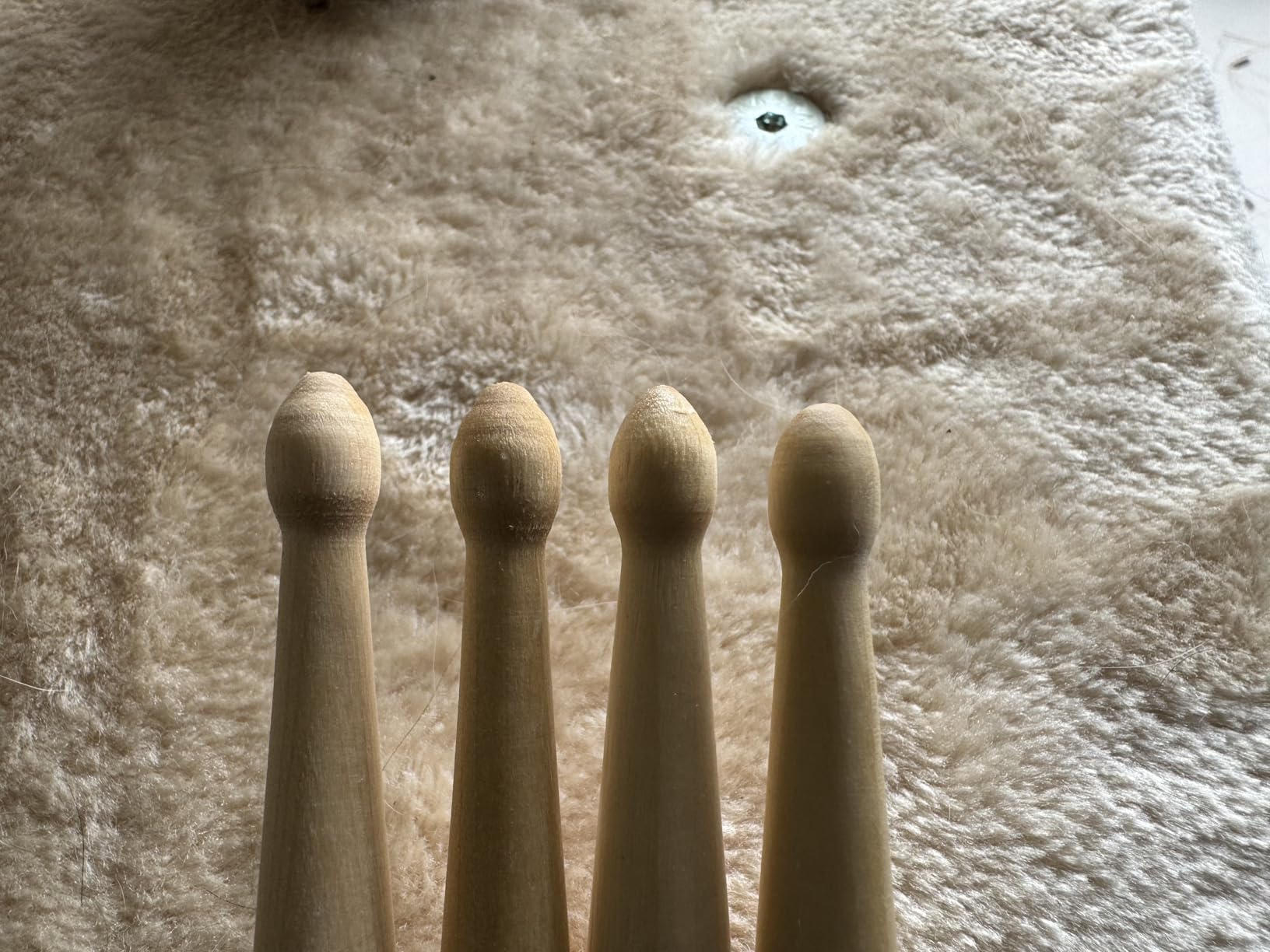
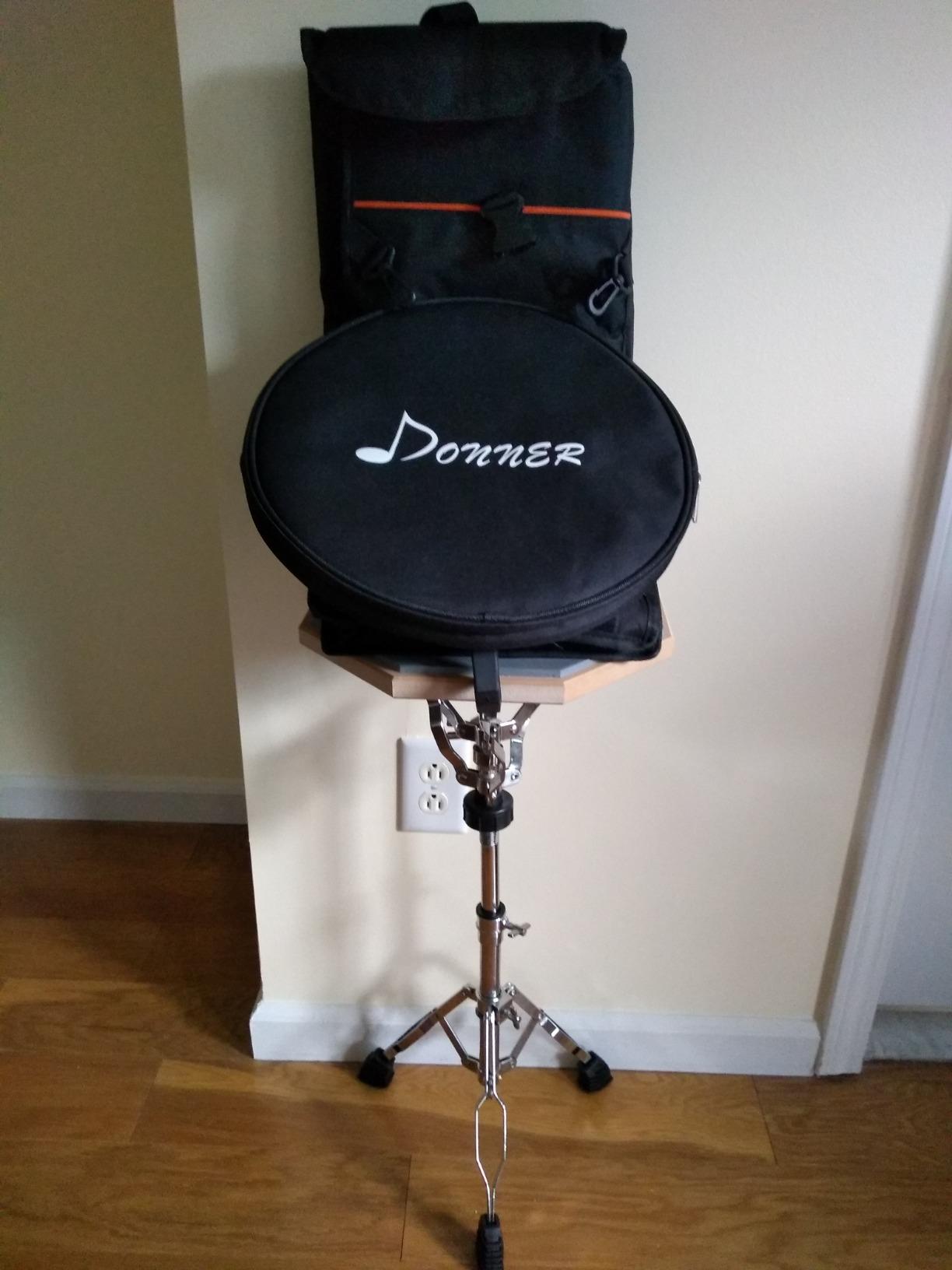
Some people do not need a pad, they need a portable practice station. This is that. You get a 12-inch double-sided rubber pad, an adjustable double-braced tripod snare stand that fits 10 to 14 inch drums, three pairs of drumsticks, a stick bag, drum gel, and a backpack with internal dividers. Nothing else needs buying before the first session.
The pad itself is a good pad. High density elastic rubber over an EVA polymer mat and a compressed wood board, which is a combination reviewers describe as noticeably better than flimsy pads in the same bracket. The double-sided format gives you the same kind of choice the Evans two-sided model offers, without a separate outlay for a stand.
The stand is where the reviews concentrate. Double braced, rubber feet, quick to assemble and quick to break down, and it holds a pad at a proper snare height without wandering. Instructors and families mention the tripod and the bag as the reasons the set works for lessons, where a bare pad on a table is not enough.
Two things come up repeatedly. The stand adjusts from 14.2 to 22.8 inches, which is a real problem for an adult over roughly four feet tall, and the bundled maple sticks are basic enough that some buyers replace them early. At 3.8 kg the whole set is heavy, but it packs into one bag.
Who the Donner stand set suits
Anyone starting from nothing, and anyone who practises in places where a table is not available. A bedroom, a hallway, a conservatory, a shared rehearsal space. The stand gets the pad to snare height, which is the single biggest factor in building correct technique as a beginner.
Families and instructors who want one purchase per student that will also survive being carried to a lesson will find the backpack organisation the deciding feature. Pad, stand and sticks have their own compartments, so nothing rattles on the bus.
Where the Donner stand set falls short
Adult height. A 22.8 inch maximum will leave a tall player bent over the pad, which is exactly the posture that builds bad habits. Check your sitting height against the adjustment range before you commit, and if it does not reach, the alternative in this roundup with a taller range is the one with the 23 to 31 inch adjustment.
The accessories are the weakest part. Three pairs of sticks means two are spare, but the sticks themselves chip and break faster than a proper maple or hickory pair, and the drum gel is a nice touch rather than something you will use daily.
8. GrowDaily 12 Inch Pad And Stand Set – Best for Adults and Kids Sharing One Pad
Drum Practice Pad Snare Drum Stand Set 12 In
12 inch rubber pad
Adjustable stand 19.5 to 31.5 inch
5.85 lb set
Six sticks and two bags
Pros
- Tall adjustable stand suits kids and adults
- Double support tripod holds a real snare height
- Six maple sticks plus a stick bag
- Carry bag for the whole set
Cons
- Nearly 6 lb to move around
- Too tall for lap practice
- Young brand with a shorter record
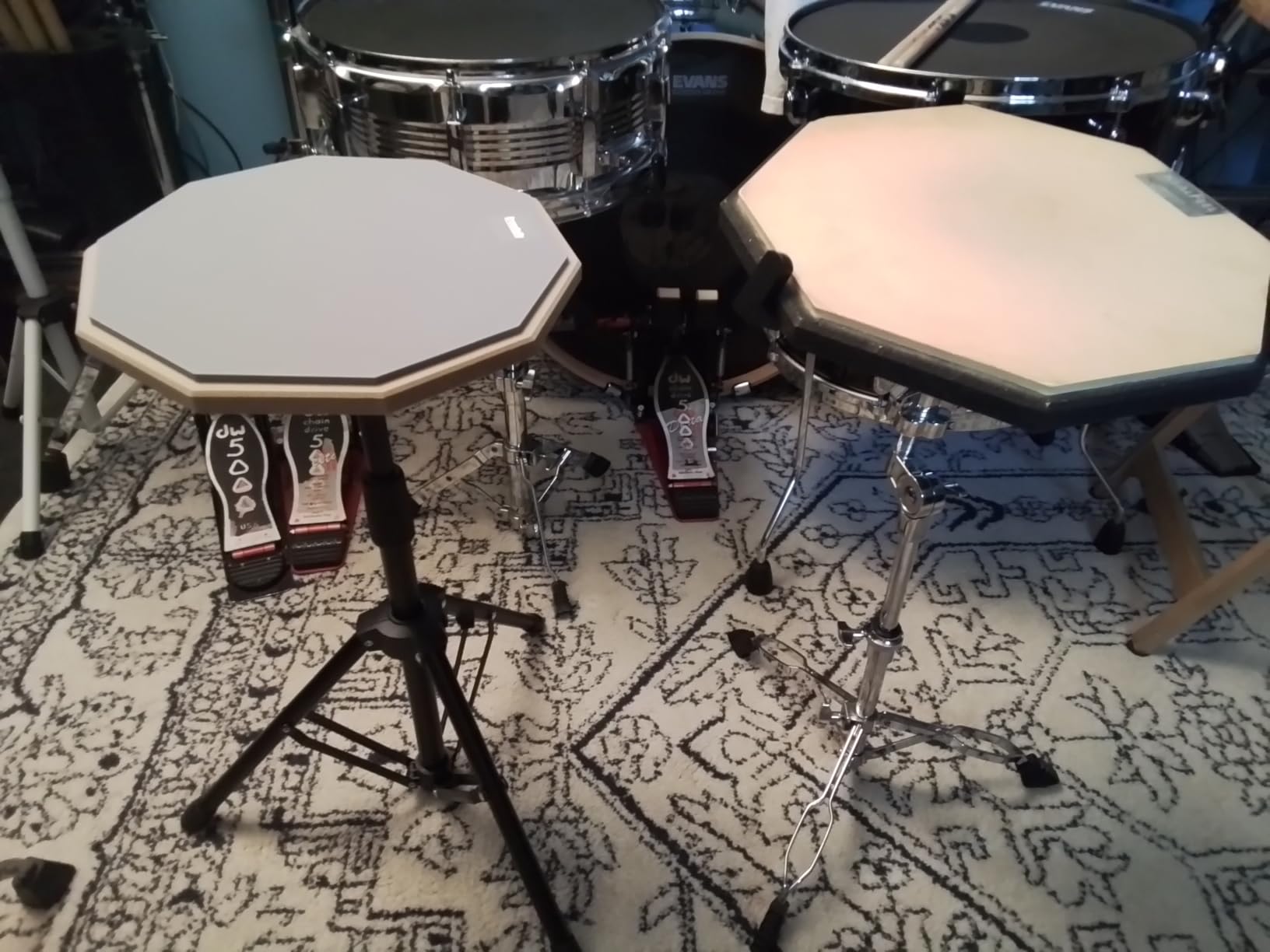
The decision this set solves is height. The stand adjusts from 19.5 to 31.5 inches, which is a range wide enough for a seven year old and a full height adult to use the same setup at correct snare height. Buyers name that range as the deciding factor more than any other single feature, because a pad at the wrong height teaches the wrong posture no matter how good the surface is.
You get a 12-inch pad with high resilience rubber over a shock absorbing cotton base, a double support tripod with an adjustable basket for 12 inch snares, three pairs of maple sticks, a stick bag, and a carry bag for the whole thing. It is one of the more complete packages at this level.
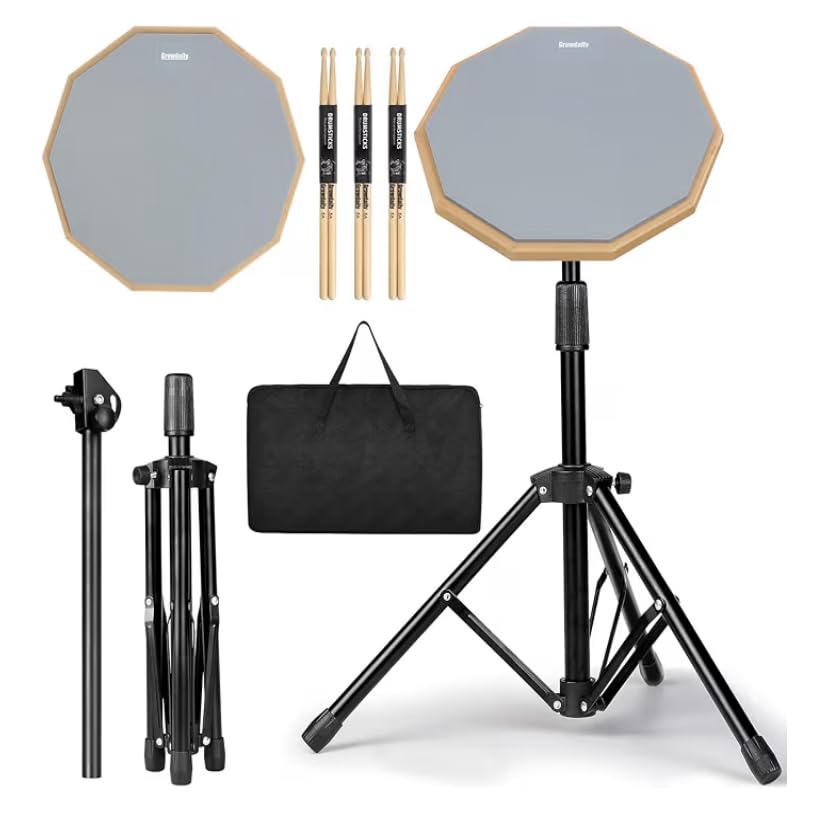
Owners describe the pad feel as close to a real snare, and the high resilience rubber gives a livelier return than the firmer budget slabs. The shock absorbing base again does the quiet work, which matters if the stand is set up in a living room rather than a garage. It ranks first in the Practice Pads and Devices category among the sets we covered, and the review volume reflects that.
At 5.85 pounds the set is genuinely heavy, and reviewers say so. Moving it between rooms is a two hand job. It is also a tall fixed setup, which rules out lap practice entirely, so it is a stand product or it is nothing.
Who the GrowDaily stand set suits
Homes where more than one person practises, from a child starting lessons to a parent following along. The height range means nobody has to compromise, which removes the most common household objection to sharing equipment.
Anyone practising without a drum kit who wants a proper snare height and a full 12-inch surface. The stand is sturdy enough to hold a real 12-inch snare if you later want to practise on hardware rather than the pad, which makes it a useful bridge to buying a kit.
Where the GrowDaily stand set falls short
Weight and bulk. Nearly 6 pounds of stand, pad and accessories is a lot to lift over a threshold, and it is a poor fit for small flats where any kit needs to be stored out of the way. The same applies to the tripod, which is fine once placed and awkward to move.
It is also a young product with a shorter service record than the drumhead manufacturers in this roundup, so there is less long-term feedback on how the rubber and the basket hardware age. The adjustable basket and the height range are the parts worth inspecting carefully on arrival.
9. HAIRIESIS 12 Inch Double Sided Pad – Best Budget Bundle
HAIRIESIS Snare Drum Practice Pad,12-Inch Practice Drum Pad,Double Sided Silent Drum Pad and Sticks,Drum Pads Carry Bag
12 inch double-sided
High density elastic rubber
3.36 lb
Two stick pairs and bag
Pros
- Double sided pad with two rubber faces
- Anti slip sound insulating base absorbs impact
- Two pairs of 5A sticks included
- Light enough to move between rooms
Cons
- Rebound is less lively than gum rubber
- Carry bag is basic
- Smaller review base than known brands
This is one of the most direct routes to a full 12-inch double-sided pad with sticks in the box, and at 3.36 pounds it is light enough to carry between rooms without a case. The high density elastic rubber surface sits over an anti-slip, sound insulating base with shock absorption, which is the same three layer construction the more expensive budget sets use.
Owners mostly frame it as a complete starter bundle rather than a premium surface. You get the pad, two pairs of 5A sticks, and a waterproof Oxford fabric carry bag. For someone whose neighbour complained about the last practice session, having two stick pairs and a bag removes every reason to delay.
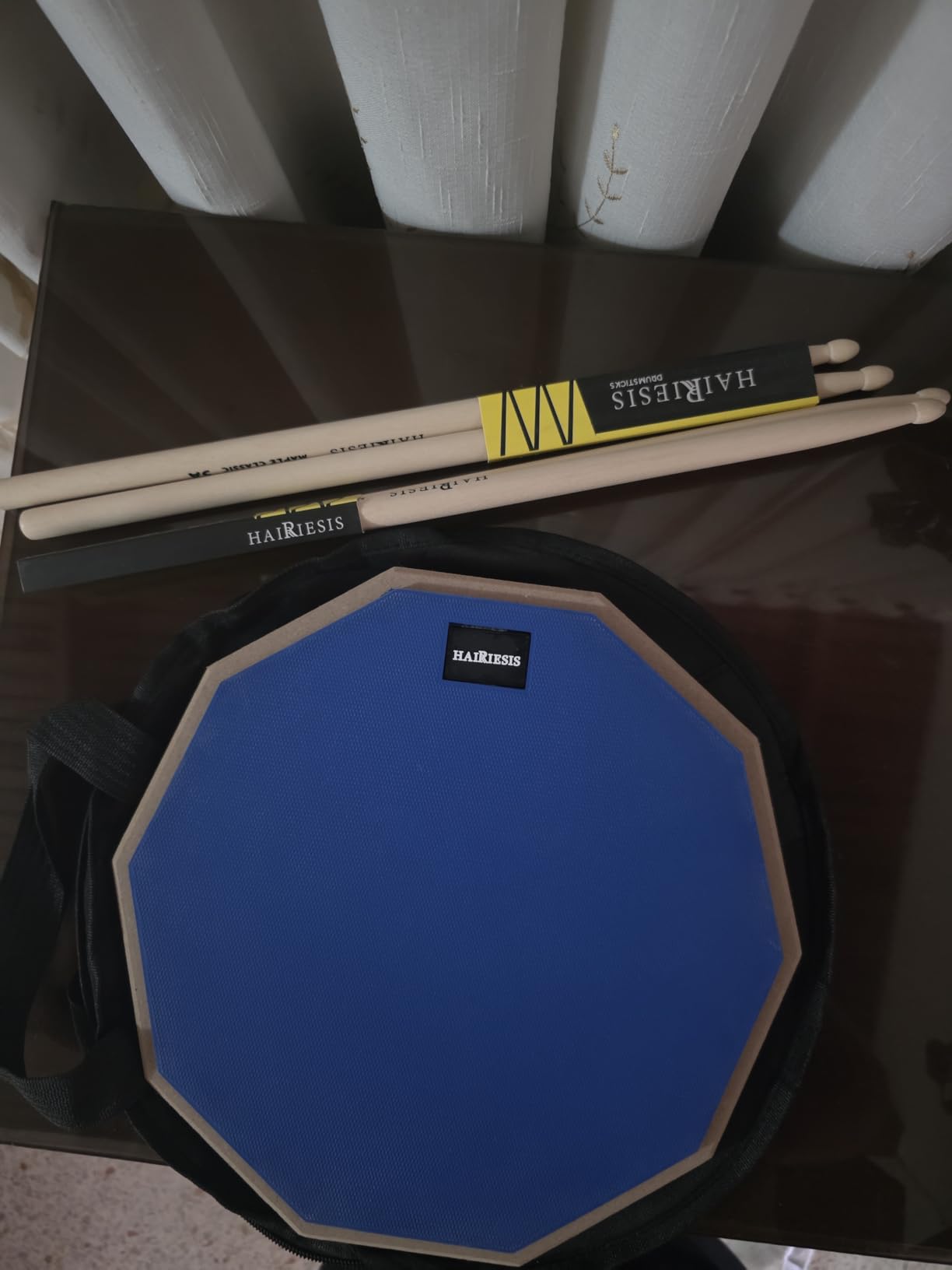
Two faces is the real draw at this level. A hard rubber side and a softer rubber side means you can alternate between conditioning work and technique work on one slab, and you do not need a second object mid session. Several colours are available too, which matters more than it sounds for a child who refuses to practise on the grey one.
The rebound is the compromise. Reviewers describe it as adequate and drum-like rather than lively, and anyone coming from natural gum rubber will notice the difference in stick return. It is a perfectly good surface for hand control and rudiment work; it is not a substitute for a coated head if your sticking needs that kind of feedback.
Who the HAIRIESIS pad suits
Beginners, students, and anyone who wants silence, portability and two playing surfaces without assembling a list of accessories. The shock absorbing base is why it suits a flat, and the 3.36 pound weight is why it suits a rucksack.
Anyone who wants a cheap second pad for a different room, or a backup to keep in a car so a practice session is never skipped because the main pad is at home.
Where the HAIRIESIS pad falls short
Feel and support. The rubber does not return the stick the way gum rubber does, and a smaller review base means less long-term evidence about how the surface holds up after a couple of years of hard playing. The carry bag is a basic sleeve rather than a case with structure.
If you are moving past beginner stage and want your pad to train the same response as an acoustic head, this is where the extra money is better spent. Buy the most complete set you like for a first month, then upgrade the surface, not the accessories.
10. Offworld Percussion Invader V3 – Best for Saving Your Sticks
Offworld Percussion Invader V3 Practice Pad
14 inch playing surface
360 degree stick saving rim
DarkMatter polymer
4.9 lb matte frame
Pros
- Rim element saves stick tips and supports rim work
- DarkMatter polymer surface resists wear
- Weight keeps it planted on a stand
- Made by a specialist pad maker
Cons
- Premium tier cost for the whole package
- Heavier than most practice pads
- Single playing surface
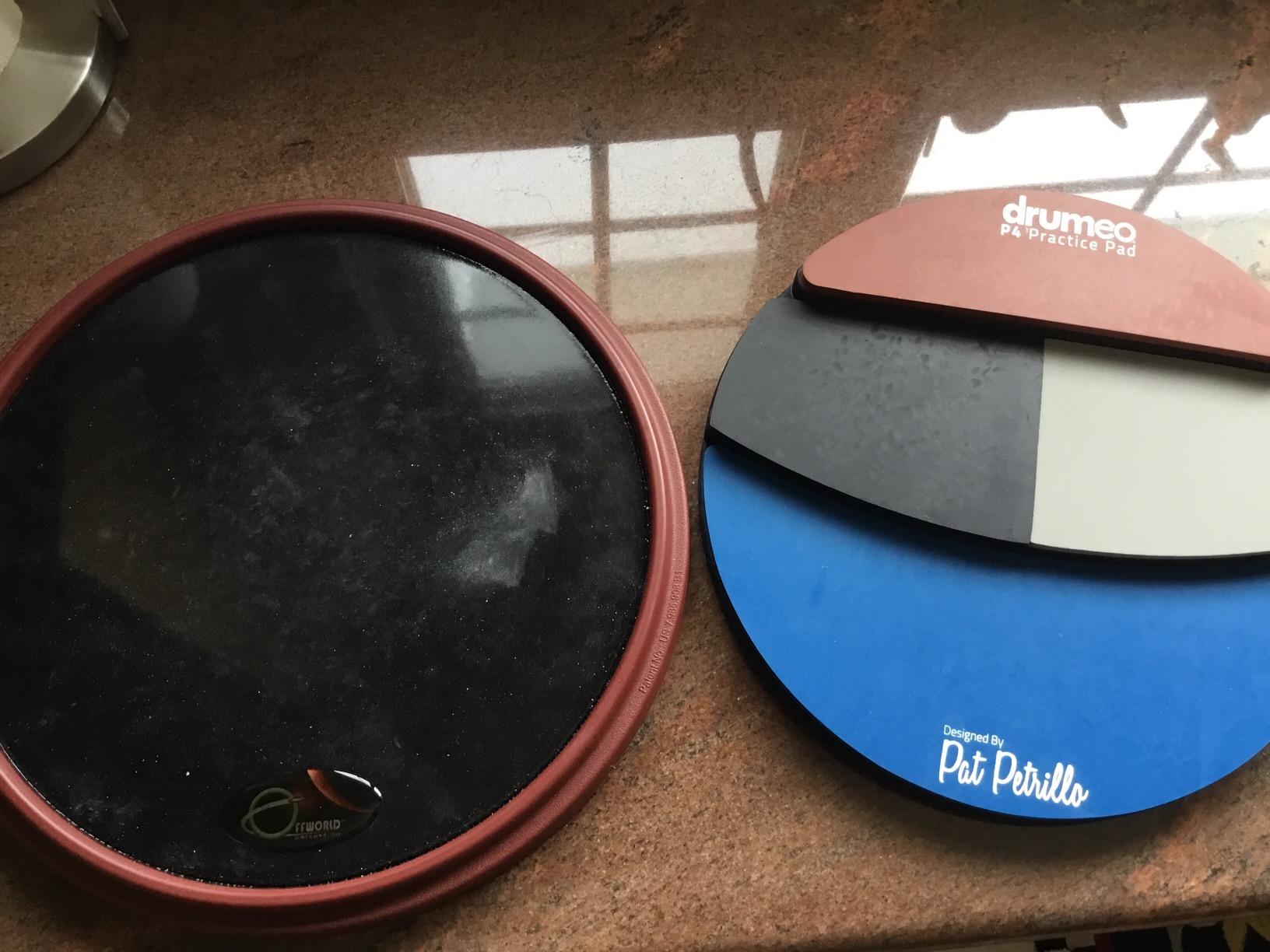
The Invader is the specialist choice. A 14 inch polymer playing surface in a 4.9 pound frame, with a 360 degree rim element that wraps the whole perimeter. That rim is the point of the pad. It takes the hit instead of your stick tip, which is why it shows up in round hands playing on a real kit, and why reviewers who own a full set of sticks stop worrying about wearing them out on a practice surface.
It is also the community favourite that editorial roundups keep missing. Drummers on forums describe the Invader as the best pad on the market, and the review base here is small but strongly loyal, with a 4.8 average that sits alongside the much more numerous RealFeel reviews.

Build quality is the other argument. The frame is metal, the finish is matte, and the newly formulated playing surface is a polymer rather than a rubber or a coated head, which means it does not smell, does not peel and does not crease at the edges. At 4.9 pounds it stays where you put it even when you are playing accents hard.
The response is its own thing, not a copy of anything. You are not playing a drum, you are playing a polymer surface, and if you have spent years on a kit you will either love the difference or find it distracting for the first few weeks.
Who the Invader V3 suits
Working drummers who go through sticks, and anyone who plays rimshots and cross-stick material on a regular basis. The 360 degree rim gives you somewhere to put the stick that is not the centre of the head, which changes how much of a pad routine you can do without wearing your tips flat.
Players who have had cheap pads fall apart and want something that survives a decade. A polymer surface and a metal frame address both of the quality complaints that come up repeatedly about budget pads: peeling coatings, curling rubber edges and stripped screws.
Where the Invader V3 falls short
It is a premium-tier purchase, and you are paying for the rim and the frame as much as the surface. A beginner practising rudiments on a lap for ten minutes a day will get more out of a simpler rubber slab and will not notice the difference for years.
It is also single sided. There is no firmer conditioning face to flip to, so endurance work happens on the same surface as technique work. And at 14 inches with 4.9 pounds of frame it is not a pad you carry between rooms.
11. Donner 12 Inch Pad With Snare Simulation – Best for Snare-Wire Buzz
Drum Practice Pad 12 Inches, Donner Quiet Drum Pad with Removable Snare Simulation Built-in 800 Steel Balls, Drum Sticks, 40 Standard Rudiments(Black)
12 inch silicone surface
Removable 800 ball snare simulation
1.62 kg
Rudiment printout included
Pros
- Steel bead system reproduces snare wire buzz
- Stick slot in the hoop allows modern technique
- Silicone surface on a compressed wood base
- Includes a printout of the 40 standard rudiments
Cons
- Bundled sticks are budget models
- Snare simulator is a small separate part
- Heavier than some similar pads
Here is the problem with most practice pads: they train your hands but not your ears for ghost notes. A snare buzz is a whole category of dynamic and this pad reproduces it with a removable unit containing 800 steel beads. Fit the simulator, add a stroke, and you hear the wires. Take it out and you are back to a quiet silicone practice surface in seconds.
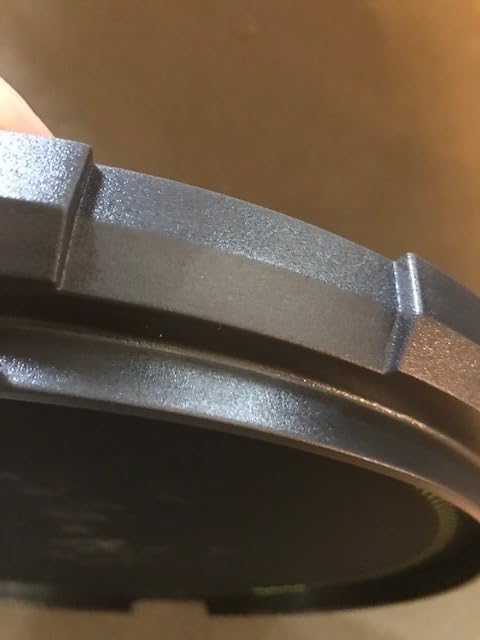
The second detail is the hoop. There is a stick slot carved into it and the rim sits at standard snare height, which means cross-stick and modern rim techniques are actually playable. On most rubber pads the hoop is a moulded edge you cannot work against properly.
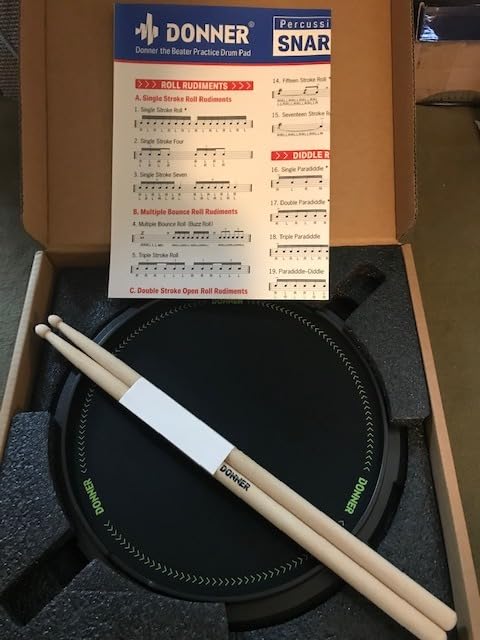
Construction is straightforward and durable: high density compressed wood, a long lasting silicone surface, and a non-scuff EVA bottom that grips a table, a stand or a lap. At 12.2 by 12.2 by 1.38 inches it is a full size snare footprint with real playing area, and the 1.62 kg frame keeps it stable under rolls.
What is in the box matters here. Maple drumsticks and a printout of the 40 standard rudiments come with it, and that printout is quietly the most useful thing for a beginner, because it gives a beginner a plan for what to practise rather than a surface to practise on.
Who the Donner snare simulation pad suits
Anyone who lives in an apartment and misses the noise. Ghost notes, rim clicks and buzz accents are what most drummers are actually missing when they switch to a pad, and the bead system puts some of that back without bringing the volume of a drum.
Students working through the 40 standard rudiments, and anyone whose teacher keeps sending them home with exercises and no structure. Turn the simulator off for rudiment control, turn it on for dynamic work, and the same pad covers both halves of a practice session.
Where the Donner snare simulation pad falls short
The bundled sticks are budget models. This is a pad that will teach you better technique, and it deserves proper sticks, so plan to replace them. The 800 bead unit is also a small separate component that can be dropped and needs to live somewhere safe between sessions.
It is heavier than some similar pads at 1.62 kg, and while reviewers call that weight an advantage in use, it does make the pad less convenient to carry. It is also a single surface design, so there is no firmer side for conditioning work.
12. Horse 12 Inch Pad And Stand Set – Best for Outdoor and Shared Practice Spaces
Horse Practice Drum Pad, 12 Inch Double Sided Exercise Drumming Pads Kit Set, Adjustable Height 23-31 Inch Snare Drum Stand Devices, Drum Sticks Drumsticks for Professional Beginner Adult Drummer
12 inch double-sided
Silicone over EVA cotton and Aspen
3 kg set
Stand adjusts 23 to 31 inch
Pros
- Stand adjusts from 23 to 31 inches for all ages
- Aspen plate and EVA absorb impact noise
- Foldable tripod fits 8 to 15.6 inch drums
- Carry bag holds the whole training kit
Cons
- Bulkiest set in this roundup
- Bundled sticks are basic
- Smaller review base than rivals
This set is built around sound absorption more than anything else in the roundup. An EVA cotton layer and a sturdy Aspen plate sit under a high elasticity silicone playing surface, and that combination is what keeps impact noise from travelling into the next room. Owners practising near shared walls or in a flat report the deadening as the reason they bought it.
The stand is the other half. A foldable double-braced tripod with rubber arms grips 8 to 15.6 inch drums and adjusts from 23 to 31 inches, which is a tall range covering children through to adults at proper snare height. A carry bag holds the whole training kit, so it moves to a garden, a park or a rehearsal room as one unit.
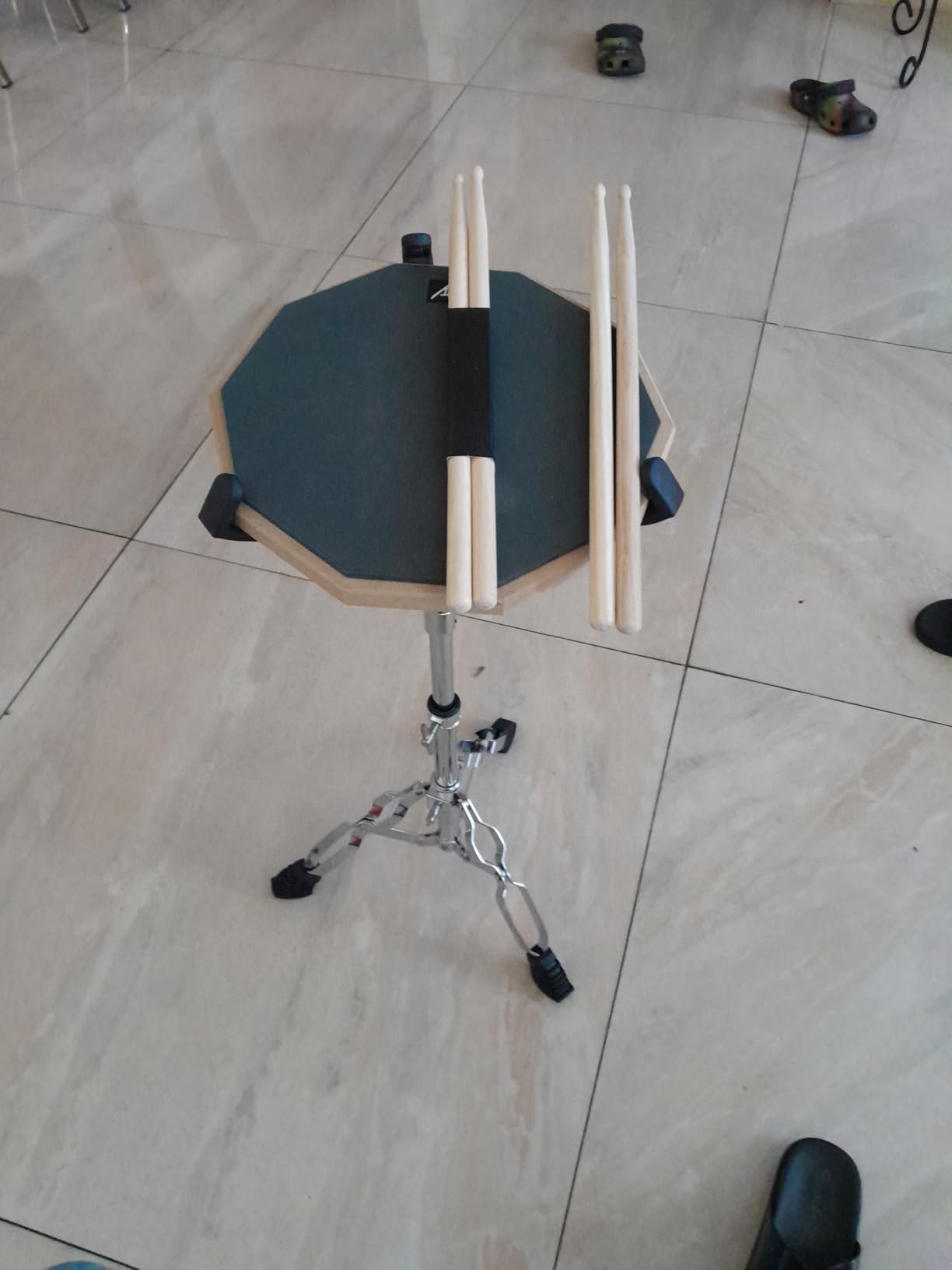
The silicone surface has good response and holds up under repeated striking, and being double sided you get two faces to work with. The base construction is solid rather than flimsy, and the rubber grippers on the tripod keep it planted on carpet and on hard floors where a bare stand slides.
It is also the bulkiest option here. Owners note it is heavier than expected to carry for what looks like a small kit, so plan the move before you plan the practice session. The set carries a 6 month manufacturer warranty, which is worth having on a package with this many parts.
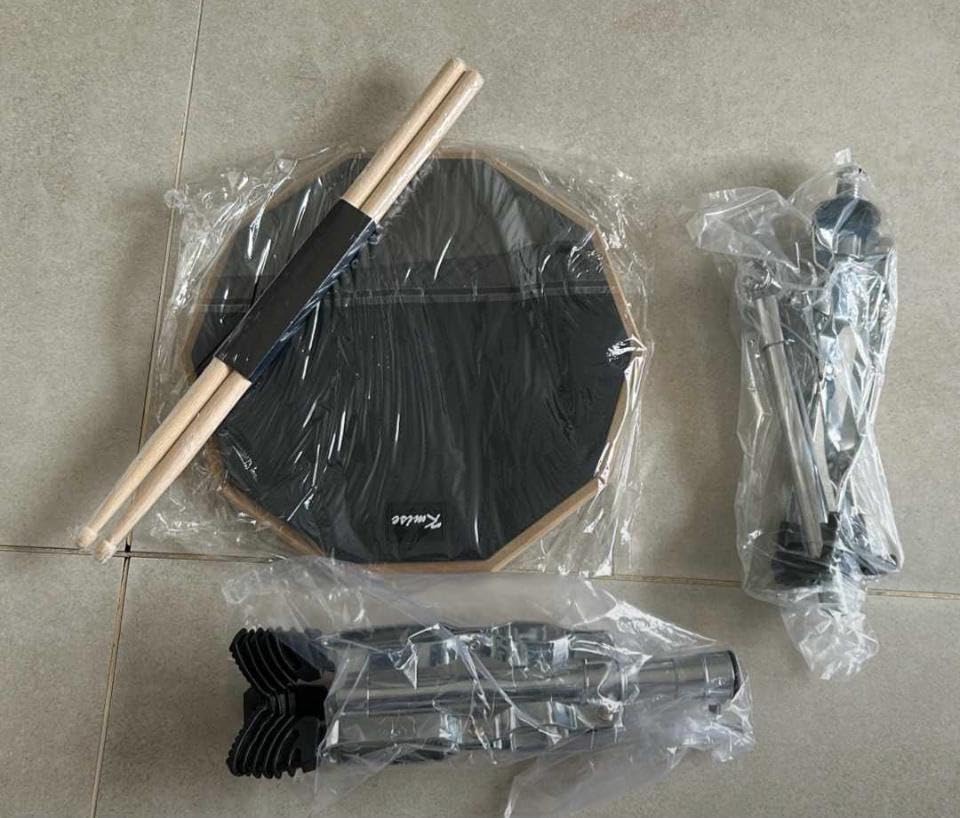
Who the Horse stand set suits
Anyone practising outdoors or in a space where noise travels. A garden, a garage, a room with a shared wall. The Aspen and EVA stack is the reason, and it is the same acoustic logic as the louder practice kits sold for exactly this problem.
Households where a child and an adult both practise, since the 23 to 31 inch range covers both at correct height. The foldable tripod also means it packs into a car boot, which is rare for a set that includes a stand.
Where the Horse stand set falls short
It is the heaviest and least portable package in this roundup, and the foldable stand is a two hand job to reassemble. If your practice spot is one room, you are carrying equipment you did not need to carry.
It also has the smallest review base of the established options, so there is less long-term evidence on how the silicone surface and the tripod hardware age. The bundled sticks are basic. Inspect the basket adjustment and the rubber arms as soon as it arrives rather than assuming.
How to Choose a Practice Pad in Seven Steps
Work through these in order and the right pad becomes obvious. Start with where you will actually practise, then work down to the surface, because the surface is the only decision you cannot change later without buying again.
1. Fix the space first. A table, a lap, a snare basket and a floor area are four different requirements. Lap and table players need a base that grips and a weight that stops the pad sliding. Stand players need a pad that either fits a basket or comes with a stand tall enough to hold snare height.
2. Pick your diameter. Six and 7 inch pads suit travel and young players. Eight inch is a genuine lap pad for beginners. Ten inch gives you a snare basket fit and rolls without feeling cramped. Twelve inch is the standard adult surface and the most transferable to an acoustic kit. Fourteen inch is a full kit working surface.
3. Choose the surface, not the brand. Gum rubber for realistic rebound, hard or recycled rubber for endurance and loudness control, coated head for real drum feel, silicone for durability, mesh for electronic kit players. This single choice matters more than everything else on this list combined.
4. Count the surfaces you will use. Single sided pads do one job well. Double sided pads let you switch between technique and conditioning without a second purchase. If you are not sure, double sided wins.
5. Check the mounting, honestly. Will it fit a snare basket, will it take a stand, or does it need a table? Most pads do one of the three and only a few do more than one, which catches people out constantly because the listings rarely say it. A pad that will not mount anywhere forces you to stand over a table, and standing over a table is not practice posture.
6. Weigh it against your hands. Anything above about 4 pounds is a permanent fixture. Between 2 and 4 pounds is portable with effort. Under 2 pounds is genuinely carryable, and that is the weight band for children and hotel practice.
7. Treat accessories as optional and the base as essential. Included sticks are usually the weakest part of any bundle. A non-slip, shock absorbing base is what determines whether the pad is quiet and whether it stays where you put it. We have a separate guide on practice amplification for players who want more volume control than a pad alone gives.
Gum Rubber vs Hard Rubber vs Coated Head
Natural gum rubber is the surface that most closely copies a real drumhead. It is slightly textured, it returns the stick at a height you can work with, and it is quiet. Every Evans RealFeel in this roundup uses it, and drummers consistently describe it as the reference for how a practice pad should respond.
Hard or recycled rubber does less. It absorbs more of the stroke energy, which makes it quieter and much better for endurance work, because you are not fighting a surface that keeps giving energy back. It is also the firmer side on the two-sided pads. The trade is straightforward: realism on one side, muscle on the other.
A coated drumhead is a real head. It bounces the way a snare bounces, it sounds like a snare when you roll it, and you can judge hand volume and dynamics from the sound. It is the most useful surface for sticking accuracy and the loudest option by a wide margin. The Remo tunable pad in this roundup is the clearest example, and it is the reason that pad suits players whose main problem is roll control.
Silicone and polymer surfaces sit in between. They do not smell, they do not peel, and they do not take a stick marking, which makes them the most durable choice for someone playing hard every day. They also do not perfectly copy a drum, so they train control and endurance rather than feel. Gel and conditioning pads go further in the same direction, trading all realism for silence.
How Quiet Is a Practice Pad, Really?
Honest answer: a good practice pad reduces noise enormously but it does not remove it. A 12-inch gum rubber pad at controlled stroke height is close to silent to anyone outside the room. Play full power rock strokes on any rubber pad and you will produce a sharp, metronome-like click that carries through a wall, because that click is the stick and it is not something a rubber slab can absorb.
Rough order of quietness, quietest first. Gum rubber and conditioning surfaces are quietest. Pads with shock absorbing bases and cotton or EVA layers come next, because the base is what stops the impact reaching the table. Hard rubber sides are louder, and coated heads are loudest of all, since a head is designed to ring.
The thing most buyers misunderstand is that a pad alone rarely fixes a noise dispute. Drummers report formal complaints from noise compliance offices even while using quiet cymbals and practice pads, so the pad is one tool rather than the whole answer. The rest is time of day, neighbours being told in advance, and how hard you are actually hitting it. If you need to monitor without adding room volume, our headphone picks for drummers are worth a look.
If silence is genuinely your priority, the honest options are the single-sided RealFeel for the quietest realistic rebound, the GrowDaily 12-inch for shock absorption, and the Donner snare simulation pad for when you need the noise of wires without the noise of a drum.
What to Actually Practise on a Pad
A pad does not teach you anything on its own. Here is a structure that works, and it takes twenty minutes.
1. Match the stroke. Sit at snare height and play single strokes at a comfortable tempo, maybe 60 to 80 beats per minute. Focus on matching hand and stick height rather than speed. If you are on a stand, the height matters more than the pad.
2. Control the rebound. Play at a height where the stick just touches and returns. This is the single most transferable skill a pad develops, and it is the reason gum rubber beats a pillow for actual technique.
3. Run a rudiment ladder. Take one of the 40 standard rudiments, play it slowly until it is even, then raise the metronome by small steps. Drop back a step whenever accuracy falls apart. Going up in tempo only after clean accuracy is what separates progress from noise.
4. Work the sticking patterns. Paradiddle, single paradiddle, and the flam families give your hands coordination work that transfers directly to the kit. Add accents deliberately, because accent control is the whole reason to practise away from a drum.
5. Build endurance last. Long sessions on a firm or hard rubber side, or on a pillow if you want the lowest possible volume. Do this after the technique work, never instead of it.
A pillow is a legitimate free substitute and drummers use one for hand strength and bass technique. It is not a substitute for a pad for control work, because it gives almost nothing back, and the point of a pad is the return.
Frequently Asked Questions
What is the use of a drum pad?
A drum practice pad is a compact playing surface that behaves like a drumhead without resonating like one. You strike it with the same sticks and from the same position as a real kit, and the rubber, coated head or polymer surface absorbs the acoustic resonance while returning a controlled rebound. That lets you build hand technique, rudiments, speed and endurance for as long as you like, without the volume of a drum.
What to practice on drums as a beginner?
Start with matched single strokes at 60 to 80 beats per minute, then work on controlling rebound height so the stick just touches and returns. Next run one of the 40 standard rudiments slowly with a metronome, raising the tempo only when accuracy stays clean. Add sticking patterns and deliberate accents, and save long endurance sessions on a firm surface for the end of the session.
What to use as a drum practice pad?
For a realistic acoustic feel, choose natural gum rubber such as the Evans RealFeel. For endurance work and low volume, choose a hard or recycled rubber face, which absorbs more stroke energy. For real drumhead feel and audible roll feedback, choose a tunable coated head such as the Remo RT-0010-58. A silicone or polymer pad is the most durable option, and a pillow is a free substitute for hand strength work.
Is a practice pad worth it if I already own a drum kit?
Yes, for most players. A pad removes the need to hit a real shell for volume reasons, so you can practise at unusual hours, in places a kit cannot go, and without the fatigue of a full acoustic hit. It also builds hand technique faster than a kit, because you hear every stroke clearly and can focus purely on stroke height and accuracy.
How quiet is a drum practice pad?
A good practice pad reduces noise a great deal but does not eliminate it. Gum rubber and conditioning surfaces are the quietest, shock absorbing bases cut the impact that reaches the table, hard rubber sides are louder, and coated heads are the loudest because a head is designed to ring. Full power strokes produce a sharp click on any rubber pad, so stroke height matters more than the pad you chose.
What size practice pad should I buy?
Choose 6 or 7 inch for travel and for young players, 8 inch for lap practice by a beginner, 10 inch if you want it to fit a snare basket and to play rolls without feeling cramped, and 12 inch as the standard adult surface that transfers most directly to an acoustic kit. Fourteen inch pads give you a full working area for multi surface practice.
Conclusion
The Evans RealFeel Attacktile 12-inch two-sided pad is the best practice pad for drummers overall, because two realistic surfaces in one heavy, stable slab solve the technique and conditioning problem at the same time. The single-sided RealFeel is the one to buy if noise is the deciding factor, the Remo tunable pad is the choice for roll control and real drumhead feel, and the Donner 8-inch is the right pick for beginners and for anyone outfitting a practice room in numbers.
Beyond those, the GrowDaily 12-inch is our pick for shared walls, the Donner snare simulation pad earns its place for anyone who misses the sound of wires, the Offworld Invader V3 is the one for saving your sticks, and the three stand sets cover anyone who needs a full practice station rather than a slab. Whichever you pick, the pad is the tool and the routine is the practice, so set the metronome and start with matched strokes.