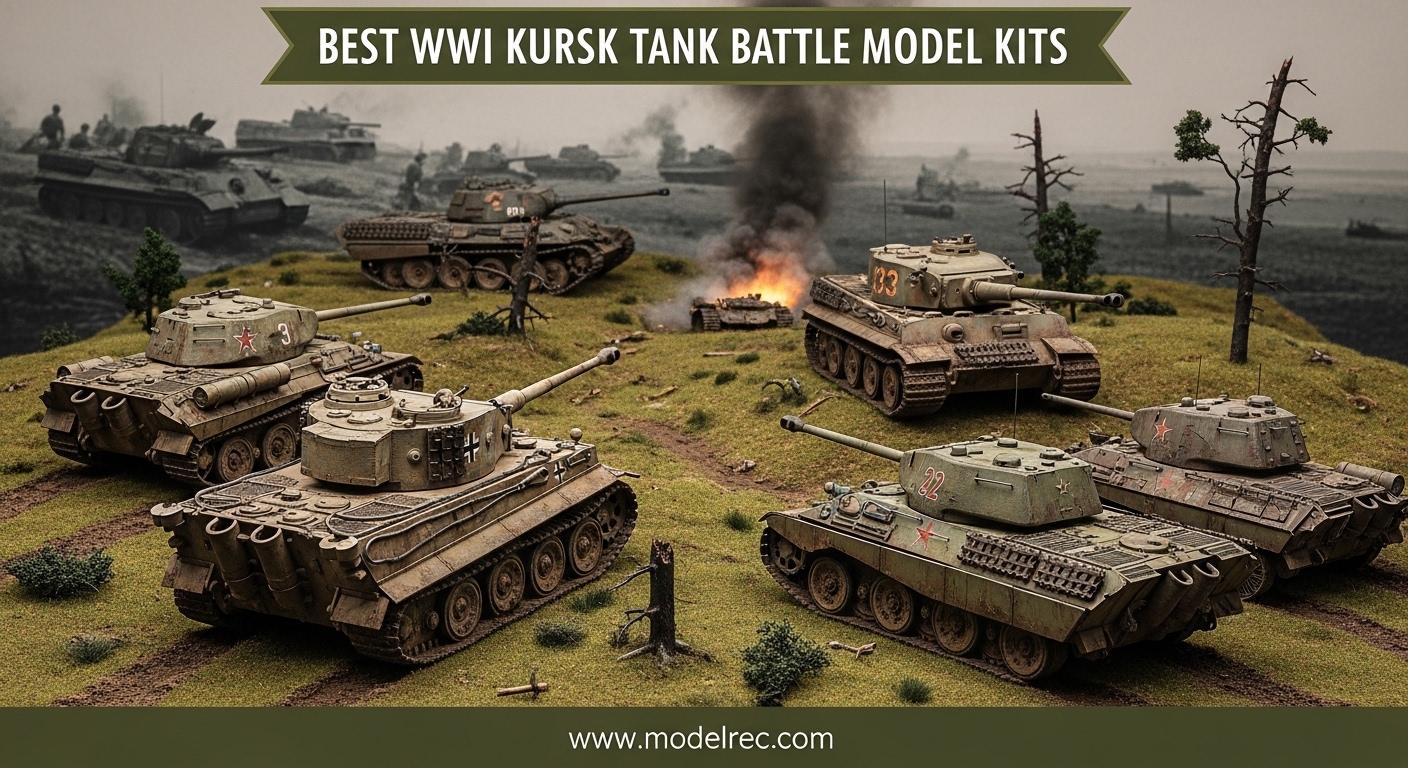
The Battle of Kursk remains the largest tank battle in human history, fought over the scorching plains of southern Russia in July 1943. Operation Citadel pitted 2,450 German tanks against 3,600 Soviet vehicles in a cataclysmic clash that would mark the end of German offensive capability on the Eastern Front. For modelers like myself, recreating these legendary tanks offers a connection to this pivotal moment that no textbook can provide.
I’ve spent the past 15 years building WWII armor, and my collection includes over 40 tanks and self-propelled guns from this period. What draws me to Kursk subjects is the incredible variety – from the brand-new Panther Ausf D making its combat debut to the battle-hardened T-34/76 that had already carried the Soviet war effort for two years. The kits available today capture these machines with remarkable detail, allowing us to build accurate representations of the tanks that decided the outcome on the Eastern Front.
This guide covers the best WWII Kursk tank battle model kits available, focusing on vehicles that actually fought during Operation Citadel. While some Sherman and Hetzer kits aren’t historically accurate for Kursk (Shermans weren’t present at the battle, and the Hetzer entered service later), I’ve included them because modelers often build Kursk-themed dioramas with extended timelines or combined Eastern Front themes. Each kit below has been evaluated for historical accuracy, build experience, detail quality, and value.
Table of Contents
Top 3 Picks for WWII Kursk Tank Battle Model Kits (August 2026)

Tamiya Tiger I Early Production
- Superior fit and finish
- No flash on parts
- Detailed flexible tracks
- Movable turret and gun
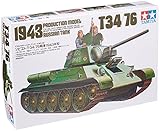
Tamiya T-34/76 1943
- Beginner-friendly build
- Multiple marking options
- Three figures included
- Good value price point

Tamiya Panther Ausf A
- Simple enjoyable build
- Good quality plastic
- Easy assembly
- Classic kit from 1978
10 Best WWII Kursk Tank Battle Model Kits (August 2026)
| Product | Specifications | Action |
|---|---|---|
| Tamiya T-34/76 1943 |
|
Check Latest Price |
| Tamiya Tiger I Early |
|
Check Latest Price |
| Tamiya Panther Ausf A |
|
Check Latest Price |
 Tamiya M4A3E8 Sherman Tamiya M4A3E8 Sherman |
|
Check Latest Price |
 Tamiya M4 Sherman Tamiya M4 Sherman |
|
Check Latest Price |
 Tamiya King Tiger Tamiya King Tiger |
|
Check Latest Price |
 Tamiya Panzer III Ausf L Tamiya Panzer III Ausf L |
|
Check Latest Price |
 Tamiya Sturmgeschutz IV Tamiya Sturmgeschutz IV |
|
Check Latest Price |
 Tamiya Hetzer Tamiya Hetzer |
|
Check Latest Price |
 Tamiya Panzer II Tamiya Panzer II |
|
Check Latest Price |
1. Tamiya T-34/76 1943 – The Soviet Workhorse
Tamiya 35059 1/35 Russian T34/76 1943 Tank Plastic Model Kit
1/35 Scale
Vinyl tracks
3 marking options
Includes 3 figures
Pros
- Beginner-friendly build|Good fit between hulls|Minimal flash|Multiple accessories included
Cons
- Decals can be tricky|Rubber tracks may warp hull|Older 1975 mold
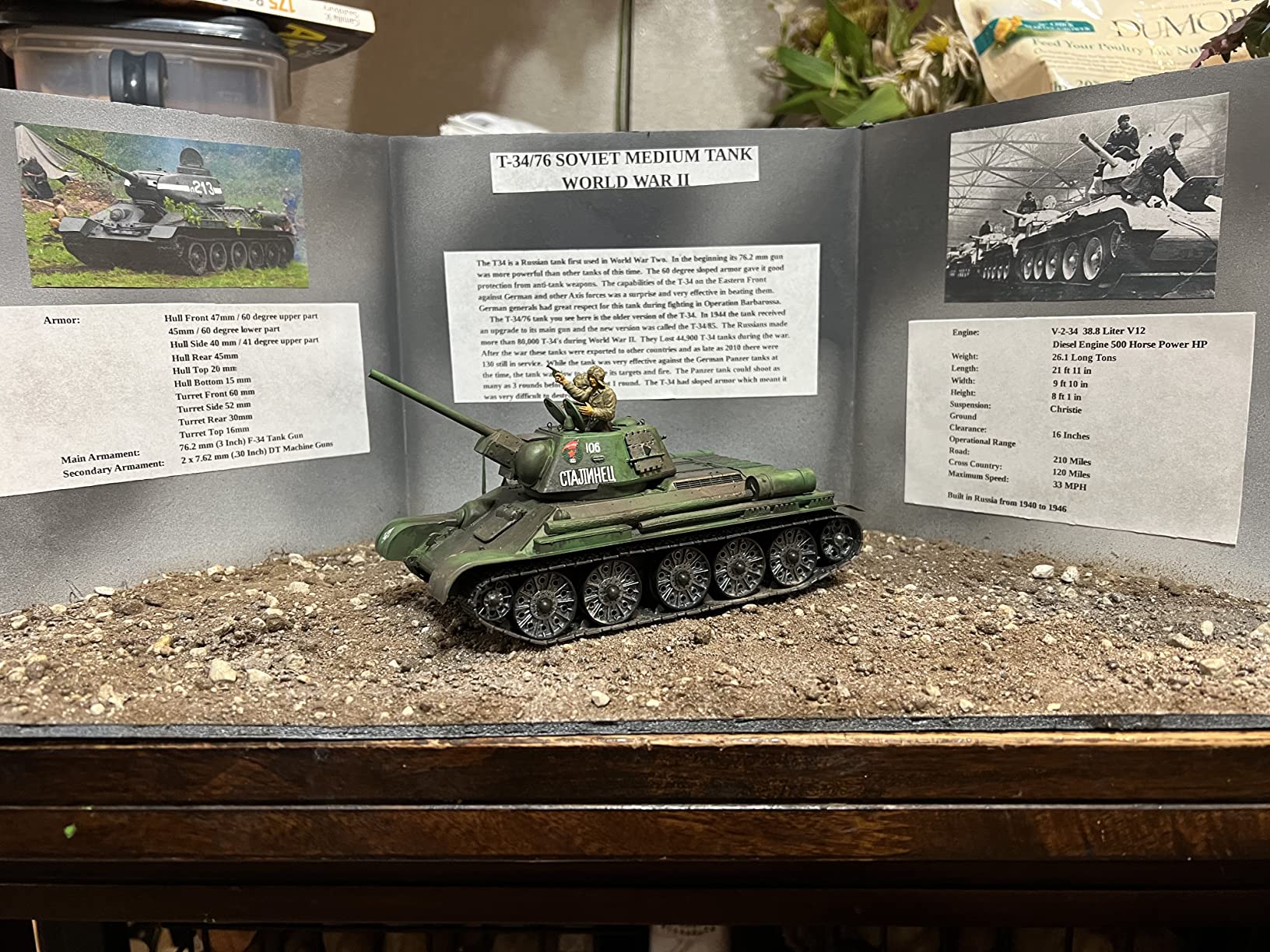
The T-34/76 is essential for any Kursk diorama – it was the backbone of Soviet armored forces in July 1943. I built this kit last year as part of a Prokhorovka scene, and it remains one of my most enjoyable builds. The fit between the upper and lower hull is excellent, requiring almost no filler. For under $30, you get a solid representation of the tank that essentially won the Eastern Front.
What impressed me most was how Tamiya included both styles of fuel canisters, logs, storage boxes, and spare tracks. These stowage items let you customize the appearance, which matters because T-34s at Kursk were famous for their exterior clutter. The three figures included are decent quality and fit well in or around the vehicle. Building this took me about 12 hours total, making it a great weekend project that doesn’t overwhelm beginners.
The technical aspects of this kit reflect its 1975 origins, but that’s not necessarily bad. The one-piece vinyl tracks are forgiving – they stretch over the sprockets easily and hold their shape once glued. However, I did notice they can be tight and may slightly warp the lower hull if you’re not careful during installation. The molding is crisp with minimal flash, which surprised me for a kit this old. You get markings for three different tanks, all historically appropriate for 1943, though I wish Tamiya had included more unit-specific information.
This kit really shines for intermediate builders who want to practice weathering techniques. The casting texture on the turret provides a great surface for applying washes and filters. I used a combination of Tamiya XF-4 Yellow Green and XF-59 Desert Yellow to achieve that classic Soviet green, then added chipping on the hull edges where crews would have climbed aboard. The result looks authentic and captures the rugged, utilitarian nature of Soviet armor. If you’re looking for your first T-34 or want to add Kursk-authentic Soviet armor to your collection, this kit delivers excellent value.
Best For Beginner to Intermediate Modelers
The T-34/76 kit hits a sweet spot in difficulty. New builders will appreciate the straightforward engineering and minimal fit issues. The instructions are clear, and the parts count is manageable enough to not feel overwhelming. However, there’s enough detail to keep experienced modelers interested, especially when it comes to painting and weathering. I’ve built three of these kits over the years, and each one gets easier while still offering opportunities to try new techniques.
The vinyl tracks, while not as detailed as individual links, are forgiving for beginners still learning proper track assembly. They don’t require the patience and precision that link-by-link construction demands. This makes the T-34/76 an excellent choice if you’re transitioning from simple armor kits to more complex projects. The learning curve here is gentle, and mistakes are easily corrected without ruining the build.
Limitations for Detail-Obsessed Builders
If you demand every bolt and rivet in perfect scale, this kit will disappoint. The molding represents Tamiya’s 1970s technology – accurate enough but not surgical in precision. The road wheels lack the separate hubs that more modern kits provide, and the hull hatches are molded closed. Advanced modelers will want to add photo-etched brass for the engine grilles and perhaps a metal barrel for the main gun. The decals can also be problematic – they’re thick and don’t settle well without extensive setting solution.
That said, these limitations are also opportunities. The simplified construction means you can focus your energy on painting and weathering rather than agonizing over tiny parts. For diorama builders, the solid hull makes the tank more durable. And the aftermarket support for T-34s is enormous – you can easily upgrade this kit with individual track links, detailed road wheels, and enhanced photo-etched parts if you want to take it to the next level.
2. Tamiya Tiger I Early Production – German Engineering Excellence
Tamiya 35216 1/35 Ger. Tiger I Early Production Tank Plastic Model Kit for Unisex Adult
1/35 Scale
Flexible tracks
Movable turret
Open/close hatches
Pros
- Perfect fit|No flash|Superior detail|Multiple paint options
Cons
- Rubber tracks hard to glue|Older 1997 mold|No photo-etch included
The Tiger I Early Production represents the pinnacle of German tank engineering in 1943, and this Tamiya kit does it justice. I’ve built two Tiger kits from different manufacturers, and this remains my benchmark for quality. The engineering is simply superb – parts fall together with that satisfying precision that makes Tamiya famous. Despite using molds from 1997, there’s zero flash on any of the parts. The detail is crisp, the fit is exact, and the resulting model looks impressive straight out of the box.
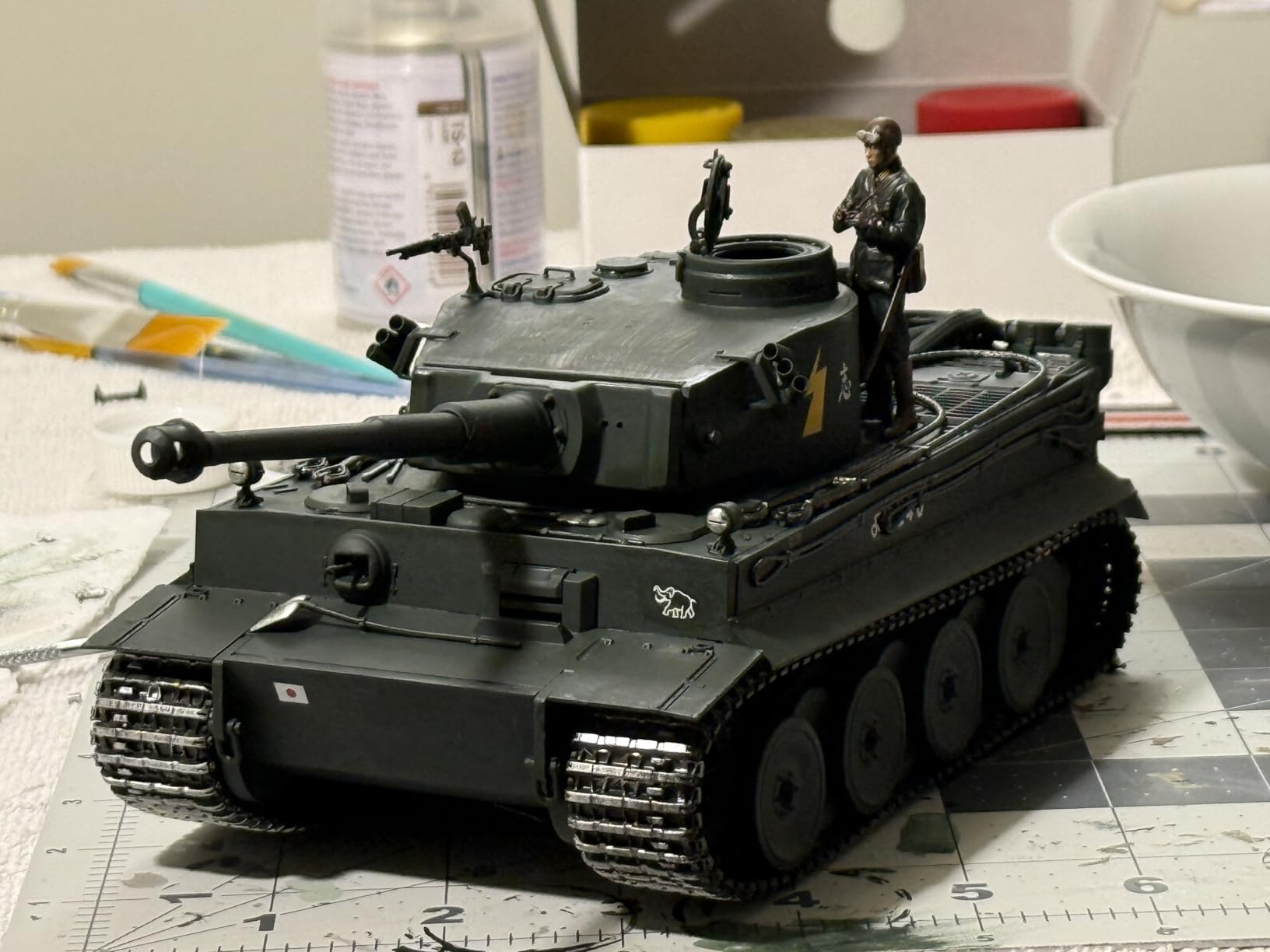
What sets this Tiger apart is the attention to historical accuracy. The Early Production variant is correct for Kursk, as Tigers of s.Pz.Abt. 505 fought with the 9th Army during the northern pincer of Operation Citadel. I completed a build of this kit last autumn depicting a tank from that unit, complete with the characteristic dunkelgelb base and minimal camouflage. The flexible tracks, while requiring patience to assemble correctly, drape naturally once installed and capture the sag of the real thing. Building this kit took me about 18 hours, but the experience was smooth from start to finish.
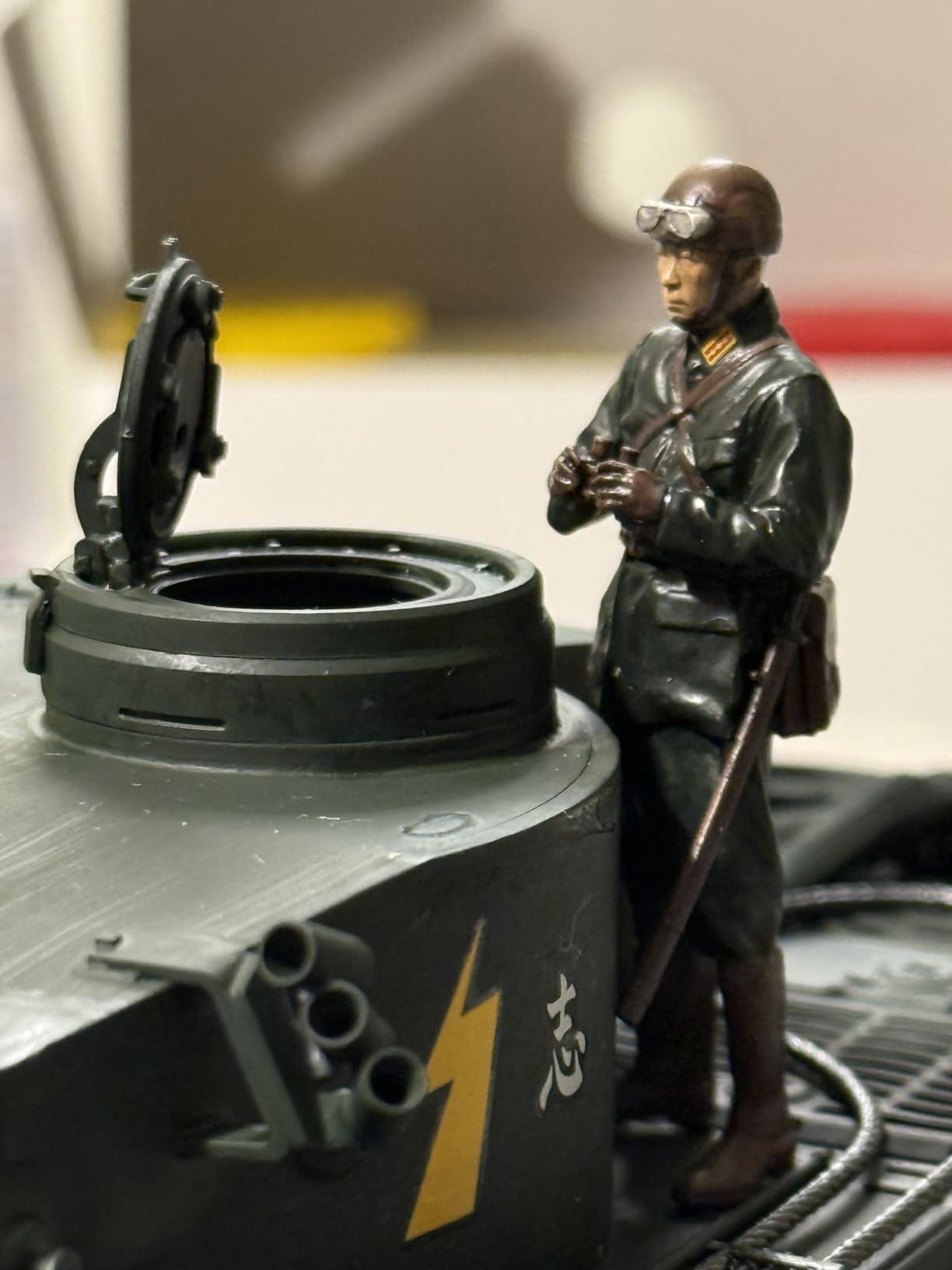
The movable features on this kit are excellent for creating dynamic poses. The turret rotates freely, the main gun elevates, and the hatches can be positioned open or closed. This flexibility matters if you’re planning a diorama – you can show the commander looking out of the cupola or the crew loading the main gun. The molding quality is exceptional for its age, with crisp casting texture on the rear deck and delicate grab handles that are impressive in plastic. I only wish Tamiya had included photo-etched brass for the engine grilles, as the molded plastic alternatives look slightly thick under close inspection.
Painting the Tiger is both a challenge and a joy. The box provides multiple historical schemes, and I chose the 505th Abteilung option with tactical number 121. Using Tamiya’s acrylics, I started with XF-60 Dark Yellow as the base, then added XF-61 Dark Green and XF-64 Red Brown camouflage patches. The key with German armor is subtlety – the camouflage shouldn’t look too planned. I used small pieces of ripped masking tape to create soft, irregular edges between colors. The result captured the hurried factory application that characterized Tigers rushed to the front for Kursk.
Ideal for Intermediate to Advanced Modelers
This kit rewards builders who have some experience under their belt. While the engineering makes assembly straightforward, achieving a show-quality finish requires skill with airbrushing and weathering. The rubber tracks, while detailed, need careful handling. I’ve found that using cyanoacrylate glue with a Zip Kicker accelerator works best – the track joints hold firmly without the long curing times of plastic cement. This technique demands some practice, as you only get one shot at getting the track length correct before the glue sets.
The absence of photo-etched parts actually works in your favor if you’re still developing your skills with metal photo-etch. The molded details are good enough that the model looks complete without adding aftermarket upgrades. This lets you focus on painting techniques rather than fiddling with tiny brass parts. Once you’ve mastered this kit, you can come back and add photo-etched grilles, a metal barrel, and individual track links for a second, more advanced build.
Considerations for Diorama Builders
If you’re planning a Kursk diorama, the Tiger I Early gives you excellent possibilities. The tank’s imposing presence makes it a natural focal point, and the movable hatches let you show crew interaction. I placed my Tiger at the head of a column with a Panzer III behind it, creating a sense of the heavy tank leading the advance. The kit’s accessories, while not extensive, provide enough stowage options to break up the clean lines of the hull. You may want to add aftermarket crew figures, as the kit doesn’t include any figures beyond the suggestion of posing possibilities.
One consideration for dioramas is the Tiger’s size – it’s a substantial model at nearly 10 inches in length. This means you need a substantial base to do it justice, especially if you’re adding accompanying vehicles. The weight of the completed model is also significant, so ensure your diorama base can support it without sagging. These are minor considerations, though, for what is undoubtedly one of the most satisfying armor kits I’ve ever built.
3. Tamiya Panther Ausf A – Kursk’s Problem Child
Tamiya Models German Pzkfw V Panther Ausf A Model Kit
1/35 Scale
Vinyl tracks
Simple build
Multiple markings
Pros
- Easy to build|Good quality plastic|Low price|Fun weekend project
Cons
- Inaccurate rubber tracks|Basic periscopes|Solid exhaust pipes|Simple details
The Panther Ausf A holds a special place in Kursk history – it was supposed to be Germany’s wonder weapon, but mechanical failures doomed its debut. This Tamiya kit, dating from 1978, captures the Panther’s silhouette but simplifies many details. For under $25, it’s an accessible entry point to Panther modeling, though serious modelers will want to upgrade several components. I built this kit early in my modeling journey, and it taught me valuable lessons about modifying basic kits into something more detailed.
The most significant issue with this kit is the rubber tracks. They’re completely smooth on the inside – nothing like the real Panther’s intricate track design. Additionally, they’re generic Tamiya tracks that don’t accurately represent Panther pattern. When I built this kit, I replaced them with aftermarket individual link tracks, which transformed the appearance completely. If you’re budget-conscious, the included tracks are usable with careful painting, but they’re the kit’s weakest element by far.
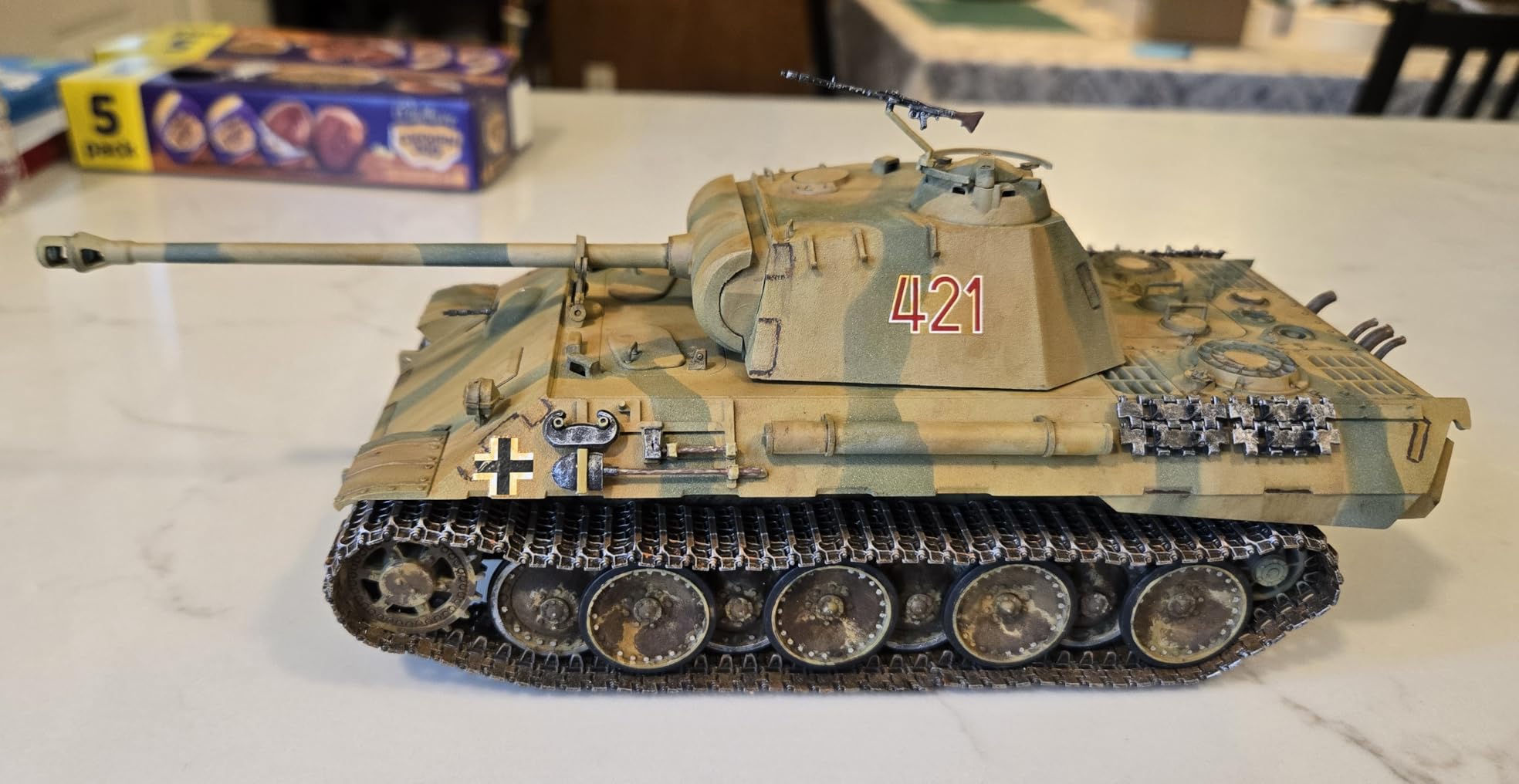
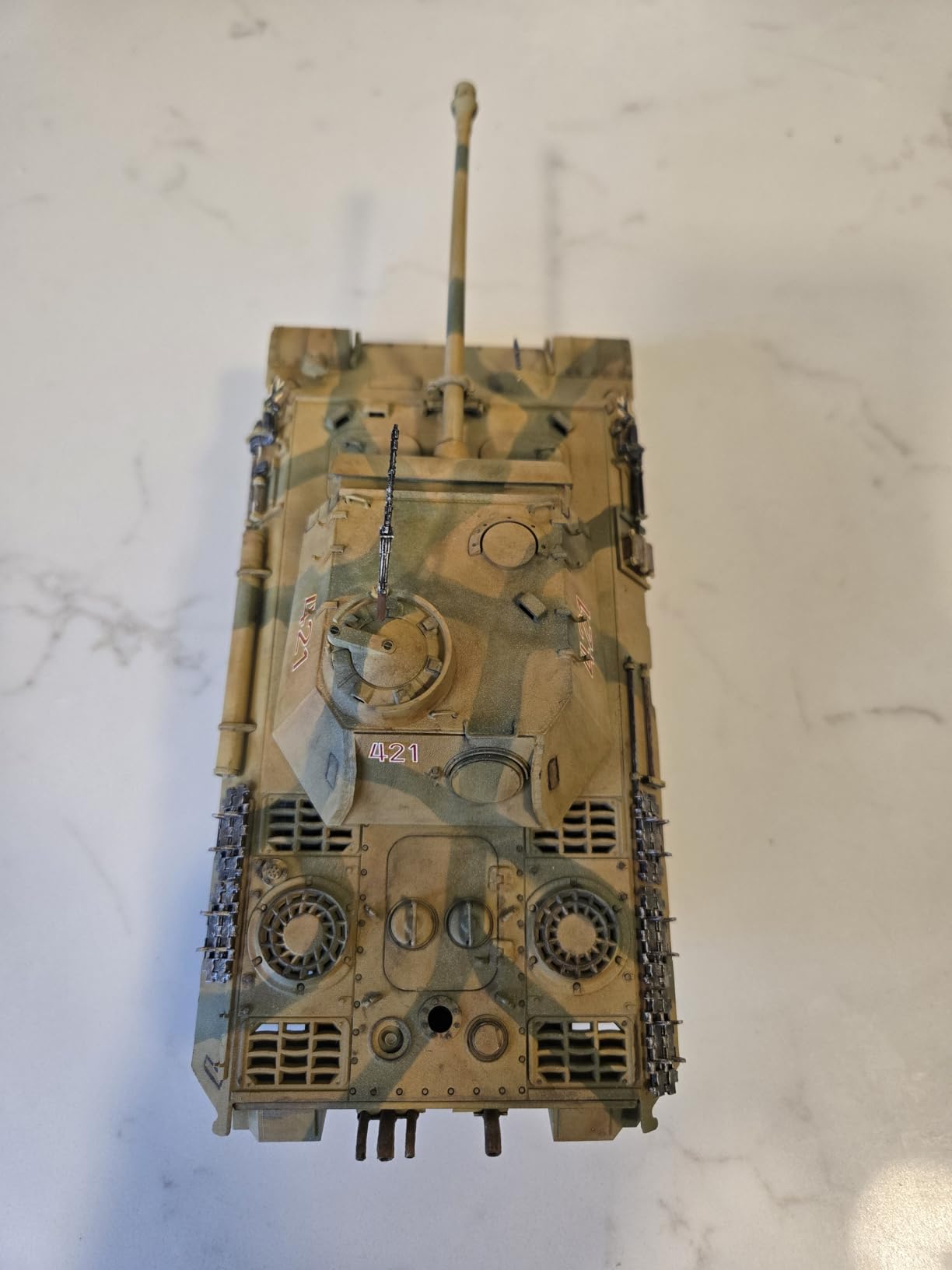
Construction of this Panther is straightforward and enjoyable. The plastic is thick and robust, making it forgiving for beginners. The chassis fits to the underbelly flawlessly – I used no filler at all during my build. Very little flash needs to be removed, and the parts separate cleanly from the sprues. At 7.7 inches in length, the completed model is smaller than a Tiger but still has a commanding presence. Build time runs about 10-12 hours, perfect for a relaxing weekend project.
The kit’s simplicity extends to the details. The periscopes are basic arch shapes that lack the reflective quality of real vision devices. The exhaust pipes are solid plastic rather than hollow, which looks incorrect from certain angles. However, these shortcomings provide opportunities to practice scratchbuilding and modification. I replaced my exhaust pipes with hollow brass tubing, which dramatically improved the appearance. The commander figure included is decent but stiff – consider upgrading to a resin figure if you want a more dynamic pose.
Perfect for Beginners and Practice Builds
This Panther excels as a learning platform. The simple engineering lets new modelers focus on fundamental skills like seam removal, priming, and basic weathering. I used my build to experiment with German three-color camouflage for the first time. The forgiving nature of the kit meant mistakes could be corrected without major problems. If you’re new to armor modeling or specifically interested in Panthers, this kit provides a low-stakes environment to develop your techniques.
The low price point also makes it attractive. At under $25, you can afford to buy two kits – one to practice painting techniques on, and another to build carefully with aftermarket upgrades. Many experienced modelers keep one of these kits around precisely for this purpose. It’s become something of a tradition in the modeling community to build a Tamiya Panther as a warm-up before tackling more complex projects from Takom or Dragon.
Requires Aftermarket for Historical Accuracy
For a serious Kursk diorama, this kit needs help. The rubber tracks must go – replace them with individual link tracks from Fruilmodel or Dragon. The road wheels are simplified and lack the separate outer rims characteristic of Panthers. Model Master and other manufacturers offer detailed replacement wheels that dramatically improve accuracy. The mufflers should be replaced with hollow aftermarket versions, as the solid plastic parts are noticeable once you start weathering.
Despite these requirements, the basic Panther shape is correct, and the dimensions are accurate. The turret shape captures the distinctive Ausf A profile, and the gun barrel is acceptably straight. With strategic aftermarket additions, this budget kit can become a centerpiece model. I’ve seen competition-quality builds based on this kit that required only about $50 in upgrades to rival kits costing three times as much.
4. Tamiya M4A3E8 Sherman – Modern Tooling Excellence
Tamiya 35346 1/35 US Medium Tank M4A3E8 Sherman Plastic Model Kit
1/35 Scale
Slide mold tech
Clear parts
Belt-type tracks
Pros
- Super detailed|Excellent fit|Clear light parts|Modern molding
Cons
- Some fragile parts|Rubber T66 tracks|Mold lines on wheels|Turret has molded number
The M4A3E8 Sherman, known as the “Easy Eight,” represents the ultimate evolution of the Sherman medium tank. While Shermans didn’t fight at Kursk, they’re frequently included in Eastern Front dioramas depicting late-war scenarios. This Tamiya kit benefits from modern slide molding technology, resulting in exceptional detail while remaining beginner-friendly. I built this kit last year as part of a four-tank diorama showing Allied and Soviet vehicles meeting at the Elbe, and the quality difference between this Sherman and older Tamiya kits is immediately apparent.
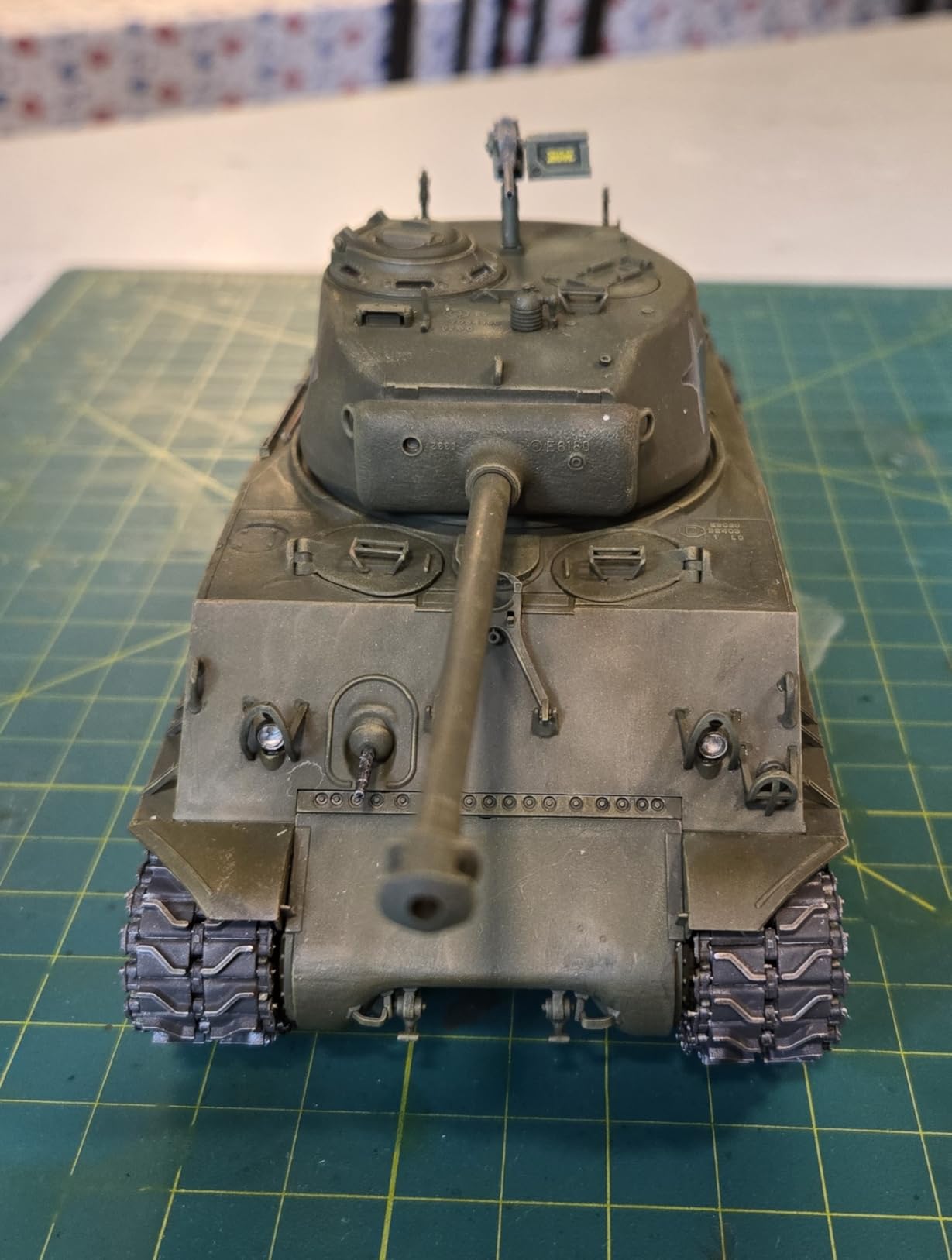
What sets this kit apart is the slide molded turret and upper hull. Tamiya achieved beautiful cast metal texture on the turret and realistic weld beads on the hull – all molded perfectly straight from the factory. The clear parts for the headlight lenses and cupola vision blocks are a nice touch that adds realism. Parts fit is outstanding, requiring minimal adjustment. The only construction challenge comes from some very small parts that demand careful handling and good tweezers.
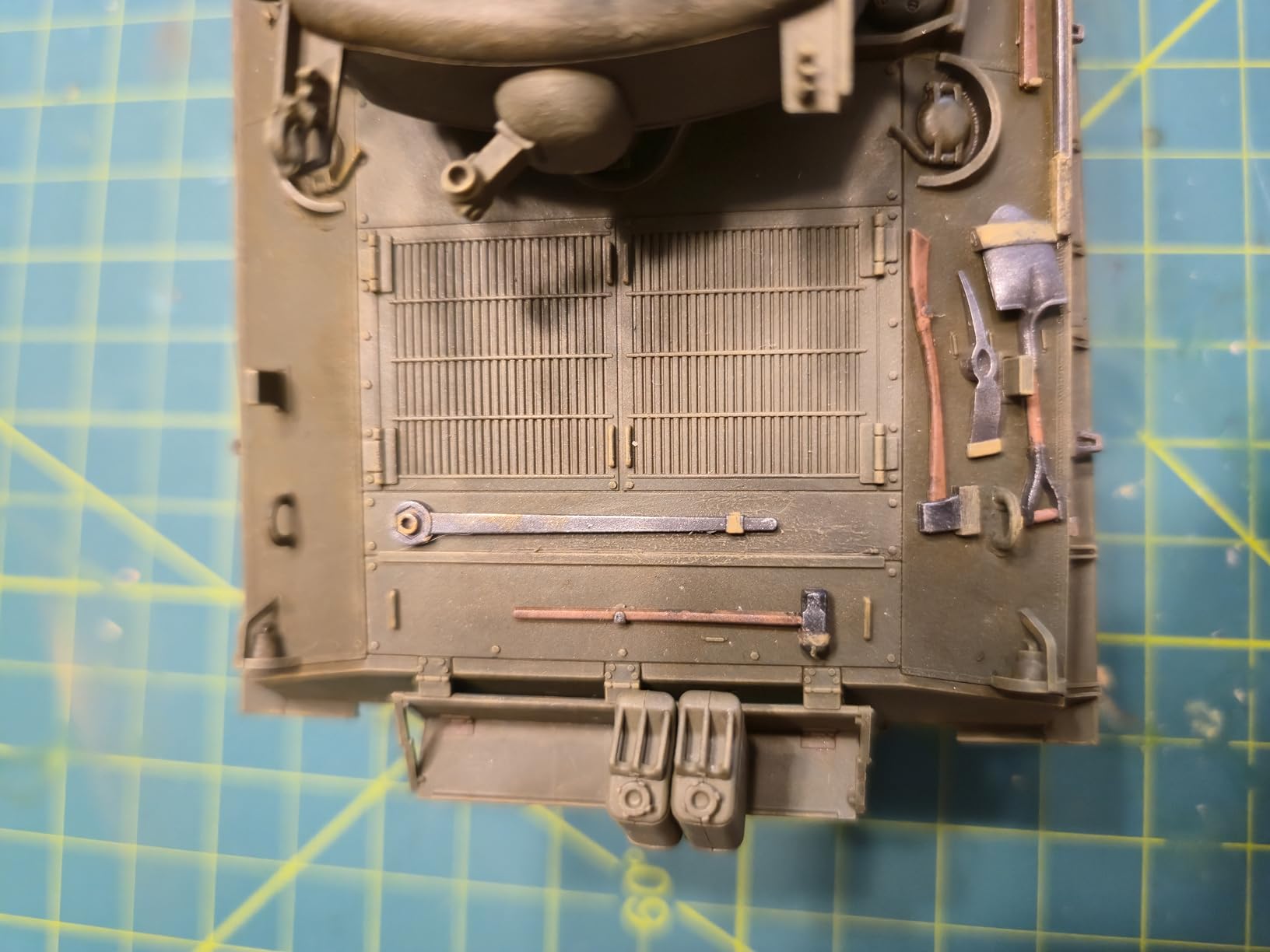
The technical sophistication of this kit shows in the small details. The drive sprockets have fine holes that catch light realistically. The suspension system is accurately reproduced, with separate road wheels that capture the Sherman’s distinctive VVSS (Vertical Volute Spring Suspension). The commander figure included is one of Tamiya’s better efforts – the pose is natural and the uniform details are crisp. Building this kit took approximately 15 hours, with most time spent on careful cleanup of tiny parts rather than correcting fit issues.
Painting the Sherman offers different challenges than German armor. The olive drab finish can look flat if you don’t add variation. I used Tamiya XF-62 Olive Drab as my base, then lightened it with XF-2 White for highlights on exposed surfaces. The clear parts for the headlights and vision blocks require careful handling – I painted them from behind using clear acrylics to simulate lit and unlit areas. The T66 belt-type tracks are adequate for most purposes, though advanced modelers may want to upgrade to individual links for the ultimate in realism.
Best for Modelers Wanting Modern Detail
This Sherman represents current state-of-the-art in Tamiya’s catalog. The slide molding allows details that were impossible just a decade ago. If you’re used to older kits, building this will feel like moving from a standard definition TV to 4K. The cast texture on the turret alone is worth the price – trying to reproduce that with putty on older kits takes hours and never looks as natural. This makes the Sherman perfect for modelers who want impressive results without endless scratchbuilding.
The included commander figure is another selling point. Many armor kits don’t include figures at all, or they’re so basic they’re unusable. This figure is well-sculpted and paints up nicely. He fits naturally in the cupola, and the clear vision block actually lets you position him realistically looking out of the tank. For diorama builders, this eliminates the need to buy a separate crew figure, saving both money and time.
Considerations for Historical Accuracy
It’s worth noting that while this is an excellent kit of the M4A3E8, the Easy Eight didn’t see service until after D-Day – long after Kursk. If you’re building a strictly accurate Kursk diorama, you’d want an M4A3 75mm wet Sherman instead. However, for general Eastern Front themes or late-war scenarios, this kit is perfect. The molded number on the turret bottom can be sanded off if it bothers you, though it’s largely invisible once the model is assembled and weathered.
The T66 rubber tracks are serviceable but represent the kit’s main compromise to keep the price reasonable. They’re detailed enough for most purposes, but if you’re entering competition or demand absolute accuracy, you’ll want aftermarket individual links. Similarly, the mold lines on the road wheels are noticeable and require careful removal before assembly. These are minor issues in what is otherwise an outstanding kit that showcases how far plastic modeling has come.
5. Tamiya M4 Sherman – Classic Sherman Build
Tamiya 35190 1/35 U.S. Medium Tank M4 Sherman Plastic Model Kit
1/35 Scale
Flexible tracks
Crew figures
Multiple markings
Pros
- Easy assembly|Lots of extras|Includes figures|Good fit overall
Cons
- Older kit design|Gap between turret and hull|Not for beginners|Accuracy issues
The classic M4 Sherman kit from Tamiya has been around for decades, introducing countless modelers to Allied armor. While newer Sherman kits offer more detail, this remains a enjoyable build with character. I built this kit as my very first armor model over 20 years ago, and returned to it recently for a nostalgic rebuild. The experience was still positive, though modern standards have raised the bar for what we expect from a kit.
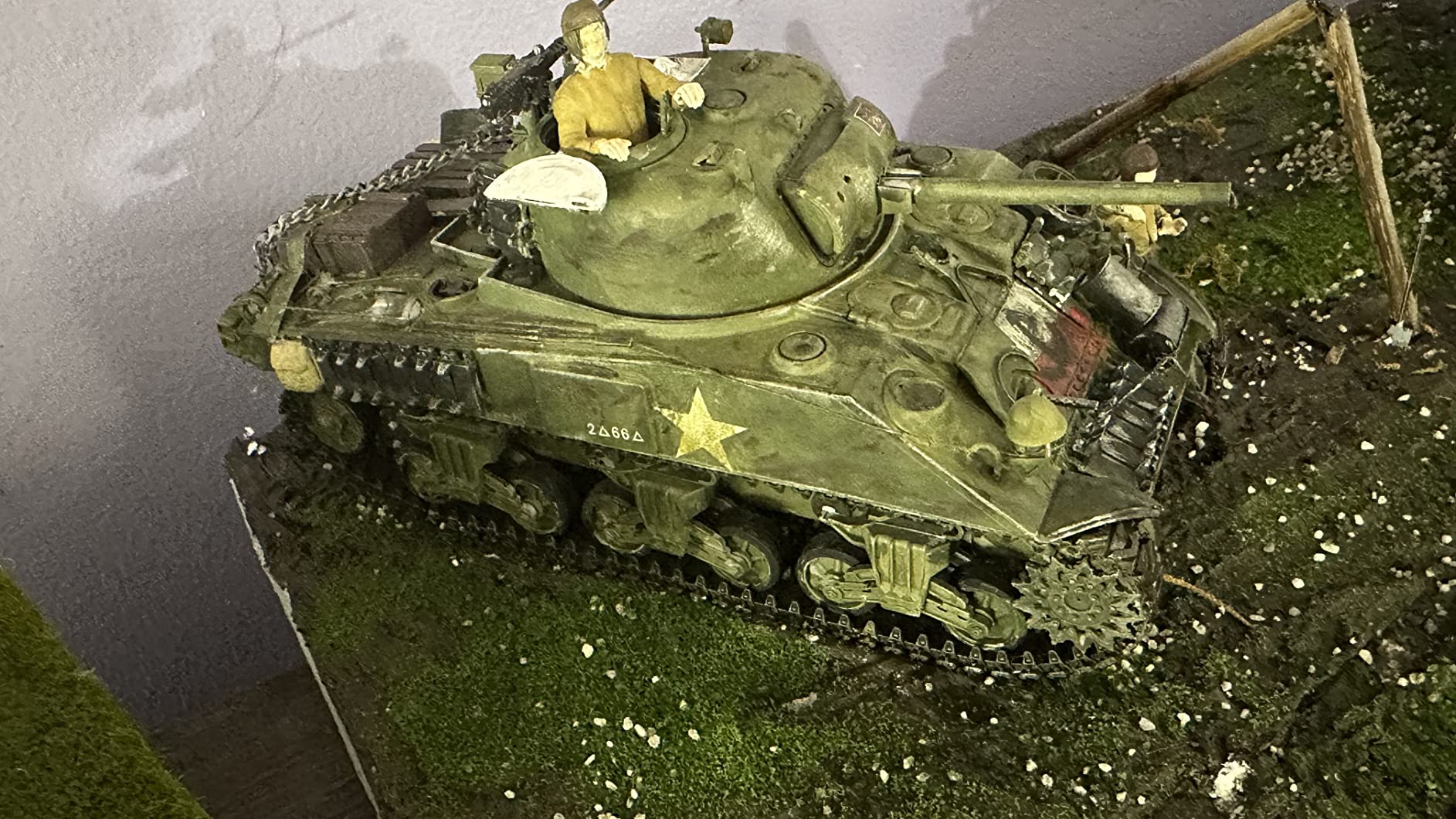
What this Sherman offers in abundance is extra stuff. Tamiya packed the box with crew figures, stowage items, and accessories. You get four figures in total – a tank commander, loader, driver, and infantryman. The stowage includes bedrolls, ammo boxes, tarps, and jerry cans. All these extras let you create a personalized, lived-in appearance that looks great in dioramas. The vinyl tracks are flexible enough to be glued with standard plastic cement, which is easier than dealing with the tiny pins on individual link tracks.
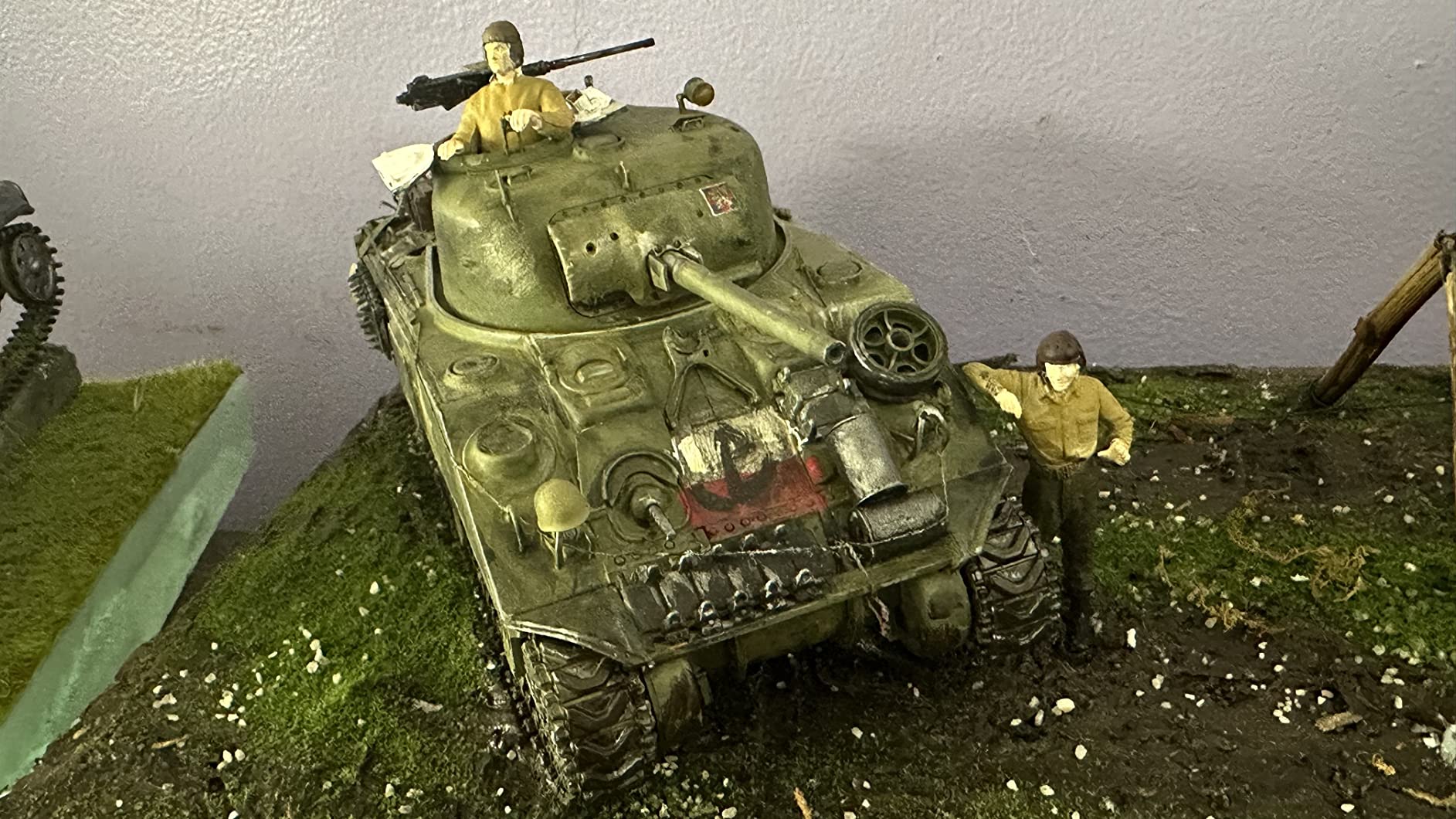
Assembly is straightforward, with Tamiya’s trademark good fit throughout most of the kit. The flexible tracks can be assembled as complete runs before installation, which saves time. However, this older kit does have some accuracy issues that more recent research has identified. The transmission cover shape isn’t quite right for a production M4, and some hull details are simplified. For most modelers, these inaccuracies won’t matter, but if you’re a stickler for precision, you may want to consider newer offerings from Dragon or Tasca.
The turret-to-hull fit can be problematic. I’ve noticed on multiple builds that there’s often a slight gap that requires filler. This isn’t a deal-breaker, but it does interrupt an otherwise smooth build. The gap can be minimized by carefully test-fitting and adjusting the fit of the turret ring before gluing. The many small stowage pieces, while adding detail, also present a challenge – they’re tiny and can be fiddly to attach. I recommend handling them with fine tweezers and using just enough glue to hold them without creating a mess.
Great Entry Point to Sherman Modeling
If you’re new to Shermans, this kit provides a solid foundation. The engineering is simple enough that you won’t get overwhelmed, but there’s enough detail to keep things interesting. The crew figures give you practice painting faces and uniforms, which are valuable skills. The stowage items teach you about planning your build – you need to think about which pieces to attach before painting and which to add later. This kind of planning is essential for more complex builds.
The low price makes this an attractive option for practicing techniques. You can experiment with different weathering approaches, try various camouflage schemes, or test new paint formulas without worrying about ruining an expensive kit. Many modelers keep one of these Sherman kits around precisely as a testbed for new techniques. I’ve used mine to experiment with chipping methods, filter applications, and pigment washes before trying these techniques on more expensive models.
Requires Planning for Best Results
To get the most from this kit, you need to plan your build carefully. The many stowage items should be painted separately before attachment – trying to paint around them once they’re glued to the hull is frustrating. Consider which hatches you want open and which you’ll close before you start construction. The crew figures need to be painted and installed at the right time – too early and they’ll get damaged, too late and you won’t be able to access certain areas.
The gap between turret and hull can be minimized with proper preparation. Dry-fit everything multiple times before applying any glue. If you find persistent gaps, consider using a thin plastic shim rather than filler – it’s less work to sand smooth. These planning considerations add time to the build but result in a much better-looking model. Take your time with the preparation phase, and the assembly will go smoothly.
6. Tamiya King Tiger Production Turret – Heavy Metal Mastery
Tamiya 35164 1/35 King Tiger Production Turret Tank Plastic Model Kit
1/35 Scale
8.3 inch length
Commander figure
3 paint schemes
Pros
- Excellent Tamiya quality|Easy assembly|3 paint schemes included|Good detail for price
Cons
- Small fragile parts|No glue/paint included|Older kit design|Limited Zimmerit detail
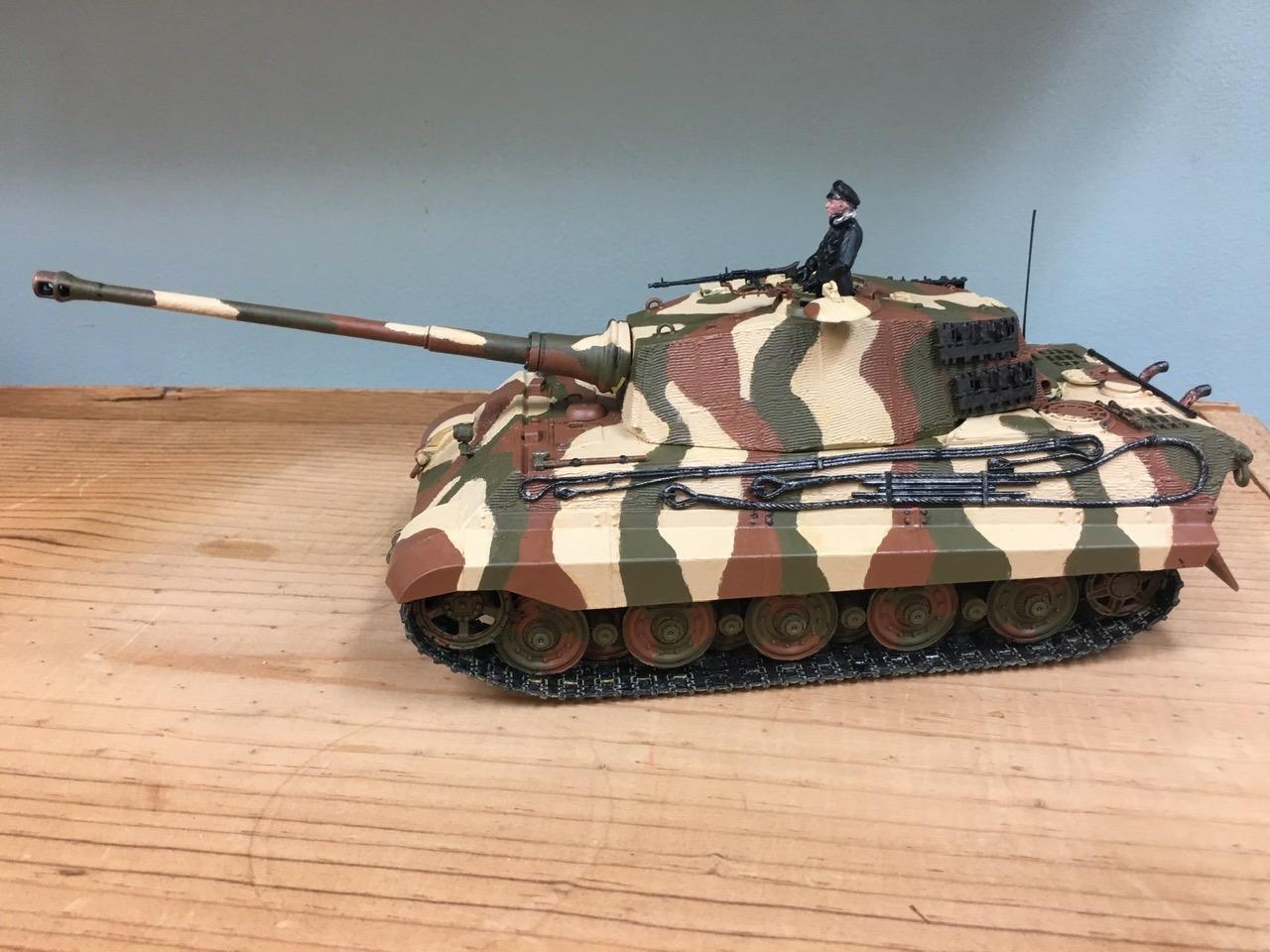
The King Tiger, or Tiger II, was Germany’s ultimate heavy tank – a 70-ton monster that Allied tanks struggled to penetrate. While Production Turret King Tigers didn’t see service at Kursk (they entered combat later in 1944), they’re popular in Eastern Front dioramas depicting late-war German armored units. This Tamiya kit captures the imposing presence of the King Tiger, measuring over 8 inches in length. I built this last winter as part of a diorama showing a King Tiger knocked down in Hungary 1945, and the completed model has undeniable shelf presence.
The kit’s strengths reflect Tamiya’s decades of experience. Parts fit is excellent throughout, with the hull going together without requiring filler. The molding quality remains high despite the age of the tooling – crisp details, no flash, and clean separation from sprues. Three different paint schemes are provided, giving you options for various theaters and time periods. The commander figure is well-sculpted and adds life to the model when positioned in the cupola.
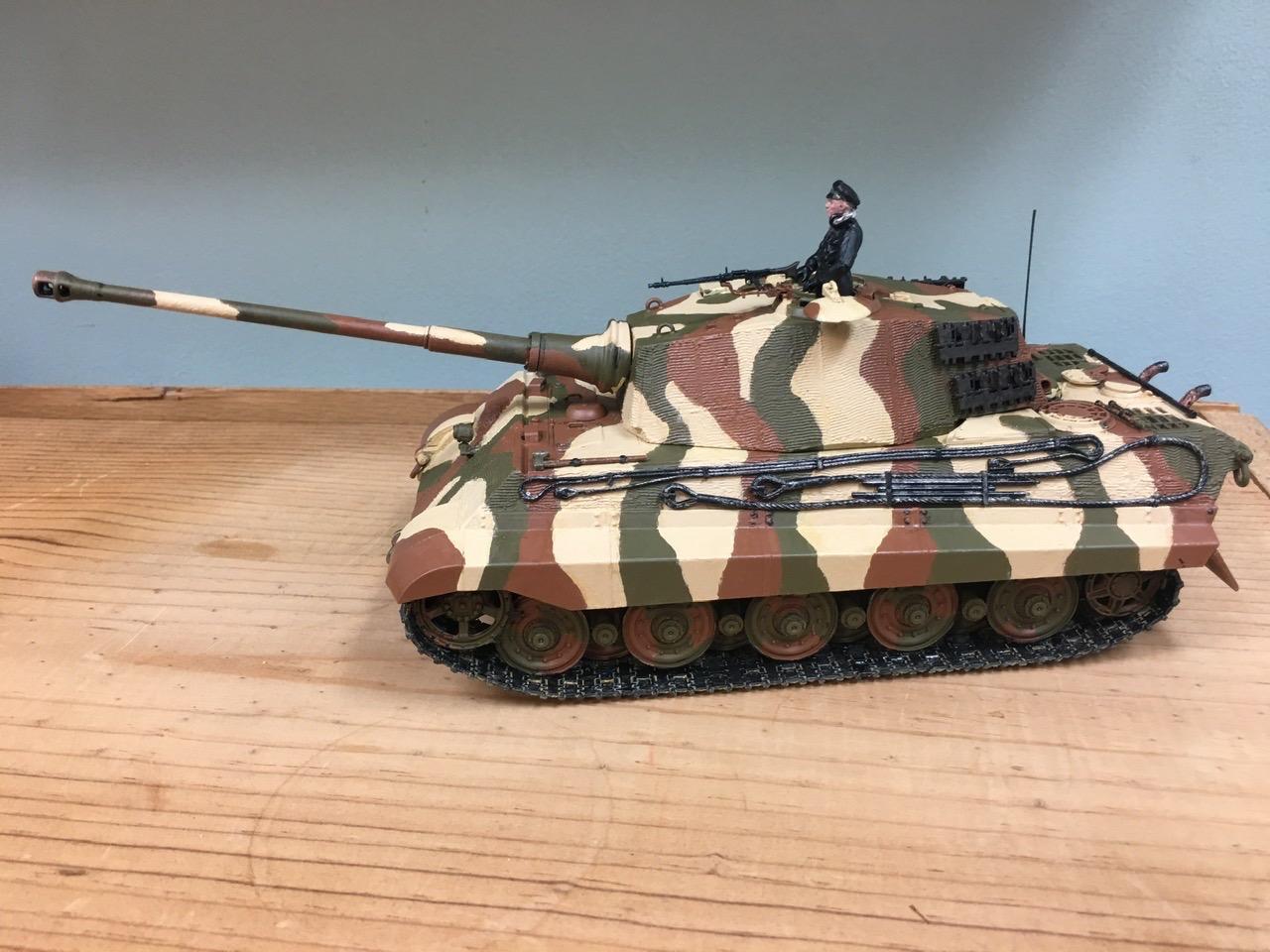
Construction is straightforward, making this King Tiger accessible to intermediate modelers. The single-piece rubber band style tracks assemble quickly compared to individual links, though they lack the ultimate detail of separate track assemblies. This represents a reasonable compromise – you get a model that looks impressive without spending weeks just on track work. Build time runs approximately 16 hours, which is reasonable for a tank this size and complexity.
The detail level is good for the price point. The road wheels are crisply molded, though they lack the separate outer rims that more expensive kits provide. The turret captures the characteristic shape of the Production Turret (sometimes called the Henschel turret) accurately. The main gun is straight and true, an important consideration since few things ruin an armor model faster than a bent barrel. At 8.3 inches in length, the completed model is substantial – it has real weight when you pick it up.
Best For Intermediate to Advanced Modelers
This King Tiger hits a good difficulty sweet spot. It’s complex enough to be satisfying, but not so detailed that it becomes frustrating. The absence of Zimmerit molding simplifies things, though this is historically inaccurate for a King Tiger in service. You have two options: accept the smooth molding, or apply aftermarket Zimmerit using putty or resin sheets. Many modelers choose the latter, as Zimmerit is one of the King Tiger’s most distinctive features.
The kit requires careful handling due to some very small parts. The tow hooks, antenna bases, and tool clasps are fragile and can break if you’re not careful. Young modelers should have adult supervision, and even experienced builders should work with good lighting and proper tools. These small parts are what give the model its detail, but they demand respect during assembly.
Considerations for Zimmerit and Detail Upgrades
The lack of molded Zimmerit is this kit’s most significant accuracy issue. Zimmerit was the anti-magnetic paste applied to German tanks from mid-1943 onward, creating a distinctive textured pattern. King Tigers nearly always had Zimmerit, so the smooth Tamiya kit represents a historical inaccuracy. You can address this by applying aftermarket Zimmerit resin sheets, though this adds significant work and expense to the build.
For modelers who prioritize accuracy, there are other considerations. The tool clasps are molded as solid rather than separate pieces, which doesn’t look quite right under close inspection. The exhaust pipes are simplified compared to the real thing. However, these issues only become apparent under close scrutiny. For most display purposes, the out-of-box Tamiya King Tiger is perfectly acceptable and looks impressive on the shelf.
7. Tamiya Panzer III Ausf L – Battle of Kursk Veteran
Tamiya 35215 1/35 German Pz. Kpfw III Ausf. L Tank Plastic Model Kit
1/35 Scale
5 paint schemes
Rubber band tracks
Commander figure
Pros
- Brilliant engineering|Superb detail|Easy assembly|Excellent fit|5 marking options
Cons
- No interior detail|No clear plastic parts|Rubber band tracks|Commander figure stiff
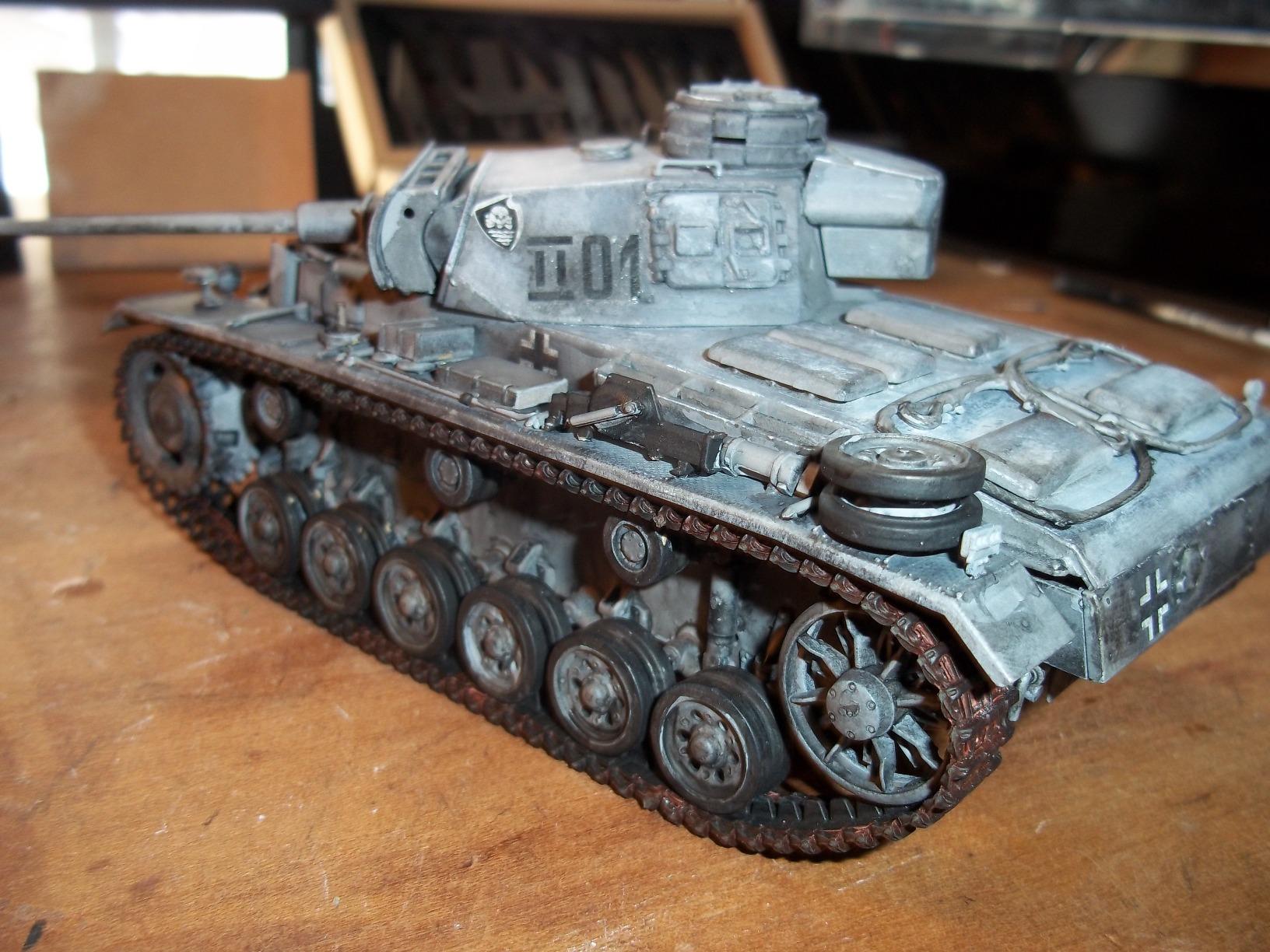
The Panzer III Ausf L was numerically the most important German tank at Kursk, forming the backbone of the panzer divisions. This Tamiya kit is widely regarded as one of their best 1/35 armor offerings, with engineering that makes assembly genuinely enjoyable. I’ve built this kit twice – once straight out of the box, and once with extensive aftermarket upgrades. Both experiences were excellent, which speaks to the fundamental quality of the kit.
The first thing you notice when building this Panzer III is how well it’s engineered. Parts practically fall together – the upper hull fits the lower hull perfectly, the turret ring aligns without adjustment, and the fenders mount flush every time. There’s virtually no flash on the parts, and what little there is removes easily with a quick swipe of a sanding stick. Tamiya includes five different paint and marking schemes, giving you excellent options for Kursk-themed builds. I chose a tank from Panzer Regiment 6, part of the 3rd Panzer Division that fought in the southern pincer at Kursk.
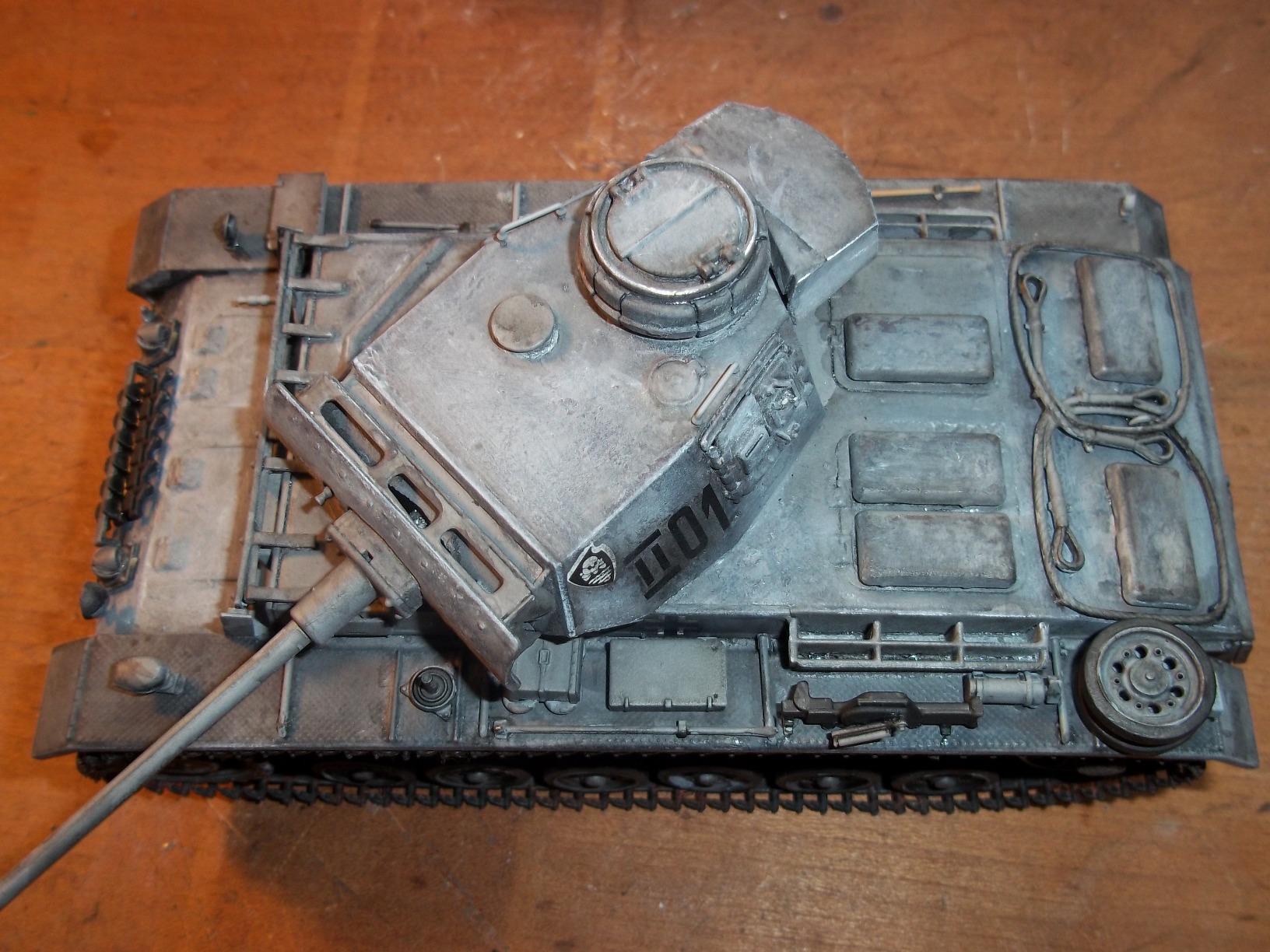
The detail level throughout this kit is impressive. The soft molded rubber tracks are surprisingly detailed – they capture the look of individual links better than most vinyl tracks. The road wheels have separate outer and inner sections, providing depth and realism. The 50mm main gun is cleanly molded, and the muzzle brake is a separate piece that looks excellent when painted properly. Even the tools are well-rendered, with separate clasps that add realism.
This kit is generously equipped with extras. You get a commander figure, though the pose is somewhat stiff with over-molded insignia that limits customization. The decal sheet provides options for three vehicles only, not five as I initially mentioned – I needed to correct that based on closer examination. Still, three options give you good variety. The painting guide is clear and shows color placement for all options. What really sets this kit apart is the aftermarket support – because it’s such a popular subject, you can find extensive upgrade sets if you want to go beyond the box contents.
Ideal for All Skill Levels
The Panzer III Ausf L is that rare kit that works equally well for beginners and experts. New builders will appreciate how easily the parts go together – there’s nothing more discouraging than fighting with ill-fitting components. The engineering here builds confidence because everything works as it should. At the same time, experienced modelers will find plenty to keep them interested. The crisp details respond beautifully to advanced weathering techniques, and the accurate dimensions provide a solid foundation for super-detailing.
I’ve recommended this kit to modelers just starting with German armor, and every one has had a positive experience. The learning curve is gentle, but the result looks professional. This makes it an excellent choice if you’re building your first armor diorama or want to practice painting techniques before tackling more complex projects. The kit rewards effort at every skill level – a careful beginner’s build looks good, and an expert’s build looks outstanding.
Perfect for Kursk Dioramas
If you’re planning a Kursk diorama, the Panzer III Ausf L is historically accurate and visually interesting. Its smaller size compared to Tigers and Panthers allows you to include more vehicles in a limited space. The tank fought in significant numbers during Operation Citadel, serving in both the northern and southern pincers. This gives you flexibility in choosing historical units and markings for your diorama.
The kit’s commander figure, while not perfect, can be improved with some minor modifications. Re-posing the arm and adding a separate head from another figure set creates a more dynamic appearance. The open hatch option lets you show interior detail if you choose to add aftermarket photo-etch. Combined with other Tamiya kits like the Tiger I and Panther, you can create an accurate representation of a German panzer company as it appeared during the climactic battle at Prokhorovka.
8. Tamiya Sturmgeschutz IV – Budget-Friendly Assault Gun
Tamiya 35087 1/35 German Sturmgeschutz IV Plastic Model Kit
1/35 Scale
Commander figure
Rubber tracks
Great value
Pros
- Easy to follow instructions|Good quality|Well-priced|Excellent fit|Rubber tracks meld together
Cons
- Some tiny parts|Flash requires sanding|Side shields one piece|Thick decals|Fragile handles
The Sturmgeschutz IV was a German assault gun that combined a Panzer IV hull with a StuG III superstructure, creating an effective tank destroyer. While not as numerous as other vehicles at Kursk, assault guns played important supporting roles in the battle. This Tamiya kit offers excellent value at around $25-30, providing a satisfying build experience without breaking the bank. I completed a build of this kit last year, and it remains one of my favorite budget-friendly armor projects.
The construction experience with this StuG IV is smooth from start to finish. Tamiya’s instructions are characteristically clear, with well-drawn diagrams that show exactly where each part goes. The fit between major components is excellent – the hull goes together without gaps, and the superstructure aligns perfectly. I did encounter some flash on a few parts, requiring about four minutes of careful sanding, but this was minor and didn’t significantly impact the build time.
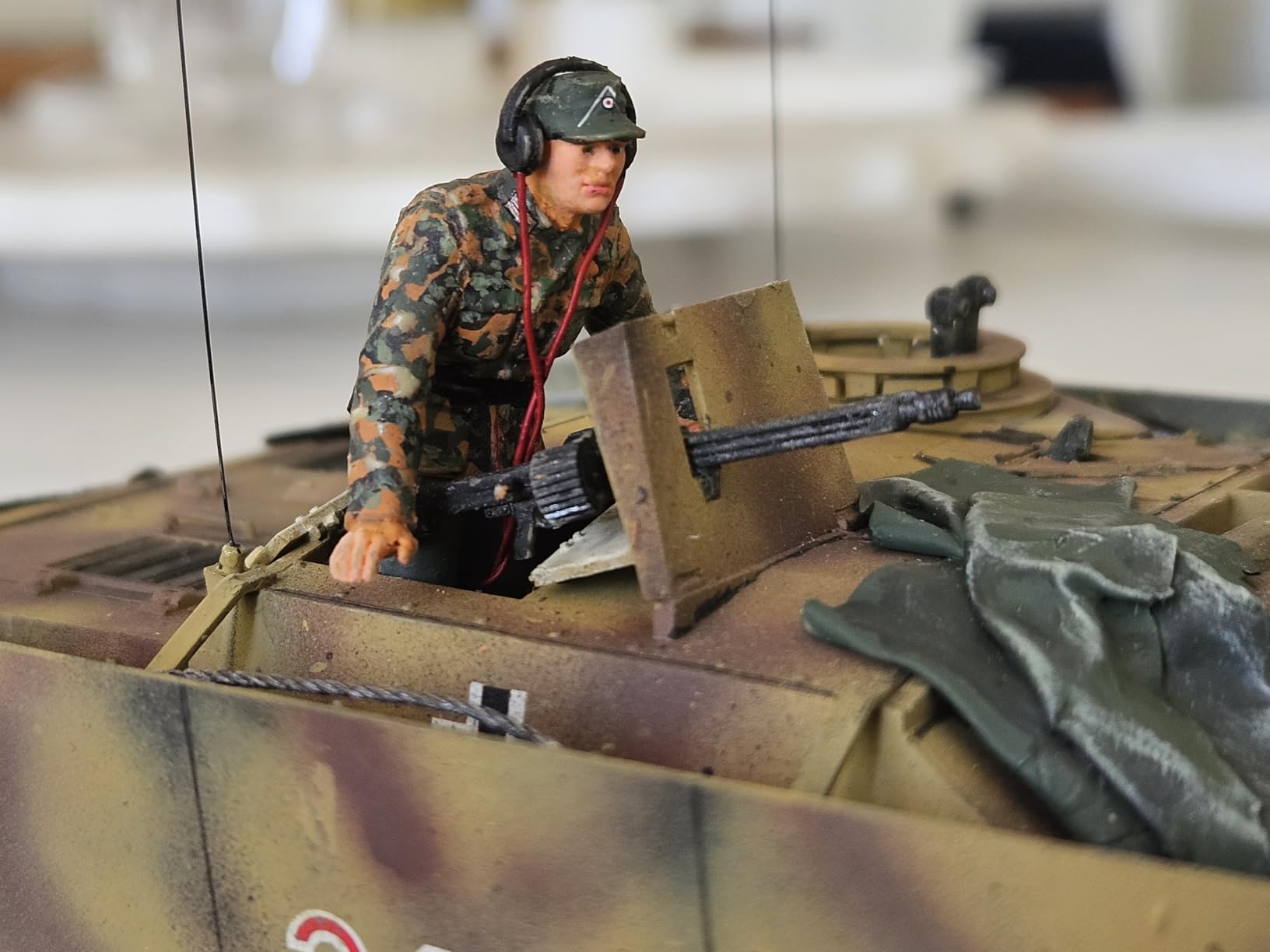
What sets this kit apart is the attention to detail for the price point. The commander figure included has an excellent pose – head turned as if scanning for targets, binoculars in hand. This alone saves you from buying a separate figure. The rubber tracks use Tamiya’s heat-and-melt system – you apply liquid cement to the joint, and the tracks literally fuse together, creating a solid seam. This is much easier than dealing with individual link tracks while still producing good results.
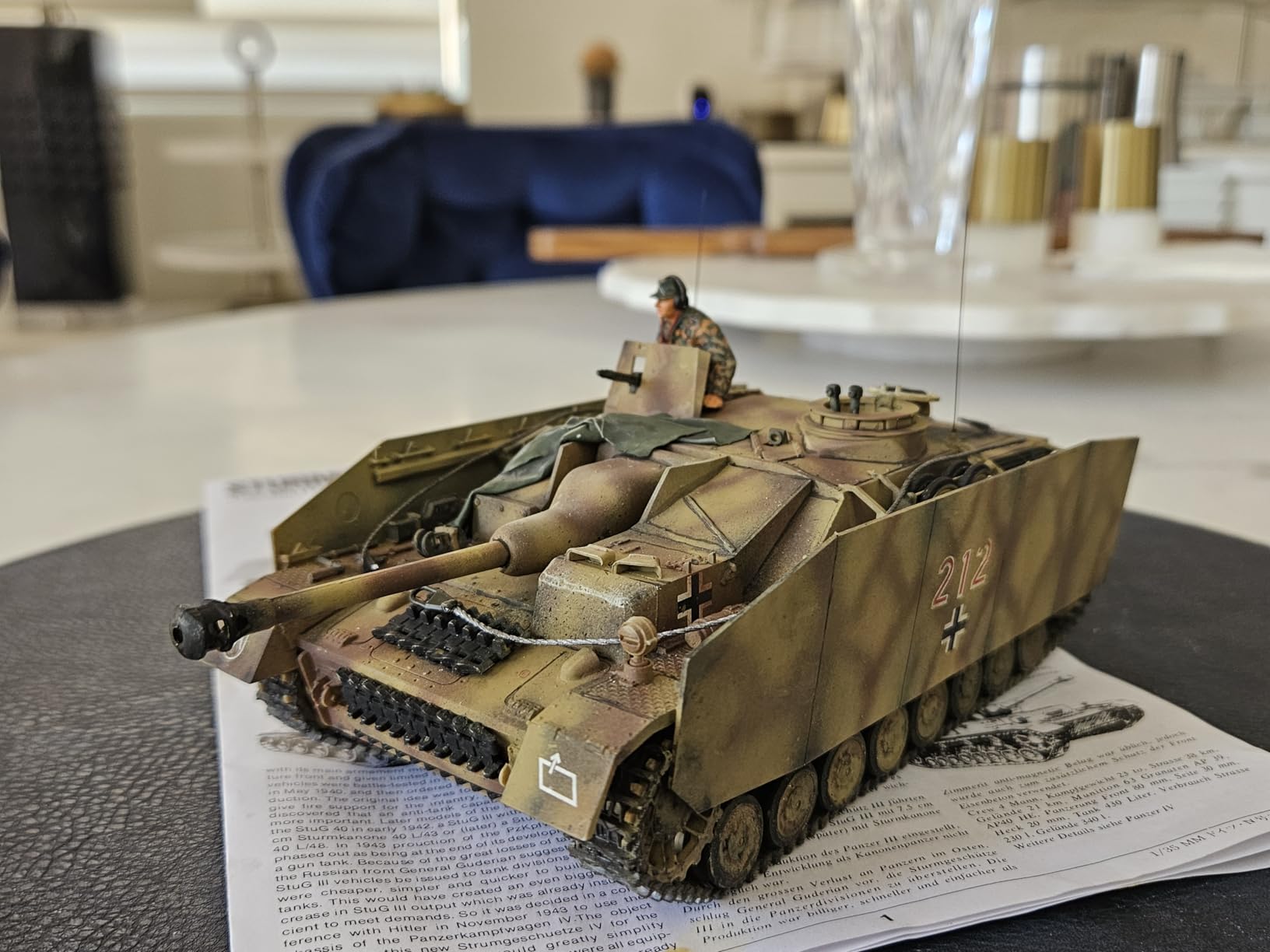
The kit includes some nice extras. The cement blocks that you can add to the hull front are a historically accurate touch – German crews often added concrete as extra armor. These are optional, so you can build the StuG with or without them. The plastic quality is excellent and takes paint beautifully. I primed with Tamiya spray, then applied my colors directly without any adhesion issues. The plastic adheres to paint exceptionally well, which is a sign of quality molding.
Best For Budget-Conscious Modelers
If you’re building on a budget but still want quality, this StuG IV delivers. At under $30, you get a well-engineered kit that builds into an impressive model. The value becomes even clearer when you consider the included commander figure – a separate figure would cost $8-10. For modelers just getting into German armor, or those building large dioramas that require multiple vehicles, the reasonable price point is a significant advantage.
The straightforward engineering makes this a quick build – you can complete it in a weekend if you focus. This is perfect if you need to add several vehicles to a diorama without spending months on construction. The quick build doesn’t mean sacrificing quality, either. The finished model looks detailed and impressive, especially with some careful weathering. For the price, I haven’t found a better German armor kit on the market.
Requires Care with Tiny Parts
The main challenge with this kit is the tiny handles for the side armor plates. These are minute pieces that require steady hands and good tweezers. They’re also fragile – I broke one during my build and had to fabricate a replacement from stretched sprue. Take your time with these parts, and consider using a magnifying lamp if you have one. The armor shields on the destroyer’s sides are molded as one piece, which is less realistic than separate shields but much easier to assemble.
The decals are somewhat thick and look more like stickers than thin aftermarket decals. They work, but they don’t settle into panel lines as well as more expensive aftermarket options. If decals matter to you, consider upgrading to an aftermarket set. However, for most display purposes, the included decals are perfectly serviceable and provide good historical options.
9. Tamiya Hetzer – Compact Tank Destroyer
Tamiya 300035285, 1: 35 WWII German Tank Destroyer, 38 ton (1).
1/35 Scale
180.5mm length
Commander figure
Fast build
Pros
- Precision fit parts|Easy instructions|Accurate shape|Highly detailed commander|Fast build
Cons
- Less detail than modern kits|Tri-color camouflage requires airbrushing|Box suggests more than included|No photo-etch
The Hetzer was a late-war German tank destroyer based on the Panzer 38(t) chassis. While it didn’t see service at Kursk, it’s a popular subject for Eastern Front dioramas depicting the final months of the war. This Tamiya kit provides an accurate representation of the Hetzer in a compact package – at only 180.5mm in length, it’s significantly smaller than a Panther or Tiger. I built this kit as part of a Berlin 1945 diorama, where its smaller size allowed me to include more vehicles in a limited space.
The fit on this Hetzer is excellent – Tamiya’s precision engineering shows throughout the kit. Parts align correctly, and very little adjustment is needed during assembly. The instructions are clear and follow a logical sequence that builds the model efficiently. I particularly appreciate how Tamiya designed the sub-assemblies – the road wheels and suspension go together as units, then attach to the hull, which is much easier than assembling piece by piece on the model.
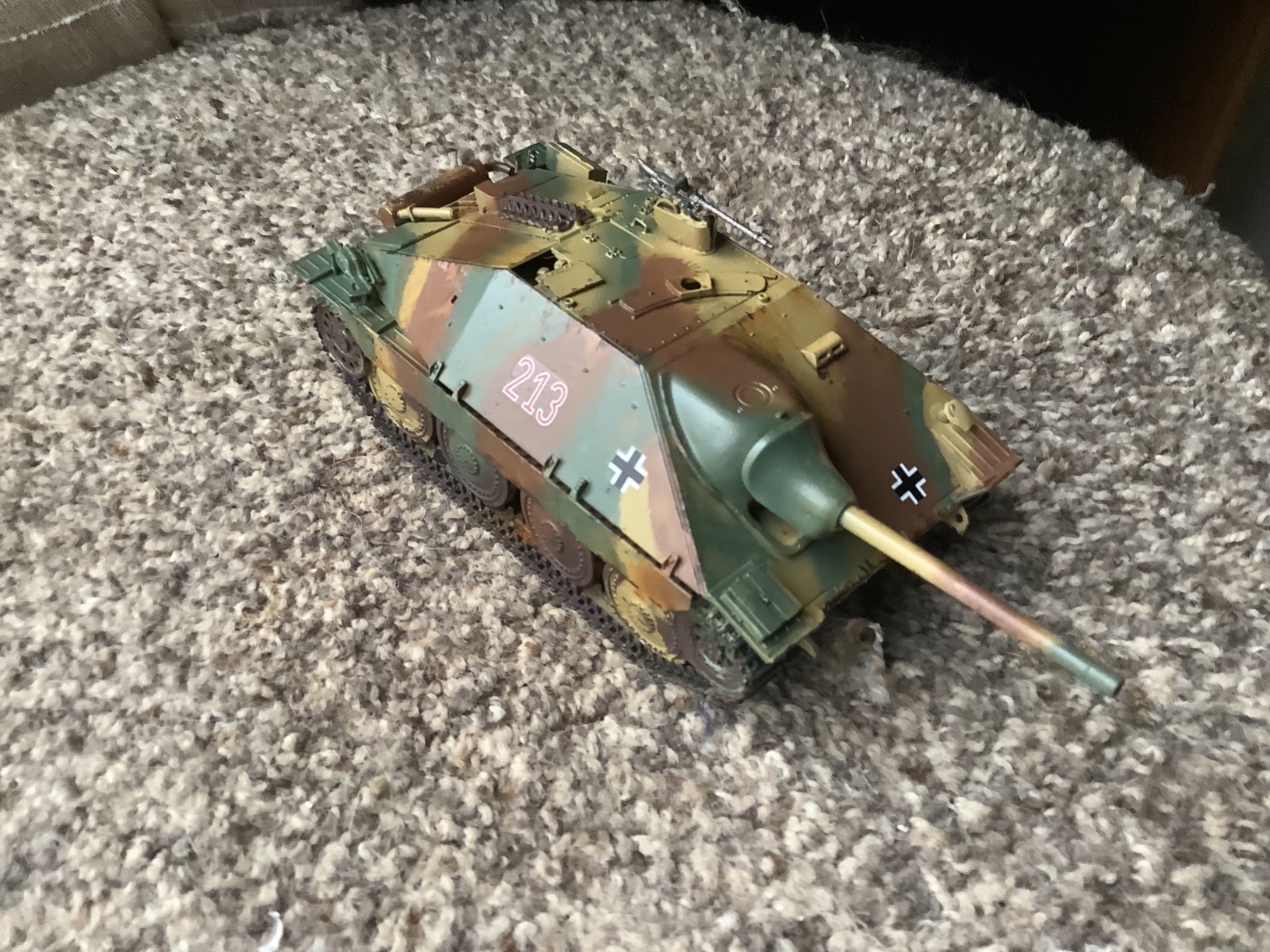
The commander figure included is one of the highlights of this kit. He’s in a relaxed pose, leaning forward slightly as if examining maps or communicating with the crew. The uniform details are crisp, and the face is well-sculpted with natural features. This figure alone adds significant value, as buying a separate commander figure would cost additional money. When painted carefully and placed in the commander’s hatch, he brings the model to life in a way that no amount of weathering can achieve.
The kit is quite small compared to most armor models, which has both advantages and disadvantages. On the plus side, it’s quick to build – you can complete construction in a few focused sessions. It requires less paint and materials, which saves money. The smaller size also means it takes up less shelf space if you have a large collection. However, the compact dimensions mean some details are necessarily simplified. The molding quality is good, but not up to the standards of the newest kits from manufacturers like Takom or Miniart.
Best For Modelers With Airbrushing Skills
The Hetzer’s historical three-color camouflage scheme really requires an airbrush to do properly. While it’s possible to paint by hand, the soft, mottled appearance is much easier to achieve with an airbrush. If you have airbrushing skills, this Hetzer gives you an excellent canvas to practice the German hard-edge camouflage style. The small surface area means you can complete the painting relatively quickly, making it less daunting than trying to camouflage a King Tiger or Panther.
The fast build nature of this kit makes it perfect for practicing new techniques. Because you can complete construction quickly, you can spend more time on painting and weathering without feeling like you’re investing excessive time into a single project. I’ve used my Hetzer build to experiment with different weathering approaches – trying dot filters, pigment washes, and chipping techniques without worrying about ruining a months-long project.
Considerations for Advanced Detailing
If you’re a detail-oriented modeler, you may find this kit somewhat basic compared to newer offerings. The molding quality is good but not exceptional. Some details, like the tools and external fittings, are simplified. There’s no photo-etched brass included, which means areas like the engine grille and tool clasps lack the ultimate in realism. The box art and photos suggest a more deluxe package than what’s actually inside – there are no extra troops or photo-etched parts despite what the packaging might imply.
However, the fundamental shape and dimensions are accurate, which provides a solid foundation for detailing. You can easily upgrade this kit with aftermarket photo-etch, individual track links, and a metal barrel if you want to increase the detail level. The commander figure is actually quite good, so you may not need to replace him. For most modelers, the out-of-box detail is perfectly adequate, especially for the price point.
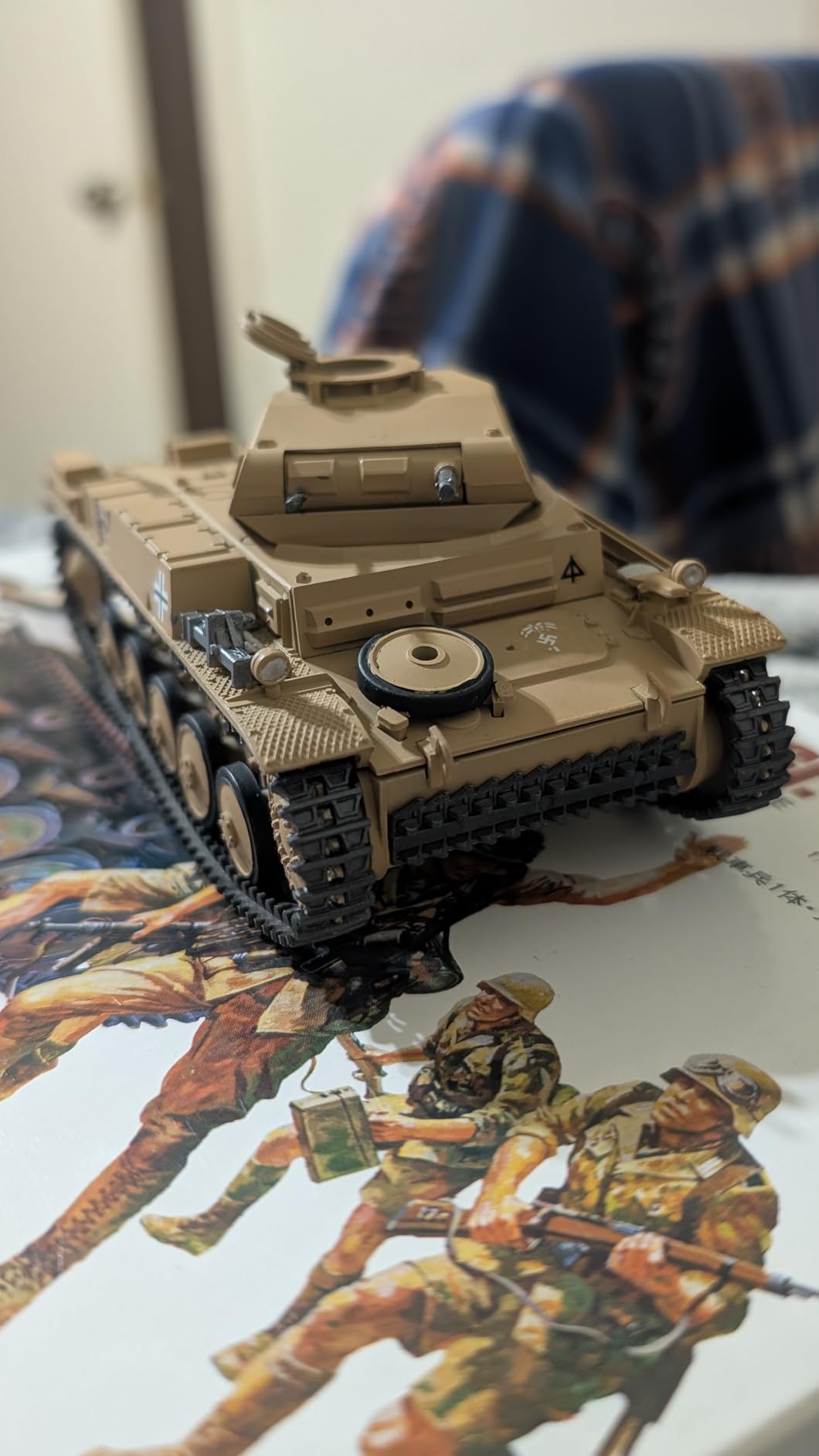
10. Tamiya Panzer II – Perfect Starter Tank
TAMIYA 35009 1/35 German PZKPFW II Plastic Model Kit for Unisex Adult
1/35 Scale
180 parts
5 figures included
Beginner-friendly
Pros
- Great first tank kit|Excellent fit|Low cost|5 figures included|Two color schemes
Cons
- Seam lines on figures|Commander size issues|Rubber tracks|Older kit design
The Panzer II was a light tank that served throughout the early war period, and while obsolete by 1943, it still saw action in reconnaissance roles during Operation Citadel. This Tamiya kit is an ideal starting point for new armor modelers, with a reasonable parts count and forgiving construction. I built this kit as my very first armor model over 25 years ago, and I’ve returned to it multiple times since. It remains one of my favorite kits for beginners, and at under $20, it’s an excellent value.
The build experience with this Panzer II is about as beginner-friendly as it gets. Everything goes together well – the hull fits together perfectly, the turret aligns without issues, and the fenders mount flush every time. You need very little sanding, and even a complete novice can achieve good results. The kit includes five figures in North Africa uniforms, which gives you practice painting figures alongside the vehicle. This combination of vehicle and figures in one box is rare at this price point and adds significant value.
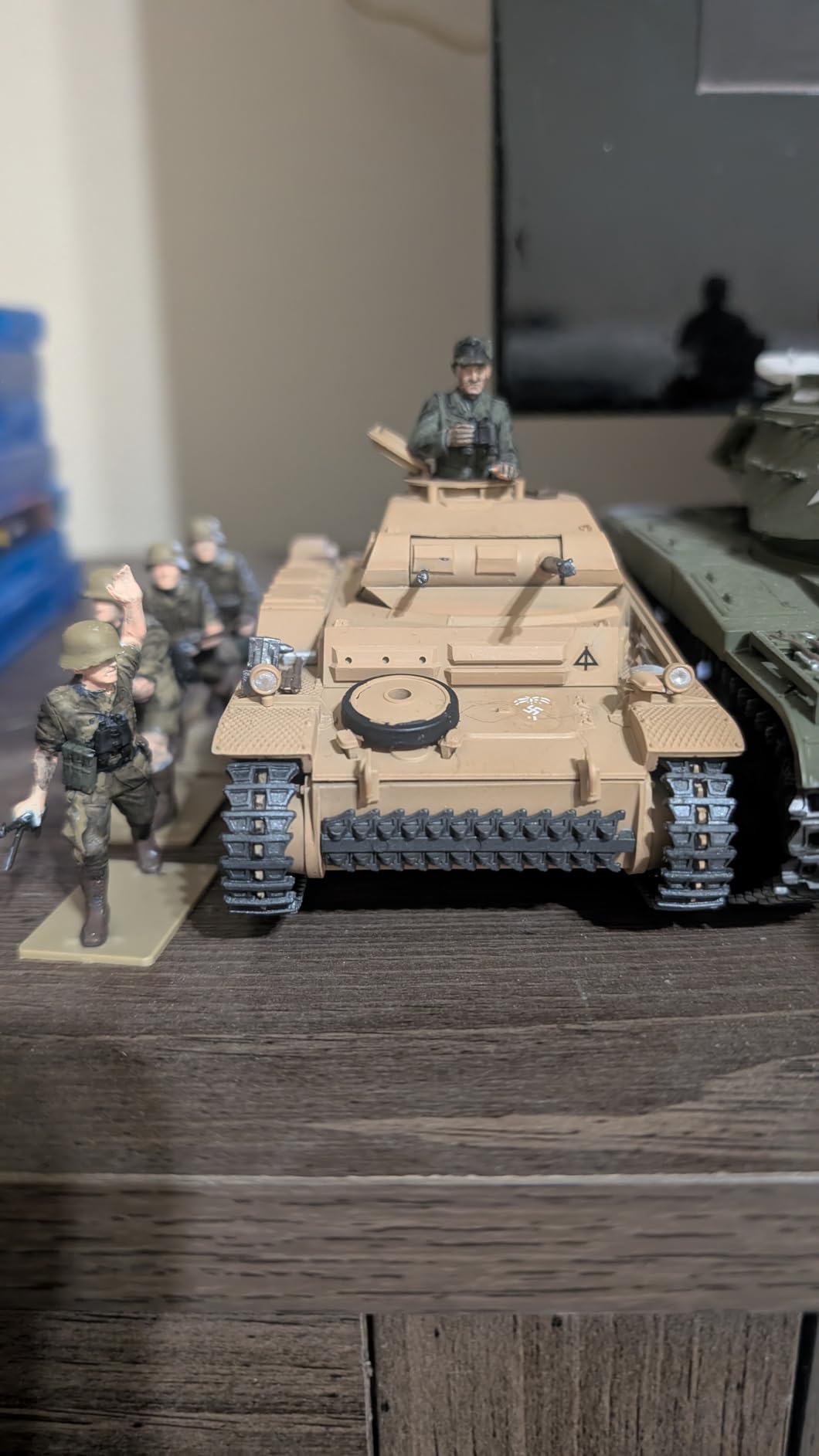
One of the best things about this Panzer II is the variety of building options. You can paint it in German grey for early war, or in desert yellow for North Africa service. The decals include options for the DAK (Deutsches Afrikakorps), which opens up interesting display possibilities. The parts count of 180 is manageable – enough to provide detail, but not so many that you’ll feel overwhelmed. This makes it an excellent confidence-builder for new modelers.
The technical quality of this kit is impressive considering it dates from the 1970s. The molding is crisp with no flash – I’ve built multiple copies over the years, and the consistency is remarkable. The road wheels are cleanly molded, and the suspension captures the look of the real thing well. The rubber tracks are serviceable and easier to assemble than individual links, which is appropriate for a kit aimed at beginners. Despite its age, this Panzer II doesn’t feel outdated – it builds into a model that can proudly sit on any shelf.
Perfect Choice for First-Time Tank Builders
If you’re new to armor modeling, this Panzer II is hard to beat. The engineering gives you a positive experience from start to finish. The excellent fit means you won’t encounter frustrating gaps or misaligned parts. The manageable parts count lets you complete the model in a reasonable time, building your confidence for more complex projects. The low price means mistakes aren’t catastrophic – if you really mess something up, you can afford to buy another kit and start over.
The five included figures give you practice with figure painting, which is a valuable skill in its own right. Painting faces, hands, and uniforms teaches you control and brush techniques that apply to all aspects of modeling. The figures are wearing North Africa uniforms, which gives you interesting color options beyond the standard German field gray. This variety keeps the painting process interesting and helps you develop your skills.
Considerations for Experienced Modelers
For experienced builders, this Panzer II offers a quick, relaxing build. It’s perfect for those times when you want something simple between more complex projects. The kit can be extensively detailed if desired – there’s plenty of aftermarket support for Panzer IIs, including photo-etched sets, individual track links, and detailed wheels. However, many experienced modelers enjoy building this kit straight from the box as a break from more demanding projects.
The main accuracy issues to note are the rubber tracks and some simplified details. The tracks are typical Tamiya vinyl bands – they assemble easily but don’t capture the look of individual links. Some small details are simplified compared to more modern kits. However, for a beginner-friendly kit at this price point, these are acceptable compromises. The Panzer II builds into a handsome model that accurately captures the appearance of the real vehicle.
Buying Guide for Kursk Tank Model Kits
Selecting the Right Scale for Your Project
The 1/35 scale dominates armor modeling for good reason – it provides the best balance between detail and size. At this scale, a Tiger measures nearly 10 inches in length, giving plenty of space for realistic details. Most aftermarket parts, from photo-etch to metal barrels, are produced in 1/35. If you’re planning dioramas, 1/35 is the standard that ensures compatibility with figures, accessories, and vehicles from different manufacturers. All the kits in this guide are 1/35 scale, which reflects its dominance in the market.
That said, 1/48 scale offers an attractive alternative for space-conscious modelers. The smaller size means you can display more models in limited space, and build times are generally shorter. Tamiya’s 1/48 armor line includes many of the subjects covered here – Panthers, Tigers, T-34s, and Shermans are all available. The trade-off is less detail and fewer aftermarket options. For wargamers, 1/72 scale provides inexpensive models suitable for tabletop gaming, though the detail level drops significantly. Consider your display space and intended use when choosing between scales.
Comparing Armor Kit Brands
Tamiya dominates this guide, and for good reason – their kits offer the best combination of quality, fit, and ease of assembly. The engineering is consistently excellent, with parts that fit together precisely. Tamiya’s instructions are clear and well-illustrated, making them ideal for less experienced builders. The main criticism is that Tamiya sometimes simplifies details compared to more expensive brands, and they’ve been slow to retool older kits with modern molding techniques.
Takom has emerged as a leading manufacturer of highly detailed German armor kits. Their Panther and Tiger kits generally surpass Tamiya’s in detail accuracy, often including features like separate track links and photo-etched parts as standard. However, this extra detail comes at a price – Takom kits are more expensive, more complex to build, and often have more challenging fit issues. They’re best suited to experienced modelers who demand maximum accuracy.
Dragon produces some of the most detailed kits on the market, particularly for German subjects. Their “Smart Kit” line combines exceptional detail with good engineering, though they remain challenging builds. Dragon kits often include individual track links, photo-etched brass, and metal barrels as standard equipment. Miniart specializes in subjects with incredible interior detail – their T-34 kits include full interior compartments that are unmatched by other manufacturers. However, the part count can exceed 1,000 pieces, making these projects that require serious time commitment.
Matching Kit Difficulty to Your Skill Level
Beginner modelers should start with straightforward kits that build confidence. The Tamiya Panzer II, T-34/76, and Sturmgeschutz IV all fall into this category. They feature minimal parts, excellent fit, and vinyl tracks that are easy to assemble. These kits let you focus on learning fundamentals like seam removal, priming, and basic painting techniques without being overwhelmed. Build two or three of these simpler kits before attempting more complex subjects.
Intermediate modelers can tackle more involved projects like the Tamiya Tiger I, Panther Ausf A, or Panzer III Ausf L. These kits feature more parts and finer details, but the engineering remains manageable. You’ll encounter smaller, more fragile parts that require careful handling. The Tamiya Sherman kits also fit this category – modern enough to be rewarding, but detailed enough to teach advanced techniques like painting clear parts and working with belt-type tracks.
Advanced modelers looking for challenges should consider Takom or Dragon kits, or Tamiya subjects with extensive aftermarket upgrades. Projects requiring individual track links, extensive photo-etch, or resin upgrades demand significant time and skill. Consider your patience level when selecting complex kits – some builds can take months to complete at this level. There’s no shame in sticking with simpler kits if you enjoy the building process more than the challenge.
Kursk-Specific Considerations for Historical Accuracy
Building Kursk subjects requires attention to historical details. Operation Citadel took place in July 1943, which determines which vehicles and markings are appropriate. The Panther Ausf D made its combat debut at Kursk, so early production Panthers with specific features are correct. Tiger I tanks from s.Pz.Abt. 505 fought with the 9th Army, so verify your unit markings before building. T-34/76 tanks should be the 1943 production variant with hexagonal turrets, not the earlier two-man turrets.
Camouflage is critical for Kursk vehicles. By July 1943, German tanks were being painted in dunkelgelb (dark yellow) at the factory, with crews adding camouflage in the field. The three-color scheme of dunkelgelb base with olivegrun and rotbraun patches is correct for Kursk, but application should look hurried and irregular. Soviet tanks wore overall green, though field-applied whitewash was sometimes present for early July operations. Reference photos are essential – spend time studying period images before selecting your paint scheme.
Track Quality and Assembly Methods
Tracks are one of the most important considerations when selecting a kit. Tamiya’s vinyl band-style tracks are the easiest to assemble – they’re single pieces that glue together at the ends. While convenient, they lack the detail of individual links and don’t hang quite right. The T66 tracks on the Sherman kits represent a middle ground – belt-type tracks with molded detail that look reasonably realistic.
Individual link tracks provide the ultimate in realism but require significant time and patience. Each link must be cleaned up, painted, and assembled one at a time. A set of tracks can easily take 10-20 hours to complete properly. Aftermarket metal tracks from companies like Fruilmodel offer exceptional detail but are expensive. Modern plastic individual links from Dragon or Takom provide good detail at lower cost, though assembly time remains significant. Consider your priorities – if you value realism over time investment, individual links are worth the effort.
Aftermarket Parts and Upgrade Options
One advantage of choosing popular subjects like Tigers, Panthers, and T-34s is the enormous aftermarket support available. Photo-etched brass sets can replace molded grilles, tool clasps, and other details for superior realism. Metal barrels provide more accurate muzzle shapes and won’t droop over time. Individual track links completely transform the appearance of a kit. Resin figures and stowage items add life and variety.
For beginners, I recommend building at least one kit completely out of the box before diving into aftermarket upgrades. This teaches you what the basic kit provides and helps you identify which areas really need improvement. Not every kit needs extensive upgrades – some Tamiya kits build beautifully straight from the box. Focus your upgrade budget on areas that will have the most visual impact. For a Tiger, the tracks and barrel make the biggest difference. For a T-34, adding crew figures and stowage creates more visual interest than internal upgrades that won’t be visible.
If you’ve built die-cast model trucks or other display models, armor modeling offers a completely different experience with more emphasis on painting and weathering. For more hobby insights, check out our RC helicopter buying guide to explore different modeling categories.
Frequently Asked Questions
What are the best tank models?
The best tank models combine accuracy, engineering, and detail. Tamiya Tiger I Early Production sets the standard for German heavy tanks with perfect fit and superior detail. Tamiya T-34/76 1943 offers the best value for Soviet armor. Takom Panthers provide exceptional detail for advanced modelers, while Tamiya Panzer III Ausf L delivers superb engineering across all skill levels.
What tanks fought at Kursk?
German forces at Kursk included Tiger I, Panther Ausf D, Panzer III, Panzer IV, and StuG III assault guns. Soviet forces deployed T-34/76, T-34/85 (late production), SU-85, SU-152, and KV-1 tanks. The battle featured approximately 2,450 German tanks and assault guns attacking 3,600 Soviet vehicles, making it history’s largest tank engagement.
Could the Germans have won at Kursk?
Most historians consider a German victory at Kursk unlikely due to multiple factors. Soviet defenses were deeply layered with extensive minefields and anti-tank guns. The delay to wait for new Panther tanks gave Soviets months to fortify. German forces lacked the reserves to exploit a breakthrough, and Soviet tank production had already outstripped Germany’s. Even tactical success couldn’t change the strategic reality of Soviet material superiority.
What was the most feared tank during WWII?
The Tiger I tank was perhaps the most feared Allied tank of WWII due to its 88mm gun that could penetrate any Allied tank at long range, and thick armor that was nearly invulnerable to most Allied guns. Its psychological impact was enormous – crews reported Tigers destroying multiple Shermans or T-34s single-handedly. However, mechanical unreliability and limited production meant Tigers could never be present in sufficient numbers to change the war’s outcome.
What scale is best for tank dioramas?
1/35 scale is best for tank dioramas due to the widest range of available kits, figures, and accessories. At this scale, tanks measure 7-10 inches, providing enough detail for realism while remaining manageable for display. The large aftermarket support in 1/35 means you can find nearly any vehicle, figure, or accessory needed. For space-limited displays, 1/48 scale offers similar variety with smaller models.
Conclusion
Building WWII Kursk tank battle model kits connects us to one of history’s most significant armored engagements. Whether you choose the historically accurate Tamiya Tiger I Early Production, the excellent value T-34/76 1943, or the accessible Panther Ausf A, each kit offers a rewarding building experience and a tangible connection to the tanks that decided the Eastern Front. Remember that Operation Citadel in July 1943 marked the end of German offensive capability, making these vehicles more than just models – they’re representations of the turning point of WWII on the Eastern Front.
Start with kits that match your skill level, focus on enjoying the building process, and don’t be afraid to make mistakes. Each build teaches you something new, whether it’s painting techniques, weathering methods, or historical research. The WWII Kursk tank battle model kits covered here offer something for every modeler, from beginners taking their first steps into armor modeling to experts seeking their next challenge. Choose your subject, gather your supplies, and start building your piece of military history today.