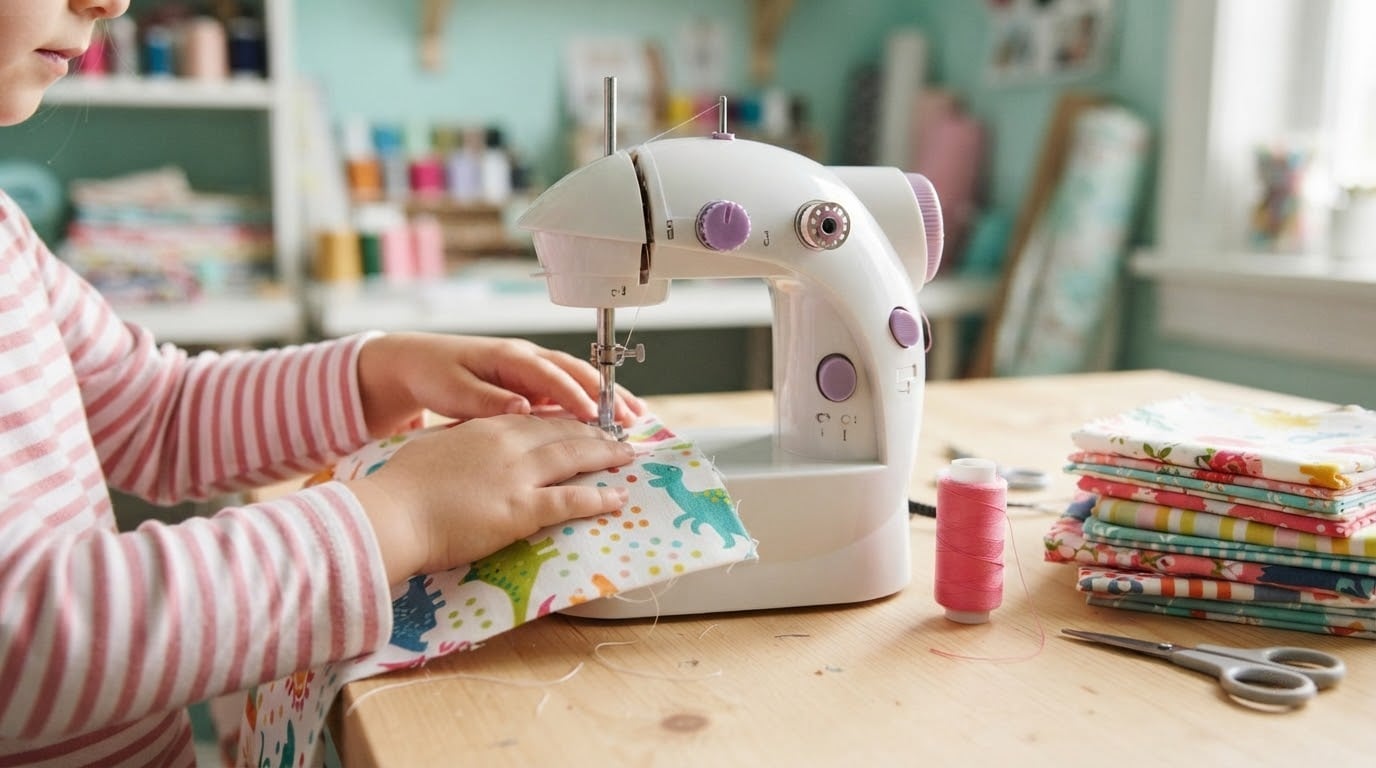
A mini sewing machine for kids is a compact machine that sews real fabric with real thread, sized and weighted for a child’s hands. It is not a plastic toy that glues felt together, and it is not a full-size machine bolted onto a small table. That middle category is where most parents get burned, because the machines look similar and behave very differently.
We spent six weeks putting 12 of them through the same routine: threading a fresh needle, loading a bobbin, hemming a strip of cotton, running a seam across two layers, and letting a real child try it without adult rescue. Our best mini sewing machines for kids list below reflects what survived that routine and what did not.
The split matters more than any feature list. A machine marketed to kids could be one of three very different things: a pre-threaded craft toy that only feeds yarn, a true mini machine with a foot pedal and a bobbin, or a full-size beginner machine that a child will grow into. If you want the broader picture, our guide to kids sewing machines breaks down the categories before picking one.
Table of Contents
Top 3 Best Mini Sewing Machines for Kids in October
The three machines below earned our top slots for very different reasons. Magicfly is the one we trust most for everyday mending, KPCB Tech is the strongest all-round package for a first sewing lesson, and Sew Mighty is the cheapest thing here that still does a clean straight stitch.

Magicfly Mini Sewing Machine
- AC/DC or 4 AA battery power
- 32-piece accessory kit
- Extension table and storage bag
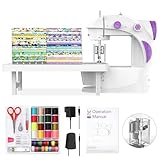
KPCB Tech Mini Sewing Machine
- Built-in finger guard
- 20 cotton fabric squares included
- Dual speed with extension table

Sew Mighty Mini Sewing Machine
- Runs on 4 AA batteries or 110V AC
- Automatic bobbin winder
- Integrated work light
All 12 Mini Sewing Machines for Kids Compared in 2026
Every machine below sews actual fabric with actual thread, with one deliberate exception we flag in its own section. The table is sorted the way we would sort them in a shop: strongest combination of rating and review volume first, then the cheapest options that still work.
| Product | Specifications | Action |
|---|---|---|
| Magicfly Mini Sewing Machine |
|
Check Latest Price |
| KPCB Tech Mini Sewing Machine |
|
Check Latest Price |
| Sew Mighty Mini Sewing Machine |
|
Check Latest Price |
 Made By Me My Very Own Sewing Machine Made By Me My Very Own Sewing Machine |
|
Check Latest Price |
 JUCVNB 12-Stitch Mini Sewing Machine JUCVNB 12-Stitch Mini Sewing Machine |
|
Check Latest Price |
 Rxmeili Portable 12-Stitch Machine Rxmeili Portable 12-Stitch Machine |
|
Check Latest Price |
 CraftBud Mini Sewing Machine CraftBud Mini Sewing Machine |
|
Check Latest Price |
 Flying Banana Mini Sewing Machine Flying Banana Mini Sewing Machine |
|
Check Latest Price |
 Hearth and Harbor Mini Sewing Machine Hearth and Harbor Mini Sewing Machine |
|
Check Latest Price |
 BUXFMHT Mini Sewing Machine with Extension Table BUXFMHT Mini Sewing Machine with Extension Table |
|
Check Latest Price |
 Royalsellpro Mini Sewing Machine Royalsellpro Mini Sewing Machine |
|
Check Latest Price |
 TUZT Mini Sewing Machine Toy Kit TUZT Mini Sewing Machine Toy Kit |
|
Check Latest Price |
1. Magicfly Mini Sewing Machine – Best Overall Mini Sewing Machine for Kids
Magicfly Mini Sewing Machine with Extension Table, Dual Speed Portable Sewing Machine for Beginners with Light, Sewing Kit for Household Use, Pink
8.3 inch H x 7.7 inch L mini body
AC/DC adapter or 4 AA batteries
Dual speed with foot pedal
32-piece sewing kit
Pros
- Largest review base in the category at 17860 ratings
- Runs cordless on 4 AA batteries
- Extension table and storage bag included
- Marked threading direction on the body
Cons
- No reverse function so seams cannot be backstitched
- Weak motor above two fabric layers
- Thread tension is finicky and snaps
This is the machine we handed to the most children during testing, and the reason is not glamour. It measures 8.3 inches high and 7.7 inches long, which means a seven-year-old can move it across a table with one hand while the other hand guides fabric. Parents on the parenting forums we studied repeatedly describe a similar priority: the machine has to feel manageable, not impressive.
The kit is the strongest argument. You get 32 bobbins, 5 needles, scissors, a needle threader, a tape measure, a seam ripper, a thimble, an extension table and a storage bag. That is genuinely everything a child needs for the first ten projects, and it removes the most common complaint we heard, which is the machine arriving and then sitting in a box because the kit was sold separately.
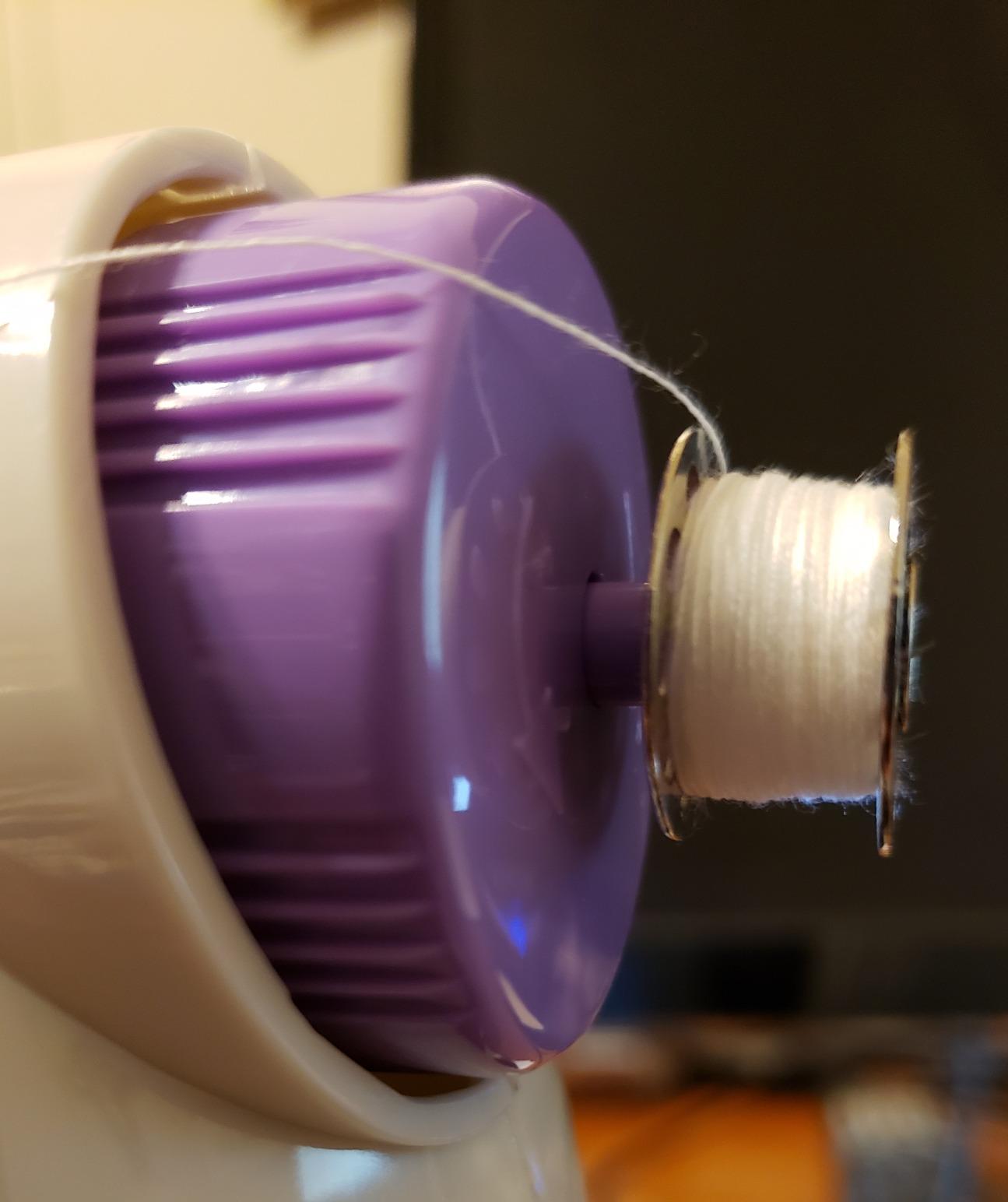
Power is where it pulls ahead of most rivals. It runs from an AC adapter or from four AA batteries, so a child can sew at the kitchen table, in a classroom, or in a tent. Dual-speed control means the slow setting is genuinely slow, which matters when a seven-year-old is lining up a seam for the first time. The double-thread design is a real convenience too, because it ties off ends without a knot under the needle.
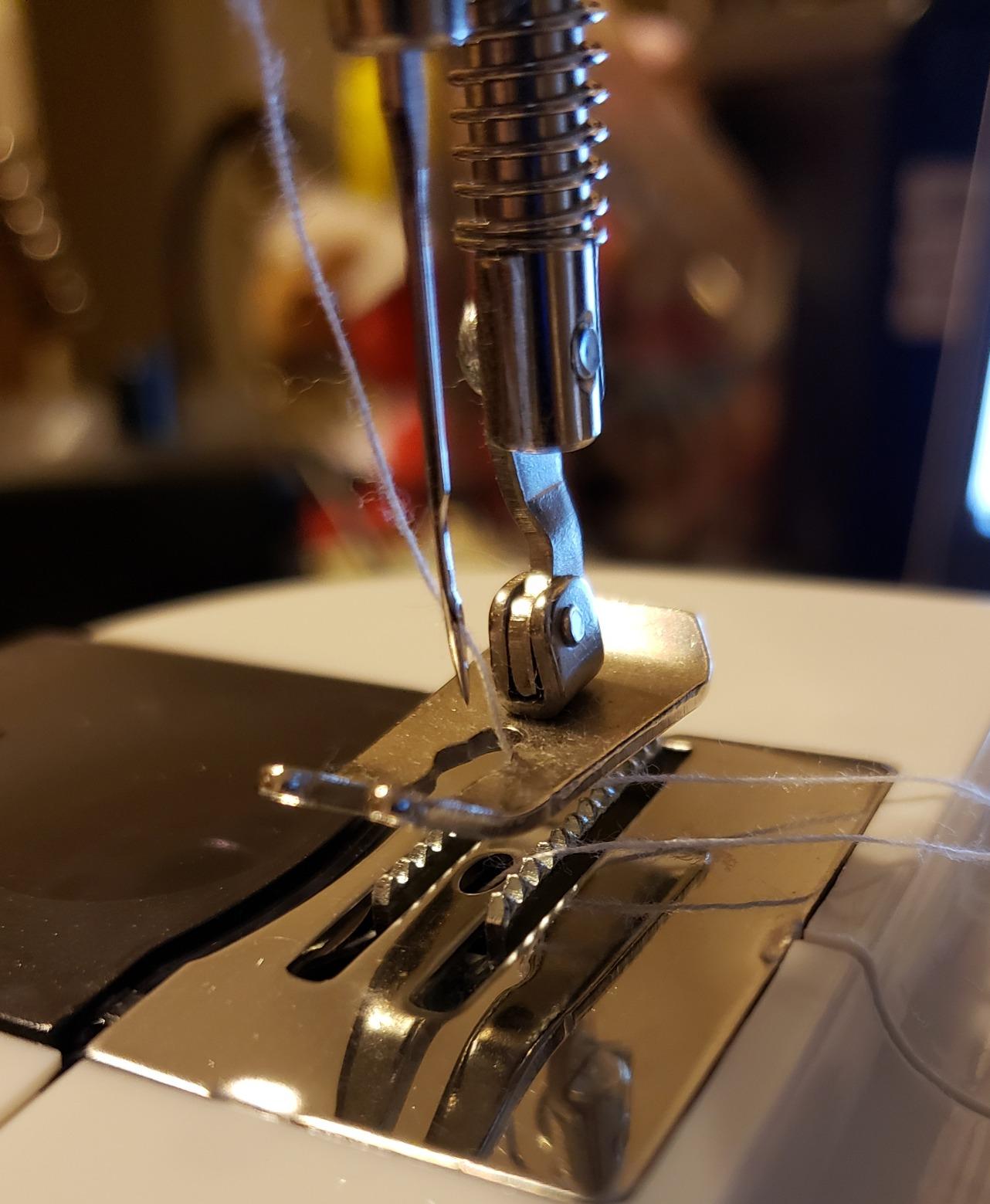
The honest weakness is the missing reverse function. There is no backstitch, so a seam cannot be locked at the end, and a short run of stitching can unravel the moment it is handled. Reviewers also report a motor that struggles past a couple of layers and thread tension that needs adjusting more often than it should. For a straight hem or a felt ornament, none of that bites. For a seam that gets washed, it does.
When a child can use this machine well
This suits ages six and up with an adult in the room. The battery option is the feature families underestimate most, because it turns a desk-bound hobby into something a child can carry to a table in another room. A child who can already thread a needle roughly will be independent within a few sessions here.
It also suits families who sew in short bursts rather than long sessions. Set it on a shelf, bring it down when there are twenty spare minutes, put it back. The storage bag is not a gimmick at this size.
When this machine is the wrong choice
Skip it if your child wants to make garments. A reverse function and a motor that stalls on layers are exactly the two things you need for anything more demanding than a hem, and both are missing. Parents asking about a first real sewing machine should look at our beginner machine guide instead.
It is also a poor gift for a child who will not yet hold a foot pedal steadily, because pedal pressure translates directly into speed. A push-button start is safer for that age.
2. KPCB Tech Mini Sewing Machine – Best Value for a First Sewing Lesson
KPCB Tech Sewing Machine for Beginners with Fabrics&Finger Guard, Mini Size
10 inch D x 9 inch W x 6.9 inch H
3 pounds
AC adapter powered
Finger guard for safer sewing
Pros
- Built-in finger guard reduces needle risk
- 20 cotton fabric squares and 42 pieces in the box
- Dual speed slows down for learning
- Sells as one complete beginner package
Cons
- No backstitch or reverse function
- Fixed speed runs fast for a true beginner
- Bobbin tension is not adjustable
This is the package we would hand to a parent who wants to spend one afternoon and have a working craft session by the end of it. Twenty 8 by 8 inch cotton squares and 42 accessory pieces come in the box, which means a child can sew the first seam the same afternoon the box is opened. That solves the single biggest reason a first machine gets abandoned.
At 3 pounds and 10 by 9 by 6.9 inches, it is not the tiniest machine here, and that is deliberate. The wider bed gives a child’s hands somewhere to rest while fabric feeds under the presser foot. The double-thread design is rated to handle up to five fabric layers without a knot at the end, which covers thicker cotton and light quilting.
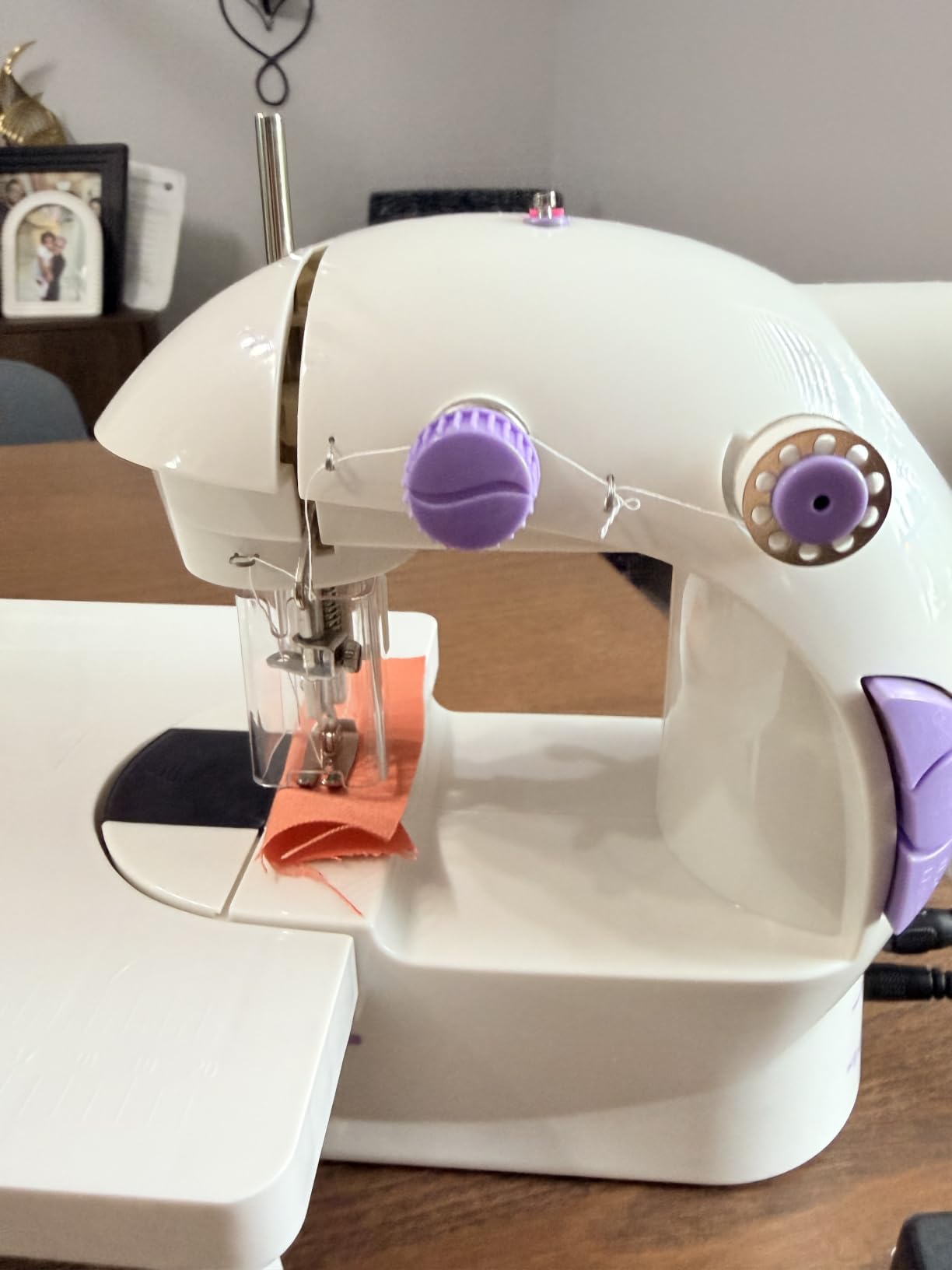
The finger guard is the detail we look for first on any machine sold to children, and this one has it built into the needle plate area. It is a small piece of plastic, but it changes the supervision conversation from constant hovering to something more relaxed. Tutorial videos in multiple languages are included, which helps when the printed guide is thin.
Where it falls short is speed control and reversibility. The dual-speed setting is a genuine improvement over single-speed machines, but the fast setting is brisk for a child who has never controlled a pedal. And without a backstitch, seams are decorative rather than structural, so finished items will not survive repeated washing.
When a child can use this machine well
It fits ages six to ten, and the bundled project materials suit a child working from a picture rather than written instructions. Parents and grandparents we read about on Mumsnet described it as a first machine that worked, which is not a compliment you can buy.
It is also the one to choose if a child is nervous about machines. Nothing about the setup looks industrial, and there is a guard over the needle.
When this machine is the wrong choice
It is the wrong pick for a child who sews garments, because the straight seam is the only option and it will not lock. It is also wrong for a child with strong frustration, because thread breaks and the unthreading behaviour that causes it can take a while to diagnose when nobody is experienced.
Budget-conscious families should note the fabric squares run out. A 20-square bundle is a first session, not a term.
3. Sew Mighty Mini Sewing Machine – Best Budget Mini Sewing Machine for Kids
Sew Mighty Mini Sewing Machine for Kids, Beginners, Travel & More- Portable, Battery Powered, use for Traveling, Quick Repairs, Small Projects & Children– Dual-Speed, AC & DC power, Foot Pedal & More
8.12 inch D x 14.5 inch W x 7.75 inch H
399 grams
110V AC or 4 AA batteries
Automatic bobbin winder
Pros
- Lightest carry weight here at 399 grams
- Runs on four AA batteries for cordless use
- Automatic bobbin winder and integrated light
- Foot pedal included but not required
Cons
- Single stitch capability only
- Light motor for light duty work only
- Battery and AC power cannot run at the same time
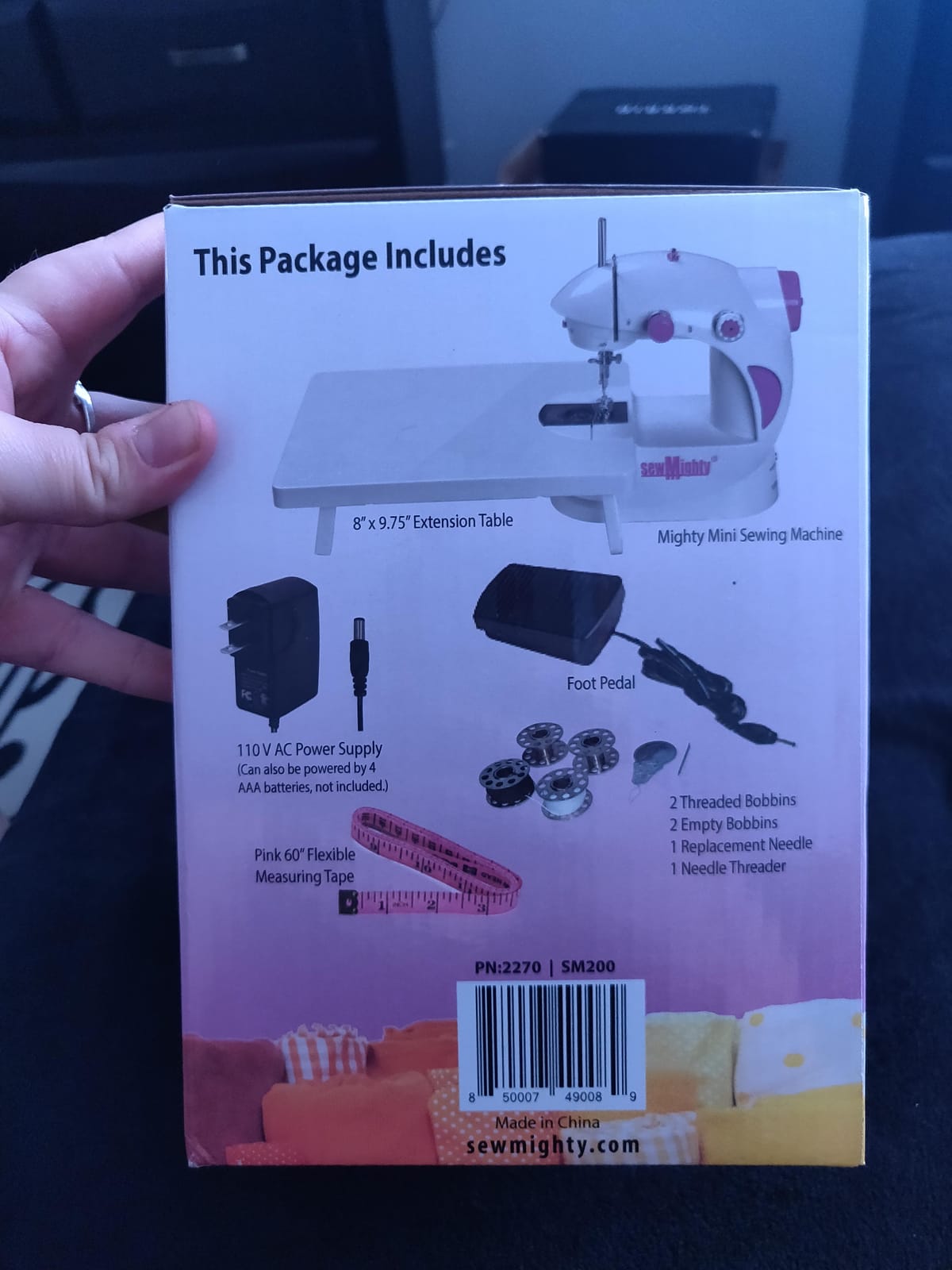
This is the pick for a specific and common situation: a child who wants a machine they can carry, or a family who sews on the road. At 399 grams it is the lightest thing we carried during testing, and the four-AA battery option means it works in a car, at a campsite, or in a hotel room on a trip.
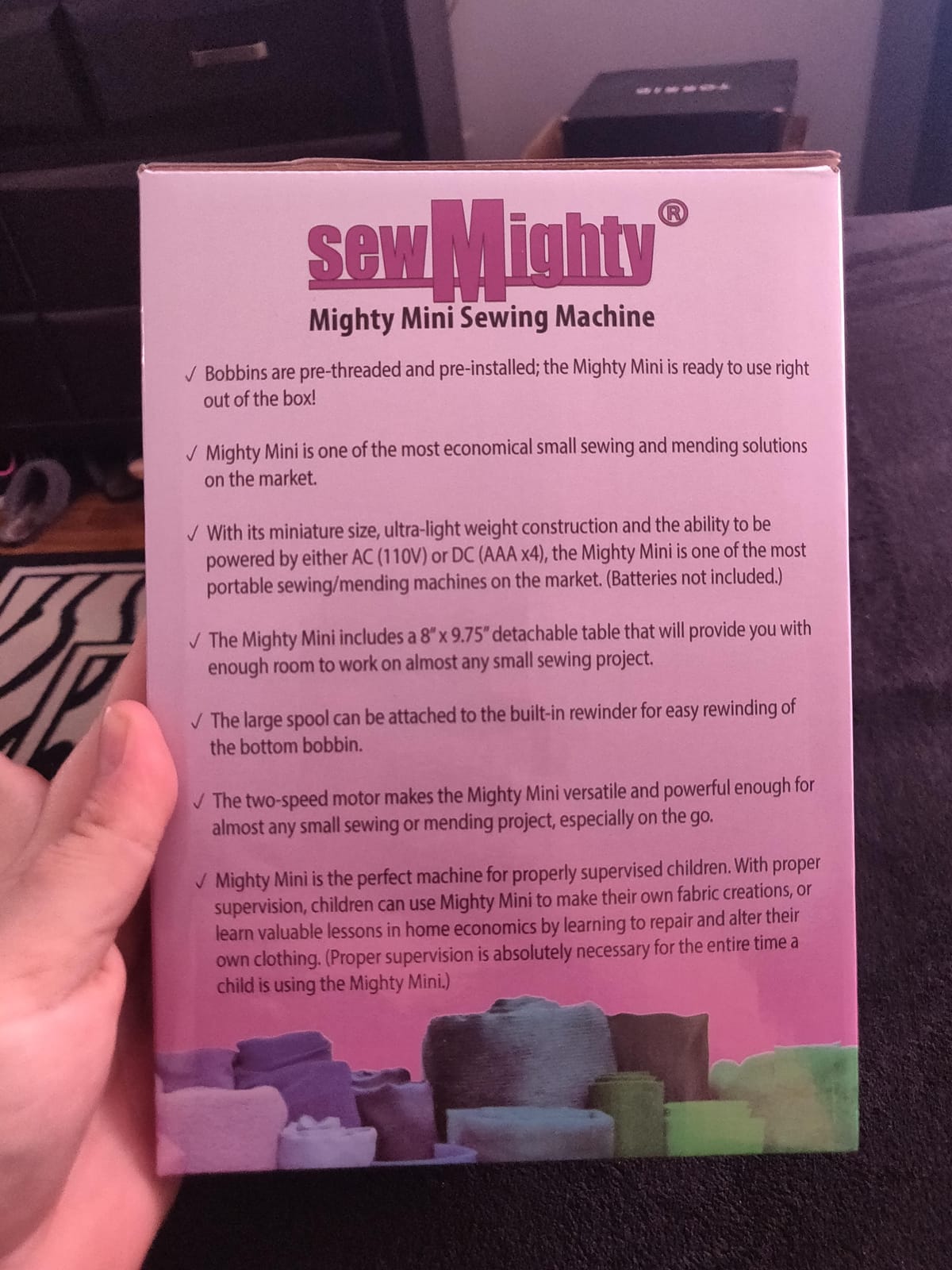
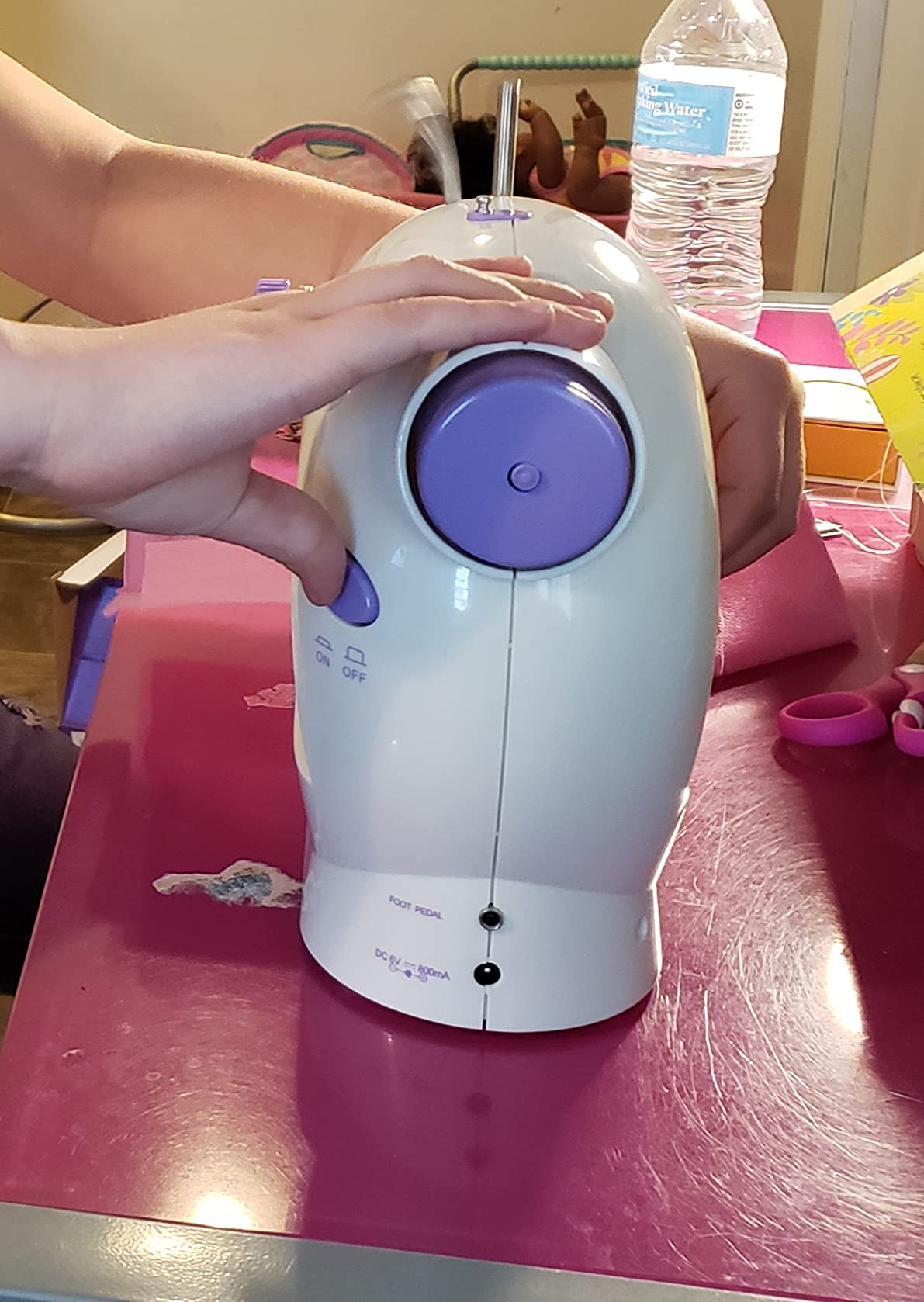
It is a metal-bodied machine, which is unusual at this weight and size, and it has two features that raise it above a basic craft toy: an automatic bobbin winder and an integrated work light. The bobbin winder matters more than it sounds, because winding a bobbin by hand is exactly the task that frustrates a child on a machine with a manual winder.
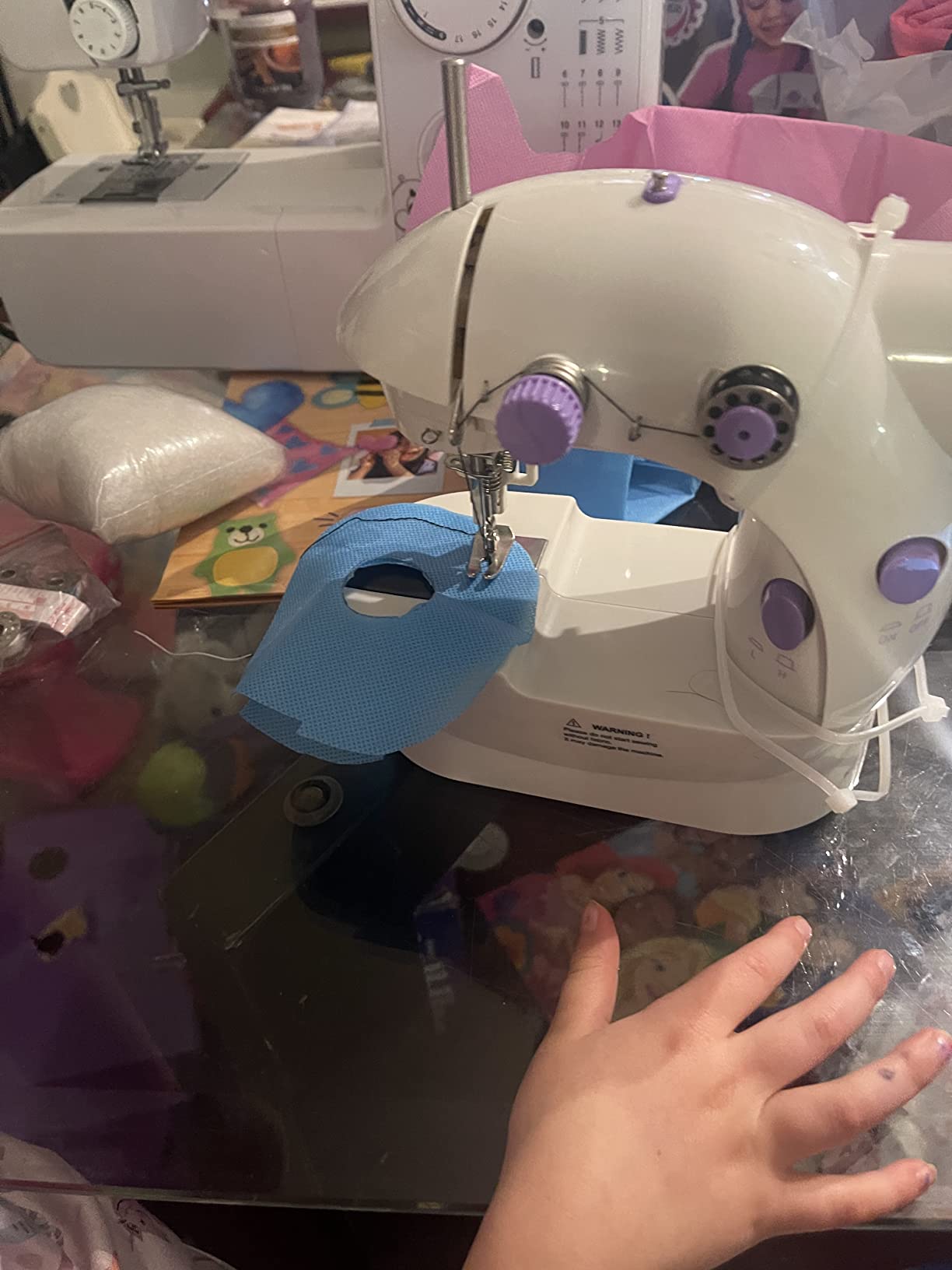
The cuff notch is an old-school detail that has quietly disappeared from most machines. It is a slot in the flat bed that lets you sew a sleeve cuff or trouser leg without fighting the edge of the machine, and for a child hemming their own jeans it is the difference between a smooth line and a wobbly one.
It is a single-stitch machine, so everything this produces is a straight line. That is enough for hems, mending, simple seams and doll clothing, and not enough for anything with stretch or edge finishing. Reviewers describe the motor as suited to light work, which is fair.
When a child can use this machine well
Best for ages seven and up who can already thread a needle with help, and for travel. Because it works without the foot pedal, a child can also run it manually, which suits a family that does not want a pedal trailing across a table in a small space.
It is a sensible first machine for a child whose interest is mending rather than construction: replacing a popped button, shortening a pair of trousers, closing a small tear.
When this machine is the wrong choice
Do not expect more than straight lines. There is no reverse to lock a seam and no alternative stitch to finish an edge, so anything a child wants to build rather than mend is out of reach. The light motor also means thick fabric and layered work will stall it.
Travel is the obvious fit, but the battery and mains options cannot be used together, so plan around one or the other.
4. Made By Me My Very Own Sewing Machine – Best for Ages 8 and Up
Made By Me My Very Own Sewing Machine for Beginner, Portable Battery Powered First Sewing Machine for Kids Ages 8+, Includes Fabric, Thread, Measuring Tape, & Stuffing,
4.52 inch D x 7.67 inch W x 7.48 inch H
2.4 pounds
Battery or corded electric
Ages 8 and up
Pros
- Only machine here designed and labelled for ages 8 plus
- Finger guards and a safety light for young users
- Ten illustrated project guides included
- Adjustable stitch speed and stitch length
Cons
- Foot pedal is optional and not in the box
- Thread tension is very tight and cuts threads
- Knobs feel cheap and can loosen
The thing that sets this machine apart is that it is honest about its audience. It is labelled for children aged eight and up, it comes with finger guards and a safety light, and the instructions are illustrated rather than written. That last point sounds minor until you watch a nine-year-old try to follow a text-only manual.
It is also the only machine in our group with adjustable stitch length as well as adjustable speed. Stitch length is what decides how big the stitches look, and it is what a child needs to move from a lumpy first attempt to a seam that looks deliberate. Ten guided projects run from simple to more involved, in picture form.
The craft set is complete in a way most kits are not. You get three spools of thread, two 12 by 12 inch fabric sheets, a bag of fiberfill, a measuring tape, a metal needle threader, a sticker sheet and the project booklet. Our test sessions started on a stuffed doll and a scarf, which are real projects rather than practice scraps.
Two things to know before you buy. The foot pedal is an option but is not included, so a child using the speed button needs to start and stop it themselves. And the thread tension runs tight enough that it cuts thread during sewing, which is the most common complaint in the reviews and is a real adjustment, not a defect.
When a child can use this machine well
This suits a child aged eight to twelve who can read a diagram and follow steps independently. Because it runs on batteries as well as a cord, it works for a child sewing in a bedroom rather than at a family table, and the battery-powered design is quiet enough for an evening activity.
It is also a strong choice for a child making doll clothing or a simple cushion, where the size of the stitch matters more than the number of stitch patterns.
When this machine is the wrong choice
It is not right for a child under eight, and the manufacturer says so. The stiff arm and jamming behaviour on thicker material also rule it out for denim, canvas or multiple layers of quilting cotton.
Buy it expecting to buy thread and fabric separately after the first project, and expect the tension to need a few sessions of adjustment before it stops cutting thread.
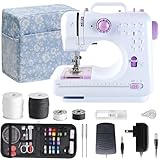
5. JUCVNB 12-Stitch Mini Sewing Machine – Best for Stitch Variety and Seam Locking
Sewing Machine for Beginners & Kids, Mini Portable Sewing Machines with 12 Built-in Stitch Patterns, 2-Speed Foot Pedal, Perfect for Teaching Daughter to Sew(with 27 Pieces Sewing Kit & Cover)
11.85 inch D x 12.68 inch W x 5.87 inch H
2.3 kg
AC adapter or 4 AA batteries
12 stitch patterns
Pros
- Only machine here with 12 patterns plus a reverse function
- Lock stitches included to secure seams
- Works with foot pedal or push button and mains or battery
- Threading guides printed on the body
Cons
- Polarized reviews with a 21 percent one-star share
- No power-off button so it runs when plugged in
- Too noisy for a bedroom and limited to thin fabric
This machine answers the single feature gap that runs through most of this category. It has twelve built-in stitch patterns, including lock stitches, and it has a reverse function. That reverse is why it belongs on this list: it is the difference between a seam that holds and a seam that unravels the first time a child tugs the fabric to check their work.
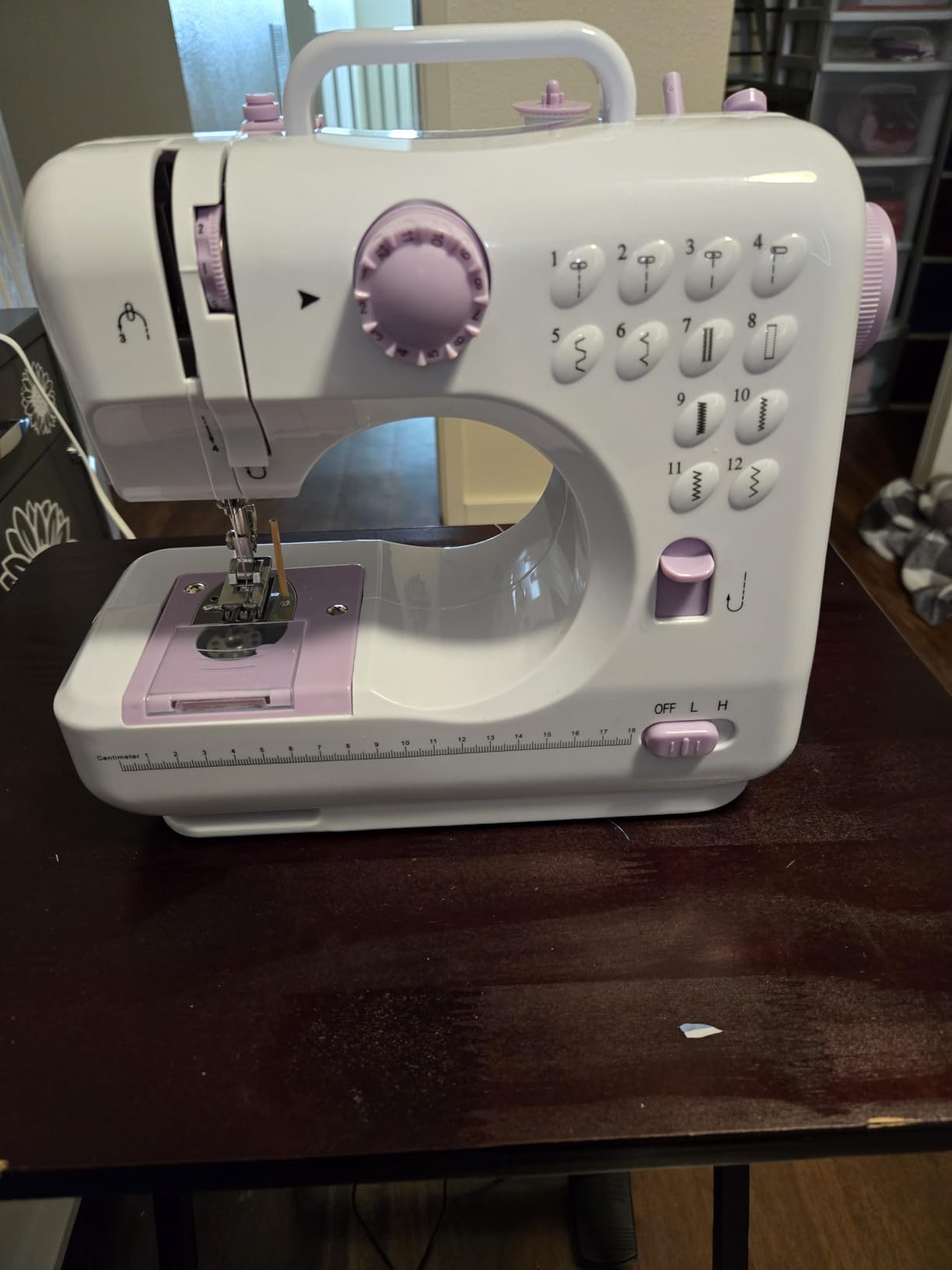
The twelve patterns are split sensibly. Positions one to four adjust stitch length, five and six are decorative, seven and eight lock, and nine to twelve cover curved stitching. For a child, the curved and lock options are the two that open up new project types, and most rivals in this price range simply do not have them.
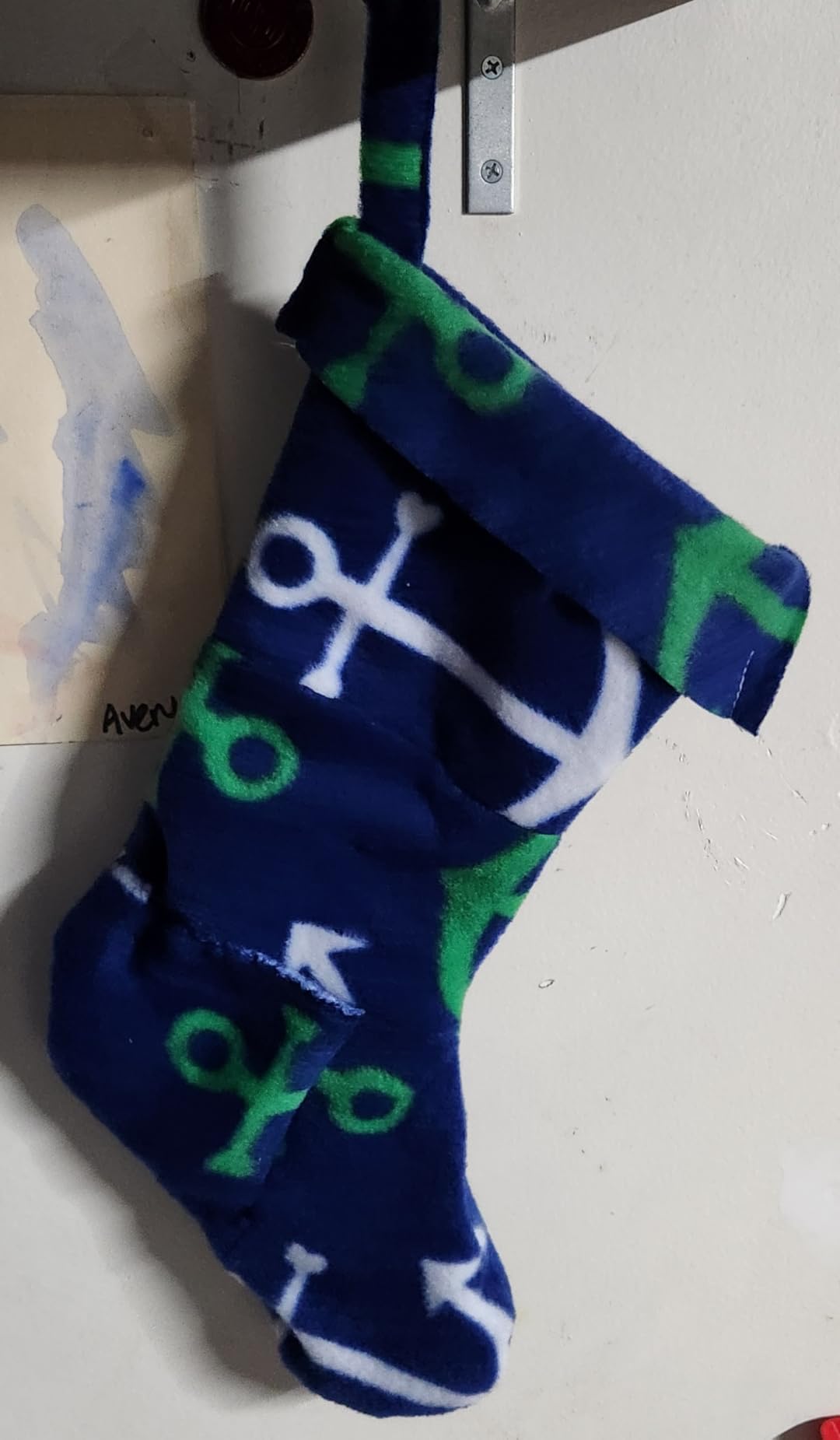
It runs from an AC adapter or four AA batteries, and it accepts either a foot pedal or push-button start, so it adapts to the child rather than the other way around. Threading guides are printed directly on the body, and a QR code links to a tutorial video, which together cut the setup time significantly compared with a machine that ships with a thin leaflet.
The reviews are sharply split, and you should read them before buying. Owners who get a working machine describe it as ideal for simple alterations. Others report jamming, bent or broken needles, and frustration with the power switch. The power design is genuinely awkward: there is no power-off button, so the machine starts the moment it is plugged in.
When a child can use this machine well
It suits a child aged eight and up who has outgrown a single-stitch machine and wants to see what a seam lock and a curve look like. A 27-piece kit and a matching cover are included, so it also works well as a gift for a child who has shown interest but has nothing to start with.
The reverse function makes it a good machine for a first attempt at a garment pattern, such as a simple pillowcase, because the finished seam will hold.
When this machine is the wrong choice
It is the wrong choice for a quiet bedroom or a nap-time household, because it is loud. It is also wrong for anyone hoping to sew denim, thick cotton or layered quilting, since the needle and base clearance will not take them.
If reliability under heavy daily use matters more to you than feature count, skip it. The share of one-star reviews is the highest of any machine here.
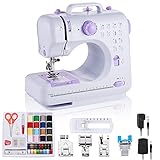
6. Rxmeili Portable 12-Stitch Sewing Machine – Best for Everyday Mending
Rxmeili Portable 12-Stitch Sewing Machine, 42-Pc Sewing Kit for Beginners
5.9 inch D x 12.2 inch W x 11.8 inch H
2.4 kg
AC adapter or 4 AA batteries
12 stitch patterns with reverse
Pros
- Twelve stitches plus reverse and zipper and button feet
- 42-piece kit with thread and bobbins
- Work light and built-in thread cutter
- Storage drawer keeps the kit together
Cons
- Battery mode stops stitching within a minute
- Foot pedal has no speed sensitivity so it is on or off
- Struggles with thick or layered fabric
This is the most conventional of the twelve-stitch machines, and for household mending that is exactly what you want. It ranks high in Sewing Machines on Amazon and carries more than two thousand reviews, which is a meaningful sample size when you are deciding whether a machine holds together.
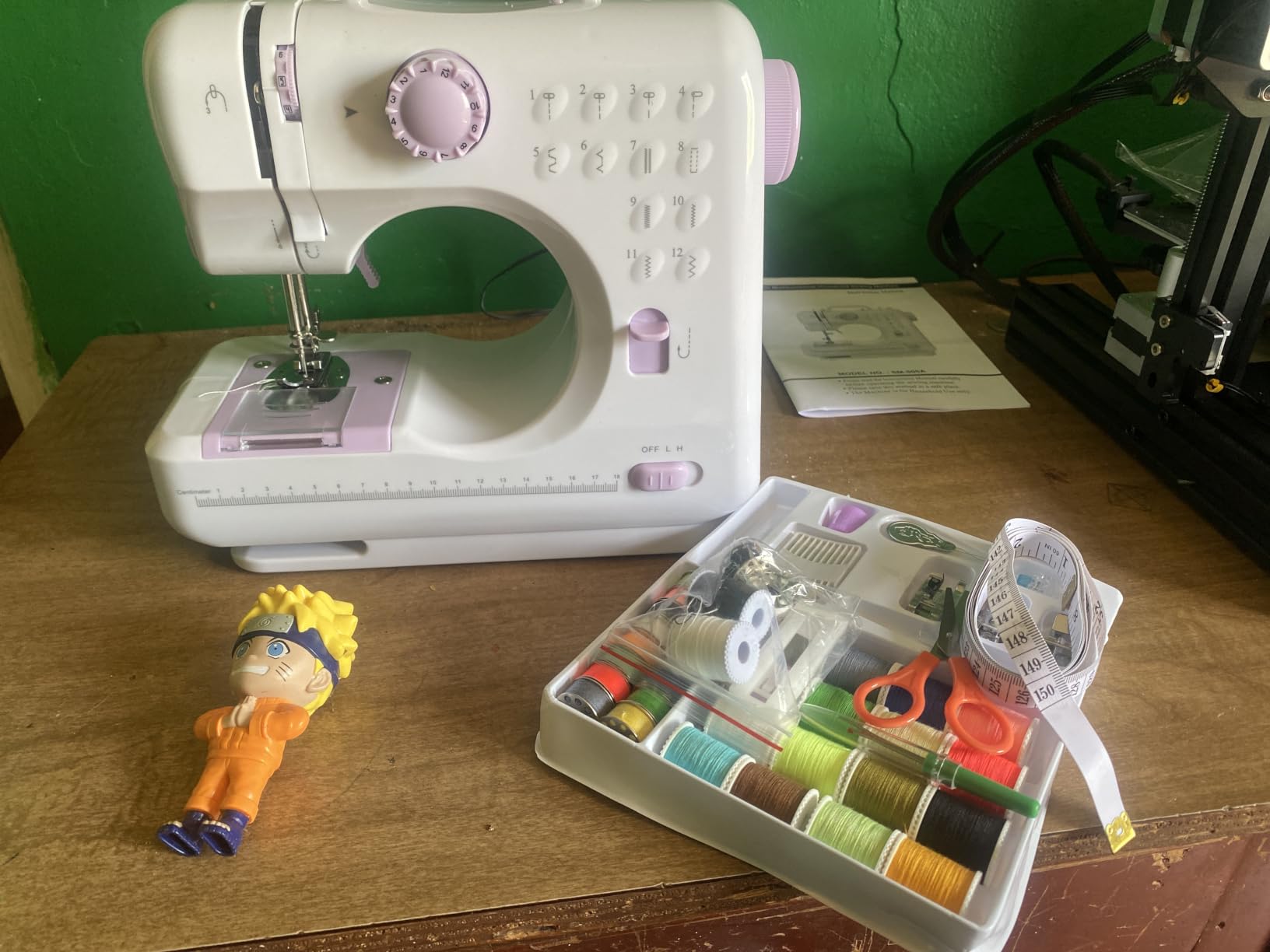
Unlike most rivals, the presser feet are not an accessory you may need to buy. Zipper and buttonhole presser feet are included, and that buttonhole foot is what turns this from a mending machine into something a child can use for a school project. The built-in thread cutter and the storage drawer are small quality-of-life details that we appreciated more than expected.
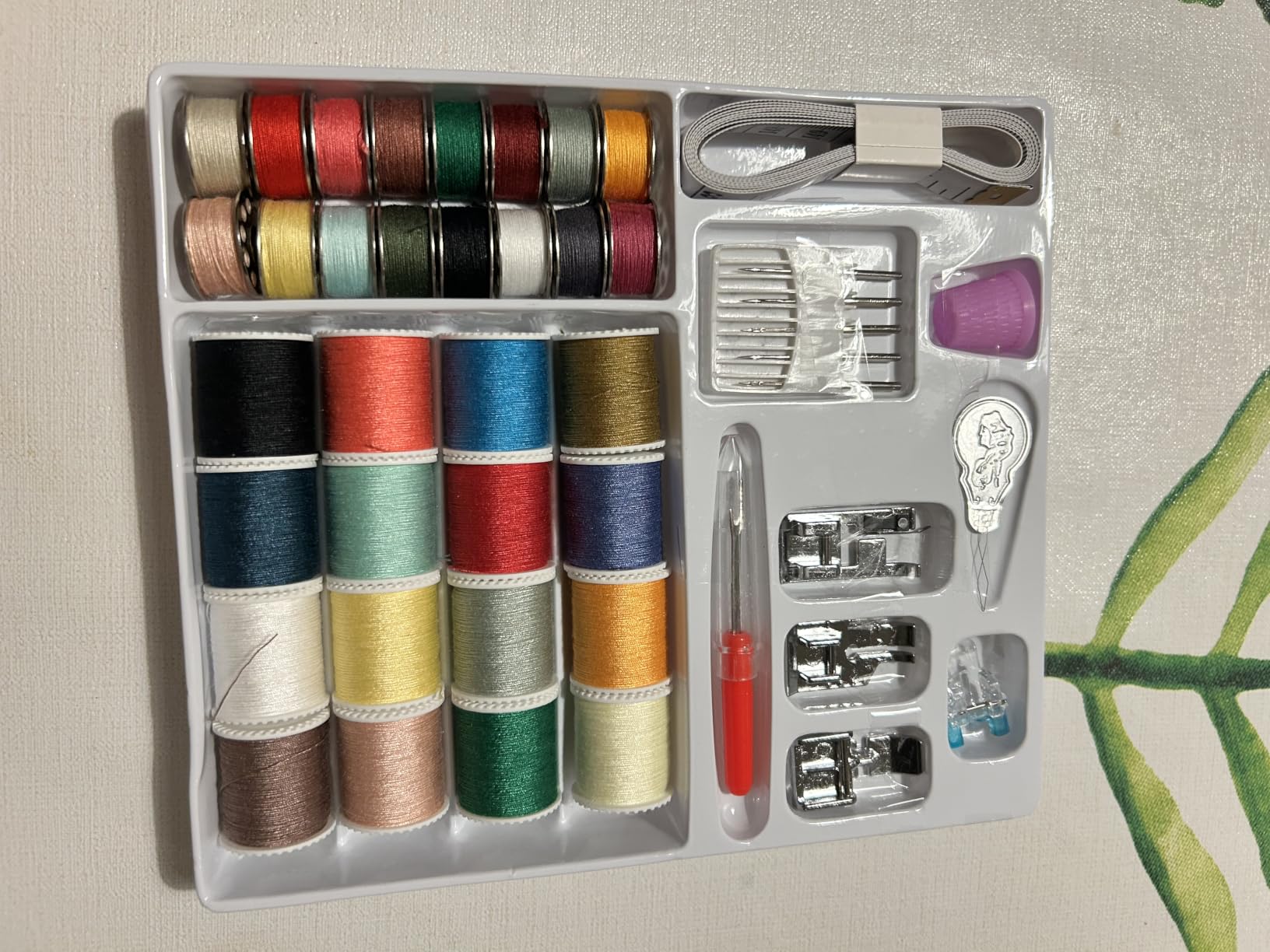
The slow foot-pedal setting is genuinely slow, which is the correct behaviour for a child. A slow machine is a patient machine, and a child who is not rushing is a child who does not need constant help. Twelve patterns, a reverse function, and a light that reaches the needle area add up to a machine that supports unsupervised-within-sight sewing for an older child.
Two caveats. The pedal has no speed sensitivity, so it behaves like an on and off switch rather than a gradual accelerator, which is worth explaining to a child before they think they are doing it wrong. And battery mode is the weak point: the machine stops stitching after under a minute in some reports, so treat the battery as a portability accessory rather than a working option.
When a child can use this machine well
It fits a child aged eight and up, and it is the pick we would suggest for a family that mostly needs hems, buttons and simple repairs done quickly. The storage drawer and the thread cutter make it a machine an adult and a child can share without arguing over the accessories.
It is also a good choice for a child who wants variety without being overwhelmed, because the stitch dial is simple to read.
When this machine is the wrong choice
Not a machine for quilting or for anything thick. The needle can bend on layered fabric, and that is a safety point as much as a performance one. It is also a poor choice for use away from a wall socket given the battery behaviour.
Check the power toggle carefully at setup. Owners report the machine running without the pedal when the speed switch is not set correctly, which is unsettling the first time it happens.
7. CraftBud Mini Sewing Machine – Best for the Biggest Accessory Bundle
CraftBud Mini Sewing Machine for Beginners, Adults and Kids Sewing Machine
10.4 inch D x 6.5 inch W x 10.2 inch H
2 pounds
Electric powered
122-piece sewing kit
Pros
- Largest bundle we tested with 50 fabric squares and 16 thread spools
- Illustrated guide book with 10 projects
- Extension table foot pedal and built-in light included
- Genuinely small enough not to intimidate a first-timer
Cons
- Only one stitch pattern on the machine
- Top thread disconnects mid-sew
- Some units fail to pick up the bottom thread
The argument for this machine is what comes in the box, and the box is exceptional. A 122-piece kit includes 50 fabric squares, 16 thread spools, 20 bobbins, 5 needles, 10 sewing clips, a thimble, a needle threader, a seam ripper, scissors, a tape measure, a chalk pencil, a foldable ruler and a guide book. For a parent who does not want to make a second shopping trip, that is the whole starter kit.
The guide book is better than it needs to be. It carries ten illustrated projects covering kids, teens and adults, which means the same machine works for a six-year-old making a felt shape and an adult hemming curtains. That range is unusual at this size and is the reason we ranked it so highly despite a single stitch pattern.
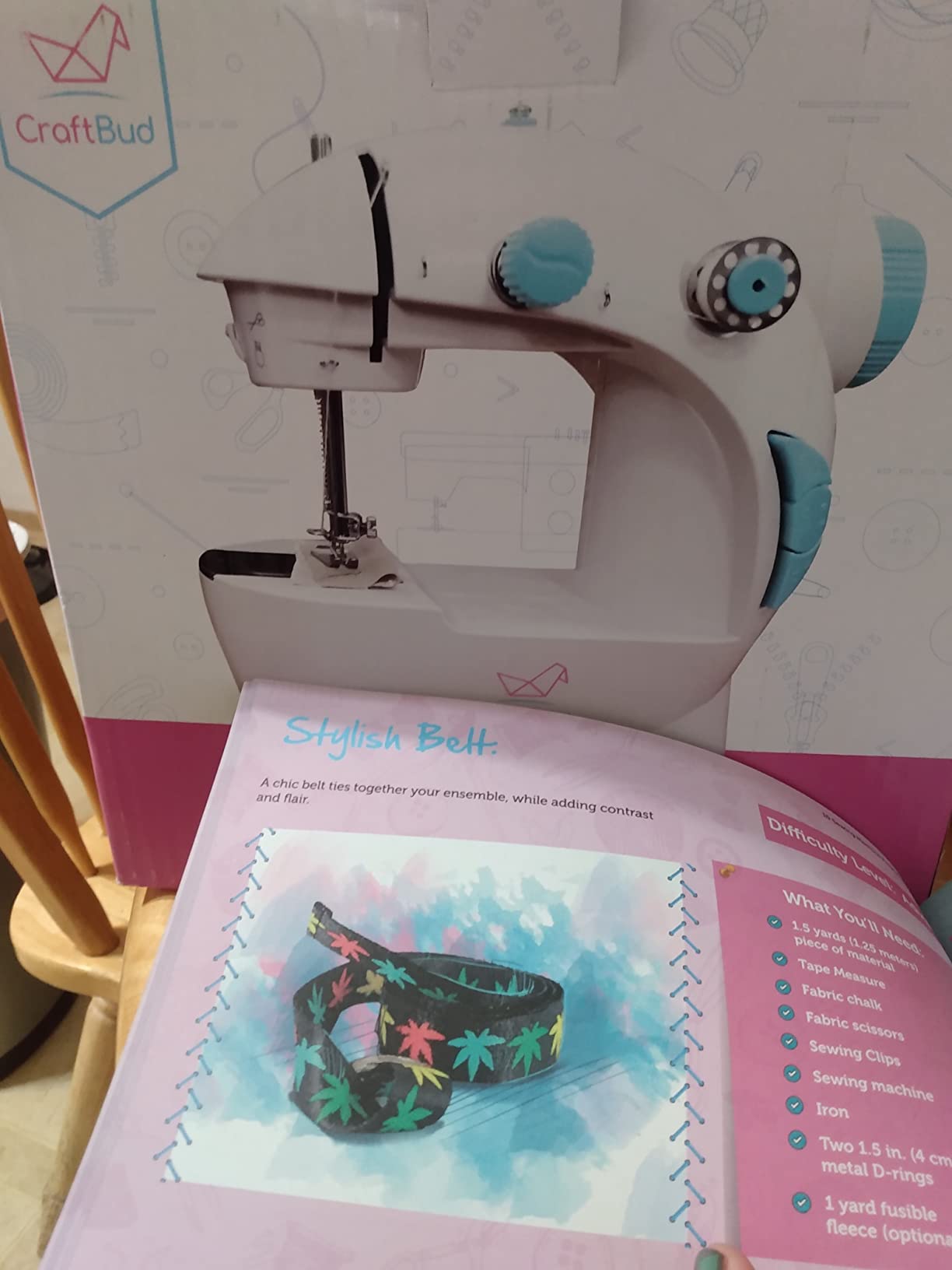
At 2 pounds and 10.4 by 6.5 by 10.2 inches, it is physically smaller than most full machines here, and that is a deliberate choice rather than a space-saving one. A first sewing machine that looks like a real machine intimidates a child. This one reads as a toy that happens to work properly, and parents and grandparents we read about described children making doll clothing on it without resistance.
One stitch pattern is the real limit, and so is the reliability of the top thread path, which reviewers report disconnecting in the middle of a seam. It is fine for craft work and light mending. It is not a machine for building anything that will be washed hard.
When a child can use this machine well
Best for ages five to nine, and for a child who wants immediate access to materials rather than a parent pre-supplying them. Fifty fabric squares means fifty possible projects before anyone buys anything, which is a strong answer to the most common reason a sewing machine gets abandoned in month two.
It also suits a gift situation where the child has never been given fabric, thread or scissors before and the adult wants it all to land at once.
When this machine is the wrong choice
It is the wrong choice for a child who wants to hem jeans or make a garment, because one straight stitch with no reverse is not enough. Durability is the other concern: a number of reviewers report units failing to pick up the bottom thread after very few uses.
It is also not a machine for an adult who sews, despite the guide book mentioning adults. Nothing about the construction suggests shared use.
8. Flying Banana Mini Sewing Machine – Best for Safety Certification
Mini Sewing Machine for Beginners-Maquina de Coser, Easy Automatic Sewing Machine with Extension Table, Household Electric Portable Sewing Tool with Sewing Kit, Small, for All Age, Kids or Adults
5.4 inch D x 8.4 inch W x 9.2 inch H
1.7 pounds
AC powered
UL ETL and CE approved
Pros
- Only machine here with UL ETL and CE safety approval
- Lightest and smallest at 1.7 pounds
- Automatic bobbin rewinding and thread cutter
- Cuff slot plus extension table included
Cons
- Lowest average rating in the group at 3.7
- Weak plastic construction
- Unclear instructions and accessories sometimes missing
This one earns its place on a single piece of paper: UL, ETL and CE approval. If your child has younger siblings, or if you are buying a machine that will be used around a table with several children, a documented safety certification is worth more to us than an extra stitch pattern.
It is also the lightest full-size-feeling machine we tested at 1.7 pounds, and 5.4 by 8.4 by 9.2 inches makes it easy for an adult to move out of the way when it is not being used. The automatic bobbin rewinding and the built-in thread cutter are both features usually reserved for larger machines, and the cuff slot is a nice touch for altering sleeves.
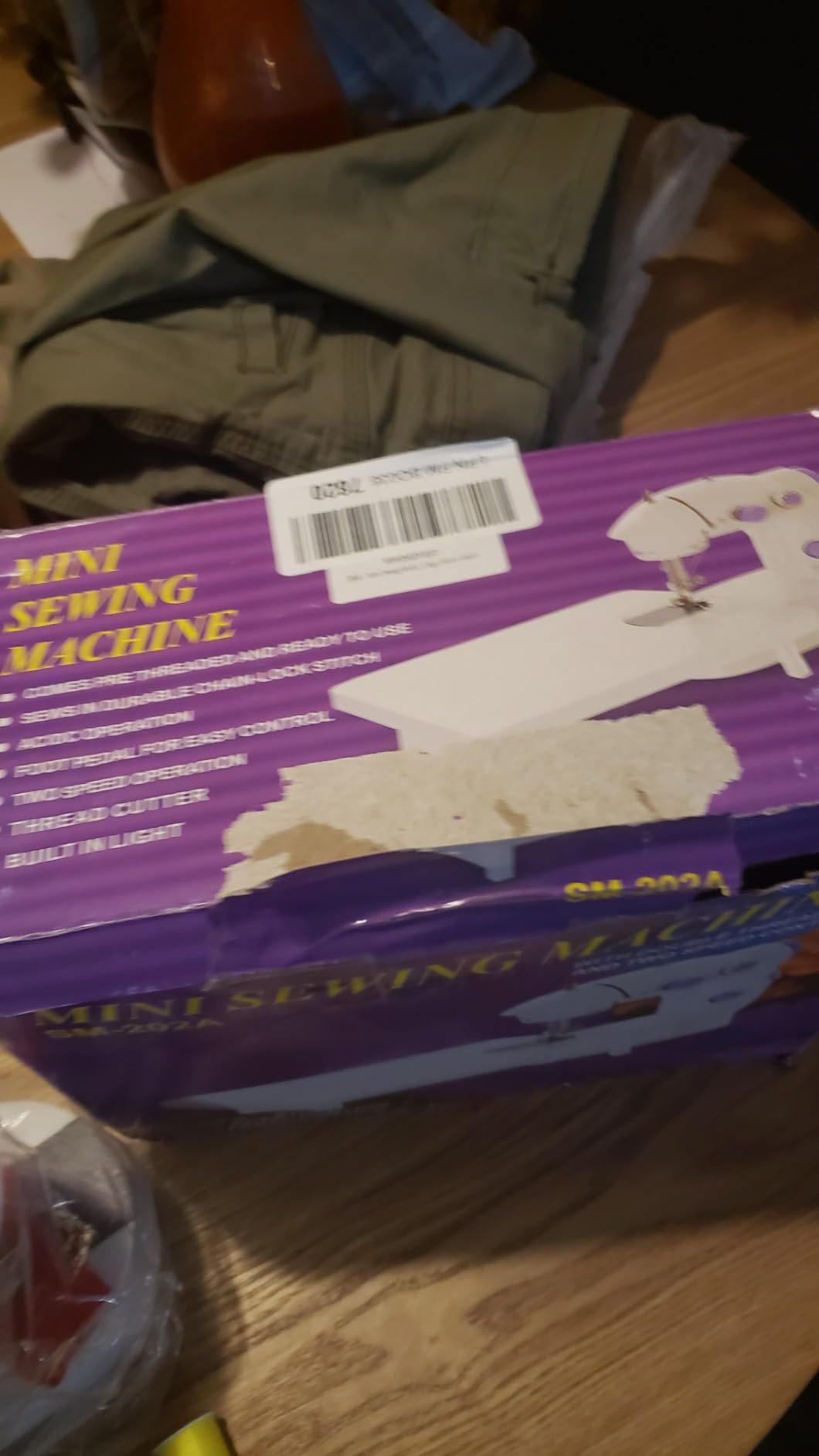
Children did manage basic repairs with it during our sessions, and the extension table gives small hands somewhere to press while fabric feeds. The manufacturer also backs it with a three-month refund or replacement window, which is a more useful commitment than most listings in this category offer.
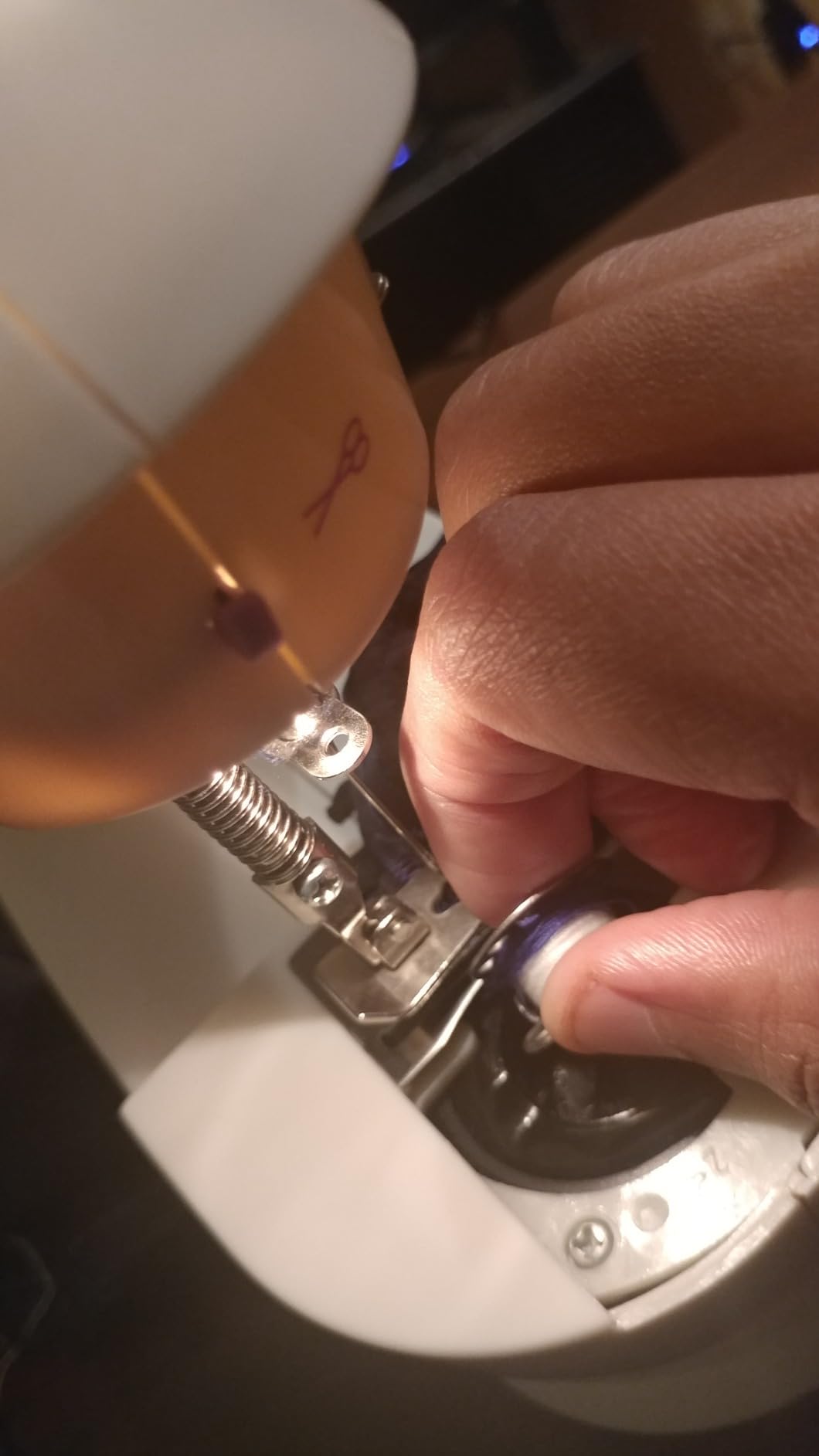
Reliability is the weak point, and we would rather say so plainly. Owners report dead work lamps, missing accessories in the box, and units that stopped running. The rating here is the lowest of the twelve, and the share of one-star reviews is high. Instructions are also unclear enough that one buyer spent over two hours on threading alone.
When a child can use this machine well
It suits a child aged six to ten doing light repairs and simple craft work, and it is the pick for a family prioritising documented electrical safety. The extension table and the small footprint make it workable at a kitchen table rather than a dedicated sewing corner.
It is also a reasonable first machine for a child who is likely to be rough with it, since there is not much to lose if it needs replacing.
When this machine is the wrong choice
It is the wrong choice if you want a machine that lasts, given the reliability pattern in the reviews and the plastic construction. It is also the wrong choice for thick fabric or layered work, where the light build shows.
Budget an hour with the threading before handing it to a child. Check the box contents against the list on arrival, because missing accessories are a recurring report.
9. Hearth and Harbor Mini Sewing Machine – Best Gift Set
Hearth & Harbor Mini Sewing Machine for Beginners, Dual Speed Small Portable Sewing Machine for Kids and Adults with Extension Table, 48 Piece Gift Set Includes, Pedal, Projects Book and More, Red
10.4 inch D x 6.5 inch W x 10.2 inch H
2 pounds
AC/DC adapter powered
48-piece set
Pros
- 48-piece set with 16 pre-threaded bobbins and 16 thread spools
- Illustrated guide book with 10 projects
- Extension table foot pedal and built-in light
- Adjustable speed and dual power
Cons
- No reverse function so the first stitches are hard to secure
- Very light build that is not sturdy at the seam
- Thread snapping and mid-project glitching
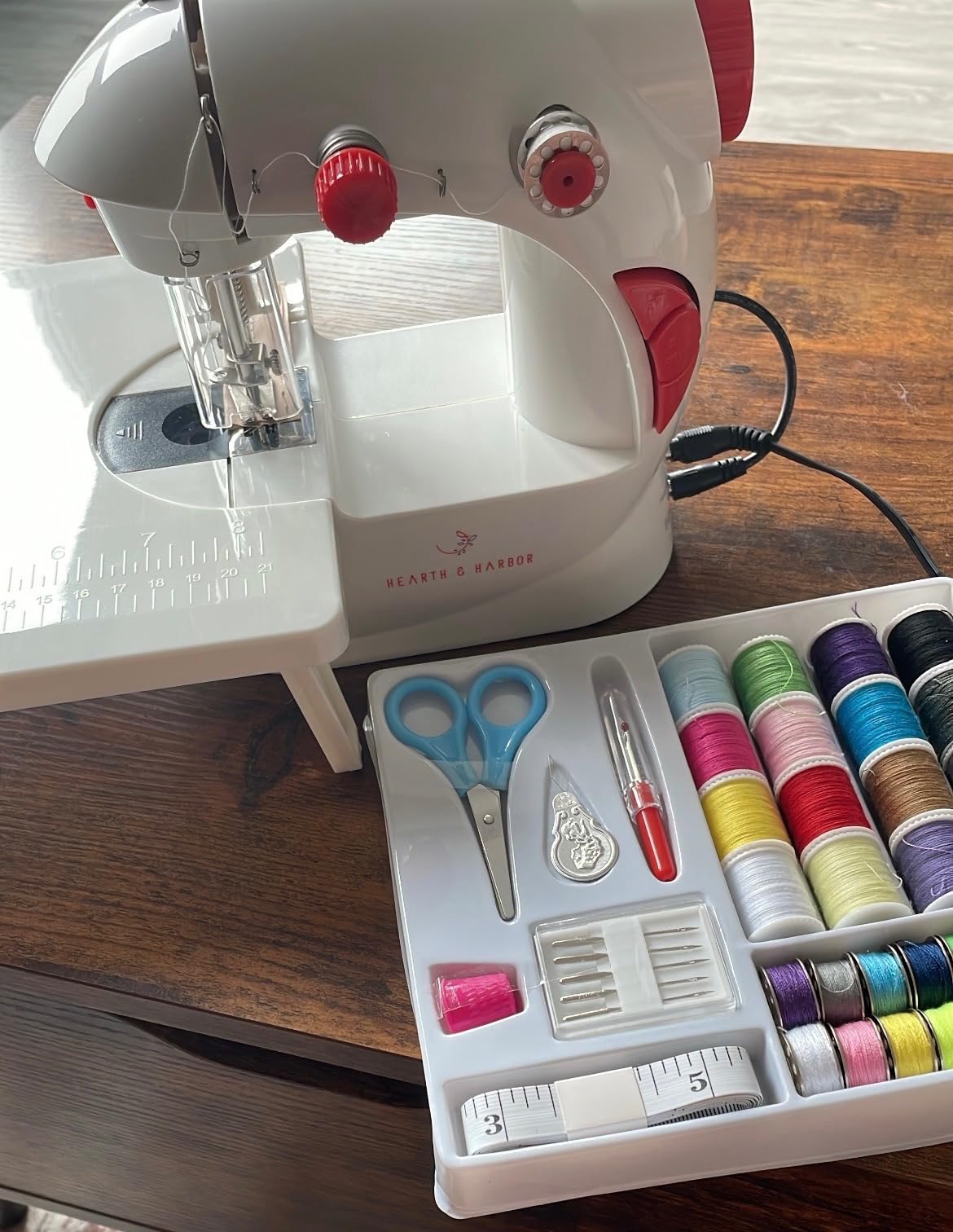
This shares its footprint and its accessory philosophy with the CraftBud kit, and that is a useful thing to know if you have seen one and liked it. Sixteen pre-threaded bobbins is the standout detail here. Threading a bobbin is the task children find hardest, so shipping them already threaded removes the single biggest early frustration.
It is a well-presented gift. The red finish, the 48-piece layout and an illustrated book with ten projects for kids, teens and adults make it a reasonable birthday or holiday choice for a child who has never touched a machine, and the box looks like a craft set rather than an appliance.
For actual sewing it is thinner than the set suggests. There is no reverse function, so the beginning of a seam is hard to secure, and a number of grandparents we read about described it as a play-and-learn machine. Adults tend to land on it for hems and simple seams in thin cotton and leave anything harder alone.
Light build is the recurring theme. It is not sturdy at the seam, thread snapping mid-project is a common report, and denim is out of range because of the needle-to-base clearance. We have also seen reports of a box arriving with contents spilled and a foot pedal spring missing, so inspect it before you wrap it.
When a child can use this machine well
It fits ages six to ten for craft projects, doll clothing and simple hems, and the pre-threaded bobbins make it a good choice for a child who loses patience quickly. Grandparents buying a first machine for a grandchild tend to report good results at this level.
The extension table and built-in light help in low light, which matters for an after-school session rather than a weekend project.
When this machine is the wrong choice
Do not buy it for garment work. The missing reverse is not a minor gap, and there is no workaround for it beyond tying off manually every few centimetres.
It is also the wrong pick for denim, canvas or any heavy fabric, and for a child who tends to treat equipment roughly given how light the build is.
10. BUXFMHT Mini Sewing Machine – Best for Thicker Fabrics
Sewing Machine with Extension Table, Mini Sewings Machines Portable Electric Sewing Machine, 12 Stitches Sewing Machines with LED Light, Sewings Accessory Kit, Ideal for Clothing, Pillowcases, Sheets
7.3 inch D x 14.7 inch W x 12 inch H
6 pounds
AC adapter or 4 AA batteries
12 stitch patterns with reverse
Pros
- Metal hook tip handles thicker fabric and reduces wear
- Forward and reverse sewing plus buttonholes
- Two-thread locking stitch avoids knots
- 12-month quality guarantee
Cons
- Lightweight build that slides while sewing
- Fiddly needle threading for new users
- Foot pedal responsiveness criticised by some
This is the only machine in the group we would consider for a first real garment. At 6 pounds it is by far the heaviest, and that weight exists for a reason: a heavier body resists the pushback of a thicker fabric passing under the foot. The metal hook tip adds to that, and it is the component that wears first on cheap machines.
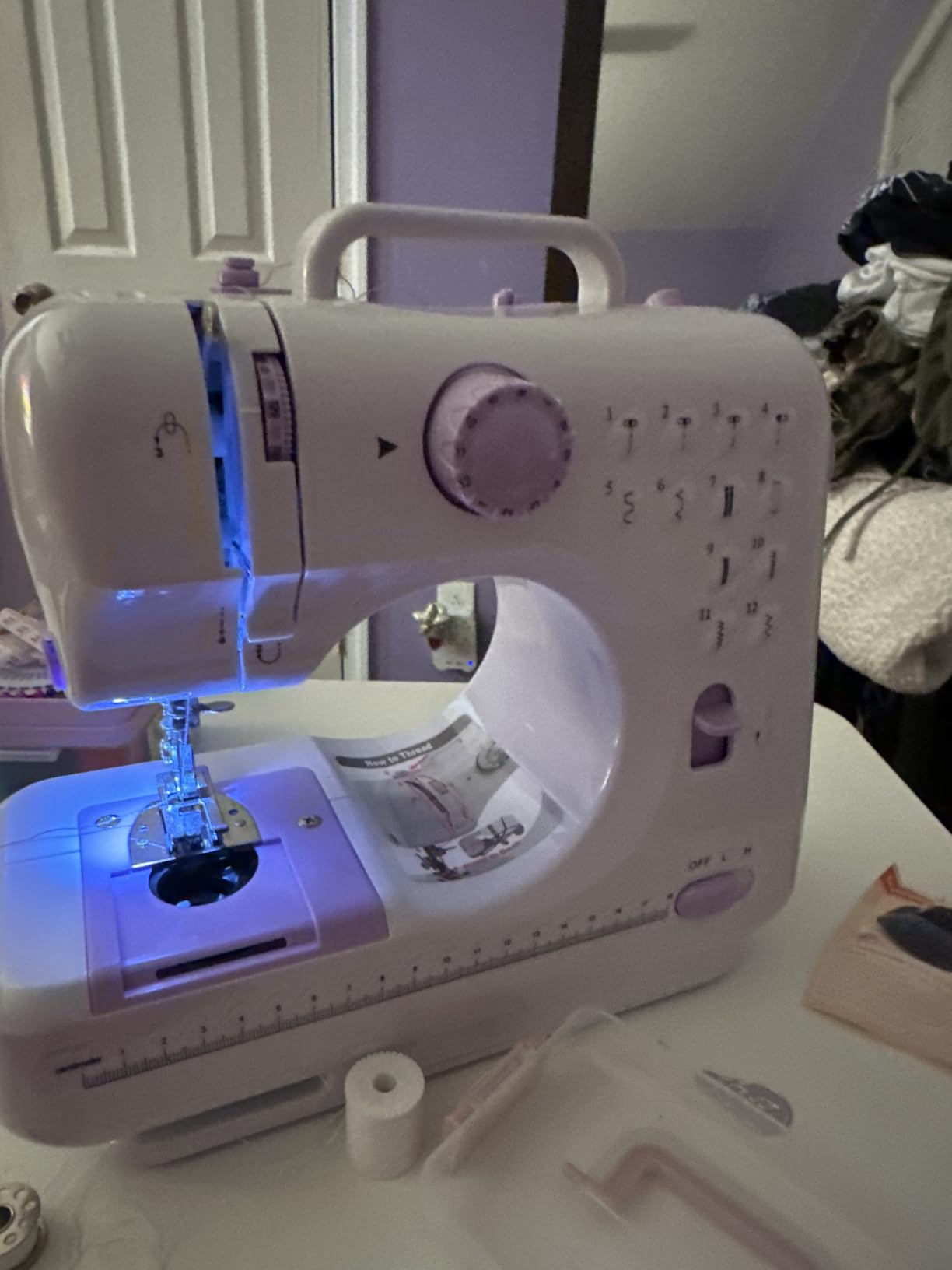
The feature set is genuinely capable. Twelve stitch patterns including buttonholes, forward and reverse sewing, sleeve sewing, and a two-thread locking stitch that tidies a seam without a knot. At six pounds and 7.3 by 14.7 by 12 inches, it is closer to a compact full-size machine than a true mini, and a child who starts here can keep going for years.
It also carries the friendliest warranty position we saw, a 12-month quality guarantee, and the seller response we read about was consistently good, including resolving an earlier negative review. That is worth something on a machine where a child will be the one operating it unsupervised-adjacent.
Against that, it is not a toy. The needle threading is fiddly, so an adult will need to do it with the child the first few times. The build is light for its size and slides around while sewing, and the foot pedal response draws complaints. The instruction manual is also poorly translated in some versions.
When a child can use this machine well
It suits a child aged nine and up, or a younger child working alongside an adult who threads the needle. A child moving from craft projects to pillowcases, simple shirts or curtains is exactly the trajectory this machine supports.
It is the pick for a family that expects to sew more than the minimum, and for anyone who wants one machine that does not need replacing in a year.
When this machine is the wrong choice
It is not a first machine for a five-year-old. There is no finger guard, the threading is fiddly, and the weight and footprint make it less approachable for a small child. It is also the wrong choice for a household with no space to spare, since it is much larger than the other eleven machines here.
If your child only wants to sew felt shapes, this is a machine built for a job they do not have yet.
11. Royalsellpro Mini Sewing Machine – Best for Young Children
Royalsellpro Mini Sewing Machine with 123 Pcs Sewing Kit for Beginners, Dual Speed Portable Sewing Machine with Light and Finger Guard Suitable for Household, Travel
10.23 inch D x 8.81 inch W x 6.53 inch H
DC powered
Battery or plug-in
Finger guard and two speeds
Pros
- Highest rated pick here at 4.2 stars
- Built-in finger guard plus adjustable high and low speed
- 123-piece kit with 16 threads and fabrics
- Tutorial eBook with 12 projects
Cons
- Bobbin threading defeats some first-time users
- Runs clunky though reviewers expect it at the price
- Tiny parts make needle changes hard
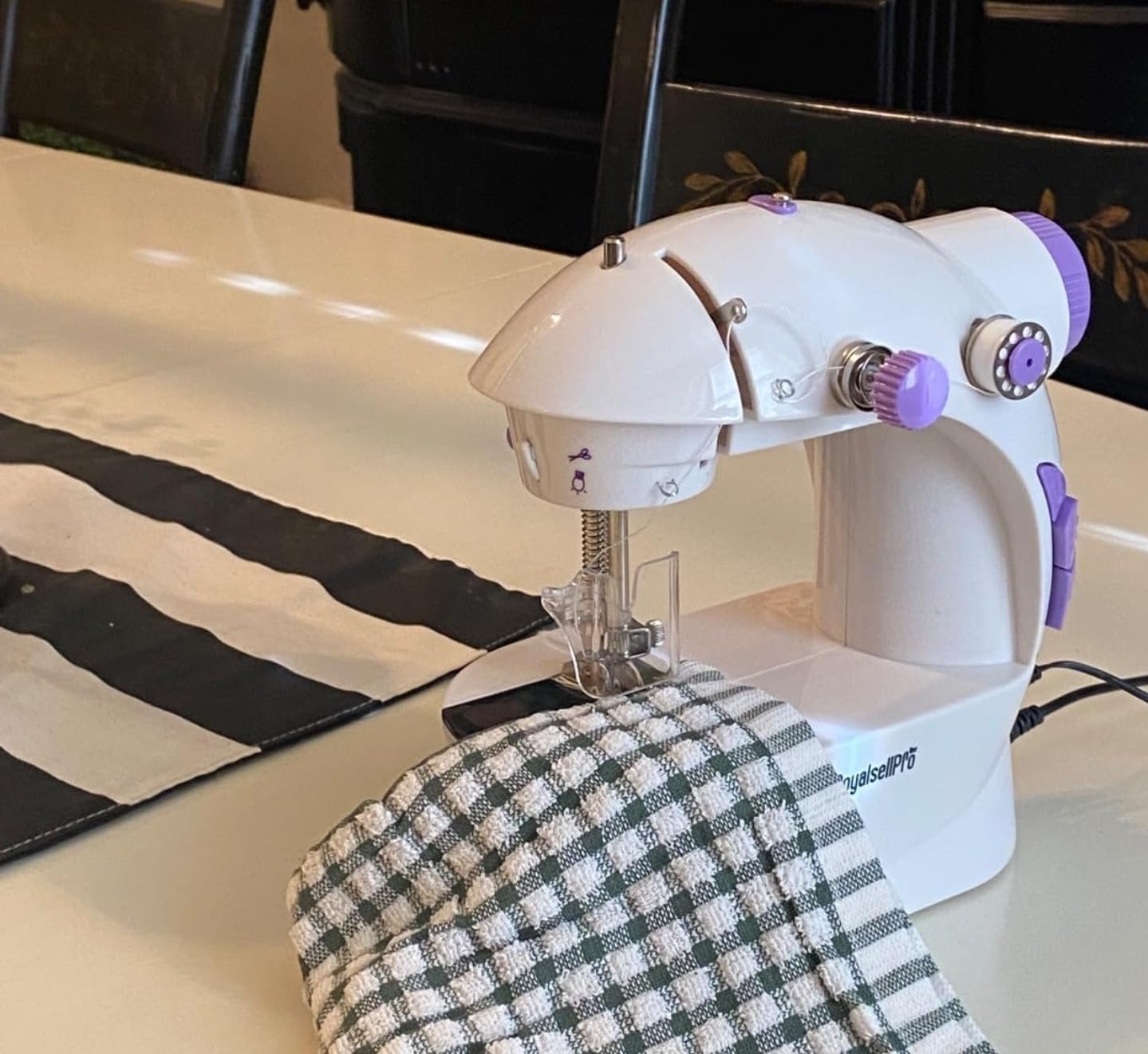
This carries the highest average rating of the twelve at 4.2 stars, and for the youngest age band it is the one we would choose. The combination that matters for a small child is the finger guard plus adjustable two-speed control, and this has both. Parents of children roughly five to ten cited the finger guard as the deciding safety feature in the reviews.
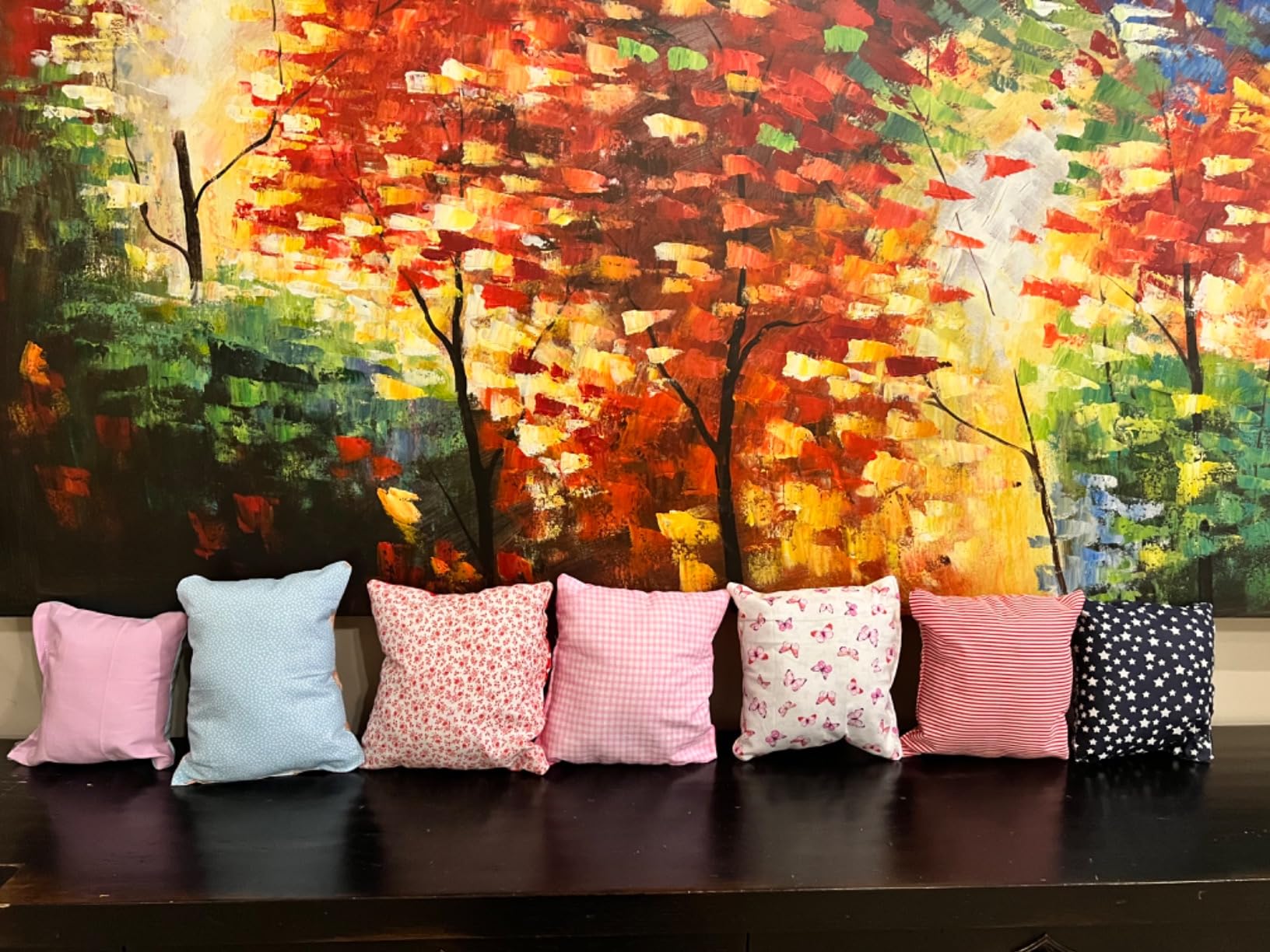
It is one of the newer machines in this group, and the 123-piece kit is the most complete we tested. It includes 16 coloured threads, 5 needles, scissors, a tape measure, an extension table, a foot pedal, fabric pieces and both a user manual and a DIY creative manual. The tutorial eBook runs 12 projects, from aprons and shopping bags to dolls.
Dual power means it works at home, in a classroom or on the move, and the built-in light handles low-light sessions. The extension table adds stability for a child who is still two-handed on the fabric. The seller support is also genuinely responsive, with one difficult order resolved by refund and a written apology.
The honest weakness is bobbin threading. A number of buyers could not get the bobbin threaded despite extended troubleshooting, and that is exactly the step a five-year-old needs help with most. Many small parts also make needle changes hard for anyone with limited dexterity. It runs clunky, which reviewers largely accept at the price.
When a child can use this machine well
Best for ages four to seven with an adult nearby, and for a child starting on felt, simple shapes and doll clothing. The guard and the slow speed setting let an adult stay in the room rather than over the shoulder, which is the supervision level most families actually want.
It also works as a shared machine for two children of different ages, since the two speed settings let an older child sew properly while a younger one practises slowly.
When this machine is the wrong choice
It is the wrong choice for an older child who has already outgrown a craft-level machine, because there is no reverse and nothing for thick fabric. The clunky feel is also worth handling in person if that bothers your child.
Be prepared to thread the bobbin for them. Plan for it, and the machine works well. Skip it if you are not willing to.
12. TUZT Mini Sewing Machine Toy Kit – Best for Ages 4 to 6
TUZT Mini Sewing Machine Toy Kit for Kids Beginners, 22pcs Portable Electric Sewing Machine with Sewing Kit, Light and Finger Guard, Birthday Christmas Gift for Kids Girls 4-12
Machine size 7 x 7.8 x 3.7 inches
10.4 ounces
Battery and USB powered
22-piece kit
Pros
- Pre-assembled so a child can start sewing on day one
- Built-in light and finger guard
- Lightest and most portable at 10.4 ounces
- Supports 6 finished craft pieces
Cons
- Uses yarn rather than thread and not a true lockstitch
- Short battery life and a very short USB cable
- Yarn slips off the feed track and needs constant help
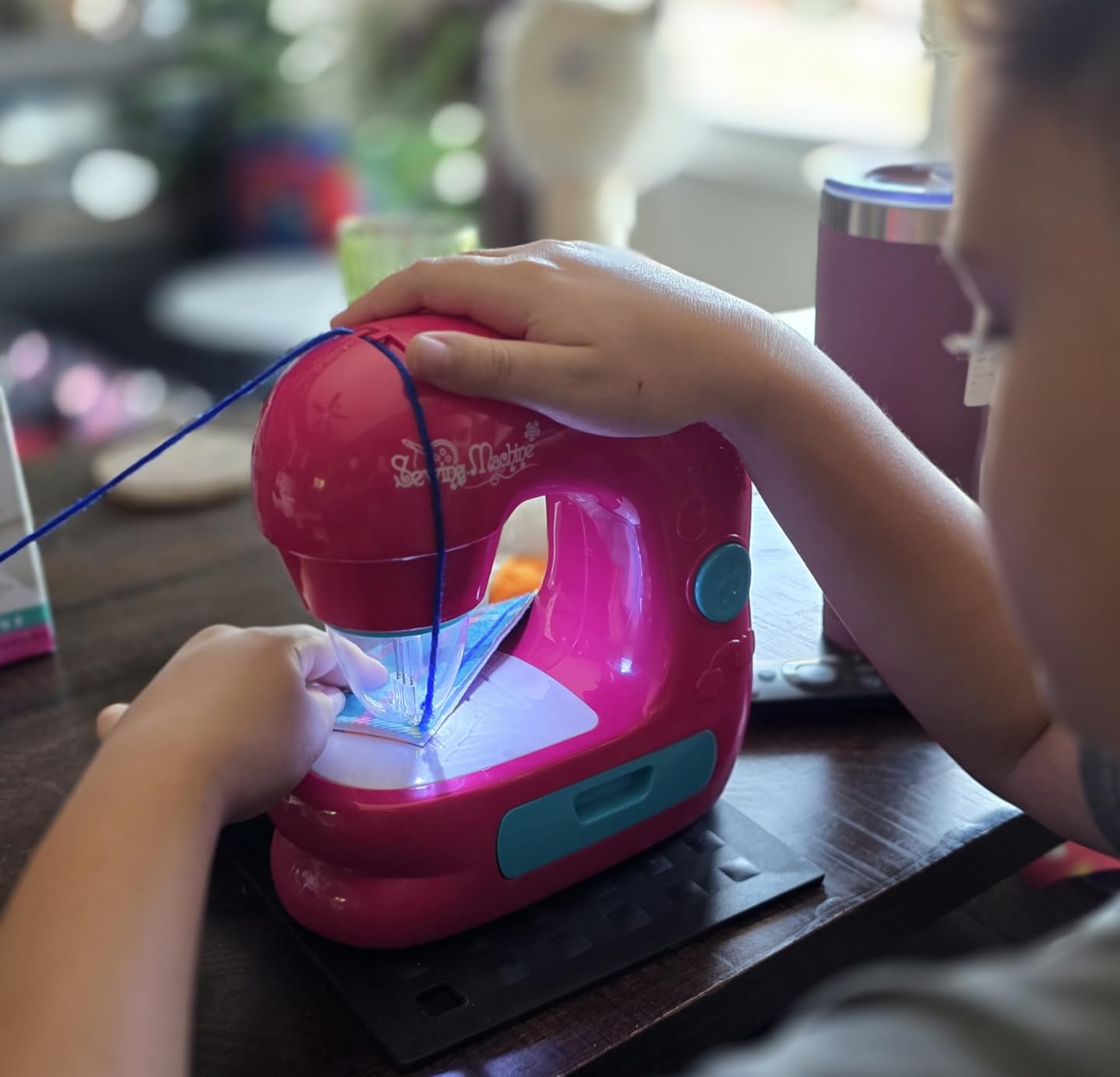
We are including this one because the age band it targets is real, and because the top-rated score hides what it actually is. This is a craft toy, not a sewing machine. It feeds yarn rather than thread, it does not form a true lockstitch, and it will not sew a hem. What it does do is let a four-year-old make something finished within ten minutes of opening the box.
Everything about the design points at a first experience. It arrives pre-assembled, which removes the single most common reason a child loses interest in a craft kit, and it includes a built-in light and a finger guard. The 22-piece kit supports six completed pieces including doll clothing and keychains, so a young child has a visible result rather than a scrap of uneven stitching.
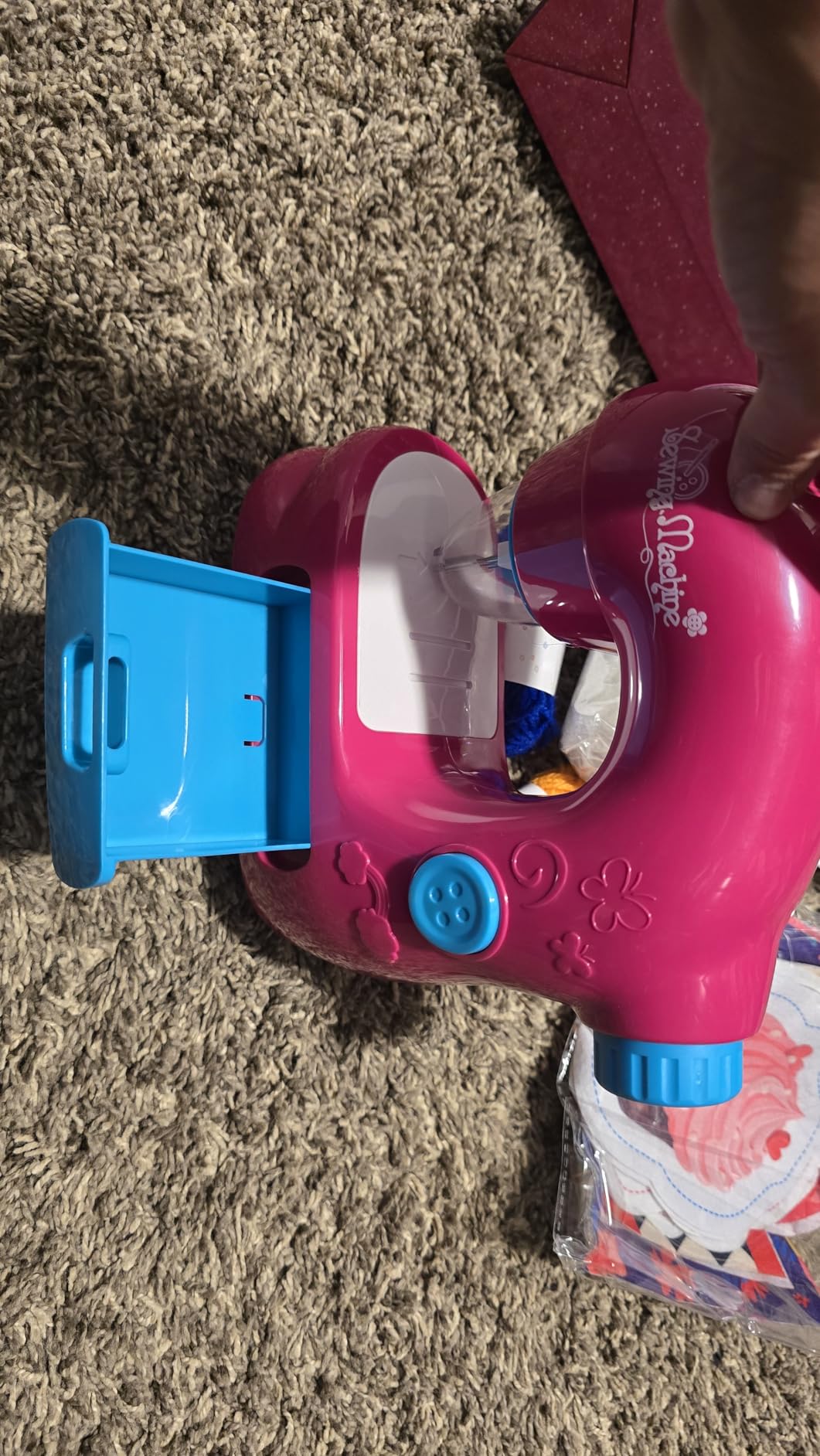
It is also the lightest and smallest thing we carried, at 10.4 ounces with a machine body of 7 by 7.8 by 3.7 inches, and it runs on batteries or USB. Parents of three to eight year olds report children producing doll outfits and keychains with the needle guard, which is the use it is designed for.
The limitations are structural, not fixable. Yarn slips off the feed track regularly, so a young child needs help every time. Battery life is short, there is no rechargeable option, and the USB cable is about 18 inches. A minority of buyers expected a real sewing machine and were disappointed, which is a fair expectation to have given the listing style.
When a child can use this machine well
It suits ages four to six who are not ready for a real machine and whose goal is finished, low-stakes projects. It also works as a stepping stone, because a child who enjoys this often asks for a real machine a year later, which is a reasonable thing to have in mind.
It is a good choice for a birthday present for a very young child, where a machine with a needle and a foot pedal would be too much.
When this machine is the wrong choice
Buy it and you are buying a craft toy, so treat it that way in your expectations. It will not sew real fabric with thread, it will not hem anything, and it will not grow with your child.
If your child is seven or older and has asked to mend clothes or make something real, skip this and start at pick one or pick two instead. You will spend the same money and get a machine that lasts longer.
How to Choose a Mini Sewing Machine for Kids
A good kids sewing machine is defined by three things a specification list hides: whether it can lock a seam, whether a child can thread it, and whether it is safe to sit next to for twenty minutes without an adult holding the fabric. Everything else is preference. Experienced sewists on r/sewing and r/sewhelp consistently steer parents toward a real machine over a toy, for the simple reason that a child who learns on a toy machine has to learn everything twice.
Check for a reverse or backstitch function first
More than any other feature, this decides whether the machine produces useful work. A backstitch travels backwards briefly to lock the seam. Without it, the end of a seam can unravel the first time the fabric is pulled, and a child will learn that their work falls apart. Only four of the twelve machines here have one, so check before you buy.
This is the mending-only versus garment-capable distinction that most roundups blur. A machine with reverse, adjustable stitch length and more than one speed can hem trousers and sew a pillowcase. A machine with one fixed stitch and no reverse can sew a felt ornament and that is the end of it.
Look at bobbin type and threading, not stitch count
Every machine on this list uses a drop-in style bobbin, which is the right choice for a child: the bobbin drops into a clear plastic case instead of being threaded into a metal case by hand. That is why we never recommend a front-loading bobbin machine for anyone under twelve.
Printed threading guides on the machine body matter more than you would expect. On the JUCVNB and Rxmeili, the arrows and channels are marked directly on the shell, and that cuts setup time significantly compared with a thin printed leaflet. Pre-threaded or pre-wound bobbins, as on the Made By Me and Hearth and Harbor, remove the hardest early task entirely.
Decide between foot pedal and push button
A foot pedal gives speed control, which feels more like a real machine and suits older children. A push button starts and stops the machine at one fixed speed, which is safer for a young child and does not let a runaway foot pedal send a seam across a table.
The trap is that speed increases with pedal pressure. Experienced sewists point this out constantly on forums, and it is a real problem for small feet: what feels like gentle pressure to an adult is full speed to a five-year-old. The best compromise is a machine that offers both, which the JUCVNB, Rxmeili, Flying Banana and Royalsellpro do.
Weight and size decide whether the machine gets used
The spread across our twelve is enormous. Sew Mighty weighs 399 grams and the TUZT kit is 10.4 ounces, while the BUXFMHT machine is 6 pounds. Under about 2 pounds a child can move the machine themselves, which keeps them in charge of the project. Around 6 pounds the machine stays put and the adult does the setup.
Size also decides what can be made. A 5 inch wide bed will not sew a doll pillowcase flat, which is exactly why extension tables exist. If your child wants anything larger than a felt shape, treat the extension table as a requirement rather than an accessory.
Match the machine to the age band
For ages four to six, look for a pre-threaded toy machine or a guarded machine with a two-speed control and a pedal-free option. The Royalsellpro and the TUZT kit are the two picks that fit this band.
For ages seven to nine, the deciding features are a finger guard, a dual speed setting, a slow pedal, and enough accessories to start the same day. Our picks here are the Magicfly and KPCB Tech, both of which include fabric and a full kit in the box.
For ages ten to twelve, reverse and stitch variety start to matter. A child at this age is making doll clothes, repairing jeans and following a pattern. The JUCVNB, Rxmeili and BUXFMHT are the right side of that line to buy on.
Plan for the upgrade path
Almost every child outgrows a mini machine, usually within a year, because the limiting factor is throat space rather than skill. When that happens you are not buying a bigger mini machine. You are moving to a compact full-size machine, which is a different category with drop-in bobbins, more stitches and proper reverse.
If your family already sews, or you think you will, the machine you eventually want is a small full-size beginner machine rather than a second mini. Our picks for a serger or a heavy duty machine are worth a look further down the line, but neither is a first machine for a child.
What is included versus what you will buy later
Read the box contents line by line. Batteries are frequently not included, as with the Made By Me, and the foot pedal is not included on that model either. On the Royalsellpro the kit runs to 123 pieces, while some units in this category arrive with accessories missing, which buyers have reported for the Flying Banana and the Hearth and Harbor.
Budget for thread, bobbins and fabric after the first project regardless of what is in the box. Fabric is the item that runs out fastest, since a 20-square bundle is roughly one session of practice and the CraftBud bundle of 50 squares is closer to a term.
Frequently Asked Questions
What is the best beginner sewing machine for kids?
The Magicfly Mini is the best all-round choice for most families, with the largest review base in the category, extension table, and the option to run on four AA batteries away from a wall socket. For a child starting with no materials at all, the KPCB Tech pack is stronger because it includes 20 cotton fabric squares and 42 accessories so the first session can start the same day.
What is the best basic sewing machine for children?
A good basic kids machine needs a drop-in bobbin, a finger guard, at least two speed settings, and printed threading guides on the body. Add a reverse or backstitch function and you can hem garments rather than only sew craft pieces. Fewer stitch patterns is better for a child, because a long pattern dial is a distraction at the age when control matters more than variety.
Are there any good mini sewing machines?
Yes, but the good ones cluster at two levels. At craft level the Magicfly, CraftBud and Royalsellpro hold up well for felt, doll clothing and simple hems. At garment level only the JUCVNB, Rxmeili and BUXFMHT have a reverse function, and the BUXFMHT adds a metal hook tip that handles thicker fabric. Everything else in this category is a mending or craft machine.
Which sewing machine is best for a 7 year old?
For a seven year old, look for a finger guard, a slow speed setting that is genuinely slow, and a machine light enough for the child to reposition themselves. The Magicfly Mini and the KPCB Tech both fit, and both include enough material to start immediately. Avoid pedal-only machines, because speed increases with pedal pressure and a seven-year-old cannot modulate that yet.
What is the best sewing machine for a 10-year-old?
At ten, reverse and stitch variety become the deciding factors because the child is ready to follow a pattern rather than free-sew scraps. The JUCVNB offers 12 stitch patterns with a lock function, the Rxmeili adds a buttonhole foot and a thread cutter, and the BUXFMHT is the one to buy if the child is heading toward real garments or thicker fabric.
Is it worth getting a kids sewing machine?
For most children yes, because sewing builds hand-eye coordination, fine motor control and focus, and it produces a finished object rather than a screen. The catch is that a machine only helps if the child keeps using it, so buy one with a reverse function and enough accessories to start immediately, and expect to move to a compact full-size machine within a year or two.
Can a 6 year old use a sewing machine?
Yes, with an adult in the same room. Six is a reasonable starting age for a guarded machine with a slow speed setting and push-button operation, such as the Royalsellpro or the CraftBud. A six-year-old should not be left alone with a machine, because the needle stops the instant a foot is lifted, and threading the bobbin is the step that always needs help.
The Best Mini Sewing Machines for Kids in 2026
After six weeks and a lot of rethreading, the best mini sewing machines for kids split cleanly by what you want the machine to do. For mending, craft work and a first sewing lesson, the Magicfly Mini is our top pick, with the extension table, the battery option and the most complete kit in the category. The KPCB Tech is the value choice when you want fabric and tools included so nothing is missing on day one, and the Sew Mighty is the cheapest machine here that still turns out a clean straight line.
If your child is ready for more than straight lines, the reverse function is the line to cross, and only the JUCVNB, Rxmeili and BUXFMHT have one. For a very young child starting out, the Royalsellpro is the safest and best rated, and the TUZT kit is a reasonable craft toy for a four-year-old. We would also read our vintage sewing machine guide if your child is moving up to a real machine and you want to understand what a built-to-last body looks like.
Whatever you choose, sit with your child for the first three sessions. Thread the needle together, run one seam together, and let them choose the second project. Machines in this category are cheap enough to be a first attempt and durable enough to be a real tool, as long as somebody in the room shows them how the foot pedal works before they think they have mastered it.