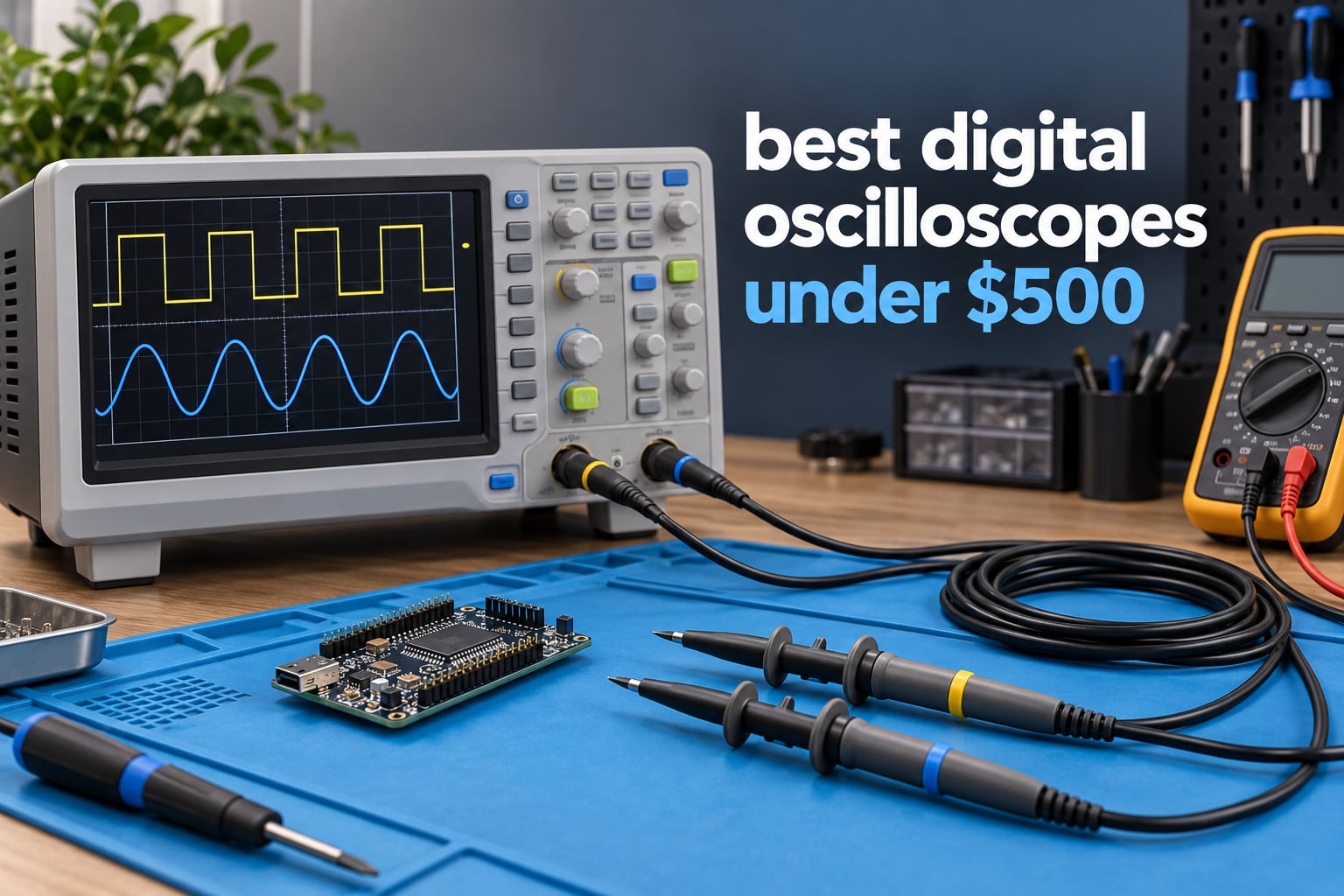
A digital oscilloscope is an electronic test instrument that samples a voltage signal over time and draws the waveform on a screen, so you can measure amplitude, frequency, timing and noise while a circuit is live. A DSO, short for digital storage oscilloscope, adds on-board memory that holds those samples so you can zoom in, save captures and analyse them later instead of watching a trace scroll past.
Finding the best digital oscilloscopes under 500 dollars in 2026 is harder than the spec sheets suggest. Two hundred and fifty megahertz of bandwidth used to mean a machine that belonged in a professional lab, and now the same bandwidth shows up on a four-channel bench unit you can put on a home workbench. What has not changed is the maths: the right scope is the one whose bandwidth comfortably clears the highest frequency in your circuit, with enough memory depth and serial decoding to make the display readable. I have worked through ten of the strongest options at this budget and grouped them by what they are actually good at.
This guide covers ten scopes between roughly 37 and 499 dollars, from a four-channel benchtop with an Ethernet port down to a pocket unit the size of a deck of cards. Every pick below sits under the 500 dollar ceiling as of the publication date, and prices move constantly, so treat the price bands I give as positioning rather than a quote. If your needs run past this budget, our guide to the best digital storage oscilloscopes under 1000 dollars is the natural next step.
How the picks were made: I weighed bandwidth against sample rate and memory depth, checked whether serial bus decoding ships enabled or sits behind a licence, counted the channels you actually get rather than the channels the marketing claims, and read owner reviews closely for the recurring gripes that spec sheets never mention. Where our earlier testing notes and owner reports conflict, I have said so plainly. Specifications are quoted from manufacturer and retailer data for each unit.
Table of Contents
Top 3 Picks for Digital Oscilloscopes Under 500 Dollars in October

Siglent SDS1104X-E
- 100 MHz bandwidth and 4 analog channels
- Dual ADC design with up to 1 GSa/s on two channels
- Standard serial decode for I2C SPI UART CAN and LIN
- Built-in Ethernet with web server for remote viewing
Siglent SDS1202X-E
- 200 MHz bandwidth on 2 channels
- 1 GSa/s real-time sampling
- 14 Mpts record length
- Standard serial bus trigger and decode

FNIRSI 2C53T
- 2-channel 50 MHz scope at 250 MSa/s
- 19999-count multimeter and DDS signal generator
- 3000 mAh battery with Type-C charging
- Storage case and probes included
Every Scope in This Roundup at a Glance in 2026
All ten units fit under the ceiling. The table below is the fastest way to see where each one sits on bandwidth, channel count and extras before you read the individual reviews.
| Product | Specifications | Action |
|---|---|---|
| Siglent SDS1104X-E |
|
Check Latest Price |
| Siglent SDS1202X-E |
|
Check Latest Price |
| FNIRSI 2C53T |
|
Check Latest Price |
 Rigol DS1054Z Rigol DS1054Z |
|
Check Latest Price |
 HANMATEK HO52 HANMATEK HO52 |
|
Check Latest Price |
 FNIRSI 1014D FNIRSI 1014D |
|
Check Latest Price |
 Rigol DS1202Z-E Rigol DS1202Z-E |
|
Check Latest Price |
 FNIRSI DSO152 FNIRSI DSO152 |
|
Check Latest Price |
 YEAPOOK ADS5012h YEAPOOK ADS5012h |
|
Check Latest Price |
 ZOYI ZT-703 ZOYI ZT-703 |
|
Check Latest Price |
1. Siglent SDS1104X-E: Best Digital Oscilloscope Under 500 Dollars Overall
Siglent Technologies SDS1104X-E 100Mhz Digital Oscilloscope 4 Channels Standard Decoder, Grey
100 MHz bandwidth
4 analog channels
Up to 1 GSa/s dual ADC
4 passive probes included
Pros
- Responsive modern interface for the price
- All serial decoders enabled at purchase with no licence fees
- Dual ADC gives 1 GSa/s on two channels
- Built-in Ethernet and web server for remote viewing
- Four usable 100 MHz probes with colour ID rings
Cons
- Multifunction knob bounces to the next menu item
- Bandwidth is software locked despite capable hardware
- Optional MSO AWG and WiFi features need paid licences
The SDS1104X-E is the scope I would put on a bench without hesitating. It is a four-channel, 100 MHz benchtop with a dual ADC architecture that delivers 1 GSa/s on two channels at the same time, and it carries a 4.8 average across 966 owner reviews, the highest rating in this roundup. For a maker who wants to watch a power rail, a clock and a data line together, having all four channels usable at full rate is the feature that matters most.
Where it beats the field is software. The interface is modern and quick to learn, and every standard serial decoder, I2C, SPI, UART/RS232, CAN and LIN, is enabled in the base firmware with no licence fee. That single decision removes the most annoying budget-scope trap, where decoding exists on paper and costs extra to switch on. The built-in Ethernet port with a web server is genuinely useful too: I can open the scope in a browser and see the same screen I see on the bench.
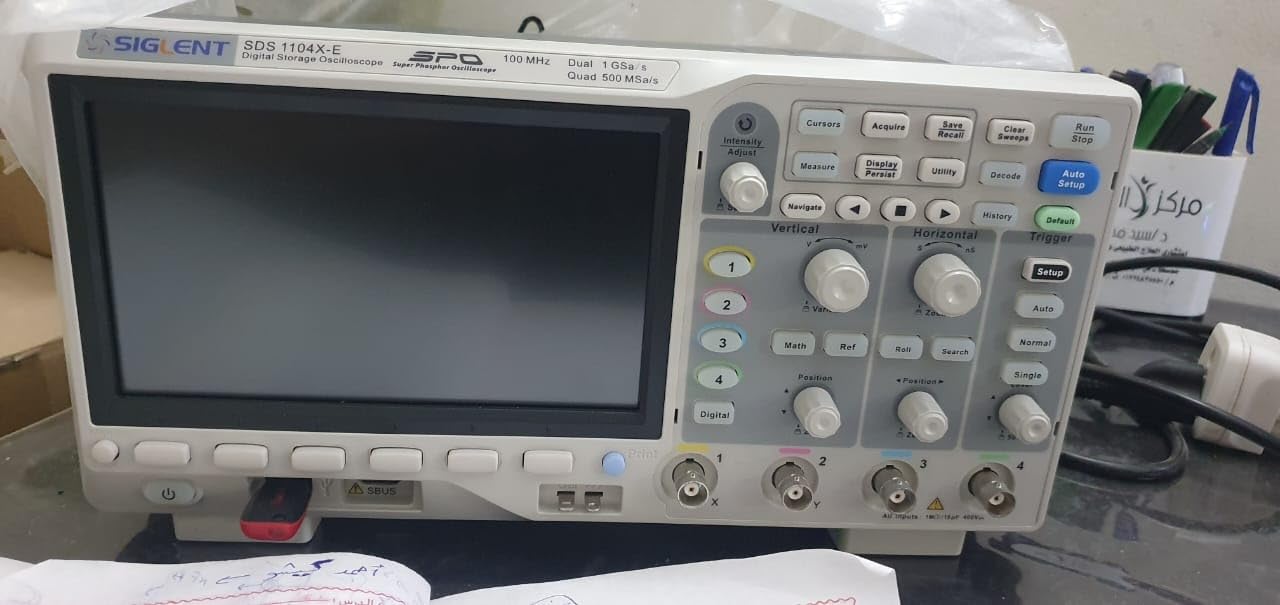
Physically it is a 12.2 by 5.12 by 5.91 inch, 6.6 pound unit, and the box includes a quick start guide, calibration certificate, four passive probes and a USB cable. The screen is a bright 7-inch colour LCD with adjustable grid and trace intensity, and the probe colour rings make it much easier to keep channel 2 and channel 3 apart on a crowded bench than bare colour-coded traces.
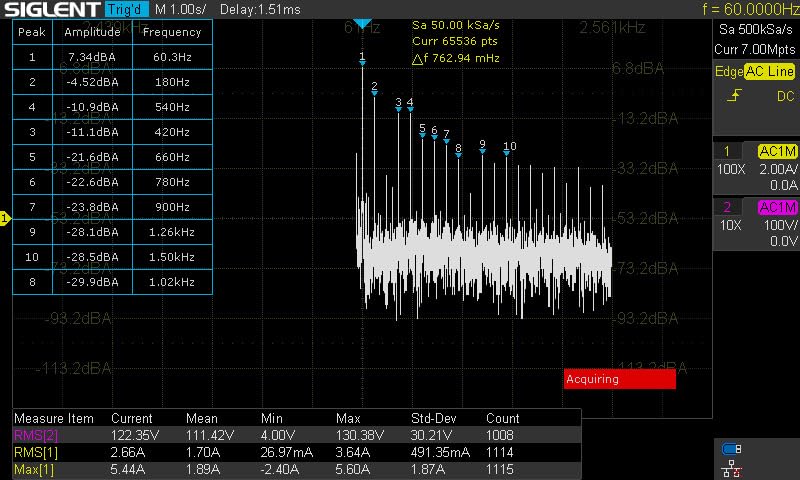
There are quirks worth knowing before you buy. The multifunction select knob is twitchy and can bounce to the next menu item when you press it, which is the single most repeated complaint in owner reviews. The hardware is capable of 200 MHz but the bandwidth is software locked, so extra bandwidth, MSO digital channels, the USB AWG module and WiFi each require a separate licence. Menu settings do not always persist and the clock sits at 1970 until it syncs to a time server. None of that stops it being the best buy here, but you should factor in a small learning curve on the controls.
Who the Siglent SDS1104X-E suits
It suits anyone who needs more than two signals visible at once, because four real analog channels at 100 MHz is the feature set that changes what you can debug. Embedded developers get the full decoder suite and a depth of memory that holds a long capture, and the Ethernet port means the scope can sit on a shelf and be viewed remotely from a laptop.
If you are starting out with microcontroller work, the four included probes mean you can have all four channels connected on day one instead of hunting for spares.
Who should skip the Siglent SDS1104X-E
Skip it if you need genuine 200 MHz of usable bandwidth now, because the licence route to it costs enough to push a different model into range. It is also the wrong pick if you are on a tight budget and only ever look at one or two signals, where two channels at twice the bandwidth is a better trade.
2. Siglent SDS1202X-E: Best for Bandwidth Headroom
Siglent Technologies SDS1202X-E 200 mhz Digital Oscilloscope 2 Channels, Grey
200 MHz bandwidth
2 analog channels
1 GSa/s real-time sampling
14 Mpts record length
Pros
- 200 MHz bandwidth at a mid-range price
- 1 GSa/s real-time sampling
- 14 Mpts record length for long captures
- Serial bus trigger and decode included as standard
- Compact two-channel footprint saves bench space
Cons
- Only two channels compared with four-channel models in the same price range
- Optional bandwidth MSO AWG and WiFi upgrades need extra licences
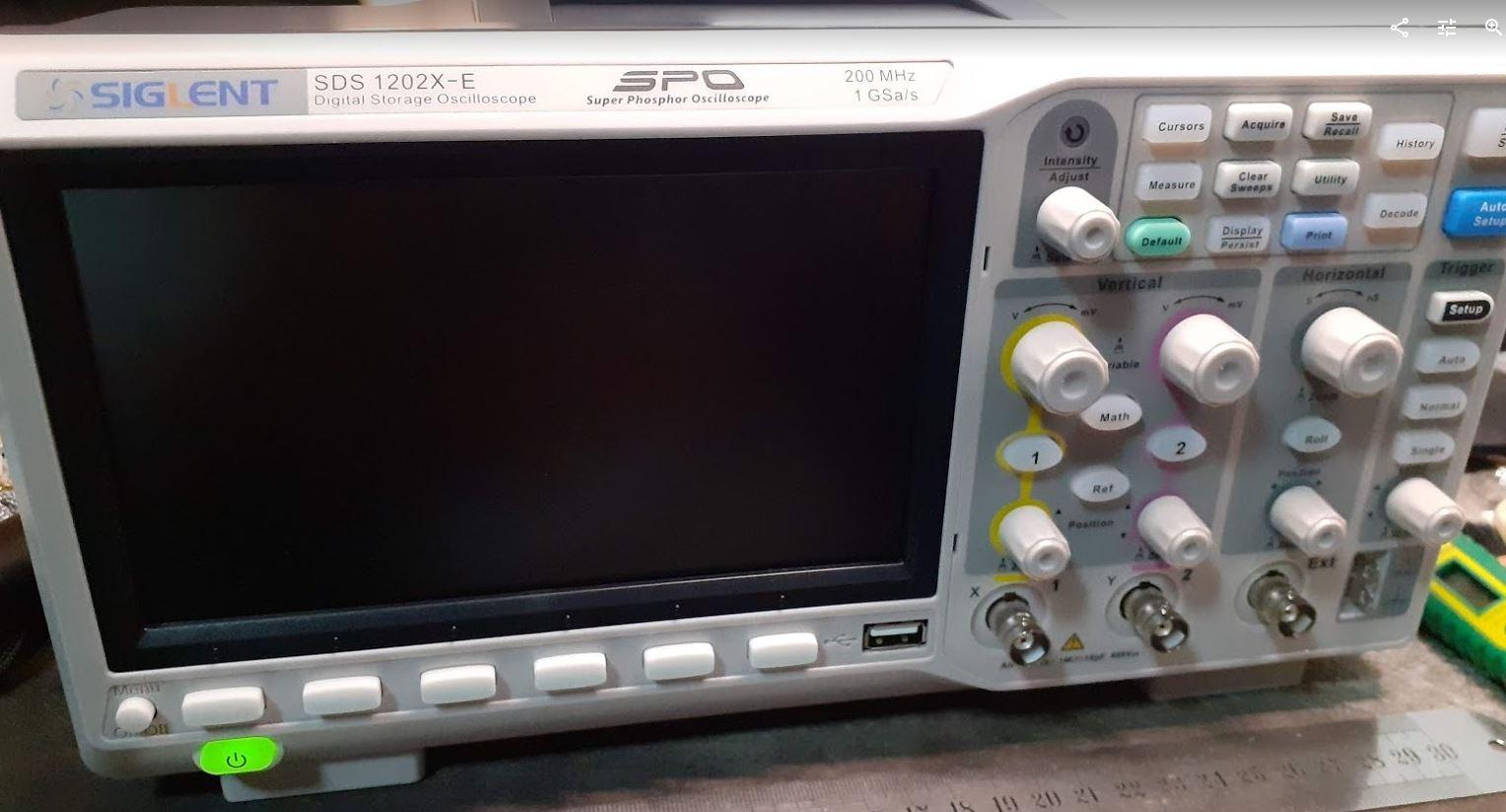
The SDS1202X-E is the most reviewed scope in this roundup, with 1455 owner reviews and a 4.7 average, and it is the one I recommend when signal speed is the deciding factor. Two hundred megahertz of bandwidth with 1 GSa/s real-time sampling and 14 Mpts of record length covers everything from audio work to fast switching edges without a licence.
Serial bus triggering and decoding for I2C, SPI, UART, RS232, CAN and LIN ships as standard, so protocol work needs no extra spend. Fourteen megapoints of memory is a real advantage here: at 1 GSa/s you can hold milliseconds of waveform and still have enough resolution to see individual transitions rather than a smeared block.
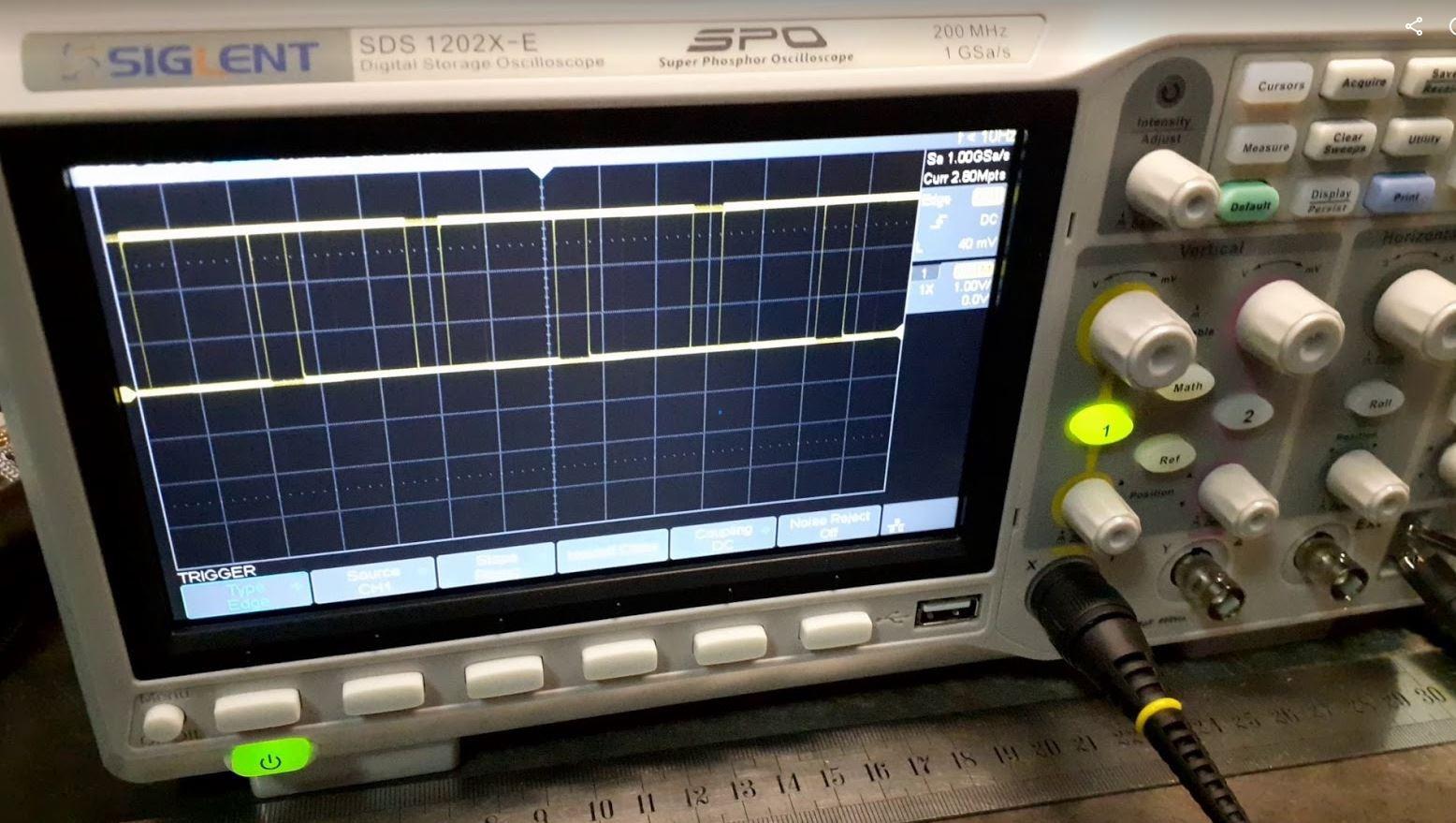
The compromise is channel count. Two channels is all you get, and when you are chasing a relationship between a clock and data line, or comparing input against output of a converter, you will be swapping probes rather than watching both at once. That is the same limitation that makes the four-channel Siglent above the more flexible daily tool.
Upgrades are available by licence, including additional bandwidth, MSO channels, the AWG module and WiFi, so the machine is not a dead end if your needs grow. It weighs 5.5 pounds and stays compact, which leaves room on a crowded bench.
Who the Siglent SDS1202X-E suits
It suits anyone working above 100 MHz, or anyone who plans to. Two hundred megahertz gives headroom against the 5x rule for signals up to 40 MHz, so rise times on fast digital edges stay visible instead of rounding off into a triangle.
It is also a good fit for audio and tone work, where 14 Mpts of record length means you can capture a long window of a low-frequency signal at full resolution.
Who should skip the Siglent SDS1202X-E
Skip it if your work is all under 50 MHz and you want to see four things at once, because the two-channel limit will slow you down more than the extra bandwidth helps. It is also heavy on licences for anyone who wants the MSO upgrade rather than pure analog measurement.
3. FNIRSI 2C53T: Most Versatile With Multimeter and Generator
FNIRSI 2C53T 3-in-1 50MHz 2CH Oscilloscope Multimeter DDS Signal Generator
50 MHz 2-channel scope
250 MSa/s and 1 Kpts depth
19999-count multimeter
DDS generator up to 50 kHz
Pros
- Scope multimeter and signal generator in one unit
- Ranks among the highest sellers in lab oscilloscopes
- 3000 mAh battery with Type-C charging
- Persistence XY mode cursors and math in this version
- Probes leads and storage case included
Cons
- Only 1 Kpts of record depth for long captures
- 250 MSa/s is modest against the 50 MHz bandwidth
- 2.8 inch display limits on-screen detail
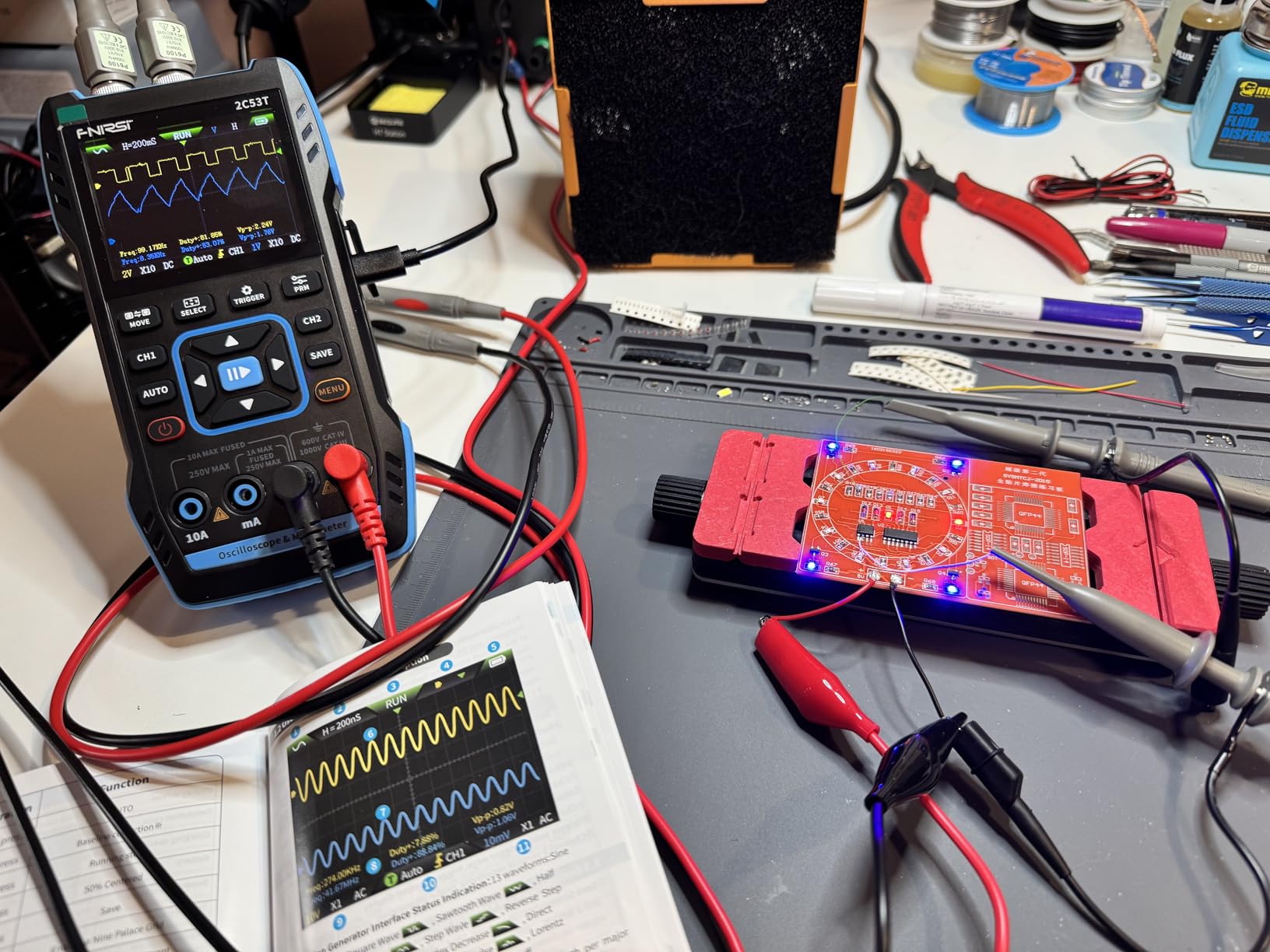
The 2C53T is the value pick, and for a lot of people it removes three instruments from the shopping list. In one 6.57 by 3.5 by 1.38 inch, 400 gram body you get a two-channel 50 MHz oscilloscope, a 4.5-digit 19999-count multimeter and a DDS signal generator, with 883 owner reviews averaging 4.3. That is not a specialist scope, but as a first instrument it is remarkably complete.
Compared with the earlier 2C23T, this version adds math operations, cursor measurement, persistence and XY mode, which are exactly the features a beginner struggles to do without. The 2.8 inch LCD, switchable grid clarity, one-click screenshot saving and reference waveform comparison are all there, and it runs off a 3000 mAh battery with Type-C charging and data transfer.
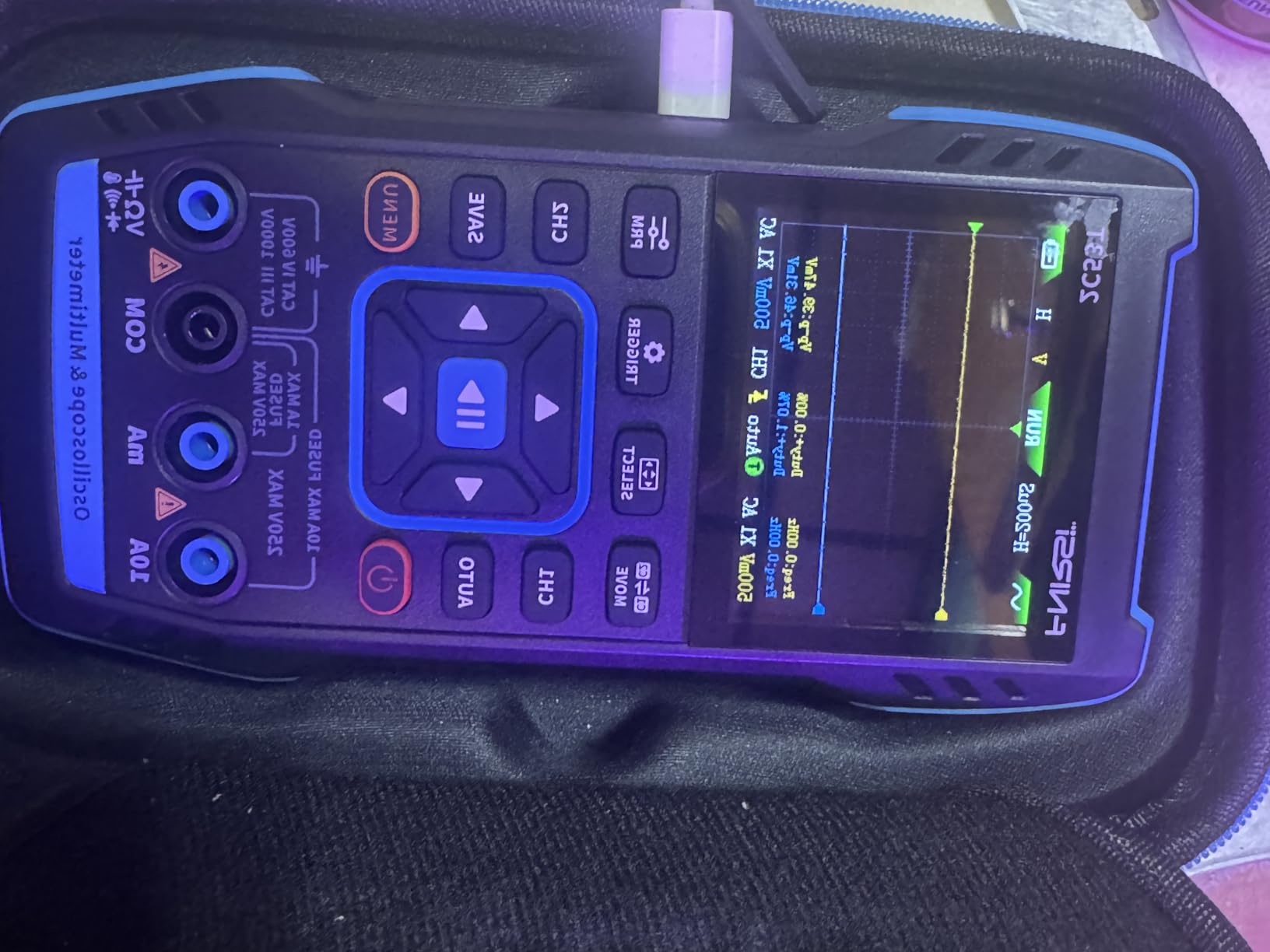
The specification that tells you what this is: 1 Kpts of record depth and 250 MSa/s sampling against 50 MHz of bandwidth. One thousand points is enough to see that a PWM signal is switching and roughly what duty cycle it runs at, and not enough for careful analysis of a long capture or a clean FFT. The generator output level is fixed rather than user adjustable, which limits it to quick functional checks of your circuits.
The box includes a 10x probe, crocodile clip probe, multimeter probe, Type-C cable and storage case, so unlike some pocket devices it arrives with something closer to a real probe. Max input voltage is 400 V on the scope side.
Who the FNIRSI 2C53T suits
It suits students, hobbyists and anyone who wants to sanity-check a signal without committing to a benchtop. Having the multimeter built in means you can confirm a supply voltage and a signal amplitude from the same device without swapping instruments, and it is the third highest rated scope in the Lab Oscilloscopes category.
For anyone testing Arduino, ESP32 or simple RP2040 projects it is plenty, particularly with the battery for bench-independent work.
Who should skip the FNIRSI 2C53T
Skip it if you need to capture a burst of events, decode a serial bus or examine noise on a fast edge. One thousand points of memory and a 250 MSa/s ceiling will not support that, and you will outgrow the small screen quickly if you use it daily.
4. Rigol DS1054Z: Best for Embedded Debugging on a Four-Channel Screen
Rigol DS1054Z Digital Oscilloscope, 50MHz, 4 Channel, 1GSa/s, Best Value
50 MHz bandwidth
4 analog channels
24 Mpts memory depth
30000 wfms/s capture rate
Pros
- 24 Mpts memory is unusually deep for the class
- RS232 UART I2C and SPI decoding enabled in base firmware
- Bright screen with colour coding matched to the input jacks
- 30000 wfms/s capture with intensity graded display
- Ethernet USB host and device plus AUX output
Cons
- Cooling fan is noticeably noisy
- Multifunction encoder overshoots and jumps a step
- Bundled probes are mediocre and hard to tune
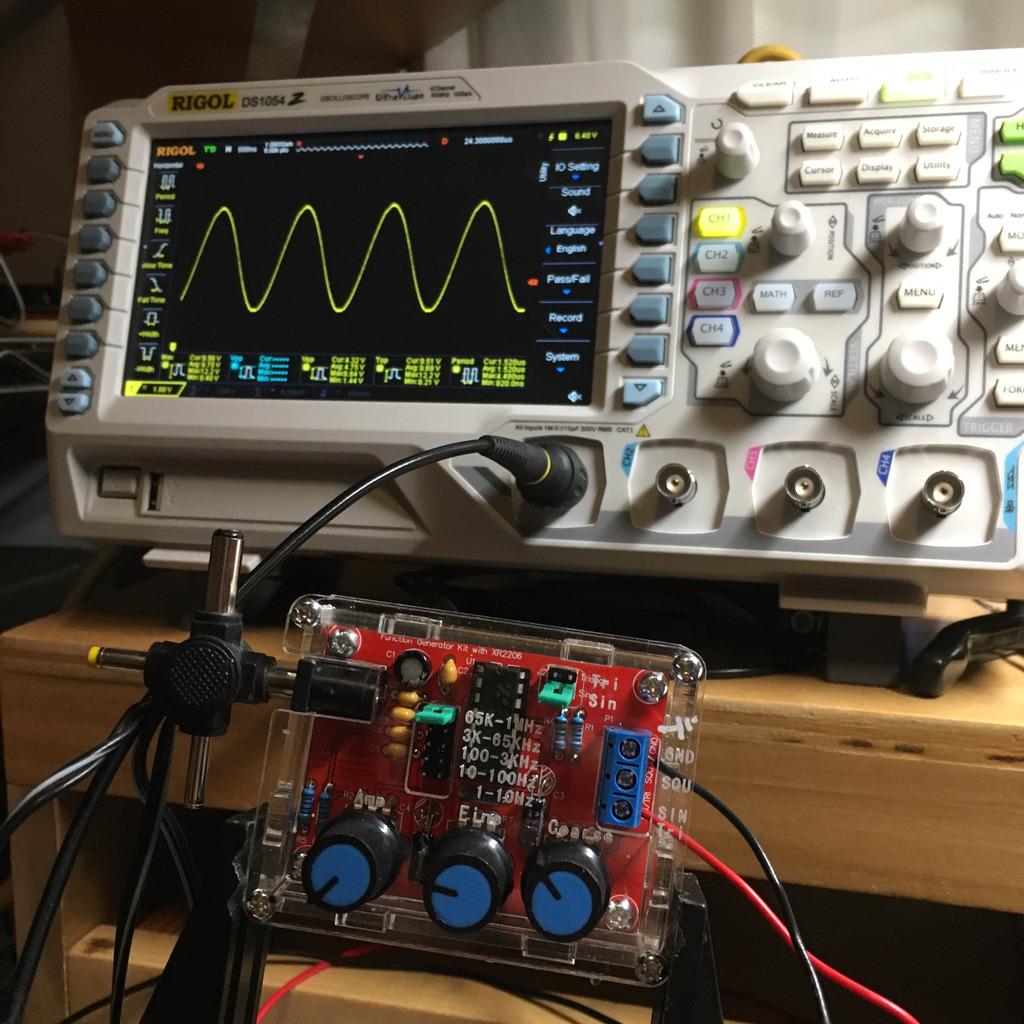
The Rigol DS1054Z is the specification outlier in this list, and the reason is memory. Twenty-four megapoints of standard record depth is pro-class capability, and combined with a 30,000 wfms/s waveform capture rate on Rigol’s UltraVision platform it means long captures stay sharp and rare glitches get a chance to show up. Four analog channels, 1 GSa/s single-channel sampling and a bright colour screen round out a 13 by 7 by 5 inch, 6.6 pound unit.
Serial decoding for RS232/UART, I2C and SPI is enabled in the base firmware, FFT and filters are built in, and you get USB Host, USB Device, LAN (LXI) and an AUX output carrying TrigOut and PassFail. Those connections matter more than they sound: they let the scope sit in a test sequence with your microcontroller and report pass or fail automatically.
Fifty megahertz of bandwidth is the limit to be honest about. It is plenty for 8-bit and 32-bit microcontroller work, logic-level signals and audio, and thin for anything above roughly 10 MHz if you want accurate edges. Rigol’s memory does not compensate for bandwidth, they solve different problems.
The owner complaints cluster in predictable places. The cooling fan is noisy enough to notice at a normal working distance, the multifunction rotary encoder overshoots and lands on the wrong menu row, and the bundled probes are mediocre. Two smaller quirks catch people out: the channel 2 and channel 4 trace colours are nearly indistinguishable, and the supplied probe colour rings do not match the channel 4 trace colour. There is no external trigger input, so a channel must be given up to trigger on.
Who the Rigol DS1054Z suits
It suits embedded developers and lab educators who need depth of capture over raw bandwidth. Recording a system boot sequence, capturing a rare bus error over thousands of frames and replaying them later are all tasks where 24 Mpts and 60,000 frame playback pay off immediately.
Anyone teaching electronics also benefits, because the PassFail output and LAN connectivity let student work be captured automatically rather than photographed.
Who should skip the Rigol DS1054Z
Skip it if your signals run above 10 MHz, because 50 MHz bandwidth will soften edges and distort rise times. It is also a poor fit for a quiet bench, where the fan becomes irritating, and if you need an external trigger for sequencing two instruments.
5. HANMATEK HO52: Best for Field Service Work
HANMATEK Handheld Digital Oscilloscope 50Mhz Bandwidth with 2 Channels HO52 3.5″ TFT Mini Oscilloscope, 2 in 1 Oscilloscope and Multimeter, Backlit Screen, Auto-Calibration Function, Memory Function
50 MHz 2-channel handheld
250 MSa/s and 8k dot record
4.5 digit true RMS meter
Backlit 3.5 inch TFT
Pros
- Scope and true RMS multimeter in a 2.6 pound handheld
- 250 MSa/s with up to 10000 wfms/s refresh
- One-key AUTO setup plus XY mode and cursors
- Stores reference waveforms images and CSV captures
- Backlit screen with self-calibration
Cons
- 8k dot record depth is shallow for long captures
- 3.5 inch display limits on-screen detail
- No dedicated knobs so navigation is button driven
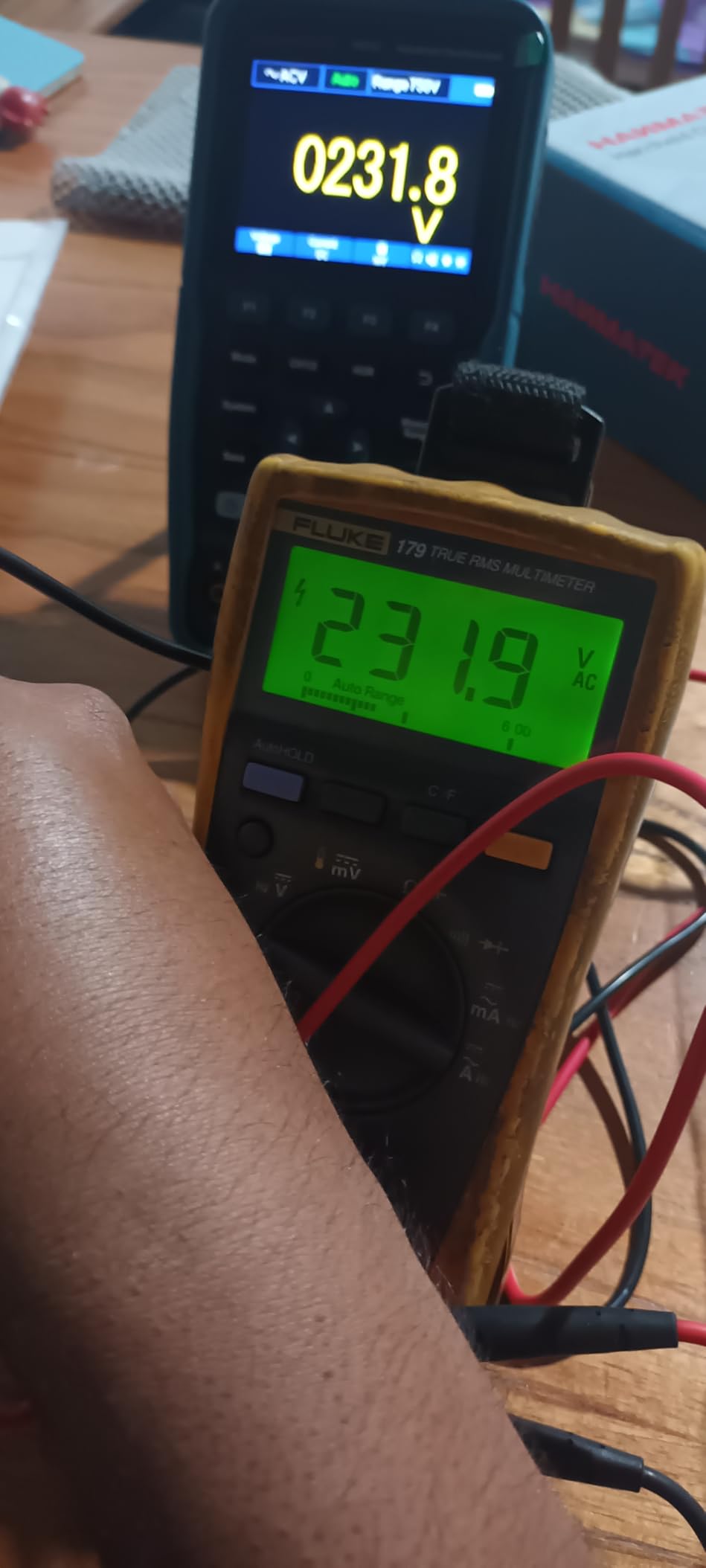
The HO52 is the pick when the work is not at a desk. It weighs 16 ounces, measures 7.83 by 1.54 by 3.94 inches, and runs off a battery with USB Type-C power bank support, so it works in a server room, a vehicle or a customer’s kitchen without hunting for a wall socket. A 4.5 digit true RMS multimeter with autorange, AC to 750 V and DC to 1000 V, shares the same body.
Scope mode delivers two channels, 50 MHz of bandwidth, 250 MSa/s real-time sampling, a record length up to 8k dots and a refresh rate up to 10000 wfms/s. There is one-key AUTO, cursor measurement, an XY function and up to six automatic measurements on screen at once, plus a backlit display that makes a dim cupboard workable.
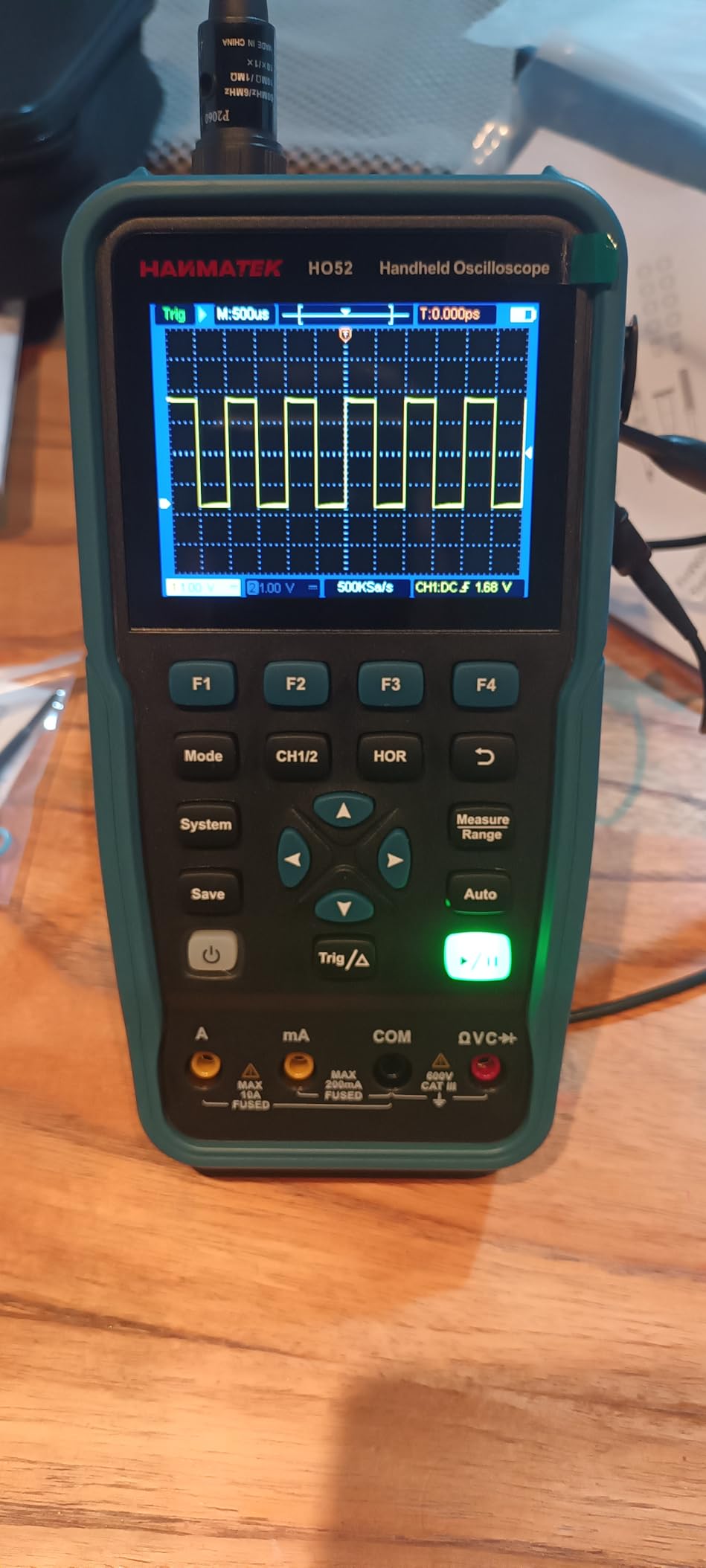
It also saves properly, which is unusual at this size: four groups of settings, four reference waveforms, four images and four CSV waveform groups, readable later over the Type-C connection on a PC. Self-calibration is built in, and lifetime technical support is offered, which matters when the unit lives in a tool bag rather than on a shelf.
The honest limits are the 8k dot record depth and the 3.5 inch display. Eight thousand points is a quick look rather than an analysis buffer, and navigation is entirely button driven because there are no dedicated knobs. That is workable for an AUTO-plus-cursor workflow, and irritating if you want to hunt around a long capture.
Who the HANMATEK HO52 suits
It suits field technicians, installers and anyone who troubleshoots away from a bench. The meter and scope share one set of leads, so checking a supply and then looking at the waveform around it takes seconds rather than a trip back to the car.
Students benefit too, since the price leaves room in the budget for a proper probe set later, and the CSV export makes lab write-ups easier.
Who should skip the HANMATEK HO52
Skip it if you sit at a desk with mains power available, because a benchtop gives you a bigger screen, deeper memory and knobs you can actually feel. It is also the wrong tool for signals above roughly 10 MHz, where 50 MHz of bandwidth is no headroom at all.
6. FNIRSI 1014D: Best Big Screen for a Beginner
FNIRSI 1014D 100MHz Digital Oscilloscope, 2 Channel Oscilloscope 2-in-1
100 MHz x2 bandwidth
1 GSa/s real-time sampling
7 inch 800x480 LCD
Built-in DDS generator
Pros
- Large 7 inch screen at this budget
- 100 MHz x2 bandwidth with up to 1 GSa/s
- Built-in DDS generator with 1000 custom waveform slots
- One-button AUTO plus cursor measurement
- Compact and light for a small bench or repair shop
Cons
- FFT readout is largely unusable with wrong frequencies and no amplitude
- Generator output amplitude is fixed and cannot be attenuated
- Manual text is tiny poorly translated and omits specifications
- Some difficulty measuring a true 100 MHz signal
- Build quality feels flimsy beside a bench scope
- Reports of units arriving with cracked screens
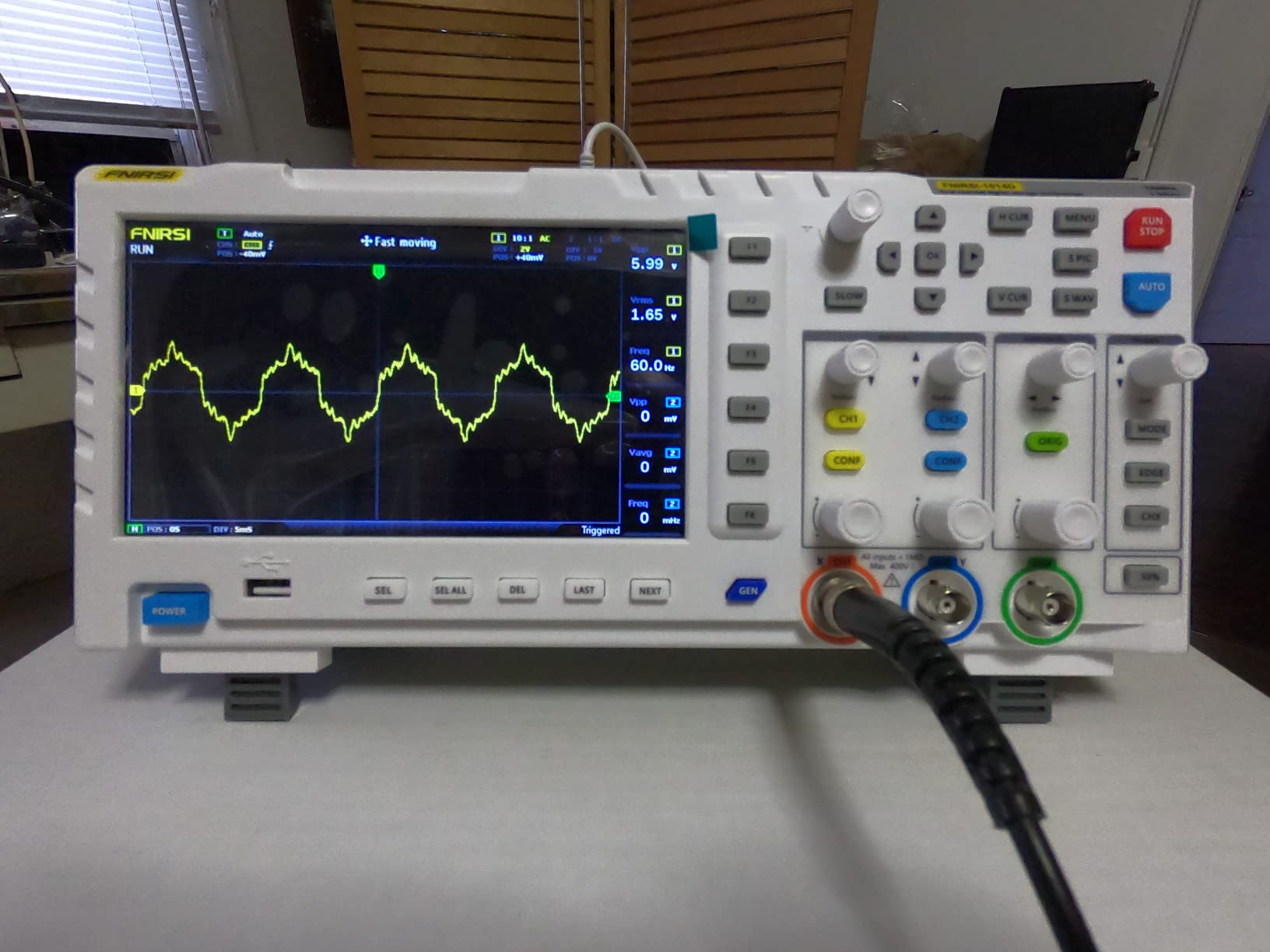
The 1014D is the beginner recommendation in this roundup, and the reason is the screen. A 7 inch 800×480 LCD inside a 3.46 pound body is the largest display available anywhere near this budget, and for someone learning to read waveforms that difference is bigger than any spec on the paper. The scope channel gives 100 MHz x2 analog bandwidth and up to 1 GSa/s real-time sampling on two channels, with single, normal and auto trigger modes.
It also carries a DDS signal generator with a 2.5 VPP chopping output, 1 Hz frequency steps, 14 function signals and slots for up to 1000 custom waveforms, which is more generator capability than most competitors at twice the price. One-button AUTO with adaptive trigger levels, cursor measurement for peak-to-peak and frequency readout, plus Lissajous XY display, are all present.
Its 4.2 average across 509 reviews is the second lowest here, and the reasons are consistent. The FFT implementation is the biggest problem: reviewers report nonsensical frequency values and no amplitude display, so treat the FFT view as decoration rather than an analyser. The generator amplitude cannot be attenuated, which limits injection tests.
Documentation is thin, with tiny and poorly translated text that omits the specifications entirely, and some owners report difficulty measuring a true 100 MHz signal. There are also reports of units arriving with cracked or defective screens, so check the panel and run the self-test as soon as it lands.
Who the FNIRSI 1014D suits
It suits someone on their first real scope who wants to see the whole picture at once, and for a student lab bench where a large display matters more than analyser features. The built-in generator also lets you test a circuit without finding a function generator, which speeds up first projects considerably.
Anyone doing audio work will like the XY display for comparing two signals and the Lissajous view for phase relationships.
Who should skip the FNIRSI 1014D
Skip it if you need trustworthy FFT readings, accurate measurements at the top of the bandwidth range, or a machine that feels solid when you carry it around. At 4.2 it is also the weakest rated unit here, and a model with a longer, stronger review history is a safer place to start.
7. Rigol DS1202Z-E: Best for 200 MHz with an External Trigger
RIGOL DS1202Z-E Digital Oscilloscope, 200MHz, 2 Channel, 1GSa/s Sampling
200 MHz bandwidth
2 channels plus external trigger
1 GSa/s and 24 Mpts
3-year main unit warranty
Pros
- 200 MHz bandwidth with 1 GSa/s sampling under 400 dollars
- 24 Mpts memory with 12 Mpts in dual-channel mode
- Bright 7 inch WVGA display with intensity graded colour
- 30000 wfms/s capture and 60000 frame playback
- RS232 UART I2C and SPI trigger and decode
- External trigger input included
- Build quality knobs and probes feel solid
- 3-year warranty on the main unit
Cons
- Multifunction knob is overly sensitive and overshoots
- Full memory export limited to the slow USB 2 front port
- Very large USB flash drives are not recognised
- Soft key legends permanently occupy both sides of the screen
- Some functions sit deep in the menu tree
The DS1202Z-E is the most complete instrument in this roundup on paper, and it wins on a detail most competitors omit: a real external trigger input alongside two analog channels. That input means you can trigger from a signal the scope is not displaying, which is what you need when chaining measurements or triggering on something outside your two probes.
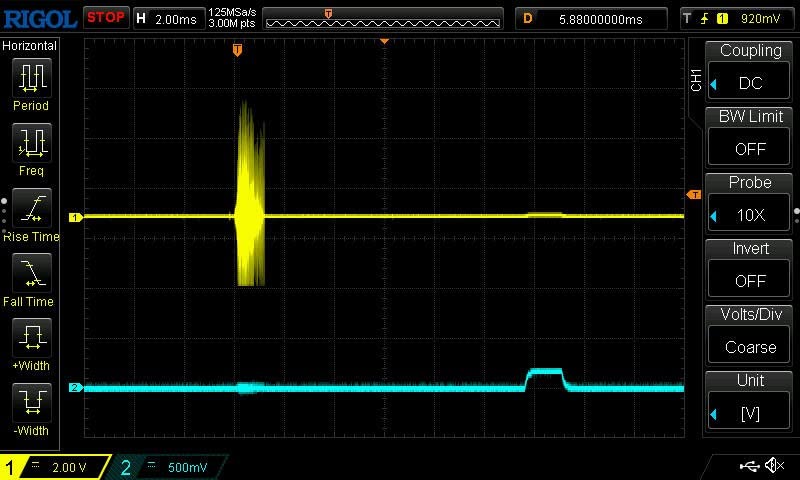
Otherwise it matches the specification leaders: 200 MHz bandwidth, up to 1 GSa/s real-time sampling, 24 Mpts of standard memory (12 Mpts in dual-channel mode), a 30,000 wfms/s capture rate with intensity graded colour, and hardware waveform recording and playback up to 60,000 frames. Serial bus trigger and decode for RS232/UART, I2C and SPI is standard, and USB Host, USB Device, LAN (LXI) and an AUX output with TrigOut/PassFail are all fitted.
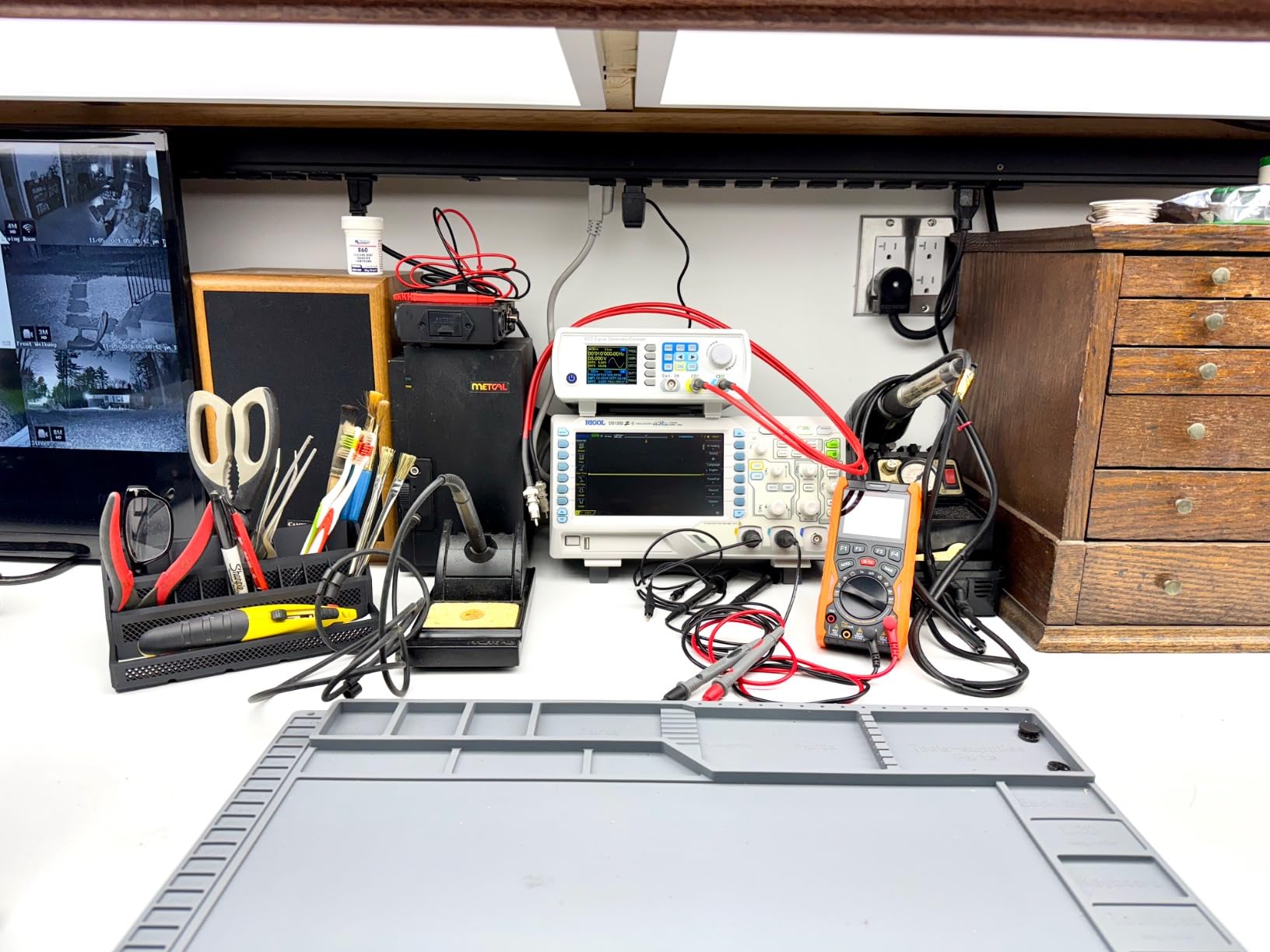
A 7 inch WVGA 800×480 TFT handles the rendering, and the unit comes with a 3-year warranty on the main unit, which is the longest cover in this list. Owners consistently single out build quality, knob action and the supplied probes as noticeably better than the price suggests.
The gripes are workflow issues rather than hardware faults. The multifunction knob is overly sensitive and overshoots selections, some functions sit deep in the menu hierarchy, and the soft key legends permanently occupy both sides of the display, which costs you usable screen area. Data export is the one real limitation: pulling a full 24 Mpoint capture is limited to the slow USB 2 front-panel port, and very large or high-capacity flash drives are not recognised, so budget for a modest drive.
Who the Rigol DS1202Z-E suits
It suits embedded developers who need 200 MHz of bandwidth and an external trigger without crossing the ceiling, and anyone planning to grow into deeper analysis later. The 60,000 frame record and playback is a real advantage when hunting intermittent faults.
The three-year warranty also makes it the lowest-risk purchase here for anyone nervous about long-term reliability on a workbench.
Who should skip the Rigol DS1202Z-E
Skip it if you need more than two signals watched at once, or if you routinely pull large captures off the scope over USB, where the USB 2 port will test your patience. For a purely student bench the warranty and menu depth are overkill.
8. FNIRSI DSO152: Best Pocket Scope for Low-Frequency Work
FNIRSI DSO152 Handheld Oscilloscope 200kHz Bandwidth, 2.5MS/s Sampling Rate
200 kHz bandwidth
2.5 MS/s real-time sampling
10x probe to 800 VPP
1000 mAh battery about 4 hours
Pros
- Pocket sized and just over 10 ounces
- Sold as an assembled unit with no soldering needed
- One-key AUTO plus Auto Normal and Single triggers
- 10x probe rated for high voltage work to 800 VPP
- Battery gives roughly four hours of continuous use
- Very low entry point for a working handheld scope
Cons
- 200 kHz bandwidth and 2.5 MSa/s limit it to low-frequency signals
- 320x240 display is small and low resolution
- Basic measurement set with limited analysis features
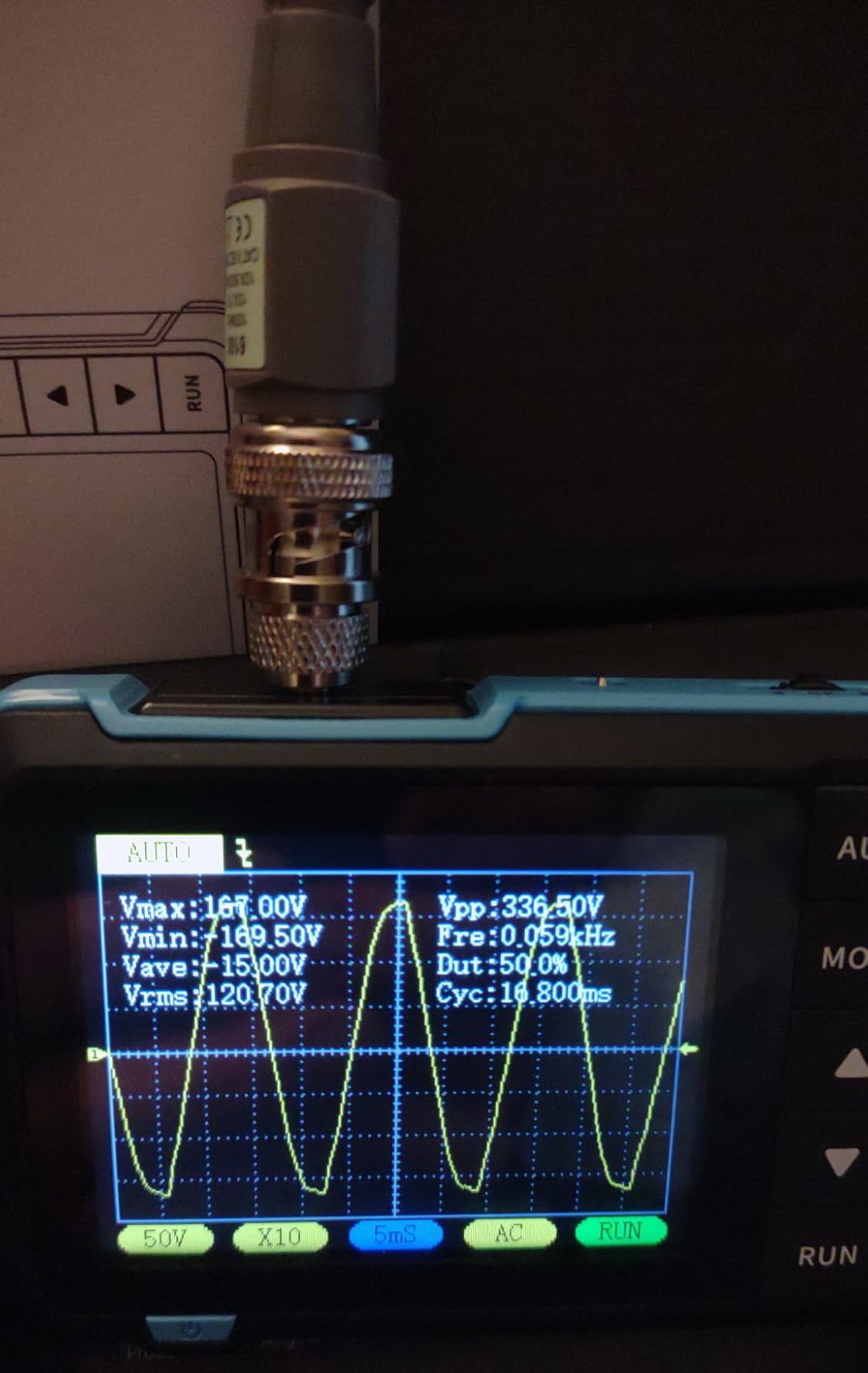
The DSO152 is not a bench scope and should not be confused with one. It is a 200 kHz bandwidth, 2.5 MS/s pocket instrument that measures 3.78 by 2.64 by 0.79 inches and weighs 10.2 ounces, built for checking slow signals on the move. For mains-related checks, audio frequencies, PWM fan tach signals and continuity of a control line, it does the job at a fraction of the cost of anything else here.
It arrives as a finished, assembled unit with a 10x probe rated to 800 VPP, equivalent to 280 V AC, which is a genuinely useful safety margin for testing around appliances. Auto, Normal and Single trigger modes are present, one-key AUTO sets every parameter, and a long press on AUTO recalibrates the baseline. The 1000 mAh lithium battery gives about four hours after a full charge, with Type-C handling data transfer, charging and firmware upgrades.
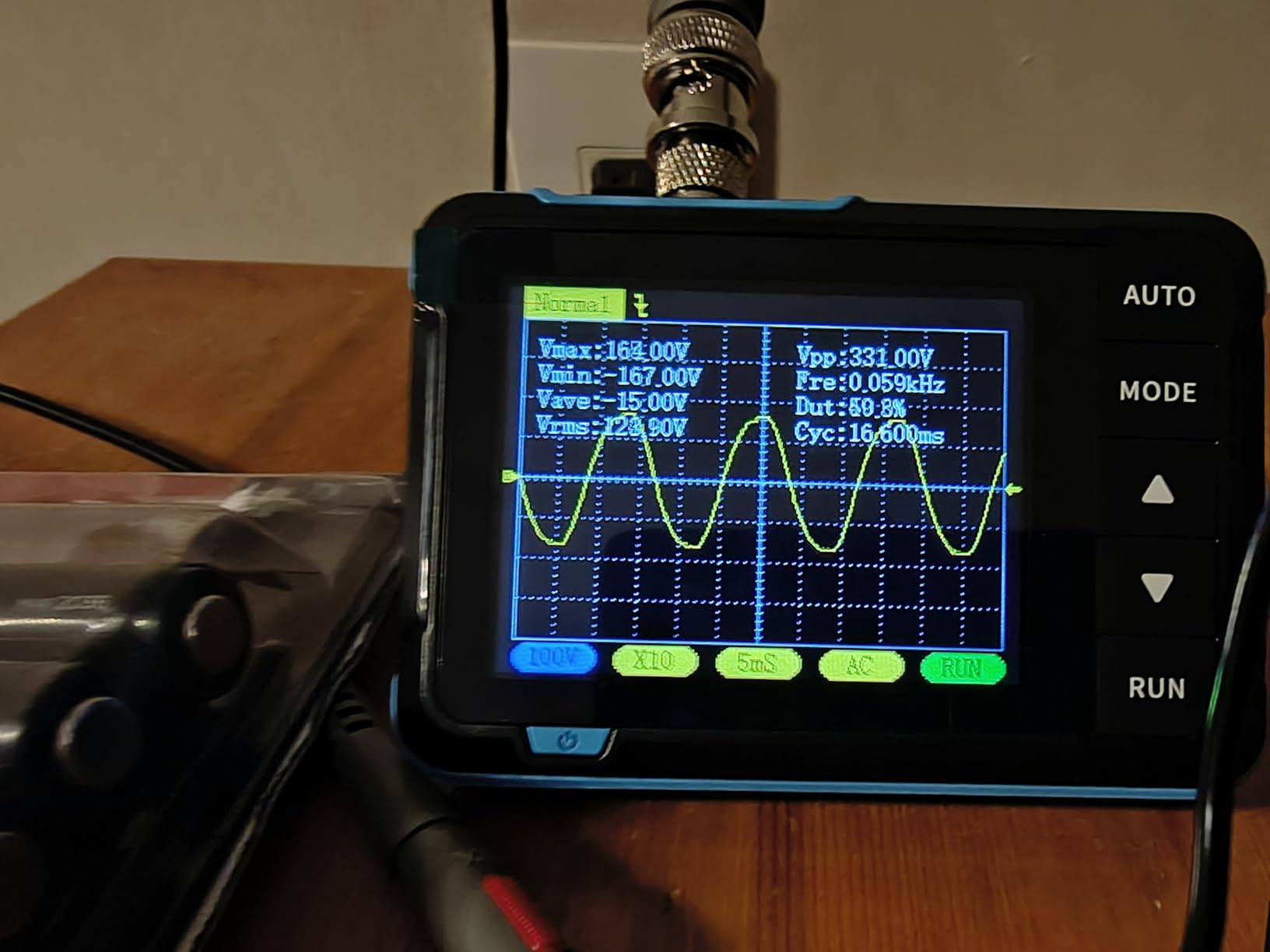
A TinkerDifferent user wrote up a first scope experience with a unit in this class, decoding connector pins on a G5 Quad LCS harness and cross-checking a PWM fan signal against a multimeter reading, and that is exactly the use case this device serves. It is a diagnostic tool for confirming a signal exists and roughly how big it is, not for analysing what it looks like.
The 320×240 display on a 2.8 inch panel is the second limitation after bandwidth. The measurement set is basic, with no cursors or deep analysis, so once you know the signal is there you need something better to look at it properly.
Who the FNIRSI DSO152 suits
It suits anyone who wants a first instrument, a field kit or a backup that lives in a toolbox. If your interest is audio, mains hum, LED flicker or slow sensor signals, 200 kHz of bandwidth is more than adequate, and the high-voltage-rated probe removes the usual objection.
It also makes a sensible travel companion for anyone who already owns a benchtop and needs a second set of eyes away from the desk.
Who should skip the FNIRSI DSO152
Skip it for microcontroller debugging, protocol work or anything above about 40 kHz, where the bandwidth is simply not there. Anyone who will squint at the trace for hours should look at a bigger screen instead.
9. YEAPOOK ADS5012h: Best Handheld for Audio and Field Troubleshooting
YEAPOOK ADS5012h Handheld Digital Portable Oscilloscope Mini Storage Oscilloscope Kit with 100MHz Bandwidth 500MS/s Sampling Rate 2.4” TFT LCD Display
100 MHz bandwidth
500 MSa/s sampling
128 kb record depth
2.4 inch TFT in a 0.5 pound body
Pros
- 100 MHz bandwidth and 500 MSa/s at this price
- Very small at 4.5 x 2.9 x 1.4 inches and 0.5 pound
- One-key AUTO reliably locks onto common waveforms
- 64M flash stores up to 2000 waveform images with thumbnails
- Triggers consistently once set to Normal mode
- Battery reportedly runs up to eight hours
- Results compare well with larger scopes on audio work
Cons
- Single input channel limits simultaneous comparisons
- Vertical movement limited to about plus or minus 4 divisions
- No zoom on a static waveform
- Limited measurement set with no cursors
- Real-world performance tops out nearer 40 MHz than stated 100 MHz
- Recessed micro-USB port needs a non-standard long cable
The ADS5012h is the most capable handheld in this roundup on paper: 100 MHz of analog bandwidth, 500 MSa/s real-time sampling and 128 kb of record depth in a 4.5 by 2.9 by 1.4 inch body that weighs half a pound. Reviewers consistently note that readings agree with larger bench scopes on audio and low-frequency RF work, which is the honest use case for it.
Storage is the quiet strength. A built-in 64M flash holds up to 2000 waveform images, and there is a thumbnail manager to browse, view, flip and delete them. Twelve automatic measurements cover voltage peak-to-peak, peak, max, min, average, RMS, frequency, cycle, duty cycle and both timing polarities, with Auto, Normal and Single trigger modes and a battery reported to run up to eight hours.
There is one channel, and that shapes everything. With a single input you cannot watch two signals at once, which rules it out for timing comparisons. Vertical movement is limited to roughly plus or minus 4 divisions, so zoomed views of high-offset signals are hard to set up, and there is no zoom on a static waveform and no cursors.
Real-world bandwidth appears closer to 40 MHz than the stated 100 MHz, owners report. The charging port is a recessed micro-USB that needs a long or right-angle cable, the documentation never explains using the Mode button as an enter key, and a few units reportedly arrived unable to power on, so test it immediately.
Who the YEAPOOK ADS5012h suits
It suits audio work, and the Gearspace community, where hobbyists build and repair amplifiers and speakers, consistently treats scopes in this class as the practical choice for that. With one channel you can still compare amplitude, frequency and phase by measuring in turn.
It is also a good bench companion for anyone who mainly wants to confirm a signal at the connector of a device, and the image storage makes it easy to build a record of a fault over time.
Who should skip the YEAPOOK ADS5012h
Skip it if you need to compare two signals simultaneously, work above about 20 MHz, or zoom into a waveform to inspect a detail. One channel is the deal breaker for most real debugging.
10. ZOYI ZT-703: Best for Automotive and Battery Work
3 in 1 Handheld Oscilloscope Automotive Dual Channel 50MHz with Digital Multimeter and Signal Generator
Dual-channel handheld
200 MSa/s normal and 280 MSa/s high speed
25000-count multimeter
128K storage depth
Pros
- 25000-count multimeter is accurate with good auto-ranging
- Dual-channel scope is unusual at this price and good for phase checks
- Solid construction with good key feel
- Bright display that stays readable at reduced brightness
- USB-C charging for use away from mains
- Includes case test leads and two scope probes
- Logical menu layout across the modes
Cons
- Scope is button driven with no dials for divisions or cursors
- Screen feels crowded when viewing waveforms
- Square wave edges deform so practical bandwidth is well below 50 MHz
- Generator is limited to probe adjustment and demos
- Display sleeps quickly and the timeout is hard to configure
- Several seconds to power on
The ZT-703 is a genuinely two-channel handheld for under 100 dollars, and that alone sets it apart. Everything else in the pocket and handheld category here is single channel, which means you can put a sensor on one input and a reference on the other and compare them directly. At 380 grams and running off USB-C, it works in a vehicle as comfortably as on a bench.
The scope runs two modes: normal at 200 MSa/s and 30 MHz maximum bandwidth with lower power consumption, and high speed at 280 MSa/s and 50 MHz with higher consumption. Storage depth is 128K, and AUTO automatic waveform recognition handles setup on unfamiliar signals. The multimeter section is a 25000-count unit covering resistance, capacitance, continuity, diodes and current, and owners single it out as the best meter in this group.
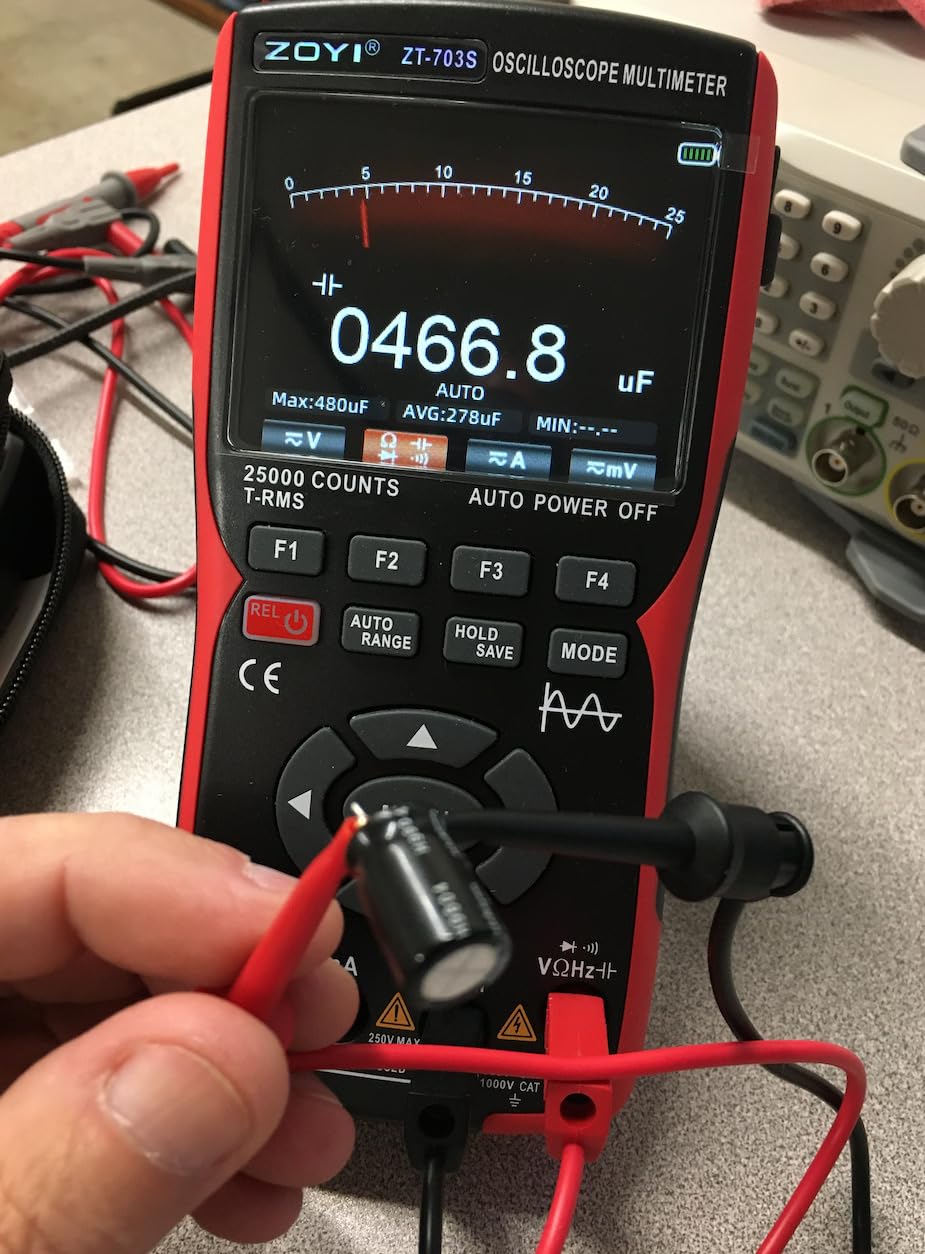
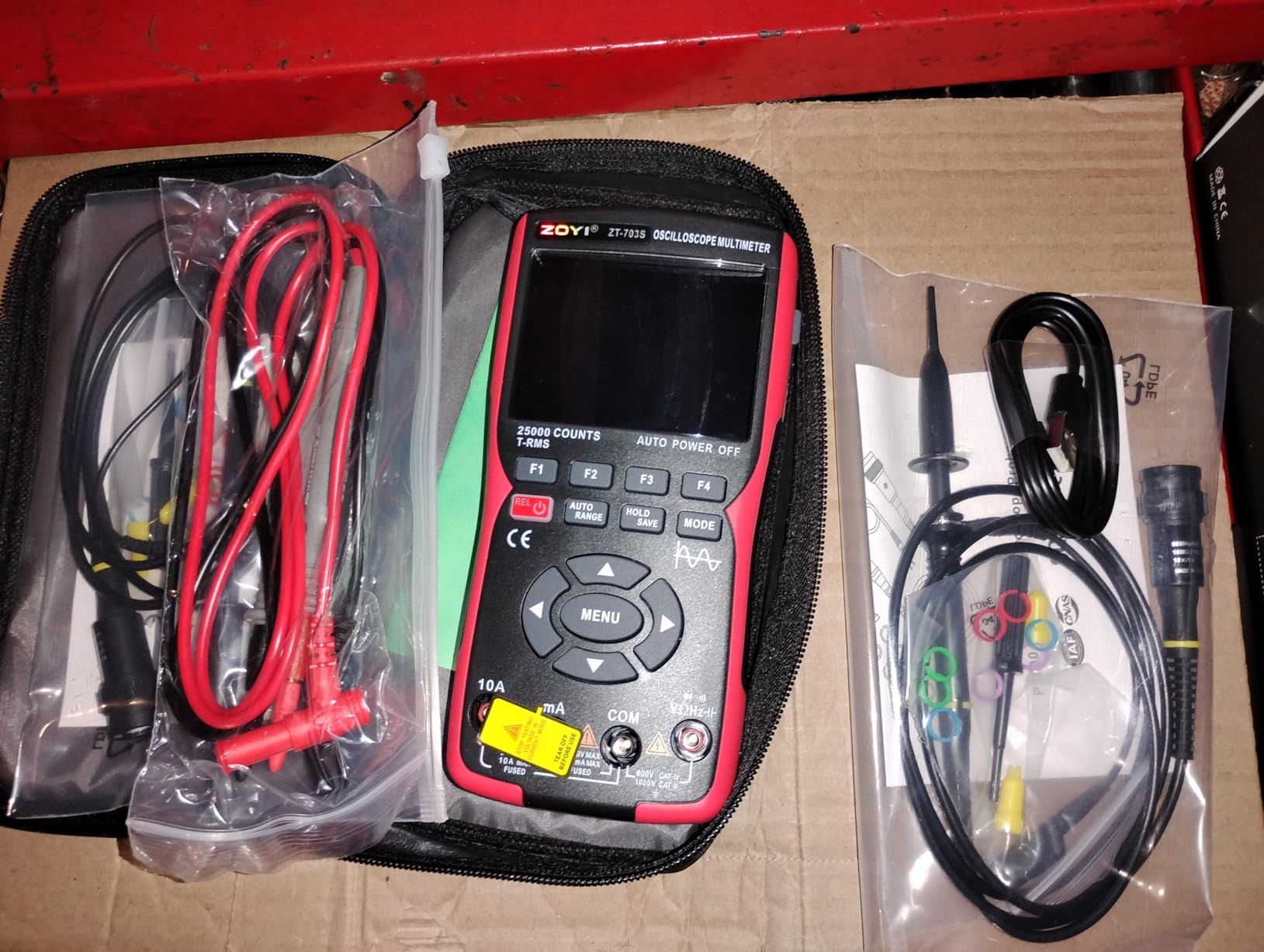
Owners also like the build. Keys have good tactile response, the screen stays readable at reduced brightness, and the menu layout across scope, meter and generator modes is simple to navigate. The box carries a cloth bag, multimeter test leads and two oscilloscope probes.
Where it falls short is signal integrity at speed. Square wave rise times and edges deform, so practical bandwidth sits well below the stated 50 MHz and closer to the 20 to 30 MHz range, which is fine for sensor and PWM work and misleading for anything fast. The on-board generator is limited to probe adjustment and demonstrations, the display sleeps too quickly with a timeout that is awkward to change, and there is no temperature measurement.
Who the ZOYI ZT-703 suits
It suits automotive diagnostics and repair, where a two-channel handheld lets you compare injector or sensor behaviour against a reference without a bench. The 25000-count meter is strong enough to handle everyday electrical checks alongside the scope work.
For battery-powered field testing of low-voltage systems, the USB-C charging and dual-channel display cover the common cases well under a hundred dollars.
Who should skip the ZOYI ZT-703
Skip it if you need honest measurements above 20 MHz, convenient cursors and timebase dials, or a function generator for real testing. The screen also gets crowded quickly, which is tiring over a long session.
What to Know Before You Buy a Digital Oscilloscope Under 500 Dollars
How much bandwidth do you actually need? Use the 5x rule
Buy at least five times the bandwidth of the highest frequency you expect to measure. That is the single most useful rule in this category, and almost nothing written about budget scopes explains it properly. The reasoning is simple: a scope is a filter as well as a measuring device, and amplitude accuracy falls off sharply as you approach its stated bandwidth, so a 100 MHz scope tells you the truth about a 20 MHz signal and starts to lie about anything near 50 MHz.
Worked example: if your highest signal is a 5 MHz SPI clock, a 25 MHz scope is the bare minimum and you would be better served by 50 MHz. If you are measuring a 1 MHz switching regulator, 50 MHz is comfortable. If you are looking at anything above 20 MHz, 100 MHz is the practical floor and 200 MHz is the only sensible choice. The arithmetic that matters is the highest frequency in your circuit multiplied by five, not the frequency you think is interesting.
Sampling rate and memory depth work together
Sampling rate tells you how finely a scope resolves the shape of a waveform, and memory depth tells you how much of it it can hold. A scope sampling at 1 GSa/s with 14 Mpts of memory can show you a millisecond of signal at full resolution. A scope sampling at 250 MSa/s with 1 Kpts of memory, like the FNIRSI 2C53T, can show you a shape and almost nothing else.
Rule of thumb: you want at least 1000 points across the slowest signal you care about, and you want bandwidth of at least five times your fastest. Specs advertising 1 GSa/s on a 50 MHz scope are not lying, but they also do not help you if the memory behind them is measured in single-digit thousands of points. Read both numbers together.
How many channels do you need?
Two channels covers most electronics work, because most debugging questions are comparisons between two signals. Three or four is what you want for power: rail, current sense and a control signal at the same time. For anyone working on switching supplies, motor control or timing between a clock and its data lines, the difference between two and four channels is the difference between seeing the problem and inferring it.
Forum buyers consistently ask for two channels with digital signal viewing and a built-in waveform generator, and that is a sensible default. Do not pay for four channels if you will only ever use two, but do not buy two channels if your circuits have several rails.
Triggers, serial decoding and automatic measurements
A trigger decides when the scope draws the screen, and a bad trigger makes even an expensive scope unreadable. Auto trigger rolls the display free, normal waits for a clean event, and single captures one. Edge, pulse width, dropout and pattern triggers matter for finding intermittent faults, and intensity graded or persistence displays let you see how often a glitch repeats.
Serial decoding is the feature that has moved from luxury to expectation. I2C, SPI and UART are the three you will actually use; CAN and LIN matter for automotive work. The critical detail is whether decoding ships enabled. The Siglent SDS1104X-E and SDS1202X-E, the Rigol DS1054Z and DS1202Z-E all include it at purchase, while on some models it sits behind a licence that pushes the real cost well past the sticker.
Which brand should you buy?
Siglent is the strongest all-rounder at this budget, with the best interface, the best decoder inclusion and two genuinely capable four-channel and two-channel machines. Rigol is the memory and capture specialist, with deeper record lengths, 30,000 wfms/s acquisition and hardware playback, which is why the DS1054Z and DS1202Z-E excel at finding rare faults.
FNIRSI covers the cheap and portable end, from a sub-40-dollar pocket unit to a three-in-one with a multimeter and generator. HANMATEK, ZOYI and YEAPOOK make handhelds where portability and battery life matter more than depth of capture. Forum discussion regularly frames the real choice as Siglent versus Rigol, and the honest answer is that Siglent wins on display and decoding while Rigol wins on memory depth and acquisition rate.
Portable and handheld scopes versus benchtop scopes
The distinction is not price, it is what you can see. A benchtop gives you a large screen, a real timebase dial, deep memory and trigger modes that hold a display still. A handheld gives you a multimeter, a battery and a body that fits in a bag. If your work is at a desk, buy benchtop. If your work involves ceilings, vehicles and customer sites, the handheld is the right tool.
Handhelds in this roundup range from the FNIRSI DSO152 at 200 kHz bandwidth to the ZOYI ZT-703 at dual-channel 50 MHz, and the gap in real capability is enormous. Read our dedicated guide to the best handheld oscilloscopes for portable troubleshooting if that is your primary use case.
Getting clean readings out of a budget scope
Start with probe attenuation. The included probes are usually switchable between 1X and 10X, and 10X is almost always the right setting for anything above a few volts because it reduces loading on the circuit you are measuring. Check that the scope and the probe agree on the setting, or every reading you take will be wrong by a factor of ten.
Second, learn to spot aliasing. If a signal is displaying as a slow beat or a triangle wave when you know it is a clean square wave, you are probably sampling too slowly, and the answer is to increase the sample rate or reduce the timebase. False triggering, where the display keeps re-triggering on noise rather than your event, is fixed by using Normal trigger mode with the level moved away from the middle of the trace, which is also what makes a scope with a real trigger input more useful in a measurement chain.
Third, connect the ground clip before the probe tip whenever possible, because the probe ground is the chassis ground and shorting it to a live node can destroy the probe. Stay inside the maximum input voltage rating on the scope, which is 400 V for the FNIRSI 2C53T, and remember that a probe rated to 800 VPP still has a lower safe rating at higher frequencies. Finally, run the self-calibration or probe compensation routine before a session, because a mis-compensated probe produces rounded corners that look like a fault in your circuit.
When to spend more than 500 dollars
500 dollars is the right ceiling for microcontroller work, audio, power supply debugging at modest frequencies, education and general repair. It is the wrong ceiling for RF, for switch-mode power design above about 1 MHz where accurate measurements matter, for automotive bus analysis at speed, and for anyone measuring signals above 50 MHz who needs trustworthy readings rather than approximate ones. Above 500 dollars you start seeing 350 MHz and 500 MHz bandwidth, four channels at full rate, real spectrum analysers and much better probe ecosystems. Our best benchtop oscilloscopes for hobbyists guide covers what the next tier adds.
Frequently Asked Questions
What is the best oscilloscope for the money?
The Siglent SDS1104X-E is the best value under 500 dollars, combining four analog channels, 100 MHz bandwidth, a dual ADC that delivers 1 GSa/s on two channels, and standard serial decoding for I2C, SPI, UART, CAN and LIN with no licence fees. If you need more bandwidth than 100 MHz and only two channels, the Siglent SDS1202X-E gives you 200 MHz with 14 Mpts of record length.
What is the best brand of oscilloscope?
At this budget Siglent offers the best interface and the most decoding included at purchase, while Rigol offers the deepest memory and highest waveform capture rate, which is why the DS1054Z and DS1202Z-E are so good at catching rare glitches. FNIRSI covers the cheap handheld and three-in-one end, and HANMATEK, ZOYI and YEAPOOK make portable units for field work.
Is a 100MHz oscilloscope enough?
For almost all hobbyist, student and microcontroller work, yes. A 100 MHz scope is accurate on signals up to about 20 MHz under the five-times-bandwidth rule, which covers SPI buses, logic levels, PWM, audio and most supply ripple. Above roughly 20 MHz you want 200 MHz so that fast edges and short rise times stay visible instead of being rounded off.
What is a good cheap portable oscilloscope?
The FNIRSI DSO152 is the cheapest option that works well, with 200 kHz bandwidth, a 10x probe rated to 800 VPP and about four hours of battery life for low-frequency and mains-related checks. For more capable handhelds, the HANMATEK HO52 adds a true RMS multimeter and the ZOYI ZT-703 gives you dual channels plus a 25000-count meter.
How many channels do I need on an oscilloscope?
Two channels covers most electronics work because most debugging questions compare two signals. Three or four channels pay off when you are looking at power, where you want a rail, a current sense signal and a control line visible simultaneously. Buy two channels if you are on a tight budget, but do not buy two if your circuits have several rails.
What sample rate do I need for an oscilloscope?
At least five times the highest frequency you will measure, so a 1 GSa/s scope suits signals up to 200 MHz in principle. The number that matters more in practice is memory depth, because a 1 GSa/s scope with 1 Kpts of memory cannot hold a long capture. Look for at least 14 Mpts if you plan to analyse anything beyond a quick look.
How do I choose an oscilloscope as a beginner?
Pick the bandwidth rule first: multiply your highest signal frequency by five and buy above that. Then confirm four analog channels if you will be measuring power, check that serial decoding for I2C, SPI and UART ships enabled rather than behind a licence, and look for memory depth above 10 Mpts. Only then compare screens, buttons and probe quality.
The Verdict: Which Digital Oscilloscope to Buy in 2026
The Siglent SDS1104X-E is the single best digital oscilloscope under 500 dollars, with four real channels, 100 MHz of bandwidth, a dual ADC and every standard serial decoder included at purchase. The runner-up is the Siglent SDS1202X-E, which trades a channel for 200 MHz and 14 Mpts, and the Rigol DS1202Z-E is the pick when you need an external trigger and a three-year warranty. For portable work the HANMATEK HO52 leads the handhelds, and the FNIRSI 2C53T is the most complete box for the least money. Prices and availability were checked on the publication date, so verify current pricing before you order.