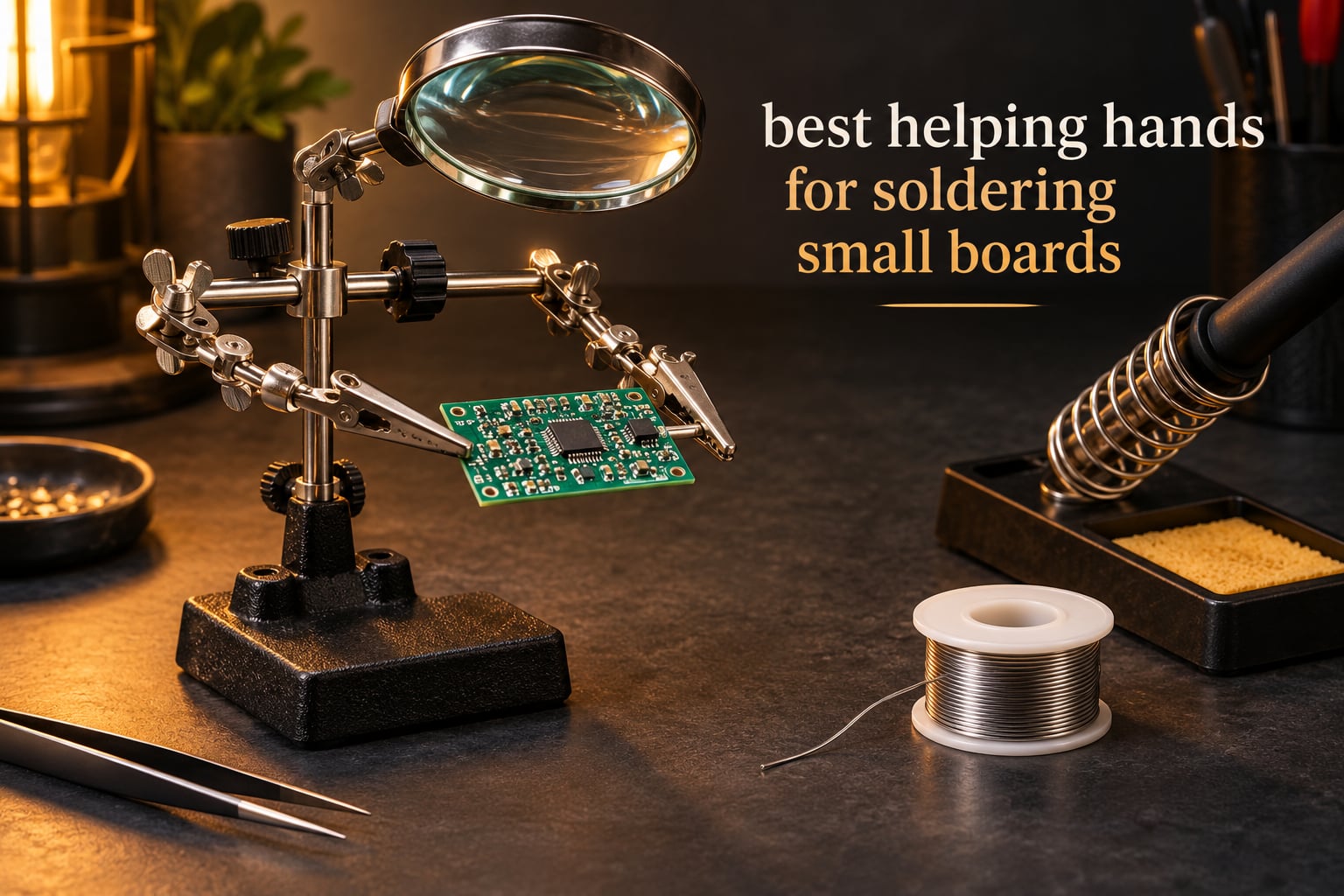
If you hand-solder small circuit boards, the best helping hands for soldering small boards are the ones that hold a board by its edge without covering the work and without shifting when the iron touches it. We spent weeks moving ten stands between a crowded bench and a small desk, soldering perfboard, a hand-pad repair and a SOIC footprint, to find out which ones actually stay put. Three came out ahead: the NEIKO 01902 as our overall pick, the Pro’sKit 900-015 for anyone who wants a small footprint and no lens, and the KOTTO 4-arm stand when you are holding more than one wire at a time.
The reason this category is confusing is that “helping hands” covers three very different machines. Some are a heavy cast-iron base with two ball-jointed arms and a magnifier. Some are a steel plate with magnetic pillars you can move anywhere across it. Some are just a pair of magnetic gooseneck arms with no base at all, waiting for you to bolt a plate to your bench. A stand built for holding a stained-glass panel is usually wrong for a 30 mm microcontroller board, and the price gap between the options is far wider than the difference in quality would suggest.
This guide is updated for 2026 and sorted by how each stand handles small work, not by brand name. We also cover what to mount a magnetic helping hand to, which is the single most common question on the soldering forums, and when a helping hand is the wrong tool entirely. If you want the lens-heavy options covered separately, we have a full guide to helping hands with magnifying glasses for soldering, and the magnetic systems get their own breakdown in our picks for magnetic helping hands with flexible arms.
Table of Contents
What Is a Helping Hand (Third Hand) for Soldering?
A helping hand, also called a third hand, is a bench-mounted stand with adjustable metal arms tipped by alligator-style clips that grip a workpiece so both of your hands stay free, one holding the iron and one feeding the solder.
The base does the load-bearing. Arms rise from it, either as ball-jointed segments that lock at a chosen angle or as flexible gooseneck wire that holds a bend. At the tip sits a spring-loaded clip, and that clip does two jobs: it holds the board, and it pulls heat away from whatever you are working on. That second job is the one experienced builders mention most. As Steve Leibson wrote for DigiKey, the clips “do double duty as heatsinks that prevent the heat of soldering from traveling farther down the wire” after he melted plastic insulation and burned his fingers.
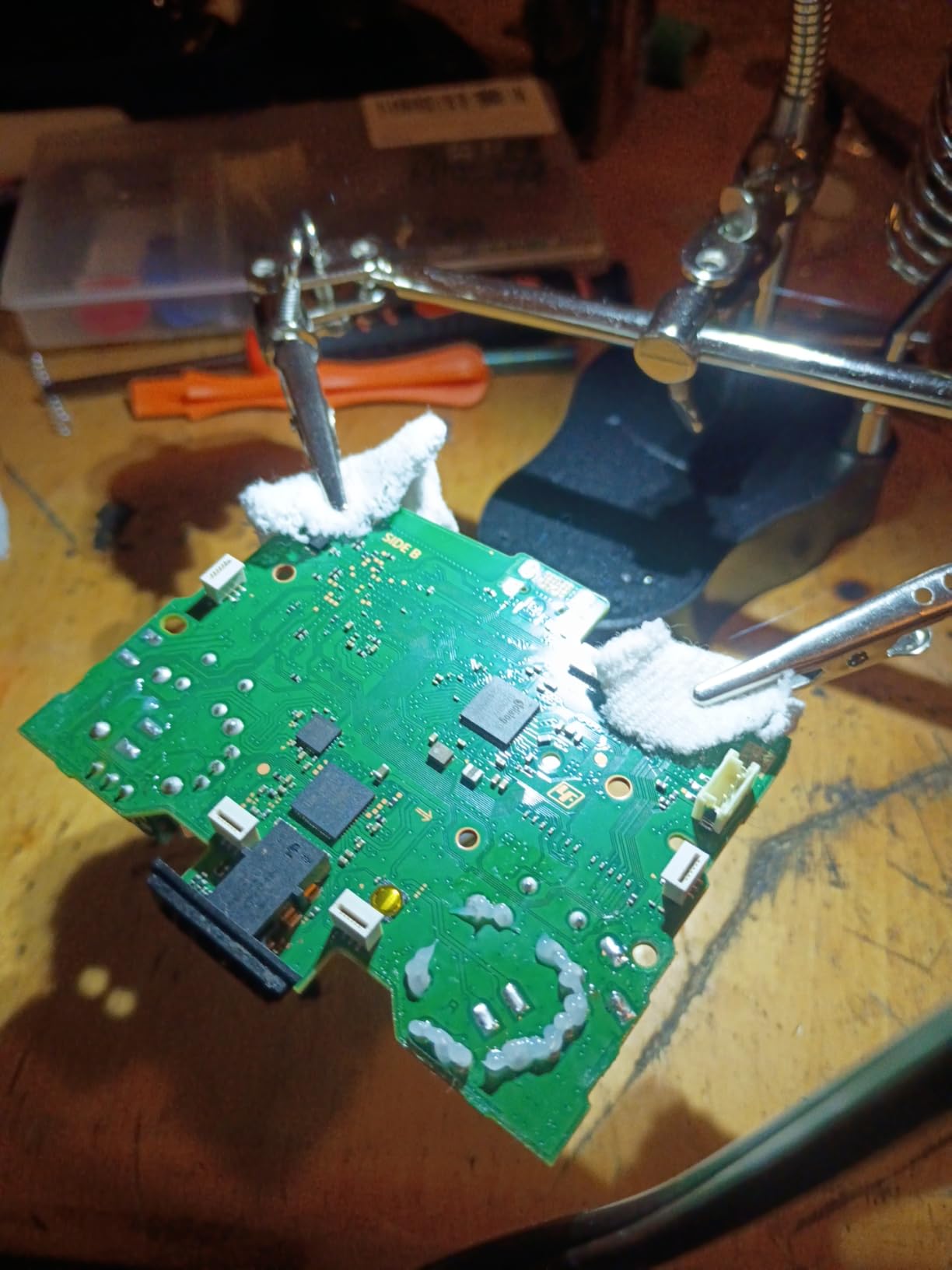
Small boards are where this matters most. On a large piece of perfboard, a slipping board is an inconvenience. On a board with 0402 resistors or a fine-pitch IC, a shift of two millimetres happens between the moment you heat the pad and the moment you feed the solder, and you get a cold joint or a bridge. The clips also act as crude heat sinks on the component lead, so a hot iron sitting on a large ground pad has somewhere to send its heat besides into your part.
Top 3 Picks for Best Helping Hands for Soldering Small Boards in October

NEIKO 01902 Helping Hand
- Cast-iron base
- 2x magnifier on ball joint
- Dual alligator clips
- 5 x 3 x 2.68 inch

Pro’sKit 900-015
- Weighted metal base
- Two alligator clips
- Compact 2.5 inch footprint
- Arms detach for tight work
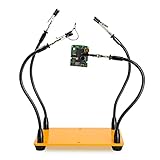
KOTTO 4-Arm PCB Holder
- Four gooseneck arms
- Rubber-capped clips
- 1.26 kg weighted base
- Locking nuts on every clip
The third slot goes to the KOTTO not because of its rating but because of its four arms, and its rubber-capped jaws are the only ones in this roundup that come covered out of the box.
All 10 Helping Hands Compared Side by Side in 2026
| Product | Specifications | Action |
|---|---|---|
| NEIKO 01902 Adjustable Helping Hand |
|
Check Latest Price |
| Pro’sKit 900-015 Helping Hands |
|
Check Latest Price |
| KOTTO 4-Arm Helping Hands PCB Holder |
|
Check Latest Price |
 RamPro 2422 Magnifying Stand RamPro 2422 Magnifying Stand |
|
Check Latest Price |
 LXIANGN 3.5X/12X LED Station LXIANGN 3.5X/12X LED Station |
|
Check Latest Price |
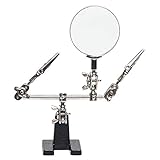 AORAEM 2.5X Helping Hands Magnifier AORAEM 2.5X Helping Hands Magnifier |
|
Check Latest Price |
 Weller WLACCHHB-02 Helping Hands Weller WLACCHHB-02 Helping Hands |
|
Check Latest Price |
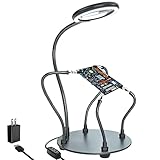 XYK 3X Magnifying Station XYK 3X Magnifying Station |
|
Check Latest Price |
 SainSmart PCBH Magnetic Station SainSmart PCBH Magnetic Station |
|
Check Latest Price |
 Fstop Labs 2-Pack Magnetic Arms Fstop Labs 2-Pack Magnetic Arms |
|
Check Latest Price |
Two columns in that table deserve a note before the individual reviews. First, only the SainSmart includes dedicated magnetic PCB pillars, which are the closest thing here to a proper board vice. Second, the Fstop Labs pack has no base at all, so it is an expansion module rather than a standalone stand.
1. NEIKO 01902 – the stand most benches already own
NEIKO 01902 Adjustable Helping Hand with Magnifying Glass, Third Hand Solder Aid, Soldering Wire Station Stand with Dual Alligator Clips and a Heavy Base, Beading & Jewelry Making Tools, Solder Holder
Cast-iron base
2x magnifier on ball-jointed arm
Dual alligator clips
5 x 3 x 2.68 inch
Pros
- Stable cast-iron base that does not slide
- Very high review volume across years of use
- 2x magnifier on an adjustable arm helps with small workpieces
- Clips and magnifier both reposition through ball joints
Cons
- Only two clips
- 2x is modest next to 3x and 4x lens stations
- Clip tension can mark delicate parts
The NEIKO 01902 has been on more benches than anything else in this list, and that shows in the numbers: a 4.4-star average across more than 15710 ratings, with roughly two thirds of those at five stars. The machine is simple. A cast-iron base, two ball-jointed arms carrying alligator clips, and a third arm holding a 2x magnifier that swings out of the way when you are not using it.
On a small board this is the configuration that works best, because the ball joints let you bring one clip down onto a board edge from almost directly above. That means the clip is not in your line of sight to the joint, which is the single most common complaint about two-arm stands with fixed goosenecks. The 5 inch by 3 inch footprint also leaves room around it for an iron stand and a solder spool.
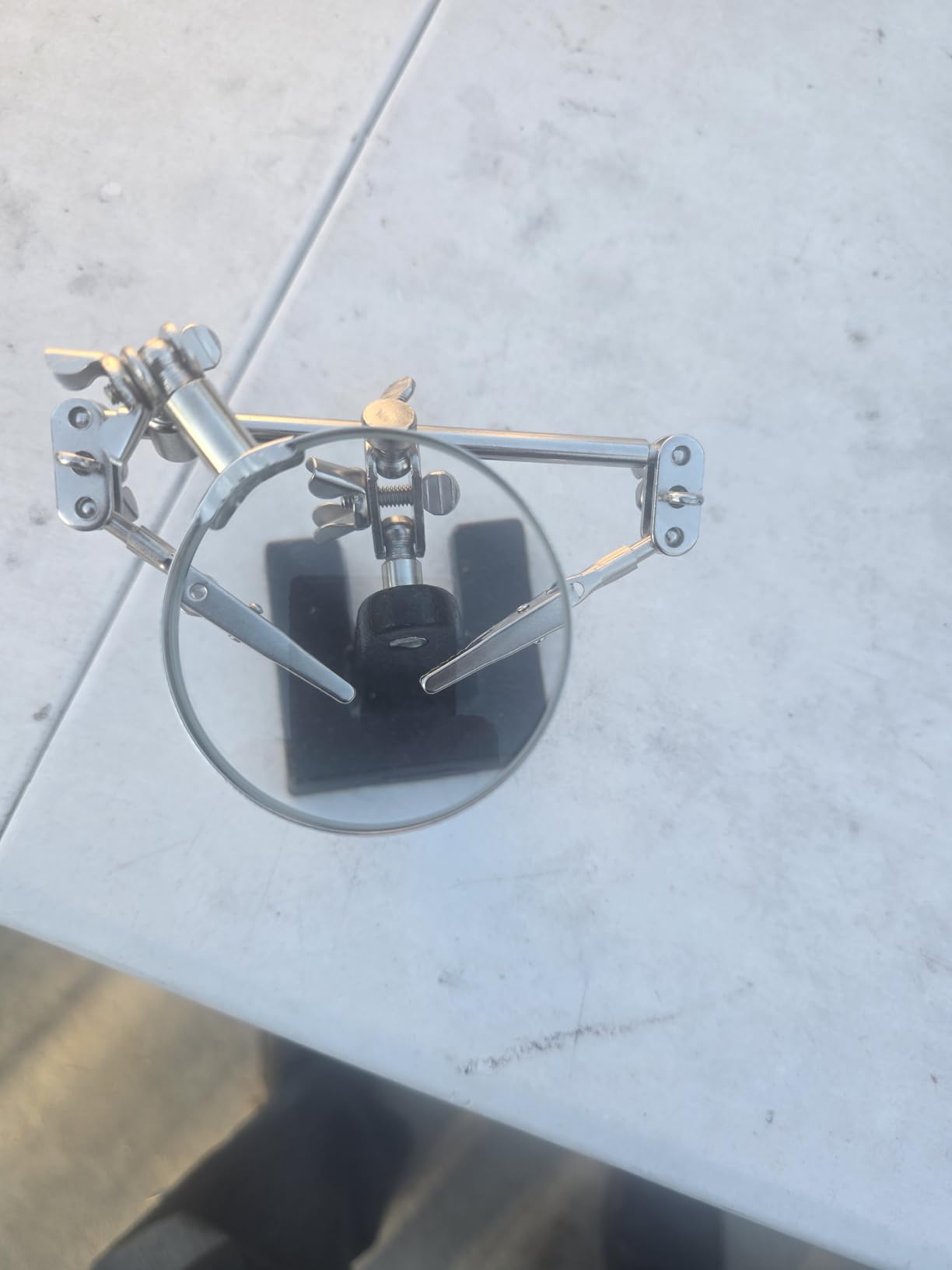
The limits are real and worth stating plainly. Two clips means you can hold a board and a wire, and that is all. If you are joining three or four wires at once, you are back to props and tape. The 2x lens is genuinely useful for inspecting a joint but it will not resolve a 0402 pad, and at 480 degrees Celsius the listed upper temperature rating is plenty for an iron tip parked nearby but not something to rest a hot iron on.
Clip tension is the other thing to plan for. The springs are firm, which is good for holding a board still, and they will leave a mark on a soft wire jacket if you squeeze and forget. A strip of self-amalgamating tape or a silicone cover over the jaws solves it, which is the same fix long-time users on GroupDIY apply.
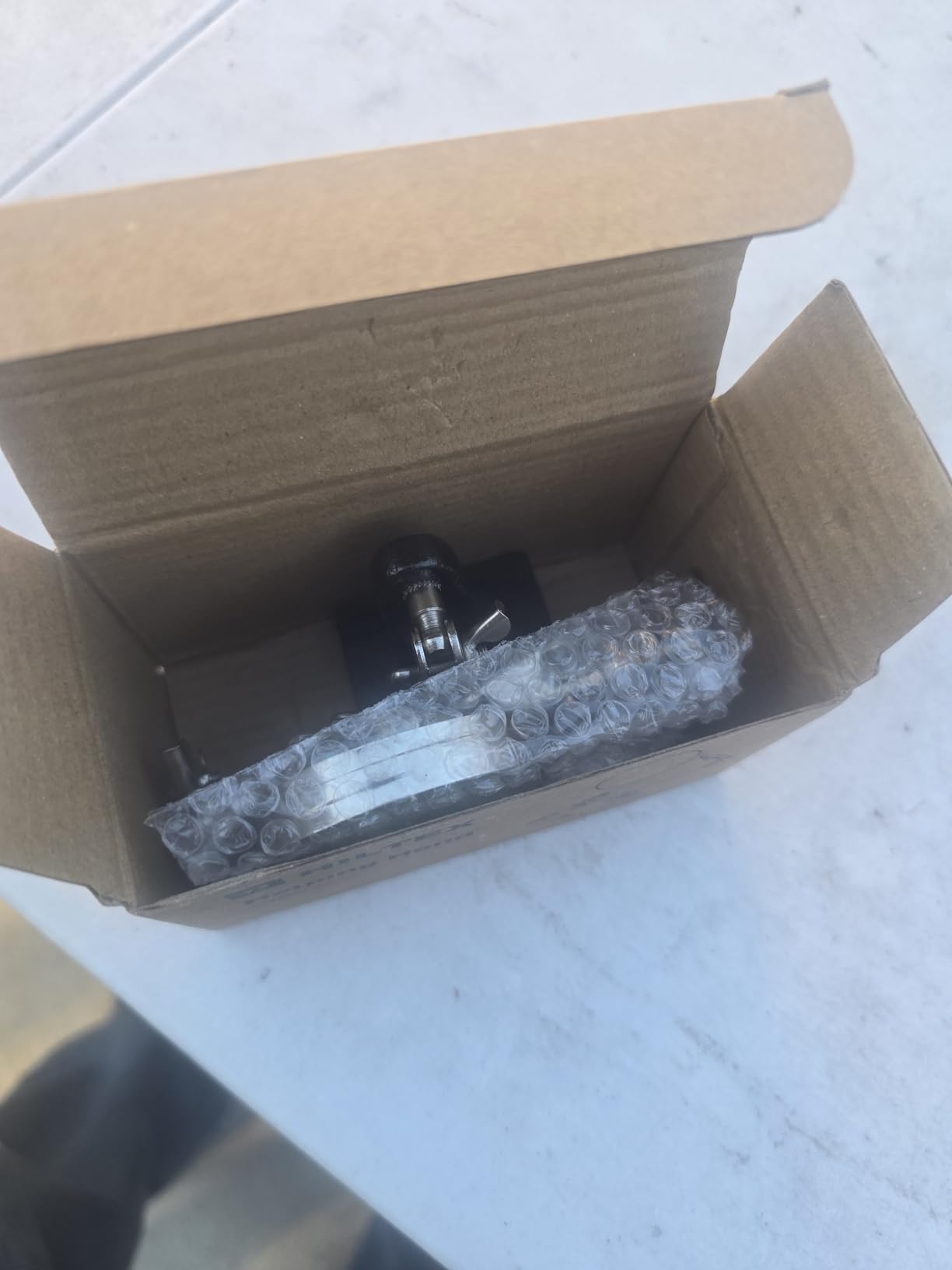
Good for holding a board while you work both hands
Reach for this one if your work is a single small board, a perfboard layout or a repair where the board stays in one place for minutes at a time. The stable base means you can lean on it a little without the whole thing walking across the bench, and the clips double as heat sinks on component leads, which is what keeps a hot pad from cooking the part behind it.
It is also the safest recommendation to make to someone who has never used a third hand, because you can clip almost anything to it and learn the technique without breaking something. If your work drifts towards fine-pitch ICs, read the SainSmart section further down first.
Not for multi-point wiring or serious magnification
Two clips is the hard ceiling. Anyone tinning a bundle of hookup wire, holding a flex cable flat, or working on a board with several exposed pads will spend more time re-clipping than soldering. And if your eyesight needs real magnification, 2x will disappoint, so read the Weller or LXIANGN sections for a stronger lens.
2. Pro’sKit 900-015 – compact weighted base, no lens
Pro’sKit 900-015 Helping Hands Soldering Aid
Weighted metal base
Two alligator clips
2.5 x 3.5 x 2.5 inch
Arms and clips detach
Pros
- Weighted base stays steady with no wobble
- Clips grip boards and solid wire without marking pads
- Joints stay tight after hours of repositioning
- Arms and clips fully adjustable and removable
Cons
- No built-in magnification
- Base tips under bulky items
- Arms are short for large components
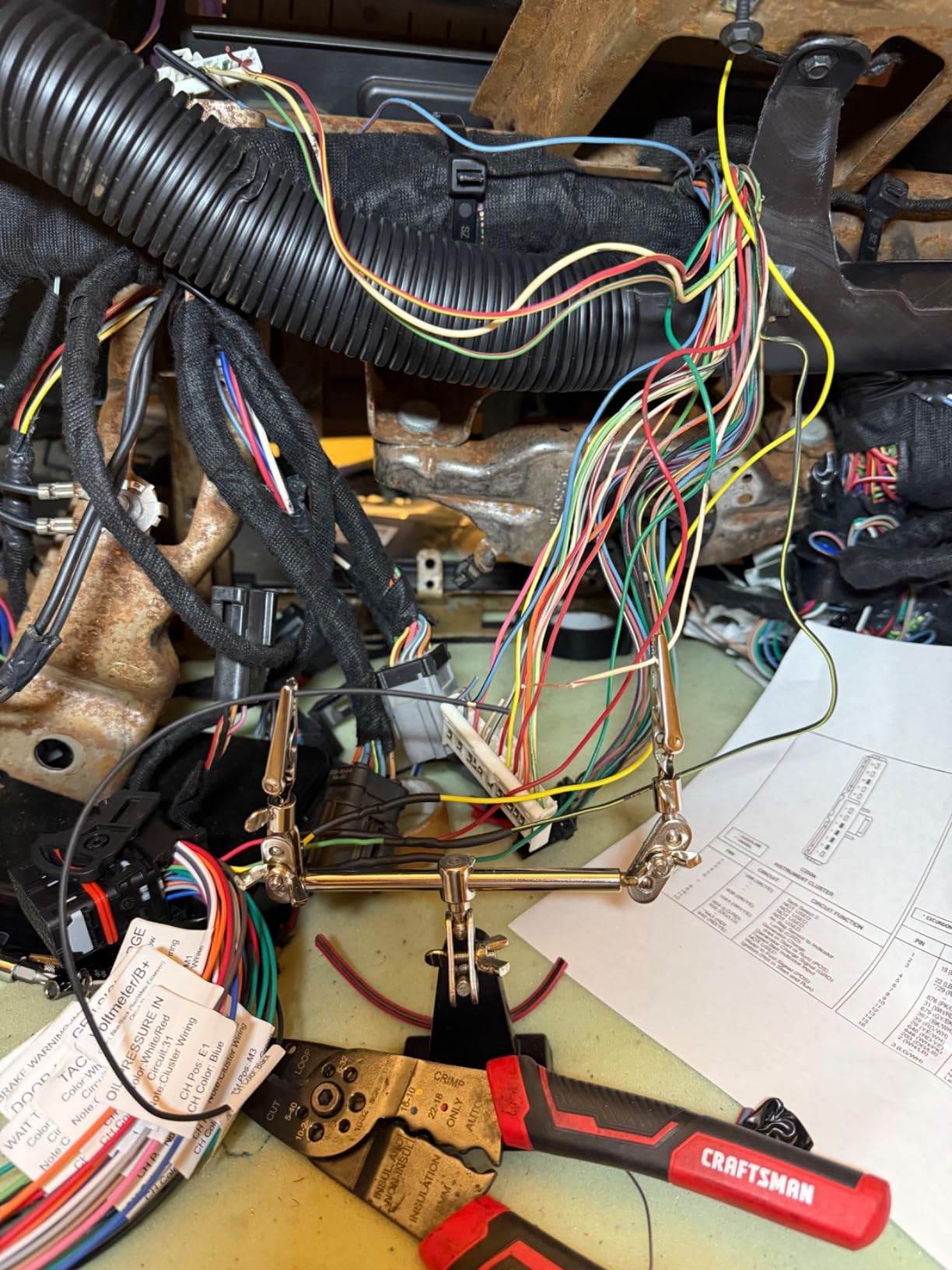
The Pro’sKit 900-015 is the one to buy when your bench is small and your work is small. At 2.5 inches by 3.5 inches by 2.5 inches it is the most compact stand here, and it rates 4.6 stars across 5809 reviews, backed by a deep body of long-term owner reports on a tool that has been in service for years. The clips are described in the specs as alligator style, the base is weighted metal, and there are several points of adjustment rather than a single fixed joint.
The detail that wins it for board work is that the arms and clips can be disassembled. You can pull an arm off entirely and bring just one clip in over a dense board, which is a genuine advantage when you are working inside a device housing where a full stand will not physically fit. Owners also report the elbow joints and small rotators staying tight after hours of repositioning, which is more than several competitors manage.
What you give up is magnification and reach. There is no lens at all, so if your eyes are not what they were, you need a separate loupe. The arms are short, which is fine for a 30 mm board and wrong for a large panel, and the base is light enough to tip if you hang something bulky like an extension cord on it. One recurring review note is clip tension high enough to bite into softened wire insulation, so treat it as a grip for wire ends rather than for insulated runs.
It is also the piece most often compared favourably to far more expensive professional stands. The point is not that it is better, it is that for a microcontroller kit or a perfboard layout, nothing else on the list earns its extra mass.
Good for cramped desks and confined housings
This is the one to choose for a laptop, a handheld console or a camera body where a 7-inch base plate simply will not go. Being able to strip an arm off and work with a single clip is the feature no other pick in this list offers in the same form. For anyone building their first few microcontroller boards, it does the job without asking you to learn anything new.
It is also a sensible first purchase if you are not yet sure that a helping hand is part of your workflow. Nothing here is wasted if you later move to a bigger station.
Not for inspection work or big assemblies
No lens means no inspection help, and you will be the one squinting. The arms are short, the clips are firm, and the base will not take weight on one side. If you work on laptop mainboards or anything with a heatsink to fit, this is the wrong size of tool.
3. KOTTO 4-Arm PCB Holder – four rubber-capped gooseneck arms
KOTTO Helping Hands Soldering,Third Hand Soldering Tool PCB Holder 4 Arms
Four 360-degree gooseneck arms
Rubber-capped tips
Weighted base, 1.26 kg
Locking nuts on clips
Pros
- Four arms hold several connections at once
- Heavy balanced base with anti-slip feet
- Rubber covers grip without marking boards
- Clips can be angled and locked with nuts
- Extra holes in base accept a light or magnifier
Cons
- Gooseneck arms spring back from their rest position
- Narrow jaw suits thin wire more than cable
- One report of a stripped arm thread
The KOTTO solves the problem the NEIKO cannot: how many things need to be held at once. Four metal gooseneck arms rise from a weighted base, each with a 360-degree stainless steel clamp tip and a tightening nut so you can set an angle and then lock it. It rates 4.6 stars across 2869 reviews and sits at number 13 in the Soldering Stations category, so the volume of use behind it is real.
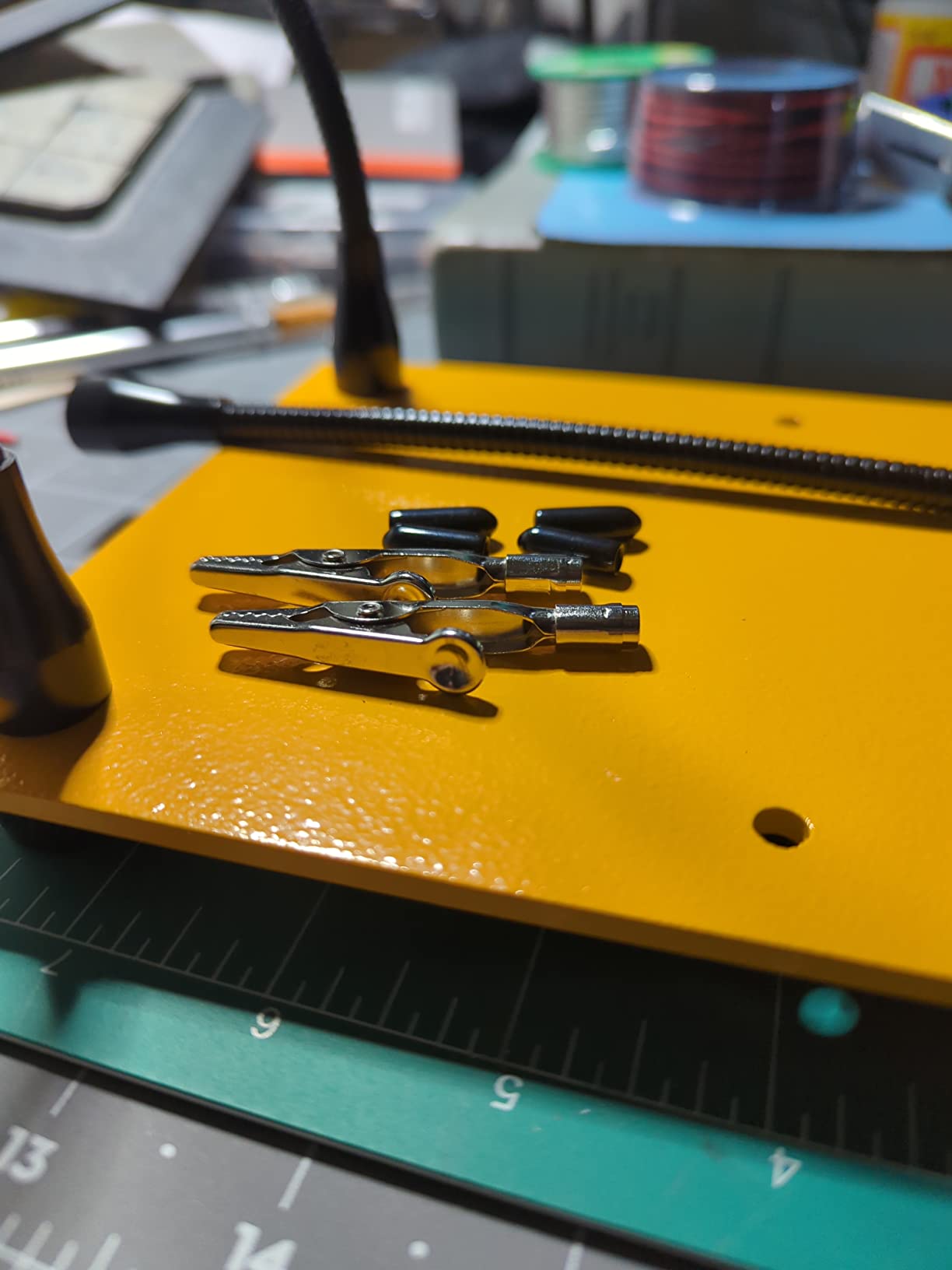
For small boards the rubber clamp covers are the detail that matters. Bare alligator teeth on a populated PCB are how you end up with a board that looks soldered but has a small scratch across a trace, and these clips come with rubber sleeves on the jaws. The base also has extra holes cut into the plate, so you can add an arm, a light or a magnifier later instead of replacing the whole stand.
The goosenecks are the tradeoff. Flexible wire arms have memory, so if you lean the board or nudge an arm, it springs back toward the shape it was bent into. Owners call this out clearly, and it matters more on a small board than on a large one because precision positioning is the whole point. The locking nuts help, but they lock a clip’s swivel, not the bend in the wire. The jaw is also narrow, which is right for thin wire and wrong for anything thick.
One isolated report describes an arm arriving with stripped threads that would not tighten. That is a single complaint rather than a pattern, but it is worth checking the threads the moment the package opens, because a joint that will not lock is worse than one that needs a wrench.
Good for multi-wire joints and small repair work
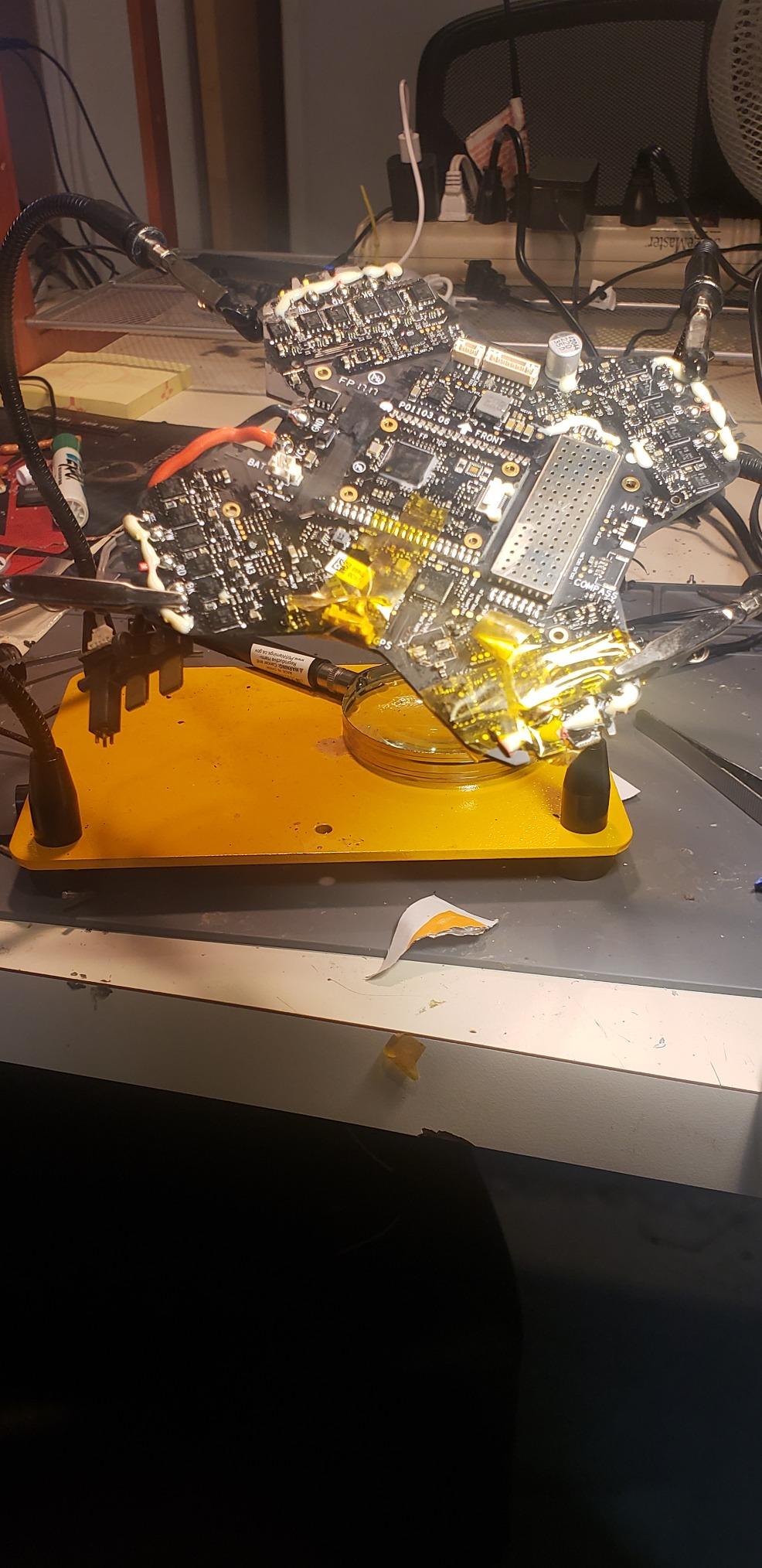
Pick this when you are tinning a bundle of wires, holding a flex cable flat, or bridging two traces at once. Four arms means you can clamp the board, a supply wire and a jumper in one go and still have a hand free for the iron. The rubber covers make it the safest of the multi-arm options for a populated board.
It is also the sensible upgrade path from a two-arm stand, since the base plate accepts extra fittings later. Our picks for magnetic helping hands with flexible arms go deeper on the gooseneck-versus-ball-joint question.
Not for jobs needing millimetre repeatability
Spring-back means the board creeps if anything touches it, and on 0402 work that is the difference between a clean joint and a mess. Narrow jaws also mean it struggles with anything that has no thin grip point, such as a wire bundle or a plastic connector body.
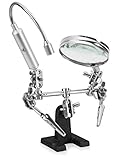
4. RamPro 2422 – retractable 4x lens on a light cast-iron base
RamPro – Helping Hand Magnifier Glass Stand – Magnifying Lens, Perfect for Soldering, Crafting & Inspecting Micro Objects
2-1/2 inch 4x retractable lens
Two 2-inch alligator clips
Cast-iron base
12.5 oz, 10.25 inch wide
Pros
- Magnifier and clips both rotate to any angle
- Cast-iron base resists rust
- Retractable lens keeps the view clear
- Only 12.5 oz so it moves between benches easily
Cons
- Lowest 4.2-star average in the roundup
- Only two clips
- Ball joints can creep under load
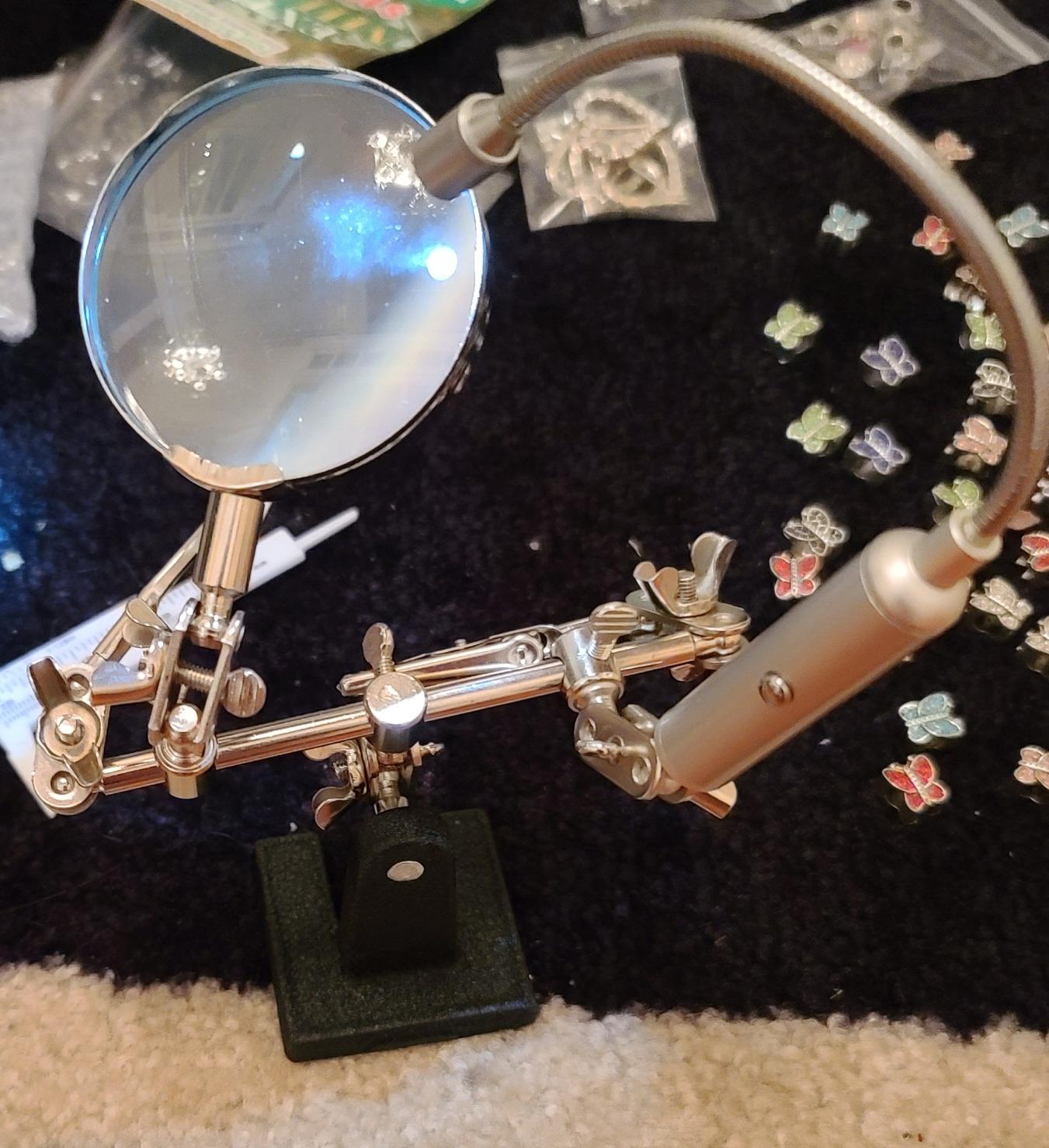
The RamPro 2422 is built around the lens. The specs list a 2-1/2 inch diameter lens at 4x zoom and 12 diopters, with the magnification strength shown as 3x on the listing, and that inconsistency is worth knowing about before you order. Owners confirm the magnifier and the clips both rotate, five ball-joint twists let you find a viewing angle, and there is an LED option in the 3x variant.
What makes it interesting for small boards is the retractable lens. You slide the glass out of the line of sight when you are placing a part, then push it back over the joint to inspect. On a 10 inch wide stand that freedom to move the lens is genuinely useful, and the cast iron base is described as rust resistant, which matters in a workshop where things get damp.
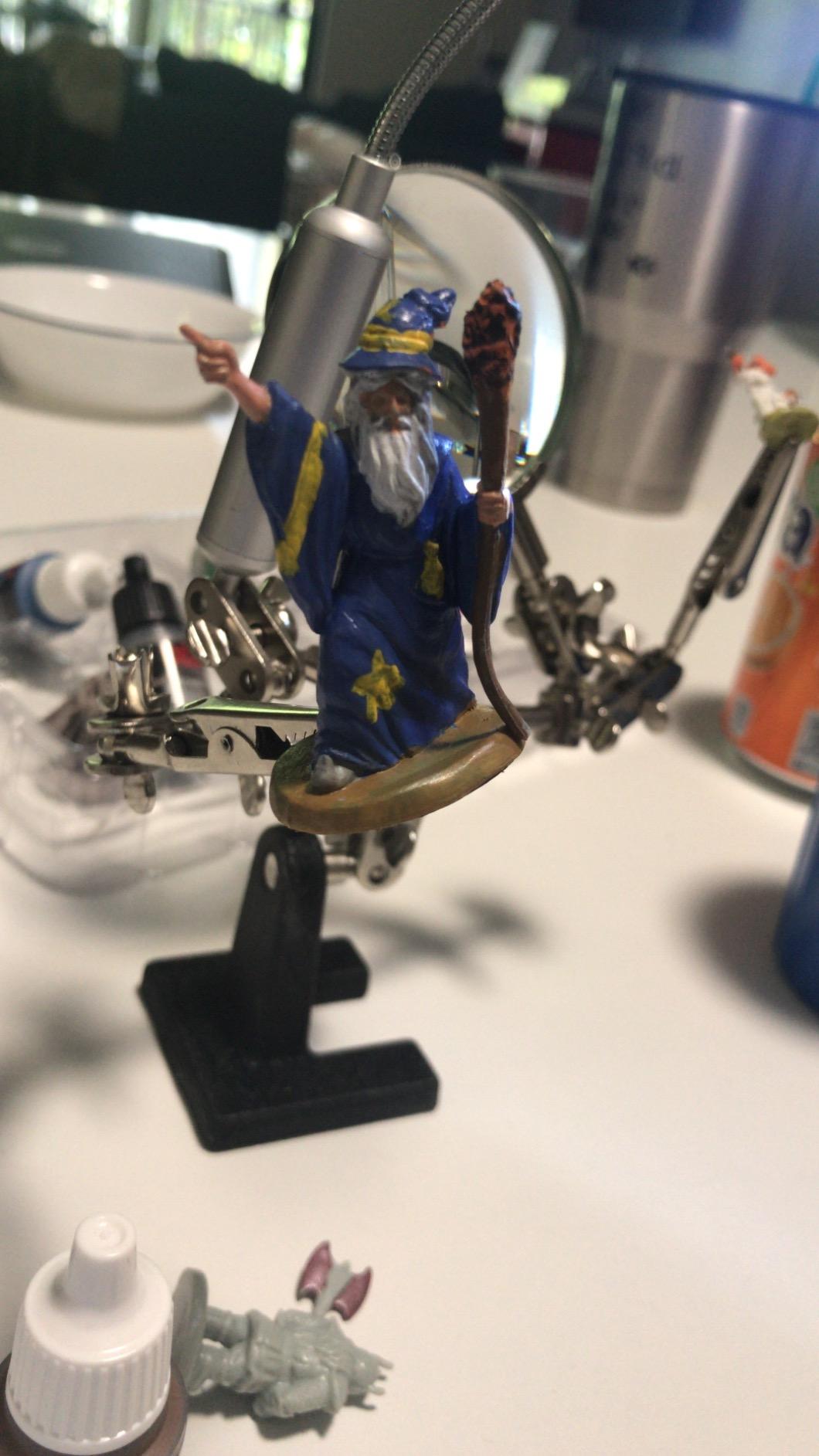
It is also the lightest real stand here at 12.5 ounces, and the wide 10.25 inch footprint is why it does not feel flimsy despite that. The cost is a 4.2-star average with 6% one-star ratings, the lowest in this roundup, and the durability reports behind that number are mixed. Two clips only, same ceiling as most competitors, and the ball joints can creep out of position if you load a clip with a heavy board.
The 2-inch clips are larger than the small ones some stands ship, which is good for a 50 mm board and useless for gripping a single component lead. This is an inspection-first tool rather than a holding-first tool.
Good for inspection-heavy work on a shared bench
If your main frustration is not being able to see a joint, this is the one. The retractable 4x lens plus rotating arms gives you a much larger working field than a 63 mm lens stand, and at 12.5 ounces you can pick it up and move it to wherever the light is good rather than rearranging your whole bench around it.
Watchmaking, phone repair and camera work all suit it, as do the craft jobs that share the same tools. We cover the craft side separately in our jewelry soldering kit picks.
Not for a main small-board stand
A 4.2 average with a visible one-star share means you are accepting build complaints as a known cost. The creeping ball joints and the two-clip limit make it a poor default if you want one stand to do everything, and the confusing magnification listing makes it harder to buy blind.
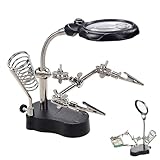
5. LXIANGN 3.5X/12X – dual LED arms and a spare clip
3.5X12X Helping Hands Soldering Station with LED Light & Alligator Clips
3.5x and 12x lens
LEDs on 360-degree arms
338 g weighted base
Spare clip and iron stand
Pros
- 3.5x and 12x covers general work and fine joints
- LED lighting removes shadows over the work
- Steel-weighted base resists wobble
- Complete kit including an iron stand and spare clip
Cons
- Acrylic lens rather than glass
- Needs 3 AAA batteries that are not included
- 9% one-star ratings
The LXIANGN 3.5X/12X does two things none of the cheaper stands here manage. It lights the work from two 360-degree adjustable arms, and it gives you a genuine high-power option, with 12x for looking at a single pad and 3.5x for the general working area. The listing describes an anti-dizziness lens design intended for extended use, and rotating metal hose arms that can be shaped and held.
It is also the most complete kit in the entry tier. You get an auxiliary clip, a soldering iron stand, the magnifier and a bilingual manual in one box, which for a first bench removes the need to buy three separate accessories. The steel-reinforced weighted base has non-slip feet, and at 338 grams it is heavy enough to sit still without taking up much bench width at 5.2 by 4.69 inches.
The honest caveat is the lens material. The listing copy says optical glass, the specification says acrylic, and buyers report acrylic. Under a bright LED at 3.5x you will notice the difference against real glass, and acrylic scratches. The LEDs also need three AAA batteries that are not included, which is a strange omission for a product whose main selling point is lighting.
It shares the roundup’s lowest 4.2-star average but with a very different complaint profile from the RamPro: 64% of ratings are five stars, so people like it, while 9% are one star, which is the highest one-star share here and points at durability rather than function. The arms and joints are where the budget shows.
Good for a first bench or poor lighting
If your work area is dim, lighting matters more than magnification power, and the LED arms here are a more direct fix than swapping to a different unlit stand. The two arms mean you can light a board from two sides and kill the shadow your hand was casting, which is a bigger practical win than an extra magnification step. The included iron stand makes it a complete first setup.
For anyone still deciding whether a third hand belongs on their bench, it is a low-risk way to find out.
Not for delicate optics or all-night sessions
An acrylic lens with a scratched surface and 12x is a poor combination, so keep the 12x lens away from solder splatter and dust. The budget arm construction is what produces the one-star reviews, and the batteries not being included is an irritation you will meet on day one.
6. AORAEM 2.5X – 63 mm glass lens on 4-way swivels
AORAEM Helping Hands Magnifier with Dual Adjustable Alligator Clips
2.5x glass lens, 63 mm
Two clips on 4-way swivels
Cast-iron base
10.88 oz
Pros
- Genuine glass lens at a low price
- 4-way swivel clips grip small parts without sliding
- Base heavier than the build suggests
- Small enough for a cramped bench
Cons
- Base is light and can tip under real load
- Stiff screws during assembly
- No lighting at all
- Grip struggles with thick items
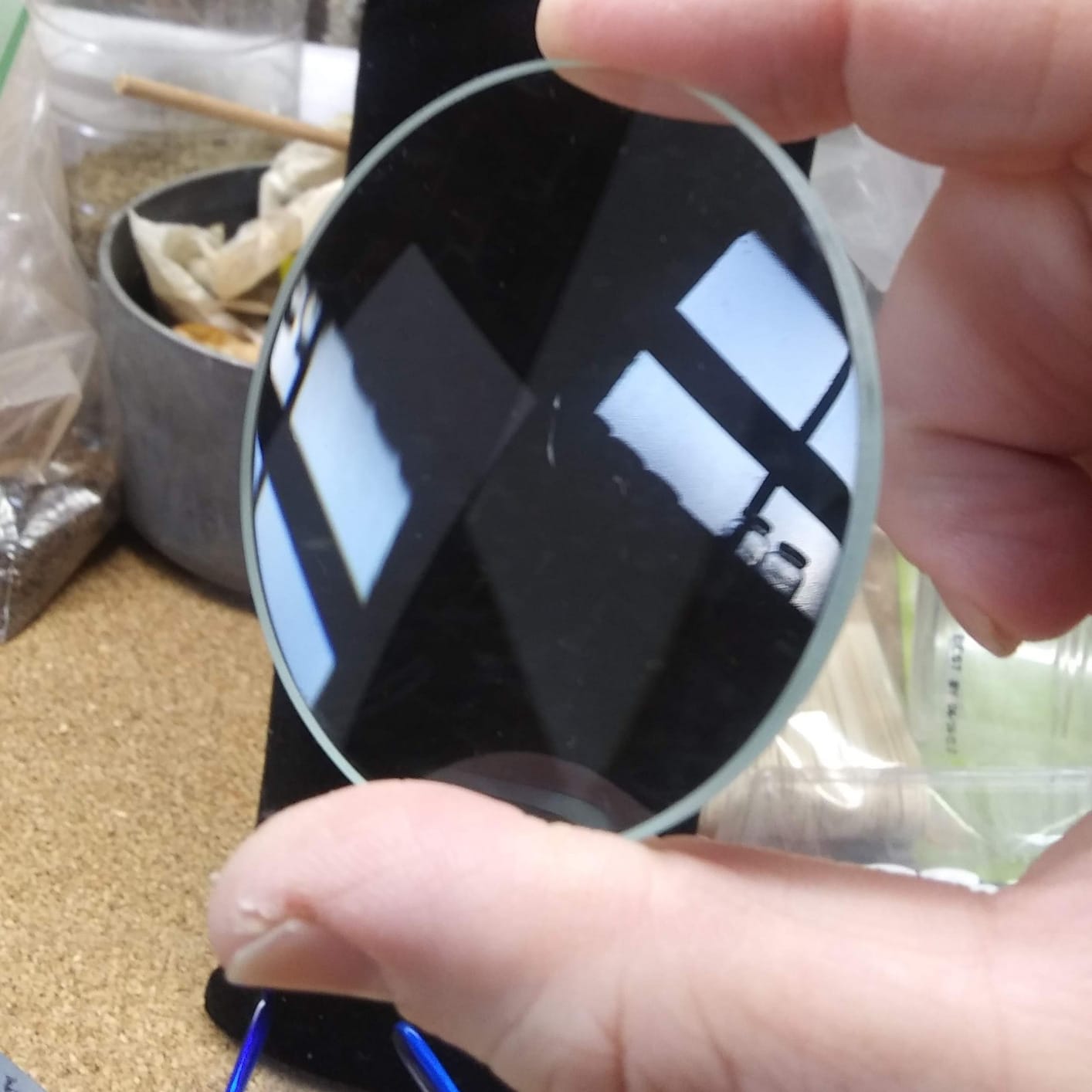
The AORAEM is the stand most people end up with after reading a bargain recommendation, and at 4.4 stars across 1430 reviews it holds up better than the build suggests. The lens is genuine glass at 2.5x and 63 mm diameter, mounted in a chrome frame on an arm that rotates a full 360 degrees, and the two clips sit on 4-way swivels rather than simple ball joints.
Those swivels are the feature worth having on a small board. A 4-way swivel lets you angle the clip so the jaws close flat on a board edge instead of catching a corner, which makes a small part far less likely to be squeezed. Owners also note the arms stiffen where you need them, so a lightly loaded clip holds a shape rather than drooping, and it ranks number 9 in Soldering Parts and Accessories for consistent demand.
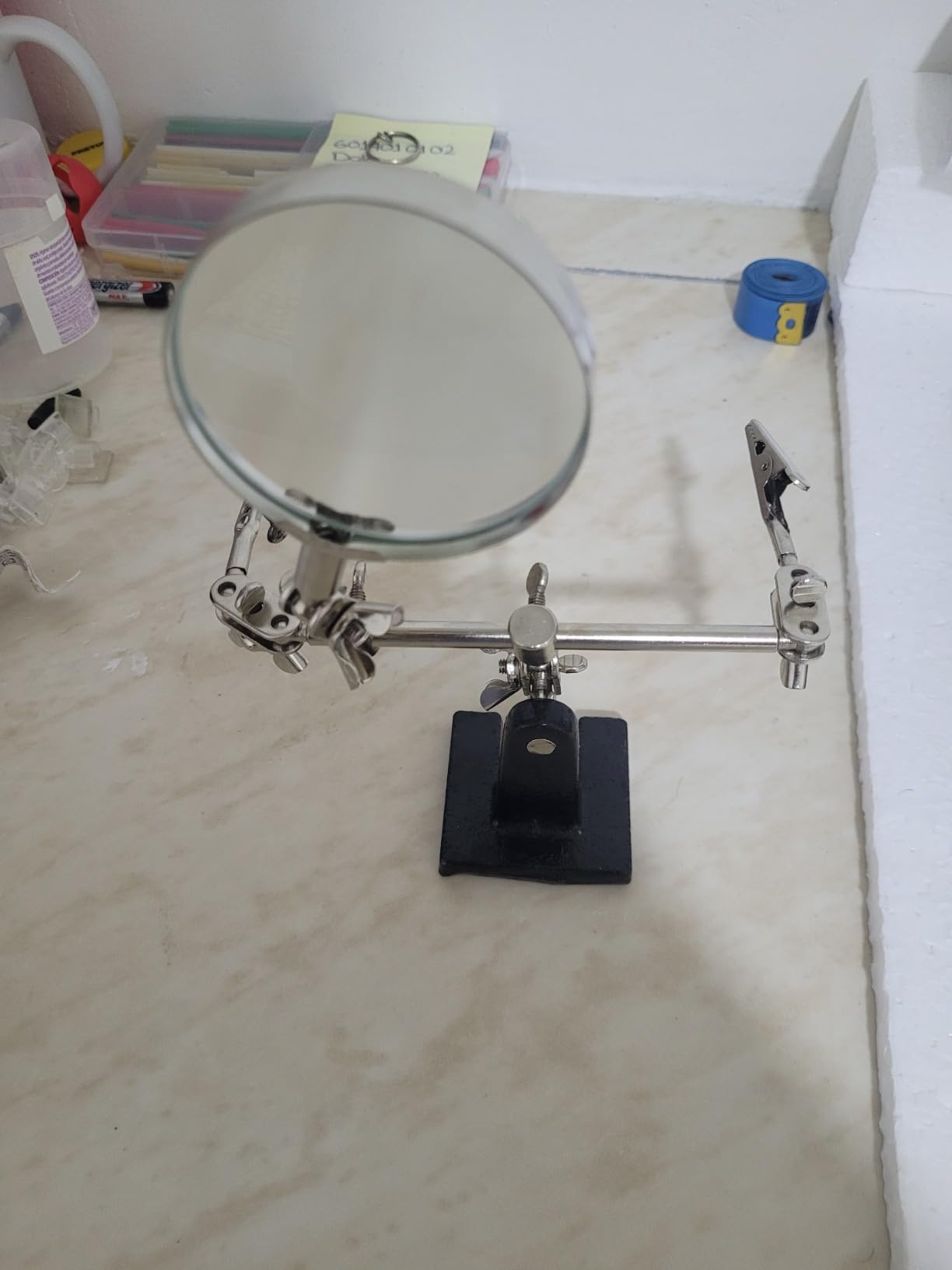
The problem is the base. At 10.88 ounces it is light, and several owners report it tipping when a genuinely heavy object is placed on it. The most common fix mentioned in reviews is gluing the base to a board or screwing it to the bench, which is a good sign about the rest of the product, because people improve it rather than replace it. Assembly screws are also reported as stiff, and there is no lighting of any kind.
Grip on thick items is another limit. This is built for small to medium work, so a guitar lead or a mains cable is going to be awkward. Taping the jaws or adding silicone covers is worth doing before you clip anything with a finished surface.
Good for small parts where glass beats power
A clean 2.5x glass lens with a 63 mm field is more pleasant to work under than a higher power plastic one, and the 4-way swivels make it good for holding awkward little assemblies. It is a sensible companion to a larger magnifier stand if you like to have two working positions.
Just secure the base properly first, because the fix is trivial and takes two minutes.
Not for heavy workpieces or unlit benches
It tips, it has no light, and it cannot hold a thick cable. If you are working on anything heavy or in a dim space, put the money into the LXIANGN or XYK instead, both of which include lighting.
7. Weller WLACCHHB-02 – 4x lens from a known iron brand
Weller Genuine Helping Hands with Magnifier | WLACCHHB-02
4x magnifying glass
Two 4-way swivel clamps
Ball-jointed arms
0.43 kg
Pros
- Recognised soldering brand with a real service network
- 4x lens is a genuine step up from 2x
- Swivel clamps place parts precisely
- Simple and compact with two clamps
Cons
- Only two alligator clips
- No integrated lighting
- Less flexible than four-arm stations
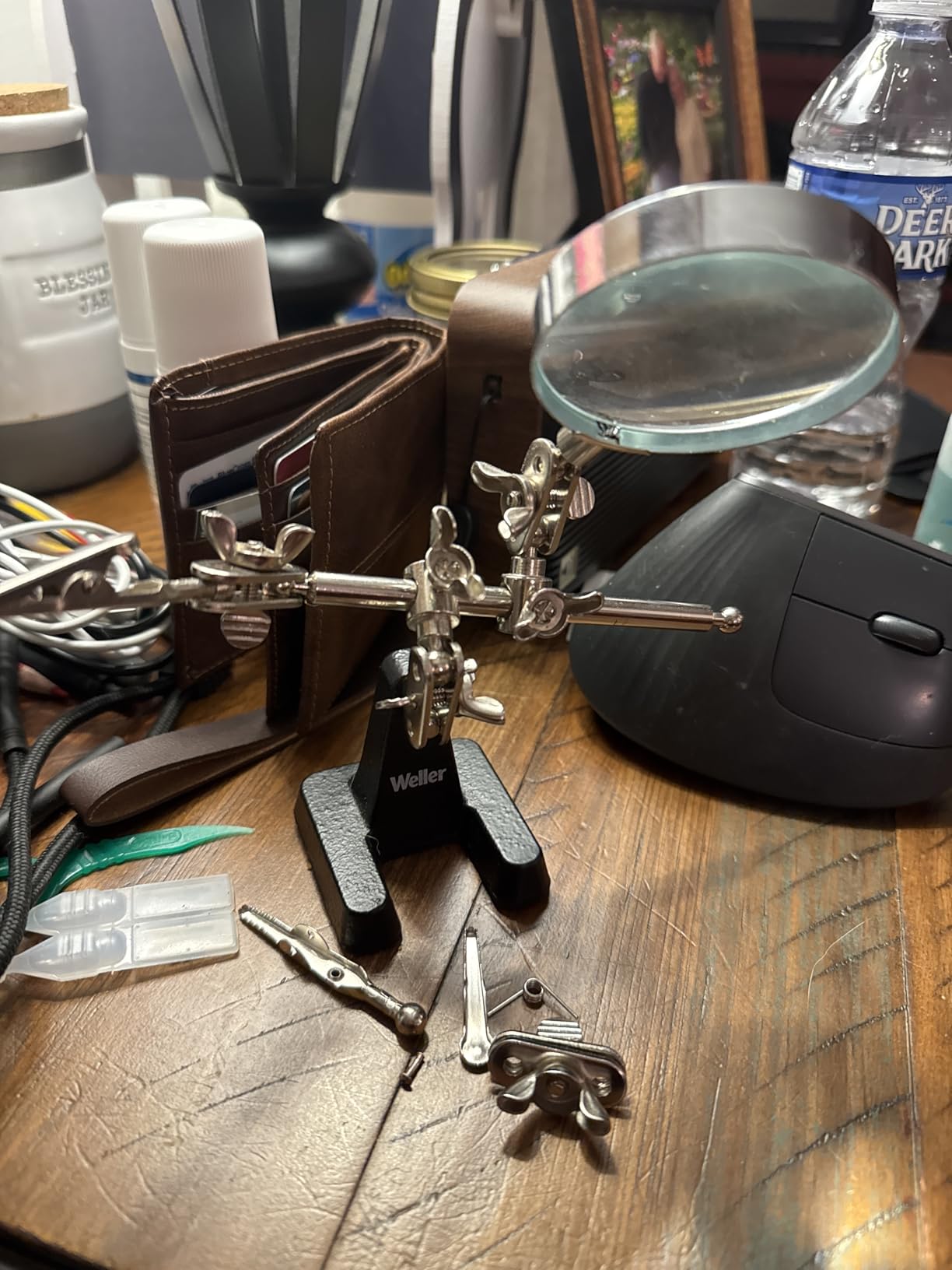
There is a practical reason to buy from Weller even when a cheaper stand has better specifications. Weller has made soldering tools for a very long time, and the WLACCHHB-02 carries a 4x magnifying glass on ball-jointed arms with two alligator clamps on 4-way swivels. It rates 4.5 stars across 1217 reviews, with roughly 72% of those at five stars.
For small boards the 4x lens is the point. Two times helps you confirm a joint exists; four times lets you see whether the solder wetted the pad or just sat on it, which is the difference between a repair that works and one that fails a week later. The 4-way swivels let you bring a clip down onto a board edge from whichever direction the housing allows, and the package weight of 0.43 kg keeps it planted.
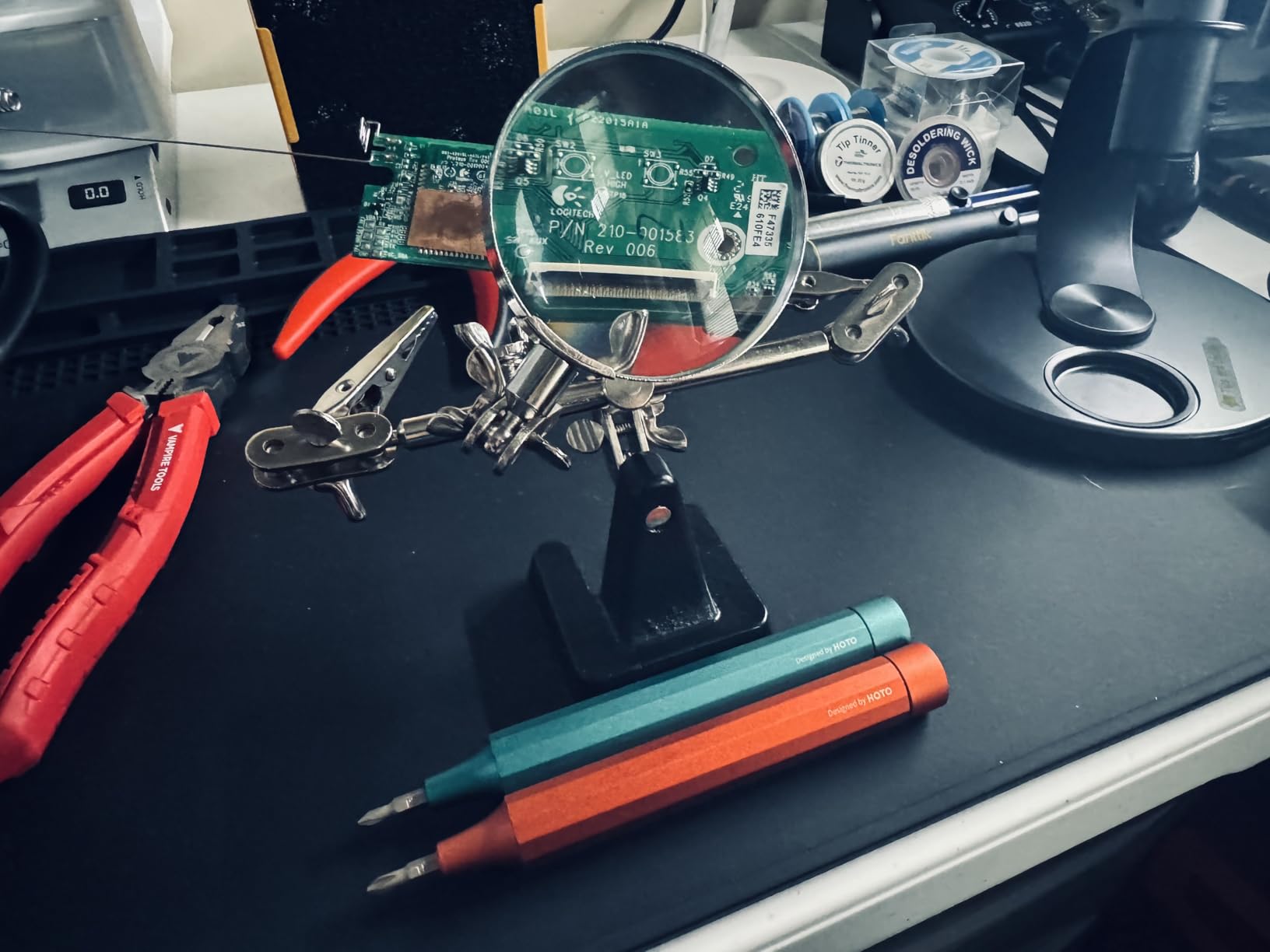
It is a two-clip tool, so the same ceiling applies as everywhere else on this list. There is no integrated light, which means the 4x lens simply magnifies whatever your room lighting is doing, shadows included. And with two arms it is much less flexible than the four-arm stations, so a multi-wire joint means you are still short one hand.
The same unit gets recommended for stained glass and general crafts, and it does work there, but small electronics is where the magnification earns its cost.
Good when brand support matters to you
If you already own Weller irons and want one ecosystem and one support path, this is the sensible pairing. The 4x lens is strong enough for inspection, and the swivel clamps are precise enough for a single board on a desk. It is also the option to pick if you are buying as a gift and want something with a name people recognise.
Pair it with one of the soldering stations we rate and you have a complete single-board setup.
Not for multi-arm jobs or dark benches
Two clips, no light, no extra reach. In a dim room a 4x lens makes an unlit workspace harder, not easier, so add a task light before you conclude the optics are poor.
8. XYK 3X Station – 500-lumen lamp and four mixed-length arms
XYK Helping Hands Soldering Station with 3X Magnifying Glass with light, 4 Flexible Helping Hand Arms Magnifier and Third Hand Soldering Tool for Electronic Repair Soldering Jewelry Crafts
3X lamp, 28 LEDs, 500 lumens
Four gooseneck arms, 7.5 and 5 inch
7-inch steel base, 1.46 kg
Six brightness levels
Pros
- Bright dimmable lamp with six levels
- Four arms of mixed length reach awkward angles
- Rubber-sleeved clips prevent scratches and shorts
- Steel base with non-slip pads will not tip
Cons
- Four arms crowd a small board during fine work
- Mains powered lamp adds a cable to the bench
- Magnifier arm has no friction joint so it drifts
The XYK XYK-141 is the first stand here that treats lighting as a primary feature rather than an accessory. The 3X dimmable lamp carries 28 LED beads at 500 lumens with six brightness levels, which is enough light to inspect a board without fighting your own shadow. It rates 4.5 stars across 1100 reviews, with about 74% at five stars.
The arm arrangement is the clever part. You get two 7.5 inch arms and two 5 inch arms, all screw-locked into a 7 inch powder-coated steel base weighing 1.46 kg. Mixing long and short arms means you can put a long arm over a board and a short one in front, instead of every clip sitting at the same distance from the work. The clips rotate 360 degrees and lock, and the rubber sleeves stop them scratching polished surfaces or bridging adjacent pads.
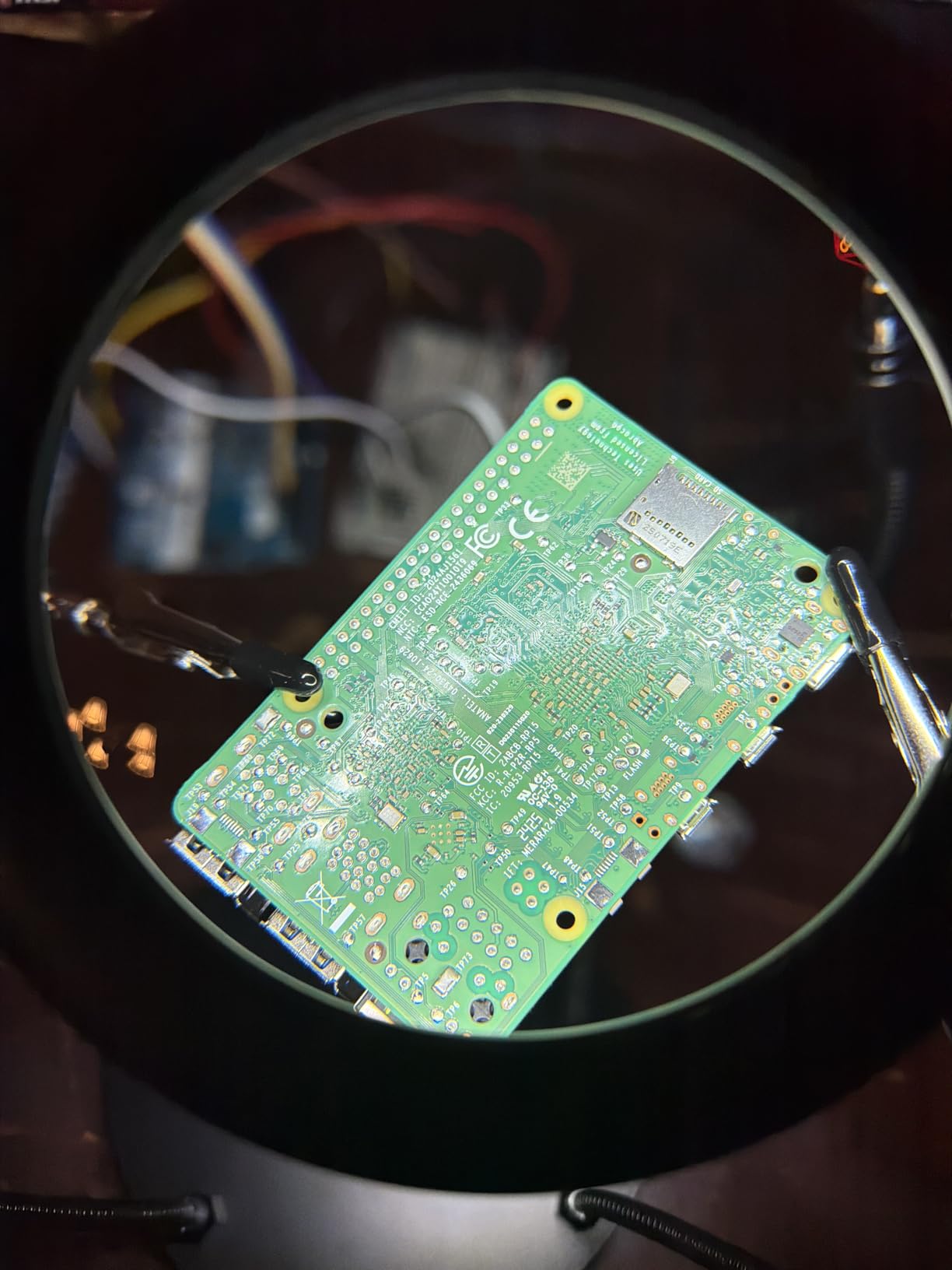
Four arms is also four arms in the way. When you are doing close macro work on a small board, the short arms physically obstruct your view and your iron hand, and owners report exactly that. The magnifier arm has no friction joint, so once you set an angle it can drift out of alignment over a long session. And a mains-powered lamp means a cable crossing the bench, which is exactly the problem a USB-powered design avoids.
It comes with a small wrench, a mini screwdriver, a cleaning cloth and a plug, which tells you the arm nuts need tools and that the manufacturers expected some assembly.
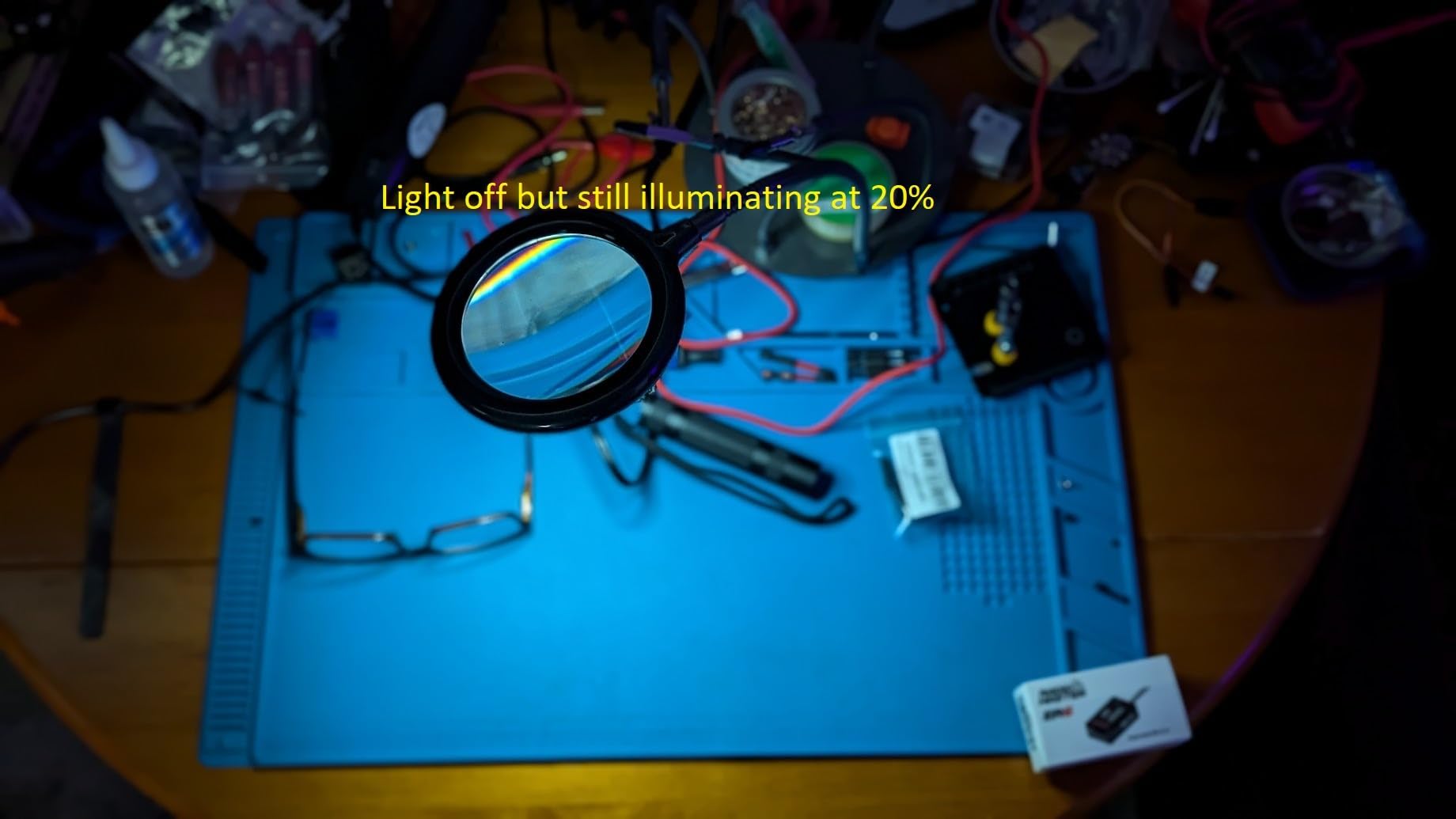
Good for dark rooms and multi-part work
Six brightness levels and 500 lumens change the working environment more than any other single feature here. If your bench is in a garage or a spare room, this solves the problem that no amount of magnification can. The mixed arm lengths also make it strong for tasks where the workpiece is not a flat board, such as a wire harness or a small mechanism.
Not for tight macro work on a small board
This is the tension in the product, and it is worth being blunt about: it is a good general station that is a slightly awkward precision station. If your main work is a 20 mm board under a microscope, four arms and a drifting magnifier will slow you down. Look at the NEIKO or Pro’sKit for that.
9. SainSmart PCBH – magnetic PCB pillars on an 11.1 inch plate
SainSmart Magnetic Helping Hands Soldering Station with an 11.1 x 7.1 Inch Larger Base, 5X LED Magnifying Lamp, 4 PCB Circuit Board Holder & 4 Flexible Magnetic Helping Hands
11.1 x 7.1 inch steel base
Four magnetic PCB pillars
Four magnetic arms, 7.5 and 14 inch
5X USB magnifier lamp
Pros
- Highest rating in the roundup at 4.7 stars
- Only pick here with dedicated magnetic PCB pillars
- Spacious 11.1 x 7.1 inch plate gives real working room
- 5X lamp with three colour temperatures and ten levels
- Rubber-sleeved clips
- Modular so you can strip it back
Cons
- Bulkiest footprint in the roundup
- Clamps are hard to tighten without twisting
- Goosenecks less rigid than ball-jointed arms
- Base finish scratches where magnetic feet slide
The SainSmart PCBH is the most capable unit here and the one that most directly answers the small-board question. It rates 4.7 stars across 723 reviews, the highest average in the roundup, with 85% five-star ratings. The base is an 11.1 by 7.1 inch powder-coated steel plate weighing over 2.4 pounds, and it comes with a one-year manufacturer warranty.
What separates it from every other pick is the four magnetic PCB pillars. These are small upright posts that hold a circuit board on its edge, and you can position them anywhere on the plate. For a small board that is a better answer than an alligator clip, because the board sits square at whatever angle you set, it is held along its whole edge rather than at two points, and your hands and your view stay completely clear. Add the four magnetic gooseneck arms, two 7.5 inch and two 14 inch, and you can hold a board and its wires at the same time.
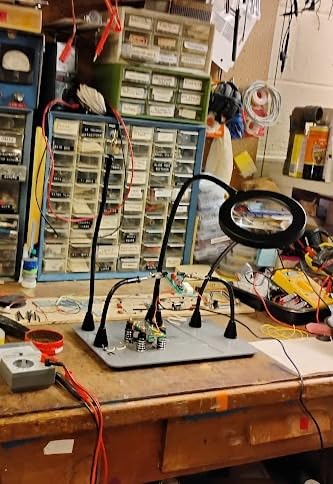
It is also the biggest thing on this list, and that is a real cost. Eleven inches of bench is a genuine commitment, and it needs four non-slip pads underneath to stay put. The alligator clamps are hard to tighten without twisting the arm, there is no wider clamp option for bulky items, and the goosenecks are less rigid than a ball-jointed stand, so a heavy board will move. The powder coat also scratches over time where the magnetic feet slide around, which is cosmetic but permanent.
Owners commonly strip the accessories out and use only what a given job needs, which is a good sign the modular layout works. The 5X magnifier lamp runs off USB with three colour temperatures and ten brightness levels, and it is the best lens in the roundup for inspecting a joint.
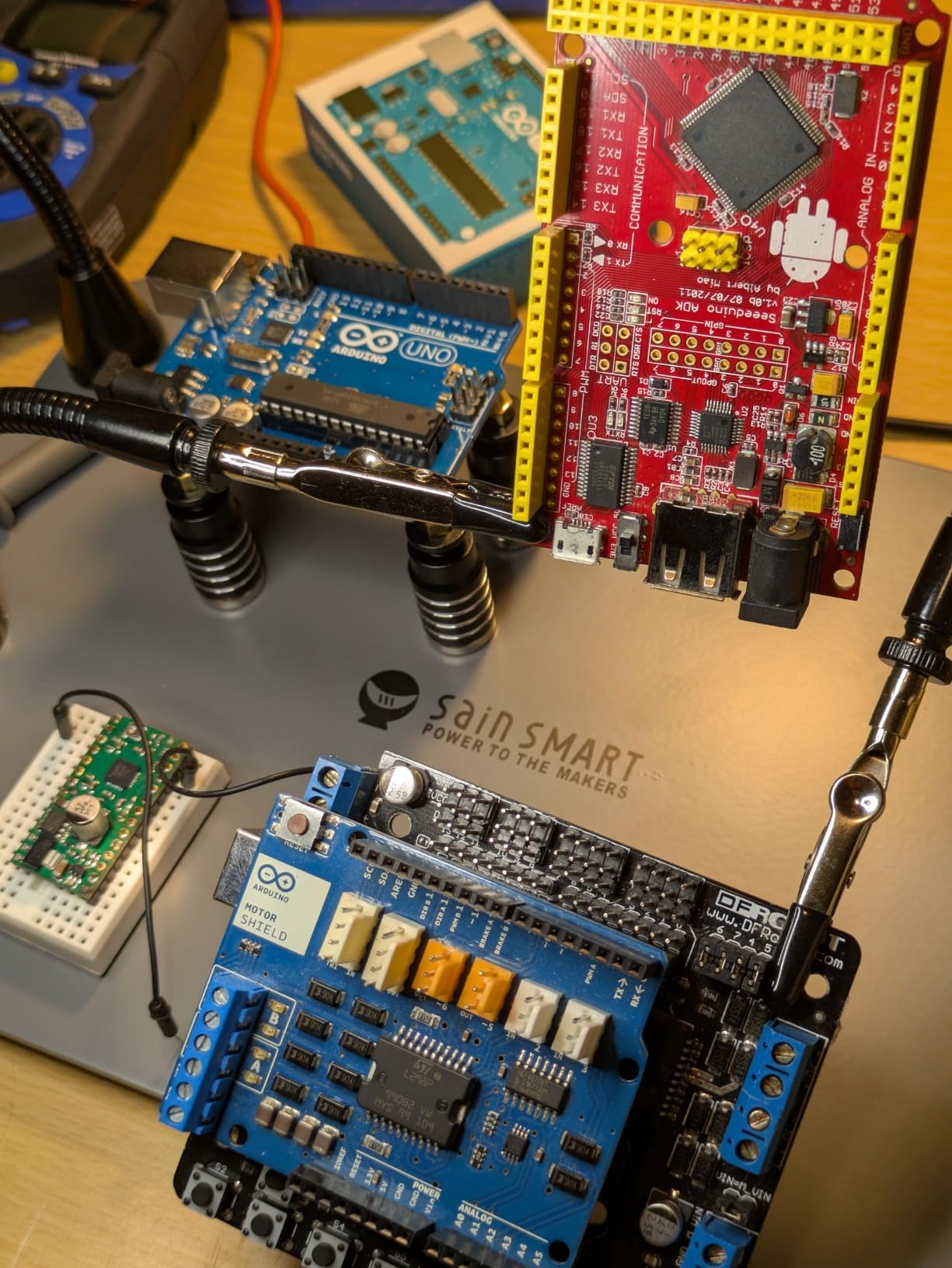
Good for the finest small-board work in the roundup
PCB pillars are the feature. Nothing else here holds a board the way a proper edge holder does, and once you have worked on a SOIC footprint with the board square in front of you and nothing in the way, going back to clips feels like a downgrade. The 14 inch arms reach across a wide plate, so a big board and a small board can both live on the same surface.
Owners describe it as the best support tool they own for micro soldering, and with 85% five-star ratings that is not marketing.
Not for a small bench or a moving workspace
It is the bulkiest option here and the least portable. If your soldering happens at a kitchen table you clear away, 11 inches of steel plate is friction you will feel every time. The narrow clip jaws and stiff tightening are also a poor match for anything chunky.
10. Fstop Labs 2-Pack – magnetic arms for an existing steel bench
2 Pack Set Magnetic Flexible Gooseneck Metal with Alligator Clips for Helping Hands Third Hand Tool Automobile Electronics Soldering Jewelry Painting Art Crafts Hobby
Two magnetic gooseneck arms
Stainless steel alligator tips
Knurled thumb nuts lock rotation
Base sold separately
Pros
- Magnetic bases attach to any steel surface with no stand needed
- Stainless steel tips grip tightly
- Knurled thumb nuts lock a chosen angle
- Two-pack lets you place both arms at once
Cons
- No base included so a steel surface is required
- Gooseneck arms spring back and creep under load
- Only two arms in the pack
- Jaw width suits thin wire more than cable
This pack is not a helping hand, and treating it as one is the most common mistake people make. It is two magnetic flexible gooseneck arms with stainless steel alligator tips, and they ship with no base. What they clamp onto is any ferrous steel surface: a bench, a steel plate, a chassis you are repairing, or the vice on the front of your bench. It rates 4.6 stars across 747 reviews with about 75% at five stars.
Once you have that mental model, it becomes extremely useful and extremely cheap per arm. The 360-degree rotation locks with knurled thumb nuts, so you set a position and it stays, and because the magnetic foot is the base, you can move an arm to a different spot on the bench between jobs rather than rebuilding a stand. It is a two-pack, so you can have two arms in position at once, which is the number most jobs actually need.
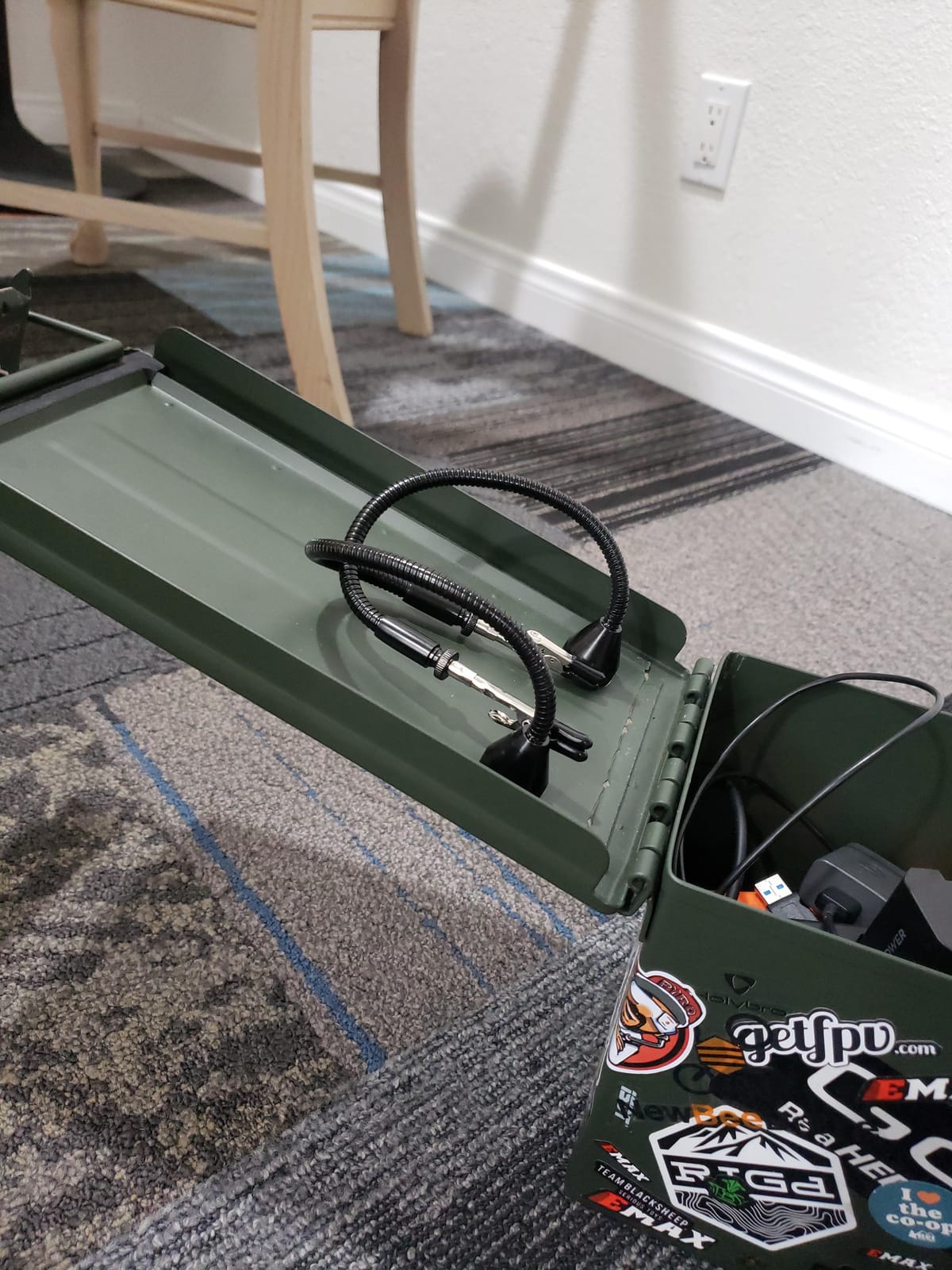
The catch is the surface. If your bench top is particle board, MDF or a plain wooden surface, these arms have nothing to hold and you will wonder why they will not work. That question, in one form or another, is the most common first post in soldering help forums, and the answer is always the same: you need steel. Bolt a thin steel plate to the bench, use a steel-cored ESD mat, or clamp a plate to the bench vise.
The goosenecks also creep and spring back, as they do on any wire arm, and the jaw suits thin wire rather than cable. But for the use it is designed for, an arm parked on a car chassis or a steel benchtop is more stable than an arm on a small weighted base, because the magnet is a fixed point with no hinge to flex.

Good for filling gaps in an existing setup
If you already have a heavy stand and find yourself short of arms, this is the cheapest way to add two more without buying a second base. Repairing electronics inside a metal enclosure is where it earns its place, because you can stick an arm to the inside wall of the case and work hands-free. It is also the natural companion to a steel mounting plate if you are building your own station.
Treat it as an expansion module, not a first purchase, unless you already have a steel surface to mount to.
Not as a standalone helping hand
No base, no stable footprint of its own, and spring-back in the arms. Buying this as your only helping hand and putting it on a wooden bench is the most common way people end up disappointed with magnetic helping hands.
Which Type of Helping Hand Is Right for You?
Three archetypes cover almost everything, and choosing between them is faster than comparing specifications. A magnetic flexible-arm station is a steel plate with arms and pillars you can move around it. A spring-loaded magnetic PCB holder is the same idea at a smaller scale, with posts that grip a board’s edge. A classic weighted base is a cast-iron or steel puck with ball-jointed or gooseneck arms rising from it, which is the traditional third hand and the only type that works on a bench with no steel in it.
If your bench is a small wooden desk with no metal surface, the classic weighted base is the only option that needs nothing extra. If you already own a steel-cored ESD mat, or you are willing to bolt a thin plate to the bench, the magnetic systems open up immediately and give you a much larger working area with better reconfiguration. If you work inside metal devices, magnetic arms that stick to the enclosure itself are the most stable option available.
On arm style, the honest answer is that ball joints hold position better and goosenecks reach further. Ball-jointed arms such as the NEIKO and Weller can be set and stay, which is what you want on a small board where two millimetres matters. Gooseneck arms such as the KOTTO, XYK and Fstop Labs reach further, flex to reach awkward angles and hold several things at once, but they have memory and drift when you touch them. For fine-pitch work, choose position holding. For harnesses and multi-wire joints, choose reach.
On budget, the spread across this roundup is wide and the performance curve is flat until the top end. Below about fifteen dollars you are getting a single-clip or dual-clip stand with a modest lens and a base that may need securing. In the middle you gain arm count, rubber-covered jaws and real LED lighting. At the top you gain PCB pillars, a 5X lamp and a plate big enough to work on comfortably. You can see the progression from the transfer boards we tested too, where the same PCB-holding problem comes up in a different form.
Do You Actually Need Helping Hands?
Sometimes you do not, and it is worth saying so. On strat-talk, experienced builders argue that a third hand brings no real advantage, and they are not entirely wrong. The strongest version of that argument is practical: for many small repairs, a pair of pliers and a rubber band holds a joint exactly as well, costs almost nothing and never springs back when you lean on it. A commenter on rctech put it plainly: “I rarely use alligator clips, but the standoffs are great for pcb work. Also don’t overlook the usefulness of a pair of plies and a rubber band.”
PCB standoffs are the other strong option. Brass or nylon standoffs raise a board a few millimetres off the work surface, and the gap underneath is where your solder wick and your iron tip go. That single change stops you resting a hot iron on the board itself, which is the most common way a small board gets scorched. A machined or 3D-printed jig that holds a board by its edge at a set height does the same job more precisely, and printing one for your own board outline takes an evening.
For holding a loose component rather than a board, r/soldering regulars reach for blue tack or sticky putty. It grips a part just enough to keep it in place, it does not conduct heat away from anything, and it comes off the board without leaving a trace. For a single joint, it is often faster than clipping anything.
So the honest position is this. A helping hand earns its place when you are doing the same operation repeatedly, when the board is small enough that a slip ruins it, or when you need both hands on tools. For a one-off repair, a standoff and a rubber band will get you there.
How to Choose: Base, Arms, Clip Scale and Magnification
Base weight and stability. A base that slides wastes more time than a cheap one costs. Look for something in the region of a kilogram or more if you will be leaning on it, and check for rubber feet rather than bare metal. If a review says the base tips, plan to glue it to a board or screw it down, which takes two minutes and fixes the problem permanently. The one thing that helps every base is testing it with a deliberate nudge before you rely on it.
Arm type and position holding. Ball-and-socket joints give you a chosen angle that stays. Gooseneck arms reach further and hold more, but they have memory and creep under a light touch. Grip jiggle is the single most common complaint about helping hands on forums, so if you are working on small parts, treat arm rigidity as a selection criterion rather than a nicety.
Clip scale for SMT work. This is where most people buy the wrong stand. A 2 inch alligator clip is fine for a 50 mm board and hopeless for gripping a single 0402 resistor or one corner of a SOIC package. Larger clips apply more pressure across a smaller distance, which is how you crack a part or scar a trace. If your work is genuinely at that scale, either accept that you will not clip individual components and hold the board by its edge instead, or use standoffs and a jig. Rubber or silicone covers on the jaws help, and GroupDIY users wrap clip teeth in tape specifically to protect fine wires.
Magnification and lighting. Two times is enough to check that a joint exists. Three to four times lets you see whether solder wetted the pad. Above that, you are working on a limited area and a loupe on a headband will serve you better. Lighting matters at least as much: a 4x lens in a dim room magnifies shadows, so if you buy an unlit stand, budget for a task light. If your vision is the limiting factor rather than your hands, read our magnifying helping hands guide before choosing.
Setting it up for a small board. Mount the base first and make sure it is on the side of the bench that puts the arms between you and the board, not behind it. Position the arms before you pick up the iron, so you are not shaping wire with a hot tool in your hand. Grip the board along an edge or on its mounting holes rather than across components, and never clamp a clip on a part you have already soldered. Slide the magnifier out of the way while you place parts, then bring it back to inspect. Finally, nudge the whole stand with one finger before you heat anything. If it moves, fix the base now rather than mid-joint.
What to mount a magnetic base to. A magnet needs steel. A thin steel plate bolted or screwed to the bench top is the most reliable option and gives you a large area to position arms and pillars across. A steel-cored ESD mat does the same job while protecting your board, which makes it the neatest single purchase. A bench vise with a flat steel plate clamped in the jaws works if you work on one device at a time and move around. A bare steel benchtop works if you have one. Particle board, MDF, glass and plastic do not, and no amount of magnet strength will change that.
Frequently Asked Questions
What is the best helping hand for soldering?
For most people the NEIKO 01902 is the best all-round choice: a cast-iron base that stays planted, two ball-jointed arms that hold position, and a retractable 2x magnifier. The Pro’sKit 900-015 is the better buy on a cramped bench because it is only 2.5 by 3.5 inches and the arms detach. For fine-pitch work on very small boards, the SainSmart PCBH is the strongest because it includes magnetic PCB pillars that hold a board square by its edge.
Are alligator clips safe for small circuit boards?
Not without preparation. Bare alligator teeth can scratch traces and squeeze small parts, and the spring tension is firm by design. On a populated board, fit silicone or heat-shrink covers over the jaws, or wrap them in tape, and grip the board along an edge or a mounting hole rather than across a component. A clip also acts as a heat sink on the component lead, which is useful, but that benefit only applies when the clip is on the lead and not on the joint itself.
What size alligator clips do I need for SMD soldering?
For 0603 parts and larger, the standard 10 mm and 20 mm clips on most stands are adequate. Below that, at 0402 and 0201 scale, a full-size clip is the wrong tool: it grips a whole section of board and its pressure can crack the part. Hold the board by its edge or on standoffs instead of clipping the component, and use a jig or a 3D-printed fixture when you need repeatable positioning. No helping hand in this roundup has a clip fine enough for individual SMD components.
How do I stop my helping hands from slipping?
Three fixes, in order of effectiveness. First, add mass: glue the base to a board or screw it to the bench, or move to a heavier base. Second, increase rigidity: gooseneck arms spring back, so prefer ball-jointed arms and tighten every lock nut, or brace the arm against something solid. Third, grip correctly: clip the board edge or a mounting hole rather than its lightest point. A deliberate nudge test before you heat anything catches most problems.
Do I need helping hands for soldering?
Not always. For a one-off repair, PCB standoffs plus a pair of pliers and a rubber band hold a joint perfectly well, and blue tack handles loose components. A helping hand earns its place when you repeat the same operation, when the board is small enough that a slip ruins the joint, or when you need both hands on tools at once. Experienced builders on electronics forums make exactly this argument, and they are right more often than product pages admit.
What do I attach a magnetic helping hand to?
A ferrous steel surface, and nothing else. The most reliable option is a thin steel plate screwed to the bench top, which gives you a large area to position arms across. A steel-cored ESD mat does the same job while protecting your board. A steel plate clamped in a bench vise works if you move between devices. Particle board, MDF, glass and plastic will not hold a magnet, which is the most common reason a magnetic helping hand seems not to work.
Final Verdict for Small-Board Soldering in 2026
The best helping hands for soldering small boards is the NEIKO 01902 for almost everyone: the most reviews in the roundup by a wide margin, a cast-iron base that does not move, and ball-jointed arms that hold an angle instead of springing back. Buy the Pro’sKit 900-015 instead if your bench is small, the SainSmart PCBH if you work on fine-pitch boards and want proper magnetic PCB pillars, and the KOTTO 4-arm stand if you routinely hold more than one wire at a time.
Whatever you choose, grip the board along an edge, cover the clip teeth, and check the base is fixed before you heat anything. Those three habits matter more to the quality of a small-board joint than any specification on the box. Last updated for 2026.