Its 8-inch (203mm) aperture at 2032mm focal length gives you a long, flat, high-contrast image of Jupiter, Saturn and Mars from a tube short enough to carry with one hand. The GoTo database and SkyAlign alignment also remove the two things that frustrate beginners most: finding a planet and keeping up with it as it drifts.
That said, eight inches is not automatically the right answer for everyone, and honest roundups should say so. This guide covers nine Schmidt-Cassegrain telescopes from 6-inch (152mm) up to 11-inch (279mm), including one optical tube assembly you would pair with your own mount. We worked through the published focal lengths, mount types, weights and payload figures for each one.
Planetary detail is capped by atmospheric seeing, not by your telescope’s aperture. On a night of steady air, a good 6-inch SCT and a good 8-inch SCT look more alike than their price gap suggests. On a night of turbulence, the extra aperture buys you nothing. If you are still deciding between optical designs, our telescopes for viewing planets guide covers refractors, Dobsonians and Maksutovs alongside SCTs.
Table of Contents
Top 3 Best Schmidt Cassegrain Telescopes for Planetary Viewing in October
Three picks cover most readers. The 8SE is the balanced all-rounder with by far the largest owner base here. The Evolution 8 trades the hand controller for WiFi and a battery. The Advanced VX 8 is the one to buy if you plan to grow into long-exposure imaging later.

Celestron NexStar 8SE
- 8 inch (203mm) aperture at f/10
- 2032mm focal length
- Single fork arm GoTo with SkyAlign
- StarBright XLT coatings

Celestron NexStar Evolution 8
- 8 inch aperture at 2032mm
- Built-in 10-hour LiFePO4 battery
- WiFi control via SkyPortal app
- Brass worm gears

Celestron Advanced VX 8
- 8 inch aperture at f/10
- Advanced VX German equatorial mount
- 30 lb instrument capacity
- 2 inch stainless steel legs
All 9 Best Telescopes Compared Side by Side in 2026
The table below covers every scope in this roundup with its aperture, focal length, mount style and defining feature. At 200x and above, mount steadiness matters as much as glass.
| Product | Specifications | Action |
|---|---|---|
| Celestron NexStar 8SE |
|
Check Latest Price |
| Celestron NexStar Evolution 8 |
|
Check Latest Price |
| Celestron Advanced VX 8 inch |
|
Check Latest Price |
 Celestron CPC Deluxe HD 11 inch Celestron CPC Deluxe HD 11 inch |
|
Check Latest Price |
 Celestron CPC 9.25 inch Celestron CPC 9.25 inch |
|
Check Latest Price |
 Celestron NexStar Evolution 6 Celestron NexStar Evolution 6 |
|
Check Latest Price |
 Celestron Advanced VX 6 inch Celestron Advanced VX 6 inch |
|
Check Latest Price |
 Celestron 11 inch Optical Tube Assembly Celestron 11 inch Optical Tube Assembly |
|
Check Latest Price |
 Celestron CGEM II 11 inch Celestron CGEM II 11 inch |
|
Check Latest Price |
1. Celestron NexStar 8SE – Best Overall Schmidt-Cassegrain for Planets
Celestron NexStar 8SE Computerized Telescope – Schmidt-Cassegrain
8 inch (203mm) aperture
2032mm focal length at f/10
10.88 kg complete weight
2 year warranty
Pros
- Fully automated GoTo with 40000 plus object database
- SkyAlign alignment gets you observing in minutes
- Compact single fork arm is easy to carry
- StarBright XLT coatings on all surfaces
Cons
- Batteries and 12V adapter sold separately
- Manual focus only at high power
- One eyepiece supplied for low power
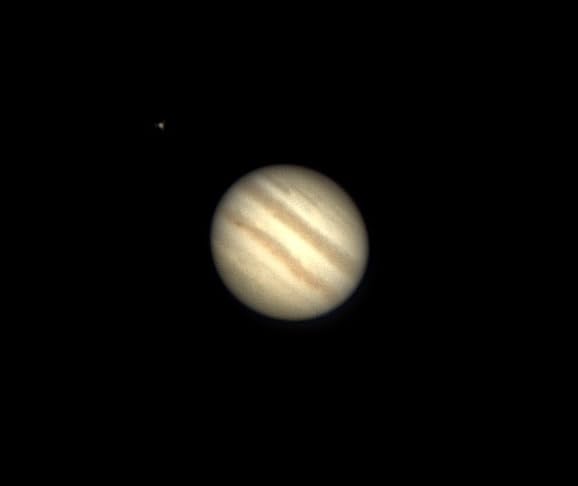
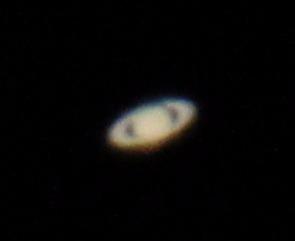
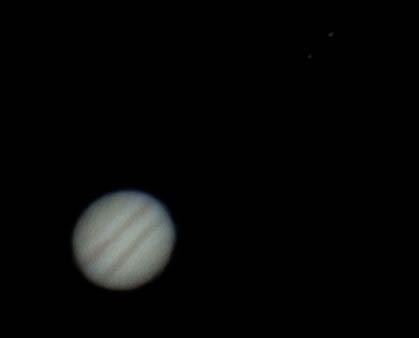
The 8SE is the scope I recommend most often, and owner reports explain why. Jupiter at 200x with a 10mm eyepiece shows the main belt structure and both polar regions under steady air. Saturn at that magnification shows the rings divided, and Titan moves visibly across the disc within a few minutes. The Moon at 100x is where most first-time owners get hooked, because craters along the terminator resolve in a way that a smaller aperture never delivers.
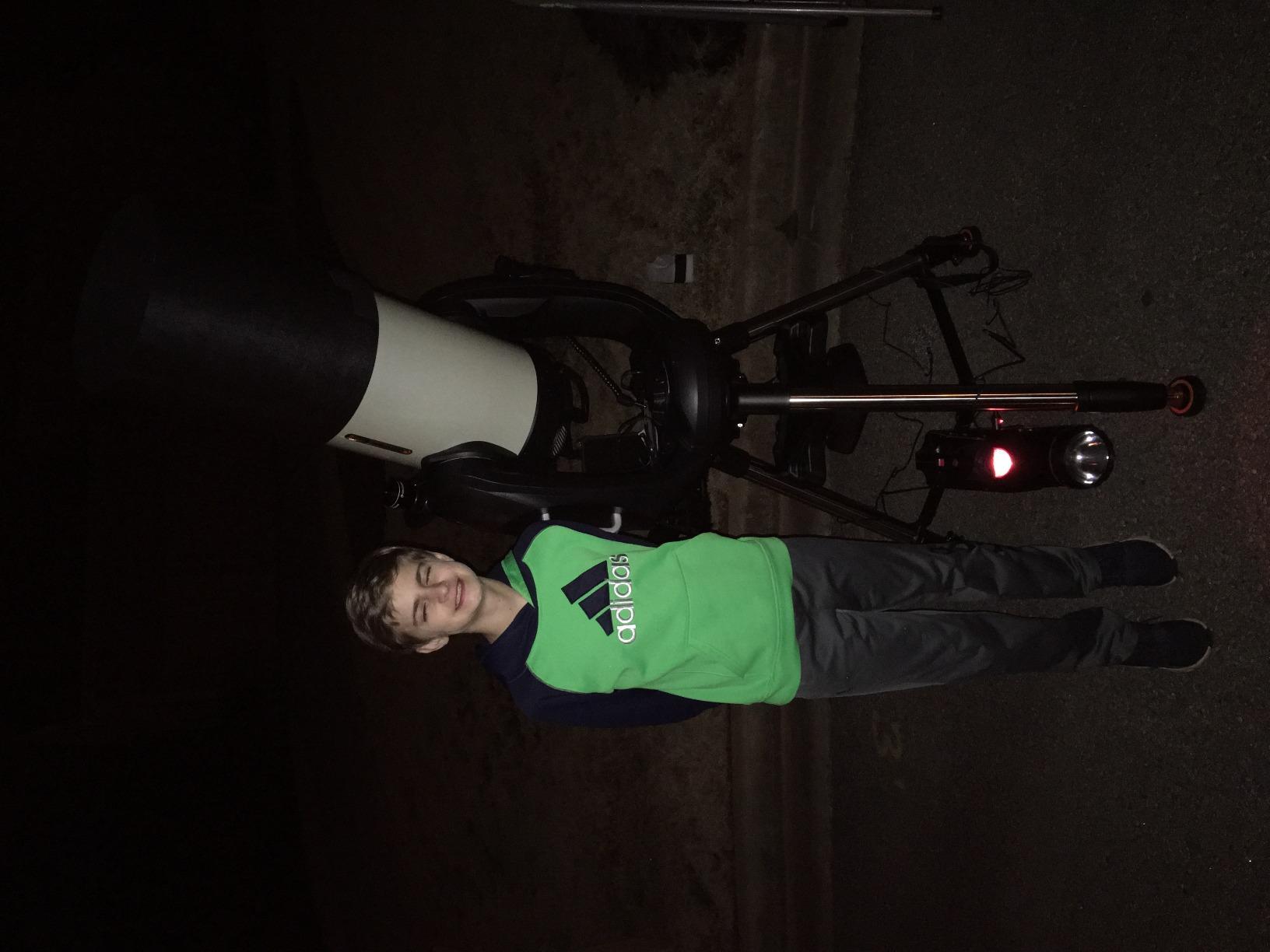
The mount deserves credit for that. The single fork arm is genuinely portable, and the whole package at 10.88 kg is something one person can carry from a car to a lawn without a dolly. Owners consistently point out that the GoTo accuracy is the real time saver. Enter Saturn once and it lands in a 25mm eyepiece’s field nearly every session, which means you spend your night looking rather than hunting.
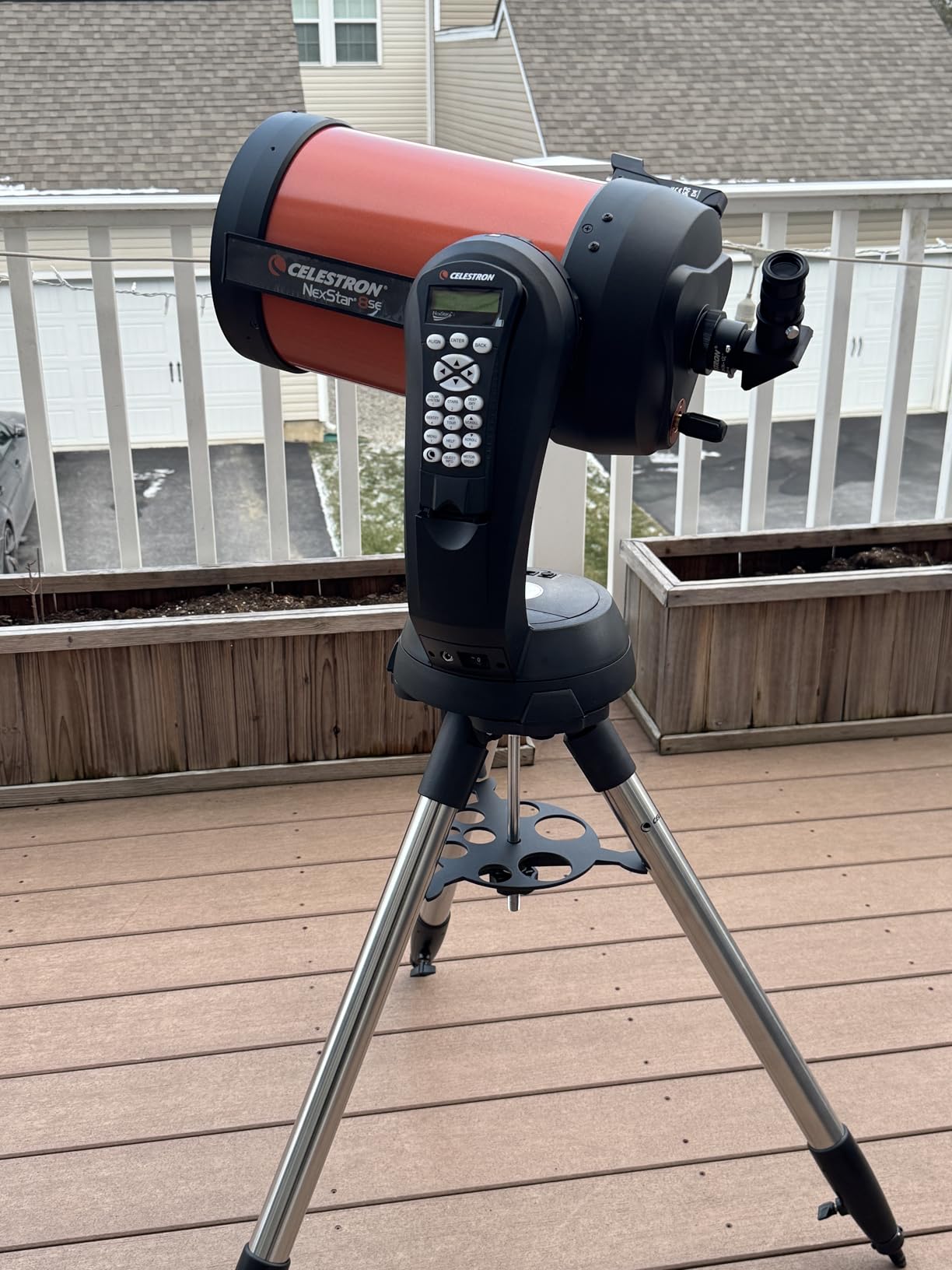
Two practical things catch new owners out. The package does not include batteries or a power adapter, which is a strange omission for a scope this capable. Plan for eight AA batteries or a separate power tank before your first night, and note that with a 2032mm focal length the supplied 25mm eyepiece gives you about 81x. To reach the 200x range where Jupiter rewards you, you need a 10mm eyepiece or a Barlow.
That focal length in a tube only 43.2 cm long is the point of the design. You get high magnification and a tight, well-corrected field in an instrument one person can lift, and you never need a fast converter for planetary work.
Is the 8SE steady enough for high magnification?
Mostly yes, and it is worth being honest about the conditions. On the steel tripod supplied, the fork settles within a minute or two of a slew, and it holds a planet steadily at 150x to 250x. Past about 300x, you will start to see vibration from the tripod and from any wind on the fork arms, and this is the single most common complaint in owner discussions about this mount. Observers in breezy locations report the same issue on other lightweight forks too, so it is a class characteristic rather than a defect in this one.
If you observe from exposed sites, the practical fix is damping rather than upgrading. Hang a small weight from the centre of the tripod spreader, walk the legs carefully before you start, and avoid touching the tube for a minute after any manual nudge. Blowing a gust across the fork arms will shake the image far more than the drive motors ever will.
Who should buy the 8SE and who should not?
Buy it if you want one telescope that handles planets, the Moon, bright globulars like M13 and M27, and double stars without a steep learning curve. It also suits anyone who wants a grab-and-go instrument for family or club nights, since one person can set it up on a folding table.
Pass on it if you plan to grow into long-exposure deep-sky imaging and want to avoid buying a wedge later, or if you live somewhere the mount’s payload headroom would be a permanent limitation for larger accessories. In those cases the Advanced VX 8 gives you the same tube on a far steadier platform.
2. Celestron NexStar Evolution 8 – Best SCT for Wireless Control
Celestron NexStar Evolution 8″ WiFi Telescope for Deep-Sky Views
8 inch (203mm) aperture
2032mm focal length
Built-in 10-hour battery
WiFi via SkyPortal app
Pros
- Built-in 10-hour lithium iron phosphate battery
- WiFi app control removes manual alignment
- Brass worm gears give smooth tracking
- Carry handles built into the fork
Cons
- Supplied 13mm eyepiece is widely criticised
- App pairing can be finicky
- Occasional quality control defects reported
The Evolution 8 solves the two things that frustrate people most about entry-level GoTo scopes. There is no hand controller to lose, and there is no battery pack to manage. You attach the tube, level the tripod, switch it on, and the built-in GPS plus WiFi link to the SkyPortal app on your phone. Owners put setup at roughly eight to ten minutes from unpacking to a planet in the field.
For planetary work the brass worm gear drives matter more than the marketing suggests. Smoother gearing means less periodic error during tracking, and tracking accuracy is what keeps Jupiter centred while you change eyepieces. The 74 reviews carry a 4.4 average with about three quarters at five stars, and planetary users specifically report clear banded views of Jupiter and well-defined Saturn.
One eyepiece complaint comes up repeatedly, so consider it part of the package rather than a surprise. The bundled 13mm is widely considered the weakest part of an otherwise well-engineered package, and several owners prefer the 40mm for finder work. Budget for one quality high-power eyepiece early. At 2032mm focal length, a 10mm gives you about 203x and a 7mm pushes toward 290x.
How much does WiFi control actually improve a night of planet viewing?
More than the feature list suggests, in one specific way. With a hand controller, changing eyepieces and re-centring takes 20 to 30 seconds each time. With the app you tap a button and the mount slews for you. Over an evening of stepping through magnifications that difference adds up to real observing time rather than setup time.
The honest caveat is connectivity. Multiple owners report that pairing the app across several devices, or reconnecting after the phone sleeps, takes persistence. Our advice is to pair once with the phone you will actually use in the field, disable auto-switching between paired devices if the app allows it, and carry a charged power bank. The internal battery runs around ten hours, which comfortably covers a normal session.
Is the Evolution 8 right for you if you care about imaging?
It works for planetary video capture, because short high-frame-rate recordings from a phone or a planetary camera tolerate alt-az field drift better than long deep-sky exposures do. For anything beyond that, this is the wrong platform. There is no polar alignment procedure and no wedge provision in the standard setup, so stars smear into trails in longer exposures.
Judged purely as a visual planetary instrument, the answer is yes. Judged as an all-round imaging scope, the Advanced VX 8 in position three is a better buy for a similar tier of spending. Our guide to telescopes for viewing galaxies covers the imaging trade-offs in more detail if that is your priority.
3. Celestron Advanced VX 8-inch – Best Equatorial Platform for Planets
Celestron Advanced VX 8″ Schmidt-Cassegrain Computerized EQ Telescope
8 inch (203mm) aperture
2032mm focal length at f/10
80.4 pounds complete
30 lb payload capacity
Pros
- German equatorial mount tracks accurately
- Solid stainless steel tripod damps vibration
- Same optical tube as the 8SE at f/10
- Ready for long-exposure imaging later
Cons
- Heaviest in the 8 inch class at 80.4 pounds
- Polar alignment adds setup steps
- Only one eyepiece supplied
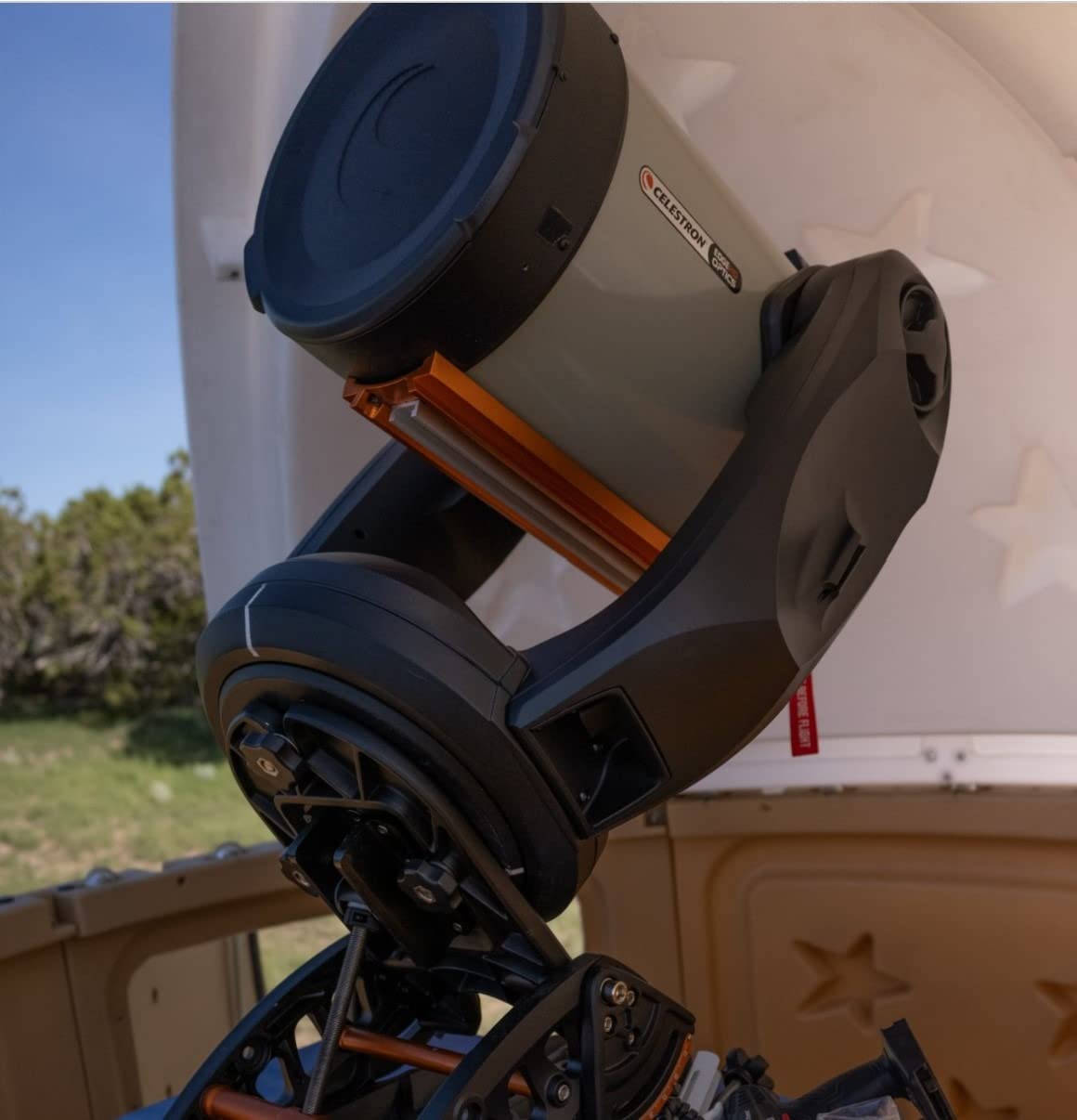
Same glass as the 8SE, very different experience. The Advanced VX German equatorial mount tracks with far less periodic error than a single fork, and the 2-inch stainless steel tripod legs damp vibration in a way the smaller tripod on the 8SE does not. Owners who moved from an entry-level fork to this mount describe the difference in image steadiness as immediate, especially above 250x.
The Advanced VX pairs the same 8-inch aperture at 2032mm focal length, so the two tubes deliver identical planetary magnification. The difference between them is entirely in the mount beneath, and for many observers that is the whole decision.
Magnification math works the same way. The supplied 25mm eyepiece gives you roughly 102x, which is already enough to see Jupiter’s four Galilean moons moving. A 10mm eyepiece takes you to about 200x and a 7mm to around 290x. The listed maximum of 480x with accessories is a theoretical ceiling you should not chase, because atmospheric seeing will fall apart long before you get there.
The reason to buy this over the Evolution 8 is the mount, not the optics. Both use the same 8-inch Schmidt-Cassegrain tube. The AVX gives you polar alignment, periodic error correction and a 30 lb payload capacity, which is the difference between a visual scope and a system you can put a camera on for a few minutes of planetary video or a long deep-sky exposure on a good night.
Is an equatorial mount actually better for planets?
For visual observing, marginally. Tracking in declination on an equatorial mount means the motor pushes against gravity in the smoothest part of its travel, so images hold steadier and the periodic error is smaller. For a beginner the difference may be hard to see at 150x. For anyone pushing past 300x on a steady night, it is noticeable.
The bigger argument for equatorial is optionality. Once you polar align and add a wedge, the same mount handles deep-sky imaging later. Alt-az forks cannot be converted in any practical sense. If you already know you will grow into astrophotography, paying for equatorial now saves a second purchase.
What does 80 pounds mean for real life?
It means two people should carry it, and that the tripod is the part you set up first. That is the honest trade-off. Owners break the instrument into the optical tube, the counterweight shaft assembly and the tripod, and carry the pieces to a dark site, but the total mass is what makes this a backyard-first instrument rather than a spontaneous one.
Against that, the stainless steel tripod and the equatorial head hold a pointing accuracy that survives temperature changes and long sessions better than the lighter fork alternatives. If your observing site is a driveway or a back garden, the mass buys you something real: it does not move when you walk past it.
4. Celestron CPC Deluxe HD 11-inch – Premium Pick for Large-Aperture Detail
Celestron CPC Deluxe HD 11″ GoTo Telescope for Maximum Light Gathering
11 inch (279mm) EdgeHD aperture
2800mm focal length
125.6 pounds complete
Fastar compatible
Pros
- EdgeHD optics give sharp fields edge to edge
- Dual fork arm mount is very steady
- GPS and SkyAlign speed up pointing
- 23mm Luminos eyepiece is a good start
Cons
- Extremely heavy at 125.6 pounds
- No carrying case supplied
- Collimation manual reportedly out of date
This is the telescope to buy if your observing site is a fixed spot and you want the most planetary resolution you can carry. Eleven inches of aperture at 2800mm focal length is a serious instrument. The EdgeHD optical design corrects the off-axis coma that limits ordinary Schmidt-Cassegrains, which matters when you push a planet to the edge of a wide eyepiece field.
Owners with long tenures describe it as the best combination of aperture and alt-az convenience they have owned. The dual fork arms hold the heavy tube without the sag you would expect, GoTo pointing is noticeably more accurate than on single fork designs, and the upgraded gears and motors track quietly enough that you can hear a subtle drive fault if one develops. At 18 reviews and a 4.5 average with 81 percent at five stars, the sentiment is consistent.
The included 23mm Luminos eyepiece is a genuine gift rather than filler. At 2800mm focal length it delivers roughly 122x, which sits in the sweet spot for first views of Saturn and Jupiter. Progress to a 13mm for around 215x once you want belt structure, and to a 9mm for 311x when conditions are steady.
Now the part nobody enjoys: it weighs 125.6 pounds, and every reviewer flags it. This is a semi-permanent setup that needs help to move and a solid surface underneath. No carrying case is supplied, and the manual’s collimation section is reportedly out of date, which matters if you intend to tune the optics for high-power planetary use.
Budget for the accessories that make it usable. A dew shield matters more on an 11-inch than on a 6-inch because the front glass has far more surface area to fog. A power tank or portable supply replaces the mains dependency. And if your site is not permanent, honestly reconsider whether a lighter 8-inch serves you better.
How much detail does 11 inches actually add over 8 inches?
An 11-inch gathers about 1.9 times the light of an 8-inch and resolves roughly 37 percent finer detail in theory. In practice you see it as cleaner edges on Jupiter’s limbs, better separation of double stars inside a planet’s disc, and finer ring structure on Saturn. On nights of mediocre seeing, the difference shrinks noticeably.
The stronger case for 11 inches is brightness at lower magnification. At 122x with the included eyepiece, an 11-inch shows Jupiter and Saturn with a brightness and colour saturation that an 8-inch cannot match at the same magnification. Many observers find that seeing Saturn well at moderate power is more rewarding than fighting for detail at maximum.
Is the CPC Deluxe HD worth it for a beginner?
Usually not. The weight, the dew surface and the accessory list create real friction for someone who has never aligned a GoTo mount. If you are new to observing, an 8-inch fork or a 6-inch with a bundled kit will teach you the sky faster and cost less of your attention.
If you already know that planets are your long-term interest and you have a permanent observing spot, the calculus changes completely. This is one of the few telescopes here that will still deliver meaningful upgrades in a decade. If you want the range in one instrument, our full Schmidt-Cassegrain roundup covers the entry tiers.
5. Celestron CPC 9.25-inch – Best for Rock-Steady Alt-Az Tracking
Celestron CPC 9.25″ Schmidt Dual Fork Arm GoTo Telescope
9.25 inch (235mm) aperture
Computerized dual fork alt-az
Built-in GPS and SkyAlign
79 pounds complete
Pros
- Dual fork mount damps vibration within seconds
- GoTo and tracking beat lighter forks
- Resolves Uranus as a disc and near doubles
- Built-in GPS and spirit level
- Good focus across the field
Cons
- Very heavy at 79 pounds
- Base pin hard to engage alone
- SkyAlign fails if stars are not centred
- Only a 40mm eyepiece supplied
The 9.25-inch CPC sits in a useful gap. It gives you noticeably more than 8 inches of resolution while keeping the alt-az convenience that people who image deep sky with SCTs often prefer to give up. The dual fork arm mount is the reason, and owner reports describe it damping out vibration within seconds of a slew, which is exactly the behaviour you want at 250x on the Moon.
Experienced observers who upgraded from an 8SE consistently call this a large step up in mount steadiness, GoTo accuracy and image definition. Several report resolving Uranus as a small disc, picking out Neptune with averted vision, and splitting double stars near one arcsecond apart. At a 92.52 inch focal length, that is a meaningful capability rather than a spec-sheet claim.
The built-in GPS and spirit level cut setup time, and the 9×50 finderscope is a real finder rather than the tiny reflex units found on some entry-level packages. The included 40mm eyepiece gives you a comfortable low-power view of the lunar surface, though it is a finder-level tool rather than a planetary one.
Does SkyAlign fail often in practice?
It fails for one predictable reason, which owners mention consistently. If the alignment stars are not centred precisely in the finder or eyepiece when you confirm each one, the computed pointing model is off and GoTo accuracy suffers at the target. The fix is unglamorous: centre carefully, confirm, and repeat any star the controller flags as poor.
Beyond that, SkyAlign on this mount is reliable. It works from any two or three reasonably bright stars, so you are not forced into a particular alignment star. If you observe in a light-polluted garden, picking alignment stars away from the sky glow near the horizon makes a measurable difference.
What is the 9.25-inch sweet spot for magnification?
Use 50x per inch of aperture as your ceiling guide, which puts the top of the useful range around 460x, but treat that as a theoretical number rather than a target. In practice, the 9.25-inch gives clean, usable views from about 90x to roughly 300x on a steady night.
Worked out from the 2350mm-class focal length of this tube, a 25mm eyepiece gives roughly 94x and a 10mm gives about 235x. That 235x is where the extra aperture over an 8-inch starts to pay in visible belt structure and ring detail. Beyond 300x, focus drift and image shake become the limiting factors rather than resolution.
6. Celestron NexStar Evolution 6 – Best Bundled Eyepiece and Barlow Kit
Celestron NexStar Evolution 6 150mm f/10 Telescope with Accessories Kit
6 inch aperture
1500mm focal length
5 Plossl eyepieces
Barlow and filters included
Pros
- Genuine accessory kit with Barlow and 5 eyepieces
- WiFi control over 120000 plus objects
- Internal battery for field sessions
- Stainless steel tripod reduces vibration
Cons
- WiFi connection problems reported repeatedly
- Customer support responses lacking
- 6 inch aperture limits faint planetary detail
This package solves a problem most buyers do not realise they have. Almost nobody starts out with enough eyepieces, and the gap between the included Plossl and a genuinely good planetary eyepiece is where first-time observers get stuck. Here the bundle includes 40mm and 13mm Plossl eyepieces, a deluxe kit with five more Plossls, a Barlow lens, filters and a carry case. You can reach high magnification on night one without a second order.
The optics are a 6-inch Schmidt-Cassegrain at 1500mm focal length, so the same f/10 ratio as the larger tubes. With the 13mm eyepiece you get roughly 115x, which is enough for the Cassini Division to peek through on a good night and for Jupiter’s moons to shift visibly. Add the 2x Barlow with a 13mm and you reach about 230x.
WiFi control runs through the Celestron app with an object database listed at over 120,000 entries. Going to a planet takes one tap, which is a large usability gain over setting circles. Listed magnification ceiling is 354x, and total kit weight is 35.4 pounds, which is light enough to carry comfortably to a dark site.
Can a 6-inch SCT really show Saturn’s rings?
Yes, clearly. The rings are among the largest and brightest structures in the solar system, and a 6-inch at 100x to 150x shows the ring system, the shadow of the planet on the rings at certain angles, and Titan as a bright point. The Cassini Division, the dark gap inside the rings, is where aperture becomes the limiting factor. It appears as a faint unevenness in a good 6-inch under steady seeing and becomes an obvious dark line in an 8-inch.
The general rule from owner experience is that a clear Cassini Division on a 6-inch is not an every-night promise. That is normal and expected, not a fault in the telescope. If Saturn’s rings are your primary target, size matters more here than for the Moon.
What is wrong with this package besides the WiFi?
Connectivity is the recurring complaint. Owners report WiFi connection problems with tablets and computers repeatedly, which is frustrating when the whole selling point is app control. Pair once with a single device before you travel and confirm it reconnects after the screen sleeps.
The second issue is support. Several owners report little or no response from the manufacturer’s customer service. That does not affect the hardware, but it does affect peace of mind if something arrives damaged. With only five reviews recorded, this package also has a thin owner base, so treat the 4.6 average as encouraging rather than conclusive.
7. Celestron Advanced VX 6-inch – Compact Equatorial Step Up
Celestron Advanced VX 6″ Schmidt Computerized EQ Telescope
6 inch (152mm) aperture
1500mm focal length at f/10
Advanced VX equatorial mount
75.4 pounds complete
Pros
- Brighter and sharper than a 90mm Maksutov
- Mount damps vibration and slews quickly
- GoTo accuracy steps up from entry forks
- Breaks down for one-person transport
Cons
- No power supply beyond a 12V car adapter
- Balance gears feel stiff when balancing
- Dovetail clamp can mark the dovetail bar
The Advanced VX 6 is the interesting middle option in this roundup. Its 6-inch Schmidt-Cassegrain at 1500mm focal length is optically a different class from a 90mm Maksutov-Cassegrain, and reviewers with experience of both say the difference is obvious on the planets. Secondary obstruction on an SCT is smaller relative to aperture than a Maksutov’s full corrector mirror, so contrast holds up better.
What you gain over the 6-inch fork packages is the mount. The Advanced VX has All-Star Polar Alignment and programmable error correction, and it tracks with much less error than a fork. Owners report consistent one-minute exposures with autoguiding once it is set up, which puts it on the shortlist if you want to blend planetary video with some imaging.
The included 20mm eyepiece gives you 75x, which frames the Moon and Jupiter well. For planetary detail, a 10mm takes you to 150x and a 7mm to about 214x. That 150x is the number that matters here. At 6 inches, 150x on Jupiter in steady air is a genuinely good view, and pushing beyond 200x usually costs more in image shake and seeing than it returns in detail.
Two practical notes on this one. The power supply is a 12V cigarette lighter adapter only, so for backyard or field use you will want an AC supply or a power tank. The balance gears are also reported as feeling stiff, which makes the initial RA and declination balancing a two-person job the first time.
Is a 6-inch SCT better than a 6-inch Maksutov-Cassegrain for planets?
For most observers, yes. Forum consensus across observing communities is that Sky-Watcher Maksutovs such as the Skymax 180 and 127 are excellent planetary instruments with sharp, high-contrast, low-maintenance views, and they are often recommended as an alternative to an 8-inch SCT. If you own one, you already know the Maksutov’s strengths.
The SCT wins on light throughput and on unobstructed contrast at higher power, because a Maksutov’s fully silvered meniscus reflects several percent of incoming light before the primary. It also wins on native focal length flexibility and on aperture per dollar. The Maksutov wins on compactness, on needing no collimation in the field, and on producing a pleasing, high-contrast image at lower magnification.
Is a 75-pound equatorial scope worth it over a lighter fork?
Only if you will use the equatorial advantages. If your plan is purely visual planetary observing from a garden, a single fork arm is quieter to set up, lighter to move, and costs less. If there is a chance of imaging or of tracking a planet for an extended video sequence, the AVX 6 is the better instrument and the extra mass is justified.
Reviewers describe this scope as a clean upgrade from an entry-level NexStar, with only four reviews recorded and a 4.4 average. Quality control gripes appear in that small sample, including a loose tripod leg spike, so inspect the package carefully on arrival.
8. Celestron 11-inch Optical Tube Assembly – Best Build-Your-Own Option
Celestron 11″ Schmidt-Cassegrain Optical Tube Assembly
11 inch (279mm) aperture
2800mm focal length
Tube only at 39.7 pounds
Fastar compatible
Pros
- Highest rated optical tube here at 4.8 stars
- Reports of Mars polar cap and surface features
- Optics arrive well collimated and packaged
- Fastar compatible for wider fields
Cons
- No mount supplied
- A heavy-duty mount must be bought separately
- Focus knob adjuster described as finicky
- Bulky for a grab-and-go instrument
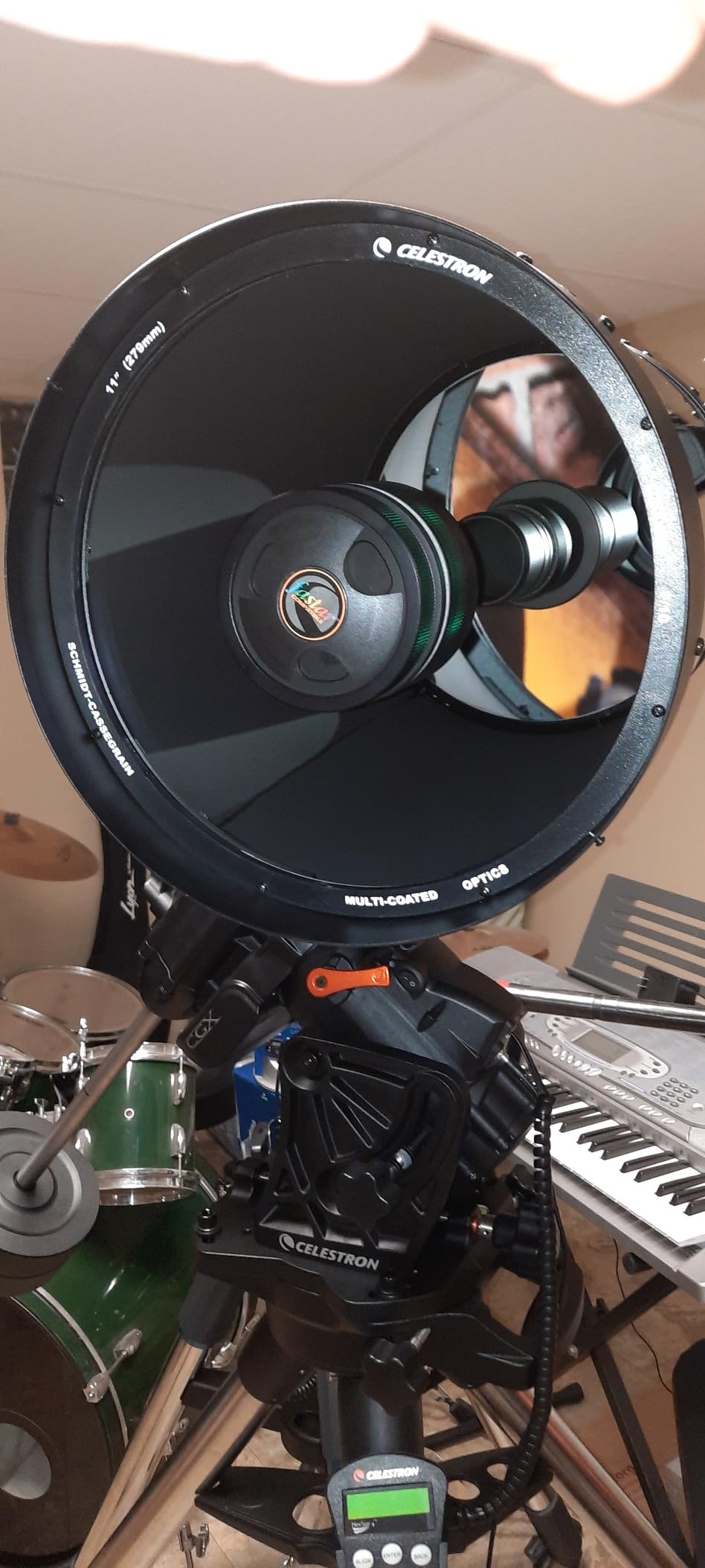
This is the only pure optical tube assembly in the roundup, and that changes the decision entirely. You are buying 11 inches of aperture and nothing else. In exchange you choose the mount, which means you can put observatory-grade optics on a mount that suits your site, your weight budget and your observing style.
On performance, the reports are the strongest in this roundup. With a 4.8 average across four reviews and all four at four stars or better, owners describe Mars surface features and a visible polar ice cap, and Jupiter appearing huge with extensive detail. The optics arrive well collimated and well packaged, which removes a common source of early frustration. At 2800mm focal length the tube supports around 700x theoretically and roughly 400x in usable conditions.
The Fastar compatibility is worth noting for the future. It means the tube can later be converted to a fast focal ratio for wide-field imaging work without replacing the optics.
What you give up is convenience. There is no mount, no tripod and no finder in the box. Reviewers are uniform on this point. You need an equatorial mount or a genuinely heavy-duty alt-azimuth mount, and that mount becomes the most expensive part of the system once you add a wedge, a power supply and quality eyepieces.
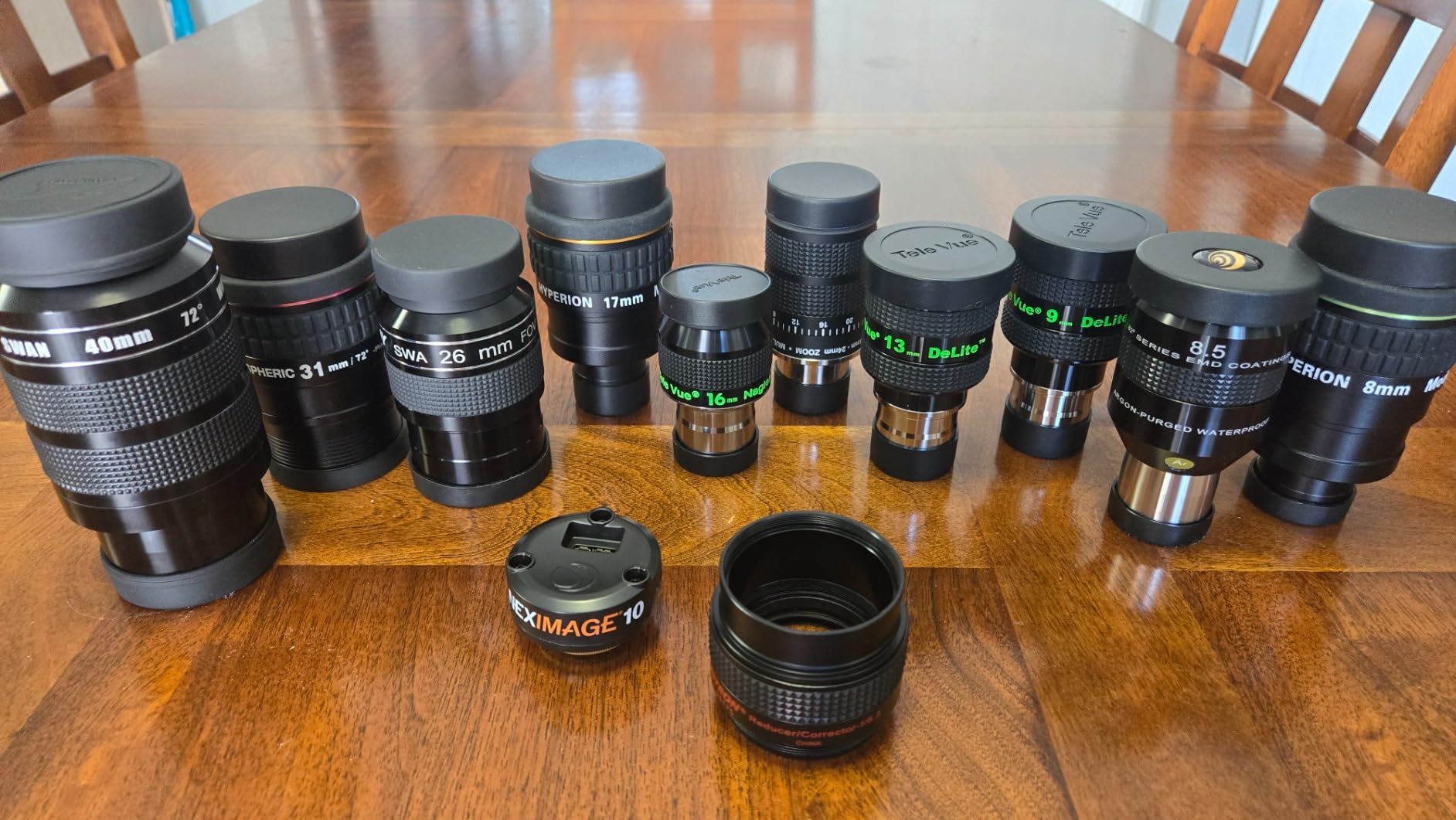
The included 25mm eyepiece gives about 112x, a good starting point on the Moon and Jupiter. Plan on 2-inch diagonals and eyepieces for serious planetary work at high power, plus a dew shield, since the 11-inch corrector has a large surface to fog. Owners also report that the stock focus knob adjuster is awkward, with a FeatherTouch-style upgrade a common recommendation.
Should a beginner buy an optical tube assembly?
No, and this is the clearest beginner-unfriendly product in the roundup. The reason optical tubes attract beginners is that the price looks lower than a complete package, but it is not a cheaper telescope. It is the same telescope with the mount decision pushed onto you, and mount choice is where most of the money and most of the mistakes go.
Buy it instead if you already own a capable equatorial mount that can handle roughly 40 pounds, or if you are building a permanent observatory setup and want the aperture without a fork arm in the way. If you are starting from nothing, take the same optical performance in a complete package.
Do I need to collimate an 11-inch tube before using it?
For visual planetary work, often not on day one. The unit arrives well collimated according to owners, and collimation matters most at high magnification and with fast wide-field setups. A simple star test at the eyepiece tells you whether it is close enough: if a focused star looks like a tight concentric ring rather than a soft donut, you are fine for planetary observing.
Recheck after transport, after large temperature swings, or any time the tube is bumped. Owners of large SCTs generally collimate seasonally rather than monthly. The bigger practical risk at this aperture is dew, not collimation drift.
9. Celestron CGEM II 11-inch – Best for Imaging and Long Tracking Sessions
Celestron CGEM II 11″ Schmidt-Cassegrain Telescope with GoTo EQ Mount
11 inch (279mm) aperture
2800mm focal length
CGEM II equatorial GoTo mount
2 inch steel tripod
Pros
- 11 inch aperture sharpens planetary views sharply
- Breaks down into sections one person can carry
- Locates thousands of objects reliably once aligned
- Sturdy 2 inch steel tripod
Cons
- Steep setup and polar alignment learning curve
- Soft metal azimuth knobs can strip
- Mount screws need periodic checking
- 148.5 pounds total assembled
The CGEM II 11 pairs the same 11-inch aperture as the CPC Deluxe HD with a German equatorial mount, and that makes it the right pick if your priority is tracking accuracy and imaging rather than alt-az simplicity. Long-term owners describe an outstanding instrument that sharpens planetary views and reveals Messier and Herschel objects with minimal averted vision.
The mount is the reason. Once polar aligned, it locates thousands of objects reliably, including by celestial coordinates, and tracks with the consistency that long exposures demand. Listed magnification ceiling with compatible eyepieces is 660x, though usable planetary magnification on an 11-inch tops out far below that in typical seeing.
It also breaks down into sections a single person can carry and set up in a backyard, which owners specifically mention. That is a real advantage over permanently mounted observatory instruments, even though the assembled weight is 148.5 pounds.
How hard is the setup for a first-time owner?
Harder than any fork scope in this roundup. The critical review among the six recorded is from a beginner who found alignment and GoTo setup frustrating, and that is the honest characterisation. Equatorial setup means levelling, rough polar alignment, then a finer alignment procedure before GoTo will point accurately.
Mitigations exist. All-Star Polar Alignment procedures work with any bright stars rather than a specific pole star. A polar scope or an accurate digital setting helps a lot. And the payoff is a mount that keeps a target centred for the length of an imaging session instead of drifting in circles, which matters far more once you are past the visual stage.
Are there hardware details worth checking on arrival?
Yes, three. The azimuth adjustment knobs use soft metal threads that can strip if overtightened, so snug them gently rather than applying your full strength. Mount screws can work loose over time and need periodic checking, which is ordinary maintenance rather than a defect. And at 148.5 pounds assembled, plan the move with a second person or a proper lifting plan.
If your interest is purely visual planetary observing and you do not want alignment friction, the CPC Deluxe HD 11 gives you the same aperture with far simpler handling. This scope makes more sense when tracking accuracy over time is the priority.
Why Schmidt-Cassegrains Work So Well on Planets
A Schmidt-Cassegrain folds a very long focal length into a very short tube. Light enters through a glass corrector plate, reflects off a concave spherical primary mirror at the back, then bounces off a small convex secondary through a hole in the primary and into the eyepiece. The result is a 2032mm focal length in a tube roughly 43cm long on the 8-inch models. That combination is unusually well matched to planetary observing.
Planets are small, bright and high-contrast targets. You are not gathering light, you are resolving fine detail. What matters is how much magnification the optical design can deliver before aberrations and atmospheric turbulence take over, and how cleanly the tube rejects stray light. A long focal length gets you magnification in a manageable instrument, and a baffled closed tube keeps the contrast that makes cloud belts and ring divisions visible.
The focal ratio deserves a note because it confuses newcomers. The scopes here run at f/10 native focal length, with the 11-inch tubes at 2800mm and the 8-inch tubes at 2032mm. Slower focal ratios are the friendliest for planetary work because they produce a flatter field and less off-axis aberration at the eyepiece.
What aperture realistically buys you, and what it does not
Resolution scales with aperture, so more aperture always resolves finer detail in theory. The limiting factor is seeing, the steadiness of the atmosphere above you, and on most nights that is the wall you hit. Forum observers make this point repeatedly: many nights the aperture difference between a 6-inch and an 8-inch is simply not visible.
Set expectations by tier. A 6-inch reliably shows the Moon’s craters along the terminator, Jupiter’s four Galilean moons as points, Saturn’s ring system and Titan, and Mars as a small orange disc. An 8-inch adds Jupiter’s cloud bands and the Cassini Division in Saturn’s rings on good nights. A 9.25-inch splits close double stars and resolves Uranus as a disc. An 11-inch brings out Mars polar caps and finer ring structure, as owner reports on these scopes describe.
SCT versus Maksutov-Cassegrain for planetary viewing
Both designs are compact and both are praised by forum observers. Sky-Watcher Maksutovs such as the Skymax 180 and 127 are frequently recommended as an alternative to an 8-inch SCT, and if you want the sharpest high-contrast views in a grab-and-go package with no field decentering and no collimation, a Maksutov is a strong choice.
The SCT wins on light throughput, since a Maksutov’s fully silvered meniscus costs several percent of incoming light before the primary, and on aperture available per unit of money. It also wins if you later want imaging upgrades. The Maksutov wins on compactness, on maintenance, and on the fact that it never needs collimation in the field. Our Maksutov-Cassegrain roundup goes into that design in detail.
How to Choose a Schmidt-Cassegrain Telescope for Planetary Viewing
Aperture is the first decision and it is the one people get wrong by over-weighting. Step back from the price ladder and ask what you will actually look at. If Saturn’s rings and Jupiter’s moons are the goal, a 6-inch delivers them. If Jupiter’s cloud structure and the Cassini Division matter to you, 8 inches is the practical floor. Above 8 inches you are buying capability for Mars and double stars rather than for the outer planets.
Work out your magnification range from the published focal length
Magnification equals the telescope’s focal length divided by the eyepiece’s focal length. Every scope in this roundup lists its focal length, so you can compute your range before you buy. An 8-inch at 2032mm gives 81x with a 25mm eyepiece, 203x with a 10mm and 290x with a 7mm. The 6-inch at 1500mm gives 115x with a 13mm and 230x with a 13mm plus a 2x Barlow.
As a working rule, useful magnification runs to roughly 50x per inch of aperture on a steady night, and about 2x per millimeter. Beyond that you are magnifying turbulence rather than detail. Forum advice is consistent on this point: more magnification is not automatically more detail, and stepping up past the point where the image starts to boil usually makes it worse rather than better.
Treat mount steadiness as a planetary feature, not an afterthought
At 200x and above, a shaky mount produces a worse view than a smaller, steadier one. This is the most underweighted factor in buying an SCT. Dual fork designs such as the CPC 9.25 and CPC Deluxe HD 11 damp vibration faster than single fork arms. Equatorial mounts such as the Advanced VX line track with less periodic error because the motor pushes against gravity more evenly.
Payload capacity matters for the same reason. When a mount carries a heavy tube plus camera, its remaining stiffness determines whether the image holds together at high power. Check the stated instrument weight capacity and leave headroom rather than running at the limit.
Plan for dew before your first night
Dew on the corrector plate is the most common Schmidt-Cassegrain problem, and owners report it degrading contrast and sharpness badly. It is worst in humid climates, in autumn nights with clear skies, and on larger apertures where the front glass has more area to fog. Our solar viewing guide covers safe daytime observing, which shares the same optics.
Work through a staged response. First, fit a dew shield and accept that the widest usable field narrows slightly as a result. Second, a resistively heated dew band around the front of the tube keeps the corrector just above the dew point and is the proper fix for regular observers. Third, a hair dryer on low and cool, held at a distance, clears an already-fogged corrector in a couple of minutes between targets. Never use heat above cool, because thermal gradients across the corrector will wreck collimation and image quality.
Decide between an optical tube and a complete package
Optical tube assemblies look cheaper on paper because the mount is missing, not because it is free. Budget for a capable equatorial or heavy-duty alt-azimuth mount, a wedge if you will image, a power supply, diagonals, eyepieces and a dew shield. Once those are counted, the apparent saving often disappears.
A complete package still makes sense when you want a working system with minimal decisions. The fork-mounted scopes assemble and align in minutes with no polar alignment, and the equatorial packages come with a mount sized to the tube. Buy the optical tube only when you already own a suitable mount or are building a permanent setup.
Do not skip thermal settling time
A telescope brought from a warm house into a cold night needs time to reach ambient temperature before the image is truly sharp. Give a large tube at least 30 to 45 minutes, and an 8-inch fork around 20 to 30 minutes. Observers report that a stable, thermally settled scope delivers noticeably sharper planetary images than one that is still adjusting, and dew control helps here too since a warm tube fogs faster.
Power is worth planning as well. Some fork mounts run on eight AA batteries, which drain during long sessions. Models with built-in lithium iron phosphate batteries remove that problem entirely, and external power packs are the standard solution for equatorial mounts that ship with only a car adapter.
Frequently Asked Questions
What are Schmidt-Cassegrain telescopes good for?
Schmidt-Cassegrain telescopes are good at planetary viewing, lunar observing, double stars and bright deep-sky objects. The long focal length packed into a short tube gives high magnification in a portable package, and the baffled closed tube holds contrast on targets like Jupiter and Saturn. Many owners also use them for planetary video capture and, with an equatorial mount and wedge, longer-exposure imaging.
What is the best telescope for seeing planetary detail?
Among Schmidt-Cassegrain telescopes, an 8-inch model is the practical sweet spot for planetary detail. The Celestron NexStar 8SE pairs 203mm of aperture at 2032mm focal length with a GoTo mount that points reliably, and its owner base of 1579 reviews at a 4.3 average is the largest in this roundup. Budget for a 10mm eyepiece so you can reach about 200x, where Jupiter’s cloud bands resolve.
What aperture do I need to see Jupiter’s Great Red Spot?
A 6-inch aperture can show the Great Red Spot as a distinct darker oval on Jupiter’s disc. An 8-inch reveals surrounding belt structure and the spot’s internal shape with more clarity, and an 11-inch resolves fine detail around it. Remember that atmospheric seeing often limits what you can actually see more than aperture does, so the difference between sizes is clearest on steady nights.
Can I see the Cassini Division in a 6-inch telescope?
Sometimes. In a 6-inch Schmidt-Cassegrain at 100x to 150x with steady seeing, the Cassini Division appears as a faint unevenness in Saturn’s rings. In an 8-inch it becomes an obvious dark gap on most reasonable nights. Forum observers are candid that a clearly divided ring system in a 6-inch is not an every-night promise, so treat it as a bonus rather than a guarantee.
Are Meade telescopes better than Celestron for planets?
Observing community consensus is that Celestron and Meade optical tubes are both capable, and that the mount is the real differentiator rather than the glass. Because Meade exited the consumer telescope business, new Celestron models also come with the full support, accessories and firmware ecosystem that new Meade scopes no longer do. For a first planetary Schmidt-Cassegrain today, Celestron is the more practical choice.
Is Sky-Watcher or Celestron better for planetary viewing?
It depends on which design you mean. Sky-Watcher is best known for Maksutov-Cassegrain telescopes such as the Skymax 180 and 127, which forum observers praise for sharp, high-contrast, low-maintenance planetary views in a compact package. Celestron builds the Schmidt-Cassegrain options covered in this roundup, which win on light throughput, aperture per dollar and upgrade paths. A Maksutov is a strong alternative to an 8-inch SCT rather than a direct substitute.
Are Schmidt-Cassegrain telescopes hard to use for beginners?
Fork-mounted models with WiFi, such as the NexStar Evolution 6 and Evolution 8, are among the easiest telescopes to start with because there is no polar alignment and the app handles target acquisition. Equatorial models such as the Advanced VX line add a polar alignment step that first-time owners often find frustrating, but they allow polar alignment for later imaging. Give any GoTo mount 20 to 30 minutes of thermal settling before judging the image.
Do Schmidt-Cassegrains suffer from dew, and how do I stop it?
Yes, and it is the most common Schmidt-Cassegrain complaint. Dew on the corrector plate flattens contrast and sharpness, especially in humid climates and on larger apertures. Work in stages: fit a dew shield first, then a resistively heated dew band for regular observing, then clear an active fog with a hair dryer on cool held at a distance. Avoid high heat, which creates thermal gradients that spoil collimation.
Conclusion
The best Schmidt-Cassegrain telescopes for planetary viewing come down to three honest answers. For most people, the Celestron NexStar 8SE is the pick: proven optics, reliable GoTo, a portable fork design and the largest owner base in this roundup at 1579 reviews. For anyone who wants to skip the hand controller entirely, the Evolution 8 adds WiFi and a ten-hour internal battery. For observers who will grow into imaging, the Advanced VX 8 puts the same tube on a far steadier equatorial platform.
Go bigger only when your observing site is fixed. The CPC 9.25, CPC Deluxe HD 11 and CGEM II 11 all deliver more planetary resolution, and all three weigh enough that they are semi-permanent instruments. Pair them with a dew shield, a good 10mm or 13mm eyepiece, and a plan for thermal settling, and they will show you Jupiter’s belts, Saturn’s rings and Mars’s polar caps for years.
Whichever you choose, give it twenty minutes outdoors before judging it, keep the corrector dry, and step magnification up gradually rather than jumping to the maximum. That habit alone puts you ahead of most first-time owners, and it is the fastest way to get more from the best Schmidt-Cassegrain telescopes for planetary viewing in 2026.