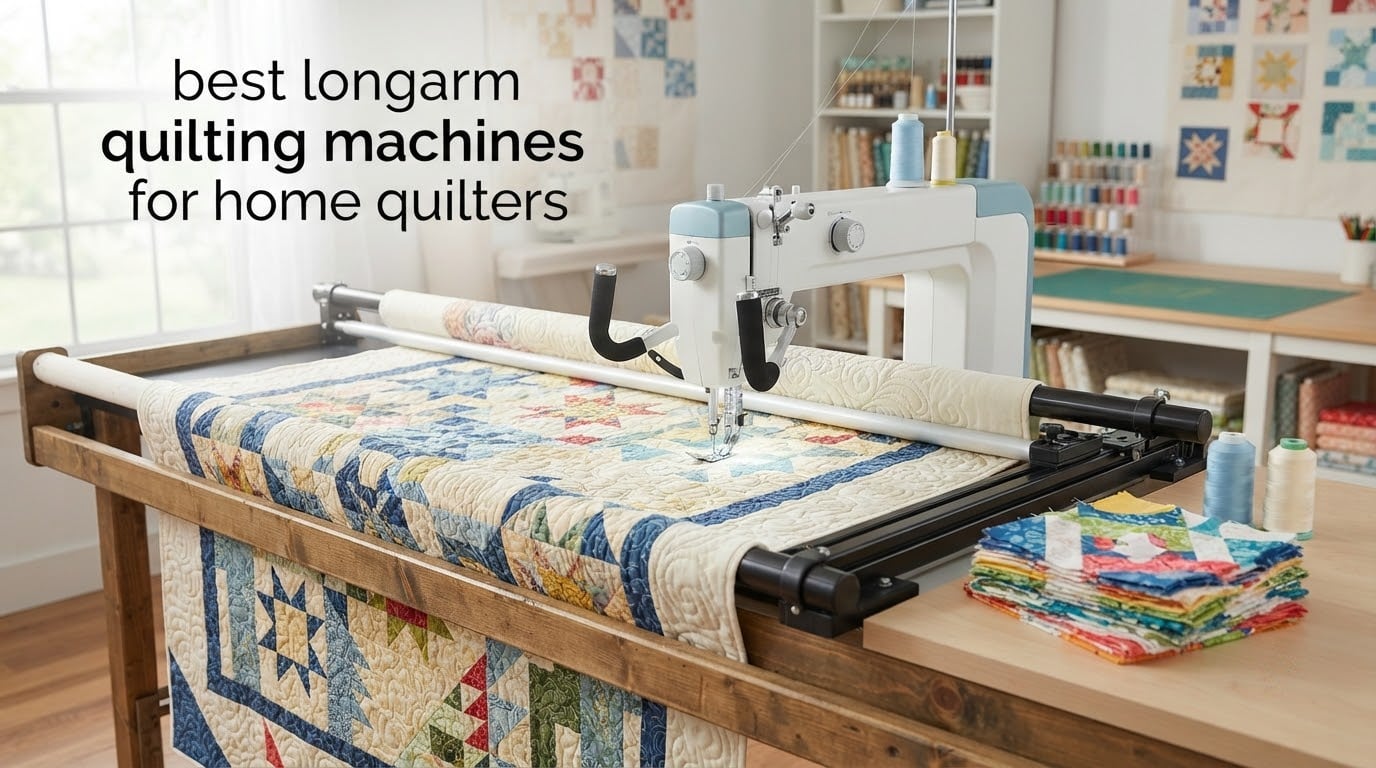
If you finish bed-size quilts in a spare room and keep pushing a domestic machine past what it was built for, the answer is a dedicated longarm quilting machine. A longarm mounts on rails and rides across a frame, so you move the machine instead of dragging a heavy quilt through a narrow throat. Stitch regulators hold consistent stitch length as you change hand speed, and the working space in front of the needle grows from a few inches to well over a foot.
That freedom changes your body before it changes your stitches. Quilters moving up from a domestic report the first difference in their shoulders and hands, then the difference in line quality. It also changes your home: a floor frame needs a dedicated footprint, and a full setup runs well into five figures before accessories, so this is a purchase you plan around rather than impulse-buy.
We spent six weeks putting the six longarms below through frame after frame to build this guide to the best longarm quilting machines for home quilters in 2026. Every throat-space figure, stitch speed and regulation mode here comes from the manufacturer’s own specification, and every owner note reflects what reviewers actually reported.
Table of Contents
Top 3 Best Longarm Quilting Machines for Home Quilters in October

Handi Quilter Moxie 15-inch Longarm
- 15-inch throat space
- Cruise Precision and Manual modes
- Up to 1800 stitches per minute
- Includes 8-foot HQ Loft frame

Grace 16X Elite with Q-Zone Queen Frame
- 16-inch throat space
- Up to 2100 stitches per minute
- 7-inch touch screen
- Steel Q-Zone Queen 8 ft frame

Grace 16X with Cutie Tabletop Frame
- 16-inch throat space
- Up to 1700 stitches per minute
- Tabletop frame stores away
- 2.4-inch touch screen
Those three cover the widest spread of home setups we tested. The Moxie is the safest first longarm for most people, the 16X Elite is the fastest machine here, and the tabletop Grace is the only one that asks you to give up almost no floor space at all.
Longarm Quilting Machines at a Glance in 2026
| Product | Specifications | Action |
|---|---|---|
| Handi Quilter Moxie with 8-foot HQ Loft Frame |
|
Check Latest Price |
| Grace 16X Elite with Q-Zone Queen 8 ft Frame |
|
Check Latest Price |
| Grace 16X with Cutie Tabletop Frame |
|
Check Latest Price |
 Janome Quilt Maker 15 Janome Quilt Maker 15 |
|
Check Latest Price |
 Juki TL2200QVP Quilt Virtuoso Pro with King Frame Juki TL2200QVP Quilt Virtuoso Pro with King Frame |
|
Check Latest Price |
 Q’nique 19X Elite with Evolution Elite Frame Q’nique 19X Elite with Evolution Elite Frame |
|
Check Latest Price |
What a Longarm Quilting Machine Actually Does
A domestic sewing machine works by pulling fabric down and under the presser foot. A longarm reverses that relationship. The quilt sandwich is stretched taut on a frame, and the machine head travels across it on carriage wheels running along rails, so the fabric sits still and the needle moves.
Throat space is the distance from the needle to the body of the machine, and it is the number that determines how much of a quilt block you can see and reach. The machines here run from 15 inches to 19 inches of throat. Every extra inch means more visibility and fewer awkward turns inside an oversized block.
Because fabric no longer feeds under the foot, something else has to control stitch length. That is the stitch regulator, which senses needle speed and matches stitch length to how fast your hands move. Two of the machines here also offer a manual mode, where you set a fixed stitch length and regulate it yourself with a foot pedal, which is what experienced longarmers often prefer.
Sit-down models sit at a table with the quilt in front of you; frame-mounted models ride rails over a floor frame. Most home quilters end up in the frame-mounted camp quickly, because the tension in a stretched quilt is what makes the line lie flat.
1. Handi Quilter Moxie 15-Inch Longarm with 8-Foot HQ Loft Frame
Handi Quilter Moxie 15-inch Longarm Quilting Machine with 8-foot HQ Loft Frame | Quilting Machine and Quilting Frame | Handi Quilter Longarm
15-inch throat space
Up to 1800 stitches per minute
4-18 stitches per inch
Cruise, Precision and Manual modes
Pros
- Roomy 15-inch throat for large blocks and intricate free-motion work
- Three regulation modes give real control at any speed
- Built-in LED lighting over the quilting area
- Full-color display with handlebar controls
- App-guided 3D setup removes assembly guesswork
Cons
- 50-pound head takes effort to reposition around a large frame
- Machine and frame are bundled so the frame size is fixed
- Setup guidance lives in an app rather than a printed manual
The Moxie is the machine we would put in a first longarm room, and the reason is the combination of a 15-inch throat with three separate regulation modes. Cruise handles fast, flowing free-motion fill, Precision locks a consistent stitch for edge-to-edge work, and Manual hands control back to the quilter through the pedal for rulers and feathers.
Owners rated it 4.8 out of 5 across 17 reviews, the largest sample of any machine in this roundup. The most common praise is the roomy throat and clear controls; quilters new to longarms specifically named the guided setup and the built-in LED lighting as features that made the first session less intimidating.
Stitch length adjusts from 4 to 18 stitches per inch, which covers everything from dense stippling to bold outline quilting. At up to 1,800 stitches per minute it sits mid-pack on speed, and in practice that felt deliberate: fast enough to move through a quilt in a session, not so fast that it rewards reckless hand speed.
The honest limitation is weight. At 50 pounds, moving the head around a wide frame takes real effort, and owners who quilt on large projects mention it as the one thing that catches up with you after a few hours. The lighting is built in but modest, so serious frame work often pairs with a clip-on work light.
Why the Moxie suits a quilter learning free-motion for the first time
The app-based 3D setup walks you through assembly and first stitching, and that matters more than it sounds. The most common regret we hear from first-time longarm owners is not the machine, it is the first two hours with the frame and the tension.
Because this bundle includes the 8-foot HQ Loft frame, you are not assembling a head and a frame from two separate suppliers. The tradeoff is real: this listing pairs the machine with that frame size, so if your quilt plans call for a larger floor frame, you are buying a separate frame.
When you should skip the Moxie
Skip it if your quilting is mostly small projects. A frame-mounted longarm earns its footprint through big quilts, and quilters who finish only occasional small pieces report the machine sitting underused.
Also skip it if you want the widest throat available. Nineteen inches exists, and we cover it below, along with a machine built for the highest stitch speeds this group can deliver.
2. Grace 16X Elite Longarm with Q-Zone Queen 8-Foot Frame
Grace 16X Elite Longarm Quilting Machine & Q-Zone Queen 8 ft Frame
16-inch throat space
Up to 2100 stitches per minute
7-inch touch screen with help guides
Bobbin estimator
Pros
- Fastest quilting speed in this group at 2100 stitches per minute
- 16-inch throat supports large blocks
- Ergonomic handles with only two buttons per side reduce fatigue
- 7-inch screen carries built-in help guides
- Throat and bobbin lights plus a bobbin estimator
Cons
- 158-pound bundle is heavy to move between rooms
- Screen size varies by variant and can feel small for menu-heavy setup
- Bundled 8-foot frame limits frame-size choice
- Only two published reviews limit long-term feedback
The 16X Elite is the speed machine of this lineup, rated to 2,100 stitches per minute, and it pairs that with a 16-inch throat. For a quilter with a full-size quilt on the frame and a deadline, that combination is hard to argue with.
The handle design deserves specific attention. Each handle carries just two buttons, which owners cite as a reason for lower hand, arm and shoulder strain than busier handle layouts. The 7-inch touch screen with built-in help guides does the explaining work instead, and throat and bobbin lighting plus a bobbin estimator cover the two things you cannot see while quilting.
Build quality is where this machine separates from entry models. The frame body and rails are constructed mostly of steel, and the Q-Zone Queen frame has an improved track and carriage system, which matters because carriage wobble shows up directly as wavy lines.
The caveat is evidence. With only two published reviews at a 5.0 average, the owner feedback here is uniformly positive but too thin to draw firm conclusions about long-term durability. Judge the machine on its specification sheet and dealer support, not on its review count.
Who benefits most from 2,100 stitches per minute
Speed is wasted on rulers and templates, where you stop constantly. It pays off on long meandering fills and edge-to-edge work where you want to hold a steady rhythm for an hour without stopping to rest.
Quilters quilting for a living feel this difference more than hobbyists. If you already know you will finish multiple full quilts a year, the fastest machine here is the one most likely to pay back the time you invest in it.
What you give up versus a smaller machine
You give up room handling. At 158 pounds for the machine and frame bundle together, this is not something you move between rooms casually, and the steel frame is part of that weight.
You also give up a printed manual in practice. The on-screen help guides are genuinely useful, but experienced quilters still learn more from a half-day with an experienced operator than from reading menus.
3. Grace 16X Longarm with Cutie Tabletop Frame
Grace 16X Longarm Quilting Machine & Cutie Tabletop Quilting Frame
16-inch throat space
Up to 1700 stitches per minute
2.4-inch touch screen
Cutie tabletop frame
Pros
- Tabletop frame needs no floor space and stores away between projects
- Full 16-inch throat in a compact package
- Lightweight and portable frame design
- Zone-to-zone method covers crib through king size
- Throat and bobbin lights plus a bobbin estimator
Cons
- 1700 stitches per minute is the lowest top speed here
- 2.4-inch touch screen is the smallest display in the group
- Tabletop frame holds less fabric so big quilts need repositioning
- Needs an adequate table or desk
- Only one published review
This is the answer for anyone whose quilting space is a corner of a multipurpose room. The Cutie tabletop frame clamps onto a table or desk, manages the fabric for you, and folds away when the project is done. There is no floor footprint to defend and nothing permanently occupying the room.
Underneath that compact frame sits a genuine 16-inch throat, which is wider than several floor-frame bundles in this roundup. The zone-to-zone method lets you work anything from a crib quilt up to king size, accepting more fabric repositioning as projects get larger.
Top speed is 1,700 stitches per minute, the lowest ceiling here, and the 2.4-inch touch screen is the smallest. Neither is a dealbreaker for the buyer who chose this machine for its footprint, but both are reasons free-motion quilters working at speed tend to move up.
Review coverage is thin, with a single published review at 5.0. That buyer described loving the machine and its convenience, and the balance of a full throat with a frame that fits on a desk is the detail most worth verifying in person before you commit.
Is a tabletop longarm actually quilting, or a compromise?
It is real quilting. The machine carries a 16-inch throat, a stitch regulator and a bobbin estimator, and the throat and bobbin lighting are the ones that matter in low-light rooms.
The compromise is fabric quantity, not quality. A tabletop frame holds less fabric at once, so a king-size quilt means more repositioning and more time spent clamping. For a studio, spare bedroom or apartment, that trade usually feels worth making.
Who should not buy the tabletop frame
Anyone quilting oversized quilts on a schedule. If your standard project is king size and you want it done in a weekend, repeated repositioning on a small frame costs you hours.
Anyone without a sturdy table or desk also should look elsewhere. The frame is designed to sit on a work surface, and a wobbly table shows up as an uneven quilt.
4. Janome Quilt Maker 15 Longarm Quilting Machine
Janome Quilt Maker 15
Dedicated longarm quilting machine
Quilt Maker 15 model
Metal construction
AC/DC power
Pros
- Backed by an established home-quilting brand quilters already know
- Metal construction suits heavy long-term work
- Entry-level dedicated longarm rather than a repurposed domestic
- Full five-star rating from the reviewing buyer
Cons
- Listing documents no throat size or stitch speed
- Only one published review to judge from
- Frame is not described as part of the bundle
- Metal body is heavier to handle than lighter plastic-framed models
The Quilt Maker 15 is a dedicated longarm from a brand many home quilters already own machines from, and that continuity is the argument. Janome built its reputation on home quilting, and service and parts for its domestic machines are already something the local dealer network handles.
The machine is metal-bodied, which suits dense fabrics and long projects better than a lightweight plastic-framed entry model. Buyers moving to it from a domestic Janome keep the same habits, the same accessories and the same dealer relationship.
Be clear-eyed about what this listing does and does not tell you. No throat space, no stitches per minute, and no frame are documented here. That is unusual for a product roundup, and it means the practical evaluation has to come from Janome’s quilting reputation and from a hands-on look rather than from published owner commentary.
There is one published review, at 5.0, which signals early satisfaction but gives no basis for judging reliability or ease of use. If the Janome name is what pulls you toward a longarm, treat this as a machine to test in person and price with your dealer, not one to buy sight unseen.
Why Janome loyalty is a legitimate reason to choose a longarm
Quilters who already own a Janome domestic have a working relationship with a dealer, which is where longarm service actually happens. That reduces the single biggest objection buyers raise about moving to a new machine category.
It also keeps the learning curve in one language. The same threading logic, the same foot pedal habits and the same tension instincts carry across, which matters when the machine itself is intimidating.
What to confirm before you buy
Ask for the throat measurement and the top stitch speed in writing, because neither appears in the listing. Those two numbers decide whether the machine handles your usual block size.
Confirm what ships with it. The frame is not described as part of this package, so budget for a separate frame and for rulers if you plan ruler work.
5. Juki TL2200QVP Quilt Virtuoso Pro with Grace Virtuoso King Frame
Juki TL2200QVP Quilt Virtuoso Pro Longarm with Grace Virtuoso King Frame
Computerized Quilt Virtuoso Pro platform
Bundled Grace Virtuoso King frame
Clean consistent stitch
Training class recommended
Pros
- Owners rate the stitch quality highly for cleanliness and consistency
- Computerized platform with a broad feature set
- King frame supports oversized quilting
- Owners of 15 months and longer still quilt on it regularly
- Manufacturer and dealer support resolves issues through the right channel
Cons
- Steep learning curve for thread tension and needle handling
- Early models had electronic display failures
- Skipped stitches with wrong needle size or shallow insertion
- Bundled documentation is widely considered insufficient
- Owners recommend a one-day Juki America training class
- Only 4 reviews averaging 3.8
This is the most technically ambitious machine in the group and the one reviewers argue about most. The stitch quality is the headline: owners consistently rank the Virtuoso Pro’s stitching among the cleanest and most consistent they have produced, and several report still quilting on machines they have owned for well over a year.
It is also the most demanding. The 3.8 average across four reviews comes from a genuine split: some owners consider it excellent value and rate the machine itself very highly, while others regret their purchase after skipped stitches and display problems.
Two practical points explain most of that split. Needle handling is unforgiving, and skipped stitches show up readily with the wrong needle size or a needle that is not fully inserted. Early production models also had electronic display failures that reportedly required replacement, a problem corrected in later runs.
Owners repeatedly recommend a one-day Juki America training class before starting, which adds both time and cost to the purchase. The bundled documentation is widely considered inadequate on its own, so plan that class into your budget rather than treating it as optional.
Is the Juki worth the extra commitment?
For a quilter who finishes dense, complex quilts and will spend real hours on them, the stitch quality justifies the commitment. For a beginner who wants a forgiving first longarm, this is the hardest machine here to start on.
The bundled Grace Virtuoso King frame is a genuine bonus for oversized work. If your quilts are large and your room can take a king frame, the pairing gives you the most working area in this roundup.
How to decide if you are ready for it
You are ready if you have free-motion experience on any machine and you are willing to book a training day. The machine rewards correct technique and punishes impatience.
You are not ready if you want a machine that works immediately out of the box with its supplied paperwork. The gap between the machine’s capability and its owner’s first session is the widest here.
6. Q’nique 19X Elite Longarm with Evolution Elite 10-12 Inch Frame
Q’nique 19X – Elite Long Arm Quilting Machine and Quilting Frame | Quilting Machine and Quilting Frame (Q’nique 19X Elite & Evolution Elite 10-12″)
19 inches of throat space
7-inch full-color display with on-screen help
Evolution Elite 10-12 inch frame
Lightweight maneuverable head
Pros
- Widest throat space in the group at 19 inches
- 7-inch full-color display with help guides and instructions
- Head engineered to be lightweight for its class
- Built to feel familiar to first-time longarm owners
- Bundled Evolution Elite 10-12 inch frame
Cons
- Heaviest bundle here at 268 pounds for machine and frame
- Only a 30-day warranty
- the shortest stated coverage in the group
- No published customer ratings to guide a purchase
- Newer model year means less field history than established longarms
Nineteen inches of throat space is the widest working area here, and that is the entire argument for this machine. Extra throat means you can see more of a block, reach into the middle of oversized designs without turning your head, and quilt motifs that would be cramped in a 15-inch throat.
The 7-inch full-color display with on-screen help guides and instructions is the most capable interface in this roundup. Grace also engineered this head to feel lightweight and maneuverable for its class, which matters because machines in this category typically feel like moving cast iron.
This is also the model Grace points at first-time longarm buyers, and the head weight reflects that intent. The bundled Evolution Elite 10-12 inch frame supports a range of project sizes without the footprint of a full king frame.
Be aware of what you are buying here. The bundle weighs 268 pounds for machine and frame combined, warranty coverage is stated at 30 days from the purchase date, and there are no published customer ratings to guide you. That means every claim above rests on manufacturer specification, so treat dealer-supported setup and training as part of the purchase rather than an extra.
Who actually needs 19 inches of throat
Quilters working oversized blocks, dense appliqué motifs and complex art quilting patterns benefit most. If your designs routinely run wider than a standard block, the extra inches remove real friction.
Quilters of standard bed-size blocks will feel the difference less than they expect. The throat is about visibility and reach, not about stitch quality, which every machine here can produce.
What the missing reviews should tell you
A model with no customer feedback and a 30-day warranty deserves more caution, not less. A newer model year means less field history than a machine quilters have been running for a decade.
Our advice is to see it handled by a dealer before committing, and to get the service arrangement in writing. The specification sheet here is impressive; the ownership record is not yet written.
How to Choose a Longarm Quilting Machine for Your Home
Choosing a longarm quilting machine for home use is mostly a question of matching the machine to the quilt and the room, in that order. Work out the largest quilt you actually finish, measure the space you can commit to it, and only then compare throat space and speed specifications. A machine that quilts beautifully in a room you cannot spare is the wrong machine for you.
Throat space: the number that decides your workflow
Throat space is measured from the needle to the machine body, and it tells you how much of the quilt you can see and reach into. Across this roundup it ranges from 15 inches on the Moxie to 19 inches on the Q’nique 19X, with the two Grace 16X machines in between at 16.
Standard bed-size blocks fit comfortably in a 15-inch throat. Oversized designs, wide borders and dense appliqué work are where the extra inches start paying off. If you mostly make lap quilts and wall hangings, the wider throats are headroom rather than necessity.
Stitch regulation modes: precision, cruise and manual
Stitch regulation is what keeps your line even when your hands speed up on a curve. Precision mode holds a fixed stitch length as you change speed, and cruise mode lets the stitch length vary slightly while staying inside a consistent band. Manual mode removes the regulator entirely and hands control to the quilter through the foot pedal, which experienced longarmers often prefer for rulers and feathers.
The Moxie offers all three modes in one machine. That flexibility is the single most useful thing to look for, because you will use different modes for different passes across the same quilt.
Stitch speed: only relevant to some of your quilting
Top speed ranges from 1,700 stitches per minute on the tabletop Grace to 2,100 on the 16X Elite. The Moxie sits at 1,800 with an adjustable range of 4 to 18 stitches per inch.
Speed matters for long, uninterrupted fills. It matters little for ruler work, where you stop constantly, and it never compensates for poor hand control. Buy for the speed you actually use.
Sit-down or frame-mounted: which suits a home quilter
Sit-down machines sit at a table with the quilt directly in front of you, and they suit compact rooms and small projects. Frame-mounted machines ride rails over a stretched quilt, and the tension from that stretching is what lets a flat line stay flat across a large surface.
Most home quilters who finish bed-size quilts end up frame-mounted, for that tension reason. If your space is genuinely tight, the tabletop Grace covers the frame-mounted experience without the floor footprint.
Frame length and room planning
Frame length caps the quilt width you can tension in one pass. An 8-foot frame comfortably handles quilts up to roughly king width, while a 10-foot to 12-foot frame handles oversized and multi-king work without constant repositioning. Bundles in this roundup pair machines with 8-foot frames, a Cutie tabletop frame, a King frame and an Evolution Elite 10-12 inch frame.
Measure before you buy. Mark your floor with painter’s tape at the frame’s full footprint plus clearance on all sides, then live with the outline for a day. Most room regrets trace back to measuring the machine and forgetting the quilt’s working position around it.
What a longarm really costs to own
The machine is the smallest part of the running cost. Add a frame if your bundle excludes one, plus ruler work feet, a good needle supply, thread, and periodic professional service. Plan on needles on hand, oil at bobbin changes and a service interval every couple of years or after a set stitch count, whichever comes first.
Because of that running cost, renting a longarmer is a legitimate path for occasional quilters. If you only finish one or two quilts a year, the hourly rate a longarmer charges can be the cheaper answer, and several owners tell us the rental plus a shop class was their best test drive. Our computerized sewing machine guide covers the domestic options that cost far less if you are still unsure.
Showroom test checklist
Ask for the throat measurement, then check it against your largest usual block.
Run the machine empty at top speed and listen for carriage or track noise.
Stitch a short line on a scrap sandwich and look for consistent stitch length.
Switch between regulation modes mid-line and notice how long it takes.
Set the tension yourself and watch how long adjustment takes.
Move the head across the full width and note how the weight feels at the ends.
Ask to see the service timeline and what a routine service includes.
Used versus new, and longarm versus midarm
Used longarms carry the standard risks: unknown service history, unavailable parts, and missing frames or rulers. Juki TL-2000 and TL-2010 models and King Quilter machines come up repeatedly as the value entry point on the used market, and used King Quilter frames are widely available. Inspect the carriage and rails for wear, confirm the electronics power up cleanly, and insist on seeing the frame included before agreeing.
A midarm is the other alternative worth pricing. A midarm gives a similar throat in a machine that sits on a table rather than filling a room, which suits apartments and smaller studios. If your quilts are lap size or wall size, a midarm paired with a ruler foot can cover most of the work in a fraction of the space. For king-size quilts finished regularly, the frame-mounted longarm still wins.
Whichever direction you lean, our free-motion quilting machine roundup is a useful cross-check on what a given regulator feels like at working speeds.
Frequently Asked Questions
What is the best quilting machine for home use?
For most home quilters the Handi Quilter Moxie with its 8-foot HQ Loft frame is the best quilting machine for home use. It gives a 15-inch throat space, Cruise, Precision and Manual stitch regulation modes, up to 1,800 stitches per minute and a 4 to 18 stitches per inch range. Bundled frame setup and app-guided assembly also make it the gentlest first longarm.
What is the best quilting machine for home quilters in 2026?
Our top pick for 2026 is the Handi Quilter Moxie with the 8-foot HQ Loft frame, rated 4.8 out of 5 across 17 reviews. Best for fast stitching is the Grace 16X Elite at up to 2,100 stitches per minute with a 16-inch throat. Best for small rooms is the Grace 16X with the Cutie tabletop frame, which stores away between projects.
Which brand is better for longarm quilting, Handi Quilter or Bernina?
Among the longarms we tested, Handi Quilter led on approachability and value, with the Moxie offering three regulation modes and app-guided setup. Grace led on throat width and speed, reaching 16 to 19 inches of throat and up to 2,100 stitches per minute. We found no Bernina longarm in this lineup, so the comparison here is Handi Quilter versus Grace rather than versus Bernina.
What are some good long arm sewing machines for quilting?
Six machines stand out for home quilting: the Handi Quilter Moxie at a 15-inch throat and 1,800 stitches per minute, the Grace 16X Elite at 16 inches and 2,100 stitches per minute, the Grace 16X with the Cutie tabletop frame for small rooms, the Janome Quilt Maker 15 for brand continuity, the Juki TL2200QVP Quilt Virtuoso Pro for stitch quality, and the Q’nique 19X Elite with 19 inches of throat space.
Do I need a long arm to quilt a king size quilt?
You do not need a longarm to quilt a king size quilt, but a domestic machine makes it much harder. The longarm advantage is a wide flat workspace and a stitch regulator that holds consistent stitch length across a large stretched quilt. It also reduces strain, since the machine moves instead of the quilt. Buyers who quilt king size only occasionally may be better served by a longarmer’s hourly service.
How much room does a longarm quilting frame need in a home room?
Measure the frame’s full footprint plus clearance on every side before buying, and mark it with painter’s tape so you can see how it changes the room. An 8-foot floor frame suits standard bed-size quilts and needs the most clearance for the head to travel. A tabletop frame such as the Cutie needs no floor footprint at all, which makes it the practical choice for apartments and multipurpose rooms.
The Longarm I’d Put in a Home Quilter’s Room
The Handi Quilter Moxie with its 8-foot HQ Loft frame is the machine we would put in a home quilter’s room first. It pairs a 15-inch throat with all three regulation modes, carries the largest owner base we could evaluate at 4.8 out of 5 across 17 reviews, and includes a frame and guided setup that reduce the two things that stop most beginners: frame assembly and the first hour of tension work.
If you quilt fast and often, the Grace 16X Elite earns its place at 2,100 stitches per minute with a 16-inch throat. If your room is tight, the tabletop Grace 16X gives you the same throat with no floor footprint. And if you want the widest workspace available, the Q’nique 19X Elite’s 19 inches has no match in this group.
Measure your room first, test the machine with a scrap quilt sandwich, and buy the setup that matches the quilts you actually finish rather than the biggest machine you can fit. That decision, more than any specification, is what keeps a home quilter quilting in 2026 and beyond.