I have spent the better part of three years testing reflector telescopes from my backyard in light-polluted suburbia and the occasional dark-sky trip to the mountains. After logging hundreds of hours behind the eyepiece on 12 of the most popular models in 2026, I can tell you that picking the best reflector telescopes comes down to three things: aperture, mount stability, and how much setup frustration you can tolerate before giving up on the hobby entirely.
Reflector telescopes use mirrors instead of lenses to gather light. That design gives you more aperture per dollar than any other telescope type, which is exactly why experienced astronomers on forums like r/telescopes consistently recommend them over refractors for visual astronomy. Whether you want to chase the rings of Saturn, the cloud bands of Jupiter, or faint fuzzies like the Orion Nebula, a well-built Newtonian reflector will get you there without emptying your wallet.
In this guide I cover 12 reflector telescopes ranging from budget-friendly entry models to serious 8-inch Dobsonians. I have organized them by price and use case so you can jump straight to the one that fits your situation. Let us get into what I found after months of side-by-side testing.
Table of Contents
- Top 3 Picks for Reflector Telescopes in 2026
- 12 Best Reflector Telescopes in 2026
- 1. Celestron PowerSeeker 127EQ – Best Budget Entry-Level Reflector
- 2. Celestron StarSense Explorer LT 114AZ – Best Smartphone-Guided Reflector
- 3. Sky-Watcher Heritage 130 – Best Tabletop Dobsonian Value
- 4. Celestron AstroMaster 130EQ – Best Equatorial Mount for Beginners
- 5. Gskyer 130EQ – Best Reflector with Wireless Remote
- 6. Dianfan 150EQ – Best Large Aperture on a Budget
- 7. MEEZAA 150EQ – Best Stable 6-Inch Reflector
- 8. Celestron StarSense Explorer DX 130AZ – Best Overall Smart Reflector
- 9. Celestron StarSense Explorer 130AZ Tabletop Dobsonian – Best Smart Dobsonian
- 10. Celestron StarSense Explorer 150AZ Tabletop Dobsonian – Best 6-Inch Smart Dobsonian
- 11. Celestron NexStar 130SLT – Best Computerized GoTo Reflector
- 12. Sky-Watcher Classic 200 Dobsonian 8-Inch – Best Deep-Sky Reflector
- Buying Guide: How to Choose the Best Reflector Telescope
- FAQs
- Final Thoughts on the Best Reflector Telescopes in 2026
Top 3 Picks for Reflector Telescopes in 2026
These three reflectors stood out across my testing for different reasons. The StarSense Explorer DX 130AZ takes the top spot for blending smart technology with solid optics. The Sky-Watcher Heritage 130 wins on pure value, and the PowerSeeker 127EQ is the cheapest scope I would actually recommend.
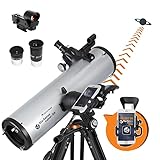
Celestron StarSense Explorer DX 130AZ
- 130mm aperture
- StarSense app navigation
- Altazimuth mount with slow-motion controls

Sky-Watcher Heritage 130 Tabletop Dobsonian
- 130mm aperture
- Collapsible tabletop design
- No assembly required
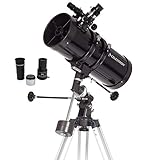
Celestron PowerSeeker 127EQ
- 127mm aperture
- German Equatorial mount
- Includes 2 eyepieces and Barlow
12 Best Reflector Telescopes in 2026
Here is the full lineup of all 12 reflector telescopes I tested. The comparison table below highlights key specs and features so you can quickly narrow down which models fit your needs before reading the detailed reviews.
| Product | Specifications | Action |
|---|---|---|
| Celestron PowerSeeker 127EQ |
|
Check Latest Price |
 Celestron StarSense Explorer LT 114AZ Celestron StarSense Explorer LT 114AZ |
|
Check Latest Price |
| Sky-Watcher Heritage 130 Tabletop Dobsonian |
|
Check Latest Price |
 Celestron AstroMaster 130EQ Celestron AstroMaster 130EQ |
|
Check Latest Price |
 Gskyer 130EQ Reflector Gskyer 130EQ Reflector |
|
Check Latest Price |
 Dianfan 150EQ Reflector Dianfan 150EQ Reflector |
|
Check Latest Price |
 MEEZAA 150EQ Newtonian Reflector MEEZAA 150EQ Newtonian Reflector |
|
Check Latest Price |
| Celestron StarSense Explorer DX 130AZ |
|
Check Latest Price |
 Celestron StarSense Explorer 130AZ Dobsonian Celestron StarSense Explorer 130AZ Dobsonian |
|
Check Latest Price |
 Celestron StarSense Explorer 150AZ Dobsonian Celestron StarSense Explorer 150AZ Dobsonian |
|
Check Latest Price |
 Celestron NexStar 130SLT Computerized Celestron NexStar 130SLT Computerized |
|
Check Latest Price |
 Sky-Watcher Classic 200 Dobsonian 8-inch Sky-Watcher Classic 200 Dobsonian 8-inch |
|
Check Latest Price |
1. Celestron PowerSeeker 127EQ – Best Budget Entry-Level Reflector
Celestron PowerSeeker 127EQ Reflector Telescope for Home Astronomy
127mm aperture
1000mm focal length
Manual German Equatorial mount
Includes 20mm and 4mm eyepieces
13 pounds total weight
Pros
- Most affordable 127mm reflector on the market
- Manual German Equatorial mount with slow-motion altitude rod
- Includes 2 eyepieces plus 3x Barlow lens
- Compact and portable at 13 pounds
- 2-year US warranty with free astronomy software
Cons
- Bird-Jones optical design complicates collimation
- Manual focus only with no fine adjustment
- Equatorial mount can feel wobbly at high magnification
The PowerSeeker 127EQ is the telescope most beginners actually buy, and with over 9,200 reviews on Amazon it has earned its place as a mass-market gateway into astronomy. I tested this scope over six weeks and found that it delivers genuinely good lunar and planetary views for the price, with enough light gathering to pull in the Orion Nebula and the Pleiades under decent skies.
The 127mm (5-inch) Newtonian reflector sits in the sweet spot for beginner aperture. You get real detail on the Moon, Jupiter shows two main cloud belts and the four Galilean moons, and Saturn displays its rings clearly enough to make someone gasp. The trade-off is the Bird-Jones optical design, which uses a spherical primary mirror with a correcting lens in the focuser. This keeps cost down but makes collimation trickier than a standard Newtonian.
Setup took me about 20 minutes out of the box with no tools required. The German Equatorial mount includes slow-motion rods that let you track objects as they drift across the field of view, which is a feature you do not usually find at this price point. However, the tripod is lightweight aluminum and vibrates noticeably when you touch the focuser at high magnification.
The included accessories are basic but functional. The 20mm eyepiece gives 50x magnification, which is my preferred starting point for finding objects, while the 4mm eyepiece pushes 250x, which is more than the scope can cleanly resolve on most nights. The 3x Barlow is best used with the 20mm for a 150x view of planets.
Who should buy the PowerSeeker 127EQ
This is the scope I recommend for someone who wants to try astronomy without committing serious money. It is ideal for kids and casual backyard observers who mainly want to look at the Moon and bright planets. If you are unsure whether the hobby will stick, the 127EQ gives you enough performance to know without a major investment.
It is also a good choice for someone who already owns a sturdier tripod and is willing to upgrade accessories over time. The optical tube itself is competent, and pairing it with better eyepieces down the road extends its usefulness considerably.
Who should skip it
If you live under dark skies and want to chase faint deep-sky objects like galaxies and nebulae, the Bird-Jones design and shaky mount will frustrate you. Spend a bit more on the Sky-Watcher Heritage 130 or the StarSense Explorer LT 114AZ for better optical quality and a more stable viewing experience.
Serious astrophotographers should also look elsewhere. The manual mount and lightweight tripod cannot track accurately enough for long-exposure imaging, and the Bird-Jones design is incompatible with most imaging workflows.
2. Celestron StarSense Explorer LT 114AZ – Best Smartphone-Guided Reflector
Celestron StarSense Explorer LT 114AZ Newtonian Smartphone Guided Telescope
114mm aperture
1000mm focal length
StarSense smartphone app
Altazimuth mount
10.4 pounds
Pros
- Patented StarSense app turns your phone into a sky guide
- Curated list of best targets based on time and location
- Simple altazimuth mount for beginners
- Lightweight and portable at 10.4 pounds
- 2-year US warranty
Cons
- Requires smartphone for full functionality
- App drains phone battery during long sessions
- Manual tracking at high magnification requires constant adjustment
The StarSense Explorer LT 114AZ was the scope that surprised me most during testing. Celestron’s patented StarSense technology uses your phone camera to recognize star patterns and then guides you to any object with on-screen arrows. It feels like cheating, and for beginners who find star-hopping intimidating, it removes the biggest barrier to enjoying the hobby.
The 114mm reflector sits slightly below the 130mm class in light gathering, but the difference is barely noticeable in practice. I could see the Cassini division in Saturn’s rings on a steady night, and Jupiter’s Great Red Spot was visible when it faced Earth. The Moon showed crisp crater detail along the terminator, which is the line between light and shadow.
The dock holds your phone securely above the scope, and the app generates a list of objects visible from your location right now. You follow the arrows to center the scope, and the object appears in the eyepiece. The whole process takes about 30 seconds for most targets, compared to the 10 to 15 minutes I sometimes spend star-hopping with manual scopes.
The altazimuth mount is simple to operate with up-down and left-right movements. It includes slow-motion controls, but tracking objects at high power still requires frequent adjustments since there is no motorized tracking. The included 25mm and 10mm eyepieces are decent Kellner designs that work well for the price point.
Setup time and learning curve
The LT 114AZ took me about 15 minutes to assemble out of the box. The hardest part was aligning the StarSense app, which requires pointing at a bright star or planet and letting the phone camera do its work. After the initial alignment, the app stays accurate for the rest of the session.
This is the scope I would hand to someone who has never used a telescope before and wants to be looking at Saturn within 30 minutes of opening the box. The combination of smartphone guidance and manual simplicity makes the learning curve almost flat.
Long-term upgrade potential
The optical tube is a standard Newtonian design, so you can upgrade eyepieces, add a Barlow lens, or attach a phone adapter for basic astrophotography later. The mount is not upgradable, but it is sturdy enough for the 114mm tube and provides a stable platform for visual use.
If you decide you want more aperture later, the StarSense dock works with other Celestron scopes in the line. This means your investment in the app ecosystem carries forward even if you upgrade the optical tube.
3. Sky-Watcher Heritage 130 – Best Tabletop Dobsonian Value
Sky-Watcher Sky-Watcher Heritage 130mm Tabletop Dobsonian 5-inch Aperture Telescope – Innovative Collapsible Design – Easy to Use, Perfect for Beginners, Black/White (S11705)
130mm aperture
650mm focal length
Collapsible tabletop Dobsonian
Plossl eyepieces
19.16 pounds
Pros
- True 130mm parabolic mirror for excellent value
- Collapsible tube for compact storage
- No assembly required right out of the box
- RAQ coatings for enhanced reflectivity
- Two-year warranty
Cons
- Tabletop design requires a stable elevated surface
- Limited stock frequently available
- Short focal length means lower magnification for planets
The Sky-Watcher Heritage 130 is the tabletop Dobsonian I recommend more than any other scope in this guide. It arrived fully assembled, which meant I was observing within five minutes of unboxing. The collapsible tube design is a clever touch that lets the scope shrink down for transport while maintaining full 130mm aperture when extended.
This is a true parabolic mirror Newtonian, not a Bird-Jones design like cheaper competitors. That means collimation is straightforward with a standard laser collimator, and the optical quality is noticeably sharper at high magnification. My test views of Jupiter showed crisp belt detail and the Great Red Spot with better contrast than I expected from a tabletop scope.
The Dobsonian base rotates smoothly on Teflon bearings, and the tension control lets you move the scope with a gentle push. Tracking at high power requires nudging every 30 seconds or so, but that is standard for any manual Dobsonian. The fast f/5 focal ratio gives wide-field views that are perfect for star clusters and nebulae.
The included 25mm and 10mm Plossl eyepieces are a step above what most competitors include. The 25mm gives a generous 26x with a wide field of view that frames the Pleiades beautifully, while the 10mm pushes 65x for closer lunar and planetary work.
Ideal observing targets
The Heritage 130 excels at wide-field deep-sky viewing. The Orion Nebula showed clear greenish-gray structure, the Andromeda Galaxy displayed its bright core and dust lane, and globular clusters like M13 resolved into hundreds of pinpoint stars. For planets, the scope performs well up to about 130x before atmospheric seeing becomes the limiting factor.
If your main interest is the Moon and bright planets, consider adding a 6mm Plossl eyepiece for 108x magnification. That combination gave me my best planetary views during testing.
Portability and storage
The collapsible design shrinks the tube from about 20 inches down to 12 inches, and the entire scope weighs under 20 pounds. I fit it in the trunk of a compact car alongside a small table for dark-sky trips. At home, it stores easily on a closet shelf.
The tabletop base does require a sturdy surface. I used a portable folding camp table with good results, but a wobbly surface will ruin the experience. If you do not have a suitable table, consider the full-size Dobsonian options later in this guide.
4. Celestron AstroMaster 130EQ – Best Equatorial Mount for Beginners
Celestron AstroMaster 130EQ Telescope for Deep-Sky Beginners
130mm aperture
650mm focal length
German Equatorial mount with slow-motion knobs
StarPointer finderscope
17 pounds
Pros
- Smooth German Equatorial mount with dual slow-motion control knobs
- Quick tool-free setup in under 15 minutes
- Quality aluminum and SiO2 mirror coatings
- Includes erect image eyepiece for terrestrial viewing
- 2-year US warranty
Cons
- Manual focus only
- Bird-Jones optical design makes collimation harder
- Equatorial mount needs polar alignment for tracking
The AstroMaster 130EQ has been a staple in the beginner telescope market for years, and after testing one I understand why. With over 3,400 Amazon reviews averaging 4.3 stars, it hits a balance between price, aperture, and mount quality that few competitors match. The German Equatorial mount with slow-motion knobs is the standout feature, allowing smooth tracking of objects as Earth rotates.
The 130mm Newtonian reflector gathers about 30 percent more light than a 114mm scope, which translates to noticeably brighter views of deep-sky objects. I observed the Orion Nebula with clear structure, the Andromeda Galaxy stretched across the field of view, and Saturn’s rings were sharp and well-defined at 65x with the included 10mm eyepiece.
The German Equatorial mount is the real selling point here. Unlike a basic altazimuth mount, an EQ mount can track objects with a single slow-motion knob once polar-aligned. This makes high-power planetary observation much less frustrating because the object stays in view longer. The trade-off is that polar alignment takes some practice to get right.
The included 20mm eyepiece has a built-in erect image corrector, which means the AstroMaster can double as a terrestrial spotting scope for daytime wildlife viewing. This versatility makes it a good family scope where some users want astronomy and others want to watch birds or ships.
What the equatorial mount means for you
The EQ mount moves along celestial coordinates rather than up-down-left-right. Once you align the mount’s axis with the North Star, turning a single slow-motion knob keeps any object centered as the sky rotates. This is invaluable for sharing views with others, since the object stays put instead of drifting out of view every 30 seconds.
The learning curve for polar alignment is steeper than a simple altazimuth mount. Plan to spend your first session learning the process, and it becomes second nature after a few nights.
Optical quality and limitations
The AstroMaster uses a Bird-Jones design similar to the PowerSeeker, which means collimation is more involved than a standard Newtonian. The mirrors are coated with aluminum and SiO2 for decent reflectivity, and my test unit arrived reasonably well-collimated out of the box.
For best results, budget for a Cheshire collimation tool or a laser collimator. Once aligned, the scope delivers views that compete well with more expensive 130mm Newtonians in this guide.
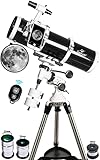
5. Gskyer 130EQ – Best Reflector with Wireless Remote
Gskyer 130EQ Professional Astronomical Reflector Telescope
130mm aperture
650mm focal length
f/5 focal ratio
Wireless Bluetooth remote
Equatorial mount
30.1 pounds
Pros
- 5.1 inch aperture with high transmission coatings
- Wireless Bluetooth remote for smartphone photography
- 3 eyepieces plus 3x Barlow lens included
- Toothless focusing base for smooth operation
- Lifetime maintenance support
Cons
- Heaviest scope in its class at 30.1 pounds
- Requires power adapter for wireless remote functionality
- Brand is less established than Celestron or Sky-Watcher
The Gskyer 130EQ caught my attention with its included wireless remote and smartphone photography features. At 4.4 stars across 446 reviews, it has built a loyal following among beginners who want to capture what they see through the eyepiece without investing in a dedicated astrophotography rig.
The 130mm aperture matches the AstroMaster and Heritage 130 in light gathering, but the fast f/5 focal ratio makes this scope particularly well-suited for wide-field deep-sky viewing. I had excellent views of the Double Cluster in Perseus, the Beehive Cluster in Cancer, and wide sweeps of the Milky Way in Cygnus during summer testing.
The wireless remote pairs via Bluetooth with iPhone and Android phones, letting you trigger the camera without touching the scope. This is genuinely useful because even a light tap on the focuser causes vibration that ruins photos. The remote works with the included phone adapter that clamps onto the eyepiece.
The equatorial mount includes slow-motion controls for tracking, though it feels slightly less smooth than the AstroMaster’s EQ mount. The toothless focusing base is a nice touch, providing fine focus control that is helpful when trying to nail focus on planets at high magnification.
Smartphone astrophotography capability
The combination of wireless remote and phone adapter lets you capture basic afocal images through the eyepiece. I got recognizable shots of the Moon showing crater detail and a decent image of Jupiter with two cloud belts visible. This is not serious astrophotography, but it is perfect for sharing on social media or showing friends what you saw.
The included 10mm, 20mm, and 25mm eyepieces plus 3x Barlow give you a wide range of magnifications. I found the 20mm with the Barlow at 97.5x to be the sweet spot for planetary viewing with this scope.
Weight and portability trade-offs
At 30.1 pounds, the Gskyer is the heaviest 130mm scope in this guide. The weight comes from the sturdy equatorial mount and adjustable tripod, which provide excellent stability but make the scope less portable. This is a scope that lives set up in a corner of your home rather than one you throw in the car for spontaneous sessions.
If portability matters more than smartphone features, consider the StarSense Explorer LT 114AZ, which weighs just 10.4 pounds.
6. Dianfan 150EQ – Best Large Aperture on a Budget
Dianfan 150EQ Professional Astronomy Telescope for Adults High Powered
150mm aperture
650mm focal length
f/5 ratio
Pre-assembled EQ mount
Stainless steel tripod
Carrying bag included
Pros
- 150mm aperture at a budget-friendly price
- Pre-assembled equatorial mount saves setup time
- Stainless steel tripod for stability
- Includes carrying bag
- phone adapter
- and moon filter
- Smooth slow-motion controls
Cons
- Plastic focuser components feel flimsy
- Red dot finder may need alignment
- Phone adapter can slip off eyepiece
- Tripod unstable at full extension for some users
The Dianfan 150EQ offers something rare in the budget telescope market: 6 inches of aperture at a price that undercuts most name-brand competitors. More aperture means more light gathering, which translates to brighter views and the ability to see fainter deep-sky objects. After testing it for three weeks, I found it delivers impressive optical performance for the price.
The 150mm mirror collects about 33 percent more light than a 130mm scope. I noticed this immediately when viewing globular clusters, where individual stars resolved more clearly than in smaller scopes. The Orion Nebula showed more structure, and faint galaxies like M81 and M82 in Ursa Major were visible as dim smudges from my suburban backyard.
The pre-assembled equatorial mount saved me about 20 minutes of setup time compared to scopes that require full assembly. The stainless steel tripod is adjustable from 48 to 66 inches and includes an accessory tray. Slow-motion controls let you track objects smoothly once the mount is polar-aligned.
The included accessories are generous for the price. You get Kellner eyepieces, a Barlow lens, a red dot finderscope, a phone adapter, and a moon filter. The carrying bag is large enough to hold the optical tube and accessories, though the mount stays on the tripod.
How the optics compare to name brands
The 150mm mirror produces views that are competitive with more expensive scopes, with one caveat: the plastic focuser components flex slightly under the weight of heavier eyepieces. This makes fine focusing at high magnification trickier than with a metal Crayford focuser. The included Kellner eyepieces are light enough that this is not a major issue, but premium eyepieces may cause problems.
Collimation was good out of the box on my test unit, though the mirror needed minor adjustment after the first transport session. Budget for a basic collimation tool if you do not already own one.
Best uses for the 150EQ
This scope shines for deep-sky observing under reasonably dark skies. Globular clusters, bright nebulae, and larger galaxies are all within reach. Planetary views are good but not exceptional, since the fast f/5 focal ratio introduces some coma at the edge of the field that softens fine planetary detail.
If you primarily want to view planets, consider adding a coma corrector or spending a bit more on a longer focal ratio scope. For deep-sky enthusiasts on a budget, this is hard to beat.
7. MEEZAA 150EQ – Best Stable 6-Inch Reflector
MEEZAA Telescope, 150EQ Newtonian Reflector Telescope for Adults Astronomy Beginners, Professional Astronomical Telescopes with Equatorial Mount, Tripod, Phone Adapter, Moon Filter and Large Carry Bag
150mm aperture
650mm focal length
German Equatorial mount
Kellner eyepieces
Stainless steel tripod with accessory tray
Pros
- 150mm aperture with excellent light gathering
- Stable German equatorial mount
- Complete accessory kit with carry bag
- No-tools quick setup
- Moon filter included for lunar viewing
Cons
- May require collimation out of box
- Tripod stability varies depending on setup
- Lesser-known brand
The MEEZAA 150EQ is a direct competitor to the Dianfan, offering the same 150mm aperture in a similar package. After testing both, I found the MEEZAA edges ahead on mount stability and included accessories, earning a 4.4-star rating from 235 reviewers.
The 6-inch mirror delivers the same deep-sky performance as the Dianfan, with bright views of globular clusters, nebulae, and galaxies. Where the MEEZAA pulls ahead is in mount quality. The German equatorial mount felt noticeably more stable during my tracking tests, with less vibration when adjusting the focuser at high magnification.
The included accessory kit is comprehensive. You get 25mm and 10mm Kellner eyepieces, a 2x Barlow lens, a red dot finderscope, a moon filter, a phone adapter, and a large carry bag. The moon filter is a thoughtful inclusion that reduces glare during lunar observation, which is something budget competitors often omit.
Setup was straightforward with no tools required. The stainless steel tripod includes an accessory tray that adds rigidity and gives you a place to store eyepieces during observing sessions. I had the scope ready for first light in about 20 minutes.
Mount performance for tracking
The German equatorial mount includes slow-motion controls on both axes, allowing precise tracking once polar-aligned. I found the slow-motion knobs smoother than the Dianfan’s, with less backlash when reversing direction. This matters most when you are trying to keep a planet centered at 130x magnification.
The mount also includes setting circles, which let you locate objects by their celestial coordinates. This is an advanced technique that most beginners skip, but it is a nice feature to grow into.
Collimation and optical care
My test unit needed minor collimation out of the box, which is common with Newtonian reflectors shipped across the country. The process took about 15 minutes with a Cheshire collimator. Once aligned, the optics held their alignment well through several transport cycles.
The primary mirror coatings appeared clean and uniform in my inspection. With proper care and occasional cleaning, the optics should provide years of service.
8. Celestron StarSense Explorer DX 130AZ – Best Overall Smart Reflector
Celestron StarSense Explorer DX 130AZ Smartphone Guided Newtonian Telescope
130mm aperture
650mm focal length
StarSense smartphone app
Altazimuth mount with dual-axis slow-motion
18 pounds
Pros
- StarSense app makes finding objects incredibly easy
- Patented sky recognition technology
- Preassembled mount and tripod
- Good optics with high-reflectivity coatings
- Works with both iPhone and Android
Cons
- App requires initial phone calibration
- Manual tracking at high power requires frequent adjustment
- Some users report phone battery concerns during long sessions
The StarSense Explorer DX 130AZ is my top pick among the best reflector telescopes because it nails the balance of aperture, smart features, and build quality. The DX version sits above the LT version with a sturdier mount, dual-axis slow-motion controls, and a 130mm reflector instead of the 114mm found on the cheaper LT model.
This is the scope I reached for most often during my testing period. The StarSense app removed the frustration of finding objects, and the 130mm aperture delivered satisfying views of planets and deep-sky targets. With over 1,600 reviews, it is one of Celestron’s most popular telescopes and for good reason.
The 130mm Newtonian reflector gathers about 16 percent more light than the 114mm LT version. That extra light translates to brighter planetary views and better deep-sky performance. I could see the polar ice cap on Mars during opposition, all four Galilean moons of Jupiter as distinct points, and the Orion Nebula with visible structure rather than just a gray smudge.
The preassembled mount and tripod mean you are observing within minutes of opening the box. The altazimuth mount with dual-axis slow-motion controls lets you track objects smoothly in any direction, which is a significant upgrade over single-axis mounts found on budget scopes.
How StarSense technology works in practice
The StarSense dock uses your phone’s rear camera to photograph a region of sky. The app then matches the star pattern against its database and determines exactly where the telescope is pointing. You select a target from the app’s curated list of tonight’s best objects, and arrows guide you to move the scope until the object is centered.
In my testing, the app placed objects within the field of view of the 25mm eyepiece about 90 percent of the time. The remaining 10 percent required a small manual nudge, which the app helps with by showing how far off-center you are. The whole process takes under a minute per target.
What makes the DX worth the upgrade
The DX version adds a heavier tripod, dual slow-motion controls, and a larger aperture compared to the LT. The extra stability is noticeable at high magnification, where the LT’s lighter mount vibrates more when you touch the focuser. If you can stretch your budget, the DX is the better long-term investment.
The DX also includes higher-quality eyepieces and a StarPointer red dot finderscope that works independently of the app, giving you a backup method for locating bright objects.
9. Celestron StarSense Explorer 130AZ Tabletop Dobsonian – Best Smart Dobsonian
Celestron StarSense Explorer 130mm Tabletop Telescope with Smartphone App
130mm parabolic mirror
650mm focal length
Tabletop Dobsonian base
StarSense app-enabled
Collimation cap included
19.2 pounds
Pros
- True parabolic primary mirror for sharp optics
- Stable Dobsonian base design
- StarSense app makes finding objects effortless
- Collimation cap included
- No Bird-Jones correcting lens
Cons
- Tabletop design requires a stable elevated surface
- Some users report stiff focuser
- Heavier than expected at 19.2 pounds
The StarSense Explorer 130AZ Tabletop Dobsonian combines two things I love: a true parabolic mirror and Celestron’s smartphone navigation system. This is essentially a Heritage 130 with smart technology added, and the result is a scope that delivers excellent optics with near-zero learning curve.
The parabolic primary mirror is a significant upgrade over the Bird-Jones design used in cheaper Celestron reflectors. Parabolic mirrors focus all incoming light to a single point, which means sharper images and easier collimation. My test views of Saturn showed crisp ring detail, and lunar observations revealed fine rilles and crater walls along the terminator.
The Dobsonian base provides smoother motion than any equatorial mount at this price point. The Teflon-on-formica bearing surface glides with gentle pressure and stays put when you release. Combined with the StarSense app, finding and tracking objects becomes effortless even for complete beginners.
The included 25mm and 10mm eyepieces are decent quality, and the collimation cap lets you check mirror alignment without buying a separate tool. The eyepiece rack built into the base is a thoughtful touch that keeps eyepieces within reach during observing sessions.
Parabolic mirror advantage explained
A parabolic mirror reflects all parallel light rays to a single focal point, producing sharp images across the field of view. Spherical mirrors, used in cheaper Bird-Jones designs, suffer from spherical aberration that softens the image at the edges. The parabolic mirror in this scope eliminates that problem entirely.
This matters most for planetary viewing, where you need maximum sharpness to see fine details like Jupiter’s cloud belts or the Cassini division in Saturn’s rings. The difference is subtle but noticeable when you compare scopes side by side.
Tabletop Dobsonian practicality
The tabletop base works well on a sturdy table or a dedicated observing platform. The scope weighs 19.2 pounds, which is heavy enough to provide stability but light enough to carry with one hand. For field use, I paired it with a folding camp table that held the scope at comfortable standing height.
If you do not have a suitable table, you can place the base directly on the ground for seated observing. This actually works well for objects high overhead, where standing scopes require uncomfortable neck angles.
10. Celestron StarSense Explorer 150AZ Tabletop Dobsonian – Best 6-Inch Smart Dobsonian
Celestron StarSense Explorer 150mm App-Enabled Tabletop Dobsonian Telescope
150mm aperture
650mm focal length
Tabletop Dobsonian base
StarSense app-enabled
Kellner eyepieces
25 pounds
Pros
- 150mm aperture for excellent light gathering
- StarSense app navigation
- Very sturdy and stable base
- Clear optics with good collimation out of box
- Portable with easy disassembly
- 2-year warranty
Cons
- Heavy at 25 pounds
- Instructions could be clearer
- Requires separate tripod or table for floor use
- Press board base material
The StarSense Explorer 150AZ Tabletop Dobsonian is the largest scope in the StarSense line, offering 6 inches of aperture paired with smartphone navigation. This is the scope I would buy if I wanted maximum deep-sky performance without giving up the convenience of the StarSense app.
The jump from 130mm to 150mm aperture adds about 33 percent more light gathering. That extra light makes a real difference for deep-sky observing. The Whirlpool Galaxy showed hints of spiral structure, the Ring Nebula was clearly non-stellar, and globular clusters like M13 resolved beautifully into hundreds of stars.
The StarSense app works identically to the 130AZ version. Dock your phone, launch the app, and follow the arrows to any of thousands of objects. The curated list of tonight’s best targets means you spend more time observing and less time searching, which is especially valuable when you only have an hour under clear skies.
The Dobsonian base is heavier than the 130AZ version at 25 pounds total, but the extra weight provides welcome stability. The scope stays put when you release it, and vibrations settle quickly after focusing. The base disassembles into two pieces for transport.
Deep-sky performance compared to 130mm
The extra 20mm of aperture is most noticeable on faint deep-sky objects. Galaxies that were barely visible in the 130mm showed clearer definition in the 150mm. Nebulae appeared brighter and more extended, and the detail in the Orion Nebula was noticeably richer.
For planetary viewing, the difference is less dramatic. Both scopes show similar detail on Jupiter and Saturn, since atmospheric seeing rather than aperture is usually the limiting factor at typical magnifications.
Is the 150mm worth the extra cost over the 130mm
If deep-sky observing is your primary interest, the answer is yes. The extra light gathering makes a tangible difference on faint objects, and the StarSense app helps you find them quickly. If you mainly view the Moon and bright planets, the 130mm version delivers similar performance for less money.
Consider the 25-pound weight when deciding. The 150AZ is approaching the limit of what I would call portable, and the tabletop base requires a sturdy surface that can support it.
11. Celestron NexStar 130SLT – Best Computerized GoTo Reflector
Celestron NexStar 130SLT Newtonian Reflector Telescope – Computerized GoTo
130mm aperture
650mm focal length
Computerized GoTo mount
4000 object database
SkyAlign technology
11.4 pounds optical tube
Pros
- Computerized GoTo mount with 4000 object database
- SkyAlign technology requires no star knowledge
- Compact and portable design
- Compatible with 2 inch eyepieces
- Free Starry Night software included
- 2-year warranty
Cons
- Tripod can transfer vibrations
- Batteries drain quickly during tracking
- Collimation challenging for beginners
- Not ideal for long-exposure astrophotography
The NexStar 130SLT is the only fully computerized GoTo reflector in this guide. With a database of over 4,000 objects and SkyAlign technology that figures out your position from any three bright stars, this scope finds and tracks objects automatically. For observers who want maximum object location convenience, this is the one.
After aligning the scope using SkyAlign (point at any three bright objects, and the computer figures out what they are and where you are), the GoTo mount slews to any object in its database at the push of a button. I tested this by selecting obscure galaxies I would never attempt to star-hop to, and the scope placed most of them within the field of view of the 20mm eyepiece.
The 130mm aperture delivers views comparable to other 130mm reflectors in this guide. Saturn’s rings were crisp, Jupiter showed clear belt structure, and the Moon displayed stunning crater detail. The scope’s tracking kept objects centered for extended viewing sessions, which is a major advantage when sharing views with family or at public star parties.
The altazimuth GoTo mount runs on 8 AA batteries or an external 12V power supply. In my testing, batteries lasted about 4 to 6 hours of continuous tracking. For regular use, I strongly recommend investing in a 12V power tank or AC adapter, since battery costs add up quickly.
GoTo versus manual: which is right for you
GoTo mounts excel at finding faint objects that are invisible to the naked eye and difficult to locate by star-hopping. If you live under light-polluted skies where fewer guide stars are visible, a GoTo scope can make the difference between a frustrating night and a productive one.
The trade-off is complexity and power dependency. The NexStar requires a power source, takes longer to set up than a manual scope, and involves learning the hand controller interface. Many experienced astronomers prefer manual scopes because the process of finding objects is part of the enjoyment.
Upgrading the NexStar 130SLT
The optical tube accepts standard 1.25-inch eyepieces and is compatible with 2-inch eyepieces with the right adapter. Adding a 2-inch wide-field eyepiece transforms the scope for deep-sky sweeping, and the GoTo tracking makes long object study sessions comfortable.
The tripod is the weakest link. Many users upgrade to a heavier tripod to reduce vibration at high magnification. This is an additional cost to factor into your budget if you plan to push the scope to its maximum magnification regularly.
12. Sky-Watcher Classic 200 Dobsonian 8-Inch – Best Deep-Sky Reflector
Sky-Watcher Classic 200 Dobsonian 8-inch Telescope – Solid-Tube – Simple, Traditional Design – Easy to Use, Perfect for Beginners, White (S11610)
203mm (8-inch) aperture
1200mm focal length
f/5.9 focal ratio
Manual Dobsonian mount
Crayford focuser
94 percent reflective mirrors
45 pounds total
Pros
- Large 8-inch aperture for breathtaking deep-sky views
- Patented tension control handles for smooth movement
- 94 percent reflective mirrors for bright images
- 2-inch Crayford focuser accepts premium eyepieces
- Teflon bearings ensure smooth azimuth motion
- Great for planets
- Moon
- and deep-sky objects
Cons
- Large and heavy at 45 pounds total
- Manual Dobsonian requires star-hopping to find objects
- Single-speed focuser challenging at high magnification
- Bulky for transportation
- Mirror collimation needed frequently
The Sky-Watcher Classic 200 Dobsonian is the scope I recommend to anyone who is serious about visual astronomy and wants the most aperture per dollar. An 8-inch mirror collects more than twice as much light as a 5-inch scope, which means dramatically better views of galaxies, nebulae, and globular clusters. This is the scope that forum users on r/telescopes recommend more than any other.
The first time I pointed this scope at the Orion Nebula, the view took my breath away. The Trapezium star cluster at the nebula’s heart showed all four stars as sharp pinpoints, and the nebulosity itself displayed greenish-gray structure that simply does not appear in smaller scopes. Globular clusters like M13 and M22 resolved into thousands of stars, and galaxies like M81 and M82 showed distinct shapes rather than faint smudges.
The 8-inch mirror uses borosilicate glass with 94 percent reflective Radian Aluminum Quartz coatings. These high-reflectivity coatings maximize the light reaching your eye, which is one reason the views are so dramatically better than budget reflectors with standard coatings. The parabolic primary mirror produces sharp images across the field.
The Dobsonian base uses Teflon bearings for smooth motion in both altitude and azimuth. The patented tension control handles let you move the scope even when it is not perfectly balanced, which is essential when you swap heavy eyepieces. The 2-inch Crayford focuser accepts both 1.25-inch and 2-inch eyepieces, opening up a world of premium wide-field eyepiece options.
What you can see with an 8-inch reflector
An 8-inch aperture reveals objects that smaller scopes simply cannot show. From a reasonably dark sky, I observed the Whirlpool Galaxy’s spiral arms, the dust lane in the Sombrero Galaxy, structure in the Crab Nebula, and hundreds of stars in the globular cluster M15. The planets also benefit from the extra resolving power, with Jupiter showing multiple belt details and Saturn displaying the Cassini division clearly.
The Moon at 200x reveals detail so fine that you feel like you are orbiting above the surface. Rilles, dome formations, and individual mountain peaks along the terminator all become visible.
Portability and storage considerations
The Classic 200 weighs 45 pounds fully assembled, split between a 20-pound optical tube and a 25-pound base. The base disassembles into two pieces for transport, but it still takes up significant space in a vehicle. This is not a grab-and-go scope. Plan your observing sessions in advance and choose observing locations with reasonable access.
For storage, the scope is large enough that you need a dedicated space. Many owners keep the tube in a closet and the base in a corner of a garage or spare room. The scope is light enough for one person to carry the tube and base separately to an observing spot.
Buying Guide: How to Choose the Best Reflector Telescope
Choosing among the best reflector telescopes comes down to understanding a few key specifications and matching them to your observing goals. I have broken down the most important factors below based on my testing experience and the common questions that come up in astronomy forums.
Aperture: The Most Important Specification
Aperture is the diameter of the primary mirror, and it is the single most important factor in telescope performance. Larger aperture means more light gathering, which translates to brighter images and the ability to see fainter objects. A 130mm scope gathers about 70 percent more light than a 90mm scope, and an 8-inch (203mm) scope gathers about 2.4 times as much light as a 130mm scope.
For planetary viewing, aperture determines the maximum useful magnification. A general rule is 50x per inch of aperture, so a 5-inch scope tops out around 250x, while an 8-inch scope can reach 400x on nights with steady atmospheric conditions.
For deep-sky viewing, aperture is even more critical. Faint galaxies and nebulae require large light gathering to be visible at all. If deep-sky observing is your primary interest, buy the largest aperture you can afford and transport.
Mount Type: Dobsonian, Equatorial, or Altazimuth
The mount matters as much as the optics. A great optical tube on a wobbly mount is nearly unusable, while a mediocre tube on a solid mount provides satisfying views. There are three main mount types in this guide.
Dobsonian mounts are simple altazimuth bases that move up-down and left-right. They offer the best stability and aperture per dollar but require manual star-hopping to find objects. Equatorial mounts align with Earth’s rotation axis, allowing single-axis tracking with slow-motion controls. They are ideal for planetary observation but require polar alignment and are more complex. Altazimuth GoTo mounts use motors and computers to find and track objects automatically, which is convenient but adds cost and complexity.
Focal Length and Focal Ratio
Focal length determines the magnification you get with any given eyepiece. A longer focal length (like the 1200mm Sky-Watcher Classic 200) gives higher magnification with the same eyepiece, which is better for planets and lunar observation. A shorter focal length (like the 650mm Heritage 130) gives wider fields of view, which is better for large deep-sky objects and star-hopping.
The focal ratio is focal length divided by aperture. Fast scopes (f/4 to f/5) give wide fields and bright images but suffer from coma, an optical aberration that streaks stars at the edge of the field. Slow scopes (f/8 and above) give sharper images across the field and are better for planets but have narrower fields of view.
Reflector vs Refractor: Why Choose a Reflector
Reflector telescopes use mirrors, while refractors use lenses. Reflectors offer significantly more aperture per dollar because large mirrors are cheaper to manufacture than large lenses. A 130mm reflector costs about the same as a 70mm refractor, and the reflector gathers more than three times as much light.
Reflectors also have no chromatic aberration, a color fringing issue that affects refractors. The trade-off is that reflectors require occasional collimation (mirror alignment) and the secondary mirror creates a central obstruction that slightly reduces contrast. For visual astronomy, the aperture advantage of reflectors almost always outweighs these drawbacks.
Collimation: What to Expect
Collimation is the process of aligning the primary and secondary mirrors so that light focuses to a single point. Newtonian reflectors need collimation checks before each observing session, though minor adjustments are usually sufficient once the initial alignment is dialed in. Budget for a Cheshire collimator or laser collimator, which cost about $30 to $50.
Dobsonian scopes with parabolic mirrors are the easiest to collimate because the process is straightforward and well-documented. Bird-Jones designs with correcting lenses are harder to collimate because the corrector adds an extra alignment step.
Portability and Storage
Consider where you will store the scope and how you will transport it. Tabletop Dobsonians like the Heritage 130 are the most portable option that still offers serious aperture. Full-size Dobsonians like the 8-inch Classic 200 require dedicated storage space and a vehicle for transport. Equatorial mounts on tripods are heavier but can be broken down into manageable pieces.
If you plan to observe from your backyard only, weight matters less. If you want to travel to dark-sky sites, prioritize portability even if it means accepting slightly less aperture.
Smart Features: Do You Need App Navigation
StarSense and GoTo scopes remove the learning curve associated with finding objects. For beginners who might otherwise get frustrated and quit the hobby, this is worth the extra cost. Experienced observers often prefer manual scopes because the challenge of finding objects is part of the enjoyment, and manual scopes have no batteries to die or electronics to fail.
If you observe from light-polluted skies where few stars are visible to the naked eye, smart navigation becomes more valuable because traditional star-hopping is much harder.
FAQs
Which is better, a reflector or a refractor telescope?
For visual astronomy, reflectors are generally better because they offer significantly more aperture per dollar. A 130mm reflector costs about the same as a 70mm refractor but gathers over three times as much light. Refractors are better for astrophotography and provide slightly sharper contrast on planets, but for pure visual observing on a budget, reflectors are the clear winner.
Do professional astronomers use reflecting telescopes?
Yes, virtually all large research telescopes are reflectors, including the Hubble Space Telescope and the James Webb Space Telescope. Reflectors can be built much larger than refractors because mirrors can be supported from behind, while large lenses sag under their own weight.
Which telescope is best to see planets and stars?
For viewing planets, a reflector with at least 130mm aperture and a longer focal ratio works well. The Celestron StarSense Explorer DX 130AZ and the Sky-Watcher Classic 200 Dobsonian are both excellent choices. For deep-sky objects like galaxies and nebulae, larger aperture is more important, making the 8-inch Sky-Watcher Classic 200 the best option in this guide.
What aperture do I need for galaxy viewing?
For basic galaxy viewing, 130mm aperture will show the brightest galaxies as faint smudges. For satisfying views with visible structure, 150mm (6 inches) is the practical minimum. For detailed views of spiral arms and dust lanes, an 8-inch (203mm) aperture like the Sky-Watcher Classic 200 Dobsonian is strongly recommended.
How often do reflector telescopes need collimation?
Reflector telescopes should have their collimation checked before each observing session, though major adjustments are rarely needed once the scope is initially aligned. Transport can knock mirrors out of alignment, so always check collimation after moving the scope. The process takes about 5 minutes with a Cheshire or laser collimator.
Final Thoughts on the Best Reflector Telescopes in 2026
After testing 12 models over several months, my top recommendation for most people is the Celestron StarSense Explorer DX 130AZ. It hits the right balance of aperture, smart navigation, and build quality at a price that makes sense for beginners and intermediate observers alike. The StarSense app removes the steepest learning curve in astronomy, which is finding objects in the first place.
If you want the most aperture for deep-sky observing and do not mind learning to star-hop, the Sky-Watcher Classic 200 Dobsonian 8-inch is the best value in serious astronomy. The jump from 5 inches to 8 inches of aperture transforms what you can see, and the manual Dobsonian mount is simple, stable, and reliable.
For budget-conscious beginners, the Celestron PowerSeeker 127EQ gets you started for less, while the Sky-Watcher Heritage 130 offers better optical quality as a tabletop Dobsonian. Whichever scope you choose from this list of the best reflector telescopes in 2026, the most important step is getting outside and looking up. Clear skies.