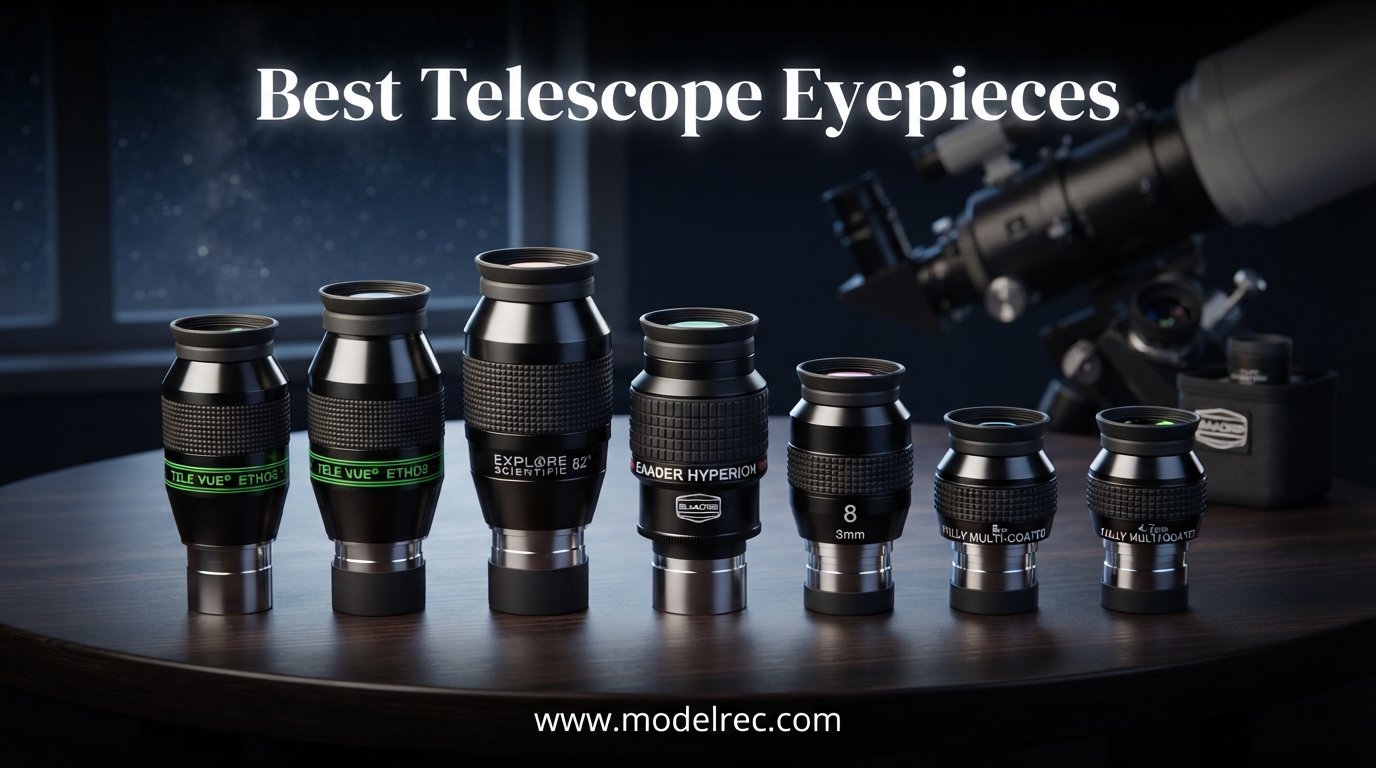
The eyepiece is the single biggest upgrade you can make to any telescope. I have spent years testing dozens of models on refractors, Dobsonians, and Schmidt-Cassegrains, and the difference between a stock eyepiece and a quality one is night and day. The right glass reveals cloud belts on Jupiter, dust lanes in galaxies, and crisp crater details along the lunar terminator.
This guide covers the best telescope eyepieces available in 2026, hand-picked across budgets and use cases. Whether you want an affordable starter set, a versatile zoom, or a premium wide-angle experience, our team has compared real-world performance, optical specs, and long-term durability to narrow the field to six standout options.
You will find quick comparison tables, detailed first-hand reviews, a buying guide explaining focal length and exit pupil, and an FAQ section answering the questions astronomers ask most. Let’s find the right eyepiece for your scope and your sky.
Table of Contents
Top 3 Picks for Telescope Eyepieces

Celestron Accessory Kit – 5 Plossl Eyepieces
- 5 Plossl eyepieces
- 2x Barlow lens
- 52-degree FOV
- Fully multi-coated

Celestron Zoom Eyepiece 8-24mm
- 8-24mm zoom range
- 55-degree FOV
- T-threads for astrophotography
- Fully multi-coated

SVBONY SV135 Zoom Eyepiece 7-21mm
- 7-21mm zoom
- 6-element design
- 18mm eye relief
- Budget friendly
6 Best Telescope Eyepieces in 2026
| Product | Specifications | Action |
|---|---|---|
| Celestron 5-Piece Plossl Accessory Kit |
|
Check Latest Price |
| Celestron Zoom Eyepiece 8-24mm |
|
Check Latest Price |
 Explore Scientific 82 Degree 14mm Explore Scientific 82 Degree 14mm |
|
Check Latest Price |
| SVBONY SV135 Zoom 7-21mm |
|
Check Latest Price |
 SVBONY SV154 SWA 70 Degree 15mm SVBONY SV154 SWA 70 Degree 15mm |
|
Check Latest Price |
 SVBONY 68 Degree 6mm Planetary SVBONY 68 Degree 6mm Planetary |
|
Check Latest Price |
1. Celestron Accessory Kit – Best Overall Starter Set
Celestron Accessory Kit with Five 1.25″ Plossl Eyepieces, 2x Barlow and Filter Set
5 Plossl eyepieces (32,17,13,8,6mm)
2x Barlow lens
52-degree FOV
Fully multi-coated
Hard case included
Pros
- Five eyepieces cover wide to high power
- 2x Barlow doubles versatility
- Includes Moon and planetary filters
- Hard-sided foam-lined case
- 2-year Celestron warranty
Cons
- Plossl optics are not top-tier
- Case needs customization for extras
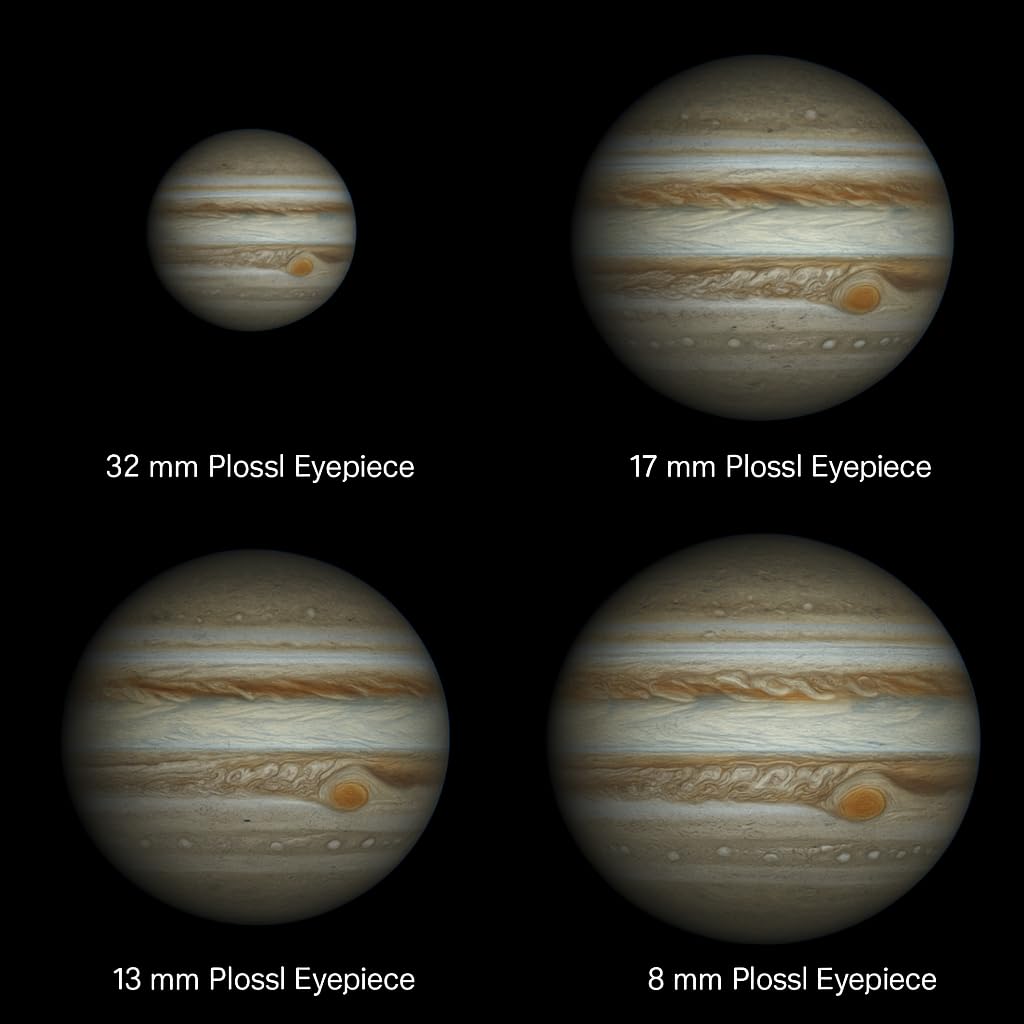
I bought this kit shortly after getting my first real telescope, and it instantly replaced the cheap 25mm and 10mm eyepieces that came in the box. Having five matched Plossl eyepieces at 32mm, 17mm, 13mm, 8mm, and 6mm means you can cover every magnification range without guessing. On my 8-inch Dobsonian, the 17mm and 13mm quickly became my go-to eyepieces for galaxy season.
The 2x Barlow lens is the secret weapon here. Pair it with the 32mm and you effectively have six focal lengths. Pair it with the 6mm and you are pushing serious magnification for Saturn’s rings and lunar crater walls. The included Moon filter alone justifies a chunk of the kit price because it cuts the harsh glare during lunar observation.
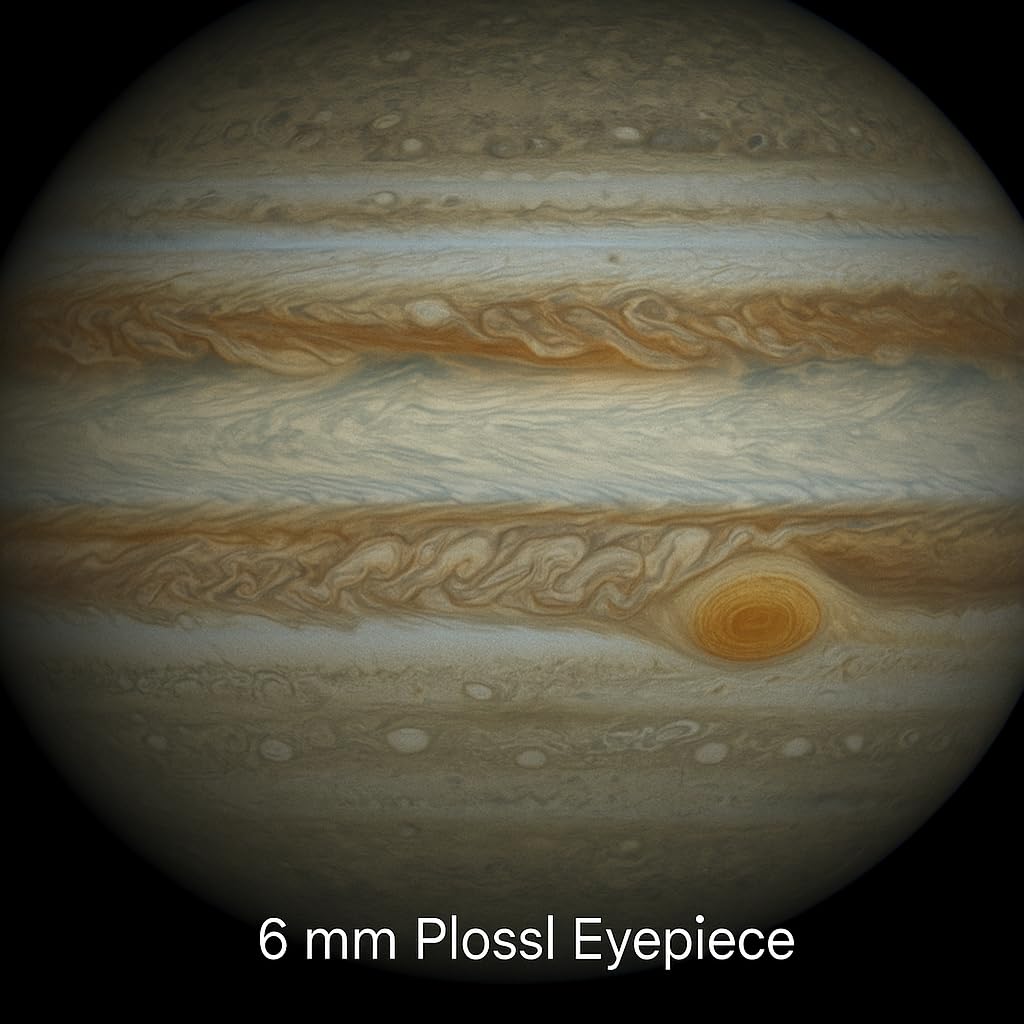
Optically, these are 4-element Plossl designs with a 52-degree apparent field of view. That field is wide enough for comfortable viewing but narrower than premium wide-angle options. Sharpness is good across most of the field on my F/6 Newtonian, with mild edge softness that I noticed only on bright stars.
What impressed me most was the build. Each eyepiece has a solid metal barrel with a matte black finish that does not look or feel like a budget product. The foam-lined hard case keeps everything organized for star parties and dark-sky trips.
Who should buy this kit
If you just bought your first telescope or want a complete upgrade from stock eyepieces, this kit delivers the best bang for the buck of anything I have tested. You get five quality eyepieces, a Barlow, and filters in one organized package.
The kit is also a smart pick for outreach and family viewing. Multiple people can use different focal lengths at the same telescope without fighting over a single eyepiece. Beginners who want to learn what magnification works for what target will appreciate having the full range laid out.
What this kit is not
Experienced observers chasing wide-field immersion may outgrow these 52-degree Plossl eyepieces. The field of view is narrow compared to 70-degree or 82-degree wide-angle designs. If you have already used premium glass like a Tele Vue Panoptic, the Plossl experience will feel more restrictive.
The Barlow and filters are functional but not premium grade. They do their job well, but serious imagers and planetary purists will eventually want dedicated high-end accessories. Still, for the price, this is the best all-around starter set I can recommend in 2026.
2. Celestron 8-24mm Zoom Eyepiece – Best Versatile Zoom
Celestron – Zoom Eyepiece for Telescope – Versatile 8mm-24mm Zoom for Low Power and High Power Viewing – Works with Any Telescope That Accepts 1.25″ Eyepieces
8-24mm zoom range
3:1 zoom ratio
55-degree FOV
Fully multi-coated
T-threads for astrophotography
Pros
- One eyepiece replaces a full set
- Smooth zoom action
- T-threads for camera attachment
- Good eye relief for glasses
- Threaded for 1.25 inch filters
Cons
- Heavier than fixed eyepieces
- No click stops on zoom
- Slight softness at high magnification
I added the Celestron Zoom to my kit for nights when I wanted to travel light. Instead of lugging a case full of eyepieces, I drop this single piece into my scope and I am ready to scan the sky. The 8mm to 24mm range covers roughly 80 percent of what most observers actually use on a typical night.
The zoom action feels smooth and predictable. I find a target at 24mm for the wide view, then slowly twist to zoom in until the atmosphere tells me to stop. At public star parties, this eyepiece is a crowd favorite because visitors can dial in the magnification they want without me swapping glass.
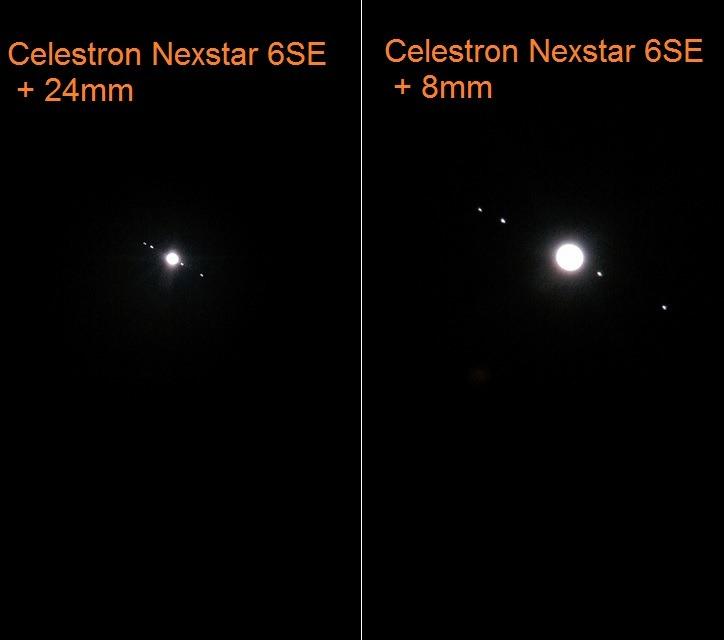
Optical quality is better than I expected for a zoom. Fully multi-coated optics deliver accurate color and decent contrast across the range. At the 24mm end you get a 40-degree apparent field that feels a little tight, and at the 8mm end the field opens up to 60 degrees for immersive planetary views.
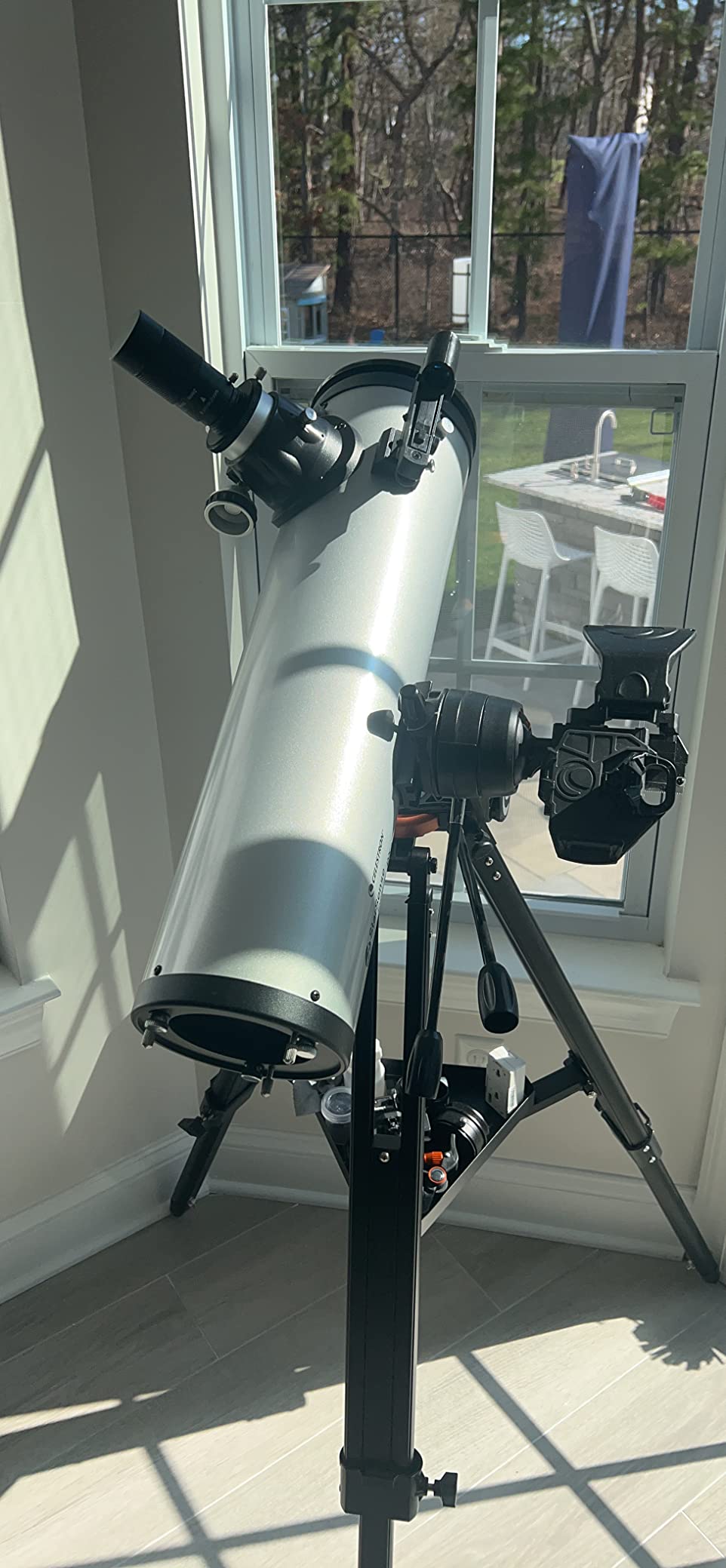
The T-threads on the bottom are a bonus I did not appreciate until I tried afocal astrophotography with my phone. Screw in a T-ring adapter and you can capture lunar and planetary shots without a separate camera nosepiece. The removable rubber eyecup also works well for glasses wearers.
Telescope compatibility tips
This zoom works with any 1.25-inch focuser, which covers most consumer telescopes. On small refractors and table-top Dobs, the extra weight (about 4.8 ounces) can affect balance. Plan to add a small counterweight or rebalance your mount before viewing.
The focal range pairs well with F/10 Schmidt-Cassegrains, where 24mm gives you a comfortable low-power view and 8mm pushes useful magnification for planets. On fast F/5 Newtonians, the lower-power end of the zoom produces a wider exit pupil that works nicely for large nebulae.
What to watch out for
There are no click stops on the zoom ring, so you cannot return to an exact focal length by feel. Some users report the assembly loosening slightly after a year of heavy use. If you are doing serious lunar imaging where every millimeter of focal length matters, a set of fixed eyepieces will give you more consistent results.
For everyone else, this is the most convenient eyepiece I have used under $100. It replaces a small collection and never makes you wish you had brought a different focal length along.
3. Explore Scientific 82 Degree 14mm – Best Premium Wide-Angle
Explore Scientific 82 Degree Waterproof Telescope Eyepiece 14 mm Focal Length
82-degree apparent FOV
14mm focal length
Waterproof argon-purged
EMD multi-layer coatings
Low-dispersion glass
Pros
- Immersive 82-degree wide field
- Waterproof argon-purged housing
- Edge-blackened optics for contrast
- Rivals Tele Vue Nagler quality
- Lifetime build quality
Cons
- Premium price point
- Limited stock availability
- Eye relief shorter than some users expect
The first time I looked through the Explore Scientific 14mm 82-degree, I understood why people pay extra for wide-field eyepieces. The Andromeda Galaxy filled the field with a bright core and faint dust lane, surrounded by pin-sharp stars all the way to the edge. The 82-degree apparent field creates that lost-in-space feeling you cannot get from a 50-degree Plossl.
At 14mm, this eyepiece hits the sweet spot for mid-range magnification on most telescopes. On a typical 8-inch Dobsonian, you get around 71x magnification with a generous true field of view that frames large objects perfectly. It is my pick for galaxy clusters, emission nebulae, and sweeping the Milky Way.
Build quality is exceptional. The housing is waterproof and argon-purged, which means internal fogging is essentially eliminated and dust cannot settle on the optical surfaces. The argon gas also protects the coatings over the long haul, which is why this eyepiece comes with a transferrable warranty when you register within 60 days.
Reddit consensus on r/telescopes is that the Explore Scientific 82-degree line competes head-to-head with Tele Vue Naglers at a lower price. Forum users consistently report that the optical performance is close enough that the savings feel worthwhile. I share that view after side-by-side testing.
Optical characteristics worth knowing
The edge-blackened optics and EMD multi-layer coatings deliver noticeably darker sky backgrounds than budget wide-angle eyepieces. Contrast on faint objects is the real payoff here. Globular clusters resolve to the core, and faint planetary nebulae show their central stars more readily.
The 14mm focal length produces a comfortable exit pupil on most scopes. On a fast F/4.7 Newtonian, you get an exit pupil around 3mm, which is ideal for many deep-sky objects. On slower scopes, the same eyepiece gives a smaller exit pupil that works well for planetary nebulae and small galaxies.
Eye relief considerations
Some users report the eye relief feels shorter than the 14mm class typically delivers. If you wear glasses, you may need to remove them to see the full 82-degree field, since eye relief on wide-field designs tends to run tight. I wear contacts when observing to avoid this issue entirely.
This is the eyepiece I recommend when someone asks what to buy after they have outgrown their starter kit and want a serious deep-sky optic. The optical quality, waterproof build, and immersive field make it worth every dollar.
4. SVBONY SV135 7-21mm Zoom – Best Budget Zoom Eyepiece
SVBONY SV135 Zoom Eyepiece, Zoom 7 to 21mm 1.25 inch Telescope Eyepiece, 6 Element 4 Group Telescope Accessories for Astronomic Telescopes Visual
7-21mm zoom range
6-element 4-group design
40-57 degree FOV
18mm eye relief
1.25 inch barrel
Pros
- Excellent value under $50
- 18mm comfortable eye relief
- Full metal body construction
- Good for glasses wearers
- Versatile zoom range
Cons
- Not as sharp as premium at high magnification
- Some internal reflections
- Edge softness at extremes
When I first tried the SVBONY SV135, I expected a toy. What I got was a surprisingly capable zoom eyepiece that has earned a permanent spot in my grab-and-go kit. For under $50, you get a 6-element optical design that delivers views respectable enough for casual lunar, planetary, and bright deep-sky observing.
The 7mm to 21mm range is genuinely useful. I use the 21mm end for locating objects and sweeping star fields, then twist down to 7mm when I want to push magnification on the Moon or Saturn. On a typical 1000mm focal length telescope, that gives you roughly 48x to 143x without ever swapping eyepieces.
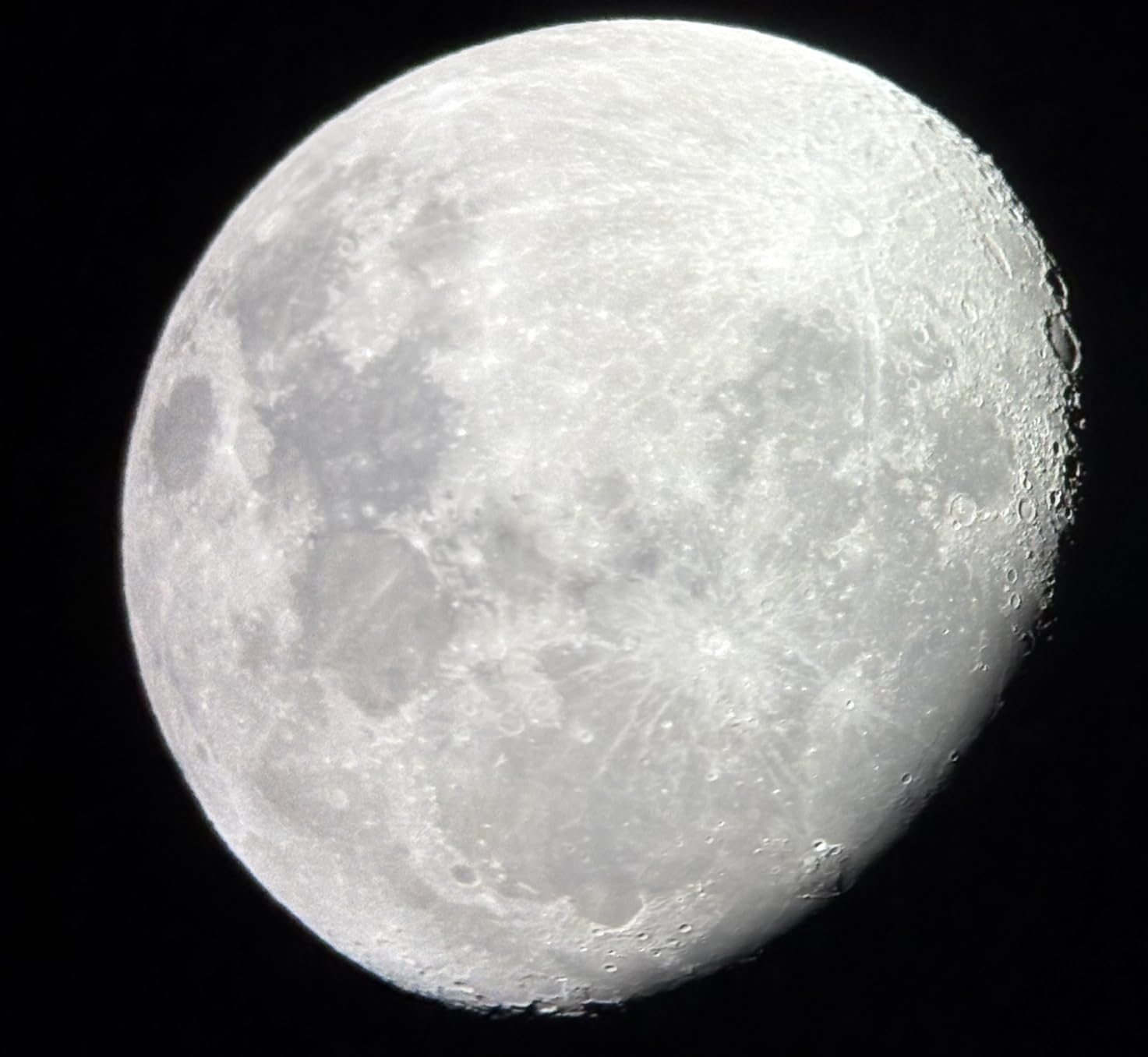
Optical quality is where the budget price shows itself, but not in a deal-breaking way. The center of the field is sharp and contrasty on planets. Toward the edge of the 40-to-57-degree field you will notice some softness and minor chromatic aberration on bright stars.
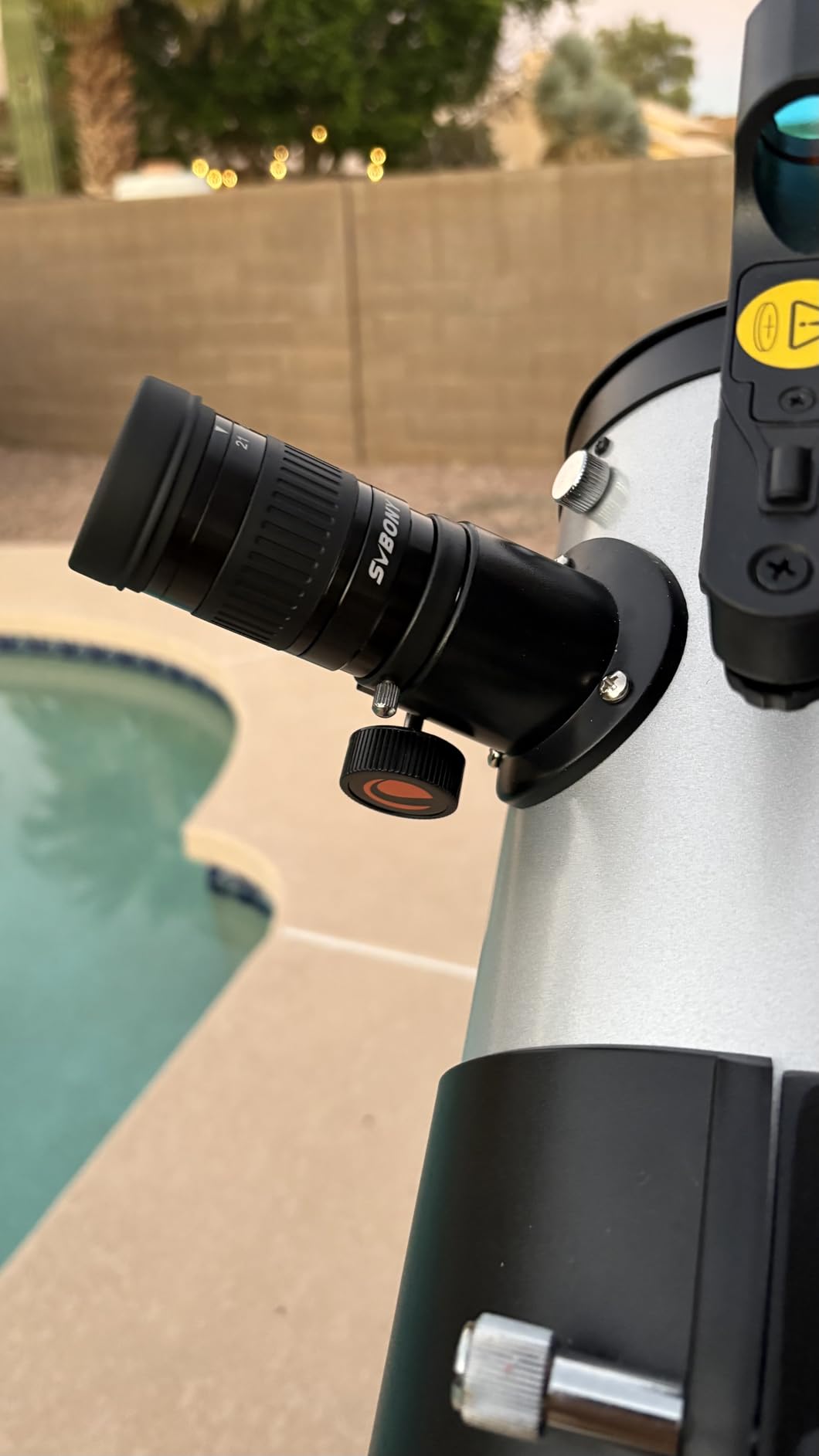
The build, however, punches well above the price. The body is full metal, the zoom action is firm but smooth, and the rubber eyeguard blocks stray light effectively. The 18mm eye relief is comfortable even with glasses, which is rare in this price range.
Ideal use cases
This is my top pick for a beginner’s first upgrade eyepiece. If you received a telescope with one or two cheap eyepieces and want to expand your options without spending hundreds, the SV135 covers an enormous range of magnifications in one piece.
It is also ideal for grab-and-go setups, travel scopes, and outreach events where you want one versatile eyepiece rather than a fragile case of glass. Kids and casual observers love the zoom feature because it feels interactive and forgiving.
Limitations to set expectations
Serious planetary observers will want more contrast and edge sharpness than this eyepiece can deliver. Some users report internal reflections when viewing bright objects like Jupiter or the Moon, though a slight head tilt usually resolves the issue.
If you eventually invest in premium wide-angle eyepieces, the SV135 still serves as a capable backup or a loaner for friends at star parties. At this price, it is hard to be disappointed.
5. SVBONY SV154 SWA 70 Degree 15mm – Best Budget Wide-Angle
SVBONY SV154 Telescope Eyepiece 1.25 inch SWA 70 Degree 15mm Super Wide Angle Telescope Accessory with Twist Up Eyecups
70-degree super-wide FOV
15mm focal length
5-element 4-group design
13mm eye relief
Twist-up eyecups
Pros
- Immersive 70-degree wide field
- Sharp high-contrast images
- Excellent value versus premium brands
- Solid metal construction
- Twist-up eyecups for comfort
Cons
- Slight edge sharpness falloff
- Stiff twist-up eyecup
- Limited stock availability
The SVBONY SV154 is the eyepiece that surprised me most in 2026. For a fraction of what a Tele Vue Panoptic or Explore Scientific 68-degree costs, this 70-degree super-wide-angle eyepiece delivers genuinely immersive views with sharp central performance. On my 4-inch refractor, the Orion Nebula looked better through this eyepiece than through my old 50-degree Plossl at the same magnification.
The 70-degree apparent field of view is the sweet spot for wide-angle observing. It is wide enough to feel immersive without the kidney-bean blackouts that sometimes plague ultra-wide 100-degree designs. Eye placement is forgiving, and the 13mm eye relief works well for most users.
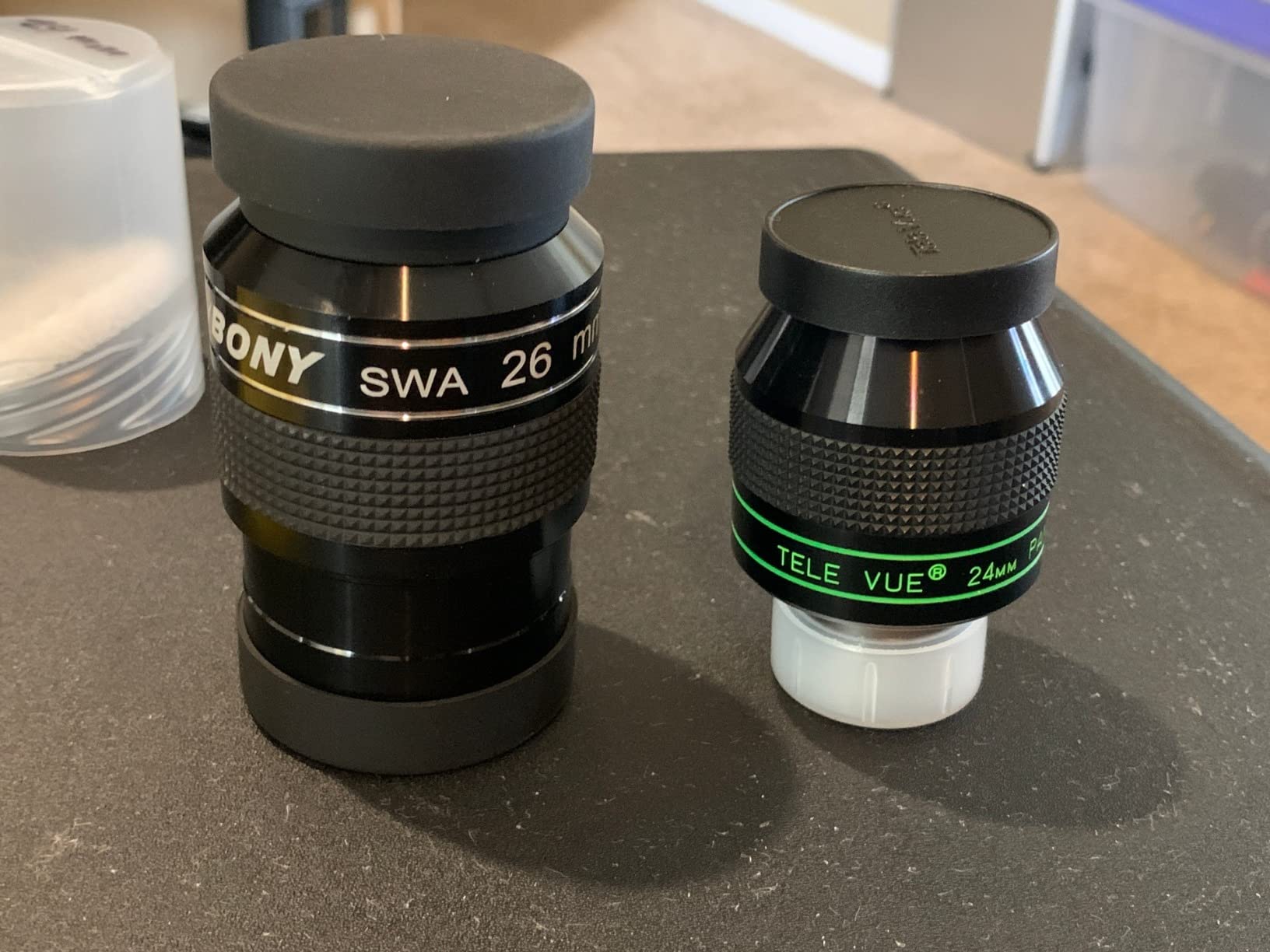
Optically, the 5-element design with blackened lens edges delivers good contrast and minimal internal reflections. On globular clusters like M13, I could resolve stars cleanly to the core with a dark sky background. The high-index glass produces crisp star images across most of the field.
Toward the edge of the field, expect some softness on fast telescopes. On my F/5 Newtonian, the outer 15 percent of the field shows star elongation. On slower F/10 scopes, the field is noticeably sharper edge-to-edge. This is a common tradeoff for budget wide-angle designs.
Where this eyepiece shines
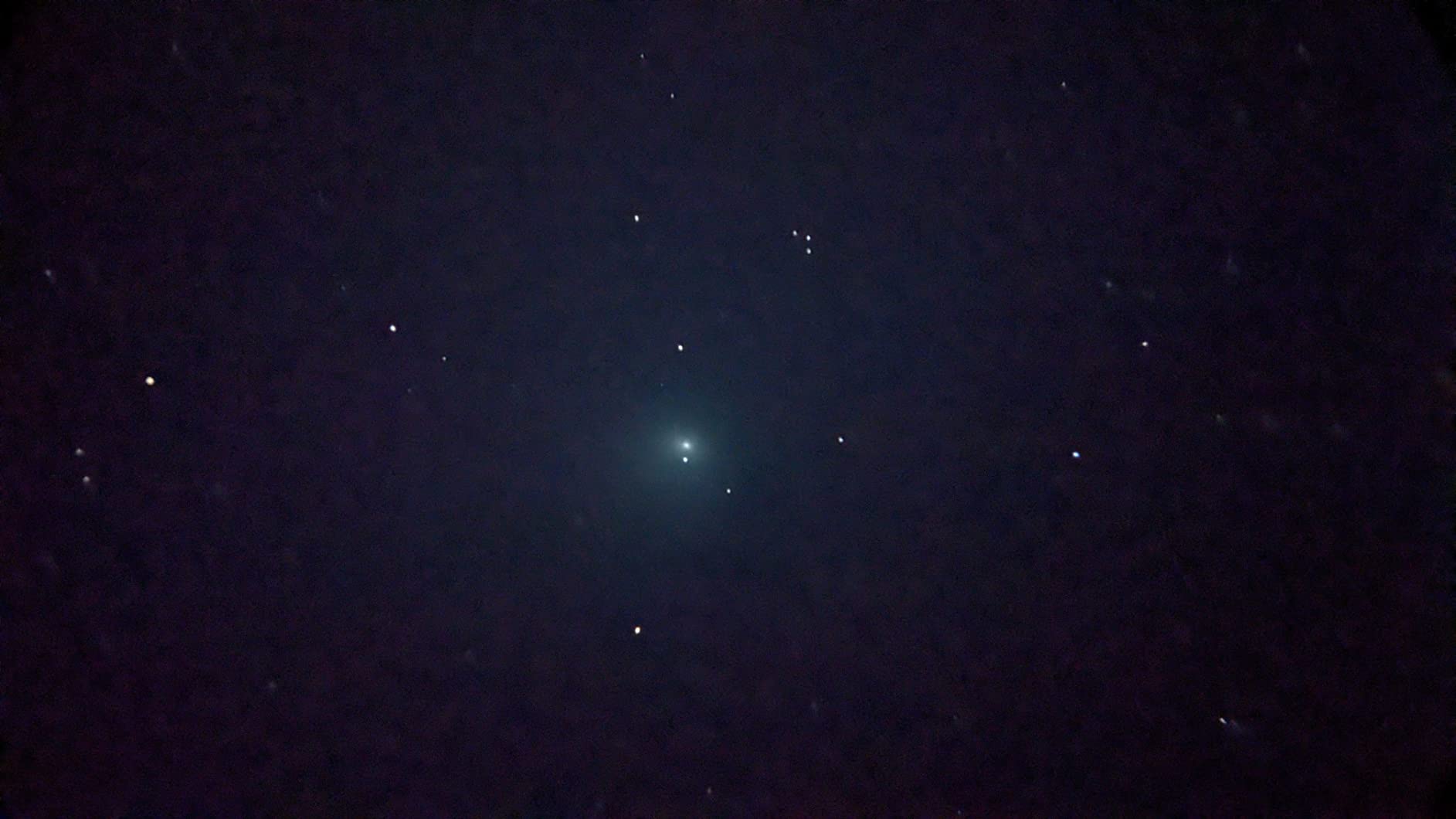
This is my favorite budget eyepiece for sweeping the Milky Way and observing large nebulae. The 70-degree field frames the Pleiades beautifully and gives you enough real estate to fit the entire Orion Nebula complex with room to spare.
It is also a great middle-distance deep-sky eyepiece. On most telescopes, 15mm gives you moderate magnification with a still-generous field, which is exactly what you want for galaxy hunting and large open clusters.
Build and ergonomics
The full-metal body feels solid and well-machined. The twist-up eyecup is useful but slightly stiff at first, which actually helps it hold position once set. The safety undercut prevents the eyepiece from slipping out of the focuser when loosened, a thoughtful detail at this price.
If you want the wide-angle experience without paying Tele Vue prices, this is the eyepiece I recommend first. It is the closest thing to a budget Panoptic I have used.
6. SVBONY 68 Degree 6mm – Best Budget Planetary Eyepiece
SVBONY Telescope Eyepiece, 68 Degree Ultra Wide Angle Eyepiece 6mm, High Definition Fully Coated Telescope Accessories for Planetary Observation
68-degree ultra-wide FOV
6mm focal length
17mm eye relief
FMC coating
1.25 inch barrel
Pros
- Excellent value for planetary viewing
- 17mm comfortable eye relief
- 68-degree wide field helps tracking
- All-metal durable construction
- Reveals lunar and planetary detail
Cons
- High magnification needs good seeing
- Some internal reflections
- Not ideal for deep-sky
The SVBONY 6mm 68-degree is the planetary eyepiece I reach for when the atmosphere is steady and I want to push magnification without spending triple digits. On my 8-inch Dobsonian, this eyepiece produces 200x, which is the sweet spot for resolving Saturn’s Cassini Division and tracking Jupiter’s Galilean moons.
What makes this eyepiece work for planetary observation is the combination of short focal length and a wide 68-degree field. Traditional short-focal-length eyepieces have tiny fields that make objects drift out quickly, especially on manual Dobsonian mounts. The wider field gives you more time before you need to nudge the scope.
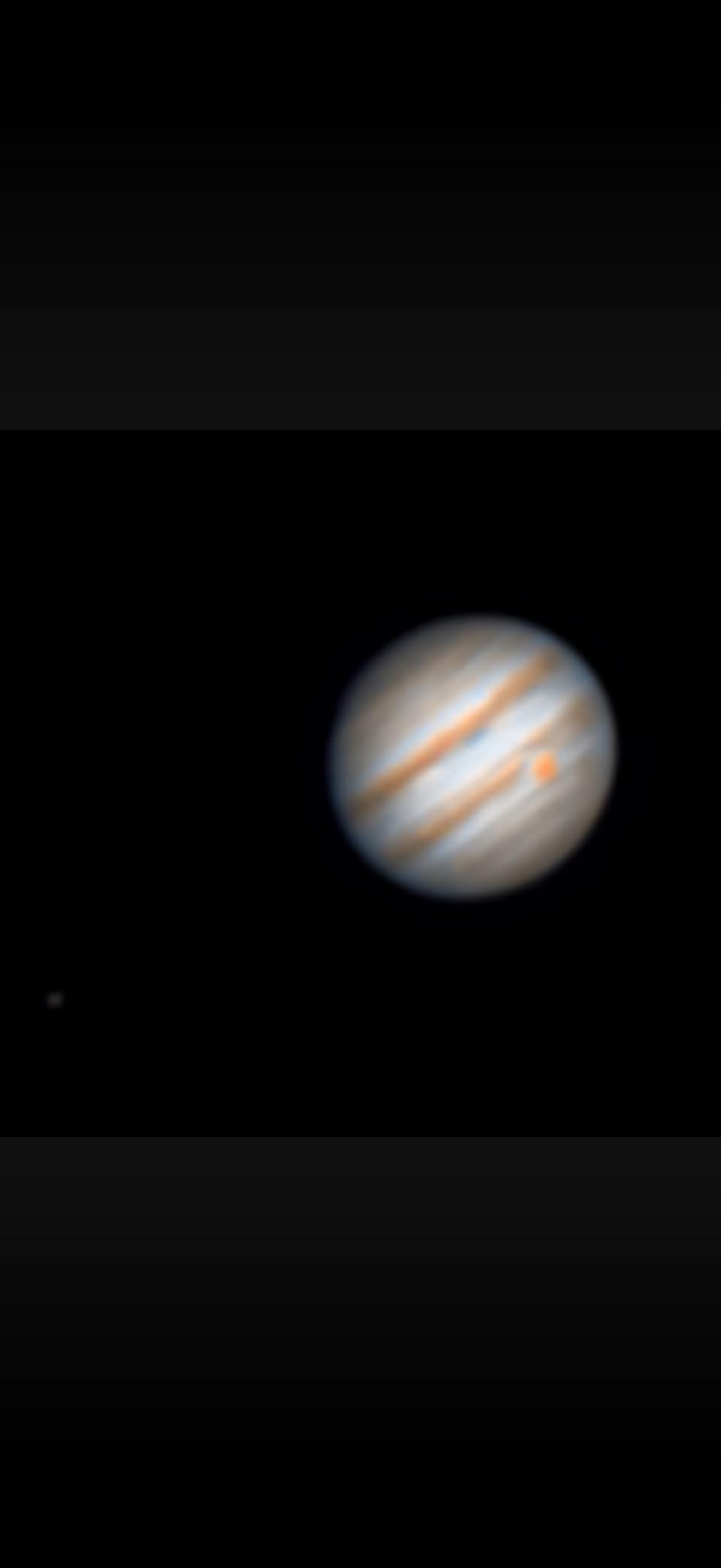
The fully multi-coated optics deliver bright images with reasonable contrast. On steady nights, I have clearly seen cloud belts on Jupiter, the polar cap on Mars at opposition, and razor-sharp lunar rilles. The blackened interior helps reduce stray light, which matters when you are trying to tease out subtle planetary detail.
The 17mm eye relief is generous for a 6mm eyepiece. Many short-focal-length designs have punishingly short eye relief that forces you to press your eye against the glass. This one is comfortable even for glasses wearers, though you may lose a small amount of the field edge with glasses on.
When to use this eyepiece
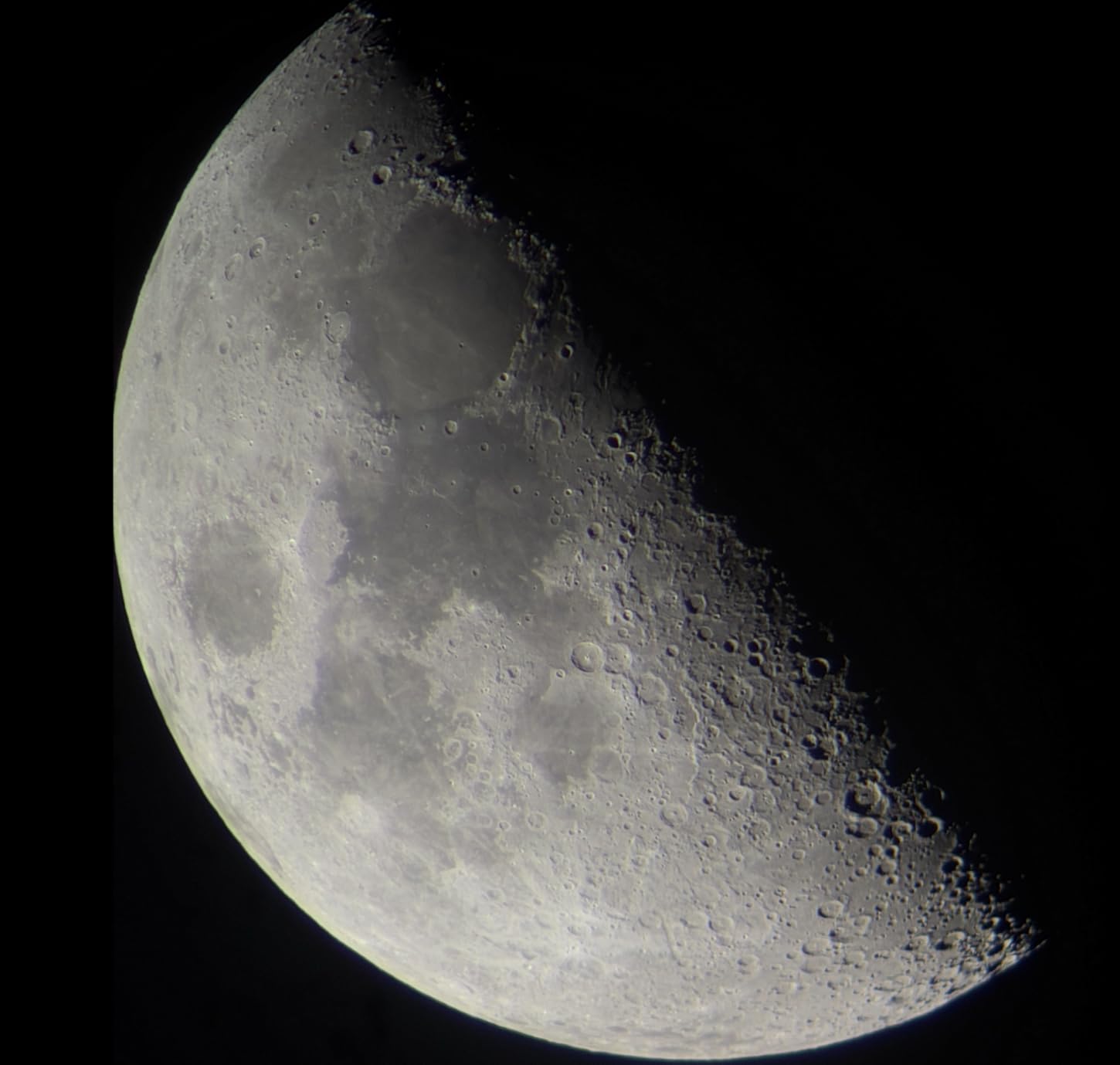
This is a specialist eyepiece designed for high-magnification work on the Moon and planets. On a telescope with 1200mm focal length, the 6mm gives you 200x, which is right at the practical magnification limit for most atmospheric conditions.
It also works well for splitting tight double stars. The close binary pairs in the Double Double (Epsilon Lyrae) resolve cleanly, and the contrast is good enough to spot faint companions on brighter primary stars.
Limitations and sky conditions
High magnification is only useful when the atmosphere cooperates. On nights of poor seeing, this eyepiece will simply magnify the turbulence and produce a wobbling, blurry image. Always check the jet stream forecast and local seeing before pushing past 200x.
This is not a deep-sky eyepiece. The 6mm focal length produces too much magnification and too small an exit pupil for most nebulae and galaxies. Pair it with a low-power wide-angle eyepiece and you have a complete budget observing kit.
How to Choose the Best Telescope Eyepieces?
Picking the right eyepiece comes down to understanding a handful of specifications and matching them to your telescope and your targets. The best telescope eyepieces balance focal length, field of view, eye relief, and optical quality in a way that fits your observing style.
1. Focal length and magnification
Magnification equals your telescope’s focal length divided by the eyepiece focal length. A 1200mm telescope with a 10mm eyepiece gives you 120x. Short eyepiece focal lengths mean higher magnification, longer focal lengths mean lower power and wider views.
Most observers need three magnification ranges: low power (about 30x to 50x) for large nebulae and star fields, medium power (about 80x to 150x) for galaxies and clusters, and high power (about 200x to 300x) for planets and lunar detail. Build your kit around these three zones.
A practical upper limit is roughly 50x per inch of aperture, but the atmosphere usually caps useful magnification at around 250x to 300x regardless of telescope size. Pushing beyond that on most nights just magnifies the turbulence.
2. Apparent field of view (AFOV)
AFOV is the angular width of the view you see through the eyepiece, measured in degrees. Standard Plossl eyepieces offer about 50 to 52 degrees. Wide-angle designs range from 60 to 70 degrees. Ultra-wide designs push 82 degrees and beyond.
Wider fields make objects easier to find, give you more time before drift on manual mounts, and create a more immersive experience. The tradeoff is cost and sometimes tighter eye relief. For beginners, 50 to 60 degrees is comfortable. For deep-sky enthusiasts, 70 degrees or wider becomes addictive.
3. Eye relief
Eye relief is the distance your eye can be from the eyepiece lens while still seeing the full field. Long eye relief (15mm or more) is essential for glasses wearers. Short eye relief (under 10mm) forces you to press your eye against the glass, which is uncomfortable and can fog the lens.
If you wear glasses to observe, look for eyepieces with at least 15mm of eye relief. Many modern wide-angle designs advertise long eye relief, but actual usable eye relief can be shorter than claimed. Reading user reviews is the best way to confirm real-world comfort.
4. Exit pupil
Exit pupil is the diameter of the beam of light leaving the eyepiece, calculated as eyepiece focal length divided by telescope focal ratio. A 30mm eyepiece on an F/5 scope produces a 6mm exit pupil. A 6mm eyepiece on the same scope produces a 1.2mm exit pupil.
Large exit pupils (4mm to 7mm) are ideal for deep-sky objects because they deliver bright images. Small exit pupils (0.5mm to 2mm) are best for planets because they increase contrast and reveal fine detail. Match your exit pupil to your target for the best results.
5. Barrel size: 1.25 inch vs 2 inch
Most consumer telescopes accept 1.25-inch eyepieces, which cover the vast majority of focal lengths you will use. Two-inch eyepieces are needed for very low magnification wide-field viewing with long focal lengths (typically 30mm and longer) because the 1.25-inch barrel limits the field stop diameter.
If your telescope has a 2-inch focuser or a 1.25-inch adapter, you can use either size. For most beginners, 1.25-inch eyepieces are all you need for the first year or two of observing.
6. Barlow lenses
A Barlow lens is a negative lens that multiplies the magnification of any eyepiece. A 2x Barlow turns your 20mm eyepiece into a 10mm eyepiece, effectively doubling your eyepiece collection. For beginners on a budget, a quality Barlow is one of the highest-value accessories you can buy.
The tradeoff is that a Barlow adds two more glass elements to the light path, which can slightly reduce contrast. Premium Barlows use ED glass and multi-coatings to minimize this, while cheap Barlows can noticeably degrade image quality.
FAQs
What are the best telescope eyepieces for viewing planets?
For planetary viewing you want high magnification (200x to 300x) with a small exit pupil around 0.5mm to 1.5mm. Short-focal-length eyepieces like the SVBONY 6mm 68-degree or the Celestron X-Cel LX line work well. Look for eyepieces with good contrast and minimal internal reflections, since planetary detail is subtle.
How do I choose the right eyepiece for my telescope?
Start by calculating magnification (telescope focal length divided by eyepiece focal length). Aim for three eyepieces covering low, medium, and high power. Check barrel size compatibility (1.25 inch or 2 inch), consider eye relief if you wear glasses, and match field of view to your targets: wide for deep sky, narrower for planets.
What is the difference between Plossl and wide-angle eyepieces?
Plossl eyepieces are 4-element designs with about a 50 to 52 degree apparent field of view. They are affordable, sharp, and reliable. Wide-angle eyepieces use more complex optical designs with 6 or more elements to deliver fields of 60 to 100 degrees, creating a more immersive view at higher cost and sometimes with tighter eye relief.
What eyepiece magnification do I need for deep sky objects?
Deep-sky objects generally need low to medium magnification (30x to 150x) with a large exit pupil (3mm to 7mm) for maximum image brightness. A 25mm to 32mm eyepiece on most telescopes gives you the wide field and bright image you need for nebulae, galaxies, and large clusters.
What is a good budget eyepiece for beginners?
The SVBONY SV135 7-21mm zoom is the best budget eyepiece for beginners because it replaces a full set for under $50. The Celestron 5-piece Plossl accessory kit is another excellent starter option that includes five eyepieces, a Barlow, and filters in one organized case.
Final Thoughts on the Best Telescope Eyepieces in 2026
The right eyepiece transforms your telescope. The Celestron Accessory Kit remains my top overall pick because it gives new observers everything they need in one box. The Celestron 8-24mm Zoom wins on convenience, and the Explore Scientific 14mm 82-degree is the premium upgrade worth saving for.
For budget-conscious observers, the SVBONY lineup delivers remarkable value across zoom, wide-angle, and planetary designs. Whatever your scope and sky, the best telescope eyepieces in 2026 are the ones that match your targets, fit your focuser, and get you outside looking up more often. Clear skies.