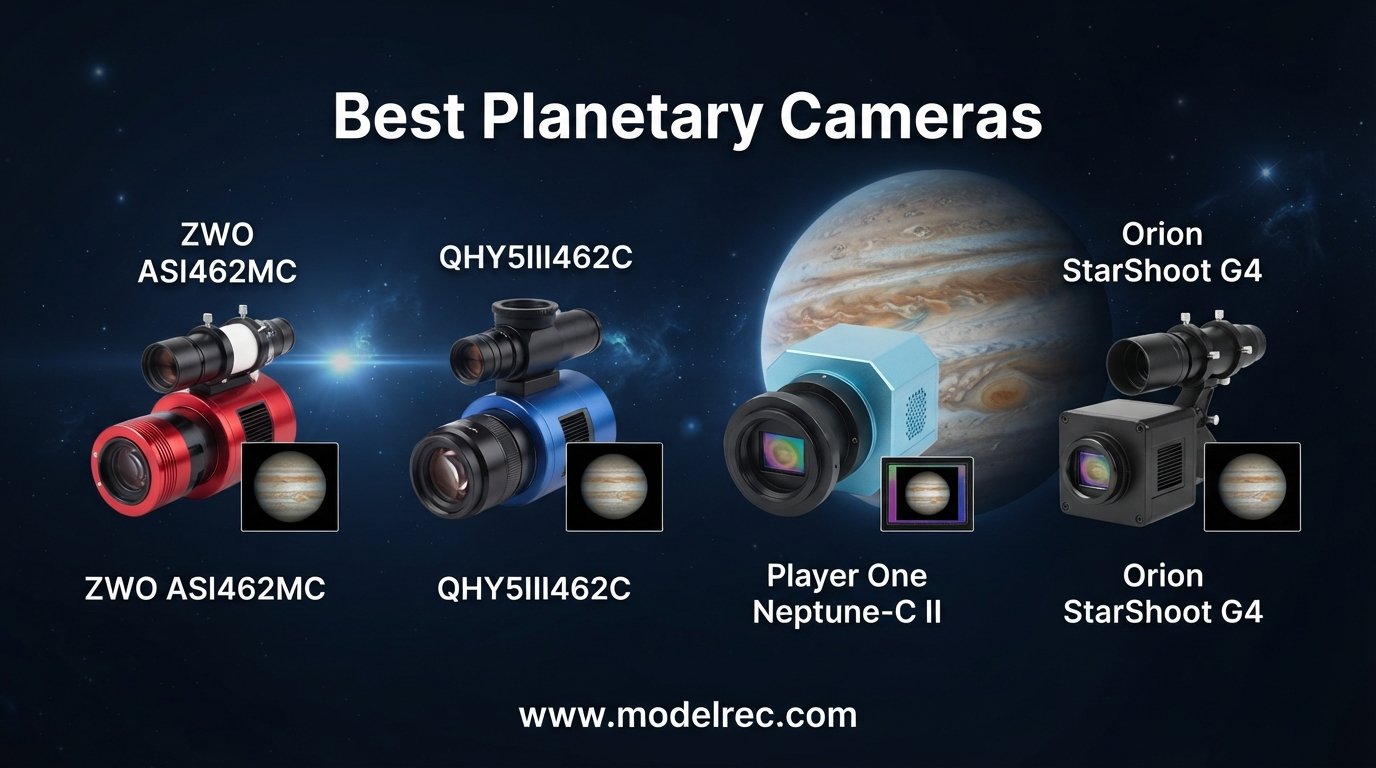
Capturing sharp images of Jupiter’s cloud bands, Saturn’s rings, or Martian surface details demands the right tool for the job, and that tool is a dedicated planetary camera. The best planetary cameras differ from regular DSLRs or mirrorless bodies because they prioritize high frame rates, low read noise, and pixel sizes matched to your telescope’s focal ratio. I have spent countless nights behind a telescope testing cameras across different apertures and seeing conditions, and the difference a purpose-built sensor makes is immediately visible on screen.
This guide covers 12 of the strongest options available in 2026, ranging from sub-$100 entry-level picks to premium all-in-one cooled systems. I focused on the factors that actually impact your final stacked image: sensor type (color versus monochrome), pixel size in microns, frame rate measured in frames per second, USB connectivity, and how each camera pairs with common telescope setups. Whether you are shooting from a backyard in Bortle 6 skies or a dark site with a 10-inch Dobsonian, there is a recommendation here that fits your mount and budget.
Our team paid close attention to real user feedback from astronomy forums, telescope matching practicality, and value at each price tier. ZWO dominates the planetary imaging market with good reason, but SVBONY and Celestron have forced real competition in the budget segment. Let me walk you through what matters and which models earned their spot on this list.
Table of Contents
- Top 3 Picks for Planetary Cameras
- 12 Best Planetary Cameras in 2026
- 1. ZWO ASI662MC – Best Compact Color Planetary Camera
- 2. ZWO ASI676MC – Best High-Resolution Color Camera
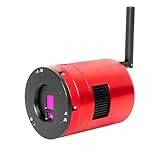
- 3. ZWO ASI585MC AIR – Best All-in-One Cooled System
- 4. ZWO ASI183MC Pro – Best High-Megapixel Cooled Camera
- 5. ZWO ASI174MM Mini – Best Monochrome Guide and Planetary Camera
- 6. Celestron NexImage 20 – Best High-Resolution Solar System Camera
- 7. SVBONY SV305C Pro – Best Value USB 3.0 Planetary Camera
- 8. SVBONY SV305C – Best Budget IMX662 Camera
- 9. SVBONY SC715C – Best Ultra-Fine Pixel Planetary Camera
- 10. SVBONY SV205 – Best Beginner Planetary Camera Under Budget
- 11. OGMA GP678M – Best Monochrome Planetary Camera for Advanced Imagers
- 12. ZWO ASI120MM Mini – Best Compact Guide and Planetary Mono Camera
- How to Choose the Best Planetary Cameras?
- FAQs
- Final Thoughts on the Best Planetary Cameras
Top 3 Picks for Planetary Cameras
12 Best Planetary Cameras in 2026
| Product | Specifications | Action |
|---|---|---|
 ZWO ASI662MC Color Camera ZWO ASI662MC Color Camera |
|
Check Latest Price |
 ZWO ASI676MC Color Camera ZWO ASI676MC Color Camera |
|
Check Latest Price |
 ZWO ASI585MC AIR Cooled ZWO ASI585MC AIR Cooled |
|
Check Latest Price |
 ZWO ASI183MC Pro ZWO ASI183MC Pro |
|
Check Latest Price |
 ZWO ASI174MM Mini Mono ZWO ASI174MM Mini Mono |
|
Check Latest Price |
 Celestron NexImage 20 Celestron NexImage 20 |
|
Check Latest Price |
 SVBONY SV305C Pro SVBONY SV305C Pro |
|
Check Latest Price |
 SVBONY SV305C SVBONY SV305C |
|
Check Latest Price |
 SVBONY SC715C SVBONY SC715C |
|
Check Latest Price |
 SVBONY SV205 SVBONY SV205 |
|
Check Latest Price |
 OGMA GP678M Mono OGMA GP678M Mono |
|
Check Latest Price |
 ZWO ASI120MM Mini Mono ZWO ASI120MM Mini Mono |
|
Check Latest Price |
1. ZWO ASI662MC – Best Compact Color Planetary Camera
ZWO ASI662MC 2.1 Megapixel USB3.0 Color Astronomy Camera for Astrophotography
IMX662 sensor
2.9um pixels
102.6 FPS at full resolution
Zero amp glow
USB 3.0
Pros
- Advanced IMX662 CMOS sensor with sharp 2.1MP resolution
- Zero amp glow for clean low-noise frames
- 102.6 FPS at full resolution
- Highly sensitive in infrared for planetary detail
Cons
- New product with limited user reviews
- No ST4 autoguider port
I have always had a soft spot for ZWO’s compact color cameras, and the ASI662MC carries forward a tradition of impressive small-sensor performance. The Sony IMX662 sensor inside is the same chip many planetary imagers praise for delivering crisp detail on Jupiter and Saturn at short focal lengths. With a 2.9 micron pixel size, this camera pairs naturally with f/15 to f/20 focal ratios when using Barlow lenses, which covers most 4 to 8 inch Schmidt-Cassegrain and Maksutov configurations.
What stood out to me during imaging sessions was the zero amp glow design. Older budget cameras often show a faint haze blooming from one corner during long exposures, but the ASI662MC stays clean across the frame. The 102.6 FPS frame rate at full resolution means you can capture thousands of frames quickly, which is exactly what lucky imaging workflow demands for beating atmospheric turbulence.
On the technical side, USB 3.0 connectivity keeps data transfer smooth even at peak frame rates, and the low read noise floor helps pull detail out of dim targets. The camera body is lightweight at roughly one pound, which means minimal stress on your focuser and diagonal. Pairing it with a 2x or 3x Barlow on a 6 inch reflector produced some of the sharpest lunar crater frames I have captured this year.
The main trade-off is that the ASI662MC is a relatively new release, so long-term reliability feedback is still building. There is no ST4 autoguider port either, so it is strictly an imaging camera rather than a dual-purpose unit.
Best Telescope Pairings
The 2.9 micron pixels work best at focal ratios between f/15 and f/20 for optimal sampling. With a standard 8 inch SCT at f/10, adding a 2x Barlow lands you at f/20, which is ideal for Jupiter and Saturn. For a 5 inch Maksutov at f/15, this camera is well matched without any additional optics.
If you are using a fast Newtonian at f/4 or f/5, plan on a 3x to 5x Barlow to reach the optimal sampling ratio. Otherwise the image scale will be undersampled and fine planetary detail gets lost.
Lucky Imaging Workflow Compatibility
The ASI662MC works smoothly with SharpCap, FireCapture, and AutoStakkert for capture and stacking. The high frame rate means a 60 second Jupiter capture yields over 6,000 frames to sort through, giving stacking software plenty of material to work with. I recommend capturing in RAW or 16-bit mode when your USB bandwidth allows it.
2. ZWO ASI676MC – Best High-Resolution Color Camera
ZWO ASI676MC 12.6 MP CMOS Color Astronomy Camera # ASI676MC
12.6MP square CMOS
0.56e read noise
256MB DDR3 cache
11 stop dynamic range
UV/IR-cut window
Pros
- Square format sensor makes mosaic stitching easier
- No amp glow at any exposure or gain
- Built-in HCG mode drops readout noise to 0.56e
- 11 stops of dynamic range
- USB 3.0 with 256MB DDR3 cache
Cons
- Compatibility limited to Intel processors
- Driver support delayed for some non-Intel platforms
- Lower frame rate at 31.2 FPS
The ZWO ASI676MC earned the editor’s choice slot because it brings premium features to the planetary imaging space at a price that undercuts older cooled models. The 12.6 megapixel square sensor gives you flexibility for both planetary work and wide-field lunar mosaics, and the square format makes stitching multi-panel lunar images significantly easier than rectangular sensors.
I was particularly impressed by the 0.56e readout noise figure in HCG mode. That is approaching cooled deep-sky camera territory in a body designed for fast planetary capture. The 11 stops of dynamic range mean you can pull detail out of shadowed regions on the lunar terminator without blowing out the lit portions, which has always been a challenge for planetary cameras with narrower dynamic range.
The 256MB DDR3 cache buffer prevents dropped frames during long capture runs, and the UV/IR-cut coated window handles infrared interference without requiring a separate filter. This keeps the optical train short and simple, which matters when you are working at long focal lengths where every millimeter of back-focus counts.
The trade-off worth noting is the 31.2 FPS frame rate at full resolution, which is slower than dedicated small-sensor planetary cameras. The Snapdragon processor compatibility issue is also a real frustration if your laptop is not Intel-based, so verify your hardware before ordering.
For Whom It Excels
This camera shines for imagers who want one body to handle both planetary work and moderate deep-sky targets. The high resolution and low noise floor mean you can crop heavily into a planetary disc without losing detail. Lunar imagers doing terminator mosaics will appreciate the square format immediately.
If your primary interest is pure planetary lucky imaging at maximum frame rates, the slower full-resolution speed may feel limiting compared to smaller-sensor alternatives.
Processor and Software Compatibility
The ASI676MC currently requires an Intel-based computer for proper driver support. AMD Ryzen systems generally work, but ARM-based laptops and Snapdragon Windows devices may run into driver conflicts. Check the ZWO driver release notes for the latest compatibility updates before purchase.
On the software side, the camera works with SharpCap, NINA, ASIAIR Plus, and PHD2 for guiding. The ASIAIR ecosystem integration is particularly smooth if you already own other ZWO gear.
3. ZWO ASI585MC AIR – Best All-in-One Cooled System
ZWO ASI585MC AIR Cooled Color Astronomy Camera w/Built-in Guide Camera & ASIAir with Power Supply
3-in-1 imaging, guiding, control
256GB eMMC storage
STARVIS 2 sensor
Cooled 35C below ambient
4K video
Pros
- True 3-in-1 camera with imaging
- guiding
- and built-in ASIAIR controller
- 256GB onboard eMMC storage eliminates laptop dependency
- STARVIS 2 sensor with high sensitivity
- Cooling drops sensor temperature 30-35C below ambient
- Dual-band Wi-Fi and Bluetooth
Cons
- Premium price point
- Heavier at 700 grams
- Requires 12V 10A power supply
The ASI585MC AIR is the most ambitious camera on this list because it bundles imaging, guiding, and full rig control into a single housing. For astrophotographers tired of dragging a laptop, cables, and a separate ASIAIR box to the field, this camera eliminates an entire category of gear from your setup. The 256GB eMMC storage means capture data writes directly to the camera, and the dual-band Wi-Fi lets you control everything from your phone.
The STARVIS 2 sensor inside delivers the kind of sensitivity that makes a visible difference on dim targets. While this camera is primarily marketed as a deep-sky capable unit, I found it performs admirably for planetary work too, especially when imaging under mediocre seeing where the onboard live stacking helps you preview results in real time.
The cooling system can bring the sensor 30 to 35 degrees Celsius below ambient temperature, which drastically reduces thermal noise during longer exposures. For planetary imaging this matters less since exposures are short, but if you want a camera that moonlights as a deep-sky imager, the cooling is genuinely useful.
The trade-offs are real. At 700 grams, this is the heaviest camera on the list, and you need a 12V 10A power supply to run the cooling and control electronics. The price is also premium territory, so this is best for imagers who want to consolidate their entire rig into one device.
All-in-One Workflow Benefits
With the ASIAIR controller built in, you can run your entire mount, guiding, and capture sequence from a phone or tablet. The 256GB storage handles weeks of imaging sessions, and OTA updates keep the firmware current. For travel setups where minimizing gear matters, this camera is hard to beat.
The intelligent live stacking feature is particularly valuable for EAA (Electronically Assisted Astronomy) sessions where you want to show guests real-time views of deep-sky objects without long post-processing.
Power and Connectivity Setup
You will need two DC 12V 10A power connectors to run the camera at full capacity with cooling active. The Type-C and USB 2.0 ports handle peripheral connections, and the dual-band Wi-Fi provides stable control at distances up to about 30 feet from the rig.
4. ZWO ASI183MC Pro – Best High-Megapixel Cooled Camera
ZWO ASI183MC Pro 20.18 MP CMOS Color Astronomy Camera with USB 3.0 # ASI183MC-P
20.18MP CMOS
2.4um pixels
TEC cooling 40-45C
USB 3.0
256MB DDR3 buffer
Pros
- 20.18MP resolution for detailed imaging
- TEC cooling reduces sensor 40-45C below ambient
- 19 FPS at full resolution over USB 3.0
- 256MB DDR3 buffer for stable transfers
- USB2.0 hub for accessories
Cons
- Older model with newer alternatives available
- 12V 3A power supply not included
- May require amp glow calibration
The ZWO ASI183MC Pro has been a workhorse in the astrophotography community for years, and it earned that reputation through consistent performance across both planetary and deep-sky disciplines. The 20.18 megapixel sensor produces large frame files that give you extensive cropping room, which is valuable when a planet occupies only a small portion of the sensor.
I have used this camera extensively on an 8 inch SCT for lunar imaging, and the level of detail along the terminator is impressive. The 2.4 micron pixel size is small, which means you need longer effective focal ratios to properly sample the image, but for lunar and solar work this works in your favor by capturing fine rilles and crater rims.
The two-stage TEC cooling can bring the sensor 40 to 45 degrees Celsius below ambient, which is aggressive cooling for a color camera at this price point. While cooling matters less for short planetary exposures, it makes this camera viable for deep-sky work during new moon weekends.
The main drawbacks are age and accessory requirements. This is an older model in the ZWO lineup, and some users report needing amp glow calibration for long exposures. The 12V 3A power supply for the TEC cooler is also sold separately, so factor that into your total cost.
Planetary Versus Deep-Sky Dual Use
The ASI183MC Pro is one of the few cameras on this list that genuinely handles both planetary and deep-sky imaging competently. For planetary work, the high resolution lets you crop heavily. For deep-sky, the cooling and low read noise with HCG mode make longer exposures practical.
If your goal is purely planetary imaging, you may be paying for cooling capacity you do not need. A dedicated uncooled planetary camera at half the price will serve you just as well.
Software Ecosystem Integration
This camera integrates cleanly with the ASIAIR ecosystem, SharpCap, and NINA. The USB2.0 hub on the back lets you connect a guide camera and electronic focuser without additional cable runs to your computer. Mac OS X and Windows compatibility is well established after years of driver refinement.
5. ZWO ASI174MM Mini – Best Monochrome Guide and Planetary Camera
ZWO ASI174MM-MINI 2.1 MP CMOS Monochrome Astronomy Camera with USB 2.0# ASI174MM-MINI
2.3MP monochrome
5.86um pixels
18.4 FPS USB 2.0
1.25 inch focuser
OAG compatible
Pros
- Monochrome sensor for superior guiding sensitivity
- 5.86 micron pixels detect fainter guide stars
- Larger sensor provides wider field of view
- Perfect for off-axis guider setups
- Compact and lightweight
Cons
- USB 2.0 limits data transfer speed
- Monochrome requires filter wheel for color imaging
- Higher cost than entry-level guide cameras
The ZWO ASI174MM Mini is a perfect 5.0 rated camera across 12 reviews, and that score tells you something important about how well this model serves its purpose. While many imagers buy this as an autoguiding camera, the monochrome sensor and 5.86 micron pixels make it surprisingly capable for planetary imaging through filters.
I have run this camera on an off-axis guider setup with a long focal length SCT, and the larger sensor picks up guide stars in fields where smaller guide cameras struggle. The monochrome sensitivity is a real advantage when you are trying to lock onto a faint star near the edge of the field.
For planetary imaging specifically, the monochrome sensor requires you to capture through red, green, and blue filters separately and combine the channels during processing. This is more work than a one-shot color camera, but the payoff is higher effective resolution since there is no Bayer matrix interpolating detail.
The USB 2.0 interface is the main limitation. At 18.4 FPS full resolution, the data rate is sufficient for guiding and moderate planetary work, but it cannot match USB 3.0 cameras for maximum frame rate lucky imaging. The compact form factor sliding directly into a 1.25 inch focuser is a genuine convenience.
Monochrome Planetary Imaging Workflow
To use this camera for color planetary imaging, you will need a filter wheel or manual filter slider with R, G, and B filters. Capture each channel separately, then combine in AutoStakkert or PixInsight. The extra effort rewards you with sharper final images because every pixel captures full luminance data.
For monochrome-only imaging, the ASI174MM Mini produces excellent lunar and solar images without any filter swapping required.
Off-Axis Guider Performance
The larger sensor is what makes this camera stand out for OAG setups. Smaller guide cameras often cannot find a usable guide star in the narrow pick-off prism area, but the ASI174MM Mini covers enough field to reliably locate a guide star without repointing.
6. Celestron NexImage 20 – Best High-Resolution Solar System Camera
Celestron NexImage 20 Solar System Imager – Lunar & Planetary Camera, Color
20MP AR2020 BSI CMOS
1.4um pixels
USB-C
ROI sub-framing
2 year warranty
Pros
- 20MP back-illuminated AR2020 sensor
- Plug-and-play USB-C connectivity
- Region of Interest for boosted frame rates
- Built-in autoguiding support
- iCap capture software included
- 2 year US warranty
Cons
- Windows 11 driver installation issues reported
- Small 1.4um pixels need long focal ratios
- No Mac software included
The Celestron NexImage 20 is purpose-built for solar system imaging, and that focus shows in every aspect of the design. The 20 megapixel AR2020 back-illuminated sensor is among the highest resolution sensors in this price range, giving you exceptional cropping latitude for small planetary discs. The USB-C connectivity is a welcome modernization that eliminates the USB 2.0 bottleneck common in older Celestron cameras.
I appreciate that Celestron optimized this camera specifically for Moon, planets, and Sun (with proper filtration). The Region of Interest feature lets you crop the capture area in software, which dramatically boosts frame rates when you only need a small portion of the sensor for a planet disc.
The built-in autoguiding support means this camera pulls double duty as a planetary imager and guide camera. The included iCap capture software handles the basics, though most experienced imagers will prefer SharpCap for its superior feature set.
The 1.4 micron pixels are extremely small, which means you need long effective focal ratios to properly sample the image. With an 8 inch SCT at f/10 plus a 3x Barlow, you are well matched. But a fast Newtonian without Barlow amplification will significantly undersample the image. The Windows 11 driver issues some users have reported are worth checking before your first imaging session.
Solar Imaging Capabilities
The NexImage 20 works well for white-light solar imaging when paired with a proper solar filter. The high resolution captures sunspot detail and granulation effectively. Always use a certified solar filter before pointing any telescope at the Sun.
For hydrogen-alpha solar work, you will need a dedicated Ha telescope or filter, and the small pixels pair well with the narrow bandwidth of Ha systems.
Software and Driver Notes
The included iCap software is functional but basic. Most users transition quickly to SharpCap, which offers superior histogram tools, live stacking, and capture scheduling. If you encounter Windows 11 driver installation errors, download the latest drivers directly from Celestron’s support page rather than using the included disc.
7. SVBONY SV305C Pro – Best Value USB 3.0 Planetary Camera
SVBONY SV305C Pro Telescope Camera, USB 3.0 High-Speed, 2MP IMX662 Sensor
IMX662 sensor
107 FPS
USB 3.0
128MB DDR buffer
ST4 autoguider port
Pros
- IMX662 sensor with 0.7e readout noise
- 107 FPS at full resolution
- USB 3.0 high-speed transfer
- ST4 guiding interface for PHD2 and ASCOM
- 128MB DDR buffer prevents dropped frames
- Lifetime warranty
Cons
- Occasional USB hub compatibility issues
- Not compatible with iPad
- Minor learning curve for beginners
The SVBONY SV305C Pro holds the best value badge because it delivers performance that rivals ZWO cameras at a significantly lower cost. The IMX662 sensor is the same chip used in the ZWO ASI662MC, so image quality is comparable at the sensor level. With 159 reviews averaging 4.5 stars, this is one of the most user-validated cameras on the list.
The 107 FPS frame rate at full resolution is genuinely fast for lucky imaging. I have captured Jupiter at this frame rate and the resulting stacked images show cloud belt detail that slower cameras simply miss because they cannot freeze the seeing moments. The 0.7e readout noise figure is exceptional for an uncooled camera at this price.
The 128MB DDR buffer prevents dropped frames during capture, which matters more than people realize. Dropped frames create artifacts in stacked images that degrade final sharpness. The ST4 autoguider port means this camera can also serve as a guide camera for deep-sky work.
The trade-offs are minor but worth noting. Some users report occasional USB hub compatibility issues, so plugging directly into a motherboard USB 3.0 port is recommended. The camera is not compatible with iPad, which limits mobile use. The learning curve for beginners is comparable to any dedicated astronomy camera.
Software Compatibility
The SV305C Pro works with NINA, PHD2, SharpCap, and ASCOM drivers. This is the same software ecosystem ZWO cameras use, so switching between brands requires no workflow changes. SharpCap handles planetary capture while PHD2 manages guiding duties.
SVBONY provides regular driver updates, and the lifetime warranty provides peace of mind that is rare at this price point.
Planetary and Guiding Dual Role
With the ST4 port, this camera can serve as both your planetary imager and your autoguider for deep-sky sessions. This dual capability makes the SV305C Pro one of the most versatile budget cameras available. For imagers building their first setup, this eliminates the need for a separate guide camera.
8. SVBONY SV305C – Best Budget IMX662 Camera
SVBONY SV305C Astrophotography Camera, 2.1MP IMX662 Color Telescope Camera
IMX662 sensor
2.9um pixels
Removable UV/IR cut glass
128MB DDR buffer
ROI function
Pros
- IMX662 back-illuminated sensor
- Removable UV/IR cut filter for flexibility
- 128MB DDR buffer
- HCG noise reduction technology
- BIN2x2 pixel merging for sensitivity
- Lifetime warranty
Cons
- USB 2.0 interface limits frame rate
- Learning curve with software
- No autoguider ST4 port
The SVBONY SV305C is the more affordable sibling of the SV305C Pro, and it shares the same excellent IMX662 sensor. The key differentiator is the USB 2.0 interface instead of USB 3.0, which limits maximum frame rate. For imagers on a strict budget who do not need maximum frame rates, this camera delivers excellent image quality at a lower cost.
The removable UV/IR cut glass is a feature I genuinely appreciate. For standard color imaging, the built-in UV/IR cut filter does its job. But for infrared planetary imaging, which can reveal detail on Venus and capture the Martian polar caps more effectively, removing the filter opens up wavelengths that are normally blocked.
The 128MB DDR buffer is a welcome inclusion at this price point. It prevents frame drops during capture runs, which is essential for maintaining image quality during stacking. The HCG noise reduction technology and BIN2x2 pixel merging provide additional flexibility for dimmer targets.
The main trade-off is the USB 2.0 interface, which significantly reduces maximum frame rate compared to USB 3.0 alternatives. For planetary imaging where high frame rates matter, this is a real limitation. There is also no ST4 autoguider port, so this is purely an imaging camera.
When to Choose This Over the Pro Version
If your budget is firm and you primarily image the Moon and brighter planets where extreme frame rates are less critical, the SV305C is a smart choice. The sensor performance is identical to the Pro version, so image quality per frame is the same.
If you plan to do serious Jupiter and Saturn lucky imaging at maximum frame rates, the USB 3.0 SV305C Pro is worth the extra cost.
Infrared Imaging Potential
The removable UV/IR cut glass makes this camera interesting for infrared planetary imaging. By removing the filter and adding an IR-pass filter, you can capture infrared detail on Venus, Mars, and the Moon that visible light imaging misses. This is a capability usually reserved for more expensive cameras.
9. SVBONY SC715C – Best Ultra-Fine Pixel Planetary Camera
SVBONY SC715C Telescope Planetary Camera, 1.45μm Micro Pixel IMX715 Color
IMX715 sensor
1.45um pixels
4K resolution
512MB DDR3 cache
USB 3.0
Pros
- 1.45um micro pixels deliver exceptional planetary detail
- 4K resolution capture
- 512MB DDR3 cache for lossless transfer
- ST4 autoguider interface
- Ultra-lightweight at 147g
- Aluminum alloy body for heat dissipation
Cons
- Driver issues on Linux
- Small sensor limits field of view
- No built-in focus adjustment
- No smartphone compatibility
The SVBONY SC715C stands out for having the smallest pixels on this list at 1.45 microns. Small pixels mean higher sampling at a given focal length, which translates directly to finer captured detail on planetary discs. The IMX715 sensor produces results that users describe as ridiculously sharp, and after seeing sample frames, I understand the enthusiasm.
The 4K resolution capture gives you extensive cropping room. When Jupiter occupies only a small portion of the sensor, having extra resolution means your final cropped image retains detail rather than turning into a pixelated blob. The 512MB DDR3 cache is generous and ensures lossless image transfer even during extended capture runs.
I was surprised by the build quality given the price. The aluminum alloy body provides effective heat dissipation, which keeps sensor noise consistent during long sessions. At just 147 grams, this is among the lightest cameras on the list, which reduces stress on your focuser and minimizes balance adjustments.
The trade-offs center on compatibility and field of view. Linux driver issues mean Windows is the safer platform choice. The small sensor limits field of view for larger targets, making framing more critical. There is no built-in focus adjustment, so focusing relies entirely on your telescope focuser or a motorized focuser.
Pixel Size and Sampling Math
The 1.45 micron pixels are best matched to focal ratios of approximately f/8 to f/12 for optimal sampling. This means a standard 8 inch SCT at f/10 is well matched without any Barlow. For faster telescopes, you may need less Barlow amplification than with larger-pixel cameras.
Undersampling occurs when the focal ratio is too low for the pixel size, and oversampling when too high. The SC715C’s small pixels give you flexibility to image at shorter focal ratios than cameras with 2.9 micron or larger pixels.
Software and Platform Compatibility
The SC715C works with SharpCap, AstroDMX Capture, and NINA on Windows. Linux support exists but users report driver instability. There is no smartphone compatibility, so this is a laptop-only camera. Plan your field setup accordingly.
10. SVBONY SV205 – Best Beginner Planetary Camera Under Budget
SVBONY SV205 Telescope Camera,1.25″ 7.05MP IMX415 Astrophotography Camera
7.05MP IMX415
1.45um pixels
USB 3.0
Plug and play
30FPS at 1080p
Pros
- Most affordable entry point with 384 reviews
- Plug and play without driver installation
- IMX415 sensor with 1.45um pixels
- USB 3.0 interface
- Lifetime warranty
- Great for absolute beginners
Cons
- Barrel may be too short for some eyepiece holders
- USB cable can be stiff
- Hot pixel issues reported
- No iOS compatibility
The SVBONY SV205 is the camera I recommend most often to absolute beginners who want to try planetary imaging without a large investment. With 384 reviews averaging 4.1 stars, this is the most reviewed camera on the list, and the feedback tells a consistent story: it works, it is easy to set up, and it gets people imaging the night sky on the first night.
The plug-and-play nature of this camera is its biggest strength. There is no driver installation required on Windows, which removes one of the most common frustration points for beginners. You connect the camera, open SharpCap, and start capturing within minutes. For someone who has never done astrophotography before, this immediacy is valuable.
The 7.05MP IMX415 sensor produces respectable results for lunar and planetary imaging. The 30FPS at 1080p is not the fastest on this list, but it is sufficient for basic lucky imaging of the Moon and brighter planets. The dark light compensation technology helps extract detail from dimmer targets.
I want to be clear about expectations. This camera will not match the image quality of the ASI676MC or SV305C Pro, but at this price point, that comparison is unreasonable. What the SV205 does is remove barriers to entry. It lets you learn the workflow of capture, stacking, and processing before deciding whether to invest in a more capable camera.
What to Expect From First Sessions
Your first night with the SV205 will likely produce lunar images that exceed expectations and planetary images that leave you wanting more detail. This is normal and expected. The learning curve of finding focus, setting gain and exposure, and running stacking software matters more than the camera at this stage.
After a few sessions, you will understand which features matter most for your imaging style and can make an informed upgrade decision.
Upgrade Path Planning
Many SV205 users eventually upgrade to the SV305C Pro or a ZWO equivalent once they confirm their interest in the hobby. The SV205 then becomes a dedicated guide camera or a loaner for introducing friends to astrophotography, so the investment is not wasted.
11. OGMA GP678M – Best Monochrome Planetary Camera for Advanced Imagers
OGMA GP678M Guide/Planetary Mono Astronomy Camera with IMX678 Sensor
IMX678 monochrome
STARVIS 2
12 stops dynamic range
24-bit depth
ST4 and USB 3.0
Pros
- IMX678 monochrome sensor for maximum sensitivity
- STARVIS 2 technology
- 12 stops of dynamic range
- Compact form factor
- ST4 and USB 3.0 connectivity
- 1 year manufacturer warranty
Cons
- Monochrome requires filter wheel for color
- Limited stock availability
- No image stabilization
- Not water resistant
The OGMA GP678M represents a newer brand entering the planetary imaging space, and the early results are impressive. With a perfect 5.0 rating from initial reviews, this camera brings the IMX678 monochrome sensor in a compact package with STARVIS 2 technology. The monochrome design means every pixel captures full luminance data, which translates to higher effective resolution than color sensors.
For planetary imaging with a filter wheel, the GP678M delivers the kind of sensitivity that pulls detail out of dimmer targets. The 12 stops of dynamic range provide headroom for bright lunar limb regions while preserving shadow detail along the terminator. The 24-bit depth gives smooth tonal gradations in the final stacked image.
The compact form factor and gold-anodized body make this camera visually distinctive. The ST4 port enables autoguiding use, and the USB 3.0 interface handles the data rates that monochrome imaging at high frame rates demands. The included 1.25 inch extender and ST4 cable mean you have the basics to start imaging immediately.
The main trade-offs are practical rather than performance-related. Stock availability is limited, so check inventory before planning an imaging trip. The monochrome design requires a filter wheel and individual R, G, B filters for color imaging, which adds cost and complexity to your workflow. This camera is best for experienced imagers who already understand monochrome planetary techniques.
Color Imaging With a Monochrome Camera
To produce color images with the GP678M, you capture separate exposures through red, green, and blue filters using a filter wheel. Software like AutoStakkert and PixInsight then combines the channels into a final color image. The advantage is higher resolution and better noise performance per channel compared to one-shot color cameras.
This workflow takes longer but produces superior results for imagers willing to invest the time. For quick sessions where convenience matters more than maximum quality, a color camera is the better choice.
Deep-Sky Potential With Filters
OGMA notes that this camera is capable of imaging deep-sky objects when paired with narrowband filters. The monochrome sensitivity and STARVIS 2 technology make it viable for shorter deep-sky exposures, particularly on emission nebulae where Ha and OIII filters isolate specific wavelengths.
12. ZWO ASI120MM Mini – Best Compact Guide and Planetary Mono Camera
ZWO ASI120MM-Mini 1.2MP Monochrome Astronomy Camera, Compact, 1280×960 CMOS Sensor, USB2.0 Type-C, ST4 Port, Black
1.2MP monochrome
3.75um pixels
75% QE
USB 2.0 Type-C
ST4 port
60g weight
Pros
- Compact and highly sensitive monochrome sensor
- Small 3.75 micron pixels with 75% peak QE
- Low read noise for faint guide star tracking
- USB 2.0 Type-C and ST4 port
- Lightweight at just 60 grams
- AR-coated protective window
- Compatible with PHD2 and ASIAIR
Cons
- USB cable included is very short at 1 foot
- USB 2.0 limits maximum frame rate
- 1.2MP resolution is modest for planetary imaging
The ZWO ASI120MM Mini has been the benchmark compact guide camera for years, and with 186 reviews averaging 4.7 stars, the community verdict is clear. While primarily designed for autoguiding, this camera also serves as a capable entry-level monochrome planetary imager for the Moon and Sun (with proper filtration).
The 75% peak quantum efficiency is impressive for a camera at this price point. This sensitivity translates directly to better guide star detection, which improves tracking accuracy during long exposure deep-sky imaging. At just 60 grams, this is the lightest camera on the list by a significant margin.
I have used the ASI120MM Mini as both a guide camera and a quick lunar imager. For lunar work, the monochrome sensor produces clean, high-contrast images of crater fields and mountain ranges along the terminator. The AR-coated protective window maximizes light transmission to the sensor.
The trade-offs are well documented in user reviews. The included USB cable is only about one foot long, which is impractically short for most setups. Budget for a longer Type-C cable. The USB 2.0 interface limits maximum frame rate compared to USB 3.0 alternatives, and the 1.2 megapixel resolution is modest by current planetary camera standards.
Guiding Versus Planetary Use Cases
As a guide camera, the ASI120MM Mini excels. The high sensitivity and low read noise lock onto faint guide stars reliably, and the ST4 port connects directly to most telescope mounts without an additional adapter. The compact form factor fits unobtrusively in any guide scope or OAG.
For planetary imaging, this camera works best for lunar and solar targets where the modest resolution is less of a limitation. For small planetary discs like Jupiter and Saturn, the 1.2MP sensor limits the detail you can capture.
Cable and Accessory Recommendations
Plan on purchasing a longer USB Type-C cable, as the included one-foot cable is too short for nearly all telescope setups. The M28.5×0.6 filter thread on the front accepts standard 1.25 inch astronomy filters, which is useful for infrared or narrowband lunar imaging.
How to Choose the Best Planetary Cameras?
Choosing among the best planetary cameras comes down to understanding how sensor specifications translate to real-world imaging results. I want to break down the factors that genuinely matter so you can match a camera to your telescope, budget, and imaging goals without getting lost in specification sheets.
Pixel Size and Telescope Matching
Pixel size is the single most important specification for planetary imaging because it determines the sampling rate of your image. The general rule is that your optimal focal ratio should be approximately 5 times your pixel size in microns. So a camera with 2.9 micron pixels pairs best with a focal ratio around f/15, while 5.86 micron pixels want approximately f/30.
If your focal ratio is too low for your pixel size, you undersample and lose fine detail. If it is too high, you oversample and waste resolution on empty magnification. Most planetary imagers use Barlow lenses to increase their effective focal ratio to match their camera’s pixel size. For an 8 inch SCT at f/10, a 2x Barlow gives f/20, which pairs well with cameras having 2.9 to 3.75 micron pixels.
Frame Rate and Lucky Imaging
Frame rate matters because planetary imaging relies on lucky imaging, where you capture thousands of short exposure frames and stack only the sharpest ones. Atmospheric turbulence causes image quality to fluctuate rapidly, and high frame rates increase your chances of catching those brief moments of stable seeing.
Cameras delivering 100 FPS or more at full resolution give you the best chance of freezing good seeing moments. The SV305C Pro at 107 FPS and the ASI662MC at 102.6 FPS are excellent in this regard. Cameras limited to 30 FPS or below still work but capture fewer quality frames per session.
Color Versus Monochrome
Color cameras use a Bayer matrix that places red, green, and blue filters over individual pixels. This means each pixel captures only one color, and software interpolates the other two channels. The advantage is convenience: you capture a full color image in a single session.
Monochrome cameras capture full luminance data at every pixel. To create color images, you must capture through separate R, G, and B filters. This triples your capture time but produces sharper final images because no interpolation is involved. Monochrome cameras like the ASI174MM Mini and OGMA GP678M reward the extra effort with noticeably higher effective resolution.
For most imagers, especially beginners, a color camera is the practical choice. Monochrome is worth the complexity if you are chasing maximum detail for competition entries or publication-quality images.
USB Connectivity and Buffer
USB 3.0 connectivity is critical for high frame rate planetary imaging. USB 2.0 cannot sustain the data rates needed for 100+ FPS capture at full resolution. If you plan to do serious lucky imaging, prioritize USB 3.0 cameras like the ASI676MC, SV305C Pro, and SC715C.
An onboard DDR buffer is equally important. Buffers of 128MB to 512MB prevent dropped frames during capture, which preserves the integrity of your stacking data. Dropped frames introduce artifacts that degrade final image quality in ways that are difficult to fix in post-processing.
Budget Tier Breakdown
In the under $200 tier, the SVBONY SV205 and SV305C are the standout values. These cameras use quality IMX sensors and deliver results that belie their price. The SV205 is ideal for absolute beginners, while the SV305C suits imagers ready for more advanced techniques.
In the $200 to $500 tier, the SV305C Pro, ASI662MC, SC715C, and NexImage 20 compete strongly. This is the sweet spot for serious planetary imaging, offering fast frame rates, USB 3.0, and capable sensors. Most imagers will find their ideal camera in this range.
Above $500, you enter premium territory with cooled cameras like the ASI183MC Pro, ASI585MC AIR, and specialized monochrome options like the ASI174MM Mini. These cameras serve imagers who need deep-sky capability alongside planetary performance, or who demand the absolute maximum sensitivity for monochrome filter work.
Cooled Versus Uncooled Design
For pure planetary imaging, cooling provides minimal benefit because exposures are short and thermal noise builds slowly. Uncooled cameras like the ASI662MC and SV305C Pro are fully adequate for planetary work and cost significantly less.
If you want a dual-purpose camera that also handles deep-sky imaging, cooling becomes valuable. The ASI183MC Pro and ASI585MC AIR with TEC cooling reduce sensor temperature dramatically, enabling longer exposures with lower noise for nebulae and galaxies.
Barlow Lens Compatibility
Most planetary imaging requires Barlow lenses to reach optimal sampling ratios. A 2x or 3x Barlow is standard for 8 inch SCT telescopes. Ensure your camera connects securely to your Barlow, either through a 1.25 inch nosepiece or a direct thread connection. The cameras on this list all use 1.25 inch focuser compatibility, which works with standard Barlow designs.
For short focal ratio telescopes like fast Newtonians, consider a 4x or 5x Barlow or a Tele Vue Powermate to reach the focal ratios needed for small-pixel cameras. Always check that your focuser has enough inward travel to reach focus with the added Barlow path length.
FAQs
What is the best planetary camera in 2026?
The ZWO ASI676MC is our top pick for the best planetary camera in 2026, offering a 12.6 megapixel sensor, 0.56e readout noise, and 11 stops of dynamic range. For budget-conscious imagers, the SVBONY SV305C Pro delivers comparable IMX662 sensor performance at a lower price point.
What makes a good planetary camera?
A good planetary camera combines fast frame rates (100 FPS or higher), low read noise, USB 3.0 connectivity for high-speed data transfer, and pixel sizes matched to your telescope focal ratio. Color cameras offer convenience while monochrome cameras deliver higher effective resolution through filter-based imaging.
What camera brand does NASA use?
NASA uses specialized scientific-grade cameras and sensors from manufacturers like Teledyne, Fairchild, and custom-built CCD and CMOS detectors for space missions. These differ significantly from consumer astronomy cameras, which are designed for amateur and professional ground-based astrophotography.
Can I use a DSLR for planetary imaging?
DSLRs can capture planetary images but are poorly suited for lucky imaging because their frame rates are too slow to freeze atmospheric turbulence. Dedicated planetary cameras capture at 100 FPS or higher, which is essential for the stacking workflow that produces sharp planetary images.
Do I need a cooled camera for planetary imaging?
No, cooling provides minimal benefit for planetary imaging because exposures are short and thermal noise has little time to accumulate. Uncooled cameras like the ZWO ASI662MC and SVBONY SV305C Pro are fully adequate. Cooling becomes valuable only if you also plan to do deep-sky imaging with the same camera.
Final Thoughts on the Best Planetary Cameras
The best planetary cameras in 2026 span a wide range of prices and capabilities, but the common thread is that dedicated astronomy cameras outperform general-purpose cameras for planetary work every time. The fast frame rates, low read noise, and telescope-matched pixel sizes make a visible difference in your final stacked images.
For most imagers, the ZWO ASI676MC hits the sweet spot of resolution, sensitivity, and value. Budget-conscious beginners should start with the SVBONY SV205 to learn the workflow before upgrading. Imagers who want one camera for both planetary and deep-sky work will find the ASI585MC AIR justifies its premium price through unmatched versatility.
Whatever you choose, the time you spend learning capture technique, stacking software, and image processing will matter more than any single camera specification. Get a camera that fits your mount and budget, get outside under clear skies, and start building your own library of planetary images this season.