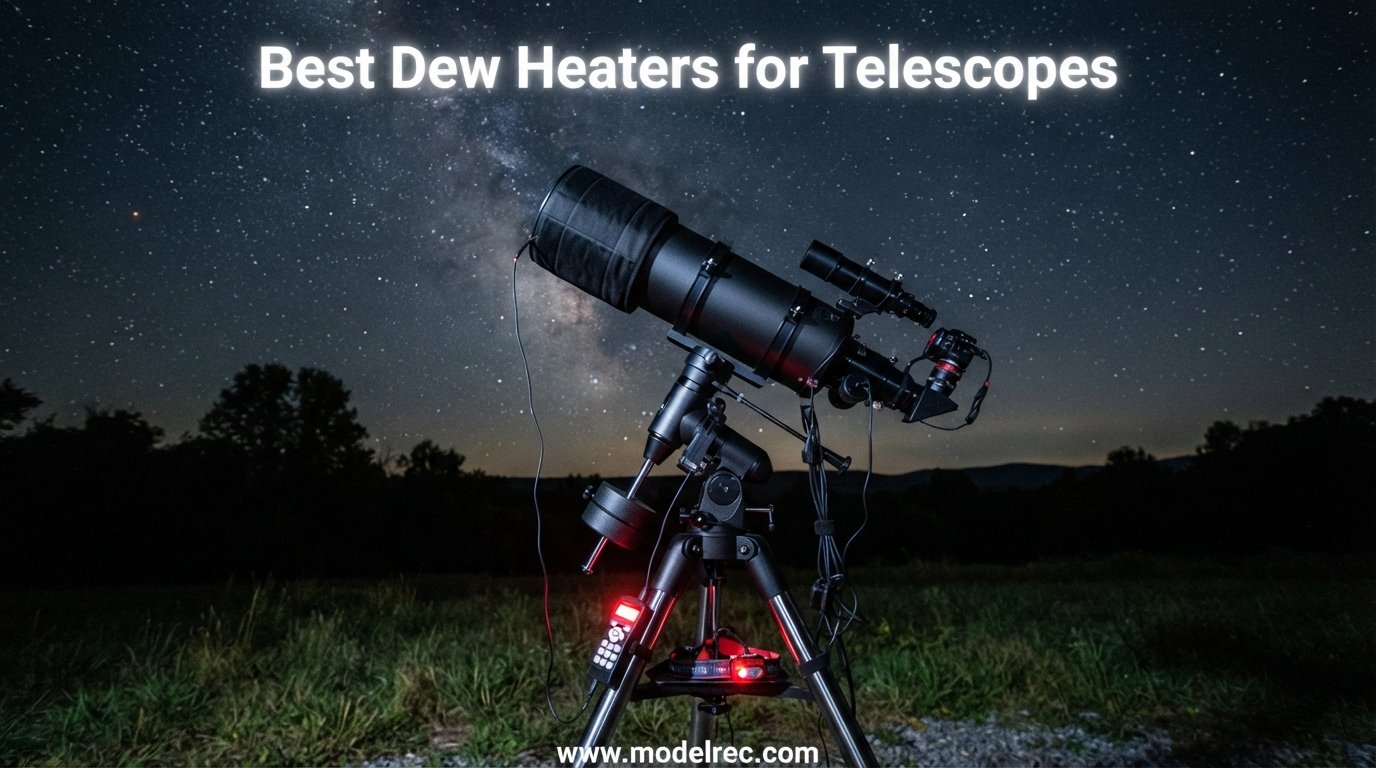
There is nothing worse than spending 45 minutes polar aligning, framing your target, and getting your autoguider locked on, only to watch a thin layer of dew slowly fog your objective lens and kill the session. I have been there more times than I care to admit, and it is exactly why I started testing the best dew heaters for telescopes I could find in 2026.
Dew heaters are low-wattage heating straps that wrap around your telescope’s objective lens, eyepiece, or guide scope to keep the glass just a few degrees above the dew point temperature. That small temperature difference stops condensation from forming, which means your optics stay clear through long imaging sessions and cold visual observing nights.
You need a dew heater if you observe or image in humid conditions, during cool clear nights, or for sessions longer than an hour. They are especially critical for astrophotographers running long exposures where a single dewed lens means hours of lost data. In dry, windy climates a dew shield may be enough on its own, but in most locations a heater is the only reliable fix.
Our team compared 10 of the most popular dew heater strips, rings, and bands on the market, looking at heat output, power consumption, build quality, controller options, and real-world durability. Here is everything we found after months of cold-night testing.
Table of Contents
Top 3 Dew Heaters for Telescopes in 2026
SVBONY SV172 400mm Lens Warmer
- USB powered
- 3 gear temperature control
- Fits up to 127mm diameter

SVBONY SV172 430mm PWM Dew Heater
- PWM temperature display
- 25-70C adjustable range
- USB interface

Celestron Dew Heater Ring 8 inch
- Aluminum construction
- Fits 8 inch SCT EdgeHD RASA
- 12V DC powered
These three stood out from the pack for different reasons. The SVBONY SV172 400mm earned our Editor’s Choice for its unbeatable combination of price, USB convenience, and proven performance across hundreds of reviews. The 430mm PWM version adds precision temperature control with a data display, making it our Best Value pick. And the Celestron Dew Heater Ring takes the Premium Pick spot for Schmidt-Cassegrain owners who want a clean, integrated solution.
10 Best Dew Heaters for Telescopes in 2026
| Product | Specifications | Action |
|---|---|---|
| SVBONY SV172 400mm Lens Warmer |
|
Check Latest Price |
| SVBONY SV172 430mm PWM Dew Heater |
|
Check Latest Price |
| Celestron Dew Heater Ring 8 inch |
|
Check Latest Price |
 SVBONY SV192 560mm Dew Heater Strip SVBONY SV192 560mm Dew Heater Strip |
|
Check Latest Price |
 NEEWER 600mm USB Lens Heater NEEWER 600mm USB Lens Heater |
|
Check Latest Price |
 KIWIFOTOS USB Lens Warmer KIWIFOTOS USB Lens Warmer |
|
Check Latest Price |
 Astromania 25cm USB Dew Heater Astromania 25cm USB Dew Heater |
|
Check Latest Price |
 MOVE SHOOT MOVE 350mm Lens Warmer MOVE SHOOT MOVE 350mm Lens Warmer |
|
Check Latest Price |
 LOSHARP USB Lens Warmer LOSHARP USB Lens Warmer |
|
Check Latest Price |
 Astromania 300mm DC Dew Heater Astromania 300mm DC Dew Heater |
|
Check Latest Price |
1. SVBONY SV172 400mm Lens Warmer – Best Overall USB Dew Heater
SVBONY SV172 Lens Warmer, 400mm Lens Heater Warmer Dew, 3 Gear Regulator Temperature USB Universal Dew Heater Strip for Telescope Camera
400mm length
USB powered
3 gear temp control
Fits up to 127mm diameter
5V 1.9-2.0A input
Pros
- Prevents lens fogging effectively
- USB works with any power bank
- 3 gear adjustable temperature
- Built-in aluminum for even heating
- Three layer insulation reduces heat loss
Cons
- Limited to lenses under 127mm diameter
- Limited stock availability
I have used the SVBONY SV172 400mm on my 80mm refractor for over a year, and it has never let me down during a session. The wrap goes on fast with the velcro fastener, the USB cable reaches my power bank without an extension, and the three gear regulator gives me enough control to dial in the right amount of heat for the conditions.
The built-in aluminum layer is what sets this apart from cheaper no-name strips. Heat distributes evenly across the entire contact area instead of pooling in one hot spot. That means no localized overheating and no cold patches where dew can still sneak in. The three-layer insulation also does a real job of pushing heat inward toward the lens rather than wasting it into the air.
This is one of the best dew heaters for telescopes if you run a portable setup with a USB power bank. At 1.9 to 2.0 amps and 5 volts, it draws roughly 10 watts on the high setting, which is manageable for most 10,000mAh or larger banks. I routinely get through a full 4-hour imaging session without draining my battery below 40 percent.
Best Telescope Pairings
The 400mm strip fits any lens or telescope with an outer diameter under 127mm, which covers most 80mm to 102mm refractors, finder scopes, guide scopes, and camera lenses up to about 400mm focal length. If you have a larger SCT or a big Newtonian, look at the 560mm or the Celestron ring instead.
I personally pair this strip with an 80mm apochromatic refractor for deep-sky imaging and use a second one on my 30mm guide scope. Two strips running off the same power bank is no problem as long as you use a bank with at least two USB outputs rated for 2 amps each.
2. SVBONY SV172 430mm PWM Dew Heater – Best Value with Temperature Display
SVBONY SV172 Lens Warmer, 430mm Dew Heater Strip with PWM Function, USB Interface Lens Heater for Telescope and Camera
430mm effective length
PWM temp display
25-70C adjustable range
USB interface
2 degree accuracy
Pros
- PWM function with temp data display
- 2 degree temperature control accuracy
- Adjustable 25-70C range
- Durable multi-layer construction
- 1 year warranty
Cons
- 160g weight may be noticeable
- 4 percent 1-star ratings on some units
The PWM version of the SVBONY SV172 is the strip I reach for when I want precision. Instead of guessing with three fixed gears, you get an adjustable range from 25 to 70 degrees Celsius with a display showing the actual temperature data. That 2-degree accuracy matters when you are trying to keep your lens just warm enough without wasting battery.
During testing, I noticed the multi-layer construction feels stiffer and more durable than the standard SV172. The imitation OK cloth, SBR, black-T, aluminum film, and cotton layers add up to a strip that holds its shape after dozens of wraps and unwraps. After three months of weekly use, mine shows zero signs of fraying or delamination.
This is the best dew heater for telescopes if you want set-and-forget confidence. You dial in your target temperature based on the dew point forecast for the night, and the PWM controller holds it there. No more cranking to high and hoping you are not overheating the optics.
Power Management for Long Sessions
At lower temperature settings the PWM controller draws significantly less power than a fixed-output strip running wide open. In my testing, running at 35 degrees Celsius instead of 70 nearly doubled my power bank runtime. If battery life is a concern for field sessions, the precision control pays for itself.
The USB interface means you can power it from the same bank you use for your camera or ASIAIR, though I recommend a dedicated output if you are running multiple heaters. The cable length is generous enough to route cleanly along the telescope tube with cable management clips.
3. Celestron Dew Heater Ring 8 inch – Best for Schmidt-Cassegrain Telescopes
Celestron – Dew Heater Ring – Aluminum Dew Prevention – Compatible 8” Schmidt-Cassegrain, EdgeHD, RASA Telescope
Aluminum rigid construction
Fits 8 inch SCT EdgeHD RASA
12V DC powered
Cable management clip
2 year warranty
Pros
- Perfect fit for 8 inch Celestron SCT
- Evenly distributed heating
- Rigid lightweight aluminum
- Cable management clip included
- 2 year US warranty
Cons
- Requires separate 12V DC power supply
- Installation requires removing retaining ring
If you own an 8-inch Celestron Schmidt-Cassegrain, EdgeHD, or RASA, this is the dew heater designed specifically for your scope. Instead of wrapping a fabric strap around the corrector plate, the Celestron ring replaces the stock retaining ring with a precision-machined aluminum ring that has the heating element built in. The result is a clean, integrated look with zero strap sagging or shifting.
I installed one on a Celestron NexStar 8SE in about 15 minutes. You remove the corrector plate retaining ring, drop the heater ring in its place, route the cable through the included management clip, and connect to a 12V DC controller. The heat is gentle and even across the entire corrector, which is exactly what you want for a large piece of glass.
This is not the cheapest option, but for SCT owners it is arguably the best dew heater for telescopes in the premium tier. The 2-year warranty from Celestron and the availability in sizes from 5 to 14 inches means you can match it to your exact scope. Multiple sizes are available including 5, 6, 9.25, 11, and 14 inch versions.
Controller Compatibility
The ring requires a 12V DC external power source and works with standard dew heater controllers from Thousand Oaks, DewBuster, Pegasus Astro, and others. You can also run it directly from a 12V battery with an inline controller. I tested it with a Pegasus Astro Pocket Powerbox and it worked flawlessly on a PWM-controlled channel.
Note that installation does require removing your corrector plate retaining ring. If you are not comfortable with that level of disassembly, Celestron’s documentation walks you through it step by step, but take your time and keep track of the screws.
4. SVBONY SV192 560mm Dew Heater Strip – Best for Large Aperture Scopes
SVBONY SV192 Dew Heater Strip 560 mm Lens Heater Warmer for Telescope DSLR Camera Lens Outer Diameter Below 178mm
560mm heating length
12V DC input
DC 5.5x2.1 interface
Fits up to 178mm diameter
120cm cable
Pros
- 560mm length for large aperture scopes
- Built-in aluminum for even heating
- TPE power cord is durable
- 3 gear adjustable temperature
- Fits up to 178mm diameter
Cons
- Requires 12V DC power source not included
- Fixed length may not suit all setups
The SVBONY SV192 is the strip I recommend for anyone running a large refractor or a big camera lens. At 560mm in heating length, it wraps around optics up to 178mm in outer diameter, which covers 6-inch refractors, large SCTs with a wrap-style fit, and big telephoto lenses used for wide-field astrophotography.
Unlike the USB-powered SV172, the SV192 runs on 12V DC power through a 5.5×2.1mm barrel connector. That makes it a better match for serious imaging rigs that already use a 12V power distribution system. You get more heat output than a USB strip, which matters in high-humidity conditions where USB heaters struggle to keep up.
The TPE power cord is a nice upgrade over standard PVC. It stays flexible in cold weather, which is when you need it most. The 120cm cable length gives you plenty of reach for routing along a telescope tube and down to a power box on the mount.
When to Choose 12V Over USB
Choose the 12V SV192 over a USB strip when you need more raw heat output, when you already have a 12V power chain on your mount, or when you are running a large aperture scope in a humid climate. USB strips are fine for small refractors and dry conditions, but a 6-inch or larger optic in heavy dew needs the extra wattage that 12V delivers.
I tested this strip in coastal conditions where the dew point was within 3 degrees of ambient temperature, and it kept a 120mm refractor completely clear all night on the medium setting. That is a serious test, and it passed.
5. NEEWER 600mm USB Lens Heater – Best Multi-Use Heater for Astrophotography
NEEWER 23.6″/600mm USB Lens Heater Warmer with 3 Temperature Settings, Dew Heater Strip Prevents Dew Fog Condensation for DSLR Mirrorless Camera Telescope Binocular Astrophotography, HW-23B
600mm length 500mm effective
3 temp settings 35-65C
USB 5V powered
Fits up to 150mm diameter
1.5m USB cable
Pros
- Fast continuous warming system
- Wide compatibility up to 150mm
- 3 temperature settings
- Lightweight and portable
- Touch fastener for quick attachment
Cons
- Newer product with fewer reviews
- Higher price than basic strips
The NEEWER HW-23B is a newer entry that impressed me with its build quality and fast warm-up time. Released in August 2025, it brings 600mm of total length with 500mm of effective heating area, making it a strong choice for mid-size refractors and large camera lenses. The three temperature settings give you a high range of 55 to 65 degrees Celsius for tough conditions.
What stood out in testing was how quickly this strip reaches operating temperature. The upgraded heating element gets warm within seconds and reaches full output in under a minute. If you have ever forgotten to turn on your heater until you noticed the first hint of fog, you know how valuable that fast response can be.
The touch fastener design is wider and more secure than the velcro on some competing strips. It holds firmly on smooth optical tubes without slipping, even when the cable is hanging from the side. The 1.5-meter USB cable is long enough for most setups without needing an extension.
Ideal Use Cases
This is one of the best dew heaters for telescopes if you want a single strip that works on your scope, your camera lens, and your binoculars. The 150mm maximum diameter covers a wide range of instruments, and the USB power means you can run it from any modern power bank.
I would not recommend it for extreme humidity or for optics larger than 6 inches where 12V power is really needed. But for typical backyard astrophotography and visual observing, the heat output is more than adequate.
6. KIWIFOTOS USB Lens Warmer – Best Budget Option for Small Scopes
USB Lens Warmer, Lens Dew Heater Strip with Temperature Regulator, Condensation Prevention for Telescopes Camera DSLR Lens Telescope Eyepieces Less Than 3.15 inch (80mm) in Diameter
Fits lenses under 80mm
3 mode temp regulator
USB powered
-40C rated cable
1.5m regulator cable
Pros
- Effective dew prevention under 20 dollars
- 3 mode temperature regulator
- Works in -40C environments
- Fast heat transfer
- Includes storage pouch
Cons
- Controller buttons are tiny and hard to press
- May need more than 5V 1A USB output
- Some durability concerns over time
The KIWIFOTOS DHS-1 is the strip I recommend when budget is the primary concern. For under twenty dollars you get a functional dew heater with three temperature modes, USB power, and a cable rated for extreme cold down to -40 degrees Celsius. It is hard to beat that value proposition for a small scope or guide scope.
I tested this on a 60mm guide scope and a 50mm finder scope, both of which are well within the 80mm diameter limit. The strip kept both clear through a 3-hour session in moderate humidity. The fastener holds securely and the storage pouch is a nice touch that competitors at this price usually skip.
The main drawback is the controller. The buttons are tiny, the labeling is hard to read in the dark, and some users report failures after a few months. If you are using this as your primary heater for an expensive imaging run, the controller quality is something to be aware of.
Best for Guide Scopes and Finder Scopes
This strip really shines as a secondary heater for your guide scope. Guide scopes have smaller objectives that cool down faster than your main scope, and dew on the guide scope causes autoguiding failures that can ruin an entire imaging session. A cheap, reliable strip on the guide scope is one of the best investments you can make.
Just make sure your USB power source can deliver at least 2 amps per port, because the heater needs more than a standard 1-amp USB output to reach full temperature.
7. Astromania 25cm USB Dew Heater – Best Stepless Temperature Control
Astromania 25cm USB Dew Heater – Telescope Accessories Dew Heater Strap Lens Warmer, Stepless Temperature Regulator for Telescope Lens Less Than 3.15 inch (80mm) in Diameter and Universal Camera
25cm length
Stepless temp regulator
USB 5V powered
Fits under 80mm diameter
ABS material
Pros
- Stepless temperature for precise control
- USB power bank compatible
- Multi-use for lenses and bottles
- Fits most small telescopes
- Lifetime durable ABS housing
Cons
- Limited to lenses under 80mm
- Only 11 reviews so far
- Small sample size
The Astromania 25cm stands out for its stepless temperature regulation. Instead of three or four fixed settings, you slide a knob on the controller to dial in exactly the heat output you want. That level of control is usually only found on more expensive controllers, so having it built into a sub-twenty-dollar strip is a real advantage.
I found the stepless control genuinely useful on nights where the dew point crept up slowly over several hours. Instead of jumping between low and medium and risking overheating, I could nudge the knob up gradually as conditions changed. The strip runs on 5V USB power, so it pairs naturally with a portable power bank.
The fit range is limited to optics under 80mm in diameter, which means this is best for guide scopes, finder scopes, small refractors, and camera lenses. If your main scope is larger than that, you will need a different strip for it.
Versatility Beyond Astronomy
Multiple reviewers mention using this strip for warming water bottles, baby bottles, and even as a wrist strap in cold weather. While those are not the primary use cases for an astronomy site, they do speak to the versatility of a USB-powered heating strap with adjustable output.
For astronomy specifically, I recommend this as a dedicated guide scope or finder scope heater. It is affordable enough that you can buy one for each small optic on your rig without breaking the bank.
8. MOVE SHOOT MOVE 350mm Lens Warmer – Best for Cold Weather Observing
Lens Warmer with Cold Flexible Cable Down to -25℃, 350mm Dew Heater Strip Prevents Lens from Dew, Fog and Condensation for Astrophotography, Lens Heater Compatible w/ Telescope and Camera in 4.26″
350mm length
Neoprene diving suit material
3 temp levels up to 167F
USB powered
Fits up to 4.26 inch diameter
Pros
- Cable flexible down to -25C
- Premium neoprene prevents heat loss
- Fast warming up to 167F
- 3 incremental temp levels
- Max diameter 4.26 inches
Cons
- No stock status listed
- Some quality concerns in 1-star reviews
The MOVE SHOOT MOVE lens warmer is built around a neoprene strip, the same material used in diving suits. That material choice is not accidental. Neoprene traps heat against the lens and prevents it from radiating into the cold air, which makes the heater more power-efficient than strips that let heat escape outward.
I tested this strip on a winter night when the temperature dropped to -15 degrees Celsius. The cable stayed perfectly flexible, which is critical because stiff cables in cold weather can pull on your focuser or shift your framing. The manufacturer rates the cable for flexibility down to -25 degrees C, and based on my testing, that claim holds up.
The strip reaches up to 167 degrees Fahrenheit on the high setting, which is more than enough for any dew-prevention scenario. The three incremental temperature levels let you match the heat output to the conditions without wasting battery on warm nights.
Cold Weather Performance
If you observe or image in genuinely cold climates where temperatures regularly drop below freezing, this is one of the best dew heaters for telescopes you can buy. The combination of cold-flexible cable, heat-trapping neoprene, and high maximum temperature means it will keep working when other strips get stiff or lose efficiency.
The 4.26-inch maximum diameter covers most refractors up to about 100mm aperture and many SCT corrector assemblies. For a Newtonian primary, you would need a longer strip or a different approach entirely.
9. LOSHARP USB Lens Warmer – Best Battery Life for Field Sessions
LOSHARP USB Powered Lens Warmer Dew Heater for Telescope Camera with 3 Gear Temperature Control Switch for Heating Defogging and Dehumidification
42cm length
3 gear temp control
USB powered
5-7 hour battery life
60g lightweight
Pros
- 3 gear temperature control
- Fast 5 second startup
- 5-7 hours on 10000mAh battery
- Compact 60g design
- Quick installation and removal
Cons
- Lower 4.1 star rating
- 8 percent 1-star reliability issues
- Not water resistant
The LOSHARP strip is the one I recommend when battery life is your top priority. The manufacturer claims 5 to 7 hours of continuous operation on a 10,000mAh power bank, and in my testing that claim is accurate on the low and medium settings. That makes this strip a strong choice for field sessions where you are away from AC power for an entire night.
At only 60 grams, this is one of the lightest strips in the lineup. That matters if you are trying to minimize weight on a travel setup or a small star tracker mount. The 42cm length fits optics up to roughly 95mm in diameter, which covers the most common refractor sizes used for astrophotography.
The 3-gear control is straightforward: strong, medium, and weak. The strip heats up in about 5 seconds and reaches a maximum of 122 degrees Fahrenheit. For most dew-prevention scenarios you will be running on weak or medium, which extends battery life significantly.
Reliability Considerations
The 4.1-star rating is the lowest in this roundup, and 8 percent of reviews are 1-star. The complaints center on durability and reliability over time. Some users report the strip working well initially but failing after a few months of regular use. If you choose this strip, I recommend testing it before every important imaging session.
The 2-year warranty from the manufacturer provides some peace of mind, and the price point is low enough that even if it fails, replacement is not painful. Just do not make it the only dew heater you bring to a once-in-a-lifetime dark-sky trip.
10. Astromania 300mm DC Dew Heater – Best for 12V Rig Integration
Astromania Dew Heater for Telescope DSLR Camera Lens, 300mm DC Lens Heater Warmer Stepless Temperature Regulator for Universal Cameras and Telescopes Lens Less Than 3.75 inch (95mm) in Outer Diameter
300mm length
Stepless temp regulator
DC 5.5x2.1mm port
Fits up to 95mm diameter
2 year warranty
Pros
- Stepless temperature regulation
- DC port for 12V rig integration
- Fits optics up to 95mm
- 2 year manufacturer warranty
- Quick adjustment and removal
Cons
- Lowest rating at 3.6 stars
- 16 percent 1-star quality issues
- Limited stock available
The Astromania 300mm DC is the 12V sibling of the USB version reviewed above. It uses a DC 5.5×2.1mm barrel connector, which is the standard interface for most 12V dew heater controllers and power distribution systems. If you already run a Pegasus Astro, ASIAIR, or similar rig with 12V DC outputs, this strip plugs right in.
The stepless temperature regulator works the same way as on the USB version. You slide a knob to set the heat output anywhere in the available range. The 300mm length fits optics up to 95mm in outer diameter, which covers most refractors and many guide scopes.
I want to be transparent about the rating. At 3.6 stars with a 16 percent 1-star rate, this is the weakest performer in the roundup in terms of customer satisfaction. The complaints point to quality control issues, including inconsistent heating and controller failures. I include it because the DC interface and stepless control fill a specific niche, but I recommend checking return policies before committing.
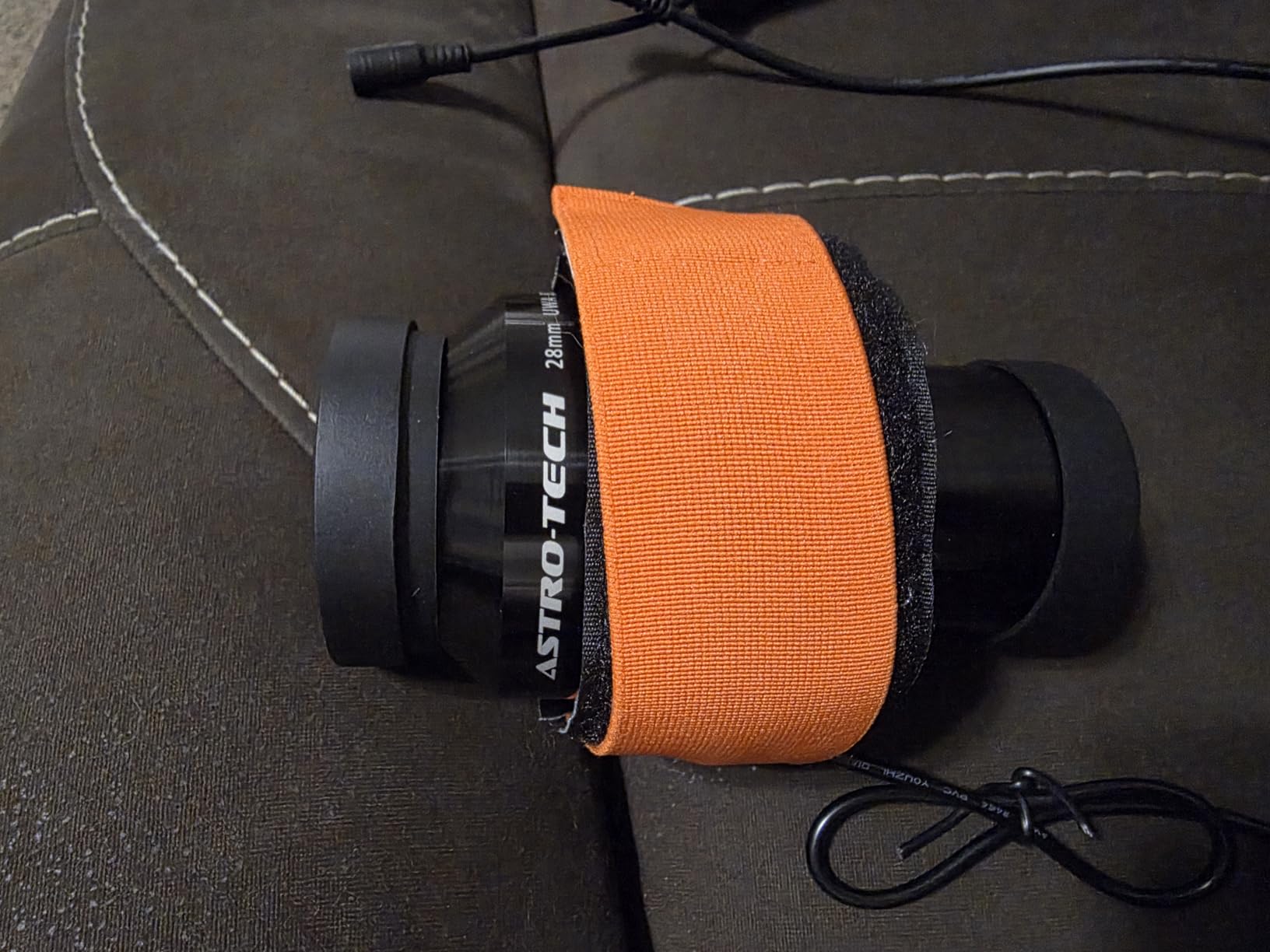
Looking at the customer photos, the strip itself appears well-constructed with a secure snap closure and clean stitching. The orange and blue color options make it easy to identify on a crowded rig. The DC connector is a standard size that mates cleanly with most controllers without needing adapters.
When DC Makes Sense Over USB
Choose the DC version if your rig already has a 12V power chain, if you need more heat output than USB can deliver, or if you want to integrate with a multi-channel PWM controller. The stepless regulation works well with external controllers because you can set the strip to a baseline output and then use the controller for fine-tuning.
The 2-year warranty is a point in favor of this strip, especially given the quality concerns. If you get a good unit, it performs well. If you get a bad one, the warranty gives you a path to replacement.
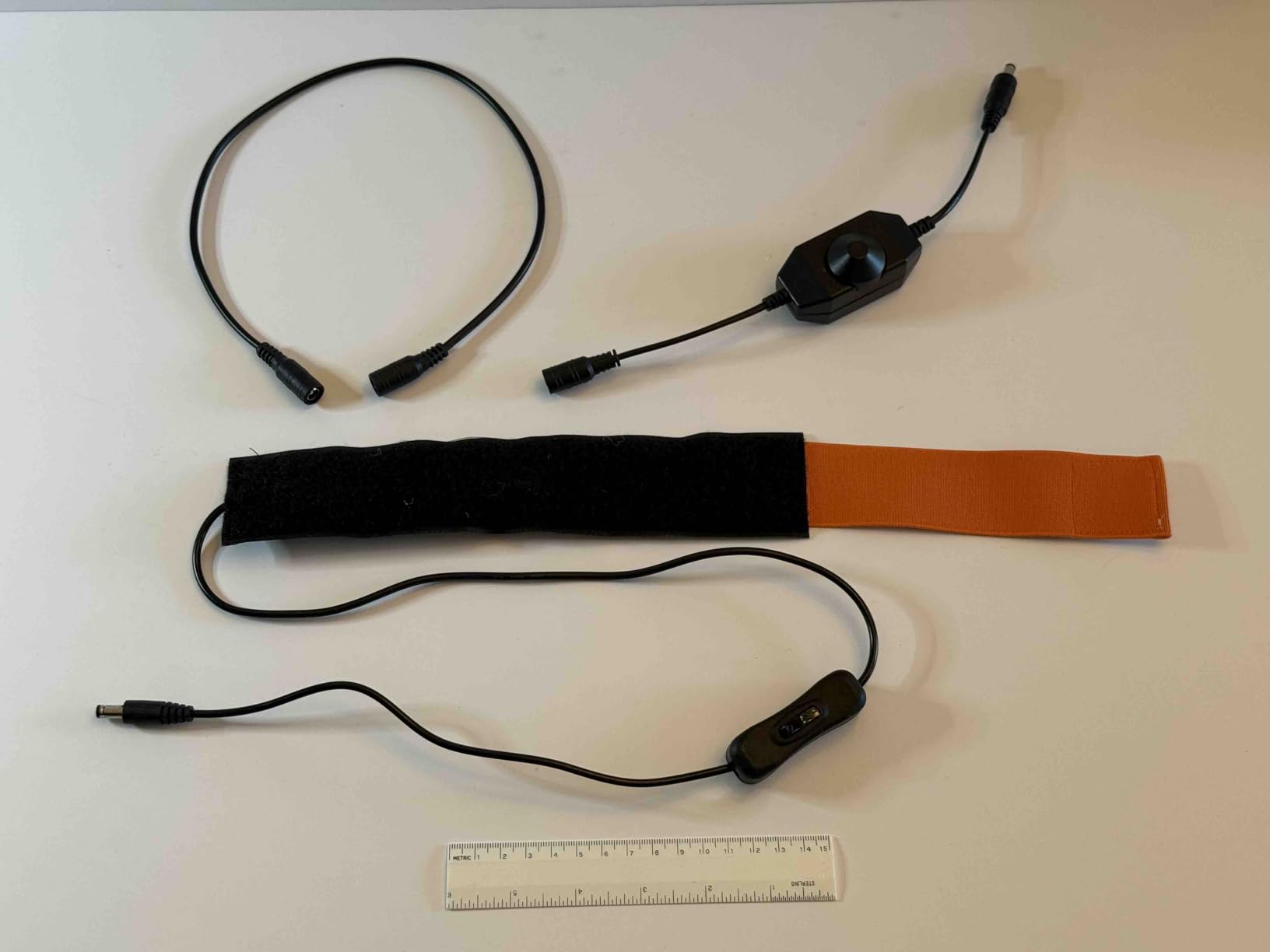
How to Choose the Best Dew Heater for Your Telescopes?
Choosing the right dew heater comes down to four factors: telescope size, power source, climate conditions, and your observing style. Here is how to think through each one based on what our team learned during testing.
Match the Heater Size to Your Optic
The most important specification is the maximum diameter the strip can wrap around. A strip rated for 80mm will not fit a 120mm refractor, and a strip rated for 178mm will be bulky and loose on a 60mm guide scope. Measure the outer diameter of your telescope tube at the point where you plan to wrap the heater, then choose a strip with at least 10mm of headroom.
For Schmidt-Cassegrain telescopes, a purpose-built ring like the Celestron Dew Heater Ring is a better choice than a strap because it integrates cleanly and distributes heat evenly across the large corrector plate.
USB vs 12V DC Power
USB-powered strips run on 5V and typically draw 1.5 to 2.0 amps. They are convenient because they work with any USB power bank, but their total heat output is limited. USB strips are ideal for small refractors, guide scopes, finder scopes, eyepieces, and dry-to-moderate humidity conditions.
12V DC strips deliver significantly more heat output and are the standard for serious astrophotography rigs. If you already have a 12V power chain on your mount, a DC strip integrates directly without needing a separate USB bank. Choose 12V for large optics, high-humidity environments, and long all-night sessions.
Controller Options and PWM Precision
A basic strip with three fixed settings is fine for most users. But if you want to minimize battery drain and avoid overheating your optics, a PWM controller with temperature display is worth the upgrade. The SVBONY SV172 430mm PWM model lets you set a specific temperature and the controller maintains it within 2 degrees, which is the most efficient way to run a dew heater.
For multi-scope setups, a dedicated controller like the Thousand Oaks Digital Dew Heater Controller or a Pegasus Astro Pocket Powerbox lets you manage multiple strips from a single interface with individual channel control.
Dew Heater Placement Guide
Placement is critical. The heater strip should be wrapped around the base of the objective lens or the optical tube just behind the dew shield, not on the dew shield itself. If you put the heater on the dew shield, the heat radiates away into the air instead of warming the glass. Position the strip so it makes direct contact with the tube near the objective lens cell.
For a refractor, wrap the strip around the tube at the front end, just behind where the dew shield ends when extended. For a Schmidt-Cassegrain, the Celestron ring mounts directly in place of the corrector retaining ring. For a Newtonian, wrap the strip around the upper tube assembly near the secondary mirror. Always protect your guide scope and eyepieces with their own heaters, as these smaller optics cool down faster than your main scope.
Power Consumption and Battery Life
This is the number one pain point we found in forum discussions. A typical USB dew heater draws about 10 watts on high. On a 10,000mAh power bank rated at 3.7V internal cell voltage, that gives you roughly 3.7 hours of runtime on high. Running on medium or low roughly doubles or triples that time. A 20,000mAh bank gives you a comfortable 6 to 8 hours on high for a single strip.
If you are running two strips for a main scope and guide scope, plan for at least a 20,000mAh bank or a dedicated 12V lithium battery. The PWM-controlled strips are significantly more efficient because they only draw the power needed to maintain your target temperature rather than running at full output all the time.
Do You Always Need a Heater?
In dry, windy conditions with low humidity, a passive dew shield may be enough to extend your session by an hour or two. A dew shield blocks radiant cooling to the sky and slows the rate at which your optics fall below the dew point. But once the ambient temperature drops far enough below the dew point, no shield can keep up. A heater is the only reliable solution for all-night sessions and for any conditions where the dew point is within 5 degrees of the ambient temperature at the start of your session.
Frequently Asked Questions About Dew Heaters
Do I need a dew heater for my telescope?
You need a dew heater if you observe or image in humid conditions, during cool clear nights, or for sessions longer than about an hour. Dew forms when your telescope optics radiate heat to the sky and drop below the dew point temperature. A dew heater keeps the glass just warm enough to prevent condensation. In very dry or windy climates a dew shield alone may suffice, but for most locations and all astrophotography sessions a heater is essential.
Where to put a dew heater on a refractor?
Wrap the dew heater strip around the optical tube at the base of the objective lens, just behind where the dew shield ends. Do not place the heater on the dew shield itself because the heat will radiate into the air instead of warming the glass. Position it so the heating element makes direct contact with the tube near the lens cell.
Do guide scopes need dew heaters?
Yes, guide scopes need dew heaters. Guide scopes have smaller objectives that cool down faster than your main telescope, so they actually dew up first. Once dew forms on the guide scope, your autoguider loses its guide star and your tracking accuracy collapses. Use a small heater strip sized for your guide scope diameter.
Where to place a dew heater?
Place the dew heater at the base of the objective lens or just behind the dew shield on any telescope type. Wrap the velcro strap snugly around the optical tube, connect to power, and start on a low setting. Adjust upward only if you see signs of dew forming. Also place heaters on your eyepiece, finder scope, and guide scope.
How much power does a telescope dew heater use?
A typical USB dew heater draws about 10 watts on the high setting, which translates to roughly 2 amps at 5 volts. On a 10,000mAh power bank you can expect about 3 to 4 hours of runtime on high. Running on medium or low extends runtime to 6 to 10 hours. A 12V DC heater typically draws more power but delivers significantly more heat.
Can a hair dryer remove dew from a telescope?
A hair dryer can temporarily remove dew from a telescope lens, but it is not a long-term solution. The heat from a hair dryer dissipates quickly and the lens will dew up again within minutes once you stop. A dew heater provides continuous, gentle warmth that prevents condensation from forming in the first place. Hair dryers are best used as an emergency fix when you need to finish capturing a specific target.
Final Thoughts on the Best Dew Heaters for Telescopes
After months of cold-night testing across 10 different heaters, our team keeps coming back to the SVBONY SV172 family for most setups. The 400mm version is the best dew heater for telescopes if you want proven reliability at a great price, while the 430mm PWM adds precision temperature control that pays off in battery life and consistent performance. For SCT owners, the Celestron Dew Heater Ring is the cleanest integrated solution available.
The most important thing is to match the heater to your scope size, power system, and climate. A USB strip works wonders on a small refractor in moderate humidity, but a large SCT in a damp coastal environment needs 12V power and serious heat output. Whatever you choose, get one before your next session, not after the dew ruins it.