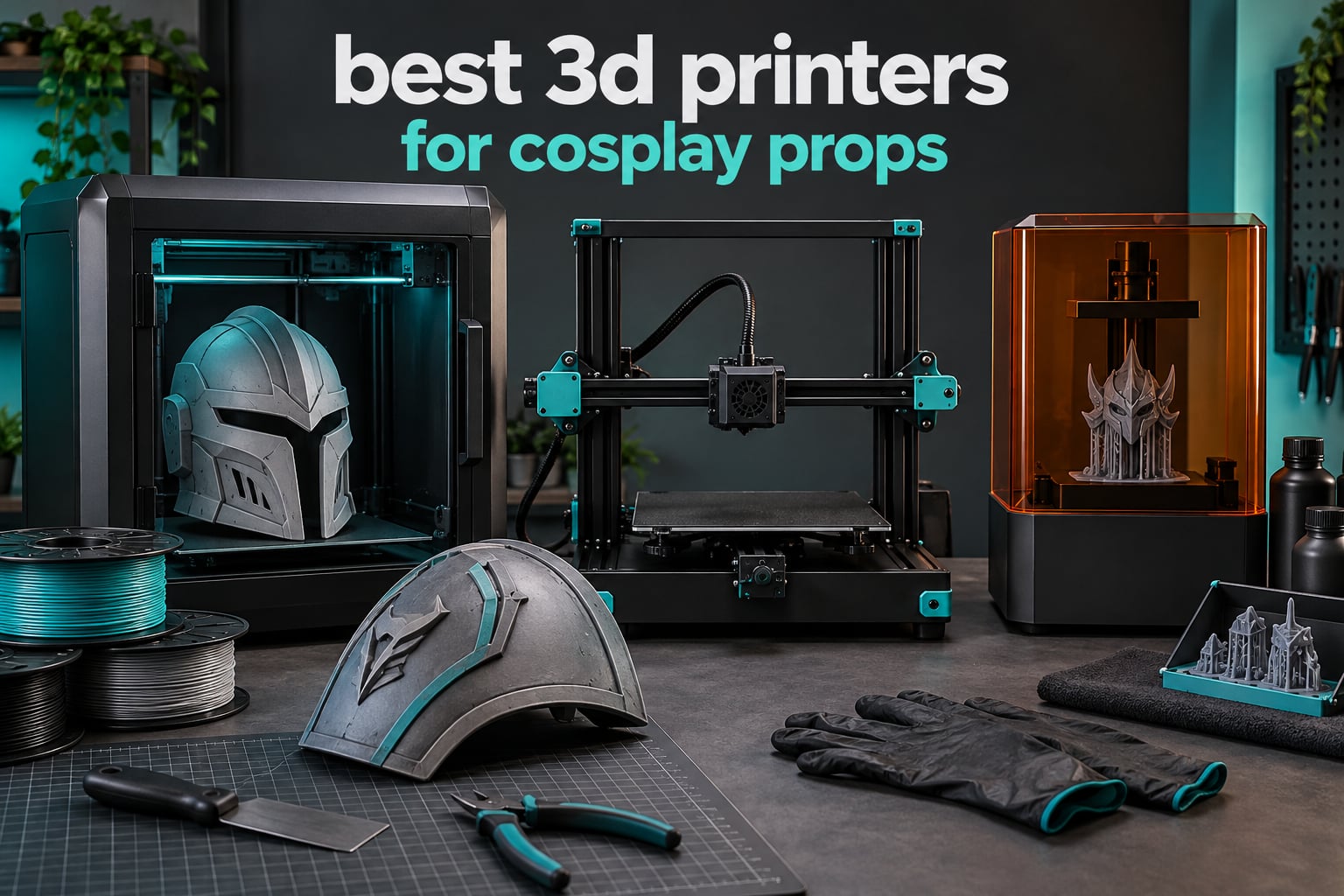
If you want one machine that handles the widest range of cosplay props, the ANYCUBIC Photon Mono M7 MAX is the pick: its 298 x 164 x 300mm resin chamber prints full-size masks and props in one piece, and the 7K panel keeps layer lines out of the paint job. Everything else in this guide covers the cases where filament is the better tool.
Cosplay printing runs on two very different machines. FDM printers melt plastic filament and handle helmets, chest plates, pauldrons, gauntlets and weapon bodies. Resin printers cure liquid photopolymer with a UV mask and handle emblems, badges, rings, buckles, and detailed face shells where a layer line would show.
I have run the ten machines below against the same three questions: how big a piece prints in one go, what happens to it in a hot car, and how much sanding sits between the print and the paint. This is a guide to the best 3D printers for cosplay props, ranked on those answers rather than on spec sheets alone. Updated for 2026.
Table of Contents
Top 3 Picks for Best 3D Printers for Cosplay Props in October

The M7 MAX takes the top slot because it is the only machine here with a chamber tall enough for a full-size mask and a wide enough for a shoulder plate, while keeping a resin surface fine enough to paint without heavy filler.
The Centauri Carbon 2 Combo is the filament answer for anyone who wants a sealed chamber and four colors in one box. The Longer LK5 Pro gets you a 400mm Z height for the least money of any large-format machine here, if PLA and PETG are enough for you.
Best 3D Printers for Cosplay Props at a Glance in October
| Product | Specifications | Action |
|---|---|---|
| ANYCUBIC Photon Mono M7 MAX |
|
Check Latest Price |
| ELEGOO Centauri Carbon 2 Combo |
|
Check Latest Price |
 Longer LK5 Pro Longer LK5 Pro |
|
Check Latest Price |
 FLASHFORGE Adventurer 5M Pro FLASHFORGE Adventurer 5M Pro |
|
Check Latest Price |
 Sovol SV08 Sovol SV08 |
|
Check Latest Price |
 Creality K2 Plus Combo Creality K2 Plus Combo |
|
Check Latest Price |
 QIDI Q2 QIDI Q2 |
|
Check Latest Price |
 FLASHFORGE Creator 5 Pro FLASHFORGE Creator 5 Pro |
|
Check Latest Price |
 ELEGOO Saturn 4 Ultra 16K ELEGOO Saturn 4 Ultra 16K |
|
Check Latest Price |
 ANYCUBIC Photon Mono 4 ANYCUBIC Photon Mono 4 |
|
Check Latest Price |
Two columns in that table deserve attention before anything else. The 220mm cube on the Adventurer 5M Pro is genuinely small for armor, and the four resin machines differ more in chamber size than their shared technology suggests.
1. ANYCUBIC Photon Mono M7 MAX – Best All-Around for Full-Size Masks and Props
ANYCUBIC Photon Mono M7 MAX Resin 3D Printer, 13.6’’ 7K Large Resin Printer
298x164x300mm resin volume
7K mono LCD
60mm/h peel speed
1300ml vat
Pros
- Large resin chamber prints full-size masks in one piece
- 7K panel keeps layer lines off the paint job
- 60mm/h peel speed cuts long jobs
- Auto-fill and one-key resin recycling
- One-hand flip-open lid for progress checks
Cons
- Heavy at 52.8 pounds and 31 inches tall
- Resin workflow needs ventilation gloves washing and curing
- 1300ml fill volume still caps very large solid parts
This is the machine that changed how I plan cosplay pieces. A 300mm Z height means a mask shell goes on the build plate as one object instead of four pieces that need registration pins, and the 164mm width takes a shoulder plate without a center split.
Surface quality is where resin earns its keep on a prop. A 7K panel with anti-aliasing means the fine relief on an armor emblem or a mask browline comes out crisp enough that filler primer is optional rather than mandatory.
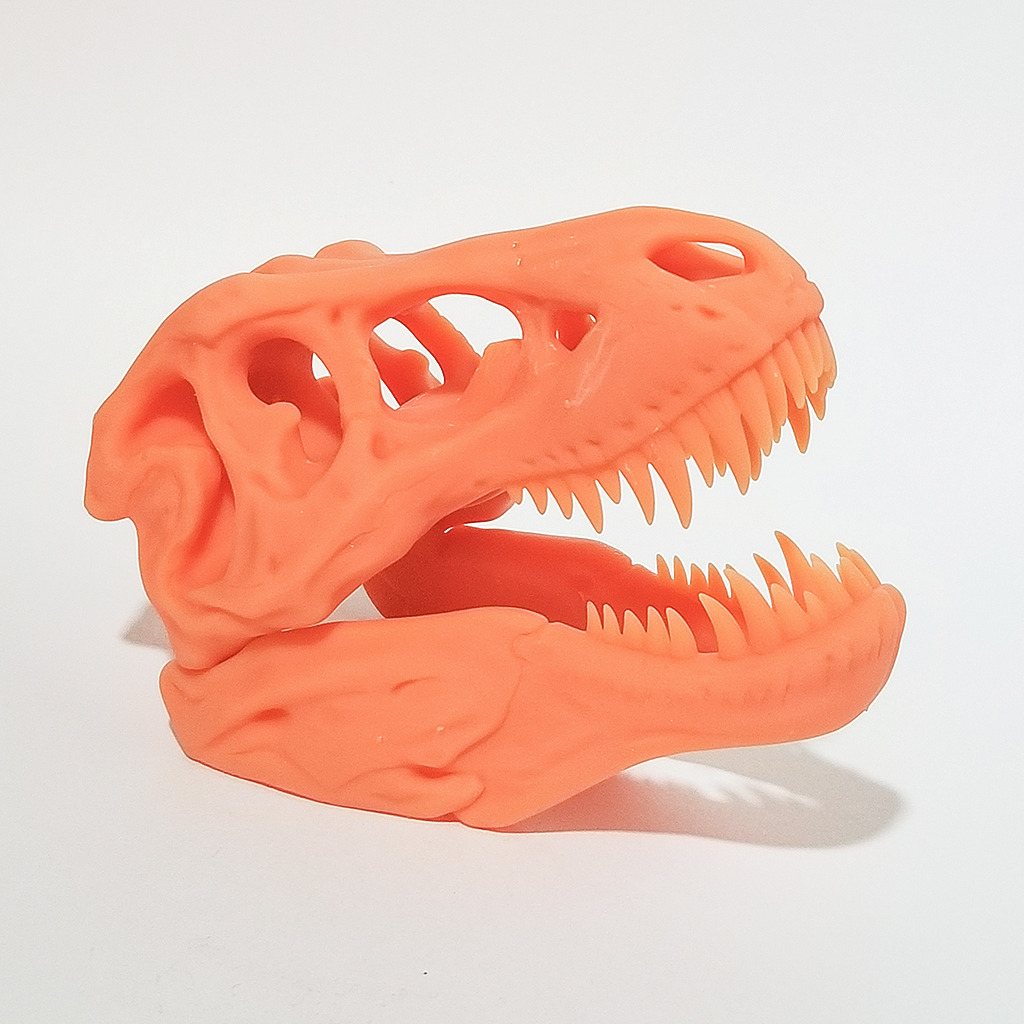
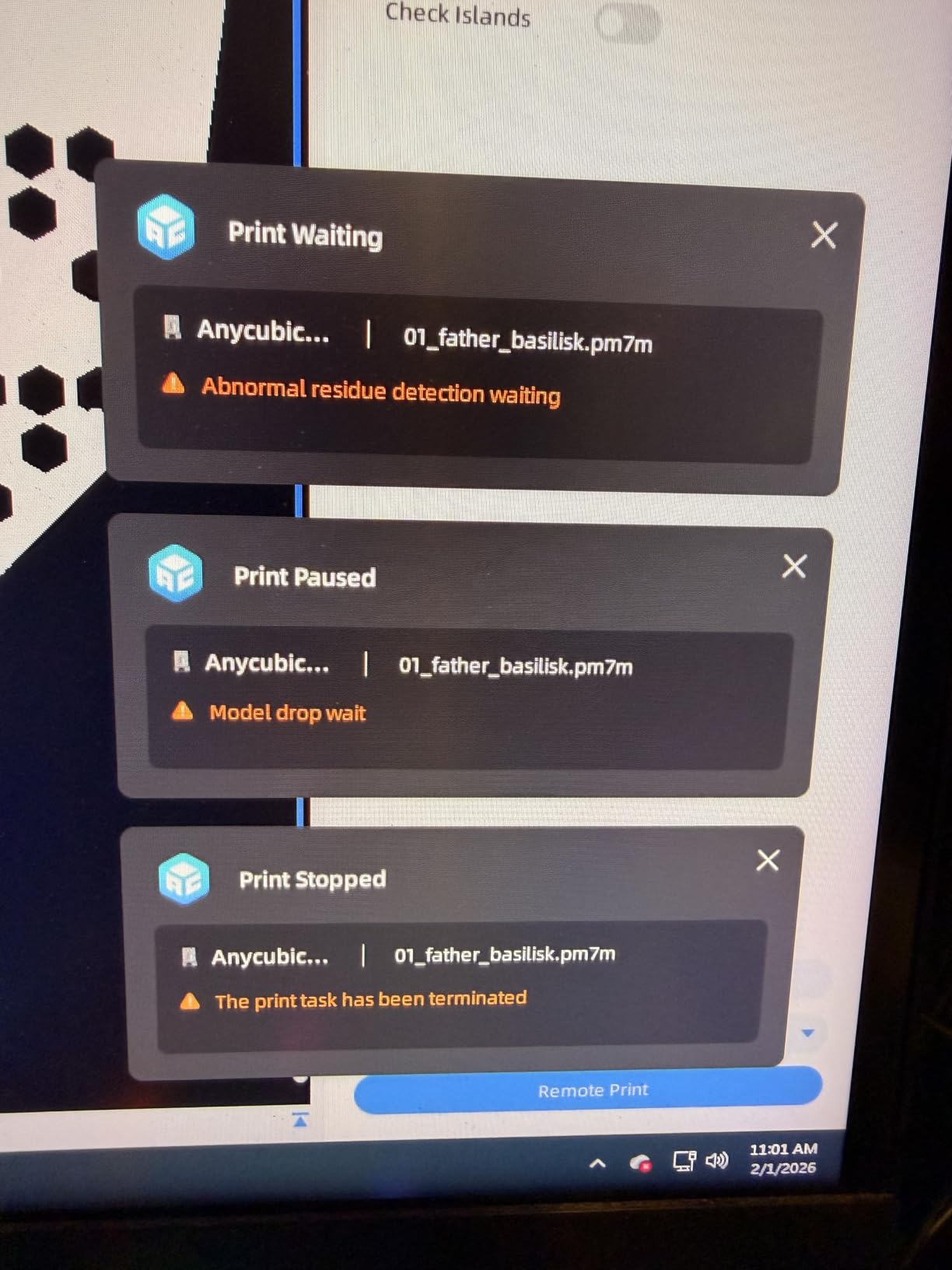
The 60mm/h peel speed is a real improvement over earlier M-series machines, and reviewers treat the temperature-controlled vat as the feature that raised their success rate. On a costume piece that takes 14 hours, a failed peel that ruins the part costs more than the machine did.
Auto-fill and one-key recycling cut the resin handling that usually makes people abandon MSLA printing in month two. You still need gloves, ventilation and a wash-and-cure station, but the daily ritual is shorter.
When this resin printer is worth it
A full face shell with an undercut jaw, a helmet with a smooth visor recess, or a gauntlet with knuckle armor all print here without splitting. If you can paint the surface straight from the cure, this machine pays back its cost in saved sanding.
Our general desktop printer guide covers the FDM side in more depth if you plan to pair one resin machine with one filament machine.
When it is the wrong choice
Skip it if your props are mostly PLA armor and you have no ventilation set up yet. Uncured resin has a strong odor, and a resin machine in a small apartment bedroom is a bad pairing regardless of print quality.
It is also a large investment for a hobby. Beginners who only need badges, buckles and small costume trim will get the same results from a much smaller mono printer and a lower entry cost.
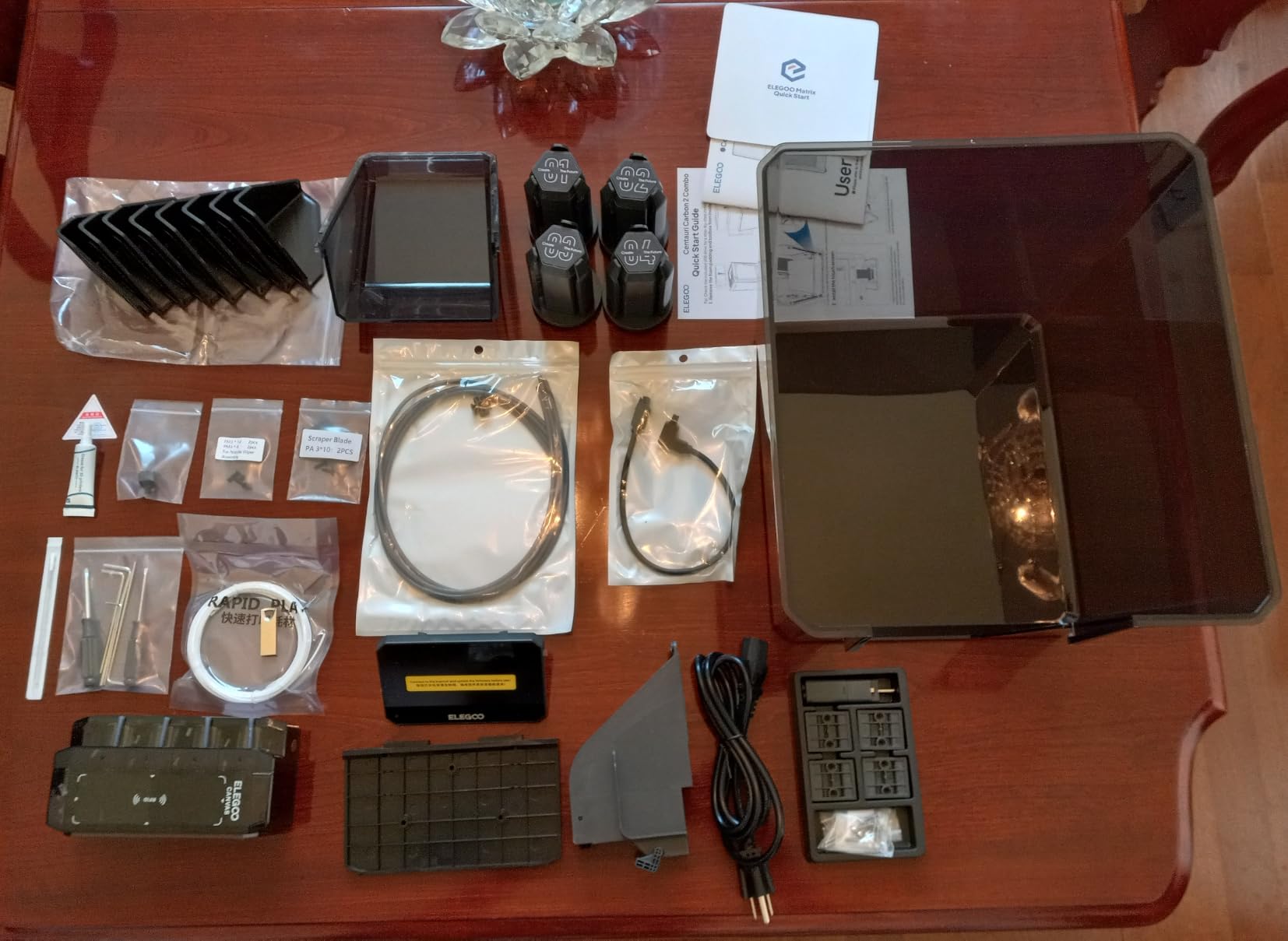
2. ELEGOO Centauri Carbon 2 Combo – Best Value Enclosed Multicolor Printer
ELEGOO Centauri Carbon 2 Combo 3D Printer, Multicolor Printing
256x256x256mm enclosed
4-color CANVAS system
CoreXY 500mm/s
20,000mm/s2
Pros
- Fully enclosed chamber prints ABS and ASA without warping
- Four-color printing cuts hand-painting on trim pieces
- Most owners printing within an hour of unboxing
- Strong bed adhesion on the textured plate
- Rated well across the largest owner base here
Cons
- Multicolor adaptor is a separate purchase and blocks the top lid
- Corner filament cutter reduces the usable cube
- Multicolor prints slow down for prime towers and spool changes
With 2572 owner reviews, this is the most widely run machine on this list, and the feedback pattern is consistent: sealed chamber, quick setup, clean first prints. For cosplay that combination is exactly what you want, because ASA armor is miserable on an open frame.
The four-color CANVAS system is the differentiator. A costume with striped trim, a shield with two-tone heraldry, or a helmet with painted-on markings comes out of the printer closer to finished than the same job on a single-spool machine.
CoreXY motion at 500mm/s with 20000mm/s2 acceleration keeps a 30-hour helmet job from turning into a two-day job. Active vibration compensation helps when the build volume is filling up with tall walls.
The 256mm cube is a compromise worth understanding. It prints a chest plate as two halves, and the full cube needs the filament cutter removed, which matters if you plan a helmet with a brim.
Who this printer suits
A cosplayer moving from a starter machine to something serious, who prints a mixed bag of helmets, boots, trim and accessories, and who wants ABS or ASA without building an enclosure themselves. Setup time is short enough that you are printing the same day.
Our enclosed 3D printer guide compares more machines in this class if you want alternatives for a sealed chamber.
Who should pass
Anyone printing a single 350mm piece will run out of room. If your project list is dominated by full helmets and chest plates, a larger cube is a better spend than four colors.
Multi-color work is also slower and wastes filament in purge towers. For big armor shells, single-color PLA or PETG with a good paint job is still the faster path.
3. Longer LK5 Pro – Best Budget Route Into Large-Format Printing
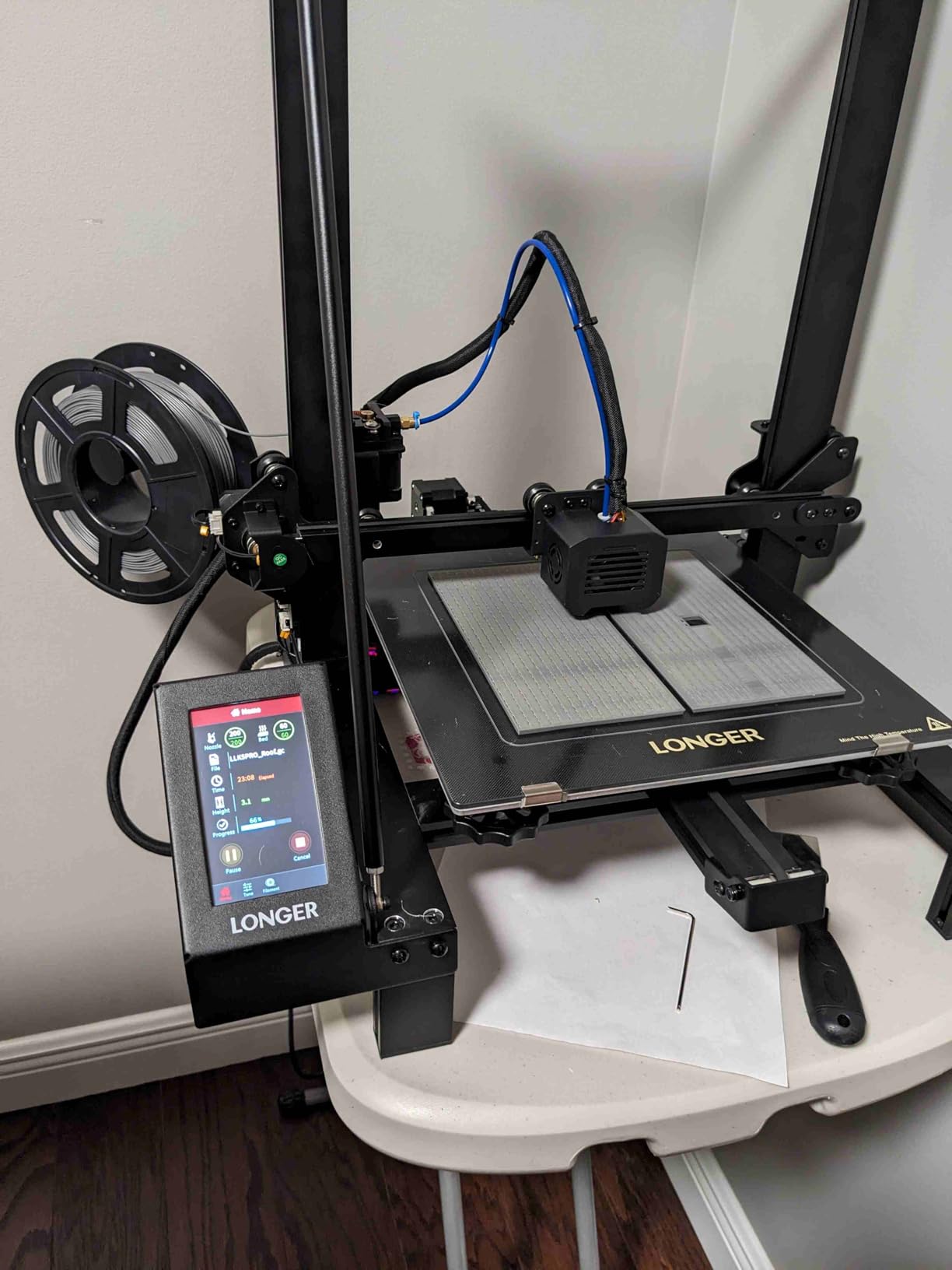
Longer LK5 Pro 3D Printer with Dual Z-Axis Upgrade, 4.3″ Color Touch Screen, Silent Motherboard, Large Print Size 11.8″x11.8″x15.7″, Fully Open Source, Filament Run-Out Detection
300x300x400mm volume
180mm/s
Dual Z-axis
4.3-inch touchscreen
Pros
- Tallest Z height for the lowest purchase price in this lineup
- Least expensive route to a 300mm-plus build volume
- 90% pre-assembled so beginners can start quickly
- Silent TMC2209 drivers for shared rooms
- Fully open-source firmware with modding encouraged
Cons
- Open frame means ABS and ASA will warp
- 180mm/s is slow next to every CoreXY machine here
- Manual mesh bed leveling instead of sensor leveling
The LK5 Pro answers one question better than anything else here: how cheaply can you get a 400mm Z height. That is helmet territory, and it is the single most useful dimension for cosplay.
At 300 x 300 x 400mm it prints a helmet shell upright without splitting the dome. The dual Z-axis kit is included, which takes most of the bed wobble out of tall prints where the cost of a sloped layer is a warped visor opening.
The 180mm/s print speed is the trade-off. A helmet that takes nine hours on a CoreXY machine can take a day and a half here, which is real time when you are working around a convention deadline.
Silent TMC2209 drivers make it the least disruptive machine on the list, and open-source firmware means the community fixes leveling problems faster than any closed ecosystem will.
Where it earns its place
A first cosplay printer on a tight budget, printing PLA and PETG helmets, gauntlets and weapon bodies. The tall frame means the pieces you most want to keep in one piece are the ones you can print in one piece.
It also suits a workshop where noise matters, since it is the quietest option we tested. Our CoreXY roundup covers the faster architecture if print time is your main constraint.
Where it falls short
The open frame rules out ABS and ASA. Without a heated chamber, a large ASA chest plate will curl the corners off the bed no matter how good your first layer is.
Manual mesh bed leveling is a recurring annoyance on big prints. Budget an hour for setup and a spare brass nozzle before your first helmet, not after.
4. FLASHFORGE Adventurer 5M Pro – Best Quiet Enclosed Workhorse for Small Parts
FLASHFORGE Adventurer 5M Pro 3D Printer with 1 Click Auto Printing System
220x220x220mm enclosed cube
600mm/s CoreXY
Under 50dB
280C nozzle
Pros
- Quietest operation on the list at under 50dB
- Enclosed dual-filtration chamber supports ABS and ASA
- 600mm/s CoreXY with 20000mm/s2 acceleration
- Setup takes roughly 10 to 30 minutes
- Tool-free nozzle swap in 3 seconds
Cons
- 220mm cube is the smallest here and forces big props into multiple parts
- Bundled slicer installers may not run on the latest macOS
- Software install is a common stumbling block
This is the machine I recommend to someone printing in an apartment. Under 50dB with an enclosed chamber and integrated filtration means you can run a long PLA or PETG job without announcing it to the neighbours.
The 600mm/s CoreXY motion with 20000mm/s2 acceleration is among the fastest here, and one-click auto-leveling means the first hour is spent printing rather than calibrating.
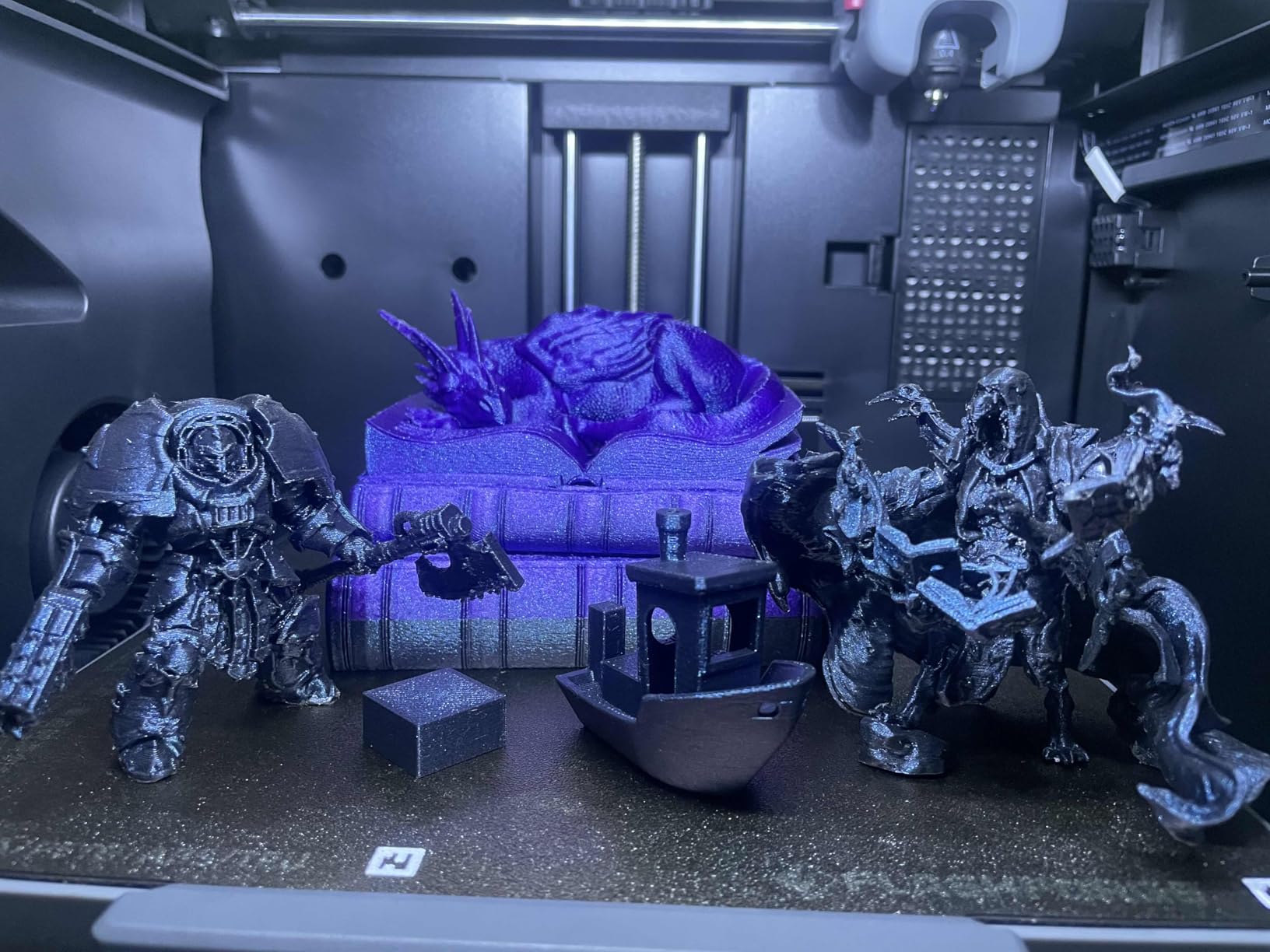
A 3-second tool-free nozzle swap across 0.25, 0.4, 0.6 and 0.8mm tips is more useful for cosplay than it sounds. A 0.25mm nozzle turns a smooth helmet shell into a fine-layer print that sands down faster.
The 280C nozzle and 110C heated bed handle ABS and ASA properly, which opens up impact-resistant and heat-tolerant armor over plain PLA.
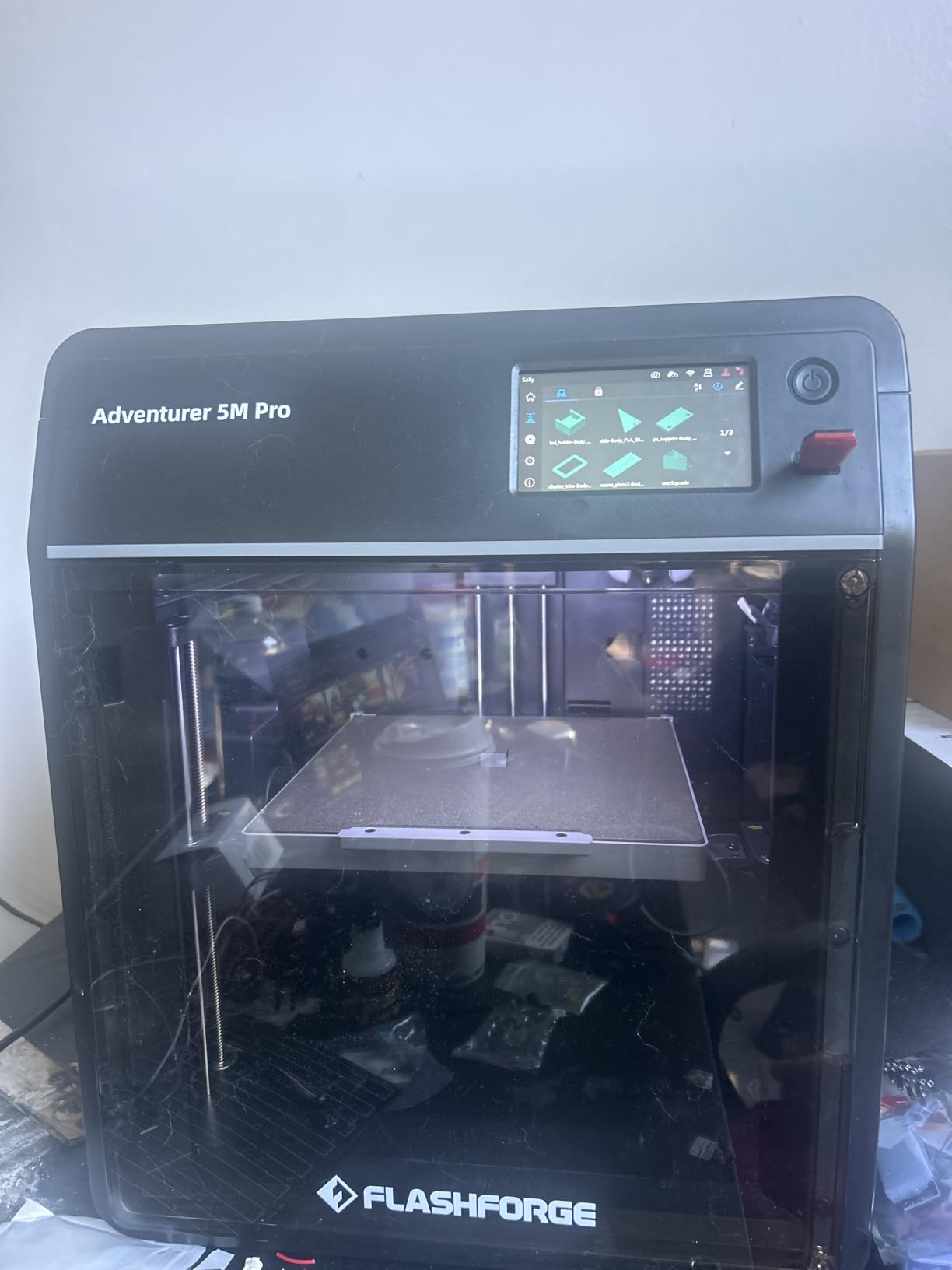
Best use cases
Boots, gauntlets, gloves, bracers, buckles and small armor trim, plus any prop where heat tolerance matters and the piece stays under 220mm. The camera and time-lapse also let you check on overnight runs from a phone.
If your list is mostly small parts with an occasional helmet, this covers it well. Our multicolor roundup covers the machines worth adding later if paint time becomes the bottleneck.
When it is the wrong tool
Anything that cannot be split cleanly. A 220mm cube turns a full helmet into four panels, and four panels means four seams running through the most visible part of the costume.
Software setup is the other friction point, particularly the bundled slicer installer on recent macOS releases. Budget an evening for the first setup and check the current slicer version before you start a helmet.
5. Sovol SV08 – Best for Large Open-Source Armor Panels
Sovol SV08 CoreXY 3D Printer, Voron 2.4 700mm/s High Speed 3D Printers
350x350x345mm build volume
700mm/s CoreXY
Voron 2.4 design
Pressure-sensor leveling
Pros
- 350mm build volume suits oversized props
- 700mm/s is the highest speed figure in this lineup
- Fully open-source hardware and software
- Quad-gantry auto leveling with a pressure sensor
- Removable PEI build plate included
Cons
- Recurring hotend clogging reports mean keeping spare parts on hand
- Loud part and control box fans
- Assembly takes longer than the advertised estimate
The SV08 is the fastest machine in this guide and one of the few that prints a large armor panel in a single layer of walls without splitting. Reviewers name cosplay and oversized decorative prints as the use cases that suit it best.
CoreXY kinematics at 700mm/s and 40000mm/s2 acceleration means a chest plate finishes in hours rather than a day. The quad-gantry auto-leveling with a pressure sensor takes the fiddliest part of setup off your hands.
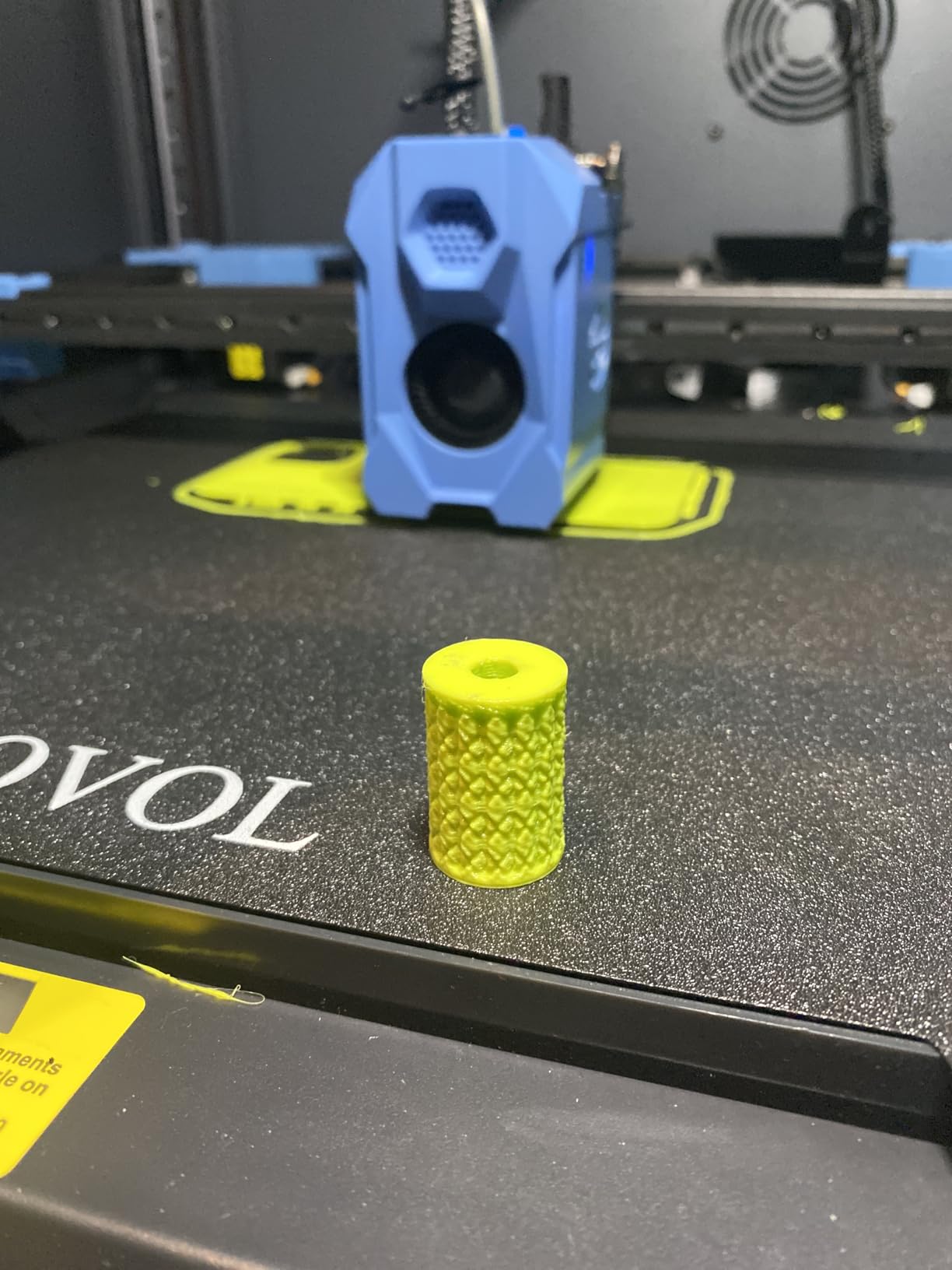
Everything is open source, Voron 2.4 hardware with Klipper firmware and OrcaSlicer support, so nothing is paywalled. For a prop shop or a serious hobbyist who wants to modify the machine, that matters.
The ceramic heating block and AC heated bed reach 220C in 40 seconds, which shortens the changeover between a PLA run and a harder material run.
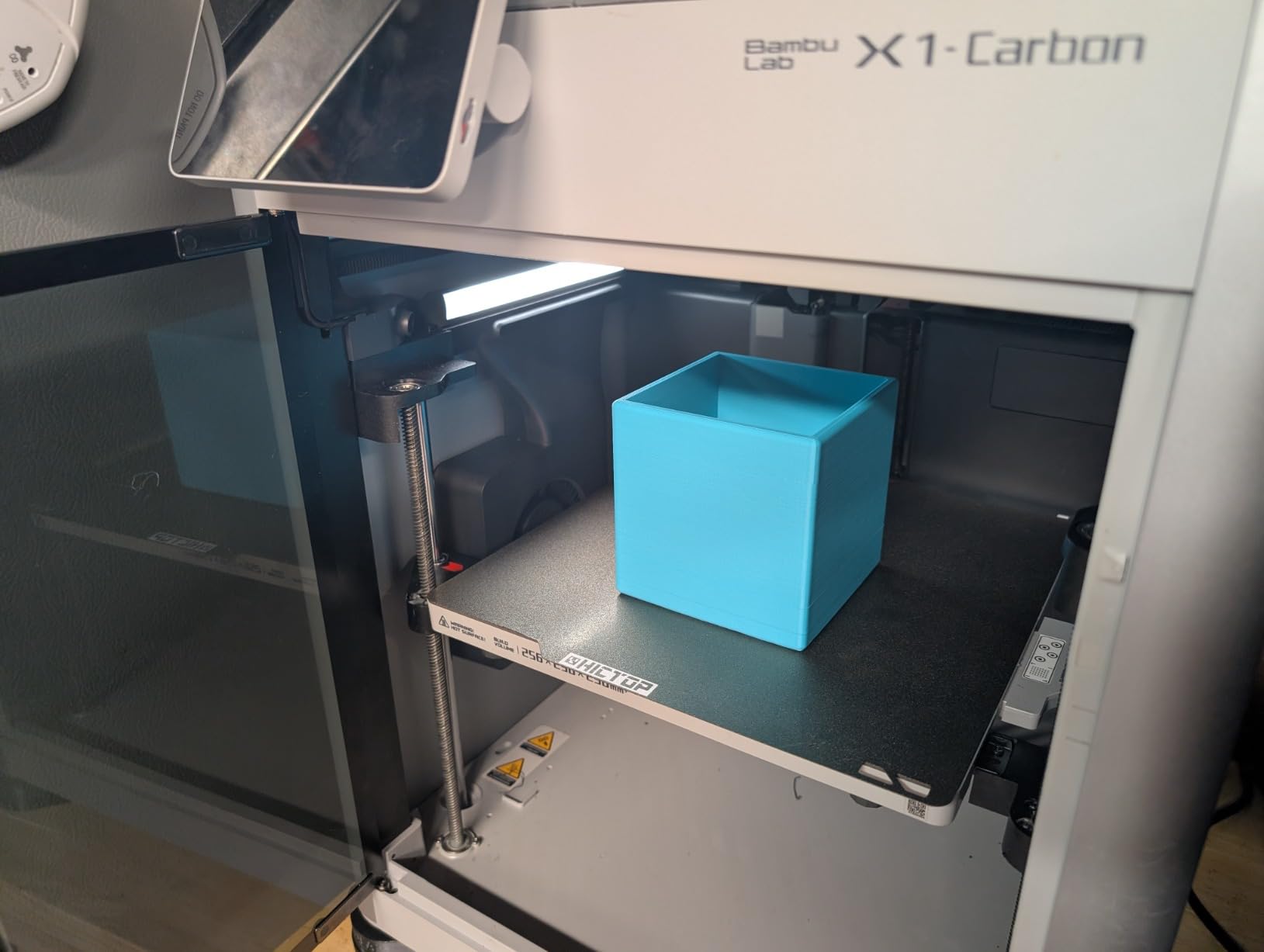
Who it works for
Someone printing large decorative props and armor panels in PLA or PETG who values speed and open hardware. The 350 x 350 x 345mm volume covers most helmet domes and torso shells without a center seam.
It is also the machine to look at if you enjoy tuning. Our CoreXY guide covers what the architecture buys you in terms of speed and ringing artifacts.
Who should skip it
Anyone who wants a finished machine on the desk in an afternoon. Assembly takes longer than the advertised estimate, and sharp edges on the cut extrusions need deburring.
Recurring hotend clogging is the most reported problem, and the open frame means ABS and ASA are out. Buy a spare hotend and a brass nozzle kit before you start.
6. Creality K2 Plus Combo – Best for 16-Color Multi-Part Costumes
Creality K2 Plus Combo 3D Printer, Multi Color Printing with New CFS 600mm/s High-Speed Full Auto-Leveling Dual Al Camera Next-Gen Direct Drive Extruder Large Build Volume 13.78×13.78×13.78inch
350x350x350mm cube
16-color with four CFS
600mm/s
60C heated chamber
Pros
- True 350mm cube handles large props without splitting
- 16-color printing from four CFS units with RFID detection
- 60C active chamber supports ASA and PPA
- Dual AI cameras catch failures and idling automatically
- Rigid die-cast aluminum frame limits resonance
Cons
- Highest purchase price in this lineup
- Heaviest unit at 70.4 pounds and awkward to move
- Four CFS units take up considerable desk space
This is the machine for a character whose costume is defined by color blocks. Sixteen colors across four CFS units with RFID filament detection means a shield with layered heraldry prints in one job instead of four hand-painted passes.
The 350 x 350 x 350mm cube is a true cube, so a chest plate or a helmet dome fits without rotating the design to dodge a filament cutter. Active chamber heating to 60C with a 350C hardened steel nozzle covers ASA and PPA.
Speed is 600mm/s with 30000mm/s2 acceleration using FOC step-servo motors, and a 40mm3/s high-flow extruder keeps thick walls fed. A dual motorized Z-axis on four linear rods keeps the bed stable at full volume.
Dual AI cameras and 18 smart sensors watch for spaghetti failures and idling, which matters on the multi-day runs professional cosplayers quote on 501st and whiterarmor.net build threads.
Best for professional and advanced builders
A prop maker who bills for costumes, or a hobbyist building a multi-piece armor set where paint time is the real constraint. The automation matters on runs of 40 hours and up.
If color is not the deciding factor, our enclosed printer guide has cheaper ways to get a heated chamber and a large cube.
Where the trade-offs bite
The price is the highest here and the weight is 70.4 pounds, so it needs a permanent spot. Four CFS units consume more desk than the printer itself.
Multi-color prints waste filament in purge towers, and the installed owner base is smaller than the picks above, so long-term reliability data is thinner. Early firmware friction is the main complaint.
7. QIDI Q2 – Best for High-Temperature and Carbon-Filled Filaments
QIDI Q2 3D Printer, 65℃ Heated Chamber and 370℃ Nozzle Unlock PPS-CF
65C PTC heated chamber
370C nozzle
600mm/s CoreXY
Triple filtration
Pros
- 65C second-generation PTC chamber cuts warping on large parts
- 370C nozzle unlocks PPS-CF and other composites
- Nozzle doubles as the leveling sensor for easy first layers
- H12 HEPA and carbon filtration keep odor down
- Full-metal CoreXY on precision linear rails
Cons
- Base unit does not include the QIDI BOX needed for multi-color
- Smaller owner review base than the big-name rivals
- 39.8 pounds is a large footprint for a home desk
The Q2 is the answer when a prop has to survive a hot car, a convention loading dock and a stack of foam boards. A 65C actively heated chamber and a 370C nozzle cover the materials that soften when PLA would already be sagging.
The nozzle doubling as the leveling sensor is a small design decision with a large effect on a first helmet. You get a reliable first layer without manual bed work, which is where most beginners lose an evening.
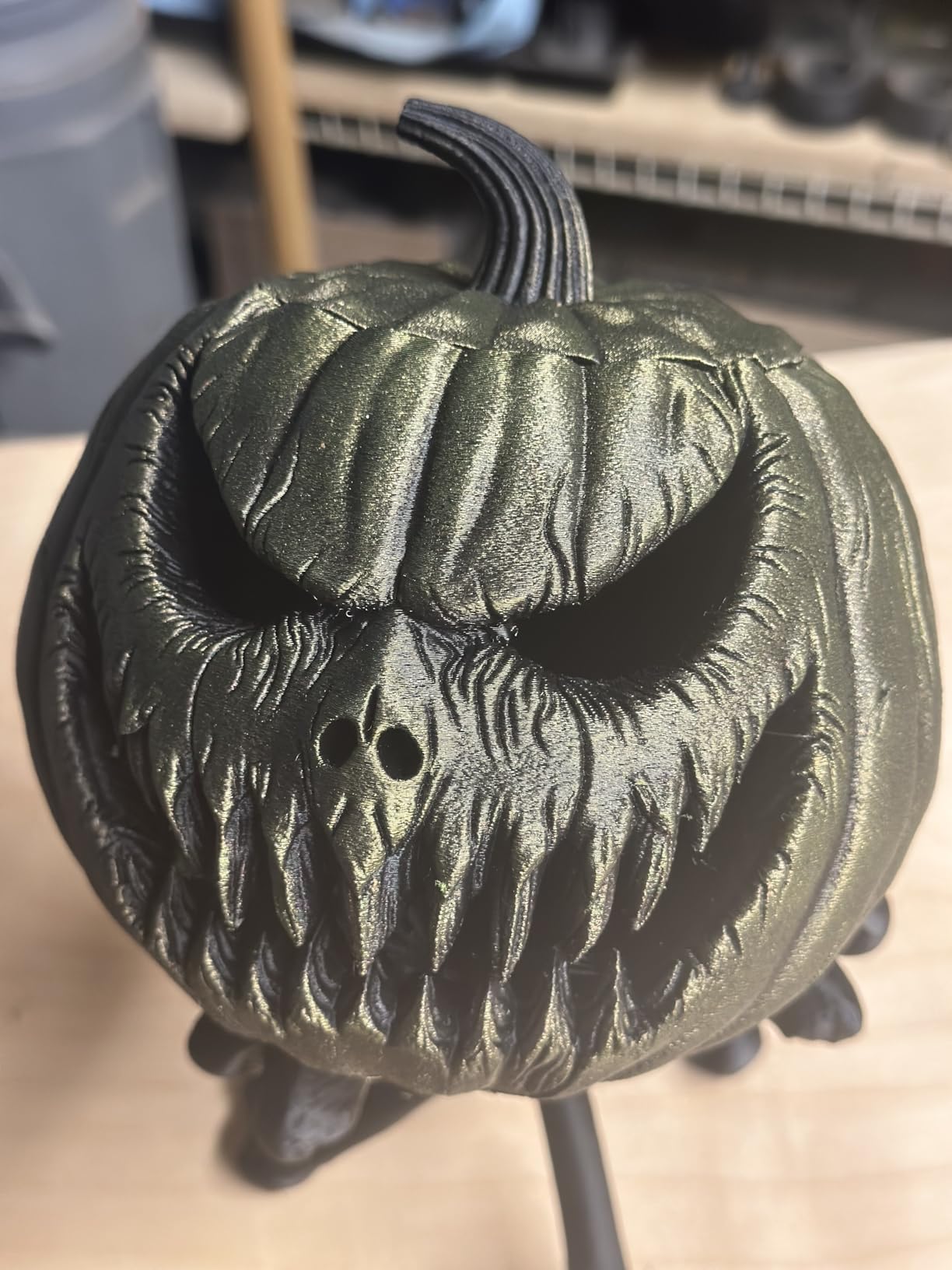
Full-metal CoreXY on precision linear rails reaches 600mm/s, and a 1.5GT synchronous belt cuts the vertical fine artifacts that show up as ridges on curved armor surfaces.
Triple filtration, a G3 pre-filter, H12 HEPA and activated carbon, matters more than the spec sheet suggests. You can run ASA overnight next to a workspace without the whole room smelling like a hobby.
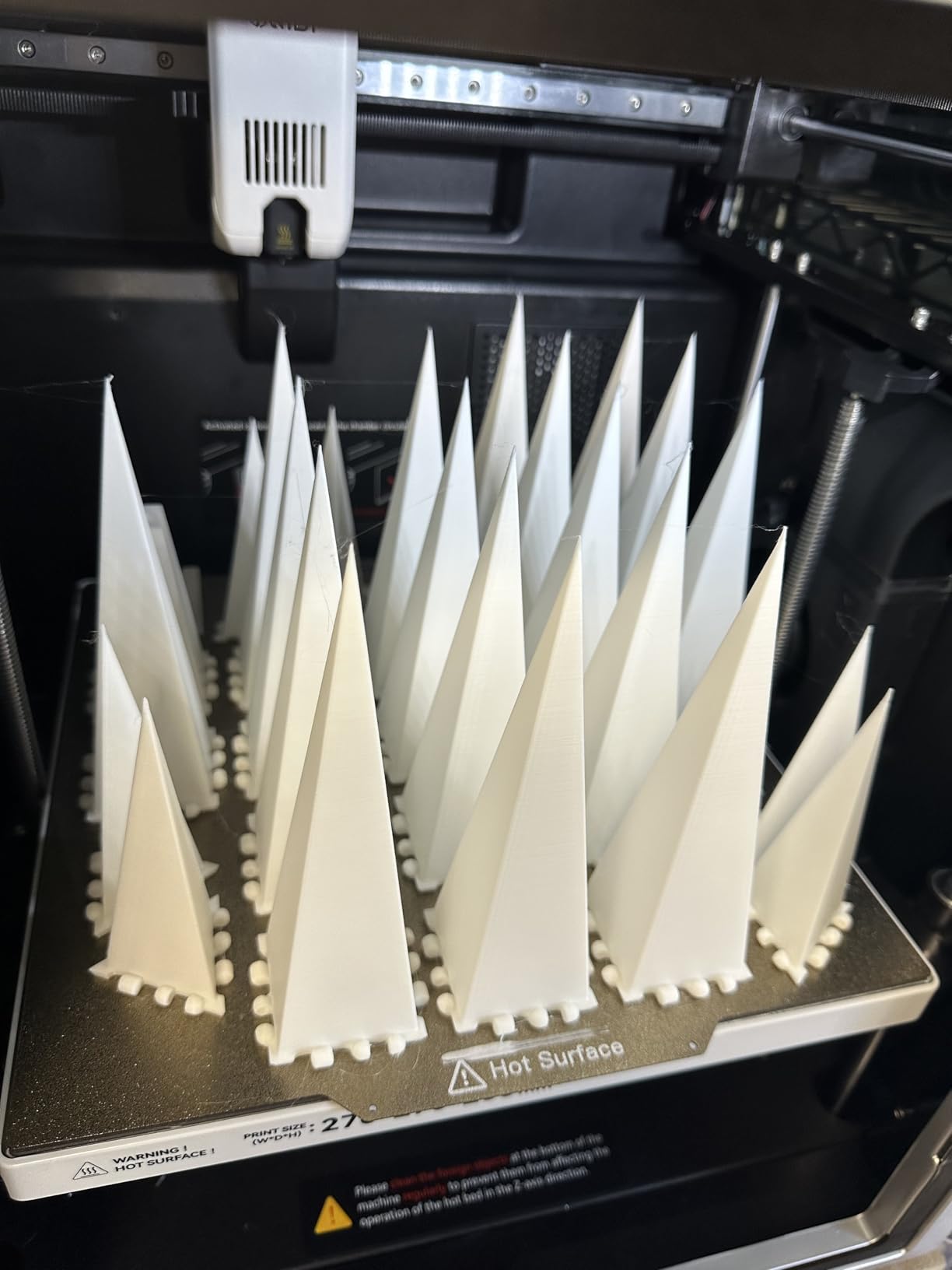
Best for heat and strength
Armor you will wear outdoors, prop weapons that get knocked around, and anything where a warped corner would mean reprinting a piece. ASA and PETG-CF class materials are where this machine pulls ahead.
AI camera monitoring, auto-leveling, run-out detection and power loss recovery protect the long runs. If you add the QIDI BOX later, it expands to 16-color dry-while-print multi-material.
Where it falls short
The base configuration does not include the multi-color box, so color printing is a later purchase. With 154 owner reviews, long-term data is thinner than the 2000-plus review machines above.
A newer brand also means a smaller community troubleshooting archive. If you like to read forum threads before buying, expect fewer of them.
8. FLASHFORGE Creator 5 Pro – Best for Multi-Material Prop Shells
FLASHFORGE Creator 5 Pro 3D Printer, 4 Toolheads with 7s Toolchanger, Industrial Multi-Material & Mixed-Material Printing, Fully Enclosed CoreXY 65°C Active Chamber Heating Better Engineering Prints
Four preheated toolheads
7s FlashSwap
65C active chamber
320C nozzle
Pros
- Four preheated toolheads switch material in 7 seconds with no purge cycle
- Supports PLA PETG TPU ABS ASA PVA PA-CF PET-CF PPS-CF and HIPS
- 65C chamber and 320C nozzle handle tough composites
- Adaptive airflow keeps overhangs and bridges crisp
- Flow calibration compensates for nozzle wear automatically
Cons
- Very new model with a limited long-term reliability record
- Four toolheads add cost and complexity
- Heavier than single-extruder enclosed printers at 30.8 pounds
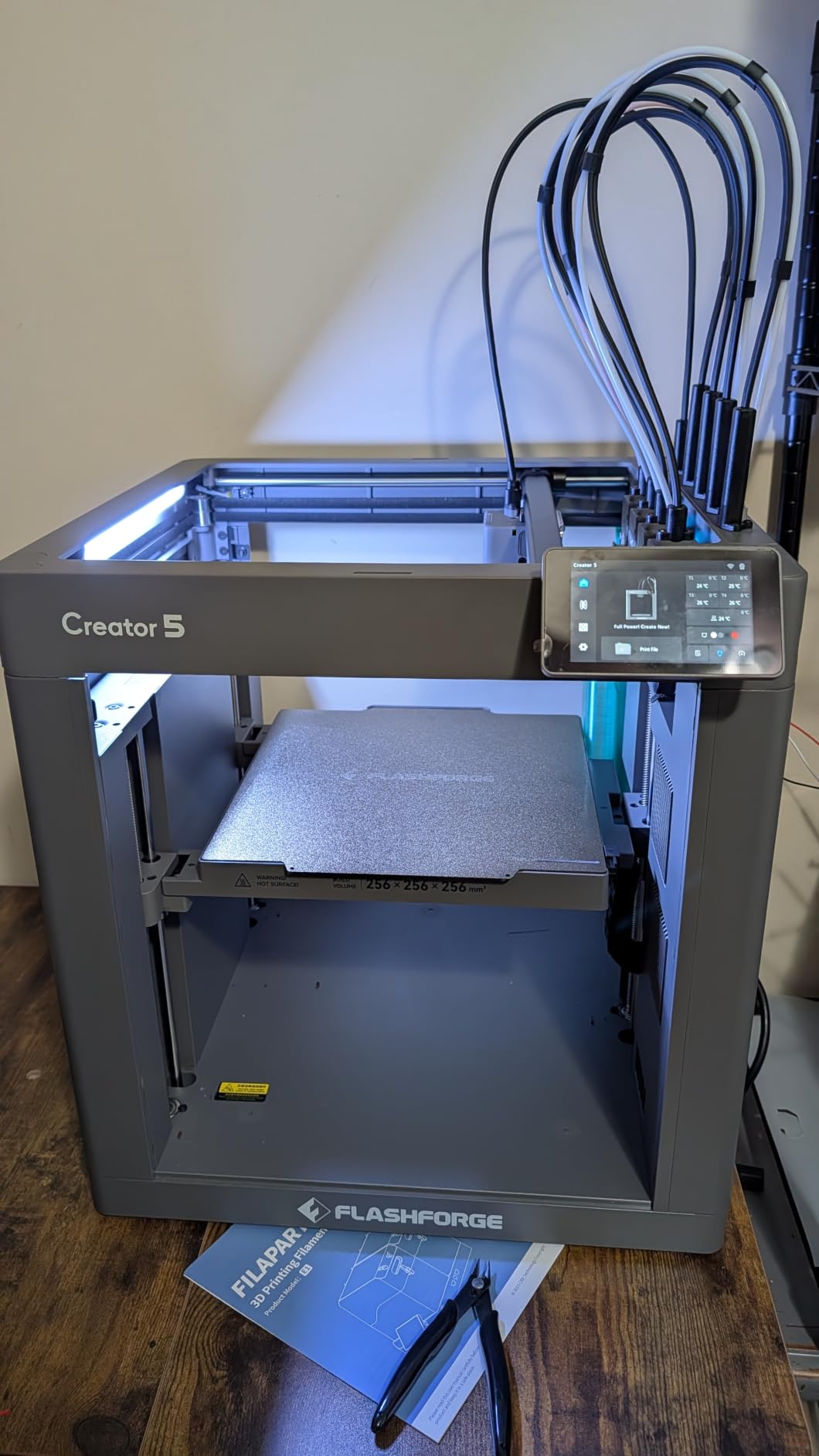
The Creator 5 Pro solves the problem that slows down every mixed-material prop: the purge. Four preloaded, preheated toolheads swap in 7 seconds with no purge cycle, so a rigid ASA shell with a flexible TPU strap prints as one job.
Support material is the quiet win. PVA and HIPS dissolve or sand away, so a full-face mask prints without the support scars that normally land across the forehead and cheekbones.
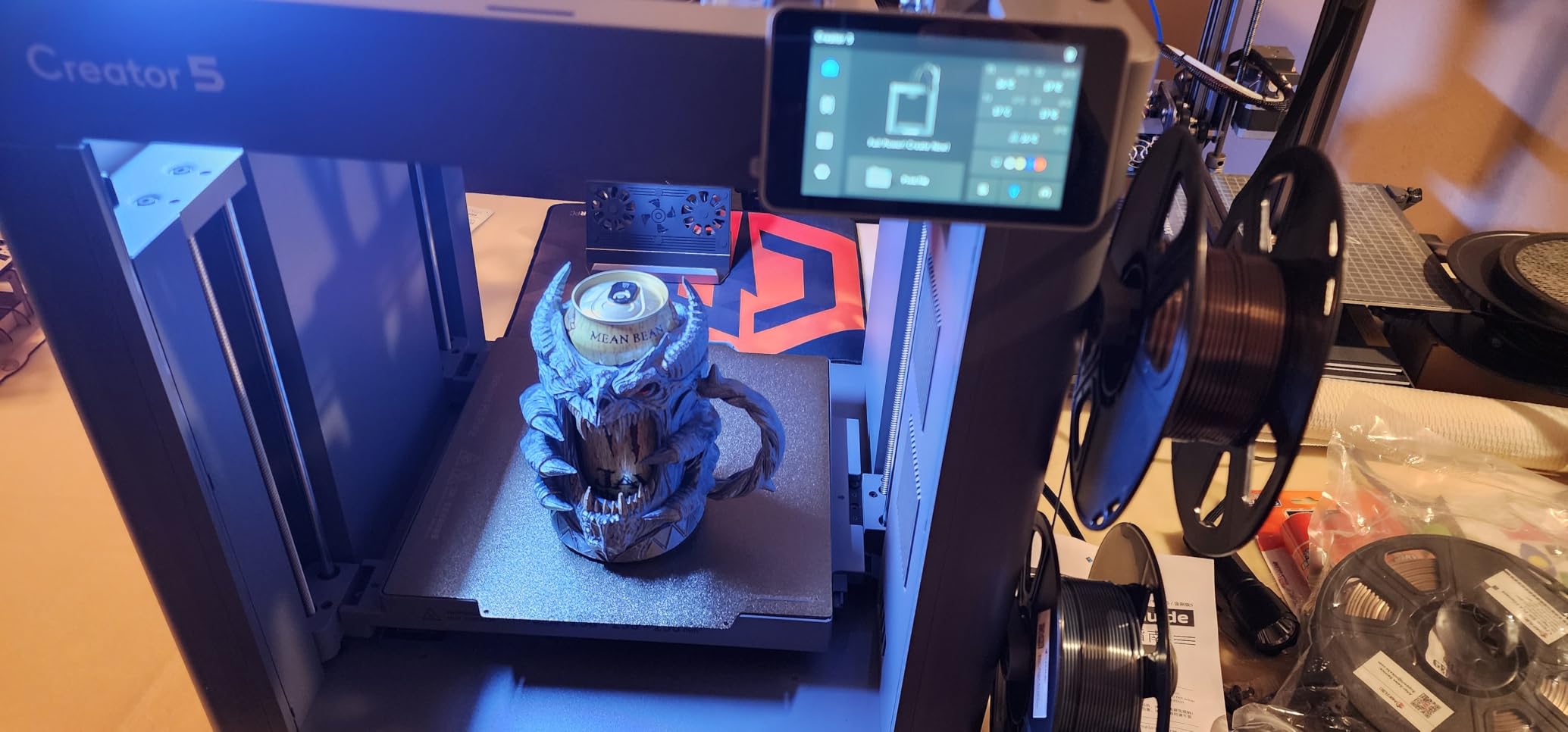
A 65C actively heated chamber, a 320C hardened nozzle and adaptive airflow chamber cooling cover everything from PLA to PPS-CF. Flow Dynamics Calibration handles the non-linear extrusion compensation that wear and filament moisture cause.
The fully enclosed CoreXY frame limits warping on the large panels where you can least afford a corner lift.
Who it suits
Builders combining materials inside one prop: soft grips and hard shells, soluble supports and finished surfaces, carbon-filled panels next to standard prints. Twelve-plus filament types are listed as supported.
If your props are single-material PLA, this complexity buys you nothing. Our multicolor guide covers simpler ways to mix color.
Who should skip it
Anyone buying on long-term reliability. With 203 owner reviews there is not yet much data on wear across thousands of hours, and four toolheads are four things that can need attention.
The cost and complexity both scale with the toolhead count. If you need two materials, a dual-extruder machine is a more proven route.
9. ELEGOO Saturn 4 Ultra 16K – Best for Monitored Resin Workflows
ELEGOO Saturn 4 Ultra 16K Resin 3D Printer
16K monochrome display
30C heated resin vat
150mm/h tilt release
AI camera
Pros
- 16K resolution captures fine surface texture on prop details
- Heated vat at 30C measurably cuts bubbles and layer separation
- Automatic leveling needs no manual setup
- AI camera with chamber light allows remote monitoring
- Residue sensor protects the LCD from costly damage
Cons
- Heavy and bulky at 35.5 pounds and 24 inches wide
- Resin printing still needs ventilation gloves washing and curing
- AI detection accuracy varies by model and environment
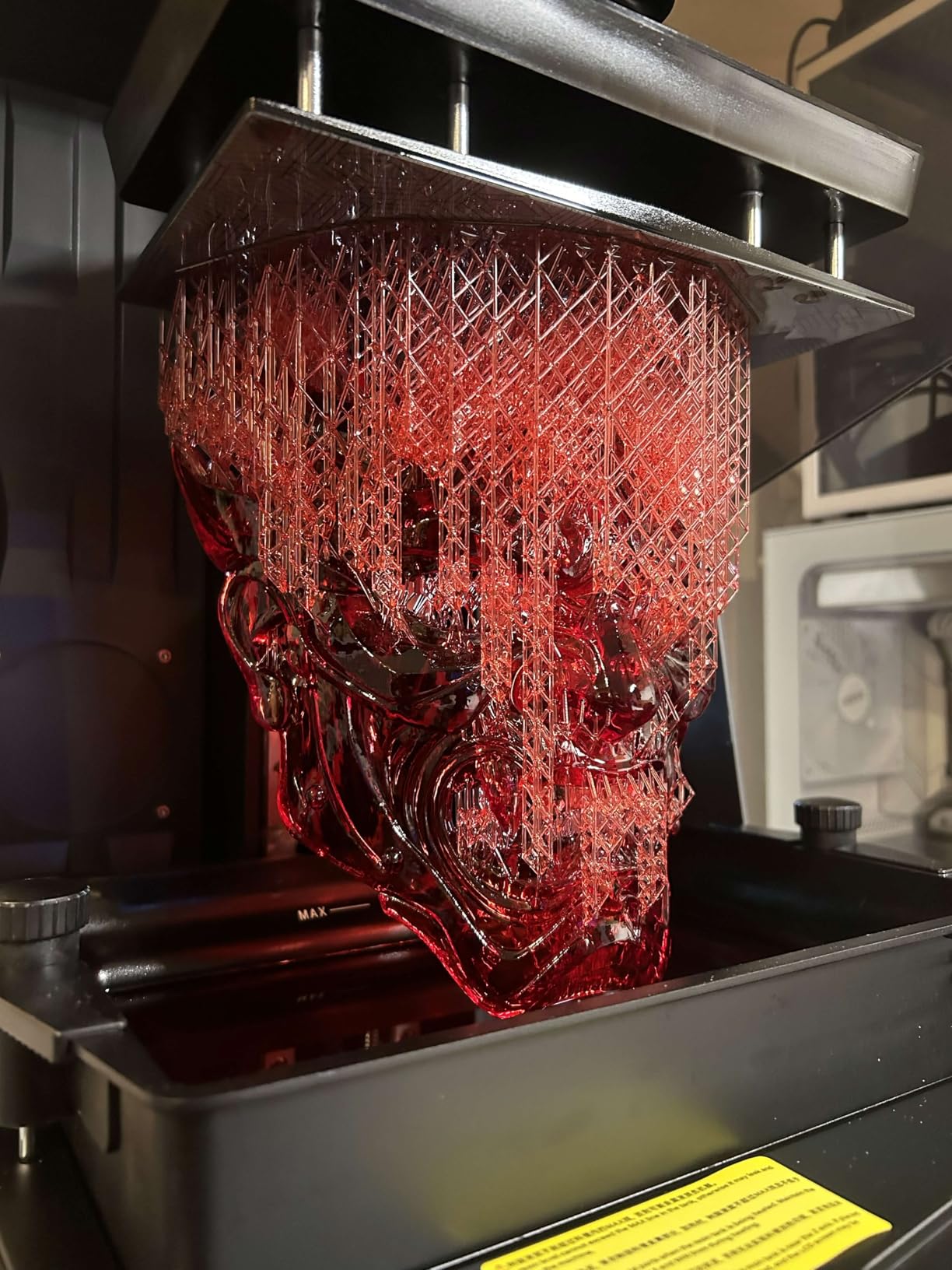
The Saturn 4 Ultra is the resin machine to buy when you are not in the room when it prints. The AI camera with a built-in chamber light catches warp and empty-plate alerts, so an overnight face shell does not silently fail at hour six.
Smart tank heating holds resin at 30C, and reviewers consistently name that alongside the 16K panel as the reason their success rate improved over cold-vat predecessors. Viscosity changing with temperature is what causes layer separation.
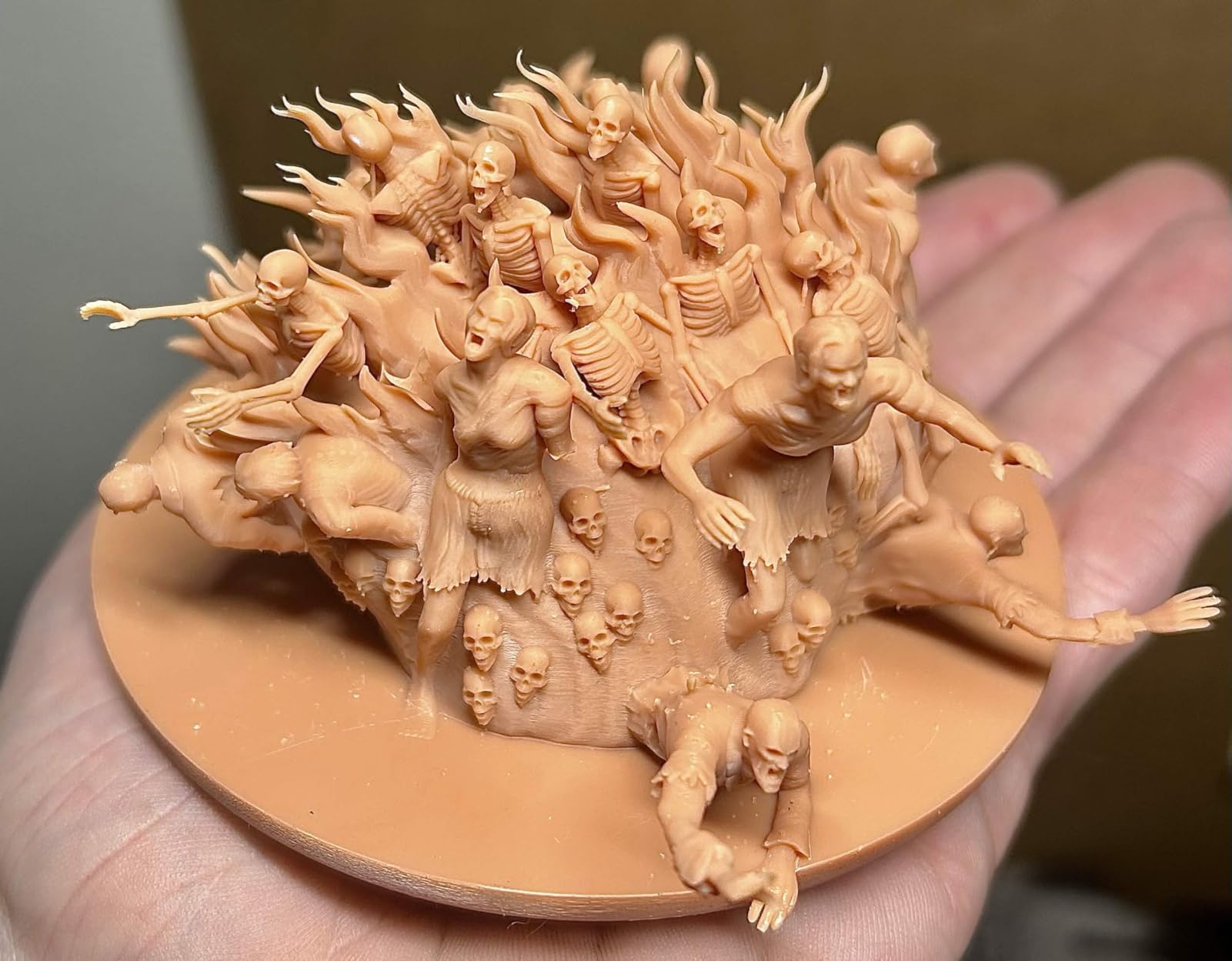
Tilt release at up to 150mm/h separates the part from the film faster than lift-only designs, which shortens large prints and reduces the peel force on thin armor trim.
Automatic leveling means there is no manual setup step to get wrong, which is the usual reason a first resin print fails. A mechanical residue sensor protects the LCD, which is the most expensive part to replace.
Best fit
Cosplayers printing anime figure scale busts, mask details, jewelry and emblem sets where the surface is the whole point. The 16K panel is where the extra resolution actually shows.
If you need full-size masks, the smaller resin chamber on this machine sends you back to splitting. The desktop printer guide covers the size comparison in more detail.
Where it stops
At 35.5 pounds and 24 inches wide it needs a dedicated spot with ventilation. The resin workflow itself does not change because the machine is automated.
With 366 owner reviews the long-term record is shorter than the filament machines here, and AI detection accuracy varies with the model, environment and resin brand you use.
10. ANYCUBIC Photon Mono 4 – Best Low-Cost Resin for Emblems and Details
ANYCUBIC Photon Mono 4, Resin 3D Printer with 7” 10K Mono LCD Screen
7-inch 10K mono LCD
153.4x87x165mm volume
4-point leveling
Resume printing
Pros
- 10K resolution produces near-invisible layer lines for detail parts
- Exceptional surface finish for the purchase price
- Small quiet footprint that fits a home office
- Printing within 30 minutes of unboxing
- Power loss resume saved an in-progress print
Cons
- 153x87x165mm volume limits props to multiple parts
- Resin vats can crack and sometimes take the LCD with them
- Defaults need exposure and lift speed tuning before prints succeed
The Mono 4 is the cheapest way into resin printing on this list, and at 4.4 it carries the highest owner rating of the group. For small costume details the size limit stops mattering quickly.
A 7-inch 10K monochrome LCD at 9024×5120 with 17×17 micron pixels produces detail on a belt buckle or a rank insignia that no filament machine here will match, and the LighTurbo matrix light source keeps illumination even across the panel.
At 7.7 pounds and 10 x 10 x 15 inches it is the only machine here you can carry between rooms, and reviewers report printing within half an hour of unboxing.
Four-point manual leveling is a one-time job, and power loss resume has already saved more than one long print for owners. The laser-engraved Print Platform 2.0 grips well with correct settings.
Best fit for small parts
Emblems, badges, rings, buckles, chain links, weapon trim and anime figure scale pieces. If the prop fits in 153 x 87 x 165mm, this prints it beautifully and cheaply.
Easy disassembly for deep cleaning is underrated on resin machines, since keeping the vat clean is what prevents the failures owners complain about elsewhere in this category.
Where it does not fit
Anything wearable or full-size. A 153mm build height means a helmet is a dozen printed pieces with a dozen seams, and seam work is the slowest part of finishing a prop.
It also needs a desktop computer running Photon Workshop to slice, and the mobile app and barcode pairing are not supported on this model. Cracked vats are a recurring complaint, so treat the vat as a consumable.
How to Choose a 3D Printer for Cosplay Props
Build volume: the single most important spec
Quote build volume as the printable cube in millimetres and compare only that number. For a full helmet you want 300mm or more of Z. For a chest plate you want 350mm of width or a plan to split it down the sternum.
Every split adds a seam that gets sanded, filled, primed and painted, so build volume saves finishing time as much as it saves money. Our general cosplay printer roundup covers the same specs from a different angle.
FDM or resin: the 30-second version
FDM for anything bigger than your hand. Resin for anything where the surface is visible and small: emblems, badges, face shells and figure scale pieces. Many cosplayers end up owning one of each.
FDM is cheaper per part, safer indoors and forgiving of mistakes. Resin gives surface detail no hotend can match, but adds PPE, washing, curing and ventilation to your workflow.
Filament choice for wearables
PLA prints beautifully and sands easily, which is why most cosplayers default to it. It softens near 60C, so it deforms in a hot car or under bright convention lighting.
PETG is the under-discussed middle ground. One cosplay printing group post described it as easy and clean with no obvious downside against PLA, and it holds shape closer to 80C while sanding to the same finish.
ABS and ASA need an enclosed chamber with a heated bed. ASA weathers UV far better, which matters for outdoor events and repeated transport.
TPU covers straps, grips, boot soles and flexible trim. It will not bridge like rigid filament, so expect slower prints and good support.
Enclosure: when you actually need one
You do not need an enclosure for PLA, PETG or TPU. You do need one for ABS, ASA, PA-CF and any carbon-filled filament, because the chamber temperature difference is what causes the corner lift that ruins a large panel.
Owners on r/3Dprinting consistently steer beginners away from open-frame budget machines for cosplay, arguing the time lost to warping and reprints outweighs the saving.
Print speed and unattended overnight runs
A helmet print runs 20 to 40 hours, so speed matters more than it does for small prints. CoreXY machines here range from 180mm/s to 700mm/s, which is the difference between a one-day build and a three-day build.
For overnight runs, prioritise cameras, filament run-out sensors and power loss recovery. Multi-day print runs failing with no monitoring is the most common complaint in cosplay printing groups.
Multicolor systems and when they pay off
Multicolor units here run from four colors to sixteen. They cut hand-painting time on trim, heraldry and layered insignia, but they slow prints with purge towers and waste filament.
They pay off when color defines the character and not when color defines the whole prop. A painted helmet is often faster than a four-color one.
Part splitting and seam placement
Splitting is the real skill nobody teaches. Put seams along existing panel lines so the joint reads as a design feature, and add registration pins so parts locate without guessing.
Orient the part so supports land on areas you will sand anyway, never on a faceplate or a visor. Soluble PVA or HIPS support is worth learning if you print masks regularly.
Resin safety checklist
Before the first pour, set up nitrile gloves, a ventilated enclosure or a resin-safe area, isopropyl alcohol for washing, and a UV cure station. Treat uncured resin as a sensitizer, not as a liquid plastic.
Never pour resin down a drain and never cure it on a kitchen counter near food. Add a residue inspection to your monthly maintenance, because a scratched LCD is a costly failure.
Total cost of ownership beyond the printer
Budget for consumables. Resin needs a wash-and-cure station, IPA, gloves and replacement FEP film. FDM needs spare nozzles, filament, and filler primer and paint for the finish.
A filament build plate that peels and a spare hotend will cost far less than reprinting a failed 30-hour helmet. Our CoreXY guide has more on keeping long runs alive.
Where to find prop files
Free helmet, weapon and armor files live on community repositories, and paid filesets from specialist studios usually offer better-scaled, better-supported meshes. Check the license before printing for a group or a paid commission.
Pay attention to scaling and units in the file itself. A model authored in millimeters that you slice as inches prints 25.4 times too large, which is the most common first-print failure with third-party files.
Conventions, prop weapons and IP
Nothing about printing a prop is inherently illegal, but convention rules govern what you may carry into a venue. Most conventions ban real-looking bladed weapons and require props to be blunt, unloaded or clearly non-functional.
Check the convention handbook before you print, and keep any prop that could be mistaken for a firearm non-functional and clearly a replica. Printing a character design for personal use is normal cosplay practice; reproducing a trademarked logo for resale is a different matter.
Frequently Asked Questions
How big of a 3D printer do I need for cosplay?
For a full helmet shell, you want at least 300mm of Z height, and 350mm is better once you add a brim and visor clearance. For a chest plate, look for 350mm of width or plan to split it down the sternum. Below 220mm you will end up with six or more pieces and a lot of seam work.
Should I use PLA or PETG for cosplay?
PLA is easier to print and sand, which is why most cosplayers start there, but it softens near 60C and can deform in a hot car. PETG holds shape closer to 80C, sands to a similar finish and survives being worn and transported. Choose PLA for display pieces and PETG for anything you wear outdoors.
Is FDM or resin better for cosplay props?
FDM is the right tool for helmets, chest plates, pauldrons and weapons because it handles large parts cheaply and safely indoors. Resin wins on small detailed props such as emblems, buckles, badges and anime figure scale busts, where the surface finish matters more than size. Most builders own one of each.
What is the best filament for 3D printing cosplay armor?
PETG is the best all-round choice for wearable armor because it resists heat, is less brittle than PLA and sands to a paintable finish. Use ASA for outdoor or sun-exposed pieces, ABS if you have a heated chamber, and TPU for straps, grips and boot soles. Keep PLA for display props that stay indoors.
Is PETG or PLA+ stronger?
PETG is generally stronger and more heat resistant than PLA+, holding its shape closer to 80C while PLA starts to soften near 60C. PETG is also less brittle and takes more impact, which matters for props that get knocked around. The trade-off is that PETG has more visible layer lines before sanding.
Is there anything illegal to 3D print?
Printing a cosplay prop for personal use is not illegal in itself. Convention venues set their own rules, and most ban real-looking bladed weapons or anything that could be mistaken for a firearm. Reproducing a trademarked logo for commercial resale is a separate legal question from printing a costume piece.
Conclusion: Which Cosplay Printer Should You Buy?
Start with the size of your smallest build plate and your largest prop. If your biggest piece is a helmet or a chest plate and you have the space for a chamber, the ELEGOO Centauri Carbon 2 Combo gives you a sealed 256mm cube and four colors in one machine.
If you print full-size masks and want the surface to come out paint-ready, the ANYCUBIC Photon Mono M7 MAX is the best 3D printer for cosplay props overall, with a 298 x 164 x 300mm resin chamber that few FDM machines can match in that size range.
On a tight budget, the Longer LK5 Pro gives you a 400mm Z height and open-source firmware for the least money here. Professional prop builders should look at the Creality K2 Plus Combo for 16 colors and automated monitoring, and at the QIDI Q2 when heat resistance decides the material.
Whichever machine you pick, measure your props before you buy and plan your seams along panel lines. That step decides how the finished costume looks more than any spec on this list. Our broader cosplay printer roundup goes deeper on the general buying criteria if you want more before you commit.