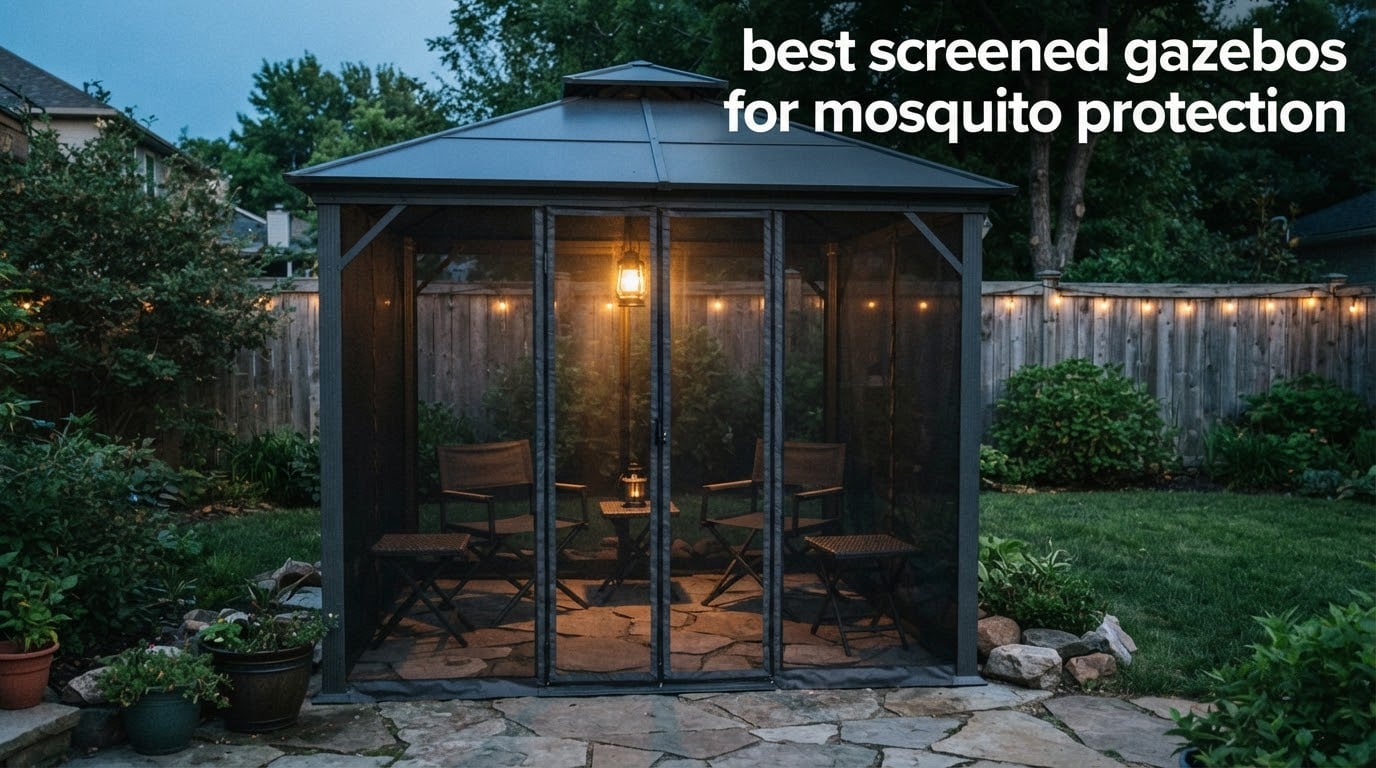
Finding the best screened gazebos for mosquito protection comes down to one spec that most product pages bury: mesh gauge. A standard mosquito mesh stops mosquitoes and flies, and nothing smaller. No-see-um mesh also stops midges and gnats, at the cost of airflow. Below that, you are looking at a mesh wall that traps heat like a greenhouse panel.
We spent weeks putting ten of the most popular screened gazebos side by side, reading thousands of buyer reviews, and checking every published specification against what owners actually report after a summer or two outdoors. The list below covers everything from 10×10 pop-up screen houses to an 11×11 heavy steel gazebo built for a full patio table.
Our best overall pick is the COOS BAY 11×11. It gives you the largest standing footprint in the group, four zippered mesh walls that actually seal, and the highest review volume of any gazebo we looked at. If you plan to carry it to a campsite rather than park it on a patio, the Alvantor screen house is the one to buy instead.
Before you shop, it is worth understanding what a screened gazebo can and cannot do. It blocks insects that fly. It does nothing at all about mosquitoes entering from underneath, and it traps heat in ways that surprise people. Our general gazebo guide covers frame materials and roof types in more depth, and our patio gazebo picks focus on footprint and headroom.
Table of Contents
Top 3 Best Screened Gazebos for Mosquito Protection in October
COOS BAY 11×11 Pop Up Gazebo
- 121 sq ft footprint
- Four zippered mesh walls
- UPF 50+ fabric
- 42.3 lb steel frame
Alvantor Pop Up Screen House
- 12 lb fiberglass frame
- Six mesh walls
- UPF 50+
- Folds to 39.3 inch bag
CROWN SHADES 10×10 Gazebo
- Center-lock steel frame
- Detachable mesh walls
- Silver-coated 150D Oxford
- 2-year warranty
All 10 Best Screened Gazebos for Mosquito Protection in 2026
| Product | Specifications | Action |
|---|---|---|
| COOS BAY 11×11 Pop Up Gazebo |
|
Check Latest Price |
| Alvantor Pop Up Screen House 10×10 |
|
Check Latest Price |
| CROWN SHADES 10×10 Pop Up Gazebo |
|
Check Latest Price |
 VEVOR 12×12 Pop Up Gazebo Tent VEVOR 12×12 Pop Up Gazebo Tent |
|
Check Latest Price |
 Quictent 10×10 Pop Up Screened Canopy Quictent 10×10 Pop Up Screened Canopy |
|
Check Latest Price |
 East Oak 10×10 Pop Up Screen Tent East Oak 10×10 Pop Up Screen Tent |
|
Check Latest Price |
 EVER ADVANCED 11.5 x 9.8 Screen House EVER ADVANCED 11.5 x 9.8 Screen House |
|
Check Latest Price |
 CAMPROS CP 13×13 Screen House CAMPROS CP 13×13 Screen House |
|
Check Latest Price |
 MASTERCANOPY 11×11 Pop Up Gazebo MASTERCANOPY 11×11 Pop Up Gazebo |
|
Check Latest Price |
 VIVOHOME 10×10 Outdoor Screen Tent VIVOHOME 10×10 Outdoor Screen Tent |
|
Check Latest Price |
1. COOS BAY 11×11 Pop Up Gazebo with Netting
COOS BAY 11×11 Pop Up Gazebo with Netting, Canopy Tent, Beige
121 sq ft floor
Alloy steel frame
Four zippered mesh walls
UPF 50+, water resistant
42.3 lb
Pros
- Largest standing footprint here at 121 sq ft
- Tool-free pop-up with carry bag
- Four zippered mesh walls block insects
- UPF 50+ fabric with dual vented top
- Highest review volume in the group
Cons
- Heaviest build at 42.3 lb
- About 14 percent of reviews are one star
- Fabric is water resistant not waterproof
This is the gazebo we kept coming back to. At 132 by 132 inches it covers a full patio dining set without the foot of usable space, and the 116.4 inch peak height means an adult can stand and walk through it. Buyers consistently describe the four zippered mesh sidewalls as effective against mosquitoes while keeping sightlines and airflow intact.
Setup is the classic spring-loaded pop-up. The canopy goes on flat, you push the frame, and it locks itself in seconds with no tools. The carrying bag is included, which matters given the 42.3 lb weight, and the dual vented top gives the shaded interior a place to breathe during a July afternoon.
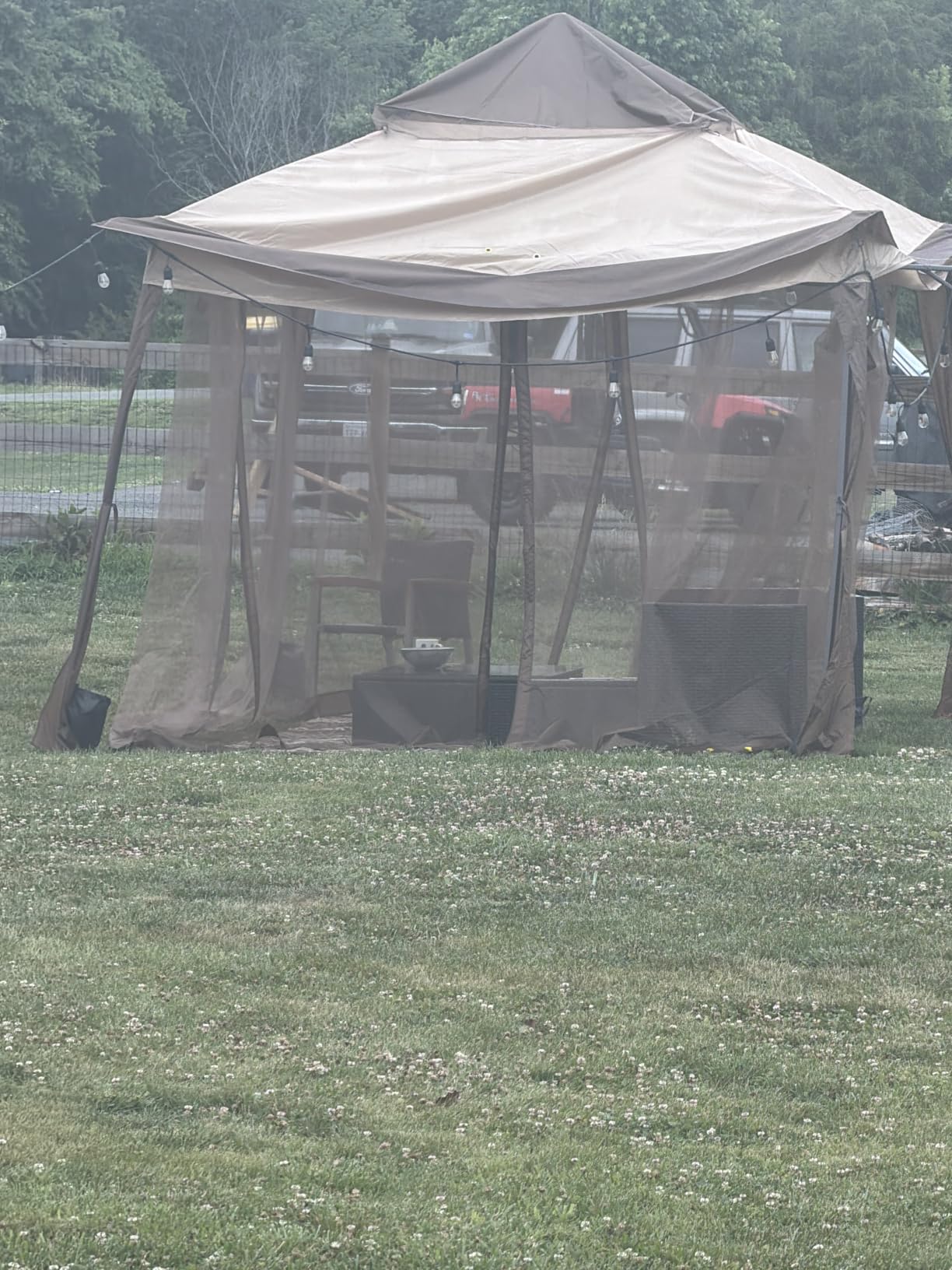
The build is honest alloy steel with a powder-coated finish, and the canopy is 150D Oxford with a water-resistant coating plus UPF 50+ UV blocking. That is shade and drizzle protection. It is not built for a sustained downpour or for standing all winter, and the fabric goes brittle faster than a roofed structure would.
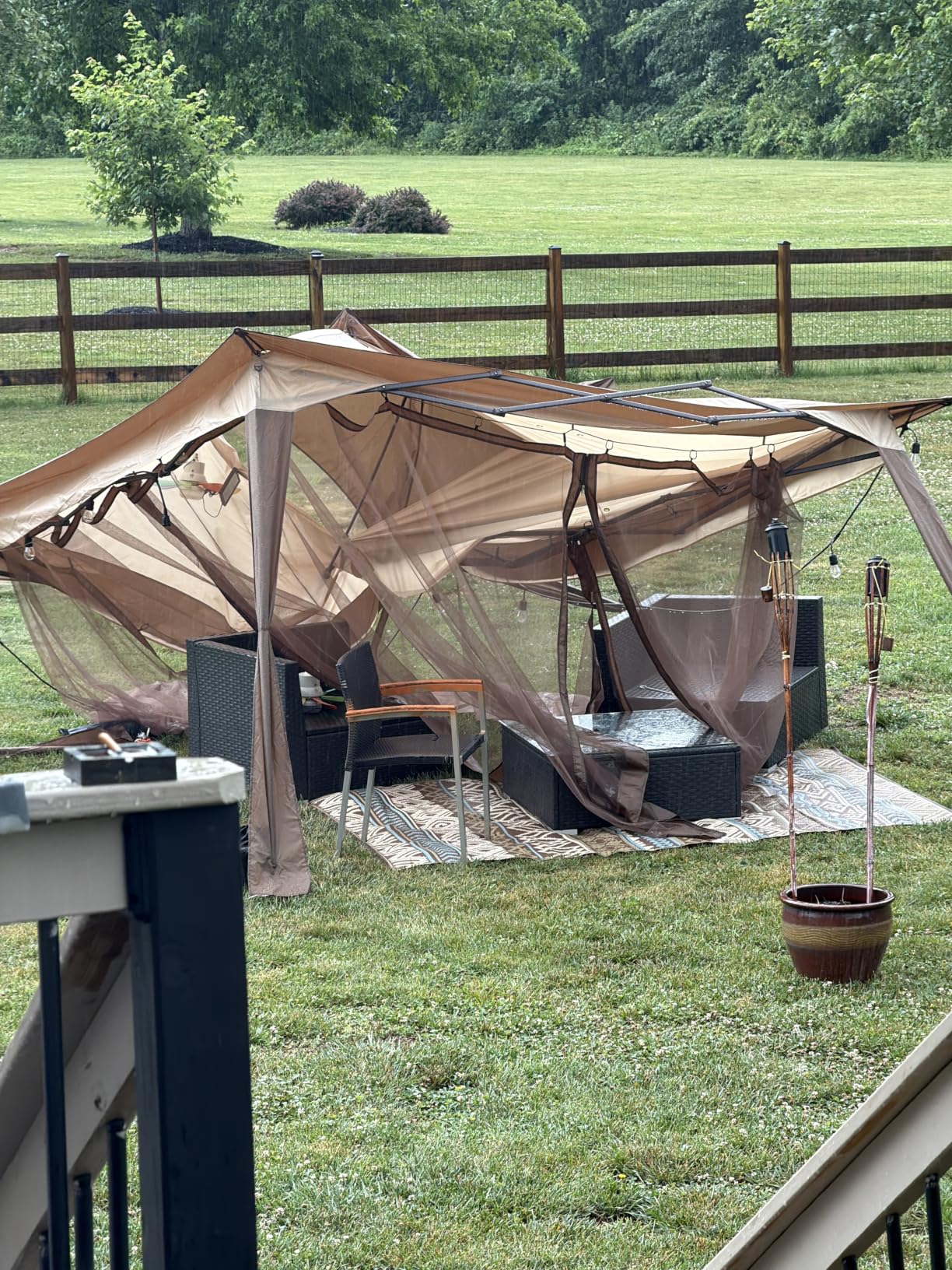
Durability is where the picture splits. About 14 percent of nearly nine thousand reviews are one star, and the recurring complaint is stitching and frame failure after a season or two of hard use. Buyers who keep it up for a summer or two report no problems at all. The one-year limited warranty is the shortest protection on this list, which is the main reason we would not call this a lifetime purchase.
How the mesh performs against mosquitoes
Owner photos show tight, uniform mesh on all four walls, with zippered flaps that close down to the ground rather than stopping at the frame rail. That ground-level closure is what actually decides whether a mosquito gets under the edge and into your evening.
The mesh is a standard insect gauge. It handles mosquitoes, flies, and gnats. If your problem is midges and no-see-ums, the tiny biting midges that bite hardest around dusk, look at a no-see-um mesh model like the East Oak instead. This one trades a little airflow for shade you can actually see through.
When this gazebo is the wrong choice
If you need to stand for hours at a grill or want to leave a cooler and chairs in place through the season, the 42.3 lb frame is a two-person job to reposition. And if your mosquitoes arrive with a hot, humid wind off the water, a full mesh wall of this gauge will hold in the heat as much as it holds out bugs.
We would also look elsewhere if you plan to leave the structure standing through winter weather. The soft top and spring steel frame are designed for warm months. For our wider gazebo comparisons and roof-type differences, see the full gazebo guide.
2. Alvantor Pop Up Screen House Tent
Alvantor Screen House Room Camping Tent Outdoor Canopy Pop Up Sun Shade Hexagon Shelter Mesh Walls Not Waterproof 10’x10′ Beige Patent Pending
10x10x7 ft hexagonal
Fiberglass frame
Six mesh wall panels
12 lb, carry bag
Six sandbags, 12 guylines, 12 stakes
Pros
- Lightest option at roughly 12 to 15 lb
- One person can set and carry it
- Fiberglass will not rust
- Fits most car trunks when folded
- 6 sandbags and 12 guylines included
Cons
- 84 inch peak height
- Not water resistant
- Not recommended above 24-30 mph
- Floor sold separately
Nothing else in this roundup gets out of the car as easily. The fiberglass rib frame pops open on its own, folds back down to a 39.3 by 2.4 inch bag, and weighs about 12 lb in the listed specifications. One person can unfold it, stake it, and pack it away in a few minutes.
The design is hexagonal rather than square, with six mesh wall panels for 360 degree ventilation and clear views out. The top is UPF 50+ for sun protection, and the double-sided silicone zipper door closes cleanly. Sandbags, guylines, and stakes come in the box, which removes the most common excuse for a bad first impression.
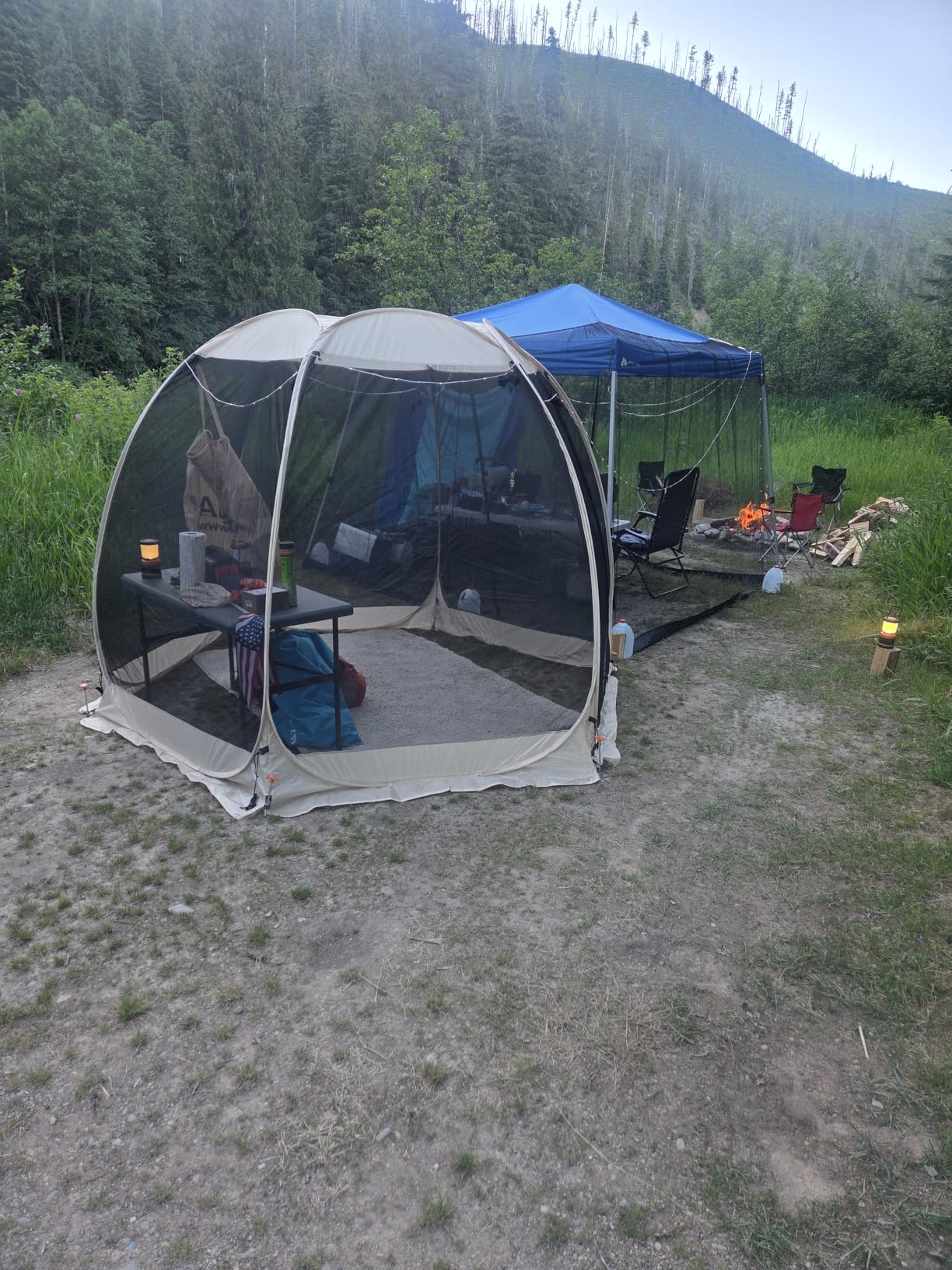
The trade-off is headroom. At 84 inches tall, this is a sit-down shelter, not a standing room. Adults cannot walk upright inside, and moving a grill or cooler around requires crouching. For a picnic table with chairs, a card game, or kids on a blanket, that is fine. For a patio dining table, it is not.
The top is explicitly not water resistant. This is a bug and sun shelter for dry climates and dry campsites, not a rain shelter. The manufacturer also advises against use above roughly 24 to 30 mph wind, and the floor is a separate purchase if you want one.
Why this one carries the highest rating
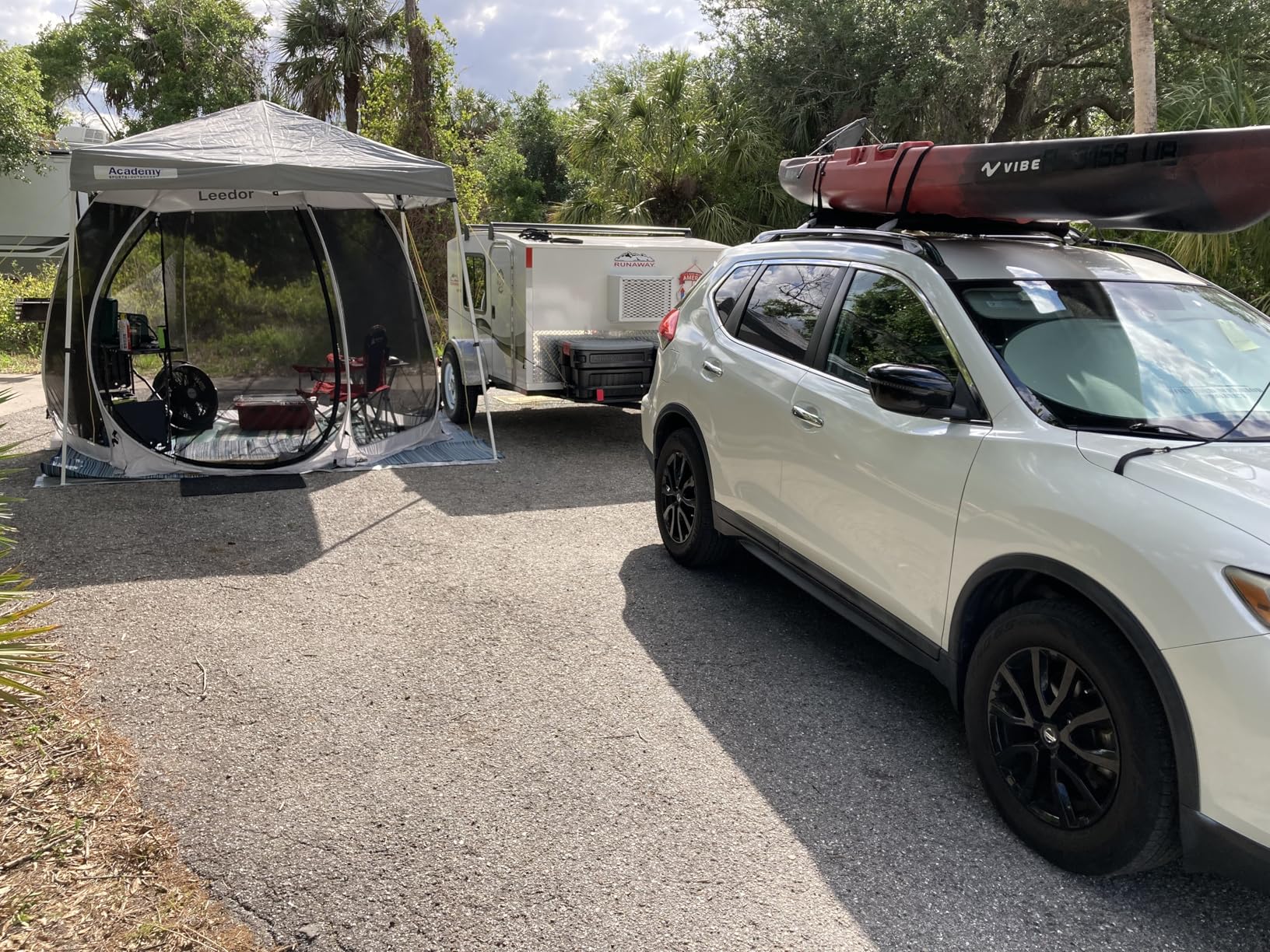
At a 4.5 average across more than eight thousand reviews, with roughly three quarters of buyers giving five stars, this is the best satisfaction record in the group. The reasons are consistent: light weight, one-person setup, tight mesh, and a packed size that fits a normal trunk.
Fiberglass is the quiet hero here. It will not rust the way a steel frame does if you leave it damp in storage, which makes it the safer pick for campers and anyone storing the unit in a shed over winter.
Where it falls short
Heat is the real complaint pattern. Fine mesh on all six walls plus a solid top means the interior can get genuinely warm at midday, and reviewers in hot climates describe a usable morning and evening but a struggle at noon. Roll up or remove one wall panel and it changes quickly.
Skip it if you need to stand, if your site gets real rain, or if you want to leave the unit standing for a season without taking it down. Our patio gazebo guide covers taller standing-height options in more detail.
3. CROWN SHADES 10×10 Pop Up Canopy with Mosquito Netting
CROWN SHADES Gazebo 10×10 Pop Up Canopy with Mosquito Netting, Beige
100 sq ft canopy
Alloy steel CENTERLOK frame
150D silver-coated Oxford
Detachable mesh walls
45.2 lb
Pros
- Center-lock legs make solo setup fast
- Overhanging roof line blocks more sun and rain
- Strong wind performance when anchored
- Wheeled bag plus stakes
- sandbags and ropes
- Two auto-deploying roof vents
Cons
- Heaviest unit here at 45.2 lb
- Mesh tears easily at corners
- Thin pole covers nick easily
- Warranty honored at one year not two
This is the most engineered gazebo in the roundup. The CENTERLOK four-way center-lock leg system with bronze-coated steel legs and single-push height adjustment means one person can raise and lock the frame without fighting the hub, which is the single biggest source of frustration with pop-up designs.
The 150D Oxford fabric has a silver-coated interior that reflects 99 percent of UV, and the roof line overhangs far enough to throw real shade onto the furniture underneath. Owners call this out specifically as better sun and rain coverage than a typical budget pop-up.
Stability is the headline claim and owners back it up, reporting the anchored frame holding through gusts around 50 mph. The kit includes eight stakes, four sandbags, four guy ropes, pre-drilled leg bases, and a wheeled storage bag, which is the most complete anchoring package here.
The mesh sidewalls are detachable with dual-sided zippers, hook and loop straps, and ground anchoring tabs, so you can strip them in summer and use it as a plain shade canopy when mosquitoes are not the problem. That flexibility is worth real money in a mixed climate.
The complaints are specific and consistent: cheap mesh that catches on branches and tears at the corners, mesh hooks that bend, thin plastic pole covers that nick easily, and screen tie strings that are not well sewn. Several buyers also report the listed two-year warranty being applied at one year.
What decides it for most buyers
Choose this one if you want the strongest structure in a soft-top gazebo and you will anchor it properly. The center-lock leg design and the overhang roof solve real problems that cheaper frames ignore, and the detachable mesh lets the same structure serve as a canopy in winter months.
The mesh itself is the weak link. If biting midges are your problem, a dedicated fine mesh unit will outperform it regardless of how good the frame is.
Who should skip it
At 45.2 lb it is the heaviest thing here, and the mesh is the first component to fail. If you have kids climbing on the frame, or you plan to move it between the patio and the campsite regularly, that weight is a real tax.
Also reconsider if you are buying on a two-year warranty promise. Read the reviews on warranty service before you decide what that promise is worth in practice.
4. VEVOR 12×12 Pop Up Gazebo Tent with Mosquito Netting
VEVOR 12x12ft Pop Up Gazebo Tent with Mosquito Netting, 6 Removable Wind Panels & 2 Mesh Windows, Outdoor Canopy Shelter for Patio, Army Green
144 sq ft six-sided
UPF50+ high-density mesh
Fiberglass poles
6 removable wind panels
35.3 lb
Pros
- Largest footprint here at 144 sq ft
- Fine mesh blocks mosquitoes no-see-ums and sand fleas
- Removable panels let you trade privacy for airflow
- Responsive brand customer service
Cons
- Nearly 40 lb in practice
- Two-person setup with three center poles
- Supplied stuff bag is too small
- Fine mesh reduces breeze flow
If the question is how many people can sit inside without touching elbows, this is the answer. At 144 square feet the footprint is the largest in the group, rated for eight, and it has the headroom to move around rather than crouch.
Where it genuinely beats the others is insect coverage. Buyer reviews specifically name mosquitoes, no-see-ums, and sand fleas as things that stay out, which points to genuinely fine high-density polyester mesh rather than the standard insect gauge.
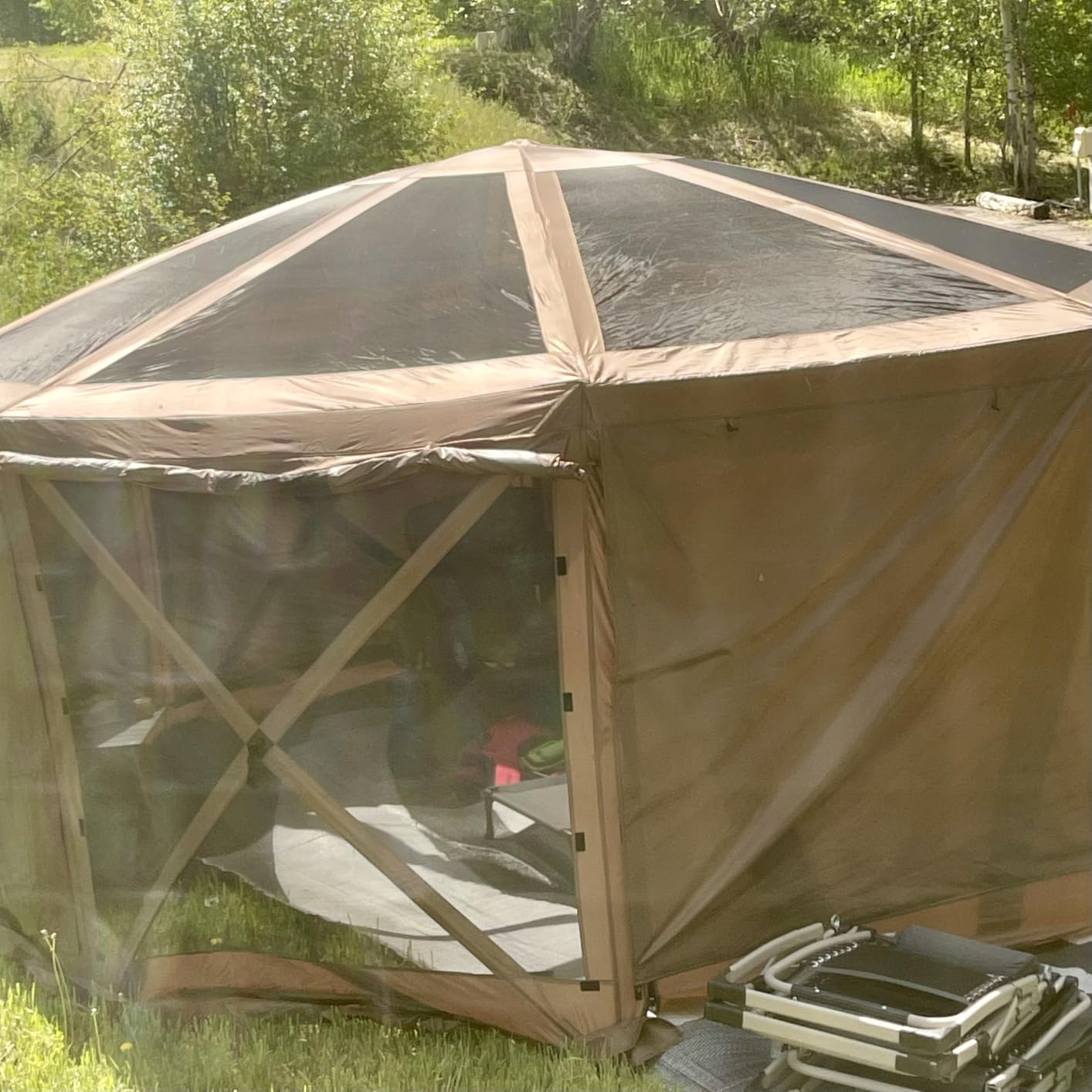
The six removable wind panels are a smart design. Two of them have mesh windows, so you can keep full weather cover on the sides facing the street and open panels toward the breeze. That flexibility is what makes it usable in a four-season backyard rather than only at mosquito season.
Setup is not a one-person pop-up. It uses three separate center poles rather than a spring hub, which buyers describe as a two-person job. Several buyers also report the supplied stuff bag being too small for the folded tent plus accessories, so plan on a bigger storage solution.
Weight is listed at 35.3 lb, though owners describe it as closer to 40 in practice. That is car camping weight, not backpacking weight. Fiberglass poles can split when slid into the metal sockets, and folding has to be done carefully to avoid creasing them.
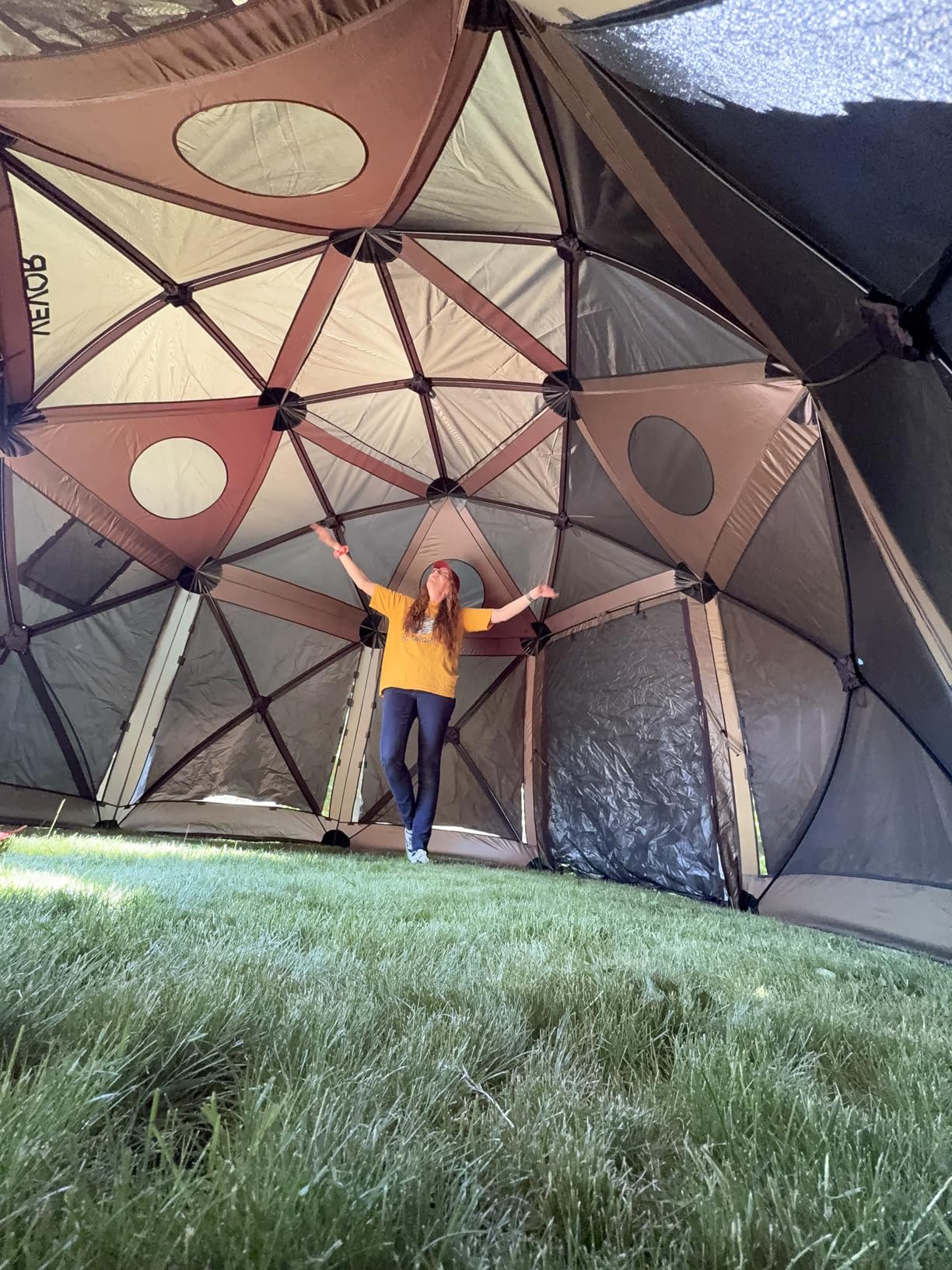
Mesh performance and airflow
This is the strongest anti-midge performer here. Buyers in heavy midge country report the fine mesh making a real difference where standard-gauge units failed. The cost is airflow, and reviewers are candid that the mesh noticeably reduces breeze through the structure.
Our advice is to start with the panels on and open two of them as the day warms. That gets you the best of both without stripping the shelter down entirely.
When to choose something else
Skip it if you need to carry it on foot, or if you want a single-person unfold. Also note the manufacturer advises against heavy rain and storms, so treat it as a bug and sun shelter with light rain capability.
Worth mentioning that VEVOR customer service comes up repeatedly in reviews as responsive, with owners reporting replacement poles sent for broken units. Service like that is worth something when a fiberglass pole is the weak point.
5. Quictent 10×10 Pop Up Screened Canopy Tent
Quictent 10’x10′ Pop up Screened Canopy Tent with Mosquito Netting
100 sq ft, fits 8-10
420D Oxford with PU layer
Full Velcro mesh seal
Wheeled carry bag
40 lb
Pros
- Full Velcro attachment leaves no gaps
- Wheeled carry bag for a bulky frame
- PU-coated fabric held up well in rain for most buyers
- Roomy 100 sq ft interior
- Customer service replaced frames and tops free
Cons
- Center hub and leg buttons hard to lock
- Roof fabric cups rainwater on the unbraced frame
- Fabric turns brittle in strong sun
- Mesh sheds threads at seams
The 420D polyester Oxford with silver coating and a PU waterproofing layer is the heaviest canopy fabric in this roundup, and that is why this is the one to buy if your gazebo has to survive actual rain. Most competitors here are water resistant at best.
The full Velcro attachment system is the other standout. Instead of loose mesh panels hanging from hooks, the screens wrap and stick to the frame for a claimed 360 degree seal with no gaps. Buyers who have used cheaper add-on netting report the difference is immediate.
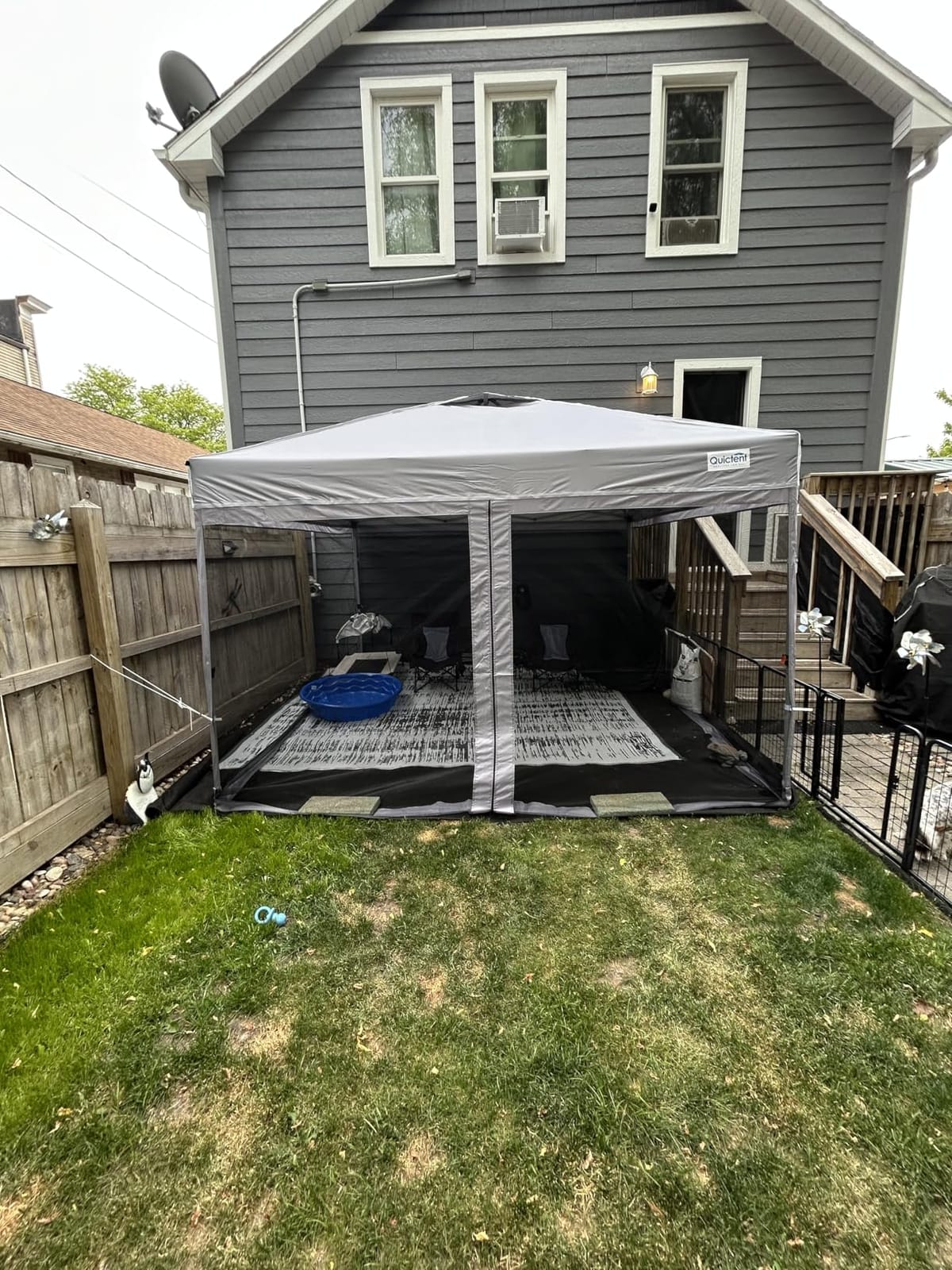
Interior space is generous at 100 square feet with a listed capacity of 8 to 10 people. The wheeled carry bag matters more here than with lighter units, because at 40 lb this is otherwise an awkward carry. Setup claims one person and no tools on the fully assembled pop-up frame.
Rain pooling is the recurring structural complaint. Because the side frames are unbraced, wind-driven rain can cup in the roof fabric and deform the frame, and the hard center hub with fiddly leg buttons is a known frustration for solo setup.
Long-term UV exposure is the other failure mode. Owners report the fabric becoming brittle and tearing at stress points within a season or two in strong sun, and the mesh walls being difficult to tension properly while shedding loose threads at the Velcro seams.
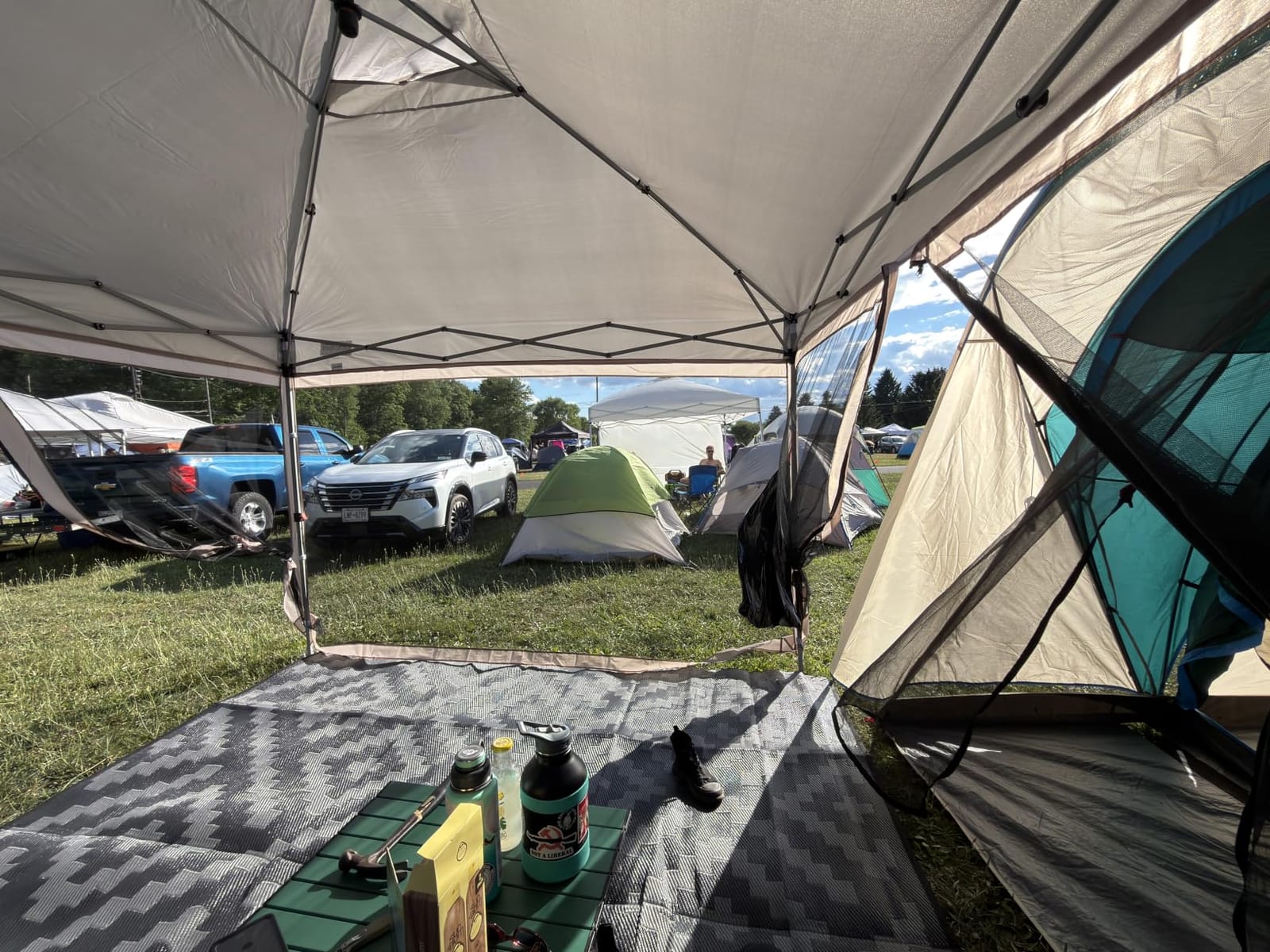
When the extra fabric weight pays off
This is the pick if your mosquitoes peak in a rainy season, if you have kids and pets who will be inside for long stretches, or if you plan to keep the structure up through shoulder months. The waterproofing gives you a place to sit when a shower passes instead of packing everything away.
Customer service is genuinely strong here, with repeated reports of replacement frames and canopy tops shipped at no charge. That materially changes the long-term value of a unit whose fabric is the consumable part.
Where it disappoints
The hub and leg buttons frustrate solo setup, and the unbraced frame plus roof fabric pooling is a real pairing: rain plus wind is the scenario that damages this unit. If you live somewhere windy, read the anchoring notes in our buying guide carefully before setting it up.
Also note that a wheeled bag does not make a 40 lb steel frame portable. If you need to move it often, look at a fiberglass option instead.
6. East Oak 10×10 Pop Up Screen Tent with Mosquito Netting
East Oak Pop up Screen Tent with Mosquito Netting, Portable Screen House Canopy Shelter, 10 x 10 FT Instant Screen Gazebo & UPF 50+ UV Protection for Patio, Backyard, Deck & Outdoor Activities, Beige
96 sq ft
D33 fine mesh
Reinforced steel and fiberglass
23.4 lb
Sub-minute pop-up
Pros
- One-person setup in under a minute
- Folds to a 30.7 inch carry case
- D33 fine mesh with genuine airflow
- Longest warranty here at 3 years
- Full anchoring kit included
Cons
- Not water resistant
- 90 inch ceiling is the lowest here
- Not recommended above 24 mph wind
- Bulkier than fiberglass-only models
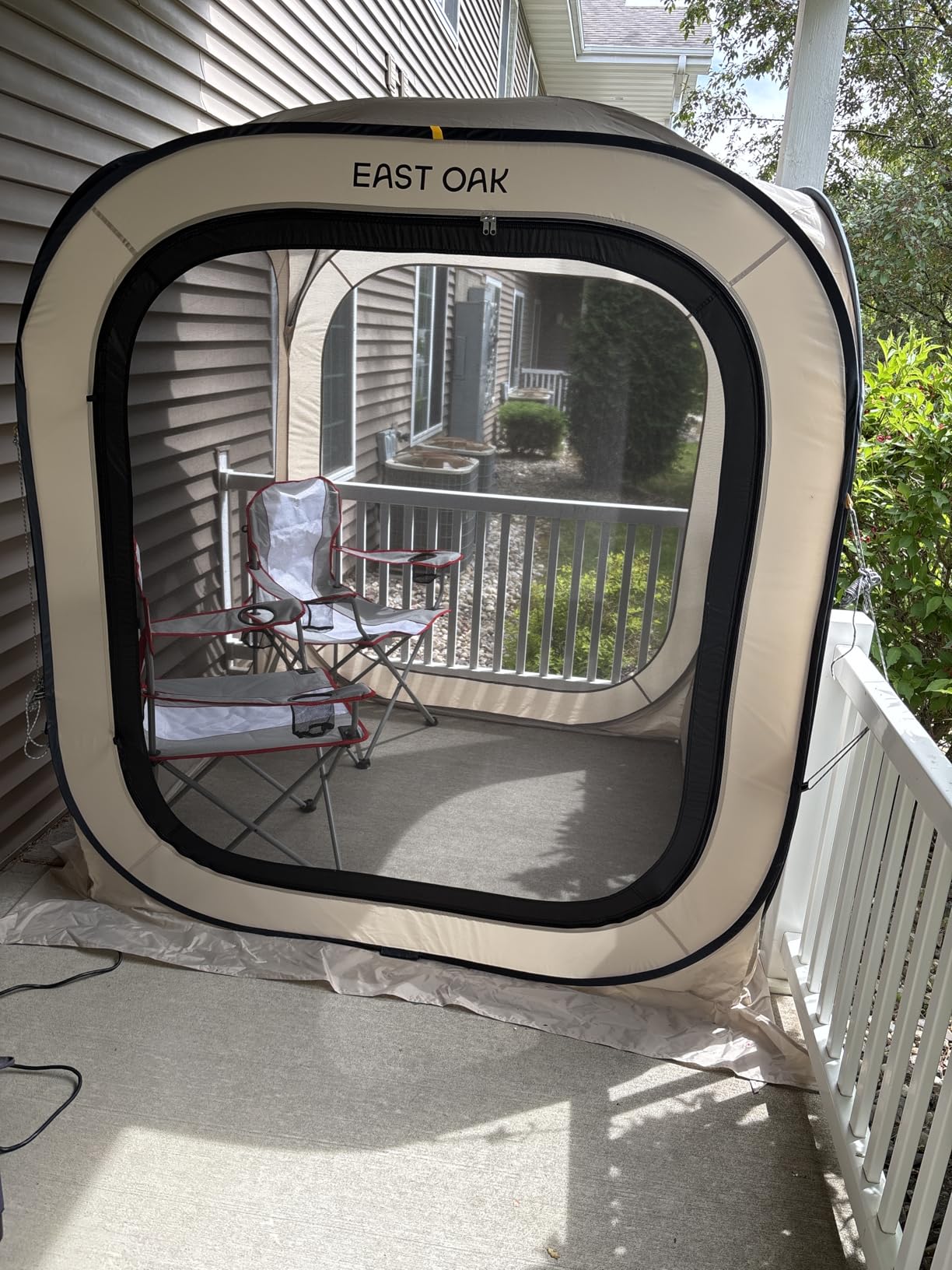
This is the fastest setup in the roundup and the warranty you would want in a product like this. Owners report one person unfolding and locking it in under a minute, then refolding it into a 30.7 inch carry case without any disassembly step.
The mesh is the reason to look here. D33 fine mesh is a named specification with an implied hole size, and it is a step finer than standard insect netting. Buyers report strong bug protection that still passes a real breeze, which is the balance most screened gazebos get wrong.
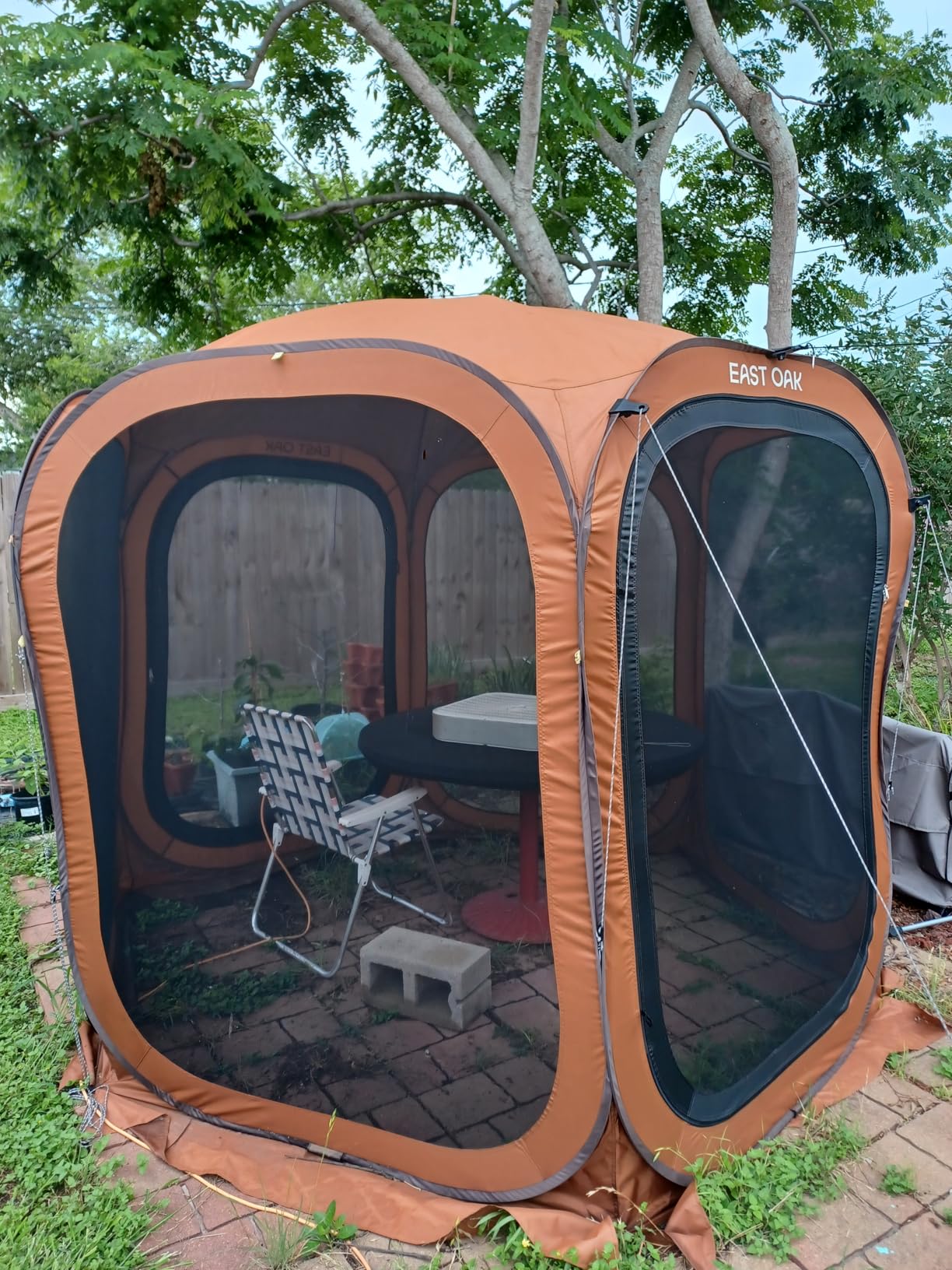
The frame is a hybrid: reinforced steel main structure with fiberglass top structure designed to resist water accumulation. Double-sided zippers and double-stitched connections add real seam strength. The box includes a carry bag, twelve ground stakes, six guylines, six sandbags, and three telescoping poles.
There is also a top hook for hanging a lamp and an edge strip for a light strip, both with the pendant light sold separately. That detail matters more than it sounds, because screened gazebos are used most heavily at dusk when the bugs are worst.
Limitations are real. It is not water resistant at all, so it is for shade and insect protection only. At 90 inches, the ceiling is low enough that tall users cannot stand. And the manufacturer advises against use above 24 mph wind.
Is three years of warranty worth anything?
On paper it is the strongest warranty here, and on a product that folds, tents, and lives outdoors for several seasons, that is meaningful. It signals a company willing to stand behind seams and frame joints, which is where these products actually fail.
Pair it with the mesh specification. The explicit D33 gauge is rare in this category and gives you something concrete to compare against listings that only say mosquito netting.
When to pass
If you need to stand up, eat at a table, or use the gazebo in rain, skip it. The 90 inch ceiling and the absent water resistance together rule it out for year-round patio use.
At 23.4 lb it is heavier than the fiberglass-only screen houses, but still a two-person lift rather than a two-person carry. If portability is the priority, our value pick is the better fit.
7. EVER ADVANCED 11.5 x 9.8 Pop Up Screen House Tent
EVER ADVANCED Pop up Screen House Tent for Camping 11.5 x 9.8 ft, Instant Screened Gazebo Canopy with Netting, Portable Shelter Enclosure for Outdoor, Backyard, Khaki
113 sq ft
UPF 50 coated polyester
Fiberglass frame
21.5 lb
Packs to 54 inches
Pros
- Genuine one-minute pop-up with no pole assembly
- Mesh blocks gnats while circulating a breeze
- 21.5 lb and the bag fits most trunks
- Roomy enough for a picnic table and chairs
Cons
- 71 inch sidewall height is a sit-down shelter
- Rain enters through sloped mesh sides
- Optional panel listings do not fit this model
- Zippers feel less robust than the rest
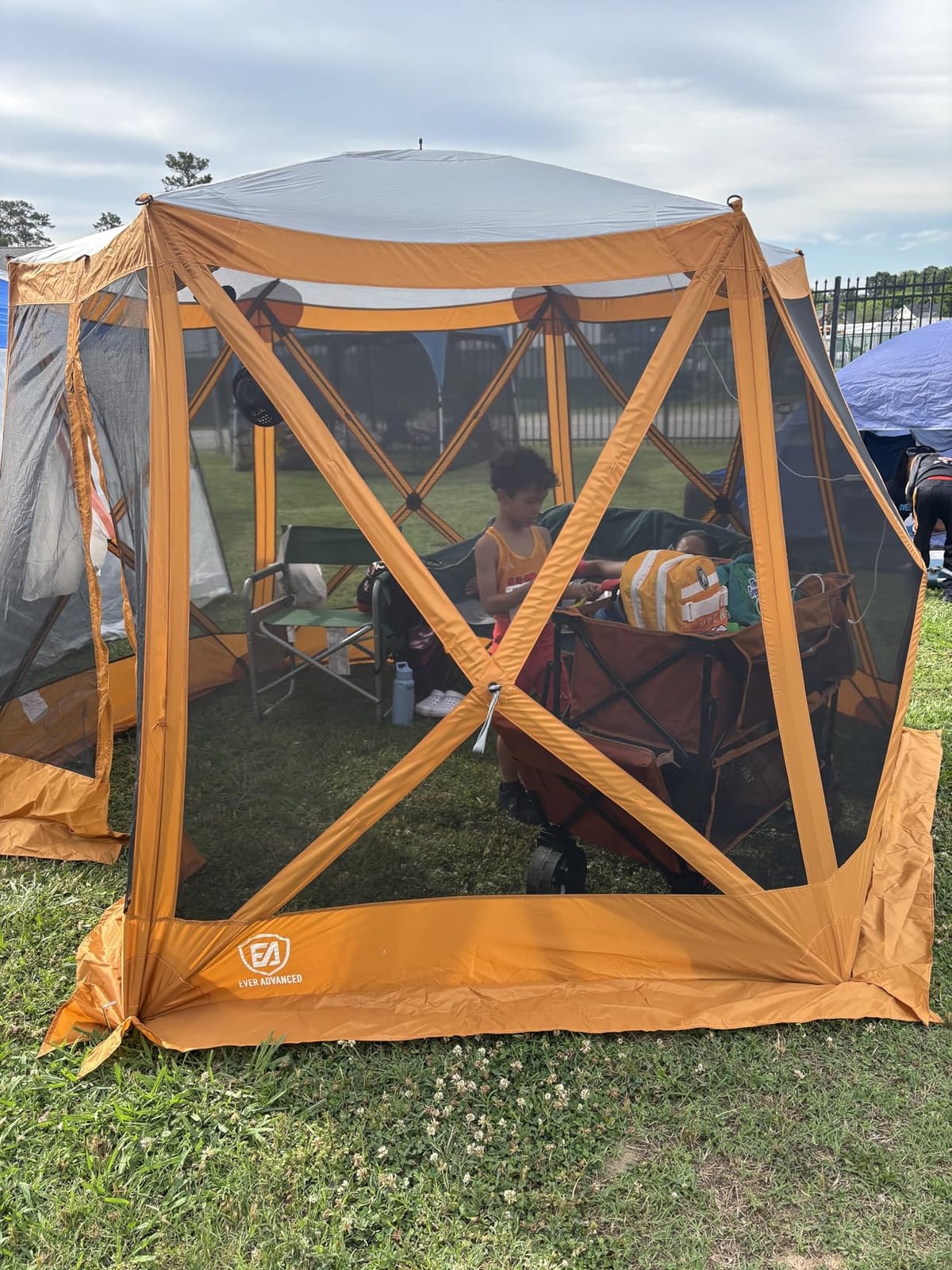
This is the one we would pack for a weekend at a campground or a festival. It requires no initial assembly at all, pops open in about a minute, and folds to 54 by 7.8 inches, which fits the trunk of most cars without a roof rack.
At 11.5 by 9.8 feet and 113 square feet it is large enough to fit a picnic table with chairs around it and seat about six people. That combination of packed size and interior floor is unusual in this category and is what separates it from the smaller screen tents.
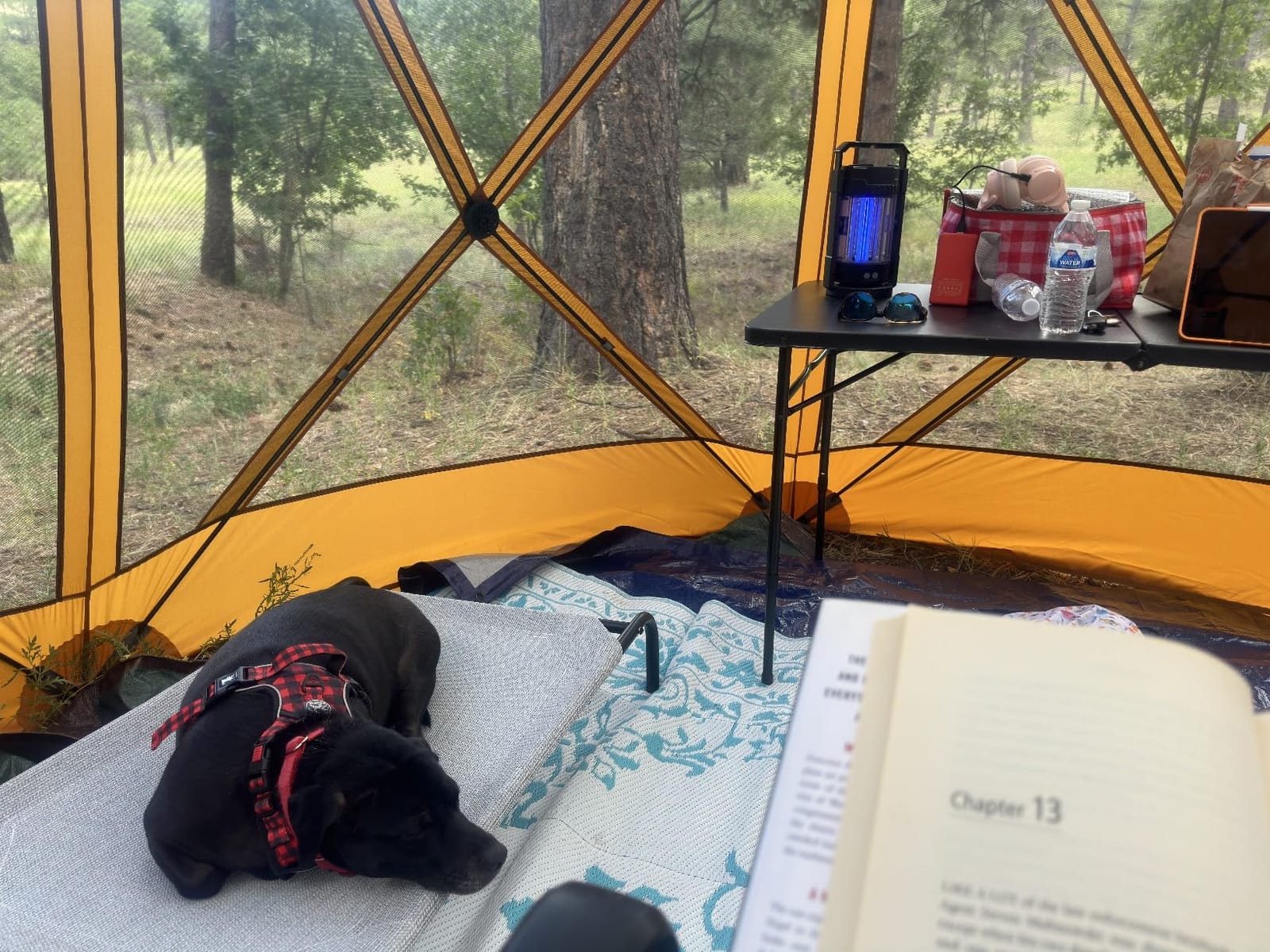
The mesh is described as bug-proof yet breathable, and owners confirm it keeps out the smallest gnats while still circulating a breeze. The top is UV-resistant coated polyester with a UPF 50 rating, and the flexible fiberglass poles handle repeated fold cycles better than segmented poles.
The company positions it as extra living space for full-time RVers, which tells you something about the intended use. Buyers report it holding up well staked down through several rainstorms.
The weaknesses are height and rain direction. At 71 inches, the sidewall height makes this strictly a sit-down shelter. Rain entering through the sloped mesh sides reaches about halfway down before it stops, unless you add optional panels. And there is a confusing listing issue: the side panels sold separately only fit the panel-ready version, not this one.
Why the low profile is not always a problem
Sit-down height is a feature for this use case. A lower profile means less wind surface area and less leverage for a gust to work with, which is why a screen house is often the safer thing to leave standing at a campsite where a tall gazebo would be gone after the first squall.
The trade is real though: no standing, no cook stove, no moving around easily. If your camp setup involves a cooler and chairs, it works. If it involves a standing camp kitchen, it does not.
Check the listing before you order
The optional panel confusion is worth two minutes of care. Confirm that the version you are buying is the panel-ready one before you plan to add walls. The zippers are also the component owners flag as less robust than the rest of the build.
8. CAMPROS CP 13×13 Screen House Tent
CAMPROS CP Screen House Tent 13 x 13 Ft Screened Mesh Net Wall Canopy
13x13 ft, about 134-140 sq ft
86 in center height
190T UV-resistant top
Fiberglass frame
24 lb
Pros
- 13x13 shelter for a very low outlay
- One of the largest covered areas here
- 190T top gives solid UV resistance
- Fiberglass frame packs slim with no poles to thread
- Carry bag
- stakes and tie downs included
Cons
- 86 in peak height is the lowest here
- Three-person setup of about 10 minutes
- No attached floor
- Top is water resistant not waterproof
At 13 by 13 feet this gives you a larger footprint than most of the more expensive units in the roundup, and it does so with a simple fiberglass frame that has no separate poles to thread through fabric sleeves.
The 190T polyester top is UV resistant, which is the right spec for the job. A screen house spends most of its life in direct sun, and a top that degrades in two weeks makes the whole unit disposable. Carry bag, ground stakes, and tie downs all come included.
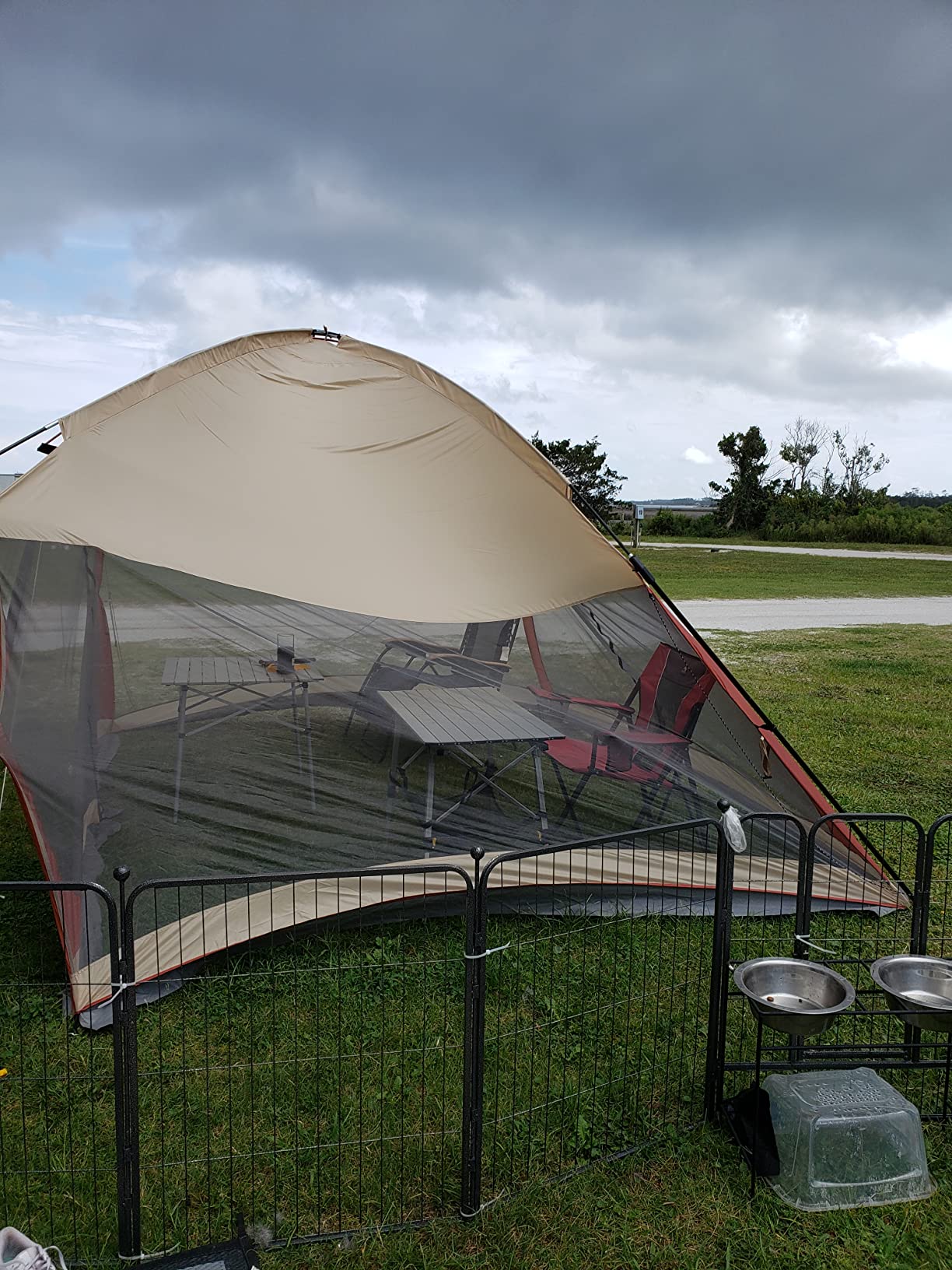
Setup is the honest drawback: about 10 minutes with three people. That is not a dealbreaker if you put it up once at a campsite or for a summer on the patio, and it is a dealbreaker if you planned to unfold it for every evening meal.
There is no attached floor, so you are looking at grass, a tarp, or your own flooring. The top is water resistant rather than waterproof, so it handles drizzle and not sustained rain.
Buyer detail is thinner than for the higher-volume models here, with fewer customer photos and less owner feedback to draw on. That is worth knowing when you are weighing an unfamiliar brand against a unit with tens of thousands of reviews.
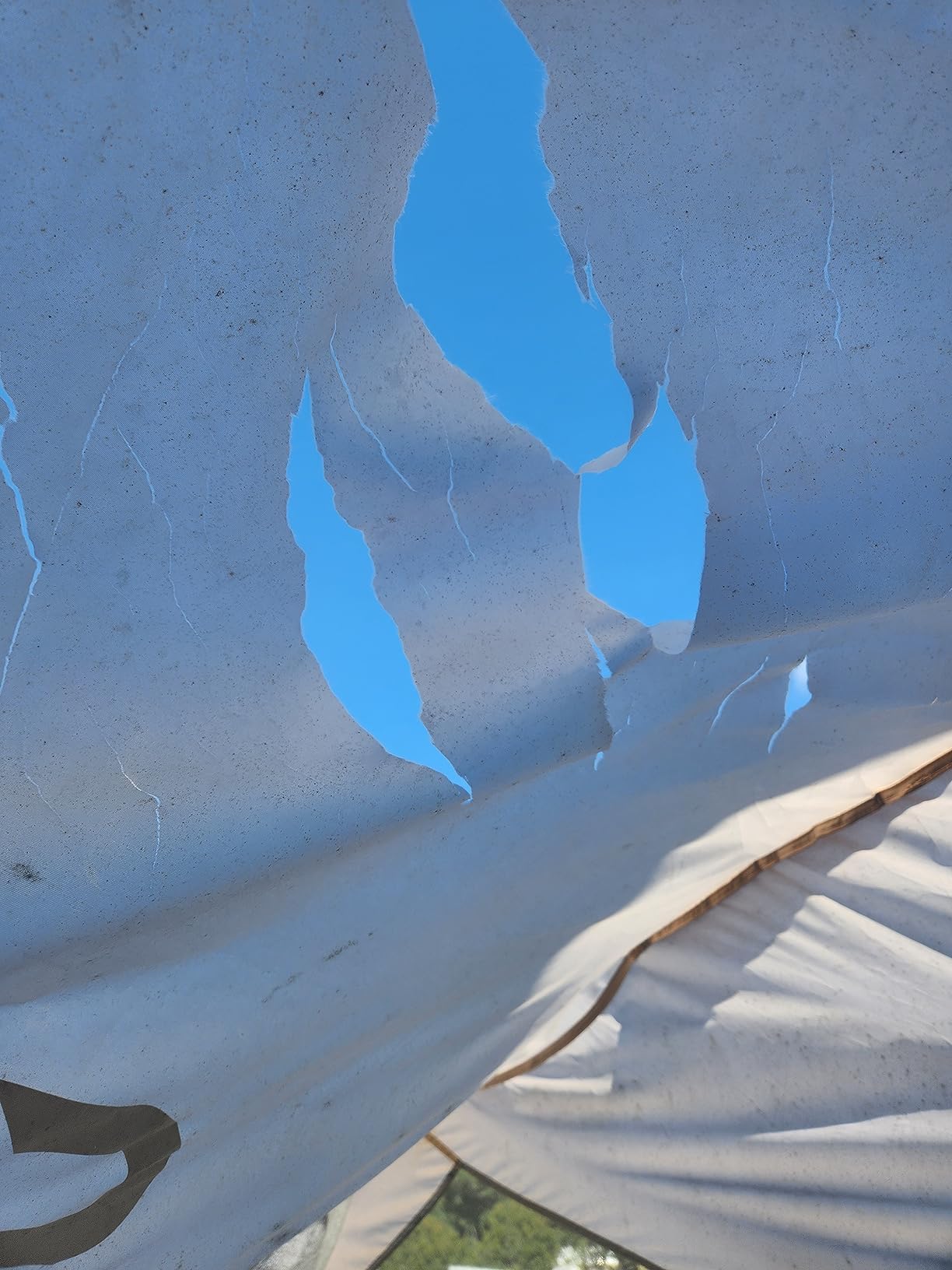
Big footprint, small budget
The combination that makes this interesting is size per dollar. Thirteen by thirteen is bigger than three of the models here, and it carries a 4.3 average across more than a thousand reviews. For a family that wants a large shaded, bug-free sitting area on a minimal outlay, the arithmetic is hard to argue with.
The fiberglass frame also packs into a slim 25 by 9 inch bag, which is smaller than the packed size of several units that cost several times more.
Know what you are getting
At 86 inches, this is the lowest peak height in the group. It is a crouching, sitting shelter. If the idea is a standing room or a table-height dining space, look elsewhere.
Plan on ten minutes and two extra hands for the first setup, and bring your own floor. After that it stays up and does its job for the whole season.
9. MASTERCANOPY 11×11 Pop Up Gazebo with Netting Screen Walls
MASTERCANOPY 11×11 ft Pop Up Gazebo with Netting Screen Walls, Champagne
121 sq ft top coverage
116.4 in height
Double-tiered 180D polyester
UPF 50, silver coated
Straight-leg alloy steel
Pros
- Tallest interior among the heavy steel models
- 121 sq ft from a 10x10 straight-leg frame
- Double-tiered vented roof with drain holes
- Blocks 95 percent of UV rays
- Mesh walls give bug protection and privacy
Cons
- Heaviest at 45.7 lb
- Soft double-tiered roof is less rigid
- Fabric is not for extreme weather
- One year frame and 6 month parts warranty
The defining feature here is height. At 116.4 inches, this is one of the tallest interiors in the roundup, which means adults can stand, move a chair, and walk through without ducking. That alone puts it in a different category from the low screen houses.
The roof is a double-tiered soft top in 180D polyester with a silver coating, blocking about 95 percent of UV rays. Multiple drain holes are cut into the fabric to prevent water pooling, which is a genuine improvement over flat single-layer roofs that collect rain and sag.
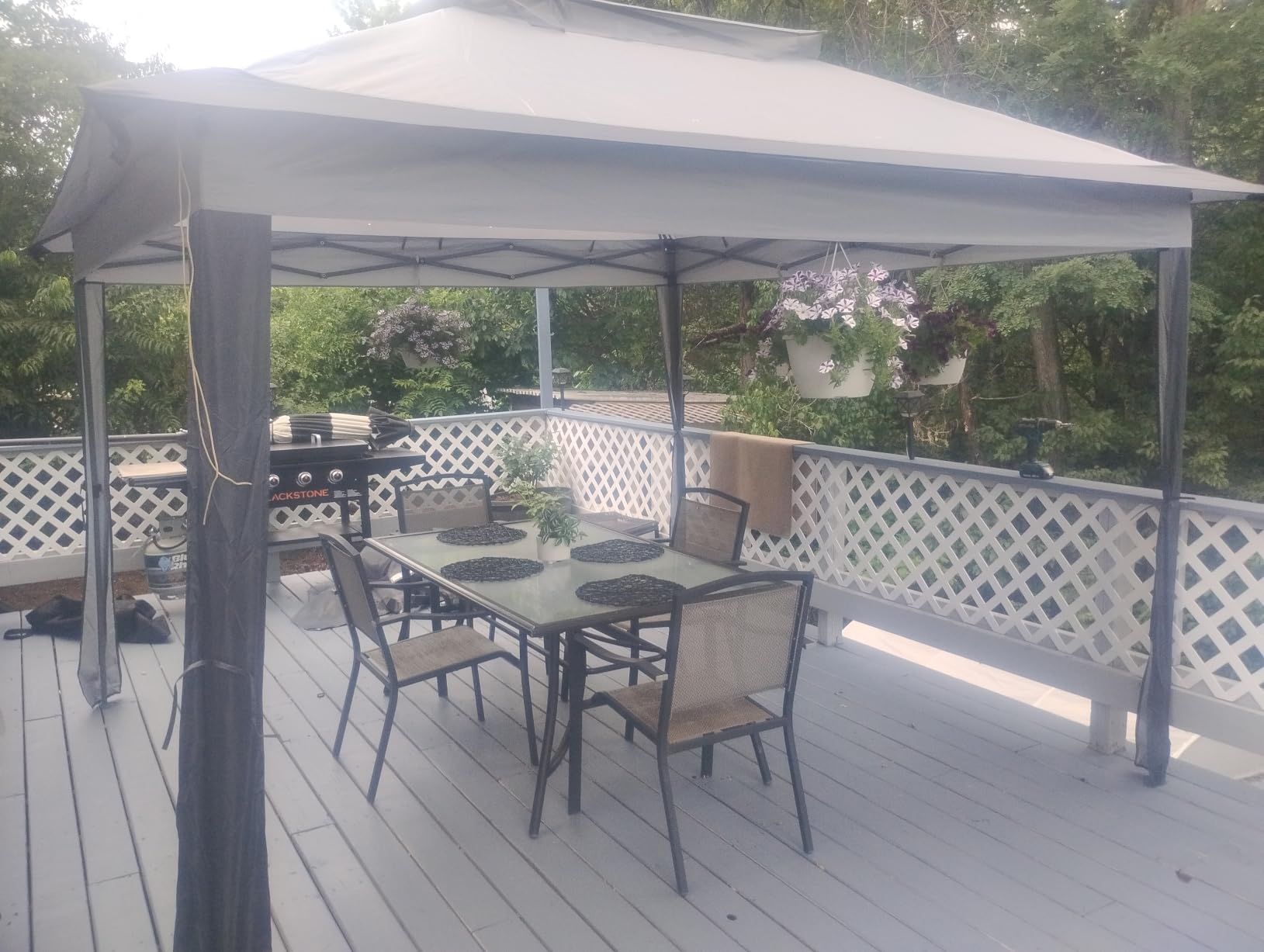
The frame is a 10 by 10 straight-leg alloy steel design that pushes out to 11 by 11 top coverage, giving 121 square feet of shaded space for 6 to 8 people. Mesh screen walls cover the sides for both insect protection and privacy, which is useful when the gazebo sits next to a neighbor’s fence line.
Owners consistently praise the standing room and the effective screening for events, weddings, and backyard cookouts. The soft top is also far quieter in wind than a hard top, which some people prefer.
The criticisms are predictable for a soft-top steel frame at this weight. At 45.7 lb it is the heaviest unit here and not a one-person carry. The double-tiered fabric roof is less rigid than a metal or single-layer design and can sag when wet. And the warranty is the shortest in the group at one year for the frame and six months for other parts.
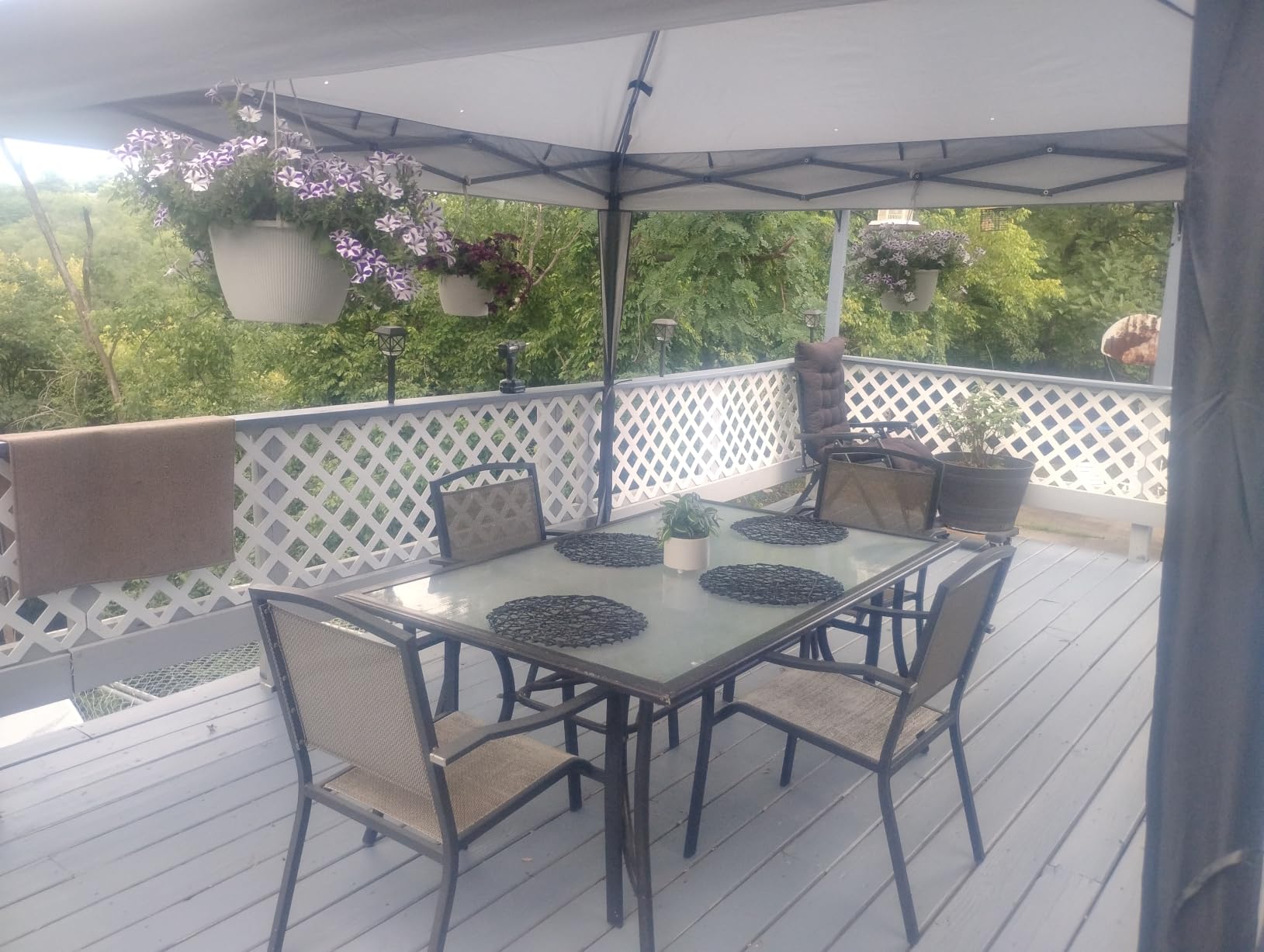
Standing room changes how you use it
Almost every other screened gazebo here is a sit-down space. This one works like an outdoor room: standing to grill, walking to the cooler, moving a chair without crouching. For a patio with a dining table that must stay where it is, that difference decides the purchase.
The 95 percent UV blocking and the vented double roof also keep the interior more usable in the late afternoon than an unvented single-layer top would.
When to choose a lighter model
Skip it if you will be moving it regularly, and think hard before leaving it up in an exposed location. The soft fabric roof is the first thing to go in a serious storm, and a 45.7 lb frame on a windward side does not help itself.
The warranty length is another reason to look elsewhere if you plan several seasons of use. Check our gazebo buying guide if you want to understand how soft-top and hardtop designs differ under load.
10. VIVOHOME 10×10 Outdoor Screen Tent with Mosquito Netting
VIVOHOME 10x10ft Outdoor Screen Tent with Mosquito Netting
100 sq ft
Four height levels to 6.8 ft
30gsm mesh
150D silver-coated Oxford
Powder-coated steel
Pros
- Four height levels adjustable to 6.8 ft
- 30gsm mesh is heavier and more private
- Pre-assembled tool-free pop-up frame
- Roller bag with casters and a side pocket
- Reinforced triangular frame adds rigidity
Cons
- Heaviest mesh here blocks more breeze
- 34.6 lb is awkward despite the wheeled bag
- Water repellent not waterproof
- One year warranty only
This is the only unit here with four separate height levels, adjustable up to 6.8 feet, with leg markings to help you set it. On a patio where the ground slopes or where you need clearance over a table, that adjustment is more useful than it first appears.
The mesh is 30gsm, noticeably heavier than the standard mesh on most competitors. Owners report it adding real privacy: neighbors cannot see in, but ventilation still works. The detachable sidewalls mean you can strip it back to a plain canopy when mosquitoes are not the concern.
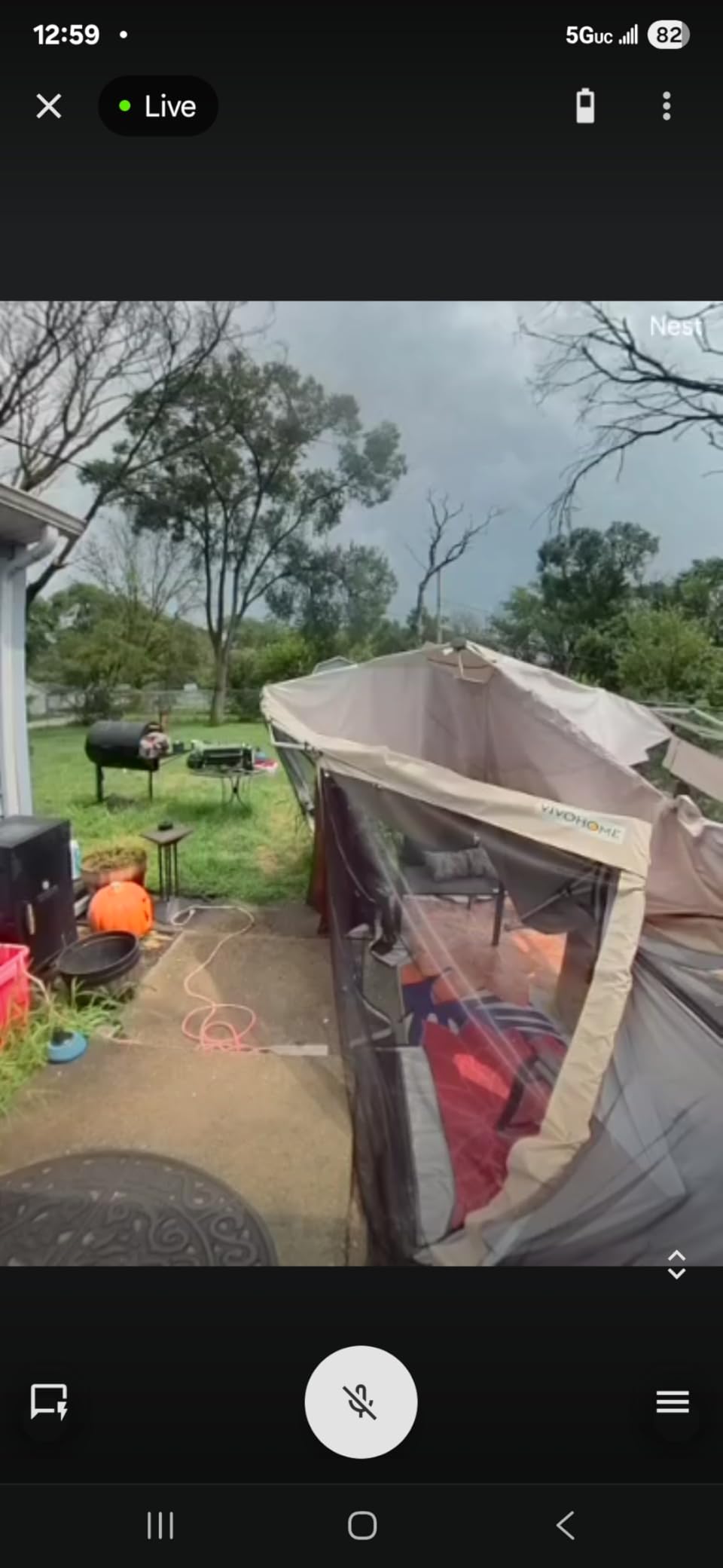
The canopy is 150D silver-coated Oxford with UPF 50+ protection reflecting 99 percent of sunlight, and the powder-coated steel frame resists scratches and rust. The reinforced triangular frame design adds rigidity that most pop-ups at this class lack.
Setup is a pre-assembled pop-up frame with no tools needed. Adhesive straps secure the top cover, the height buttons are thumb-friendly, and metal feet plates, ground nails, and wind ropes are included. Interior headroom runs from 99.6 to 111.6 inches.
The heavy mesh is the central trade-off. Reviewers are candid that it blocks more breeze than lighter mesh, which compounds the heat problem in summer. Water protection is water repellent rather than waterproof, and the one year warranty is short for a product at this end of the roundup.
Privacy as the deciding feature
If you sit on a patio bordered by a fence, a neighbor’s deck, or a busy street, the 30gsm mesh is the feature that justifies this pick. It reads as a screen wall rather than a mosquito net, and the detachable design means it does not have to be privacy all season.
The adjustable height is the second draw. A 6.8 foot setting clears most dining tables and gives standing-adjacent comfort in a way that the fixed-height screen houses here cannot match.
What to watch before buying
At 34.6 lb it is still an awkward carry, even with the caster-equipped roller bag. If you imagined moving it from the patio to the campsite each weekend, that is not the use case.
In hot weather, plan to roll up or detach one wall early. Heavier mesh plus a solid top plus direct sun is the combination that turns a screened gazebo into an oven, and no amount of anchoring changes that.
How to Choose a Screened Gazebo That Actually Works
Mesh gauge decides what gets blocked
Standard mosquito mesh has holes large enough for mosquitoes and flies to pass but too small for most gnats. No-see-um mesh, which is what the East Oak D33 specification describes, closes that gap and also stops midges, biting gnats, and sand fleas. Finer mesh still blocks more, but airflow drops as hole size shrinks.
That is the entire trade-off, and it is why a fully meshed gazebo can feel hot. A popular camping forum thread on screen shelters describes it plainly: fine mesh blocks light breezes, and during the day the shelter turns into an oven. The practical fix is removable or detachable walls, which is why six of the ten units here let you strip panels back.
Wind limits and anchoring by surface
Only some manufacturers publish a wind figure. The East Oak advises against use above 24 mph. The Alvantor is not recommended above roughly 24 to 30.8 mph. Several others publish nothing at all, which is a gap worth knowing about before a gust arrives.
Surface matters as much as the number. On grass, use the included ground stakes driven at an angle away from the shelter, plus guylines to fixed points. On concrete or a paved patio, stakes do not work, so use sandbags on every leg or the frame lifts. On decking, screw the feet to the boards rather than relying on weight alone.
Never leave a pop-up standing unattended in a forecast storm. Owners on these forums describe a cycle of lowering the canopy or simply taking the fabric off and waiting out gusts, which is the correct call.
Heat build-up is the most common complaint
Mesh blocks bugs and blocks moving air at the same time. Hot summers make this the deciding factor more often than size. Look for a vented or double-tiered roof: the COOS BAY, CROWN SHADES, and MASTERCANOPY all have one. Look for removable walls, and use them.
The general rule from owners is simple: net the gazebo, not yourself in. Sit inside the screen rather than hanging a net over yourself outside it, and the temperature difference is dramatic.
Screen house versus pop-up canopy with netting
A purpose-built screen house seals mesh to a frame at the base, floor level included, which is why the Quictent and East Oak get near-complete coverage. A pop-up canopy with netting panels hung from a rail leaves a gap at the bottom, and that gap is exactly where mosquitoes get in.
If you already own a canopy and want bug protection without replacing it, add-on netting panels are a compromise worth understanding. They are easier, cheaper, and they will never seal as well as integrated mesh. For a long-term patio structure, integrated mesh is the better buy.
Off-season storage and mildew
Leave these up year-round only if your manufacturer allows it. UV degrades mesh and makes canopy fabric brittle, and a frame left damp in a shed can corrode at the joints. The practical routine is simple: dry the fabric fully, refold it along its fold lines, and store the bag somewhere ventilated.
Mildew is the common complaint from owners who put a damp screen house back in its bag. It comes from trapped moisture, not from the material. Wiping the mesh down and letting it air out for a few hours before packing prevents most of it.
When a screened gazebo is the wrong tool
If your main problem is mosquitoes entering from the ground rather than the air, a floor or a ground tarp matters more than mesh gauge. Add a fitted floor and bugs stop coming up under the walls. Several units here sell floors separately.
If your site gets regular hard wind, a screened gazebo is the wrong structure entirely. A fixed hardtop gazebo or a permanent pavilion is the right answer, and no amount of sandbags changes that. If you need a room you can use in the rain, look at the waterproof-canopy models rather than a screen house.
Frequently Asked Questions
What is the best gazebo with mosquito netting?
The COOS BAY 11×11 is the best overall pick here. It pairs the largest standing footprint in the group at 121 square feet with four zippered mesh sidewalls that seal to the ground, UPF 50+ fabric, and the highest review volume of any unit we tested. The East Oak 10×10 is the better choice if fine no-see-um mesh and a three-year warranty matter more than headroom.
Is there a mosquito-proof gazebo available?
No screened gazebo is completely mosquito-proof, because mosquitoes can enter from the ground rather than the air. What you can get is mesh fine enough to block mosquitoes, gnats, no-see-ums, and sand fleas, combined with zippered doors that close to the base of the frame and a floor or ground tarp to stop ground-level entry. Models such as the VEVOR 12×12 and the East Oak use fine mesh for exactly this reason.
How much wind is too much for a pop-up canopy?
Published limits are limited, but the two figures available in this group are worth respecting: the East Oak is not recommended above 24 mph, and the Alvantor is not recommended above roughly 24 to 30.8 mph. Treat 24 mph as the practical ceiling for any soft-top pop-up gazebo. Above that, take the canopy down rather than relying on stakes and sandbags.
How do you keep mosquitoes out of a gazebo?
First, seal the entry points: choose screens that zip to the frame at ground level rather than hanging from a rail, and check the door flap closes fully. Second, add a floor or lay a ground tarp inside so mosquitoes cannot enter from underneath. Third, use fine mesh if midges and no-see-ums are the problem. Fourth, anchor the unit so the skirt stays taut, and avoid leaving doors propped open all evening.
Can you leave a pop-up gazebo up all year?
You can, but it costs you lifespan. UV exposure degrades mesh and makes canopy fabric brittle, and a frame stored or left damp can corrode at the joints. Most owners who leave units up through winter report fabric tearing at stress points within a season or two. Dry the fabric fully, refold it along its fold lines, and store the bag in a ventilated space if you take it down.
Which Screened Gazebo Should You Buy?
For most households, the COOS BAY 11×11 is the answer: the biggest usable space, mesh that seals, standing headroom, and the deepest review base to back the recommendation. For campers and small patios, the Alvantor screen house carries on one person and fits in a car trunk. If you need standing room and the strongest soft-top frame money can buy, the CROWN SHADES holds up best when anchored.
Match the rest by constraint rather than by ranking. Big gatherings on a patio point to the VEVOR 12×12. Rain in the forecast points to the Quictent. Midges and no-see-ums point to the East Oak or the VEVOR. Camping and small budgets point to the EVER ADVANCED or the CAMPROS 13×13. Standing room with privacy points to the VIVOHOME.
Whichever one you choose, the mesh gauge, the floor or tarp, and the anchoring are what decide whether it works. Those three specs matter more than the badge on the box, and they are the reason we keep coming back to this category every summer.
We update this roundup as new models land and owner feedback shifts, so check back through 2026 and beyond for the latest picks.