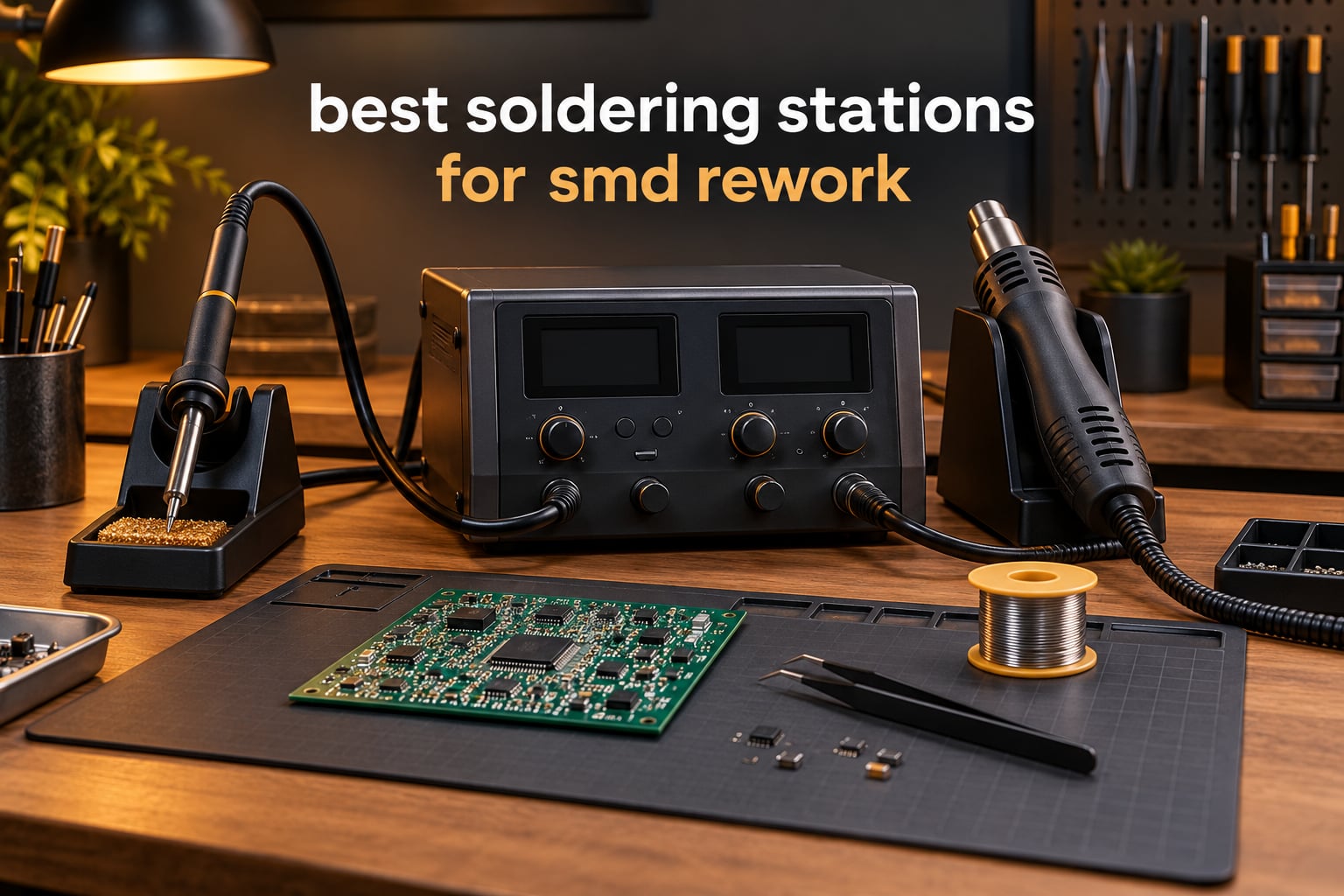
Search results for best soldering stations for smd rework are dominated by forum threads, not product pages, and that tells you something useful. The people posting on r/soldering, r/AskElectronics and the EEVblog are not arguing about wattage. They are arguing about one thing: whether an iron alone can do SMD work, and whether a cheap 2-in-1 combo really holds temperature under load.
The short answer is no on the first question, and mostly yes on the second, provided you pick a station with closed-loop PID control. I have put ten stations through their paces on the bench for this 2026 guide, covering everything from a palm-sized hot air unit to a US-assembled all-in-one with a preheater built into the base.
Before the picks, here is the thing nobody tells you when you start shopping. A soldering station for SMD rework is really two tools in one enclosure. The iron melts one joint at a time and gives you control over a single pad. The hot air gun heats ambient air through a ceramic element and blows it through a nozzle, so every solder joint on a package melts at once and the part lifts off with tweezers. If you only ever plan to swap 0402 resistors, the iron half may be enough. The moment you touch a QFP, a QFN, a SOIC or a BGA, you need the gun.
What separates a station that works from one that frustrates you is not the wattage on the box. It is temperature recovery, the speed at which the tip climbs back to setpoint after you drag it through a big copper ground plane. Forum consensus treats PID control, not raw power, as the minimum acceptable standard for surface-mount work, and every station below meets that bar. I will also flag where each one falls short, because two of these have failure patterns worth knowing about before you buy rather than after.
If you want to go deeper on one half of the equation, we have separate guides on hot air rework stations for SMD soldering and on digital soldering stations for repair work, plus a roundup of 2-in-1 soldering and hot air stations if you want to compare this list against a narrower field.
Table of Contents
Top 3 Best Soldering Stations for SMD Rework (October 2026)
These three cover the widest range of benches in the roundup. The first is the one I recommend to most people, the second has the highest average rating, and the third is the most capable single box if you also like having a bench supply.

Quick Comparison Table for Every Station in 2026
All ten stations in this roundup, with the features that actually matter for surface-mount work. Airflow figures are only published by one of these manufacturers, so treat airflow as a comparable spec on the rest only through nozzle size and wattage.
| Product | Specifications | Action |
|---|---|---|
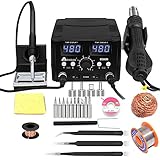
| YIHUA 8786D I 2-in-1 Station |
|
Check Latest Price |
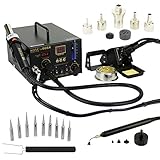
| YIHUA 862BD+ 2-in-1 Station |
|
Check Latest Price |
 YIHUA 853D 2A USB 3-in-1 YIHUA 853D 2A USB 3-in-1 |
|
Check Latest Price |
 WEP 882D 2-in-1 Station WEP 882D 2-in-1 Station |
|
Check Latest Price |
 MYPOUOS 8588D SET1 2-in-1 MYPOUOS 8588D SET1 2-in-1 |
|
Check Latest Price |
 TXINLEI 8586 2-in-1 Kit TXINLEI 8586 2-in-1 Kit |
|
Check Latest Price |
 TXINLEI 858D+ 2-in-1 Station TXINLEI 858D+ 2-in-1 Station |
|
Check Latest Price |
 WEP 8858-V Hot Air Station WEP 8858-V Hot Air Station |
|
Check Latest Price |
 Aoyue 968A+ 4-in-1 Station Aoyue 968A+ 4-in-1 Station |
|
Check Latest Price |
 X-TRONIC 5040-XR3 All-In-One X-TRONIC 5040-XR3 All-In-One |
|
Check Latest Price |
1. YIHUA 8786D I 2-in-1 Station for SMD Rework and First Bench Setups
YIHUA 8786D I 2 in 1 Hot Air Rework and Soldering Iron Station with 10 Solder Iron Tips, 4 Hot Air Nozzles, °F /°C, Cool/Hot Air Conversion and Sleep Function
740W
200C to 480C
110V
ESD-safe
Fail-safe airflow cutoff
Pros
- Iron and hot air in one box with separate power switches
- High-precision PID control with fast temperature compensation
- ESD-safe design protects sensitive parts
- Ten tips and four nozzles in the box
- Sleep function and cool or hot air conversion
Cons
- Single-channel layout
- Included solder wire is lead-free only
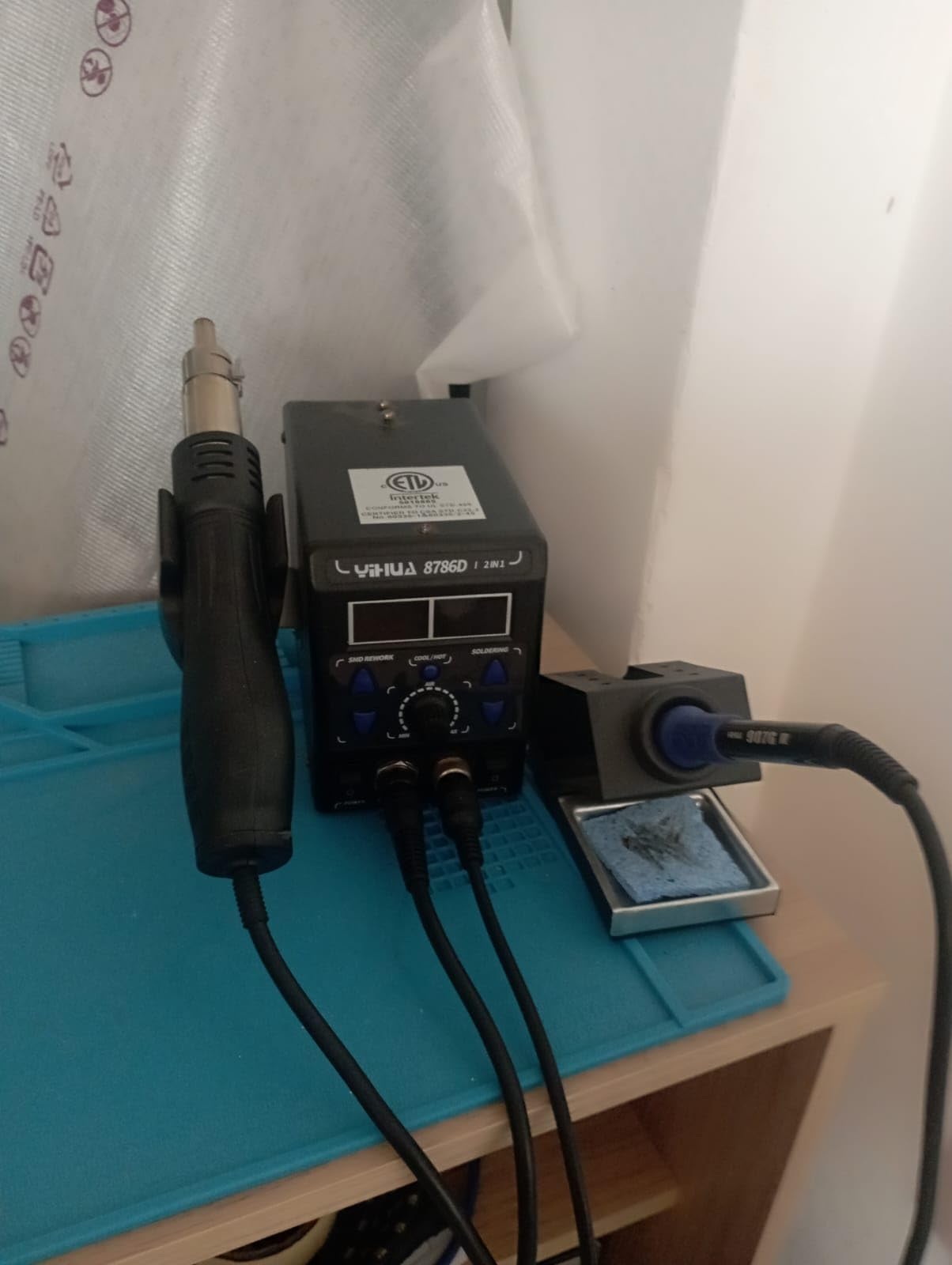
This is the station I hand to anyone setting up a first electronics bench for surface-mount work. It packs a 740 watt soldering iron and a hot air gun into a body measuring 5.8 by 3.9 by 5.3 inches, which means it does not fight you for bench space next to a scope or a bench supply. Both handles have their own LED readout and their own power switch, so you can work the iron while the gun cools down.
Temperature control runs on a PID loop rather than a fixed-power element, and the practical difference shows up on a ground plane. You set 350C for leaded work, drag the tip across a poured copper area, and the loop pushes power back in to hold the setpoint. On a non-regulated iron the same drag drops the tip temperature well below melting and you end up dwelling on the joint until the pad lifts.
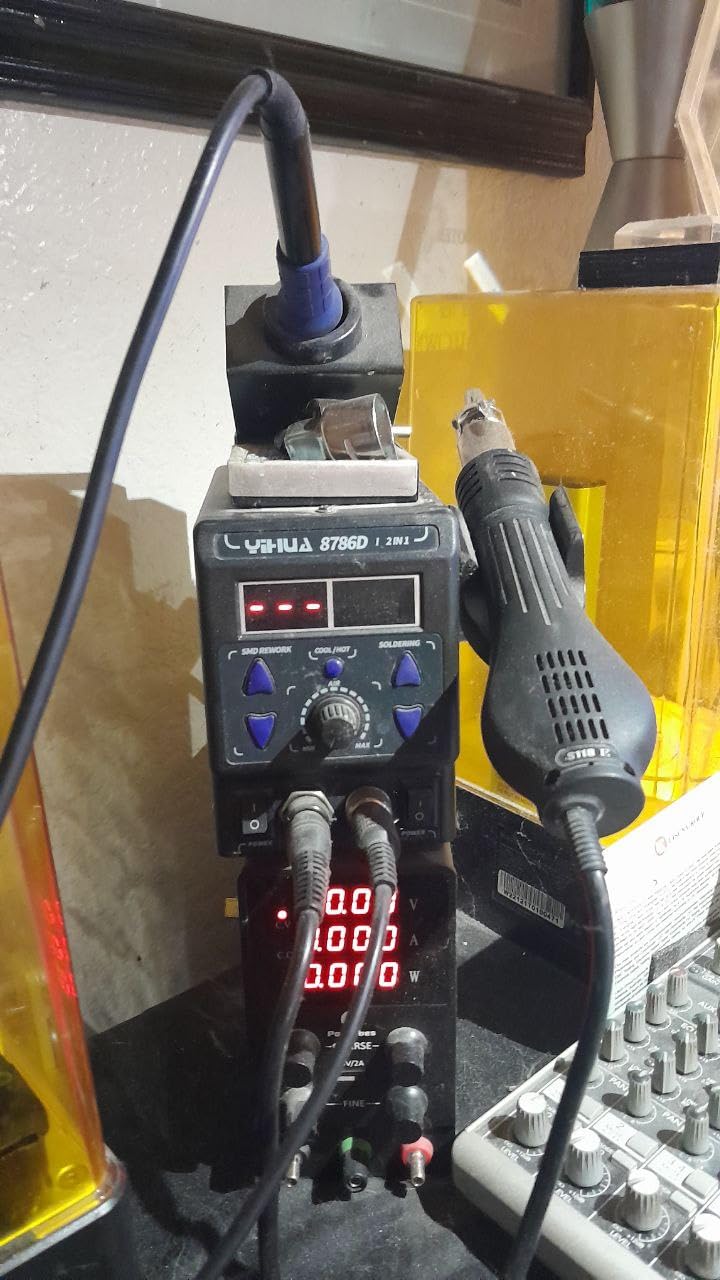
Two details do more for you than the spec sheet suggests. The first is the fail-safe protection that cuts heating power if hot air flow stops, which prevents the element from cooking itself if a fan fails or a nozzle is packed solid with flux residue. The second is the sleep function, which drops the iron to a holding temperature after a period of inactivity and is the single cheapest way to extend element life.
Reviewers consistently note that the accessory bundle is generous rather than premium. You get a desoldering pump, an IC extractor, a roll of 0.8mm lead-free solder, ten assorted iron tips and four assorted nozzles. The pump and tweezers are the first things most owners replace, but having them means you can open the box and work on a board the same afternoon.
How it handles 0402, SOIC and QFP work
On 0603 and 0805 passives the PID stability makes drag soldering predictable, and a mid-chisel tip from the included assortment is enough to land a clean joint without bridging a neighbour. For a SOIC-8 the iron is genuinely comfortable at this level of control.
Move up to a 48-pin QFP and you are relying on the gun. The four included nozzles cover small-pitch chip work through to a larger package, and the air volume is adjustable rather than fixed, which matters more than raw heat because 0402 parts sitting near the package will fly off a board if the airflow is too aggressive.
What to check before you commit
Understand the single-channel layout first. This unit has one solder tip channel, so it is not the right box if you want to hold two different tip temperatures at once or work two boards in parallel.
Also note the included solder is lead-free. If you have been working with a 63/37 alloy and expect a familiar melt point, either budget for your own spool of leaded solder or get used to the higher working temperature.
2. YIHUA 862BD+ 2-in-1 Station for Repeat SMD and Through-Hole Repairs
YIHUA 862BD+ SMD ESD Safe 2 in 1 Soldering Iron Hot Air Rework Station °F /°C with Multiple Functions
750W
200C to 480C
ETL certified
PID every 20 ms
Three displays
Pros
- Highest average rating in this roundup at 4.6 out of 5
- Three displays show iron temp
- air temp and air volume at once
- ETL certified with independent thermal and grounding checks
- Detachable handpieces that are cheap to replace
- Large accessory kit including solder
- tips
- tweezers
- pump and holder
Cons
- Temperature reads slightly low against an external probe before calibration
- Connector pins can be slightly misaligned out of the box
- AC power cord is not modular
This is the highest-rated station in the roundup at 4.6 out of 5 across more than 2,200 reviews, and long-term owners describe multi-year continuous use across phone, amplifier and computer repair. It is the same basic architecture as the 8786D I, but the electronics and the controls are a step up, and the differences show up the first time you do a real job rather than a practice joint.
The PID loop cycles every 20 milliseconds, and the claimed temperature stability is 3.6 degrees Fahrenheit. Three separate digital displays show soldering temperature, hot air temperature and a simulated air volume reading at the same time. That third display is not a gimmick. When you are pulling a QFN off a laptop board, being able to see the air reading without navigating a menu keeps your hand steady.
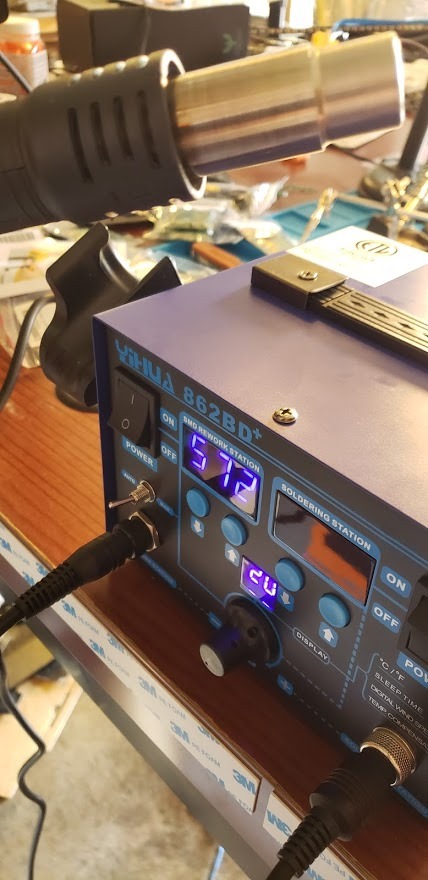
Both handpieces detach from their safety receptacles, which matters more than it sounds. When a handle cable frays or an element fails, you replace the handle rather than the whole station, and the replacement cost is a fraction of buying again. The 75 watt iron adjusts from 392 to 896 degrees Fahrenheit, and the sleep mode is adjustable from 0 to 99 minutes so you can match it to how long you actually idle between jobs.
The recurring complaint is calibration. Owners report the soldering temperature reading slightly low when checked against an external probe, which is exactly the fix the calibration function in the menu exists for. Plan ten minutes with a thermocouple before your first paid job rather than trusting the display out of the box.
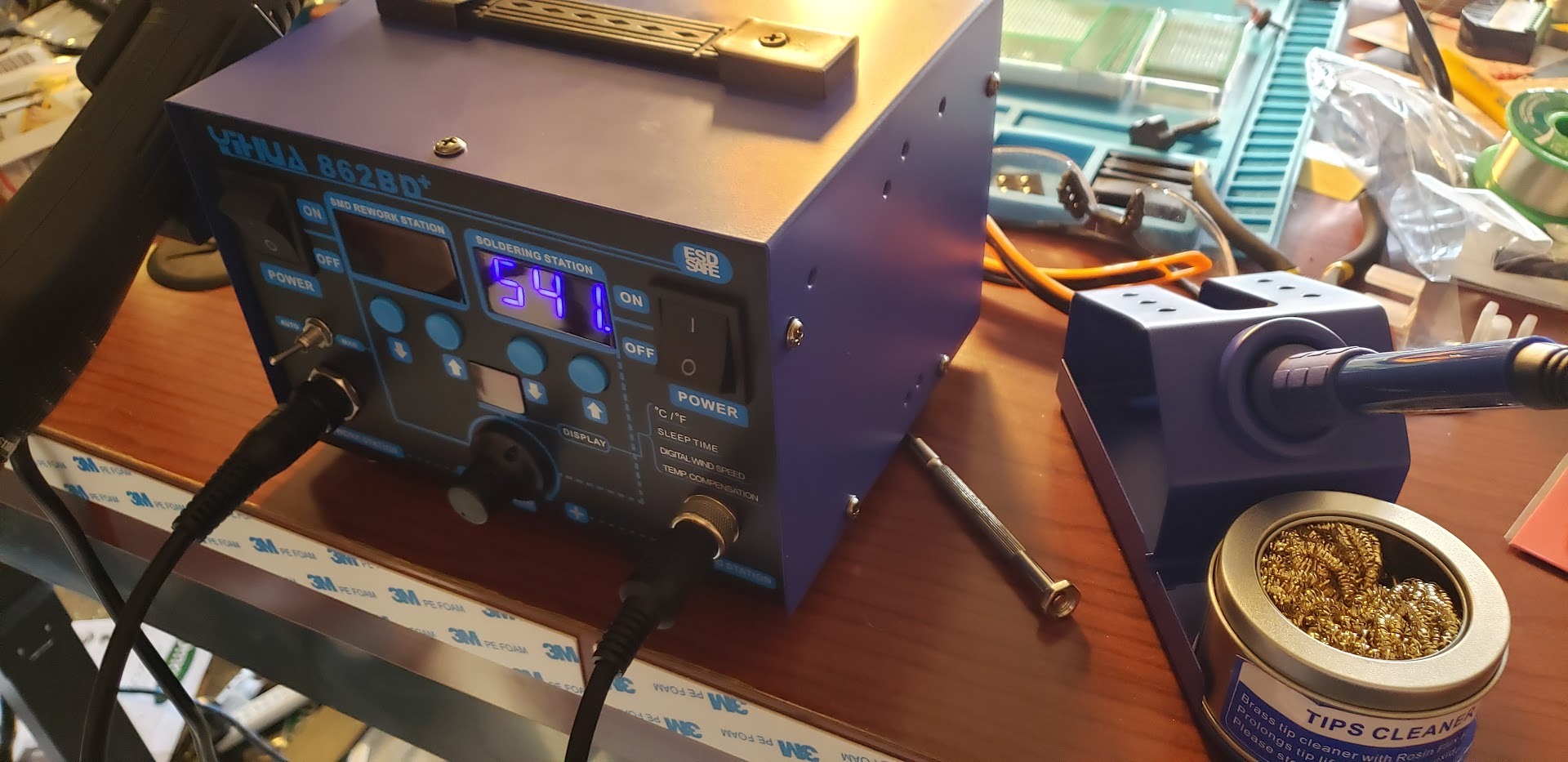
Where the extra control pays off on multi-pin packages
The second handpiece reporting air volume independently is what makes this the pick for anyone doing connector replacements or power IC swaps on dense boards. Small passives adjacent to a hot package are the classic casualty of an over-aggressive rework, and being able to back the airflow down while holding temperature is the whole game.
Detachable handles also mean you can keep a dedicated fine-pitch tip in one handle and a heavier chisel in the other, which removes the tip swap from the middle of a delicate operation.
Reasons to look elsewhere
If your bench is small, the 4.88 by 9.8 by 7.36 inch body is one of the larger footprints in this roundup. The 8786D I does the same job in a noticeably tighter box.
Also expect to calibrate on day one, and check the connector pins on both handles early. A few units arrive with slightly misaligned pins, which presents as an intermittent connection rather than an obvious fault.
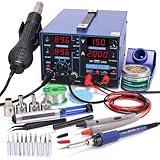
3. YIHUA 853D 2A USB 3-in-1 Bench for Rework Plus Low-Voltage Testing
YIHUA 853D 2A USB SMD Hot Air Rework Soldering Iron Station, DC Power Supply 0-15V 0-2A with 5V USB Charging Port and 35 Volt DC Voltage Test Meter
Iron plus hot air plus 0-15V supply
120 L/min
5V USB port
0-35V test meter
Pros
- Only unit here bundling a bench DC supply and voltmeter
- Integrated 5V USB port for testing powered devices
- Hot air reaches up to 120 L/min with adjustable volume
- Sleep mode and automatic shut-down
- Reported clean removal of EEPROM and surface-mount chips
Cons
- Larger bench footprint than two-function stations
- Included iron tips are the first thing many owners upgrade
- Hot air nozzle clamp tabs are awkward to tighten
- Power and handpiece cords run short
This is a genuinely different proposition from the rest of the list because it is three tools, not two. The base unit contains a soldering station, a hot air rework station and a bench DC power supply with a voltage test meter. The supply delivers 0 to 2 amps at 0 to 15 volts in supply mode, or up to 35 volts in test mode, and there is a 0.5 amp 5V USB port for powering a target device while you probe it.
That DC supply is not a gimmick for anyone who does board-level debugging. Once you have reflowed a charge port or swapped a charging IC, you need to know whether the rail comes up correctly before you close the board. Reviewers report verifying the output with a Fluke meter, which is the level of check you would want before trusting it.
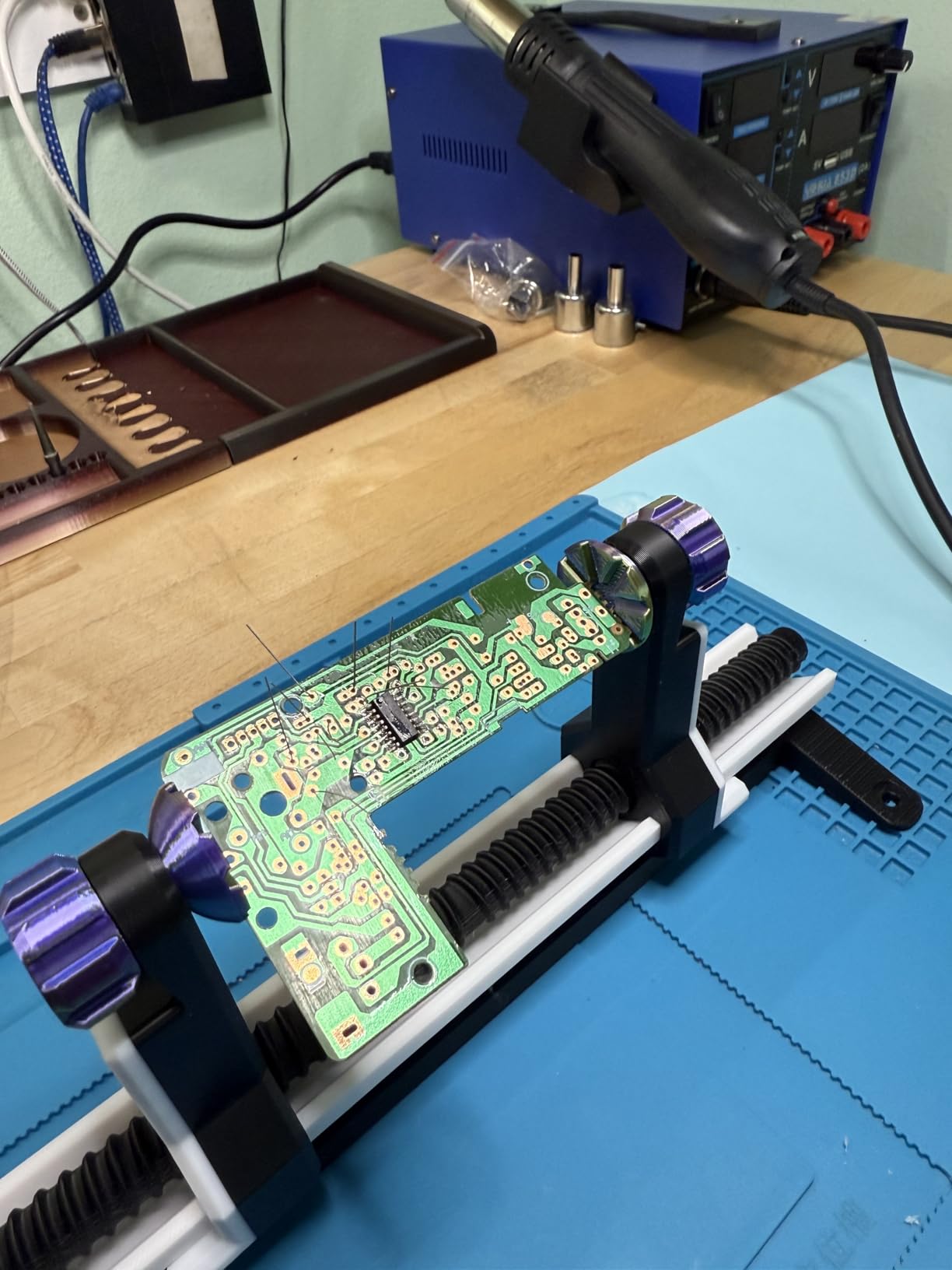
The hot air side is the strongest in this roundup on paper, with adjustable volume up to 120 litres per minute across a 212 to 896 degree Fahrenheit range. The iron covers 392 to 896 degrees. Users with decades of experience report reflowing BGA packages and 0201 parts under a microscope on this unit, and several reviews detail support replacing a defective handpiece within days.
The 4.76 kg weight and 9.96 by 7.32 by 4.88 inch body are the trade-off. This is not a station for a cramped shelf. It wants a proper bench with room for your forearms, and the cords are on the short side, so plan your outlet position carefully.
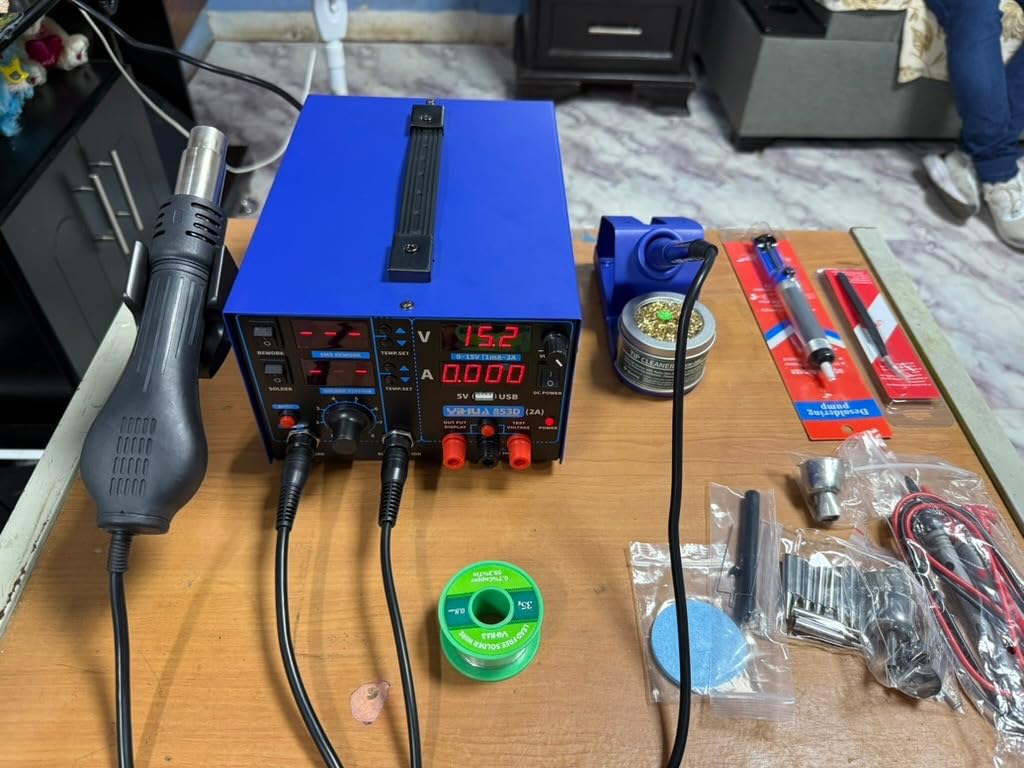
Best use for the integrated supply and USB port
Pair the DC supply with rework when you are bringing up a board from scratch. Reflow a connector, then set 5 volts through the USB port and watch current draw while you check for a short before committing to a battery. It removes a whole class of guesswork.
The 0 to 35 volt test mode also covers the 3.3 and 5 volt logic rails that most phone and laptop work runs on, so a single box covers both soldering and first-power-up diagnostics.
What gives buyers pause
Size is the first objection. If your other two tools are already good, you are paying for a power supply you might only touch occasionally, and the WEP 882D or the 8786D I covers the rework half for a fraction of the money.
Second, the included iron tips are adequate rather than good. Budget for a proper chisel and a fine bevel set in the first month, and expect to fiddle with the nozzle clamp tabs, which several owners describe as awkward to tighten.
4. WEP 882D 2-in-1 Station for the Tightest Budget SMD Bench
WEP 882D Soldering Iron Station 2-IN-1 SMD Hot Air Rework Station with 2 Spools of Solder Wire, 5 Soldering Tips, 3 Hot Air Nozzles, Brass Wool Tip Cleaner, Tweezers, Desoldering pump
750W
212C to 480C
1.1 kg body
PID on both handles
110V
Pros
- Compact 3.54 by 5.9 by 2.28 inch body saves real bench space
- PID temperature control on both the iron and the gun
- Calibration
- sleep
- standby and auto shut-down all built in
- Two spools of solder wire so it is usable immediately
- One-year US technical support
Cons
- Single-channel design limits simultaneous independent operation
- Accessory tips and nozzles are entry-level rather than professional
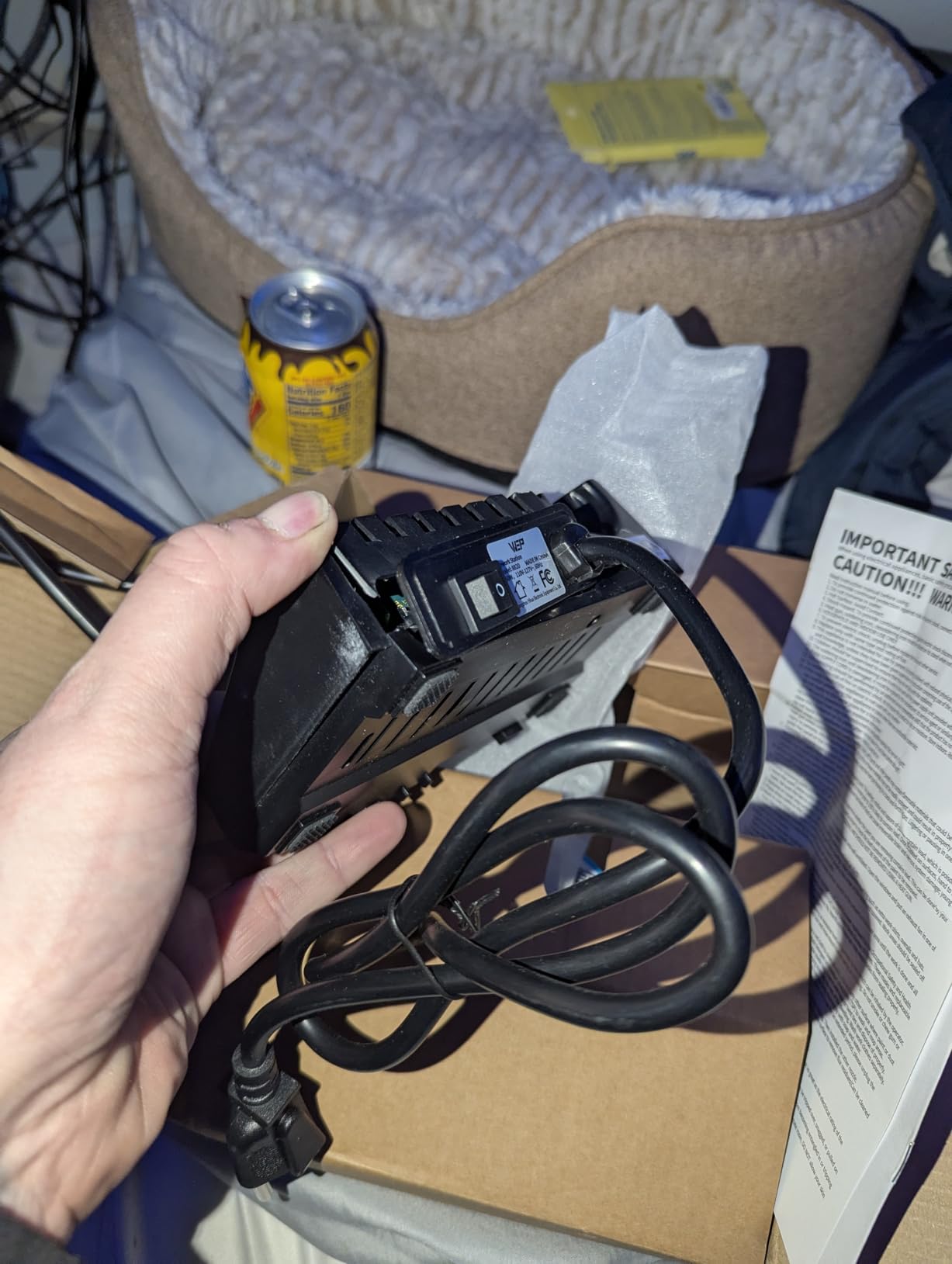
The WEP 882D is the value pick in this roundup, and it ranks in the top ten of its category on sales volume. At 1.1 kg and 3.54 by 5.9 by 2.28 inches it is the smallest two-function unit here, which is the feature that actually decides it for anyone working on a laptop at a kitchen table or sharing a bench with other tools.
Underneath, it is a serious 750 watt design. Both the iron and the hot air gun run on a built-in PID program, the iron covers 392 to 896 degrees Fahrenheit, and the gun covers 212 to 896 with variable air volume. That calibration function is unusual at this end of the market and worth using on day one with an external probe.
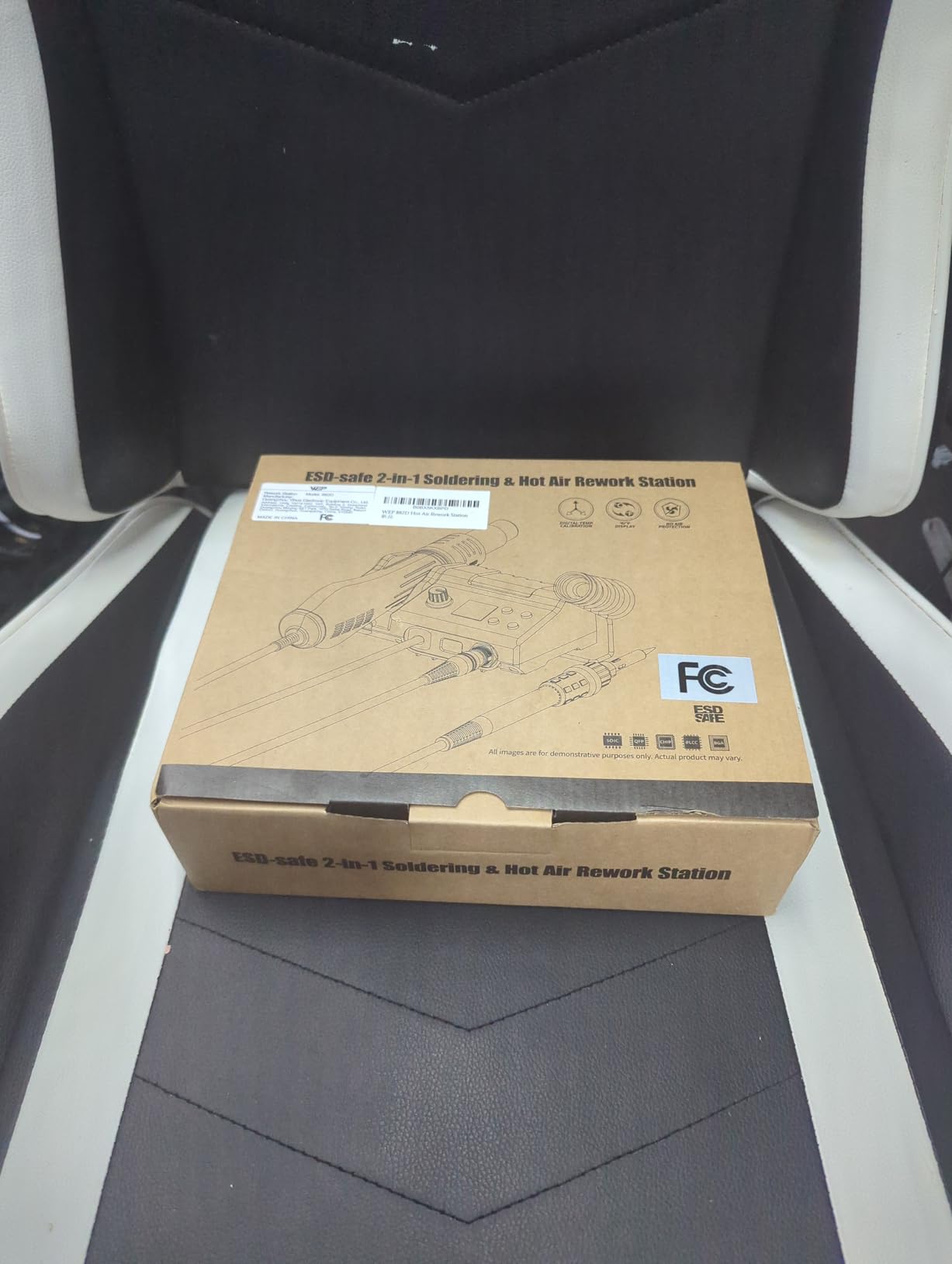
Reviewers point out the sleep mode, standby mode and auto shut-down functions as the quiet reason to like this unit. Leaving a hot iron parked in its cradle for an afternoon is the fastest way to cook an element, and having all three protection behaviours built in changes how you can work. A calibration routine that takes minutes rather than hours also means the display can be trusted.
The kit ships with five soldering tips, three hot air nozzles, two spools of solder wire, brass wool for tip cleaning, tweezers and a desoldering pump. Having two spools means you have both an alloy on hand without a separate order, which matters when you are starting out and do not yet have a preference.
How it performs on chip packages and hard ground planes
PID on both handles is the feature that separates this from the very cheapest no-name boxes, and reviewers note quick heat-up alongside clear controls. On SOIC and small QFP work the gun is usable with a medium nozzle at moderate airflow, which is the correct way to avoid launching a nearby 0402 part across the bench.
On large pours with a lot of thermal mass, the 750 watt rating gives the loop enough headroom to recover. It will not match a dedicated premium iron for fine-pitch bevel work, but it will not stall either.
Trade-offs to accept up front
It is a single-channel design, so you are running one iron at one temperature. If your work involves alternating between a bulk tip and a fine tip constantly, or you want two irons live at once, this is the wrong architecture.
The included tips and nozzles are entry-level. Treat them as consumables that get replaced in the first month rather than as a reason to avoid the station.
5. MYPOUOS 8588D SET1 2-in-1 Station for Fast Heat-Up and Ceramic-Core Air
MYPOUOS 2 IN 1 750W LED Digital Soldering Station Hot Air Gun Rework Station Electric Soldering Iron For Phone PCB IC SMD BGA Welding SET 110V (8588D SET1)
750W
100C to 480C
About 10 second heat-up
Handle induction
110V
Pros
- Reaches usable temperature in roughly 10 seconds on both handles
- Ceramic-core hot air element is more consistent than mica core
- One owner reports four-plus years of weekly use
- Fully ground-wired construction verified by a reviewer disassembly
- Anti-static design with fault self-detection
Cons
- Accessories are basic and tips wear quickly
- Un-tinted blue LED display is hard to read in direct light
- Iron handle is all plastic with no insulating collar
- Some units reported a defective or pulsing hot air fan
- No master power switch
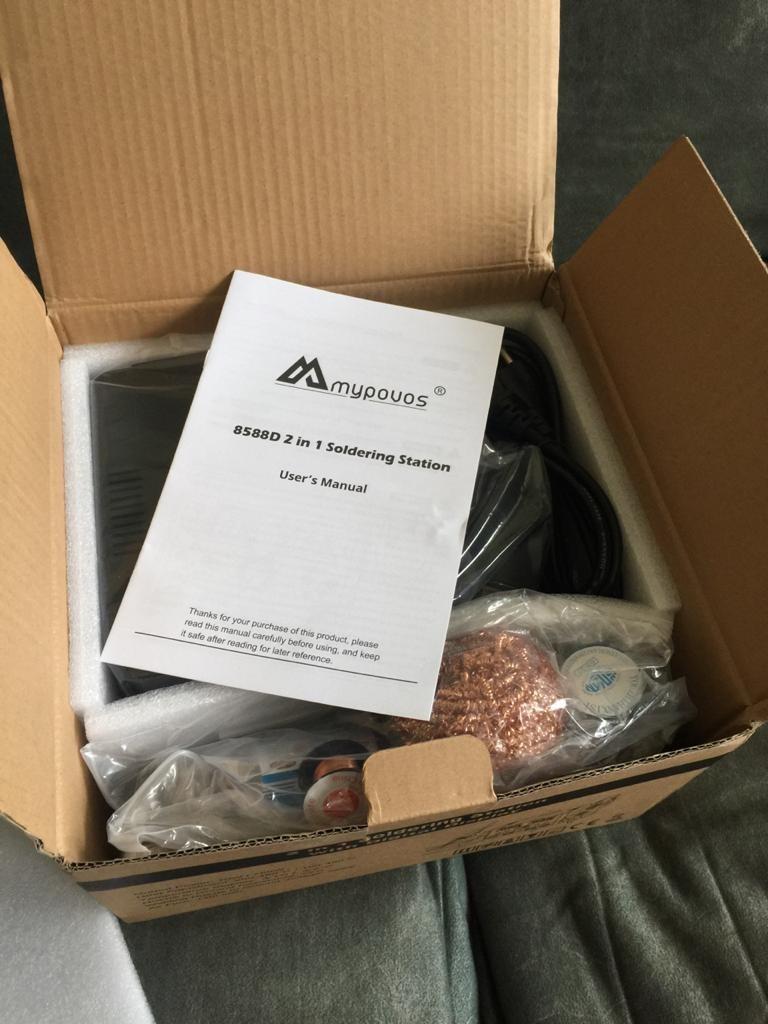
The fastest heat-up in this roundup is the reason this station earns a place. Reviewers time roughly 10 seconds to usable temperature on both the iron and the hot air gun, which sounds like a small detail until you are doing fifty connector replacements in a session. You are not waiting on the element, you are waiting on the board.
The handle induction system is a genuinely good design idea. Lift the iron off its cradle and it heats; return it and it cools, automatically, with no button press. For hot air the handle cools automatically the same way. Given how many owners cook elements by leaving irons parked, having the behaviour built into the handles rather than the software is a real reliability gain.
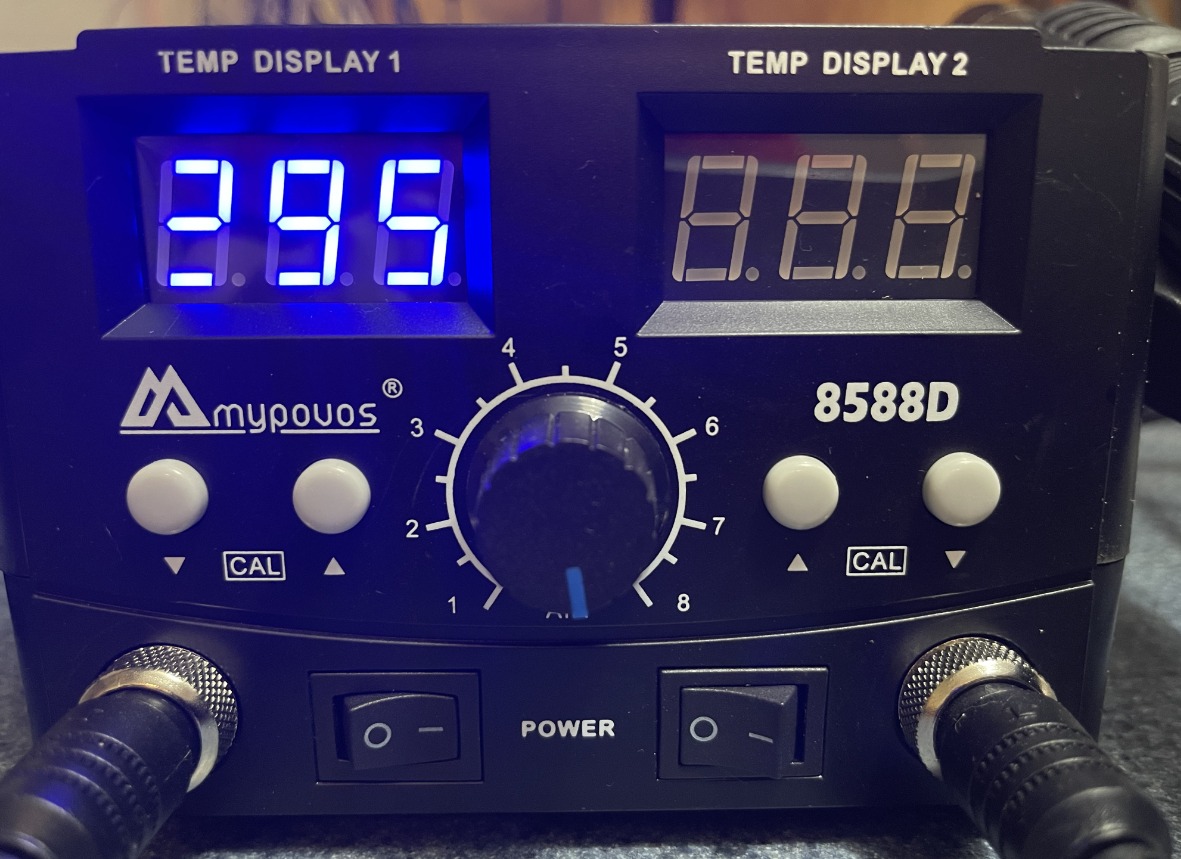
Temperature runs 100 to 480 degrees Celsius, which is 212 to 896 degrees Fahrenheit, with adjustment in 1 degree steps and a tolerance of plus or minus 2 degrees. The 750 watt output is the joint highest here, and the anti-static design includes fault self-detection with a warning rather than just a static-safe label.
One reviewer took the unit apart and confirmed the wiring is correctly ground-wired, which is worth knowing given how often ultra-budget units are discussed in forums. The ceramic-core hot air element is also reported as more consistent than the mica cores used in cheaper boxes.
Situations where the 10-second heat-up pays off
Batch work is the clear case. Replacing a run of electrolytic capacitors, redoing a row of through-hole joints, or cycling a connector pin a dozen times all reward a station that is ready the moment you are. The induction system also removes the temptation to leave the iron hot between joints.
Long single jobs benefit less. If you place one large ground plane and let the station sit, heat-up speed is irrelevant and thermal mass takes over.
Where this one falls short
There is no master power switch, so you need a switched power bar to cut the unit fully. That is a mild irritation rather than a defect, but it is the kind of thing that irritates you daily.
Two items are worth planning around. The un-tinted blue LED display is genuinely hard to read under direct light, so angle your bench lighting. And a minority of owners report a defective or pulsing hot air fan, so check the fan behaviour the day the unit arrives rather than discovering it mid-job.
6. TXINLEI 8586 2-in-1 Kit for BGA Work with Spare Elements Included
TXINLEI 8586 110V Solder Station, 2 in 1 Digital Display SMD Hot Air Rework Station and Soldering Iron, 12pcs Different Soldering Tips, Tweezers,Desoldering Pump,700W 480℃
100C to 480C
1C stability
Spare elements
12 tips
6-in-1 BGA tools
Pros
- Hot air gun reaches melt temperature in about 20 seconds from cold
- Spare heating elements for both the iron and the gun in the box
- Twelve tips and a 6-in-1 BGA tool set included
- Used successfully for GPU reballing and phone repairs
- Cable flexibility compared favourably to a premium iron
Cons
- Instruction manual is difficult to decipher
- Included tips are low quality and wear quickly
- Iron stays hot at the lowest setting even with the power switch on
- Blower keeps running until 100C which can scorch nearby surfaces
- Ceramic iron element sits loose
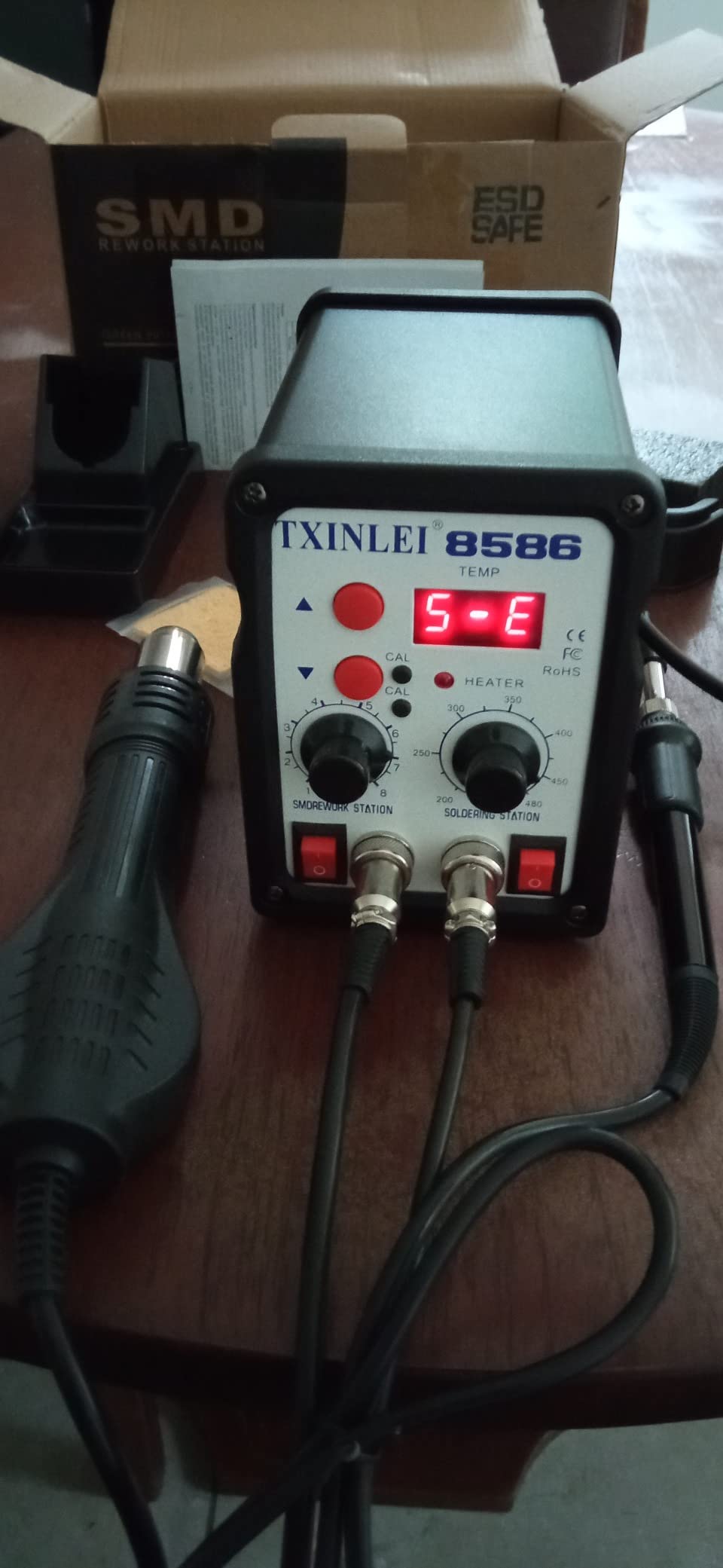
The reason this kit stands out is the box contents. You get twelve soldering tips, two pairs of tweezers, a desoldering pump, a six-in-one BGA tool set, an IC puller, and spare heating elements for both the iron and the hot air gun. That last item is unusual, and given that elements are the component most likely to fail, having a spare in the drawer on day one is worth real money over a year of work.
Temperature control is microcomputer based with a digital LED display, and the stated stability is 1 degree Celsius. The hot air gun reaches melt temperature in about 20 seconds from cold, and the unit is rated for SOIC, CHIP, QFP, PLCC and BGA packages. Reviewers report using it for GPU reballing and phone repairs, which puts it firmly in real-work territory rather than practice territory.
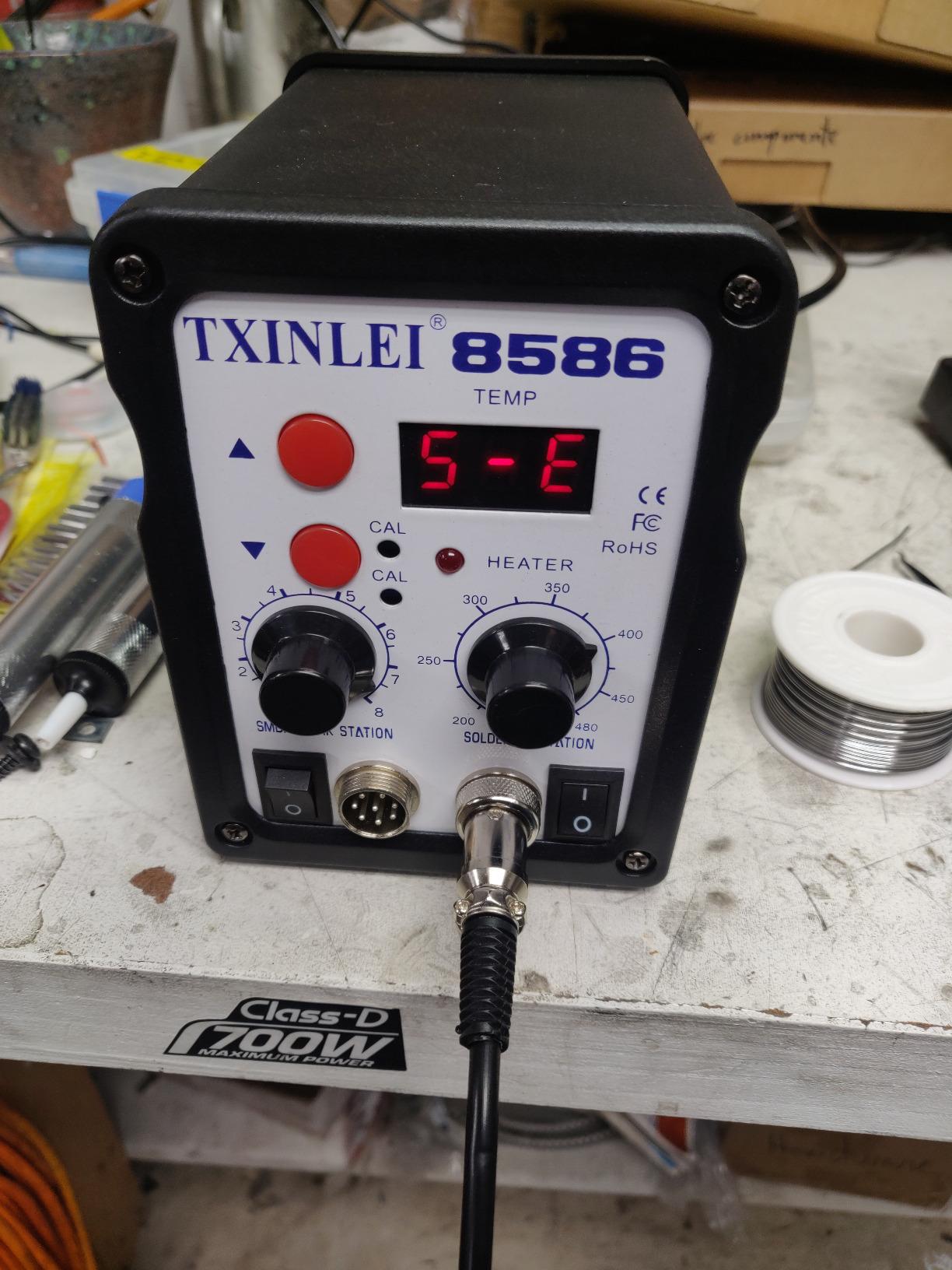
Handle induction is built in, so the iron heats when lifted and stops when returned to the cradle. Cable flexibility is compared favourably to a premium iron by reviewers, which sounds minor but is a real fatigue factor over a long session.
The listed wattage of 60 watts is a headline figure worth reading carefully, because it does not describe what you experience during a rework. Judge the iron on recovery under load and the gun on how quickly it recovers after you move it off a package, not on the wattage printed in the listing.
What the BGA tool set actually gets you
A six-in-one BGA tool set is typically a collection of reballing stencils, a wick and a picking aid. Reviewers who used this unit for GPU reballing credit the combination of the stencils with a workable hot air temperature, rather than any single tool doing the heavy lifting.
If BGA and fine-pitch package work is a regular part of your job, having the consumables in the box saves an order and a wait. If it is occasional, it is a pleasant surprise rather than a reason to buy over a better-controlled station.
Reasons buyers return or hesitate
The manual is the standout weakness, and the calibration procedure described in it is described as obtuse. If you are the type who will read it, be aware that this is real friction. Several owners also note the iron stays hot at the lowest setting even with the power switch engaged, which defeats the point of the cradle.
Two more cautions. The blower keeps running until the element reaches 100 degrees Celsius, so avoid parking sensitive plastic or tape in the plume path. And the ceramic iron element sits loose and takes longer to reach melt temperature than a premium iron, so do not read the fast hot air spec as fast iron response.
7. TXINLEI 858D+ 2-in-1 Station for Quiet Bench Work
TXINLEI 858D 110V Solder Station, Digital Display SMD Hot Air Rework Station Solder Iron Kit Heat Gun, Tweezers, Desoldering Pump
700W
100C to 450C
Under 45dB
Three nozzles
Handle induction
Pros
- Quietest running in this roundup at under 45dB
- 700W output with quick warm-up and stabilization
- Three interchangeable nozzle sizes give workable airflow options
- Includes a spare hot air heater and BGA tool set
- Handle induction stops heating when returned to the cradle
Cons
- Lower temperature ceiling of 450C than the other units here
- Accessory quality is entry level and tips wear quickly
- Some units shipped with a hot air fan that stopped working
Noise is the reason to shortlist this one. At under 45 decibels it is the quietest station in the roundup, and that matters if you work in a shared room, at night, or on calls. The blower noise from a hot air station is a constant background hiss, so a difference of several decibels is more noticeable than the number suggests.
Underneath it is a 700 watt design with microcomputer control, a digital display and a temperature range of 100 to 450 degrees Celsius. Handle induction means the iron heats when lifted and stops automatically when returned. Three interchangeable nozzle sizes in big, medium and small cover most surface-mount work, and the manufacturer advises setting temperature low and airflow high to protect IC packages, which is sound advice.
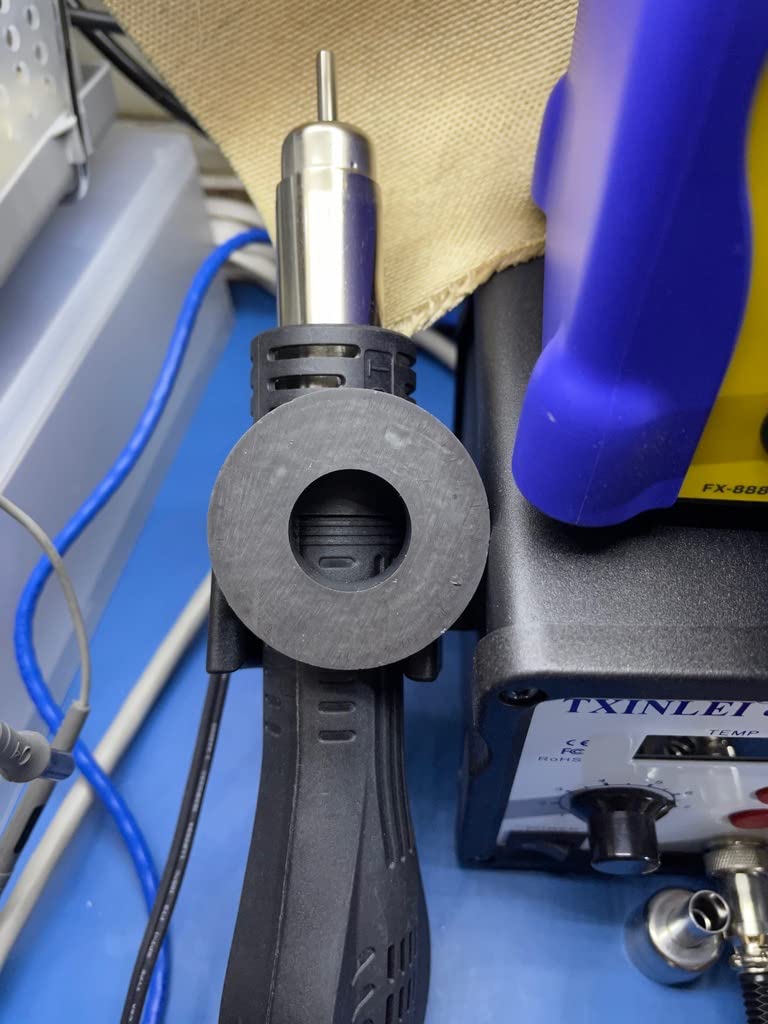
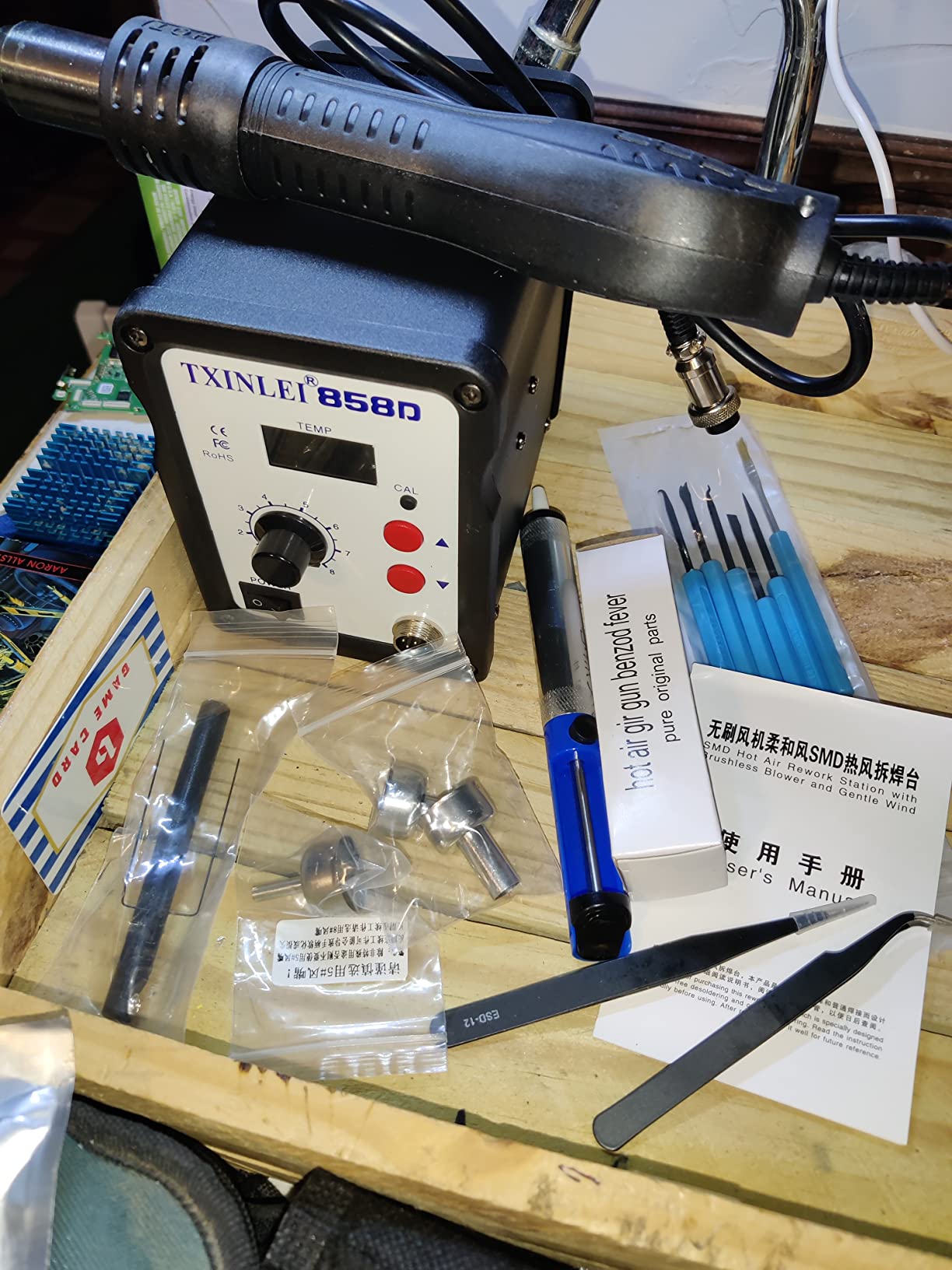
The kit includes a spare hot air heater, a six-in-one BGA tool set, two tweezers, a desoldering pump and an IC puller. Having a spare hot air heater in the box is the same kind of practical insurance as the spare elements in the 8586 kit, and the hot air element is the part most exposed to flux residue and thermal cycling.
Owners describe it as a capable budget station in the established 858D format, with quick heat-up and good accessories for the money. The review base is the second smallest here, so treat the picture as useful but not as deep a dataset as the units with two thousand-plus reviews.
Where a lower temperature ceiling is fine
A 450 degree ceiling is ample for 0402, 0603 and 0805 passives, SOIC packages, small QFP work and connector repairs, which covers the overwhelming majority of hobby and intermediate rework. If you are reworking large leaded BGA arrays you may find yourself wanting more headroom, but the low end of the range matters more for protecting small parts.
The three nozzle sizes are the more important variable at this level than peak temperature, because airflow control is what stops neighbouring components from blowing off the board.
What to verify on arrival
Check the hot air fan the day the unit arrives. Some units in this review set shipped with a fan that stopped working, and a failed fan on a hot air station is a much bigger problem than a failed fan on a computer, because the element is still being heated.
Also treat the tips as consumables. Owners consistently report they wear quickly under heavy use, so order a proper set of tips and nozzles rather than planning around the supplied ones.
8. WEP 8858-V Hot Air Station as a Compact Companion to a Separate Iron
WEP 8858-V Hot Air Rework Station Kit with Compact Size, Integrated Nozzle Holder, 3 Nozzles, 2 Tweezers, Adjustable Temperature& Air Volume, PID Program, °C/°F Conversion and More
Hot air only
212C to 480C
3.5 inch body
Front-panel airflow knob
Digital calibration
Pros
- Palm-sized 3.5 by 4.6 by 2.4 inch body with integrated holders
- Air volume adjusts from a single front-panel knob without a menu
- Digital calibration and F to C conversion are rare at this level
- 212 to 896F range covers most SMD rework
- Hot air fail-safe protects the element
Cons
- No soldering iron included so it needs pairing with a separate iron
- Small accessory bundle of three nozzles and two tweezers
This is the odd one out, and deliberately so. The WEP 8858-V is a hot air rework station with no soldering iron, which makes it a companion to a good iron rather than a replacement for one. If you already own a decent temperature-controlled iron and only lack rework capability, this is the cheapest way to close the gap without buying a second full station.
The design intent is obvious from the dimensions. At 3.5 by 4.6 by 2.4 inches it is the smallest unit in the roundup, and the body has an integrated hot air gun holder and nozzle holder so everything stores in the footprint of the unit itself. That is a genuinely useful idea for a crowded bench or a field kit.
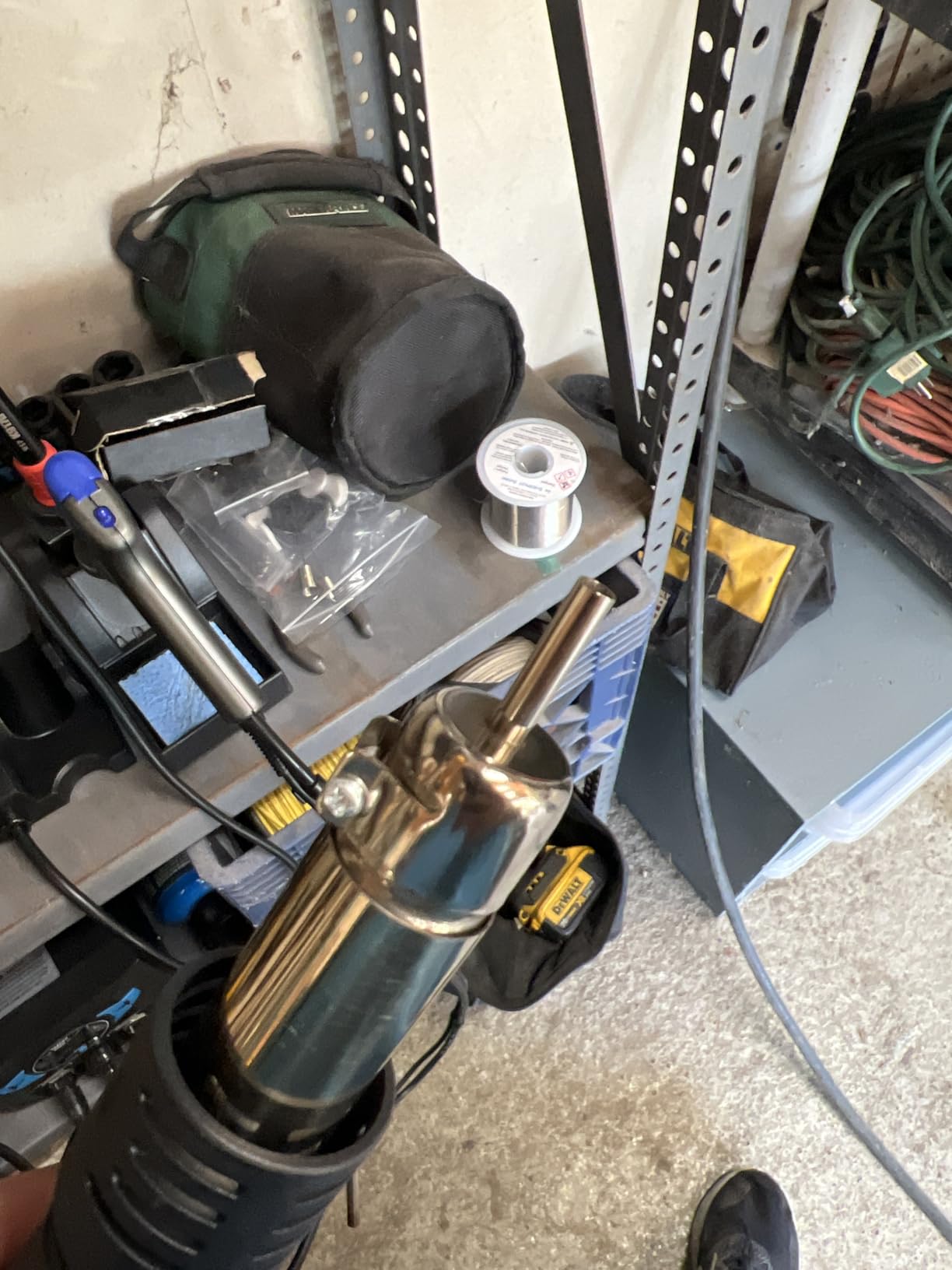
Control is unusually direct for a unit this small. Air volume adjusts from a single knob on the front panel with no secondary menu to navigate, which during a live desolder means your other hand is holding tweezers rather than cycling through settings. The PID program monitors temperature and adjusts power output, and there is digital temperature calibration alongside Fahrenheit to Celsius conversion and a hot air fail-safe.
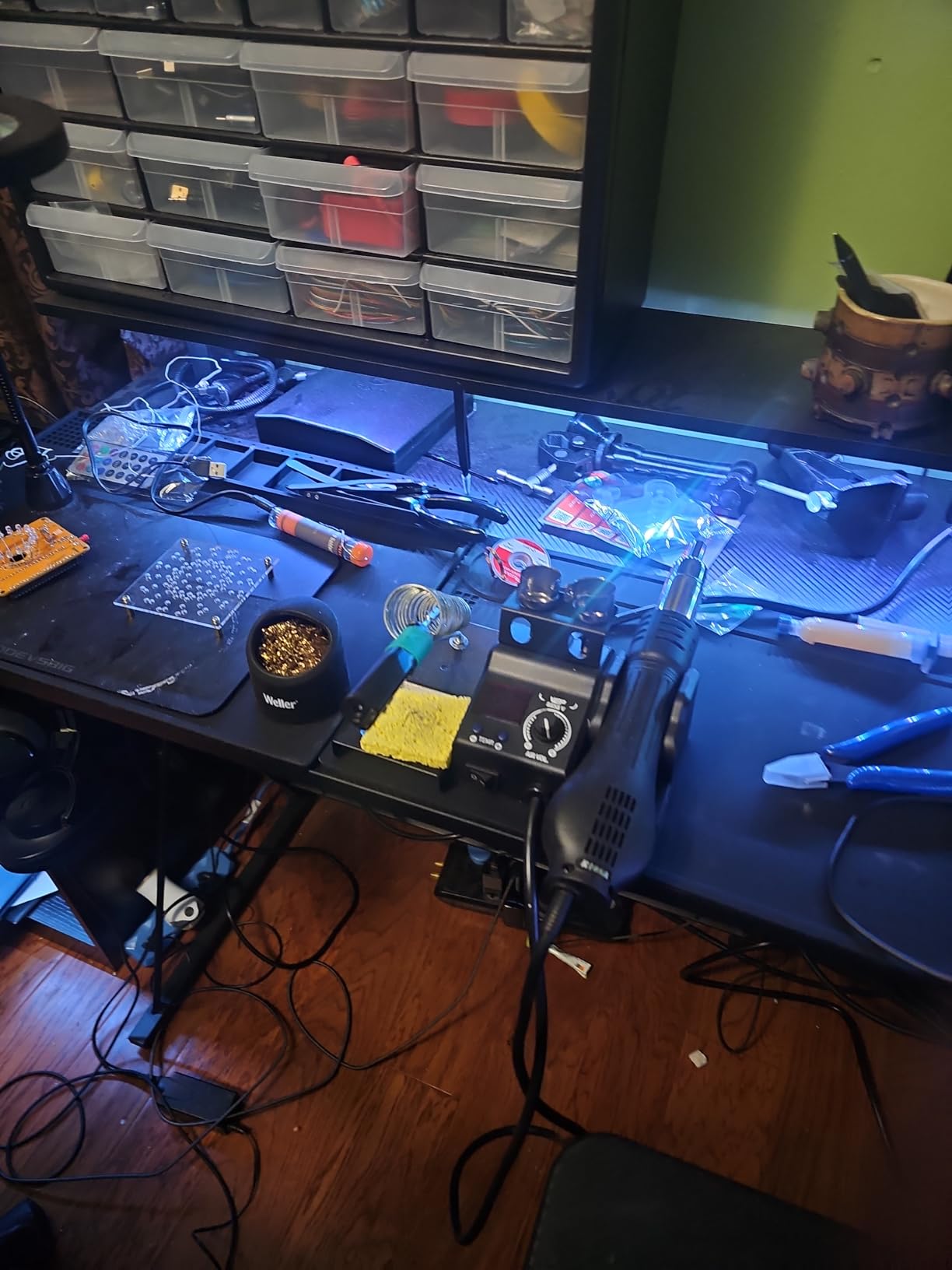
Reviewers favour the compact footprint, straightforward controls and PID stability, and treat it as a dedicated hot air complement to a separate soldering iron. The 212 to 896 degree Fahrenheit range covers the great majority of SMD rework jobs.
When a hot air-only unit is the right call
It is the right call when your iron is already good. Most entry irons are fixed-wattage and uncontrolled, so if you have one of those, adding this unit and then a temperature-controlled iron is still cheaper than starting from scratch with a full combo.
It is also the right call for travel or field repair, where volume matters more than integration. The unit is small, the gun and nozzles clip to the body, and you still have full PID temperature control on the air.
What you give up by not buying a combo
You end up with two boxes, two power cords and two temperature controls, and no shared sleep or shut-down behaviour across both tools. For someone doing continuous rework that is real friction, and a 2-in-1 such as the WEP 882D or the YIHUA 8786D I solves it in one footprint.
The accessory bundle is also minimal by design: three nozzles and two tweezers, one bent and one straight. Plan on ordering additional nozzle sizes early, since nozzle diameter is the variable that most affects rework quality.
9. Aoyue 968A+ 4-in-1 Station for Repeated Bench Rework With Fume Control
New Aoyue 968A+ SMD Digital Hot Air Rework Station… (110)
4-in-1
70W iron
Built-in smoke absorber
Vacuum pickup
110V
Pros
- Only station here with a built-in smoke absorber for repeated rework
- Vacuum pickup tool for handling tiny surface-mount parts
- 70W soldering iron paired with hot air in one base unit
- Long-established brand with a one-year manufacturer warranty
- Aoyue is repeatedly named a value alternative to a premium brand
Cons
- Highest price in this roundup
- Listed package contents are base unit only
- Lowest average rating among the four units at 4.4 out of 5
The Aoyue 968A+ solves a problem none of the other nine address. It has a built-in smoke absorber and a vacuum pickup tool alongside the hot air rework station and a 70 watt soldering iron, which makes it a four-in-one base unit. For anyone doing hours of lead-free rework at a bench where a separate fume extractor is not an option, that is a real advantage rather than a feature-list entry.
The vacuum pickup also solves a practical problem with small parts. Trying to lift a 0402 capacitor off a board with tweezers while a fan is running is how parts end up on the floor. A suction tool lets you move the part deliberately, and it is the single accessory most often missing from cheaper kits.
On the technical side, expect less than the top of this list. The soldering iron is 70 watts, digital temperature control is present, and the unit runs on 110 volts. It is heavier than it looks at around 11 pounds, and the base measures 5.91 inches across by 12.17 inches tall, so give it vertical clearance.
Aoyue is a long-established brand in the repair world and appears repeatedly across forum threads as the value alternative to a premium station for hobbyists who cannot justify the premium. The warranty is one year from the manufacturer. The listed package contents are the base unit, so treat handpieces, tips and nozzles as things to confirm with the seller before you order.
When built-in fume extraction is worth paying for
If you are doing repeated rework of lead-free joints, the vapour is the part of the job nobody sees and everybody pays for. A built-in absorber removes the need for a separate unit, and it is most valuable on a bench without an extraction arm or window.
It also makes the station a better fit for shared or indoor workspaces where a bench fan is not an option. Combined with the vacuum pickup, this is the most self-contained bench in the roundup.
Trade-offs against the cheaper units
This is the most expensive station in the roundup, and the 4.4 average rating is the lowest among the four units that clear that mark, with 7 percent one-star reviews. That combination tells you the feature set is genuinely distinct but the execution is not flawless, so read the one-star reviews before deciding.
Also confirm what actually ships. If the handpieces, tips and nozzles are not included, the effective cost of getting a working bench rises, and at that point a 2-in-1 plus a standalone fume fan may serve you better.
10. X-TRONIC 5040-XR3 All-In-One for Large Boards Needing a Preheater
X-Tronic’s • Cutting Edge in Technology • Model 5040-XR3 All-In-One Hot Air Rework & Soldering Iron Station with Preheater. Now Includes Plug & Play Hot Air Gun With Iron Holder & Sponge Cleaner
1270W total
70W iron, 500W gun, 700W preheater
Hakko tips
3-year warranty
Pros
- Only station here with a built-in 700W preheating station
- Highest total output at 1270W across three functions
- Iron accepts standard Hakko tips so existing tips are usable
- Samsung microcontroller with PID control and Magic Temp
- US design
- QC and repair with a three-year warranty and lifetime support
Cons
- Most expensive unit in the roundup
- Bundled accessories are weak with uneven tweezers and a flickering lamp
- Board guide rails have about a quarter inch of play
- Assembly takes time and one unit needed a clipped screw
The X-TRONIC 5040-XR3 is the only station in this roundup with a preheating station built into the base, and that single feature changes what kind of work you can attempt. The 700W preheater brings a large board up to temperature before you apply hot air, which reduces the temperature differential across the board and is the difference between a clean chip removal and a board that warps or delaminates on the far side from where you are working.
Total output is 1270 watts, split into a 70 watt soldering iron, a 500 watt hot air gun and the 700 watt preheater. A Samsung microcontroller runs the PID loop, Magic Temp technology handles the temperature handling, and the iron accepts standard Hakko tips. If you or a previous owner already has a Hakko tip collection, that compatibility alone removes a real cost.
Temperature range is 212 to 896 degrees Fahrenheit on both functions, with stated stability of 4.8 degrees Fahrenheit on the iron and 1.8 on the gun. X-Tronic designs, assembles and repairs in Lincoln, Nebraska, and the warranty is three years with lifetime technical assistance, which is the longest warranty in this roundup and the one support claim reviewers single out most often after element and base-unit replacements.
The 15 pound weight and 9.8 by 7.4 by 8 inch body make this a permanent bench fixture rather than something you move around. Rated accuracy is 70 percent five-star, the lowest of the ten, and 8 percent one-star, so it is a station with a strong following and a specific set of complaints.
Which jobs actually need the preheater
Large ground planes and multilayer boards are the case. When you heat one end of a big board with hot air and the other end stays at ambient, thermal expansion pulls on solder joints and can delaminate copper or crack a BGA package as it comes off. Preheating closes that gap.
It also helps with lead-free work in general, since lead-free alloys need a higher melt temperature and therefore a steeper gradient across the board. If you want to run a preheater separately, we have covered the best hot plate preheaters for SMD rework separately.
What reviewers complain about
The bundled accessories are the main criticism: uneven tweezer tips, a flimsy IC popper and a flickering magnifying lamp. Treat the accessories as decoration and buy the tools you need, including solder paste and flux kits for the reflow stage.
Two more practical notes. The board-holding guide rails have roughly a quarter inch of play and some owners tape them down to remove the slop. And assembly takes time, with one reviewer having to clip an over-long screw on the IC popper, so budget an evening rather than an afternoon.
How to Choose a Soldering Station for SMD Rework
PID closed-loop control is the minimum standard
A fixed-wattage iron has no temperature feedback. It pushes a set amount of power into the element regardless of whether you are sitting in air or resting on a large copper pour, so the tip temperature swings with the job. A PID station senses the tip or element temperature through a thermocouple and adjusts power continuously to hold your setpoint, which is the difference between a clean joint and a lifted pad.
Every station in this roundup has PID on at least the iron, and all but one have it on the hot air gun as well. The 853D 2A USB is the one that publishes a specific cycle time at 20 milliseconds. The practical test is not the cycle rate but recovery: touch the tip to a large ground plane and time how long until the display returns to setpoint. If it takes more than a couple of seconds, your next real job will be frustrating.
Airflow and nozzle size decide whether parts survive
Nozzle diameter should roughly match the package footprint, with a little margin. A nozzle narrower than the part heats it unevenly, and a nozzle much wider than the part delivers its heat to neighbouring components instead. The widely used pattern is a small nozzle for 0402 and 0603 passives and chip packages, a medium nozzle for SOIC and small QFN, and a wide nozzle for QFP and BGA arrays.
Airflow is the other half. Too little and the package never reaches melt temperature, so you keep heating and eventually cook the board. Too much and small passives nearby lift off and fly. Start at mid airflow, hold temperature, and adjust one variable at a time. The 853D 2A USB publishes a maximum of 120 litres per minute, and the stations that let you change airflow from a front panel rather than a menu save time in the middle of a job.
Temperature presets by job type
For leaded 63/37 solder, an iron around 330 to 350 degrees Celsius suits most through-hole and larger SMD work, with hot air between 300 and 350 degrees. For lead-free alloys you move up, typically 370 to 400 degrees Celsius on the iron, and you expect the hot air to be near the top of the range with higher airflow to compensate for the higher melting point.
Small 0402 and 0603 parts are the exception where lower is better, because their thermal mass is tiny and the pad underneath conducts heat away fast. Many technicians drop to roughly 320 to 330 degrees for leaded fine-pitch work and add dwell time instead. If your station has a 480 degree ceiling like most of these do, treat the maximum as an emergency setting rather than a working temperature.
Iron or hot air: which tool for which package
Through-hole joints and connectors: iron. It gives you per-joint control and no risk of blowing neighbouring parts, and for a fresh joint on a fresh board there is no reason to reach for the gun.
0402, 0603 and 0805 passives: iron for soldering, hot air for removal. Removing a tiny capacitor with an iron means heating each end individually and levering the part, which works on a two-terminal part and rarely works on anything bigger.
SOIC, SOT and small QFN: hot air for removal, iron for placement if you can hold it, hot air for reflow. A bevel or hoof tip with fine solder on each lead is the fastest route on placement for a SOIC.
QFP and QFN with an exposed thermal pad: hot air, with the board preheated if it is large. Airflow set moderate, temperature held steady, and you lift straight up rather than twisting, because twisting shears pads.
BGA packages and anything under a shield: hot air, and usually a preheater. There is no iron technique for these. If a phone board or console board is in front of you, the preheater on the X-TRONIC or a separate hot plate is the difference between a reball and a scrapped board.
Heat shrink tubing: the hot air gun with a wide nozzle, away from the board. This is one job where the gun is used with no board attached at all, so a dedicated hot air unit like the WEP 8858-V serves well.
ESD safety and why some parts genuinely need it
ESD-safe means the station’s tip, handle and ground reference are at equal potential and the unit does not build a charge that discharges through a component. It matters most for CMOS-family parts: microcontrollers, memory, QFN and BGA devices, and anything with a gate oxide thin enough to be damaged by a few hundred volts of static that you never see.
On a bench with a grounded mat, a grounded iron and a grounded board, you are largely protected regardless of the station. On an ungrounded bench with carpet or a plastic mat, the station’s own grounding is doing more of the work, and this is where the ESD-safe and fully ground-wired construction claims on the YIHUA and MYPOUOS units earn their place in the list. A reviewer who disassembled the 8588D confirmed the wiring is ground-wired, which is the kind of verification most listings never bother with.
Hakko, Weller and the rest: what actually differs
The forum argument is usually framed as Hakko versus Weller, and for surface-mount work the two are close to interchangeable. Reviewers describe them that way, with the decision coming down to which tip ecosystem you already own and which handle shape suits your grip. Neither appears in this roundup because both are single-purpose irons, and the query needs hot air as much as it needs an iron.
The useful comparison here is tier rather than brand. The YIHUA and WEP units give you PID control and a hot air gun in one box for less than a premium iron alone costs, which is why they dominate this list. What you give up is tip ecosystem maturity and calibration confidence, and the YIHUA 862BD+ going through independent safety certification is the closest any of these come to the premium standard.
Nozzles and hot air tips are not interchangeable between brands, so a fragmented ecosystem is a genuine long-term cost. The one exception here is the X-TRONIC, whose iron accepts standard Hakko tips, which makes it the easiest station in the list to supplement with a known-good tip collection.
How to calibrate a station before your first real job
Budget ten minutes with a thermocouple before you trust the display. Buy a cheap K-type probe if you do not have one, and remember that a measurement made with a probe clipped to the tip shaft reads lower than the actual tip temperature, so compare relative readings rather than absolute ones.
Warm the station fully and leave it for fifteen minutes so the element and the thermocouple reach steady state. Then set a known temperature, touch the probe to the working end of the tip, and note the difference between the display and the probe. Repeat at a second temperature to check whether the error is a fixed offset or a scaling difference. A fixed offset is a simple calibration entry; a scaling difference means the element or sensor is drifting and support should be contacted.
For the hot air gun, put the probe in the airstream at the nozzle exit rather than touching the element, and check that the airflow does not deflect the reading. Calibrate the iron and the gun separately, then write the offsets down. Re-check every few months, because calibration drift is one of the most common complaints in forum threads about budget stations.
Common failures and how to fix them
Calibration drift: the display no longer matches reality. Fix it with the calibration procedure above before replacing anything, because most cases are a sensor offset rather than a failed element.
Burned heating elements: expected to fail after roughly 18 to 24 months of heavy use if you leave irons parked hot. Sleep mode, standby and auto shut-down extend element life considerably, and handle induction is better still because the heating stops at the cradle rather than in software. Two kits in this roundup ship with spare elements, which is the cheapest insurance available.
Loose nozzle screws: thermal cycling works the clamp loose. Check nozzle tightness every few sessions, and never use pliers on the nozzle body itself. Owners report clamp tabs that are awkward to tighten from the factory, so a small hex key is worth keeping at the bench.
Blocked air intakes: flux residue and dust restrict airflow, and a restricted fan makes the element run hotter than the setpoint. A failed fan can be a genuine safety issue on some units, so check that the fan is spinning the day a station arrives and treat a pulsing or dead fan as a return, not a repair.
Blowaway parts: a nozzle much wider than the component, or airflow above what the temperature requires. Fix it by narrowing the nozzle, not by dropping the temperature below melt and then leaning on the joint.
Accessories a first SMD bench actually needs
Beyond the station itself you want brass wool for tip cleaning, a proper tip set covering a fine bevel, a mid chisel and a hoof, ESD-safe tweezers with a fine point, a desoldering pump, an IC extractor sized for the packages you work on, spare nozzles in at least three diameters, liquid flux, a solder sucker, leaded and lead-free solder wire, and a grounded mat with a wrist strap.
Our advice is to buy the station with its included basics, then upgrade the consumables first. Tips, nozzles and tweezers are cheap, wear out, and make a larger difference to your results than moving up a station tier.
Frequently Asked Questions
Which is the best SMD rework station?
The YIHUA 8786D I is the best all-round choice in our 2026 roundup, pairing a 740 watt PID-controlled iron with a hot air gun, an ESD-safe design, fail-safe airflow protection and a full accessory bundle in a compact body. The YIHUA 862BD+ is the pick if you want three digital displays, detachable handpieces and independent safety certification, while the X-TRONIC 5040-XR3 is the one to buy if large boards and a built-in preheater are part of your work.
Do I need a hot air gun to do SMD rework, or is a soldering iron enough?
For 0402, 0603 and 0805 passives, a temperature-controlled iron is enough to solder and generally enough to remove a two-terminal part. The moment you touch SOIC, QFP, QFN or BGA packages you need hot air, because a single iron cannot melt every joint on a multi-pin package at once. Practitioners doing real chip work almost universally treat an iron-only station as insufficient.
Which is better, Hakko or Weller?
For SMD work the two are close to interchangeable, and the decision comes down to tip ecosystem preference and handle feel rather than performance. Reviewers consistently treat them as equivalent for surface-mount work. Neither includes hot air, so for a station that covers both soldering and rework you need a 2-in-1 unit or a separate hot air station such as the WEP 8858-V.
What is the golden rule of soldering?
Heat the joint, not the solder. Rest the iron tip against the pad and leg so both reach temperature together, then feed fresh solder into that joint so it flows from the metal, not from the tip. Keep the iron roughly 20 to 30 degrees above the solder melting point, use flux, and give a good joint time to cool undisturbed before you move the board.
What temperature should I use for hot air rework?
For leaded 63/37 solder, run the iron around 330 to 350 degrees Celsius and the hot air between 300 and 350 degrees. For lead-free alloys move up to roughly 370 to 400 degrees with higher airflow to compensate for the higher melting point. Drop to 320 to 330 degrees for 0402 and 0603 parts with leaded solder, since their thermal mass is small and the pad conducts heat away quickly.
How do I calibrate a soldering or hot air station?
Warm the station fully for about fifteen minutes, then compare the display against a K-type thermocouple at two known setpoints. A consistent difference is a fixed offset you can enter through the calibration function on most of these stations. Measure the iron at the tip and the gun in the airstream at the nozzle exit, calibrate the two separately, and re-check every few months because drift is a common complaint.
What is the best soldering station for a beginner doing SMD work?
The WEP 882D is the strongest starting point, giving you PID control on both the iron and the hot air gun, sleep and auto shut-down functions, a calibration mode and solder wire in the box inside a very compact body. The YIHUA 8786D I is the alternative if you want a larger accessory bundle and a longer accessory list out of the box. Either way, buy proper tips and flux before you start on a board you care about.
Why does my hot air gun blow small components off the board?
Almost always because the nozzle is wider than the component or the airflow is higher than the temperature requires. Match the nozzle diameter roughly to the package footprint, start at mid airflow, and raise temperature before airflow. A dedicated nozzle change costs very little and fixes the problem properly, whereas lowering temperature below melting just leads you to heat the joint for longer and risk the pad.
Which Soldering Station for SMD Rework Should You Buy?
If you are starting a first bench, buy the YIHUA 8786D I. It gives you PID control on both handles, ESD-safe construction, fail-safe airflow protection and enough tips and nozzles to be productive on the day it arrives, all in a body small enough to leave room for everything else. If you want the highest rated option and will calibrate it on day one, the YIHUA 862BD+ adds three displays and detachable handpieces that are cheap to replace.
Buy the WEP 882D if bench space is your binding constraint. Buy the YIHUA 853D 2A USB if you also want a bench supply and a way to power a board while you test it. Buy the WEP 8858-V only if you already own a good iron and just need rework capability.
For fumes and part handling, the Aoyue 968A+ is the only unit here with a built-in smoke absorber and vacuum pickup. For large boards, multilayer construction or anything under a shield, the X-TRONIC 5040-XR3 is the one with a preheater, Hakko tip compatibility and a three-year warranty with US-based support.
Whichever you choose, calibrate before the first real job, use handle induction or sleep mode every single day, and buy proper tips and flux before you buy a bigger station. Those three habits matter more to your rework results than the tier of hardware you picked, and they are the difference between the best soldering stations for SMD rework being a tool you trust or an expensive paperweight.