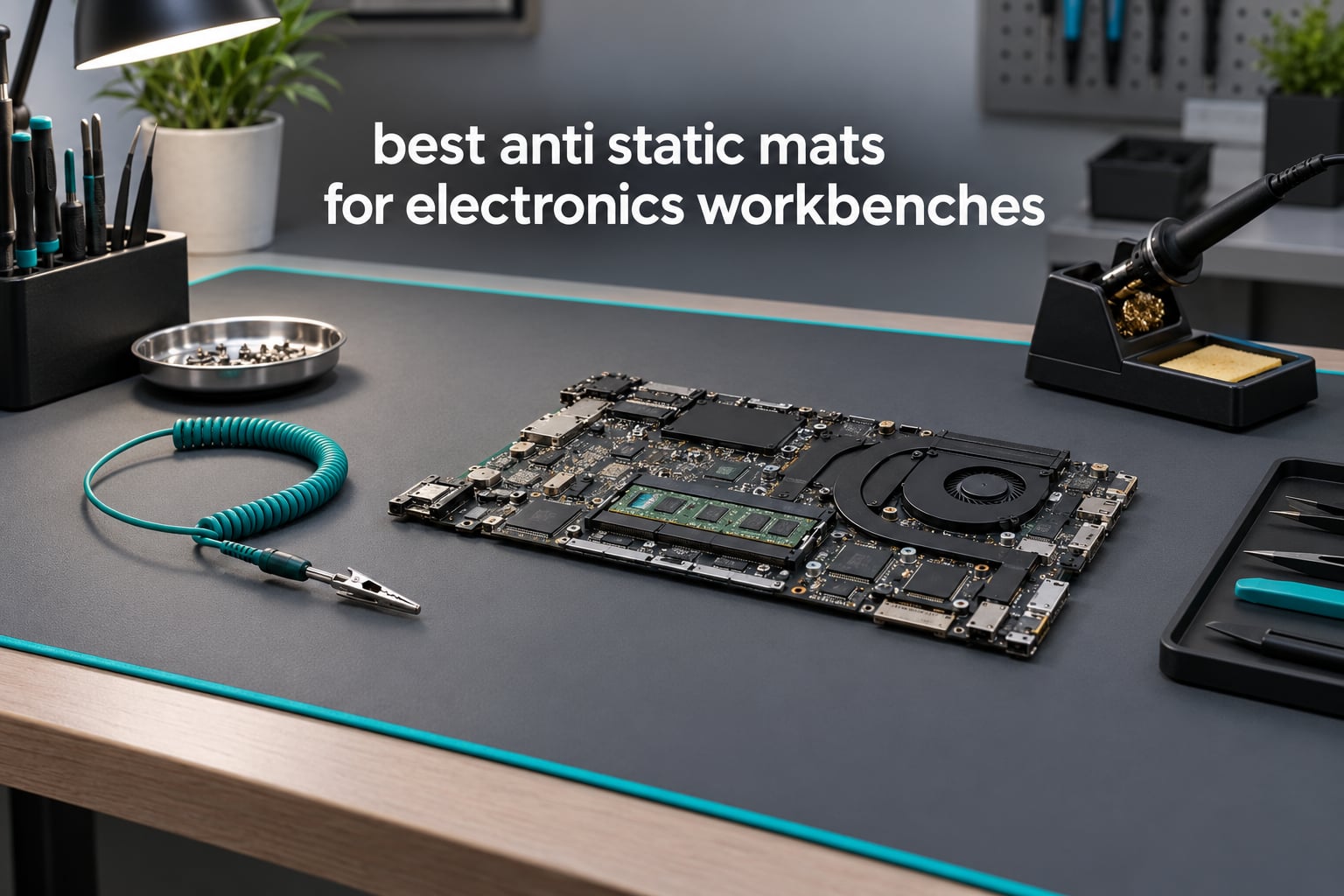
An anti static workbench mat is a two-layer surface — a static-dissipative top layer over a conductive base — that bleeds electrostatic charge off your body and off the parts on your bench into a grounding point. That is the whole job, and it is the difference between a board that boots and a board that fails three weeks later for no reason anyone can find. A single discharge of a few thousand volts can vaporize microscopic traces inside CMOS, MOSFET and CPU parts without leaving a visible mark.
So if you open laptops, rebuild PCs, rework motherboards or assemble circuit boards, the best anti static mat for electronics workbench use is not a luxury. It is the cheapest insurance on the bench. I compared 12 of them — from compact silicone soldering pads to full two-layer rubber bench mats and one 118 inch roll — on published surface resistivity, heat rating, grounding hardware, and what owners report after months of daily work.
What follows is the short version first, then a review of every mat, then a grounding walkthrough that will save you from the wiring mistakes that show up in almost every forum thread I read. Last updated for 2026.
Table of Contents
Top 3 Best Anti Static Mats for Electronics Workbenches in October

StarTech Large Anti-Static ESD Mat
- ANSI/ESD S4.1 compliant
- 23.6 x 47.2 in two-layer PVC
- 6.6 ft grounding wire

iFixit Portable Anti-Static Mat
- 10^7 - 10^9 ohm resistivity
- Mat plus wrist strap and cord
- Folds flat
- lifetime guarantee

HPFIX Silicone Soldering Mat Kit
- 10^6 - 10^8 ohm resistivity
- 932F heat-resistant silicone
- 15.9 x 12 in with ruler and trays
Those three are the picks I would hand to a friend without a follow-up question. The StarTech is the most standards-credible option with real bench coverage, the iFixit is the best complete kit for anyone who moves between workstations, and the HPFIX is the one that adds soldering heat protection without breaking the bank.
All 12 anti static mats compared in 2026
| Product | Specifications | Action |
|---|---|---|
| StarTech Large Anti-Static ESD Mat |
|
Check Latest Price |
| iFixit Portable Anti-Static Mat |
|
Check Latest Price |
| HPFIX Silicone Soldering Mat |
|
Check Latest Price |
 AKEOIL Silicone Soldering Mat AKEOIL Silicone Soldering Mat |
|
Check Latest Price |
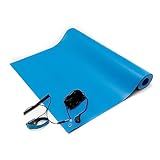 Bertech ESD Anti-Static Table Mat Kit Bertech ESD Anti-Static Table Mat Kit |
|
Check Latest Price |
 Kaisi Extra Large Soldering Mat Kaisi Extra Large Soldering Mat |
|
Check Latest Price |
 KooMall 36×24 Anti Static Rubber Mat Kit KooMall 36×24 Anti Static Rubber Mat Kit |
|
Check Latest Price |
 LUTICO Anti Static ESD Mat 24×48 LUTICO Anti Static ESD Mat 24×48 |
|
Check Latest Price |
 MWRF Source ESD Mat Kit MWRF Source ESD Mat Kit |
|
Check Latest Price |
 Hooandxk Anti Static Soldering Mat Hooandxk Anti Static Soldering Mat |
|
Check Latest Price |
 MYOYAY Rubber ESD Soldering Mat Roll MYOYAY Rubber ESD Soldering Mat Roll |
|
Check Latest Price |
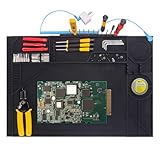 VECO-T Silicone Soldering Mat VECO-T Silicone Soldering Mat |
|
Check Latest Price |
A note on reading that table: surface resistivity is the single most useful number on it. Conductive mats sit around 10^4 to 10^6 ohms per square, static-dissipative mats sit between 10^6 and 10^9, and anything that publishes no figure at all is a marketing word rather than a specification.
1. StarTech Large Anti-Static ESD Mat — best overall bench mat
StarTech Large Anti-Static ESD Mat, TAA, ANSI/ESD S4.1 compliant, Table
23.6 x 47.2 in
Two-layer PVC
ANSI/ESD S4.1 tested
2-year warranty
Pros
- 23.6 x 47.2 in surface covers a serious bench area
- ANSI/ESD S4.1 surface resistance compliance
- Two-layer PVC with textured underside for grip
- 6.6 ft grounding wire with snap-on clip
- Two-year warranty
Cons
- PVC surface is not rated for direct soldering-iron contact
- Beige coloration shows solder and flux staining over time
StarTech makes the pick I keep coming back to, and the reason is boring rather than exciting: it publishes a standard and passes it. Surface resistance on this mat is tested to ANSI/ESD S4.1, and the construction is two layers of PVC at 0.04 in each, with a textured black underside that grips the desk. That is the exact architecture the standard was written around.
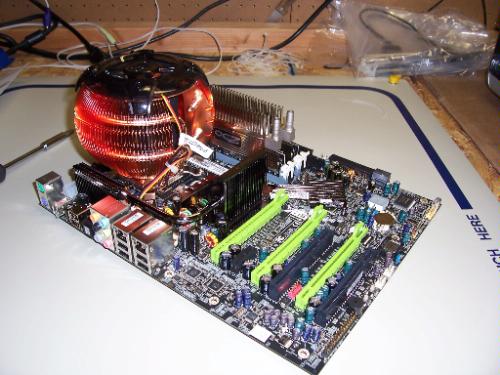
At 23.6 by 47.2 inches you get a genuinely long working strip. That is enough to lay out a full ATX motherboard with the CPU, cooler and memory staged to one side, which is the situation where a mat that is too small quietly causes the most mishandling. At 1.6 pounds it also rolls up without feeling like you are lifting a floor mat.
The 6.6 ft grounding wire with a snap-on clip is longer than most cables in this group, which matters if your nearest ground point is a bench leg or an equipment chassis rather than the wall. Owners consistently mention the size and the standards compliance as the deciding factors, and 75 percent of its 2,498 ratings are five-star.
What you give up with this mat
Heat, for one. The upper layers here are PVC, and reviewers are direct about it: this is not a surface to rest a soldering iron on or to catch molten solder. If your bench is primarily a solder bench, put a silicone pad on top of it rather than expecting this one to take spatter.
The beige color is the other trade. It hides dust but shows solder splatter and flux staining permanently enough that you will be tempted to hide it under a second mat. Both are minor, and neither touches the electrical performance.
Who should buy it
Buy this if you want one mat that covers a real work area, carries a documented standard, and does not need a second purchase to be usable. It is a sensible default for PC builders and repair benches that are not primarily hot-solder stations.
Pair it with a high-CRI task light if you are working on dense boards, because a mat protects the parts and nothing protects your eyes from a dark QFN package.
2. iFixit Portable Anti-Static Mat — best complete kit
iFixit Portable Anti-Static Mat – ESD Pad, Wrist Strap, Grounding Cord
24 x 24 in
10^7 - 10^9 ohms
Wrist strap plus 1.8 m cord
Lifetime guarantee
Pros
- Complete kit: mat
- adjustable wrist strap and 1.8 m grounding cord
- Published 10^7 - 10^9 ohm surface resistivity
- Folds and rolls for transport between workstations
- Backed by a lifetime guarantee
- 83 percent five-star share across 2505 ratings
Cons
- 60 x 60 cm is small for a full electronics workbench
- Nylon construction is not rated for direct soldering-iron contact
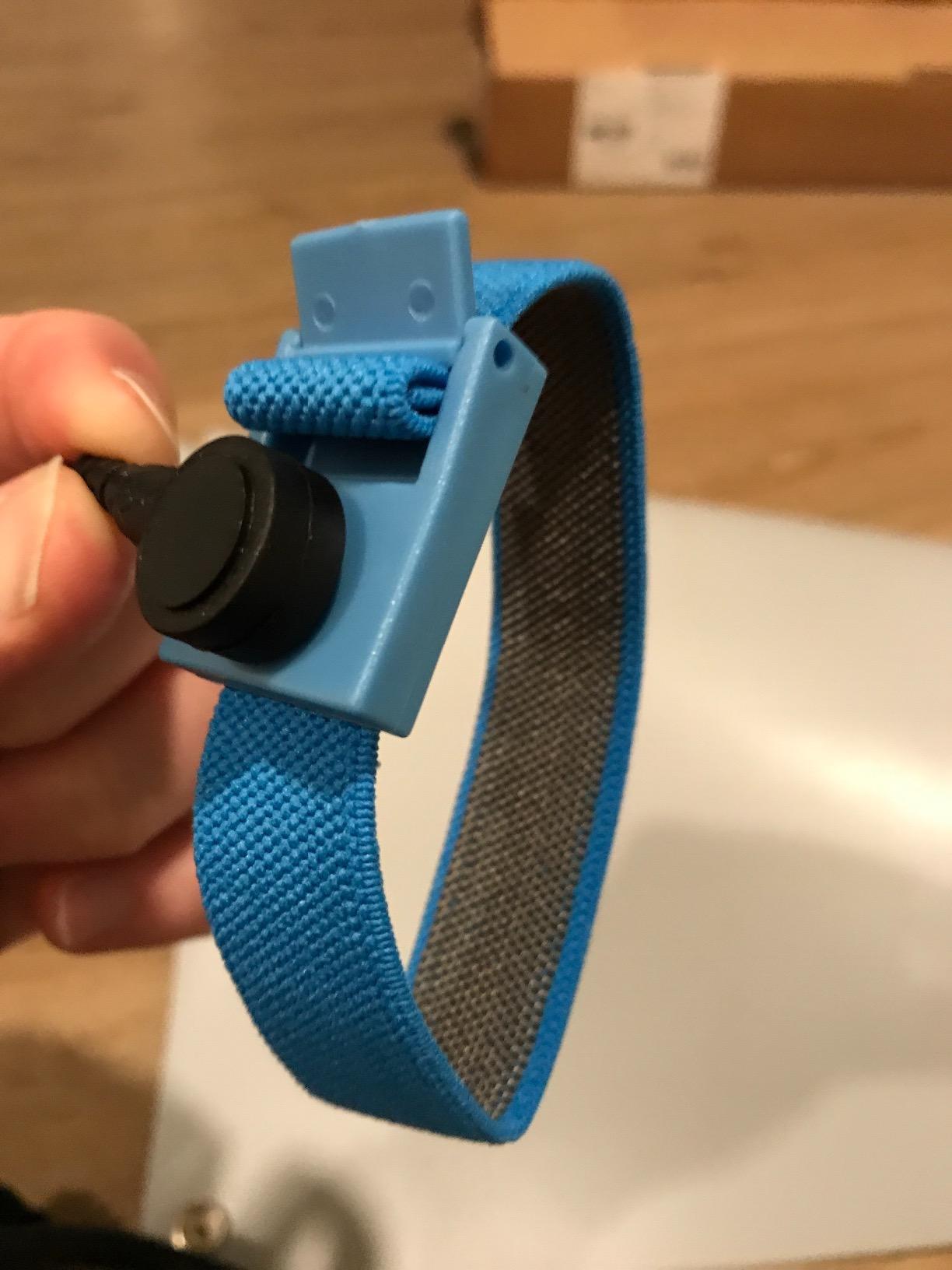
The iFixit kit is the one I recommend when someone asks whether they need a wrist strap too. You get the mat, an adjustable wrist strap that fits down to XL, and a 1.8 m grounding cord, plus a 10 mm ground snap already on the mat. Nothing else in this group comes as a complete, ready-to-work system from a repair-focused brand.
It also publishes its numbers, which is rarer than it should be: surface resistivity of 10^7 to 10^9 ohms, which sits in the middle of the static-dissipative band. That is the right place for a bench mat, and owners who have measured their own setups tend to confirm it.
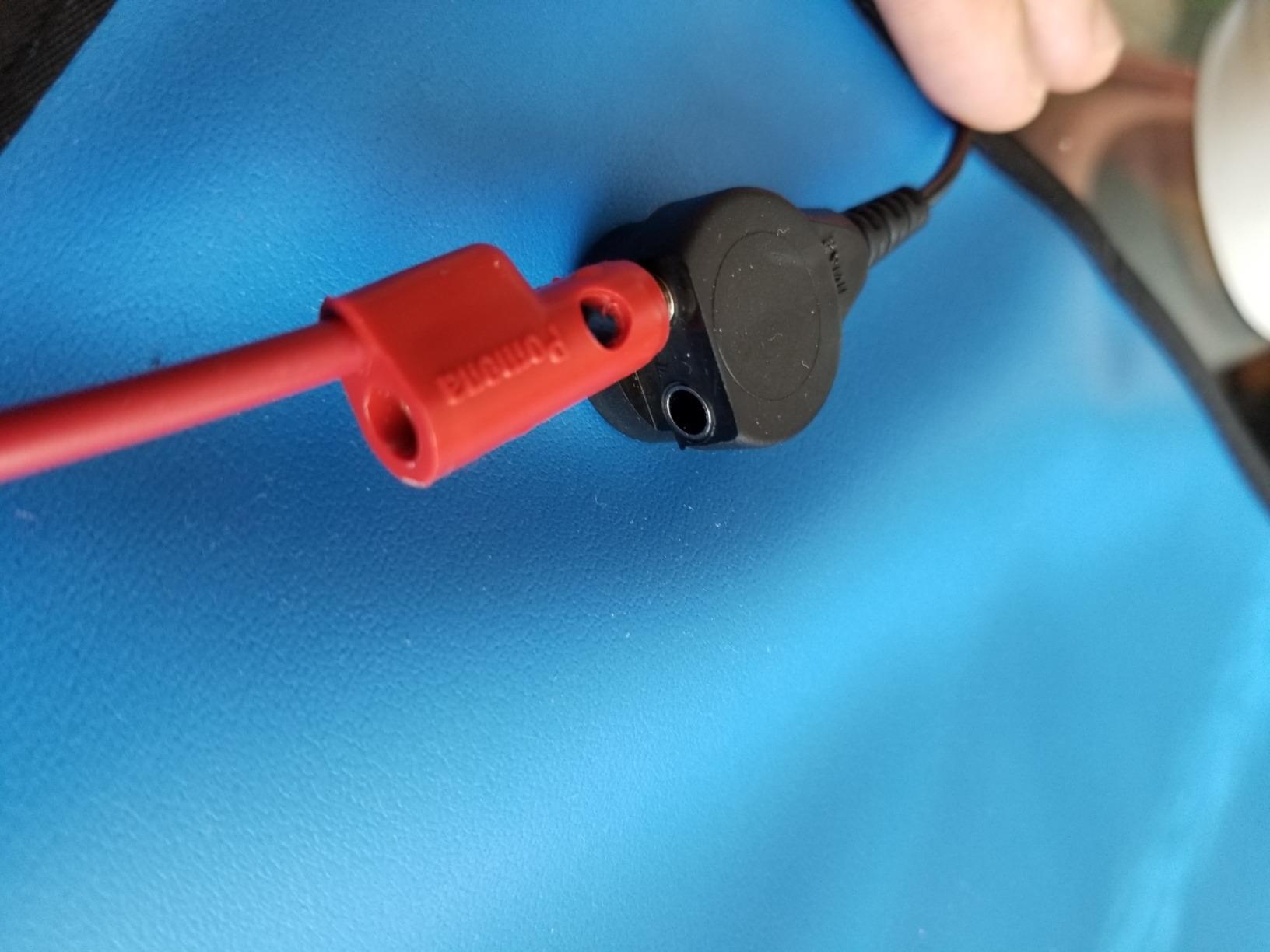
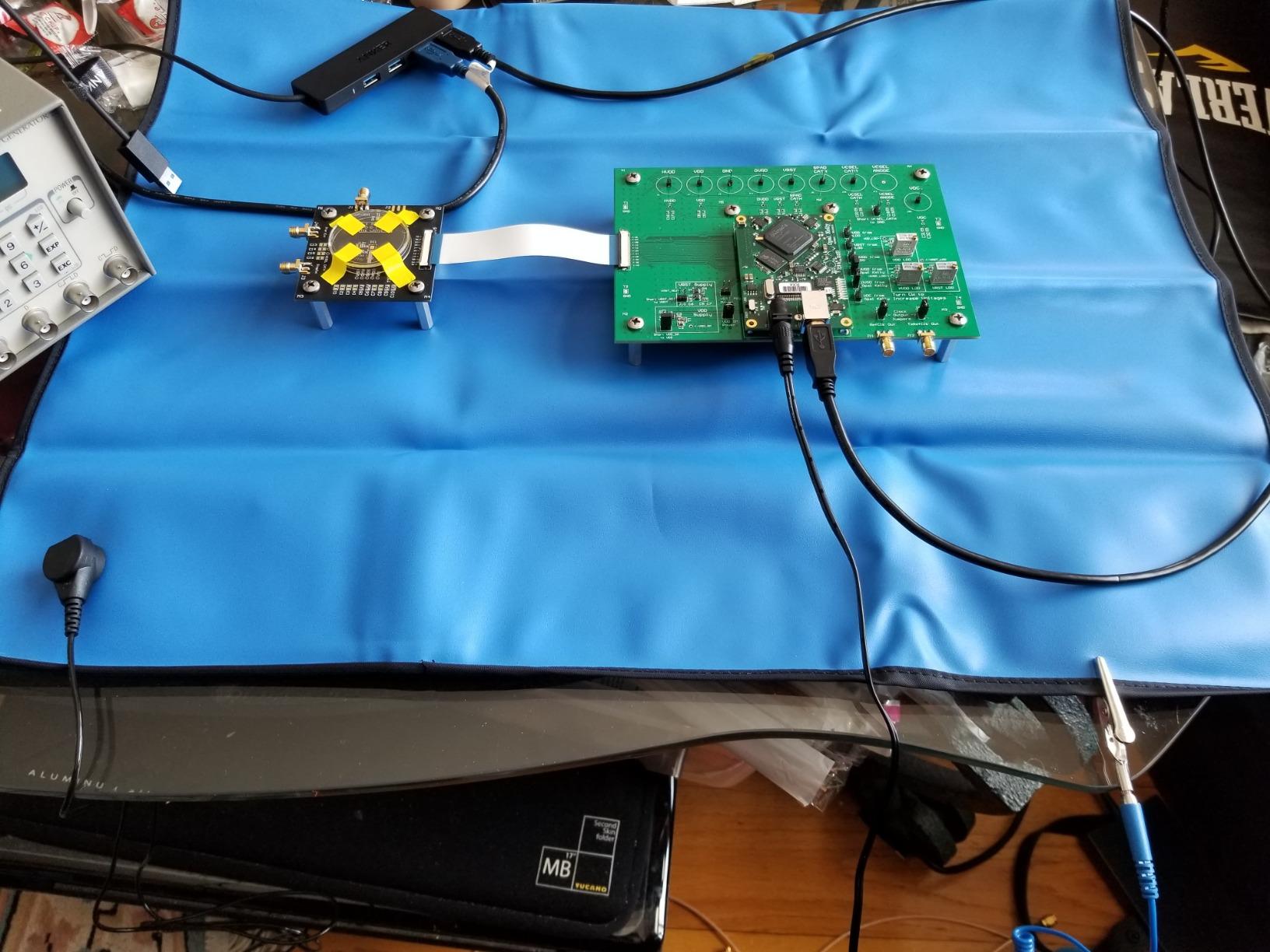
At 24 by 24 inches it is genuinely portable — it folds flat and packs, which is the reason so many people buy it for field repair rather than a fixed bench. The lifetime guarantee also means a failure at year three is not your problem.
Where the size becomes a problem
Twenty-four inches square is a laptop or a phone repair surface. It is not a desktop PC build, and it is not a motherboard rework station. Trying to disassemble a full tower on it means parts on the floor and parts on your lap, which is exactly the handling pattern that causes drops.
The nylon and polymer construction also has no heat story at all. Keep it away from irons and hot-air rework.
Who should buy it
Buy this if you repair away from a dedicated bench, or you are setting up a first ESD station and want the cord, snap and strap already matched to the mat. Mixing a strap from one kit onto a mat from another is where grounding mistakes happen.
Once you are past that stage, our full ESD mat breakdown covers the larger fixed-bench options in more depth.
3. HPFIX Silicone Soldering Mat — best value with real ESD specs
Anti-Static Mat ESD Safe for Electronic Includes ESD Wristband and Grounding Wire, HPFIX Silicone Soldering Repair Mat 932°F Heat Resistant for iPhone iPad iMac, Laptop, Computer, 15.9” x 12” Grey
15.9 x 12 in
10^6 - 10^8 ohms
932F silicone
Strap, cord and plug
Pros
- Silicone surface rated to 932F for soldering heat
- 10^6 - 10^8 ohm published resistivity
- Built-in ruler plus compartments and screw trays
- Includes wristband
- grounding cord and grounding plug
- Rolls up flat and stays flat
Cons
- 15.9 x 12 in work area is tight for large boards or desktop builds
- Compartment dividers are not magnetized so tiny parts can bounce out
Most cheap silicone soldering mats advertise heat resistance and say nothing about static, which is why people assume all of them are marketing. This one actually publishes a resistivity figure of 10^6 to 10^8 ohms, so it belongs in a roundup about anti static mats rather than being tossed aside as a heat pad.
The silicone is rated to 932 F, which means you can drop a stray solder blob or rest an iron for a second without cutting a hole in your bench. That protection matters more than most buyers realize, because spatter is what actually damages the surface of a mat over a year of work.
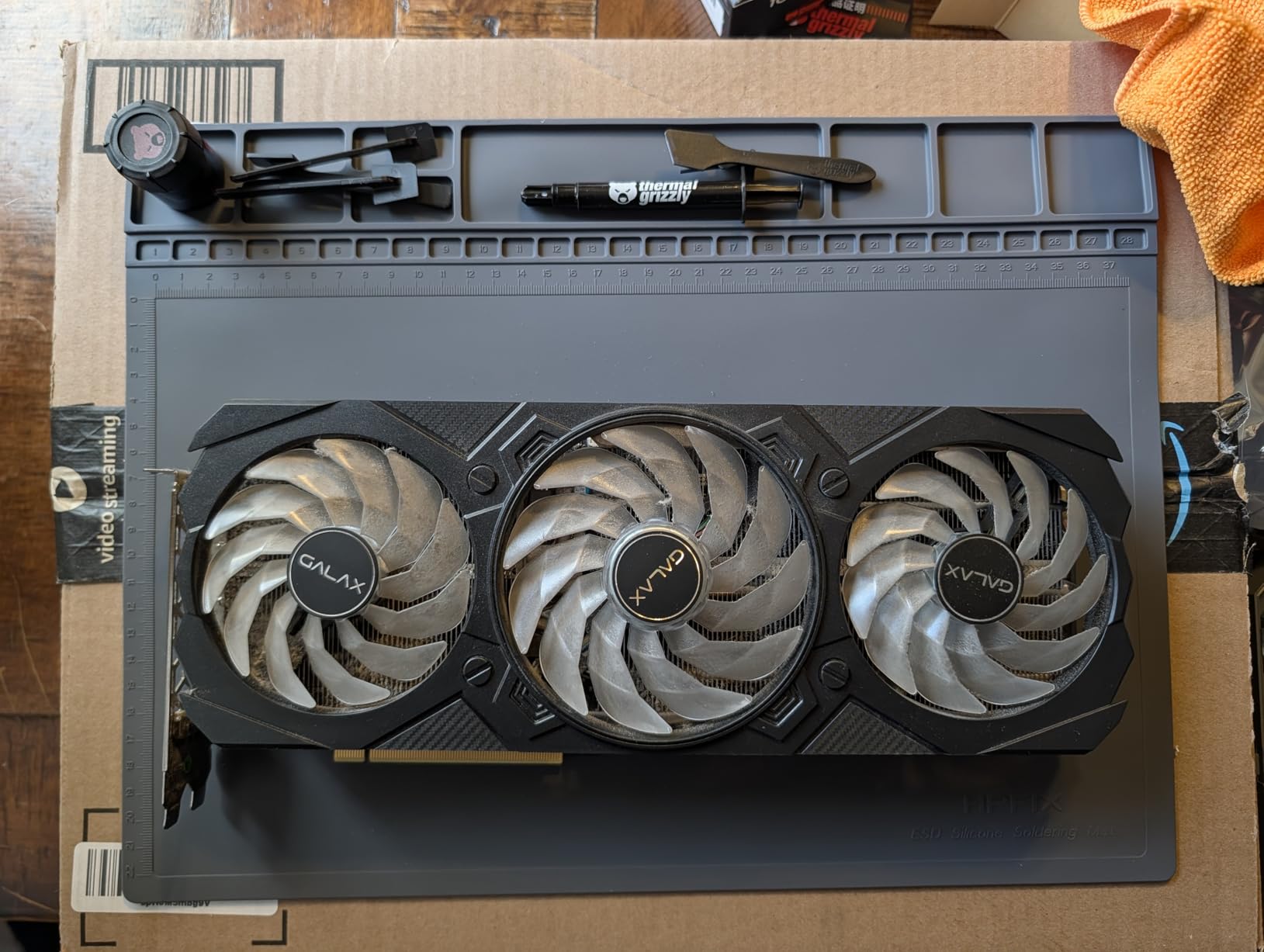
The layout is where this earns its keep: a built-in ruler, parts compartments and screw trays, all in one pad. Owners consistently praise the organization and the fact that the grounding plug, cord and wristband all come in the box, so there is no second order to make.
What limits it
Fifteen point nine by twelve inches is compact. It suits phone, laptop and small board work. For a full ATX build you will run out of room well before you run out of mat.
The compartment dividers are plain silicone, not magnetic, so 0402-size parts can and do escape when you brush against them. If you work with very small components, expect to chase them.
Who should buy it
Buy this if your bench does mixed work — some board-level soldering, some device repair — and you want one pad that handles both heat and static without an accessory order. At this rating and review count it is the most proven product in the roundup after the StarTech and the iFixit.
For storage of the loose parts that inevitably migrate, our anti-static component bags guide covers the next step.
4. AKEOIL Silicone Soldering Mat — best for parts organization
AKEOIL Silicone Soldering Mat for Electronics Repair, 17.7 x 11.8 in
17.7 x 11.8 in
932F silicone
124 screw slots
0-36 cm ruler
Pros
- Densest parts organization here with 124 screw slots and 42 compartments
- Silicone rated to 932F shields the bench from spatter
- Anti-static non-slip base that resists deformation
- Arrives flat and holds shape after being rolled
- Squeezes the most organization into a small footprint
Cons
- Magnetic areas are weak and inconsistent across the pad
- The three compartment lids do not stay closed
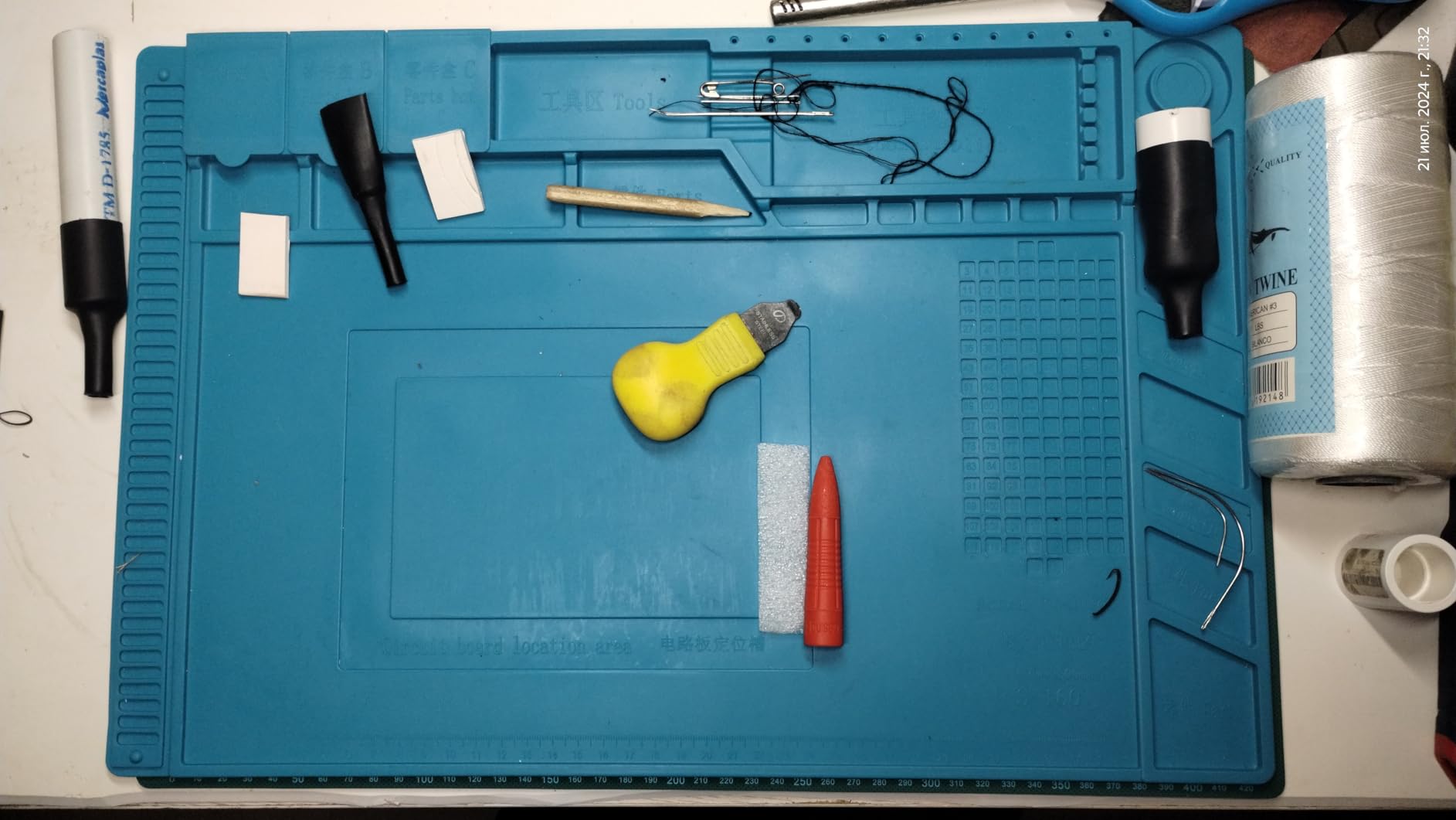
At 4.8 average across 861 ratings, this has the highest star rating of the twelve in this roundup, and the reason is not subtle: nobody has ever gone back to complain about missing screw slots. One hundred and twenty-four defined screw positions, 42 spare compartments, 15 tool notches, a 0 to 36 cm ruler and three covered parts boxes.
The silicone is rated to 932 F, so it takes solder spatter the same way the HPFIX does. The base is described as anti-static and non-slip, though it does not publish a resistivity number, so treat the static claim as a comfort feature rather than a specification you can verify.
Two things owners consistently like: it arrives flat in a box with no permanent creases, and it holds its shape after being stored rolled in a toolbox. Flat-from-the-box is rarer than it sounds among silicone pads, and it is the difference between using the mat and rolling it back up.
Where the magnets fall short
The four magnetic areas are weak, and the strength is inconsistent across the pad, so a screw held near one edge will not behave the same as one near the other. Owners who work under magnification report the magnets simply are not strong enough for very small fasteners.
The three compartment lids also do not stay shut, which means loose parts end up loose. Budget for the lids, not for the magnets.
Who should buy it
Buy this if you strip and rebuild devices regularly and your biggest pain is the tray of screws rolling off the bench. It is also a good first mat, because the combination of heat resistance, flat packing and low cost is hard to argue with at this point.
For verifying what you have taken apart, a component tester pairs naturally with this kind of organized bench.
5. Bertech ESD Anti-Static Table Mat Kit — best for durability
Bertech ESD Anti-Static Table Mat Kit, 16 In. x 24 In., Blue, Includes an ESD Wrist Strap and ESD Grounding Cord, MADE IN USA
16 x 24 in
0.094 in thick
10e9 - 10e10 ohms
Made in USA
Pros
- Made in the USA from thick anti-static vinyl that lasts years
- Publishes surface resistivity
- tensile strength and service temperature
- Chemical resistant to acids
- detergents
- solvents and alcohols
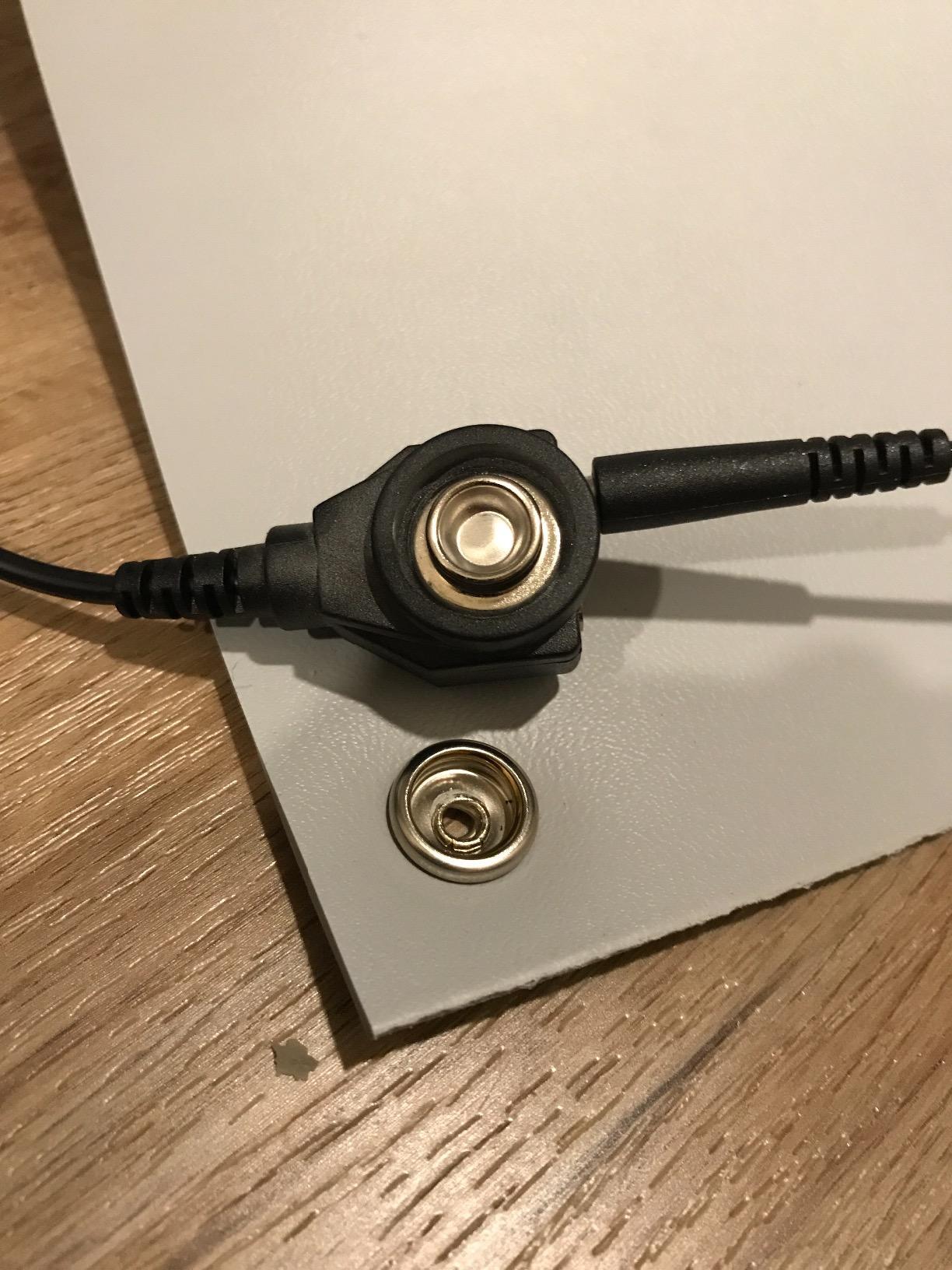
- Grounding snap pre-installed so it works out of the box
- Easy to cut down to a custom bench size
Cons
- Strong new-vinyl smell that takes days to off-gas
- Vinyl is not heat resistant and can melt on solder contact
- Ground cord relies on the receptacle screw rather than a plug-in ground
Bertech is the option people in the electronics community point to once a bench is a permanent fixture rather than a corner of a desk. The 0.094 inch vinyl is thick — roughly 2.4 mm — and that mass is exactly why owners still rate it highly after two or more years of daily use.
It is also the most transparent product here on paper. Surface resistivity of 10e9 to 10e10 ohms, tensile strength of 900 lbs per square inch, a service temperature of -20 F to 160 F, and RoHS compliance. Very few consumer-facing mats give you four verified specifications instead of one adjective.
The construction is a single-layer homogeneous polymer mix rather than a two-layer sandwich, with a grounding snap pre-installed. That means there is no delamination risk, and it can be cut down with a blade to fit a bench that is not a standard size — a genuinely useful property when your bench is 23.5 inches wide and nothing is 23.5 inches wide.
The two real drawbacks
First, the off-gassing. Owners repeatedly describe a strong new-vinyl smell that takes days to fade. Ventilate the bench for a few days before you work sensitive parts on it.
Second, and more seriously, vinyl is not heat resistant. A dropped bead of molten solder will melt a hole in this mat, so it belongs on an assembly and repair bench, not a soldering bench. The service temperature ceiling of 160 F is the number that tells you this.
Who should buy it
Buy this when you want the last mat you will have to think about. It suits PCB assembly, inspection and general repair, and it is the one I would put down permanently in a workshop that is already set up for panel and terminal work alongside it.
6. Kaisi Extra Large Soldering Mat — best for heavy soldering work
Kaisi Extra Large Soldering Mat, 932°F Heat Resistant Silicone Solder Mat
27.6 x 15.7 in
932F silicone
94 screw positions
Not ESD rated
Pros
- Work area of 27.6 x 15.7 in
- the largest in this group
- Holds up to repeated direct soldering work
- Unrolls and lies flat immediately with no flattening time
- Non-slip on both the top and bottom faces
- Raised edges and molded compartments retain tiny screws
Cons
- Manufacturer states this mat is NOT anti-static and provides no ESD protection
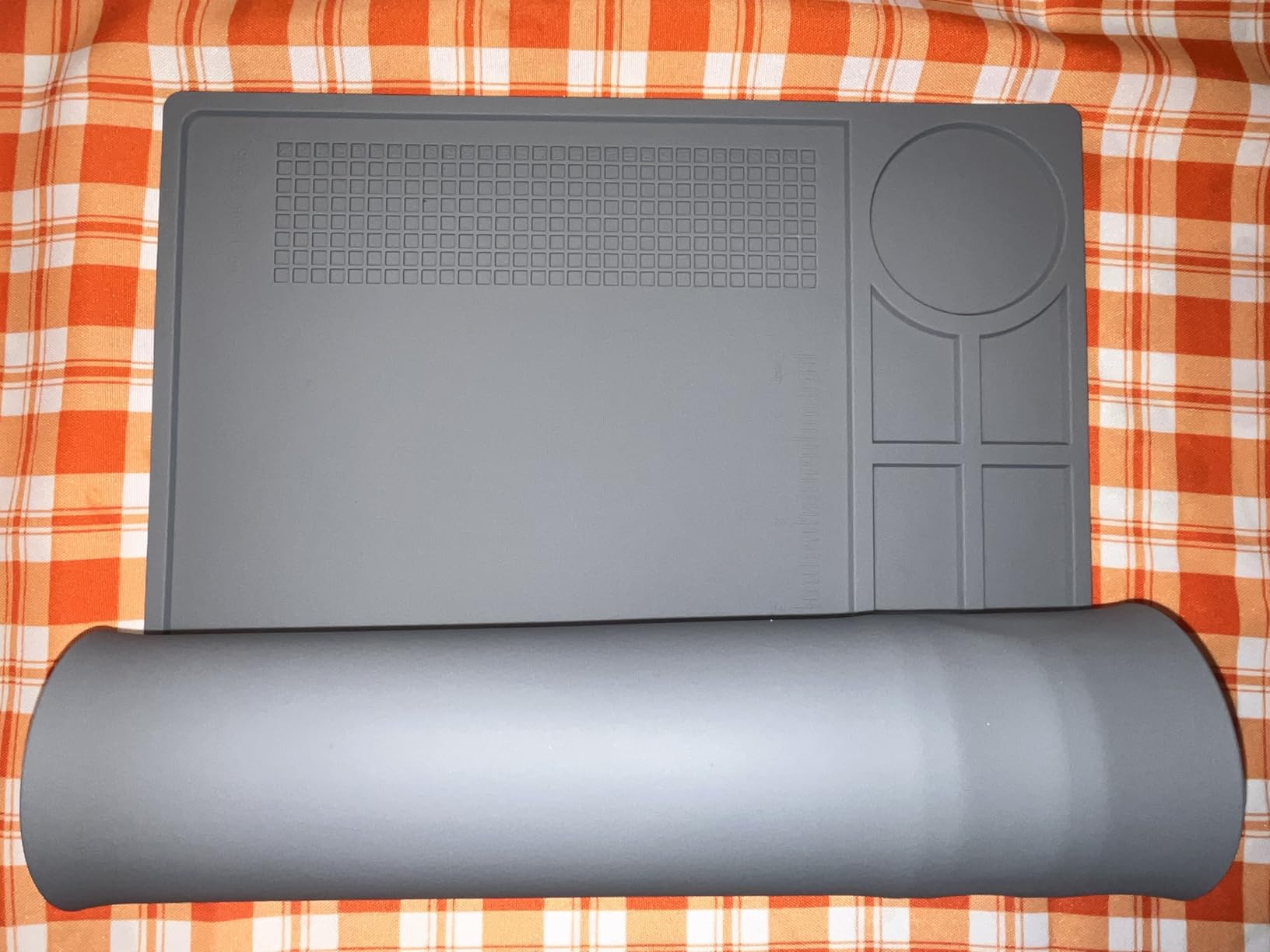
- Surface texture attracts dust and debris and needs brushing out
I am including this one precisely because it is not an anti static mat, and the manufacturer says so plainly. That honesty is worth more than a vague claim, and it makes this the clearest illustration in the roundup of why the word anti-static on a silicone pad often means nothing.
As a soldering surface it is strong. The 27.6 by 15.7 inch area is the biggest silicone work surface in this roundup, the 932 F rating means the iron can sit on it, and it has 94 screw positions plus 32 small parts slots. Owners report that it unrolls and lies flat immediately, with no overnight flattening under weight.
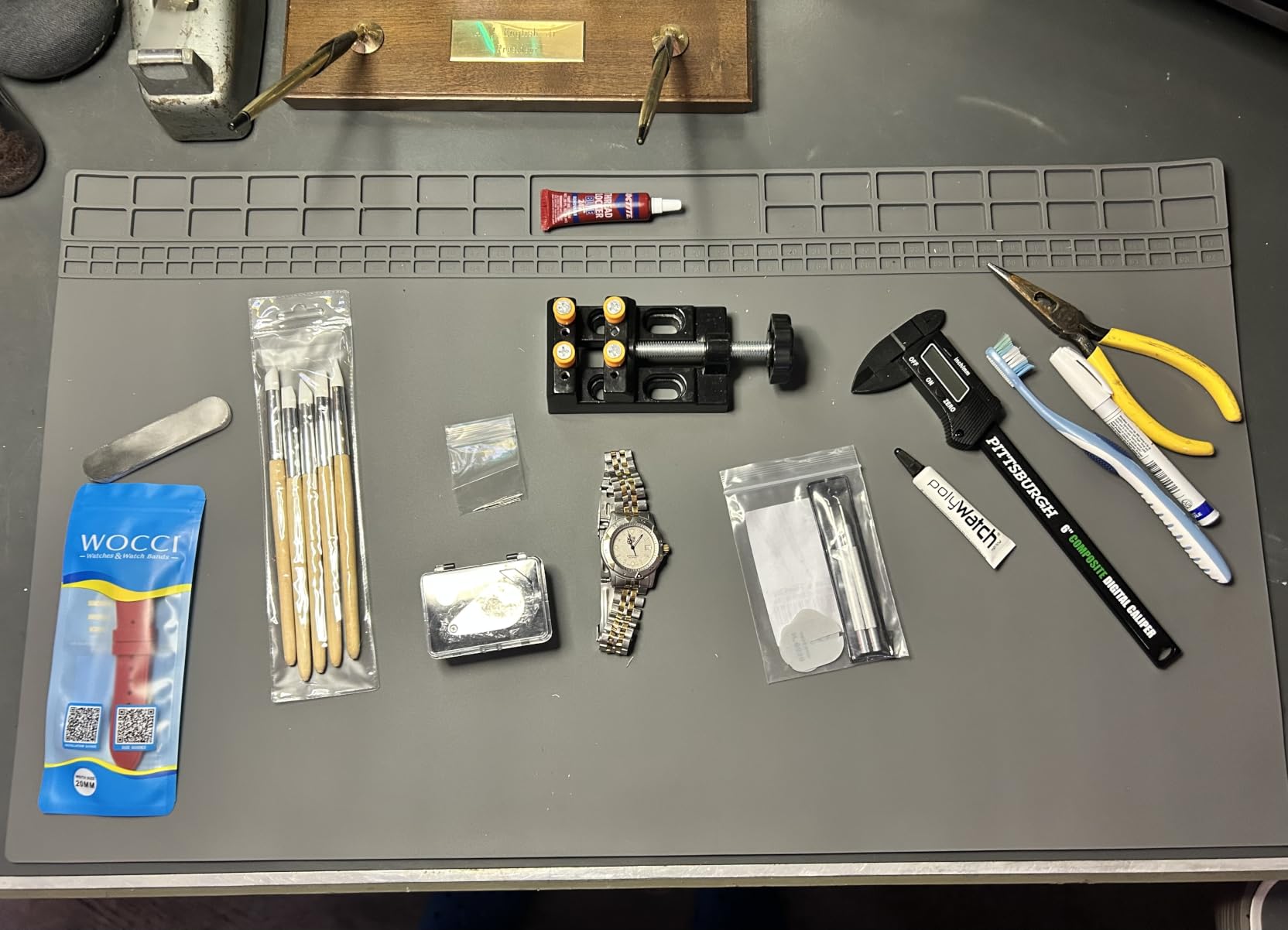
It is also completely non-magnetic, which matters more than it sounds for watch and compass-adjacent work where a stray magnet on the bench can do real damage. Grease and solder residue lift off with a wipe.
Why it is not a substitute for an ESD mat
The listing states the mat is not anti-static and will not protect against electrostatic discharge. Silicone is an insulator. It will not bleed charge off a board, and no amount of grounding cord fixes that, because there is no conductive path to bleed into.
The textured surface also collects dust and debris and needs periodic brushing, which is a maintenance item the smooth mats do not have.
Who should buy it
Buy this as the top layer of a two-mat bench, not as your only mat. A dissipative base underneath gives you the static protection, and this sits on top for hot work. That layered setup is the arrangement experienced technicians describe most often.
7. KooMall 36×24 Anti Static Rubber Mat Kit — best for full bench coverage
KooMall 36×24 Inch Anti Static Rubber Mat Kit for ESD Sensitive Electronic Device Repair, Soldering, PC Building, Assembly, Table Work, With Grounding Plug Cord, Antistatic Wrist Strap, Heat Resistant
36 x 24 in
Conductive both sides, 10^3 - 10^5 ohms
250C
Stud grounds
Pros
- Full 36 x 24 in coverage for PC builds and full-size workbenches
- Both faces are conductive so the mat still works if flipped
- Two 10 mm male studs give a stable positive grounding connection
- Anti-slip dotted texture on the working face
- Kit includes US grounding plug
- ESD wrist strap and ground cord
Cons
- A cluster of one and two star reviews reports fit and finish issues on some mats
- Rubber is less heat resistant than the silicone mats
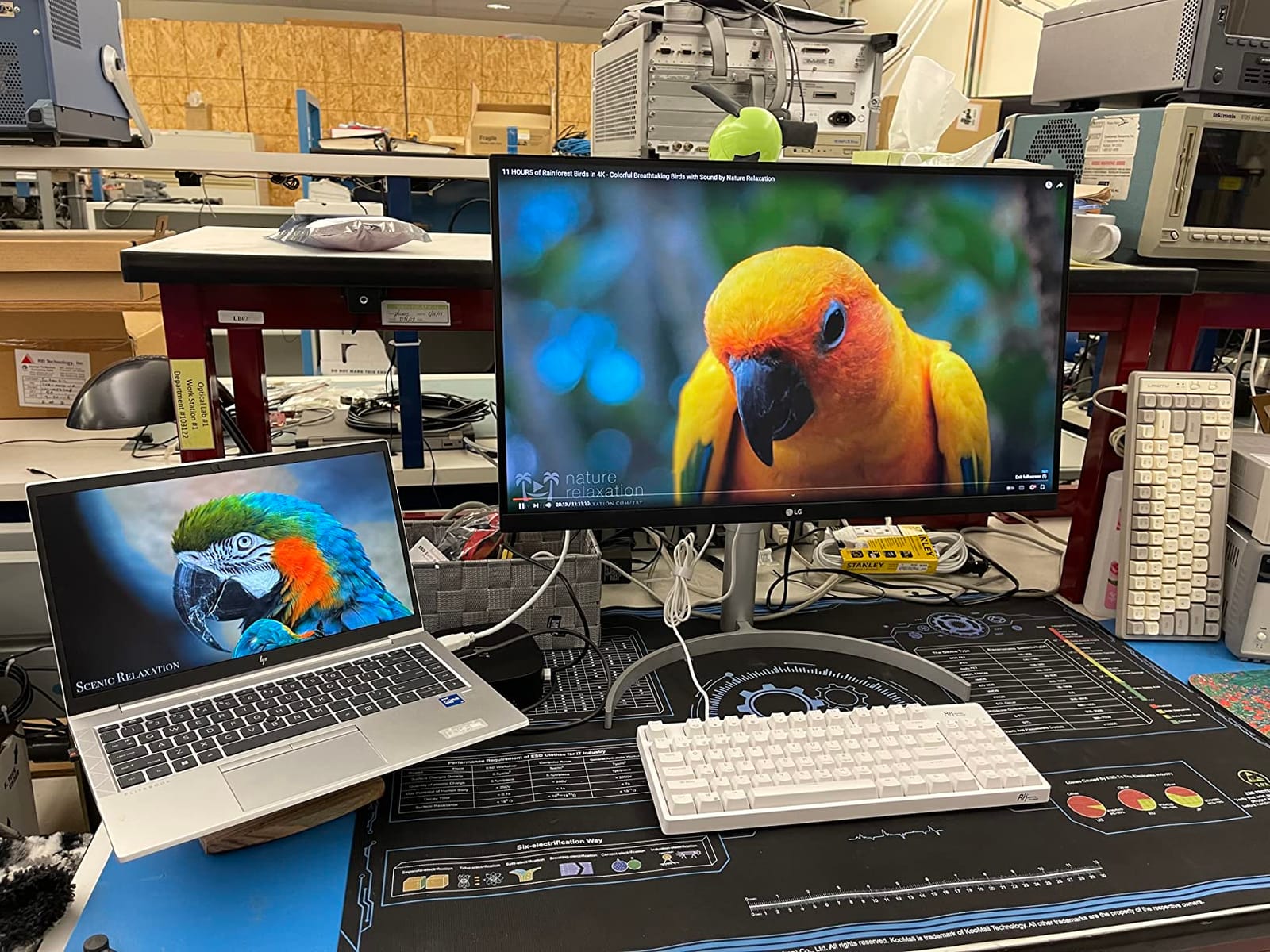
Thirty-six by twenty-four inches is full US bench width, and that is the point of this one. If you build complete PCs, swap drives or work on anything that needs the whole surface, a 16 by 24 mat makes you stage parts somewhere else, and staging is where static damage happens.
Technically it is a genuine two-sided conductive rubber mat with a surface resistance of 10^3 to 10^5 ohms. That is in the conductive class, not the dissipative class, which is correct for a conductive-base design where the top layer is what you touch. The practical advantage is that flipping it does not disable it.
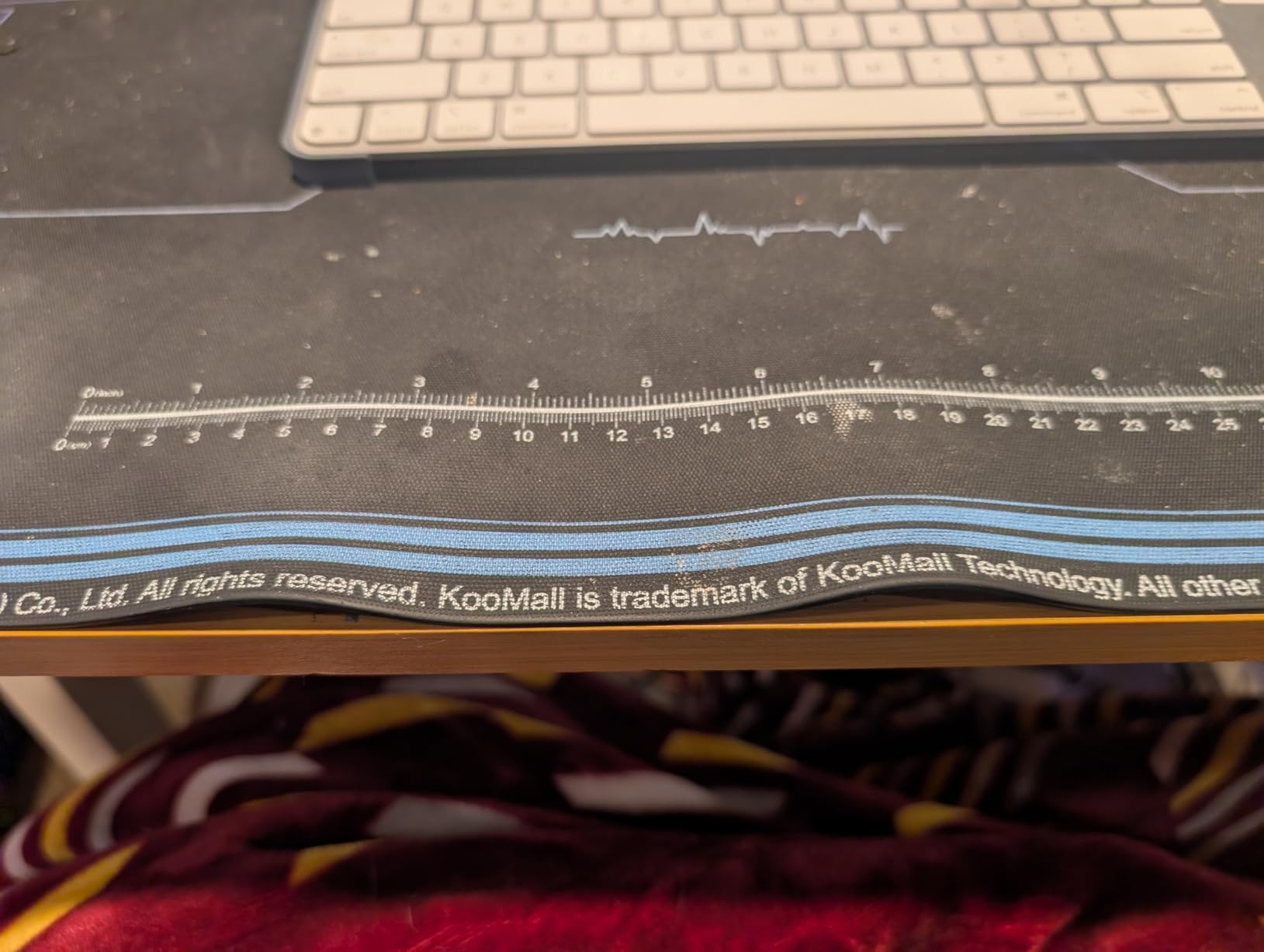
The two 10 mm male studs are worth calling out. A stud gives a positive mechanical connection for your ground cord, which is far more reliable than squeezing an alligator clip onto a flat mat edge and hoping. The kit also includes a US grounding plug and an ESD wrist strap.
What to watch for
Quality control is inconsistent. A small cluster of one and two star reviews describes some pieces arriving with fit or finish problems, so inspect the edges and the stud on arrival rather than assuming every unit is identical.
The 250 C upper temperature rating is decent for occasional soldering contact, but it is well below the 932 F silicone pads. For a hot-air or heavy solder bench, keep a silicone layer on top.
Who should buy it
Buy this if your bench is at least 36 inches deep and you assemble whole machines. It is a strong first purchase for someone building a dedicated repair station who wants the mat, the strap and the ground lead to arrive as one matched set.
8. LUTICO Anti Static ESD Mat 24×48 — best for a permanent bench
Anti Static ESD Mat for Electronics Repair, 24″X48″, Grounding Kit
24 x 48 x 0.08 in
10^6 - 10^8 ohms
Dissipative top, conductive base
Pros
- Large 24 x 48 in surface for full bench coverage
- Proper multi-layer construction with dissipative top and conductive bottom
- Kit includes wrist strap
- coil cord and ring-terminal ground cord
- Works as a permanent bench mat rather than a stored roll
- Grounding stud can be relocated to a preferred edge
Cons
- One owner measured the blue top layer as insulating rather than dissipative
- Strong chemical or vinyl odor on the underside
- 180F temperature limit is low for soldering
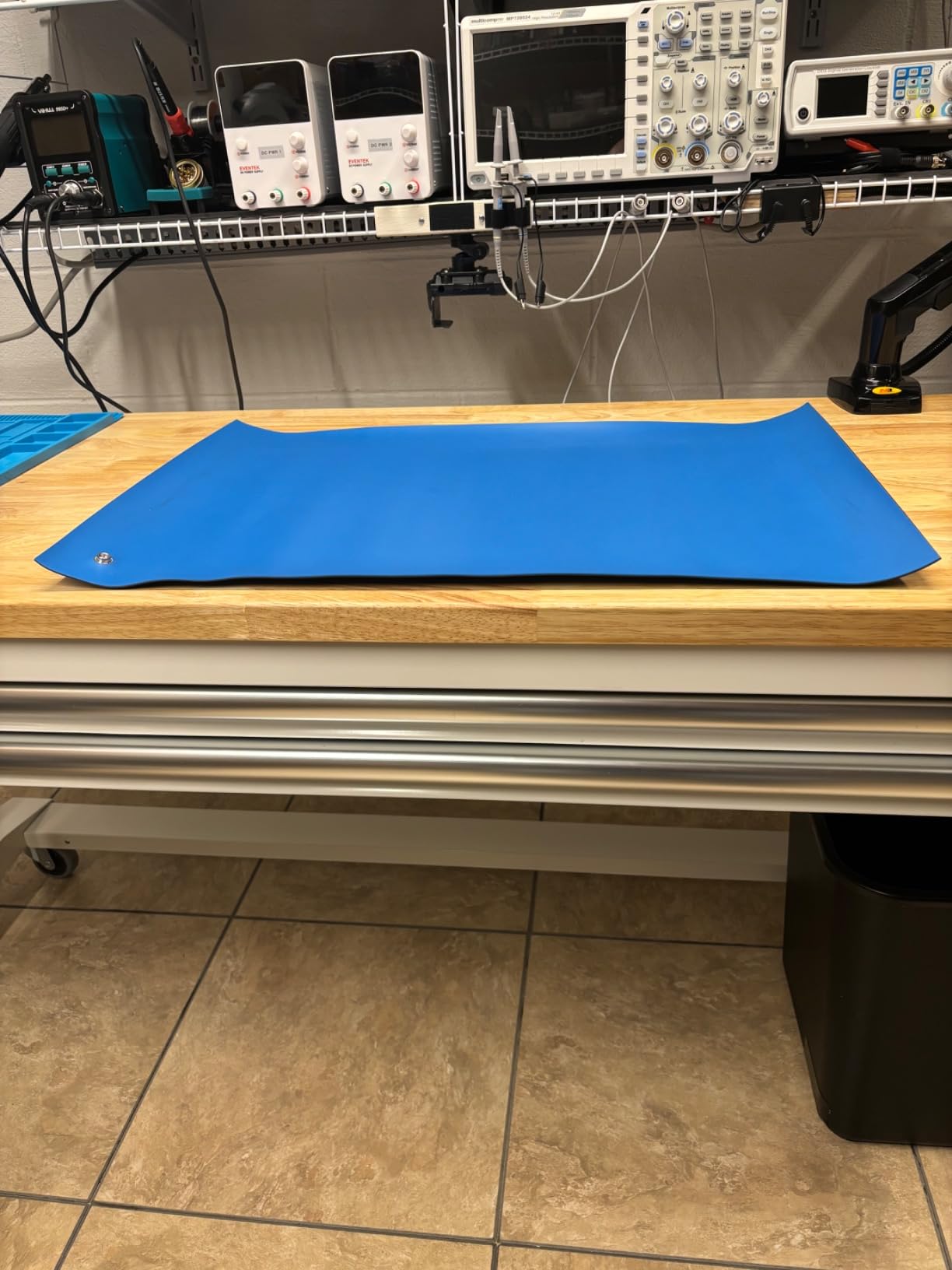
This one splits opinion more than any other in the roundup, and I would rather show you that than hide it. Experienced technicians describe it as professional grade: a proper multi-layer composite with a blue dissipative top over a black conductive base, published surface resistivity of 10^6 to 10^8 ohms and volume resistivity of 10^5 to 10^8 ohms, and a full grounding kit with a wrist strap, coil cord and ring-terminal ground cord.
At 24 by 48 inches with a 0.08 inch thickness, it is built to stay down. It is a permanent bench surface rather than something you roll into a drawer, and the grounding stud can be moved to whichever edge suits your cable routing.
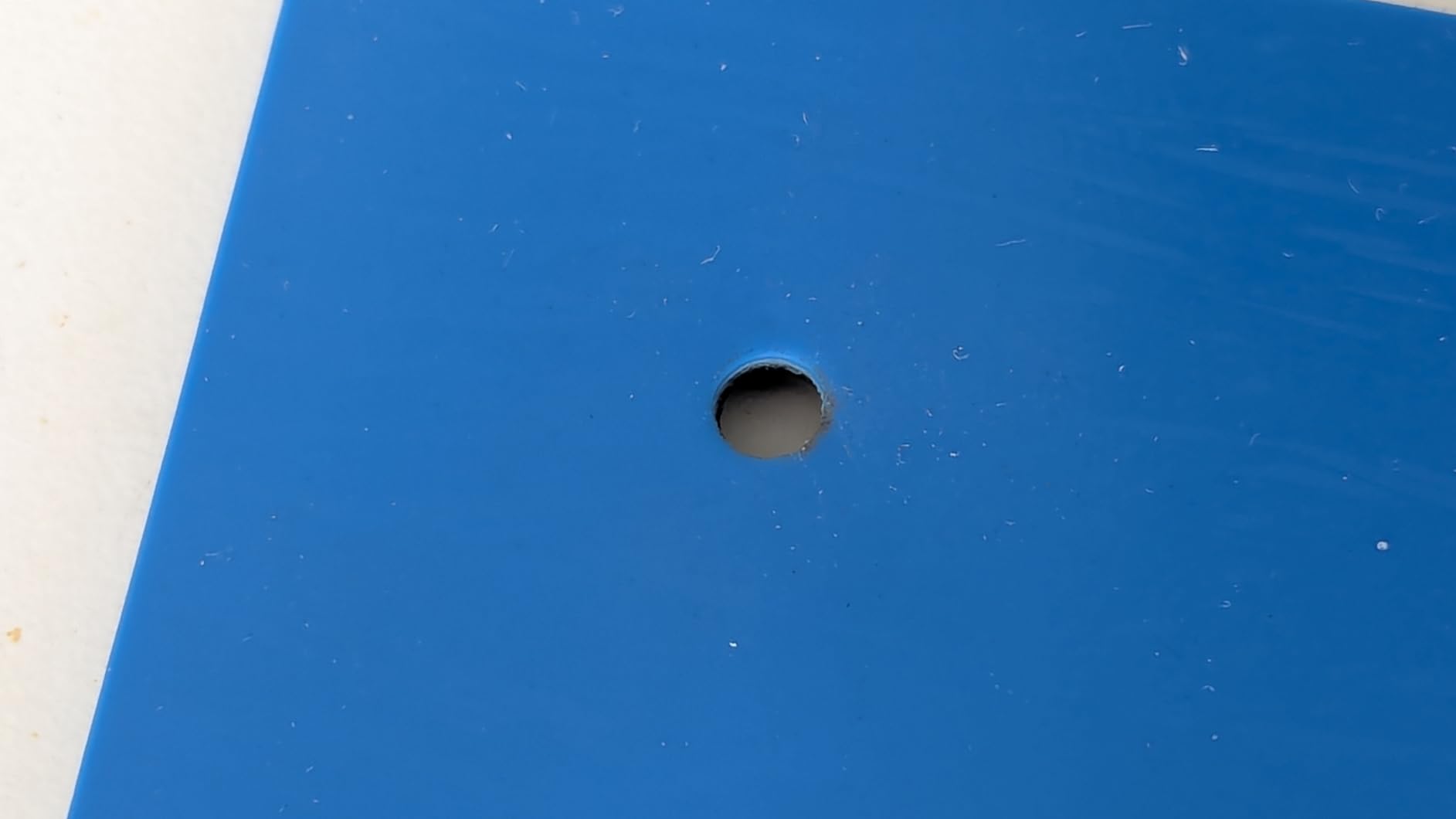
Other owners are blunt about two problems. One reports measuring the blue layer as insulating rather than dissipative on a bench multimeter, and several describe a strong chemical odor on the underside that some find mold-like. The 4.2 average across 195 ratings, with 9 percent one-star reviews, is the lowest here for a reason.
How to decide if it suits you
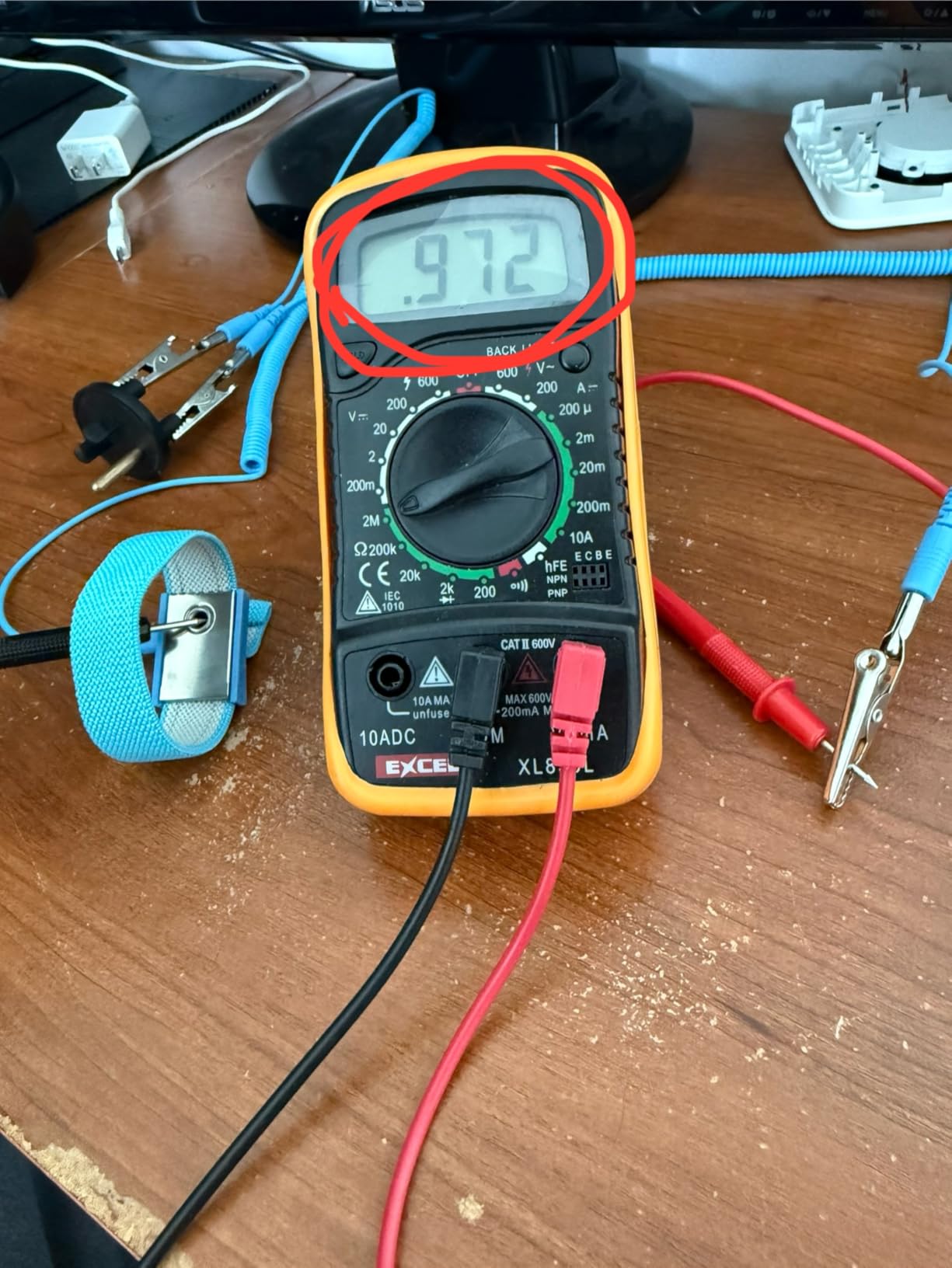
If you buy it, measure it yourself before trusting it. A two-dollar bench multimeter across the surface will tell you in seconds whether the top layer sits in the 10^6 to 10^9 band, and that check removes the biggest unknown in this listing.
The 180 F temperature rating is the other limit. That is a cool bench, not a solder bench. Use it for assembly, rework-free inspection and general repair.
Who should buy it
Buy this if you have a fixed 48 inch bench space and want the largest correct-construction mat you can find, and if you are comfortable verifying the surface yourself on arrival. Skip it if you are sensitive to chemical odors or you intend to solder directly on it.
9. MWRF Source ESD Mat Kit — best thick rubber kit
MWRF Source ESD Mat Kit with Wrist Strap and Grounding Cord (20 Inches x 24 Inches x 0.12 Inch, Blue)
20 x 24 x 0.12 in
Nitrile rubber
10e9 - 10e10 ohms
10 ft cord
Pros
- Thick
- heavy-duty nitrile rubber that feels substantial
- Complete kit with a 10 ft ground cord and wrist strap
- 20 x 24 in suits mid-size benches
- Stays flat after being stored coiled for years
- Ready to use out of the box
Cons
- Strong initial rubber odor that takes days of off-gassing
- Wrist cord is long enough to disconnect if you reach too far
The MWRF kit is the simple answer for a mid-size bench. Twenty by twenty-four inches of nitrile rubber at 0.12 inch thickness, which gives it real heft on the bench, with a published surface resistivity of 10e9 to 10e10 ohms and a grounding snap that works out of the box.
Owners report the rubber staying flat after being stored coiled for years, which is the failure mode that ruins most thin mats. It also comes with a 10 foot ground cord, one of the longer leads here, plus a wrist strap.
The catch
The rubber odor on arrival is strong and takes days of off-gassing before you will want to work on it. Ventilate, and do not seal parts in the same room while it cures.
More practical: the wrist cord is long enough that a reach across the bench can disconnect you. Long leads give you freedom of movement, but freedom of movement also means you can be ungrounded without noticing. Keep the lead short enough that a full stretch pulls you back toward the mat.
Who should buy it
Buy this for general repair and PC assembly on a bench that is not huge, particularly if you want a mat with real weight to it so it does not slide when you push a board across it. It is not a soldering surface and not a transportable kit.
10. Hooandxk Anti Static Soldering Mat — best combined ESD and heat pad
Anti Static Soldering Mat, Extra Large 27.6″ x 15.7″ Heat Resistant 932°F Large Silicone ESD Safe Work Mat with Grounding Accessories and Anti Static Wrist Strap (Black)
27.6 x 15.7 in
10^6 - 10^9 ohms
932F silicone
Full grounding kit
Pros
- Combines published 10^6 - 10^9 ohm resistivity with 932F silicone
- Extra large 27.6 x 15.7 in area handles laptops and full boards
- Full kit included with wrist strap
- coiled cord and ground cord
- Protects the bench from direct iron contact
Cons
- Small review base of 51 ratings so long-term durability is less documented
- Listed under floor matting rather than lab ESD supplies
This is the design I would want if I could only have one mat for mixed work, because it does the thing that is genuinely hard to find: it pairs a published 10^6 to 10^9 ohm surface resistivity with 932 F silicone in a single pad. Most silicone pads publish heat and stay silent on static. This one publishes both.
At 27.6 by 15.7 inches it is a full laptop-and-board work area, and the kit includes an ESD wrist strap, a coiled cord and a ground cord, so the grounding system is matched to the mat from the start.
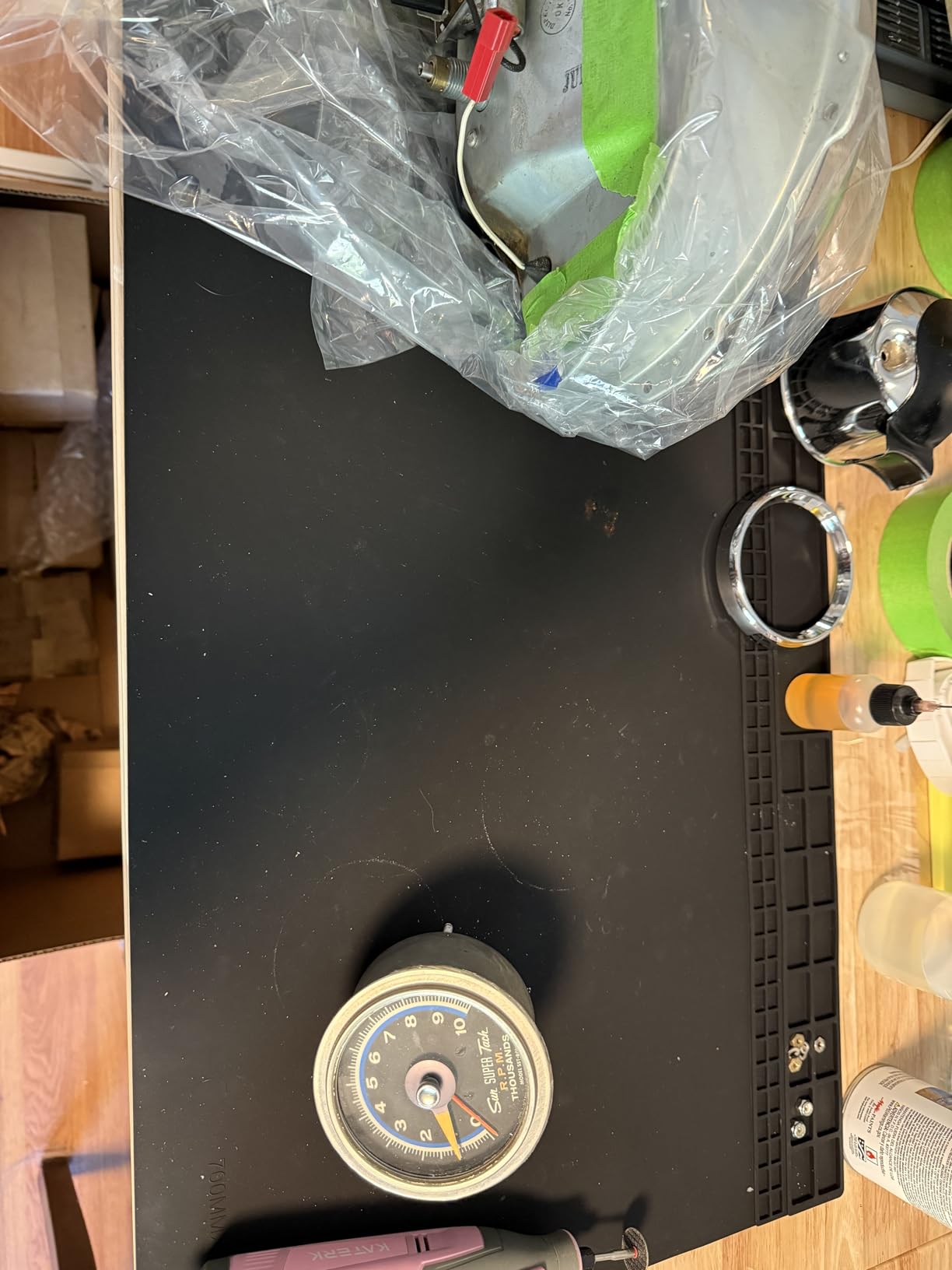
It folds for transport, which makes it a reasonable second mat for a field kit alongside something like the iFixit. The five-star share is 75 percent with zero one-star reviews, which is a good sign for a newer listing.
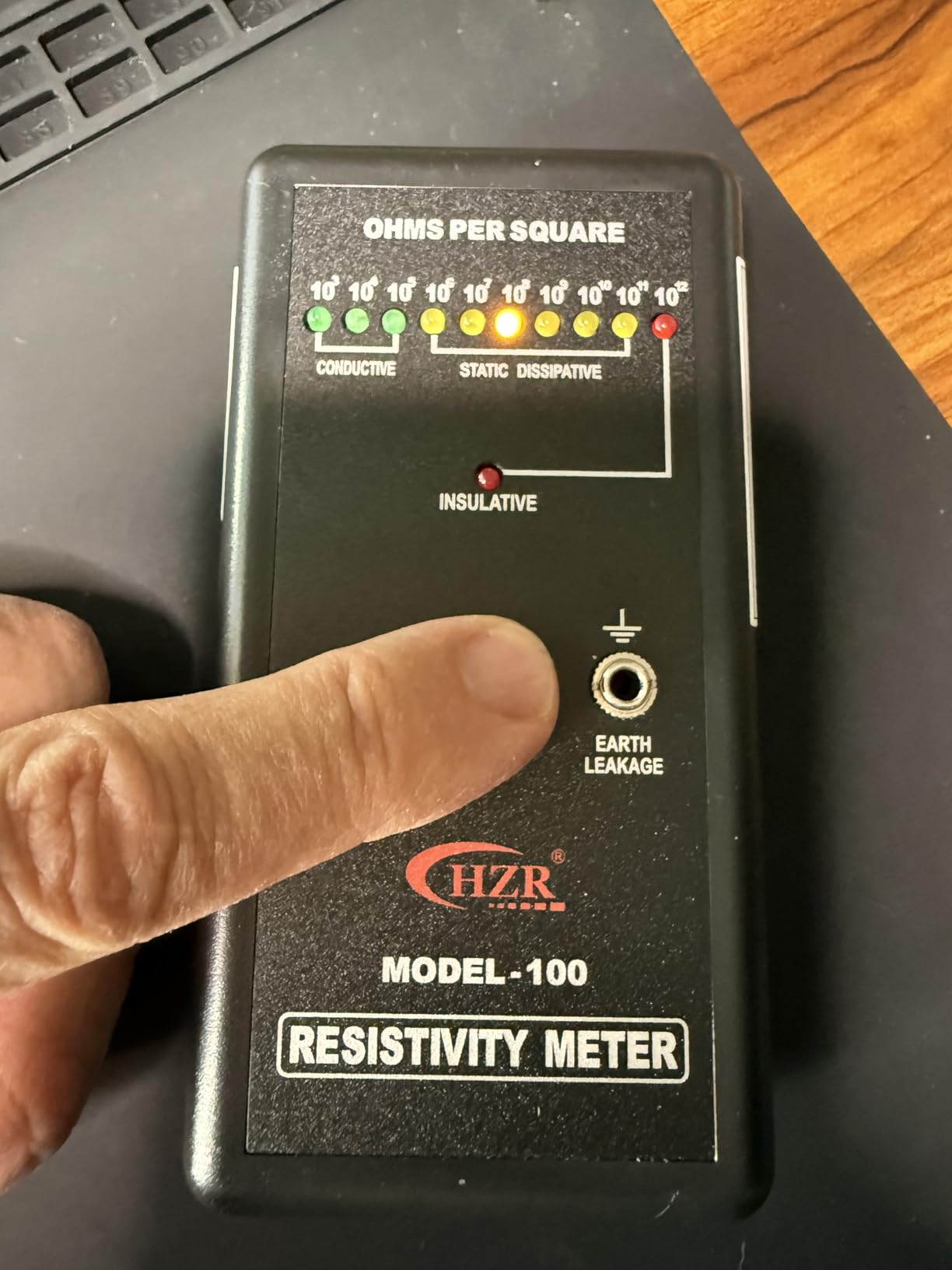
What the small review base means
Fifty-one ratings is thin. Owners are satisfied, but nobody has documented what this mat looks like after three years, and any heat-driven hardening or curl in silicone shows up slowly. If your bench sees daily hot work, treat it as a mat you may replace rather than a lifetime purchase.
Its category placement under commercial floor matting rather than lab ESD supplies is a small signal about how it was sourced, not about the physics.
Who should buy it
Buy this if you do both soldering and static-sensitive board work on one surface and do not want to manage two mats. It is also a good choice for a shared or secondary bench where budget matters but you still want a published resistance figure.
11. MYOYAY Rubber ESD Soldering Mat Roll — best roll format
MYOYAY 23.6″ x 118″ Rubber ESD Soldering Mat Roll 0.08″ Thick Anti-Static High Temperature Workbench Mat Electrical Grounding Desk Pad for Workstation Soldering Electronics Circuit Board Repair
118 x 23.6 in roll
0.08 in thick
Two-layer rubber
450C rating
Pros
- Longest roll here at 118 in so a full bench can be covered and trimmed
- Tells you top and bottom layer resistivity separately
- 450C rating shrugs off solder spatter
- Cuttable with a razor or scissors for a custom footprint
- Strong underside traction that grips wood
Cons
- Very strong rubber odor that can persist for weeks or months
- Edges curl permanently and do not relax even with a heat gun
- Heavy at 5.35 kg so it is awkward to move or store rolled
If your bench is not a standard size, a roll solves a problem no pre-cut mat can. This one is 118 by 23.6 inches — 300 by 60 cm — at 0.08 inch thickness, and you cut it to whatever footprint you actually have. Owners use it to cover a full bench and trim around obstacles.
The construction is the most transparent of the rolls. It is genuine double-layer rubber, and the manufacturer gives you both numbers: a top layer at 2 x 10e6 to 10e8 ohms and a bottom layer at 8 x 10e3 to 10e5 ohms. Separate values for separate layers is what a real two-layer mat looks like on paper.
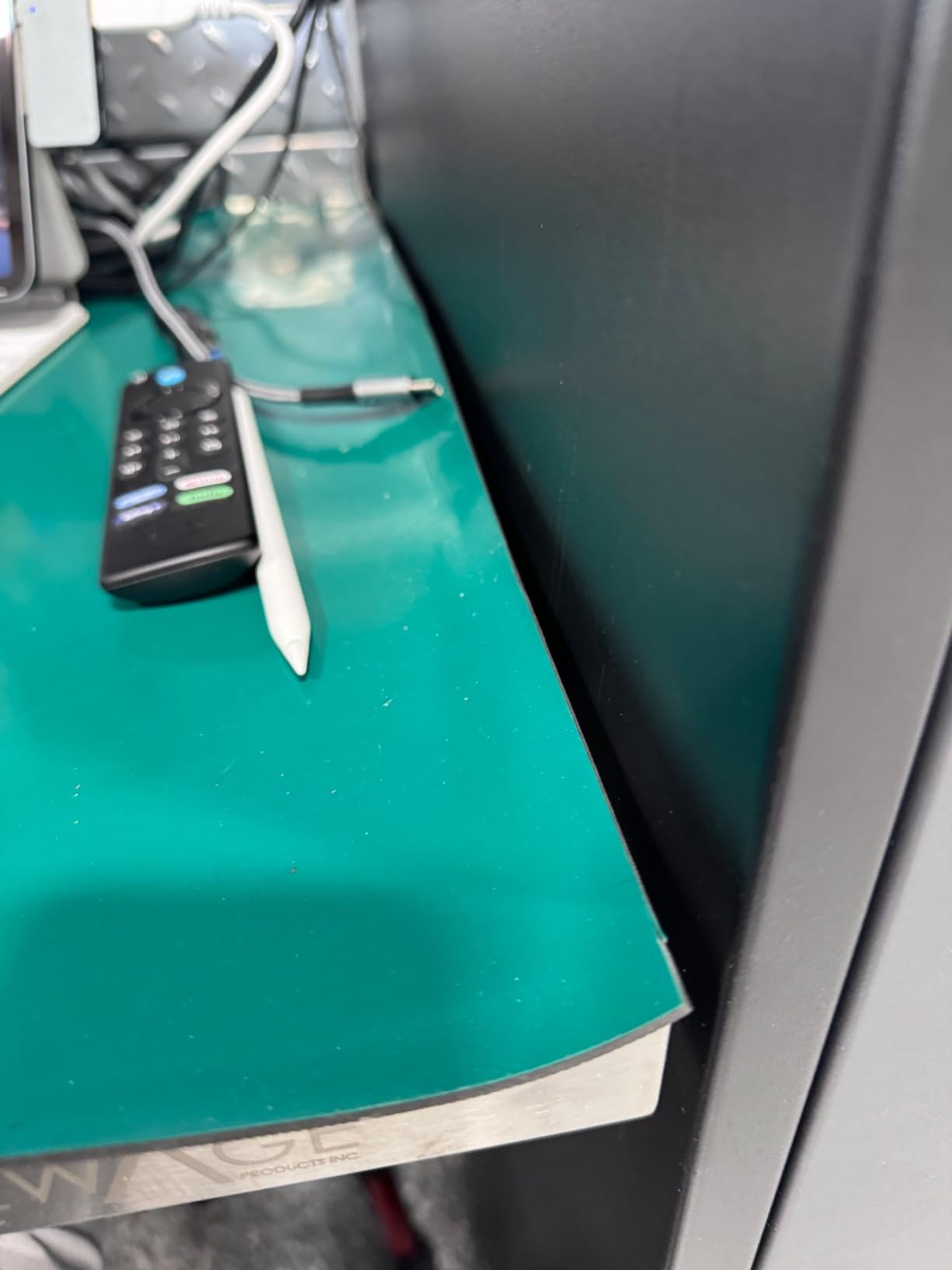
A 450 C rating is serious for a rubber mat, and owners report hot solder spatter scraping off without damage. It is also resistant to acid, alkali, chemical flux, oil, grease and most solvents, so it holds up in a messy rework area.
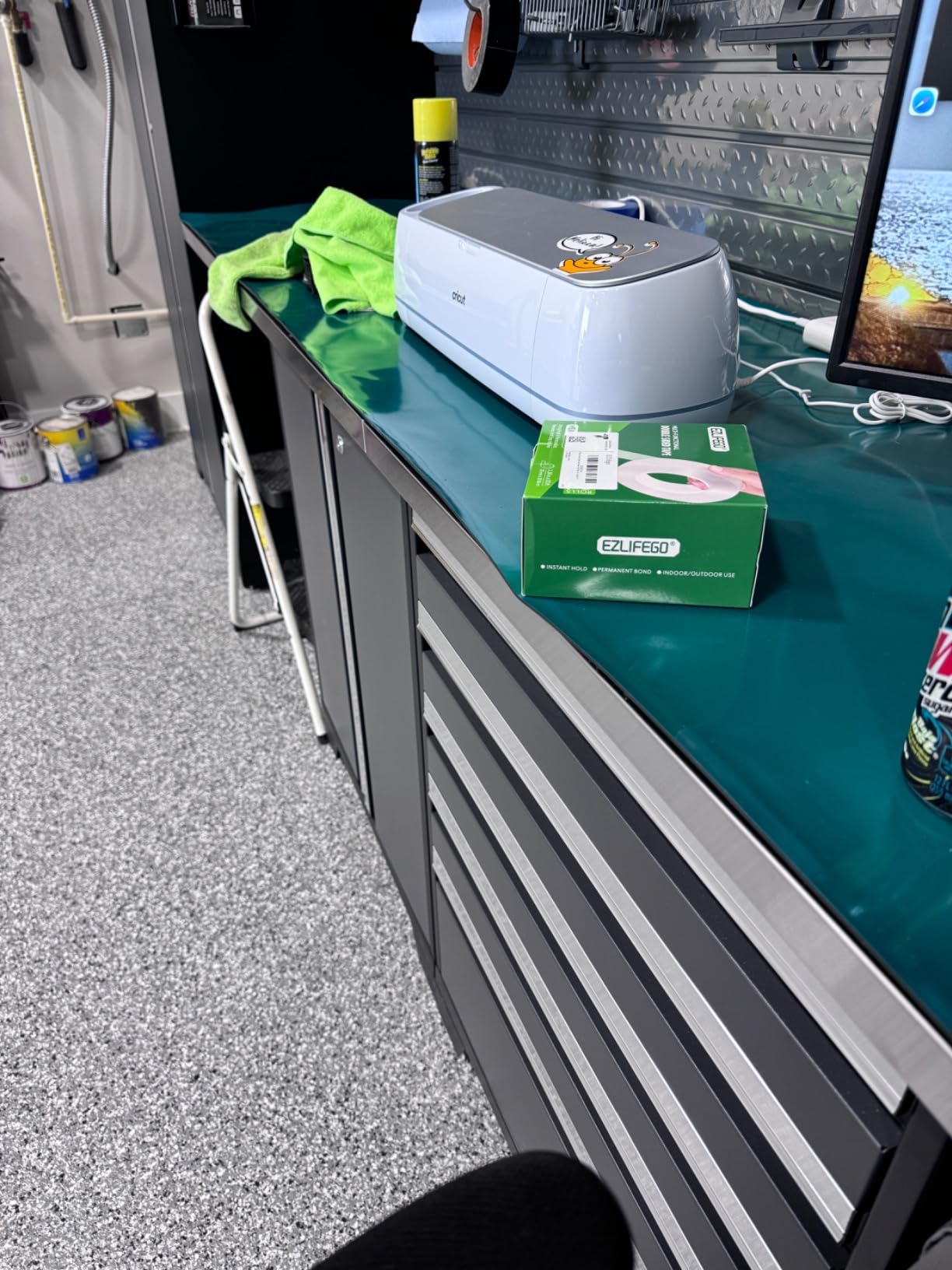
Three practical problems
The rubber odor is the big one — owners describe it lasting weeks or months, and it is strong enough to matter in a closed room. Ventilate from day one.
Second, the edges curl permanently and do not relax, even under a heat gun. That is a known property of uncured rubber edges on a roll, and it means you must fasten the cut edge down or accept a raised lip where parts can catch.
Third, it weighs 5.35 kg, so rolling it up to put away is a two-person job. Treat it as a permanent install.
Who should buy it
Buy this if your bench is an awkward size, if you solder heavily enough to care about a 450 C rating, or if you want a surface that survives chemical flux. Do not buy it for a small desk or for a portable kit.
12. VECO-T Silicone Soldering Mat — best hands-free grounding
VECO-T Silicone Soldering Mat with Soldering Stand, 20×14 Inch ESD Anti Static & 932°F Heat Resistant Workbench Mat for Electronics Repair, PCB, Phone, Watch, PC Building
20 x 14 in
932F silicone
Built-in iron stand
Dual grounding
Pros
- Only option here with a soldering stand built into the mat
- Hands-free grounding method works without a wrist strap
- Silicone rated to 932F protects the bench from iron contact
- Compartments for wires
- solder and screws
- Resists solder splashes
- glue and resin
Cons
- Can take most of a day to flatten after being stored rolled
- Bubbles up under extended hot air rework
- Grounding between layers measured as somewhat weak
The idea here is the most interesting in the roundup. Instead of relying only on a wrist strap, VECO-T uses a hand-touch equalization protocol: you touch the mat with your bare hand for three to five seconds before picking up a board, and the volume-conductive silicone spreads the charge off you across the whole surface. It is a legitimate hands-free alternative to strapping up.
The mat is 20 by 14 inches of silicone rated to 932 F, with an integrated soldering stand molded into it. That stand is the feature no other mat in this group has, and it stops you from propping a hot iron on the bench edge.
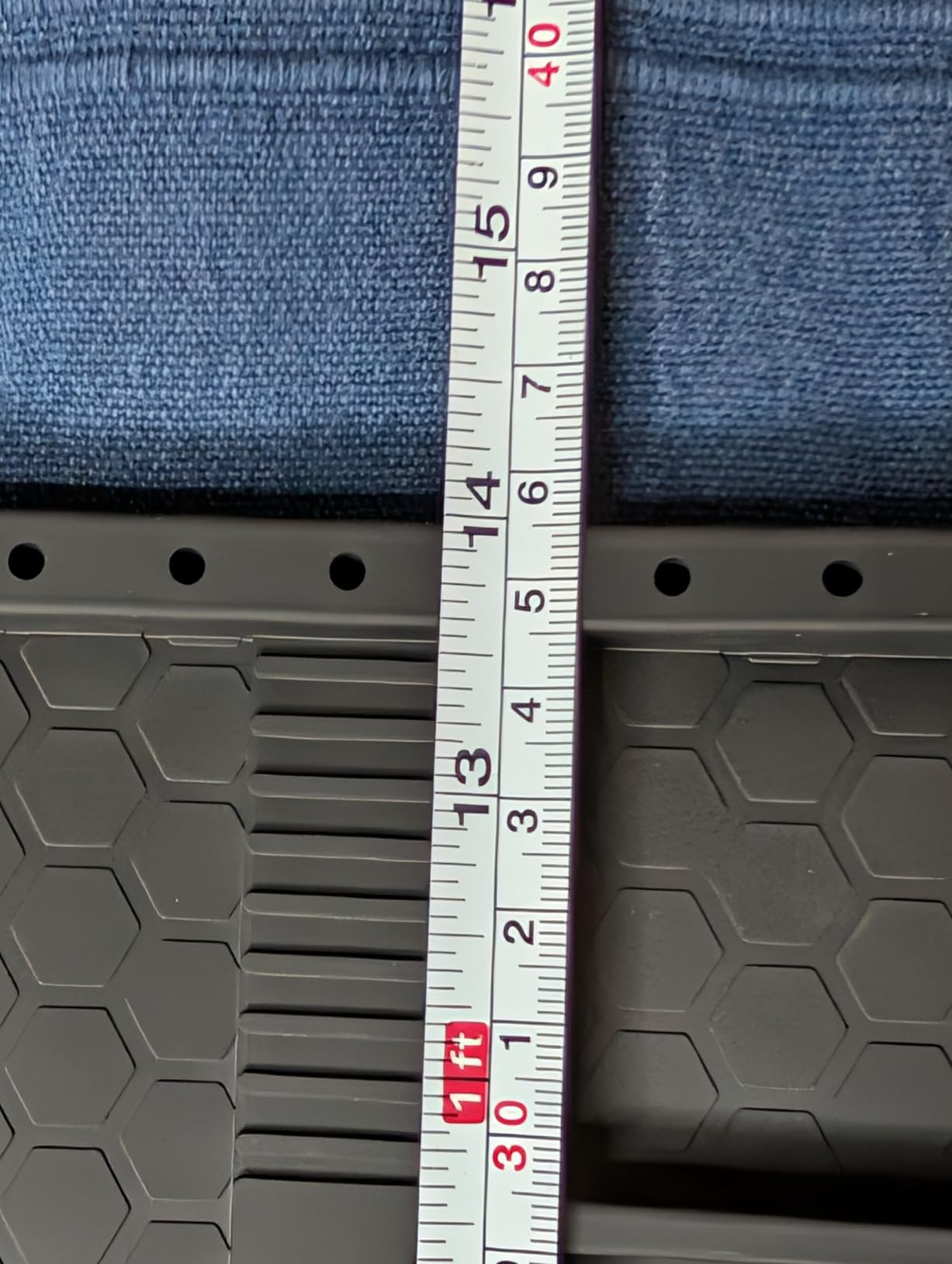
Grounding is dual-mode: an outlet plug or a universal alligator clip, so you can choose your ground point. Engraved measurement guides and compartments for wire, solder and screws round out the layout, and the surface resists solder splash, glue and resin.
What gives with heat and time
Silicone and heat are a trade. Under extended hot air rework this mat bubbles up, and if you store it rolled it can take most of a day to flatten fully. Both matter if you do rework rather than assembly.
One owner also measured the grounding connection between layers as somewhat weak, though still functional. With only 37 ratings, long-term behavior here is simply not documented yet.
Who should buy it
Buy this if you hate wrist straps, work alone, and want a mat that handles an iron without a separate stand. Pair it with a conventional two-layer mat if you also handle high-value boards where a single layer of protection is not enough.
How to ground an ESD mat safely
Grounding is where most people get this wrong, and it is also the part with a genuine safety rule attached. The goal is not to plug yourself into the earth. The goal is to bring you and the board to the same potential, slowly and safely, so no discharge happens between you and the parts.
Confirm your mat is dissipative or conductive. If the listing gives no surface resistance figure, treat it as unknown rather than compliant. A bench multimeter across the surface gives you a number in seconds.
Attach the ground cord to the mat’s stud or snap using the 10 mm connection provided. Do not improvise with an alligator clip clamped to a loose edge unless the mat is designed for it.
Run the cord to a real earth point — a properly earthed outlet, or an equipment chassis with a ground symbol. Confirm your outlet is actually earthed; this is a common and unresolved doubt among first-time users.
Use a wrist strap with a 1 to 2 MOhm current-limiting safety resistor if you are wearing one. The resistor is not optional. Safety guidance for ESD straps is explicit that a strap-to-earth lead must include one, and that you must never make yourself the shortest path to ground.
Clip the strap to the mat, not to the bench frame. Many experienced users deliberately avoid any mains earth connection at all and simply bond themselves to the mat, which is safe and effective.
To state the safety rule plainly: never connect yourself directly to earth. A direct connection is a shock risk, and a well-made strap or cord with a current-limiting resistor is what makes the system safe. If a grounding cord or plug adapter is mis-wired, unplug it and check the manual before you handle anything expensive.
What to check before you buy an anti static workbench mat
Surface resistivity and the static-dissipative range
Surface resistivity is resistance measured across the face of the material, expressed in ohms per square. The ESD range most people mean is 10^6 to 10^9 ohms, which is the static-dissipative class defined under standards such as ANSI/ESD S4.1 and STM11.11. Conductive materials sit lower, at roughly 10^4 to 10^6 ohms, and insulators are far above 10^9. For a bench mat you touch constantly, the dissipative band is the one you want, because it bleeds charge away without creating a path to ground through you.
A mat with no published figure is not disqualified, but it is a mat you are taking on trust. Buy it for the heat rating and the layout, and verify it yourself with a multimeter.
Rubber vs silicone vs vinyl vs mod mats
Rubber is the professional standard: two-layer construction, conductive base, genuinely dissipative top, good chemical resistance, and it does not care about heat as much as people assume. It is heavy and it smells on arrival.
Silicone is a heat material, not a static material. It handles a soldering iron beautifully and tolerates solder spatter, but it is an insulator, so on its own it does not dissipate charge unless the manufacturer has added a conductive formulation and published a number. The VECO-T and Hooandxk mats in this roundup are examples where a conductive silicone exists; the Kaisi mat is an example where the manufacturer says plainly that it does not.
Vinyl is the durable middle ground. The Bertech mat shows the pattern: thick, chemical resistant, cuttable, long-lived, and not heat resistant at all.
Printed mod mats are decorative unless they publish a resistance figure. Check before you count one as protection.
Rolls versus pre-cut mats, and bench sizing
Pre-cut mats are ready in seconds and lie flat immediately. Rolls cover an awkward bench in full and can be trimmed to fit, at the cost of weight, permanent edge curl and a multi-day odor. Choose a roll when coverage and heat rating matter more than convenience.
On sizing, measure before you order. A 36 by 24 inch mat covers a full US bench width. A 24 by 24 mat suits laptop and phone work. Anything under about 20 by 24 inches will run out of room during a desktop build, and running out of room is what causes dropped parts.
Heat resistance
For soldering, look for a number rather than the phrase heat resistant. A silicone pad rated to 932 F will take an accidental iron contact indefinitely. Vinyl pads top out far lower — the Bertech service ceiling is 160 F — and will melt if you drop solder on them. The MYOYAY roll sits at 450 C, which is closer to industrial rework territory.
If your bench is both a solder bench and an assembly bench, the practical answer is two mats: a dissipative rubber or vinyl base, and a smaller silicone pad on top for the hot work.
Grounding accessories
Check what is in the box before you order a second thing. The iFixit, HPFIX, KooMall, MWRF, Hooandxk and VECO-T kits all include a strap and cord. The StarTech includes a 6.6 ft wire with a snap-on clip. The LUTICO kit does not include an outlet ground adapter, so budget for that separately.
A 10 mm stud or snap is the most reliable attachment point. A bare alligator clip on a mat edge is workable but easy to knock loose at the worst moment.
Cleaning and lifespan
Rubber and vinyl mats wipe with isopropyl alcohol and standard solvents. Silicone pads clean with soap, water or alcohol, and the AKEOIL and Kaisi mats both clean easily. Avoid harsh solvents on any unknown polymer.
Expect off-gassing on arrival from every rubber and vinyl mat in this roundup. Ventilate for a few days. Beyond that, the failure modes are edge curl on rolls, heat hardening on silicone under repeated hot work, and staining on light-colored surfaces. Buy one you can live with visually and the lifespan question stops being interesting.
Frequently Asked Questions
Do ESD mats actually work?
Yes, when the mat is genuinely static-dissipative and properly bonded. A dissipative top layer spreads charge across the surface and a conductive base carries it away through a ground cord, so no spark forms between you and the board. A mat with no published resistance figure, or a plain silicone pad with no conductive layer, will not do this regardless of what the listing says.
Do I need an anti static mat for PC building?
You need one for the parts, not the case. CPUs, RAM, SSDs, NAND flash and RF components are the ones that fail from static discharge, and a discharge can vaporize a microscopic trace with no visible damage. Building entirely from a sealed retail box into a case is the lowest risk scenario; any step that opens an anti-static bag raises it.
Does silicone stop static electricity?
No. Silicone is an insulator, so a plain silicone soldering mat will not dissipate charge. Silicone is excellent at handling soldering heat, which is a different job. If a silicone mat also publishes a surface resistivity figure, the manufacturer has added a conductive formulation and it may work, so check the spec rather than the material name.
What is the difference between a grounding mat and an anti-static mat?
They are the same product described two ways. A grounding mat is one that comes with or accepts a ground cord and snap so charge drains away to an earth point. An anti-static mat describes the function of slowing and spreading charge on the surface. A mat with no way to attach a cord is only doing half the job, so look for both a resistance figure and a connection point.
Do you really need an anti-static wrist strap?
A strap plus a bench mat is enough for almost everyone, and antistatic clothing is unnecessary for most users. The strap keeps you at the same potential as the parts while you work, which a mat alone cannot do because it only equalizes you when you touch it. If you hate wearing one, the VECO-T hand-touch method is a workable alternative on a volume-conductive mat.
What is the best heat-resistant mat for soldering irons?
A silicone mat rated to 932 F, ideally with a built-in iron stand and a published ESD resistance figure. The HPFIX, AKEOIL, Kaisi, Hooandxk and VECO-T mats in this roundup all carry that rating. For heavy production work the MYOYAY rubber roll goes further at 450 C. Vinyl and PVC mats melt on contact and belong on assembly benches, not solder benches.
Which anti static mat to buy in 2026
For most electronics workbenches, the StarTech is the best anti static mat you can put down and forget — it is the only pick here with a documented ANSI/ESD S4.1 surface resistance test across a genuinely long working area. If you work across multiple locations, the iFixit kit gives you a matched mat, strap and cord that folds flat. If solder and static share your bench, the HPFIX is the value pick, and the AKEOIL is the one to buy when lost screws are your daily problem.
Go bigger when the work justifies it: KooMall for full 36 inch bench coverage, the MYOYAY roll for an awkward bench and heavy heat, Bertech for a permanent install that lasts. Whatever you choose, ground it through a 1 to 2 MOhm safety resistor and never earth yourself directly. That single habit prevents more problems than the model of mat you picked.