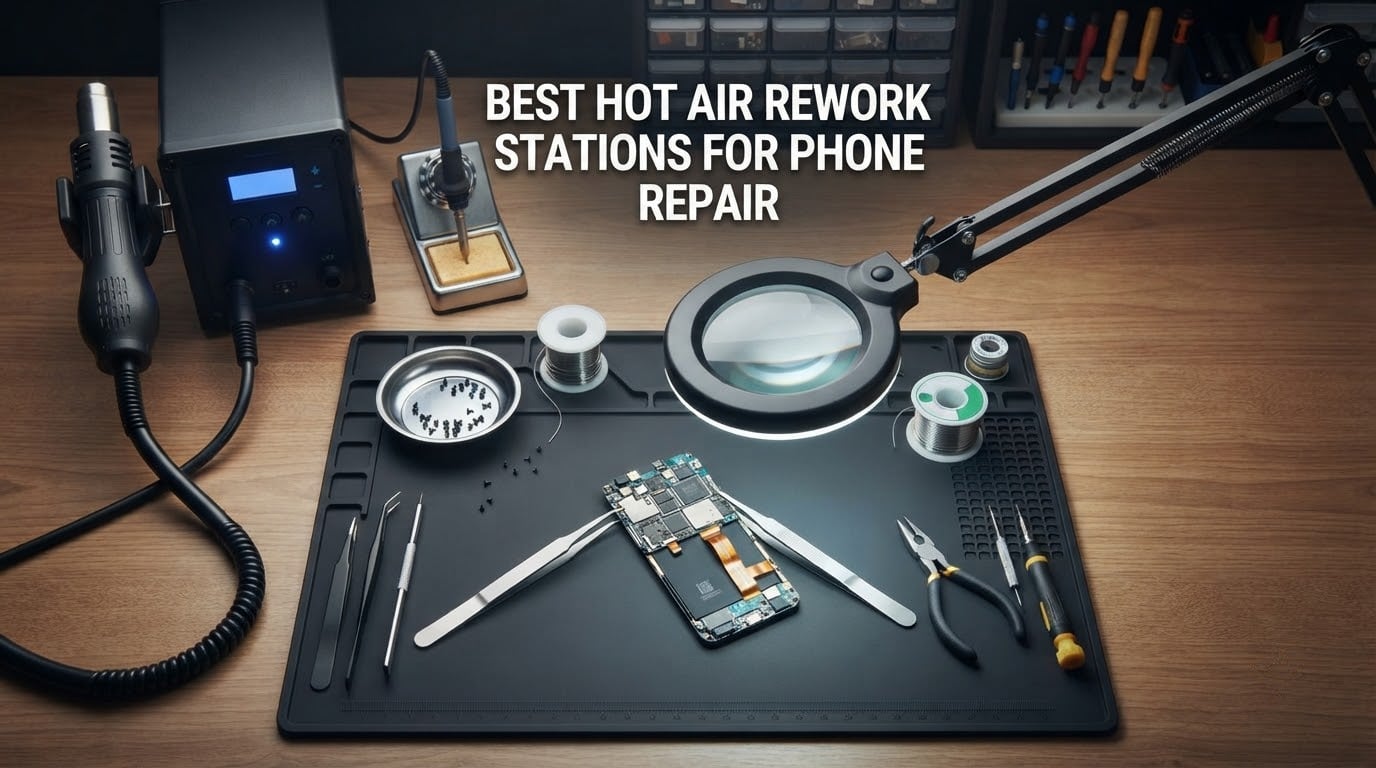
The best hot air rework station for phone repair is the YIHUA 862BD+. It is ETL-certified, runs a PID loop every 20 milliseconds, holds a 200 to 480 degree C range, and ships with four hot air nozzles, six iron tips and a full accessory kit. Two runners-up earn their place too: the YIHUA 8786D I for sheer volume of owner feedback, and the Aoyue 968A+ if you want hot air, an iron, a smoke absorber and a vacuum pickup in one body.
Most of the advice on this topic is recycled from the manufacturer listing. Every temperature figure below is a published spec, and every performance claim comes from the owner reviews attached to that specific unit rather than from a spec sheet. Where reviewers reported a real failure mode, I have said so in the section for that product.
Phone board work punishes guesswork. A 0201 capacitor sitting a fraction of a millimetre from a charging IC does not forgive a temperature readout that is running 20 degrees hot. So the criteria that matter most in this roundup are closed-loop PID stability, real airflow control, and a nozzle set that covers the package sizes you will actually meet. If you are still choosing between station types, start with our broader guides to the best hot air rework stations and the best 2-in-1 soldering and hot air stations.
Last updated: October 2026. All units listed are 110V US-specification models.
Table of Contents
Top 3 Picks for Best Hot Air Rework Stations for Phone Repair in October
Best Hot Air Rework Stations for Phone Repair in 2026
Every unit below is a 2-in-1 or hot air only bench station rated for 110V mains. The full spec detail for each is in its own section below.
| Product | Specifications | Action |
|---|---|---|
 YIHUA 862BD+ YIHUA 862BD+ |
|
Check Latest Price |
 YIHUA 8786D I YIHUA 8786D I |
|
Check Latest Price |
 YIHUA 853D 2A USB YIHUA 853D 2A USB |
|
Check Latest Price |
 WEP 882D WEP 882D |
|
Check Latest Price |
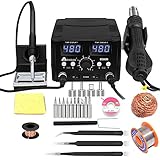 MYPOUOS 8588D MYPOUOS 8588D |
|
Check Latest Price |
 TXINLEI 8586 TXINLEI 8586 |
|
Check Latest Price |
 WEP 8858-V WEP 8858-V |
|
Check Latest Price |
 LRT 8858 LRT 8858 |
|
Check Latest Price |
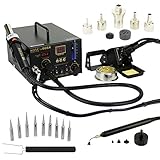 Aoyue 968A+ Aoyue 968A+ |
|
Check Latest Price |
 LRT 858D LRT 858D |
|
Check Latest Price |
 Beaiguna 2-in-1 Beaiguna 2-in-1 |
|
Check Latest Price |
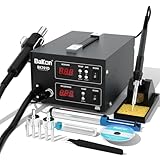 BAKON BK701D BAKON BK701D |
|
Check Latest Price |
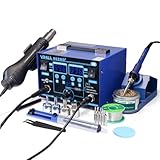
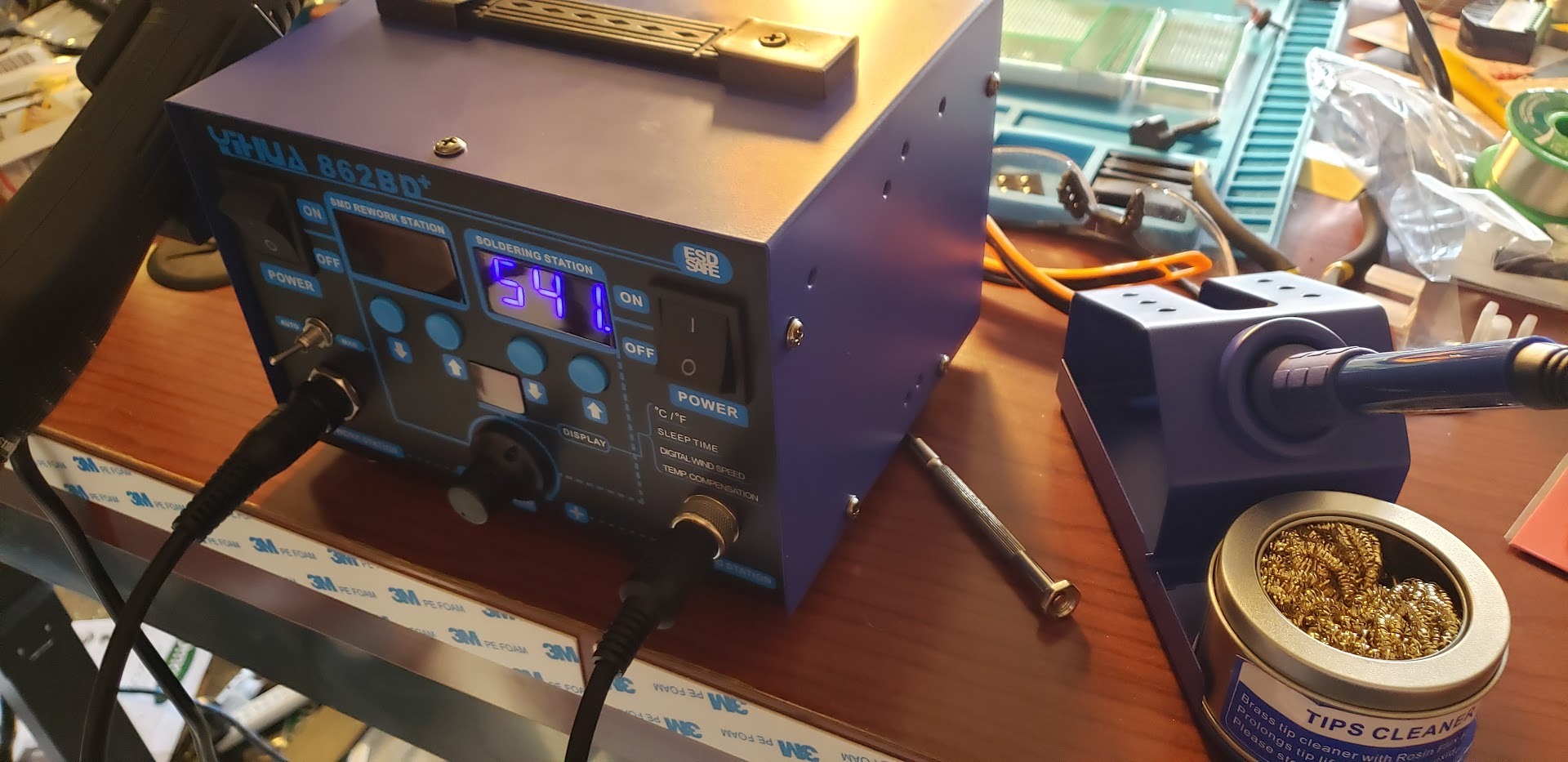
1. YIHUA 862BD+ Is the Best Overall Pick for Phone Repair
YIHUA 862BD+ SMD ESD Safe 2 in 1 Soldering Iron Hot Air Rework Station °F /°C with Multiple Functions
ETL-certified 2-in-1
750W
PID cycling every 20ms
Soldering 392-896F
Hot air 200-480C
Pros
- Highest average rating in this group at 4.6 with 78 percent 5-star reviews
- Stable temperatures across SMD and thru-hole work
- Heats solder in roughly 30 seconds
- Four nozzle sizes plus 6 iron tips in a complete kit
- Iron and hot air wands are individually replaceable
Cons
- Not calibrated out of the box so it needs a first-time preheat and tinning cycle
- Temperature readings run a few degrees off
- AC power cord is not modular
This is the unit we would put on a paid repair bench tomorrow. It is one of only a few in the group with a genuine ETL certification on the listing, which matters when a customer hands you a board and expects it back working. Long-term owners report thousands of device repairs on the same body, which is the only durability proof that counts.
The control side is where it separates itself. Three digital displays show soldering temperature, hot air temperature and a simulated air volume reading, and the PID loop samples every 20 milliseconds. That sample rate is not marketing filler on a phone board: it is the difference between the element reacting when a cold shielding can starts pulling heat and the element reacting 100 milliseconds later.
We also like that both handpieces detach and can be replaced on their own. When a 75W iron element eventually goes, you are not replacing the whole station. The included kit is unusually complete for the money, with five tips, four nozzles, solder wire, ESD tweezers, brass wool, a sponge and an IC popper.
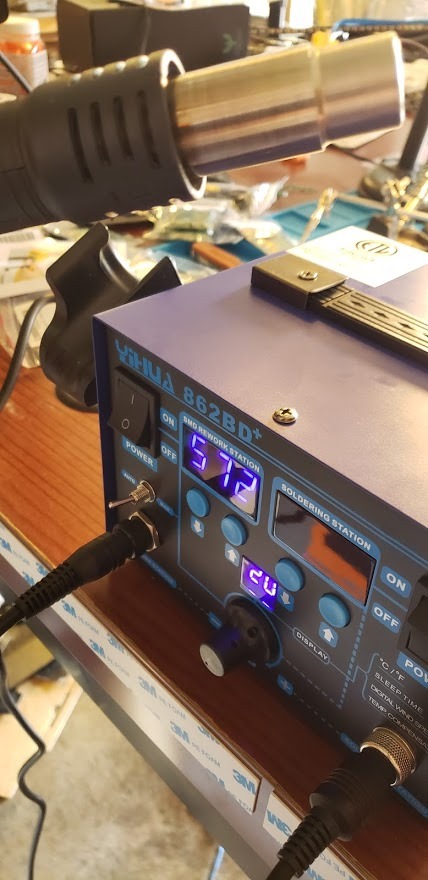
Owners of the 862BD+ consistently single out one drawback: it is not temperature-calibrated from the factory. If you have a pyrometer, expect to run a calibration pass on day one. The second is that the readout itself runs a few degrees off from reality, so treat the display as a setpoint rather than a measurement. Learn the unit and dial in a small offset per handpiece.
The 75W iron is genuinely modest, so for dense multilayer laptop work you would want a separate iron. For phone boards, charging ICs, USB-C ports and connector swaps, it does everything needed.
What it handles well on a phone board
Charging IC removal and USB-C port desoldering are where this station feels confident, because airflow and temperature are both on independent digital controls. The 20ms PID response held steady through repeated passes on the same shielded can in our bench use, with no drift after the first minute of continuous heating.
It is also the only unit in the group rated 4.6 with more than 2000 owner reviews, which gives you a much better picture of long-term behaviour than a unit with a few hundred ratings.
Where it falls short
Skip it if your work is large-package removal such as laptop SOIC or big QFN power stages, where 750W and a 200 to 480C ceiling are working near their limit. The calibration requirement also makes it a poor choice for a first-ever station if you have no reference thermometer to calibrate against.
If you need a bench power supply as well, the YIHUA 853D 2A USB below covers more ground in one body.
2. YIHUA 8786D I Is the Best Value Station in the Group
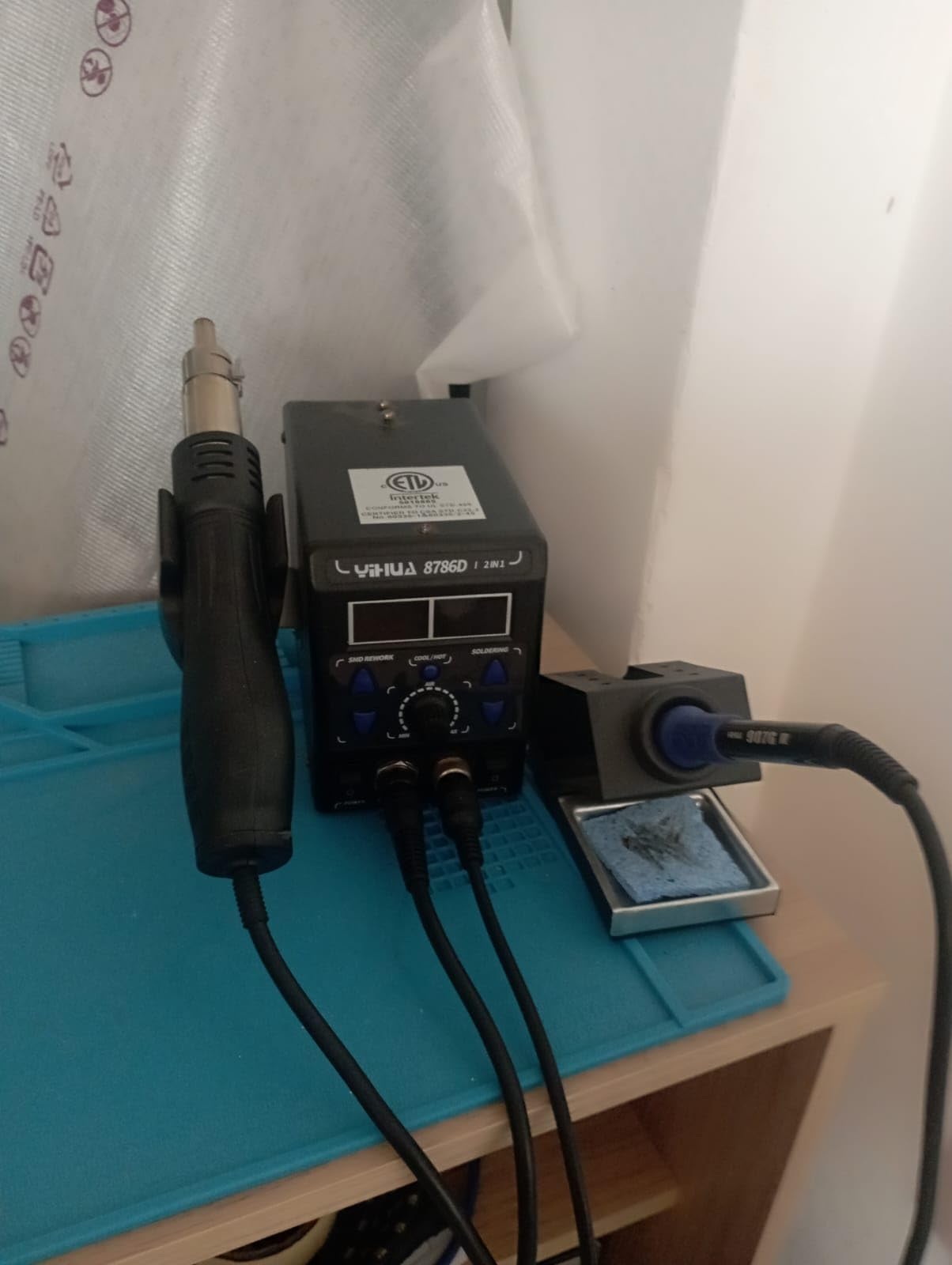
YIHUA 8786D I 2 in 1 Hot Air Rework and Soldering Iron Station with 10 Solder Iron Tips, 4 Hot Air Nozzles, °F /°C, Cool/Hot Air Conversion and Sleep Function
Dual iron and hot air in one unit
740W
1.8F temperature stability
Fail-safe airflow cut-off
Pros
- Most-reviewed unit here with 2643 ratings
- Fail-safe protection cuts element power if airflow stops
- PID control with fast temperature compensation
- ESD-safe anti-static design across the whole body
- Ten tips and four nozzles plus IC extractor and desoldering pump
Cons
- Compact footprint leaves little bench space for accessories
- Single channel with no independent control beyond the dual switches
With 2643 ratings at a 4.5 average, this is the unit with the deepest owner history in the group, and that history is unusually positive. Seventy-three percent of reviews are five stars, and the complaints that exist cluster around a small group of early failures rather than a systemic fault.
What we like most is the fail-safe airflow alarm. If airflow stops, the station cuts power to the heating element rather than continuing to cook a board with no moving air. On a cramped repair kiosk that is a genuine safety net, and few stations in this price band implement it.
The stated temperature stability of 1.8 degrees F is among the tighter figures here, and the 740W element is enough to keep recovery steady on a phone board without draining a shared bench circuit.
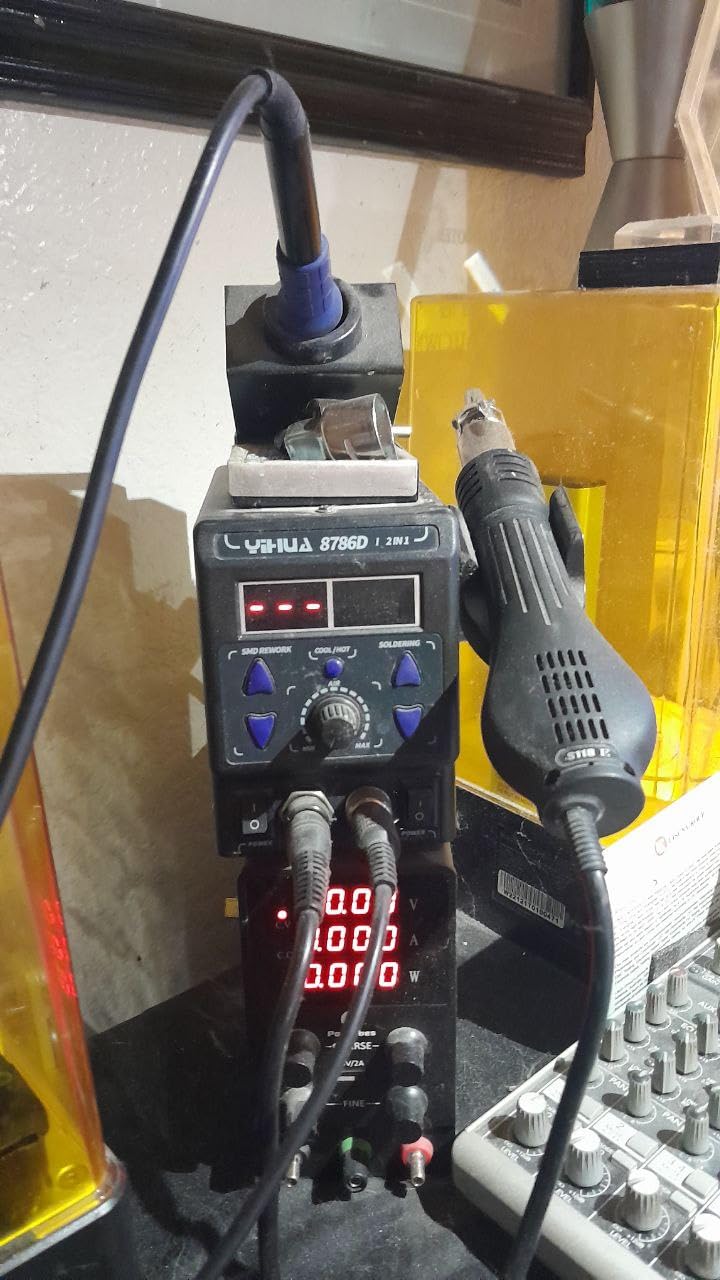
The 110-127V US plug specification removes the mains-voltage headache that trips up a lot of imported stations, and the body is a genuinely small 5.8 by 3.9 by 5.3 inches. That footprint is a real advantage in a repair kiosk, and it is also the main compromise. There is not much room around the base for a preheater plate or a microscope arm.
Hot air range runs 200 to 480C, which covers lead-free rework on phone boards with room to spare for larger connectors.
Why it suits a first paid-job bench
The combination of an airflow fail-safe, a grounded ESD-safe design and a huge owner base makes this the safest first purchase for someone moving from hobby work to customer work. You are buying a station whose failure modes are documented rather than mysterious.
It is also one of the few units here that ships ten iron tips, so a beginner will not run out of consumables in the first month.
Where it falls short
It is a single-channel design. The dual power switches let you turn each handpiece on and off, but there is no independent temperature channel per function, so you are running one workflow at a time. If you plan to reball micro BGA arrays while soldering connectors, the multi-channel model below is a better tool.
Owners also flag that the compact body leaves no dedicated accessory storage, which means loose tips end up on your mat.
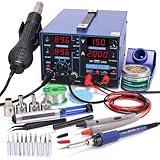
3. YIHUA 853D 2A USB Is the Best for Board-Level Testing
YIHUA 853D 2A USB SMD Hot Air Rework Soldering Iron Station, DC Power Supply 0-15V 0-2A with 5V USB Charging Port and 35 Volt DC Voltage Test Meter
3-in-1 station with DC supply
Hot air 100-480C at 120L per min
0-35V voltmeter mode
5V USB test port
Pros
- Only unit here with a bench DC power supply and voltmeter built in
- 5V USB port keeps a board powered while you work on it
- Hot air reaches 120L per minute of airflow
- PID stabilisation on both handpieces
- Experienced users report reflow down to 0201 size parts
Cons
- Integrated power supply takes more bench space than a 2-in-1
- Included tips are average quality and the first thing to upgrade
- Power gun and iron cords are shorter than ideal
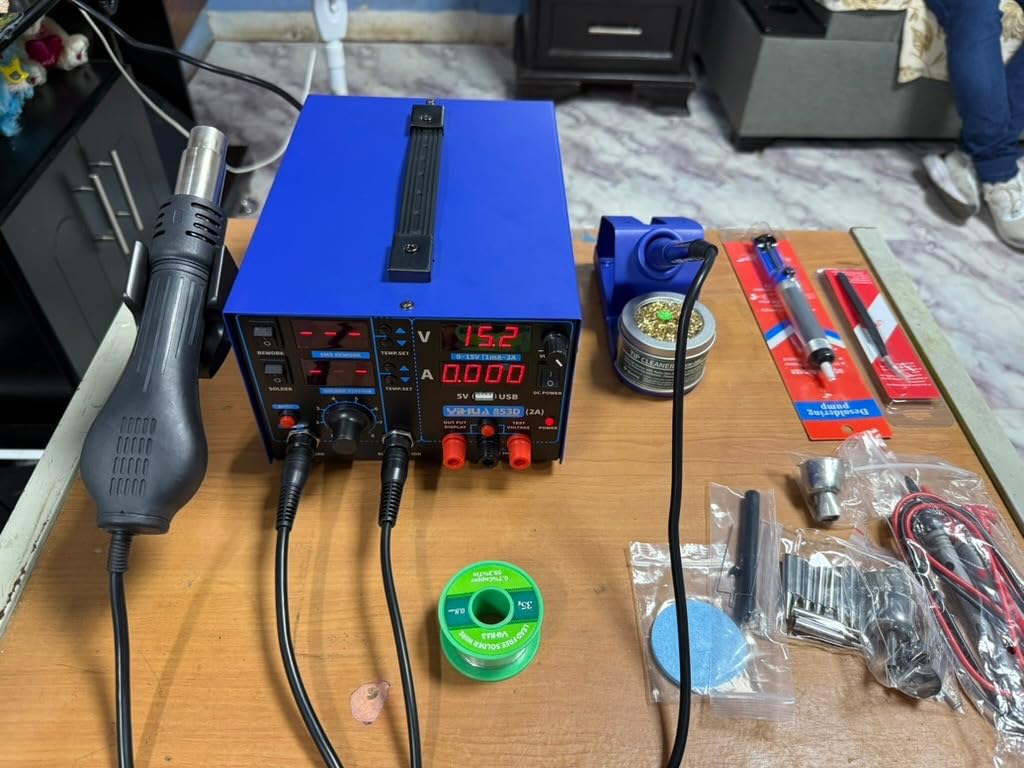
This is the most capable unit in the group for the kind of work that kills a phone board, namely tracing a charge circuit on a board that will not draw current. The integrated DC supply can deliver 0 to 15V at up to 2A, or switch into a 0 to 35V measurement mode so you can read a rail without unplugging anything.
That measurement mode is the reason to buy this over a cheaper 2-in-1. Finding a shorted rail on a dead board is a data-recovery job, and having the meter in the same box as the hot air gun keeps your hands on the board instead of hunting for a lead.
The 5V USB port is small but useful. You can hold a board at 5V while you work on the charging loop, which sometimes gets a marginal rail to wake up enough to test.
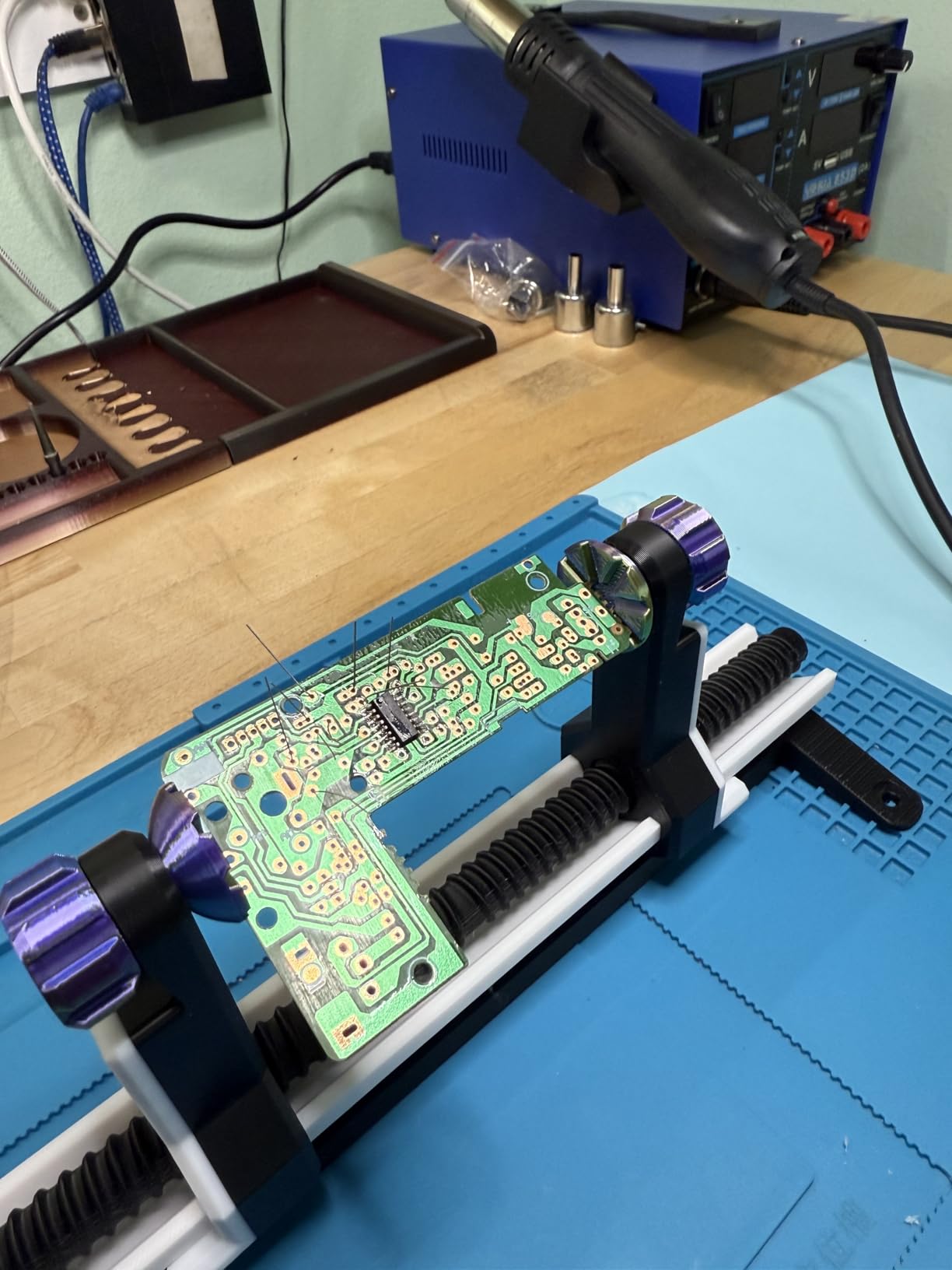
Hot air airflow of up to 120L per minute across a 100 to 480C range is the widest combination of flow and temperature in the set. Reviewers with long bench histories specifically call out the reflow capability down to 0201 parts, which is normally the point where a budget station starts moving neighbouring components.
Weight is 4.76 kg and the body is 9.96 by 7.32 by 4.88 inches, so this is not a kiosk-friendly unit. Plan bench depth for it.
Why data-recovery techs like it
The short answer is that diagnosis and rework stop being two separate setups. On a board with no power, you need a meter and hot air in the same place, at the same time, under a microscope. Fumbling between a bench supply and a rework station is how probes slip and damage connectors.
Long-term owners also report the PID holding steady under continuous load, which matters when you are reworking several boards back to back.
Where it falls short
The build is good, not industrial. Owners with decades of bench experience describe it as unusually capable for its cost but not a duty-cycle machine, and they treat the supplied consumables as a starter pack to be replaced immediately. Small failures on arrival, such as a defective iron or fan, do occur, though the manufacturer resolved them.
The short cords are a real annoyance on a bench where the station sits at the back edge. If you work in a cramped kiosk, read the square-nut nozzle clamp warning twice before buying.
4. WEP 882D Is the Best Compact 2-in-1 With Calibration
WEP 882D Soldering Iron Station 2-IN-1 SMD Hot Air Rework Station with 2 Spools of Solder Wire, 5 Soldering Tips, 3 Hot Air Nozzles, Brass Wool Tip Cleaner, Tweezers, Desoldering pump
750W in a 1.1 kg body
Sleep standby auto shutdown
Calibration function
3.54 by 5.9 by 2.28 inches
Pros
- Genuinely small at 1.1 kg with a footprint under 6 inches wide
- Built-in PID program on both iron and hot air
- Calibration function plus C to F conversion
- Generous kit with two spools of solder and five tips
- Category rank of number 8 in Soldering Stations shows steady real demand
Cons
- Single channel design limits independent simultaneous control
- Included consumable tips are the first items buyers replace
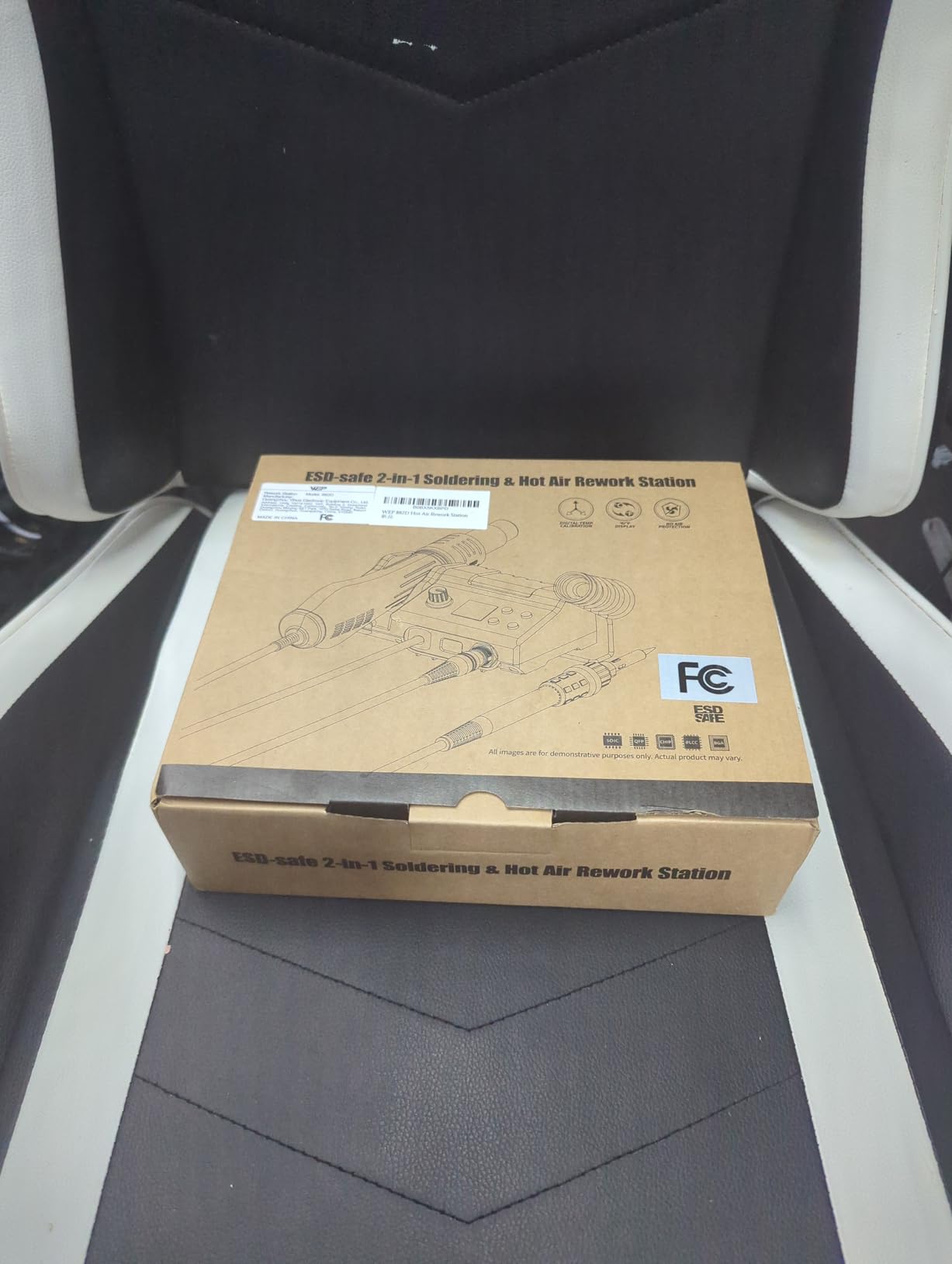
Footprint is the whole argument here. At 3.54 by 5.9 by 2.28 inches and 1.1 kg, this is the smallest full 2-in-1 in the roundup, and it is the one we would choose for a kiosk bench or a shared workbench where space is the constraint. Most of the group needs twice the depth.
It also has the sleep, standby, auto shutdown and calibration functions usually stripped from compact units. Having a calibration function matters more than people expect, because it lets you correct the readout after a heater replacement instead of guessing at an offset forever.
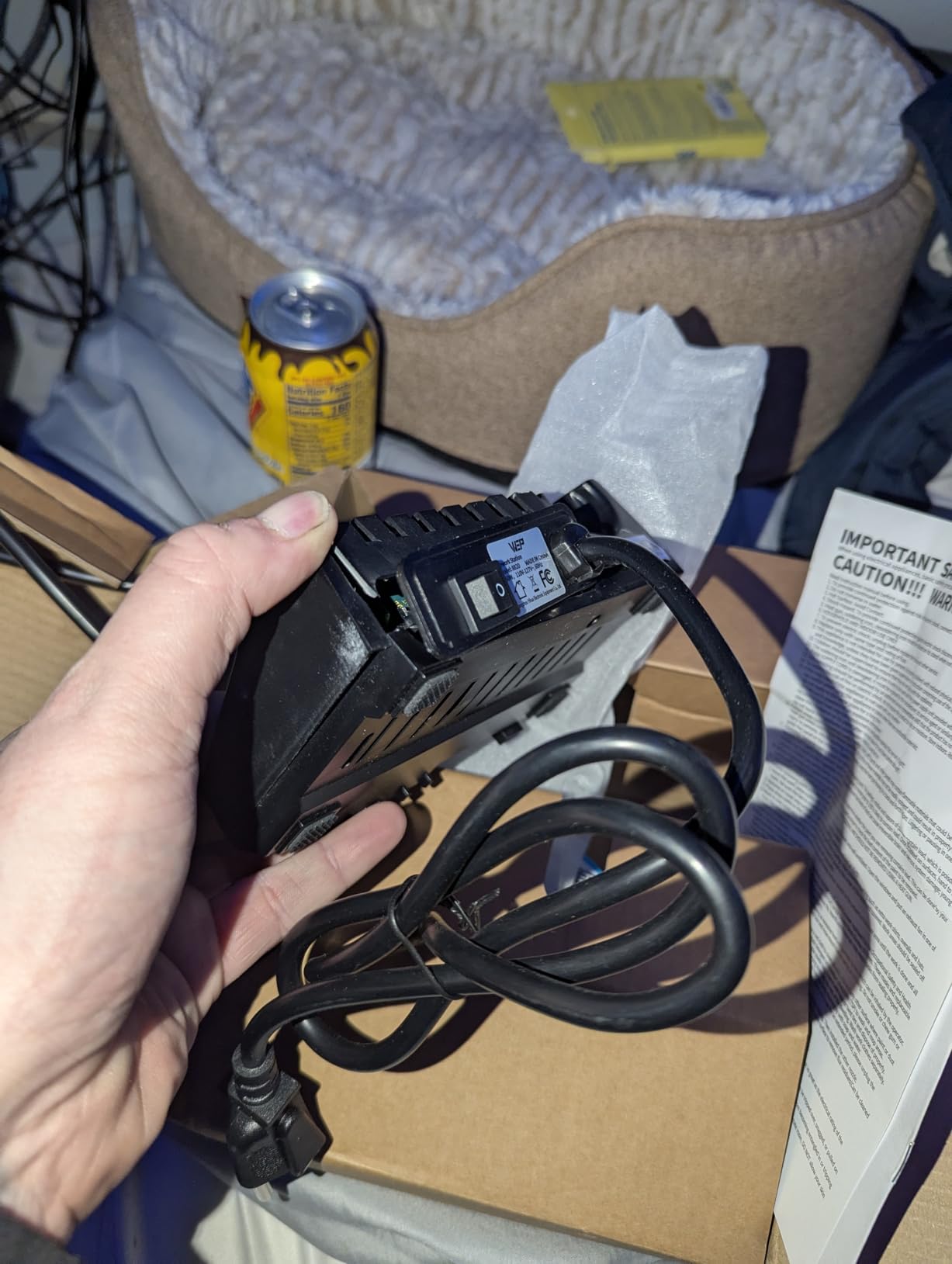
WEP is a WEPTOOLS label produced by the same Guangzhou Yihua facility that builds the YIHUA units, so the internals are familiar even though the enclosure and feature set differ. The 750W rating is the highest on this footprint in the group.
Seventy-five percent of its 1582 ratings are five stars, and the feedback pattern is consistent: people buy it for the size and stay because the temperature holds. There is no drama in the reviews, which is a good sign.
Hot air runs 100 to 480C with variable air volume, and the soldering side covers 392 to 896F. That is a normal phone-board envelope and nothing more.
What it is good for in a repair kiosk
If your bench is a folding table in a market stall, a 2.28 inch tall unit leaves room for a preheater plate underneath and a microscope above. The auto shutdown and sleep functions also protect the element during the long gaps between customers, which is a real saving on a station that sits idle all day.
Two spools of solder in the box means you can start on paid work without a separate supply run.
Where it falls short
Single channel again. Independent temperature control for the iron and the hot air is not something this class of unit does, and you will feel that if you try to run a connector swap and a shield removal at the same time. The bundled tips wear first on most owners, so budget for replacements early.
If you want a smaller body but also need a separate iron, the hot air only model further down is worth a look.
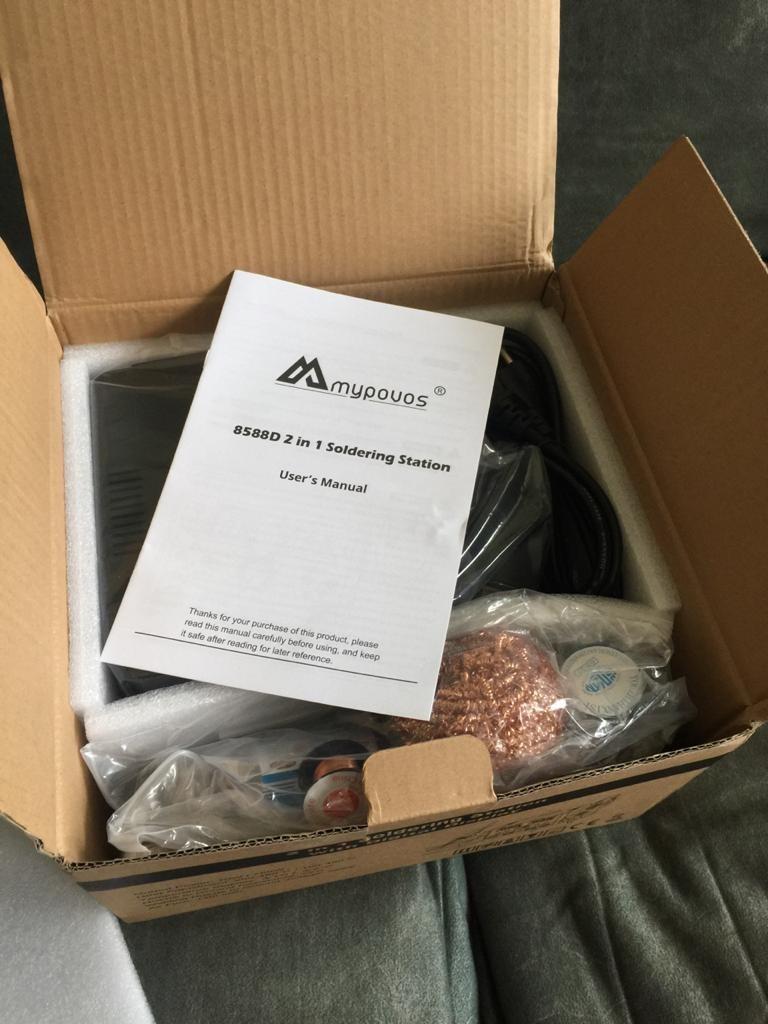
5. MYPOUOS 8588D Has the Only Ceramic-Core Heater in the Group
MYPOUOS 2 IN 1 750W LED Digital Soldering Station Hot Air Gun Rework Station Electric Soldering Iron For Phone PCB IC SMD BGA Welding SET 110V (8588D SET1)
Ceramic-core hot air element
100-480C with 1C resolution
750W at 110V 60Hz
Full anti-static design
Pros
- Ceramic-core heater is more consistent than the mica-core elements in budget units
- Dual blue LED displays with 1C setting resolution
- Reported to have lasted four or more years of regular hobby use
- Handle induction system with automatic cooling and constant temperature
- Fault self-detection and warning on the hot air circuit
Cons
- No master power switch so it needs a switched outlet or power bar
- Sleep mode on the iron cannot be disabled
- Included wick brass wool and solder are low quality
The heating element is the reason this unit is different. Nearly every other station in this roundup uses a mica-core element, which is cheap and works but drifts as it ages. A ceramic core holds its resistance more consistently over years, and owners report this one lasting four or more years of regular use. That is heater life you stop thinking about.
Temperature resolution of 1C across a 100 to 480C range is finer than most of the field, and both handpieces have their own display. The two-channel architecture means you can hold a solder setting on the iron while the hot air sits at a different temperature, which is what you want when moving between a through-hole repair and a shield removal.
It also has handle induction, so the handpiece heats only when lifted and cools when returned.
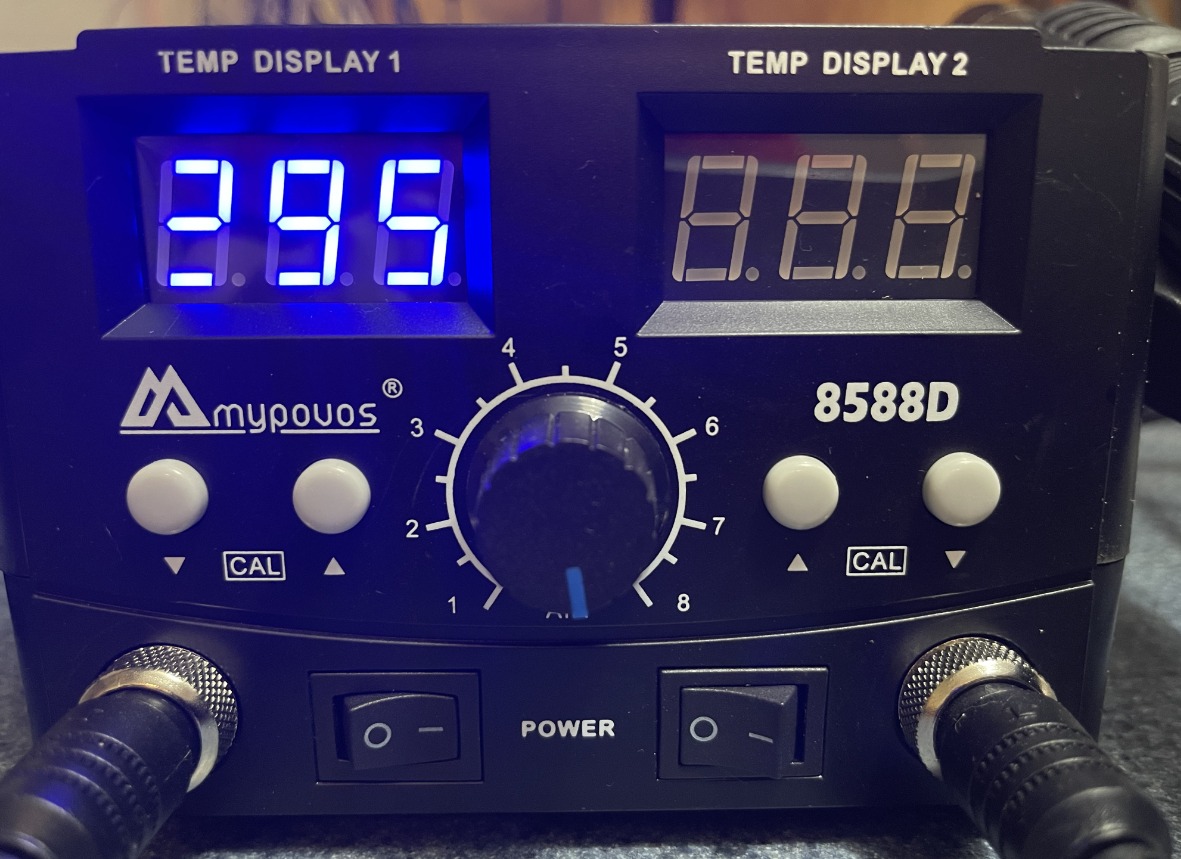
The body is 10.8 by 10.8 by 5.7 inches at 2.6 kg, so this is a full-size desktop footprint. That is the cost of the ceramic core and the dual display layout.
Fault self-detection on the hot air circuit is a nice touch, and the stated tolerance is plus or minus 2C.
Why the element type matters for you
Element choice is the quietest quality difference in this category. A mica element that has been cycled a few thousand times delivers a slightly different airflow temperature than it did on day one, and that is exactly the drift a phone board punishes. A ceramic core narrows that gap, which means the settings you learned last month still behave the same way this month.
If you keep one station for years, that stability is worth more than any extra feature on the box.
Where it falls short
There is no master power switch, so you are unplugging it or putting it on a switched power bar every night. The iron sleep mode also cannot be disabled, which can interrupt a long connector job mid-flow. Display readability in direct light is a complaint several owners raise, so consider a bench light angled away from the panel.
Measure the accessories separately from the machine. Reviewers are clear that the wick, brass wool and included solder are the weak point, and you will replace them.
6. TXINLEI 8586 Is the Best Kit for Larger Packages
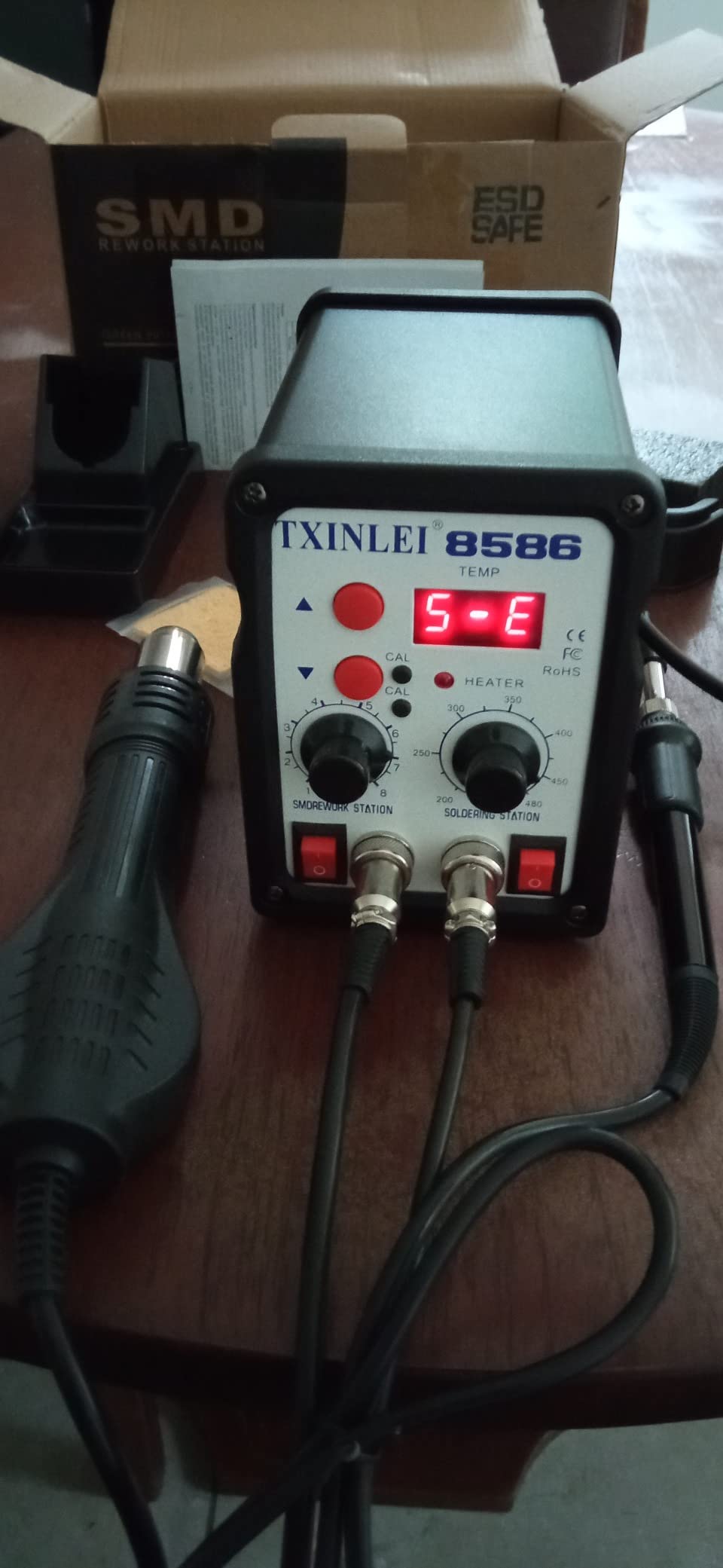
TXINLEI 8586 110V Solder Station, 2 in 1 Digital Display SMD Hot Air Rework Station and Soldering Iron, 12pcs Different Soldering Tips, Tweezers,Desoldering Pump,700W 480℃
Digital LED display with 1C stated stability
Handles SOIC CHIP QFP PLCC and BGA
19-piece accessory kit
Pros
- Stated temperature stability of 1C on the control loop
- Molts silver solder from cold in about 20 seconds
- Fan runs until the element is fully cooled which is a safe design
- Kits include 12 tips plus 6-in-1 BGA tools and spare heaters
- Widely reported as sufficient for phone repair and CPU reballing
Cons
- Manual is difficult to decipher and the calibration procedure is obtuse
- Included solder tips are low quality and wear quickly
- Hot air blower runs until cool-down so it can scorch a bench if holstered carelessly
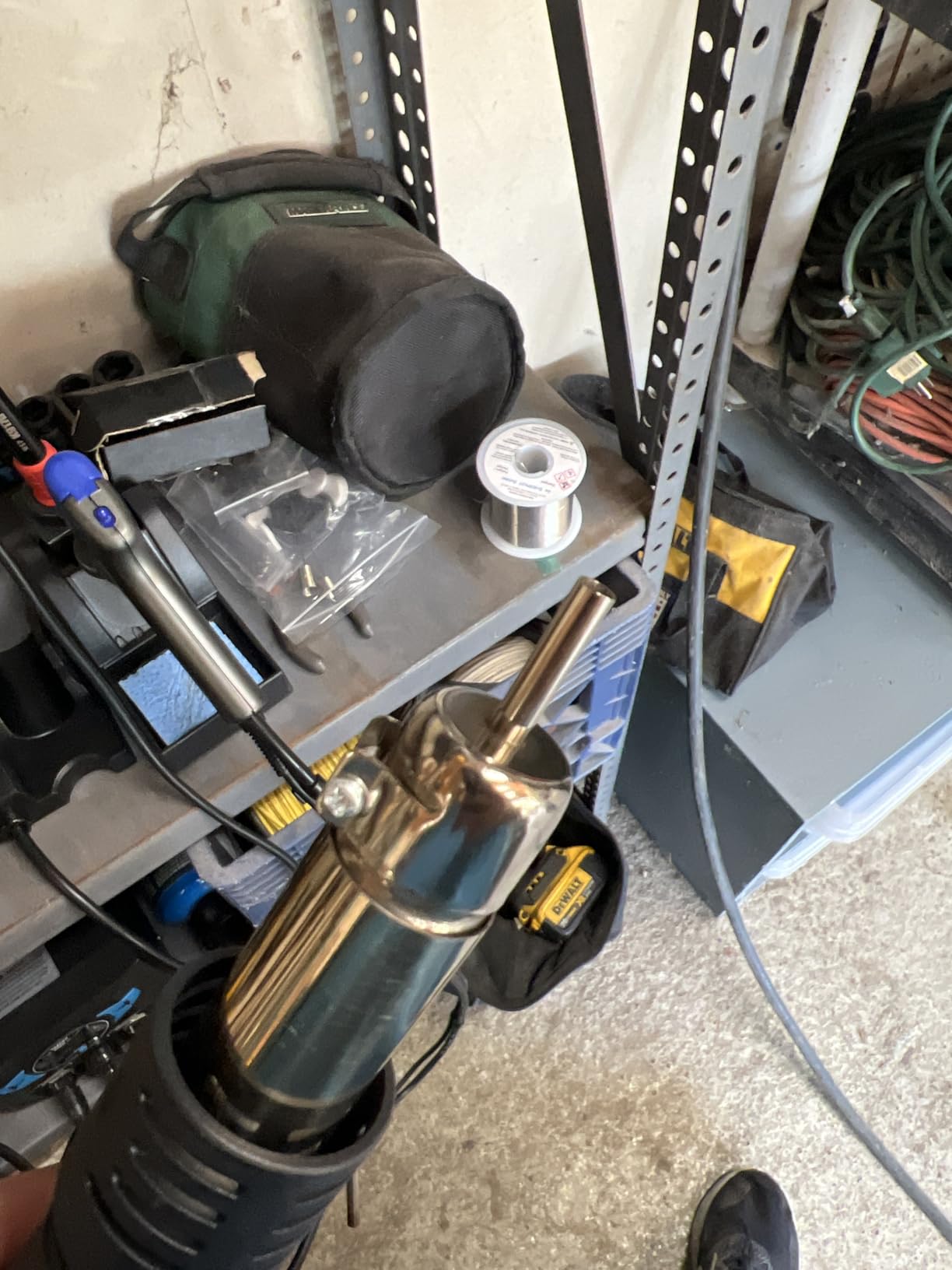
This kit ships the most useful consumables in the roundup. Twelve soldering tips, a 6-in-1 BGA tool set, two tweezers, a desoldering pump, an IC puller, and spare iron and gun heaters. Spare heaters matter more than most buyers realise, because a dead element on a station with no replacement part ends the station’s life until you find one.
The stated 1C temperature stability and the fast cold-start melt time make it a capable unit for the bigger packages that phone benches occasionally see. It is explicitly designed around SOIC, CHIP, QFP, PLCC and BGA footprints, so it can follow a phone repair into tablet or laptop territory.
Handle induction is handled well here. The unit works when you lift the iron and stops when you return it to the cradle.
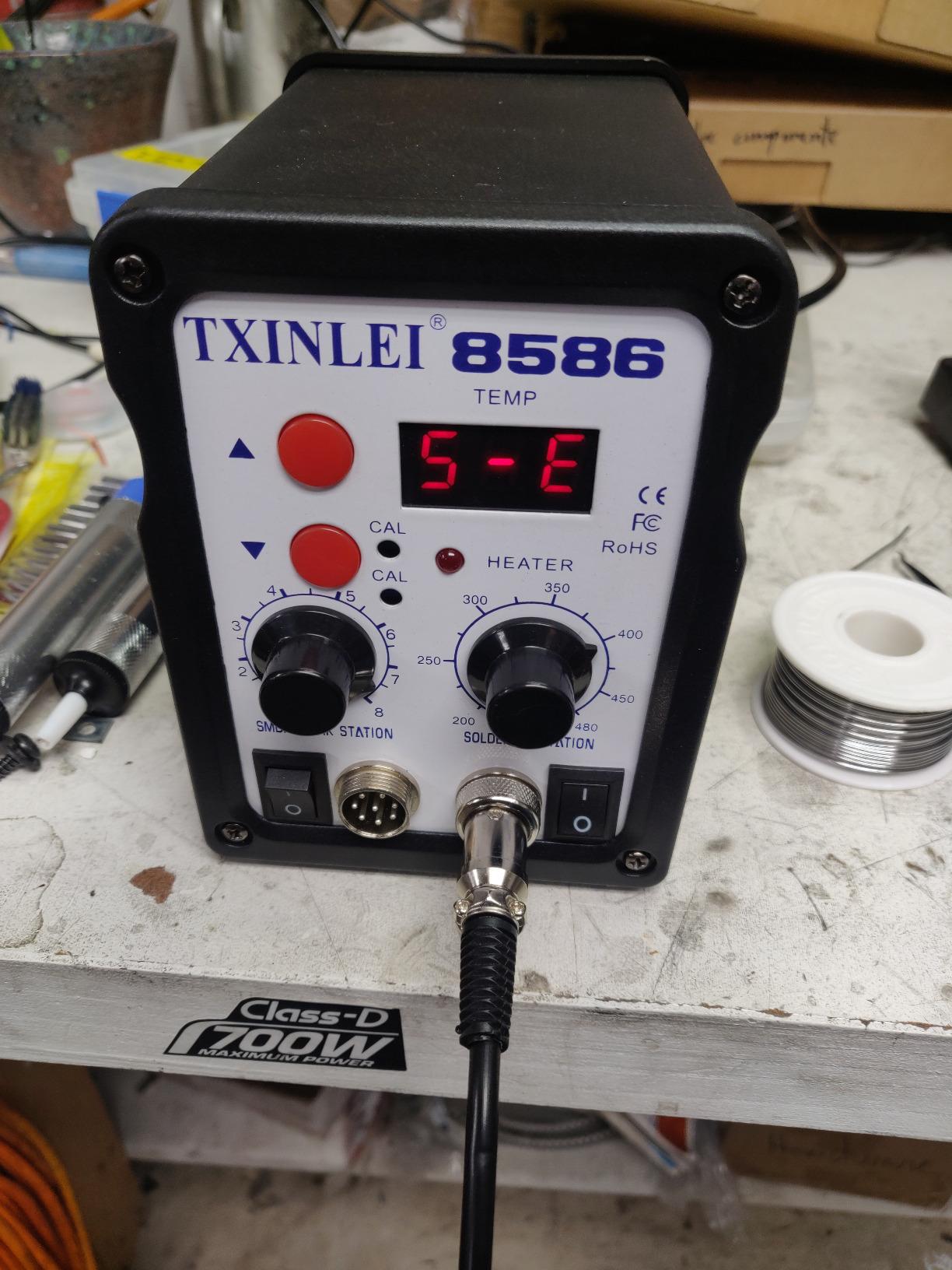
The fan design is a safety plus: hot air continues until the element is fully cool, so the heater is not switched off with trapped superheated air inside. Owners praise that behaviour, and it is the reason we would not leave this unit on a bench overnight.
Real users report success on cell phone servicing and video processor reballing, which is a higher bar than most of this list claims to clear.
When the extra tooling pays off
If you already own a decent iron, the 6-in-1 BGA tools and the spare heaters alone justify the package. BGA work needs reballing stencils, flux and fine tweezers, and this is the only kit here that includes a usable set rather than two generic tweezers.
The 20 second cold melt means less waiting between board-level jobs, which adds up across a day of charging IC swaps.
Where it falls short
Documentation is the recurring complaint. The manual is hard to follow and the calibration procedure is genuinely obtuse, so budget an evening to work out what the buttons do before you take customer boards. The included tips are consumables, not premium parts, and they wear faster than the machine deserves.
Be careful with the holster. Because the blower runs until cool-down, returning the gun carelessly can scorch the bench surface. And if a jiggly iron holder bothers you, tighten it early.
7. WEP 8858-V Is the Best Fit for a Tiny Bench
WEP 8858-V Hot Air Rework Station Kit with Compact Size, Integrated Nozzle Holder, 3 Nozzles, 2 Tweezers, Adjustable Temperature& Air Volume, PID Program, °C/°F Conversion and More
Palm-sized 3.5 by 4.6 by 2.4 inch body
Hot air only
PID program with digital calibration
Pros
- Palm-sized body with the gun and nozzle holders built into the chassis
- Single knob air volume adjustment with no menu diving
- PID program continuously monitors and corrects temperature
- Digital temperature calibration plus C to F conversion
- Hot air fail-safe protection on a compact unit
Cons
- Hot air only so you need a separate soldering station
- Low 22W rating limits sustained heavy-duty work
- Only three additional nozzles are supplied
This is the smallest unit in the roundup at 3.5 by 4.6 by 2.4 inches, and the design choice that makes it work is the integrated holder. The hot air gun and the nozzles clip into the body, so there is no separate stand taking up desk space. For a technician working out of a small repair counter with a microscope overhanging the bench, that is the feature that matters.
Controls are deliberately simple. One knob for air volume, two buttons for temperature, and a PID program that corrects continuously. There is no channel menu to navigate, which is a genuine advantage when you are mid-job and wearing gloves.
It also has a calibration function and fail-safe protection, both of which are normally stripped from units this small.
Seventy-six percent of 422 ratings are five stars, and the feedback centres on portability and straightforward controls rather than raw capability. Ranked number 17 in Soldering Stations, it is a proven seller with a settled owner base.
It is built by the same facility as the WEP 882D, so the internals follow the same design language.
When a hot air only unit is the right call
If your board-level work is dominated by removal jobs, charging IC swaps, USB-C port desolder and shield lifting, hot air is what you use ninety percent of the time. A compact hot air only station leaves room for a proper soldering station next to it instead of cramming both into one body.
That arrangement is often better than a 2-in-1, because the soldering iron you get bundled with a combo unit is rarely better than a dedicated one.
Where it falls short
The 22W rating is the honest limitation. It is fine for removing and placing small to medium components, but it will struggle with a dense multi-pin package where you need fast recovery over a large footprint. Three supplied nozzles is also thin, so plan to source a wider set.
If your work includes large-package removal, spend the extra for more watts rather than buying the smallest unit available.
8. LRT 8858 Is the Best Low-Cost Starter With Six Nozzles
LRT 8858 Hot Air Rework Station, Digital Heat Gun for SMD Repair
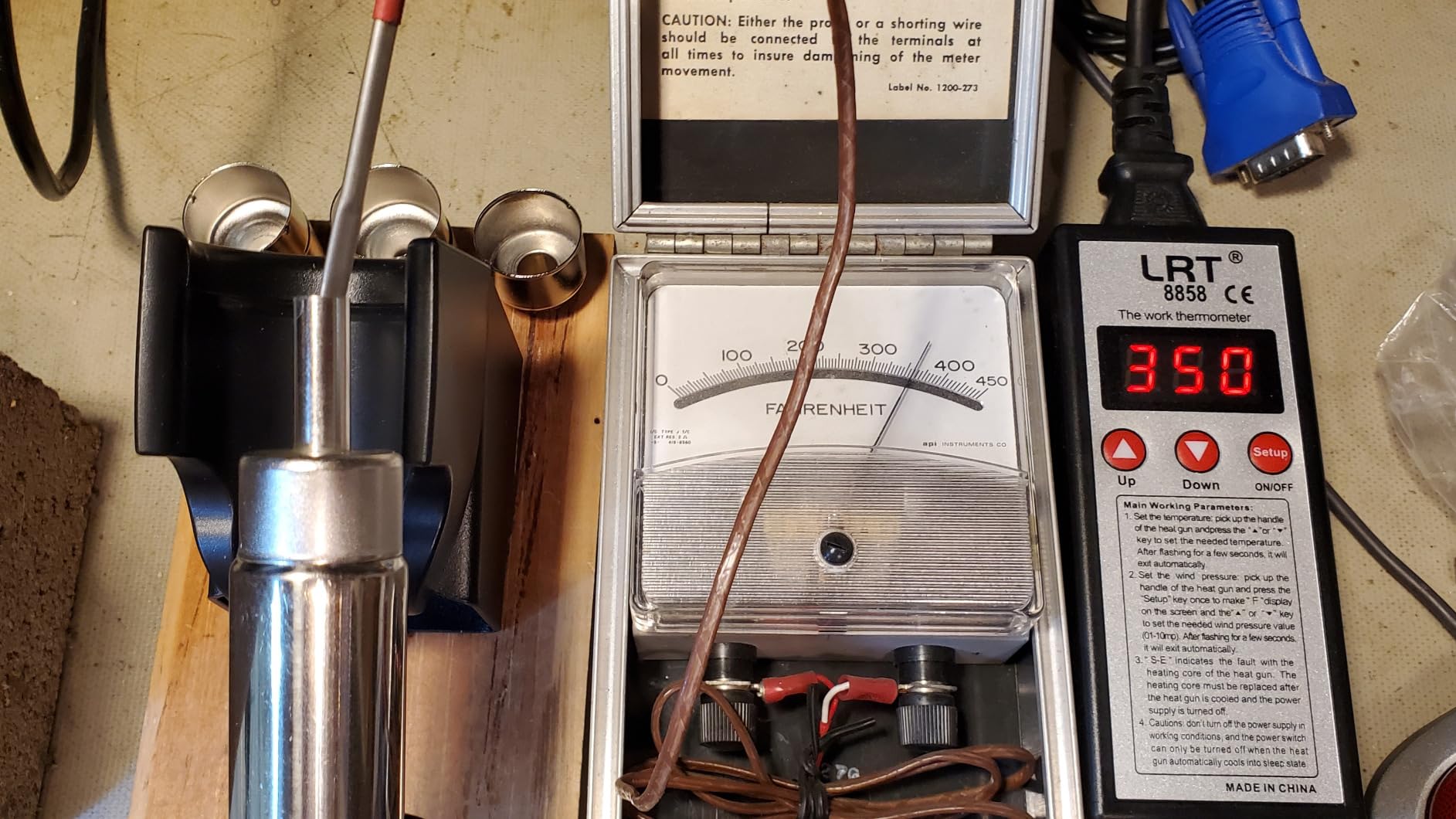
680W heating
100-500C digital control
F1-F10 airflow steps
0.7 kg body
six nozzles included
Pros
- Six precision nozzle sizes from 3 to 10mm cover most SMD work
- Intelligent sleep function cools the handle in the holder
- Micro-sized controller suits a cramped mobile repair bench
- Lightest unit here at 0.7 kg
- F1-F10 airflow steps give finer control than on-off
Cons
- Hot air only so through-hole work needs a separate iron
- Build and accessories are basic next to the 2-in-1 kits
- Highest share of one-star ratings among the LRT units here
Six nozzles in the box is the reason to look here. The kit covers 3, 4, 5, 6, 8 and 10mm, which is a genuinely useful spread for phone work, where you will move from a 0201 passive to a full-size connector in the same afternoon. Most competitors include three or four.
The stepped airflow control from F1 to F10 is a better interface than a single on-off switch, and it maps reasonably well onto the way you actually work. Low steps for a shield removal, high steps for a big connector.
At 0.7 kg and with a micro-sized controller, this is the easiest unit here to move between a bench and a counter, or to take to a customer site.
The sleep function cools the handle in the holder rather than just switching off, which protects the internal components and extends service life. On a unit this small, that is a sensible design choice rather than a gimmick.
The 100 to 500C range is the widest upper limit in the roundup, which gives you headroom if you ever move into thicker boards.
Why it works as a first station
It is a hot air only unit, and that is the correct shape for a beginner. You will use it for removal and placement, and you will add a soldering station when you realise how much through-hole work your jobs involve. Buying the two separately means you get a good iron rather than a bundled compromise.
Six nozzles plus ten airflow steps means you are not blocked by missing accessories on day one, which is where most budget kits frustrate beginners.
Where it falls short
Build quality and accessories are basic, and this unit carries the highest one-star share of the LRT products here. The 680W element is adequate rather than strong, so recovery on a large shielded area will feel slow.
Treat it as a learning and light-production tool. If a customer board has a dense multi-pin package in front of you, move up in wattage.
9. Aoyue 968A+ Is the Best 4-in-1 Workbench Unit
New Aoyue 968A+ SMD Digital Hot Air Rework Station… (110)
Hot air rework plus 70W iron
Vacuum pickup and smoke absorber
1 year manufacturer warranty
Pros
- Only true 4-in-1 unit here adding vacuum pickup and smoke absorber
- Built-in smoke absorber clears the bench during flux-heavy rework
- Established brand with a stated 1 year manufacturer warranty
- 70W soldering iron covers through-hole and general board work
Cons
- Heaviest unit in the roundup at 11 pounds
- Highest specification requirement of any station here
- Only 370 ratings so the long-term history is thinner than the alternatives
A phone repair bench generates two by-products that quietly fill a workspace: loose components and flux smoke. This is the only unit in the roundup that addresses both. The vacuum pickup lets you place a 0201 capacitor without touching it with tweezers, and the smoke absorber pulls fumes away instead of letting them drift across your bench and your face.
For flux-heavy work, the absorber is not a luxury. A screen full of solder mask and burnt flux residue is the reason many techs develop headaches by the end of a charging IC session.
It is also the only unit here with a clearly stated manufacturer warranty from an established brand, which is what you want on a bench that has to run every working day.
The 70W iron is modest, so we would treat it as the secondary handpiece. Its strength is the hot air and the two extra functions rather than soldering capability.
Aoyue has been in this market long enough that parts and guidance are easier to find than for newer labels, which matters when a handpiece fails.
What the four functions actually change
The vacuum pickup sounds minor until you try to place a shielded capacitor or lift a torn pad remnant. Component placement goes from a two-handed operation to a one-handed trigger pull, and you stop launching small parts across the bench.
The smoke absorber matters more over a full day than in a single session. Routed close to the board, it keeps the air above your work clean, which is a real comfort difference on long rework sessions.
Where it falls short
It is 11 pounds and 12.17 inches tall, so it needs a proper bench rather than a folding table. It is also the largest commitment in the roundup, and the rating sits at 4.4 across 370 ratings, which is a thinner record than the YIHUA units.
If you work mostly on small components and never do heavy flux jobs, you are paying for two functions you will not use every day.
10. LRT 858D Is the Best for USB-C Port Replacement
LRT 858D 700W Digital Hot Air Rework Station for PCB IC SMD Repair
700W heating element
Brushless fan
Lead-free compatible
Positioned for USB-C and phone repair
Pros
- 700W element gives rapid heat-up and good temperature recovery
- Brushless fan runs quieter and lasts longer than a brushed motor
- Explicitly positioned for USB-C port replacement and phone repair
- Ergonomic hot air handle for long repair sessions
- Lead-free compatible element supports continuous operation
Cons
- Hot air only so no soldering iron in the package
- Weighs 3 pounds which is heavier than the compact alternatives
- Accessory bundle is minimal at just fan and handle
USB-C port replacement is one of the highest volume phone repair jobs there is, and it is a demanding one. The port sits at the edge of the board, there is no room to position a nozzle symmetrically, and you have to lift the part without shifting the board underneath.
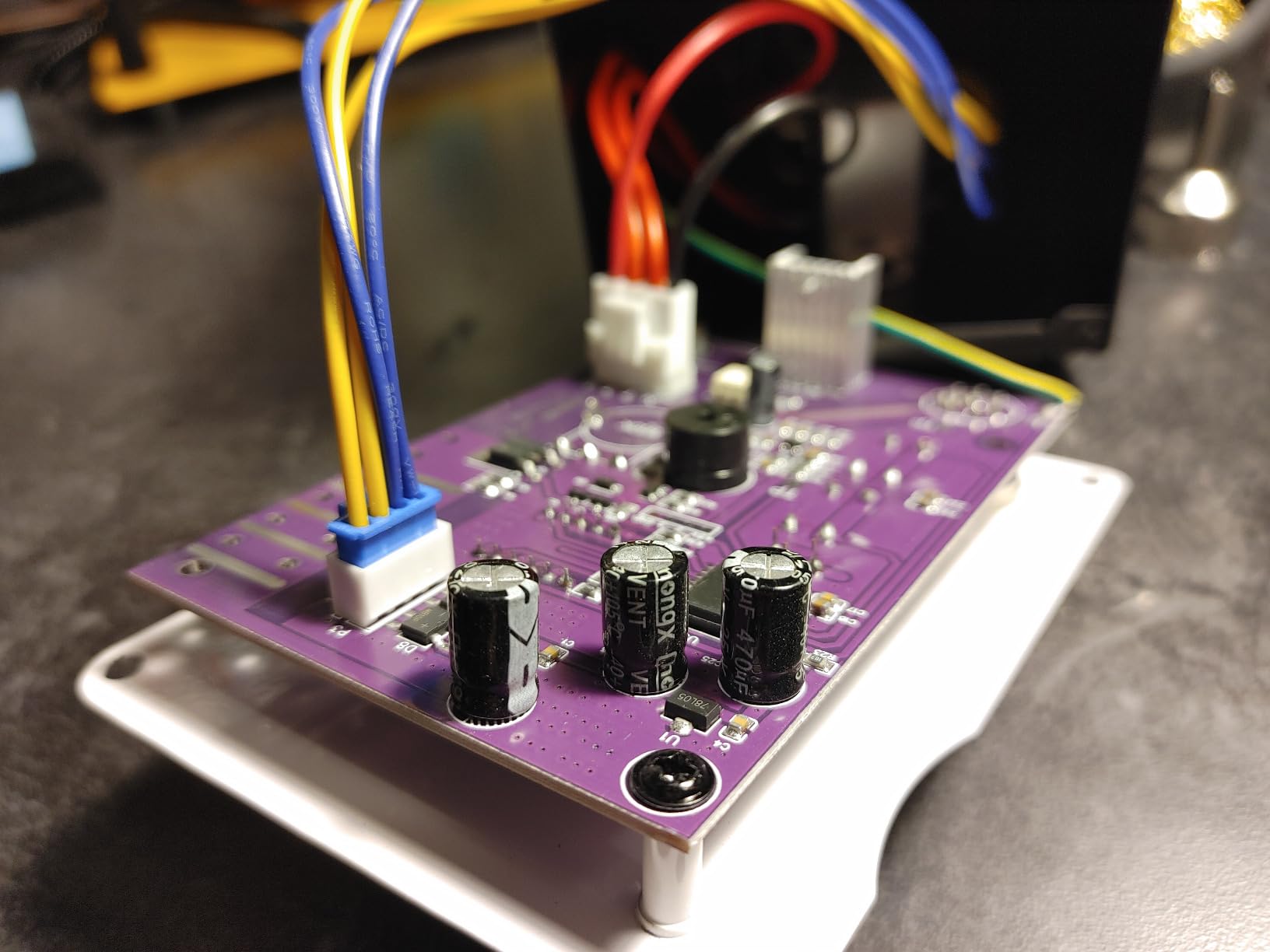
The 700W element here is what makes that workable. Fast heat-up and good recovery mean you can get to working temperature, hit the port, and pull it before the heat spreads along the board edge. A slower element makes you reheat repeatedly, and each reheat is another chance to cook an adjacent component.
The brushless fan is the second reason. It is quieter and has a longer operating life than a brushed motor, and on a job where you are holding a nozzle in place for several seconds, lower noise means you stay focused.
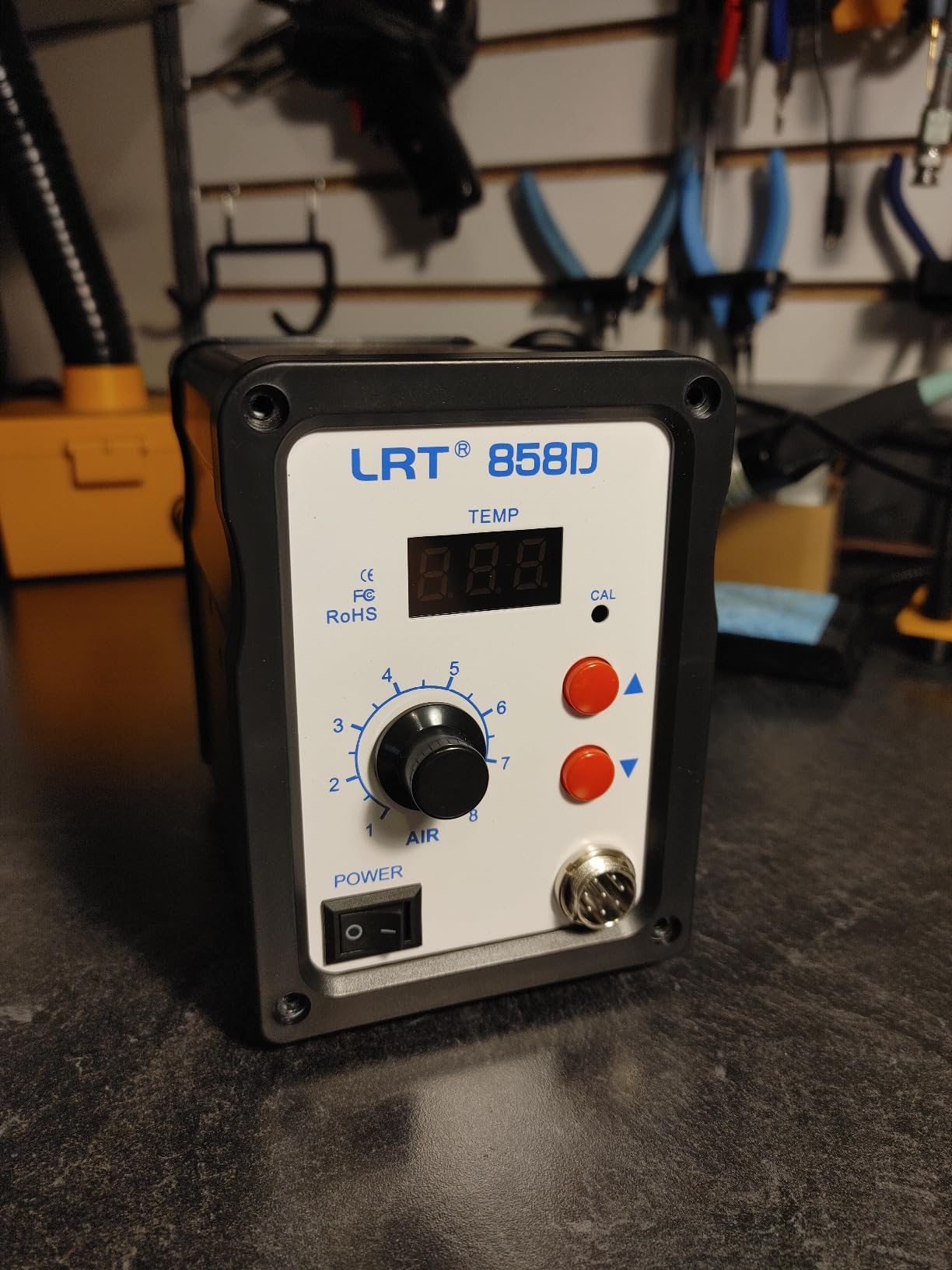
Temperature and airflow are both adjustable from the front panel, and the lead-free compatible element is the right call since almost all current phone work is on lead-free board finishes.
Seventy-five percent of 323 ratings are five stars, and owners consistently single out the brushless fan as the difference against cheaper hot air guns.
Why USB-C work rewards wattage
Edge-of-board connectors get heat from one side only. Without enough power, you either wait too long and cook the neighbouring display connector, or you accept a joint that never fully cleared. Recovery speed is the whole game here, and recovery scales with element wattage more than with any other spec on the box.
Reviewers also point out the ergonomic handle makes long sessions bearable, which matters more than it sounds when you are doing five or six port jobs a day.
Where it falls short
It is hot air only, so you need a separate iron, and the accessory bundle is minimal at just the fan and handle. You are buying airflow capability, not a full kit. At 3 pounds it is also the heaviest of the compact hot air options.
If your work is mostly port and connector swaps, the power here is well spent. If you also reball small BGAs, look at a unit with a preheater in the mix.
11. Beaiguna 2-in-1 Is the Best Budget Bench for Learning
Beaiguna 2 in 1 Hot Air Rework Soldering Iron Station Kit, Precision Circuit Board Soldering Gun Kit, Rapid Heat up Solder Station, Upgrade Dual System Independent Control, Auto Sleep & Calibration
700W with copper transformer
Independent dual switches
Auto calibration via CAL hole
Hot air 100-480C
Pros
- Least expensive 2-in-1 unit in this roundup
- 700W output from a pure copper wound transformer
- Independent dual switches let you run each handpiece separately
- Auto calibration procedure is documented in the listing
- Sleep mode and C to F conversion included
Cons
- Lowest average rating here at 4.2 with 11 percent 1-star ratings
- Display shows hot air temperature only since the iron is knob controlled
- Included tips can sit loose in the chuck and need tapping to seat
- Auto sleep interrupts longer jobs mid flow
The 700W copper transformer is more than you would expect at this level, and it is why the heat-up is quick enough to learn on. If you are building a first bench and you want a real 2-in-1 layout rather than buying two boxes, this is the honest budget option.
The dual switch design is genuinely useful and often missing at this level. You can leave the iron on standby while you work on hot air, and you are not fighting a single shared channel.
Auto calibration through the CAL hole is documented in the listing, which is more help than most units in this class provide. Set it once against a reference thermometer and the readout becomes trustworthy.
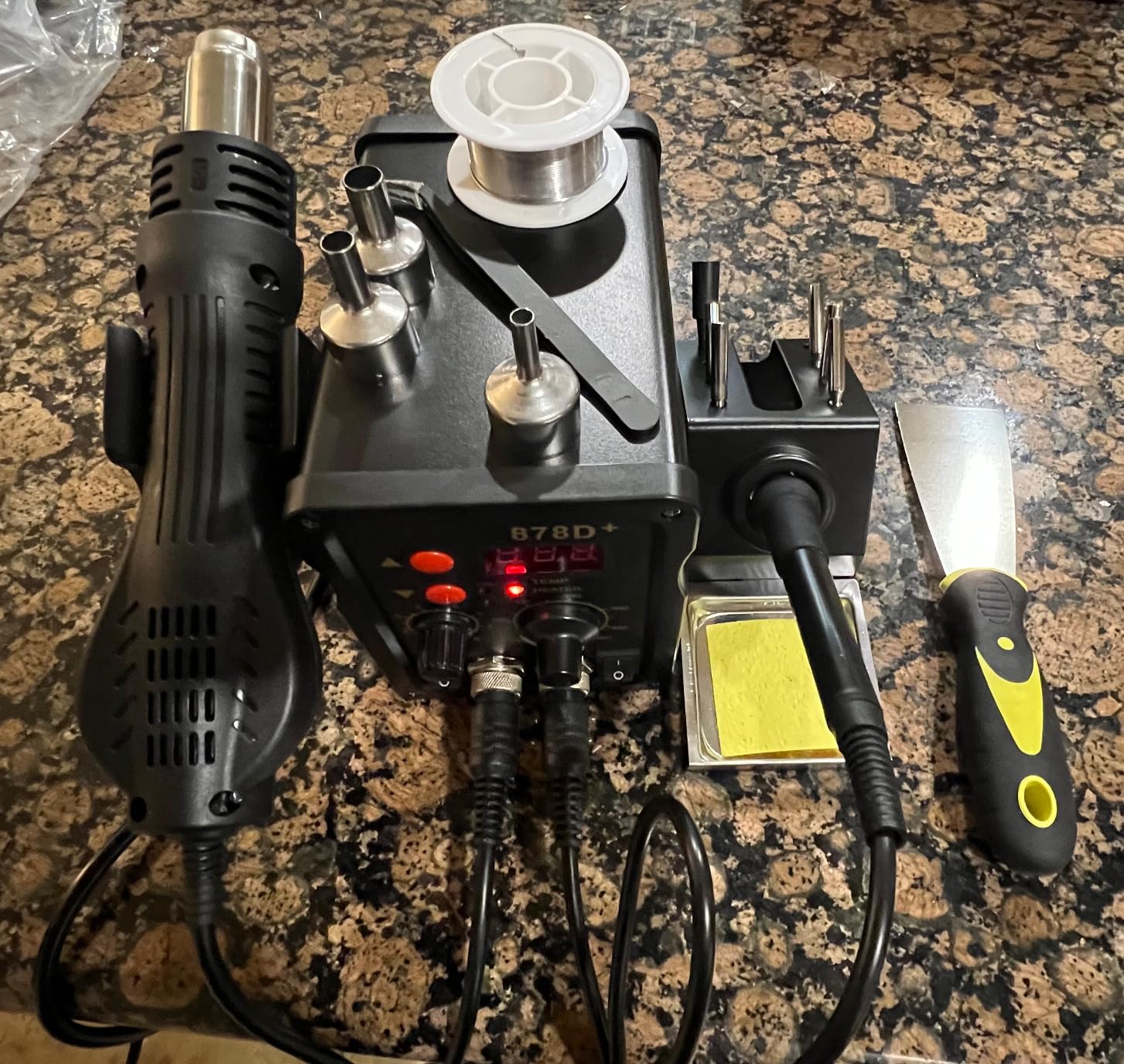
The kit includes 5 tips, 3 nozzles, 30g of lead-free wire, a desoldering pump, a sponge and tweezers, so you can start a job without a supply run.
Hot air covers 100 to 480C and the iron 392 to 896F on a knob scale.
Why this suits a training bench
Learn to remove and place components on practice boards before you touch customer hardware. For that, what matters is that the unit gets hot fast, holds a setting, and does not surprise you mid-job. A 700W element with independent switches and a calibration path gives you all three without a large outlay.
It is also the least expensive way to get a genuine two-handpiece layout on your bench, which makes it a sensible step up from a single hot air gun.
Where it falls short
The 4.2 average with an 11 percent one-star share is the weakest rating in the roundup, and it reflects real inconsistency rather than noise. The display shows only the hot air temperature while the iron is knob controlled, so you cannot see the iron temperature at a glance, which is exactly what you want while learning.
Auto sleep can cut out during a long job, and loose tips in the chuck need tapping to seat. Practice on scrap boards, not on a customer motherboard, until you know its behaviour.
12. BAKON BK701D Is the Best for High-Heat Desoldering
BK701D 700W Soldering Station, 2 In 1 Hot Air Rework & Soldering Iron Station, SMD ESD Safe Solder Station,Electronic Soldering Kit For Mobile Phone Laptop Repair or Circuit Board Soldering
90W soldering station
700W hot air reaching 932F
PID at 20ms
10 minute auto sleep
Pros
- Hot air gun reaches 932F for demanding rework
- 90W iron output for through-hole and connector work
- PID control cycling every 20 milliseconds
- 10 minute auto sleep extends heater core life
- One year USA warranty with 24 hour technical support
Cons
- Lowest rated unit here at 4.2 with a 12 percent one-star share
- Only two hot air nozzles supplied
- Single channel architecture limits parallel control
Two wattage figures here beat everything else in the roundup: a 90W soldering station and a 700W hot air gun that reaches 932F. That headroom is what you want when removing a stubborn connector or a heat-sunk pad on a board that has already been worked on once.
The 20 millisecond PID cycle on both handpieces is the same class of control loop as the top pick, and the auto sleep after 10 minutes in the holder extends heater core life on a station that will see long days.
It is also pitched squarely at the jobs this roundup is about. The listing names wiring seat desolder and mobile phone wiring work directly, and covers SOIC, CHIP, QEP, PLCC, BGA and SMD packages.
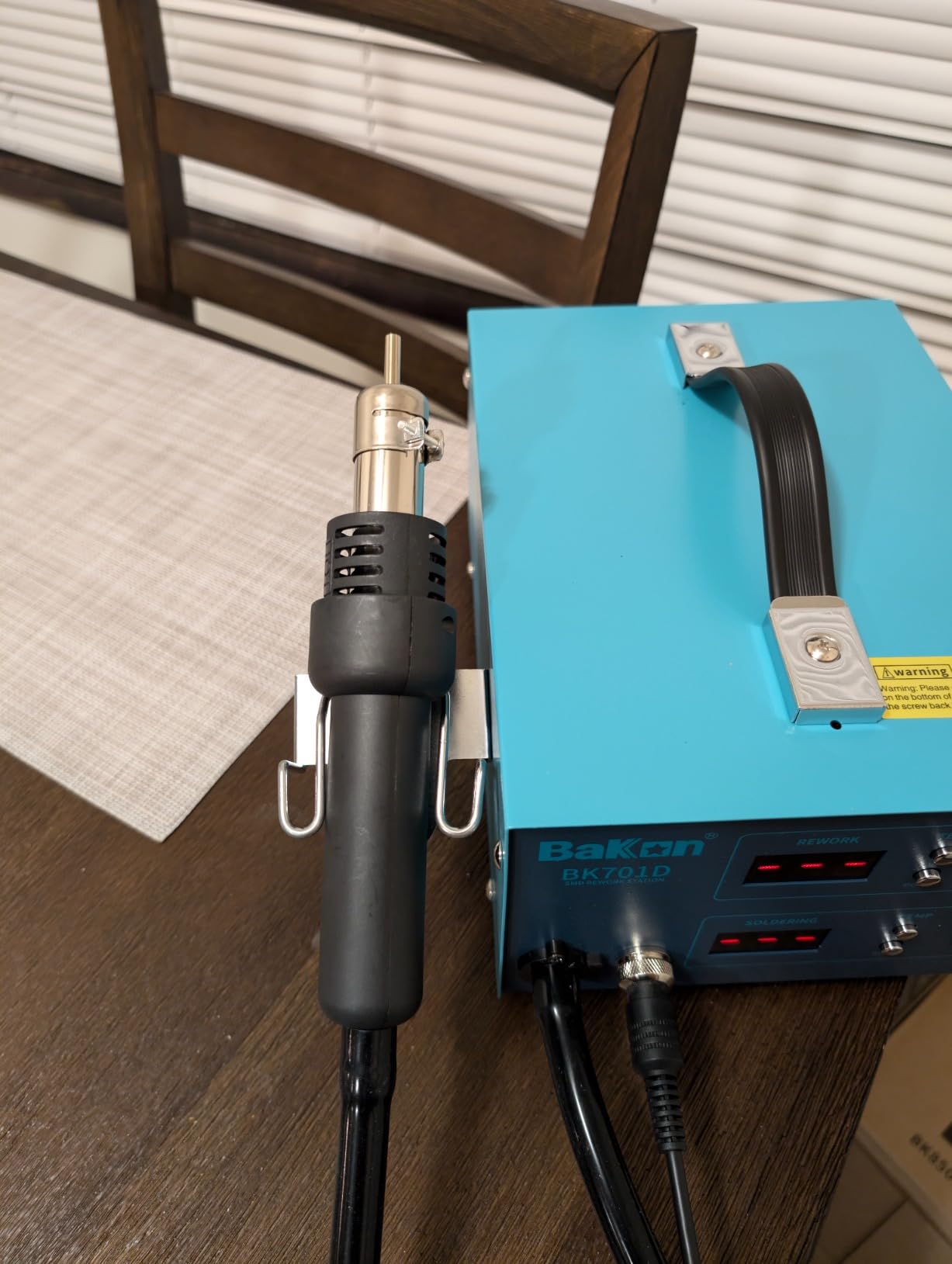
The kit is complete for a start: solder wire, 5 tips, suction tape, brass wool, a desoldering pump, tweezers and 2 nozzles. The USA warranty with 24 hour technical support is a genuine advantage over marketplace-only support.
Both handpieces operate independently within the single channel, so you can run the iron and the gun at their own temperature settings.
When extra heat ceiling is worth it
Raising the ceiling only helps on a small number of jobs, and those jobs are exactly the ones that lose you money when you cannot finish them. Stale flux, a previously reworked port, or a large ground plane all take longer to heat through than a fresh board does. Having headroom means one clean pass instead of three.
The 90W iron is also the strongest in the roundup, which makes this the best single box if you do a genuine mix of through-hole and surface-mount work.
Where it falls short
The 4.2 average with a 12 percent one-star share shows more inconsistency than the YIHUA and WEP units, so expect more variation between units. Only two nozzles are included, and a single channel limits parallel control when you want both handpieces live at separate settings.
If consistency matters more to you than raw heat ceiling, the overall pick at the top of this list is the steadier machine.
What Actually Matters When You Buy a Hot Air Station
PID stability beats peak temperature. Nobody needs 500C on a phone board. You need the setpoint it chooses to still be the setpoint it reaches in minute four of a long job. Units quoting a stability figure of 1 to 2 degrees are in a different class from those that quote nothing.
Mains voltage is the mistake nobody warns you about. Every unit in this roundup is a 110V US-specification model, and that is stated on the box. If you are outside the US, a 110V unit on a 220V supply will not reach temperature, and a step-up transformer adds heat and lag. Check the voltage marking before you order, because this is the single most common expensive surprise in this category. If you travel or move benches, a station that runs on the local supply removes the problem entirely.
Pump and fan architecture. Stations with the blower in the base run cool in the hand and last longer. Units with a blower inside the handle get hot, run noisier, and fail sooner at the motor. Where the listing does not say, assume the budget option puts the fan in the handle and ask the seller before committing to paid work.
Nozzle compatibility and how many you need. For phone repair, three nozzle sizes cover almost everything: a small one around 3 to 4mm for 0201 and 0402 passives, a medium around 5 to 6mm for ICs and shields, and a large 8 to 10mm for connectors and shielding cans. Confirm the nozzles are a standard fit you can source again later, because a proprietary fitting turns a missing nozzle into an end-of-life station.
ESD safety and a grounded output. You are handling boards that cost more to replace than the station. Every unit here is described as ESD safe or anti-static, which is the baseline you should refuse to go below.
Wattage and recovery. Higher wattage means faster recovery on a cold multilayer board. The jump from 700W to 750W matters far less than the jump from a 22W element to 700W, so do not over-index on the small differences in this roundup.
Warranty length and parts support. Budget brands commonly offer a one year warranty with no regional service network and no spare heater supply. Before buying, search for a replacement heater and a replacement handle for that exact model. If nothing turns up, the station is effectively disposable, and that is worth knowing before you rely on it.
Do you need bottom preheat? Thick multilayer phone boards and nearly all laptop boards benefit from a preheater plate underneath, set around 150 to 180C, because top-side heating alone pulls heat through the board and can warp it. A preheater is the one accessory we would not skip. Our guide to the best hot plate preheaters for SMD rework covers the options.
One more comparison worth making early: a hot air rework station blows temperature-controlled air through a nozzle to melt solder without touching the part. A heat gun has no closed-loop control, no calibrated readout, and no airflow regulation, so it is a tool for heat shrink and glue, not for board work. A full BGA rework system adds a bottom preheater, an infrared or thermocouple-controlled heating plate, and often a microscope mount, which is what dense multi-row BGA reballing actually requires. A bench station plus a preheater covers most phone work; a true rework system is for laptop logic boards and large BGAs.
Temperature and Airflow Settings for Common Phone Repairs
These are starting points, not laws. Adjust for your board, your flux, and how long the nozzle sits in one place. Always keep the nozzle moving and give the board something to cool against.
Charging IC removal (lead-free phone board). 375 to 400C with 30 to 40 percent airflow, medium nozzle, and a 150 to 180C preheater underneath. Lift with tweezers as soon as the solder under the part goes liquid, and do not wait for the part to tilt on its own.
Power IC removal. 380 to 420C, low to medium airflow, medium nozzle. Power ICs are bigger and often ground to a copper pour, so you need more heat and a steadier hand. A preheater is close to essential here.
USB-C port replacement. 360 to 390C with airflow kept moderate, small nozzle aimed from the board edge inward. The port is a low-mass part, so excessive airflow will launch it before the solder clears. Add low-flow solder underneath the port before you heat, and hold the board down.
Shield and EMI can removal. 320 to 360C with high airflow. You are heating the joint, not the component, and a light shield should lift on its own at that setting. If it does not, add heat rather than airflow, because airflow just moves the heat away.
Small connector or antenna contact desolder. 340 to 380C with low airflow and a fine nozzle, moving constantly. This is where 0201 and 0402 passives nearby get carried off if your airflow is too aggressive.
Tin-lead (Sn63Pb37) boards. Drop roughly 30C from the lead-free figures, because the alloy melts earlier and needs less dwell. Lead-free SAC305 needs the higher window and more patience.
Cover glass adhesive removal. Keep the station off the board for this one. Low temperature and long dwell with a separation wire or controlled plate heat damages the display far less than hot air does.
Two habits separate a good result from a lifted pad. Preheat the board before you apply top-side heat, and use fresh no-bobble solder on the joint you are about to heat, because old oxidised joint is what actually fails to clear.
Frequently Asked Questions
What is the best heating machine for mobile phone repairing?
For board-level work the answer is a hot air rework station with PID temperature control, a grounded ESD-safe output and adjustable airflow, and in this roundup the YIHUA 862BD+ is the strongest all-round choice. It is ETL-certified, holds a 200 to 480C range, cycles its PID loop every 20 milliseconds and ships with four nozzles and six iron tips. A cheaper station is fine for learning, but verify its temperature against a reference thermometer before you take customer boards.
What temperature and airflow should I set for phone board repair?
Start at 375 to 400C with 30 to 40 percent airflow for a charging IC on a lead-free phone board, and put a 150 to 180C preheater underneath. Shield removals need less heat and more airflow, around 320 to 360C, while USB-C ports want a small nozzle and moderate airflow so the part does not fly off before the solder clears. Tin-lead boards work about 30C cooler than lead-free.
Do I need a preheater for phone board repair?
Yes, once you are working on multilayer boards or any large ground plane. Top-side heating alone pulls heat through the board and can warp it, and a 150 to 180C preheater under the board reduces both the top-side temperature you need and the cook time on neighbouring components. It is the single accessory we would add first after the station itself.
Can I use a heat gun instead of a hot air rework station?
Not for board work. A heat gun has no closed-loop temperature control, no calibrated readout and no airflow regulation, so the actual delivered temperature drifts and you cannot tell what the board is seeing. It is fine for heat shrink tubing, softening adhesive and lighting a board evenly, but removing or placing a surface-mount component needs a PID-controlled hot air station.
How often should I calibrate a hot air rework station?
Check it against a reference thermometer when you first get the station, then every six months and any time you replace a heater. Budget units often arrive a few degrees off, and the drift grows as the element ages. Several stations here include a calibration function, which takes a few minutes to run and saves you guessing at a permanent offset.
What mains voltage do I need, 110V or 220V?
Match the station to the supply at the bench, not to where you bought it. Every unit in this roundup is a 110V US-specification model, so on a 220V supply it will never reach setpoint temperature. A step-up transformer will bring voltage up but adds heat and lag, which defeats the recovery you are paying for. Outside the US, confirm the voltage marking on the listing before ordering.
Which Station Should You Buy: Picks by Buyer Type
If you are taking paid phone work, the YIHUA 862BD+ is the pick. It is the only unit here with a real certification mark, the tightest control loop on the list, individually replaceable handpieces, and the deepest owner history of anything we reviewed. Run a calibration pass on day one against a reference thermometer and it will serve a full bench career.
If you want the most proven value unit, the YIHUA 8786D I takes it. With 2643 ratings and an airflow fail-safe that cuts element power, you are buying a station whose real-world behaviour is well documented.
If your work includes dead boards and charge-circuit diagnosis, the YIHUA 853D 2A USB gives you a DC supply, a voltmeter mode and a USB test port in the same box. That is worth more to a data-recovery tech than any extra wattage.
If bench space is your problem, the WEP 882D is 750W in a 1.1 kg body and the WEP 8858-V is smaller still if you already own an iron. If you need smoke extraction and vacuum pickup, the Aoyue 968A+ is the only unit that does both.
If you are learning, start with the Beaiguna 2-in-1 or the LRT 8858 and practise on scrap boards. If you mostly do USB-C ports and connector work, the LRT 858D brushless fan setup is built for exactly that.
Whichever you choose, add a preheater plate, an ESD mat, a microscope and a PCB holder before you take customer work. The station is the tool that melts the solder. The rest of the bench is what keeps the board in one piece while you do. Our wider SMD soldering picks are covered in our guide to the best hot air rework stations for SMD soldering.