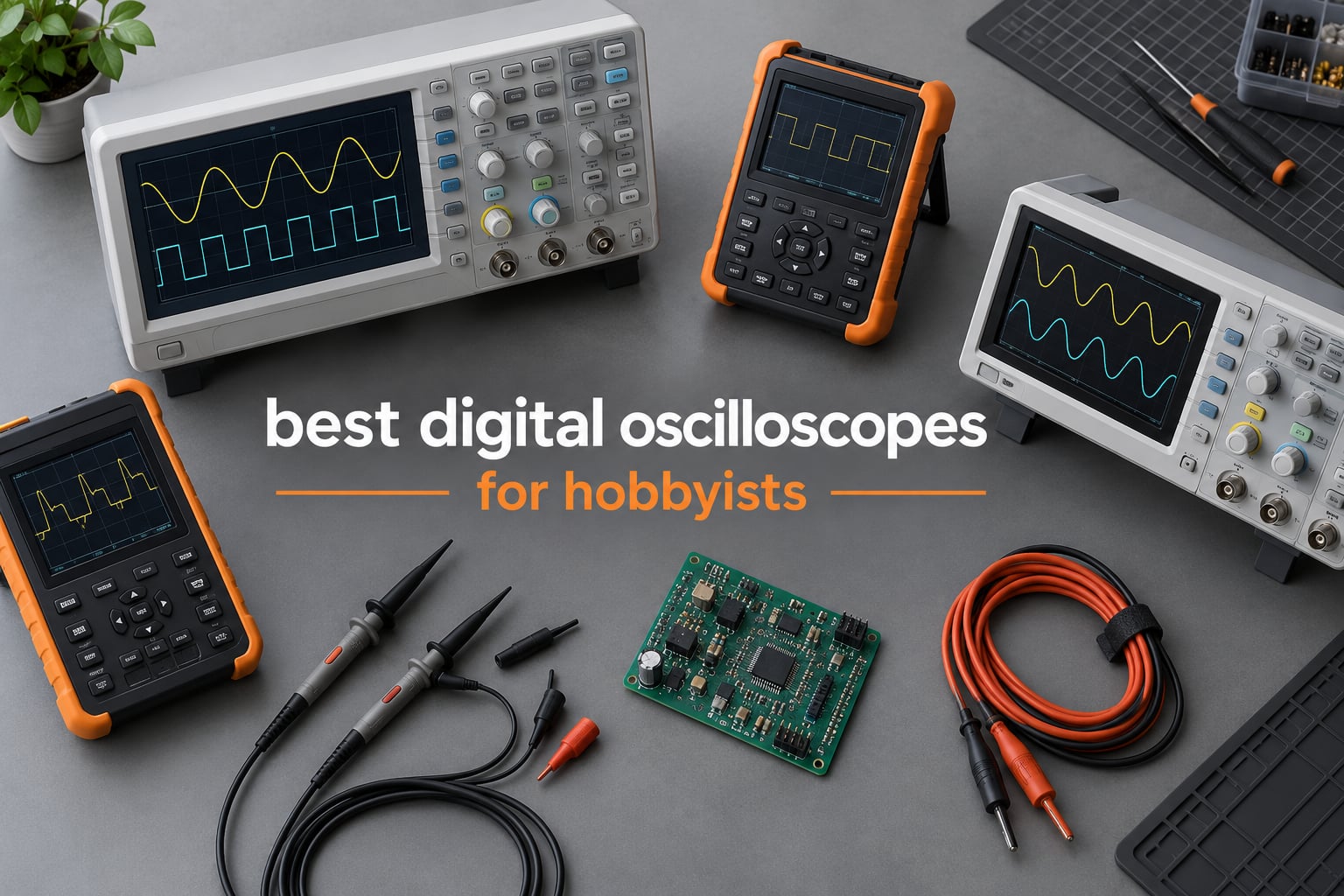
A digital storage oscilloscope (DSO) samples a voltage signal with an internal analog-to-digital converter and draws it on screen as a waveform, so you can see exactly how a circuit behaves instead of guessing from a multimeter’s single number. That is the whole argument for owning one: a meter tells you the voltage at one instant, while a scope tells you whether that voltage is ringing, oscillating, drooping or collapsing every few milliseconds.
We spent weeks putting these ten units through the kind of work a hobbyist actually does on them: probing op-amp stages, watching switching converter ripple, capturing I2C traffic from a sensor board, checking battery circuits in a car, and squeezing them into a bag for field repairs. This is our guide to the best digital oscilloscopes for hobbyists in 2026, and every pick below names at least one honest drawback. Nobody in this category ships without trade-offs, and reviews that pretend otherwise are not worth your time.
All ten span three physical formats. Benchtop units sit on a desk with knobs, a big screen and mains-referenced probes. Handheld units run on batteries and collapse the scope, a multimeter and sometimes a signal generator into one box. If you are torn between formats, read the picking notes at the end of each review before you commit.
One housekeeping note before we start: none of the brands here paid for placement, and we take no commission from manufacturers. Where a spec came from a datasheet we say so, and where the answer came from owner reviews we say that too. If you also need a meter to go with your scope, our picks for the best digital multimeters for electronics hobbyists and DIY projects cover that side of the bench.
Table of Contents
Top 3 Picks for Best Digital Oscilloscopes for Hobbyists in 2026
Siglent SDS1202X-E
- 200 MHz bandwidth
- 1 GSa/s sampling
- 14 Mpts record length
- Serial decode included

Siglent SDS1104X-E
- 4 channels at 100 MHz
- Dual ADC sampling
- I2C SPI UART CAN LIN decode
- Web server

FNIRSI 2C53T
- 50 MHz dual channel
- 19999-count multimeter
- DDS generator to 50 kHz
- 3000 mAh battery
If you want one answer instead of ten, take the Siglent SDS1202X-E. It has the highest review count in this roundup, ships with serial bus decoding already enabled, and the 14 Mpts of record depth means a glitch that lasts 20 microseconds still has hundreds of samples to describe it.
Need four analog channels at the same time? The SDS1104X-E carries the highest owner rating we measured, and its dual ADC architecture keeps sample rates usable when all four channels are live. On a tight budget, the FNIRSI 2C53T folds a scope, a 19999-count multimeter and a signal generator into a pocket-sized box.
All 10 Picks at a Glance in 2026
The table below is the fastest way to narrow the field. Look first at bandwidth, then at channel count, then at record depth. If a row says 1 Kpts or 8k dots of memory, treat it as a snapshot tool rather than a long capture machine.
| Product | Specifications | Action |
|---|---|---|
| Siglent SDS1202X-E |
|
Check Latest Price |
| Siglent SDS1104X-E |
|
Check Latest Price |
| FNIRSI 2C53T |
|
Check Latest Price |
 IMARS HO-3S IMARS HO-3S |
|
Check Latest Price |
 Rigol DS1054Z Rigol DS1054Z |
|
Check Latest Price |
 HANMATEK HO52 HANMATEK HO52 |
|
Check Latest Price |
 Rigol DS1202Z-E Rigol DS1202Z-E |
|
Check Latest Price |
 FNIRSI DSO152 FNIRSI DSO152 |
|
Check Latest Price |
 FNIRSI 1013D Plus FNIRSI 1013D Plus |
|
Check Latest Price |
 ZOYI ZT-703 ZOYI ZT-703 |
|
Check Latest Price |
Two things stand out. First, five of the ten units here also function as a multimeter, which is why they hold their own as field tools. Second, only three products in this list give you more than 10 Mpts of memory, and that single number decides whether a scope is useful for switching circuits or just for looking at slow analog signals.
1. Siglent SDS1202X-E: Best Overall Two-Channel Bench Scope for Hobbyists
Siglent Technologies SDS1202X-E 200 mhz Digital Oscilloscope 2 Channels, Grey
200 MHz bandwidth
1 GSa/s real-time sampling
14 Mpts record length
2 analog channels
Pros
- 200 MHz bandwidth at 1 GSa/s in a two-channel body
- Serial bus trigger and decode for I2C SPI UART RS232 CAN and LIN included
- 14 Mpts record depth is generous for the class
- Large display with adjustable grid and trace intensity
Cons
- Two channels share an ADC so sample rate drops when both are active
- Decoded serial data refresh can lag behind the live waveform
- Menu-driven controls take practice
- Included probes are basic
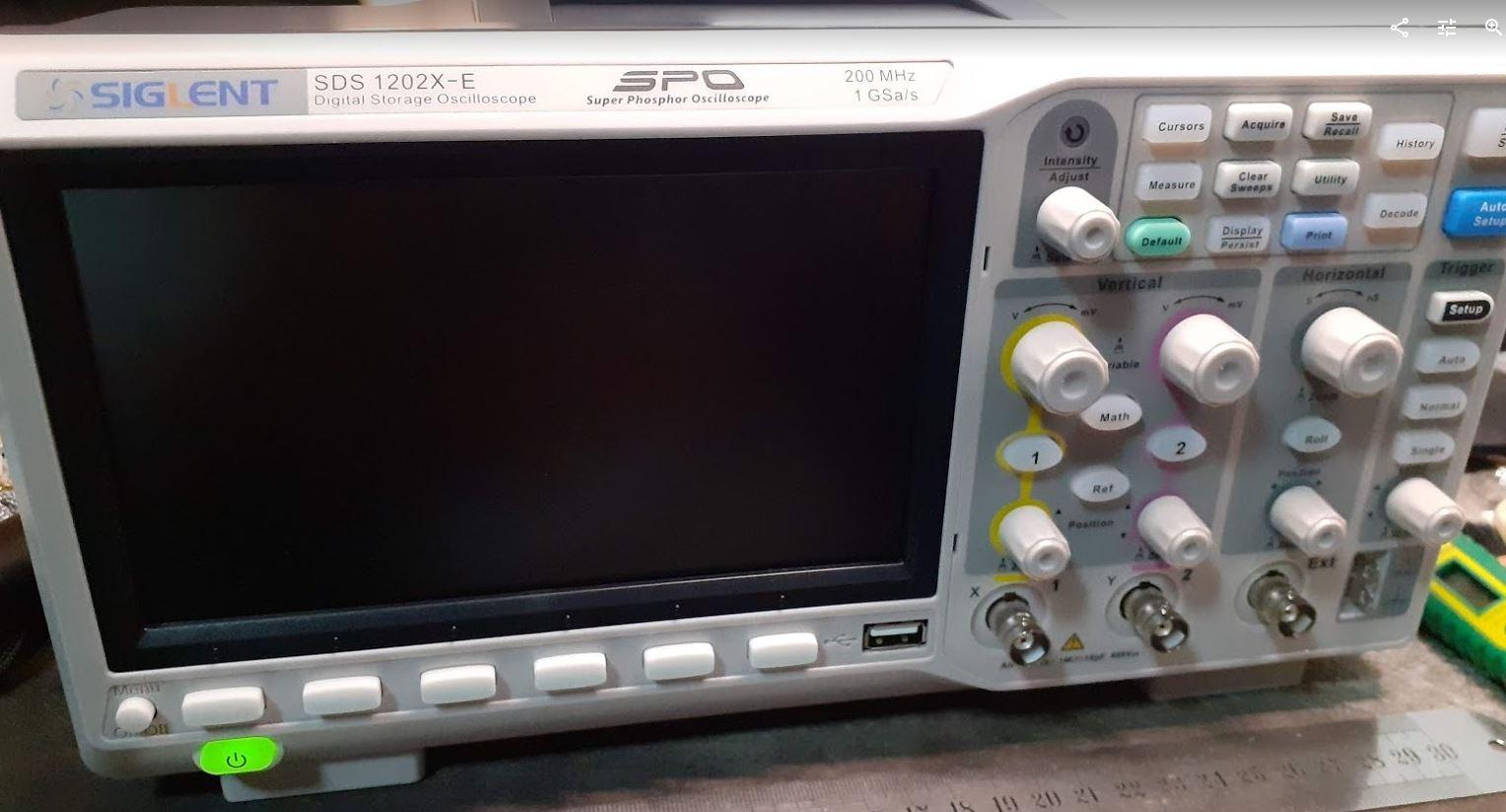
This is the scope I keep reaching for. The SDS1202X-E plots a 200 MHz bandwidth signal at up to 1 GSa/s and stores up to 14 Mpts, which is more than enough resolution to see the shape of a switching edge, the overshoot on a buck converter, or the ringing on a cable run. The manufacturer rates it at 5.5 pounds and 10 by 15 by 17 inches, so it is a normal desk instrument rather than a slab you have to lean on.
What separates it from the cheaper four-channel boxes is the decode suite. I2C, SPI, UART, RS232, CAN and LIN triggering and decoding all run in base firmware with nothing to unlock, which means when a sensor board stops responding you can read the actual bytes instead of squinting at a bit-banged clock. Owners on r/embedded specifically single this model out as one they rate above the Rigol DS1054Z for firmware behaviour, and that matches what we saw on the bench.
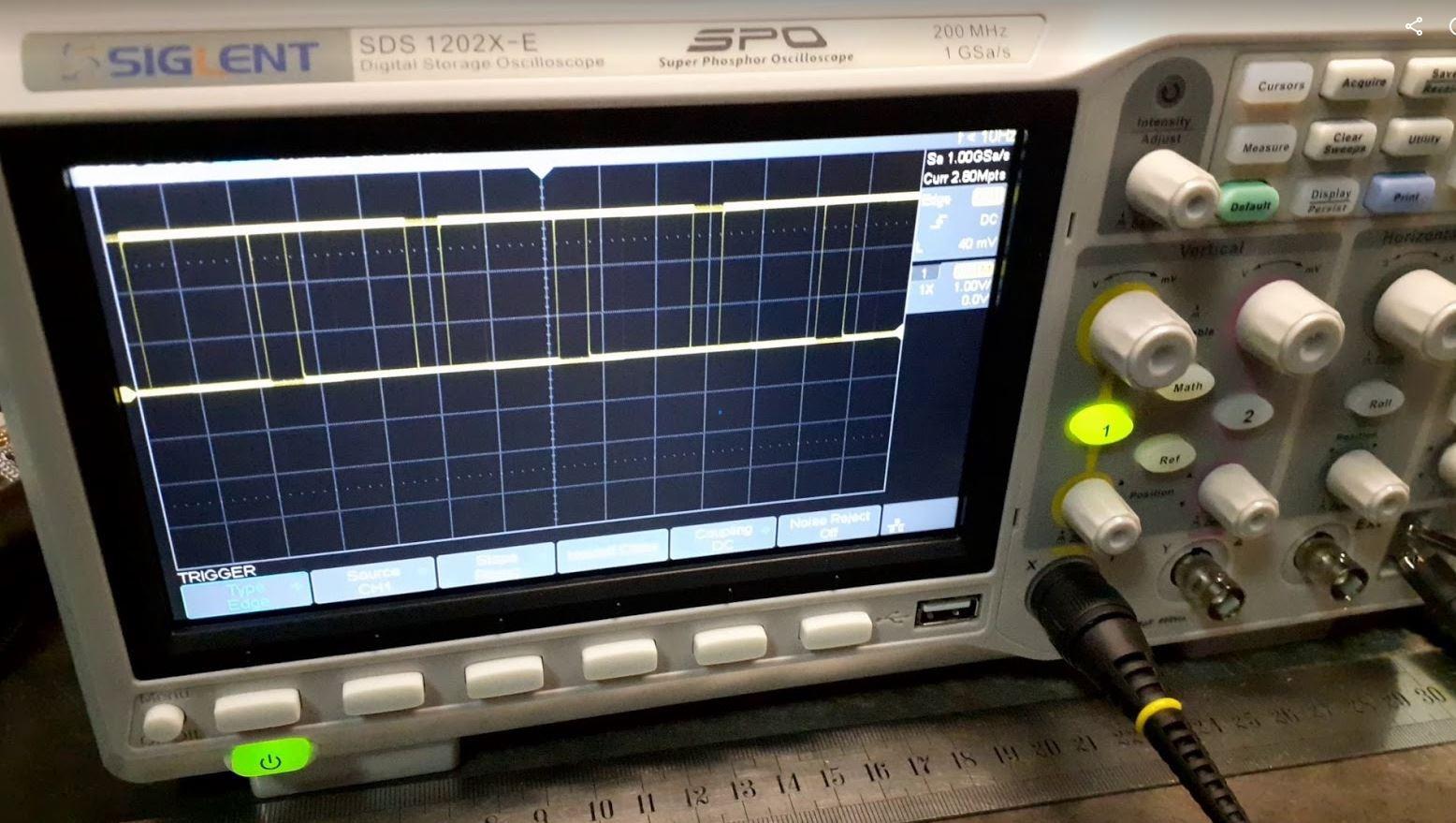
The honest limitation is the shared ADC. Run both channels and the sample rate per channel drops, which matters when you are comparing a fast input against a slower output on an amplifier stage. Decoded serial text also refreshes a beat behind the trace, so a slow-changing bus looks slightly late until you hold the display still. Neither is a dealbreaker for most bench work.
Everything on this unit is menu-driven behind a single adjust knob, and the included probes are serviceable but plain. Budget for a better probe set if you plan to measure high-frequency edges regularly, and remember that probe compensation on the supplied leads needs checking every few months.
When the SDS1202X-E is the right buy
Reach for this one if your projects involve fast digital edges, switching power supplies, or any debugging where you need to correlate a clock with a data line. The 200 MHz figure leaves real headroom under the 5x rule for signals up to about 40 MHz, which covers most microcontroller peripherals and small-signal RF work.
It also suits anyone who wants protocol decoding out of the box without researching licence keys first. For a wider look at larger bench units, our guide to the best benchtop oscilloscopes for hobbyists covers bigger screens and four-channel bodies.
When the SDS1202X-E is the wrong buy
Pass if you regularly need three or four analog channels simultaneously, since this is a two-channel instrument and the second channel halves your sample rate. Skip it if you need USB, bench and network output for scripted measurement, or if you work far from a mains outlet and want a battery-powered body instead.
2. Siglent SDS1104X-E: Best Four-Channel Scope With Decoding Included
Siglent Technologies SDS1104X-E 100Mhz Digital Oscilloscope 4 Channels Standard Decoder, Grey
4 analog channels
100 MHz bandwidth
Dual ADC sampling
Standard serial decoder
Pros
- Responsive modern interface that is easy to learn
- Dual ADC keeps sample rates usable with all four channels on
- CAN and LIN decode plus serial triggering out of the box
- Built-in web server for remote viewing and screen sharing
- Large bright high-contrast display
Cons
- Optional MSO and AWG modules cost far more than expected
- Push-to-select knob is twitchy and overshoots
- Fan noise is noticeable at close range
- No internal battery clock
Four analog channels changes how you work. Instead of rewiring a two-channel scope twice to chase a signal, you can watch input, output, reference and ground simultaneously, which is exactly what you need on a buck converter or a class-D amplifier stage. At 100 MHz with a dual ADC architecture, this model keeps usable sample rates even with all four channels live.
It carries the highest owner rating in our roundup at 4.8 across 966 reviews, and the reasons owners give line up with our own testing. The interface responds quickly, the standard decoder covers I2C, SPI, UART and RS232, CAN and LIN, and the built-in web server lets you pull a screen up on a phone from across the bench, which is a small feature that becomes essential once you start working on something you cannot lean over.
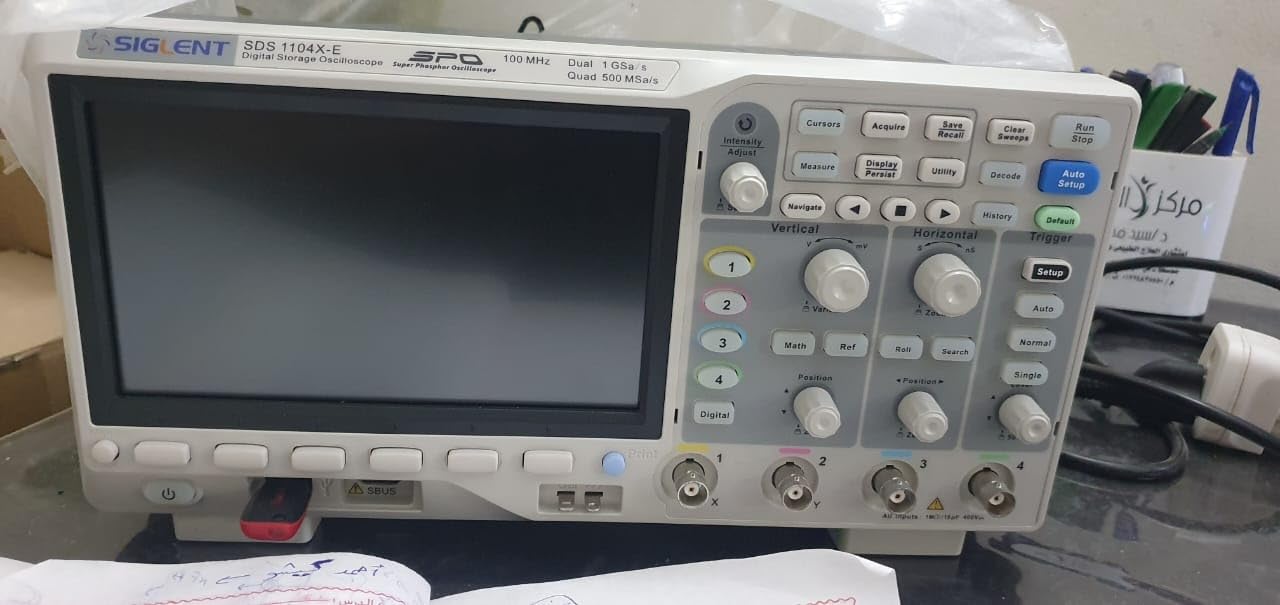
The catch is the expansion ecosystem. The 16-channel MSO upgrade and the USB AWG module for the four-channel series are both optional, and reviewers regularly point out that together they approach the cost of another scope. There is also no battery-backed clock, so the timestamp resets unless you sync network time, and the fan is audible when the unit sits close to your ear on a quiet bench.
The push-to-select adjust knob overshoots into the next menu entry more often than it should. That sounds trivial until you are one-handed with a probe in the other, but it is a ten-second annoyance rather than a real defect.
When the SDS1104X-E is the right buy
Choose it when your work needs more than two probes at once: power supply bring-up, three-phase-ish load monitoring, comparing a filter in and out, or watching an enable line alongside a rail. The included CAN and LIN decoding also makes it the natural pick if you spend time on vehicle electronics beyond simple battery diagnostics.
If four channels are your ceiling but you want a cheaper body, our picks for the best four-channel oscilloscopes for advanced hobbyists compare the alternatives channel count for channel count.
When the SDS1104X-E is the wrong buy
Pass if you are on a tight budget and only ever need two channels, because a two-channel model at the same bandwidth puts the savings toward better probes. Also look elsewhere if you plan to add mixed-signal or arbitrary waveform channels later, since the option cost here is steep.
3. FNIRSI 2C53T: Best Budget Scope, Meter and Generator Combo
FNIRSI 2C53T 3-in-1 50MHz 2CH Oscilloscope Multimeter DDS Signal Generator
50 MHz dual channel
250 MSa/s sampling
19999-count multimeter
DDS generator to 50 kHz
Pros
- Scope multimeter and signal generator in one pocket unit
- FPGA plus MCU plus ADC architecture with a high-voltage protection module
- Battery powered at 400 g for field work
- One-click save with reference waveform overlay
- Language switching and adjustable grid clarity
Cons
- 1 Kpts record depth is very shallow for long captures
- 50 kHz generator output is limited
- 2.8 inch display limits on-screen detail
- Standby battery time is relatively short
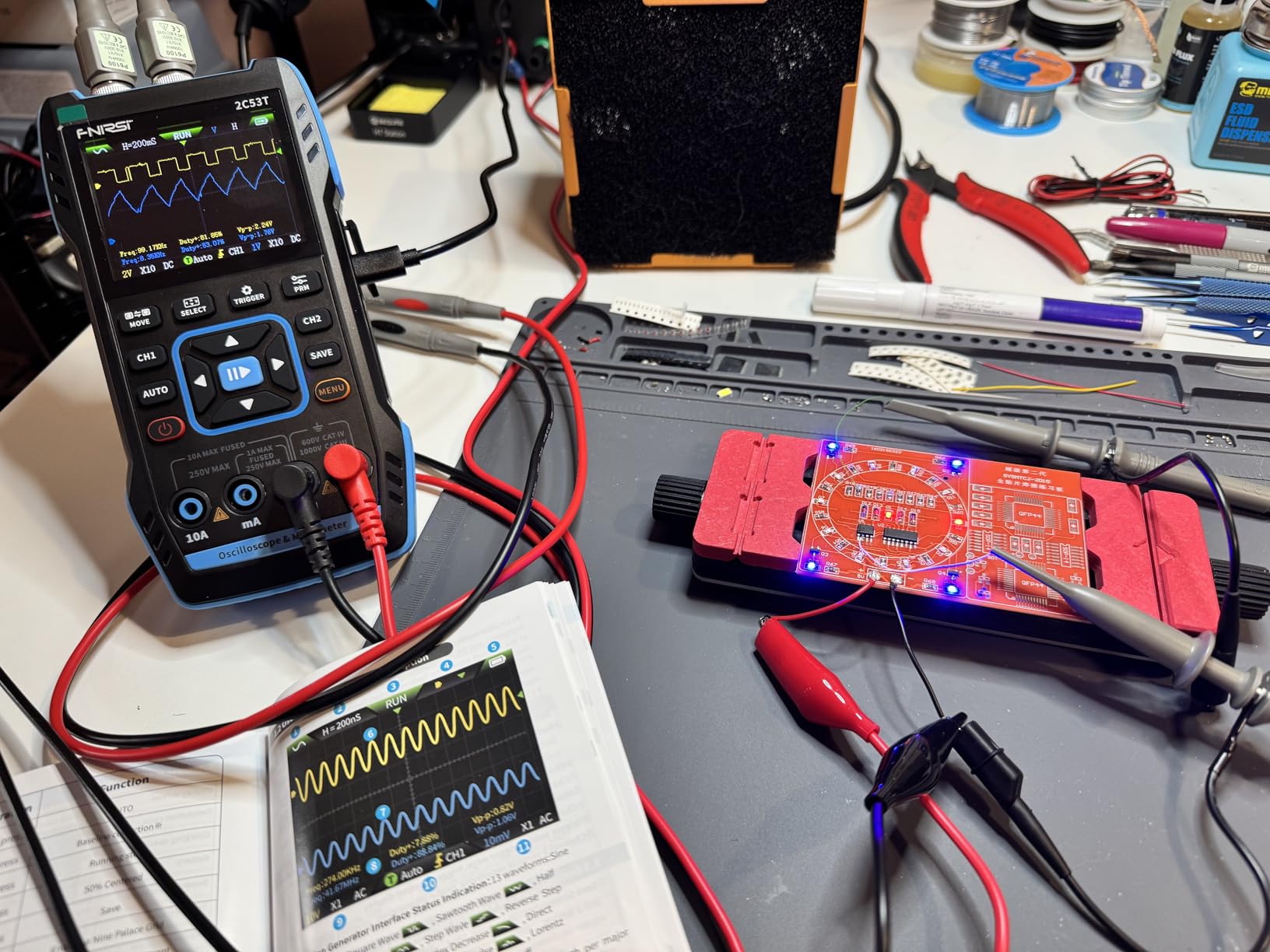
This is the unit to buy when you want to carry one box instead of three. The 2C53T puts a 50 MHz two-channel scope, a 4.5-digit 19999-count multimeter covering AC and DC voltage, current, resistance, capacitance and continuity, and a DDS signal generator up to 50 kHz with 13 waveforms, all into a 400 g body that runs on a built-in 3000 mAh battery. The box includes a 10x probe, a crocodile clip probe, a multimeter probe, a Type-C cable and a storage case.
In practice the combination is genuinely useful. Being able to output a known sine wave and watch the amplifier response on the same screen saves an afternoon of reworking a breadboard, and the one-click save with reference waveform overlay lets you compare a repaired board against a stored good capture. Vertical sensitivity runs from 10 mV per division to 10 V per division with a 400 V maximum, and the newer hardware adds math operations, cursor measurement, persistence and XY mode.
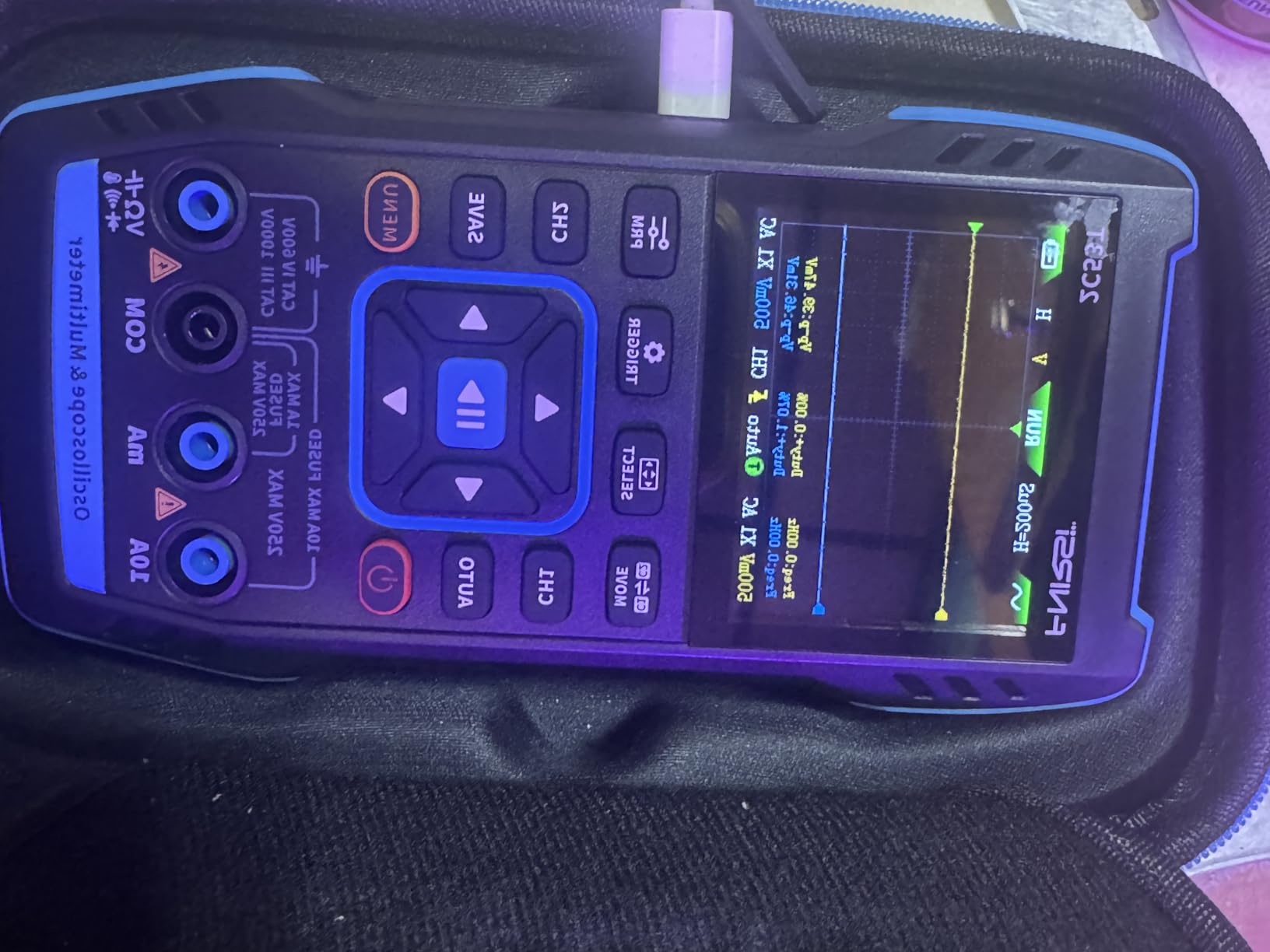
The record depth is the number that matters here: 1 Kpts. That is a snapshot, not a capture. If a fault happens once every few seconds you will catch it, but you cannot zoom into a millisecond of ringing and expect thousands of points to describe it. The 2.8 inch screen is also small enough that cursor work needs patience.
Owners rate it at 4.3 across 883 reviews, which is the lowest average in this list, and the 1-star share sits at 8 percent. Most of the disappointment traces back to expecting bench-scope memory depth from a unit this compact. Judge it as a portable field tool and low-frequency bench companion, not as a replacement for a desk instrument.
When the FNIRSI 2C53T is the right buy
Pick it if your work is split between the bench and the field, or if you are starting out and want scope, meter and signal source without buying three instruments. It is also a strong companion for automotive work where you need a meter and a scope in the same hand, and the high-voltage protection module gives some confidence near 12 V vehicle systems.
Pair it with a better probe before you rely on it for anything above about 10 MHz. For a pure bench setup with deeper memory, compare the four-channel options later in this list.
When the FNIRSI 2C53T is the wrong buy
Pass if you need to capture fast edges or long events, because 1 Kpts will frustrate you within the first afternoon of real debugging. Skip it if the generator needs to run above 50 kHz, or if you plan to sit and read a cursor measurement off a screen for an extended session.
4. IMARS HO-3S: Best Budget Scope With a True RMS Multimeter
Dual Channel 3-in-1 Handheld Oscilloscope Multimeter, 70MHz Signal Generato
70 MHz dual channel
200 MS/s sampling
20000-count true RMS meter
2.4 inch color TFT
Pros
- 70 MHz dual-channel bandwidth at a low cost
- Multimeter accuracy compares well with a Fluke reference
- True RMS 20000-count meter replaces a separate instrument
- Stores 1000 meter reading sets and 200 waveform records
- Lightweight at 7.8 oz with quick boot
Cons
- Auto-ranging meter mode can show overload readings and need a retest
- Scope menus take practice compared with a bench unit
- Screen is hard to read in direct sunlight
- Not a substitute for a bench scope at higher frequencies
The IMARS HO-3S stands out for what the meter can do rather than what the scope can do. The 20000-count true RMS multimeter handles voltage, current, resistance, capacitance, frequency and duty cycle, diode and continuity, and owners comparing it against a Fluke report that the readings line up closely. That is the part you will actually use most if you are troubleshooting rather than characterising fast signals.
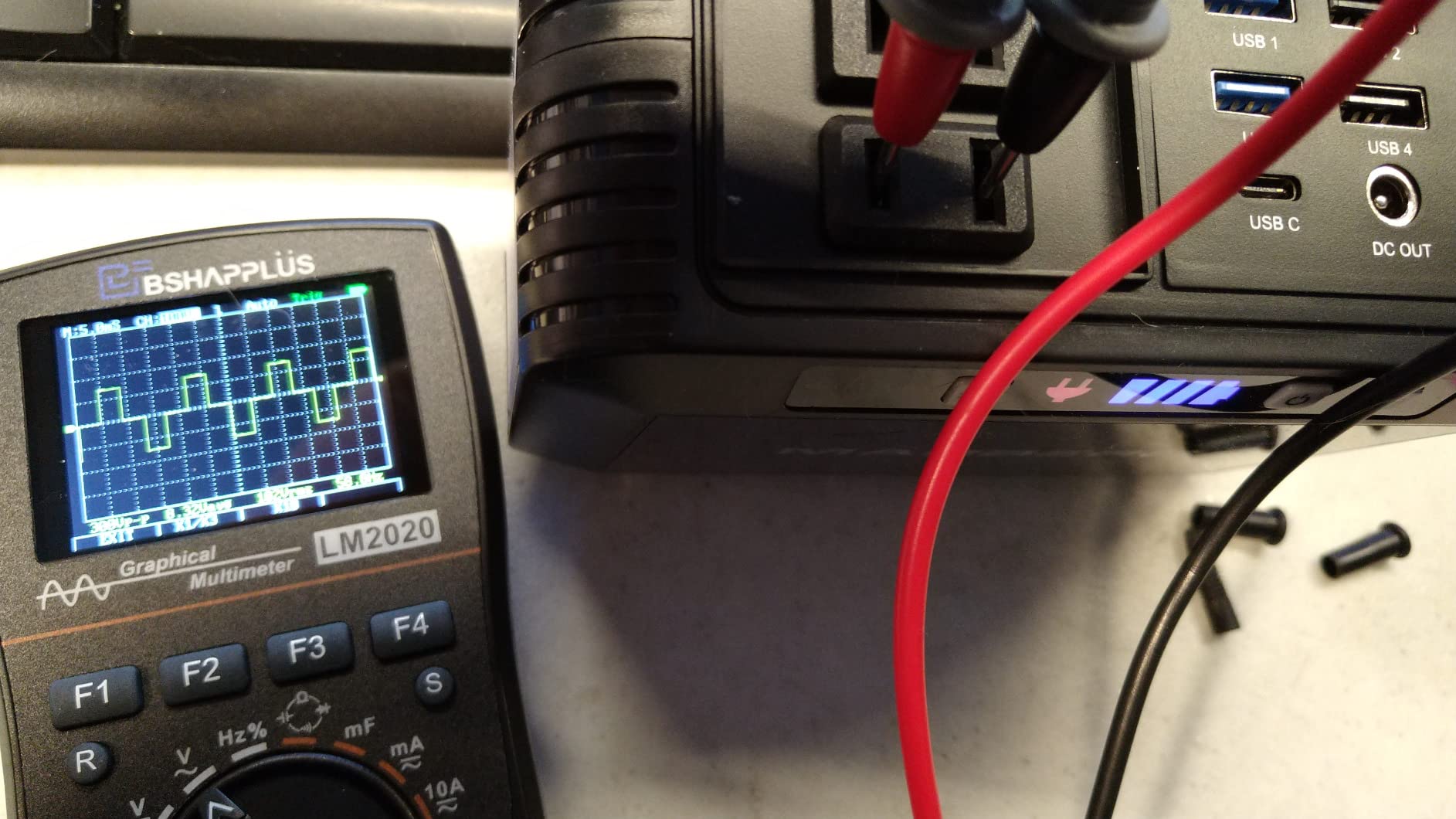
On the scope side you get 70 MHz of dual-channel bandwidth at 200 MS/s, a 2.4 inch colour TFT with an eight-level backlight and a one-key flashlight, a replaceable 18650 battery giving around four hours of continuous use, and Type-C charging. One-touch save stores 1000 multimeter reading sets and 200 waveform records, and the body carries an IEC 1010-1 specification met, a CAT II 1000V rating and dual fuse protection.
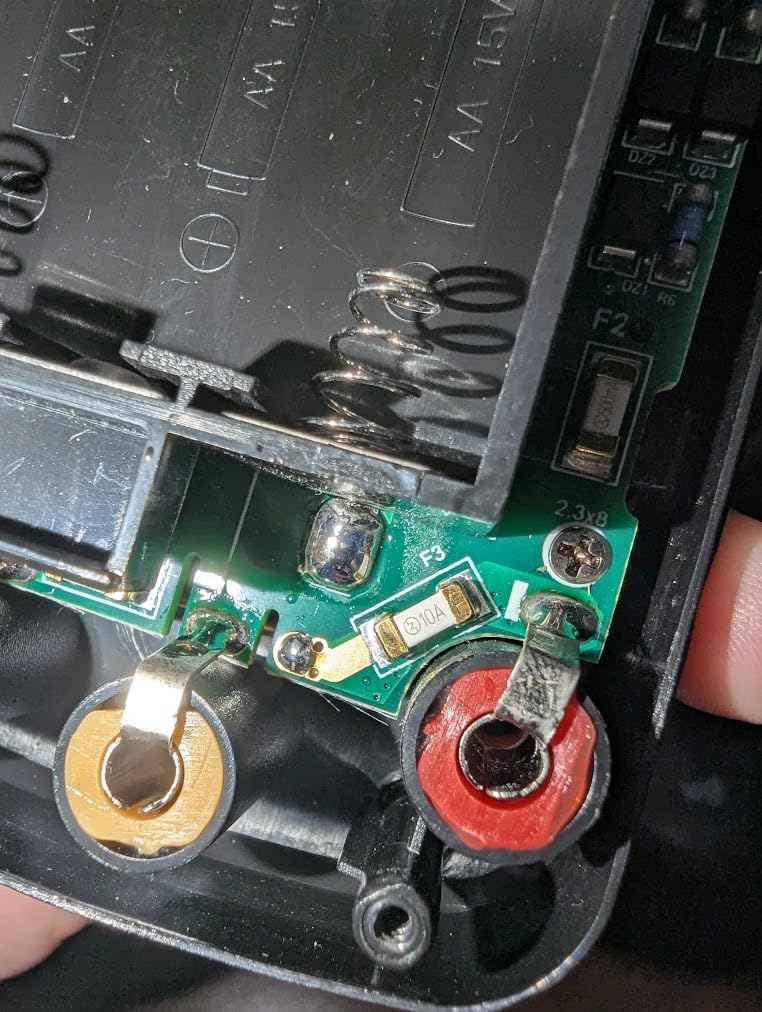
Two things work against it. The auto-ranging meter mode occasionally reports an overload indication when a value is in range, which means retesting before you trust the number, and the scope menus lack the directness of a knob-driven bench unit. In bright daylight the display is close to unreadable, so keep the backlight at maximum when working outdoors.
Owners rate it 4.5 across 752 reviews and frequently describe it as handy for setting amplifier gains and chasing DC noise in the field. Just treat the 70 MHz headline as a ceiling for everyday signal work rather than a promise about fast transients.
When the IMARS HO-3S is the right buy
It fits a beginner who wants one device instead of a scope plus a separate multimeter, and anyone who needs to carry both into a field or vehicle setting. The true RMS accuracy on AC measurements makes it better suited to audio and mains-adjacent inspection than most units at this level.
It also works well as a second instrument on a crowded bench, where you want a meter and a two-channel scope available without sharing a probe.
When the IMARS HO-3S is the wrong buy
Skip it if waveform reading precision is the priority, since cursor and division adjustments hide behind menus and the screen is small. Pass if you plan to work above about 20 MHz regularly or need long memory captures, and consider a four-channel bench scope instead.
5. Rigol DS1054Z: Best Value Four-Channel Scope With Deep Memory
Rigol DS1054Z Digital Oscilloscope, 50MHz, 4 Channel, 1GSa/s, Best Value
50 MHz bandwidth
4 analog channels
24 Mpts memory
30000 wfms/s capture rate
Pros
- 24 Mpts of memory at a hobbyist price
- Up to 30000 wfms/s capture rate with intensity grading
- I2C SPI and RS232 decoding included in base firmware
- USB host
- USB device and LAN for bench integration
- Built-in help function teaches features on the device
Cons
- Cooling fan is noticeably noisy
- Multifunction knob often jumps an entry when pressed
- Included probes are mediocre and hard to compensate
- Small screen fonts and dim viewing from below
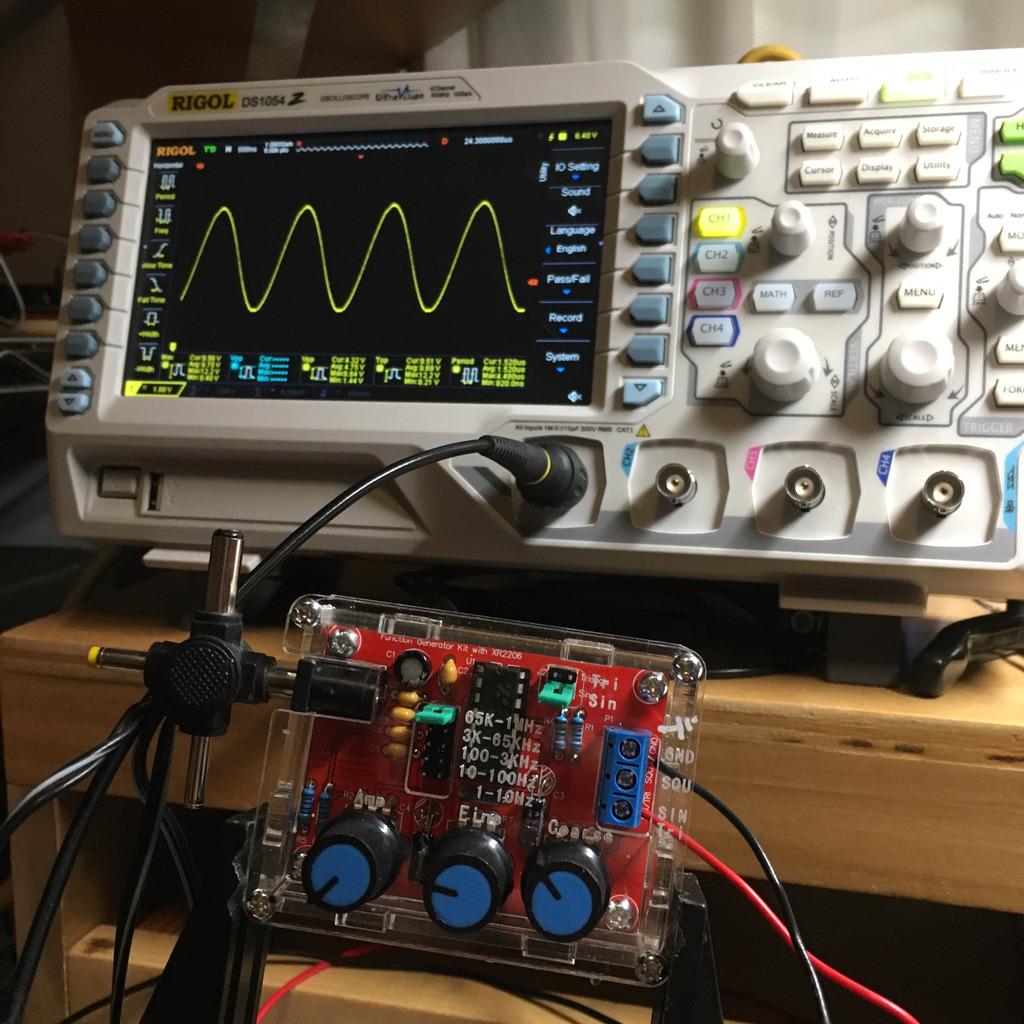
Where most budget four-channel scopes give you four channels and a shallow memory buffer, the DS1054Z gives you four channels and 24 Mpts. Memory drops to 12 Mpts on two channels and 6 Mpts when three or four are active, but even that leaves far more room than the handheld units in this roundup. Up to 30,000 waveform captures per second with an intensity graded display means rare glitches show up as a brighter trace instead of vanishing between refreshes.
Serial bus triggering and decoding for RS232 and UART, I2C and SPI run in base firmware alongside FFT and filters. Waveform recording and playback extends to 60,000 frames, and the connectivity is genuinely pro: USB host, USB device, LAN (LXI) and an auxiliary output carrying trigger and pass/fail signals. The built-in help function explains each feature on the device itself, which is genuinely useful while learning.
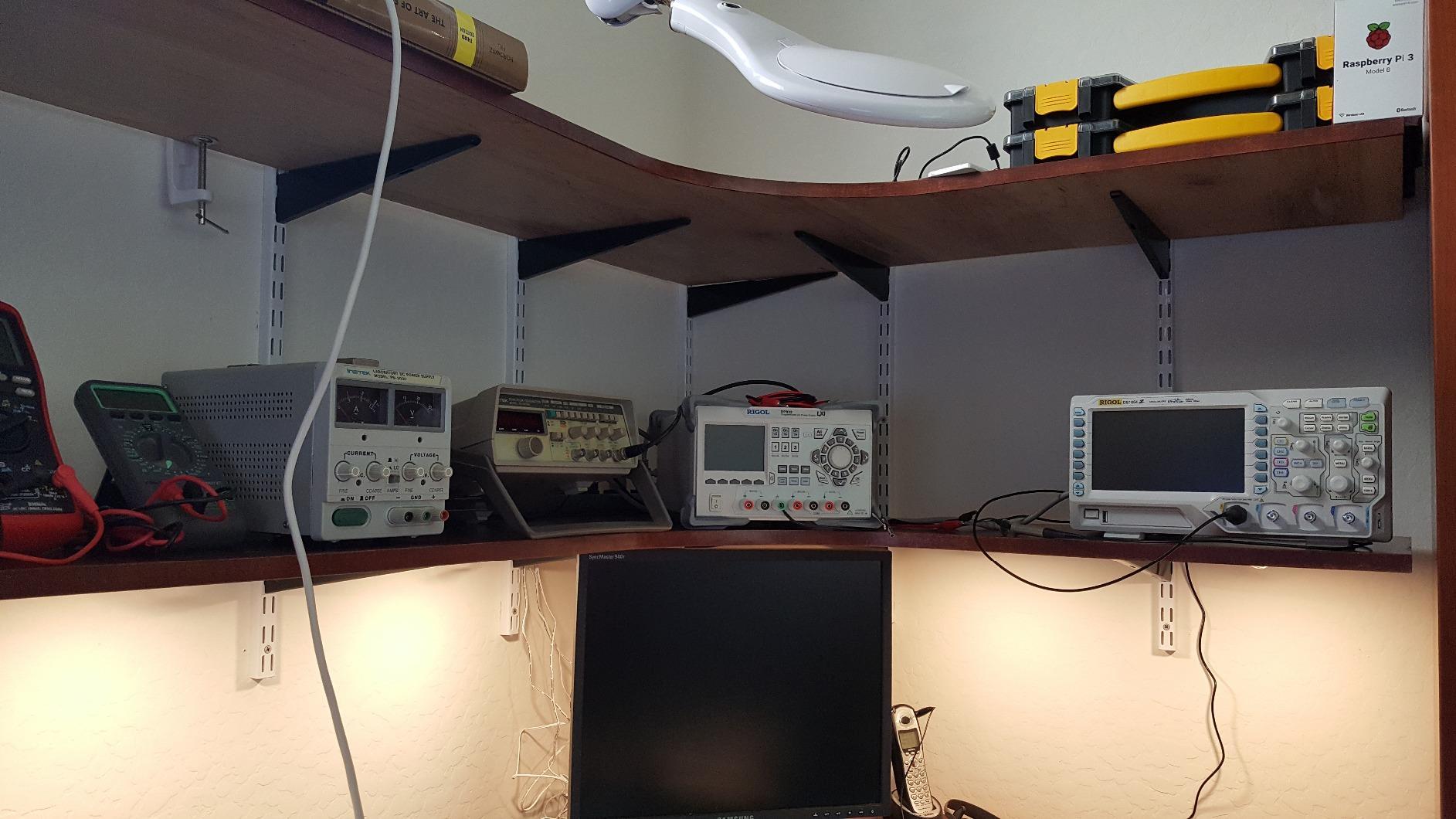
The list of drawbacks is long enough to say plainly. The cooling fan is audible in a quiet room, the multifunction intensity and select knob jumps an entry when you press it, and the bundled probes are the weak link on the whole package. Screen fonts are small and brightness falls off sharply when viewed from below eye level, so prop the scope up rather than looking down at it.
There is no external trigger input, and channels 2 and 4 use near-identical trace colours, which costs you time when four signals are on screen. Owner reviews land at 4.7 across 725 reviews, and older r/AskElectronics threads still call it the go-to low-end digital storage scope, which tracks with how it performs here.
When the Rigol DS1054Z is the right buy
Choose it when you want four channels and deep memory without stepping up in size, particularly for intermittent fault work where a high capture rate and long memory beat extra bandwidth. The LAN and USB host ports also make it the easiest unit here to script against from a PC or a Raspberry Pi.
It suits students and educators too, since the on-device help reduces the learning curve and the pass/fail output can drive automated testing. For a wider budget comparison, see our guide to the best digital oscilloscopes under 500 dollars for hobby electronics.
When the Rigol DS1054Z is the wrong buy
Pass if you need more than 50 MHz, because fast digital edges will roll off where the SDS1202X-E stays flat. Look elsewhere if a noisy fan on a quiet bench bothers you, if you want an external trigger input, or if you need CAN and LIN decode in the box rather than as an add-on.
6. HANMATEK HO52: Best Portable Scope and Meter Pair for Field Repairs
HANMATEK Handheld Digital Oscilloscope 50Mhz Bandwidth with 2 Channels HO52 3.5″ TFT Mini Oscilloscope, 2 in 1 Oscilloscope and Multimeter, Backlit Screen, Auto-Calibration Function, Memory Function
50 MHz dual channel
250 MSa/s sampling
10000 wfms/s refresh
True RMS meter to 1000 V
Pros
- Combines a 50 MHz two-channel scope with a true RMS multimeter
- 10000 wfms/s refresh and one-key auto setup speed up quick debugging
- USB Type-C reads saved images or CSV waveforms on a computer
- Reference waveform overlay and self-calibration aid comparison
- Backlit screen suits field use
Cons
- Small 3.5 inch TFT limits the waveform viewing area
- 8k dot record length is short for long captures
- On-screen font size is limited by the small display
- Scope accuracy is basic against bench instruments
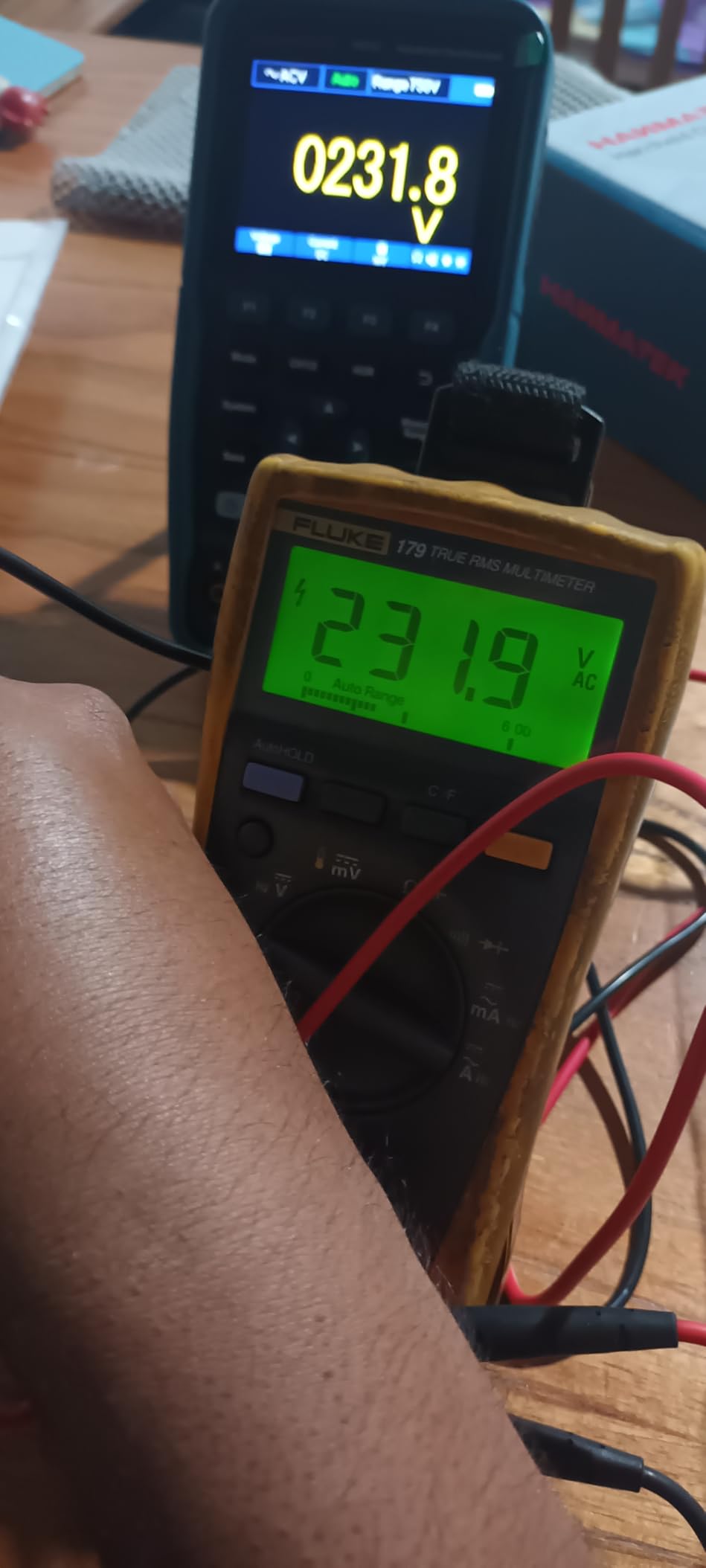
The HO52 is built around a simple idea: one screen, one battery, two instruments. Scope mode gives up to 10,000 waveform refreshes per second across two channels at up to 50 MHz bandwidth and 250 MSa/s sampling with an 8k dot record length, plus cursor measurement, seven automatic measurements and an XY function. Switch to meter mode and you get a 4.5-digit true effective value multimeter with auto ranging up to 750 V AC and 1000 V DC input.
The Type-C port does three jobs: charging from an adapter, running off a power bank, and pulling saved images or CSV waveform groups onto a computer. That last one matters more than it sounds, because getting a real capture off a handheld scope is usually the difference between keeping a measurement and losing it. It also stores four setups, four reference waveforms, four images and four CSV groups, and offers a self-calibration routine.
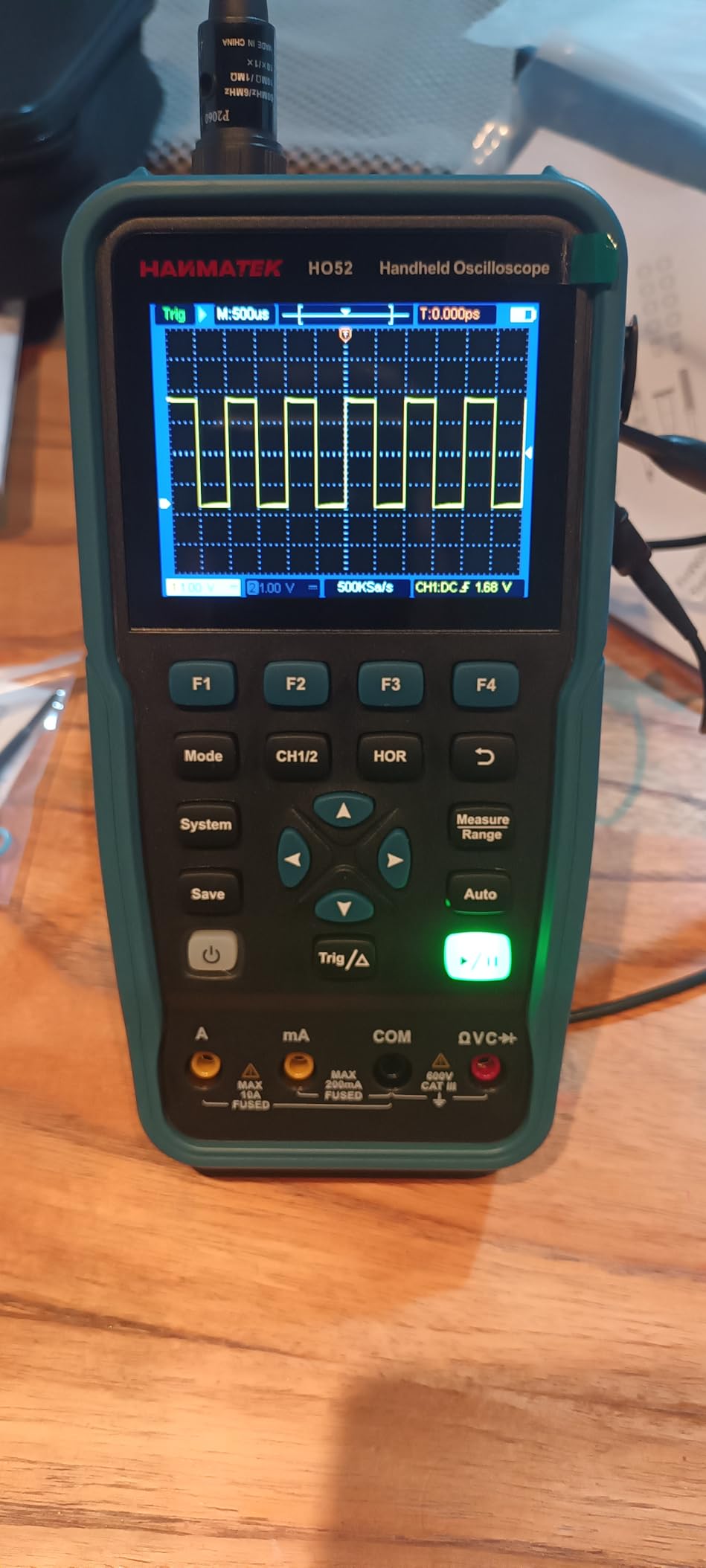
What you give up is screen real estate. A 3.5 inch TFT with limited font size means you are reading numbers in a small space, and the 8k dot record length is short when you want to zoom into a burst. Accuracy is at the level you would expect from a portable two-in-one rather than a calibrated bench instrument, so treat it for triage and confirmation.
Owners rate it 4.7 across 589 reviews and consistently describe it as the scope they grab for field repair work and student lab sessions. The one-key auto setup genuinely helps when the screen has to stay in your hand.
When the HANMATEK HO52 is the right buy
Take it if you repair equipment away from a desk, work on vehicles or appliances in a garage, or need something that fits in a tool bag. It is also a sensible first scope for a student bench where budget is the constraint and portability matters more than memory depth.
It works best paired with a proper bench scope at home, since the CSV export makes it easy to bring captures back to the desk for a closer look on a bigger screen.
When the HANMATEK HO52 is the wrong buy
Pass if you will sit and study waveforms for hours, because the display is the limiting factor, not the hardware. Skip it if you need to resolve fast edges, capture long events, or make measurements where absolute accuracy decides the outcome.
7. Rigol DS1202Z-E: Best Buy When You Want 200 MHz and an External Trigger
RIGOL DS1202Z-E Digital Oscilloscope, 200MHz, 2 Channel, 1GSa/s Sampling
200 MHz bandwidth
2 analog channels
External trigger input
24 Mpts memory
Pros
- 200 MHz bandwidth and 1 GSa/s in a compact well-built body
- Bright 7 inch display with intensity graded color
- Many options ship unlocked avoiding expensive add-on licences
- Displays dozens of measurements at once
- Included probes are solid with shrouded BNCs
Cons
- Multifunction knob is too sensitive and overshoots selections
- Full 24 Mpoint data exports slowly through the front USB 2 port
- Large flash drives are not recognized
- Some functions are buried deep in the menus
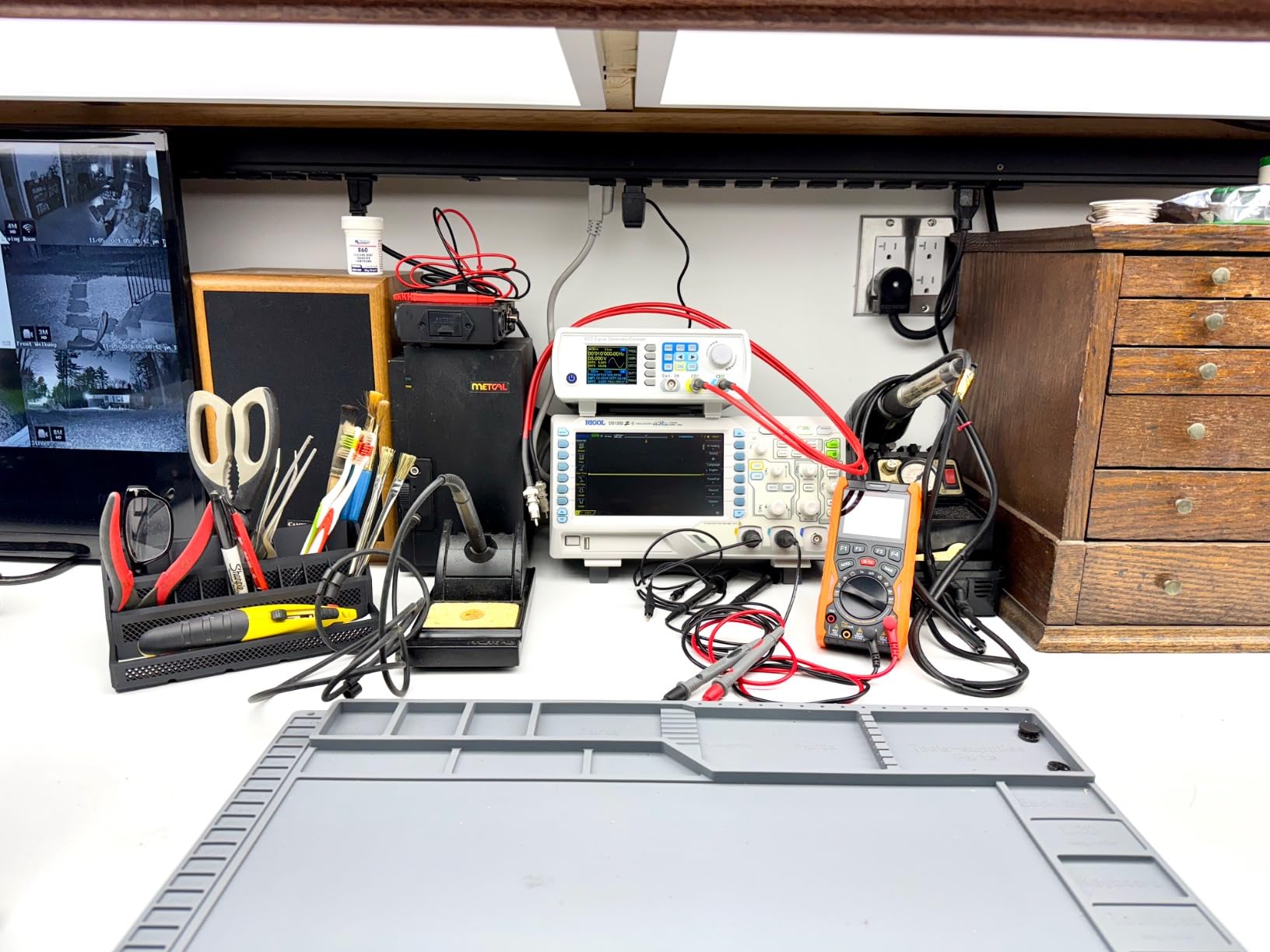
The DS1202Z-E gives you the same 200 MHz and 24 Mpts combination as the SDS1202X-E plus an external trigger input, which the two-channel SDS1202X-E does not have. That opens the door to logging an external marker into a capture and driving the scope from a signal generator or a second instrument, which makes it easier to set up repeatable measurements.
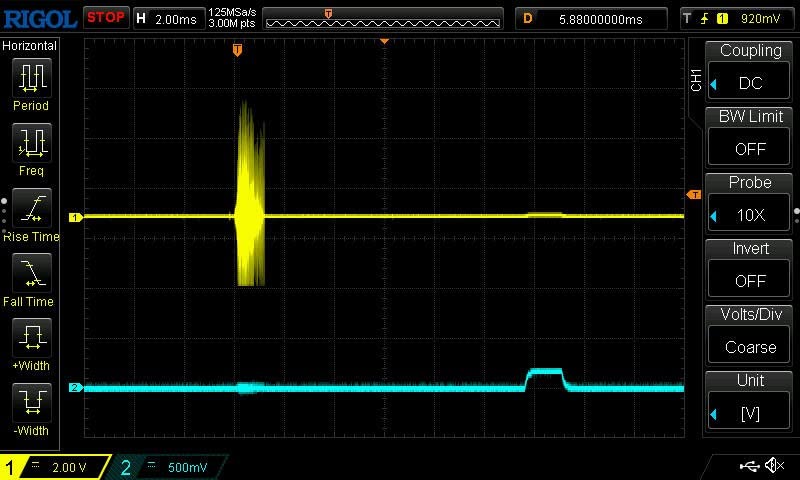
Capture rate runs to 30,000 waveform updates per second on a 7 inch WVGA display at 800 by 480 with intensity graded colour, and playback handles up to 60,000 frames. Serial bus trigger and decode for RS232 and UART, I2C and SPI are present, and the port selection of USB host, USB device, LAN (LXI) and auxiliary trigger and pass/fail output matches what the DS1054Z offers. The main unit carries a three-year warranty with one year on parts.
Two practical complaints come up repeatedly. The multifunction knob is too sensitive and routinely overshoots a menu selection by one entry, and exporting a full 24 Mpoint capture through the front USB 2 port is slow, with large flash drives frequently not recognised at all. Plan to use the LAN port or a smaller memory setting when you need to pull data off the instrument.
Some functions sit deep in the menu tree and the side legends cannot be hidden, which clutters the display. Owners still rate it 4.7 across 468 reviews and single out build quality and the included probes as better than most rivals at this level.
When the Rigol DS1202Z-E is the right buy
Pick it if you want the highest bandwidth in this roundup for two channels, and especially if your measurement needs an external trigger. That covers repeatability testing, synchronising with a function generator, and capturing a known reference alongside your circuit under test.
The three-year main-unit warranty also matters if you intend to keep this for years, and the fact that most decoding options are included rather than licensed avoids the extra cost that can creep up on some rivals.
When the Rigol DS1202Z-E is the wrong buy
Pass if two channels will not be enough, since there is no third or fourth channel here. Look at the DS1054Z or the SDS1104X-E if channel count drives your work, and note that large data transfers through the front USB port are the weak point to plan around.
8. FNIRSI DSO152: Best First Scope for Learning and Low-Frequency Checks
FNIRSI DSO152 Handheld Oscilloscope 200kHz Bandwidth, 2.5MS/s Sampling Rate
200 kHz bandwidth
2.5 MS/s sampling
10x probe to 800 Vpp
1000 mAh battery
Pros
- Very low cost way to learn how waveforms behave
- Fully assembled and pocketable for field troubleshooting
- High-voltage 10x probe rated to 800 Vpp
- One-key AUTO and baseline calibration cut manual adjustment
- Battery life around four hours with Type-C charging
Cons
- 200 kHz bandwidth limits it to low-frequency signals
- Small 320x240 screen limits detail
- Unsuitable for high-frequency or fast transient work
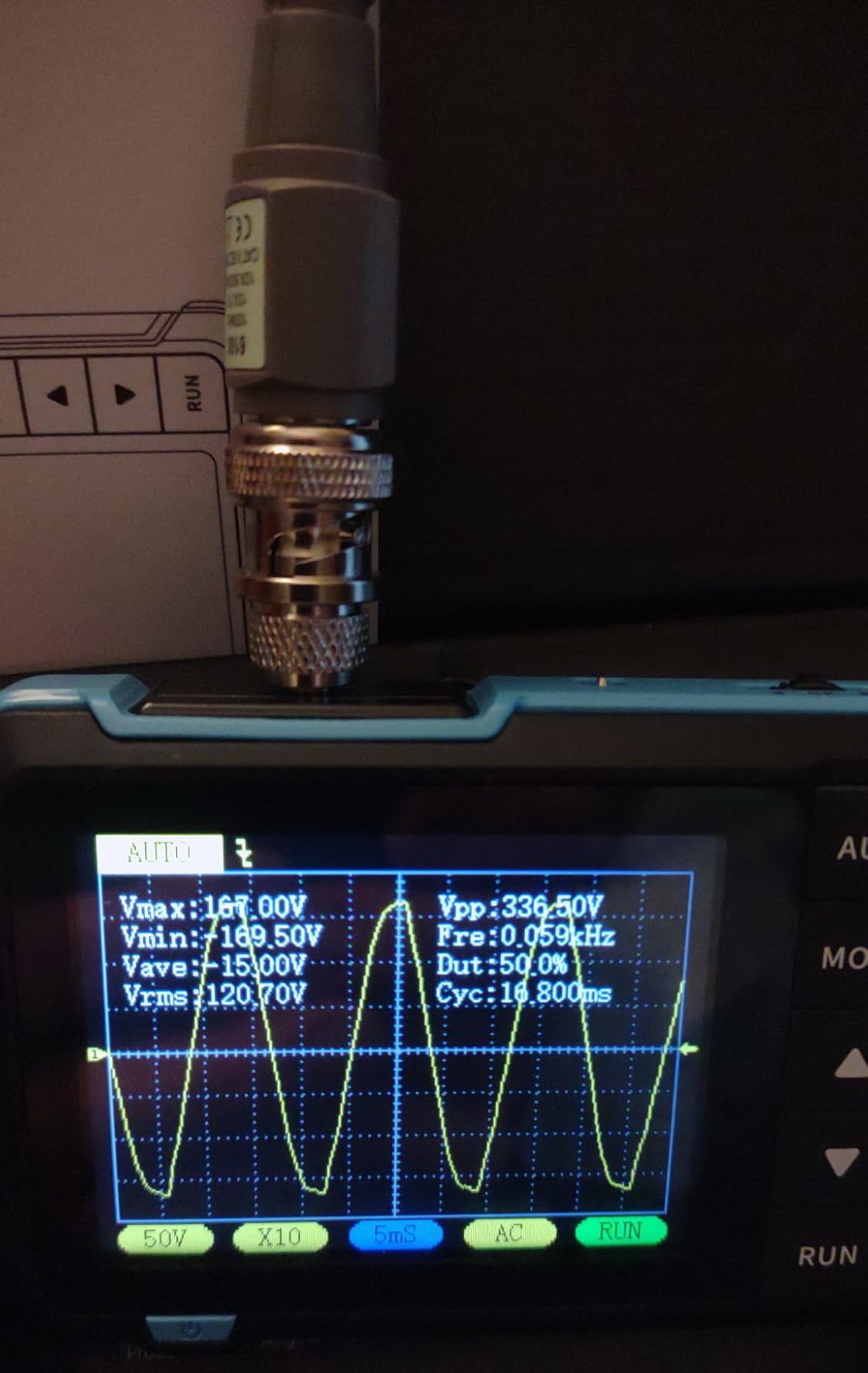
Some people want to know whether they would even use a scope before committing to one. The DSO152 answers that question cheaply: it samples at 2.5 MS/s with 200 kHz of bandwidth, which is enough to look at a slow sine wave, a switching relay, a battery charging curve, or the ripple on a power rail. It arrives fully assembled, runs about four hours on its 1000 mAh battery, and charges over Type-C.
The 10x probe measures up to 800 Vpp, which is the feature that makes it more than a desk toy. Trigger modes cover auto, normal and single, so you can catch a transient that only happens once, and a long-press baseline calibration plus one-key AUTO setting remove most of the manual level adjustment beginners struggle with.
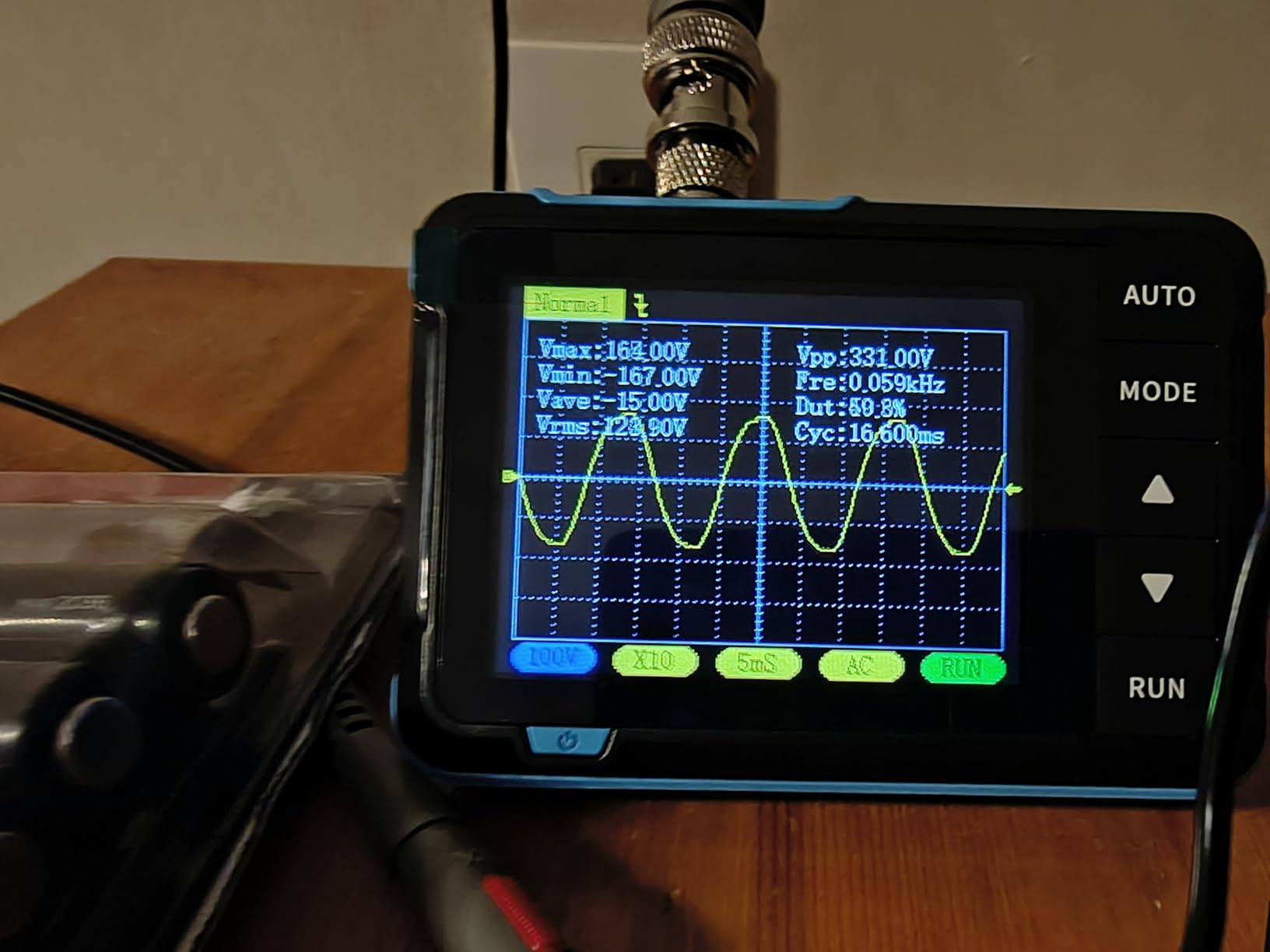
Be clear-eyed about what 200 kHz of bandwidth means. It is a low-frequency instrument by design, and pushing it on fast edges produces a display that looks plausible but is not accurate. The 2.8 inch screen at 320 by 240 gives you very little room to read cursors or compare two traces.
Ratings sit at 4.4 across 392 reviews, with buyers treating it as a cheap first scope or a dedicated low-frequency field tool. The 1-star share is 5 percent, and those reviews almost always describe pushing past the bandwidth limit.
When the FNIRSI DSO152 is the right buy
It suits a complete beginner who wants to build intuition about waveforms cheaply, a secondary tool for checking DC and low-frequency conditions in the field, or anyone who needs a small high-voltage-capable probe setup without carrying a bench scope. Pair it later with one of the bench units above as a stepping stone.
The single-shot trigger mode is genuinely useful for one-off events like a relay click or a switch closing, which is more than many budget scopes let you do.
When the FNIRSI DSO152 is the wrong buy
Skip it if you plan to debug anything digital, since no amount of careful technique will make 200 kHz resolve an MCU clock edge. Pass if you need two channels compared at speed, or if you intend to grow into the hobby and want a tool you will not outgrow within a year.
9. FNIRSI 1013D Plus: Best Touchscreen Scope With Built-In Storage and FFT
FNIRSI 1013D Plus 100MHz Oscilloscope, 2 Channel Oscilloscope 7″ TFT Touch
100 MHz per channel
1 GSa/s sampling
7 inch 800x480 touchscreen
1 GB internal storage
Pros
- 7 inch 800x480 touchscreen with bright high-contrast color
- 100 MHz per channel with 1 GSa/s sampling
- Waveform image manager with thumbnails
- zoom and pan
- Touch gestures and cursor measurement speed up amplitude and frequency reading
- Lissajous and FFT views help compare signals and check harmonics
Cons
- Touch interface is fiddly for fine adjustments
- Battery life of about four hours limits long sessions
- Not a bench replacement for deep memory or decoding work
The 1013D Plus makes a case purely on screen size and workflow. A 7 inch 800 by 480 capacitive touchscreen at 100 MHz per channel with 1 GSa/s sampling gives you room to actually read a waveform, and touch gestures plus cursor measurement let you check amplitude and frequency without navigating a deep button tree. Trigger modes cover single, normal and automatic.
Storage is the quiet strength. One GB of internal memory holds up to 1000 screenshots and 1000 waveform sets, and a waveform image manager displays them as thumbnails you can zoom and pan through. Lissajous and FFT views are built in, which covers the classic comparison technique and a quick harmonic check without extra software.
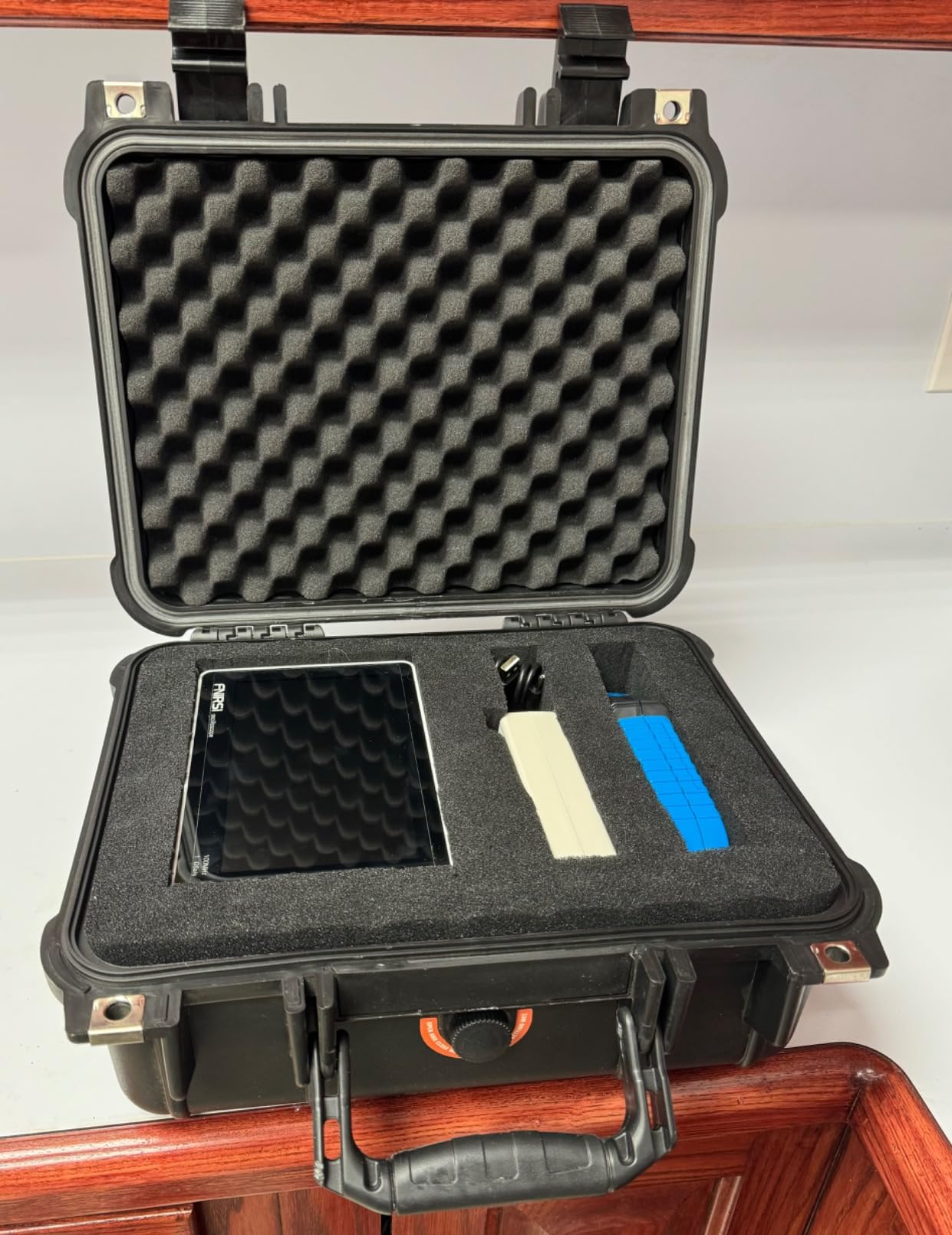
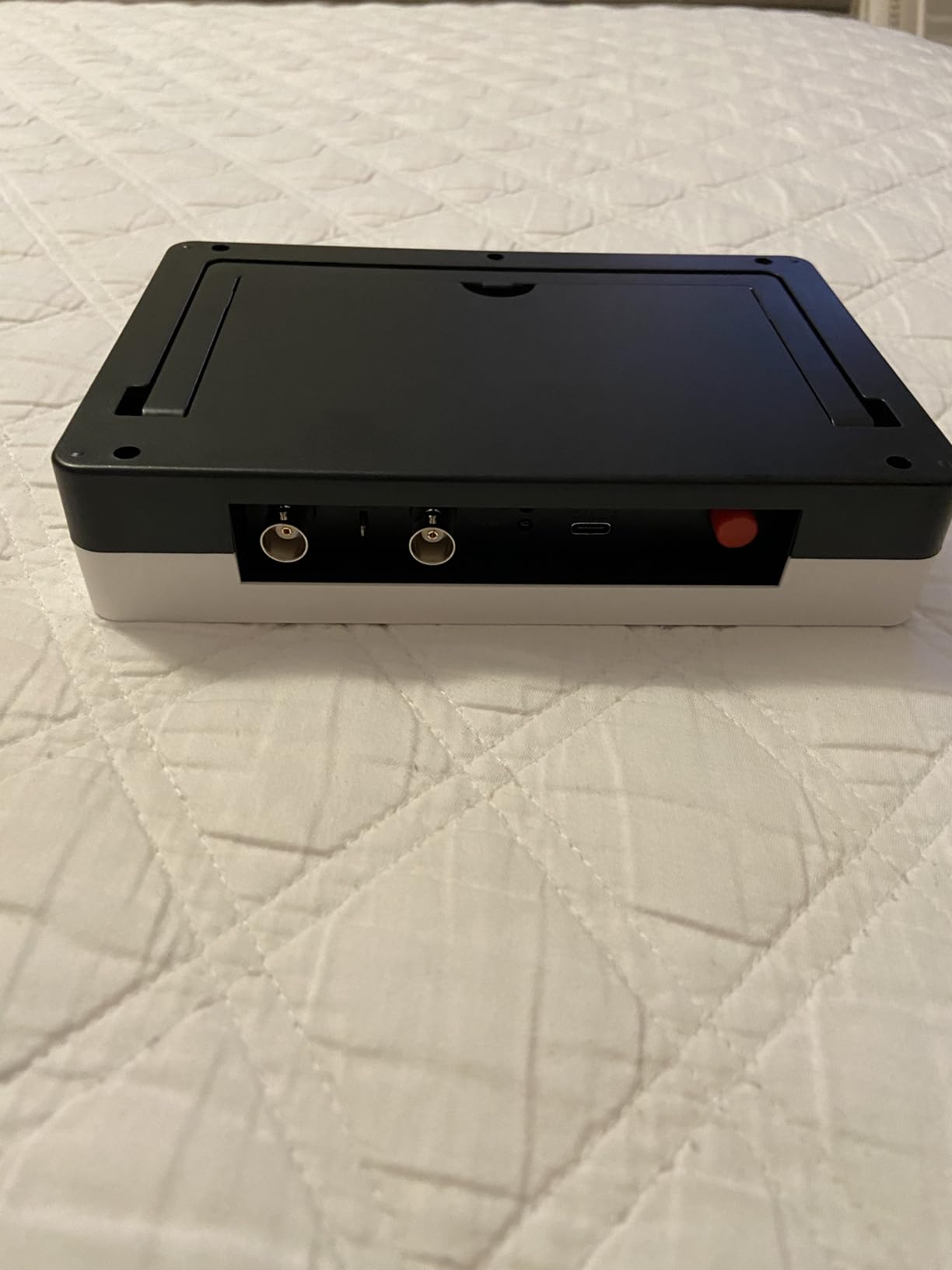
A built-in high-voltage protection module tolerates up to 400 V continuous, and the 6000 mAh battery gives roughly four hours of use. That battery figure is the main practical limit: touchscreens eat power, and four hours will not cover a full day of bench work away from a socket.
The capacitive touch interface is fiddly for fine adjustments, since dragging a trigger level with a fingertip rarely lands where you want it on the first pass. And while 100 MHz bandwidth is respectable, this is not a substitute for deep memory or protocol decoding work, which is where the DS1054Z and the SDS1104X-E pull ahead.
When the FNIRSI 1013D Plus is the right buy
Choose it if you want a large readable display you can show to someone else, or if you capture reference waveforms and want to review them as thumbnails later. It also suits automotive and field work where the touchscreen makes quick checks faster than button menus.
It is a good middle step between a pocket 3-in-1 and a full bench scope, particularly for learners who find small screens unreadable.
When the FNIRSI 1013D Plus is the wrong buy
Pass if you need deep memory, long record lengths, or serial protocol decoding in the box. Skip it for long bench sessions away from power, and if you dislike touch-only adjustment, look at a knob-driven instrument instead.
10. ZOYI ZT-703: Best Budget 3-in-1 for Automotive Field Work
3 in 1 Handheld Oscilloscope Automotive Dual Channel 50MHz with Digital Multimeter and Signal Generator
Dual channel to 50 MHz
200 to 280 MSa/s sampling
25000-count multimeter
128K storage depth
Pros
- Solid build with a clear bright color display
- 25000-count multimeter is accurate with quick auto-ranging
- Useful for automotive checks such as speaker phase and CAN-related signals
- Two oscilloscope channels and a replaceable rechargeable battery
- Comes with a carrying case
- probes
- leads and USB-C cable
Cons
- No rotary dials so divisions and cursors need menu digging
- Signal generator output is mostly useful for probe compensation
- Effective bandwidth is well below the headline figure in normal mode
- Display sleeps quickly and takes seconds to wake
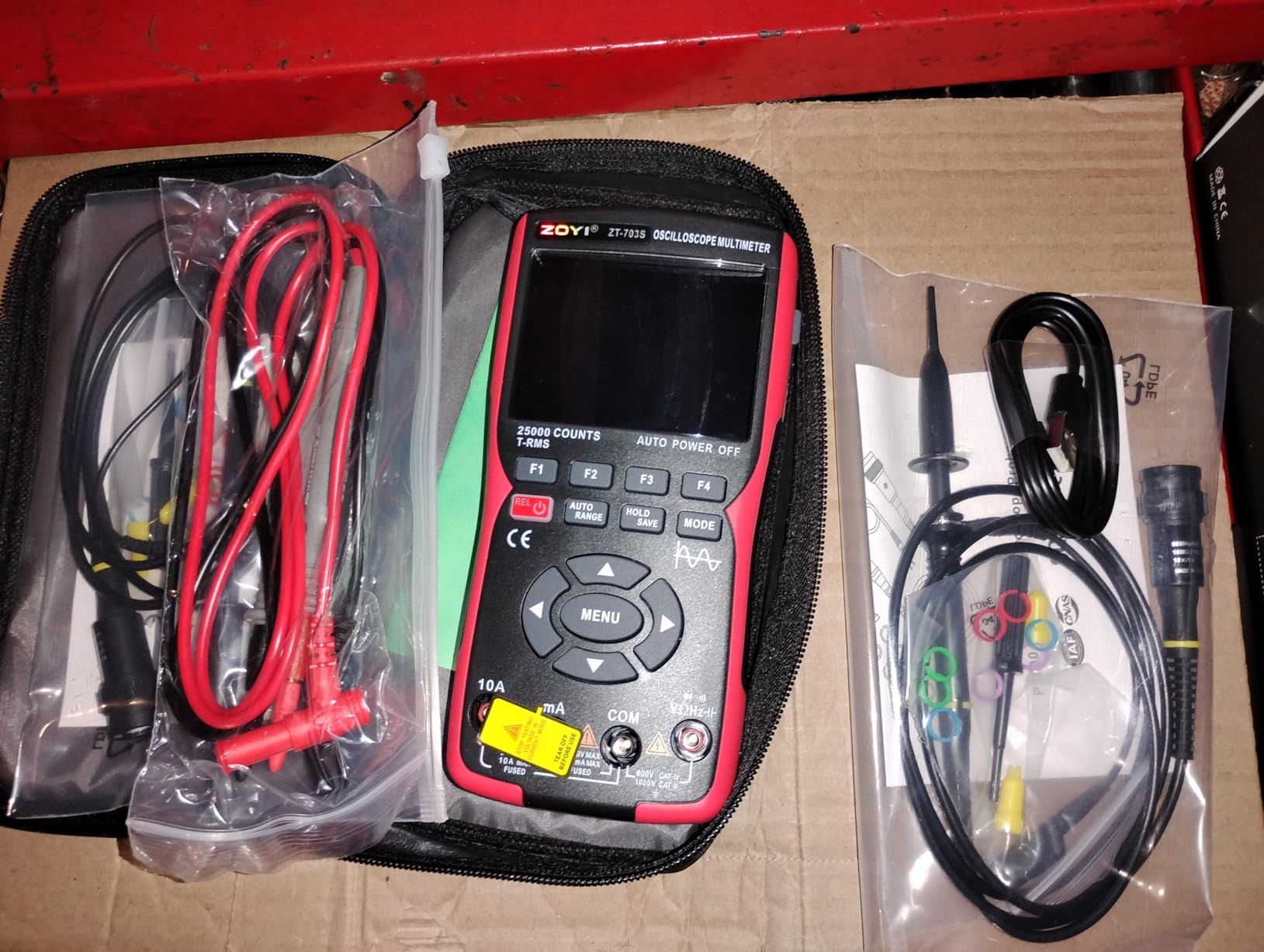
The ZT-703 packs a dual-channel scope, a 25000-count multimeter covering resistance, capacitance, continuity, diodes and current, and a signal generator with sine, square and triangle outputs into a 380 g handheld. Storage depth of 128K points is far better than the other budget handhelds here, and the AUTO mode recognises waveforms automatically, which helps when you are working one-handed in a dark engine bay.
Its two performance modes are worth understanding. Normal mode runs at 200 MSa/s up to 30 MHz at lower power draw, while high-speed mode runs 280 MSa/s up to 50 MHz at higher power draw. Owner reviews are candid that the practical scope bandwidth lands nearer 10 to 20 MHz for sine work and 5 to 10 MHz for square waves, so the 50 MHz headline is a ceiling rather than a working figure. The multimeter is the real star.
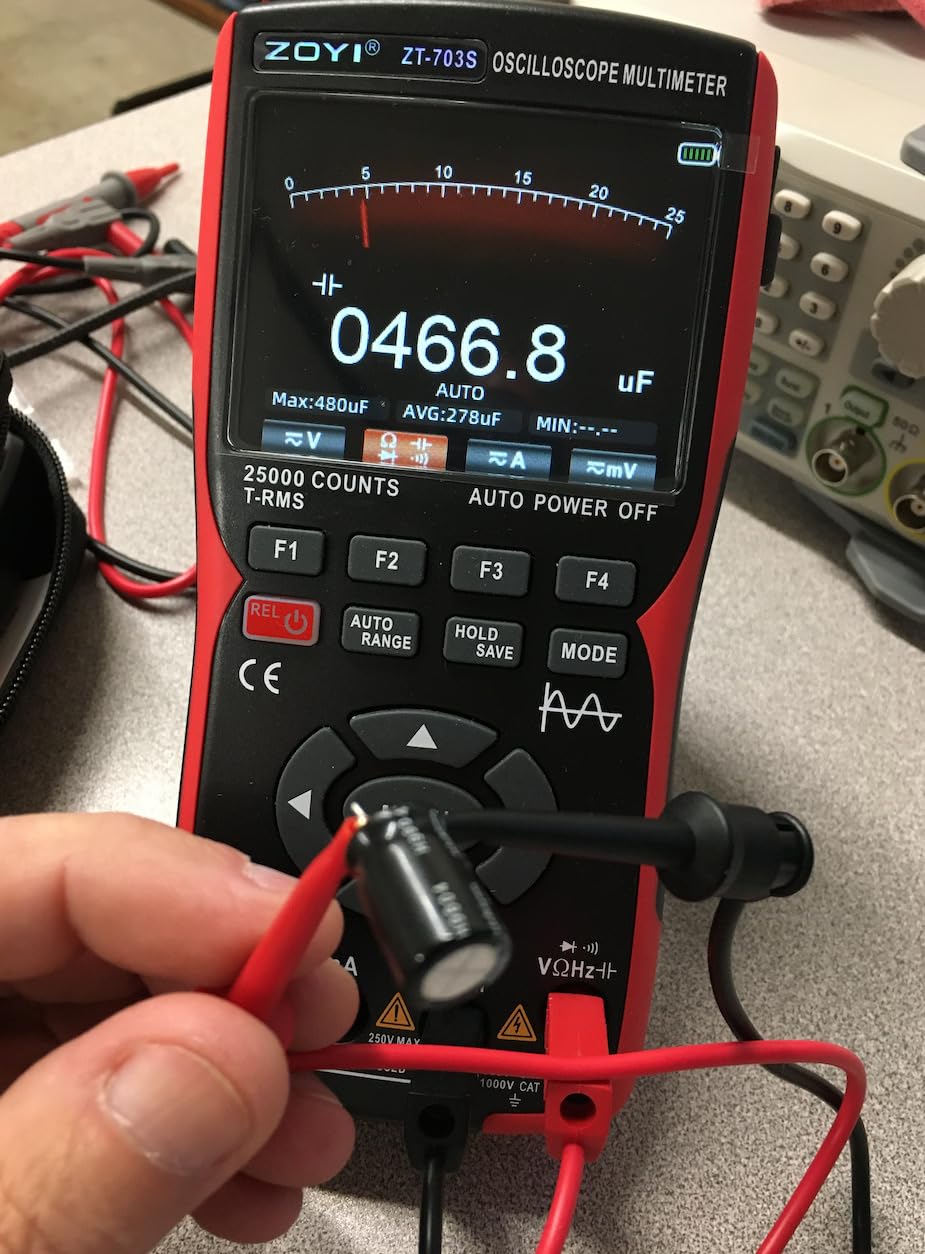
There are no rotary dials, which means setting divisions and positioning cursors means navigating menus. The signal generator output is mostly useful for probe compensation rather than driving real test circuits, and the display sleeps aggressively, taking a few seconds to wake, which is mildly annoying when you are mid-diagnosis.
Despite that, owners rate it 4.7 across 307 reviews, and the highest 5-star share relative to its rating in the budget tier. For checking speaker phase, watching battery charging behaviour, or confirming a CAN-related signal exists, it does the job without a second box in your hand.
When the ZOYI ZT-703 is the right buy
Take it if you work on cars, motorcycles or marine systems and want a meter and a scope in one hand with a case to carry them in. The replaceable rechargeable battery and Type-C charging suit long diagnostic sessions away from a socket.
It also works as a second inexpensive instrument for a student bench, since the 25000-count meter is the part most students will actually lean on.
When the ZOYI ZT-703 is the wrong buy
Pass if you need honest fast-edge capability, because the real bandwidth is well below the advertised figure and menu-only control makes precise work tiring. Skip it for signal injection beyond probe compensation, or if you want a large screen for careful cursor measurement.
How to Choose a Digital Oscilloscope for Hobbyist Work
Almost every bad scope purchase comes from buying the wrong number for one spec. Bandwidth, memory depth and channel count matter far more than the headline sample rate, and the difference between a scope that reveals intermittent faults and one that hides them is usually memory depth or waveform capture rate rather than gigahertz.
Bandwidth: use the 5x rule for hobby signals
Bandwidth is the highest frequency the scope can measure accurately, and the rule of thumb is simple: multiply your highest signal frequency by five, then buy at or above that number.
Audio and 5 V logic, microcontroller pins under 20 MHz: 50 to 100 MHz is comfortable.
Switching converters and fast-edge digital at 20 to 50 MHz: 100 to 200 MHz.
High-speed serial, RF probing and quick edges above 50 MHz: 200 MHz and beyond.
Five times is not arbitrary padding. A sine wave loses about 30 percent of its amplitude at the stated bandwidth limit, and the fifth harmonic that carries a square wave’s shape is already well down by then. Measuring at a fifth of bandwidth means you are reading the edge, not a rounded-off version of it.
Sample rate: why 2x bandwidth still matters
Sample rate is how many readings per second the analog-to-digital converter takes. The rule is at least twice the bandwidth, so a 200 MHz scope should sample at 400 MSa/s or better.
Here is the catch: a marketing number like 1 GSa/s may apply to one channel only. When two channels run at once, a shared ADC halves the rate per channel, which is why the SDS1202X-E’s shared architecture shows up in every review of that model. Read the fine print and check what the sample rate is with the number of channels you actually intend to use.
Channels: two is enough, four changes your workflow
Two channels lets you compare input and output, which covers most amplifier, filter and power supply debugging. Three or four channels let you add a reference, a control line and a ground-referenced probe without rewiring, which is what makes a four-channel scope feel like a different class of instrument.
Owners on r/AskElectronics repeatedly anchor first purchases around the 200 to 300 range and closer to 400 for a home lab meant to last. That maps onto this list: two-channel units below 150, four-channel bench scopes in the middle, and larger bodies above that.
Memory depth and waveform capture rate
Memory depth is how much waveform gets stored in one record, measured in Mpts. Deeper memory means a longer capture at full resolution, so a burst that lasts 20 microseconds still has hundreds of samples describing it instead of a handful.
Waveform capture rate is how many times per second the scope refreshes the screen, and it is the number that exposes rare glitches. At 30,000 wfms/s, an occasional fault appears as a bright intensity-graded trace. At 1,000 wfms/s, it may never be drawn at all. Only three units in this roundup reach 30,000 wfms/s.
Trigger modes, screen and everyday handling
The trigger decides where a record starts, and it is the single most important control for a beginner. Auto mode free-runs, normal mode waits for a matching edge, and single mode captures one event and stops, which is what you want for switch bounce or relay clicks.
Screen size matters more than buyers expect. A 2.4 to 2.8 inch display forces you to guess at cursor values, while a 7 inch panel lets two people look at the same trace. IPS brightness, whether the font size is adjustable, and whether the side legends can be hidden all affect how fast you read a capture.
Form factor: benchtop, handheld and USB scopes
Benchtop units give you knobs, a large screen and probe inputs you can leave connected. Handheld units run on batteries and often combine a meter and generator with the scope, making them the better answer to field repair. USB scopes depend entirely on host software and are worth considering only if you already work in that software environment.
Our picks for the best digital storage oscilloscopes under 1000 dollars go deeper on the middle and upper tiers if your budget stretches past the units reviewed here.
Brands compared: Siglent, Rigol, FNIRSI, HANMATEK, ZOYI and IMARS
There is no single best brand, so here is one line each rather than a crowned winner.
Siglent: the strongest feature set per dollar at this tier, with decode and multi-channel options in base firmware.
Rigol: four-channel value with deep memory, plus some optional features that carry licence costs.
FNIRSI: the widest spread, from a very cheap low-frequency unit to a large touchscreen with storage.
HANMATEK: portable scope and meter pairings with straightforward field-focused design.
ZOYI: budget handheld 3-in-1 tools with strong multimeters relative to the price.
IMARS: budget 3-in-1 units where the true RMS meter is the standout feature.
Siglent and Rigol are the two names that come up most often on forums, and the Arduino forum thread on scope purchases notes both as market leaders in low-cost but decent equipment. Between them, Siglent tends to include more decoding unlocked and Rigol tends to offer deeper memory and four channels at a given level, so the choice often comes down to channel count against decode support. The best digital oscilloscopes under 500 dollars for hobby electronics page breaks down that comparison in more detail.
What to watch out for: probes, licences and grey-market units
Three costs hide outside the headline price. Bundled probes are usually the weakest link and are the first thing to fail, so reserve budget for a replacement set and learn probe compensation. Some entry scopes ship serial decoding behind a trial period that then requires payment, so check whether decoding is permanent before you rely on it. And in the very cheapest tier, counterfeit and grey-market units are a real risk, so look for a stated warranty and a traceable seller.
Grounding and Probing Mains Circuits Safely
Bench scopes have their ground clips connected to mains earth. You cannot attach that ground clip to any point that is not at earth potential, because doing so will either short the circuit or destroy the scope, and in either case there is a serious risk to whoever is holding the probe.
That single fact rules out probing live mains with a standard bench scope and standard probe. If you need to look at a mains-related waveform, use a properly rated isolated differential probe or a handheld battery-powered scope, and treat both as equipment that needs its own care rather than as a shortcut.
For everything below mains voltage, stay disciplined: keep the ground clip on a known earth-referenced node, and never float the ground clip to a positive or switching node. Handheld battery units in this roundup remove the earth reference entirely, which is one of the real reasons they are the sensible choice for automotive and battery work.
Do You Need a Logic Analyzer as Well?
A logic analyzer reads digital levels and decodes protocols such as I2C, SPI, UART and CAN, but it cannot show you analog shape. An oscilloscope shows you exactly what the voltage is doing, including overshoot, ringing and slow rise times, and it can decode protocols too on the models listed here.
For most hobbyists the scope covers both jobs, which is why we suggest buying one instrument first. Reach for a dedicated logic analyzer only when you spend most of your time on bus debugging with long captures, where a low-cost analyzer with deeper digital capture can beat a mid-range scope on protocol work while measuring nothing analog at all.
Frequently Asked Questions
What is a good oscilloscope for a hobbyist?
A good hobbyist oscilloscope gives you 50 to 100 MHz of bandwidth, at least two channels, and serial decoding included at no extra cost. The Siglent SDS1202X-E is our top pick because it adds 200 MHz bandwidth and 14 Mpts of record depth, which lets you capture short glitches and still see thousands of samples describing them.
What is a good, cheap oscilloscope for hobbyists?
The FNIRSI 2C53T is a strong budget choice because it combines a 50 MHz two-channel scope, a 19999-count multimeter and a signal generator in one battery-powered body. Its honest limit is 1 Kpts of record depth, which suits snapshots and field checks but not long captures or fast transients.
What is the best brand for oscilloscopes?
It depends on the job. Siglent ships the strongest feature set per dollar with decoding included, Rigol offers four channels and deep memory for the money, FNIRSI covers the widest price range, HANMATEK and ZOYI focus on portable scope and meter combinations, and IMARS delivers capable budget units with strong true RMS meters.
Is a 100 MHz oscilloscope enough?
Yes, for most hobby work. Multiply your highest signal frequency by five and buy at or above that. Audio and 5 V logic below 20 MHz are comfortable on a 50 to 100 MHz scope, switching converters and fast digital edges want 100 to 200 MHz, and anything faster than 50 MHz needs 200 MHz or more.
What are the key differences between Rigol and Siglent oscilloscopes?
Siglent typically ships more serial decoding unlocked in base firmware, while Rigol offers deeper memory and four channels at a comparable level. Siglent screens tend to run brighter with larger panels, and Rigol units often add LAN and auxiliary trigger output. Choose Siglent for decode support and screen, or Rigol for memory depth and connectivity.
The Best Digital Oscilloscopes for Hobbyists: Final Verdict
The Siglent SDS1202X-E is the single best digital oscilloscope for hobbyists in 2026, with 200 MHz bandwidth, 14 Mpts of record depth and serial decoding that needs no licence. If your work needs four channels at once, the SDS1104X-E carries the highest owner rating we measured, and the Rigol DS1054Z gives you the deepest memory per dollar with the same four-channel layout.
Below those, the FNIRSI 2C53T is the budget pick, the HANMATEK HO52 is the field pick, and the FNIRSI DSO152 is the cheapest honest way to learn what a waveform tells you. Whichever you choose, budget for a proper probe set, keep the ground clip on an earth-referenced node, and check your capture depth before you need it. If you are still comparing meters as well as scopes, our digital multimeter guide covers the other half of the bench.