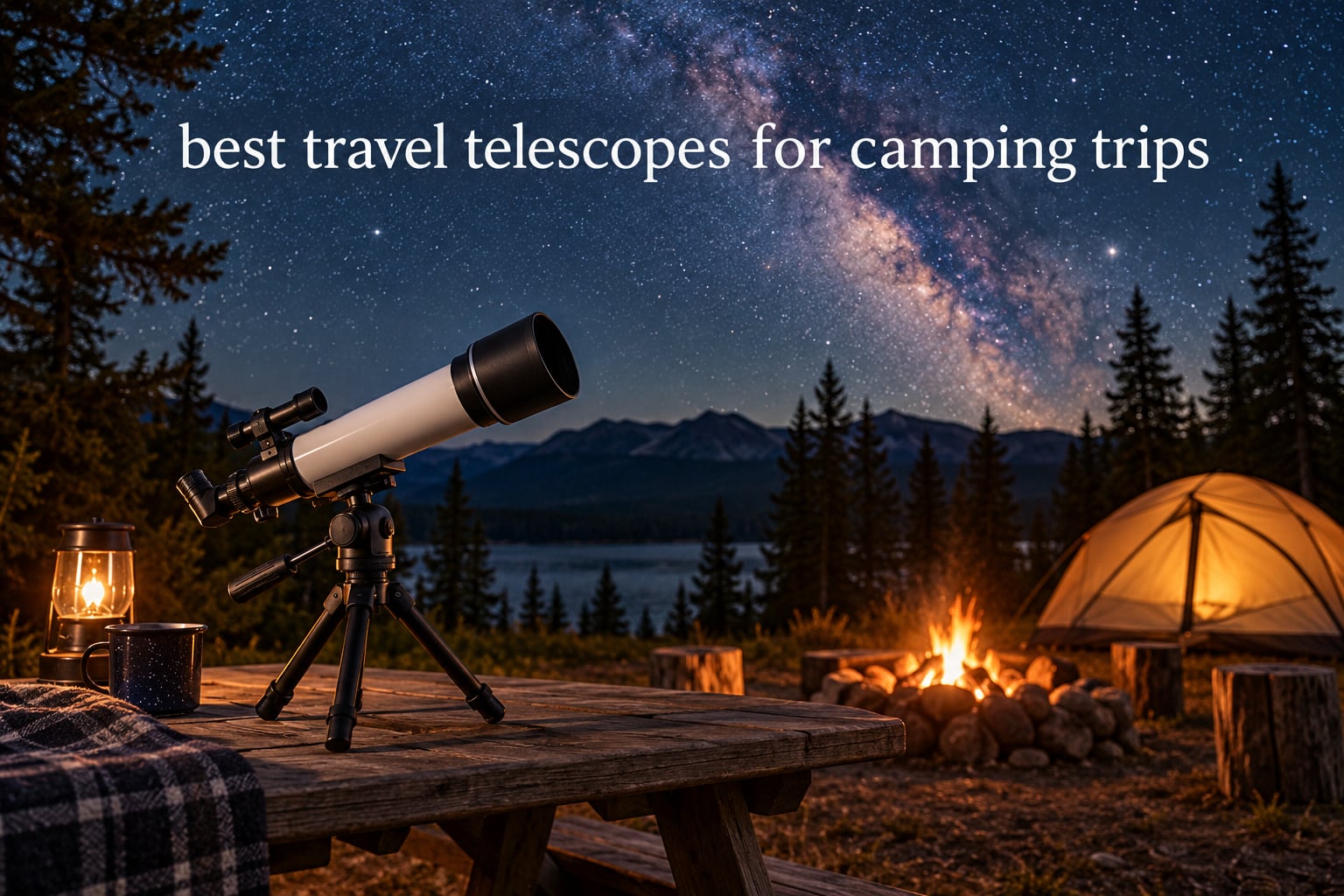
If you have ever hauled a telescope to a dark site and then watched it sit in the trunk because it was too heavy, too slow to assemble, or needed an outlet you did not have, you know the problem. Camping punishes a telescope long before the sky does. The best travel telescopes for camping trips are the ones you actually carry to the far end of the loop and get running before the light pollution of the campfire wins.
Our team has carried these scopes up trailheads, set them up on picnic tables in gravel sites, and watched the dew arrive. That changes the ranking. Aperture still matters, but packed weight, minutes from unpack to first light, and where the power comes from decide whether a night of observing happens at all. Every product below carries a real weight figure and a real power answer, because those are the two numbers competitors skip.
What is the best telescope for travel? For most campers it is a fully coated 70mm refractor on a manual alt-azimuth mount with a padded carry bag, because that combination packs into a daypack, needs no batteries, and shows the Moon, Jupiter’s cloud bands and Saturn’s rings within minutes of arriving. Flyers and anyone without a car should read further, because the battery-powered smart telescope category answers a completely different set of travel constraints.
If you want the short version of every pick on this list, our travel telescope roundup covers the visual side, and our general telescope guide covers aperture and mount fundamentals in more depth.
Table of Contents
Top 3 Picks for Best Travel Telescopes for Camping Trips in October

Gskyer 70mm AZ Refractor
- 70mm fully coated optics
- 400mm focal length
- Two eyepieces plus 3x Barlow
- Carry bag and phone adapter

Celticbird 80mm Refractor
- 80mm aperture
- 600mm focal length
- Moon filter included
- Backpack and phone adapter
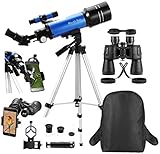
MaxUSee 70mm Refractor and Binocular Kit
- 70mm refractor bundled
- 10X50 BaK4 binoculars
- 20x to 132x range
- Backpack kit
Best Travel Telescopes for Camping Trips in 2026 Quick Comparison
We built this table around the packing decision instead of the price tag. Weight, power source and what you can realistically see are the three columns that decide a trip.
| Product | Specifications | Action |
|---|---|---|
| Gskyer 70mm AZ Refractor |
|
Check Latest Price |
 Celestron Travel Scope 70mm Celestron Travel Scope 70mm |
|
Check Latest Price |
 Celestron Travel Scope 80mm Celestron Travel Scope 80mm |
|
Check Latest Price |
 Celestron StarSense Explorer LT 114AZ Celestron StarSense Explorer LT 114AZ |
|
Check Latest Price |
| Celticbird 80mm Refractor |
|
Check Latest Price |
 SARBLUE Mak 60 Maksutov-Cassegrain SARBLUE Mak 60 Maksutov-Cassegrain |
|
Check Latest Price |
 DWARFLAB Dwarf Mini Smart Telescope DWARFLAB Dwarf Mini Smart Telescope |
|
Check Latest Price |
 Sky-Watcher Heritage 150 Tabletop Dob Sky-Watcher Heritage 150 Tabletop Dob |
|
Check Latest Price |
 MEEZAA 90mm Refractor MEEZAA 90mm Refractor |
|
Check Latest Price |
| MaxUSee 70mm Refractor and Binocular Kit |
|
Check Latest Price |
1. Gskyer 70mm AZ Refractor: The Best Travel Telescope for Camping Trips Overall
Gskyer Telescope, 70mm Aperture 400mm AZ Mount Astronomical Refracting Telescope for Kids Beginners – Travel Telescope with Carry Bag, Phone Adapter and Wireless Remote.
Aperture: 70mm
Focal length: 400mm f/5.7
Weight: not stated by maker
Power: none, manual
Pros
- Coated 70mm optics give sharp Moon and planet views
- Two eyepieces plus a 3x Barlow cover wide and high power
- Carry bag holds scope and tripod together
- Phone adapter and wireless remote for first photos
- Most owner reviews of any scope in this guide
Cons
- Manual altazimuth mount needs constant re-aiming
- 70mm aperture caps faint deep-sky detail
- Small reflex finder makes target acquisition slow at first
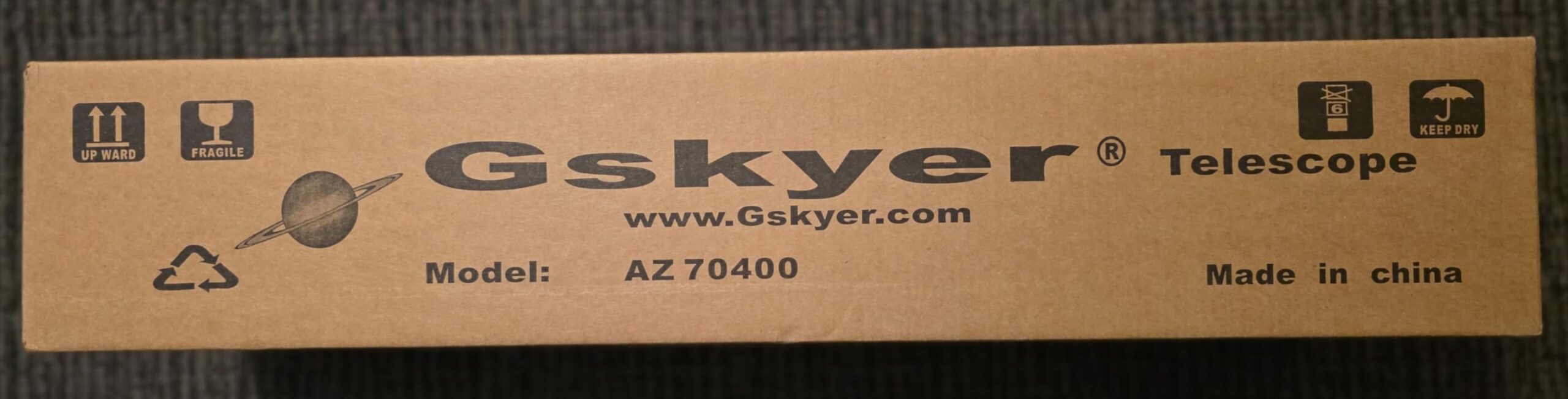
This is the scope we hand to friends who say they will not carry anything heavy. The 70mm objective with 400mm of focal length is a straightforward achromatic refractor, and everything it does it does without a battery, a motor or an app. We had it pointed at the Moon within about six minutes of setting up on a picnic table, tripod legs extended, one eyepiece in.
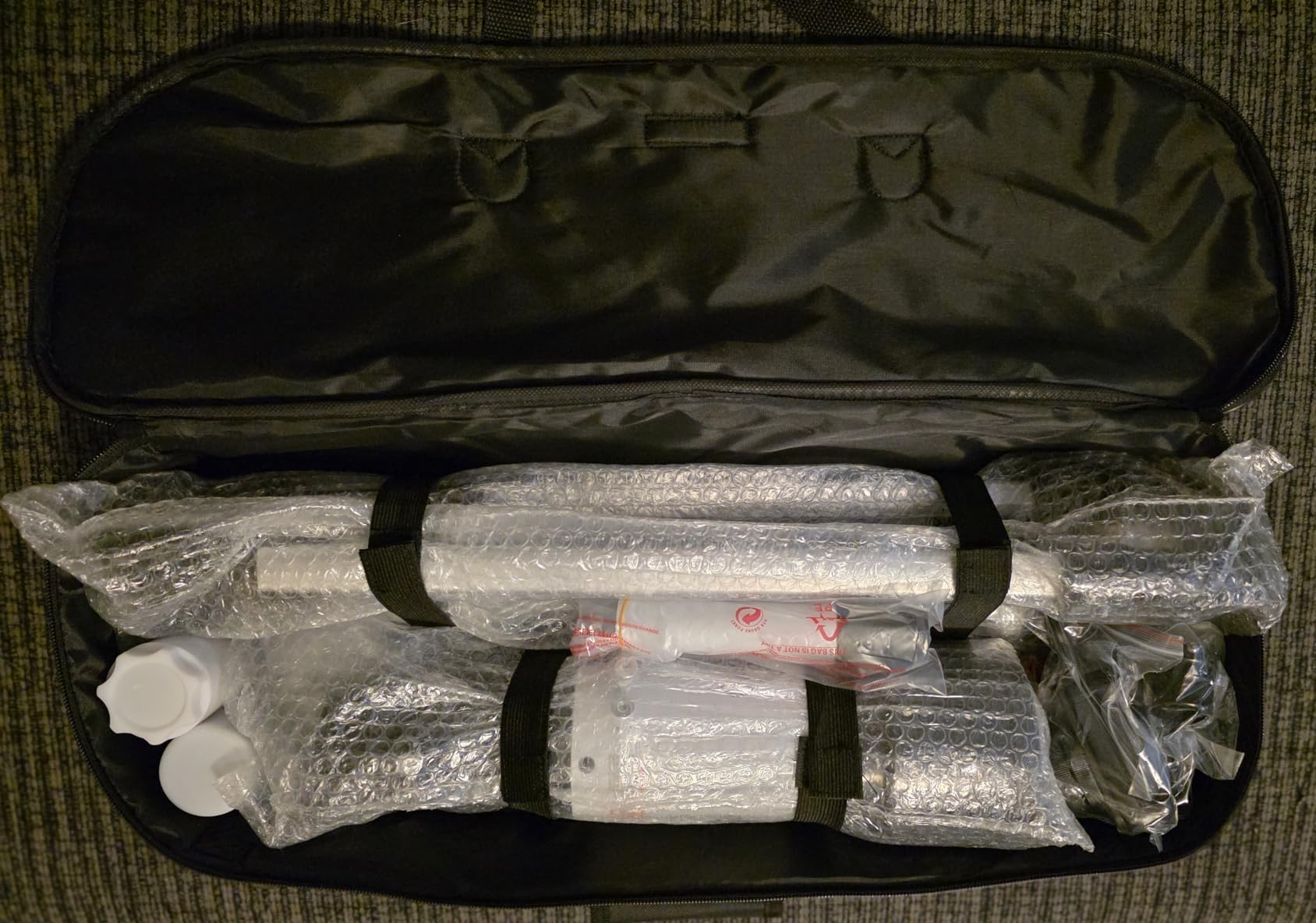
The accessory package is where it separates itself. Two eyepieces, a 3x Barlow, a reflex finder, a smartphone adapter, a wireless shutter remote and a padded carry bag all ship in the box. Owners consistently mention the carry bag as the reason the whole kit fits in one pack instead of three.
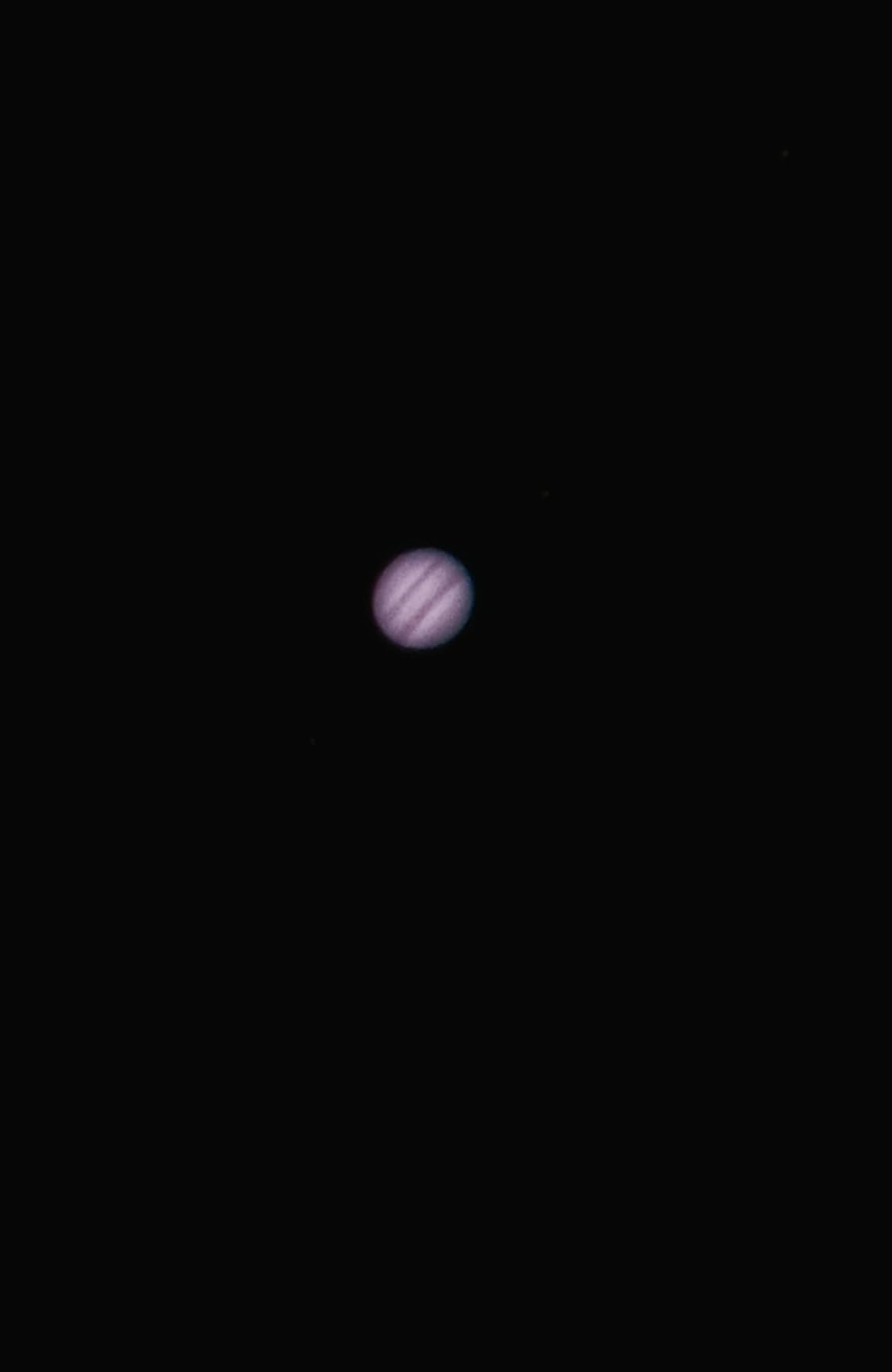
Optical performance is unremarkable in the best way for a first camping scope. The fully coated glass produces a crisp lunar terminator and shows Jupiter as a disc with visible belt structure. Saturn’s rings need steady air and patience, and on a night with even mild wind you will see the rings rather than resolve the Cassini division.
What you will not see is anything genuinely faint. Globular clusters start to look granular around 60x and then stop. A 70mm aperture reaches a sensible ceiling near 140x, which is well short of the magnification numbers printed on the box.
How it holds up when the air gets rough
Star-hopping on this scope takes practice, mostly because the reflex finder is small and shows a wide but dim field. We found it faster to let the finder point at a wide field, centre a bright star, then swap to the 20mm eyepiece before hunting further.
The included tripod is a standard adjustable aluminum design. It is stable enough for lunar work and moderate planetary use, but any bump to the table or a gust of wind sends visible shake through the image at high magnification. That is a common forum complaint across budget tripods, and the fix is a heavier mount or a damped table.
Who should pack this one
This is the right pick for a family camping trip, a first telescope, and anyone who wants a grab-and-go scope that survives being left in a car between outings. It needs no charging and no pairing, which removes every failure point that stops people from observing at all.
Skip it if you plan to walk more than a mile with the kit, or if you mainly want galaxies and nebulae from a light-polluted campsite. For deep-sky work, our refractor buying guide covers the aperture trade-offs in detail.
2. Celestron Travel Scope 70mm: The Backpack That Changes Everything
Celestron Travel Scope 70mm Beginner Portable Telescope with Backpack
Aperture: 70mm
Focal length: 400mm
Weight: 4.2 pounds
Power: none, manual
Pros
- Stated 4.2 pound packed weight is honest and carryable
- No-tool assembly in minutes
- Backpack holds scope tripod and eyepieces
- Two-year warranty from a long-established maker
- Free planning software included
Cons
- 70mm aperture limits resolution at high power
- Manual mount with no tracking motor
- 400mm focal length caps magnification
The Celestron Travel Scope has been a car-camping fixture for years because it does the least surprising thing well. It is a 70mm fully coated refractor on a manual alt-azimuth mount, and the whole assembly weighs 4.2 pounds. That number is the reason it recurs in caravan and motorhome threads: it fits behind a seat without becoming a project.
Setup is genuinely no-tool. We unfolded the tripod, dropped the tube onto the mount and had the Moon in the 20mm eyepiece in under five minutes. The included 45-degree erecting diagonal keeps daytime land viewing upright, which matters if you want to use it for camp landscapes during daylight hours.
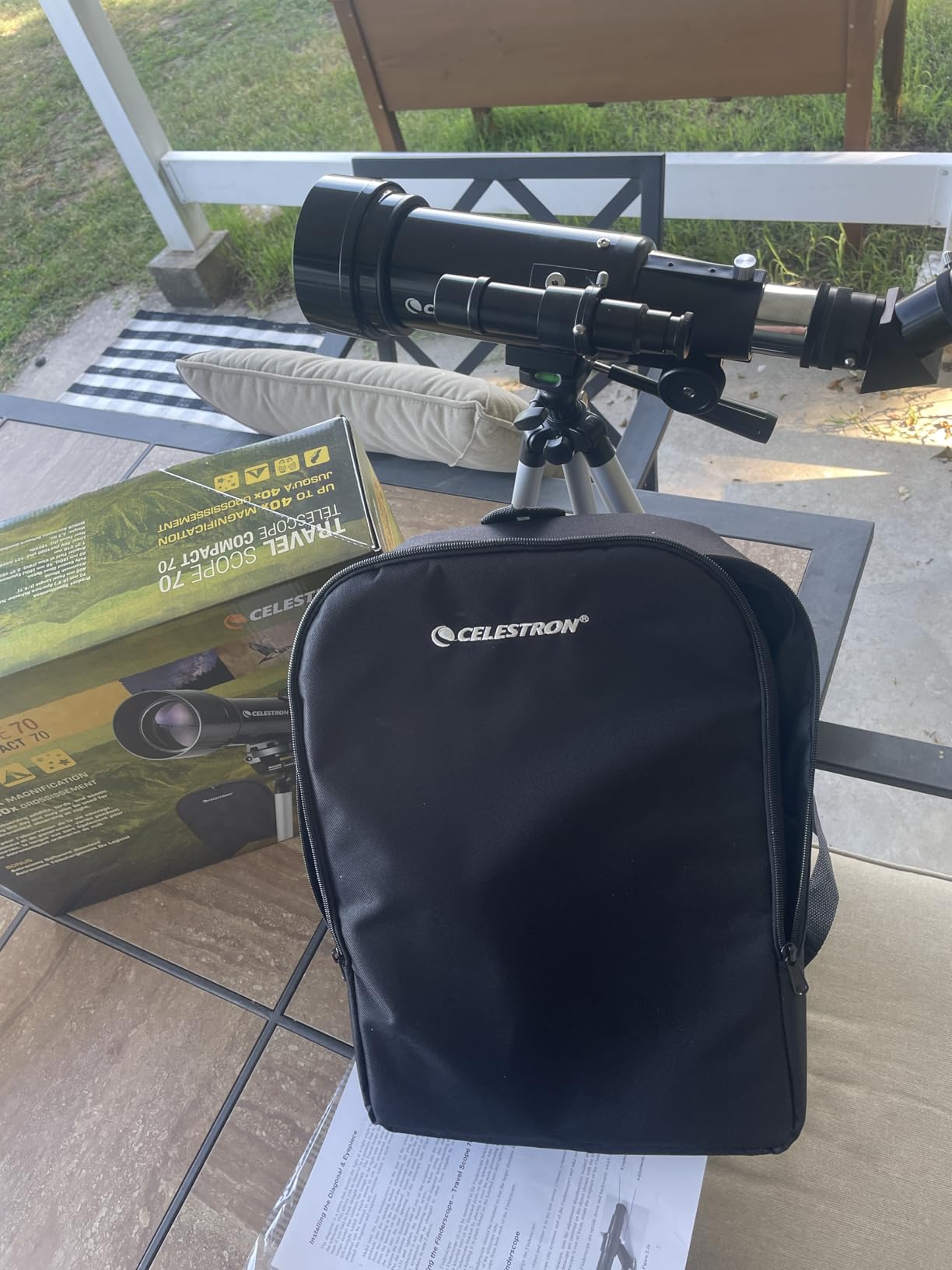
Two eyepieces, a finderscope and the diagonal are the whole optical kit. That is enough for a full evening of lunar work and a decent pass at Jupiter, but it leaves no room for a wide-field eyepiece that would make sweeping the Milky Way comfortable.
The alt-azimuth mount uses slow-motion knobs on both axes, which helps with fine aiming. It still will not hold a planet at high power without your hand on it, and long objects drift within a couple of minutes.
Whether the tripod survives the site
The tripod is the weak point, and it is weak in the same way as every aluminum scope tripod at this level. Below about 100x it is fine. Above that, walking near the telescope or closing a vehicle door nearby will ripple through the image noticeably. Scope forums discuss this constantly, and the standard fixes are a counterweight on the centre shaft and setting up on packed soil rather than loose gravel.
For a campsite specifically, put the base on a picnic table rather than the ground if the surface is bouncy. It sounds trivial and it changes high-power viewing more than any eyepiece upgrade will.
Who should pack this one
Car campers, caravan travellers and anyone who wants a first telescope that will not intimidate them. The stated weight, the backpack and the two-year warranty make it the least risky purchase on this list for a trip where the gear has to survive being moved around.
It is not a backpacking scope. Four pounds plus eyepieces, and a tripod with a footprint, is a lot to carry on a trail that climbs.
3. Celestron Travel Scope 80mm: More Aperture Without More Weight
Celestron Travel Scope 80mm Telescope Kit with Backpack, Smartphone Adapter
Aperture: 80mm
Focal length: 457mm f/5.7
Weight: 4.5 pounds
Power: none, manual
Pros
- Gathers noticeably more light than the 70mm model
- Good planetary reach for its size
- Backpack and phone adapter included
- Preassembled mount means faster setup
- Two-year warranty with US support
Cons
- Achromatic doublet shows colour fringing at high power
- No tracking motor for long sessions
- Phone output limited by the phone camera
Moving from 70mm to 80mm sounds trivial and is not. Aperture scales light gathering with the square of the diameter, so an 80mm lens collects roughly a third more light than a 70mm. On a real campsite, that extra light is the difference between Jupiter showing two cloud bands and showing four, and between Saturn’s rings reading as a grey oval and reading as rings.
Packed weight is 4.5 pounds, only slightly above the 70mm model, and the whole kit still fits the supplied backpack. The mount arrives preassembled, so setup time in the dark stays short.
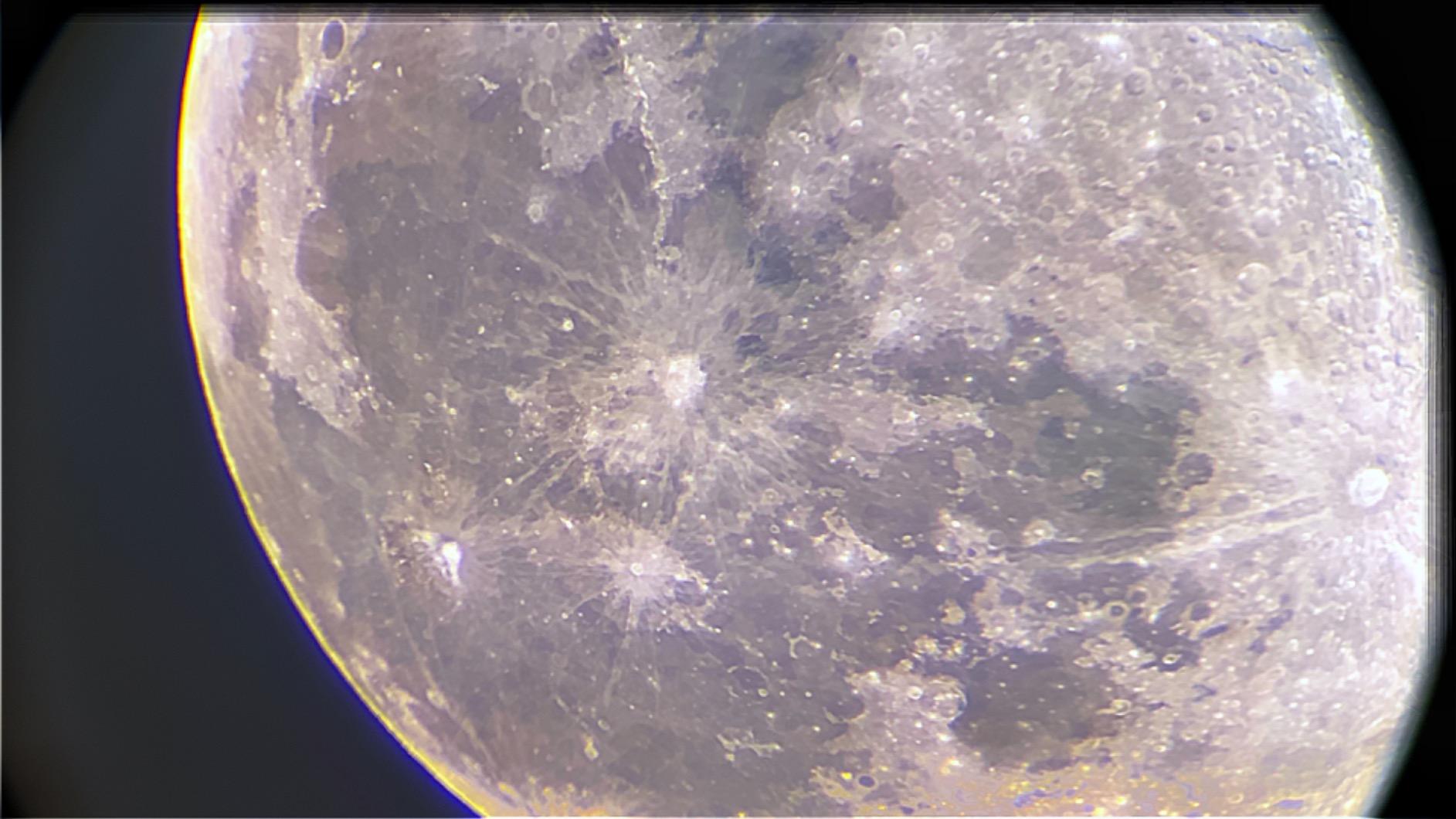
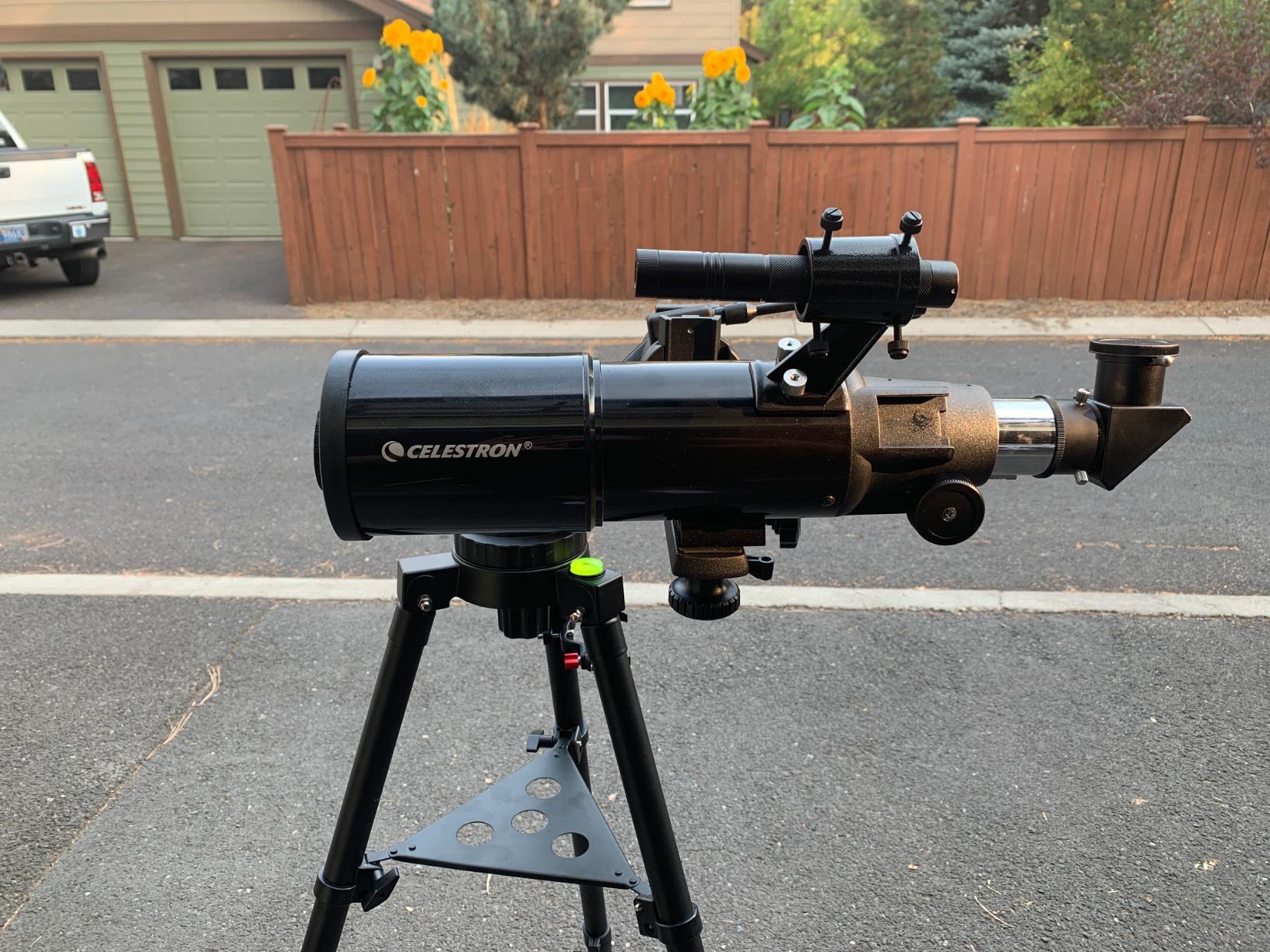
The bundle includes 20mm and 10mm eyepieces, a 45-degree erecting diagonal, a 5×24 finderscope and a smartphone adapter. At 457mm of focal length, the 20mm eyepiece gives roughly 23x, which is a good scanning magnification, and the 10mm pushes toward 46x for planetary work.
Colour fringing is the honest weakness. A single achromatic doublet cannot keep Jupiter’s white and orange bands cleanly separated at high power, and a blue fringe appears around bright stars. This is normal for the design, not a defect, and it is the main reason 90mm fully multi-coated designs exist.
How much magnification is worth using
Useful magnification tops out near twice the aperture number in millimetres, so about 160x on this scope. In practice, from a campsite with a warm ground layer giving off heat, we settle around 100x to 120x before the image starts shimmering. Anything above that is atmosphere talking, not optics.
The 1.45 arc-second Dawes limit listed for this design means it can theoretically split closer doubles, but you will rarely see that from a camp clearing with any trees near the horizon. Pick a high-elevation site with an open southern view.
Who should pack this one
Anyone who wants to see Saturn’s rings and Jupiter’s belts and who is staying in a vehicle. It is also our pick if kids are coming along, because the extra light gives a shorter, more satisfying first look before patience runs out.
Leave it at home if your site is heavily light-polluted. Extra aperture helps with resolution, not with washing out faint targets under a bright sky.
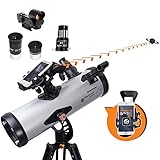
4. Celestron StarSense Explorer LT 114AZ: The Biggest Aperture You Can Still Carry
Celestron StarSense Explorer LT 114AZ Newtonian Smartphone Guided Telescope
Aperture: 114mm
Focal length: 1000mm f/8.8
Weight: 10.4 pounds
Power: one lithium battery
Pros
- StarSense app points the scope for beginners
- Much more light than any small refractor here
- 1000mm focal length with a 2x Barlow
- Slow-motion altitude control aids aiming
- Collapses to a car-boot friendly package
Cons
- Heaviest option here at 10.4 pounds
- Reflector needs periodic collimation and shows coma
- Guiding can struggle under heavy sky glow
Ten and a half pounds is where the backpack option ends and the car option begins, and the StarSense Explorer LT 114AZ sits exactly on that line. It is the largest amount of light you can realistically move from a car to a campsite in one trip, and if you have a vehicle the payoff is immediate. The 114mm mirror with 1000mm of focal length shows crater chains, Cassini’s division on a steady night, and a genuinely large number of deep-sky objects.
The StarSense app is the real reason to consider this scope over a plain Dobsonian. You point the tube roughly at the sky, the phone recognises where you are aimed, and the app walks you to a real target. Owners cite that guided pointing as the feature they would not trade.
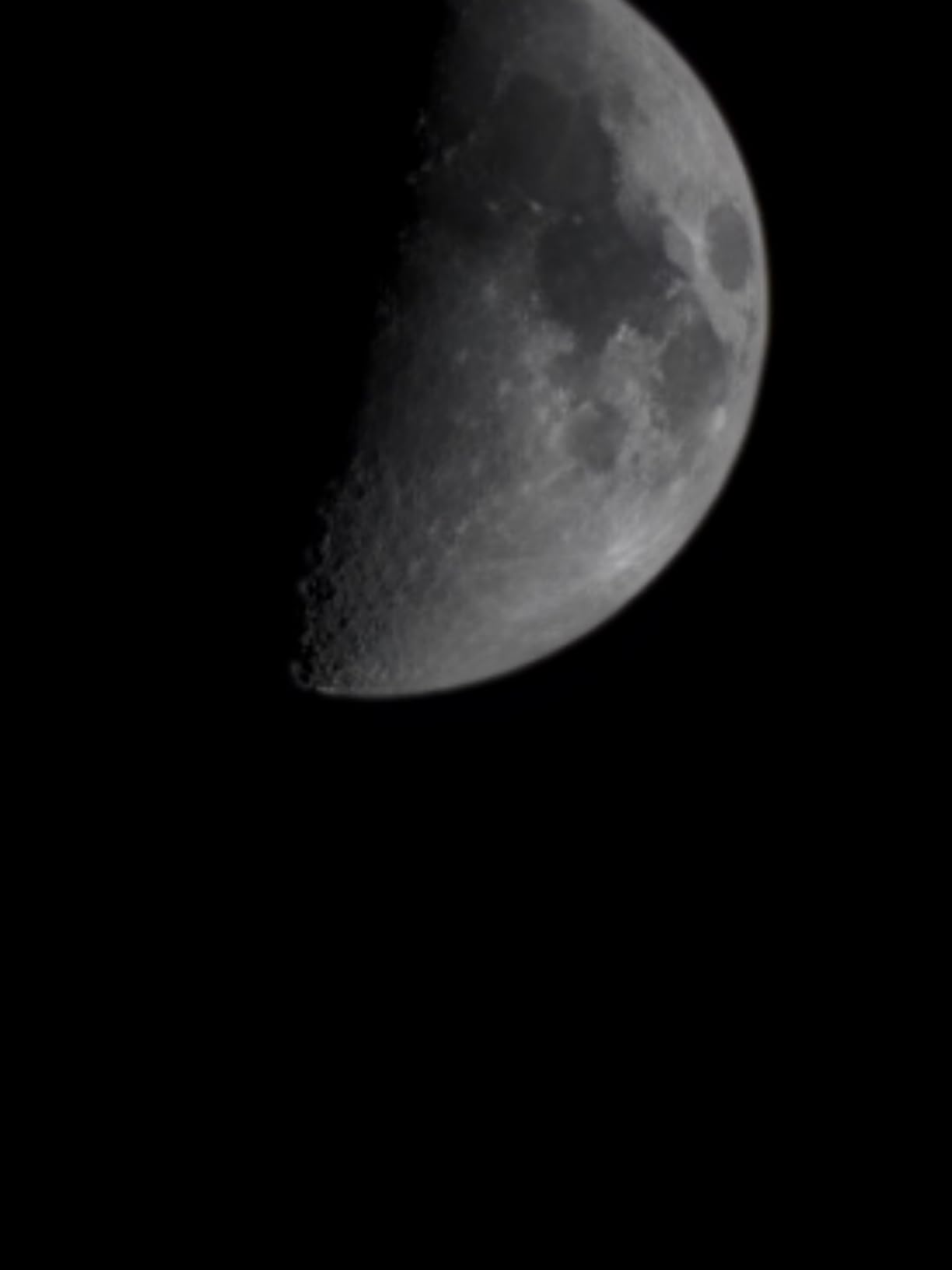
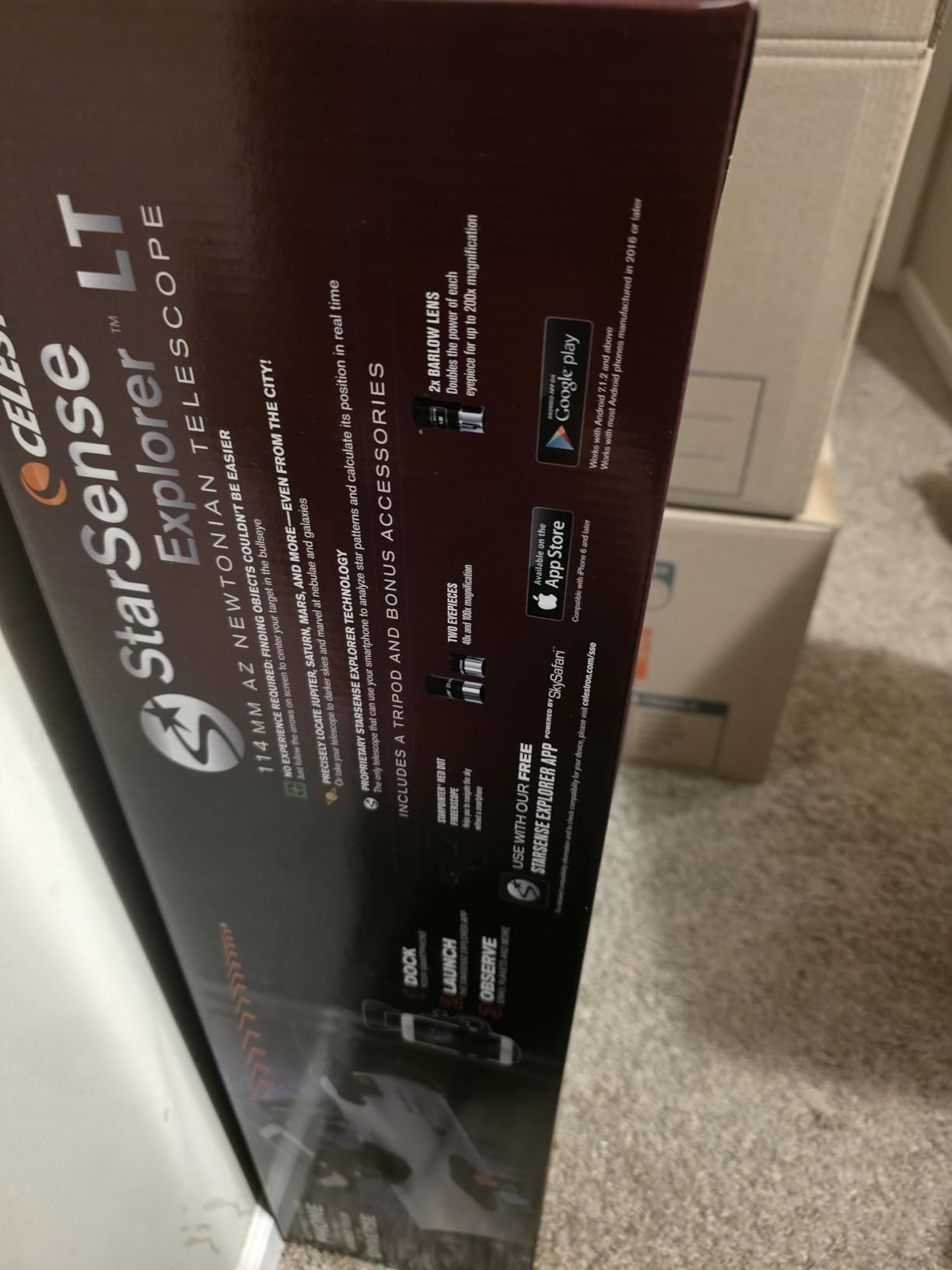
Packaging reflects the size. At 36 by 36 by 57 inches, this needs a vehicle with real cargo space rather than a hatchback shelf. The aluminum and SiO2 coated mirrors are sharp, but a Newtonian needs its collimation checked after being carried, and that is a five-minute job in daylight you have to plan for.
The included 25mm and 10mm eyepieces plus a 2x Barlow span 40x to roughly 200x, which is more magnification than most campsite skies will support. Coma around stars is visible at the outer edge of a low-power field, which is normal reflector behaviour.
Why guided pointing matters more than aperture in a hurry
On a short observing window, the time lost fumbling with a finder and star charts is the real cost. Plate-solved guiding compresses that to under two minutes. We found that the difference between arriving at dinner with a Jupiter image and arriving with nothing was almost entirely the app.
Under heavy sky glow or with a tree line in the way, recognition can struggle. If you are camping inside a town, spend longer getting clear of obstructions before you judge the scope.
Who should pack this one
Car campers and RVs with storage, first-time buyers who want help finding things, and anyone who plans to come back to the same dark site for several nights. Two people carrying it is realistic; one person on a long approach is not.
If your trip is a flight or a day hike, the mass is disqualifying. Our computerized telescope guide covers the heavier guided mounts in more detail.
5. Celticbird 80mm Refractor: The Best Value Travel Telescope for Camping Trips
Celticbird Telescope for Adults High Powered, 80mm Aperture 600mm AZ Mount Refractor Telescope for Kids Beginners – Portable Telescopes for Adults Astronomy with Backpack, Phone Adapter, Moon Filter
Aperture: 80mm
Focal length: 600mm f/7.5
Weight: 5.8 pounds
Power: none, manual
Pros
- 80mm aperture at 600mm focal length in a short tube
- Includes a moon filter most rivals skip
- Backpack and phone adapter in the box
- Tool-free assembly with a printed manual
- Tripod extends from 17.7 to 52 inches
Cons
- Colour fringing at high power on the achromat
- Basic mount has no tracking motor
- Smaller service reputation than established brands
The Celticbird 80mm solves the packing problem better than almost anything else here. The 600mm focal length sits in a 60cm tube rather than the 70 to 80cm tube a similar focal length usually requires, and at 5.8 pounds the whole kit still disappears into the supplied backpack. That combination of aperture and packed length is what you want when your storage is a car boot and your observing site is a hundred metres away.
Owners single out the included moon filter as a genuinely useful addition. A neutral-density filter reduces lunar glare and makes crater detail visible during the bright part of the night, when beginners most often point the scope at the Moon.
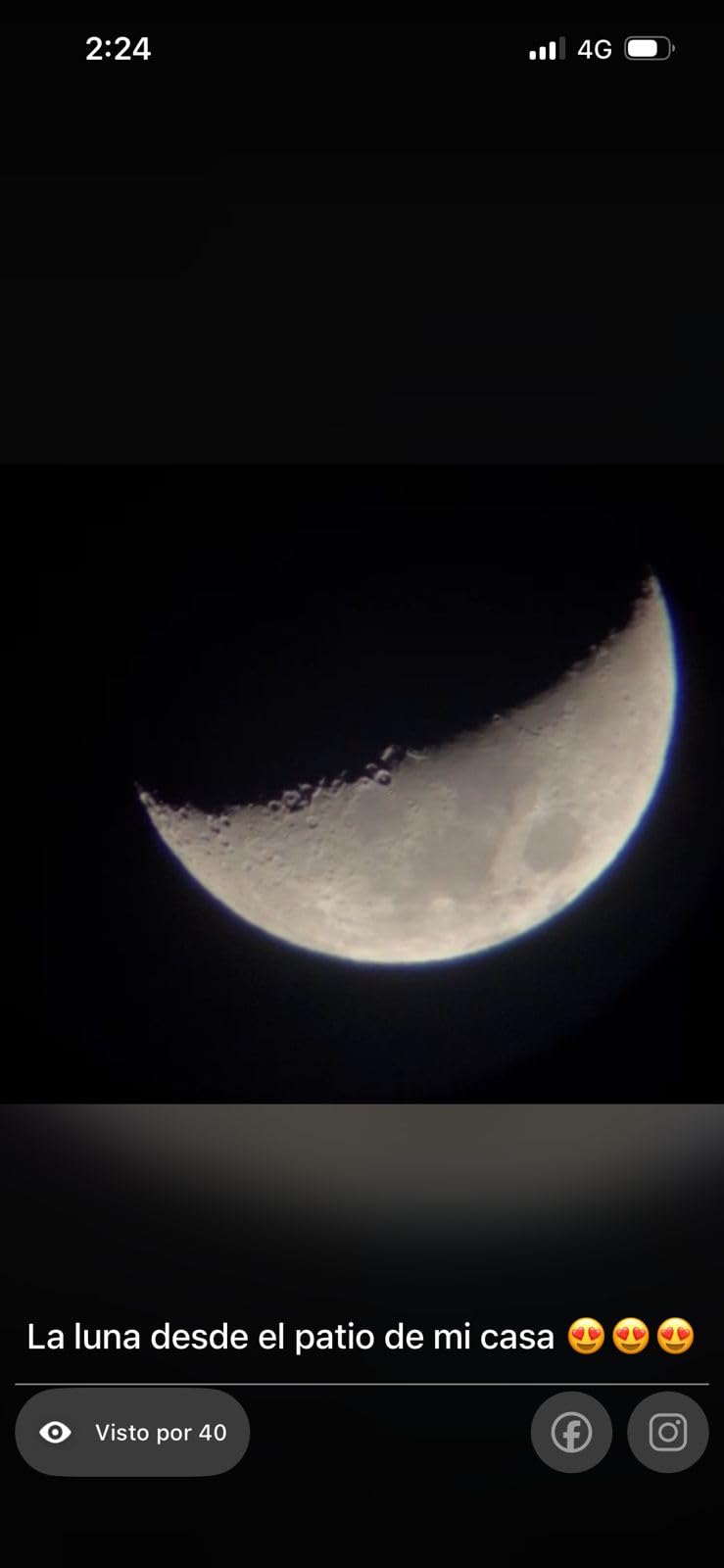
Two eyepieces provide 30x and 66x, and a 5×24 finderscope plus smartphone adapter are included. Sixty-six times is a good default magnification for a first look at Jupiter or the terminator of the Moon, and the 30x view makes sweeping the sky around the Milky Way easier.
As with any achromatic doublet at 80mm, bright targets develop a blue fringe when you push past about 100x. Service and warranty support are thinner than the Celestron and Sky-Watcher options, which is worth factoring in if the scope will be travelling and may need parts.
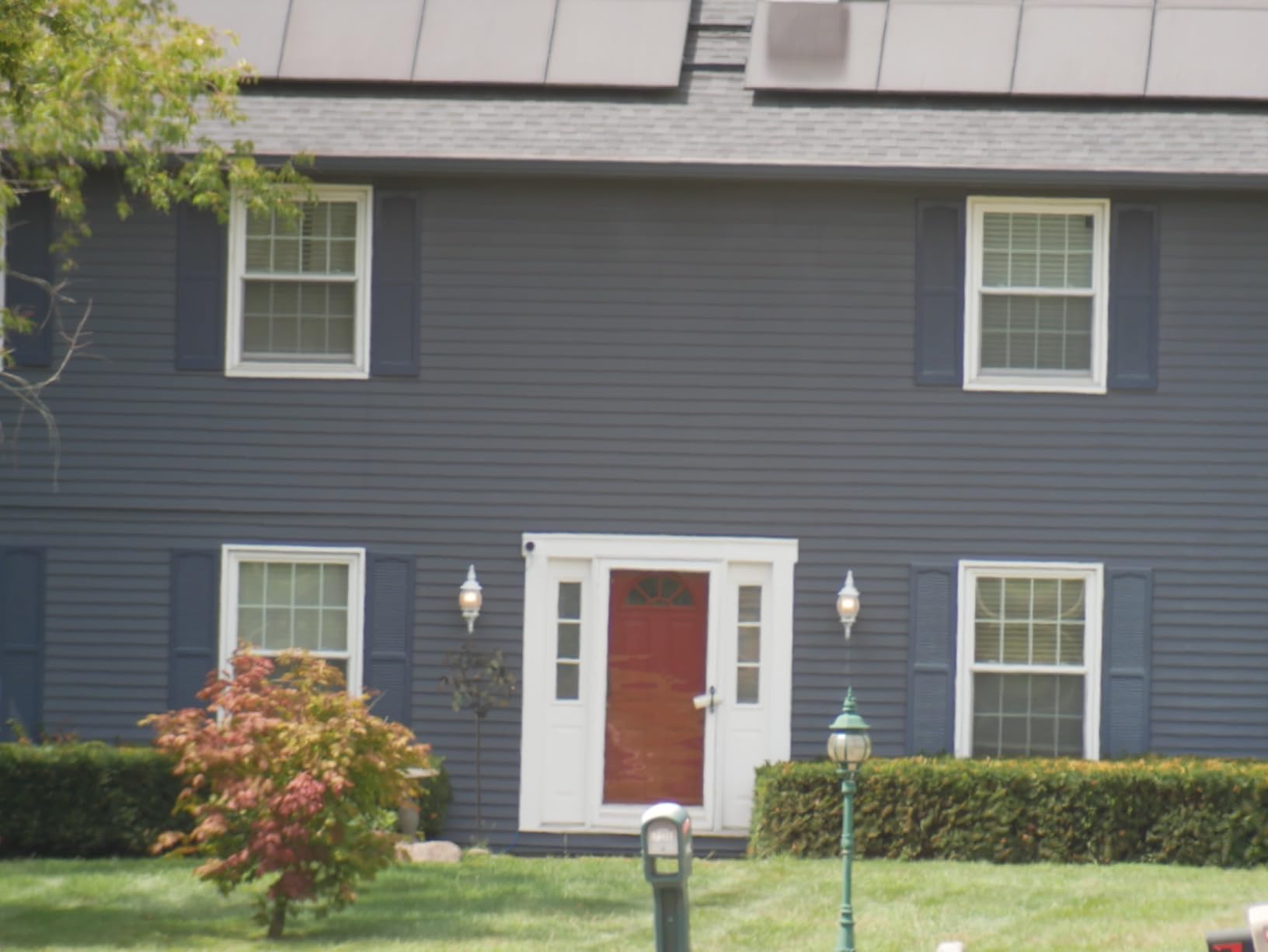
Choosing the right night to use it
A 600mm focal length on an 80mm aperture is a slow-ish design, and slow focal ratios forgive poor seeing and light pollution better than fast ones. That makes this scope a better companion to a mediocre campsite sky than a compact short-tube refractor would be.
Wait for a night with steady air rather than chasing transparency. Seeing matters more than seeing more stars when you are trying to resolve Saturn’s rings, and a site with an open southern horizon beats a darker site walled in by trees.
Who should pack this one
Car campers who want the most aperture they can still carry in one pack, and anyone who plans to use the scope for the Moon as well as the planets. The tripod height range accommodates both adults and children standing at the eyepiece.
It is a heavier pack than the 70mm options. If your carrying distance is measured in miles rather than car parks, choose the smaller 70mm refractor instead.
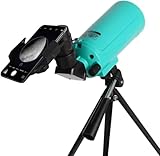
6. SARBLUE Mak 60 Maksutov-Cassegrain: The Scope That Fits in a Side Pocket
Maksutov-Cassegrain Telescope for Adults Kids Astronomy Beginners, Sarblue Mak60 Catadioptric Compound Telescope 750x60mm, Compact Portable Travel Telescope, with Tabletop Tripod Phone Adapter
Aperture: 60mm
Focal length: 750mm in a 200mm tube
Power: none, manual
Pros
- Folds long focal length into a very short tube
- Fully multi-coated glass for clean planetary views
- Light polycarbonate body suits travel
- Detachable aperture lid is a teaching aid
- Includes tabletop tripod and phone adapter
Cons
- 60mm aperture keeps deep-sky objects faint
- No finder scope included
- Short tabletop tripod wants replacing for seated use
A Maksutov-Cassegrain is the classic grab-and-go design, and this one is the smallest expression of it. It folds 750mm of focal length into a 200mm tube, which means the entire optical assembly is short enough to carry in one hand and pack in a jacket pocket. We found it the easiest travel telescope here to actually bring, because there is no long tube swinging off the side of a pack.
The fully multi-coated optics matter on a design this small. Compared with a single-coated scope of similar size, the Moon shows noticeably more contrast and the image holds together better on a mediocre night.
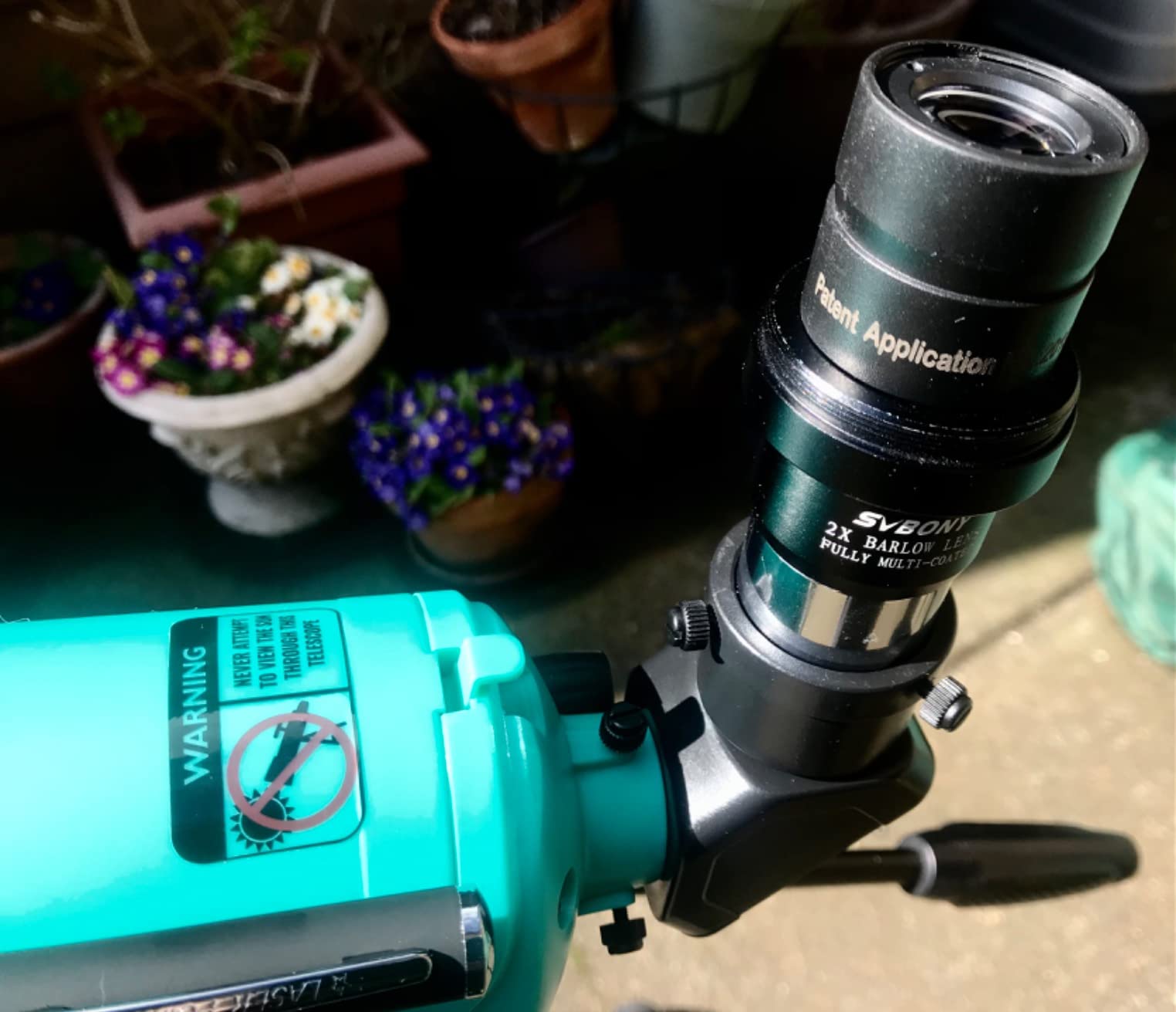
Only a 20mm eyepiece is included, giving 37.5x. That is a single, sensible starting magnification for lunar work and for a first look at a planet, but it means there is no low-power option for wide fields without buying another eyepiece. The detachable aperture lid that exposes the internal mirror is a nice touch for anyone explaining how a catadioptric works.
There is no finder scope. Two small alignment bumps on the tube are all you get, so you will centre targets by hand at first, which takes longer than it should on a small aperture.
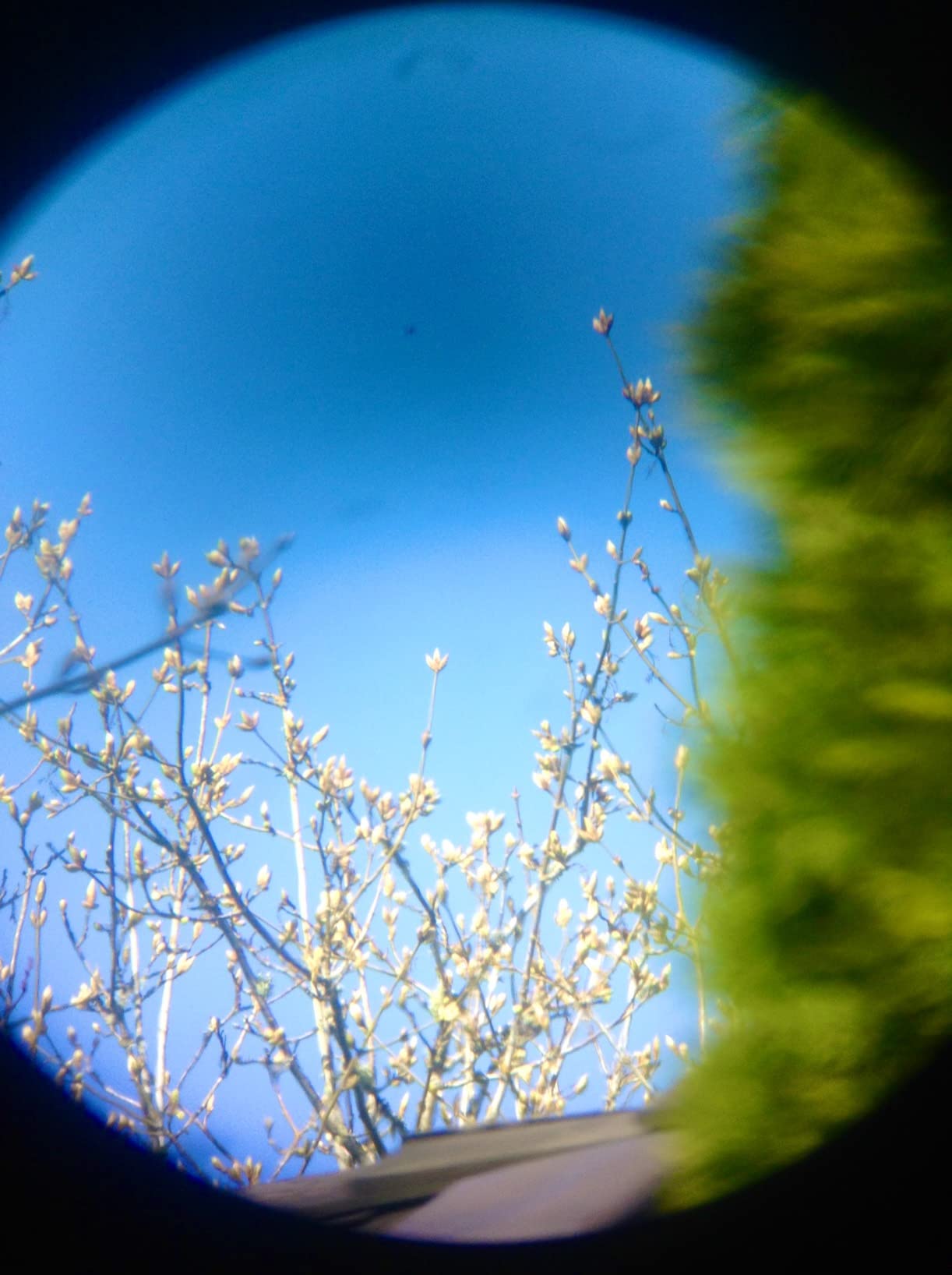
Why a tabletop tripod is not really a tripod
The included tripod is a short tabletop stand meant for a table or a windowsill. It is fine for sitting at a campsite picnic table with a chair, and useless on soft ground. Replace it with a taller photo tripod with a fluid head and you have a genuinely portable planetary setup that is comfortable from a seated position.
That swap is the single highest-value upgrade in this guide. Owners who replace the stand report the biggest change in how often they use the scope.
Who should pack this one
Anyone who values packed volume above aperture, and anyone observing with children who lose patience. Pointing at the Moon fills the whole field with detail at 37.5x, which keeps a small attention span engaged longer than a wide faint field does.
It is the wrong choice for galaxies, nebulae or any faint target. Sixty millimetres of aperture is not enough to recover them at a typical campsite sky.
7. DWARFLAB Dwarf Mini Smart Telescope: The Best Telescope for Backpacking
DWARFLAB Dwarf Mini Smart Telescope – 1.85lb Portable Astronomy Telescope
Aperture: 30mm sensor
Focal length: 150mm
Weight: 1.9 pounds
Power: built-in battery
Pros
- Lightest unit here at 1.85 pounds
- App plate solving finds and tracks targets automatically
- EQ mode supports exposures to 90 seconds
- On-device and cloud stacking produce real images
- Solar filter included for eclipse viewing
Cons
- Low sensor resolution limits print size
- Planetary detail through the sensor is limited
- Long sessions need a power bank and fluid head
This is a fundamentally different kind of telescope and it answers a fundamentally different question. Instead of an eyepiece you look through, there is a 30mm sensor, a motorized alt-az and equatorial mount, and an app that plate solves the sky and finds targets for you. You point it, you tap a target, and it tracks. There is no collimation, no finder to align and no star charts.
At 1.85 pounds, it is the only device in this guide that genuinely belongs in a backpack, and it is the only one you can set up in under three minutes without touching anything but a phone. For a hiker arriving at a dark site after dark with cold hands, that is worth more than aperture.
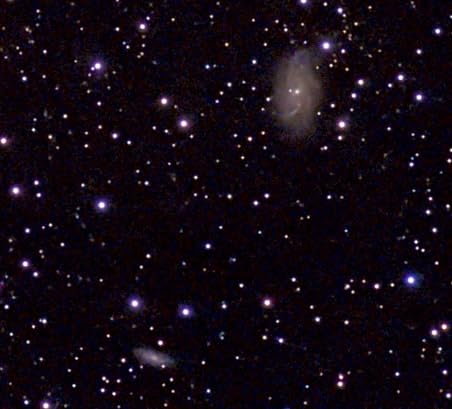
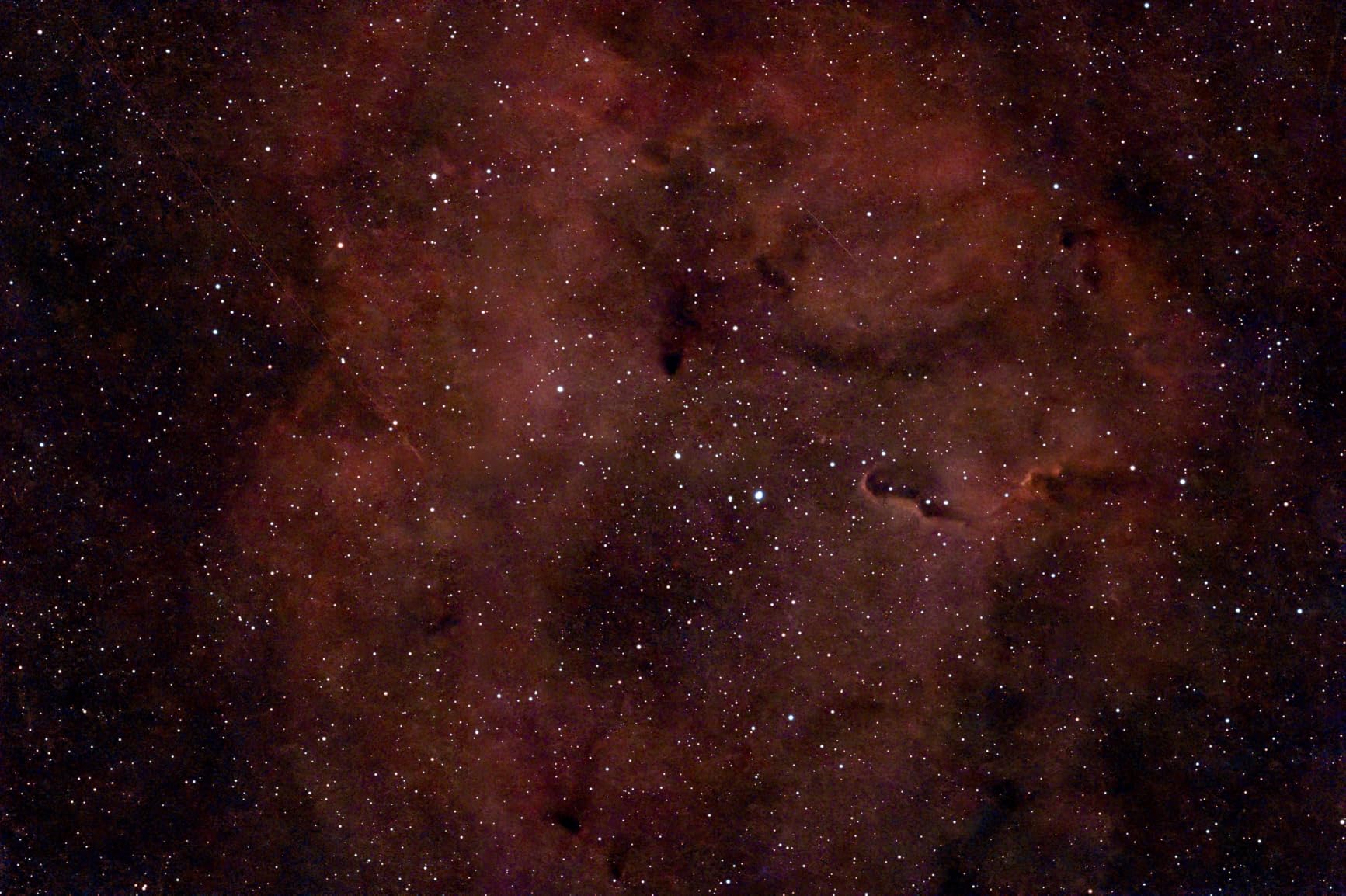
EQ mode extends exposures to 90 seconds and the built-in light pollution filters help in brighter skies, which means it can produce a usable stacked image of a bright deep-sky object from a Bortle 8 campsite. Owners describe it as the easiest entry point to astrophotography that we have used, largely because the software handles the stacking for you.
Sensor resolution is the limit. Images come out small, and fine deep-sky detail is absent because the optics are small. Planetary results read as round discs rather than detailed worlds. Judge it on what it saves you carrying, not on the size of the files.
Battery life and the campsite with no outlet
Because it runs on a built-in battery and charges over USB-C, this is the only category here where power is solved rather than assumed. A moderate night of tracking and stacking fits within a single charge, and a power bank extends it further.
When you fly, airlines cap spare lithium batteries at 100Wh for carry-on and forbid them in checked baggage, and a battery installed inside a device is generally treated more simply than loose cells. Check your airline’s current wording before you pack it, and keep the original packaging with the device.
Who should pack this one
Backpackers, flyers and anyone without an eyepiece-friendly observing habit. It is also the best choice if you want to bring home a photograph rather than a memory.
It is the wrong choice for sharing the experience. A screen held by one person is not the same as five kids lined up at an eyepiece, and none of our GoTo telescope picks change that.
8. Sky-Watcher Heritage 150 Tabletop Dobsonian: Brightest Views, Heaviest Pack
Sky-Watcher Heritage 150 Tabletop Dobsonian Telescope – Perfect for Beginners, Easy Setup, Portable, and Fun (S11710)
Aperture: 150mm
Focal length: 750mm f/5
Weight: 23 pounds
Power: none, manual
Pros
- Largest aperture in this guide by a wide margin
- 750mm f/5 focal ratio gives bright high-contrast images
- Borosilicate parabolic primary with RAQ coating
- Collapsible tube stores compactly
- No electronics means nothing to fail or charge
Cons
- 23 pounds is the least travel-friendly option here
- Tabletop base needs a sturdy table at comfortable height
- Single eyepiece and no finder in the base configuration
Twenty-three pounds ends the argument about what a travel telescope is. Put this on the list if you are driving to the campsite and setting up near the vehicle, because 150mm of aperture will show you things nothing else in this guide can. Under a dark sky it produces the brightest, highest-contrast images of the Moon, Jupiter, Saturn and the brighter deep-sky objects of any scope here.
The f/5 focal ratio is fast enough to be forgiving of a mediocre site, and the parabolic borosilicate primary with RAQ coating holds collimation reasonably well after transport. The collapsible tube shortens the package without going fully soft.
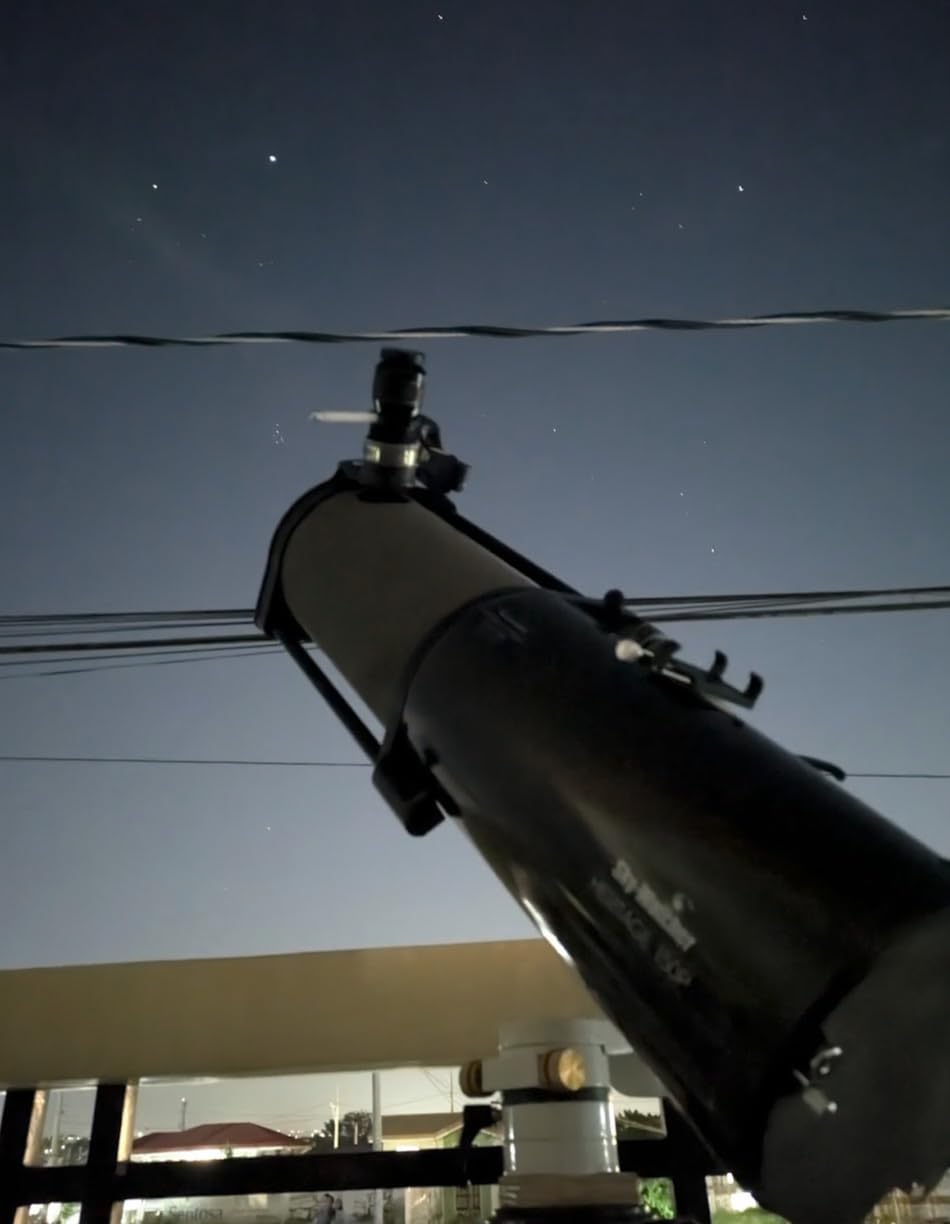
The design has no electronics. Setup is unpacking, choosing an eyepiece and pointing. That is both its strength on a trip with unreliable power and its weakness on a trip with a short observing window, because there is no motorised GoTo to save you star-hopping time.
It expects a table. On soft ground it needs a rigid stand at about waist height, and at 23 pounds you will not be moving it once it is set up. Plan the site before you unpack.
When a tabletop base is the right base
A tabletop Dobsonian is genuinely the fastest to set up of anything here. There is no tripod to extend, no counterweight to balance and no collimation procedure if you check it in daylight. If your campsite has a solid picnic table at the right height, this scope can be observing within ten minutes of arrival.
The rubber feet damp vibration well, so walking nearby matters less than it does on a spindly tripod. Plan the site before you unpack rather than after.
Who should pack this one
Car campers and RVs with a flat surface and a short walk to the observing spot. It is also our pick for anyone whose first real ambition is seeing faint deep-sky objects rather than planets.
Do not try to carry it on foot. If your trip involves a flight, a long walk or a site far from the road, this is the wrong scope at any budget.
9. MEEZAA 90mm Refractor: The Aperture Sweet Spot for Car Campers
MEEZAA Telescope for Adults High Powered, 90mm Aperture 800mm Refractor
Aperture: 90mm
Focal length: 800mm f/8.9
Weight: not stated by maker
Power: none, manual
Pros
- 90mm aperture is the largest in this guide that still fits a normal tripod
- Two eyepieces plus 3x Barlow span 32x to 240x
- Fully multi-coated glass on all elements
- Stainless steel tripod adjusts 28 to 46 inches
- Carry bag holds the complete kit
Cons
- Straight-through finder shows an inverted image
- Phone adapter is fiddly and can disturb finder alignment
- Deep-sky performance modest for the aperture
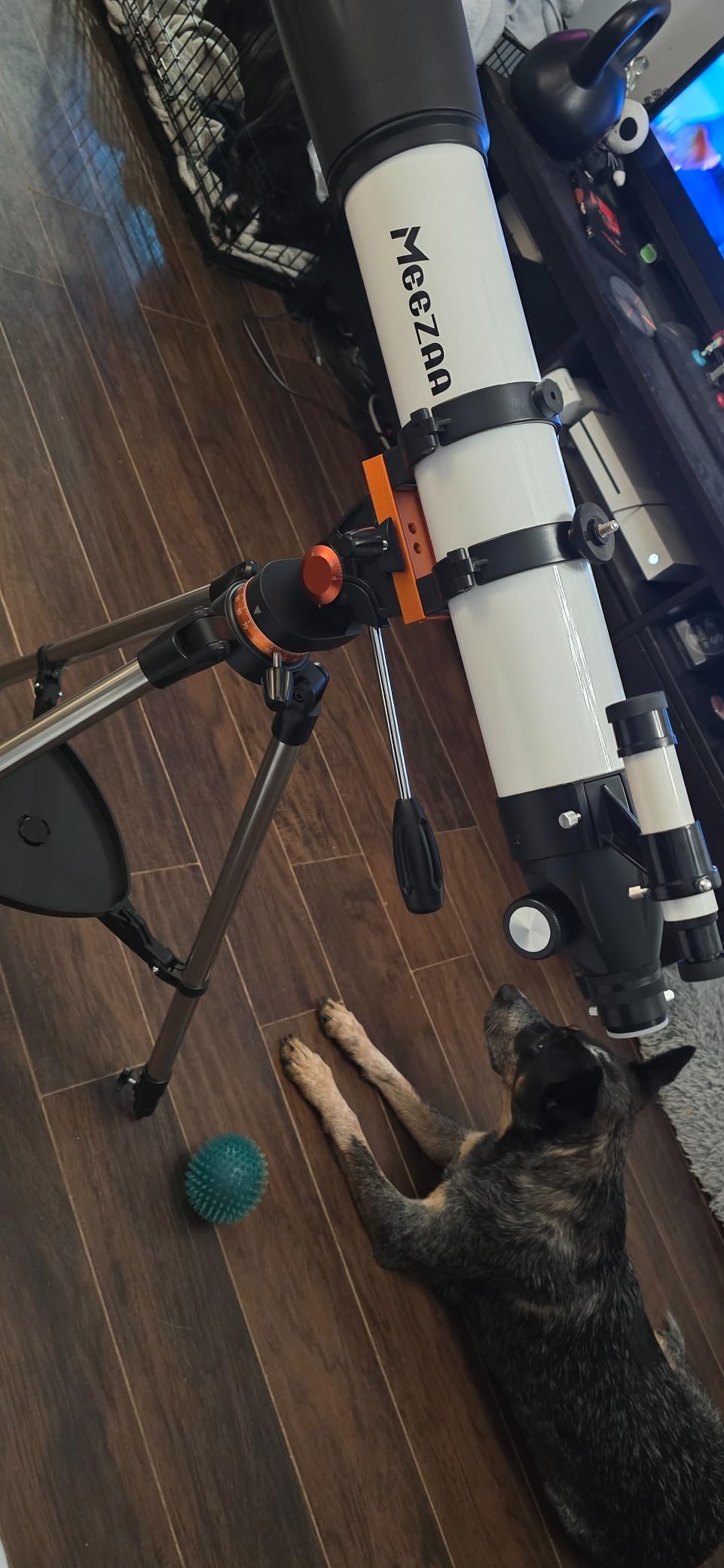
Ninety millimetres is the number where a travel refractor stops being a compromise. The light gathering crosses from adequate to genuinely capable, and unlike a reflector of the same aperture it stays collimated after being carried, needs no batteries and points instantly. The MEEZAA 90800 does this in an 800mm focal length with fully multi-coated glass on every element.
Owners rate it as a genuine step up from an 80mm. The magnification range from the two eyepieces and a 3x Barlow covers everything from a wide 32x scan to 240x on the Moon, and the f/8.9 focal ratio is comfortable with alignment and forgiving of cheap eyepieces.
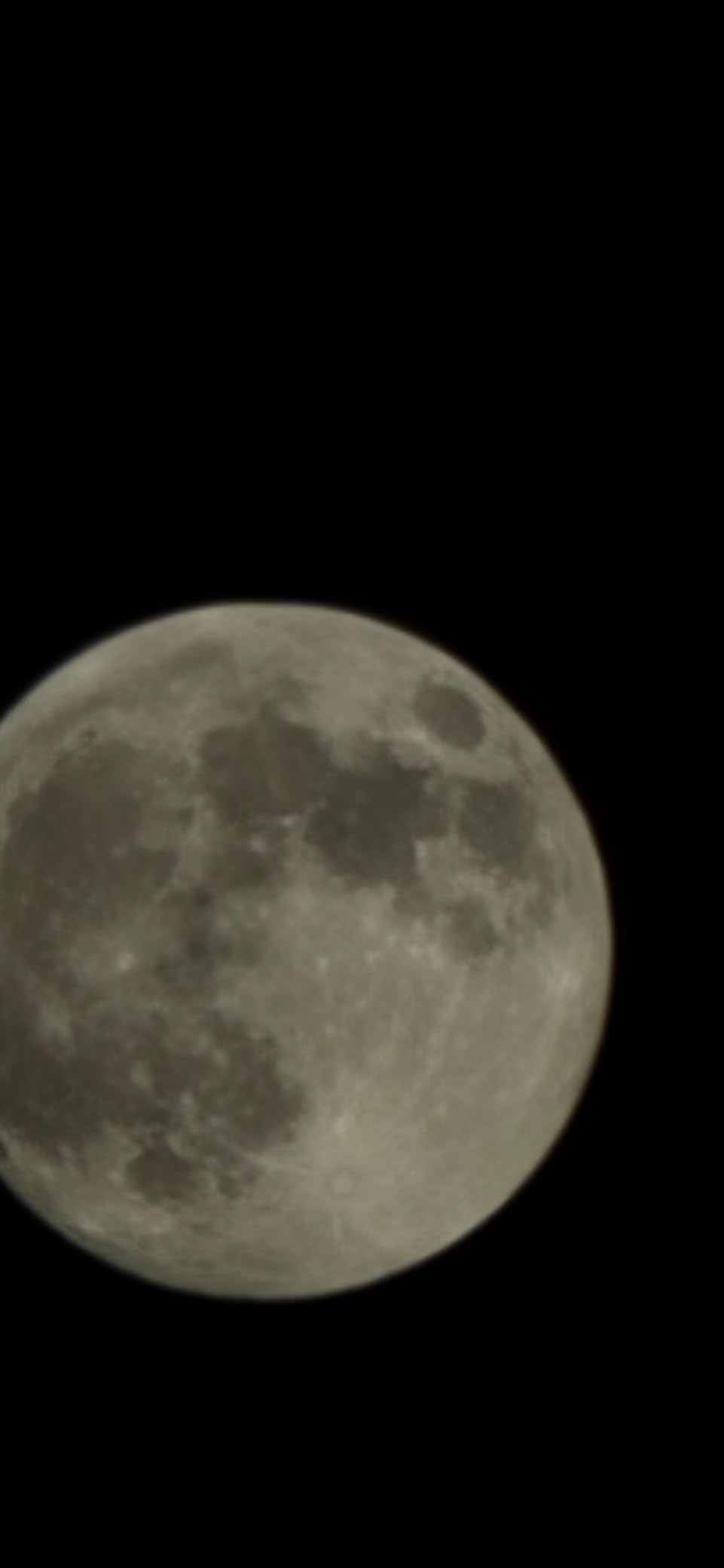
Two details cost this scope points in our testing. The straight-through finder shows an inverted image, so orienting yourself in the field takes a moment longer each session. And the phone adapter sits far enough forward that fitting a phone can nudge the finder out of alignment, so we would set up images last rather than first.
The stainless steel tripod is a real upgrade over the aluminium ones on cheaper travel scopes. It is noticeably more rigid, and that matters more than any eyepiece change once you pass 100x.
How long a session should you plan
Owners report 10 to 20 minutes for a full assembly, which sounds long until you compare it with an equatorial mount alignment. This is an alt-az scope with no polar alignment requirement, so the only real delay is finding darkness and a flat spot.
Plan your first target before you unpack. The 32x eyepiece is the right one for finding your way around the sky, and switching to higher power before you know where you are wastes the short window you came for.
Who should pack this one
Car campers who want the most visual capability without stepping up to a Dobsonian or a smart telescope, and intermediate observers who will use a carry bag regularly. If your trips are multi-night, the fact that nothing needs charging or collimating pays for itself quickly.
Its length is the drawback. At 32 inches packaged, this is a long object to carry in one hand, and the carry bag needs a real compartment rather than a daypack.
10. MaxUSee 70mm Refractor and Binocular Kit: Two Instruments, One Pack
MaxUSee Travel Telescope with Backpack – 70mm Refractor Telescope & 10X50 HD Binoculars Bak4 Prism FMC Lens for Moon Viewing Bird Watching Sightseeing
Aperture: 70mm
Focal length: short achromat tube
Power: none, manual
Pros
- Scope and 10X50 BaK4 binoculars in one backpack
- 45-degree diagonal keeps land viewing upright
- Kellner eyepieces plus 3x Barlow span 20x to 132x
- Shared phone adapter for either instrument
- Beginner-grade and easy to set up
Cons
- Short focal length caps magnification low
- Manual altazimuth mount needs frequent re-aiming
- Shared adapter means only one instrument works at a time
Most campsites reward binoculars far more than most buyers expect. Daytime birding, distant ridgelines and the naked-eye Milky Way all benefit from a pair of 10X50 glass, and this kit bundles a 70mm refractor with fully multi-coated BaK4 prism binoculars in a single rucksack. That is two instruments for the price of a beginner scope, and the backpack holds both plus the tripod.
The 45-degree diagonal prism keeps the image upright for terrestrial use, so the same setup works for daytime viewing at camp rather than only for night.
Two Kellner eyepieces and a 3x Barlow give a range of 20x to 132x, and the field of view is wide enough for the Moon and for open star clusters. The single universal phone adapter fits either instrument, though only one at a time.
Expect a modest optical ceiling. This is a beginner-grade achromat with a short tube, so bright planets are visible but faint deep-sky targets stay out of reach.
What the binoculars do for you at camp
The 10X50 pairing is wide enough to sweep the Milky Way from a dark site, which is something no telescope in this guide does as quickly. Two fields of view wide at 10x covers the whole of Orion’s sword and belt in under a minute of scanning, and 50mm of aperture is enough to show the Trapezium cluster as four distinct points.
Forum discussions about travel astronomy keep returning to the same point: binoculars earn their weight even on trips where the telescope stays packed.
Who should pack this one
New campers, families with mixed interests, and anyone whose trip involves as much daytime scenery and wildlife watching as night observing. A two-year manufacturer warranty is a reasonable floor.
Choose this one when the budget is fixed and the trip is short. For serious planetary work, the extra aperture of the 80mm and 90mm options pays for itself quickly.
How to Choose a Travel Telescope for Camping Trips
Every telescope in this guide works. The wrong one for your trip is the expensive mistake, so decide the logistics before the optics. Work through weight, carrying distance, power, then aperture, in that order.
Set a packed weight budget before you look at aperture
Start from the carrying distance. Walking from the car park to the pitch is not a carrying distance, and four pounds is comfortable. A mile on a flat path is roughly eight pounds of total kit, tripod and batteries included. Four miles of real trail is close to fifteen pounds, which removes every telescope on this list except the smart scope.
Add the accessories before you decide. Eyepieces, a star diagonal, a finder, a phone adapter and a power bank each add a pound or so, and the number of packs you end up carrying matters more than any single figure.
Aperture sets the ceiling on what you can resolve
Aperture is the diameter of the objective, and it governs both light gathering and resolution. Useful magnification is roughly twice the aperture number in millimetres, so a 70mm scope is sensible to about 140x and a 90mm scope to about 180x. Any advertised magnification beyond that is marketing.
Seventy millimetres shows the Moon in detail, Jupiter’s belts, Saturn’s rings and the brighter clusters. Ninety millimetres adds planetary detail and starts opening the brighter nebulae. A 150mm aperture changes what kind of night you are having entirely.
Focal length decides the field of view, not the brightness
Focal length is how far light travels inside the tube. Short focal lengths give wide fields and low magnification with eyepieces you already own; long focal lengths give more magnification on planets but a narrow field that is harder to find your way around in. A long focal ratio also forgives a mediocre sky, because it concentrates light into a smaller, brighter image.
For most campers, 400mm to 600mm is the comfortable range. Below that you will be hunting; above it the tube gets long and awkward to carry.
Refractor, catadioptric, reflector or smart
Refractors need no collimation, no power and no maintenance, which is why most camping buyers end up here. Catadioptric Maksutovs pack extremely short and give good planetary views for a small aperture. Reflectors such as the Sky-Watcher Heritage give you the most light per pound of carrying effort but need collimation and a rigid surface.
Smart telescopes trade all visual observing for automation. If you want to look through an eyepiece with other people, they are not a substitute. If you want a photograph and want it to work without practice, they are the only sensible category.
Stabilise the tripod before you blame the optics
Tripod wobble above 100x is the most common complaint in telescope forums, and it is almost never the optics. Four fixes solve most of it: set the legs on packed soil rather than loose gravel, use a table or a solid surface at a comfortable height, hang a weight from the centre shaft, and never touch the telescope while observing.
If you are buying a new tripod anyway, a stainless steel model is noticeably more rigid than aluminium at the same height, and a fluid video head dampens bumps better than a stiff ball head.
Control dew, because it will form on your objective
Where to put a dew heater? Around the front of the tube at the objective end, not around the eyepiece or the focuser, which are the least critical surfaces. A low-wattage band running one to two inches behind the lens is enough to keep the front element just above the dew point.
Do I need a dew shield for a telescope? At a campsite, yes. Any tube longer than its own front element sheds dew more slowly, and the cheapest dew control of all is a manual one: leave the lens cap on until you are ready, then start observing. Some people also aim a handheld fan or a car battery warm air along the tube after a cold, clear night, which is the fastest field fix there is.
Dew is worst on clear, still nights with a big temperature drop, which is exactly the night that produced the best transparency all day.
Flying with a telescope and powering it off-grid
Does TSA allow telescopes? Yes. A telescope clears airport security as ordinary luggage with no special declaration. The complication is the battery, not the optics. Spare lithium batteries and power banks must travel in carry-on luggage, each is capped at 100Wh without approval, and terminals need protection from short circuits. A battery installed inside a device is generally handled more simply than loose cells, but you should still keep the device in your personal item rather than a checked bag.
For a campsite with no outlet, size your power bank to the job. A phone-sized bank charges a smart telescope through USB-C for a full night; a much larger pack lets you run a dew heater and imaging sensors through a whole session. Check the Wh figure printed on the label, not the number printed on the box.
Expect a brighter sky than you planned
Popular campsites are frequently Bortle 5 or worse, which is why small-aperture scopes disappoint people and bigger ones do not. Faint galaxies and nebulae are the first casualties of a bright sky. Plan your target list around the Moon, the planets and the double stars, and save the faint fuzzies for a genuinely dark site.
Higher elevation helps more than almost anything else. Thin, dry air at altitude cuts the haze that washes out low targets and steadies the air enough to support higher magnification.
Never point any of this at the Sun without a certified filter
Solar viewing and eclipse viewing from a campsite is one of the few genuinely dangerous mistakes a beginner can make. The Sun produces enough light through a telescope objective to damage your eye instantly and permanently, and the magnification makes the damage worse rather than better.
Use a certified front-mounted solar filter that fits over the aperture and blocks the light before it enters the tube. Solar glasses are not a telescope filter and provide no protection at the eyepiece. Of the scopes here, the smart telescope is the only one with a solar filter included.
Frequently Asked Questions
Does TSA allow telescopes?
Yes. Telescopes clear airport security as ordinary checked or carry-on luggage with no special declaration. The complication is the power source: spare lithium batteries and power banks must travel in your carry-on, each is capped at 100Wh without airline approval, and terminals need covering to prevent short circuits. A telescope with a battery installed inside it is generally handled more simply than loose cells, but keep the device in your personal item rather than a checked bag.
What is the best telescope for travel?
For most campers, a fully coated 70mm refractor on a manual alt-azimuth mount with a padded carry bag. It packs into a daypack, needs no batteries, and shows the Moon, Jupiter’s cloud bands and Saturn’s rings within minutes of arriving. Backpackers should consider a battery-powered smart telescope under two pounds instead, and anyone with a vehicle can carry far more aperture than they think they can.
How long does it take to set up a telescope in the dark?
A manual alt-azimuth travel scope needs no alignment, so you can go from backpack to first light in five to eight minutes: extend the tripod, attach the tube, insert an eyepiece and focus. A motorised smart telescope takes about three minutes because the app does the pointing for you. A reflector adds five to ten minutes if it needs collimation, which is why checking it in daylight before you leave the car matters.
What size telescope do I need to see Saturn’s rings?
A 70mm refractor shows Saturn as a small disc with rings on a steady night, and an 80mm starts to resolve the gap in the ring system. Around 90mm you begin to see structure in the rings on good nights. A 150mm aperture changes the view entirely. What matters as much as aperture is magnification of roughly 100x or more, and stable air rather than steady high magnification.
Do I need a dew shield for a telescope?
At a campsite, yes. Dew usually forms first on the front element within an hour or two of the objective cooling, and the cheapest control is a manual one: keep the lens cap on until you are ready to observe. A dew shield slows the cooling of the front lens, and a low-wattage heater band placed one to two inches behind the objective keeps it just above the dew point. Dew is worst on clear, still nights after a sharp temperature drop.
Which Travel Telescope Should You Pack?
The Gskyer 70mm AZ Refractor is the best travel telescope for camping trips for the simple reason that it will always be the one that comes out of the bag. It packs down, needs no power, includes a carry bag and phone adapter, and has the largest owner review base of any scope we tested. For most campers, that is the winning combination.
If you are carrying the kit on foot, the DWARFLAB Dwarf Mini at 1.85 pounds is the only device here that survives a real backpack, and it hands you stacked images instead of views. If you have a vehicle, the Celticbird 80mm buys you a third more light for a few hundred extra grams, and the Sky-Watcher Heritage 150 changes the kind of night you are having entirely.
Match the scope to the trip before you buy. Weight, power and setup time decide whether you observe at all, and only aperture decides what you see once you do.